Data Descriptor

Curated Vibration Features and an Interpretable Gearbox Health Index (GHI) Baseline for Condition Monitoring Bench-Marking


by
Krisztian Horvath
Department of Vehicle Development, Audi Hungaria Faculty of Engineering, Széchenyi István University, Egyetem tér 1, H-9026 Győr, Hungary
Data 2026, 11(4), 70; https://doi.org/10.3390/data11040070
Submission received: 2 March 2026 / Revised: 23 March 2026 / Accepted: 27 March 2026 / Published: 29 March 2026

Abstract

This data descriptor provides a standardized and reproducible subsystem-level representation of the NREL wind turbine gearbox condition monitoring benchmarking dataset. The released records are derived from Healthy (H1–H10) and Damaged (D1–D10) measurement files and include subsystem-level standardized indices (KHI_HS, KHI_IMS, KHI_PL) together with a calibrated 0–1 Gearbox Health Index (GHI). The indices are generated using a fully specified and deterministic feature extraction and aggregation workflow based on established vibration indicators and healthy-referenced normalization. The Zenodo deposit contains machine-readable CSV tables intended to support transparent benchmarking across supervised classification and anomaly detection studies. The proposed GHI is introduced as an interpretable and reproducible reference baseline rather than an optimized diagnostic model. Technical validation demonstrates condition-level separability within the analyzed dataset while emphasizing the descriptive nature of the index. By releasing structured derived records and a documented regeneration procedure, this work enables an implementation-independent comparison of gearbox condition monitoring approaches and supports reproducible evaluation of alternative health index formulations.
Dataset: 10.5281/zenodo.18832721.
Dataset License: Creative Commons Attribution 4.0 International (CC-BY 4.0)

1. Introduction

Vibration-based gearbox condition monitoring has been extensively investigated and is considered one of the most developed approaches to rotating machinery diagnostics. Numerous studies show that vibration signals contain rich information about gear defects and degradation mechanisms, and both classical signal-processing methods and modern machine learning approaches have demonstrated high diagnostic accuracy [1].
At the same time, several reviews emphasize that reproducible benchmarking remains limited due to methodological heterogeneity. Differences in signal preprocessing (e.g., filtering, segmentation), spectral estimation (e.g., windowing, averaging), feature engineering (e.g., statistical indicators, envelope features), and normalization strategies often lead to inconsistent evaluation results across studies, even when similar datasets are used [2]. As a result, reported performance metrics are frequently influenced by implementation-specific design choices rather than reflecting solely the intrinsic information content of the vibration data. This challenge has been repeatedly noted in the context of data-driven prognostics and health management research [3].
To address these issues, the present work introduces a structured, machine-readable, feature-level representation of a gearbox condition monitoring benchmark dataset. Instead of proposing a new diagnostic or classification model, the focus is placed on consistent and fully specified feature extraction procedures, standardized feature representation, and deterministic regeneration of all derived records. Transparent and fully specified preprocessing workflows are essential for reproducibility and fair comparison in machine learning-based diagnostics [4].
In addition to curated per-channel features and healthy-referenced standardized scores, a simple hierarchical Gearbox Health Index (GHI) is provided as a transparent baseline. Composite health indicators have been shown to support interpretability and condition trend analysis in rotating machinery monitoring [5]. The proposed index is intentionally simple, interpretable, and reproducible; it is not intended as an optimized diagnostic solution, but rather as a stable reference anchor that enables fair comparison of alternative modeling approaches built on the same standardized feature representation.

2. Data Description

The source waveform data used in this study originate from the publicly available Wind Turbine Gearbox Condition Monitoring Vibration Analysis Benchmarking Dataset released by the National Renewable Energy Laboratory (NREL) [6], DOI: 10.25984/1844194]. The original dataset contains raw vibration time histories in MATLAB (.mat) format for two gearbox health states, comprising 10 healthy files (H1–H10) and 10 damaged files (D1–D10).
The measurements were acquired on a controlled drivetrain test rig under defined operating conditions. To improve traceability and reuse, the revised manuscript summarizes the key source-dataset metadata, including the test-rig configuration, measurement locations, sampling parameters, operating conditions, and health-state labels. In addition, a one-to-one mapping between the file identifiers used in this study (H1–H10, D1–D10) and the corresponding original NREL file names is provided in Table 1.
The present work does not redistribute the raw waveform signals. Instead, it releases structured, machine-readable derived records generated from the original dataset through a fully specified and deterministic feature extraction and aggregation workflow. The released records include:
  • Subsystem-level standardized indices (KHI_HS, KHI_IMS, KHI_PL);
  • A calibrated Gearbox Health Index (GHI) mapped to a 0–1 interval;
  • Supplementary intermediate feature exports and trend-analysis tables used for figure generation and benchmarking transparency.
All released records are provided as CSV files. Re-running the published workflow with the same source files and identical parameter settings reproduces the same derived records.

3. Feature Extraction Workflow

3.1. Preprocessing

Each vibration channel is processed independently. The selected signal segment is detrended to remove constant offsets. Spectral features are computed using Welch power spectral density estimation. No downsampling was applied in the generation of the released records; all spectral features were computed from the original signals at a sampling frequency of 40 kHz.
The rotational speed signal is used to compute the fundamental rotational frequency, defined as
f 1 x = r p m / 60 ,
The gear mesh frequency is defined as
f G M F = Z H S × f 1 x ,
where Z H S is the reference tooth count of the high-speed pinion.
For each file, a fixed 20 s analysis segment was extracted from the steady-state portion of the 1 min waveform record. No separate start-up or shut-down transient removal step was required beyond this fixed segment selection because the released benchmark files correspond to steady operating conditions.

3.2. Curated Feature Set

A compact and interpretable feature set is computed for each file and each measurement channel, following established practices in vibration-based gearbox diagnostics. The selected indicators capture both global vibration energy and fault-sensitive modulation characteristics that are widely reported in the literature [7,8].
  • RMS (Root Mean Square)—Represents the overall vibration energy and is commonly used as a baseline health indicator, as increases in mechanical damage often manifest as elevated global vibration levels [7,8].
  • Kurtosis (excess)—Measures deviation from a Gaussian amplitude distribution and is particularly sensitive to impulsive events caused by localized gear tooth or bearing defects [9].
  • GMF_Energy—Quantifies spectral energy in a narrow band centered around the gear mesh frequency (GMF). Faults such as tooth wear or breakage typically produce amplitude growth at the GMF and its harmonics, making this component fundamental in gearbox diagnostics [10].
  • SidebandIndex—Expresses the ratio of modulation sideband energy relative to the GMF-centered component. Modulation sidebands around the GMF are well-known indicators of gear defects and transmission errors, and sideband energy ratios are widely applied in gear fault detection [11].
    SidebandIndex was defined as
    S i d e b a n d I n d e x = E ( f G M F f r ) + E ( f G M F + f r ) E ( f G M F ) ,
    where f r denotes the shaft rotational frequency. Thus, the ±1× offset refers to one rotational-order spacing relative to the GMF, not to a fixed frequency-bin offset.
  • EnvelopePeak—Captures the peak amplitude of the envelope spectrum within a defined band. Envelope analysis enhances fault-induced impulsive components and is especially effective for early detection of localized gear and bearing damage [1].
These features represent commonly used indicators in gearbox diagnostics and enable direct comparison across analytical approaches.
These features represent commonly used indicators in gearbox diagnostics and enable direct comparison across analytical approaches; their definitions and parameter settings are summarized in Table 2.
The individual channel-level feature tables are used internally for subsystem aggregation. The Zenodo deposit releases subsystem-level standardized outputs and the aggregated GHI baseline rather than per-channel raw feature tables.
The selected feature set was intentionally restricted to a compact combination of time-domain, frequency-domain, and envelope-based indicators that are widely used in gearbox diagnostics and together capture global vibration energy, impulsiveness, gear-mesh excitation, modulation sidebands, and localized fault sensitivity.

3.3. Healthy-Based Standardization

For cross-channel comparability, feature values are standardized using statistics derived exclusively from the Healthy subset. Baseline normalization using healthy condition statistics is a common strategy in rotating machinery diagnostics, as it reduces variability caused by operational differences and improves sensitivity to fault-induced deviations [12,13]. For each channel and feature, the Healthy mean and standard deviation are computed, and standardized z-scores are obtained accordingly.
Missing raw feature values are preserved as NaN in the primary feature table. During standardized aggregation, missing contributions are excluded from summation to maintain numerical stability. Power spectral density estimates were computed using Welch’s method with a segment length of 4096 samples ( n p e r s e g = 4096 ), a Hann window, and 50% overlap between adjacent segments at a sampling frequency of 40 kHz.

3.4. Example Hierarchical Health Index

To provide a transparent benchmark reference, a hierarchical aggregation scheme was defined on top of the healthy-referenced standardized features. Let x i , c , m denote the value of feature m for file i and channel c. Using the Healthy subset only, the corresponding feature-wise baseline statistics are denoted by μ C , m H and σ C , m H . The standardized score is then
z i , c , m = x i , c , m μ c , m H σ c , m H .
For each channel, the standardized feature scores are aggregated into a Channel Health Index (CHI). If M c denotes the set of available features for channel c, then
1 | M c | m M c z i , c , m ,
where missing feature contributions are ignored and the average is computed only over the available terms.
The channels are then grouped into subsystem-level sets corresponding to the high-speed stage (HS), intermediate-speed stage (IMS), and planetary stage (PL). Let C S denote the set of channels assigned to subsystem s. The subsystem-level Gearbox Health Index components are computed as
K H I i , s = 1 | C S | C C S G H I i , c , s { H S , I M S , P L } ,
again excluding missing channel contributions from the aggregation.
The uncalibrated global index is defined as a weighted combination of the subsystem-level indices:
G H I R A W , i = 1 3 w H S K H I i , H S + 1 3 w I M S K H I i , I M S + 1 3 w P L K H I i , P L ,
where w H S , and w P L are the deterministic subsystem weights used in the released implementation.
If equal weights were used, state w H S = w I M S = w P L = 1 / 3 .
Finally, the calibrated Gearbox Health Index released in GHI_per_file.csv is obtained by logistic mapping of G H I r a w to the unit interval:
G H I i = 1 1 + e x p [ a ( G H I r a w , i b ) ] .
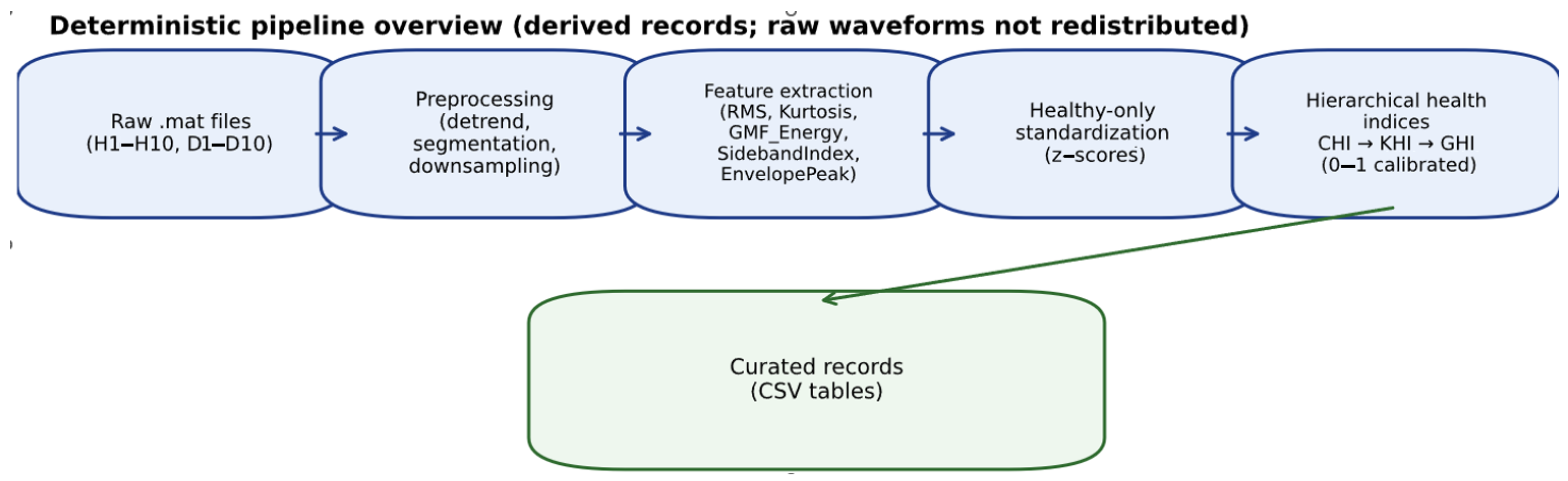
where the fixed calibration parameters used in the released implementation are a = 1 and b = 0. The resulting GHI is included as a deterministic and interpretable reference baseline for benchmarking. It is not intended as an optimized diagnostic model. The complete processing chain from waveform-level features to subsystem indices and the calibrated GHI is illustrated in Figure 1.

4. Data Records

The Zenodo deposit contains structured derived records generated deterministically from the original NREL waveform dataset.

4.1. GHI_per_file.csv

Granularity: file-level (one row per measurement file).
Columns:
  • file—file identifier (H1–H10, D1–D10)
  • group—condition label (healthy or damaged)
  • KHI_HS—subsystem index for high-speed stage
  • KHI_IMS—subsystem index for intermediate stage
  • KHI_PL—subsystem index for planetary stage
  • GHI_raw—uncalibrated aggregate score
  • GHI—calibrated 0–1 Gearbox Health Index
  • This table constitutes the primary benchmarking baseline product of the deposit.

4.2. Subsystem_standardized_indices.csv

Granularity: file-level.
Columns:
  • file—file identifier (H1–H10, D1–D10)
  • group—condition label (healthy or damaged)
  • KHI_HS—healthy-referenced standardized subsystem index for the high-speed stage
  • KHI_IMS—healthy-referenced standardized subsystem index for the intermediate-speed stage
  • KHI_PL—healthy-referenced standardized subsystem index for the planetary stage
This table provides file-level subsystem indices obtained after healthy-referenced standardization and hierarchical aggregation. It is intended for comparative benchmarking, anomaly detection, and supervised learning studies based on subsystem-level representations.

4.3. Supplementary Analytical Tables

Additional CSV files included in the deposit provide intermediate feature exports, D1–D2 comparisons, D1–D10 trend summaries, and figure support tables used in the manuscript. These records are included for transparency and reproducibility of reported figures but are not required for baseline benchmarking usage.

5. Technical Validation

Technical validation confirms that the curated records retain condition-relevant information and support benchmarking.

5.1. Condition Separability

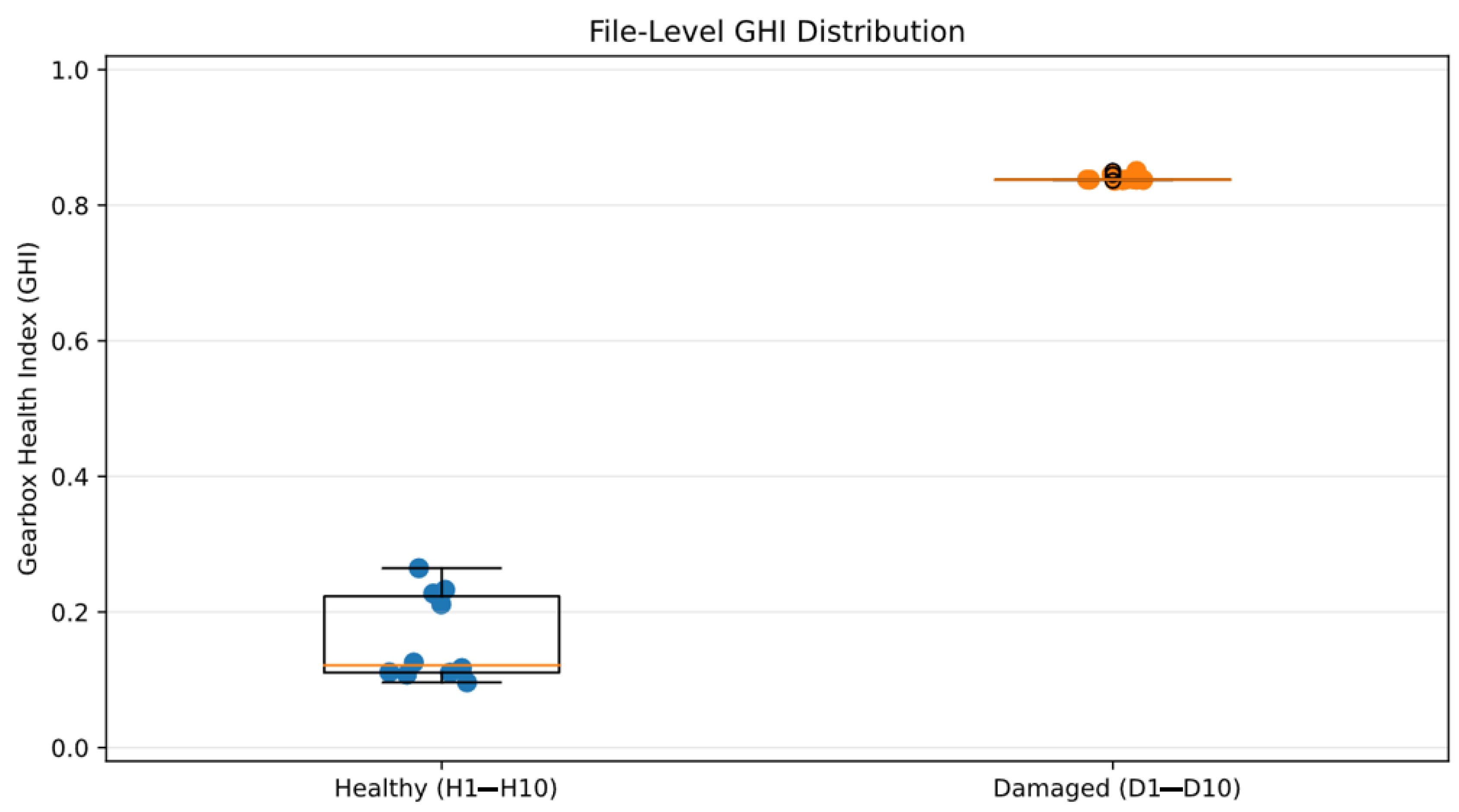
The released dataset contains 20 file-level records, comprising 10 Healthy and 10 Damaged cases. Within this small and homogeneous benchmark set, the released Gearbox Health Index (GHI) achieved complete separation between the two classes (ROC-AUC = 1.0). Given the limited sample size, this result should be interpreted as a descriptive characteristic of the present benchmark records rather than as evidence of generalizable diagnostic performance. A single misclassification would reduce the AUC to approximately 0.90, illustrating the statistical fragility of perfect separation in such a small dataset. The file-level distribution of GHI values across Healthy and Damaged records is shown in Figure 2.

5.2. Progression Behavior

Within the ordered Damaged records (n = 10), the monotonic association between GHI and file index was quantified using Spearman’s rank correlation coefficient ρ = 0.067 , p = 0.855 . The result indicates only very limited monotonic progression across the damaged cases. Accordingly, although the released GHI supports condition-level separation between Healthy and Damaged records, it does not provide evidence of a consistent progressive trend within the ordered Damaged subset.

5.3. Reproducibility

All released tables are deterministic outputs of the documented workflow. Re-running the feature extraction and aggregation scripts with identical inputs produces identical CSV records.

5.4. Limitations

The present dataset comprises 20 files (10 healthy and 10 damaged), which limits statistical robustness. Performance metrics such as ROC-AUC are highly sensitive to individual file-level variations. The dataset represents a controlled experimental campaign conducted under homogeneous operating conditions; therefore, results reflect internal consistency rather than cross-platform generalizability.
The released GHI is a deterministic aggregation of standardized features and does not incorporate cross-validation, hyperparameter tuning, or probabilistic modeling. Consequently, the index should not be interpreted as an optimized diagnostic model.
The technical validation presented here focuses on deterministic reproducibility and descriptive benchmark behavior of the released records. It does not constitute a dedicated robustness study with respect to parameter perturbations, missing channels, or outlier sensitivity. Such analyses would be valuable in future extensions, particularly for assessing ranking stability under alternative preprocessing settings and partial channel availability.
Future extensions should include larger multi-operating-condition datasets, experimental validation under variable load regimes, and adaptive frequency-band segmentation strategies to enhance robustness and applicability.

6. Usage Notes

The released derived records support:
  • Baseline benchmarking of classification methods;
  • Unsupervised anomaly detection experiments;
  • Comparative evaluation of health index formulations;
  • Sensitivity analysis across subsystem-level standardized indicators.
Users are encouraged to report both subsystem-level (KHI) and global (GHI) performance metrics to ensure comparability with the reference baseline provided in this work.

7. Conclusions

This data descriptor presents a standardized and fully documented feature-level representation of a gearbox vibration condition monitoring benchmark dataset. The primary objective of this work is not algorithmic innovation, but the elimination of methodological ambiguity through a deterministic and reproducible feature extraction and aggregation workflow derived from the original NREL waveform data. The released subsystem-level standardized indices (KHI_HS, KHI_IMS, KHI_PL) and the calibrated Gearbox Health Index (GHI) provide a transparent and interpretable baseline representation of the dataset. All processing steps are explicitly defined, and identical inputs yield identical outputs, ensuring implementation-independent reproducibility. Within the analyzed dataset (N = 20), the example GHI demonstrates clear condition-level separability between Healthy and Damaged files. However, this separability is reported solely as a descriptive characteristic of the curated dataset and does not imply statistical generalization. The index is intentionally simple and not optimized for predictive performance or degradation trajectory modeling. The core contribution of this work lies in structured data curation, standardized healthy-referenced normalization, and the release of machine-readable derived records together with a documented regeneration procedure. By removing variability caused by heterogeneous preprocessing pipelines, the dataset enables fair benchmarking of supervised classifiers, unsupervised anomaly detection methods, and alternative health index formulations. This open and deterministic representation supports methodological transparency and reproducible comparison practices in vibration-based gearbox condition monitoring research. The released records are intended to serve as a stable reference baseline for future methodological developments.

Funding

This research received no external funding.

Data Availability Statement

The original waveform dataset analyzed in this study is publicly available from the National Renewable Energy Laboratory (NREL): Sheng, S. (2014). Wind Turbine Gearbox Condition Monitoring Vibration Analysis Benchmarking Datasets. https://doi.org/10.25984/1844194 accessed on 15 January 2026. The derived feature-level and health-index records generated in this study are openly available via Zenodo at: https://doi.org/10.5281/zenodo.18832721.

Conflicts of Interest

The authors declare no conflict of interest.

References

  1. Lei, Y.; Yang, B.; Jiang, X.; Jia, F.; Li, N.; Nandi, A.K. Applications of machine learning to machine fault diagnosis: A review and roadmap. Mech. Syst. Signal Process. 2020, 138, 106587. [Google Scholar] [CrossRef] [Scilit]
  2. Li, C.; Sanchez, R.-V.; Zurita, G.; Cerrada, M.; Cabrera, D.; Vásquez, R. Fault Diagnosis for Rotating Machinery Using Vibration Signal Analysis. Sensors 2016, 16, 895. [Google Scholar] [CrossRef] [Scilit] [PubMed]
  3. Lei, Y.; Li, N.; Guo, L.; Li, N.; Yan, T.; Lin, J. Machinery health prognostics: A systematic review from data acquisition to RUL prediction. Mech. Syst. Signal Process. 2018, 104, 799–834. [Google Scholar] [CrossRef] [Scilit]
  4. Heil, B.J.; Hoffman, M.M.; Markowetz, F.; Lee, S.-I.; Greene, C.S.; Hicks, S.C. Reproducibility standards for machine learning in the life sciences. Nat. Methods 2021, 18, 1132–1135. [Google Scholar] [CrossRef] [Scilit] [PubMed]
  5. Jardine, A.K.S.; Lin, D.; Banjevic, D. A review on machinery diagnostics and prognostics implementing condition-based maintenance. Mech. Syst. Signal Process. 2006, 20, 1483–1510. [Google Scholar] [CrossRef] [Scilit]
  6. Sheng, S. Wind Turbine Gearbox Condition Monitoring Vibration Analysis Benchmarking Datasets; National Renewable Energy Laboratory: Golden, CO, USA, 2014. [Google Scholar] [CrossRef]
  7. Tiboni, M. A review on vibration-based condition monitoring of rotating machinery. Appl. Sci. 2022, 12, 972. [Google Scholar] [CrossRef] [Scilit]
  8. Caesarendra, W.; Tjahjowidodo, T. A review of feature extraction methods in vibration-based condition monitoring and its application for degradation trend estimation of low-speed slew bearing. Machines 2017, 5, 21. [Google Scholar] [CrossRef] [Scilit]
  9. Wang, Y.; Randall, R.B. Review of spectral kurtosis for fault detection, diagnosis and prognosis of rotating machinery. Mech. Syst. Signal Process. 2016, 70–71, 414–427. [Google Scholar] [CrossRef] [Scilit]
  10. Sait, A.S.S.; Sharaf-Eldeen, Y.I. A review of gearbox condition monitoring based on vibration analysis techniques: Diagnostics and prognostics. In Rotating Machinery, Structural Health Monitoring, Shock and Vibration, Volume 5; Springer: New York, NY, USA, 2016. [Google Scholar]
  11. Zhang, M.; Cui, H.; Li, Q.; Liu, J.; Wang, K.; Wang, Y. An improved sideband energy ratio for fault diagnosis of planetary gearboxes. J. Sound Vib. 2021, 491, 115712. [Google Scholar] [CrossRef] [Scilit]
  12. Antoni, J. The spectral kurtosis: A useful tool for characterising non-stationary signals. Mech. Syst. Signal Process. 2006, 20, 282–307. [Google Scholar] [CrossRef] [Scilit]
  13. Yan, R.; Gao, R.X.; Chen, X. Wavelets for fault diagnosis of rotary machines: A review with applications. Signal Process. 2014, 96, 1–15. [Google Scholar] [CrossRef] [Scilit]
Figure 1. Pipeline overview from raw (.mat) files to feature tables and health indices.
Data 11 00070 g001
Figure 2. File-level distribution of the deterministic Gearbox Health Index (GHI) across Healthy (H1–H10) and Damaged (D1–D10) records. The clear separation reflects a descriptive property of the curated dataset and should not be interpreted as evidence of generalizable diagnostic performance.
Data 11 00070 g002
Table 1. Source dataset file mapping and key metadata for the NREL gearbox benchmarking records used in this study.
Study File IDOriginal NREL File NameHealth StateDuration (min)Sampling Rate (kHz)Available SignalsBenchmark Condition
H1H1.matHealthy140AN3–AN10 + SpeedC1
H2H2.matHealthy140AN3–AN10 + SpeedC1
H3H3.matHealthy140AN3–AN10 + SpeedC1
H4H4.matHealthy140AN3–AN10 + SpeedC1
H5H5.matHealthy140AN3–AN10 + SpeedC1
H6H6.matHealthy140AN3–AN10 + SpeedC1
H7H7.matHealthy140AN3–AN10 + SpeedC1
H8H8.matHealthy140AN3–AN10 + SpeedC1
H9H9.matHealthy140AN3–AN10 + SpeedC1
H10H10.matHealthy140AN3–AN10 + SpeedC1
D1D1.matDamaged140AN3–AN10 + SpeedC1
D2D2.matDamaged140AN3–AN10 + SpeedC1
D3D3.matDamaged140AN3–AN10 + SpeedC1
D4D4.matDamaged140AN3–AN10 + SpeedC1
D5D5.matDamaged140AN3–AN10 + SpeedC1
D6D6.matDamaged140AN3–AN10 + SpeedC1
D7D7.matDamaged140AN3–AN10 + SpeedC1
D8D8.matDamaged140AN3–AN10 + SpeedC1
D9D9.matDamaged140AN3–AN10 + SpeedC1
D10D10.matDamaged140AN3–AN10 + SpeedC1
Note: C1 denotes the benchmark operating condition of the original NREL dataset, corresponding to a main shaft speed of 22.09 rpm, a nominal high-speed shaft speed of 1800 rpm, and 50% rated power. The released benchmarking files used here are 1 min waveform records sampled at 40 kHz and include channels AN3–AN10 together with the rotational speed signal. The Damaged subset represents a compound post-failure condition of the NREL gearbox after two oil-loss events, with multiple documented damage modes across gears and bearings rather than a single isolated fault type.
Table 2. Feature Definitions and Parameters.
FeatureDomainDefinitionParametersDiagnostic Relevance
RMSTime√(mean(x2))20 s segmentOverall vibration energy
KurtosisTime4th standardized moment (excess)Impulsiveness indicator
GMF_EnergyFrequencyEnergy in ±10% band around f_GMFWelch PSD, nperseg = 4096, Hann window, 50% overlap, fs = 40 kHzGear mesh excitation
SidebandIndexFrequency(E_GMF−1× + E_GMF + 1×)/E_GMF±1× spacingModulation/defect growth
EnvelopePeakEnvelope spectrumMaximum PSD of Hilbert envelope200–5000 Hz bandBearing/impact sensitivity
Disclaimer/Publisher’s Note: The statements, opinions and data contained in all publications are solely those of the individual author(s) and contributor(s) and not of MDPI and/or the editor(s). MDPI and/or the editor(s) disclaim responsibility for any injury to people or property resulting from any ideas, methods, instructions or products referred to in the content.