3.1. Data Collection and Handling
All field operations were conducted as specified in
Instructions for hydrometeorological stations and posts [
25].
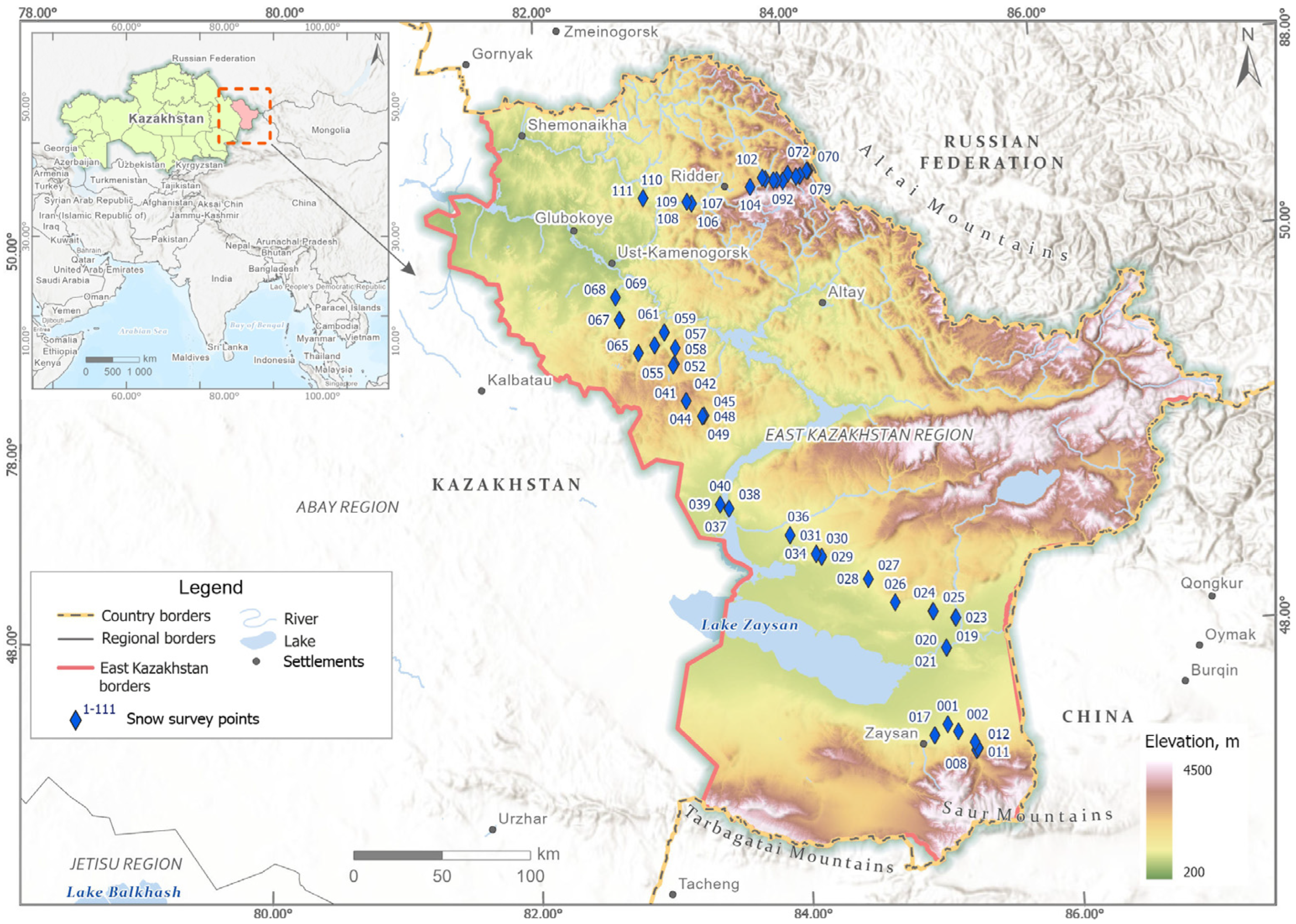
Snow survey sites were selected using a stratified, non-random sampling approach aimed at covering the main physiographic and landscape conditions of the East Kazakhstan Region. Site selection considered landscape province, landform type (ridges, valleys, depressions), elevation range, and land cover type. Field accessibility and safety constraints were also taken into account; therefore, due to difficult access to some high-mountain and highly dissected areas, the sampling is partly biased toward more accessible locations along roads and trails. The sampling design was not intended to achieve strict statistical representativeness, and no landscape type was intentionally over- or underrepresented. The primary objective was to ensure broad spatial coverage of contrasting snow accumulation conditions during the period of maximum snow storage.
The field data collection campaign took place from the third week of February to the first week of March near the time of peak snow accumulation. Snow surveys were conducted by teams of two to four individuals. Survey teams made their way to 111 measurement sites. At these sites, the survey teams measured snow depth and density, recorded snow conditions and GPS locations and took photographs.
Snow depth and density were measured at several locations within each measurement site. These measurements were taken along straight profiles (referred to as transects) at a fixed interval between locations. Two perpendicular transects were established at each snow measurement site, with 21 depth measurements (10 for each transect and one center measurement; the distance between measurements was 5 m) and five measurements of snow density.
The use of 21 depth measurements per site allowed spatial variability caused by wind redistribution, vegetation, microrelief, and other factors to be captured. At the same time, snow density, as a rule, is characterized by lower within-site variability at the scale of a single snow survey plot. The samples were evenly distributed, with one taken at the intersection of the transects (center) and one along each perpendicular transect at intervals, allowing potential variability to be captured. This methodology corresponds to standard hydrometeorological protocols [
25] and provides a balance between accuracy and efficiency of field operations. Field observations showed that variability of snow density within the survey plot was substantially lower than variability of snow depth, confirming the adequacy of the adopted sampling scheme.
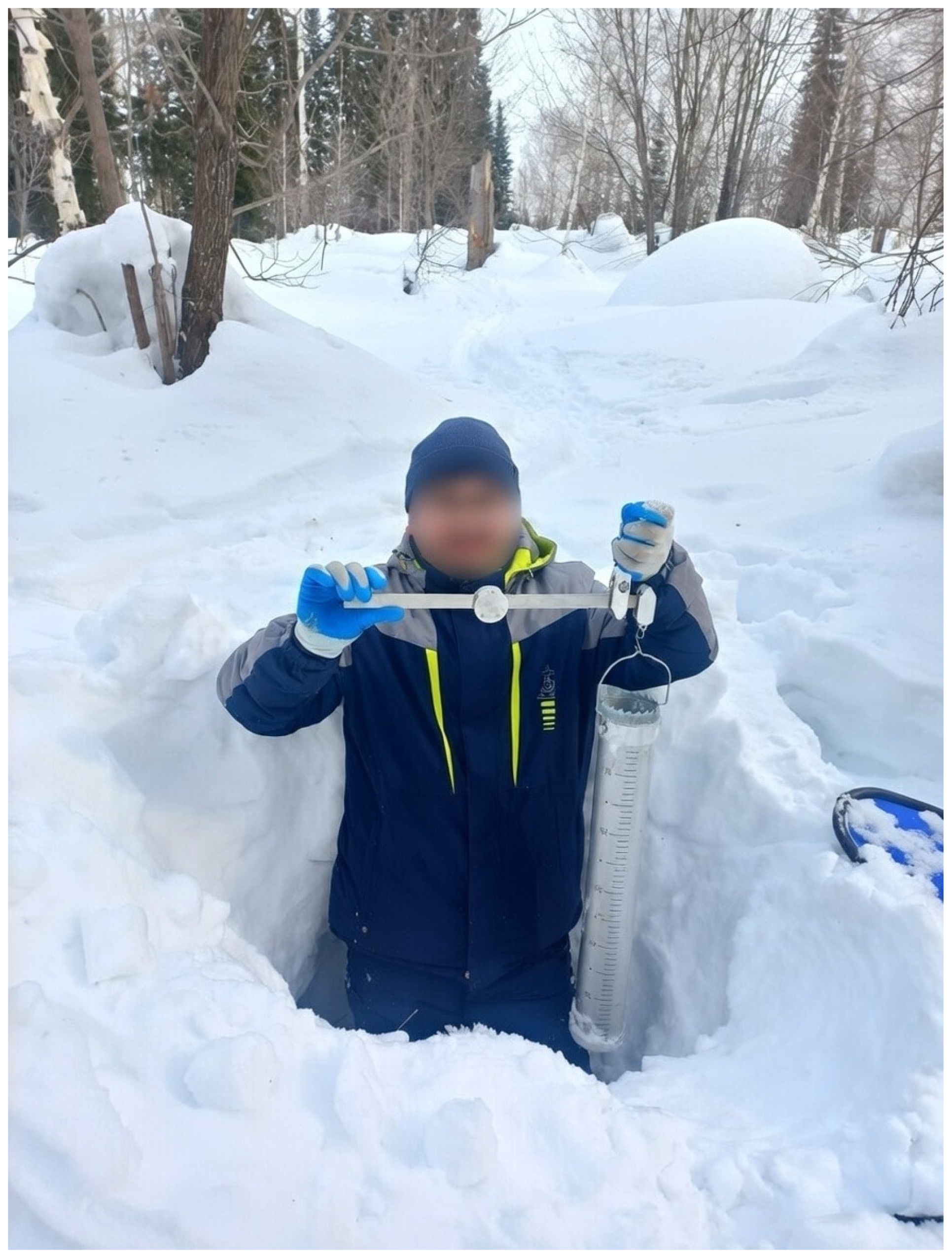
Snow depth was measured with a portable snow-measuring stick with dimensions 180 × 4 × 2 cm, with 1 cm divisions. The weighing snow gauge VS-43, shown in
Figure 2, was also used for snow sampling to determine density, because SWE is the product of snow depth and the depth-averaged snowpack density. The weighing snow gauge VS-43 is a steel tube with a cross-sectional area of 50 cm
2 and a length of 60 cm. The exterior of the tube is scribed with a height scale, from which snow depth was recorded to the nearest centimeter. Today, the tubes are considered one of the standard methods for ground-truthing SWE in deep snowpacks. Snow sampling was performed by inserting a steel tube into the snowpack. Then, the snow core was weighed using the balance, which had an accuracy of 5 g (one gradation on the balance scale, with zero on the scale corresponding to the weight of the tube).
The fields “sample_weight_1–4_g” and “sample_depth_1–4_cm” are intended to record up to four replicates (separate snow core samples) collected at the same density measurement point using the VS-43 weighing snow sampler (tube length 600 mm, cross-sectional area 50 cm2). Each field “sample_depth_n_cm” reflects the height (thickness) of the n-th extracted snow core (cm), while “sample_weight_n_g” indicates the mass of the corresponding sample (g). When snow depth is ≤600 mm, a single core is sufficient. At points with greater snow depth (up to four cores in this dataset), sequential samples are taken to fully cover the snow layer, after which the mean density (mean_density_g_cm3) is calculated from all available samples. Minor differences between total snow depth measured with the snow probe (depth_cm) and the summed core lengths (sum of sample_depth) may occur due to natural snow compaction during sampling, instrumental uncertainty (±1 cm for the VS-43), or micro-scale variability of the snow layer, and are not considered measurement errors. This approach is consistent with standard protocols and ensures reliable SWE calculation under conditions of deep snow cover.
The snow density was calculated using the following Formula (1):
where
is snow density (g/cm
3),
m is snow weight,
SD is snow depth and
s is cross-sectional area.
Snow density, when multiplied by depth, gives SWE (2). SWE was expressed as the depth of the water layer in millimeters.
All measurements of snow depth and density were performed following standard procedures using calibrated instruments. Quality-control procedures included visual verification of field records, consistency checks between snow depth and density measurements, and verification of SWE calculations. Statistical removal of outliers was not applied because extreme values reflect real spatial variability of snowpack characteristics. Measurement points with no snow cover were coded using zero values for snow density and SWE. Snow absence was recorded when no snow cover with a thickness ≥ 0.5 cm was detected visually or instrumentally using a snow probe.
3.2. Snow Distribution Patterns
3.2.1. Snow Distributions Across Landscape Provinces and Landforms
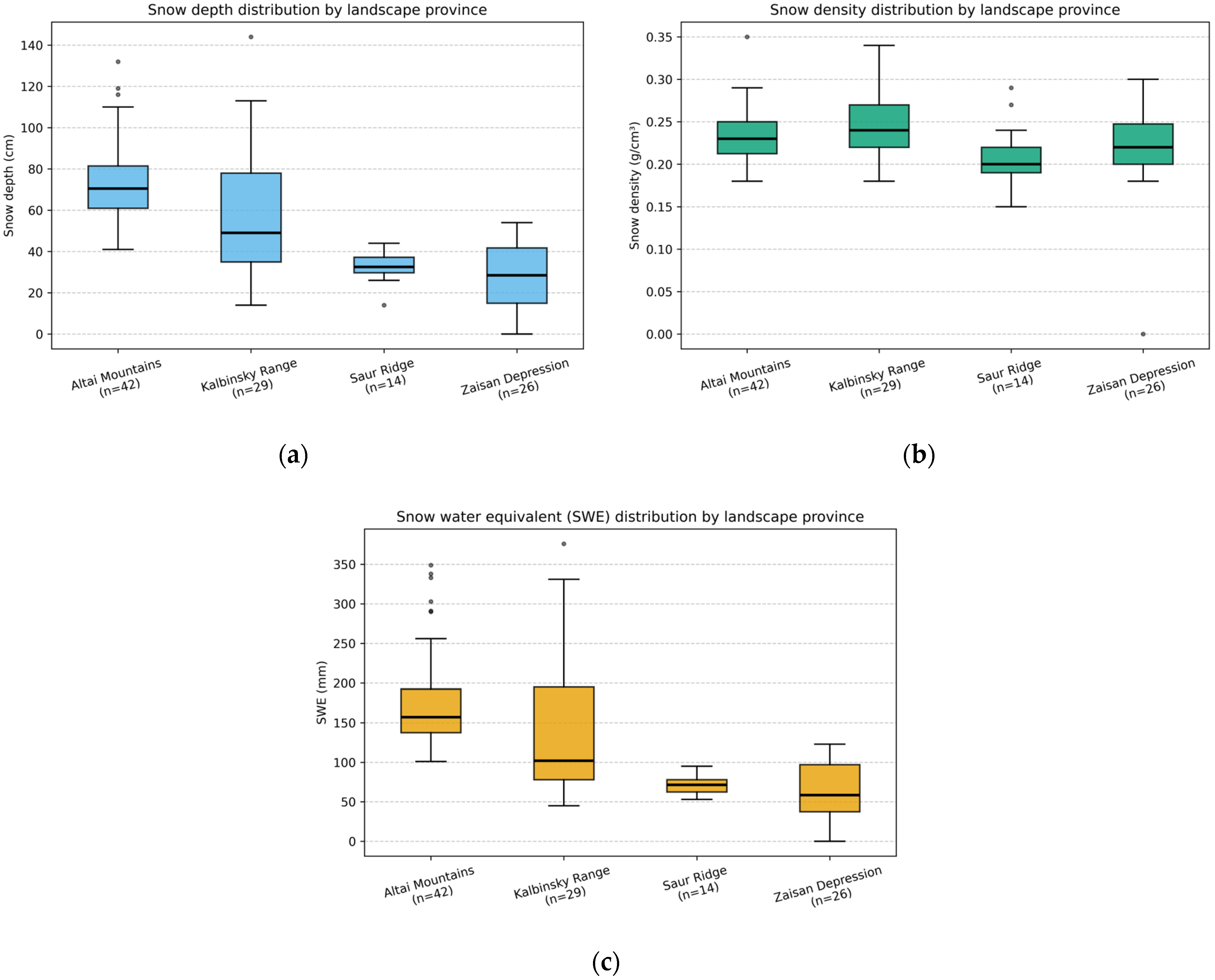
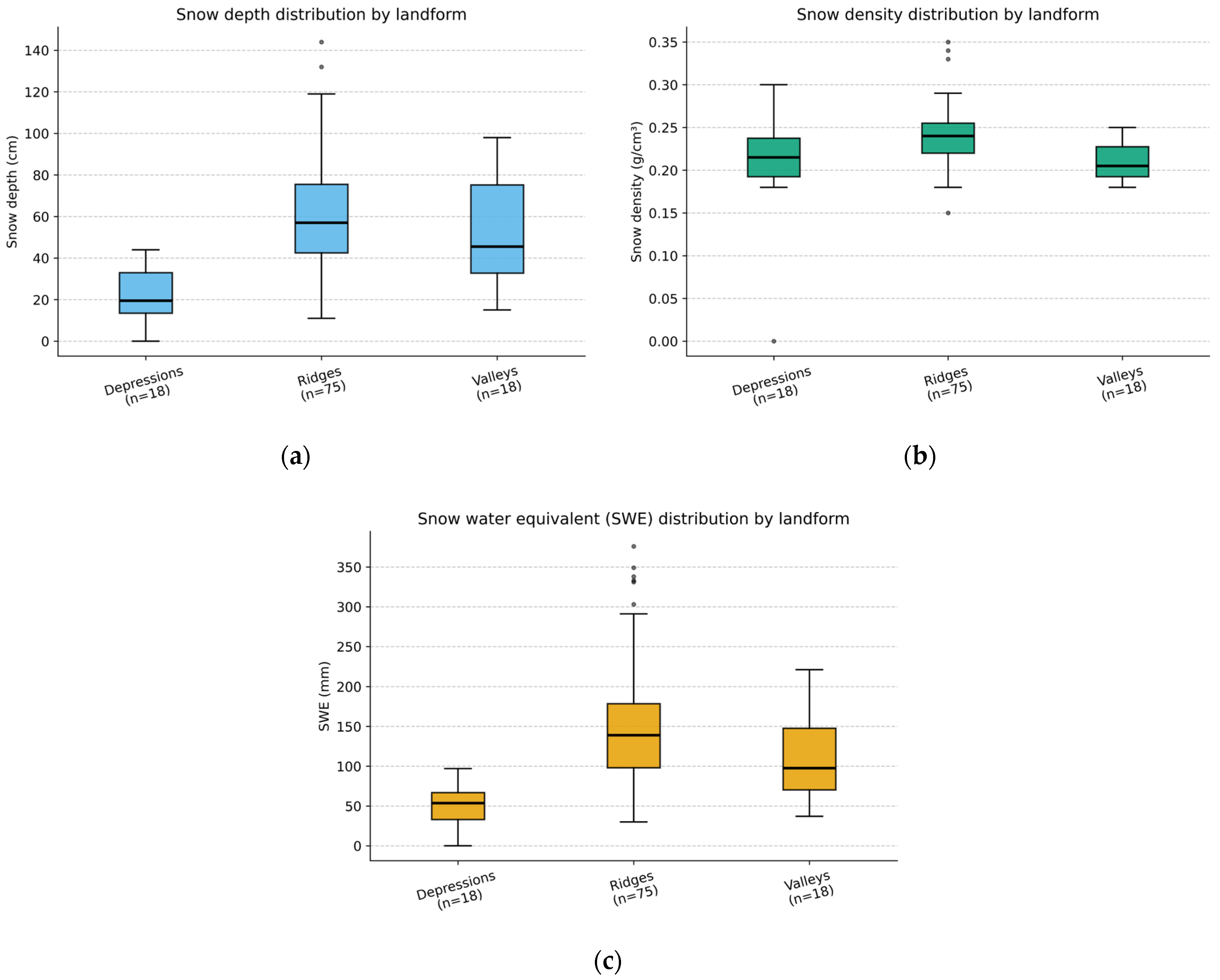
Snow distribution was analyzed using two complementary spatial classifications, with
Figure 3 illustrating the distribution of snow cover characteristics across landscape provinces and reflecting regional differences, while
Figure 4 shows how landform types (ridges, valleys, and depressions) influence snow cover distribution within the region at a more local scale.
Figure 3 shows that snow depth and SWE have higher medians and wider interquartile ranges in the Altai Mountains and the Kalbinsky Range, together with the presence of outliers. This is consistent with
Table 1, where the Altai Mountains have the highest mean snow depth (75.05 cm) and SWE (177.76 mm), while the Kalbinsky Range shows the widest range of SWE values, from 45 to 376 mm.
In contrast, the Saur Ridge exhibits low median values in
Figure 3 and narrow ranges in
Table 1, with snow depth varying only between 14 cm and 44 cm and SWE between 53 mm and 95 mm, indicating low variability. The Zaisan Depression shows similarly low central values but much wider ranges (snow depth from 0 cm to 54 cm; SWE from 0 cm to 123 mm), which explains the presence of outliers in
Figure 3.
Regional contrasts in snow density are much weaker than those observed for snow depth and SWE. Mean density values vary only slightly among regions, with mean values between 0.21 and 0.24 g/cm3, although variability is highest in the Zaisan Depression.
Snow conditions differ between landform types and among snow variables (
Figure 4;
Table 2). Ridges contain the largest amount of snow, with an average snow depth of about 62 cm and SWE of 150.88 mm. They also show the widest spread of values, with snow depth ranging from 11 to 144 cm and SWE from 30 to 376 mm. Valleys have slightly lower snow amounts than ridges, with mean snow depth around 53 cm and SWE of 112.61 mm, but their overall patterns remain similar, showing moderate variability. Depressions stand out as the least snow-covered landform. Average snow depth is only about 22.89 cm and SWE about 49.67 mm, and although most values are low, snow-free conditions are also observed.
Snow density behaves differently from snow depth and SWE. Its mean values are similar across landforms (around 0.21–0.24 g/cm3), but variability is highest in depressions, where density ranges from zero to 0.30 g/cm3, while valleys show the most uniform density values.
3.2.2. Elevation Gradients of Snow Depth, Density, and SWE
The elevation gradients of snow characteristics were calculated separately for each landscape province using linear regression (LR), with the Theil–Sen estimator applied as a robust alternative based on the median of pairwise slopes, reducing sensitivity to outliers, with a 95% confidence level used for slope estimation. The elevation ranges of snow survey sites by landscape province are summarized in
Table 3.
The relationship between snow depth and elevation varies significantly between landscape provinces. LR results indicate negligible and statistically insignificant gradients in the Altai Mountains and the Zaisan Depression. A pronounced positive gradient of about +6.6 cm per 100 m is found in the Kalbinsky Range ridge; on the contrary, there is a negative gradient of about −8.3 cm per 100 m in the Saur Ridge. Both relationships are statistically significant and are associated with moderate values of explained variance according to
Table 4.
Compared with LR, the Theil–Sen estimator results presented in
Table 5 show a steeper positive slope in the Altai Mountains, increasing from 0.58 to 1.22 cm per 100 m. In the Kalbinsky Range, the slope decreases from 6.56 to 5.245 cm per 100 m, while in the Saur Ridge the negative gradient becomes less steep, changing from −8.268 to −6.857 cm per 100 m. The largest change occurs in the Zaisan Depression, where the LR slope is near zero at +0.048 cm per 100 m but becomes weakly negative at −2.753 cm per 100 m with the Theil–Sen method, although both values remain much smaller than gradients in the other provinces.
Snow density shows generally weak or absent elevation dependence across all provinces (
Table 6 and
Table 7). LR indicates no statistically significant relationship in the Altai Mountains, Saur Ridge, and Zaisan Depression, while a weak but statistically significant positive gradient appears in the Kalbinsky Range, although with
value. The Theil–Sen results presented in
Table 7 support this pattern, confirming a weak positive gradient only in the Kalbinsky Range, while the small negative slopes suggested by LR in the Saur Ridge and Zaisan Depression reduce to near zero. Overall, both approaches show that snow density exhibits little or no systematic change with elevation across the provinces.
With respect to SWE, LR shows that only the Kalbinsky Range has a statistically significant SWE increase with elevation (+19.9 mm per 100 m), while gradients in the Altai Mountains (+1.8 mm), Zaisan Depression (+1.6 mm), and Saur Ridge (–9.9 mm) are weak and not significant. Theil–Sen slopes confirm the positive trend in the Altai Mountains and Kalbinsky Range, although the increase in the Kalbinsky Range becomes smaller (+13.4 mm per 100 m compared to +19.9 mm per 100 m from LR). In the Zaisan Depression, the slope becomes slightly negative (–3.4 mm per 100 m), while the negative gradient in the Saur Ridge remains nearly unchanged (
Table 8 and
Table 9).
Despite the expected increase in snow accumulation with elevation, linear regressions between elevation and snow characteristics exhibit low coefficients of determination (R2). Additional analysis indicates that key assumptions of LR, particularly linearity of the relationship and homoscedasticity of residuals, are not fully satisfied within the dataset. This suggests that elevation alone is not the dominant factor controlling the spatial variability of snow depth, snow density, and SWE within the studied provinces. Regression analysis was therefore used not to develop predictive models but to estimate the average elevation gradient of snow characteristics. Consequently, even with low R2 values, the regression slope still represents the average change in snow characteristics with elevation.
The negative altitudinal gradient identified in the Saur Ridge, and the similarly weak negative gradients observed in the Zaisan Depression, likely reflect regionally specific processes controlling snow redistribution. In the Zaisan Depression, this pattern probably reflects generally low snow accumulation and the limited elevation range of observations, which reduces the influence of elevation on snow distribution. Under the arid climate conditions of southeastern East Kazakhstan, the main contributing factors may include wind redistribution, orographic effects, and temperature inversions. This pattern in the Saur Ridge appears to be a local phenomenon associated with the relative isolation and lower moisture availability compared to provinces where positive gradients prevail. Similar inverse gradients have previously been observed in mountain regions of Central Asia, where they are linked to the transition from snowfall to rainfall at mid-elevations and to wind-driven snow removal from exposed high-altitude slopes. Several studies also report accelerated warming with increasing elevation and a negative correlation between temperature and snow depth, which can lead to faster snowmelt and potentially produce inverse patterns in snow distribution [
26,
27,
28]. In addition, the limited elevation range of snow survey observations in the Saur Ridge (805–955 m) may also influence the statistical significance of the detected relationship.
For the calibration of regional snow and hydrological models, these findings indicate the need to account for local drivers such as wind and topographic controls, as well as regional climatic characteristics, in order to improve forecast accuracy.




 ,
,