1. Introduction
Ball velocity is a fundamental determinant of shot effectiveness in elite football, as it directly influences both the biomechanical characteristics of ball–foot interaction and the temporal–spatial demands placed on goalkeepers (GKs) and defenders [
1,
2]. Once the ball is struck, its velocity becomes a key variable determining the time available for perceptual processing, movement initiation, and save execution. Faster shots significantly reduce the GK’s reaction window, increasing the likelihood of scoring regardless of contextual shooting conditions [
3]. Empirical work has demonstrated that higher ball velocities impose markedly greater perceptual–motor demands on GKs and substantially alter save probability profiles [
4].
Recent developments in football analytics have advanced post-shot performance variables such as expected goals on target (xGOT), which evaluate shot quality using actual ball-flight characteristics and GK performance [
5,
6,
7] rather than relying solely on pre-shot situational factors, such as shot angle or distance [
7]. The xGOT model incorporates ball velocity, GK performance, shot placement, and the body part used to take a shot to estimate the probability of scoring [
8]. By quantifying the likelihood that a shot on target results in a goal based on these factors, xGOT allows for an objective assessment of GK performance. Specifically, comparing the xGOT of shots faced to the goals actually conceded provides a measure of a GK’s ability to prevent goals beyond the expected difficulty of each attempt. Among these parameters, ball velocity is one of the most influential, as faster shots compress the temporal margins on which xGOT models are built. Currently, two xGOT models are widely recognized: The first is the classic StatsBomb xGOT model [
8], which, on the one hand focuses primarily on shot quality and goal probability, but its calculation process remains largely opaque due to the proprietary nature of the underlying algorithms. On the other hand, the model, as proposed by subsequent authors [
6], incorporated the ball’s trajectory, the initial positioning of the shooter and GK, and the GK’s movements, providing a more detailed and transparent metric that allows for a comprehensive analysis of both offensive and defensive performance.
Complementing xGOT, a recent shooter-centric metric, expected shot impact timing (xSIT), has been developed to more precisely evaluate shooting performance in football [
9,
10]. The xSIT model combines information on the position of the shooter, GK, and defenders with ball velocity and trajectory to estimate the theoretical time window available for the GK to execute an effective save. Shots with higher velocity and optimal placement reduce GK reaction time, thereby increasing the shooter’s probability of success and reflecting enhanced offensive performance. It is important to note that xSIT provides a probabilistic estimate based on assumptions regarding average player reaction times and capabilities, and therefore does not represent an absolute value for each shot. Nevertheless, by incorporating the temporal dimension alongside spatial and dynamic shot characteristics, xSIT offers a complementary perspective to xGOT, allowing evaluation of how the shooter’s performance, particularly ball velocity and placement, influences GK difficulty and, consequently, shot effectiveness in elite football situations.
Given that each post-shot metric is influenced by multiple interacting variables, no study to date has isolated the specific contribution of ball velocity to the final values of these metrics. Therefore, the aim of the present study was to examine the effect of ball velocity on xGOT and xSIT in the men’s and women’s UEFA European Football Championships. The authors hypothesized that ball velocity will have a differential effect on xGOT and xSIT between the men’s and women’s tournaments, with higher ball velocities observed in men’s matches, being associated with higher xSIT and lower xGOT values, compared to women’s matches.
2. Materials and Methods
2.1. Sample
The sample comprised all professional national teams that participated in the 2025 UEFA Women’s European Championship and the 2024 UEFA Men’s European Championship. In total, 16 national teams from the women’s tournament and 24 national teams from the men’s tournament were included. The analysis covered 31 matches from the women’s competition (24 group-stage matches, 4 quarter-finals, 2 semi-finals, and 1 final) and 51 matches from the men’s competition (36 group-stage matches, 8 round-of-16 matches, 4 quarter-finals, 2 semi-finals, and 1 final), excluding all qualifying matches. Although the number of matches analyzed differed between the women’s and men’s tournaments, this imbalance did not affect the interpretation of the results, as the analyses included the entire population of matches played in each competition. Therefore, the sample represented the full competitive context of both tournaments rather than a subsample, minimizing potential sampling bias. Furthermore, all analyses were conducted at the team level, ensuring consistency and comparability across both competitions despite differences in tournament structure.
Team-level event data were obtained from the StatsBomb Open Data repository (source:
https://github.com/statsbomb/open-data/blob/master/data/competitions.json (accessed 29 December 2025)) [
11], a freely accessible dataset widely used in performance analysis across multiple sports, including football. To date, this dataset has been widely adopted in academic research and is commonly used for the analysis of advanced performance metrics [
12,
13]. Notably, the StatsBomb data collection process is supported by strict quality control procedures and standardized annotation protocols, which underpin its reliability as a data source for football performance analysis.
2.2. Design and Ethical Approval
This study employed a descriptive and correlational design to analyze performance data from the UEFA European Football Championships, including both the women’s and men’s competitions. A comparative analysis between the two tournaments was also conducted.
In accordance with ethical standards, no information that could identify individual players was collected or analyzed. The study protocol received approval from the local institutional ethics committee (protocol code: 2025-0019).
2.3. Methodology
This study analyzed a total of 2174 shots during the 2025 UEFA Women’s EURO and the 2024 UEFA Men’s EURO, including all matches from the group stage to the final. From the men’s tournament, 1305 shots were analyzed, comprising 416 shots on target and 889 shots off target. In the women’s tournament, 869 shots were included, with 286 shots on target and 583 shots off target. The study was conducted separately for both competitions, as it is well established that ball velocity following shots differs between men and women, with higher velocities typically observed in men’s football [
14,
15,
16,
17,
18].
For all shot types, the variables used in this research included ball velocity, xSIT, and xGOT. Specifically, xGOT was calculated using two different methods: the StatsBomb xGOT model [
8] and our own model [
6]. Both xGOT models were used to examine the influence of ball velocity on this post-shot metric. The current widely used reference model is inherently opaque, as the specific contribution of ball velocity to the final xG OT value is not explicitly defined. In contrast, our own model explicitly incorporates ball velocity in its formulation, allowing its influence on the metric to be directly assessed.
All variables required for the calculation of the advanced metrics were collected from the StatsBomb open-access web data [
11]. Data were systematically collected on a match-by-match basis, with each individual shot treated as the primary unit of analysis.
Table 1 details the study variables and their operational definitions, including ball velocity, total shots (on and off target), shot outcomes (goal shots, non-goal shots), and advanced post-shot metrics (xGOT and xSIT).
2.4. Statistical Analysis
Statistical analyses were performed using SPSS (version 18; SPSS Inc., Chicago, IL, USA). All data are presented as the mean ± standard deviation (SD). The normality of the data distribution was assessed using the Shapiro–Wilk test, and the homogeneity of variances was evaluated using Levene’s test. Statistical significance was set a priori at p < 0.05.
Both ball velocity and advanced post-shot metrics (xSIT and xGOT) were analyzed using a two-way factorial analysis of variance (ANOVA 2 × 3), with sex (men vs. women) and shot type (goal shots on target, non-goal shots on target, and shots off target) as fixed factors. This analysis allowed the examination of the main effects of sex and shot type, as well as the sex × shot type interaction. When significant main effects or interactions were observed, Tukey’s honestly significant difference (HSD) post hoc tests were applied to identify pairwise differences between conditions. Statistical significance was set at
p < 0.05. Effect sizes were calculated using partial eta squared (η
2p) for all ANOVA analyses and were interpreted as small (<0.2), moderate (0.5), or large (>0.8) according to established thresholds [
19].
Finally, the Pearson correlation coefficient (r) was calculated to compare the interactions between variables, and R2 was also calculated to analyze the correlation between ball velocity and performance metrics (xSIT and xGOT). The following thresholds were applied to interpret the magnitude of r: <0.1 = trivial, 0.1–0.3 = small, 0.3–0.5 = moderate, 0.5–0.7 = large, 0.7–0.9 = very large, and 0.9–1.0 = almost perfect.
3. Results
Table 2 presents the classification of shots across the two international tournaments. In the 2024 UEFA Men’s EURO, a total of 1305 shots were recorded, of which 98 were goal shots on target, 318 were non-goal shots on target, and 889 were shots off target. In the 2025 UEFA Women’s EURO, 869 shots were analyzed, including 95 goal shots on target, 191 non-goal shots on target, and 583 shots off target.
Table 2 also reports ball velocity for each shot category in both tournaments, as well as the comparative analysis of ball velocity by sex across shot types. Significant differences in ball velocity were observed between men and women in all comparisons (
p <
0.001). Effect sizes were moderate for total shots and shots off target, and large for both types of shots on target (goal and non-goal), with ball velocity consistently higher in men than in women.
When comparing ball velocity across shot types, a consistent trend was observed in both tournaments. Specifically, significant differences were found between goal shots on target and non-goal shots on target in both tournaments (p < 0.001 in both cases), as well as between goal shots on target and shots off target (p = 0.002 in the women’s tournament and p < 0.01 in the men’s tournament). Additionally, in the men’s tournament, significant differences were observed between non-goal shots on target and shots off target (p = 0.01). Overall, results from both tournaments indicated that, for a shot to be on target and result in a goal, ball velocity tends to be lower.
Table 3 presents the values of the advanced metrics analyzed, together with the comparative analysis between men and women for shots on target. Significant differences were observed between tournaments for both the xSIT metric and the xGOT values derived from our own model (
p < 0.001), with small effect sizes (η
2p = 0.04 and η
2p = 0.06, respectively). In contrast, no significant differences were found between tournaments for the xGOT values obtained from the StatsBomb database (
p > 0.05). This discrepancy may be explained by the fact that ball velocity is an important input variable in both the xSIT metric and our own xGOT model, given the substantial differences in ball velocity between men and women, whereas ball velocity did not play a determining role in the StatsBomb xGOT model.
When comparing shot types using advanced metrics, a consistent pattern was observed across both tournaments (
Table 3). For the xSIT metric, no significant differences were found between goal and non-goal shots on target in either the women’s or men’s tournaments (
p > 0.05), with similar mean values observed across all shot categories. In contrast, both xGOT models (StatsBomb xGOT and our own xGOT model) showed significantly higher values for shots on target that resulted in a goal compared with non-goal shots on target in both tournaments (
p < 0.001; η
2p = 0.15 and η
2p = 0.08, respectively). Overall, the results from both tournaments indicated that metrics associated with the physical execution of the shot, as captured by xSIT, exhibit a limited capacity to discriminate between shots on target and shots off target. In contrast, metrics focused on the resulting difficulty for the goalkeeper, represented by both xGOT models, were strongly associated with shot success, with significantly higher values observed for shots on target that resulted in a goal. This pattern was consistent across both the women’s and men’s tournaments, suggesting that shot success was more closely related to intrinsic shot characteristics than to the competition context.
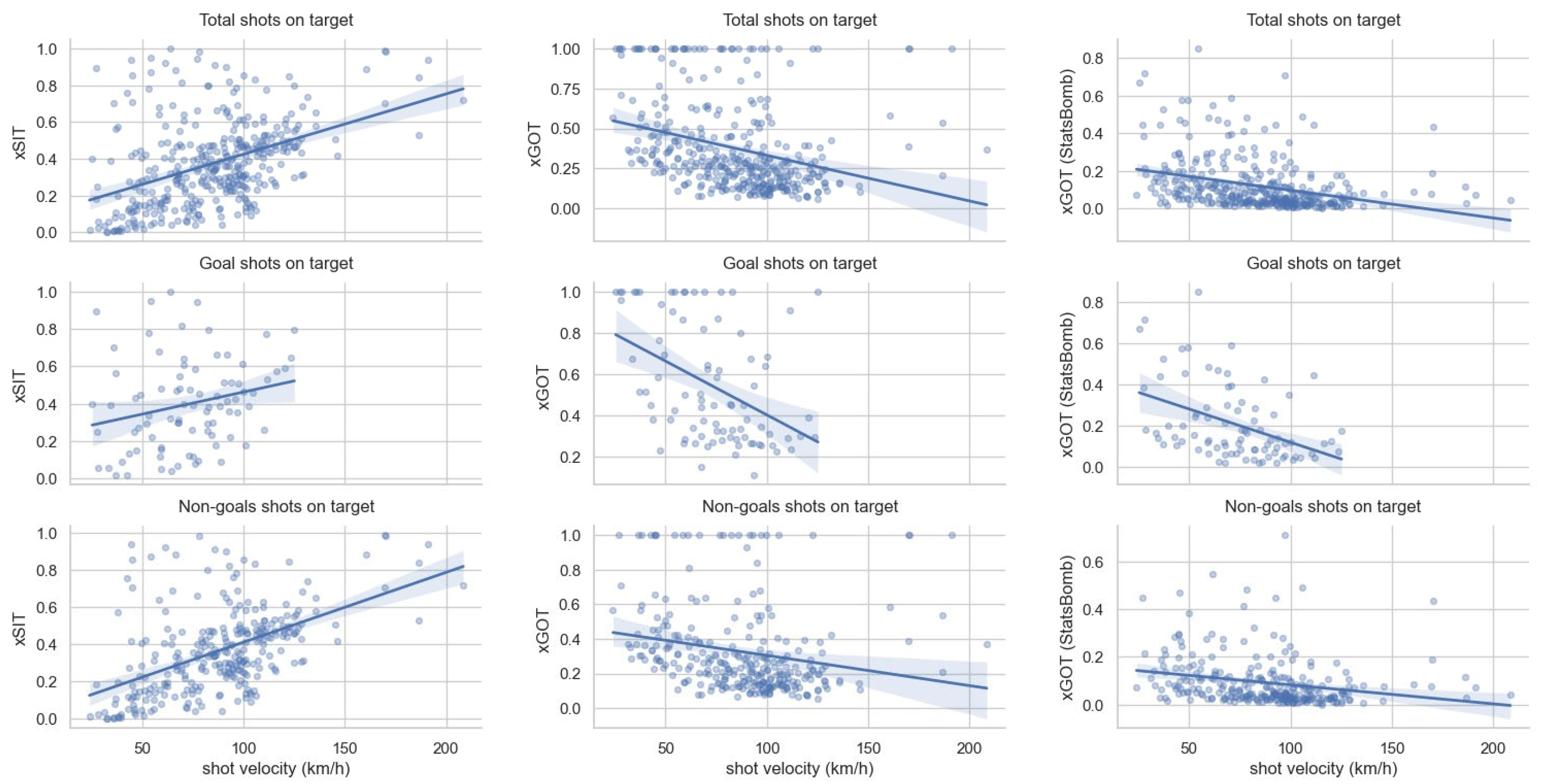
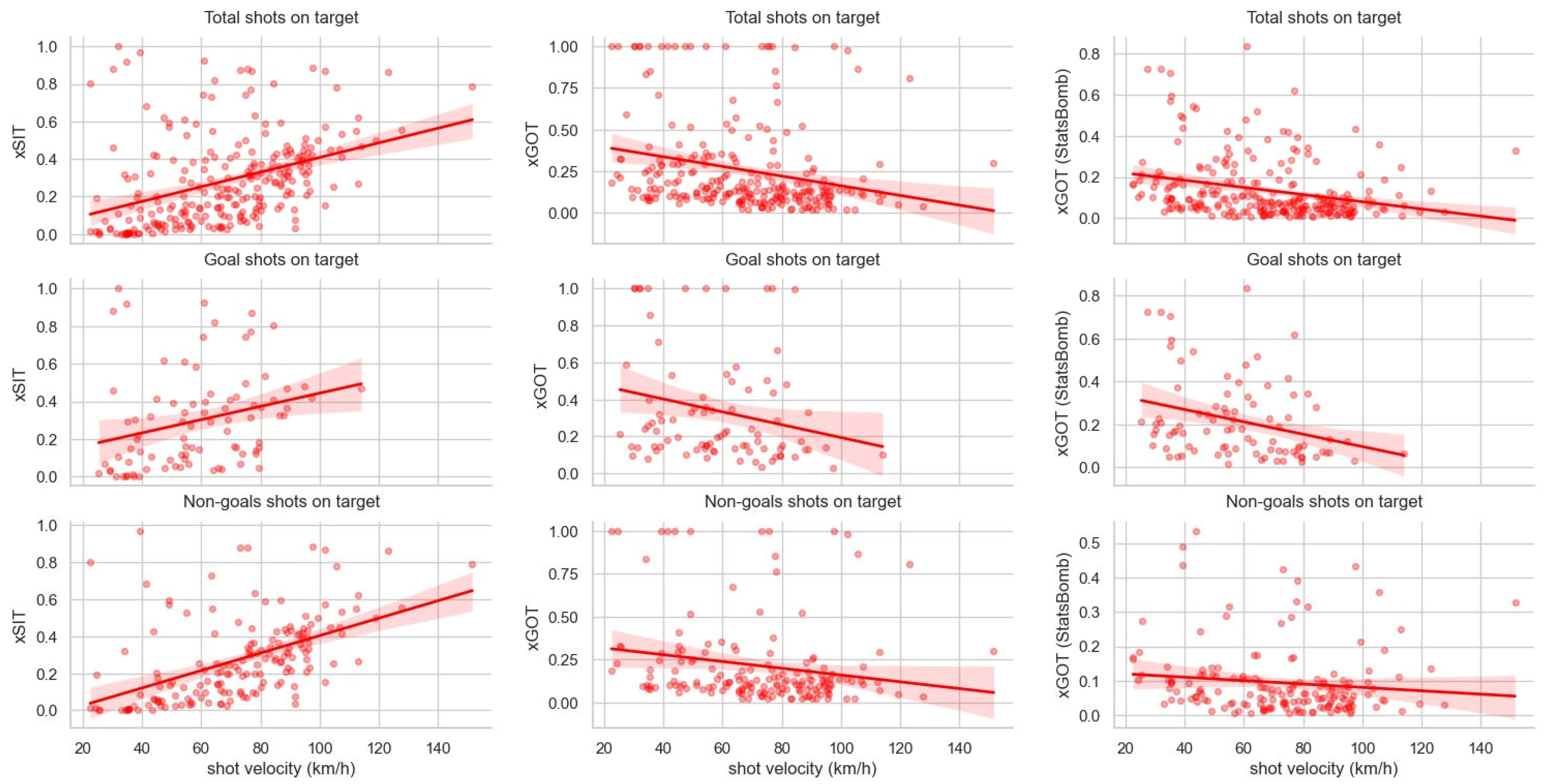
Table 4 establishes the relationship between ball velocity and the three advanced metrics analyzed in both tournaments. For the xSIT model, moderate positive correlations were observed across all shot types (r = 0.25–0.51), indicating that higher ball velocity was associated with higher xSIT values in both men and women. The strongest correlations were found for non-goal shots on target, suggesting that ball velocity played a greater role in predicting impact for shots that did not result in a goal but were on target. In contrast, the StatsBomb xGOT model showed negative correlations with ball velocity across all shot types (r = −0.11 to −0.46), indicating that higher ball velocity did not necessarily translate into higher expected goals values. This pattern was most pronounced for goal shots on target, reflecting that the StatsBomb model did not consider ball velocity to be a primary determinant and likely relies more on spatial, positional, and defensive variables. Our proprietary xGOT model also exhibited negative correlations, particularly for goal shots on target (r = −0.27 in women; −0.47 in men), highlighting that ball velocity had a greater influence in men tournaments than women tournaments. For non-goal shots on target, correlations were weak to moderate, suggesting a limited effect of ball velocity on shots that did not result in a goal. Across all models, correlations were generally higher in men than in women, especially for goal shots on target. This indicated that ball velocity was a more critical factor in male players, likely reflecting physical differences in shot power and game dynamics [
12,
13,
14,
15,
16].
Figure 1 and
Figure 2 show graphical representations of linear relationships between all advanced metrics and ball velocity for all shot on target types in the men’s and women’s tournaments, respectively.
4. Discussion
The main finding of this study was that ball velocity differed significantly between men and women, with higher velocities consistently observed in male players across all shot types during the 2024 and 2025 UEFA European Championships (
Table 2). Significant differences were also observed in shot outcomes, with goal shots on target exhibiting lower ball velocities than non-goal or off-target shots, suggesting a speed–accuracy trade-off. Notably, in the women’s tournament, ball velocity was associated with shot success (goal vs. non-goal), whereas in the men’s tournament, it was primarily associated with whether the shot was on target or off target (
Table 2).
Another key finding of this study was that advanced post-shot metrics, such as xSIT and our own xGOT model, were sensitive to ball velocity, showing clear significant differences between men and women, whereas the StatsBomb xGOT model appeared less influenced by this variable (
Table 3). When examining the types of shots on target, a similar pattern was observed in both tournaments. The xSIT metric showed no significant differences between shot types (
p > 0.05), whereas both xGOT models exhibited significant differences, with higher values observed for shots on target that resulted in a goal (
p <
0.001). These results highlighted the importance of considering sex-specific differences and ball velocity when analyzing shot performance and developing predictive models in football [
20,
21]. According to Toro-Román et al. [
22], there were clear differences between male and female players in muscle mass, body composition, and physical performance. These variables directly affected the ability to generate shot power and accuracy. In the present study, x-GOT findings indicated that player sex and ball velocity substantially influenced shot types. These results highlight the need for future prospective research. Specifically, it is important to examine the correlation between shot types and xGOT metrics with the physical and technical differences between male and female players. This approach may improve the understanding of offensive performance and enhance predictive modeling in elite football.
The observed sex-based differences in ball velocity (
Table 2) and advanced post-shot metrics (
Table 3) are supported by the emerging literature [
6,
10,
12,
23,
24], which has indicated that biomechanical and execution factors play a major role in shaping advanced performance metrics beyond contextual shot characteristics. These findings reinforce the importance of incorporating dynamic variables into performance models and highlight the need for sex-specific calibration of predictive models in football analytics. While traditional expected goals (xG) models have been widely used to quantify scoring opportunities based on contextual variables such as shot location, angle, and defensive pressure, these models typically do not incorporate dynamic execution variables such as ball velocity and player reaction time when assessing shot quality and scoring probability [
25]. Previous research has demonstrated the value of sophisticated probabilistic models to assess shot quality at scale using positional and event data from top-tier competitions, emphasizing improved predictive accuracy over basic xG formulations [
26]. However, these studies often focus on pre-shot context rather than the actual execution dynamics [
27].
More recent work has highlighted the potential of integrating dynamic performance variables into shot evaluation metrics [
9,
10,
16]. For example, the xSIT metric explicitly incorporates both ball velocity and spatial configuration of players to assess shot execution quality and has been shown to differentiate shot performance in elite men’s and women’s tournaments with high discriminative capacity [
10]. In the case of the xGOT metric, when comparing the two recently developed models (
Table 3), only our own model demonstrated the true importance of incorporating ball velocity in its calculation. This was evident because it was the only model in which significant differences were observed between men and women, highlighting the relevance of accounting for sex differences when estimating shot quality. One reason for which it is not possible to explain why the StatsBomb xGOT model showed no differences between the two groups is the lack of transparency regarding the formula used to calculate xGOT. This limitation reflects the so-called “black box” nature of proprietary models, a well-known challenge in research on advanced performance metrics. Therefore, depending on the model used, the true influence of ball velocity may be underestimated, despite the literature emphasizing its critical role in shot performance [
14,
15,
16,
17,
18]. Our results support this interpretation, as demonstrated by the observed differences in post-shot advanced metrics between men and women, specifically for xSIT and our own xGOT model (
Table 3). Notably, xSIT showed a moderate positive correlation with ball velocity (
Table 4,
Figure 1 and
Figure 2), indicating that higher ball velocity was associated with better shot execution and, consequently, better shooter performance. Conversely, both our own xGOT model and StatsBomb’s model exhibited moderate negative correlations with ball velocity (
Table 4,
Figure 1 and
Figure 2), which aligned with the interpretation that higher shot velocity increases the difficulty for the GK, resulting in lower xGOT values. These findings highlighted that while xSIT captures shooter performance, xGOT reflects the challenge posed to the GK, and together they emphasize the importance of incorporating dynamic execution variables, such as ball velocity, into predictive models for a more comprehensive assessment of shot quality.
4.1. Limitations
Several limitations of this study should be acknowledged. First, the analysis was limited to the UEFA Men’s 2024 and Women’s 2025 European Championships, and the results may not be generalizable to other competitions or levels of play. Second, ball velocity was measured using available match data, which may not capture all contextual factors influencing shot execution, such as player fatigue, defensive pressure, or environmental conditions. Third, although advanced metrics like xSIT and proprietary xGOT provide insights into shot quality, they are influenced by model assumptions and input variables, which may introduce bias or limit comparability with other predictive models. Finally, while sex-specific differences were observed, the study did not control for individual player characteristics such as skill level, position, or training background, which may modulate the relationships between ball velocity and shot outcomes.
4.2. Practical Application
This study described a new metric (xGOT) to facilitate football match analysis and the understanding of the soccer players’ or teams’ performances during matches. This measure was strongly consistent with the match results.
The findings of this study have several practical implications for coaches, performance analysts, and sports scientists working in elite football. First, the observed sex-specific differences in ball velocity suggest that training programs should be tailored according to player sex, focusing on developing shot power and precision in a manner appropriate to physiological and biomechanical capacities. Second, the evidence of a speed–accuracy trade-off, with goal shots showing lower velocities than non-goal or off-target shots, highlights the importance of emphasizing technical control and accuracy under match-like conditions rather than purely maximizing shot speed. Third, the differential sensitivity of advanced post-shot metrics indicates that xSIT and proprietary xGOT models can be effectively used to monitor and evaluate shot performance, whereas reliance solely on generic models like StatsBomb xGOT may overlook key aspects of shot execution. Finally, integrating these findings into match analysis, individual player feedback, and training drills can help optimize shooting effectiveness, allowing practitioners to develop sex-specific strategies that combine physical, technical, and tactical factors for superior performance.