


Abstract
This research quantified 46 volatile compounds in vintage wines (1998–2005) from British Columbia (BC), which had been bottle-aged for up to 120 months. Wines were analyzed up to five times, between December 2003 and October 2008. Compounds were identified using gas chromatography mass spectrometry (GC-MS) and their concentrations were related to “wine age” using single linear regression (SLR). SLR models were developed for each wine compound (eight alcohol, 12 ester/acetate, one acid, one aldehyde, one sulfur) in eight varietal wines: six red (Cabernet franc, Cabernet Sauvignon, Meritage, Merlot, Pinot noir, Syrah) and two white (Chardonnay, Pinot gris). Parameter estimates (b0, intercept; b1, slope) and R2 values for models were reported for each compound and each variety. Most of the significant SLR models (109/123) had negative slopes (−b1 coefficients), indicating a decrease in the compounds’ concentration with “wine age”. The b1 coefficients were very small for isobutyl acetate, ethyl isovalerate and ethyl decanoate (−0.00013 to −0.0006 mg/L/mon) and largest (most negative) for 3-methyl-1-butanol, ethyl lactate and isobutyl alcohol (−2.26 to −6.26 mg/L/mon). A few SLR models (14/123) had positive slopes (+b1 coefficients), indicating an increase in the compounds’ concentration with “wine age”, particularly for acetaldehyde, diethyl succinate, ethyl formate and dimethyl sulfide. The +b1 coefficients were smallest for ethyl decanoate (0.0001 mg/L/mon) and dimethyl sulfide (0.00024 mg/L/mon) and largest for dimethyl succinate and acetaldehyde (0.06 mg/L/mon). These values varied by four orders of magnitude (104), reflecting the large concentration range observed for the different volatile compounds. The work provided, for the first time, an empirical (non-theoretical) approach to documenting the evolution of volatile compounds in BC wines. It equipped the industry with an easy-to-use new tool for predicting the concentration of desirable or undesirable compounds in their wines and assisted the industry with decision making regarding the release of their wines into the marketplace.
1. Introduction
The age of wine has widespread interest among wine enthusiasts and professionals alike. Wine enthusiasts are interested in optimizing their enjoyment and maintaining the quality of their investments, while wine professionals seek to achieve the highest possible wine quality for the longest period of time.
Wine Folly [1] has categorized the aging potential of wines based on the price and type. They identify that “cheap” wines have an aging potential of ~12–16 months, while fine white and red wines can be aged for ~10 and ~20 years, respectively. Although these are general guidelines, an individual wine’s aging potential will vary depending on the influence from many factors: variety, vintage, viticultural practices, geographical and environmental conditions, as well as enological practices (yeast, temperature, malo-lactic fermentation, filtration, oak contact, oxygen (O2), pH, sulfur dioxide (SO2), bottle closure, glutathione addition, etc.)—to name a few.
The aging of a wine starts after fermentation, when the wine is exposed to O2, and then continues after bottling when the wine is not exposed to O2—that is once the O2 picked up during bottling is consumed [2]. During this time, the wine components change and integrate with one another, via a diverse collection of chemical reactions such as: acid reduction, ester formation, ester degradation, oxidation of alcohols and amino acids, and condensation of acetaldehyde with polyphenols, polymerization of phenolic compounds [2].
Ivanova et al. report that maceration time and SO2 concentration influence the extraction of phenolics-compounds that protect the wine from oxidation during aging [3]. Frivik and Ebeler made progress in understanding the role of SO2 in oxidation [4]. They found that the type of aldehydes was a function of the SO2 concentration, with the production of some aldehydes being very SO2 dependent (saturated aldehydes C1–C9), others less so (formaldehyde, propanal, pentanal, hexanal, heptanal) and some not at all (butanol) [4]. Other researchers identified that the type of aldehydes produced was dependent on the amino acids present [5].
Furthermore, McRae et al. found that the filtration grade can influence the aroma/flavor of a wine, that has been bottle-aged for 18 months [6]. Alamo-Sanza et al. report that small amounts of O2 added along with the oak alternatives (chips, staves) can produce wines, when bottle-aged, that are similar to those that are barrel-aged [7]. Picard et al. showed that the water status of the vine can influence the volatile profile (bouquet) of a bottle-aged wine [8].
Using state-of-the-art FT-ICR-MS based metabolomics combined with sensory analysis, Nikolantonaki et al. showed that vintage, type of closure and glutathione addition played a role in the oxygen stability of bottle-aged wines [9]. They concluded that the knowledge and management of a wines’ chemical composition and antioxidant metabolome, from the start of the fermentation, was essential for estimating a wine’s aging potential [9].
In theory, a complete understanding of wine aging might be eventually possible, if the influences of all the above-name factors were understood. This might be possible in traditional wine-growing regions, with a limited number of varieties and standardized winemaking practices; however, such a model in newer wine-growing regions (such as British Columbia (BC)) would be particularly complex, given the especially large number of cultural and enological practices utilized by the wineries–all of which are proprietary in nature.
This research was undertaken: (i) to establish a database for industry consisting of the chemical fingerprint of the volatile compounds in BC wines, produced and aged from Vitis vinifera grapes and, (ii) to develop empirical (non-theoretical) models, where possible, to characterize the change in volatile compounds associated with bottle-aging of BC wines.
2. Materials and Methods
2.1. Acquisition and Evaluation of BC Wines
BC wineries were invited to participate in the study. They were asked to submit one case of each varietal wine and/or blend. A total of 15 wineries shipped their wines to the Wine Research Centre (WRC) at the University of British Columbia (UBC) (Vancouver, BC, Canada), consisting of red and white BC wines. There were 10 red wines (Cabernet franc, Cabernet-Merlot, Cabernet Sauvignon, Meritage, Merlot, Merlot-Cabernet, Oculus, Pinot noir, Proprietary Red, Syrah/Shiraz) and eight white wines (Chardonnay, Ehrenfelser, Gewurztraminer, Optima, Pinot gris, Riesling, Sauvignon blanc-Semillon, Siegerrebe). An additional red wine from the USA (Cabernet Sauvignon) was added as a reference. All wines were vintage dated between 1998 and 2005. For ease of description, monovarietal and blended wines were, here and thereafter, referred to as ‘varieties’. In BC, a monovarietal wine (e.g., Merlot, Chardonnay etc.) must contain at least 85% of the stated variety [10]; whereas, blended wines must state the varietal composition in order of proportional dominance [10]. The term Meritage can be used if a wine contains two or more of the Bordeaux varieties [10]. In BC, Meritage wines typically contain 25–65% Merlot, 15–57% Cabernet Sauvignon, 14–55% Cabernet franc and sometimes smaller portions of Malbec, Petit Verdot and Syrah [11].
Wines were bottle aged and stored under optimal conditions, at 15 °C and 70% RH in the wine library at the UBC WRC. Compositional analysis of the volatiles in the wines took place by gas chromatography-mass spectrometry (GC-MS). GC-MS analyses were conducted, on all wines (18 varieties, n = 204), over a 5-year period (2003–2008) at seven sampling dates: December 2003, April 2004, May 2005, October 2005, March 2006, February 2008 and October 2008. Samples were analyzed from one to five times, depending on the wines’ availability. A ‘fresh’ bottle of each wine was opened at each of the sampling dates. BC wineries were able to access the database (18 varieties, n = 204) regarding the compositional analyses of their wines.
A subset of wines (eight varieties, n = 172), with sufficient data, were selected for model development, as described below.
2.2. Identification and Quantification of Volatile Compounds Using GC-MS
Gas chromatography-mass spectrometry (GC-MS) headspace analysis of the wine samples (n = 204) was conducted according to the methods described by Danzer et al. [12], without solid phase micro-extraction (SPME). Readers interested in SPME for volatile analyses are referred to methods used by Ziółkowska et al. [13]. A 10 mL wine sample was placed into a 20 mL headspace vial. Samples were equilibrated and agitated with 3 g of NaCl at 85 °C for 10 min, then positioned in the Agilent 7694 headspace auto sampler (Agilent Technologies, Palo Alto, CA, USA).
The volatile compounds were separated using an Agilent 6890N GC equipped with a 60 m × 0.25 mm ID, 0.25 µm thickness DB-wax fused silica open tubular column (J & W Scientific, Folstom, CA, USA). Ultra-high purity helium was utilized at a flow rate of 1.3 mL/minute. The headspace samples (1 mL) were injected through a valve that was maintained at 100 °C, while the temperature of the transfer line was kept at 110 °C. The initial temperature of the GC oven was held at 40 °C for 5 min, raised to 100 °C at a rate of 5 °C/min, then increased to 200 °C at a rate of 20 °C/min.
Compounds were detected with a 5973N Mass Selective Detector (MSD) (Agilent Technologies, Wilmington, DE, USA). The MSD was set in scan mode with mass range of 35–400 atomic mass unit (AMU). Samples were quantified using Enhanced Chemstation software (Chemstation Build 75, Agilent Technologies, Palo Alto, CA, USA), and peaks were identified using the Wiley7Nist05 library (Wiley and Sons, Hoboken, NJ, USA). Each sample was quantified in triplicate, using 3-octanol as an internal standard. The concentration of volatile compounds was reported in mg/L.
2.3. Statistical Analyses
A subset of eight wine varietal wines, each with 10 or more samples was selected for model development. These included six red (Cabernet franc, n = 16; Cabernet Sauvignon, n = 16; Meritage, n = 24; Merlot, n = 38; Pinot noir; n = 21; Syrah, n = 12) and two white (Chardonnay, n = 24; Pinot gris, n = 21) varietal wines. “Wine age” was calculated as the time from harvest in months (mon), using the vintage information and sampling dates. While it is an estimate of “wine age”, it was believed satisfactory since the fermentation period would represent a very short period (<1–2 month) compared to the aging period. The term “wine age” was therefore utilized as the name of the independent variable throughout this manuscript.
Chemical compounds were grouped into the following classes: alcohol (n = 17), ester/acetate (n = 18), acid (n = 4), aldehyde (n = 4) and other (n = 3). The last class consisted of a group of unrelated compounds (acetal, butyrolactone, dimethyl sulfide). The detection rate of the compounds was calculated as percentage, from the total sample size for each variety. If the detection rate was 50% or higher, then undetected concentrations (empty cells) were assigned a value of 0 mg/L, and further data analysis was conducted on the results of the specific chemical compound. The compounds were listed by the order of detection associated with the GC-MS analyses.
Single linear regression (SLR) models with one explanatory variable were developed, separately, for each variety, using the “wine age” as the predictor variable. Compositional analysis of the wine samples was not conducted during the first year of production; therefore the “wine age” variable was centered at 12 months. Centering does not change the slope (b1) but does change the intercept (b0) [14] (p. 229). The intercepts reported in this study indicate the concentration of compounds after 13 months.
Outliers in the SLR models were identified and removed by considering the histograms, scatterplots and studentized residuals. The models were evaluated using the coefficient of determination (R2), root-mean-square error (RMSE) and F-ratio. The R2 and F-ratio were used to assess the appropriateness of the regression model, while RMSE was used to assess the absolute fit of the model to the data (i.e., how close the observed values were to the model’s predicted values). The regression coefficients for the SLR (b0 and b1) were reported; these coefficients represented the intercept (baseline after 12 months of aging) and slope, respectively. Negative baseline concentrations indicate that the compounds were not detected frequently in those varieties at earlier stages of aging. All calculations and figures were performed using JMP (JMP®, Version <14.0.0>, SAS Institute Inc., Cary, NC, USA, 2018). The error probability (α) was set at 0.05.
3. Results
Data analyses were conducted separately on each of the varietal wines, since their chemical and sensory profiles would be expected to vary with the methods of grape production, winemaking practices, bottling and aging processes [15]. Since a detailed discussion of the chemistry of each compound is beyond the scope of this research, readers are referred to articles on specific classes of wine compounds by Riberéau-Gayon et al. [16] and Bakker and Clarke [17], or comprehensive reviews by González-Barreiro et al. [18], Panighel and Flamini [19] and Robinson et al. [20].
3.1. Alcohol Compounds
Table 1 summarizes the SLR models developed for evaluating the effect of “wine age” on the concentrations of the alcohol compounds, for each of the varietal wines.
Table 1.
Regression statistics for single linear regression (SLR) models for the variable “wine age” for eight alcohol compounds in eight varietal wines (six red, two white), centered at 1 year (12 months) of aging. F-ratios and parameter estimates (b0, intercept; b1, slope) followed by *, ** and *** are significant at p ≤ 0.05, p ≤ 0.01 and p ≤ 0.001, respectively.
3.1.1. 1-Hexanol
1-hexanol is an alcohol compound with a resin-like, flower and green (cut grass) odor in wines [21]. It was detected in almost all samples (≥94%) (Table 1). Cabernet Sauvignon, Pinot noir and Merlot had the highest baseline concentrations, between 23.27 and 18.21 mg/L. These concentrations were above the sensory threshold of 8 mg/L, as reported by Campo et al. [22]. “Wine age” significantly (p ≤ 0.05) predicted 1-hexanol concentrations in all the studied varietal wines, except Pinot gris and Syrah (p > 0.05), with concentrations decreasing over time. “Wine age” explained about half of the variance in 1-hexanol concentrations in Cabernet franc, Merlot and Cabernet Sauvignon (R2 = 48.9–55.6%) (Table 1).
3.1.2. 2-Methyl-1-Butanol (Active Amyl Alcohol) and 3-Methyl-1-Butanol (Isoamyl Alcohol)
The compounds 2-methyl-1-butanol and 3-methyl-1-butanol are considered higher alcohols or fusel alcohols. They influence the aromatic complexity of wine, and at higher concentrations have a harsh aroma and taste [23]. The compound 2-methyl-1-butanol was detected in almost all of the samples (≥94%) (Table 1), with the red varietals having higher baseline concentrations (16.71–33.33 mg/L) than the white wines (5.97–9.10 mg/L). “Wine age” significantly (p ≤ 0.05) predicted 2-methyl-1-butanol concentrations in all the studied varietal wines, except Cabernet Sauvignon and Chardonnay (p > 0.05), with the concentrations decreasing over time for all varieties. “Wine age” explained about half of the variance in 2-methyl-1-butanol concentrations in Pinot noir, Cabernet franc and Syrah (R2 = 45.4–54.0%) (Table 1).The compound 3-methyl-1-butanol was detected in almost all of the samples (≥96%) (Table 1), with Merlot having the highest (207.42 mg/L) and Pinot gris having the lowest (52.27 mg/L) baseline concentrations. “Wine age” significantly (p ≤ 0.05) predicted 3-methyl-1-butanol concentrations for all varietal wines, with the concentrations decreasing over time for all varietal wines. “Wine age” explained above forty percent of the variance in 3-methyl-1-butanol concentrations in most of the varietal wines (R2 = 40.2–50.1%), except Chardonnay (R2 = 22.7%) (Table 1).
3.1.3. Isobutyl Alcohol
Isobutyl alcohol, also known as isobutanol or 2-methylpropanol, is also a higher alcohol [24], with a solvent-like and bitter odor [21]. It was detected in almost all of the samples (≥94%) (Table 1). Isobutyl alcohol had the highest baseline concentrations of the alcohols (372.20 mg/L). While this is somewhat different than values observed in California, such differences are likely attributed to differences in yeast strain, fermentation temperature, nitrogen status and pH during fermentation [25]. The red wines had higher baseline concentrations (302.57–555.48 mg/L) than the white wines (104.99–220.79 mg/L), with all concentrations above the detection threshold, as reported by Rapp and Versini [26]. “Wine age” significantly (p ≤ 0.05) predicted isobutyl alcohol concentrations in all the studied varietal wines, except Cabernet Sauvignon and Chardonnay (p > 0.05), with the concentrations decreasing over time for all varieties. “Wine age” explained about two-thirds of the variance in isobutyl alcohol concentrations in Syrah and Pinot noir (R2 = 66.7–68.2%) and about half of the variance in Cabernet franc and Pinot gris (R2 = 48.4–48.6%) (Table 1).
3.1.4. n-butanol
N-butanol, also known as 1-butanol or butyl alcohol, is another higher alcohol. The volatile compound was detected in most of the samples (Table 1). The red wines had higher detection rates (≥94%) and the baseline concentrations (0.850–2.120 mg/L), than the white wines, with a detection rates and baseline concentration of ≥83% and 0.06 mg/L, respectively. “Wine age” significantly (p ≤ 0.05) predicted n-butanol concentrations in all the studied varietal wines, except Chardonnay, Pinot gris and Syrah (p > 0.05), with the concentrations decreasing over time in Meritage, Cabernet franc, Cabernet Sauvignon, Merlot and Pinot noir. “Wine age” explained about half of the variance in n-butanol concentrations in Meritage, Cabernet Sauvignon and Pinot noir (R2 = 48.8–55.2%) (Table 1).
3.1.5. Phenylethyl Alcohol
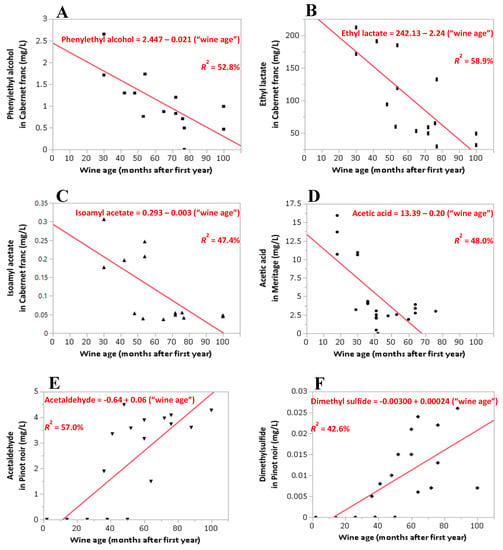
Phenylethyl alcohol, also known as 2-phenylethanol, is considered as an aromatic alcohol [24]; it has a rose-like character [22]. Phenylethanol was detected in almost all of the samples (≥92%) (Table 1). Merlot had the highest baseline concentration (7.470 mg/L), with substantially higher concentrations than the other varietals (1.000–4.040 mg/L). “Wine age” significantly (p ≤ 0.05) predicted phenylethanol concentrations in all the studied varietal wines, except Syrah (p > 0.05) with the concentrations decreasing slightly over time for all varieties. “Wine age” explained about half of the variance in phenylethanol concentrations in Cabernet franc (Figure 1A), Cabernet Sauvignon, Chardonnay and Pinot noir (R2 = 49.7–57.2%) (Table 1).
Figure 1.
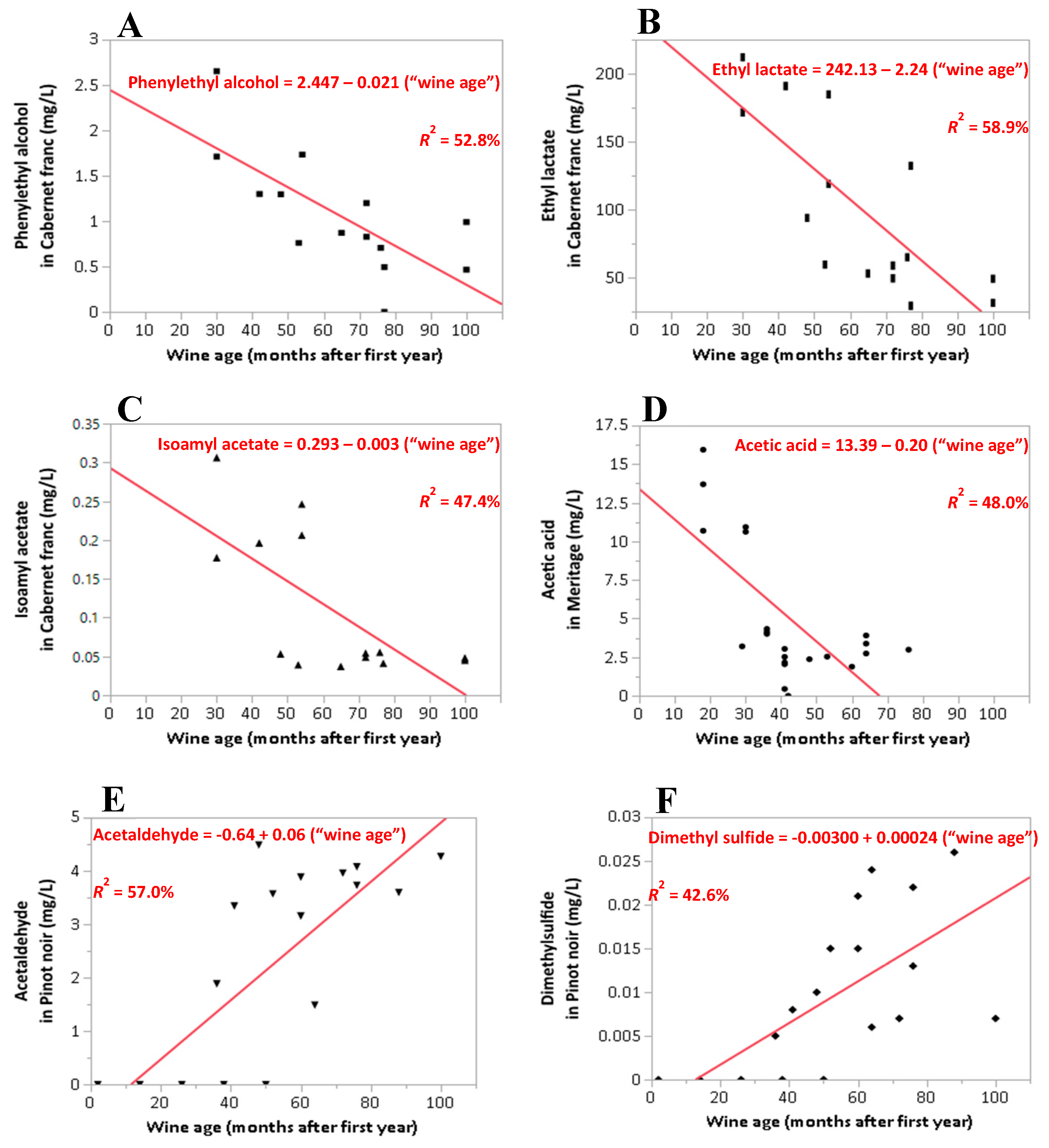
(A–F). Representative linear regressions for: (A) alcohol; (B) ester; (C) acetate; (D) acid; (E) aldehyde; and (F) sulfur compound(s), expressed as a function the baseline concentration, for varietal wines from British Columbia. The variable “wine age” was centered after the first year of production.
3.1.6. Propanol
Propanol (propyl alcohol) is a higher alcohol or fusel alcohol; it was detected in 100% of the samples (Table 1). Pinot noir, Cabernet Sauvignon, Merlot and Chardonnay had higher baseline concentrations (39.14–58.07 mg/L), compared to the other varietals (14.98–25.09 mg/L). “Wine age” significantly (p ≤ 0.05) predicted the declining propanol concentrations over time for all varietal wines. “Wine age” explained about half of the variance in propanol concentrations in Cabernet franc and Cabernet Sauvignon (R2 = 56.1–61.5%) (Table 1).
Models were not developed for 1-penten-3-ol, 2,3-butanediol, 3-ethoxy-1-propanol, 3-methyl-1-pentanol, 4-methyl-1-pentanol, acetylmethylcarbinol (acetoin), cis-3-hexen-1-ol, furfuryl alcohol and trans-3-hexen-1-ol, due to lower detection rate in the studied wines. Details of these detection rates are provided in Appendix A. Detection rates for acetoin were highest in Merlot (74%) and Pinot noir (86%) (Table 1). While both these varieties had significant b1 coefficients, the baseline concentrations (26.00 mg/L, Merlot; 18.73 mg/L, Pinot noir) (Table 1) were below the sensory threshold of 150 mg/L [27,28].
3.2. Ester/Acetate Compounds
Ester/acetate are aromatic compounds in wines that interact with each other [21,29]. Table 2 shows the SLR models developed for investigating the effect of “wine age” on the concentrations of these compounds, for each of the varietal wines.
Table 2.
Regression statistics for single linear regression (SLR) models for the variable “wine age” for 12 ester/acetate compounds in eight varietal wines (six red, two white), centered at 1 year (12 months) of aging. F-ratios and parameter estimates (b0, intercept; b1, slope) followed by *, ** and *** are significant at p ≤ 0.05, p ≤ 0.01 and p ≤ 0.001, respectively.
3.2.1. Diethyl Succinate
Diethyl succinate is an ester but does not influence the sensory characteristics of wines at normal concentrations [30]. The detection rates were lower in Chardonnay, Pinot noir and Merlot (67–71%) compared to the other varietal wines (≥88%) (Table 2). The baseline concentrations were greater in Cabernet Sauvignon, Cabernet franc and Syrah (14.24–17.96 mg/L), compared to Chardonnay, Merlot, Pinot gris and Pinot noir (with small negative baseline concentrations (zero)).
“Wine age” significantly (p ≤ 0.05) predicted diethyl succinate concentrations in all the studied varietal wines, except Cabernet franc and Cabernet Sauvignon (p > 0.05). The concentrations decreased over time in Meritage, Pinot gris and Syrah but slightly increased over time in Chardonnay, Merlot and Pinot noir, as reflected by the (−) and (+) b1 coefficients, respectively (Table 2). The increase in concentrations of diethyl succinate over time was consistent with research by Rapp and Güntert [31]. “Wine age” explained half of the variance in diethyl succinate in Syrah and Pinot noir (R2 = 50.1–50.2%), and about one-third of the variance in Meritage and Merlot (R2 = 31.1–33.3%) (Table 2).
3.2.2. Ethyl Acetate
Ethyl acetate, formed from ethanol and acetic acid, has a solvent-like odor. At sub- threshold concentrations (30–60 mg/L), ethyl acetate can enhance a wines’ fruitiness, but at higher concentrations (150–200 mg/L) it is considered a fault [32]. It was detected in most samples (≥94%) (Table 2). Chardonnay and Merlot had the highest baseline concentration (325.47–357.53 mg/L) followed by Pinot noir, Cabernet franc, Cabernet Sauvignon, Syrah, Meritage and Pinot gris with concentrations between 49.58 mg/L and 234.07 mg/L. “Wine age” significantly (p ≤ 0.05) predicted ethyl acetate concentrations in all the studied varietal wines except, Cabernet Sauvignon (p > 0.05), with the concentrations decreasing over time for all varieties. “Wine age” explained about half of the variance in ethyl acetate in Syrah, Pinot noir and Meritage (R2 = 48.4–58.2%) (Table 2).
3.2.3. Ethyl Butanoate
Ethyl butanoate, also known as ethyl butyrate, is a medium-chain fatty acids ester. This compound together with ethyl hexanoate, ethyl octanoate and ethyl decanote form a family of compounds that result in aromas which cannot be differentiated by our noses [33]. Ethyl butanoate was detected in almost all samples (≥95%) (Table 2). Merlot had the highest baseline concentration (3.39 mg/L) followed by Pinot gris, Pinot noir, Chardonnay, Cabernet franc, Syrah, Cabernet Sauvignon and Meritage (1.35–2.91 mg/L). “Wine age” significantly (p ≤ 0.05) predicted ethyl butanoate concentrations in all the studied varietal wines, except Cabernet Sauvignon and Chardonnay (p > 0.05), with the concentrations decreasing over time for all varietal wines (−0.02 to −0.04 mg/L/mon). “Wine age” explained 70.7% of the variance in ethyl butanoate concentrations for Syrah, and above half of the variance in Pinot noir (R2 = 52.8%) (Table 2).
3.2.4. Ethyl Decanoate, Ethyl Hexanoate, and Ethyl Octanoate
These ester compounds have apple-like and fresh fruit aromas in wine [24]. The detection rates of ethyl decanoate were lower in Pinot noir, Chardonnay and Merlot (67–71%) compared to the other varieties (≥88%) (Table 2). Pinot gris had the highest baseline concentration (0.1000 mg/L), with other varietals having concentrations between 0.0014 and 0.0470 mg/L. Ethyl decanotate significantly declined in concentration with “wine age” (p ≤ 0.05) for Meritage, Cabernet franc, Pinot gris and Syrah, but significantly increased for Pinot noir, as reflected by the (−) and (+) b1 coefficients, respectively (Table 2). “Wine age” explained above half of the variance in ethyl decanoate concentrations in Cabernet franc (R2 = 48.4%) and slightly more for Syrah and Pinot noir (R2 = 52.8–70.7%) (Table 2).
“Wine age” significantly (p ≤ 0.05) predicted ethyl hexanoate and ethyl octanoate concentrations in all the studied varietal wines, except Cabernet Sauvignon and Chardonnay (p > 0.05). The concentrations decreased gradually over time in Meritage, Cabernet franc, Merlot, Pinot gris, Syrah, and Pinot noir, as reflected by (−) b1 coefficients. The coefficients for ethyl hexanoate ranged between −0.002 and −0.006 mg/L/mon, while those for ethyl octanoate ranged from −0.002 to −0.009 mg/L/mon.
3.2.5. Ethyl Formate
Ethyl formate, also known as formic acid or methanoic acid, is an ester that smells like rum and tastes like raspberries [34]. Meritage had the highest detection rates for ethyl formate (88%) followed by Cabernet Sauvignon, Syrah, Pinot noir, Cabernet franc, Chardonnay, Pinot gris and Merlot with detection rates between 81–45% (Table 2). Cabernet Sauvignon had a baseline concentration (0.7799 mg/L); this was almost triple that of the next highest baseline concentration (Meritage, 0.2941 mg/L). “Wine age” significantly (p ≤ 0.05) predicted ethyl formate concentrations in Cabernet Sauvignon, Merlot and Pinot noir. The concentrations increased gradually over time in Merlot and Pinot noir but decreased in Cabernet Sauvignon as reflected by the (+) b1 and (−) b1, respectively (Table 2). “Wine age” explained about one-third of the variance in ethyl formate concentrations in Cabernet Sauvignon (R2 = 33.8%) and Pinot noir (R2 = 31.0%) (Table 2).
3.2.6. Ethyl Lactate
Ethyl lactate, also known as lactic acid ethyl ester, does not have any sensory influence at normal concentrations [30]. It was detected in almost all samples (≥94%) (Table 2). Cabernet Sauvignon, Merlot and Pinot noir had the highest baseline concentrations (367.69–379.44 mg/L) followed by Syrah, Cabernet franc, Meritage and Chardonnay (183.05–260.81 mg/L) and lastly by Pinot gris (26.79 mg/L). “Wine age” significantly (p ≤ 0.05) predicted ethyl lactate concentrations in all the studied varietal wines, except Chardonnay and Syrah (p > 0.05), with the concentrations decreasing over time for all varieties. “Wine age” explained above half of the variance in ethyl lactate concentrations in Cabernet franc (R2 = 58.9%) (Figure 1B) and Cabernet Sauvignon (R2 = 51.6%) (Table 2).
3.2.7. Ethyl Isovalerate
Ethyl isovalerate is an ester compound and contributes a fruit odor in wines [21]. It was detected in most of the samples (≥96%) (Table 2). Merlot and Cabernet Sauvignon had the highest baseline concentrations of this compound, with concentration of 0.05 mg/L. “Wine age” significantly (p ≤ 0.05) predicted ethyl isovalerate concentrations in Meritage, Merlot, Syrah and Pinot noir. The concentrations decreased gradually over time in Merlot, Syrah and Pinot noir, as indicated by the (−) b1 coefficients that ranged between −0.0003 to −0.0005 mg/L/mon and increased slightly over time in Meritage with a (+) b1 coefficient (0.0001 mg/L/mon). “Wine age” explained about half of the variance in ethyl isovalerate concentrations in Syrah (R2 = 48.3%) and Pinot noir (R2 = 48.6%), and one-third of the variance in Meritage (R2 = 36.4%) (Table 2).
3.2.8. Isoamyl Acetate
Isoamyl acetate has a banana-like odor [30]. It was detected in all of the samples (100%) (Table 2). Merlot, Syrah and Chardonnay had the highest baseline concentrations of 0.693, 0.644 and 0.579 mg/L, respectively. “Wine age” significantly (p ≤ 0.05) predicted isoamyl acetate concentrations in all the studied varietal wines, except Cabernet Sauvignon (p > 0.05), with the concentrations decreasing gradually over time for all varieties. The decrease in concentration of isoamyl acetate over time is consistent with research by Rapp and Güntert [31]. “Wine age” explained about three quarters of the variance in the isoamyl acetate concentration in Syrah (R2 = 76.7%) and about half of the variance in Cabernet franc (R2 = 47.4%) (Figure 1C) and in Pinot gris (R2 = 50.2%) (Table 2).
3.2.9. Methyl Acetate
Methyl acetate alike glue and nail polish like odor. Since the detection rates were quite low in the white wines (Chardonnay, 46%; Pinot gris, 33%), SLR models were only developed for the red wines. Merlot had the highest baseline concentration of 0.793 mg/L, followed by Pinot noir, Syrah and Meritage with concentrations that ranged between 0.270–0.437 mg/L). “Wine age” significantly (p ≤ 0.05) predicted declining methyl acetate concentrations in Meritage, Merlot, Syrah and Pinot noir, as reflected by the (−) b1 coefficients, while increasing methyl acetate concentrations for Cabernet franc was reflected by a (+) b1 coefficient. “Wine age” explained above half of the variance in methyl acetate concentrations in Syrah (R2 = 65.6%) and Pinot noir (R2 = 54.3%), but only 40.9% of the variance in Merlot (Table 2).
3.2.10. Isobutyl Acetate and Other Ester/Acetate Compounds
Isobutyl acetate, also known as 2-methylpropyl acetate, has a fruity aroma [24]. Detection rates were particularly low in the white wines (Chardonnay, 8%; Pinot gris, 5%) and SLR models were only developed for the red wines with detection rates of 47–83%. The baseline concentrations were low in all wines (0.00–0.01 mg/L). “Wine age” significantly (p ≤ 0.05) predicted the declining isobutyl acetate concentration in Pinot noir wine, with a R2 value of 27.7% (Table 2). SLR models were not developed for several other ester/acetate compounds (acetol, ethyl 2-methylbutyrate, ethyl 3-methylbutyl butanedioate, ethyl sorbate, hexyl acetate, and phenylethyl acetate), due to the low detection rates, as described in Appendix A.
3.3. Acid Compounds
Four volatile acid compounds (acetic acid, hexanoic acid, levulinic acid and octanoic acid) were identified using GC-MS analysis. SLR models were only developed for acetic acid, since it was the only acid detected in most samples. It was detected at a rate of 94–100% in Cabernet Sauvignon, Syrah, Meritage, Cabernet franc and at lower rates in other varieties (61–81%) (Table 3). Details of the detection rates for the other acids are reported as described in Appendix A. At super-threshold concentrations, acetic acid has a vinegar odor and its presence reflects a defective wine [30]. Cabernet franc, Cabernet Sauvignon, Meritage and Syrah had the highest baseline concentrations of 15.99, 15.97, 13.39 and 12.41 mg/L, respectively, while lower concentrations (≤4.51 g/L) were observed in the other varieties. “Wine age” significantly (p ≤ 0.05) modelled declining acetic acid concentrations in Meritage (Figure 1D), Cabernet franc, Syrah, Pinot gris and Pinot noir with R2 values between 33.4–53.5% (Table 3). The reduction in acetic acid concentrations over time was believed due to natural esterification processes [35].
Table 3.
Regression statistics for single linear regression (SLR) models for the variable “wine age” for one acid, one aldehyde and one sulfur compound in eight varietal wines (six red, two white), centered at 1 year (12 months) of aging. F-ratios and parameter estimates (b0, intercept; b1, slope) followed by *, ** and *** are significant at p ≤ 0.05, p ≤ 0.01 and p ≤ 0.001, respectively.
3.4. Aldehyde Compounds
Aldehydes are produced during the fermentation process and influence wine flavor, color and texture. Acetaldehyde (also known as ethanal) was detected most samples (≥90%), with slightly lower percentages for Chardonnay (71%), Merlot (71%) and Pinot noir (67%). Acetaldehyde produces an off-aroma in wine, with over-ripe bruised apple, sherry and nut-like characters [28]. Cabernet franc, Meritage, Pinot gris and Syrah had greater baseline concentrations (6.74–13.61 mg/L) than Pinot noir, Chardonnay, Merlot and Cabernet Sauvignon that had very low baseline concentrations (≤2.74 mg/L) (Table 3). “Wine age” significantly (p ≤ 0.05) predicted acetaldehyde concentrations for all the studied varietal wines, except Cabernet Sauvignon and Syrah (p > 0.05). The acetaldehyde concentrations decreased gradually over time for Meritage, Cabernet franc and Pinot gris as reflected the (−) b1 coefficients (−0.12 to −0.07 mg/L) (Table 3). The decline in concentration of acetaldehyde may have been due to anthocyanin-tannin polymerization reactions [36]. In contrast, acetaldehyde concentrations increased slightly over time for Chardonnay, Merlot and Pinot noir (Figure 1E), as reflected the (+) b1 coefficients (all 0.06 mg/L) (Table 3). “Wine age” explained more than half of the variance in the acetaldehyde concentration in Pinot noir (R2 = 57.0%), and about one-third of variance in Syrah, Pinot gris and Cabernet franc (R2 = 34.3–38.5%) (Table 3).
The SLR models were not developed for furfural because it was detected in lower percentage of the samples, as described in Appendix A. While the detection rates were higher in a few varietal wines (Syrah, Cabernet franc, Pinot gris, Chardonnay), the baseline concentrations were below the detection threshold, as reported by Dubourdieu and Tominaga [37] and were believed to have a negligible impact.
Another aldehyde, isopentanal, was only detected in one Meritage sample.
3.5. Other Compounds
Of the three compounds in this class (acetal, butyrolactone, dimethyl sulfide), only dimethyl sulfide had sufficient detection rates (43–88%) (Table 3) for development of SLR models. Significant models (p ≤ 0.05) for Meritage and Pinot noir (Figure 1F) had R2 values of 26.1% and 42.6%, respectively (Table 3). While the baseline concentrations were negligible (zero), dimethyl sulfide concentrations were predicted to increase over time. Given that this compound has an objectionable odor (cabbage-like) and a very low odor threshold (0.03–0.06 mg/L) [38], the coefficients are particularly useful for predicting the development of this odor-active compound over time.
4. Discussion and Conclusions
For comparison purposes, the statistically significant “wine age” coefficients (b1) from Table 1, Table 2 and Table 3 were summarized in Appendix B. The magnitude of the coefficients (b1) varied tremendously within a classification (alcohol, ester/acetate, acid, aldehyde, sulfur). All 48 of the significant SLRs for the alcoholic compounds had negative (−) b1 coefficients, indicating that all compounds declined in concentration over time, for all wines. The coefficients varied from −0.008 mg/L/mon for n-butanol (for Cabernet franc) to −6.26 mg/L/mon for isobutyl alcohol (for Pinot noir), spanning almost three orders of magnitude (103). Most noteworthy was the steep rates of decline for isobutyl alcohol, particularly for the red wines, with coefficients that ranged from −3.58 mg/L/mon (for Meritage) to −6.26 mg/L/mon (for Pinot noir). Intermediate rates of decline were observed for 3-methyl-1-butanol (−0.60 to −2.26 mg/L/mon), while slower rates of decline were observed for propanol (−0.16 to −0.62 mg/L/mon), 2-methyl-1-butanol (−0.06 to −0.34 mg/L/mon) and 1-hexanol (−0.07 to −0.24 mg/L/mon). Extremely slow rates of decline were observed for n-butanol (−0.008 to −0.024 mg/L/mon) in all varietals.
Most of the SLRs for ester/acetate compounds (54/62) had (−) b1 coefficients. The coefficients for the esters (n = 12) varied from −0.00013 mg/L/mon for isobutyl acetate (for Pinot noir) to −3.91 mg/L/mon for ethyl acetate (for Chardonnay), with a range of ~four orders of magnitude (104). The steepest rates of decline were observed for ethyl lactate for the red wines, with values between −2.23 mg/L/mon (for Meritage) to −3.89 mg/L/mon (for Cabernet Sauvignon). The rate of ethyl acetate decline was also high for most wines ranging from −1.76 mg/L/mon (for Meritage) to −3.91 mg/L/mon (for Chardonnay). Slower rates of decline were observed for ethyl butanoate (−0.02 to −0.04 mg/L/mon), while extremely slow rates of decline were observed for six other ester/acetate compound (ethyl decanoate, ethyl hexanoate, ethyl octanoate, ethyl isovalerate, isoamyl acetate, methyl acetate) with values between −0.0001 to −0.001 mg/L/mon. The changes, whether small or large, are consistent with reported loss of fruit character with time, as esters are hydrolyzed or oxidized to other compounds [2,35].
Slow rates of decline, or slight increases, were observed for diethyl succinate, ethyl formate, ethyl decanoate, ethyl isovalerate and methyl acetate for selected varieties.
A few significant SLRs for the ester/acetate compounds (8/62) had (+) b1 coefficients: diethyl succinate in Merlot (0.06 mg/L/mon), Pinot noir (0.05 mg/L/mon) and Chardonnay (0.02 mg/L/mon); ethyl formate in Merlot and Pinot noir, with values of 0.0029 and 0.0043 mg/L/mon, respectively; methyl acetate in Meritage (0.002 mg/L/mon); ethyl decanoate in Pinot noir (0.0001 mg/L/mon) and ethyl isovalerate in Meritage (0.0001 mg/L/mon), with the later coefficients being particularly small possibly due to slow esterification over time.
Table 1, Table 2 and Table 3 can be used to predict the concentration of any compound along the “wine age” continuum. They can also be used in combination with the sensory threshold, if available, to predict when the compound, desirable or undesirable, would become perceptible. This might be particularly useful for winemakers, who might want to know when a wine taint would become detectible for compounds such as ethyl acetate, acetaldehyde or dimethyl sulfide.
For example using the coefficients for ethyl acetate in Pinot noir (b1, −2.75 mg/L/mon; b0, 233.84 mg/L) (Table 2) along with the detection threshold (160–170 mg/L) [32], one can determine that it would take 39 (27 + 12) months (approximately 3.3 years) for this compound to become detectable. Similarly using the coefficients for acetaldehyde (Table 3) in Merlot (b1, 0.03 mg/L/mon; b0, −0.35 mg/L), Pinot noir (b1, 0.06 mg/L/mon; b0, −0.64 mg/L) and Chardonnay (b1, 0.06 mg/L/mon; b0, −0.55 mg/L) (Table 3), along with the sensory threshold (0.5 mg/L) [22], one can calculate that acetaldehyde would become perceptible in 3.3 years in Merlot, and 2.5 years in both Pinot noir and Chardonnay. This suggests that the optimal release of these wines into the marketplace would be under 3 years—assuming that most wines are consumed immediately after purchase.
5. Limitations, Precautionary Notes, Future Research
This research tracked the evolution of compounds in BC wines with bottle age, using state-of-the-art GC-MS, identifying the compounds down to μg/L level. As Villamor and Ross [39] point out, the volatile and non-volatile compounds in wine interact with one another. The matrix binds and/or releases aroma compounds, so knowledge of volatile composition on its own is not always enough to predict wine aroma and perception [39]. Knowledge of the sensory (detection) threshold for volatile compounds is very important for determining their odor activity and perceptual relevance. However, odor thresholds are often not available in wine and water thresholds are often used instead. This means that results may be misleading, since wine thresholds are often 1–2 orders of magnitude (101−102) larger than water thresholds. The challenge for future work would be to better understand the relationship between volatile composition and perceived wine aroma, for each variety. Such an approach would require a systematic experiment to evaluate all factors associated with change.
In the meantime, this work established a database that tracked the chemical fingerprint of BC wines over time. It developed simple linear models to characterize the rate of change (increase, decrease) of volatile compounds with “wine age”. These models equipped BC winemakers with an easy-to-use new tool for predicting changes in their wines. The work was the first step towards a better understanding of age-related changes and for optimizing the release of wines into the marketplace.
Author Contributions
Conceptualization H.J.J.v.V.; sample acquisition H.J.J.v.V.; wine analyses (GC-MS) L.L.M.; data compilation M.A.C.; statistical analyses M.B.; manuscript preparation M.A.C. and M.B.
Funding
H.J.J.v.V. thanks the BC Wine Grape Council for funding this research.
Acknowledgments
The authors would like to thank the BC wineries who donated wines for the project.
Conflicts of Interest
The authors declare that the research was conducted in the absence of any commercial or financial relationships that could be construed as a potential conflict of interest.
Appendix A
Table A1.
Details of detection of wine compounds (alcohol, ester/acetate, acid, aldehyde) in eight varietal wines (Cabernet franc, Cabernet Sauvignon a, Chardonnay, Meritage, Merlot, Pinot gris, Pinot noir, Syrah) that resulted in the inability to a develop single linear regression (SLR) models for the independent variable “wine age”.
Appendix B
Table A2.
Summary of the b1 coefficients (slopes) (mg/L/mon) for the 123 significant (109 negative b1, 14 positive b1) SLR models for wine compounds (alcohol, ester/acetate, acid/aldehyde/sulfur) in eight varietal wines (six red, two white).
References
- Wine Folly. Wines That Age Well. Available online: https://winefolly-wpengine.netdna-ssl.com/wp-content/uploads/2012/04/wines-that-age-well-chart.jpg (accessed on 8 July 2019).
- Dharmadhikari, M. Wine Aging. Available online: https://www.extension.iastate.edu/wine/wine-aging (accessed on 8 July 2019).
- Ivanova, V.; Vojnoski, B.; Stefova, M. Effect of winemaking treatment and wine aging on phenolic content in Vranec wines. J. Food Sci. Technol. 2012, 49, 161–172. [Google Scholar] [CrossRef] [Scilit]
- Frivik, S.K.; Ebeler, S.E. Influence of sulfur dioxide on the formation of aldehydes in white wine. Am. J. Enol. Vitic. 2003, 54, 31–38. [Google Scholar]
- Bueno, M.; Marrufo-Curtido, A.; Carrascón, V.; Fernández-Zurbano, P.; Escudero, A.; Ferreira, V. Formation and accumulation of acetaldehyde and Strecker aldehydes during red wine oxidation. Front. Chem. 2018, 6, 20. [Google Scholar] [CrossRef] [Scilit]
- McRae, J.M.; Mierczynska-Vasilev, A.; Soden, A.; Barker, A.M.; Day, M.P.; Smith, P.A. Effect of commercial-scale filtration on sensory and colloidal properties of red wines over 18 months bottle aging. Am. J. Enol. Vitic. 2017, 68, 3. [Google Scholar] [CrossRef] [Scilit]
- Alamo-Sanza, M.D.; Nevares, I. Wine aging technologies. Beverages 2019, 5, 24. [Google Scholar] [CrossRef] [Scilit]
- Picard, M.; van Leeuwen, C.; Guyon, F.; Gaillard, L.; de Revel, G.; Marchand, S. Vine water deficit impacts aging bouquet in fine red Bordeaux wine. Front. Chem. 2017, 85, 56. [Google Scholar] [CrossRef] [Scilit]
- Nikolantonaki, M.; Julien, P.; Coelho, C.; Roullier-Gall, C.; Ballester, J.; Schmitt-Kopplin, P.; Gougeon, R.D. Impact of glutathione on wines oxidative stability: A combined sensory and metabolomics study. Front. Chem. 2018, 6, 182. [Google Scholar] [CrossRef] [Scilit]
- Wines of Marked Quality Regulation. Available online: http://www.bclaws.ca/civix/document/id/complete/statreg/168_2018/search/CIVIX_DOCUMENT_ROOT_STEM:(Wines%20of%20marked%20quality)?2#hit1 (accessed on 5 August 2019).
- Gothe, J. Another Name for Meritage-Style Blends. Available online: https://www.straight.com/food/might-well-be-meritage (accessed on 5 August 2019).
- Danzer, K.; Garcia, D.D.; Thiel, G.; Reichenbacher, M. Classification of wine samples according to origin and grape varieties on the basis of inorganic and organic trace analyses. Am. Lab. 1999, 31, 26–34. [Google Scholar]
- Ziółkowska, A.; Wńasowicz, E.; Jeleń, H.H. Differentiation of wines according to grape variety and geographical origin based on volatiles profiling using SPME-MS and SPME-GC/MS methods. Food Chem. 2016, 213, 714–720. [Google Scholar] [CrossRef] [Scilit]
- Næs, T.; Brockhoff, P.B.; Tomić, O. Statistics for Sensory and Consumer Science; John Wiley & Sons Ltd.: Chichester, UK, 2010; ISBN 978-0470518212. [Google Scholar]
- Gambetta, J.M.; Bastian, S.E.P.; Cozzolino, D.; Jeffery, D.W. Factors influencing the aroma composition of Chardonnay wines. J. Agric. Food Chem. 2014, 62, 6512–6534. [Google Scholar] [CrossRef] [Scilit]
- Riberéau-Gayon, P.; Glories, Y.; Maujean, A.; Dubourdieu, D. Alcohols and Other Volatile Compounds. In Handbook of Enology: The Chemistry of Wine, Stabilization and Treatments, 2nd ed.; John Wiley & Sons Ltd.: Chichester, UK, 2006; Volume 2, pp. 51–64. ISBN 978-0470010372. [Google Scholar]
- Bakker, J.; Clarke, R.J. Volatile Components. In Wine Flavour Chemistry, 2nd ed.; John Wiley & Sons, Ltd.: Chichester, UK, 2012; pp. 155–238. ISBN 978-1444330427. [Google Scholar]
- González-Barreiro, C.; Rial-Otero, R.; Cancho-Grande, B.; Simal-Gándara, J. Wine aroma compounds in grapes: A critical review. Crit. Rev. Food Sci. 2013, 5, 202–218. [Google Scholar] [CrossRef] [Scilit]
- Panighel, A.; Flamini, R. Applications of solid-phase microextraction and gas chromatography/mass spectrometry (SPME-GC/MS) in the study of grape and wine volatile compounds. Molecules 2014, 19, 21291–21309. [Google Scholar] [CrossRef] [Scilit]
- Robinson, A.L.; Boss, P.K.; Solomon, P.S.; Trengove, R.D.; Heymann, H.; Ebeler, S.E. Origins of grape and wine aroma. Part 1. Chemical components and viticultural impacts. Am. J. Enol. Vitic. 2014, 65, 1–24. [Google Scholar] [CrossRef] [Scilit]
- Francis, I.L.; Newton, J.L. Determining wine aroma from compositional data. Austr. J. Grape Wine R. 2005, 11, 114–126. [Google Scholar] [CrossRef] [Scilit]
- Campo, E.; Ferreira, V.; Escudero, A.; Marques, J.C.; Cacho, J. Quantitative gas chromatograpy-olfactometry and chemical quantitative study of the aroma of four Madeira wines. Anal. Chim. Acta 2005, 1140, 180–187. [Google Scholar] [CrossRef] [Scilit]
- Vilanova, M.; Pretorius, I.S.; Henschke, P.A. Influence of Diammonium Phosphate Addition to Fermentation on Wine Biologicals. In Processing and Impact on Active Components in Food; Preedy, V.R., Ed.; Academic Press: London, UK, 2015; pp. 483–491. ISBN 978-0124046993. [Google Scholar]
- Ugliano, M.; Henschke, P.A. Yeasts and Wine Flavour. In Wine Chemistry and Biochemistry; Moreno-Arribas, M.V., Polo, M.C., Eds.; Springer: New York, NY, USA, 2009; pp. 313–392. ISBN 978-0387741185. [Google Scholar]
- Boulton, R.B.; Singleton, V.L.; Bisson, L.F.; Kunkee, R.E. Principle and Practices of Winemaking; Chapman & Hall: New York, NY, USA, 1996; pp. 102–192. ISBN 978-0834212701. [Google Scholar]
- Rapp, A.; Versini, G. Influence of nitrogen on compounds in grapes on aroma compounds in wines. J. Int. Sci. Vigne Vin. 1996, 51, 193–203. [Google Scholar]
- Pretorius, N.; Engelbrecht, L.; du Toit, M. Using MLF to create a buttery wine or not. Winetech Technical. 2017. Available online: https://www.wineland.co.za/using-mlf-create-buttery-wine-not/ (accessed on 5 August 2019).
- Australian Wine Research Institute. Wine Flavour, Faults and Taints. Oxidation-Type Faults: Acetaldehyde. Available online: https://www.awri.com.au/industry_support/winemaking_resources/sensory_assessment/recognition-of-wine-faults-and-taints/wine_faults/#oxidationfaults (accessed on 5 August 2019).
- Styger, G.; Prior, B.; Bauer, F.F. Wine flavor and aroma. J. Ind. Microbiol. 2011, 38, 1145–1159. [Google Scholar] [CrossRef] [Scilit]
- Zamora, F. Biochemistry of Alcoholic Fermentation. In Wine Chemistry and Biochemistry; Moreno-Arribas, M.V., Polo, M.C., Eds.; Springer: New York, NY, USA, 2009; pp. 3–26. ISBN 978-0387741185. [Google Scholar]
- Rapp, A.; Güntert, M. Changes in aroma substances during the storage of white wines in bottles. In The Shelf Life of Foods and Beverages; Charalambous, G., Ed.; Elsevier: Amsterdam, The Netherlands, 1986; pp. 141–167. ISBN 978-0444426116. [Google Scholar]
- Australian Wine Research Institute. Wine Flavour, Faults and Taints. Oxidation-Type Faults: Ethyl Acetate. Available online: https://www.awri.com.au/industry_support/winemaking_resources/sensory_assessment/recognition-of-wine-faults-and-taints/wine_faults/#oxidationfaults (accessed on 5 August 2019).
- Ferreira, V.; Cacho, J. Identification of Impact Odorants of Wines. In Wine Chemistry and Biochemistry; Moreno-Arribas, M.V., Polo, M.C., Eds.; Springer: New York, NY, USA, 2009; pp. 393–416. ISBN 978-0387741185. [Google Scholar]
- American Chemical Society. Ethyl Formate. Available online: https://www.acs.org/content/acs/en/molecule-of-the-week/archive/e/ethyl-formate.html (accessed on 8 July 2019).
- Jackson, R.S. Wine Science: Principles and Applications, 3rd ed.; Academic Press, Elsevier: Burlington, VT, USA, 2008; ISBN 978-0123736468. [Google Scholar]
- Somers, T.C.; Evans, M.E. Spectral evaluation of young red wines: Anthocyanin equilibria, total phenolics, free and molecular SO2 “chemical age”. J. Sci. Food Agric. 1977, 28, 240–246. [Google Scholar] [CrossRef] [Scilit]
- Dubourdieu, D.; Tominaga, T. Polyfunctional Thiol Compounds. In Wine Chemistry and Biochemistry; Moreno-Arribas, M.V., Polo, M.C., Eds.; Springer: New York, NY, USA, 2009; pp. 275–294. ISBN 978-0387741185. [Google Scholar]
- Australian Wine Research Institute. Wine Flavour, Faults and Taints. Reductive Wine Faults: Disulfide (DMS). Available online: https://www.awri.com.au/industry_support/winemaking_resources/sensory_assessment/recognition-of-wine-faults-and-taints/wine_faults/#reductive (accessed on 5 August 2019).
- Villamor, R.R.; Ross, C.F. Wine matrix compounds affect perception of wine aromas. Annu. Rev. Food Sci. Technol. 2013, 4, 1–20. [Google Scholar] [CrossRef] [Scilit]

© 2019 by the authors. Licensee MDPI, Basel, Switzerland. This article is an open access article distributed under the terms and conditions of the Creative Commons Attribution (CC BY) license (http://creativecommons.org/licenses/by/4.0/).