
Article

Anticipated Compound Flooding in Miami-Dade Under Extreme Hydrometeorological Events

by
Alan E. Gumbs
1,
Alemayehu Dula Shanko
1,2,
Abiodun Tosin-Orimolade
1 and
Assefa M. Melesse
1,*
1
Department of Earth and Environment, Institute of Environment, Florida International University, Miami, FL 33199, USA
2
Cvil and Environmental Engineering Department, University of Florence, 50139 Florence, Italy
*
Author to whom correspondence should be addressed.
Hydrology 2026, 13(1), 34; https://doi.org/10.3390/hydrology13010034
Submission received: 23 November 2025 / Revised: 11 January 2026 / Accepted: 12 January 2026 / Published: 16 January 2026

Abstract

Climate change and the resulting projected rise in sea level put densely populated urban communities at risk of river flooding, storm surges, and subsurface flooding. Miami finds itself in an increasingly vulnerable position, as compound inundation seems to be a constant and unavoidable occurrence due to its low elevation and limestone geomorphology. Several recent studies on compound overflows have been conducted in Miami-Dade County. However, in-depth research has yet to be conducted on its economic epicenter. Owing to the lack of resilience to tidal surges and extreme precipitation events, Miami’s infrastructure and the well-being of its population may be at risk of flooding. This study applied HEC-RAS 2D to develop one- and two-dimensional water flow models to understand and estimate Miami’s vulnerability to extreme flood events, such as 50- and 100-year return storms. It used Hurricane Irma as a validation and calibration event for extreme event reproduction. The study also explores novel machine learning metamodels to produce a robust sensitivity analysis for the hydrologic model. This research is expected to provide insights into vulnerability thresholds and inform flood mitigation strategies, particularly in today’s unprecedented and intensified weather events. The study revealed that Miami’s inner bay coastline, particularly the downtown coastline, is severely impacted by extreme hydrometeorological events. Under extreme event circumstances, the 35.4 km2 area of Miami is at risk of flooding, with 38% of the areas classified as having medium to extreme risk by FEMA, indicating severe infrastructural and community vulnerability.

1. Introduction

Compound flooding events are characterized by the occurrence of a combination of flood events simultaneously, even if the definition could take several forms, as noted by [1]. The general definition of compound flooding usually denotes larger domains that include terms such as hazard, disaster, and multihazard events, as given in [2]. Other definitions focus on the combination of two or more extreme hydrometeorological events, which may not produce a pronounced effect if they occur independently but may create a disastrous effect when they take place simultaneously or one after the other [3,4,5]. Thus, the formal definition that governs this study also follows that compound flooding is the combined occurrence of several flood-causing events that occur simultaneously or in succession, leading to a greater impact than they would have caused if they occurred separately.
Communities located in low-gradient coastal areas face increasing stress due to increased population growth and exacerbated hydrometeorological events caused by climate change [1,6,7]. In these coastal areas, the combination of water level increases with tides and sea level rise, exacerbated by climate variabilities, contributes immensely. Moreover, wave overtopping can increase flooding from storm surges in addition to extreme precipitation that occurs over land during the same period. These conditions create fertile ground for compound flooding to occur in areas and settlements closer to the coast [8].
Owing to its low-lying terrain (2 m above sea level), limestone aquifer composition, high population concentration (541.1 per km2), and financial relevance, Miami-Dade County (MDC) is the urban region with the highest susceptibility to coastal as well as pluvial flooding [9]. This economic epicenter is highly vulnerable to flooding resulting from a multitude of discharge sources, such as the possible overflow of the Miami River, storm surges as a result of hurricanes or other extreme weather events, subsurface flows due to its aquifers dominated geological structure, and sea level rise as a consequence of rising global temperatures [10]. While the interaction between groundwater and surface flow is widely known to play a role in flood dynamics in low-lying karst environments, this study focuses on surface hydrological processes and does not explicitly integrate subsurface flood into simulations.
As the devastation and destruction caused by floods are immense and widespread, understanding floods, including the exacerbating factors and their propagation, has a central role among humans [11]. With the growth of computer capabilities and a greater understanding of the physics of fluid dynamics, inundation models capable of simulating real-life flooding have been developed. These inundation models have been used in risk assessment and flood forecasting [12,13]. Although advancements have been made in this endeavor, modeling has been mostly restricted, until recently, to one type of flooding, given limitations in software [14]. Modeling involves fluvial, pluvial, or coastal flooding, without considering the combination of events. However, recently, coupling techniques have made it possible to simulate and model their dynamic interaction [6]. These developments were crucial for modeling compound events such as a combination of storm, fluvial, and coastal floods in urban and coastal communities. Numerical simulations have been applied to model and simulate flood events caused by a combination of pluvial, fluvial, and coastal flooding [1,6,7]. Numerical models such as Iber and MISDc were used to analyze compound flood events in Spain [15]. In the US states of Mississippi, Louisiana, and North Carolina, a combination of models such as ADCIRC, ECWAM, H*WIND, IOKA, STWAVE, and HEC-RAS has been used to study a combination of fluvial, pluvial, and coastal floods [16,17].
In the coastal areas of Miami-Dade and its surroundings, a handful of studies have been conducted in the areas of compound flooding. For example, the combined effects of groundwater and surface flooding in the low-lying coastal areas in Miami-Dade County [14], and an assessment of compounding effects of pluvial and coastal flooding in southern Florida and Miami-Dade County [18]. However, studies at a smaller scale within the Miami area that encompasses both riverine and coastal communities are still forthcoming.
The approach in this study lies not in the development of new hydrological models for flood prediction or extent, but in the integrative application of already established tools to generate a spatially explicit, decision-relevant characterization of compound flooding vulnerability in highly urbanized, low-lying communities. Therefore, we use HEC-RAS 2D, a two-dimensional hydrodynamic model, to explore and quantify the vulnerability of Miami and its economic epicenter, analyzing the flood inundation extent of a 50- and 100-year return period flood. The HEC-RAS 2D model has been confirmed to be suitable and efficient for such purposes in previous studies [19,20,21].
This study aimed to answer the following research questions:
  • How can a compound flood model including storm surge, precipitation, and river flooding events of various return periods be developed for the downtown Miami metropolitan area?
  • How much of downtown Miami would be affected by extreme hydrometeorological events such as a 100-year return period compound flood?
This study provides valuable insights into the vulnerability of the region and can guide policymakers in the implementation of appropriate interventions to protect its populations at risk. By integrating multiple flood drivers, this compound flooding model can help assess high-risk flood zones, vulnerable critical infrastructures, flood pathways and their extent, the influence of urbanization and land use on flood intensity, the impacts of climate change, and economic impacts, and guide future research.

2. Materials and Methods

2.1. Study Area

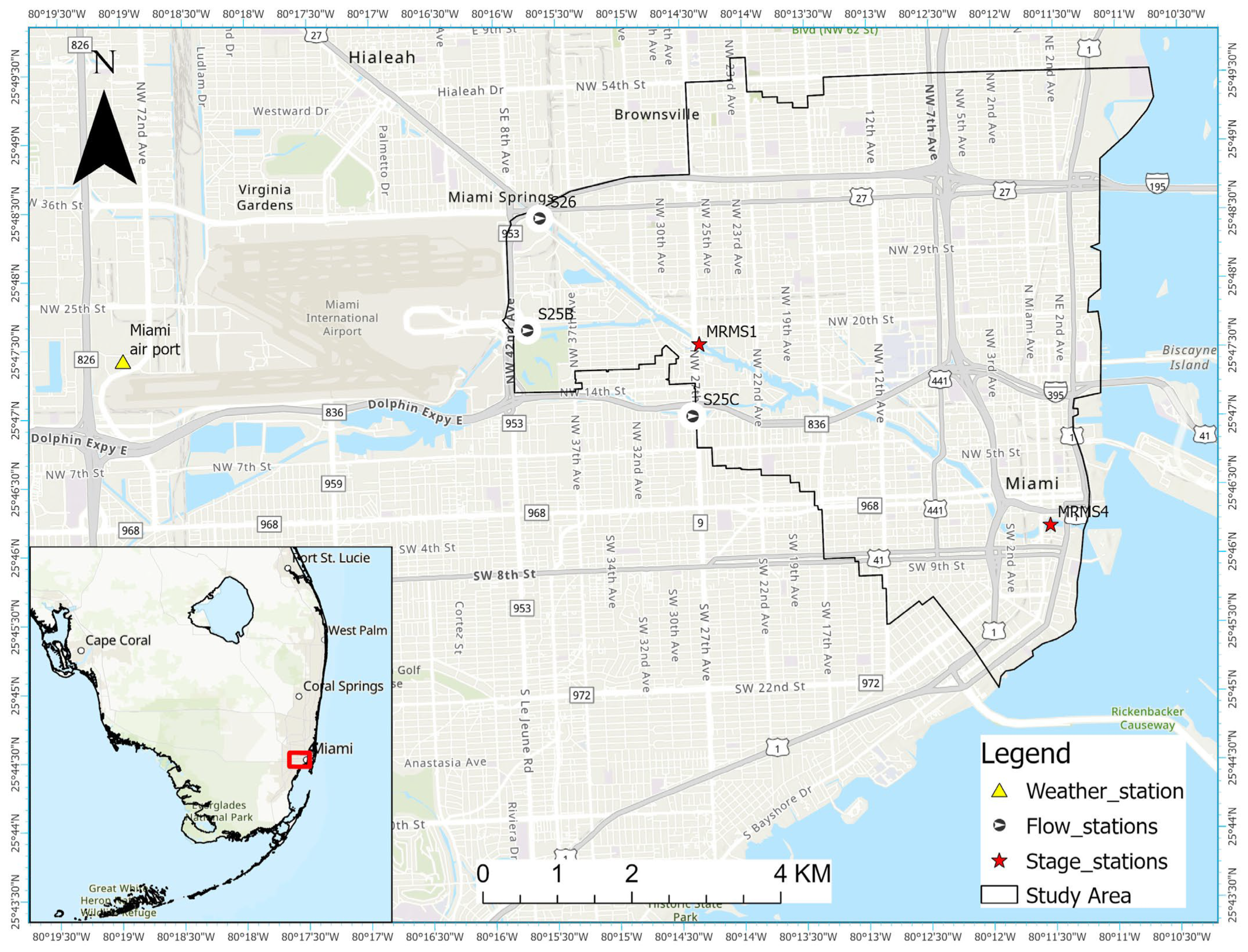
Downtown Miami, located in South Florida, is a major metropolis with high population density, numerous gray infrastructures, and a high concentration of economic activities. This economic hub is separated from the Atlantic Ocean by Biscayne Bay and Miami Beach. This placement makes the area susceptible to flooding from both hydrologic and extreme weather events. In addition to hydrometeorological events, its low elevation, high urban concentration, and proximity to the Miami River increase its risk of flooding, placing its population in extreme danger. Furthermore, most infrastructure is built on and around the Biscayne aquifer and increasing pressure on the aquifer can cause overflow of groundwater. The presence of high-density gray infrastructures in the area reduces water infiltration during extreme rainfall events, thereby increasing river discharge and water levels. Increasing the risk of multihazard inundation. To understand how different compound flooding events affect the aforementioned location, the Miami River Basin was selected as the study region, with primary focus on downtown Miami. To obtain a realistic interpretation of channel behavior during previous extreme events, the study was extended to three different stations managed by the South Florida Water Management District (SFWMD). These were S26, S25B, and S25. They can be visualized in Figure 1.

2.2. Dataset

For the production of complex hydrometeorological event simulations, precise historical data are needed. The information for our flood drivers mainly came from DBHYDRO, which is an open-source data repository for weather conditions in South Florida. Time series data for river discharge were gathered at four stations (S26, S25B, S25, and MRMS4) in cubic feet, whereas precipitation data were gathered from the Miami Airport rain gage in inches, as observed in Figure 1. All datasets were collected at 15 min intervals for consistency. Moreover, for the reproduction of a sensitivity analysis, 81 simulations were run at different time steps, Manning values, and datum correction variations. This dataset was subsequently fed into a Gradient Booster algorithm to produce a large surrogate dataset.
Table 1 Describes the type of information used as inputs for both the hydrological compound flood model and the surrogate model for sensitivity analysis in this study. It contains data used as input, description, time interval, units, and the source of each.

2.3. Methodology

This study follows similar compound simulation approaches as [10] but differentiates itself by the implementation of HEC-RAS 2D for the development of the hydrological model. HEC-RAS uses a single solver to solve multiple flood sources simultaneously in a 2D domain, which allows for the integration of multiple flood drivers needed for this research.
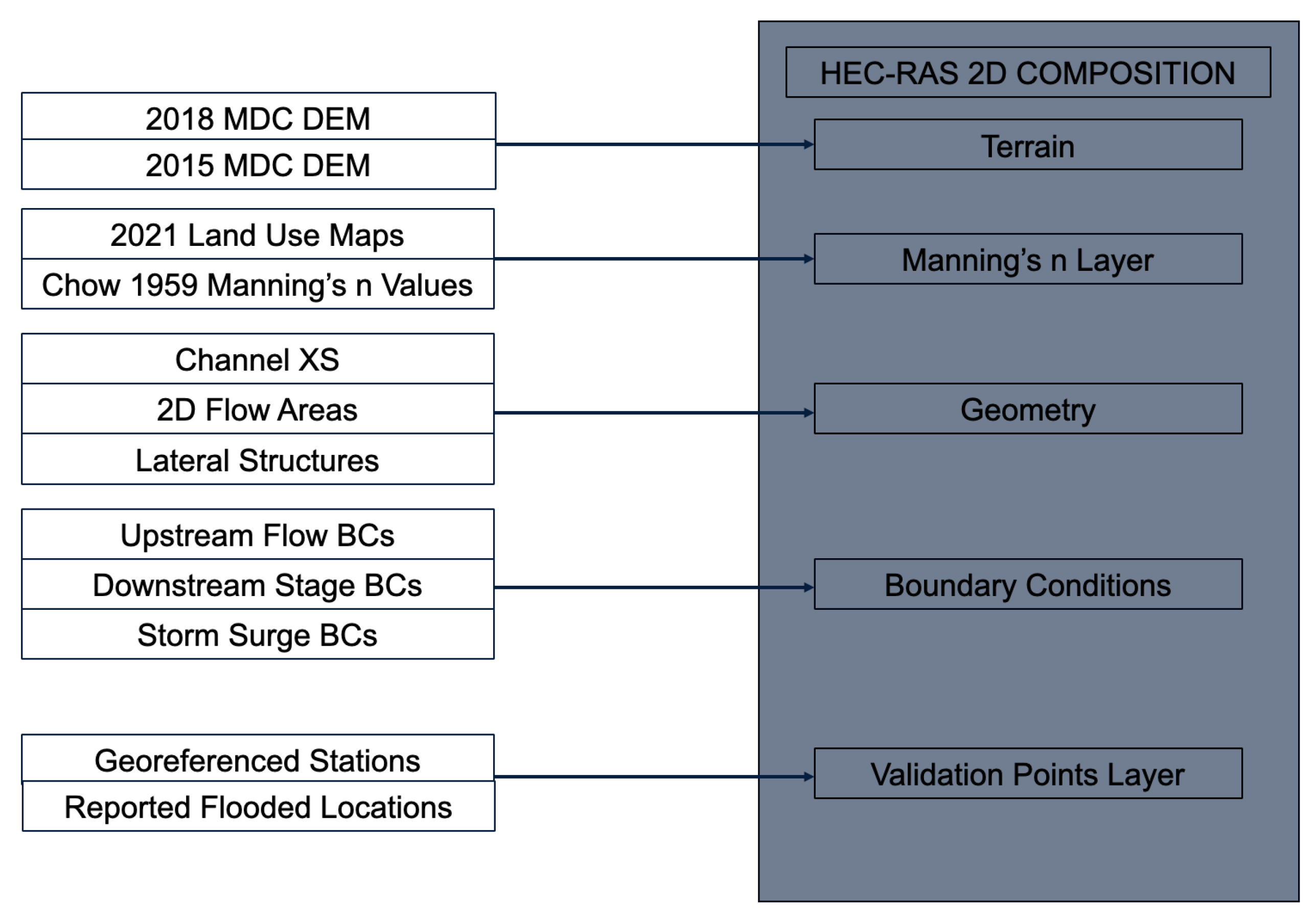
To develop a reliable compound flooding model we used terrain, land use layers, geometry, boundary condition (BC) lines, precipitation data, and reported inundation values from SFWMD stations and public sources, such as news reports. Most data were obtained from the SFWMD, DBHYDRO, and “back-bay Report” [22]. The following section displays all the major components for the development of the model and can be summarized in Figure 2.

2.3.1. Software Selection

HEC-RAS 2D was used for the development of this study due to the advantages the application provides over other available interfaces. As stated by the Army Corps of Engineers [23], the framework allows for complex two-dimensional unsteady flow simulations, which is capable of representing complex hydrodynamic interactions, such as the highly urbanized coastal area of the study domain. The software also uses structured grids, which allows improved geomorphological representation compared with other mainstream one-dimensional models.
It solves the Saint-Venant equations numerically by applying finite difference approximations. For two-dimensional models, it applies these approximations to the mentioned structured grids, instead of unstructured meshes found in finite element models. This enables the capture of dynamical processes, such as river flow, rain, and storm surge behavior. Moreover, the program is open source, and it is constantly updated by the Army Corps of Engineers. Although the software is computationally intensive, less powerful hardware can handle unsteady flow simulations efficiently.
The software is highly effective at modeling floodplain processes, such as water surface elevation, inundation extent, and flow patterns. Its unsteady flow analysis incorporates time-varying flow, nonlinear behavior, spatially and temporally changing parameters, and hydraulic inputs (e.g., flow hydrographs), which are characteristics of compound flooding events. It is also capable of emulating flow around bridges and its transition between channels and floodplains.
The governing expressions are given as a function of continuity and momentum principles for the conservation of mass and momentum at each time-step. The continuity expression ensures that the system follows a consistent water balance. The equation is as follows:
A t + Q x = 0
Here, A(x, t) represents the flow area, Q(x, t) indicates the discharge rate, t is equal to time, and x conveys the distance along the body of water. Furthermore, A t is a time derivative, representing the fluctuation in area over time. Whereas Q x is a spatial derivative, symbolizing variation in rates of flow through the bodies of water.
The momentum equation is as follows:
Q t + x Q 2 A + g A h x g A S 0 + g A S f = 0
Here, h is the height of the water surface, g denotes the acceleration as a result of gravity, S 0 denotes bed-slope, and S f represents the frictional resistance. Manning’s equation calculates this last term. Additionally, Q t stands for the time rate of change in flow, while x Q 2 A stands for the fluctuation in momentum at each unit area, and h x embodies the spatial fluctuation in water level.
Surface roughness is integrated into calculations in the form of Manning’s values. This allows for the solution of friction slope terms in the momentum equations, representing vegetation drag, bed roughness, urban resistance, and energy dissipation due to turbulence. The equations are as follows:
S f x = n 2 u u 2 + v 2 h 4 / 3
S f y = n 2 v u 2 + v 2 h 4 / 3
Here n represents Manning’s roughness coefficients. While u and v are our velocity components in horizontal directions. Lastly, h is local flow depth.
Factors such as unresolved turbulence and lateral mixing are approximated by the inclusion of Eddy Viscosity terms:
vt(2u), νt(2v)
Here, vt represents the eddy viscosity coefficient. This coefficient is user-defined in units squared per second and represents the uniform mixing in 2D grid cells. HEC-RAS solves these equations simultaneously through the whole 2D grid, allowing boundary conditions (Storm surge, precipitation, and river flow) to interact dynamically. These processes feed naturally into each other by the shallow water equations, simulating realistic compound flooding.

2.3.2. Terrain

Accurate terrain representation is critical for high-fidelity simulations in HEC-RAS. To this point, we follow a similar framework with the one used [22]. From this same study, we gathered two DEMs of 5 ft resolution, referred to as the 2018 MDC DEM and the 2015 MDC DEM. The stated maps were already converted to ft NGVD29 by the Back Bay study; they achieved this by applying a local conversion raster layer obtained from the SFWMD.
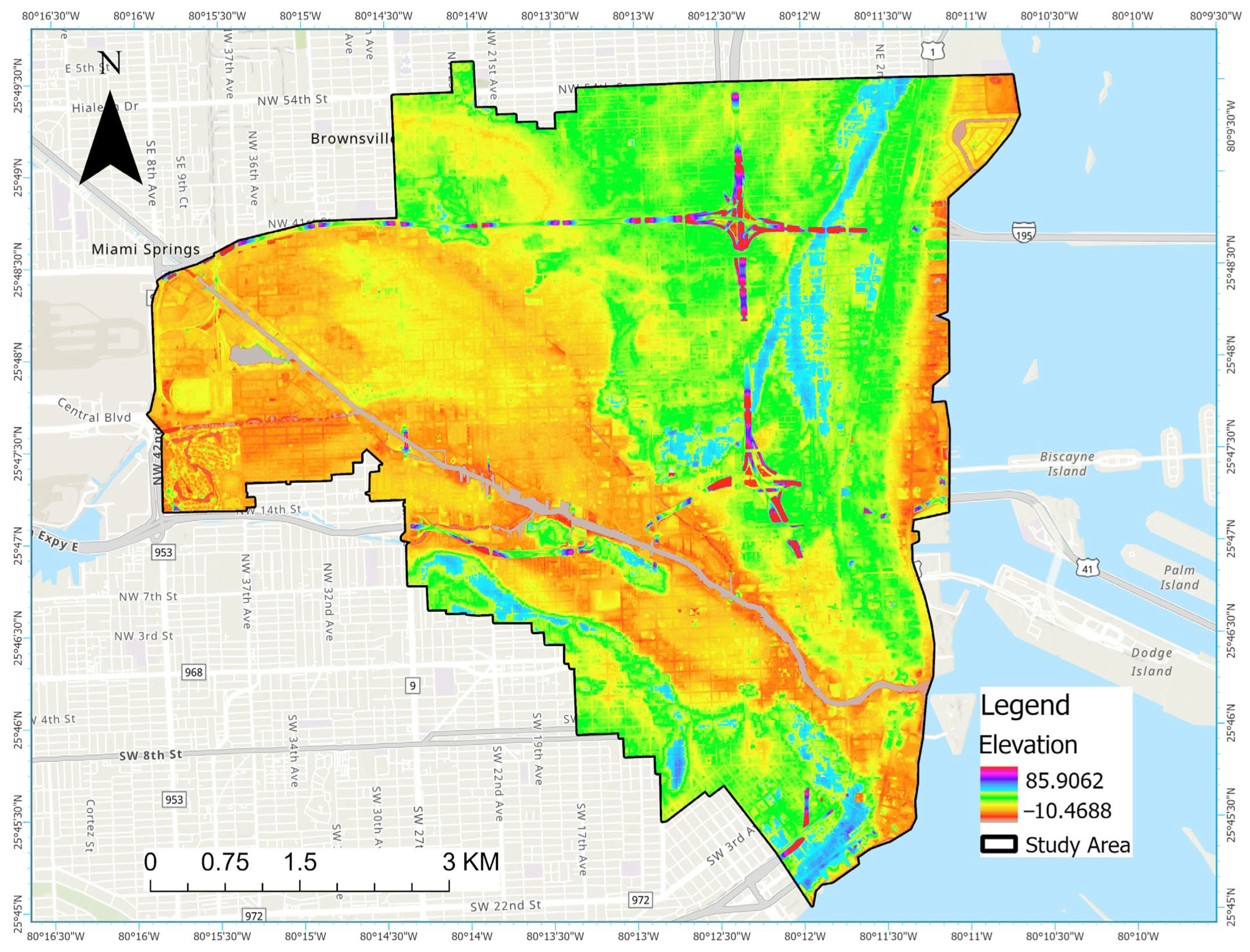
The original DEMs had missing data, which prevented the simulations execution. To address this issue, HEC-RAS’s internal stitching capability was used to overlay the 2018 MDC DEM over the 2015 MDC DEM, merging them into a single DEM (Figure 3). This final product fills any missing data from both raster layers while maintaining their resolution and increasing the coverage area. The high resolution of the DEM allows buildings to be represented within the terrain. This is beneficial, as it allows the software to perform calculations at a street level, accounting for built infrastructure.
To account for roughness at different points on our terrain, we used a land use layer originally obtained from the Miami-Dade County Open Data Hub and post-processed in ArcGIS Pro 3.6 [22]. The Land use had 13 classes, each with a specific Manning value, such as Multifamily Residential with a value of 0.15, Open Water-Lake with a value of 0.035 Parks and Open Space with a value of 0.1, etc. The selection of values was performed in accordance with [23] but refined to meet validation requirements. These values account for changes in land cover and vegetation across the domain.

2.3.3. Geometry Construction

A coupled one-dimensional/two-dimensional model was selected to balance hydraulic accuracy and computational efficiency. This approach was made based on hardware constraints, the shape of the Miami River, and the high urbanization of the area of interest. Previous studies have shown that the union of a one-dimensional channel with one or more two-dimensional flow areas dramatically reduces the computational time while maintaining high accuracy. These models are particularly effective for urban flood simulations, capturing channel flows in an efficient way while also identifying water distribution and complex interactions, enhancing predictive accuracies exceeding 87% [24,25].
One-Dimensional Geometry of the Miami River
River cross-sections used in this study were obtained from [22], which in turn gathered these parameters from older HEC-RAS models of the same watershed. These models were the FPLOS C4 watershed [26] and the Miami River watershed RAS-MODFLOW [27,28]. The models provided cross-sections for the main canals implemented in this exercise, which included the Tamiami Canal (C4), Comfort Canal (C5), and Miami River (C6). Each of these canals contained 23, 31, and 123 cross sections, respectively. River stations 5859, 5003, and 29,632 were started accordingly.
Quality control exercises were not necessary, as the previous study had already done so by removing cross-sections that did not meet the banks of georeferenced maps and adjusting the bank stations’ elevations of certain cross-sections to the actual terrain elevation. Finally, Manning’s values for the canal were maintained, similar to previous studies, keeping left and right overbanks at values of 0.1 and 0.03, respectively, for the channel.
Two-Dimensional Flow Area Geometry
Initial two-dimensional flow areas were extracted from the [22] study, which in turn were developed in ArcGIS by removing portions of the one-dimensional model. There were originally six flow meshes, covering a total of approximately 4100 hectares. Owing to the addition of a storm surge into our model, this geometry had to be modified to be capable of integrating precipitation, river, and surge flooding. To this point, four meshes were merged into two.
All these areas were discretized into grids of 40 ft-by-40 ft, with certain exceptions for refinement zones for problematic cells. These specific areas were partitioned into 10 ft-by-10 ft cell regions, which in turn solved any grid issue. After the 2D area was finished, the North Miami flow area consisted of 199,833 cells, Miami South contained 55,096, Miami River Nort was made of 11,403 cells, and Miami River West was composed of 14,688 cells.
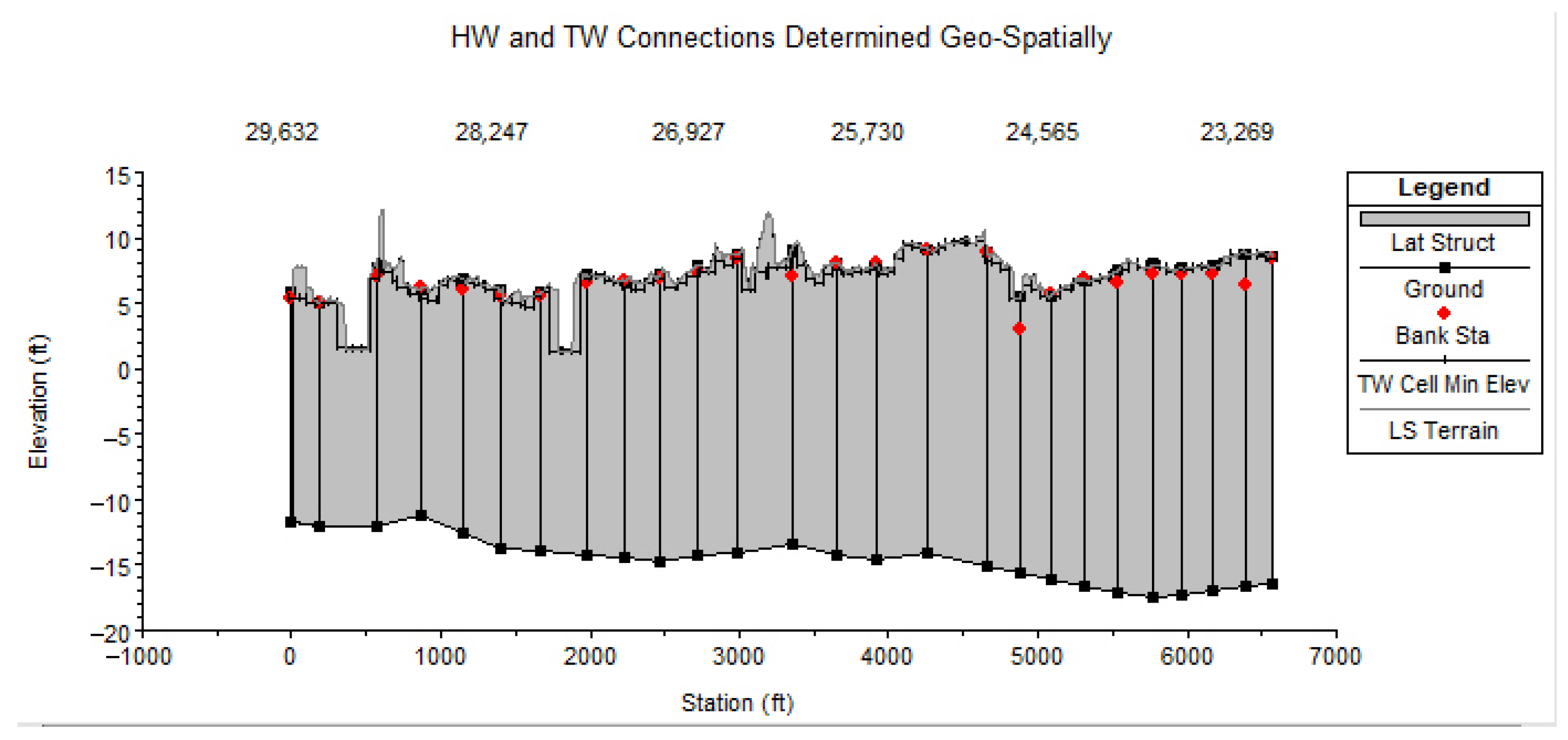
The 1D river geometry was connected to the 2D flow area by implementing zero-height weirs as lateral structures (e.g., Figure 4). Owing to the modifications made to the flow areas, all lateral structures had to be reconstructed to fit the new qualities of the model. A width of 5 ft with a coefficient of 2 was used in this model. Following this, the “Standard Weir Equation” was selected for the weir computation. The elevation of these elements was set to the elevation of the terrain along the bank. This was accomplished by clipping the weir profile to the 2D cells. The “Normal 2D Equation Domain” was used as the overflow computational method to simulate surface overflow into 2D meshes.

2.3.4. Boundary Conditions

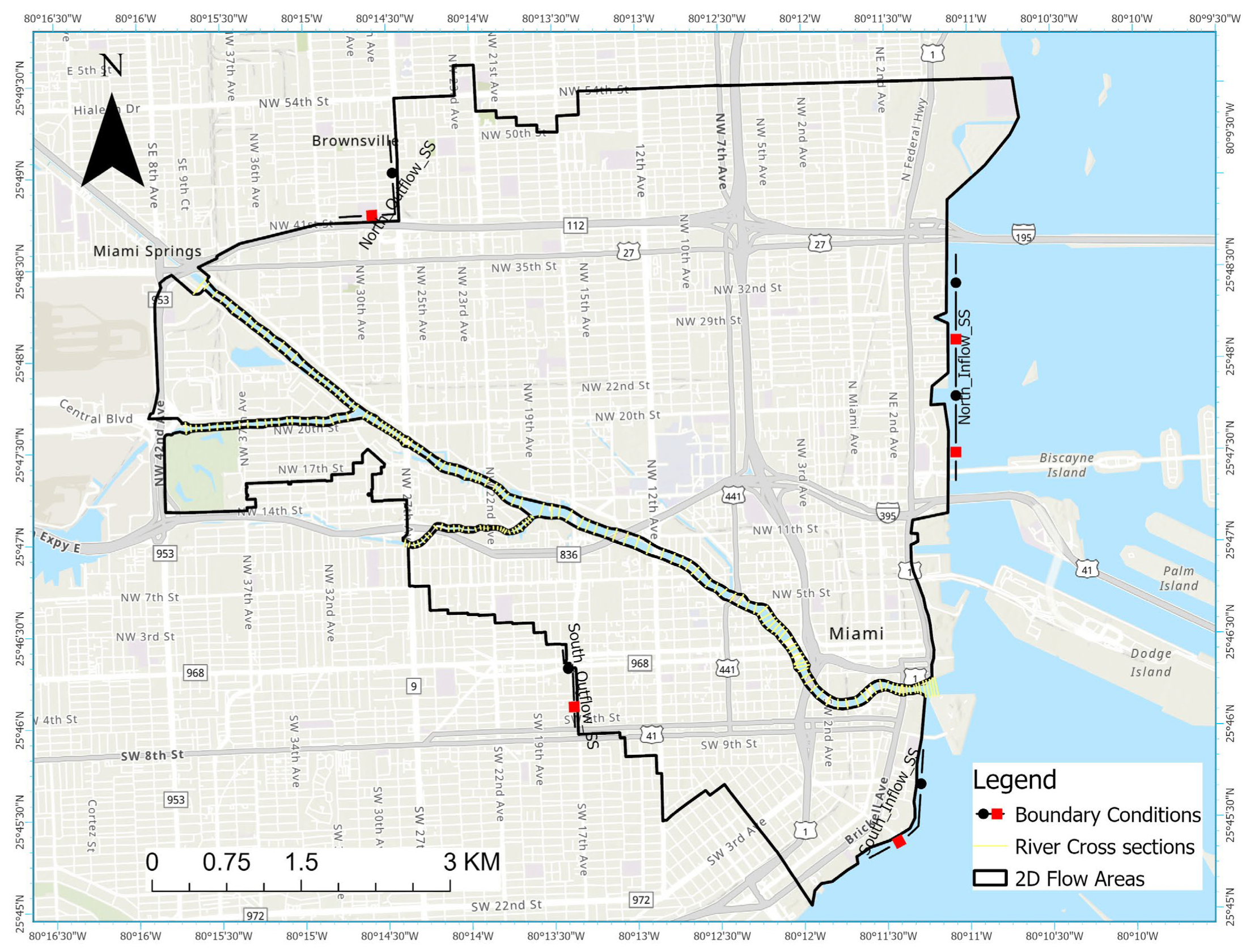
To perform unsteady simulations in this software, BCs need to be implemented into the geometry. These lines need to be located upstream and downstream of each source of water and act as inflow and outflow parameters for the model, allowing water to enter and exit the system. A total of eight BCs were implemented in the model. As seen in Figure 5. The Miami River 1D geometry uses cross-sections 5859, 5003, and 29,632 as BCs, which feed flow data in cubic feet per second. Cross-section 278 was defined as the outflow BC for the Miami River, using stage data in feet.
The 2D sections of the model have two inflow and two outflow BC lines. These inflow boundaries impose time-varying coastal water surface elevation associated with the storm surge. Stage data were used to capture the elevation of the sea at the time of the events. The two outflow BC lines were placed at the left end of the model inland. Both methods use a normal depth of 0.0003, which represents the flatness of the Miami terrain.

2.3.5. Unsteady Flow Data and Analysis

Hurricane Irma and Tropical Storm Eta were selected as real-world simulation events. For the simulation of actual hydrometeorological occurrences, data were mainly gathered from SFWMD DBHYDRO, as stated in Section 2.2. For the analysis, storm surge forcing was represented through the downstream stage BC applied along the 2D flow area boundary lines near the mouth of the Miami River and oriented parallel to the coastline. Due to the lack of continuous storm surge measurement data in the area of interest, observed water levels at station MRMS4 were used as a proxy for coastal water elevation, assuming similar stage behavior over the short spatial distance between the gage and the storm surge BC lines.
Stage values reported from station MRMS4 are referenced to a local gage datum. The terrain and hydraulic model were constructed with reference to the NGVD29 vertical datum. To reconcile both values and ensure consistency between the models’ terrain and BCs, a vertical datum adjustment of +1.28 ft, which corresponds to the difference in elevation between the gage datum at MRMS4 and NGVD29 at the BC locations, was added to the observed stage values before being introduced into HEC-RAS. This change aligns the imposed water surface elevation with the DEM, preventing artificial head losses or gains at the downstream boundary. This is critical for low gradient coastal environments, where small elevation discrepancies can substantially change surge extent and propagation [29,30].
Inside the HEC-RAS environment, the interaction of flood drivers is resolved dynamically by implementing the depth-averaged shallow water equations. Elevated water levels generated by the storm surge propagate upstream, generating backwater behavior inside the Miami River. At the same time, river inflows increase channel discharge, and spatially distributed rainfall generates runoff and overland flow inside the 2D flow area. These hydrological process interactions are calculated at each computational time step, which in turn allows the compound flood to occur from the aggregate effect of river overflow, coastal forcing, and Hortonian overland flow.
After the unsteady flow data were gathered and correctly input into HEC-RAS, multiple simulations were run in the model for Hurricane Irma and Tropical Storm Eta. The simulations were performed at timesteps of 1 min, 30, 15, 10, 5, and 1 s for both events. The number of iterations per 2D area was increased to 40 to minimize error, and a warm-up period of 12 h was used to keep the model stable. The results produced from the analysis were consistent with reported flood values.

2.3.6. Validation and Calibration

To validate and calibrate our model, we follow a similar methodology to that of [30,31]. For this purpose, we selected Hurricane Irma as the main validation event. We collected multiple reported data from the storm, which would indicate flood depth and extent. These included social posts, news articles, high water marks (HWM) from the coast, maximum stage values from stations along the Miami River, and flow hydrographs to compare simulation results. Social media reports would be mainly derived from Twitter, while new sources would include entities such as the Miami Herald and the Washington Post. Stage hydrographs would be derived from two different stations, MRMS1 and MRMS4. These two locations were selected due to them being situated in the middle and the end of the Miami River, with sufficient distance from the boundary conditions.
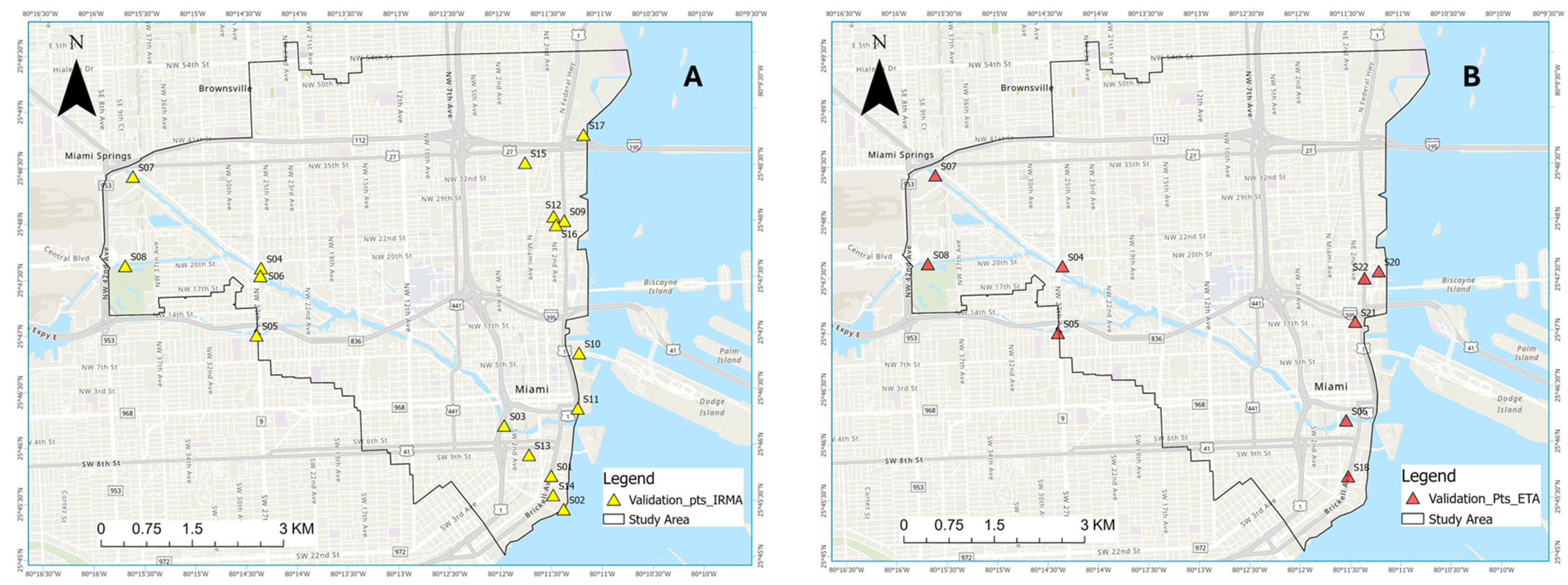
This spatial separation is crucial for model evaluation, as it reduces artificial agreement between simulated and observed hydrographs, which can result when stations selected for validation are situated too close to data input locations. By analyzing model performance at interior sections, simulation output hydrographs more accurately reflect the dynamic integrated hydrological response of the system. This includes lateral exchanges between the river and the rest of the floodplain, backwater effects, interactions between precipitation and runoff, and channel conveyance, instead of deterministic propagation generated from input flow behavior data. Validation points, on the other hand, would serve to validate the event flood extent inside the study domain. Validation points can be visualized in Figure 6.
Validation points, georeferenced locations, and sources can be found in Table 2 and Table 3. Hydrographs can be visualized in Figure 7 and Figure 8. Satellite images were also considered for the validation process, but due to the fine spatial resolution of our study, these images were too coarse to detect neighborhood-level street flooding.
Validation at Selected Stations
In addition to location-based validation shown in Table 2 and Table 3, station-based validation has been performed on selected stations across the Miami River. Two stations-MRMS1 and MRMS4 (locations shown in Figure 1), were found to have continuous data of water depth measured during both events. Thus, data from these stations were extracted from DBHYDRO database, compared to simulated water depth values, and the results are reported.
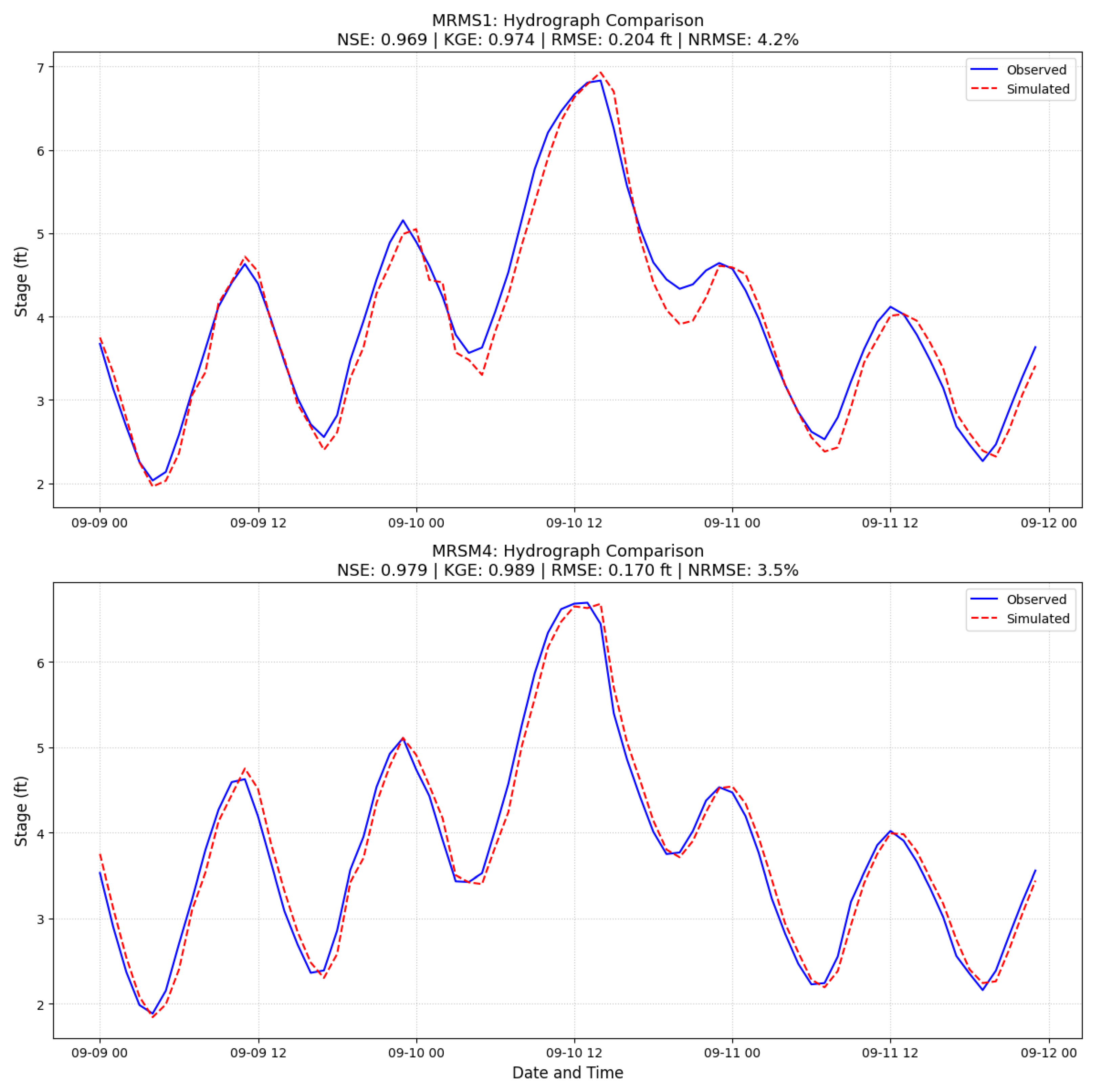
Validation metrics for this study were selected in accordance with [32]. These were Nash-Sufficient Efficiency (NSE), Kling-Gupta Efficiency (KGE), Root Mean Square Error (RMSE), and Normalized Square Error (NRMSE). These metrics evaluate error by magnitude, measuring actual disagreement between the model and reality. Simulations for the selected validation storm (Irma), the model exhibited strong performance across all performance metrics, resulting in minimal error and high accuracy, capturing the event hydrographs’ shape and timing for both stations, as observed in Figure 7. Moreover, it resulted in faithful flooding extent when compared to validation points. This supports the robustness of the model and its calibration for extreme compound event reproduction.
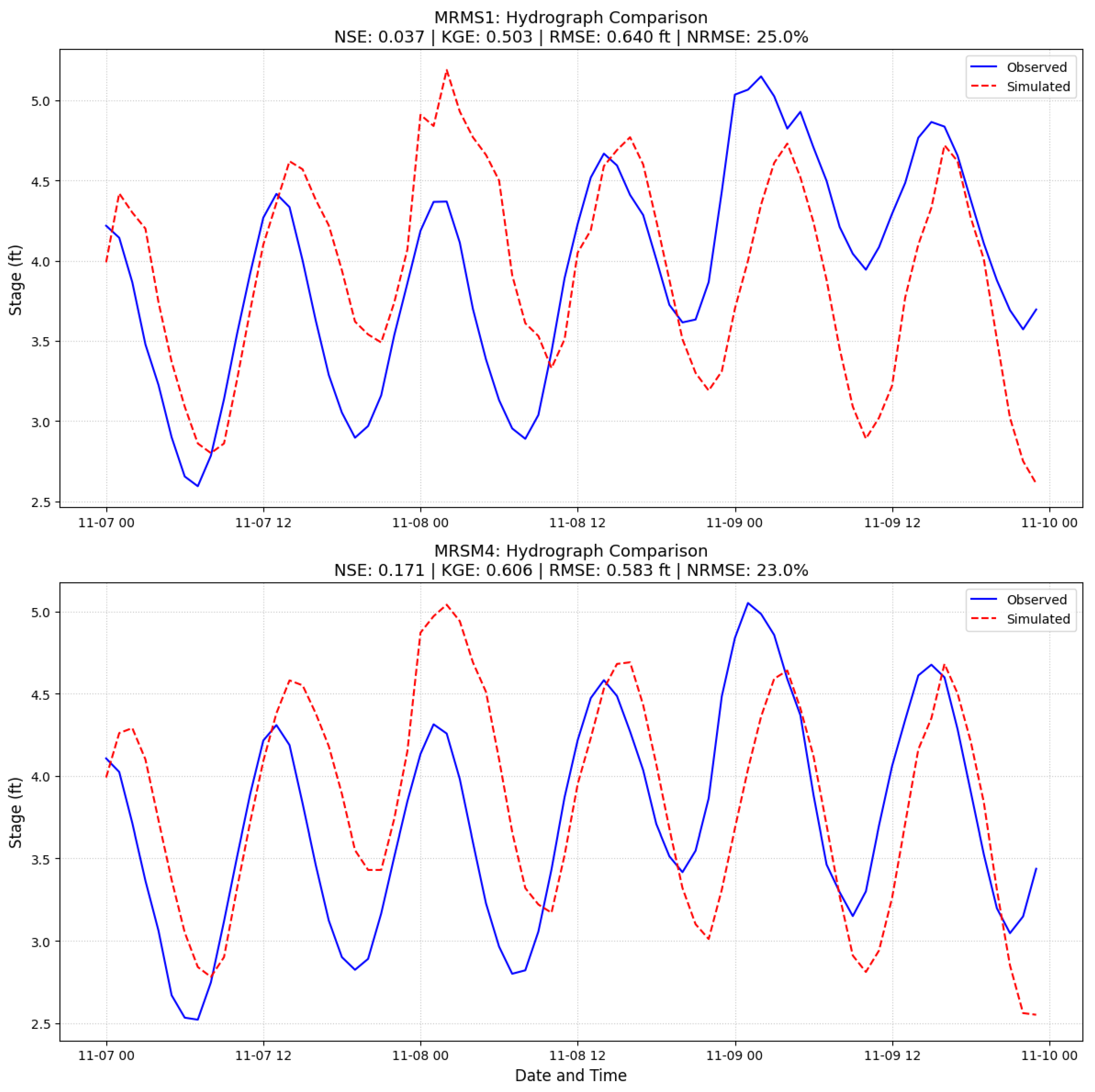
We performed a similar test for Tropical Storm Eta. In this scenario, the system underperformed, being unable to capture the hydrographs’ magnitudes and timing, while showing a higher degree of error for both stations, as observed in Figure 8. We go into more detail regarding the implications of lesser accuracy for small event reproduction in Section 4.

2.3.7. Reproduction of a 50-Year and 100-Year Design Event in Miami

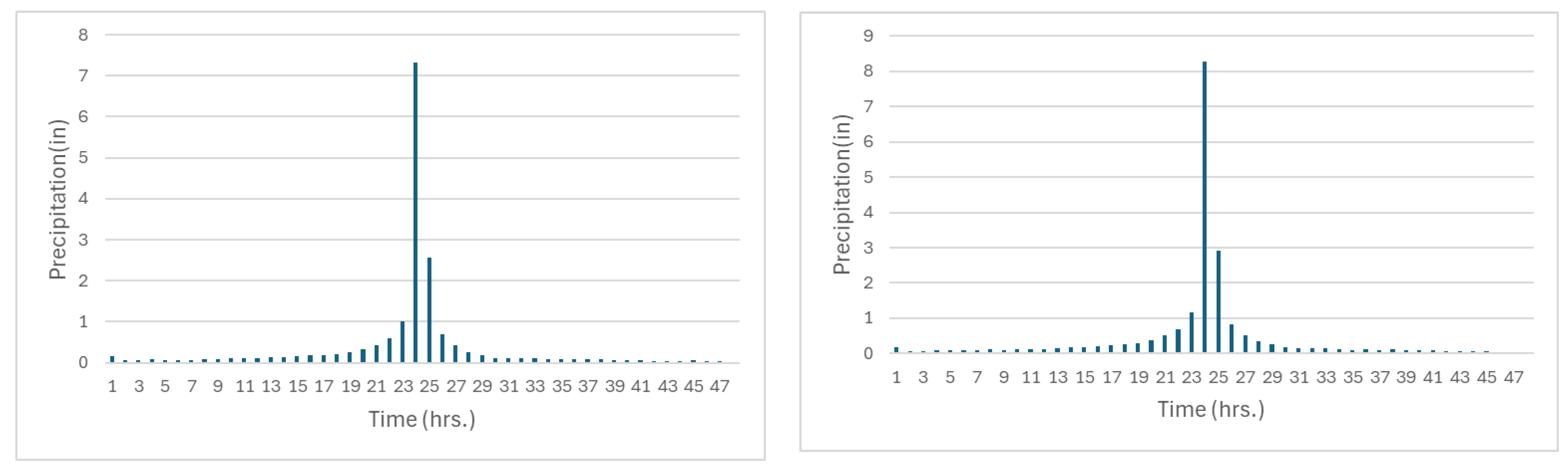
For the reproduction of design storms with return periods of 50 and 100 years, we followed steps similar to those outlined in the Sea Level Solutions Center’s Back Bay report. We gathered 50-year and 100-year 24 h total rainfall depths from Miami International Airport. This was performed through the NOAA Atlas 14 from the Miami International Airport. We then deviate from the study by using HEC-HMS instead of PCSWMM because it is free to use and straightforwardly distributes total event precipitation for the simulation time in 15 min intervals based on straightforward dimensionless hydrographs. These can be visualized in Figure 9.
We assumed baseline Irma flow and stage hydrographs to produce a hybrid rain-on-grid simulation. These represent antecedent hydrological and coastal boundary conditions. We selected this approach to computationally simulate extreme, high-impact hydrometeorological conditions, in which extreme precipitation interacts with already elevated river and coastal stages, consistent with stress testing practices in compound flooding [18].
The hybrid rain-on-grid configuration allows the software to reproduce the interaction among the mentioned flood drivers. This produces realistic stage hydrograph responses, as described by [32]. While the introduction of alternative stage and flow hydrographs may produce different results, the applied configuration generates a conservative estimation of flood risk under extreme compound forcing conditions. The rain-on-grid configuration requires the input of a 50-year and 100-year return period extreme precipitation events depicted in Figure 9 [33].

2.3.8. Layer Development

As a final part of our study, result layers were generated to showcase the results of the study. This process included the construction of risk and maximum depth ArcGIS maps. The first layer was developed by establishing risk as Depth × Velocity and using the layer export calculation feature integrated in HEC-RAS, classifying the layers into values of 0.25, 0.5, 1.5, and 2.5 for low, medium, high, and extreme risk, respectively. Following FEMA guidelines [34]. For the maximum depth overlay, the same feature was used to extract the values from the simulation results at the highest inundation time step. Finally, the results were imported into ArcGIS and put into maps for more comprehensive interpretation.

3. Results

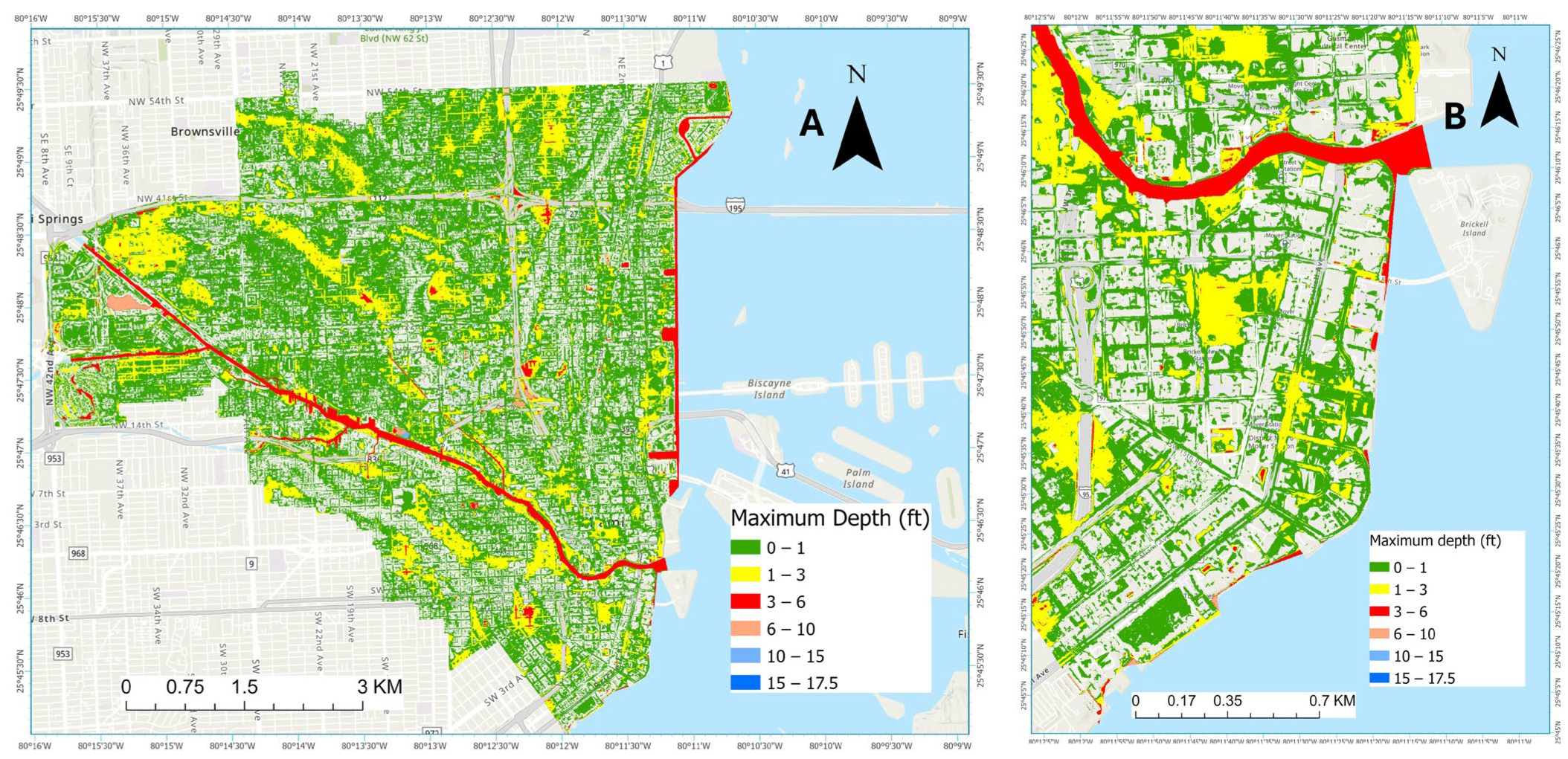
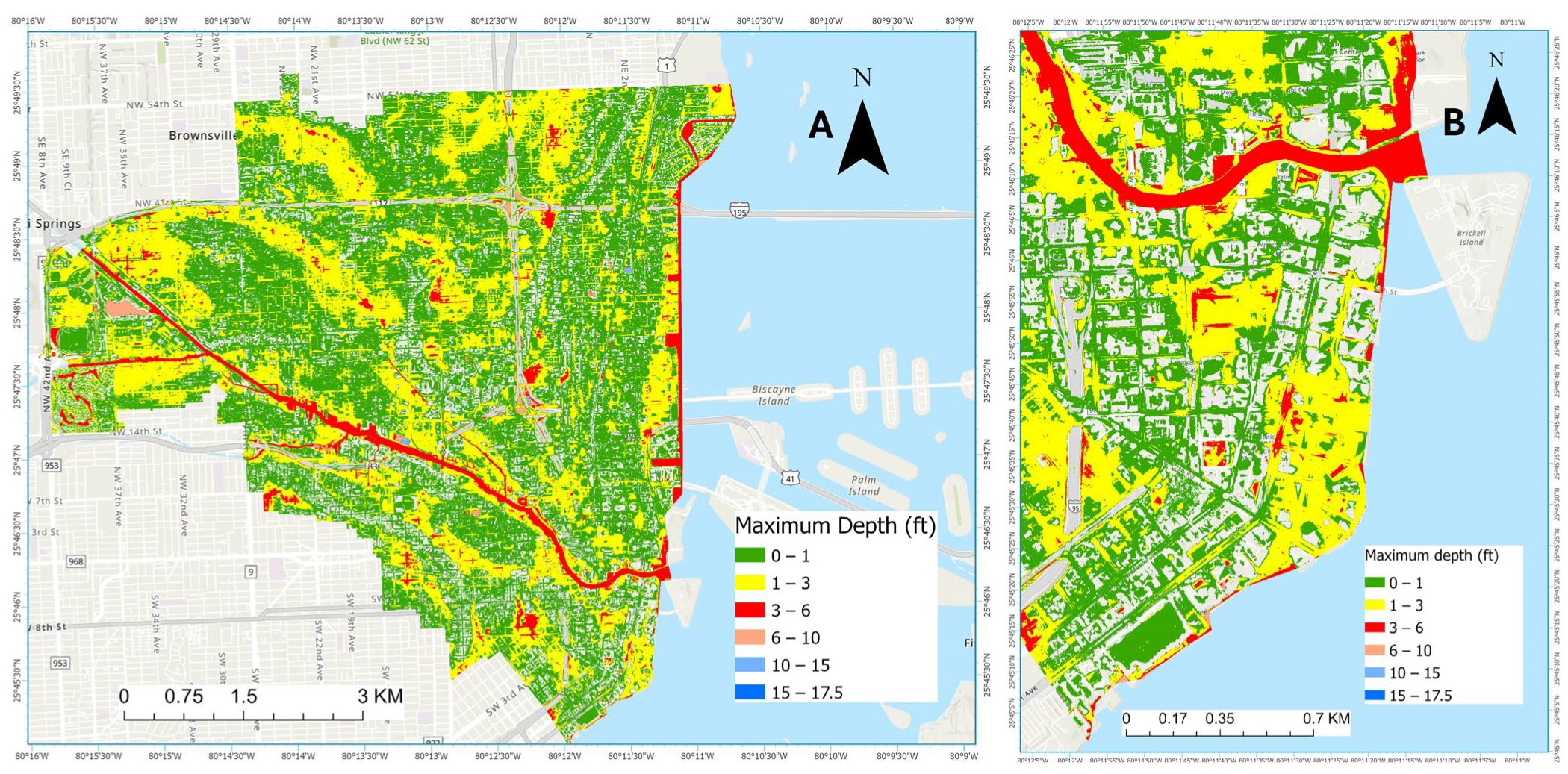
Simulations for the 50 yr and 100 yr design events provided insightful results on the vulnerability of Miami and its downtown area. These two events indicate that the whole portion of the city is at risk of flooding in the range of 0.2 inches to 6 feet, with small pockets of 17.5 feet without counting the river. These pockets are localized, being exacerbated by backwater effects as a result of the interaction of high river inflow and storm surge forcing. Moreover, areas situated along rivers and bays seem to be severely affected by hydrological conditions, such as overflow and high amounts of runoff being compounded with riverine overflow. Similar to flooding patterns observed for Hurricane Irma, as shown in Figure 10. Locations such as North Brickel, Brickel Bay, the neighborhood of Edgewater, Omni, Little Havana, and Miami International Airport (MIA) find themselves in a dangerous position. The areas are positioned in zones affected by river flooding, storm surges, or the combination of the two, placing them at the high end of the maximum depth map shown in Figure 11A. The figure also visualizes high depth in areas farther from the river, including Allapattah, Midtown, and deeper portions of Little Havana. These findings indicate that these portions of the city are vulnerable mainly to precipitation and run-of-flood events because of their low elevation.
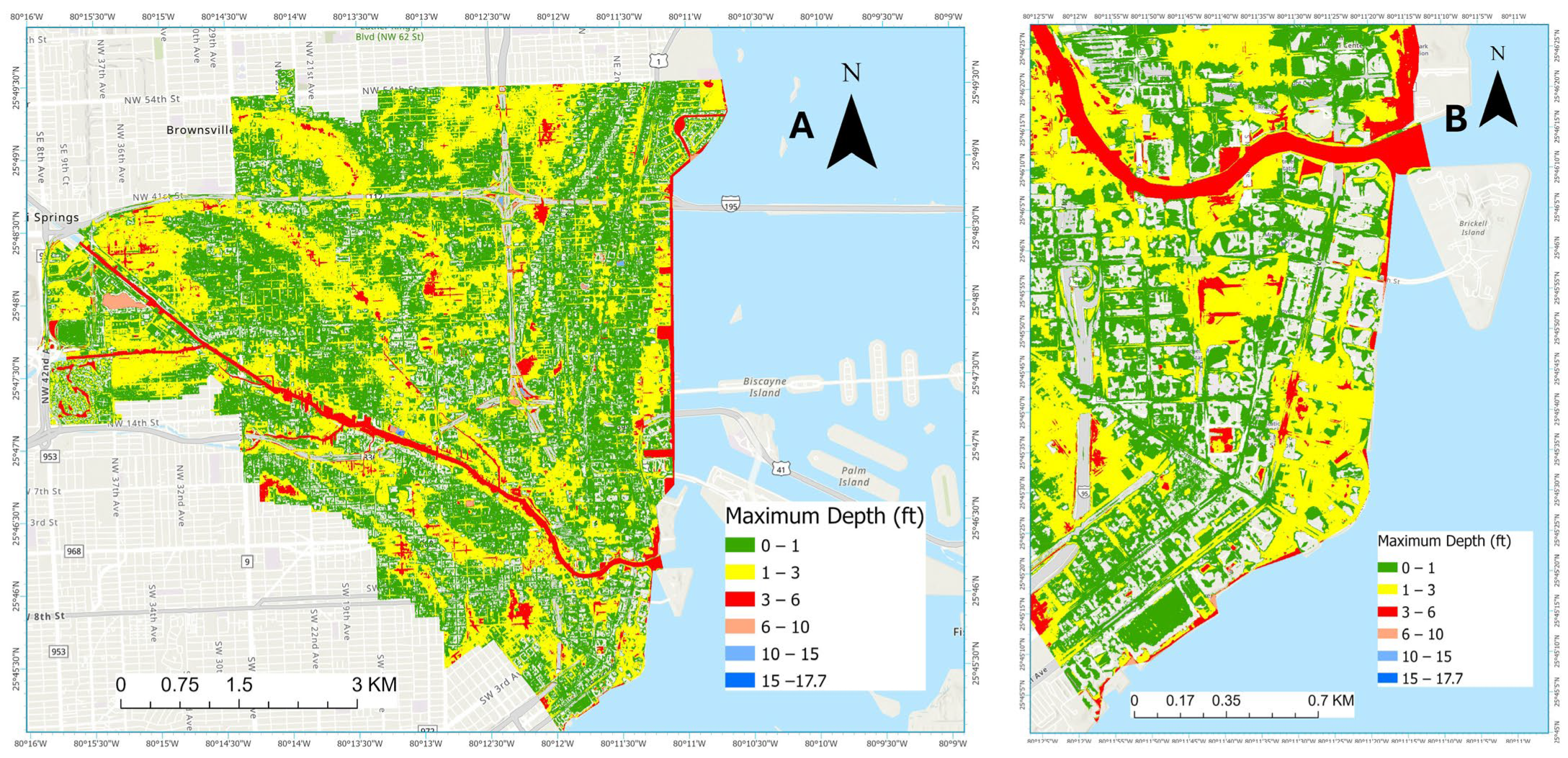
For the 100-year design return event, the simulation produced the following results, which are visualized in Figure 12A,B. Maps indicate areas at risk of 1–3 feet of flooding. Subsequently, it showed a high increase in the presence of 6 ft of inundation. These areas include Brickell, Little Havana, Park West, Wynwood, MIA, and Allapattah. The highest depth reached 17.5 ft as mentioned in the previous paragraph; however, these extreme values were confined to small, spatially isolated pockets with limited areal extent. The downtown area results are problematic. The area is highly vulnerable to street flooding and is parallel to Hurricane Irma. The flooding reaches up to 6 feet and includes areas such as Brickell Avenue, the RiverPark Park Metro station, SW Third St, Brickell Bay, and Simpson Park. Tide-influenced waterfront properties, the top elevation of seawalls and any other shoreline protection structure must be built at a minimum height of 5.0 feet above sea level at the NGVD29 datum. This is troublesome, as at the established height construction requirements stated in [35], these properties could still be in danger of being inundated under 50- and 100-year conditions.
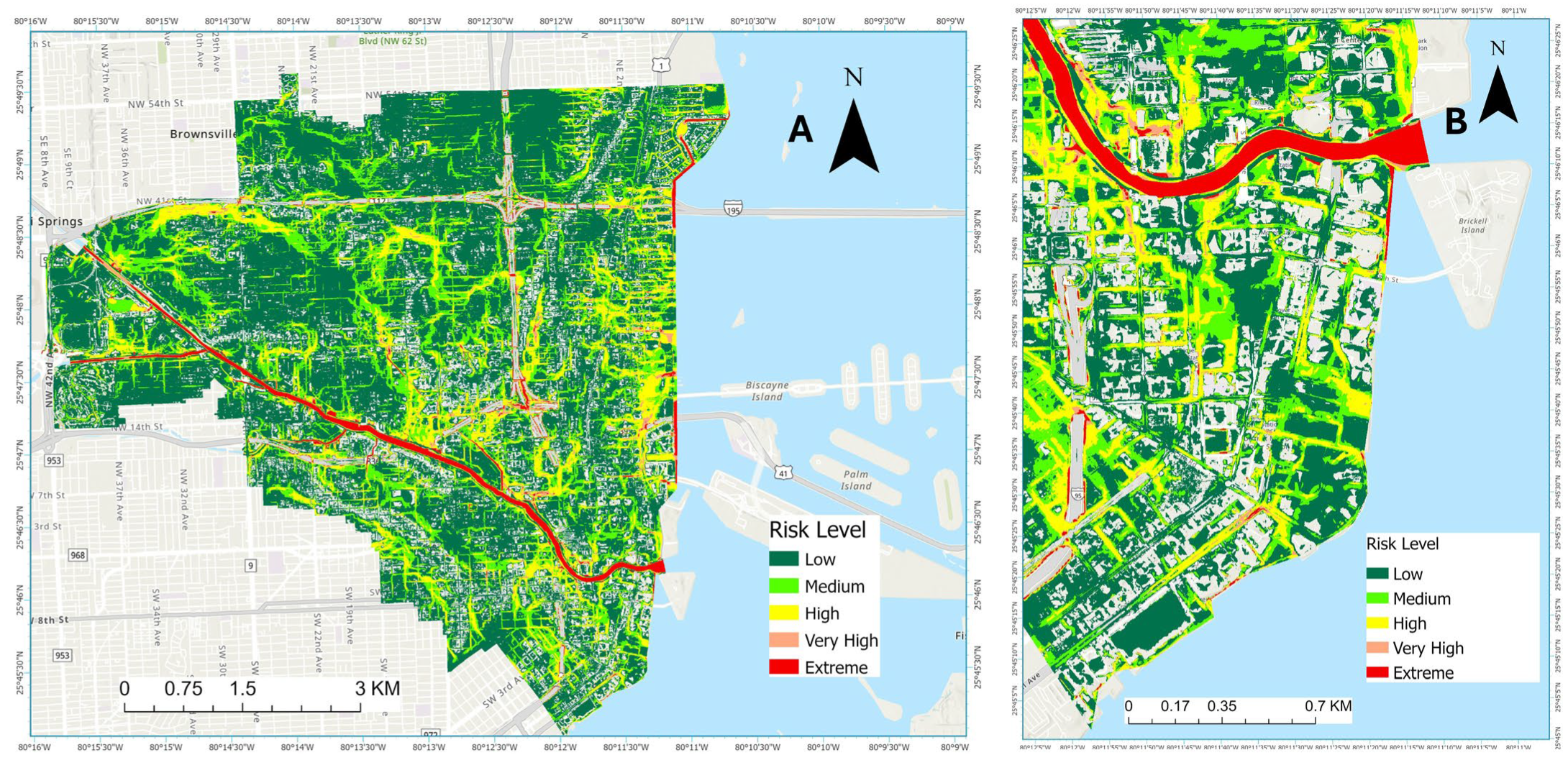
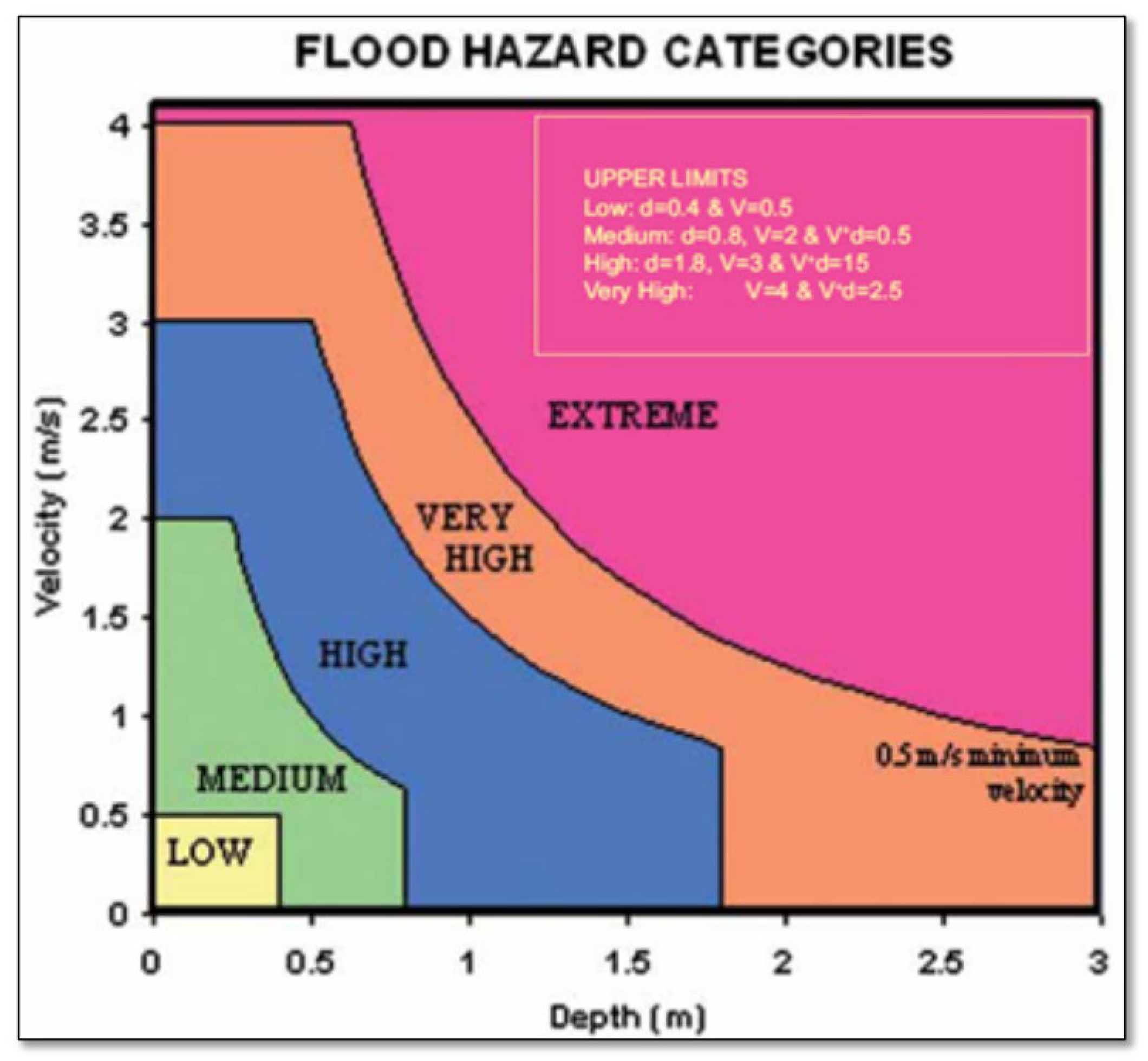
In the hopes of aiding in the production of effective and efficient policies, Figure 13A,B incorporates flood hazard categories. This was done in accordance with [34] and can be visualized in Figure 14. These indicate the populations at the most immediate risk from the 100-ear event. The inclusion of the risk parameter in Figure 13 allows us to pinpoint the most vulnerable areas. These locations are portions of OMNI, Edgewater, Midtown, Wynwood, almost the whole of Little Havana, Buena Vista, and Allapattah. Downtown is in severe danger of full street flooding to extreme levels, as visualized in Figure 13. When the risk areas for both 50-year and 100-year events were quantified, 34,530,341.18 square meters were determined. Among these, 67% were categorized as low, 18% as medium, 11% as high, 1% as very high, and 2% as extreme risk. In the case of the second synthetic event, there was an increase of 2.41% in flooded areas. In this scenario, there was an increase in medium- and high-risk areas to 21% and 14%, respectively. Very high and extreme risk also increased, but to a small extent.

3.1. Socioeconomic Impacts

Table 4 summarizes population and housing exposure by neighborhood under a 100-year compound storm scenario. It includes average income and education, dominant flood risk classification, and key physical exposure. We identified nine Miami neighborhoods, with populations ranging from 10,004 in Overtown to 53,431 in Little Havana, and housing units ranging from 6295 in Upper Eastside to 20,349 in Little Havana, according to the Statistical Atlas website and the U.S. Census Bureau’s American Community Survey 5—Year Estimates. Neighborhoods classified as Extreme/Very High include both Brickel and Downtown. Combined, they account for a population of 41,538 residents and 21,425 housing developments. Areas classified as High Risk include Wynwood—Edgewater, Upper Eastside, Overtown, Little Haiti, and Allapattah. These neighborhoods account for 112,580 residents and 42,862 living units. Medium-risk populations are in Little Havana and Flagami neighborhoods. These two put together account for 105,669 residents and 38,455 living units. Physical exposure indicates that all areas are characterized by their low elevation. Moreover, proximity to the coast is prevalent in most at-risk areas, and proximity to the Miami River is common among high-risk inland areas.

3.2. Sensitivity Analysis

After the calibration and validation of our model, a sensitivity analysis was subsequently performed following an approach similar to that of [25,29] to determine the effects of multiple input parameters on the flooding max depth at station MRMS4. The selected independent parameters were our datum correction, Manning values, and timestep of simulations, as their variation creates the most uncertainty in our model. To understand the sensitivity of our model to these inputs, local and global sensitivity tests were performed. This type of analysis requires large datasets to perform optimally and produce robust results. Here is where we found ourselves in an issue. Owing to the high computational demand from HEC-RAS 2D to perform simulations and our hardware limitations, a more creative approach must be considered. To overcome this, a surrogate model was developed to compensate for the size of our dataset. These emulators are simple and efficient mathematical models that estimate the behavior of more complex simulations. These methods are widely used today to simulate intricate environmental processes [36].
Two algorithms were tested against a dataset containing 81 simulations. These include Scikit-learn Random Forest Regressor and Historical Gradient Boosting Regressor. Both of these algorithms are ensemble learning techniques based on decision trees, but they differ in their learning frameworks. Random Forest consists of the development of multiple decision trees using bootstrap resampling and random feature selection, each resulting in an individual conclusion. The model reaches a consensus by averaging the final result of all trees. In contrast, the Gradiant Booster instead develops trees sequentially, each improving on the previous one, reducing residual errors. This process improves performance in nonlinear and heteroscedastic systems.
Table 5 summarizes the ranges and statistical properties of the HEC-RAS dataset used to train our surrogate model, including variations in Manning’s values, datum corrections, and time step calculations.
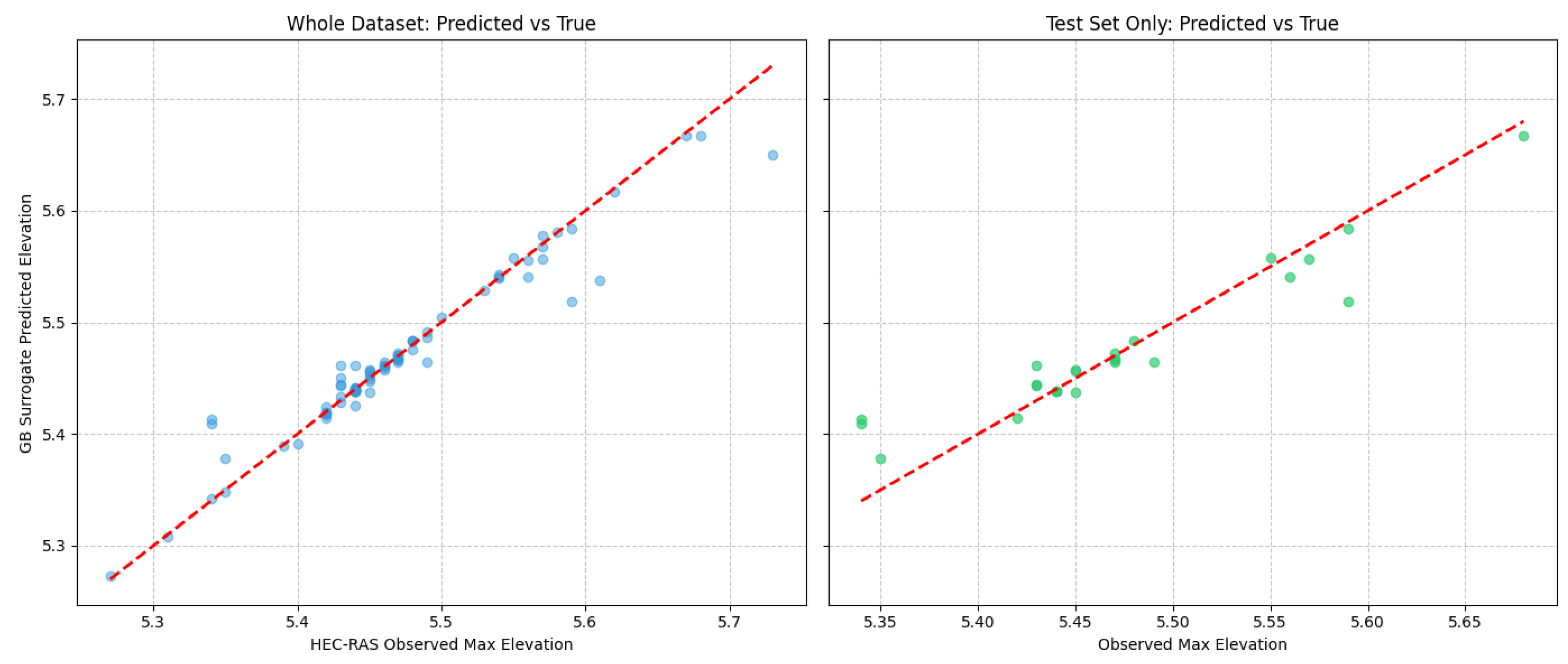
For the selection of the best model, we performed initial testing, hyperparameterization, and sanity checks to compare performance. The gradient booster regressor outperformed the random forest in all tests, obtaining a coefficient of determination of 87.8% after hyperparameterization, 14% higher than the RF model. Moreover, it produced an RMSE of 0.0277 ft, 0.0131 lower than the RF. When we plotted surrogate models’ predictions vs. HEC-RAS produced values, both models produced heavy tails. This means that both struggle when predicting outliers. Yet, the gradient booster was more tightly clustered to the diagonal line, meaning it will generalize better to these extreme values, which can be visualized in Figure 15. However, this model is still only trained on 81 simulations and should only be considered valid within the ranges shown in Table 5. Application of this model to other hydrological models for analysis would require retraining.
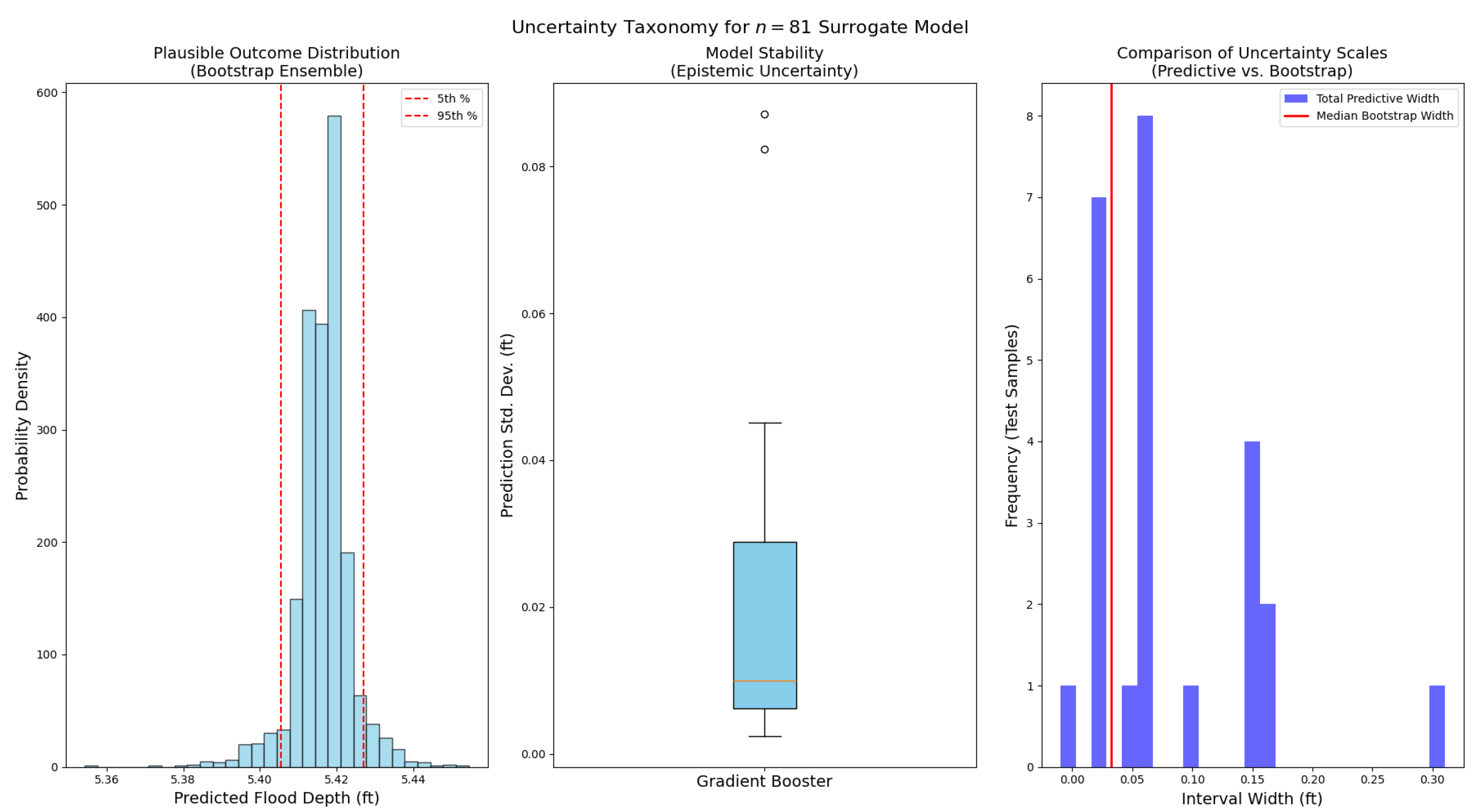
As explained in a study, uncertainty needs to be represented through ranges of possible outcomes instead of single-point estimations [37,38]. It must be based on conditional outcome uncertainty rather than statistical confidence. Epistemic uncertainty tied to our data-driven surrogate model was calculated by applying nonparametric bootstrap resampling. Multiple gradient boosters were trained on resampled versions of the training dataset with replacement. For each test point, we obtain a new distribution of predictions influenced by parameter perturbations, model sensitivity, and learning variability, instead of model bias. This framework aligns with the uncertainty taxonomy proposed by Marcha, as uncertainty is represented through an ensemble of possible model predictions and their resulting distributions, instead of a singular model’s confidence intervals.
Figure 16 is composed of three panels. Here, the first panel shows the plausible flood depths results obtained from nonparametric bootstrap resampling of the mentioned 81 simulations dataset, which contains two red dashed lines representing the 5 and 95 percentiles. The center panel shows the model stability by displaying the distribution of prediction standard deviations across 2000 simulations. It represents epistemic uncertainty associated with the model structure and the limited data used to generate it. The last panel to the right compares predictive uncertainty with bootstrap variability. It visualizes that the total uncertainty is generated from noise and variation in our parameters, not model bias or sensitivity.
The results from our uncertainty analysis demonstrate that the surrogate model shows high stability, with relatively small bootstrap variability. However, the comparison between bootstrap-derived uncertainty from panel a and predictive uncertainty from panel c shows that the overall uncertainty is dominated by aleatoric variability. This variability is associated with the volatility of compound flood drivers, instead of epistemic uncertainty tied to model bias or instability from the constructed surrogate system. These results support the robustness of the trained Gradient Booster surrogate for the task at hand.
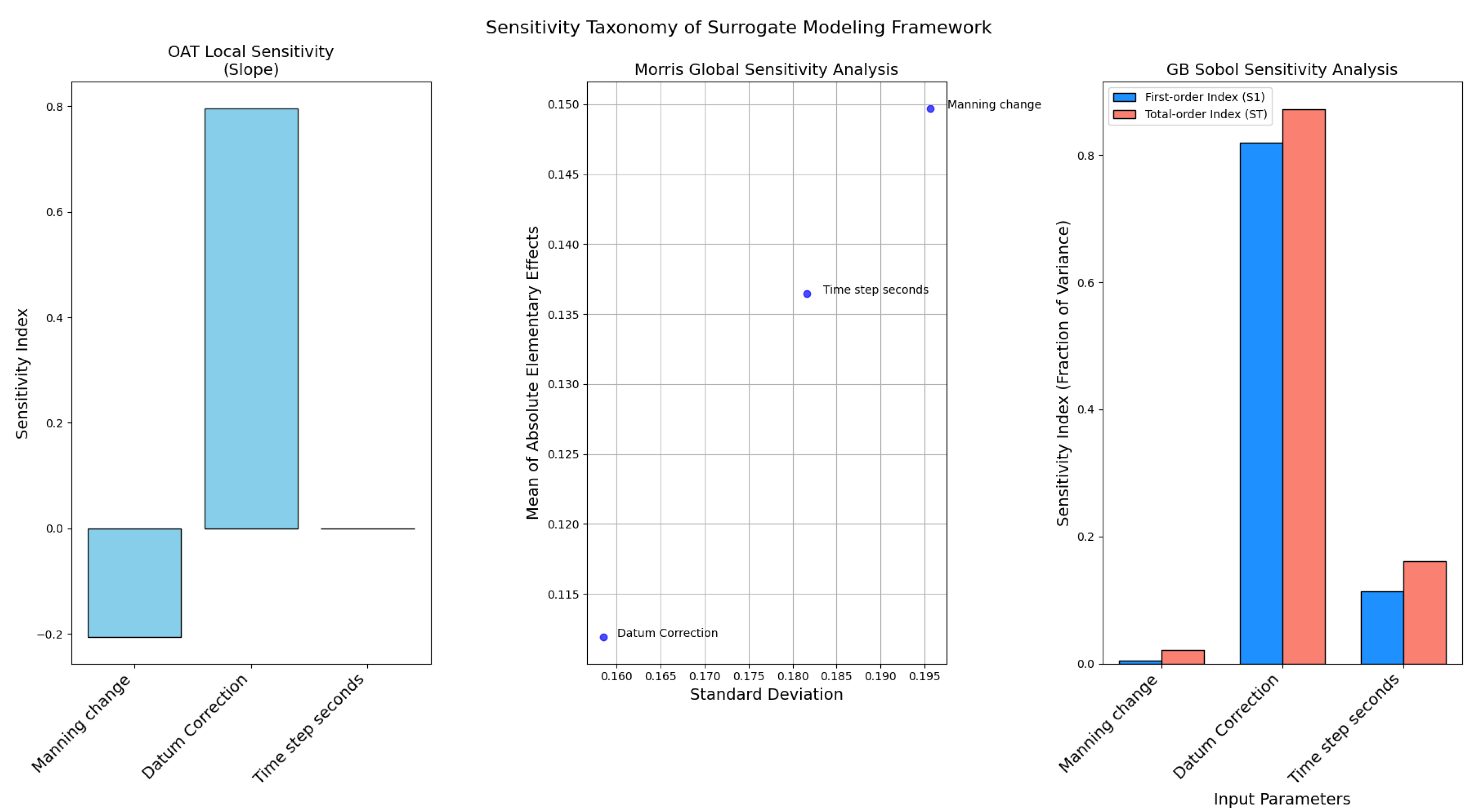
After algorithm selection and model uncertainty analysis, we moved to perform a local and global sensitivity analysis on our selected model. The one-at-a-time (OAT) method was implemented for the local examination following [25] methodology. This method is an initial test to understand how the model output parameter transforms with the variation in a single input, whereas all other inputs remain unchanged at a baseline. As for the global counterpart, which provides a more robust understanding of parameter influence on the overall model, a Morris and a Sobol analysis were performed.
The OAT analysis indicates that the model is the most sensitive to datum correction, while being less impacted by adjustments to manning values and time step for calculations. The Morris analysis showed a different result, indicating the time step selection as having the most influence, with Manning adjustment having secondary influence. However, the Sobol analysis deviated from the other two. It identified datum correction as the critical input. The first-order Sobol index (S1) is 0.8226, and its total-order index (ST) is 0.8784. The time step was identified as having the second most influence. Our model was the least sensitive to changes in Manning values, but it still showed some impact on the model. We can conclude that the model is most sensitive to the datum correction. Results from the three analyses can be visualized in Figure 17 below.

4. Discussion

The analysis performed in this study provides important insight into urban resilience of the Miami area and compound flood drivers. There exists a complex interaction between precipitation, river inundation, and coastal forcing in driving flooding in Miami [10,39]. These hydrological factors, as well as other prevailing physical factors, determine spatial differentiation in flood extent and depth across Miami neighborhoods. For example, areas situated along the coast, such as Brickel and Downtown, are characterized by low elevation, minimal terrain slopes, and proximity to Biscayne Bay, making these areas extremely sensitive to storm surges. Inland communities like Wynwood–Edgewater, Upper Eastside, Overtown, Little Haiti, and Allapattah, also located at low elevation, have more proximity to the Miami River, making them sensitive to overflows and backwater effects during extreme compound events exacerbated by high precipitation. Areas situated on higher elevations, such as Little Havana and Flagami, have reduced influence from coastal water bodies; however, they are still susceptible to flooding from inland water systems and limited drainage gradients.
The impact of flooding in the Miami area is not only limited to spatial variability but also varies with economic and resilience status in different neighborhoods, and this has been confirmed in recent studies like [40,41]. We translated simulated flood extent into potential socio-economic impacts by analyzing population and housing exposure at a neighborhood scale under a 100-year event scenario (Table 4). From this analysis, we derived that neighborhoods classified as extreme or very high risk, despite having a high exposure, are associated with a high median household income and an education level, which suggests a higher capacity to recover from and adapt to extreme events. High-risk areas also with low elevation and more proximity to the Miami River exhibit a lower household median income and education level, thus suggesting more vulnerability in comparison to coastal neighborhoods. Medium-low risk areas, despite mildly higher elevation, are most vulnerable due to low income. This indicates a high social variability in addition to spatial differences in exposure to flooding events [40,42,43,44].
Similarly to existing studies [10,18,22,39], our model correctly assumed a correlation between different flood drivers (storm surges, river flooding, and precipitation) but further integrates runoff and flow values to produce more realistic results. The model performed well, having Courant numbers (distance/timestep) less than 2 for a 15 s timestep for both 50 and 100-year events. The 100-year event initially produced courant numbers above 8, indicating a more intense process and possible divergence of the model. This was resolved by reducing the timestep to 1 s to improve the output of the model. One of the major challenges with reduced timesteps is the high computational time and cost of producing simulations due to the need to calculate complex equations at each time step over a large area. These constraints limit high reproducibility, increasing the difficulty of performing robust uncertainty analysis. Furthermore, the model showed high sensitivity to time step selection for simulation reproduction. Large timesteps produce high errors, making the results unreliable. The need to perform calculations at timesteps of 10 s or less highly affects the computational time and cost. However, high reproduction of both historical and synthetic data is imperative in today’s unpredictable climate. Stationarity and the use of historical information have increasingly become less reliable [45]. Thus, large reproductions of synthetic data event simulations are necessary, which HEC-RAS currently lacks.
Our model also demonstrated a strong performance in the production of large, complex events with coastal surge, but not with shorter-term events like flash floods. This was deduced from less intense, shorter-duration events, such as Tropical Storm Eta, which underperformed when evaluated. Arguably, the performance of the model with a short-term event is expected, as it was originally optimized for the reproduction of extreme events driven by the compounding of river, coastal, and rainfall dynamic interaction. This highlights the trade-off of configuring a model for optimizing extreme compounding events and accurately reproducing shorter, localized rainfall-driven floods. We recommend further research on the reproduction of intense, shorter-term events, such as flash floods, especially in coastal tropical regions like South Florida. Moreover, the probability of these extreme events is not quantified in this research; our primary goal is to determine a flood extent during extreme flooding in Miami neighborhoods.
While statistical approaches such as joint probability analysis, copula-based methods, and extreme value theory (EVT) are being used to estimate the likelihood of a compound flood event occurring, these methods mainly focus on estimation rather than event impact quantification [3,18]. In this study, a deterministic approach was intentionally selected to determine the impact of flood depth and the extent of extreme hydrometeorological events. The selected return periods should be considered as a stress test to evaluate the possible impact and exposure these events exacerbate on the study area, rather than a probability estimate of their occurrence.
Low-lying karst regions like Miami, where groundwater rises during extreme hydrometeorological events, can reduce infiltration capacity and exacerbate flooding through upward seepage [14]. This is a particularly influential inundation driver during prolonged precipitation or elevated coastal water conditions. However, our model configuration is most optimal for surface hydrologic modeling, excluding groundwater as one of the factors considered in this study. Flood depth in certain locations situated inland on low elevations or poorly drained areas may be underestimated, as subsurface inundation could emerge as the primary flood driver. Meanwhile, Ref. [14] who used a coupled model to assess compound flood with surface and subsurface hydrometeorological drivers, recommended prioritizing storm surge, especially for extreme compound events related to hurricanes.
It is also important to acknowledge that our model treats rainfall patterns from the Miami airport as uniform, even though this is a standard practice in hydrological studies such as [22]. The lack of variability in rainfall data could result in underestimates for localized extreme rainfall. New rain gauges have recently been installed in the Miami-Dade area by organizations such as Florida International University. The data available from the gauges is still very short. Future studies could benefit from introducing data from these gauges to capture pluvial spatial patterns.
Although the validation and calibration of the coupled one-dimensional/two-dimensional model was extensive, residual uncertainty is inherent to the established framework. This is primarily attributed to simplified processes representation and data limitations. Due to this, results should be treated as indicative of spatial and temporal patterns instead of absolute values. However, the consistency of results across simulations, and sensitivity and uncertainty analysis supports the robustness of findings. Future studies could reduce uncertainty by applying recommendations suggested above.
Compound flooding in low-elevation coastal areas results from the combination of multiple flood sources. In Miami, contributions of each of these sources vary temporally and spatially [46]. Event-based analysis indicates that under Irma-like conditions, storm surge is the main flooding driver for neighborhoods (e.g., Brickell and Downtown) situated on the coast. In this scenario, higher coastal water levels produce backwater effects, exacerbating flooding. On the other hand, simulations performed under Tropical Eta-like characteristics are mainly influenced by fluvial and pluvial effects. In this scenario, flooding is concentrated inland around the Miami River due to overflow caused by increased runoff due to high precipitation and a shallow drainage slope. In the case of synthetic 100-year conditions, the combinations of these flood drivers produce the most extreme flood conditions. In this case, the surge dominates the coastal areas, while river overflows attribute the most inundation for inland communities, which is aggravated by heavy rainfall. The separation of flood drivers spatially makes it clear that the variability in observed flood patterns cannot be attributed to a single driver, and severe flooding occurs from the dynamic interaction of multiple factors, which amplifies when they coincide temporally and spatially [46].

5. Conclusions

The HEC-RAS 1D/2D compound model approach was successful in the production of previously occurring complex hydrometeorological events as well as extreme design storms via synthetic data. The inclusion of a machine learning algorithm was also a novel integration to the sensitivity analysis of our model, and its robust framework provided conclusions in line with actual model behavior. However, the model is still constrained by multiple limitations. The high computational time and cost make the reproduction of multiple simulations for uncertainty analysis difficult. Conducting thousands of runs for a robust conclusion is something we are unable to do with the time and resources at hand. Coupled models that implement ML techniques to predict dependent parameters (e.g., Max Depth) seem promising. Moreover, the experiment was performed for large-scale extreme events. Further study on flash storms and less intense events can be beneficial for future studies. Similarly, consideration of sea level rise is necessary for future projections, as the model is based on present conditions and does not account for future higher sea levels, which could produce higher risk scenarios. Subsurface flooding and king tides should also be considered, as they can further exacerbate risk.
The results indicated that Miami and its downtown area are vulnerable to fluvial and pluvial flooding as well as storm surges from both mild and extreme hydrometeorological events. Both the population and economic impact of these types of hazards are immense because these areas are major commercial hubs and home to thousands of residents. Areas farther from the ocean (e.g., Little Havana) are highly vulnerable to river and rainfall flooding because of their low elevation and high degree of urbanization. Under 100-year flood conditions, 35,362,805.81 m2 are at risk of flooding. Thirty-eight percent of these areas are in the range of medium to extreme risk, as categorized by FEMA standards. Future studies should focus on more efficient and reproducible simulations to produce more results and reduce uncertainty, as well as the implementation of new rain gages introduced by FIU around the city to reduce rain uniformity caused uncertainty. Mitigation strategies for these areas should also be considered, such as the reduction in impermeable infrastructure and the inclusion of nature-based solutions (NBSs) to minimize flooding and reduce vulnerability, and increase the height of storm protection infrastructure for waterfront properties. Sanitary expansion and rehabilitation, as well as the integration of mangrove forests, are viable strategies and should be considered in future models.

Author Contributions

Conceptualization, A.E.G. and A.D.S.; data curation, A.D.S.; funding acquisition, A.M.M.; formal analysis, A.E.G., A.D.S. and A.T.-O.; investigation, A.E.G. and A.D.S.; methodology, A.E.G.; project administration, A.E.G.; resources, A.M.M.; software, A.E.G.; supervision, A.M.M.; validation, A.M.M.; visualization, A.E.G., A.D.S. and A.T.-O.; writing—original draft preparation, A.E.G., A.D.S. and A.T.-O.; writing—review and editing, A.E.G., A.D.S., A.T.-O. and A.M.M. All authors have read and agreed to the published version of the manuscript.

Funding

This research received no external funding.

Data Availability Statement

DEMs used in this study are available at the Miami-Dade Open Data Hub https://mdc.maps.arcgis.com/home/item.html?id=dbe8e32049df428793afe8870408974d (accessed on 20 February 2025). Hydrographs are used for precipitation, water discharge, and stage can be located in DBHYDRO https://www.sfwmd.gov/science-data/dbhydro (accessed on 5 March 2025). The Python 3.13 script used for the sensitivity analysis can be provided upon request at agumb006@fiu.edu via email.

Conflicts of Interest

The authors declare no conflicts of interest.

Abbreviations

The following abbreviations are used in this manuscript:
BCBoundary Condition
CVCross-Validation
DEMDigital Elevation Map
FEMAFederal Emergency Management Agency
FIUFlorida International University
GBGradient Booster
HEC-RASHydrologic Engineering Center-River Analysis System
IPCCIntergovernmental Panel on Climate Change
MDCMiami-Dade County
NGVD29National Geodetic Vertical Datum of 1929
OATOne At a Time
R2Coefficient of Determination
RFRandom Forest
RMSERoot Mean Square Error
SFWMDSouth Florida Water Management District

References

  1. Green, J.; Wong, T.; van der Velde, Y.; Kumbier, K. Review article: A comprehensive review of compound flooding literature with a focus on coastal and estuarine regions. Nat. Hazards Earth Syst. Sci. 2025, 25, 747–816. [Google Scholar] [CrossRef]
  2. Intergovernmental Panel on Climate Change. Managing the Risks of Extreme Events and Disasters to Advance Climate Change Adaptation: A Special Report of Working Groups I and II of the Intergovernmental Panel on Climate Change; Field, C.B., Barros, V., Stocker, T.F., Qin, D., Dokken, D.J., Ebi, K.L., Mastrandrea, M.D., Mach, K.J., Plattner, G.-K., Allen, S.K., et al., Eds.; Cambridge University Press: Cambridge, UK, 2012. [Google Scholar] [CrossRef]
  3. Leonard, M.; Westra, S.; Phatak, A.; Lambert, M.; van den Hurk, B.; McInnes, K.; Risbey, J.; Schuster, S.; Jakob, D.; Stafford-Smith, M. A compound event framework for understanding extreme impacts. Wiley Interdiscip. Rev. Clim. Change 2014, 5, 113–128. [Google Scholar] [CrossRef]
  4. Nyatuame, M.; Agodzo, S. Analysis of Extreme Rainfall Events (Drought and Flood) over Tordzie Watershed in the Volta Region of Ghana. J. Geosci. Environ. Prot. 2017, 5, 275–295. [Google Scholar] [CrossRef]
  5. Pescaroli, G.; Alexander, D. Understanding compound, interconnected, interacting, and cascading risks: A holistic framework. Risk Anal. 2018, 38, 2245–2257. [Google Scholar] [CrossRef] [PubMed]
  6. Santiago-Collazo, F.L.; Bilskie, M.V.; Hagen, S.C. A comprehensive review of compound inundation models in low-gradient coastal watersheds. Environ. Model Softw. 2019, 119, 166–181. [Google Scholar] [CrossRef]
  7. Bilskie, M.V.; Hagen, S.C. Defining flood zone transitions in low-gradient coastal regions. Geophys. Res. Lett. 2018, 45, 2761–2770. [Google Scholar] [CrossRef]
  8. Sampurno, J.; Vallaeys, V.; Ardianto, R.; Hanert, E. Integrated hydrodynamic and machine learning models for compound flooding prediction in a data-scarce estuarine delta. Nonlinear Process. Geophys. Discuss. 2022, 2022, 301–315. [Google Scholar] [CrossRef]
  9. Hanson, S.; Nicholls, R.J.; Terribile, F.; Hallegatte, S.; Corfee-Morlot, J. A global ranking of port cities with high exposure to climate extremes. Clim. Change 2011, 104, 89–111. [Google Scholar] [CrossRef]
  10. Peña, F.; Obeysekera, J.; Jane, R.; Nardi, F.; Maran, C.; Cadogan, A.; de Groen, F.; Melesse, A. Investigating compound flooding in a low elevation coastal karst environment using multivariate statistical and 2D hydrodynamic modeling. Weather. Clim. Extrem. 2023, 39, 100534. [Google Scholar] [CrossRef]
  11. Teng, J.; Jakeman, A.J.; Vaze, J.; Croke, B.; Dutta, D.; Kim, S. Flood inundation modeling: A review of methods, recent advances and uncertainty analysis. Environ. Model. Softw. 2017, 90, 201–216. [Google Scholar] [CrossRef]
  12. Arduino, G.; Reggiani, P.; Todini, E. Recent advances in flood forecasting and flood risk assessment. Hydrol. Earth Syst. Sci. 2005, 9, 280–284. [Google Scholar] [CrossRef]
  13. Apel, H.; Thieken, A.H.; Merz, B.; Blöschl, G. A probabilistic modeling system for assessing flood risks. Nat. Hazards 2006, 38, 79–100. [Google Scholar] [CrossRef]
  14. Peña, F.; Nardi, F.; Obeysekera, J.; Melesse, A. Compound flood modeling framework for surface–subsurface water interactions. Nat. Hazards Earth Syst. Sci. 2022, 22, 775–793. [Google Scholar] [CrossRef]
  15. Bermúdez, M.; López, J.; Neal, J.; Bates, P.D.; Coxon, G.; Yamazaki, D. Assessing the effects of climate change on compound flooding in coastal river areas. Water Resour. Res. 2021, 57, e2020WR029321. [Google Scholar] [CrossRef]
  16. Bunya, S.; Dietrich, J.C.; Westerink, J.J.; Ebersole, B.A.; Smith, J.M.; Atkinson, J.H.; Jensen, R.; Resio, D.T.; Luettich, R.A.; Dawson, C.; et al. A high-resolution coupled riverine flow, tide, wind, wind wave, and storm surge model for southern Louisiana and Mississippi. Part I: Model development and validation. Mon. Weather. Rev. 2010, 138, 345–377. [Google Scholar] [CrossRef]
  17. Bush, S.T.; Chu, A.; Avci, S.; Tullos, D.D. Use of 1D unsteady HEC-RAS in a coupled system for compound flood modeling: North Carolina case study. J. Mar. Sci. Eng. 2022, 10, 306. [Google Scholar] [CrossRef]
  18. Jane, R.; Cadavid, L.; Obeysekera, J.; Wahl, T. Multivariate statistical modeling of the drivers of compound flood events in South Florida. Nat. Hazards Earth Syst. Sci. 2020, 20, 2681–2699. [Google Scholar] [CrossRef]
  19. Gori, A.; Lin, N. Projecting compound flood hazard under climate change with physical models and joint probability methods. Earth’s Future 2022, 10, e2022EF003097. [Google Scholar] [CrossRef]
  20. Čepienė, E.; Kriaučiūnienė, J.; Meilutytė-Barauskienė, D.; Rimkus, E. Sea level rise impact on compound coastal river flood risk in Klaipėda City (Baltic Coast, Lithuania). Water 2022, 14, 414. [Google Scholar] [CrossRef]
  21. Gutenson, J.L.; Tarboton, D.G.; Castronova, A.M.M.; Maidment, D.R. Comparison of estimated flood exposure and consequences generated by different event-based inland flood inundation maps. Nat. Hazards Earth Syst. Sci. 2023, 23, 261–277. [Google Scholar] [CrossRef]
  22. Sea Level Solutions Center, Florida International University. Miami-Dade County Back Bay Coastal Storm Risk Management Feasibility Study: Hydrodynamic Modeling and Initial Water Quality Evaluations Supporting the Federal Feasibility Study. Available online: https://environment.fiu.edu/slsc/resources/ (accessed on 19 January 2025).
  23. Chow, V.T. Open-Channel Hydraulics; McGraw-Hill: Columbus, OH, USA, 1959. [Google Scholar]
  24. Kalimisetty, S.; Singh, A.; Korada Hari Venkata, D.R.; Venkateshwar Rao, V.; Mahammood, V. 1D and 2D model coupling approach for the development of operational spatial flood early warning system. Geocarto Int. 2021, 37, 4390–4405. [Google Scholar] [CrossRef]
  25. Tang, Z.; Chu, J.; Zhou, Z.; Zhou, T.; Yuan, K. The sensitivity analysis of parameters in the 1D–2D coupled model for urban flooding. Appl. Sci. 2025, 15, 2157. [Google Scholar] [CrossRef]
  26. South Florida Water Management District. Draft Final Report Flood Protection Level of Service (LOS) Analysis for the C-4 Watershed; South Florida Water Management District: West Palm Beach, FL, USA, 2016.
  27. South Florida Water Management District. Draft Report Miami River Watershed RAS-MODFLOW OpenMI Integration of Groundwater/hydraulic Models; South Florida Water Management District: West Palm Beach, FL, USA, 2012.
  28. South Florida Water Management District. C2, C3W, C4, C5 & C6 Watersheds: FPLOS Assessment for Current and Future Sea Level Rise Conditions—Final Comprehensive Assessment Report; South Florida Water Management District: West Palm Beach, FL, USA, 2023.
  29. Pheulpin, L.; Bertrand, N.; Bacchi, V. Uncertainty quantification and global sensitivity analysis with dependent input parameters: Application to a basic 2D-hydraulic model. LHB 2022, 108, 2015265. [Google Scholar] [CrossRef]
  30. Parkes, B.L.; Cloke, H.L.; Pappenberger, F.; Neal, J.; Demeritt, D. Reducing inconsistencies in point observations of maximum flood inundation level. Earth Interact. 2013, 17, 1–27. [Google Scholar] [CrossRef]
  31. Zotou, I.; Bellos, V.; Tsihrintzis, V.A. Calibration framework for complex 2D hydrodynamic models: Use of satellite-derived flood extent and water depth data, and evaluation with various performance metrics. Adv. Water Resour. 2025, 204, 105066. [Google Scholar] [CrossRef]
  32. Williams, G.P. Friends don’t let friends use Nash–Sutcliffe Efficiency (NSE) or KGE for hydrologic model accuracy evaluation: A rant with data and suggestions for better practice. Environ. Model. Softw. 2025, 194, 106665. [Google Scholar] [CrossRef]
  33. Zeiger, S.J.; Hubbart, J.A. Measuring and modeling event-based environmental flows: An assessment of HEC-RAS 2D rain-on-grid simulations. J. Environ. Manag. 2021, 285, 112125. [Google Scholar] [CrossRef]
  34. FEMA. Guidance for Flood Risk Analysis and Mapping: Guidance Document 14; FEMA: Washington, DC, USA, 2020.
  35. Miami River Commission. City of Miami Seawall Ordinance: Draft Revisions. 2020. Available online: https://www.miamirivercommission.org/PDF/Agenda%2003.02.20/City%20of%20Miami%20Seawall%20Ordinance%20DRAFT%20REVISIONS.pdf (accessed on 5 December 2025).
  36. Antoniadis, A.; Lambert-Lacroix, S.; Poggi, J.-M. Random forests for global sensitivity analysis: A selective review. Reliab. Eng. Syst. Saf. 2021, 206, 107312. [Google Scholar] [CrossRef]
  37. Marchau, V.A.W.J.; Walker, W.E.; Bloemen, P.J.T.M.; Popper, S.W. (Eds.) Decision Making Under Deep Uncertainty: From Theory to Practice; Springer Nature: Berlin/Heidelberg, Germany, 2019. [Google Scholar] [CrossRef]
  38. Xu, K.; Wang, C.Y.; Bin, L.L. Compound flood models in coastal areas: A review of methods and uncertainty analysis. Nat. Hazards 2022, 116, 469–496. [Google Scholar] [CrossRef]
  39. Peña Guerra, N. Integrating Compound Flood Conditions Through 2D Hydraulic Modeling for Simulating Flood Risk Processes in Coastal Cities. Doctoral Dissertation, Florida International University, Miami, FL, USA, 2021. Available online: https://www.researchgate.net/publication/347660500_Integrating_Compound_Flood_Conditions_Through_2D_Hydraulic_Modeling_for_Simulating_Flood_Risk_Processes_in_Coastal_Cities_AGU_2020 (accessed on 26 August 2025).
  40. Ali, J.; Wahl, T.; Enriquez, A.R.; Rashid, M.M.; Morim, J.; Gall, M.; Emrich, C.T. The role of compound climate and weather extreme events in creating socio-economic impacts in South Florida. Weather. Clim. Extrem. 2023, 42, 100625. [Google Scholar] [CrossRef]
  41. Ali, J.; Wahl, T.; Morim, J.; Enriquez, A.; Gall, M.; Emrich, C.T. Multivariate compound events drive historical floods and associated losses along the US East and Gulf coasts. npj Nat. Hazards 2025, 2, 19. [Google Scholar] [CrossRef]
  42. Montgomery, M.C.; Chakraborty, J. Assessing the environmental justice consequences of flood risk: A case study in Miami, Florida. Environ. Res. Lett. 2015, 10, 095010. [Google Scholar] [CrossRef]
  43. Sealey, K.S.; Burch, R.K.; Binder, P.M. Will Miami Survive? The Dynamic Interplay Between Floods and Finance; Springer International Publishing: Basel, Switzerland, 2018; p. 65. [Google Scholar]
  44. Seifert-Dähnn, I. Insurance engagement in flood risk reduction: Examples from household and business insurance in developed countries. Nat. Hazards Earth Syst. Sci. 2018, 18, 2409–2429. [Google Scholar] [CrossRef]
  45. Milly, P.C.D.; Betancourt, J.; Falkenmark, M.; Hirsch, R.M.; Kundzewicz, Z.W.; Lettenmaier, D.P.; Stouffer, R.J. Stationarity is dead: Whither water management? Science 2008, 319, 573–574. [Google Scholar] [CrossRef]
  46. Nederhoff, K.; Leijnse, T.W.B.; Parker, K.; Thomas, J.; O’nEill, A.; van Ormondt, M.; McCall, R.; Erikson, L.; Barnard, P.L.; Foxgrover, A.; et al. Tropical or extratropical cyclones: What drives the compound flood hazard, impact, and risk for the United States Southeast Atlantic coast? Nat. Hazards 2024, 120, 8779–8825. [Google Scholar] [CrossRef]
Figure 1. Study Area: Downtown Miami is located within Miami-Dade County, Florida, USA.
Hydrology 13 00034 g001
Figure 2. Flow chart for the composition of a compound flood HEC-RAS 2D model. Adapted from [22].
Hydrology 13 00034 g002
Figure 3. Final merged DEM in ft NGVD 29 at a resolution of 5 ft.
Hydrology 13 00034 g003
Figure 4. An example of weir 28,200 used as a lateral structure to connect the 1D geometry of the Miami River to a two-dimensional flow area.
Hydrology 13 00034 g004
Figure 5. One-dimensional/two-dimensional geometry of the compound flooding model, including 2D flow areas, cross-sections, and boundary condition lines.
Hydrology 13 00034 g005
Figure 6. Validation points for Hurricane Irma (A) and Hurricane ETA (B).
Hydrology 13 00034 g006
Figure 7. Stage hydrograph comparison for hurricane IRMA between observed and simulated water depth values at MRSM1 (top) and MRSM4 (bottom) stations.
Hydrology 13 00034 g007
Figure 8. Stage hydrograph comparison for hurricane ETA between observed and simulated water depth values at MRSM1 (top) and MRSM4 (bottom) stations.
Hydrology 13 00034 g008
Figure 9. 50-year and 100-year return period precipitation events used as inputs for rain-on-grid configuration.
Hydrology 13 00034 g009
Figure 10. (A,B): Maximum flood depth from a 15 s simulation for Hurricane Irma for (A) Miami-Dade and (B) Downtown Miami.
Hydrology 13 00034 g010
Figure 11. (A,B): Max flood depth during a 50-year return compound flood for (A) Miami-Dade and (B) Miami Downtown.
Hydrology 13 00034 g011
Figure 12. (A,B): Max flood depth during a 100-year return compound flood for (A) for Miami-Dade and (B) Miami Downtown.
Hydrology 13 00034 g012
Figure 13. (A,B): Risk map via FEMA (2020) [34] risk categories for (A) Miami-Dade and (B) Miami-Downtown during a 100-year return compound flood.
Hydrology 13 00034 g013
Figure 14. Flood hazard categories (adapted from [34]).
Hydrology 13 00034 g014
Figure 15. Sanity check of the surrogate model predictions against HEC-RAS simulation results.
Hydrology 13 00034 g015
Figure 16. Uncertainty characterization of the Gradient Booster surrogate model.
Hydrology 13 00034 g016
Figure 17. Results of local and global sensitivity analysis.
Hydrology 13 00034 g017
Table 1. List of datasets used for 1D/2D simulation and sensitivity analysis.
TypeStation Name/DescriptionTime IntervalUnitsSource
River Discharge (Time Series)S26, S25B, S25, and MRMS415 minCubic feetDBHYDRO
Precipitation (Time Series)Miami Airport rain gauge15 minInchesDBHYDRO
Storm Surge (Time Series)MRMS415 minStage (ft)DBHYDRO
Derived Data (Model Output)Surrogate DatasetN/AN/ABased on 81 simulations varying datum correction, time step, and Manning’s values.
Table 2. Validation points, coordinates, reported depths, model depth, and sources for a 15 s time step simulation of Hurricane Irma.
Point IDLocationCoordinatesDepth (ft)Model ValuesSource
S01JW Marriott Miami25°45′44.2″ N 80°11′29.9″ W3 to 43.05Twitter
S02Brickell Bay Dr25°45′26.3″ N 80°11′22.7″ W2 to 32.43NBC 6
S03Parque Jose Marti25°46′11.3″ N 80°11′57.5″ W2 to 32.69Twitter
S04Station MRMS125°47′32.2″ N 80°14′20.9″ W5.65.51DBHYDRO
S05Station S25H25°47′00.4″ N 80°14′23.4″ W5.145.15DBHYDRO
S06Station MRMS425°46′12.3″ N 80°11′32.1″ W5.55.44DBHYDRO
S07Station S26_T25°48′25.8″ N 80°15′35.9″ W5.75.25DBHYDRO
S08Station S25BM_T25°47′37.96″ N 80°15′40.68″ W5.75.51DBHYDRO
S09FLMIA0321325°48′46.8″ N 80°11′09.6″ W3.53.5USGS
S10Biscayne Blvd25°48′00.8″ N 80°11′21.3″ W0.5 to 10.61Twitter
S11Kaseya center25°46′49.9″ N 80°11′13.0″ W1 to 21.79The Palm Beach Post
S12InterContinental Miami25°46′20.3″ N 80°11′14.0″ W1 to 21.28Miami Herald
S13Brickell Publix25°45′55.5″ N 80°11′42.9″ W2 to 32.97Miami-Curved
S14Fortune House Hotel25°45′33.9″ N 80°11′28.8″ W1 to 21.47Washington Post
S15Midtown Miami25°48′32.0″ N 80°11′44.2″ W0.5 to 10.77Twitter
S16Northwest 24th St and Biscayne Blvd25°47′58.6″ N 80°11′26.2″ W0.5 to 10.72WPLG Local 10
Table 3. Validation points, coordinates, reported depths, model depth, and sources for a 15 s time step simulation of Tropical Storm Eta.
Point IDLocationCoordinatesDepth (ft)Model ValuesSource
S04Station MRMS125.79344, −80.2390324.073.97DBHYDRO
S05Station S25_H25°47′00.4″ N 80°14′23.4″ W4.193.46DBHYDRO
S06Station MRMS425°46′12.3″ N 80°11′32.1″ W3.83.8DBHYDRO
S07Station S26_T25°48′25.8″ N 80°15′35.9″ W4.23.74DBHYDRO
S08Station S25BM_T25.793878, −80.2613004.113.98DBHYDRO
S18SW 13th Street and Brickell Avenue25°45′42.1″ N 80°11′31.1″ W1 to 22.08Miami Herald
S19Margaret Pace Park 0125°47′39.1″ N 80°11′08.5″ W0.1 to 10.41Patch.com
S20Margaret Pace Park 0225°47′32.7″ N 80°11′12.1″ W1 to 21.93Patch.com
S21NE 2nd Ave and NE 11th St25°47′05.5″ N 80°11′26.3″ W0.1 to 10.18NBC 6
S22Biscayne Boulevard and NE 17th Street25°47′28.9″ N 80°11′20.6″ W1 to 2 2.12Patch.com
Table 4. Population and housing exposure by neighborhood under a 100-year flood scenario.
NeighborhoodPopulationHousing UnitsMedian Household Income (USD)Education Level (% Bachelor’s or Higher)Flood Risk LevelLow-Lying TerrainClose to River/CanalsClose to Biscayne Bay
Brickell27,77614,919137,80054Extreme/Very HighYesNoYes
Downtown13,7626506117,60045Extreme/Very HighYesNoYes
Wynwood–Edgewater19,796874090,00035HighYesYesPartial
Upper Eastside12,863629580,80049HighYesYesYes
Overtown10,004422830,30015HighYesYesNo
Little Haiti28,346928936,30017HighYesYesNo
Allapattah41,57114,31032,60011HighYesYesNo
Little Havana53,43120,34936,50018MediumModerateYesNo
Flagami52,23818,10630,00016MediumModerateYesNo
Table 5. Surrogate model dataset statistical properties.
VariableMinMaxMeanStdRange
Manning change−0.010.100.03180.03420.11
Datum Correction−0.200.20−0.00800.06860.40 ft
Time step seconds1.00300.00125.827286.4452300 s
Station MRMS45.275.735.46980.07950.46 ft
Disclaimer/Publisher’s Note: The statements, opinions and data contained in all publications are solely those of the individual author(s) and contributor(s) and not of MDPI and/or the editor(s). MDPI and/or the editor(s) disclaim responsibility for any injury to people or property resulting from any ideas, methods, instructions or products referred to in the content.