Article

The Valorization of an Industrial Pollutant Residue as a Teaching Tool, Part II: The Preparation of Hydrocalumite and Its Application as a Catalyst for Ibuprofen Photoremoval


1
GIR–QUESCAT, Departamento de Química Inorgánica, Universidad de Salamanca, E-37008 Salamanca, Spain
2
INAMAT2, Departamento de Ciencias, Universidad Pública de Navarra, E-31006 Pamplona, Spain
*
Author to whom correspondence should be addressed.
ChemEngineering 2026, 10(4), 45; https://doi.org/10.3390/chemengineering10040045
Submission received: 17 February 2026 / Revised: 16 March 2026 / Accepted: 20 March 2026 / Published: 1 April 2026

Abstract

Aluminum is the most used non-ferrous metal, with a well-established recycling procedure, but this process also produces new residues. We recently proposed an integrated laboratory practice based on the recovery of aluminum from the slag generated during its recycling. Now, we expand upon this research by proposing the preparation of a layered material, namely hydrocalumite, from recovered Al3+. The synthesis of this solid, its characterization, and the use of the mixed oxides produced after its calcination for the photocatalytic removal of ibuprofen from aqueous solutions are structured as a laboratory practice for students in the last years of Chemistry, Chemical Engineering, Environmental Engineering, Materials Engineering, and related university or masters degrees. In this way, the work integrates material synthesis and characterization procedures with a practical introduction to catalysis photodegradation, incorporating key concepts of the Circular Economy and Sustainable Development Goals, and educating students with respect to the environment.

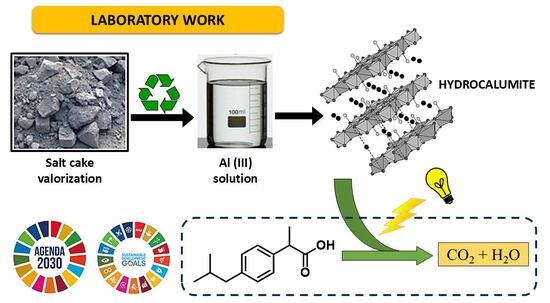
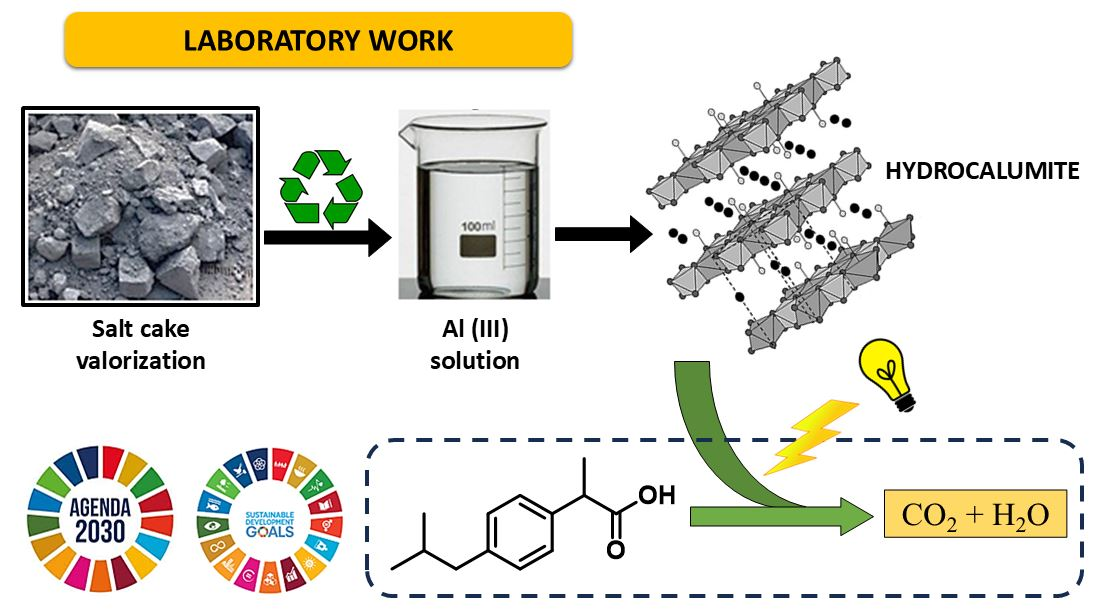
Graphical Abstract

1. Introduction

In recent years, a new environmental issue has arisen due to the increased consumption of over-the-counter drugs and personal care products (PPCPs) [1,2,3]. These synthetic substances, known as emerging pollutants, are now present in surface waters and in the environment. Emerging contaminants have potential environmental impacts, either because they are directly polluting themselves, or because of the metabolites that may be generated during uncontrolled transformation processes in aqueous media. Therefore, it is necessary that emerging contaminants be completely degraded rather than retained or separated from water by adsorption processes. Since traditional water treatment plants cannot remove most of these compounds, other strategies are required [1,2,3]. Ibuprofen, a widely used non-steroidal anti-inflammatory drug, is a key example of these pollutants. The presence of ibuprofen in aquatic ecosystems poses a critical threat to biota due to its capacity to act as a persistent metabolic disruptor. This pharmaceutical compound directly interferes with prostaglandin synthesis in non-target organisms, leading to severe alterations in reproductive cycles, embryonic development, and growth in various fish and invertebrate species. Its integration into water columns results in chronic exposure which, combined with its potential for bioaccumulation in lower trophic levels, compromises the stability of food chain. Furthermore, the biological interaction of this compound with other pharmaceutical residues generates synergistic toxicity effects that degrade biodiversity and alter the functional balance of fluvial and marine environments [4]. Different techniques have been applied for ibuprofen remediation [5].
Advanced oxidation processes (AOPs) are among the best alternatives for removing emerging pollutants from water [1,2,5]. Among AOPs, heterogeneous catalysis photodegradation is one of the most versatile options for large-scale use [6]. This technique combines electromagnetic radiation with a solid semiconductor to mineralize a pollutant (see Supporting Information). The most significant advantage of heterogeneous photocatalysis over traditional water treatment methods, as its adsorption uses porous-based materials, is its ability to achieve the complete mineralization of emerging pollutants into harmless substances, such as water and carbon dioxide, rather than merely transferring the contaminants from one phase into another. There are many heterogeneous catalysts, such as TiO2, ZnO, Fe2O3, and Fe3O4, and more complex ones like Bi2WO6 and CeO2@CN [7,8,9,10,11]. However, recent research has focused on developing low-cost catalytic materials. Layered materials, such as natural iron-based clays or calcined hydrocalumite-type compounds, have emerged as promising alternatives [8,12]. Hydrocalumite is a specific layered double hydroxide (LDH) with the chemical formula Ca2Al(OH)6Cl · 2H2O. When calcined, LDHs form mixed metal oxides (MMOs); in the case of hydrocalumite, it forms a crystalline phase called mayenite (Ca12Al14O33), which has well-known catalytic photodegradation properties [13]. Furthermore, hydrocalumite can be easily synthesized from aluminum saline slag, one of the most abundant and hazardous wastes generated by the secondary aluminum industry [14]. The synthesis of materials for environmental applications using precursors derived from industrial waste provides a dual advantage by reducing waste accumulation and minimizing the consumption of raw mineral resources. Unlike conventional photocatalysts that frequently rely on expensive noble or transition metals, this catalyst is characterized by its economic and operational sustainability due to the integration of abundant, low-cost cations such as Ca2+ and Al3+.
This article proposes an integrated laboratory experiment on Solid State Chemistry and Materials Science that covers the preparation, characterization, and application of a catalytic material for environmental remediation. This work is a continuation of our previous project [15], where students learned about aluminum’s properties, industrial production, and waste management. In that previous session, the students obtained an Al3+ solution, which they use here to synthesize a hydrocalumite precursor for the photocatalytic phase.
According to the “learning pyramid” theory, practical experiences are very effective for reinforcing concepts that are explained in theoretical lectures. Laboratory work also encourages teamwork and scientific debate [16,17,18,19,20,21]. Therefore, lab experiments are an excellent way to consolidate the essential concepts taught in experimental degrees. This specific practice connects topics from Metallurgy, Chemical Engineering, and Chemistry (Analytical, Inorganic, and Physical), including acid–base properties and redox reactions, requiring students to discuss the experimental results and prepare a rigorous final report.
This activity is designed for third- or fourth-year undergraduate students in Chemistry, Chemical Engineering, Environmental Engineering, or Materials Engineering. It also helps students to understand the principles of Circular Economy and the Sustainable Development Goals of the 2030 Agenda. It should be, therefore, a valuable teaching resource for teachers at secondary and high schools, encouraging science, technology, engineering and mathematics (STEM) vocations, especially in the fields of Chemistry and Chemical and Environmental Engineering.

2. Materials and Methods

2.1. Reagents

The extraction solutions obtained by treating aluminum saline slag with 4M HCl or 3M NaOH, according to the methodology proposed in our previous work [15], are utilized as the aluminum source (“Pure aqueous solution of [Al3+]HCl ~18,000 mg/L or [Al3+]NaOH ~16,000 mg/L”); these concentrations were determined by Inductively Coupled Plasma Mass Spectrometry (ICP-MS) in our previous work [15]. The present laboratory experiment is presented as the second part of the previously reported study. In addition, the following common laboratory reagents are required: CaCl2, NaCl, and NaOH. Furthermore, if the synthesis of hydrocalumite free of CaCO3 is desired, the use of decarbonated water and an inert gas stream (e.g., N2) is necessary. Ibuprofen sodium salt 98% was supplied by Sigma–Aldrich, Merck Madrid, Spain.

2.2. Synthesis

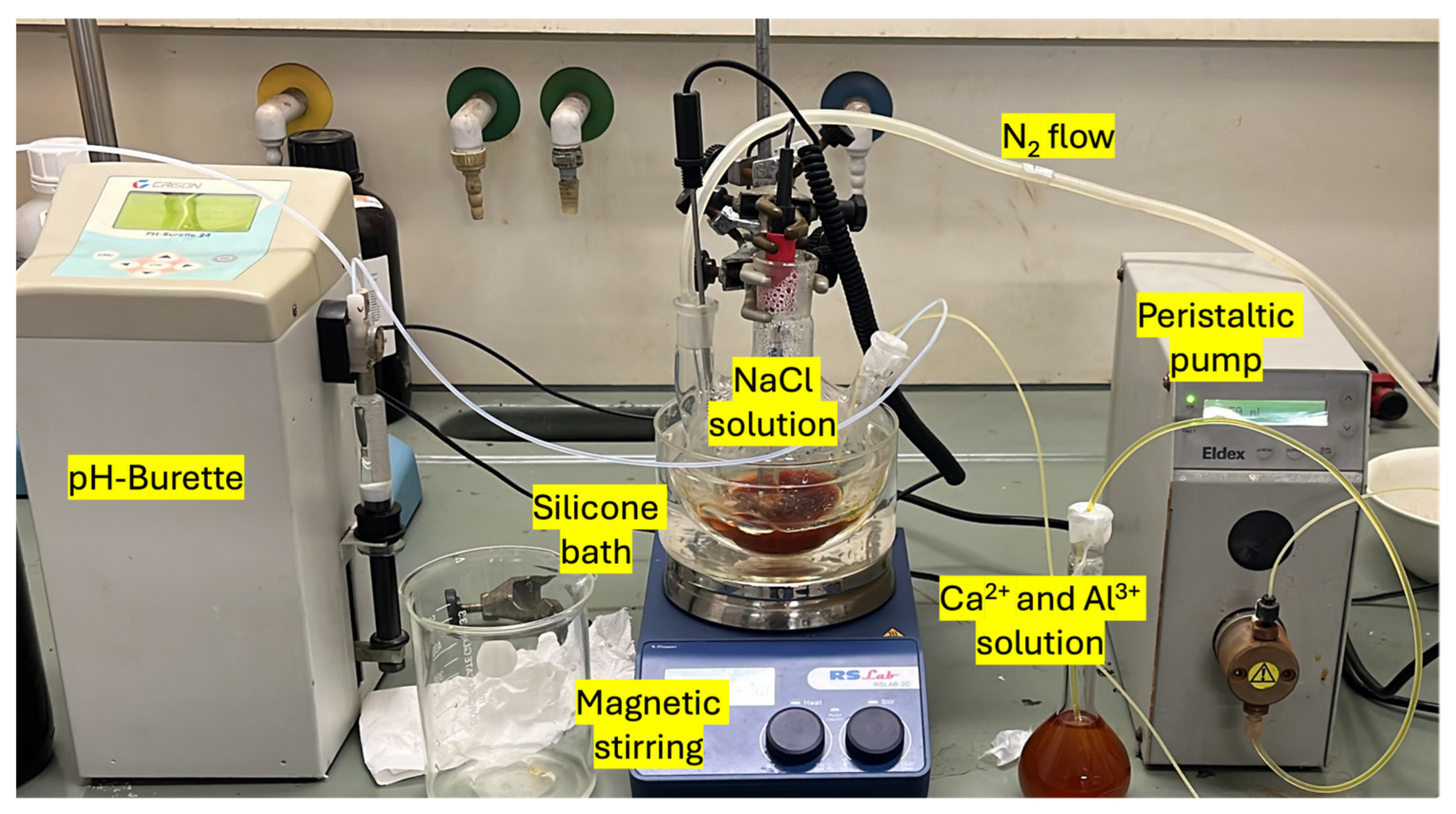
Hydrocalumite synthesis was performed via coprecipitation at a controlled pH. The experimental setup, illustrated in Figure 1, consisted of a 1 L three-neck round-bottom flask heated by a silicone bath on a hot plate with magnetic stirring and temperature control. The reagents were dosed using a peristaltic pump and a pH–burette. For the equipment, a water bath and a standard laboratory thermometer can be substituted for the silicone bath and temperature probe, respectively. Similarly, a separating funnel can replace the peristaltic pump, and a manual pH–meter with an additional separating funnel may be used in place of the automated burette. To ensure a calcite-free product, the process was conducted under a nitrogen stream using decarbonated water. The aluminum source consisted of a 100 mL portion of the [Al3+]HCl solution. To reach the specific Ca2+/Al3+ ratio required for hydrocalumite formation, the stoichiometric amount of CaCl2 was dissolved directly into this solution. An aqueous NaCl solution (100 mL, equimolar with respect to the Al3+ content) was added to a three-neck round-bottom flask, and the pH was adjusted to 11.5 using the pH–burette. (If it is decided to use 100 mL of the [Al3+]NaOH solution, it should be placed in a three-neck round-bottom flask with an equimolar amount of NaCl relative to the Al3+ dissolved in it. Subsequently, the stoichiometric amount of CaCl2 with respect to the Al3+ is dissolved in 100 mL of decarbonated water and added to the initial mixture in the flask using a peristaltic pump.) The pH was controlled with a 3 M NaOH solution. Subsequently, the temperature of the coprecipitation medium was increased to 65 °C, after which the addition of cations was started using a peristaltic pump or a separating funnel. After completing the addition, the resulting slurry was kept in agitation for 1 h at 65 °C. The white solid thus obtained was filtered and washed with distilled water until the washing waters showed a neutral pH. Subsequently, the solid was left to air-dry overnight in an oven at 70 °C. Finally, the solid was calcined at 750 °C for 2 h in an air atmosphere with a heating ramp of 10 °C/min.

2.3. Characterization

For the characterization of the samples, X-ray diffractometry is the only mandatory technique. In our case, the powder X-ray diffractograms (PXRDs) of the obtained solids were performed using a Siemens D5000 diffractometer ((Siemens España, Madrid, Spain) using the Cu Kα radiation (λ = 1.54050 Å) with a fixed divergence, from 5° to 70° (2θ), at a scanning speed of 2° (2θ)/min and time per step of 1.5 s, comparing the results with those in International Centre for Diffraction Data (ICDD) database [22]. If desired and the necessary equipment is available, the solids can also be characterized in a complementary way by Fourier transform infrared spectroscopy (FT–IR), thermal analysis, N2 adsorption–desorption isotherms at −196 °C, and diffuse reflectance ultraviolet–visible (UV–Vis) spectroscopy. In our case, the following equipment was used for the FT–IR: a Perkin–Elmer Spectrum Two instrument (PerkinElmer España, Tres Cantos, Madrid, Spain) with a nominal resolution of 4 cm−1 from 4000 to 400 cm−1, using KBr (Merck, grade IR spectroscopy)-pressed pellets and averaging 12 scans to improve the signal-to-noise ratio; for the Thermal analysis: The thermogravimetric (TG) and differential thermal analysis (DTA) curves were recorded simultaneously on a TA Instruments SDT Q600 apparatus (TA Instruments, New Castle, DE, USA) at a heating rate of 10 °C/min up to 900 °C under 50 mL/min oxygen flow (Air Liquide, Madrid, Spain, 99.999%); for the Adsorption–desorption of N2 at –196 °C: A Micromeritics Gemini VII 2390T apparatus (Norcross, GA, USA) was used. Prior to the analysis, N2 was flowed through the sample (approx. 0.1 g) at 110 °C for 2 h to remove the weakly adsorbed species. The specific surface areas were calculated by the Brunauer–Emmet–Teller (BET) method and the mean pore diameter by the Barrett–Joyner–Halenda (BJH) method [23]. The band gap value of the catalysts was estimated by a Tauc diagram approximation [24] from the ultraviolet–visible spectra recorded on a Perkin–Elmer LAMBDA 35 spectrophotometer with a diffuse reflectance accessory (Labsphere RSA–PE–20) (PerkinElmer España, Tres Cantos, Madrid, Spain), using MgO as the reference. This method allows for the band edge to be determined using the following equation, αhυ = A(hυ − Eg)1/2, where α, h, ν, Eg and A represent the adsorption coefficient, Planck’s constant, radiation frequency, forbidden band energy and a constant, respectively. From this equation, a plot of (αhν)1/2 versus hν, the so-called Tauc plot [24], shows a linear region just above the absorption edge, whose extrapolation to the photon energy axis (hν) yields the value of the semiconductor’s forbidden band energy. If a laboratory does not have all the equipment, the teacher can use the information contained in this paper to explain the techniques applied to this case.

2.4. Photodegradation

In order to carry out the photodegradation of ibuprofen, 1 L of ibuprofen sodium salt (IBU) solution in water with a concentration of 50 mg/L must be prepared. The catalytic process requires the use of a reactor, a continuous emission UV lamp and a cooling jacket for the lamp. In our case, the study was performed on a MPDS–Basic system from Peschl Ultraviolet, with a PhotoLAB Batch–L reactor and a TQ150–Z0 lamp (power 150 W), integrated in a photonCABINET (UV-Consulting Peschl España, Geldo, Castellón, Spain). Its spectrum is continuous, with the main peaks at 366 nm (radiation flux, Φ 6.4 W) and 313 nm (4.3 W). If this cabinet is not available, the reactor can be covered with aluminum foil. A 750 mL portion of the ibuprofen solution was placed in the reactor and 0.75 g of the hydrocalumite calcined at 750 °C was added. The possible adsorption of ibuprofen on the photocatalyst surface was evaluated over 35 min with continuous stirring. After that, the lamp was turned on and aliquots were taken at various times, turning off stirring and the light before removing the aliquot. The aliquots in a liquid phase were collected and filtered through a 0.22 μm Macherey–Nagel CHROMAFIL Xtra PA–20/25 membrane (Macherey-Nagel GmbH & Co, Düren, Germany) prior to analysis. The UV–Vis measurements were carried out using a Perkin–Elmer LAMBDA 35 spectrophotometer (PerkinElmer España, Tres Cantos, Madrid, Spain) interfaced with a computer equipped with UV WINLAB 2.85 software. The progress of the process was monitored by following the variation in the intensity of the characteristic absorption band of IBU at 222 nm. The experimental reproducibility was assessed by performing selected experiments in triplicate, with relative deviations always below 1%.

2.5. Time Sequence and Resources Needed

This laboratory experience is designed for a group of 12 to 16 students, working in pairs or groups of three. It allows students to apply the knowledge and skills previously acquired in subjects such as General Chemistry, Analytical Chemistry, Inorganic Chemistry, Organic Chemistry, and Chemical Engineering, while also encouraging teamwork. The activity consists of four laboratory sessions, each lasting four hours, all of which take place in a laboratory. This experiment is planned as a direct continuation of the proposal described in a previous work [15].
First session: The first session is divided into two parts. The first part consists of a brief literature search on layered double hydroxides (LDHs), their calcination-derived materials, and their application in heterogeneous photocatalysis, with special attention to hydrocalumite. Additional information is provided in the Supplementary Materials, which should be used as a starting point for the literature review. The second part of the session is devoted to the synthesis of hydrocalumite.
Second session: The second session begins with the characterization of the hydrocalumite prepared the previous day. As mentioned above, the only essential technique is powder X-ray diffraction (PXRD). After characterization, the hydrocalumite is calcined at 750 °C to obtain the heterogeneous photocatalyst.
Third session: In this session, the calcined hydrocalumite is characterized by PXRD and UV–Vis diffuse reflectance spectroscopy to determine the band gap. Other techniques, such as FT–IR spectroscopy and adsorption–desorption of N2 at −196 °C, may also be used to further characterize the calcined product. The results are then elaborated and interpreted.
Fourth session: During the final session, the catalytic photodegradation of ibuprofen is carried out using hydrocalumite calcined at 750 °C as the photocatalyst. Finally, the students prepare a laboratory report in which all stages of the experiment and the results obtained are described and discussed. Training in scientific report writing is currently very important, as a significant number of students have difficulties with reading comprehension and with writing correctly in a scientific style [25,26]. For this reason, teachers should encourage the preparation of a complete laboratory report written in a rigorous scientific style.
These sessions can be reorganized depending on the facilities and requirements of each laboratory. If the instructor feels that not all characterization techniques are necessary, previously obtained results may be provided directly to the students. If a laboratory does not have an X-ray diffractometer, the diffraction patterns of the solids can be recorded in advance and given to the students, among other possible adaptations. The resources required for this experiment include a fume hood; a magnetic stirrer; 3 M NaOH and 4 M HCl solutions; and aqueous solutions of [Al3+]HCl (~18.000 mg/L) or [Al3+]NaOH (~16.000 mg/L), prepared in advance according to previously reported procedures. Therefore, all the reagents used are commonly available in university teaching laboratories. Standard safety precautions (laboratory goggles and gloves) must be followed when handling the solutions. The use of a laboratory mask is recommended when handling the slag, especially if it is ground by the students.

2.6. Learning Objectives and Concepts

The experiment proposed in this laboratory practice can be carried out in any General Chemistry laboratory due to its simplicity. It uses common laboratory reagents, and one widely used pharmaceutical compound. The required equipment consists of basic laboratory materials. The characterization techniques needed are standard methods commonly employed in materials characterization, such as chemical analysis and powder X-ray diffraction (PXRD), which are available in the laboratories of many universities or in the central research services of most universities. However, if not available, the results reported in the present work can be used.
This laboratory practice allows students to apply and reinforce knowledge previously acquired in courses such as General Chemistry, Analytical Chemistry, Inorganic Chemistry, Organic Chemistry, and Chemical Engineering. In particular, the following skills and learning outcomes are addressed:
  • The proper handling of basic laboratory equipment.
  • The preparation and manipulation of solutions.
  • The design and synthesis of materials, mainly layered double hydroxides, eventually isolating the preparation solution from the atmosphere.
  • The study of the chemical properties of aluminum and other metallic elements, with special emphasis on redox reactions, solubility, and acid–base behavior.
  • The knowledge and use of common techniques applied to solids characterization.
  • An introduction to advanced oxidation processes (AOPs), specifically solid photocatalysts and heterogeneous photocatalysis.
  • The study and understanding of emerging contaminants.
  • The decontamination of aqueous samples using AOPs.
  • Waste management and valorization.
  • Awareness of proper chemical waste management.
  • A discussion of results through teamwork and preparation of a well-structured laboratory report. If time allows, different student groups may present their results through short oral presentations.
In addition to Chemistry- and Chemical Engineering-related content, this practice illustrates key concepts of Circular Economy through the valorization of an industrial waste and has connections with the United Nations Sustainable Development Goals (SDGs) included in the 2030 Agenda. In particular, it is related to SDG 6 (Clean Water and Sanitation), SDG 11 (Sustainable Cities and Communities), SDG 12 (Responsible Consumption and Production), SDG 13 (Climate Action), and SDG 4 (Quality Education), which underpin the entire activity. In this way, students are made aware of the importance of reducing human pressure on the environment [27,28].
During the laboratory work, instructors could review key concepts from previous courses related to the practice, such as chemical formulas, reaction balancing, stoichiometry, and pH calculations. As a result, students acquire both general and specific competencies, including:
  • Understanding various types of chemical reactions and how to balance them.
  • Understanding concentration, solubility, and solution properties.
  • Performing experiments safely and responsibly.
  • Operating common chemical instruments.
  • Using material characterization techniques.
  • Understanding the potential application of new technologies for water treatment and decontamination.
  • Working effectively in teams and collaborating on scientific projects.
  • Reading and understanding scientific literature.
  • Recording, interpreting, and analyzing experimental data.
  • Integrating knowledge from different areas of Chemistry.
  • Understanding and applying ethical behavior in scientific research.
  • Communicating scientific information clearly and effectively through written reports and oral presentations.
  • Developing specific skills in techniques such as PXRD, FT–IR, and UV–Vis spectroscopy.

3. Results

This section summarizes the main findings of our work. Although specific outcomes may vary depending on the origin and composition of the raw residue, these results facilitate data interpretation and provide educators with guidelines on the subjects to be addressed at each stage.

3.1. Hydrocalumite Characterization

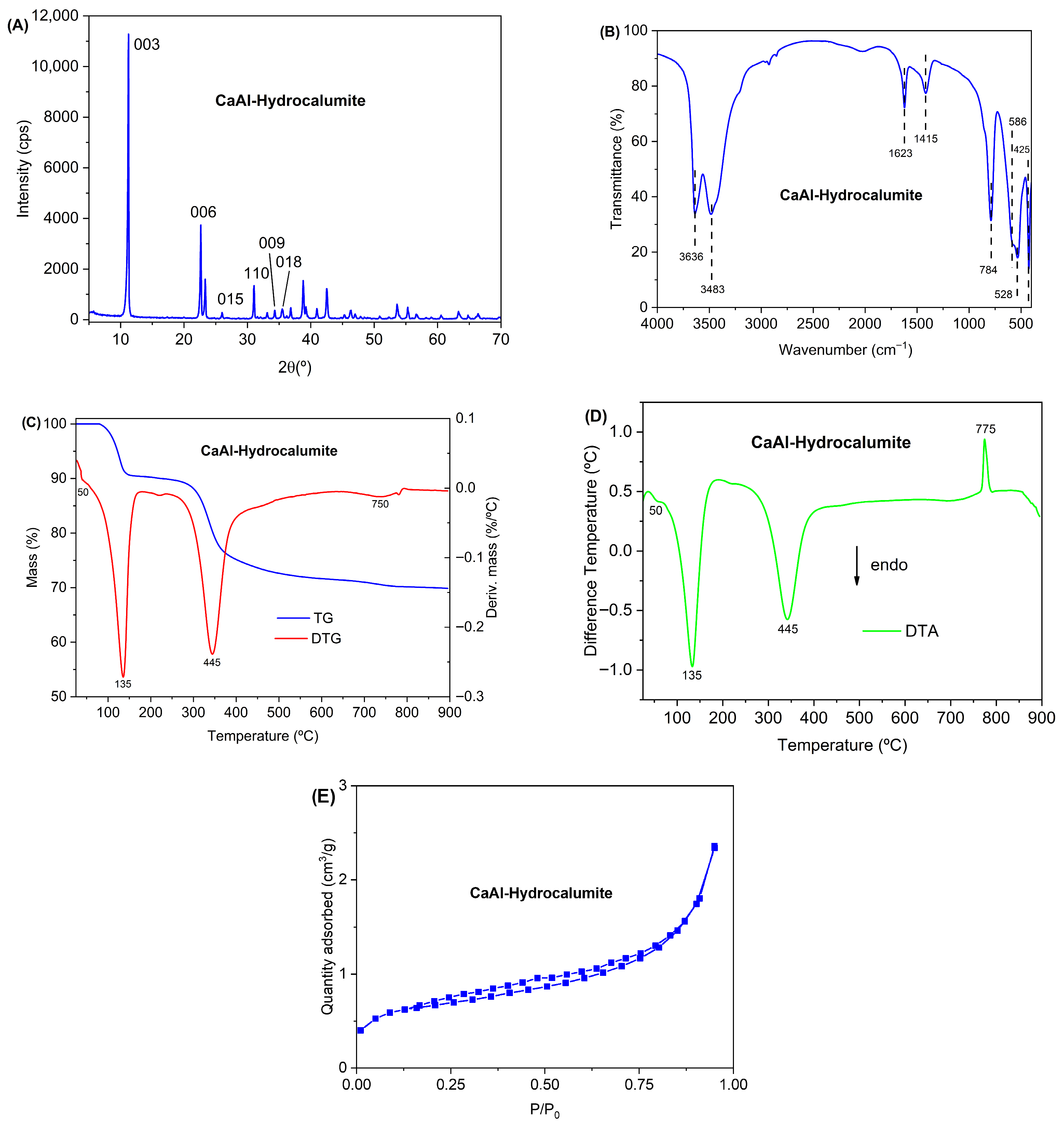
The PXRD pattern of the solid synthesized according to the procedure described in Section 2.2 is shown in Figure 2A. The diffractogram shows reflections corresponding exclusively to the hydrocalumite crystalline phase (ICDD 01–072–4773). Hydrocalumite (Ca2Al(OH)6Cl · 2H2O) shares structural similarities with hydrotalcite (Mg6Al2(OH)16CO3 · 4H2O), as both consist of cationic metal hydroxide layers. However, unlike hydrotalcite, where cations are randomly distributed, hydrocalumite exhibits a distinct ordering of Ca and Al octahedra within its sheets (see Supplementary Materials) [13]. This structural order leads to sharper and more intense diffraction profiles. Despite these differences, the PXRD patterns of both compounds display characteristic reflections corresponding to the (003), (006), (110) and (009) planes [13]. The enhanced intensity of the basal reflections in the analyzed samples indicates a strong preferential orientation, with crystallites stacked along the c-axis. This stacking is quantified by the basal distance (c0), defined as the combined thickness of the brucite-like sheet and the interlayer gallery [13]. This parameter is calculated from equation c = 3/2[d003 + 2d006]. Consequently, c is sensitive to both the hydration state and the specific geometry of the interlayer anions (e.g., size and orientation of non-spherical species like carbonate). Regarding the intralayer structure, the diffractogram exhibits a sharp reflection due to the (110) plane at ≈30° (using Cu–Kα radiation), allowing for the calculation of the lattice parameter a via the relationship a = 2d110. Since a represents the average cation–cation distance within the sheet, it remains independent of the layer-stacking sequence and is governed solely by the ionic radii of the Ca2+ and M3+ (Al3+ in this case). No other crystalline phases are identified. If the synthesis is performed without using decarbonated water and an inert atmosphere, characteristic reflections of the calcite phase (CaCO3, ICDD 01–072–1937) may appear, with the main reflection located at 2θ ≈ 29° [13]. Furthermore, carbonate ions may also be incorporated into the interlayer space, affecting the theoretical value of the lattice parameter c. This is due to the acid–base reaction between the alkaline preparation suspension and the acidic atmospheric CO2 and, in addition to the precautions required for obtaining a pure product, it is a nice way to illustrate a gas–liquid acid–base reaction, which usually produces results that are very surprising for students, and can even be related to the greenhouse effect and procedures for the removal of CO2.
The FT–IR spectrum of the hydrocalumite synthesized by the previously described controlled-pH coprecipitation method is presented in Figure 2B. The broad absorption band observed in the 3600–3500 cm−1 region is characteristic of O–H stretching vibrations [29]. Specifically, the peak at 3643 cm−1 is ascribed to the Al–OH bonds, while the band at 3478 cm−1 is attributed to Ca–OH stretching and to the hydroxyl groups from the interlayer water. The presence of water molecules is further corroborated by the bending vibration at 1618 cm−1. Additionally, the spectrum displays a band at 1410 cm−1 related to the O–C–O stretching of carbonate anions, indicating that minor carbonation took place during handling despite the precautions taken. Finally, the low-frequency-region displayed bands at 790, 527, and 422 cm−1 correspond to the lattice vibrations of Ca–O and Al–O bonds [29]. It is worth noting that the spectral profile is highly sensitive to the synthesis conditions; if the process had been conducted without decarbonated water or an inert N2 atmosphere, additional diagnostic features—such as a shoulder near 1500 cm−1 or a peak at 877 cm−1—would have likely appeared, pointing to the formation of a separate calcite phase or extensive carbonation [13,30].
The TG and DTG profiles of the synthesized hydrocalumite are summarized in Figure 2C. The thermogram exhibits three distinct mass loss stages: an initial mass drop below 100 °C due to physisorbed water desorption, followed by a second step centered at 135 °C, attributed to the removal of interlayer and structurally bound water. The third event, centered at 445 °C, corresponds to the dehydroxylation of the layers. A final, minor mass loss detected near 750 °C is likely associated with the elimination of residual hydroxyls and/or chlorine species, or sample decarbonation [13,31]. The DTA analysis characterizes the first three transitions as endothermic, whereas the process occurring between 725 °C and 800 °C is exothermic.
Finally, the adsorption–desorption isotherm of N2 obtained at –196 °C is displayed in Figure 2E. According to the IUPAC classification, the profile corresponds to a Type II isotherm exhibiting a narrow H3-type hysteresis loop. This behavior is characteristic of mesoporous aggregates with slit-shaped pores [23], according to the layered structure of the solid. The specific surface area is 5 m2/g (compatible with the high crystallinity of the solid) and the average pore diameter is 7 nm.

3.2. Characterization of Calcined Hydrocalumite

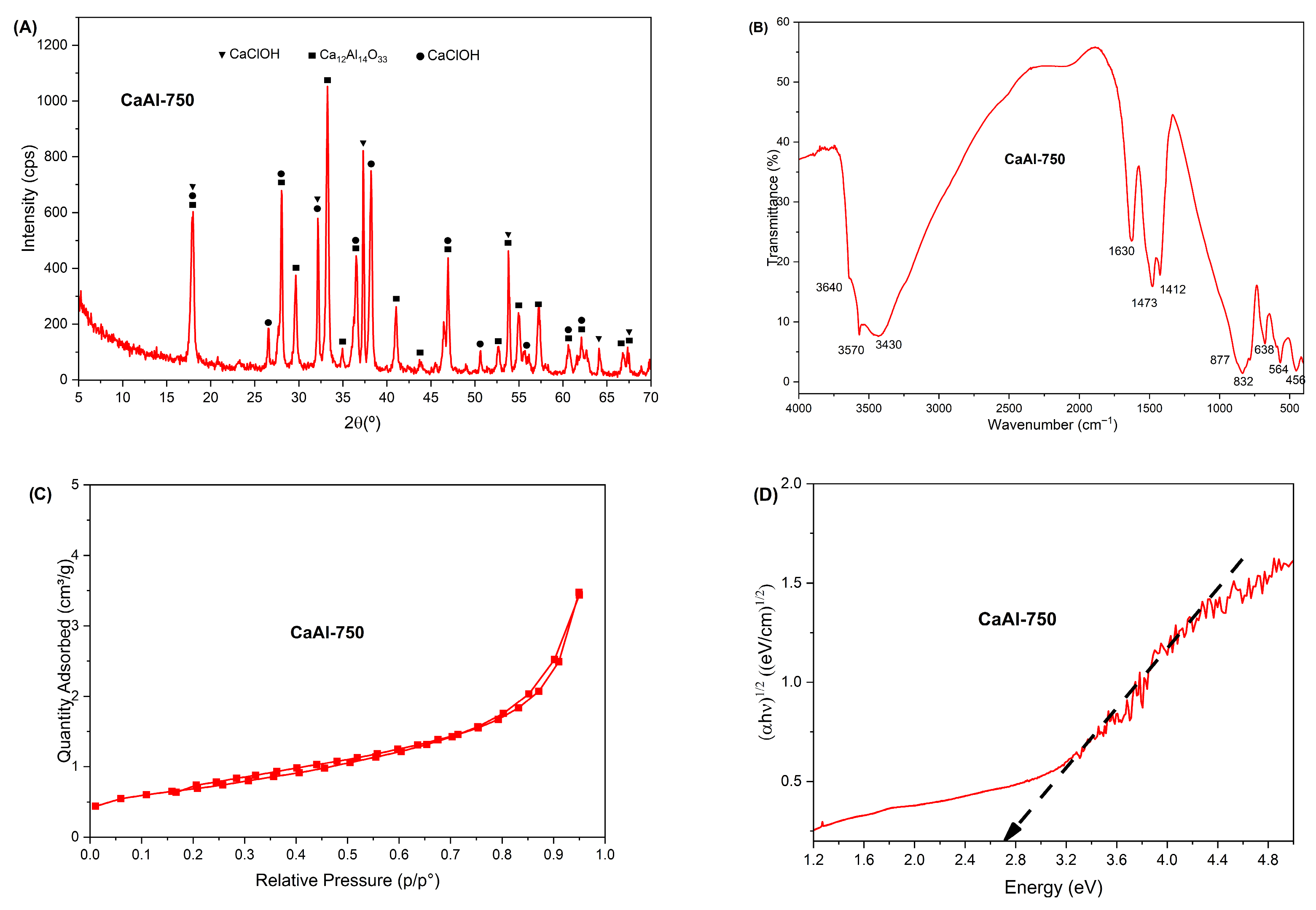
The PXRD of the hydrocalumite calcined at 750 °C is shown in Figure 3A. Three crystalline phases are identified: calcium oxide (CaO, ICDD card 01–070–5490), calcium hydroxychloride (CaClOH, ICDD card 01–073–1885) and mayenite (Ca12Al14O33, ICDD card 01–070–2144) [13,31,32]. The calcium oxide and calcium hydroxychloride do not show catalytic photoactivity, so the only crystalline phase responsible for the catalytic photoactivity is mayenite. Mayenite is a calcium aluminate characterized by a cubic crystal system within the space group I 4 ¯ 3d [32,33,34]. Its unit cell contains two formula units of Ca12Al14O33, forming a positively charged framework of 12 cages. To maintain electrical neutrality, specific “X” anions—such as H, O2−, O, O2, OH, Cl, and F, or even free electrons (e)—occupy two of these cages, resulting in the chemical representation [Ca24Al28O64]4+ 4X [32,33,34]. Within this structure, aluminum ions fill the octahedral and tetrahedral voids formed by the Ca and O framework. The functional properties of mayenite largely depend on the entrapped species. When loaded with oxygen radicals (O), the material generates reactive oxygen species (ROS) suitable for AOPs and catalytic reactions. Conversely, when it is an electron, the material acts as an electron donor, such as in organic synthesis or finding use in memory storage devices [13,32,33,34,35]. Regarding its electronic properties, while mayenite typically presents a band gap of 3.5–4 eV, the unique cage architecture allows for inter-cage electron transitions at a lower energy of approximately 2.8 eV [13,33,35].
The FT–IR spectrum of hydrocalumite calcined at 750 °C is presented in Figure 3B. The spectrum consists of a broad band in the 3600–3400 cm−1 region due to the superposition of the stretching vibration bands of the OH groups coming from different environments [32,36]. The presence of water molecules is confirmed by the band recorded at 1630 cm−1. The band at 1412 cm−1 and the left shoulder at 877 cm−1 of the band centered at 832 cm−1 are due to the presence of carbonate by fixation of atmospheric CO2 due to the basic character of the sample. The bands recorded in the region between 700 cm−1 and 400 cm−1 are due to the M–OH bonds, where M can be Ca2+ or Al3+ [32,36].
The N2 adsorption–desorption isotherm of the sample calcined at 750 °C is displayed in Figure 3C. The isotherm is classified as Type II, according to the IUPAC classification criteria [23]. No hysteresis loop is observed, and the specific surface area (SBET) is 8 m2/g, a value similar to those reported in the literature for this family of solids [32,37].
The band gap of the photocatalyst used in this work was determined using the Tauc method, obtaining a value of 2.7 eV (see Figure 3D). This band gap value could explain the good behavior of the MMOs prepared in this work, since the lamp used emits a continuous spectrum with maxima at 313 nm and 366 nm (3.96 eV and 3.39 eV, respectively). Moreover, the good photocatalytic behavior could be a contribution from the inter-cage transitions of the free electrons in the cavity–cage structure, whose excitation energy is 2.8 eV (442 nm wavelength light) [33,38,39]. In summary, the band gap value of the solids is suitable for use in catalytic photodegradation processes.

3.3. Photodegradation of Ibuprofen

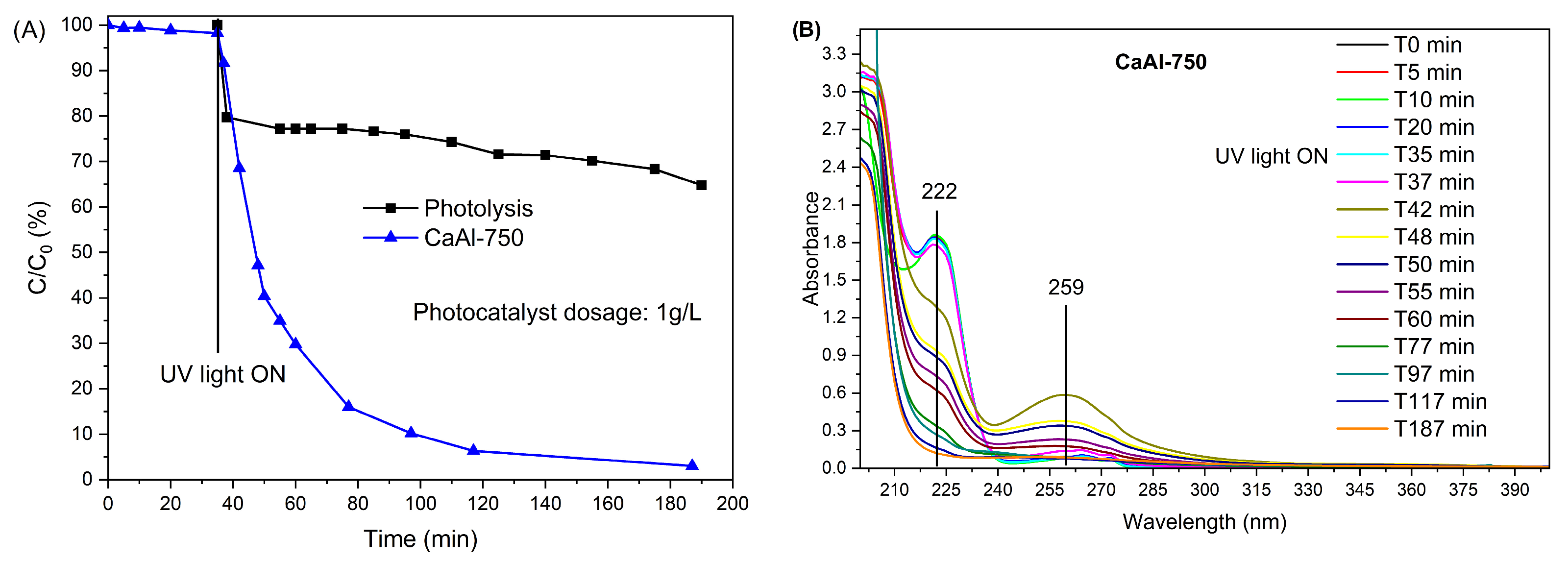
The removal of ibuprofen by a heterogeneous photocatalytic process using hydrocalumite calcined at 750 °C is summarized in Figure 4A, and was compared with the photolysis process and the possible removal of ibuprofen by adsorption processes (leaving the mixture in dark conditions for 35 min). The removal of the contaminant by adsorption for 35 min was insignificant. Then, the ultraviolet light source was activated to start photodegradation. The rapid elimination of ibuprofen was observed, so that only about 25% of the initial dose remained 25 min after the light was activated (representing one hour from the start of the assay, T60). Without the presence of a photocatalyst (by photolysis reaction only), only 21% of the initial ibuprofen was removed. The solid material CaAl–750 displayed a significant photocatalytic performance, which is supported by the mineralogical composition described above (mayenite, CaO and CaClOH). As stated above, mayenite (n-type semiconductor) has the ability to retain highly reactive species in its structure, which would facilitate the photocatalytic oxidation process of the drug. Catalysts and photocatalysts based on MMOs prepared by calcination of hydrocalumite-type compounds have been applied to remove emerging pollutants, such as paracetamol and tyrosol, and to purify wastewater from distilleries by AOPs [33,40,41]. However, their application in systems with two or more simultaneous emerging pollutants has still not been studied. Figure 4B shows the UV–visible spectra of the samples taken at various intervals of the experiment. Prior to switching on the UV light, there was no alteration in the characteristic signal of ibuprofen at 222 nm, but once the lamp was switched on there was an evident decrease in the intensity of this band, which confirms that the ibuprofen was degrading. A band at 259 nm appeared as time progressed (Figure 4B), caused by an intermediate derivative of the degradation that eventually faded away. This signal at 259 nm reached its highest relevance at 7 min of UV exposure (42 min of the total test) and was completely lost after 152 min of irradiation. Only three compounds were recognized in this work: ibuprofen, C13H18O2, and another substance with the formula C13H18O4. This last compound, with two isomers, appeared to be a hydroxylated product derived from ibuprofen, which could have originated from a pathway involving OH radicals. Therefore, it is possible to conclude that, after 152 min of light, only 3% of IBU remained in the solutions and that the degradation by the CaAl–750 catalyst appeared to take place via a dihydroxylated intermediate step of ibuprofen.
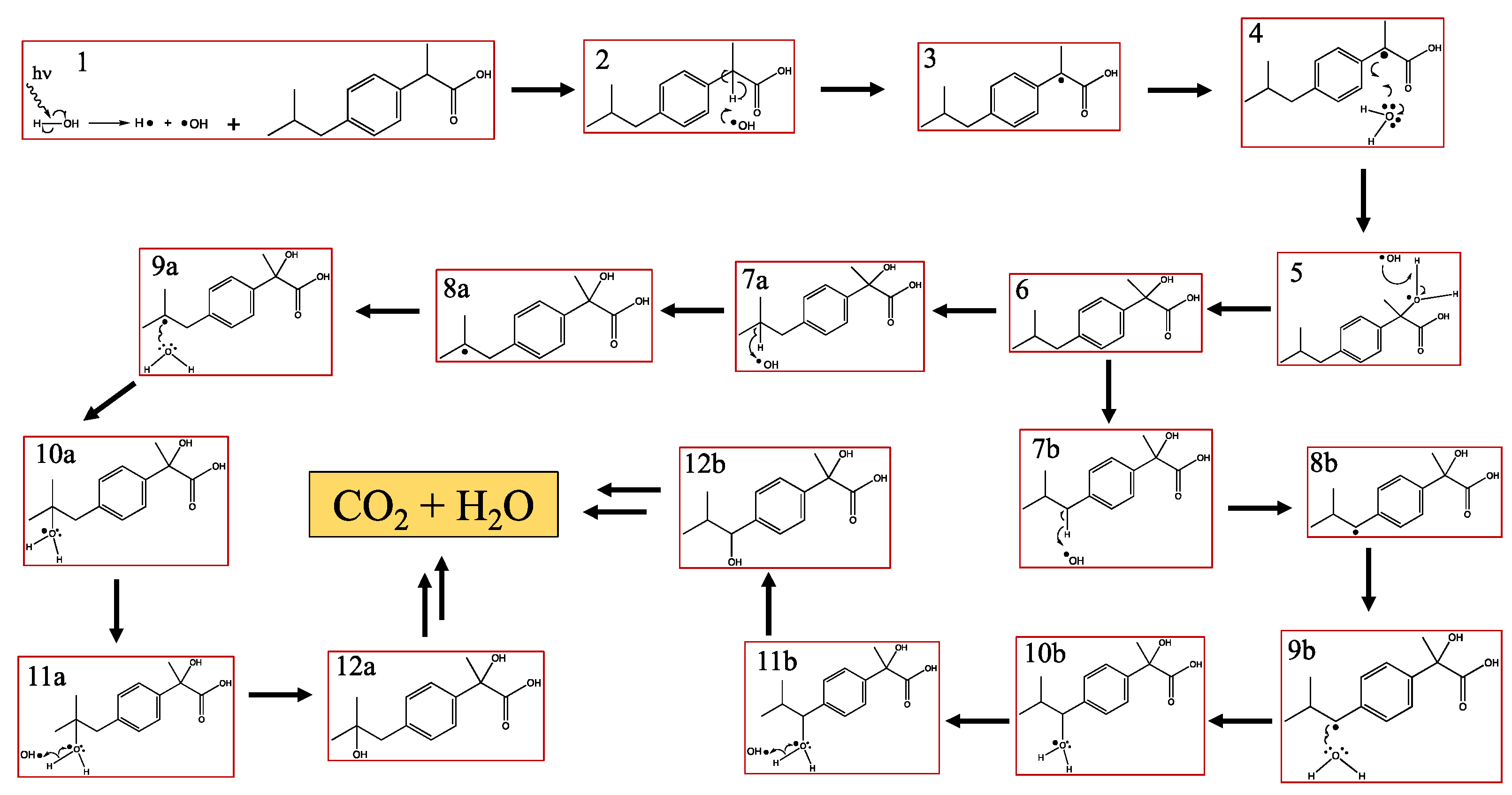
A possible route for the photocatalytic oxidation of ibuprofen using CaAl–750 is presented in Scheme 1. The process starts with the formation of OH radicals, which subsequently attack the carbonyl group on the alpha carbon (a benzyl-type carbon), so that a highly stable tertiary radical originates, as detailed in step 3, together with a water molecule. The attack on this zone is favored by the basic pH generated by the photocatalyst itself, since the hydrogen atom in the alpha position with respect to a carbonyl has a certain acidity. The contact of the radical produced in the third step with water (steps 4 and 5) results in the creation of a hydroxylated derivative of the drug (step 6). From this point, the transformation can take two distinct paths (labeled a and b in Scheme 1) to give rise to the dihydroxylated products. In route a, a tertiary radical is generated, described in steps 7a and 8a, which finally mixes with water (steps 9a, 10a and 11a) to give rise to the substance in 12a. On the other hand, in route b, a benzyl radical originates again (steps 7b and 8b), which then interacts with water (steps 9b, 10b and 11b) to produce the dihydroxylated derivative seen in 12b. This explanation is consistent with the understanding of the formation of derivatives with formula C13H18O4.

3.3.1. Evaluation of the Level of Attainment of the Goals

To check if the goals are met and to reinforce the material covered during this experiment, students must produce an individual lab report. Several additional questions can be suggested for students to answer in their lab reports. Although this largely depends on the students’ background knowledge, here are seven questions that must be included in the final report. However, other assessment methods can be applied if teachers consider them more appropriate, such as written exams or oral presentations of the results (the latter can be very interesting to assess this transversal skill, but it requires more time and is difficult to carry out in a laboratory; a presentation room would be more appropriate).
Question 1: Find literature information on other trivalent cations that can form hydrocalumite-type compounds. Could their calcination products (MMOs) be applied in photocatalysis processes?
Question 2: Identify and assign the planes that produce the different reflections observed in the diffractograms. Calculate the value of the lattice parameters a and c. How does the size of the trivalent cation affect the parameter a?
Question 3: Calculate the crystallite size using the Scherrer equation in the directions (110) and (003).
Question 4: Describe, in your own words, how a heterogeneous photocatalyst works.
Question 5: During the advanced oxidation of emerging pollutants, by-products are generated. Do they always disappear? Are they always less toxic or hazardous than the original pollutant?
Question 6: Investigate the literature for the concentration range of ibuprofen in real samples. Could the photocatalysis reaction be monitored using UV-Vis spectroscopy? Suggest an analytical technique for monitoring the photodegradation reaction in such samples.
Question 7: Previous reports have indicated that mayenite is the only component of an MMO exhibiting photocatalytic activity. Nevertheless, CaO is also present among the calcination products of hydrocalumite. If feasible, determine the band gap of a commercial CaO sample and discuss the resulting value (if experimental determination is not possible, perform a literature search). At the same time, explore other possible applications of MMOs related to the presence of CaO in them, as CO2 capture.

3.3.2. Evaluation of the Methodology

This methodology is intended to be implemented in the future as a laboratory experience in an advanced subject in the fourth year of a Chemistry degree (the last year in the Spanish curriculum). At this point, students should have already acquired general chemical knowledge of preparation and characterization of materials, as well as of heterogeneous catalysis and photocatalysis processes. In this way, students are expected to apply the general theory explained in the different subjects for the degree to a real practical case, consolidating previous and learning new knowledge. In our curriculum, the use of PXRD, FT–IR and UV–Vis spectroscopy equipment has been implemented in other previous practical subjects for the characterization of substances prepared in Inorganic Chemistry laboratories, such as CuCl, birnessites, or cis/trans–[Co(en)2Cl2]Cl. In these cases, the results were excellent (more than 90% of the students passed the courses), even though surveys and other follow-up mechanisms were not carried out. It should be emphasized once again that the feasibility of the experiments is guaranteed, since they were developed within the framework of our research and the detailed results have been published elsewhere. Therefore, the practice, in whole or in part, can help teachers of similar subjects around the world. The strengths of the method lie mainly in the preparation, characterization and application of Al3+-based materials synthesized from aluminum saline slag, as well as in the learning and promotion of the SDGs and Circular Economy set by the 2030 Agenda.

4. Conclusions

The laboratory practice proposed in this work allows for the studying of the physicochemical properties of materials, particularly Al3+-based materials, as well as reinforcing the content explained in the theoretical subjects of General Chemistry, Inorganic Chemistry, Materials Science, Analytical Chemistry, Physical Chemistry, Organic Chemistry and Chemical Engineering.
The methodology integrates key pedagogical tools: bibliography search, observation of assays, discussion among peers and elaboration of laboratory reports. At the same time, students are introduced to research and characterization techniques, while acquiring sensitivity towards environmental protection and waste treatment.
Laboratory work also helps to internalize key concepts of the Circular Economy and the SDGs. Although the text focuses primarily on the university level, many of the experiments are adaptable to secondary education. It is therefore a valuable teaching resource for teachers at this level to encourage STEM vocations, especially in the field of Chemistry and Chemical and Environmental Engineering.

Supplementary Materials

The following supporting information can be downloaded at: https://www.mdpi.com/article/10.3390/chemengineering10040045/s1, General information on layered double hydroxides, hydrocalumite, mixed oxides and photocatalysis with general references on these topics; Figure S1, LDH structure; Figure S2, AOPs mechanism.

Author Contributions

A.J.: Conceptualization, methodology, formal analysis, investigation, writing—original draft preparation, writing—review and editing. A.M.: Conceptualization, methodology, formal analysis, investigation, writing—original draft preparation, writing—review and editing. A.G.: Conceptualization, methodology, supervision, validation, project administration, funding acquisition, writing—review and editing. M.Á.V.: Conceptualization, methodology, supervision, validation, project administration, funding acquisition, writing—review and editing. All authors have read and agreed to the published version of the manuscript.

Funding

This research was funded by the Spanish Ministry of Science, Innovation and Universities through the Spanish Research Agency (References PID2023–146935OB–C21 and PID2023–146935OB–C22).

Data Availability Statement

No data was used for the research described in the article.

Conflicts of Interest

The authors declare no conflicts of interest.

References

  1. Kanakaraju, D.; Glass, B.D.; Goh, P.S. Advanced oxidation process-mediated removal of pharmaceuticals from water: A review of recent advances. Environ. Sci. Pollut. Res. 2025, 32, 14316–14350. [Google Scholar] [CrossRef]
  2. Shamim, A.; Abdullah, H.; Abid, M.B.; Nayyab, G.E.; Daud, N.K. Advanced oxidation processes for sustainable wastewater treatment. J. Mater. Sci. 2026, 61, 4857–4893. [Google Scholar] [CrossRef]
  3. Morin-Crini, N.; Lichtfouse, E.; Liu, G.; Balaram, V.; Ribeiro, A.R.L.; Lu, Z.; Stock, F.; Carmona, E.; Teixeira, M.R.; Picos-Corrales, L.A.; et al. Worldwide cases of water pollution by emerging contaminants: A review. Environ. Chem. Lett. 2022, 20, 2311–2338. [Google Scholar] [CrossRef]
  4. Parolini, M. Toxicity of the Non-Steroidal Anti-Inflammatory Drugs (NSAIDs) acetylsalicylic acid, paracetamol, diclofenac, ibuprofen and naproxen towards freshwater invertebrates: A review. Sci. Total Environ. 2020, 740, 140043. [Google Scholar] [CrossRef]
  5. Chopra, S.; Kumar, D. Ibuprofen as an emerging organic contaminant in environment, distribution and remediation. Heliyon 2020, 6, e04087. [Google Scholar] [CrossRef]
  6. Saravanan, A.; Deivayanai, V.C.; Kumar, P.S.; Rangasamy, G.; Hemavathy, R.V.; Harshana, T.; Gayathri, N.; Alagumalai, K. A detailed review on advanced oxidation process in treatment of wastewater: Mechanism, challenges and future outlook. Chemosphere 2022, 308, 136524. [Google Scholar] [CrossRef]
  7. Dal Santo, V.; Naldoni, A. Titanium Dioxide Photocatalyst; MDPI Books; MDPI: Basel, Switzerland, 2019. [Google Scholar] [CrossRef]
  8. Bobde, P.; Patel, R.K.; Panchal, D.; Sharma, A.; Sharma, A.K.; Dhodapkar, R.S.; Pal, S. Utilization of layered double hydroxides (LDHs) and their derivatives as photocatalysts for degradation of organic pollutants. Environ. Sci. Pollut. Res. 2021, 28, 59551–59569. [Google Scholar] [CrossRef] [PubMed]
  9. Wang, L.; Zhu, Z.; Wang, F.; Qi, Y.; Zhang, W.; Wang, C. State-of-the-art and prospects of Zn-containing layered double hydroxides (Zn-LDH)-based materials for photocatalytic water remediation. Chemosphere 2021, 278, 130367. [Google Scholar] [CrossRef] [PubMed]
  10. Lei, H.; Wu, M.; Liu, Y.; Mo, F.; Chen, J.; Ji, S.; Zou, Y.; Dong, X. Built-in piezoelectric field improved photocatalytic performance of nanoflower-like Bi2WO6 using low-power white LEDs. Chin. Chem. Lett. 2021, 32, 2317–2321. [Google Scholar] [CrossRef]
  11. Kumar, A.; Arya, V.; Pathak, A.; Trivedi, S.; Guin, D.; Tripathi, C.S.P. Enhanced Visible Light Photocatalytic Performance of CeO2@Acidified g-C3N4 Nanoheterostructures for RhB Degradation. Langmuir 2025, 41, 14765–14777. [Google Scholar] [CrossRef] [PubMed]
  12. Makwane, P.R.; Gupta, R.K. (Eds.) Layered Double Hydroxides and Oxides: Catalytic Nanomaterials for Energy, Environmental and Chemical Applications; Jonh Wiley & Sons, Ltd.: Hoboken, NJ, USA, 2026. [Google Scholar] [CrossRef]
  13. Jiménez, A.; Trujillano, R.; Gil, A.; Rives, V.; Vicente, M.Á. Hydrocalumite and hydrocalumite-type compounds: A special type of layered double hydroxides. Appl. Clay Sci. 2025, 267, 107707. [Google Scholar] [CrossRef]
  14. Jiménez, A.; Misol, A.; Morato, Á.; Rives, V.; Vicente, M.A.; Gil, A. Optimization of hydrocalumite preparation under microwave irradiation for recovering aluminium from a saline slag. Appl. Clay Sci. 2021, 212, 106217. [Google Scholar] [CrossRef]
  15. Jiménez, A.; Trujillano, R.; Korili, S.; Gil, A.; Vicente, M.Á. Valorization of an Industrial Pollutant Residue as a Teaching Tool: Extraction of Al3+ from Aluminum Saline Slag. ChemEngineering 2025, 9, 99. [Google Scholar] [CrossRef]
  16. Accettone, S.L.W.; DeFrancesco, C.; King, C.A.; Lariviere, M.K. Laboratory Skills Assignments as a Teaching Tool to Develop Undergraduate Chemistry Students’ Conceptual Understanding of Practical Laboratory Skills. J. Chem. Educ. 2023, 100, 1138–1148. [Google Scholar] [CrossRef]
  17. Macey, A.; Gurguis, N.; Tebboth, M.; Shah, P.S.; Chesi, C.; Shah, U.V.; Brechtelsbauer, C. Teaching reaction kinetics with chemiluminescence. Educ. Chem. Eng. 2018, 22, 53–60. [Google Scholar] [CrossRef]
  18. Rodríguez, E.; Vicente, M.A. A copper-sulfate-based inorganic chemistry laboratory for first-year university students that teaches basic operations and concepts. J. Chem. Educ. 2002, 79, 486–488. [Google Scholar] [CrossRef]
  19. Volpi, G.; Magistris, C.; Garino, C. FLUO-SPICES: Natural aldehydes extraction and one-pot reaction to prepare and characterize new interesting fluorophores. Educ. Chem. Eng. 2018, 24, 1–6. [Google Scholar] [CrossRef]
  20. Watts, F.M.; Rodriguez, J.M.G. A Review of Course-Based Undergraduate Research Experiences in Chemistry. J. Chem. Educ. 2023, 100, 3261–3275. [Google Scholar] [CrossRef]
  21. Zalewski, M.; Krawczyk, T. Celebrating 27 Years of a Chemistry Contest for High School Students at a University in Poland That Promotes Chemistry for Future Study and Career Choices. J. Chem. Educ. 2019, 96, 2655–2660. [Google Scholar] [CrossRef]
  22. ICDD. ICDD Data Base; International Centre for Diffraction Data (ICDD): Newton Square, PA, USA, 2026. [Google Scholar]
  23. Thommes, M.; Kaneko, K.; Neimark, A.V.; Olivier, J.P.; Rodriguez-Reinoso, F.; Rouquerol, J.; Sing, K.S.W. Physisorption of gases, with special reference to the evaluation of surface area and pore size distribution (IUPAC Technical Report). Pure Appl. Chem. 2015, 87, 1051–1069. [Google Scholar] [CrossRef]
  24. Tauc, J. Absorption edge and internal electric fields in amorphous semiconductors. Mater. Res. Bull. 1970, 5, 721–729. [Google Scholar] [CrossRef]
  25. Aldabbus, S.; Almansouri, E. Academic Writing Difficulties Encountered by University EFL Learners. Br. J. Engl. Lang. Linguist. 2022, 10, 1–11. [Google Scholar] [CrossRef]
  26. De-la-Peña, C.; Luque-Rojas, M.J. Levels of Reading Comprehension in Higher Education: Systematic Review and Meta-Analysis. Front. Psychol. 2021, 12, 712901. [Google Scholar] [CrossRef] [PubMed]
  27. European Parliament. Available online: https://ec.europa.eu/eurostat/statistics-explained/index.php?title=File:Waste_generation_by_economic_activities_and_households,_EU,_2020_(%25_share_of_total_waste)_12-01-2023.png (accessed on 10 February 2026).
  28. United Nations. Sustainable Development Goals. Available online: https://www.un.org/sustainabledevelopment/es/2015/09/la-asamblea-general-adopta-la-agenda-2030-para-el-desarrollo-sostenible (accessed on 10 February 2026).
  29. Nakamoto, K. Infrared and Raman Spectra of Inorganic and Coordination Compounds: Part A: Theory and Applications in Inorganic Chemistry, 6th ed.; John Wiley & Sons: Hoboken, NJ, USA, 2008. [Google Scholar]
  30. Gevers, B.R.; Labuschagné, F.J.W.J. Green synthesis of hydrocalumite (CaAl-OH-LDH) from Ca(OH)2 and Al(OH)3 and the parameters that influence its formation and speciation. Crystals 2020, 10, 672. [Google Scholar] [CrossRef]
  31. Jiménez, A.; Vicente, M.A.; Rives, V. Thermal study of the hydrocalumite–katoite–calcite system. Thermochim. Acta 2022, 713, 179242. [Google Scholar] [CrossRef]
  32. Jiménez, A.; Trujillano, R.; Rives, V.; Vicente, M.Á. Mixed–metal–oxide photocatalysts generated by high–temperature calcination of CaAlFe, hydrocalumite–LDHs prepared from an aluminum salt–cake. Catal. Today 2023, 423, 114008. [Google Scholar] [CrossRef]
  33. Jiménez, A.; Guerra, M.; Pascual, D.; Trujillano, R.; Rives, V.; Vicente, M.A.; Gil, A. Photodegradation of paracetamol on CaAlGa and ZnAlTi mixed metal oxides (MMO) synthesized via LDH from Al–saline slags. J. Environ. Chem. Eng. 2025, 13, 116143. [Google Scholar] [CrossRef]
  34. Sánchez-Cantú, M.; Barcelos-Santiago, C.; Gomez, C.M.; Ramos-Ramírez, E.; Peralta, M.D.L.R.; Tepale, N.; González-Coronel, V.J.; Mantilla, A.; Tzompantzi, F. Evaluation of Hydrocalumite-Like Compounds as Catalyst Precursors in the Photodegradation of 2,4-Dichlorophenoxyacetic Acid. Int. J. Photoenergy 2016, 2016, 5256941. [Google Scholar] [CrossRef]
  35. Rebollo, B.; Jiménez, A.; Trujillano, R.; Rives, V.; Gil, A.; Vicente, M.A. Hydrocalumite–TiO2 hybrid systems synthesized from aluminum salt cake for photodegradation of ibuprofen. J. Environ. Chem. Eng. 2024, 12, 112395. [Google Scholar] [CrossRef]
  36. Jiménez, A.; Trujillano, R.; Rives, V.; Soria, M.A.; Madeira, L.M.; Vicente, M.Á. CaAlFe–mixed metal oxides prepared from an aluminum salt–cake and their evaluation as CO2 sorbents at moderate temperature. Chem. Eng. J. 2023, 473, 145165. [Google Scholar] [CrossRef]
  37. Júnior, R.L.S.; Rossi, T.M.; Detoni, C.; Souza, M.M.V.M. Glycerol carbonate production from transesterification of glycerol with diethyl carbonate catalyzed by Ca/Al-mixed oxides derived from hydrocalumite, Biomass Convers. Biorefinery 2020, 13, 661–673. [Google Scholar] [CrossRef]
  38. Phrompet, C.; Sriwong, C.; Srepusharawoot, P.; Maensiri, S.; Chindaprasirt, P.; Ruttanapun, C. Effect of free oxygen radical anions and free electrons in a Ca12Al14O33 cement structure on its optical, electronic and antibacterial properties. Heliyon 2019, 5, e01808. [Google Scholar] [CrossRef]
  39. Tangpakonsab, P.; Banlusan, K.; Moontragoon, P.; Namuangruk, S.; Amornkitbamrung, V.; Kaewmaraya, T. Electronic structures and optical properties of nanoporous complex oxide 12CaO.7Al2O3 (C12A7) under high pressure. Comput. Mater. Sci. 2021, 194, 110456. [Google Scholar] [CrossRef]
  40. Jiménez, A.; Esteves, B.M.; Trujillano, R.; Soria, M.A.; Madeira, L.M.; Rives, V.; Vicente, M.Á. Tyrosol removal by photo–Fenton–like process using CaAlFe mixed oxides synthesized via hydrocalumite from aluminum salt cake. J. Environ. Chem. Eng. 2024, 12, 112423. [Google Scholar] [CrossRef]
  41. Jiménez, A.; Rodrigues, C.S.D.; Trujillano, R.; Madeira, L.M.; Vicente, M.Á. Application of new griffithite–hydrocalumite–katoite materials synthesized from salt cake in the purification of biodigested wine distillery wastewater by Fenton’s process. Process Saf. Environ. Prot. 2026, 206, 108274. [Google Scholar] [CrossRef]
Figure 1. Laboratory set up to carry out the synthesis process.
Chemengineering 10 00045 g001
Figure 2. (A) PXRD pattern, (B) FT–IR spectrum, (C,D) thermal analysis curves, and (E) N2 adsorption–desorption isotherm of synthesized CaAl–hydrocalumite (adapted from [13]).
Chemengineering 10 00045 g002
Figure 3. (A) PXRD pattern, (B) FT–IR spectrum, (C) N2 adsorption–desorption isotherm, and (D) band gap determination of calcined CaAl–hydrocalumite (adapted from [31,32,35]).
Chemengineering 10 00045 g003
Figure 4. (A) Ibuprofen photodegradation using CaAl–750 sample (photolysis is included for comparison) and (B) ultraviolet–visible spectra of samples taken at different times when CaAl–750 sample was used as photocatalyst [32].
Chemengineering 10 00045 g004
Scheme 1. Mechanism proposal for ibuprofen photodegradation using CaAl–750 photocatalyst (adapted from [32]).
Chemengineering 10 00045 sch001
Disclaimer/Publisher’s Note: The statements, opinions and data contained in all publications are solely those of the individual author(s) and contributor(s) and not of MDPI and/or the editor(s). MDPI and/or the editor(s) disclaim responsibility for any injury to people or property resulting from any ideas, methods, instructions or products referred to in the content.