
Article

The Role of a SiC Sublayer in Modulating the Electrochemical Behavior of CoxSy/SiC Heterostructure Supercapacitor Electrodes

by
Tatiana A. Moiseeva
1,
Inna Yu. Bogush
1,
Oleg I. Il’in
1,
Alexey N. Yatsenko
2,
Rajathsing Kalusulingam
1,3 and
Tatiana N. Myasoedova
1,*
1
Institute of Nanotechnologies, Electronics and Electronic Equipment Engineering, Southern Federal University, Taganrog 347900, Russia
2
Technological Department, Platov South-Russian State Polytechnic University, Novocherkassk 346428, Russia
3
Faculty of Science and Engineering, Waseda University, Tokyo 169-8555, Japan
*
Author to whom correspondence should be addressed.
ChemEngineering 2026, 10(2), 29; https://doi.org/10.3390/chemengineering10020029
Submission received: 24 September 2025 / Revised: 19 January 2026 / Accepted: 5 February 2026 / Published: 10 February 2026

Abstract

In this study, we investigated the electrochemical properties and performance characteristics of CoxSy and silicon–carbon-based heterostructures synthesized on nickel foam substrates for energy storage applications. Cobalt sulfide films were successfully electrodeposited on nickel foam (NF) using cyclic voltammetry (CV) from the solutions with different Co2+ concentrations. The presence of a silicon–carbon sublayer promotes the deposition of cobalt sulfide material. The amorphous phase of α-CoS was observed by the X-ray diffraction technique. Raman spectroscopy confirmed the formation of CoS and CoS2 phases. A significant increase in electrode areal capacitance is observed with the silicon–carbon film sublayer from 0.5 to 1.3 F·cm−2 and from 1.6 to 2.3 F·cm−2 at 3 mA·cm−2 for samples prepared from solutions with CoCl2·6H2O concentrations of 0.005 M and 0.02 M, respectively. In the case of gravimetric capacitance, an increase is observed in the presence of a silicon–carbon sublayer for the SiC@CoS_0.005 sample, rising from 690 F·g−1 to 748 F·g−1 at 4 A·g−1. Conversely, the SiC@CoS_0.02 sample shows a decrease from 1287 F·g−1 to 6590 F·g−1. It was shown that the capacitance of all the electrodes derives from the mix of diffusion-controlled and surface-controlled capacitance processes. The electrochemical impedance spectroscopy (EIS) analysis indicates that the formation of heterostructure materials significantly alters the electrochemical properties by reducing both Rf and Rs.

1. Introduction

Recently, semiconductor-based sulfur materials have attracted significant attention due to their remarkable chemical and physical properties, making them suitable for various advanced applications, including energy storage and conversion [1,2], catalysis [3], solar energy harvesting [4], and wastewater treatment [5]. Continued progress in this field is essential for improving the efficiency and sustainability of emerging technologies. At the same time, the development of such materials must address economic and environmental considerations, including cost-effective synthesis and sustainable resource utilization. Among different sulfur-based materials, cobalt sulfides, particularly CoS, Co9S8, Co4S3, and CoS2, have emerged as some of the most extensively investigated systems due to their tunable compositions, rich redox chemistry, and promising electrochemical behavior.
The integration of cobalt sulfide-based electrodes into supercapacitor systems, particularly through hybridization with carbon-based materials, offers several significant advantages for improving the performance and efficiency of energy storage devices. Such hybrid structures combine the high theoretical capacitance and rich redox activity of cobalt sulfides with the excellent electrical conductivity, mechanical stability, and large surface area of carbon materials, resulting in improved charge transport, enhanced electroactive surface sites, and superior overall electrochemical behavior.
Incorporating conductive carbon materials such as activated carbon or graphene with cobalt sulfide can significantly enhance the overall electrical conductivity of the electrode. This synergistic interaction promotes efficient charge transport and accelerates the electron transfer, which is essential for achieving the rapid charge–discharge behavior required in high-performance supercapacitors [6,7]. Similarly, integrating cobalt sulfide with silicon–carbon materials can further improve mechanical stability and electrochemical activity due to the strong interfacial coupling between the components [8]. Although cobalt is relatively expensive compared to some alternative materials, combining cobalt sulfide with abundant and cost-effective carbon structures remains economically viable. Moreover, the high energy density and superior electrochemical performance achieved by such hybrid electrodes can justify the investment in cobalt sulfide-based systems for targeted applications [9].
Numerous synthesis techniques including hydrothermal, solvothermal, sonochemical, and sol–gel methods have been widely employed to fabricate CoxSy materials with diverse morphologies and phase compositions. Among these, electrochemical deposition is particularly noteworthy, as it enables the direct formation of active materials on conductive substrates without the need for additional binders [3,4]. Despite the progress made in developing cobalt sulfide (CoxSy) systems, a deeper understanding of how specific electrodeposition parameters influence the resulting material properties is still required. The fabrication of CoxSy thin films through electrodeposition remains relatively underexplored, and further systematic studies are necessary to elucidate its full potential. Moreover, only a limited number of reports have investigated the application of CoxSy materials in supercapacitor systems [10,11,12,13].
Methods for forming metal sulfide–carbon composites include one-pot synthesis approaches utilizing precursors such as metal–organic frameworks [14] or biomass-derived materials [15], in situ strategies in which metal sulfides are generated within a pre-formed carbon matrix [16], and post-synthesis routes that combine pre-constructed carbon frameworks with metal sulfide components [17]. The development of carbon–cobalt sulfide heterostructures is driven by the desire to harness the synergistic interactions between both components—pairing the high electrical conductivity and structural stability of carbon-based materials with the rich redox activity and high specific capacitance inherent to cobalt sulfides. This integrated approach addresses the limitations of the individual materials and enables enhanced electrochemical performance.
In this work, cobalt sulfide was synthesized on nickel foam substrates pre-coated with a silicon–carbon sublayer to improve electrochemical behavior. Additionally, the influence of the Co2+ ion concentration in the electrodeposition electrolyte on the surface morphology and specific capacitance of the resulting electrodes was systematically examined for their potential application in supercapacitors.

2. Materials and Methods

2.1. Experimental Materials

Cobalt(II) chloride hexahydrate (CoCl2·6H2O) (OOO NPP “Aquatest”, Rostov-on-don, Russia), thiourea (CH4N2S) (OOO NPP “Aquatest”, Rostov-on-don, Russia), potassium chloride (KCl) (Component-Reagent LLC, Moscow, Russia), carbon plates (Shijiazhuang Nalai Biotechnology Co., Ltd., Shijiazhuang, Hebei, China), nickel foam (NF) (Wuzhou HGP Advanced Materials Technology Co., Ltd., Wuzhou, Guangxi, China), hydrochloric acid (HCl) (Sigma Tech, Moscow, Russia), methanol (CH3OH) (Chimmed, Moscow, Russia), hexamethyldisilazane (HMDS) (AO “EKOS-1”, Moscow, Russia), and potassium hydroxide (KOH) (AO “EKOS-1”, Moscow, Russia) were used as received. Bidistilled water (H2O) was prepared via a second distillation step from pre-distilled water. All chemicals and materials were utilized without further purification.

2.2. Characterization

The phase composition of the materials was confirmed with Raman spectroscopy using DXR 3xi Raman imaging microscope (Thermo Fisher Scientific, Waltham, MA, USA) with 532 nm laser at 5 mW. The X-ray diffraction (XRD) spectra were collected with a diffractometer ARL X’TRA,Thermo Fisher Scientific, Ecublens, Switzerland) using Cu Kα radiation (1.5406 Å). The crystallite size was estimated from the Scherrer equation. The morphological analysis was performed using scanning electron microscopy (Nova Nanolab 600, Thermo Fisher Scientific, Eindhoven, The Netherlands) coupled with Energy-dispersive X-ray Spectroscopy (EDX) (Edax Ametek Genesis, DAX (AMETEK Inc.), Mahwah, NJ, USA).
The mass of the deposited material was determined using a DA-125DC analytical balance (Kern & Sohn GmbH, Balingen, Germany) (discreetness of 0.00001 g/0.0001 g).
X-ray photoelectron spectroscopy (XPS) analysis was performed on an Escalab 250Xi spectrometer (Thermo Fisher Scientific, East Grinstead, UK) equipped with a monochromatic Al Kα X-ray source (hν = 1486.6 eV). All spectra were acquired using a 650 μm X-ray spot at a constant pass energy of 50 eV. The overall experimental energy resolution was approximately 0.3 eV. Measurements were conducted at room temperature under ultrahigh vacuum conditions, maintaining a base pressure of ~1 × 10⁻⁹ mbar. To mitigate the sample charging effects, a combined electron and low-energy argon ion flood gun system was employed throughout the analysis.

2.3. Electrode Preparation

In this study, cobalt sulfide samples were synthesized through electrochemical deposition from solutions of 0.005 M and 0.02 M CoCl2·6H2O in conjunction with 0.75 M thiourea (50 mL). A high molar ratio of thiourea (TU) to metal ions in electrodeposition is a critical factor for controlling the properties of the resulting cobalt sulfide deposit, primarily by facilitating the formation of a single-source precursor complex like the [Co(TU)]n cation [18,19].
The electrochemical process was conducted using a potentiostat-galvanostat (P-45X, Elins Ltd., Chernogolovka, Russia) within a standard three-electrode electrochemical cell configuration. The reference electrode utilized was an Ag/AgCl electrode with a concentration of 3.5 M KCl, while the counter electrode was a carbon plate. The working electrode comprised a nickel foam substrate with dimensions of 40 mm × 10 mm. Prior to deposition, the nickel foam was pre-treated using a 10% hydrochloric acid (HCl) solution and subsequently rinsed thoroughly with bidistilled water to ensure a clean surface.
Electrochemical deposition was performed via cyclic voltammetry, employing a potential range from −1240 mV to 160 mV. The scanning rate was maintained at 5 mV s−1, and a total of 17 deposition cycles were executed. The choice of cobalt sulfide deposition cycles number was based on preliminary research (Figure S1).
Composite samples featuring a silicon–carbon sublayer were fabricated using the following procedure described earlier [20,21,22]. A silicon–carbon film was deposited onto a nickel foam substrate from a solution of methanol (CH3OH) and hexamethyldisilazane (C6H19NSi2) in a 9:1 ratio. The deposition process was conducted utilizing a stationary current source (Hansheng Puyuan HSPY-1000-003, Shanghai Hansheng Puyuan Electric Co., Ltd., Shanghai, China). The substrate was positioned on the negative electrode (cathode), while a carbon plate served as the positive electrode (anode), with a separation of approximately 6 mm between them. The deposition was continued for 40 min at a voltage of 100 V. Following this, cobalt sulfide was deposited on the silicon–carbon film using the same method.
As a result, several samples were produced: a pure silicon–carbon film (SiC), cobalt sulfide samples deposited from 0.02 M and 0.005 M solutions (designated as CoS_0.02 and CoS_0.005), as well as cobalt sulfide samples with a silicon–carbon sublayer (identified as SiC@CoS_0.02 and SiC@CoS_0.005).

2.4. Electrochemical Characterization

Electrochemical characterization was performed in a three-electrode system where the working electrode was nickel foam (NF) with deposited electrode material. Platinum electrode served as a counter electrode and Ag/AgCl as reference electrode with a concentration of 3.5 M KCl in 1 M KOH as electrolyte. The working electrode was made from the large sample (Section 2.3) by cutting off a part. The area of the working electrode covered with the electrode materials was 1 cm2. A potentiostat-galvanostat (P-45X, Elins Ltd., Chernogolovka, Russia) was used to test the electrode for cyclic voltammetry (CV), and Galvanostatic charging discharging (GCD) and electrochemical impedance spectroscopy (EIS) with a frequency range of 0.01 Hz–10 MHz at 10 mV of Alternating Current Voltage (AC).

3. Results and Discussion

3.1. Electrochemical Deposition

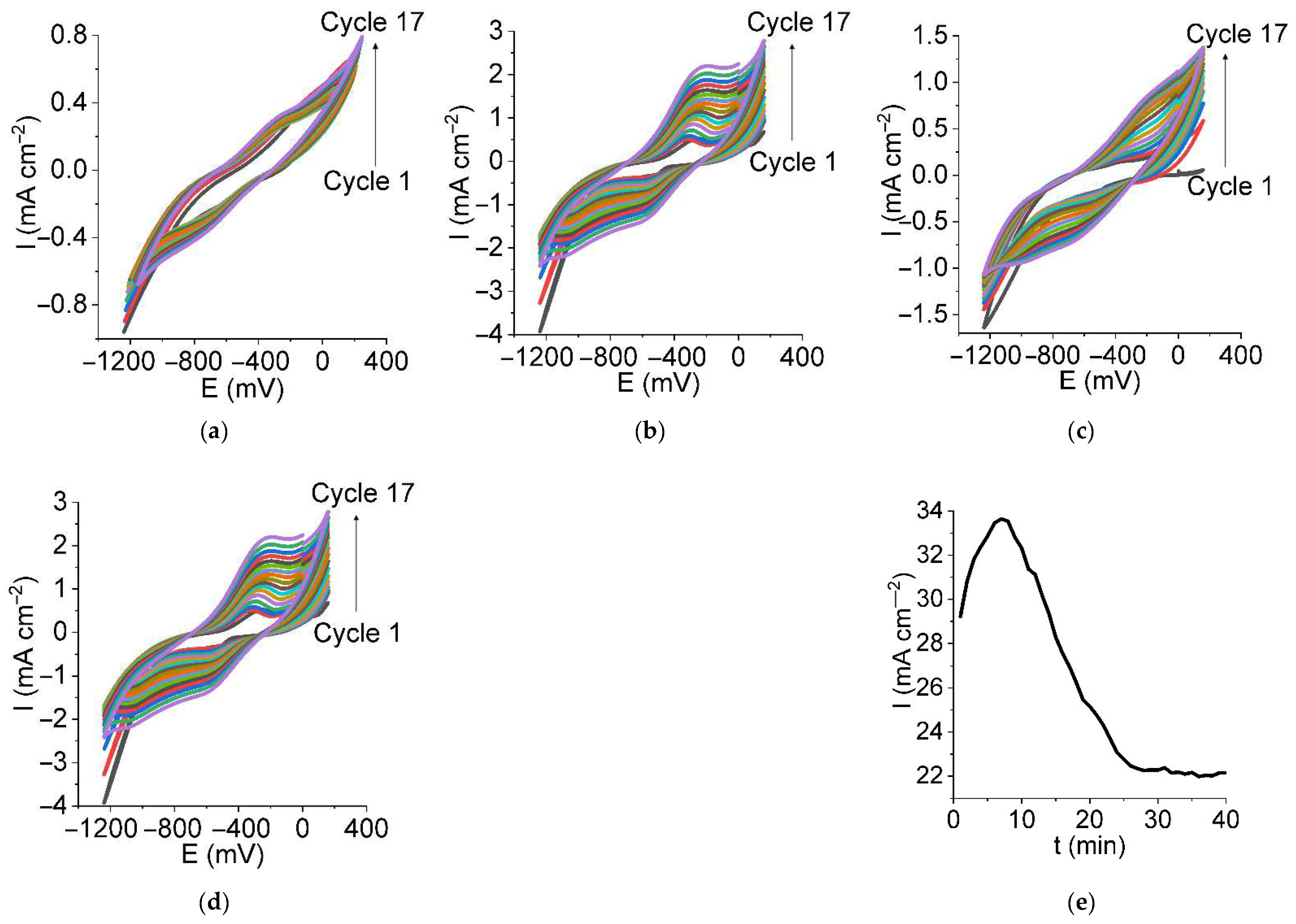
The cyclic voltammograms corresponding to the electrodeposition of cobalt sulfide are presented in Figure 1a–d. The deposition profiles display two well-defined redox peaks. With an increasing number of deposition cycles, both the oxidation and reduction peaks gradually shift oxidation peaks move toward more negative potentials, while reduction peaks shift toward more positive potentials. Simultaneously, the anodic and cathodic current densities progressively increase. The enhancement of peak currents at higher Co2+ concentrations is attributed to the greater availability of metal ions at the electrode–electrolyte interface. An elevated ion concentration promotes a higher rate of charge transfer, leading to increased current response, provided the process is not restricted by diffusion or mass-transport limitations [23]. Recent studies [3] have proposed a mechanistic pathway for metal sulfide formation during electrochemical deposition. In this pathway, thiourea initially interacts with Co2+ ions and hydroxide ions to form a complex species, typically represented as (NH2)2CS·Co2+·OH. This intermediate subsequently decomposes to generate cobalt sulfide according to the following reaction sequence:
C o 2 + + C S ( N H 2 ) 2 + 2 O H C o O H 2 C S ( N H 2 ) 2 C o S + H 2 N C N
The deposition curve of the silicon–carbon film is shown in Figure 1e. At the initial stage, a rise in current is observed, which is attributed to the dissociation of organic molecules in the methanol–HMDS solution, resulting in increased ionic conductivity. As the deposition progresses, the concentration of dissociable functional groups decreases, leading to a gradual decline in conductivity and, consequently, a reduction in current over time [24].
Table 1 summarizes the mass loadings of the deposited materials for the CoS and SiC@CoS samples. The data clearly demonstrate that the presence of a silicon–carbon sublayer significantly enhances the deposition of cobalt sulfide. For instance, the mass loading of CoS increased from 0.5 mg·cm−2 for CoS_0.005 to 2.0 mg·cm−2 for SiC@CoS_0.005, and from 1.2 mg·cm−2 for CoS_0.02 to 3.5 mg·cm−2 for SiC@CoS_0.02. This pronounced mass gain indicates that the SiC sublayer promotes more efficient nucleation and growth of the cobalt sulfide phase, likely due to improved surface conductivity and increased number of active sites for electrodeposition.

3.2. Morphological and Compositional Study

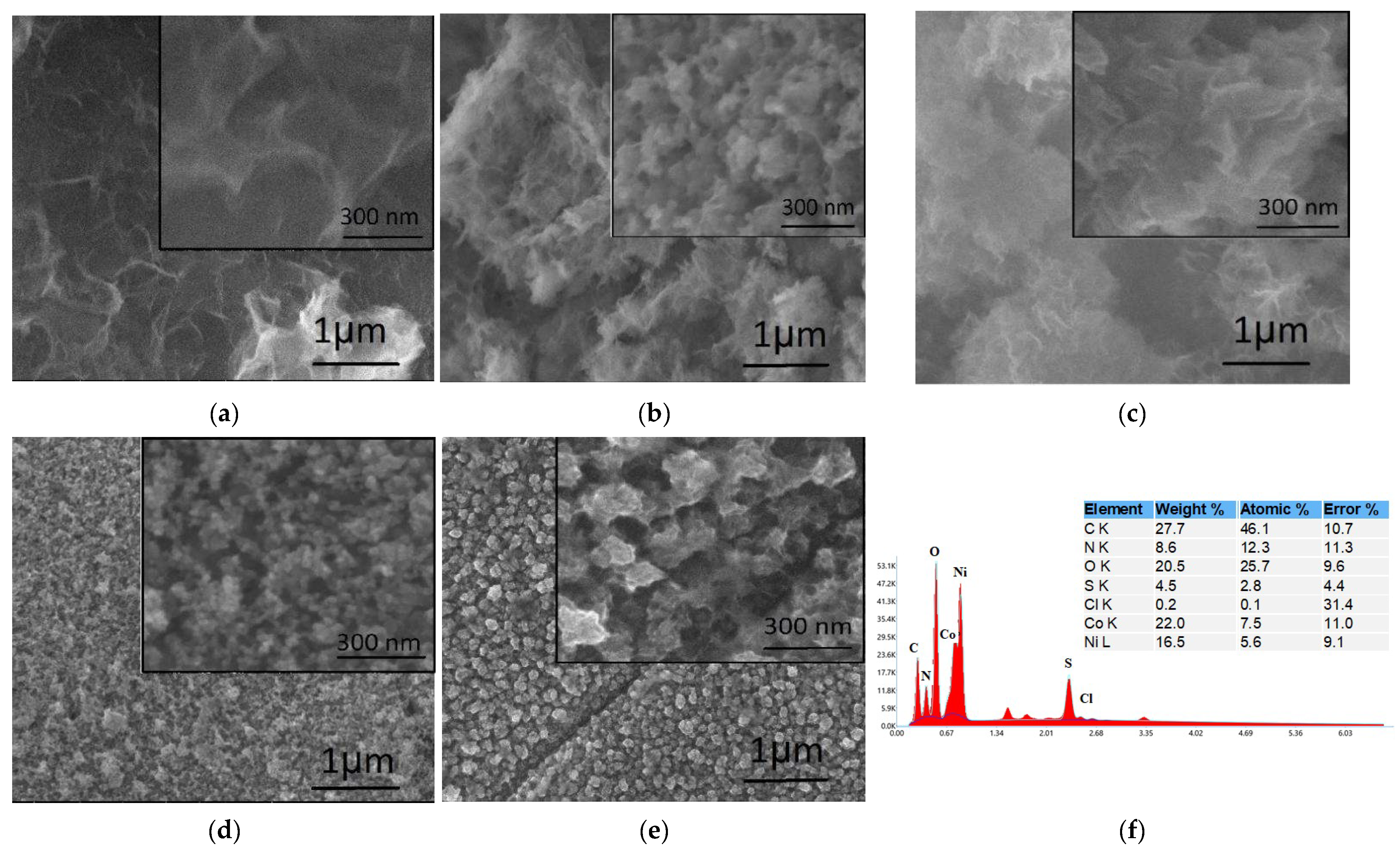
The morphological characteristics of the cobalt sulfide thin films synthesized via electrochemical deposition were examined using scanning electron microscopy (SEM). Figure 2 presents the SEM images of samples grown on nickel foam substrates from electrolytes containing different concentrations of cobalt ions. All cobalt sulfide-based samples exhibit a cloud-like morphology composed of thin, wrinkled nanosheets. This sheet-like architecture is typical for amorphous sulfide materials, which lack long-range crystalline order and grain boundaries (Figure 2a–d). The amorphous nature is further supported by the broad and diffused halo observed in the XRD patterns (Figure 3b). For samples prepared from the higher Co2+ concentration (0.02 M), the deposited films display a denser and more compact morphology compared to those obtained from the lower concentration precursor (0.005 M) (Figure 2c,d). Such morphological differences arise from the increased availability of metal ions during nucleation and growth. The presence of an amorphous structure—with abundant defects, unsaturated coordination sites, and the absence of grain boundaries—can significantly enhance electrochemical performance by facilitating ion diffusion and increasing active surface area. This improvement is particularly advantageous in energy storage systems such as supercapacitors and batteries [25,26,27].
The chemical composition of the electrodeposited cobalt sulfide film was analyzed using EDX, and the corresponding spectrum is shown in Figure 2f. The clear presence of cobalt and sulfur peaks confirms the successful formation of the cobalt sulfide film. The detected carbon (C) and nitrogen (N) signals are attributed either to surface contamination from air exposure [28] or to adsorbed CN and NH4+ species originating from the electrolyte [29]. Oxygen (O) and nickel (Ni) signals arise from the underlying substrate. Trace amounts of chlorine likely originate from chloride-containing components in the electrolyte solution.

3.3. X-Ray Photoelectron Spectroscopy (XPS)

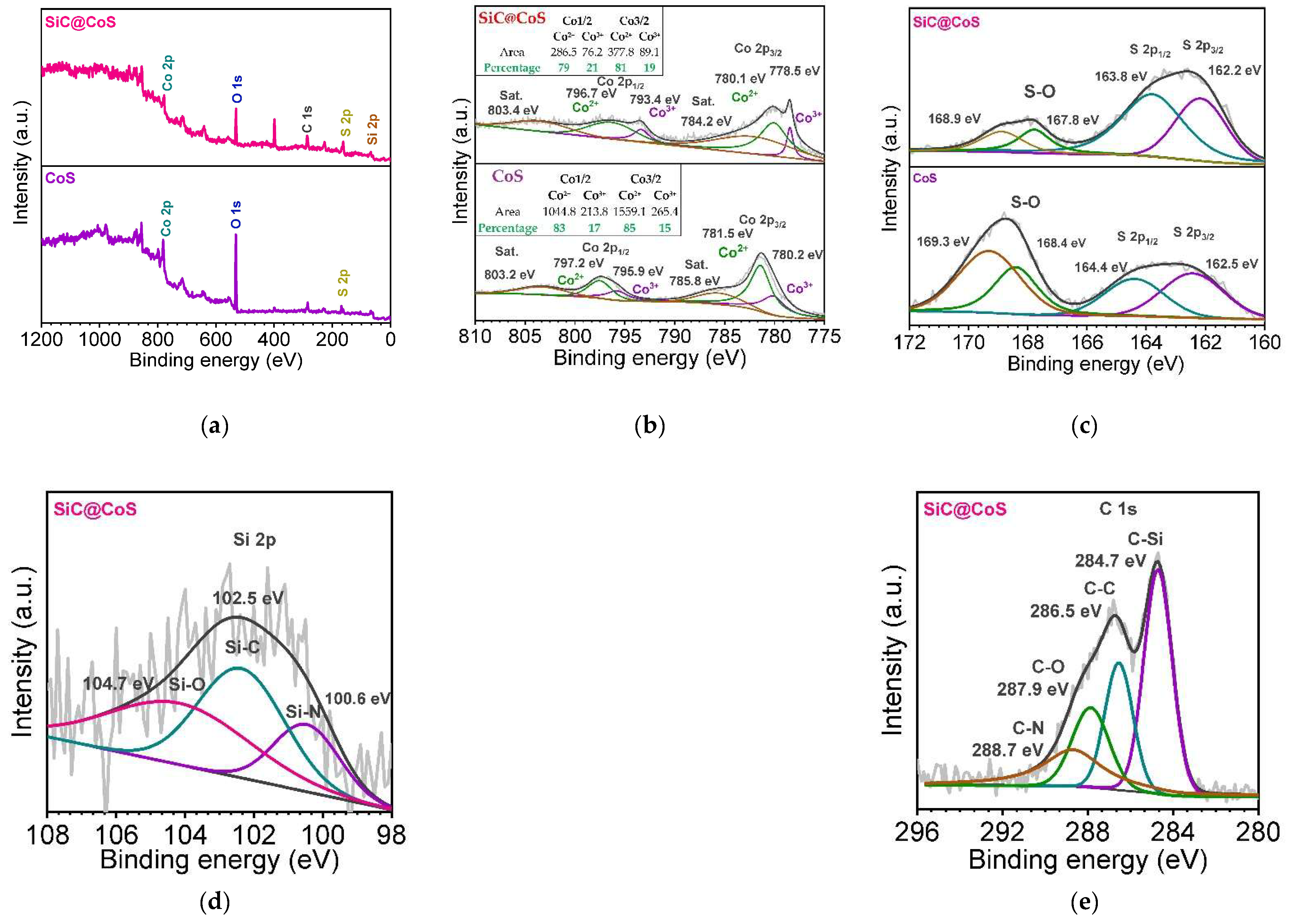
To verify the chemical states of cobalt and sulfur and evaluate the effect of the silicon–carbon interlayer on the electronic structure of the deposited films, X-ray Photoelectron Spectroscopy (XPS) analysis was performed for the CoS and SiC@CoS samples (Figure 3). In the Co 2p region of the CoS sample, the Co 2p3/2 peak located at 781.4 eV and its satellite at 785.8 eV, together with the Co 2p1/2 peak at 797.2 eV (satellite at 803.2 eV), indicate the coexistence of Co2+ and Co3+ species. This mixed-valence state is characteristic of cobalt sulfides and directly contributes to the Co2+ /Co3+ Faradaic redox behavior observed in the CV curves. The sulfur 2p spectrum shows S 2p3/2 and S 2p1/2 peaks at 162.5 and 164.4 eV, confirming S2−/S22− associated with Co–S bonding. Minor peaks at 168–169 eV correspond to oxidized sulfur species formed due to surface exposure to air. For the heterostructure SiC@CoS sample, the Co 2p3/2 peak appears at 779.7 eV with a satellite at 784.2 eV, significantly shifted toward lower binding energies relative to pure CoS. This shift indicates stronger electronic interaction between the CoS layer and the underlying Si–C substructure, suggesting partial electron transfer from SiC toward Co, which stabilizes Co2+ species. Such interfacial electronic modulation is known to facilitate faster redox kinetics, aligning with the enhanced electrochemical performance of SiC@CoS_0.005. It can be found from Figure 3b that the content of Co2+ and Co3+ are 80% and 20% for SiC@CoS, and 84% and 16% for CoS. The S 2p region shows peaks at 162.2 and 163.8 eV, confirming preserved Co–S bonding, while the reduced intensity of S–O contributions indicates that the SiC layer improves surface stability. The Si 2p spectrum contains peaks at 100.6 eV (Si–N), 102.5 eV (Si–C), and 104.7 eV (Si–O), verifying the composition of the silicon–carbon film. The C 1s spectra further support the presence of C–Si, C–C, C–O, and C–N bonds. Overall, XPS results confirm the mixed-valence nature of cobalt in both samples and reveal significant electronic coupling at the SiC/CoS interface, which contributes to the improved capacitive behavior of the heterostructure electrodes.

3.4. Raman and XRD Analysis

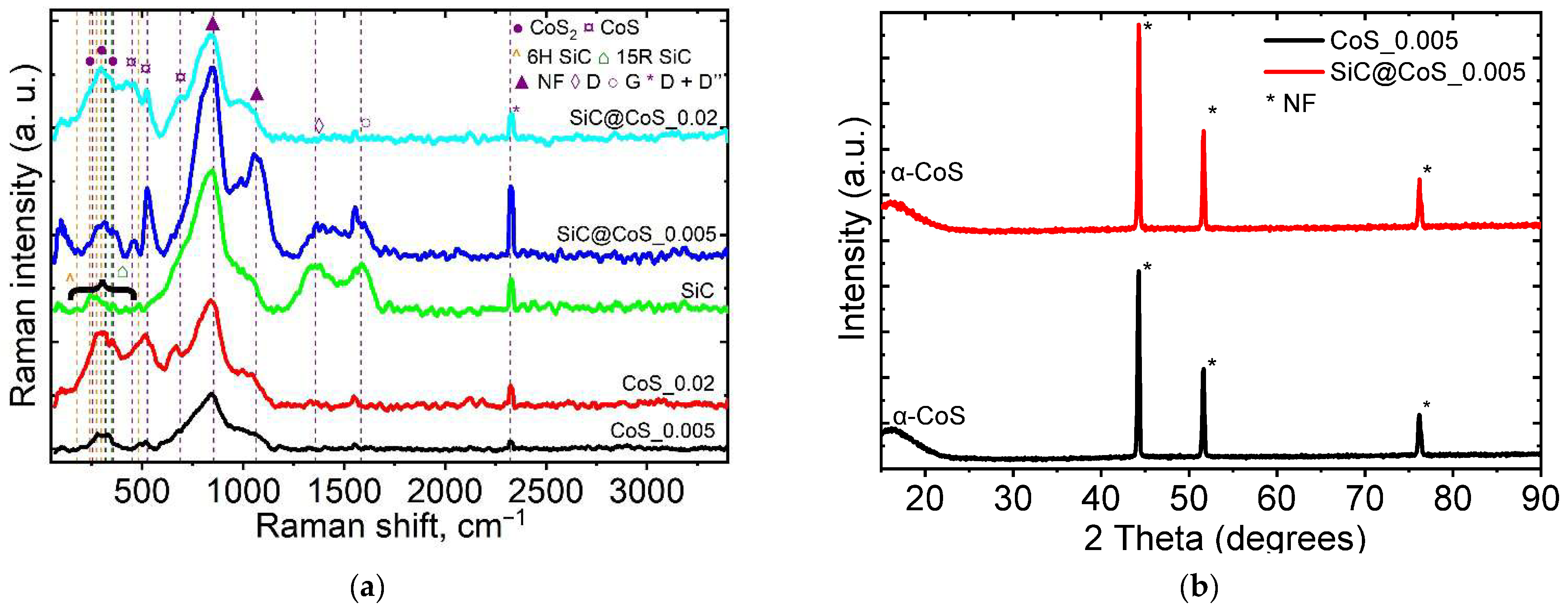
Raman spectroscopy was employed to investigate the structural characteristics of the electrodeposited materials and to confirm their successful growth on the NF substrate. The Raman spectra (Figure 4a) reveal two distinct groups of peaks: bands at 253, 315, and 359 cm−1 correspond to the characteristic vibrational modes of CoS2, consistent with previously reported data [26,30], while the peaks located at 450, 525, and 690 cm−1 are attributed to the CoS phase [26,31]. For the silicon–carbon sample, the characteristic graphite vibrational modes (D and G bands) are clearly observed at 1356 and 1583 cm−1, respectively [32]. Additionally, the peak at 2324 cm−1 lies within the region typically associated with second-order Raman features, indicating its possible assignment as a second-order band of carbonaceous materials [33]. Several Raman bands in the range of 200–700 cm−1 correspond to SiC polytypes, including 6H-SiC (177, 241, 273, 298, 482 cm−1) and 15R-SiC (321, 350 cm−1) [34]. All spectra also exhibit prominent substrate-related features between 849 and 998 cm−1, which can be attributed to hydrated nickel species, likely nickel hydroxides or oxides previously reported to show bands in the 550–950 cm−1 region, with a notable feature near 840 cm−1 [35,36,37]. A strong peak at 1064 cm−1, also associated with the substrate, corresponds to the NiO phase [38].
According to the XRD patterns (Figure 4b), the electrodeposited materials exhibit an amorphous structure. The amorphous α-CoS phase is characterized by the absence of sharp diffraction peaks and the presence of a broad, nonlinear background hump at low diffraction angles, consistent with the literature reports [39]. The diffraction peaks observed at 44.2°, 51.6°, and 76.1° correspond to the (111), (200), and (220) planes of the nickel foam substrate, respectively [40].

3.5. Electrochemical Study

3.5.1. Cyclic Voltammetry (CV)

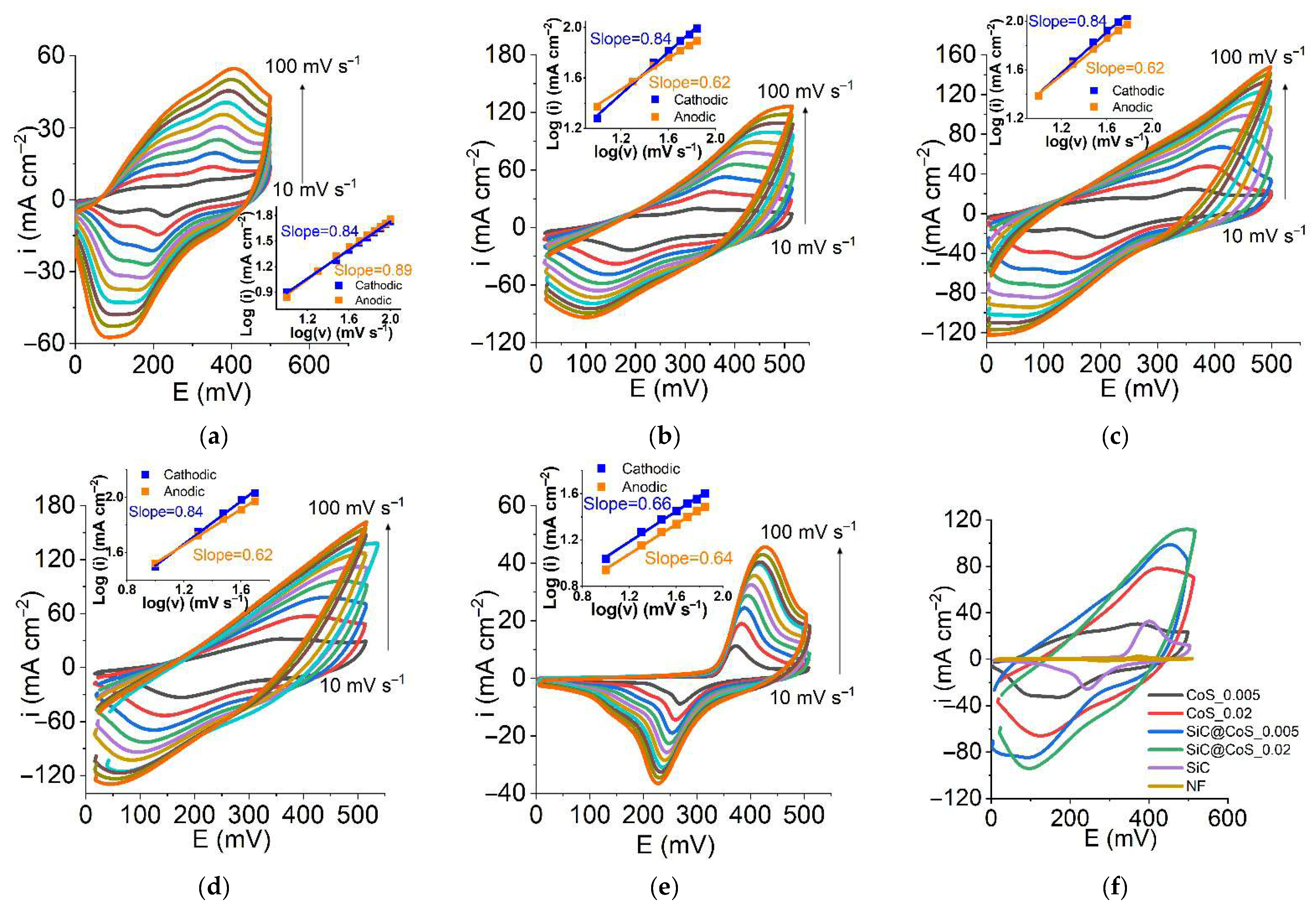
Cyclic voltammetry measurements were carried out at scan rates of 10–100 mV·s−1 in a three-electrode configuration using Ag/AgCl (3.5 M KCl) as the reference electrode and 1 M KOH as the electrolyte (Figure 5a–e). The CV curves of the cobalt sulfide electrodes are relatively symmetrical and display two pairs of well-defined redox peaks corresponding to Faradaic transformations involving cobalt oxidation states (Co2+/Co3+). According to the literature, the two anodic peaks are associated with the oxidation of CoS to CoSOH, followed by the conversion of CoSOH to CoSO, along with related cobalt redox transitions [13]:
C o S + O H C o S O H + e
C o S O H + O H C o S O + H 2 O + e
The symmetry and clarity of the redox peaks indicate favorable electronic and ionic conductivity of the cobalt sulfide films, enabling efficient charge storage behavior. As the scan rate increases, the anodic peaks shift to more positive potentials and the cathodic peaks shift to more negative potentials, accompanied by an increase in peak current density. This behavior is characteristic of diffusion-controlled Faradaic processes, where ion transport limitations begin to influence the electrochemical response at higher scan rates [13]. For electrodes incorporating a silicon–carbon underlayer, both anodic and cathodic currents increase noticeably (Figure 5c,d). This enhancement is attributed to the improved electrochemical activity resulting from the increased mass loading of the active material and reduced diffusion resistance offered by the conductive Si–C layer [41]. The enclosed area of the CV curves varies among the electrodes at identical scan rates, reflecting clear differences in electrochemical storage capacity. These variations arise from distinctions in surface morphology, structural features, and accessible electroactive surface area, which determine the number of available redox sites [42,43]. To further assess the redox behavior, the dependence of peak current density (ip) on scan rate (ν) was analyzed. Their relationship typically follows the power-law expressions [44,45]:
i p = α υ b
log ( i p ) = b log υ + log ( α )
where ip is the peak current density, ν is the scan rate, α is an adjustable constant, and b is the slope of the log–log plot.
A b-value of 0.5 indicates that the electrode reaction kinetics are predominantly governed by diffusion-limited redox processes, which are characteristic of battery-type or pseudocapacitive behavior. In contrast, a b-value approaching 1.0 represents ideal capacitive behavior, typical of electrochemical double-layer capacitance. In our study, the b-values extracted from the peak current versus scan rate plots (Table S1) show that all electrodes exhibit a mixed charge-storage mechanism, involving both diffusion-controlled and surface-controlled capacitive contributions [46]. However, the b-value of the SiC-based electrode is notably closer to 0.5, suggesting that its charge-storage process is more strongly diffusion-controlled, consistent with battery-like behavior. The relatively lower b-value indicates that ion insertion and extraction play a more dominant role in the SiC electrode. This behavior can enhance ion-transport efficiency, potentially improving overall electrochemical performance. The structure of SiC providing favorable channels for rapid ion movement likely contributes to improved charge storage, higher effective capacitance, and better cycling stability in SiC-containing composites.
The capacitive and diffusion contributions to the total current response can be quantified using the following relationship:
i υ = k 1 υ + k 2 υ 1 2
where i is the current at a fixed potential V, k1 and k2 are constants, and ν is the scan rate.
By plotting the current ( i ) against the square root of the voltage ( υ 1 2 ), we can ascertain the constants k 1 and k 2 , which allows us to directly evaluate the contributions of capacitance ( k 1 υ ) and diffusion ( k 2 υ 1 2 )-controlled processes [47].
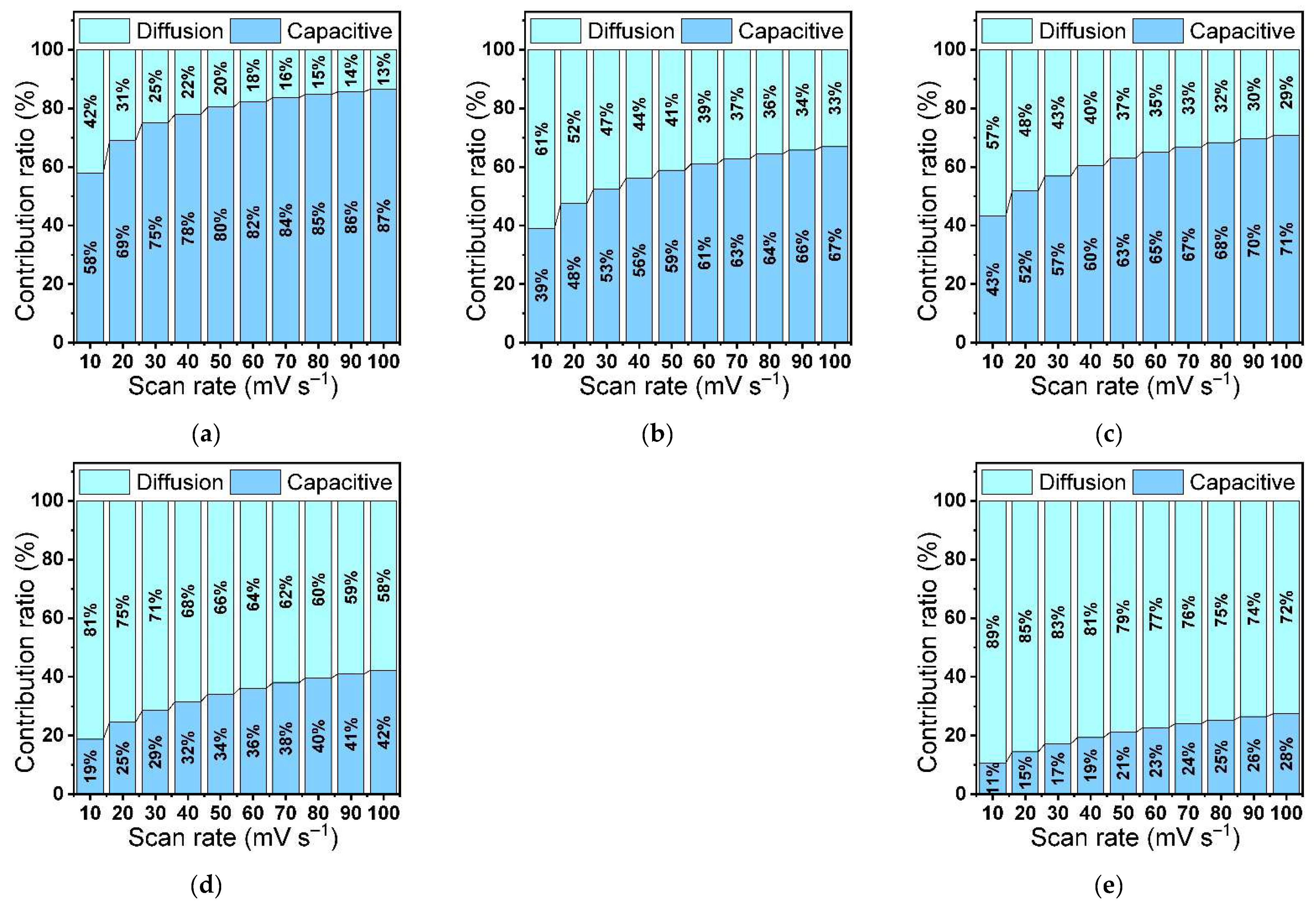
Figure 6 illustrates the relative contributions of these two processes at various scan rates for all electrodes. As the scan rate increases, the time available for ion diffusion decreases, leading to a reduction in the diffusion-controlled contribution. The SiC electrode exhibits the highest fraction of diffusion-controlled charge storage, reinforcing its predominantly pseudocapacitive nature [48] (Figure 6e).

3.5.2. Galvanostatic Charging Discharging (GCD) and Stability Tests

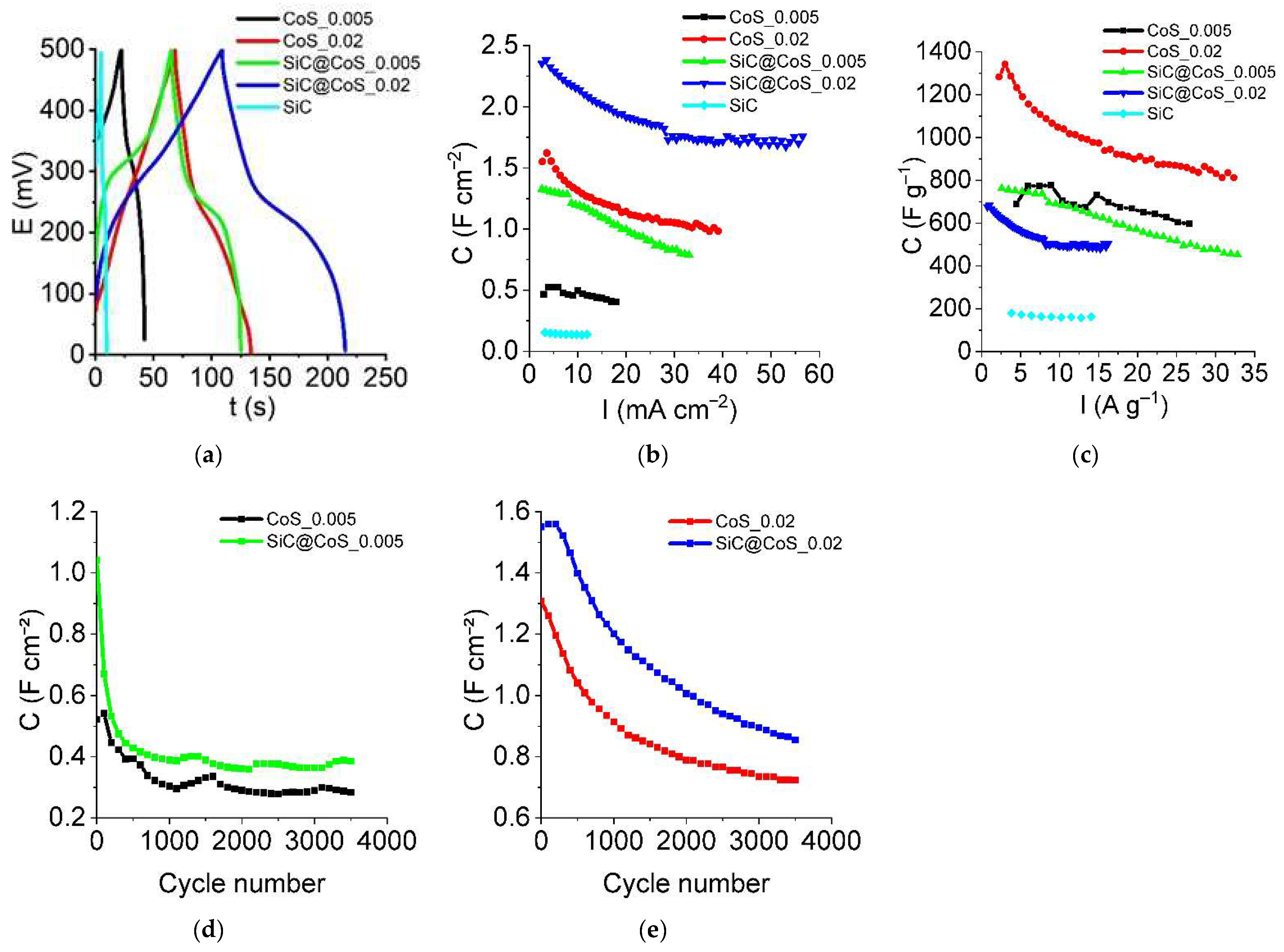
GCD measurements were performed within a potential window of 0–0.5 V at various current densities. The GCD curves obtained at 10 mA·cm−2 are shown in Figure 7a and Figure S2. The pronounced nonlinearity in both the charging and discharging segments confirms the partial pseudocapacitive nature of the electrode materials, consistent with the redox processes identified in the CV analyses [22]. The GCD profiles exhibit two distinct potential reduction regions: a rapid discharge zone at the beginning, and a slower discharge region thereafter, indicating excellent capacitive behavior and efficient charge storage capability.
The areal capacitance (Cs) and gravimetric capacitance (Cg) were calculated using the well-known equations:
C s =   I × t U × S     , C g = I × t U × m  
where I / S or I/m is current density (A·cm−2 or A·g−1); t is discharge time (s); U is the potential window (V) and S and m are the electrode area and active material mass, respectively.
A noticeable improvement in areal capacitance is observed for the electrodes incorporating the silicon–carbon sublayer. At 3 mA·cm−2, the capacitance increases from 0.5 to 1.3 F·cm−2 for samples prepared from the 0.005 M Co precursor and from 1.6 to 2.3 F·cm−2 for the 0.02 M samples (Figure 7b). This enhancement arises from the broader operational current density range and improved charge-storage efficiency imparted by the SiC underlayer.
The silicon–carbon layer enhances the electrical conductivity of the heterostructure electrode, facilitating rapid electron/ion transport and improving overall capacitive performance [49]. For gravimetric capacitance (Figure 7c), the SiC@CoS_0.005 electrode shows an increase from 690 F·g−1 (CoS_0.005) to 748 F·g−1 (SiC@CoS_0.005) at 4 A·g−1. However, the SiC@CoS_0.02 electrode exhibits a decrease from 1287 F·g−1 (CoS_0.02) to 590 F·g−1 (SiC@CoS_0.02). This reduction is attributed to the significantly higher mass loading and greater density of the SiC@CoS_0.02 sample, as evidenced by morphological analyses. Thicker and denser electrodes introduce substantial diffusion limitations: electrolyte ions must travel longer distances to access deeper active regions, ion transport becomes restricted at higher current densities, electrochemical reactions occur predominantly at the outer surface layers, the inner regions remain underutilized, which collectively reduce the effective gravimetric capacitance despite increased areal capacitance. As a result, the capacitance per unit mass declines as the electrode thickness increases.
Furthermore, the specific capacitance decreases with increasing current density (Figure 7b), which is attributed to bulk diffusion limitations. At higher discharge currents, ions are unable to fully penetrate the internal pores and bulk of the electrode within the shortened timescale [6].
The cycling stability tests were conducted at current densities of 7 mA·cm−2 and 21 mA·cm−2. for all electrodes (Figure 7c,d). After 3500 charge–discharge cycles, the capacitance retention values were found to be: ~60% (CoS_0.005), ~40% (SiC@CoS _0.005) and 57% (CoS_0.02), ~66% (SiC@CoS _0.02). Among all samples, the SiC@CoS_0.02 electrode exhibits the best overall performance at 21 mA·cm−2, showing both enhanced capacitance and improved long-term durability (for SiC@CoS_0.02). Special attention should be paid to the long-term durability of the SiC@CoS_0.005 sample. A significant drop in capacitance of 36% is observed after the first 100 cycles, and after 500 cycles, the capacitance stabilizes and remains constant up to 3500 cycles. This improvement can be attributed to the synergistic effect between the cobalt sulfide active layer and the silicon–carbon underlayer, which enhances electrical conductivity and promotes stable ion transport during repeated cycling. The gradual decrease in capacitance observed for all electrodes may result from the progressive blockage of pores due to electrolyte ion diffusion and accumulation on the electrode surface. This phenomenon has been previously reported; for example, Co9S8 electrodes showed a capacitance retention of only 53.3% after 2000 cycles at 10 mA·cm−2 [6] illustrating that capacity fading is common in sulfide-based systems under prolonged cycling. A comparison of the present results with recently reported cobalt sulfide/carbon-based electrodes (Table 2) demonstrates that the electrochemical performance of our syntcarhesized electrodes is comparable or superior to those reported in the literature. Notably, the electrodes developed in this study are capable of operating effectively at higher current densities, highlighting their strong potential for practical supercapacitor applications.

3.6. Electrochemical Impedance Spectroscopy (EIS)

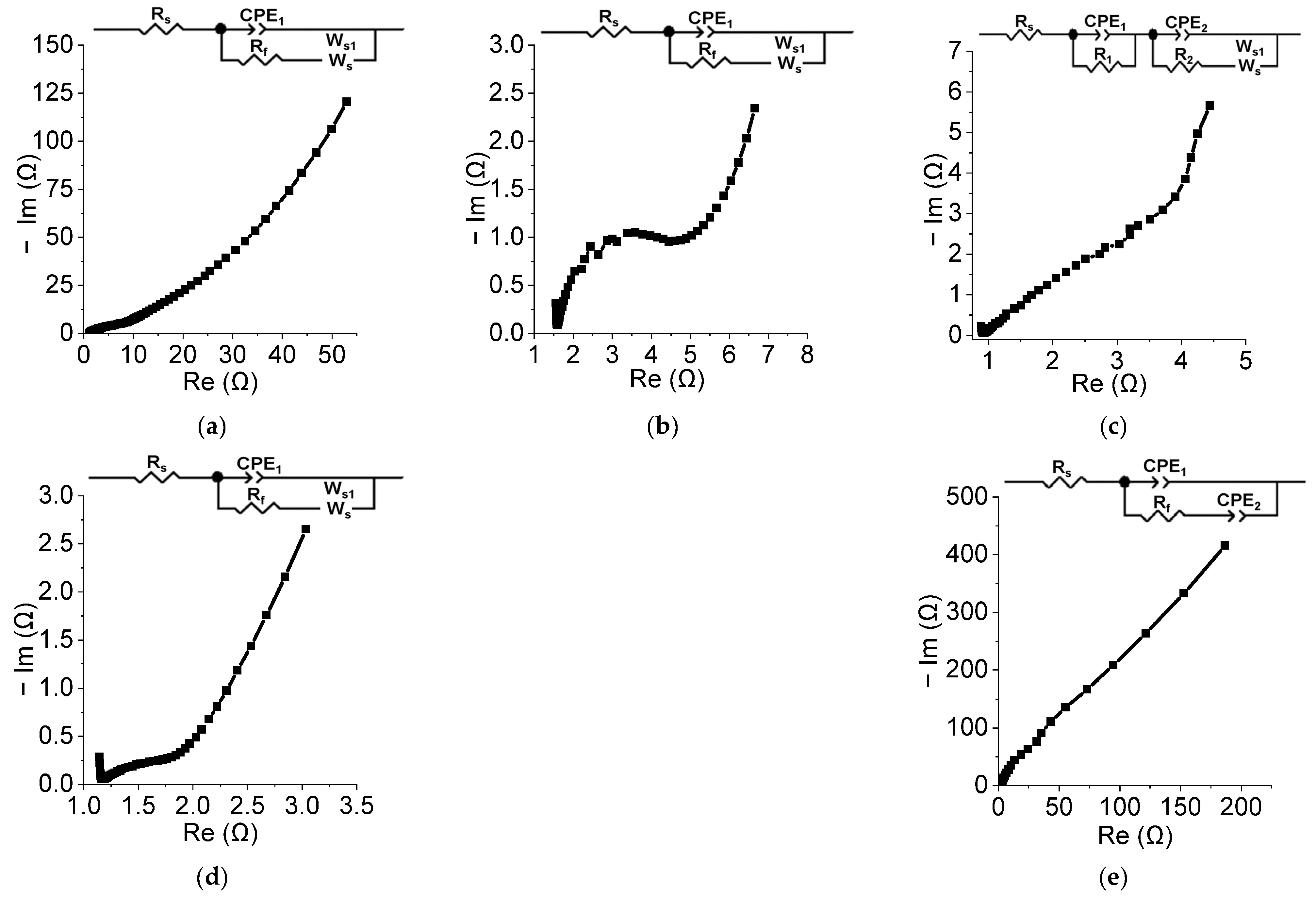
Electrochemical impedance spectroscopy was employed to investigate the charge-transfer kinetics, ion diffusion behavior, and interfacial processes occurring in the prepared electrodes. The Nyquist plots along with the corresponding fitted equivalent circuits are presented in Figure 8. The fitting quality is high, with R2 values ranging from 0.98 to 0.99, and the errors associated with the fitted circuit parameters remaining below 13% (Table 3). Based on the EIS results, the samples can be classified into two groups depending on the dominant electrochemical process: one group exhibits primarily capacitive behavior, while the second displays behavior governed by diffusion-controlled processes. The generalized equivalent circuit used for fitting consists of the solution resistance (Rs), constant phase element (CPE), charge-transfer resistance (Rf), and the Warburg diffusion element (W), which accounts for semi-infinite ion diffusion within the electrode matrix [53]. The equivalent series resistance (Rs) ranges between 0.87 Ω and 1.54 Ω. The lowest value is recorded for the SiC@CoS_0.005 electrode, indicating superior electrical conductivity and improved interfacial contact between the electrode and electrolyte, thereby reducing ohmic losses [54]. In contrast, the CoS_0.02 sample exhibits the highest Rs, which may be attributed to the higher electrolyte viscosity at increased precursor concentration and the less uniform, denser morphology of the active material, hindering ion transport pathways. In the presence of silicon–carbon sublayer the Rs value become lower due to the electronic interaction between the CoS layer and the underlying Si–C substructure (XPS study) (Table 3) declaring the faster ion transport and enhanced capacity.
To account for surface heterogeneity, roughness, and porosity of the electrodes, a constant phase element (CPE) was applied in the impedance fitting. The phase index (CPE-P) ranges from 0.43 to 0.81. The relatively high CPE-P value (0.81055) for the SiC sample indicates a smoother and more uniform surface [55]. In contrast, the CoS-based samples (SiC@CoS_0.02 and CoS_0.02) exhibit CPE-P values of 0.43 and 0.69, respectively, revealing pronounced surface heterogeneity that likely originates from the developed morphology and possible nanostructure formation on the film surfaces [56].
A significant influence of the charge-transfer resistance (Rf) on the electrochemical activity is evident. The SiC@CoS_0.02 sample shows one of the lowest Rf values (1.51 Ω), indicating fast faradaic processes and efficient charge transfer, comparable to highly active Co- and Ni-based catalysts [57]. In contrast, the bare SiC electrode displays a markedly higher Rf (1607 Ω), likely due to the formation of a thick passivating oxide layer that hinders electron transport an effect commonly reported in systems with protective surface oxides [58]. The presence of a Warburg element (W) confirms the contribution of diffusion processes to charge-transfer kinetics. The W element is defined by W-R (diffusion resistance), W-T (diffusion constant), and W-P (phase index). The CoS_0.005 sample exhibits a relatively high W-R value (39.29 Ω), suggesting substantial diffusion resistance, likely arising from narrow pore channels or partial particle agglomeration [59]. In contrast, the SiC@CoS_0.02 sample shows a much lower W-R (7.041 Ω), indicating more favorable ion-diffusion pathways. The SiC@CoS_0.005 sample also requires a more complex equivalent circuit with two parallel Rf–CPE branches, implying zones with differing charge-transfer kinetics [53,60]. Despite this complexity, its overall behavior, low Rs, moderate Rf, and the presence of a Warburg element are consistent with trends observed in high-performance composite electrodes. The diffusion parameter W-P ≈ 0.76 points to a partially capacitive diffusion characteristic, typically associated with porous electrodes where diffusion is geometrically restricted [54].
The differences between the equivalent circuits for SiC@CoS_0.005 and SiC@CoS_0.02 arise from morphology variations induced by different CoS precursor concentrations. SEM images at 50,000× magnification show that SiC@CoS_0.005 possesses a porous “cloud-like” architecture with high roughness and surface heterogeneity. Such a structure results in domains with differing charge-transfer kinetics, justifying the use of two parallel Rf–CPE branches. In contrast, SiC@CoS_0.02 forms a dense, compact, and fine-granular coating with relatively uniform structural features. This homogeneity supports a consistent charge-transfer behavior across the surface, adequately represented by a single Rf–CPE branch.

4. Conclusions

Heterostructured cobalt sulfide/silicon–carbon electrodes were successfully fabricated via electrochemical deposition on nickel foam. Raman spectroscopy revealed two distinct groups of peaks corresponding to CoS2 and CoS phases, while the silicon–carbon underlayer exhibited multiple polytypes, including 6H-SiC and 15R-SiC. XRD analysis confirmed the predominantly amorphous nature of the deposited electrode materials. Electrochemical studies showed that the charge-storage kinetics of all electrodes arise from a combination of diffusion-controlled and surface-controlled capacitive processes, with the contribution of the diffusion-controlled mechanism decreasing at higher scan rates. The introduction of a silicon–carbon sublayer resulted in a substantial enhancement of electrode capacitance, increasing from 0.5 to 1.3 F·cm−2 and from 1.6 to 2.3 F·cm−2 for electrodes synthesized using 0.005 M and 0.02 M CoCl2·6H2O precursor solutions, respectively. Cycling stability tests demonstrated capacitance retentions of 60% (CoS_0.005), 40% (SiC@CoS _0.005), 57% (CoS_0.02), and 66% (SiC@ CoS_0.02) after 3500 charge–discharge cycles. Among them, the SiC@CoS_0.02 electrode exhibited both improved capacitance and superior cycling stability at a current density of 21 mA·cm−2. Gravimetric capacitance increased significantly with the incorporation of a silicon–carbon sublayer for the SiC@CoS_0.005 electrode, rising from 690 F·g−1 (CoS_0.005) to 748 F·g−1 (SiC@CoS_0.005) at 4 F·g−1. Conversely, a decrease was observed for the SiC@CoS_0.02 electrode, dropping from 1287 F·g−1 (CoS_0.02) to 590 F·g−1 (SiC@CoS_0.02), which can be attributed to its substantially higher mass loading and denser morphology. EIS analysis revealed that the incorporation of the silicon–carbon sublayer considerably modifies the electrochemical behavior by reducing both Rs and Rf and by altering diffusion pathways. Composite electrodes such as SiC@CoS_0.02 and SiC@CoS_0.005 demonstrated favorable combinations of high conductivity and low charge-transfer resistance, underscoring their potential for use in high-specific-power supercapacitor applications. Overall, the cobalt sulfide–based heterostructures investigated in this work exhibit promising electrochemical performance, driven largely by the engineered surface morphology and optimized material architecture. These findings highlight the importance of tuning synthesis parameters, surface roughness, and porosity to accelerate charge-transfer processes and enhance long-term stability. Future studies should emphasize scaling the fabrication process and integrating CoxSy-based heterostructures into practical energy-storage systems, while addressing economic and environmental considerations to support sustainable technological development.

Supplementary Materials

The following supporting information can be downloaded at https://www.mdpi.com/article/10.3390/chemengineering10020029/s1, Figure S1. Dependences of specific capacity on current density and number of deposition cycles: (a) pure CoxSy on NF; (b) CoxSy on the NF with silicon-carbon sublayer.; Figure S2. Charge-discharge curves: (a) SiC; (b) CoS_0.005; (c) CoS_0.02; (d) SiC@CoS_0.005; (e) SiC@CoS_0.02; Table S1. b values, estimated from the plots.

Author Contributions

Conceptualization and methodology, T.N.M.; validation, I.Y.B., T.N.M. and T.A.M.; formal analysis, T.N.M.; investigation, T.A.M., A.N.Y., R.K. and O.I.I.; writing—original draft preparation, T.A.M.; writing—review and editing T.N.M., R.K. and I.Y.B.; visualization, T.A.M.; supervision, T.N.M.; All authors have read and agreed to the published version of the manuscript.

Funding

The work was supported by grant of the Russian Science Foundation №25-23-00514 at the Southern Federal University (https://rscf.ru/project/25-23-00514/ accessed on 4 February 2026).

Data Availability Statement

The original contributions presented in the study are included in the article. Further inquiries can be directed to the corresponding author.

Acknowledgments

The authors gratefully acknowledge the Resource Center “Physical Methods of Surface Investigation” of St. Petersburg State University for XPS measurements.

Conflicts of Interest

The authors declare no conflicts of interest.

References

  1. Li, N.; Lv, T.; Yao, Y.; Li, H.; Liu, K.; Chen, T. Compact graphene/MoS2 composite films for highly flexible and stretchable all-solid-state supercapacitors. J. Mater. Chem. A. 2017, 5, 3267–3273. [Google Scholar] [CrossRef]
  2. Yang, X.; Zhao, L.; Lian, J. Arrays of hierarchical nickel sulfides/MoS2 nanosheets supported on carbon nanotubes backbone as advanced anode materials for asymmetric supercapacitor. Power Sources 2017, 343, 373–382. [Google Scholar] [CrossRef]
  3. Poimenidis, I.; Papakosta, N.; Loukakos, P.A.; Marnellos, G.E.; Konsolakis, M. Highly efficient cobalt sulfide heterostructures fabricated on nickel foam electrodes for oxygen evolution reaction in alkaline water electrolysis cells. Surfaces 2023, 6, 493–508. [Google Scholar] [CrossRef]
  4. Gulen, M. Lithium perchlorate-assisted electrodeposition of CoS catalyst surpassing the performance of platinum in dye sensitized solar cell. J. Mater. Sci. 2022, 57, 3513–3524. [Google Scholar] [CrossRef]
  5. Prakash, J.; Jasrotia, R.; Himanshi; Singh, J.; Kandwal, A.; Sharm, P. Wastewater Treatment: The Emergence of Cobalt Ferrite and Its Composites in Sulfate Radical-Based Advanced Oxidation Processes. Emergent Mater. 2024, 7, 2237–2259. [Google Scholar] [CrossRef]
  6. Halder, A.; Aman, M.; Lichchhavi; Jha, S.K. Enhancing supercapacitor performance with binder-free cobalt sulfide pseudo-capacitive electrodes: A path to sustainable energy storage. J. Elect. Chem. 2024, 972, 118631. [Google Scholar] [CrossRef]
  7. Chen, C.-Y.; Shih, Z.-Y.; Yang, Z.; Chang, H.-T. Carbon nanotubes/cobalt sulfide composites as potential high-rate and high-efficiency supercapacitors. J. Power Sources 2012, 215, 43–47. [Google Scholar] [CrossRef]
  8. Ojha, G.P.; Kang, G.W.; Kuk, Y.-S.; Hwang, Y.E.; Kwon, O.H.; Pant, B.; Acharya, J.; Park, Y.W.; Park, M. Silicon Carbide Nanostructures as Potential Carbide Material for Electrochemical Supercapacitors: A Review. Nanomaterials 2023, 13, 150. [Google Scholar] [CrossRef]
  9. Khan, J.; Ahmed, A.; Al-Kahtan, A.A. Strategic design of binary transition metal sulfides for superior asymmetric supercapacitors. Mater. Adv. 2025, 6, 3344–3354. [Google Scholar] [CrossRef]
  10. Li, X.; Wu, H.; Guan, C.; M Elshahawy, A.; Dong, Y.; J Pennycook, S.; Wang, J. (Ni, Co) Se2/NiCo-LDH core/shell structural electrode with the cactus-like (Ni, Co) Se2 core for asymmetric supercapacitors. Small 2018, 15, 1803895. [Google Scholar] [CrossRef]
  11. Wang, H. Facile synthesis of silver fungus-like CoS for high-performance supercapacitors. J. Energy Storage 2021, 40, 102764. [Google Scholar] [CrossRef]
  12. Liu, H.; Hu, R.; Qi, J.; Sui, Y.; He, Y.; Meng, Q.; Wei, F.; Ren, Y.; Yulong, Z.; Wei, W. One-Step Synthesis of Nanostructured CoS2 Grown on Titanium Carbide MXene for High-Performance Asymmetrical Supercapacitors. Adv. Mater. Interfaces 2020, 7, 1901659. [Google Scholar] [CrossRef]
  13. Luo, F.; Li, J.; Yuan, H.; Xiao, D. Rapid synthesis of three dimensional flower-like cobalt sulfide hierarchitectures by microwave assisted heating method for high-performance supercapacitors. Electrochim. Acta 2014, 123, 183–189. [Google Scholar] [CrossRef]
  14. Fei, Z.; Song, Y.; Wu, M.; Wu, Y.; Chen, Y.; Kang, D.J.; Bian, C.; Qian, Y. MOF-derived metal sulfides and their composites: Synthesis and their electrochemical water splitting. Catalysts 2025, 15, 928. [Google Scholar] [CrossRef]
  15. Kalusulingam, R.S.; Ravi, K.; Mathi, S.; Mikhailova, T.S.; Srinivasan, K.; Biradar, A.V.; Myasoedova, T.N. Bagasse derived n-doped graphitic carbon encapsulated cobalt nanoparticles as an efficient bifunctional catalyst for water splitting reaction. Colloids Surf. A Physicochem. Eng. Asp. 2024, 692, 133959. [Google Scholar] [CrossRef]
  16. Chen, F.; Jia, D.; Jin, X.; Cao, Y.; Liu, A. A general method for the synthesis of graphene oxide-metal sulfide composites with improved photocatalytic activities. Dye. Pigment. 2015, 125, 142–150. [Google Scholar] [CrossRef]
  17. Fan, J.; Hu, L.; Qi, Z.; Wan, T.; Huang, S.; Zhang, X.; Han, Z.; Chu, D. Electrodeposited cobalt sulfide on a vertical graphene nanocomposite for high-performance supercapacitors. New J. Chem. 2021, 45, 20249. [Google Scholar] [CrossRef]
  18. Sarma, A.; Dippel, A.-C.; Gutowski, O.; Etter, M.; Lippmann, M.; Seeck, O.; Manna, G.; Sanyal, M.K.; Keller, T.F.; Kulkarni, S.; et al. Electrodeposition of nanowires of a high copper content thiourea precursor of copper sulfide. RSC Adv. 2019, 9, 31900–31910. [Google Scholar] [CrossRef]
  19. Edwards, P.H.; Bairan Espano, J.R.; Macdonald, J.E. Rational Phase Control in the Synthesis of Cobalt Sulfides. Chem. Mater. 2024, 36, 7186–7196. [Google Scholar] [CrossRef]
  20. Plugotarenko, N.K.; Myasoedova, T.N.; Mikhailova, T.S.; Grigoryev, M.N. Electrochemical Deposition of Silicon-Carbon Films: A Study on the Nucleation and Growth Mechanism. Nanomaterials 2019, 9, 1754. [Google Scholar] [CrossRef]
  21. Grigoryev, M.N.; Myasoedova, T.N.; Mikhailova, T.S.; Plugotarenko, N.K. The electrochemical deposition of silicon—Carbon thin films from organic solution. In Saint Petersburg OPEN 2018. Book of Abstracts; Academic University Publishing: Saint Petersburg, Russia, 2018; pp. 563–564. [Google Scholar]
  22. Myasoedova, T.N.; Mikhailova, T.S.; Grigoryev, M.N. Effect of nickel and manganese doping on the structure, morphology and the electrochemical performance of the silicon-carbon films. J. Alloys Compd. 2021, 855, 157504. [Google Scholar] [CrossRef]
  23. Skoog, D.; Holler, F.; Crouch, S. Principles of Instrumental Analysis; Brooks/Cole, Cengage Learning: Belmont, CA, USA, 2007. [Google Scholar]
  24. Grigoryev, M.N.; Myasoedova, T.N.; Mikhailova, T.S. The electrochemical deposition of silicon—Carbon thin films from organic solution. J. Phys. Conf. Ser. 2018, 1124, 081043. [Google Scholar] [CrossRef]
  25. Li, Z.B.; Liu, P.; Yang, G.W. Efficient All-2D Amorphous Cobalt Sulfide Nanosheets/Multilayered Molybdenum Disulfide Hybrid Heterojunction Catalyst for Electrochemical Hydrogen Evolution. Glob. Chall. 2019, 4, 1900066. [Google Scholar] [CrossRef] [PubMed]
  26. Ait-Karra, A.; Zakir, O.; Mourak, A.; Lasri, M.; Idouhli, R.; Abouelfida, A.; Mohy Eddine Khadiri, M.E.; Benzakour, J. A Comprehensive Structural, Morphological, and Electrochemical Analysis of Electrodeposited Cobalt Sulfide Thin Films. J. Electrochem. Soc. 2025, 172, 052503. [Google Scholar] [CrossRef]
  27. Lin, J.-Y.; Liao, J.-H.; Chou, S.-W. Cathodic electrodeposition of highly porous cobalt sulfide counter electrodes for dye-sensitized solar cells. Electrochim. Acta 2011, 56, 8818–8826. [Google Scholar] [CrossRef]
  28. Ghahremaninezhad, A.; Asselin, E.; Dixon, D.G. Electrodeposition and Growth Mechanism of Copper Sulfide Nanowires. J. Phys. Chem. C 2011, 115, 9320–9334. [Google Scholar] [CrossRef]
  29. Ait-karra, A.; Zakir, O.; Ait baha, A.; Lasri, M.; Idouhli, R.; Elyaagoubi, M.; Abouelfida, A.; Khadiri, M.; Benzakour, J. Electrodeposition and characterization of copper sulfide (CuS) thin film: Towards an understanding of the growth mechanism. J. Solid. State Electrochem. 2023, 27, 2051–2065. [Google Scholar] [CrossRef]
  30. Kinner, T.; Bhandari, K.; Bastola, E.; Monahan, B.M.; Haugen, N.; Roland, P.J.; Bigioni, T.; Ellingson, R. Majority carrier type control of cobalt iron sulfide (CoxFe1–xS2) pyrite nanocrystals. J. Phys. Chem. C 2016, 120, 5706–5713. [Google Scholar] [CrossRef]
  31. Peng, S.; Han, X.; Li, L.; Zhu, Z.; Cheng, F.; Srinivansa, M.; Adams, S.; Ramakrishna, S. Unique cobalt sulfide/reduced graphene oxide composite as an anode for sodium-ion batteries with superior rate capability and long cycling stability. Small 2016, 12, 1359–1368. [Google Scholar] [CrossRef]
  32. Bokobza, L.; Bruneel, J.-L.; Couzi, M. Raman Spectra of Carbon-Based Materials (from Graphite to Carbon Black) and of Some Silicone Composites. C J. Carbon. Res. 2015, 1, 77–94. [Google Scholar] [CrossRef]
  33. Merlen, A.; Buijnsters, J.G.; Pardanaud, C. A Guide to and Review of the Use of Multiwavelength Raman Spectroscopy for Characterizing Defective Aromatic Carbon Solids: From Graphene to Amorphous Carbons. Coatings 2017, 7, 153. [Google Scholar] [CrossRef]
  34. Aksyanov, G.; Kompan, M.E.; Kul’kova, I.V. Raman Scattering in Mosaic Silicon Carbide Films. Fiz. Tverd. Tela 2010, 52, 1724–1728. [Google Scholar] [CrossRef]
  35. Krasser, W.; Renouprez, A.J. Raman Scattering of Hydrogen Chemisorbed on Silica—Supported Nickel. J. Raman Spectrosc. 1979, 8, 92–94. [Google Scholar] [CrossRef]
  36. Qiu, Z.; Tai, C.W.; Niklasson, G.A.; Edvinsson, T. Direct observation of active catalyst surface phases and the effect of dynamic self-optimization in NiFe-layered double hydroxides for alkaline water splitting. Energy Environ. Sci. 2019, 12, 572–581. [Google Scholar] [CrossRef]
  37. Faid, Y.A.; Barnett, A.O.; Seland, F.; Svein Sunde, S. Ni/NiO nanosheets for alkaline hydrogen evolution reaction: In situ electrochemical-Raman study. Electrochim. Acta 2020, 361, 137040. [Google Scholar] [CrossRef]
  38. Usha, K.S.; Sivakumar, R.; Sanjeeviraja, C. Preparation of pure NiO thin film by radio frequency magnetron sputtering technique and investigation on its properties. J. Mater. Sci. Mater. Electron. 2022, 33, 16136–16143. [Google Scholar] [CrossRef]
  39. Zang, S.; Hou, Y.; Chang, J.; Xu, F.; Wu, D.; Jiang, K.; Gao, Z. Amorphous-crystalline heterostructures enable energy-level matching of cobalt sulfide/nickel iron layered double hydroxide for efficient oxygen evolution reaction. J. Colloid. Interface Sci. 2024, 656, 485–494. [Google Scholar] [CrossRef]
  40. Toparli, C. Synthesis and characterization of high entropy oxy-hydroxides for electrocatalytic oxygen evolution and reduction reaction. J. ESOGU Eng. Arch. Fac. 2023, 31, 698–704. [Google Scholar] [CrossRef]
  41. Bard, A.J.; Faulkner, L.R. Electrochemical Methods: Fundamentals and Applications, 2nd ed; John Wiley & Sons: Hoboken, NJ, USA, 2001. [Google Scholar]
  42. Wang, C.-M.; Wen, C.-Y.; Chen, Y.-C.; Chang, J.-Y.; Ho, C.-W.; Kao, K.-S.; Shih, W.-C.; Chiu, C.-M.; Shen, Y.-A. The Influence of Specific Surface Area on the Capacitance of the Carbon Electrodes Supercapacitor. In Proceedings of the International Conference on Industrial Application Engineering, Fukuoka, Japan, 28–31 March 2015. [Google Scholar] [CrossRef]
  43. Junlin, L.; Xu, W.; Li, S.; Javed, M.S.; Liu, G.; Hu, C. Rational design of CuO nanostructures grown on carbon fiber fabrics with enhanced electrochemical performance for flexible supercapacitor. J. Mater. Sci. 2018, 53, 739–748. [Google Scholar] [CrossRef]
  44. Yang, T.; Liu, J.; Zhang, M.; Yang, D.; Zheng, J.; Ju, Z.; Cheng, J.; Zhuang, J.; Liu, Y.; Zhong, J.; et al. Encapsulating MnSe nanoparticles inside 3D hierarchical carbon frameworks with lithium storage boosted by in situ electrochemical phase transformation. ACS Appl. Mater. Interfaces 2019, 11, 33022–33032. [Google Scholar] [CrossRef]
  45. Wang, Y.-K.; Liu, M.-C.; Cao, J.; Zhang, H.-J.; Kong, L.-B.; Trudgeon, D.P.; Li, X.; Walsh, F.C. 3D hierarchically structured CoS nanosheets: Li+ storage mechanism and application of the high-performance lithium-ion capacitors. ACS Appl. Mater. Interfaces 2019, 12, 3709–3718. [Google Scholar] [CrossRef] [PubMed]
  46. Liu, H.M.; Yao, Z.X.; Liu, Y.S.; Diao, Y.X.; Hu, G.X.; Zhang, Q.F.; Li, Z. In situ synthesis of nitrogen site activated cobalt sulfide@N, S dual-doped carbon composite for a high-performance asymmetric supercapacitor. J. Colloid. Interface Sci. 2021, 585, 30–42. [Google Scholar] [CrossRef] [PubMed]
  47. Tian, Y.; Ma, Y.; Sun, R.; Zhang, W.; Liu, H.; Liu, H.; Liao, L. Enhanced Electrochemical Performance of Metallic CoS-Based Supercapacitor by Cathodic Exfoliation. Nanomaterials 2023, 13, 1411. [Google Scholar] [CrossRef] [PubMed]
  48. Plugotarenko, N.K.; Myasoedova, T.N.; Bogush, I.Y. The effect of the electrolyte concentration on the charge transfer at the electrolyte/silicon-carbon interface: Electrochemical impedance spectrometry study. Mater. Sci. Semicond. Process. 2021, 135, 106121. [Google Scholar] [CrossRef]
  49. Jiang, D.; Xu, Q.; Meng, S.; Xia, C.; Chen, M. Construction of cobalt sulfide/graphitic carbon nitride hybrid nanosheet composites for high performance supercapacitor electrodes. J. Alloys Compd. 2017, 706, 41–47. [Google Scholar] [CrossRef]
  50. Ahmad, R.; Iqbal, N.; Noor, T. Development of ZIF-Derived Nanoporous Carbon and Cobalt Sulfide-Based Electrode Material for Supercapacitor. Materials 2019, 12, 2940. [Google Scholar] [CrossRef]
  51. Miya, L.A.; Ghosh, S.K.; Kumari, P.; Mallick, K.; Morema, C.N.M. Eco-friendly and sustainable supercapacitor design: Cobalt sulfide nanoparticles embedded on carbon cloth as an electrode material for asymmetric devices. Chem. Pap. 2025, 79, 7617–7631. [Google Scholar] [CrossRef]
  52. Deng, Y.; Wang, X.; Wang, Z.; Wang, X.; Li, Z.; Wang, L.; Zhou, C.; Chen, D.; Luo, Y. Yolk–Shell Structured Nickel Cobalt Sulfide and Carbon Nanotube Composite for High-Performance Hybrid Supercapacitors. Energy Fuels 2021, 35, 5342–5351. [Google Scholar] [CrossRef]
  53. Kochuparampil, A.P.; Joshi, J.H.; Rathod, K.R.; Jethva, H.O.; Joshi, M.J. The effect of adding zinc sulphide nano-particles on structural, functional, thermal, dielectric, impedance and nonlinear optical properties of ammonium pentaborate crystals. J. Phys. Chem. Solids 2019, 129, 424–433. [Google Scholar] [CrossRef]
  54. Ghosh, S.; Paul, A.; Samanta, P.; Landge, B.; Mandal, S.K.; Sinha, S.; Dutta, G.G.; Murmu, N.C.; Kuila, T. Influence of Transition Metals (Cu and Co) on the Carbon-Coated Nickel Sulfide Used as Positive Electrode Material in Hybrid Supercapacitor Device. J. Compos. Sci. 2021, 5, 180. [Google Scholar] [CrossRef]
  55. Vadhva, P.; Hu, J.; Johnson, J.M.; Stocker, R.; Braglia, M.; Brett, D.J.L.; Rettie, A. Electrochemical Impedance Spectroscopy for All-Solid-State Batteries: Theory, Methods and Future Outlook. ChemElectroChem 2021, 8, 1930–1947. [Google Scholar] [CrossRef]
  56. Li, H.; Zhao, Y.; Wang, C.A. MoS2/CoS2 composites composed of CoS2 octahedrons and MoS2 nano-flowers for supercapacitor electrode materials. Front. Mater. Sci. 2018, 12, 354–360. [Google Scholar] [CrossRef]
  57. Li, J.; Li, J.; Shao, M.; Yan, Y.; Li, R. MOF-Derived Ultrathin NiCo-S Nanosheet Hybrid Array Electrodes Prepared on Nickel Foam for High-Performance Supercapacitors. Nanomaterials 2023, 13, 1229. [Google Scholar] [CrossRef]
  58. Kim, H.-J.; Kim, C.-W.; Punnoose, D.; Gopi, C.V.V.M.; Kim, S.-K.; Prabakar, K.; Rao, S.S. Nickel doped cobalt sulfide as a high performance counter electrode for dye-sensitized solar cells. Appl. Surf. Sci. 2015, 328, 78–85. [Google Scholar] [CrossRef]
  59. Karmakar, S. Impedance Spectroscopy for Electroceramics and Electrochemical System. Appl. Phys. 2024, 6, 10–56. [Google Scholar] [CrossRef]
  60. Cesiulis, H.; Tsyntsaru, N.; Ramanavicius, A.; Ragoisha, G. The Study of Thin Films by Electrochemical Impedance Spectroscopy. In Nanostructures and Thin Films for Multifunctional Applications: Technology, Properties and Devices; NanoScience and Technology; Springer: Cham, Switzerland, 2016; pp. 3–42. [Google Scholar] [CrossRef]
Figure 1. Electrochemical behavior of different electrolyte substrate systems on nickel foam: (a) CoS_0.005; (b) CoS_0.02; (c) SiC@CoS_0.005; (d) SiC@CoS_0.02; and (e) SiC.
Chemengineering 10 00029 g001
Figure 2. SEM images: (a) CoS_0.005; (b) CoS_0.02; (c) SiC@CoS_0.005; (d) SiC@CoS_0.02; (e) SiC; and (f) EDX spectra of CoS_0.005 sample.
Chemengineering 10 00029 g002
Figure 3. (a) Survey spectra, (b) Co 2p spectra, and (c) S 2p spectra of CoS and SiC@CoS, (d) Si 2p spectrum, and (e) C 1s spectrum of SiC@CoS.
Chemengineering 10 00029 g003
Figure 4. (a) Raman spectra and (b) XRD spectra of the materials.
Chemengineering 10 00029 g004
Figure 5. CV curves of (a) CoS_0.005; (b) CoS_0.02; (c) SiC@CoS_0.005; (d) SiC@CoS_0.02; (e) SiC; (f) at 50 mV·s−1 in comparison to NF.
Chemengineering 10 00029 g005
Figure 6. Relative contribution of the capacitive and diffusion-controlled charge storage at different scan rates of (a) CoS_0.005; (b) CoS_0.02; (c) SiC@CoS_0.005; (d) SiC@CoS_0.02; and (e) SiC.
Chemengineering 10 00029 g006
Figure 7. (a) Charge–discharge curves at 10 mA·cm−2. (b) Dependence of areal capacitance on current density. (c) Dependences of gravimetric capacitance vs. current density. Stability of electrodes at (d) 7 mA·cm−2 and (e) 21 mA·cm−2.
Chemengineering 10 00029 g007
Figure 8. Nyquist plots of the electrodes: (a) CoS_0.005; (b) CoS_0.02; (c) SiC@CoS_0.005; (d) SiC@CoS_0.02; and (e) SiC.
Chemengineering 10 00029 g008
Table 1. Masses of the deposited materials for CoS and SiC@CoS samples, showing the enhanced CoS deposition in the presence of the silicon–carbon sublayer.
SampleCoS_0.005CoS_0.02SiC@CoS_0.005SiC@CoS_0.02SiC
Mass of the deposited material (mg·cm−2)0.51.22.03.50.8
Table 2. Comparative characteristics of recently reported cobalt sulfide and carbon-based electrodes.
MaterialElectrolyteSpecific CapacitanceCurrent Density/Scan RateCycle Stability (Capacitance Retention)Ref.
Carbon nanotubes(CNT)/CoS1 M KOH2000 F·g−1
1000 F·g−1
10 mV s−1
100 mV s−1
1500 cycles (91%)[7]
Zeolitic Imidazolate Framework -Derived Nanoporous Carbon and Cobalt Sulfide2 M KOH677 F·g−1100 mV s−11600 cycles (74%)[50]
Cobalt sulfide nanoparticles on carbon cloth2 M KOH382.3 F·g−15 mV s−15000 (97%)[51]
Yolk−Shell-Structured Nickel Cobalt Sulfide and Carbon Nanotube Composite2 M KOH464.8 F·g−11 A·g−18000 cycles (91.3%)[52]
Cobalt sulfide/graphen2 M KOH2603 F·g−15 A·g−13000 (150%)[17]
SiC@CoS_0.021 M KOH1.55 F·cm−2 (426 F·g−1)21 mA·cm−2
(6 A·g−1)
3500 (66%)This work
SiC@CoS_0.0051 M KOH1.04 F·cm−2
(598 F·g−1)
7 mA·cm−2
(3.5 A·g−1)
3500 (40%)This work
Table 3. Equivalent circuit parameters extracted from the EIS analysis of the electrodes.
RsCPE-T1CPE-P1Rf1CPE-T2CPE-P2Rf2W-RW-TW-P
SiC0.94165
(1.6%)
0.00311
(2.9%) *
0.81055
(0.8%)
1607
(2.9%)
0.003414
(2.2%)
0.72706
(2.3%)
----
SiC@CoS_0.021.109
(0.6%)
0.17803
(8.2%)
0.42947
(3.4%)
1.514
(6.5%)
---7.41
(5.9%)
6.916
(6.7%)
0.62578
(2%)
CoS_0.0051.133
(0.8%)
0.0073565
(5.8%)
0.770074
(1.3%)
14.18
(6.6%)
---39.29
(11.7%)
2.788
(12.8%)
0.35671
(4.66%)
CoS_0.021.535
(1.2%)
0.0155
(11.5%)
0.685
(3.3%)
2.447
(4.24%)
---8.645
(3.2%)
15.31
(1.7%)
0.35725
(12.5%)
SiC@CoS_0.0050.87615
(1.5%)
0.07478
(1.9%)
0.51386
(5.7%)
72
(4.6%)
0.068861
(9.9%)
0.53236
(4.5%)
365
(10.3%)
76
(6.9%)
0.167
(7.2%)
0.76
(5%)
* Error.
Disclaimer/Publisher’s Note: The statements, opinions and data contained in all publications are solely those of the individual author(s) and contributor(s) and not of MDPI and/or the editor(s). MDPI and/or the editor(s) disclaim responsibility for any injury to people or property resulting from any ideas, methods, instructions or products referred to in the content.