Abstract
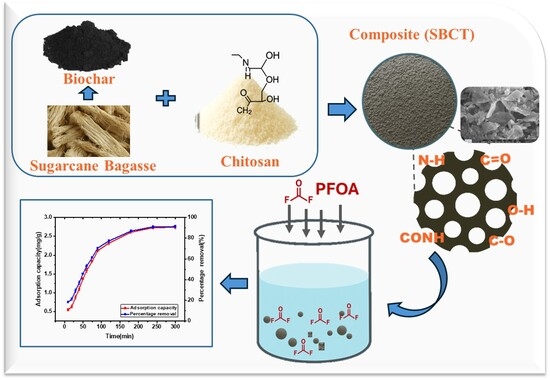
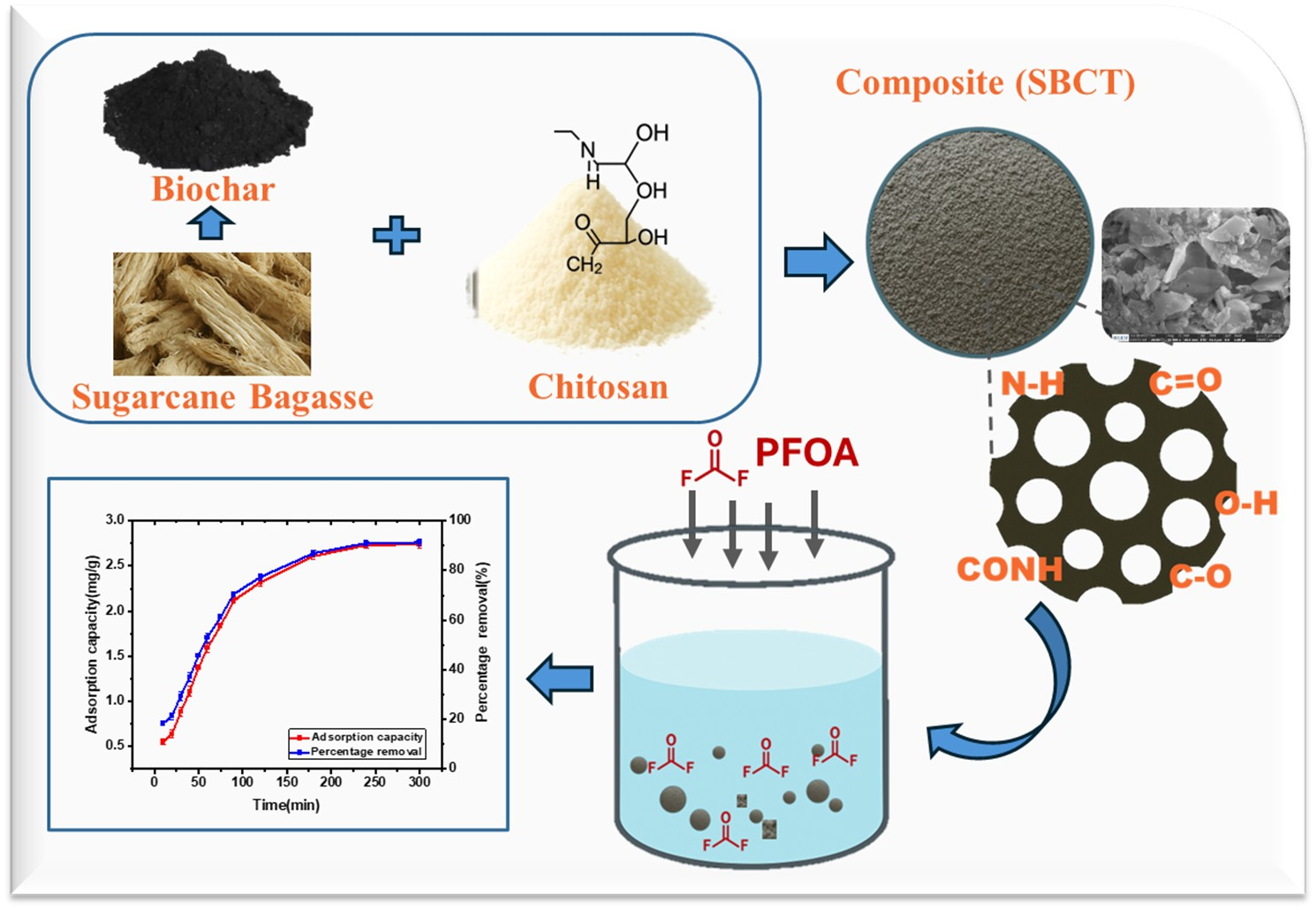
In the recent years, several studies from developing economies have reported the presence of per- and polyfluoroalkyl substances (PFAS) in water bodies, with perfluorooctanoic acid (PFOA) predominating, a potential endocrine disruptor. In this study, an engineered sugarcane bagasse biochar–chitosan composite (SBCT) was designed, synthesized, and evaluated as a novel adsorbent for the removal of PFOA from aqueous systems at concentrations up to 500 ppb. Batch adsorption experiments were conducted to investigate the effects of initial PFOA concentration, contact time, pH, adsorbent dosage, and temperature. Scanning electron microscopy (SEM) showed that SBCT has a significant porous structure. The composite showed over 90% of PFOA removal from water. Further, peaks corresponding to C–F bonds observed after adsorption by Fourier transform infrared (FTIR) spectroscopy confirms the adsorption of PFOA on SBCT. The protonated amine groups (NH3+) in chitosan enhanced the adsorption of anionic PFOA through electrostatic attraction with carboxyl groups (COO−). The kinetic study revealed that pseudo-first-order best described the adsorption process, with an equilibrium adsorption capacity (qeq) of 2.78 mg/g, suggesting that physisorption is the predominant mechanism. The Langmuir Isotherm model gave the best fit, establishing a maximum adsorption capacity (qmax) of 9.08 mg/g. Thermodynamic analysis revealed that the adsorption process was spontaneous and exothermic, consistent with physisorption. The regeneration capacity of the SBCT composite demonstrated exceptional reusability over five methanol adsorption–desorption cycles. The adsorption kinetics, equilibrium behavior, and regeneration efficiency suggest that SBCT is a viable low-cost adsorbent for batch adsorption-based treatment systems targeting PFOA removal, particularly in decentralized and resource-constrained water treatment applications.
1. Introduction
Perfluorooctanoic acid (PFOA), used as an anionic surfactant, is a long-chain perfluoroalkyl carboxylic acid (PFCA) within the broader class of per- and polyfluoroalkyl substances (PFAS) [1]. PFOA is utilized as a processing aid in making fluoropolymers for the production of non-stick cookware, waterproof clothing, and insulation, and in coatings, fire-fighting foams, and lubricants for their oil, water, and stain resistance [2,3,4]. The worldwide emissions resulting from commercial PFOA manufacturing were estimated between 90 and 970 tonnes from 1951 to 2002, 30–430 tonnes from 2003 to 2015, and are projected to reach 630 tonnes between 2016 and 2030, while emissions from fluoropolymer production were reported between 1220 and 6560 tonnes (1951–2002), 660–3870 tonnes (2003–2015), with an expected increase to 4520 tonnes (2016–2030) [5].
Owing to its remarkable chemical stability and surface activity ascribed to its strong carbon–fluorine (C–F) linkages, PFOA is resistant to biodegradation [6,7] and is listed as a persistent organic pollutant (POP) in Annex A of the Stockholm Convention since 2019 [1,8]. Despite its widespread utilization in industrial and domestic applications, multiple studies have reported its toxicological effects, including carcinogenicity, genotoxicity, endocrine disruption, liver toxicity, immunological dysfunction, and reproductive issues [3,9,10]. PFOA is defined as hydrophobic and oleophobic due to its low fluorine polarizability, but it has a robust and particular affinity for human serum albumin [11] and supported by molecular simulations [12], highlights its pronounced proteinophilic nature.
The hydrophobic and lipophobic characteristics of PFASs pose significant challenges in remediation efforts [13,14]. Wastewater treatment facilities are significant sources of PFAS, since PFOA concentrations in effluents (110 ng/L) surpass those in influents (100 ng/L) at a U.S. facility, demonstrating inadequate effectiveness in removal [15]. Wastewater PFOA concentrations were found predominant among PFASs in wastewater from developed countries such as Sweden [16], Japan [17], and Korea [18] span from tens to hundreds of ng/L, with values in Sweden reported up to 11.9 µg/L in Sagargatan pumping station [19]. Similarly, wastewater studies from developing and rapidly industrializing regions, China [20,21], and Kenya [22], report the dominance of PFOA concentrations, confirming its widespread presence in municipal and industrial wastewater systems. In developing economies, groundwater PFOA concentrations of up to 2.51 µg/L have been reported in industrial regions of China [23]. In China, elevated PFOA concentrations in drinking water are ascribed to upstream wastewater treatment plant discharges into source streams [6,24]. These findings highlight the growing burden of PFOA pollution in developing regions and underscore the need for cost-effective and decentralized remediation strategies. Common treatment procedures are typically inadequate for eliminating trace levels of PFOA from wastewater, while advanced technologies are sometimes prohibitively costly. Adsorption, especially with materials like activated carbon, provides a more cost-effective and efficient solution, delivering enhanced removal performance and less secondary pollution compared to methods such as coagulation, degradation, or filtration [7,25,26]. Adsorption is recognized as a simple, effective, and cost-efficient method for removing PFASs from water. The efficacy of diverse adsorbents in eliminating PFOA has been examined, encompassing nanomaterials, activated carbon, carbon nanotubes, ion exchange polymer resins, and different minerals [27,28,29,30]. Biochar, an economically carbon-dense substance generated through the pyrolysis of biomass under low-oxygen conditions, has emerged as a potential adsorbent for removing PFOA from water and wastewater [31,32,33]. Biochar is preferred over other adsorbents because of its cost-effectiveness, superior adsorption performance, and ecologically friendly properties. Additionally, one of the benefits of employing biochar is its ability to be customized for specific carbon sequestration [34]. Sugarcane bagasse, an agro-industrial byproduct, is considered a suitable raw material for extensive biochar production owing to its plentiful availability, economic viability, substantial mineral content, and inherently porous fibrous structure [35]. Again, Chitosan’s non-toxicity, hydrophilicity, biodegradability, and biocompatibility render it a cost-effective, renewable, and eco-friendly sorbent for effective water purification [36]. Chitosan-modified biochar has demonstrated improved efficacy in augmenting the adsorptive capacity for a wide range of contaminants, including arsenic (V) [37], Ofloxacin [38], and heavy metals [39].
Given the challenges with PFOA in wastewater particularly in developing economies, we have synthesized a novel engineered biochar in the form of sugarcane bagasse biochar/chitosan composite (SBCT) for effective removal of PFOA present even in trace levels in water. The SBCT composite material was characterized using FTIR methodology, SEM examination, and Brunauer–Emmett–Teller (BET) surface area methods. Adsorption kinetics and isotherm models were employed to evaluate the PFOA uptake capacity. We have further investigated the impact of initial PFOA concentration, adsorbent dosage, pH of the aqueous PFOA solution, and temperature on adsorption effectiveness. Additionally, the potential for reusing the exhausted adsorbent was examined using several regeneration agents. Finally, the effectiveness of SBCT has been compared with other adsorbents for PFOA removal.
2. Materials and Methods
2.1. Adsorbate
Perfluorooctanoic acid (PFOA), chitosan (deacetylated chitin), and epichlorohydrin (ECH) were sourced from Sigma Aldrich (St. Louis, MO, USA). Every additional reagent was of analytical grade. The stock solution was initially made with methanol, while Milli-Q water was used to formulate all subsequent working solutions. The concentrations of the prepared PFOA solutions were verified using Gas Chromatography–Electron Capture Detector (GC–ECD) (Agilent Technologies, Santa Clara, CA, USA) analysis after derivatization based on external calibration with derivatized PFOA standards, and the measured concentrations were within ±5% of the nominal values. The corresponding calibration curve is provided in Figure S1.
2.2. SBCT Preparation
The novel SBCT was synthesized utilizing a modified technique derived from established methods in the literature [38,40]. The raw material, sugarcane bagasse (SB), was procured from a local cane juice seller in Tamil Nadu (Chengalpattu, Indian) and divided into smaller pieces. The bagasse was thoroughly cleaned with Milli-Q water to eliminate the surface contaminants and subsequently dried in a hot air oven at 105 °C for 8 h to eradicate moisture content. The dried bagasse was powdered using a grinder and subjected to isothermal pyrolysis in an oxygen-limited environment in a preheated muffle furnace at 350 °C for 70 min. A lower pyrolysis temperature (350 °C) under slow pyrolysis conditions was chosen to retain surface functional groups and minimize ash formation in sugarcane bagasse biochar, facilitating effective chitosan modification and PFOA adsorption [41]. The residual ash and other contaminants from the biochar were removed by washing the biochar with Milli-Q water. The biochar was dried at 80 °C in a hot air oven, screened through a 150 µm nylon mesh, and stored in a sealed container within a desiccator to prevent moisture absorption. Preliminary experiments were carried out using different biochar–chitosan mass ratios (1:1 and 2:1). Based on adsorption performance and surface characteristics, the 2:1 ratio was selected for further study. The higher biochar content also improves economic feasibility, as biochar is a low-cost agro-waste material compared to chitosan. In this procedure, 2 g of chitosan powder was dissolved in 200 mL of a 3% (v/v) acetic acid solution while being magnetically stirred to obtain a homogeneous solution. Subsequently, 4 g of biochar derived from sugarcane bagasse was integrated into the 2 g chitosan solution in a 2:1 ratio (SB:CT) and stirred continuously for 2 h. To facilitate crosslinking, 300 mL of a 2% (v/v) epichlorohydrin (ECH) solution was introduced, and the mixture was stirred in a water bath shaker at 40 °C for 30 min. The pH was later adjusted to a range of 8.0–10.0 using a 1 mol/L NaOH solution. The resultant composite was meticulously cleaned to eliminate any remaining alkali before utilization.
2.3. Adsorbent Characterization
The chemical functionality and composition of the SBCT composite were examined by Fourier-transform infrared spectroscopy (FTIR) using a PerkinElmer ALPHA-FT-IR spectrometer (PerkinElmer Inc., Waltham, MA, USA) over the wavelength range of 400–4000 cm−1. Surface morphology and structural properties were assessed using scanning electron microscopy (SEM) employing an FEI Quanta 200 instrument (FEI Company, Hillsboro, OR, USA). At the same time, the composition of the elements was analyzed through energy-dispersive X-ray spectroscopy (EDAX) using an FEI Nova SEM 450 (FEI Company, Hillsboro, OR, USA). The Brunauer–Emmett–Teller (BET) surface area was ascertained by nitrogen adsorption–desorption isotherms at 77 K utilizing a Quantachrome Autosorb IQ analyzer (Quantachrome Instruments, Boynton Beach, FL, USA). The point of zero charge (pZC) of the SBCT composite was ascertained using the specified methodology given elsewhere [42]. Briefly, a 50 mL solution of 0.1 M NaCl was mixed with 0.5 g of biochar and permitted to remain undisturbed for 24 h to reach equilibrium. A series of solutions with differing initial pH values (pHi) was generated by adjusting the pH using 0.1 M hydrochloric acid and sodium hydroxide solutions. After the equilibration interval, the final pH (pHf) was documented, and the pH difference (ΔpH = pHi − pHf) was calculated. A graph of ΔpH against pHi was constructed to determine the pZC. All measurements were conducted in triplicate to guarantee repeatability.
2.4. Batch Adsorption of PFOA
Adsorption studies were conducted in duplicate utilizing the SBCT composite as the adsorbent. Simulated wastewater with perfluorooctanoic acid (PFOA) concentrations between 0.5 and 4 mg/L was generated, and 30 mL of this solution was placed into 50 mL Nalgene tubes (Southern India Scientific Corporation (SISCON), Chennai, Tamil Nadu, India). Each tube was allocated 0.02 g of the SBCT material and underwent agitation at 150 rpm in an orbital shaker, sustained at ambient temperature (25 °C), for different contact times. After treatment, the suspensions were filtered through a 0.22 μm membrane to isolate the solid and liquid phases. Before analysis, the filtrate was subjected to derivatization, transforming PFOA into its anilide form through the use of 2,4-difluoroaniline (DFA) as the derivatizing reagent and N, N-dicyclohexylcarbodiimide (DCC) as the dehydrating agent. The derivatization of PFOA prior to GC–ECD analysis was performed following established protocols reported in the literature [43], with minor modifications to optimize sensitivity and peak resolution. PFOA was quantified in a GC-ECD system (Agilent 7890B, Agilent Technologies, Santa Clara, CA, USA) using an HP5 column (Agilent Technologies, Santa Clara, CA, USA) (30 m length, 0.32 mm internal diameter, 0.25 μm film thickness). Nitrogen was used as a carrier gas, with a total flow rate of 18.8 mL per minute. The temperature of the detector was maintained at 280 °C. Sample injections were conducted in splitless mode with a fixed injection volume of 1 μL.
The adsorption capacity at equilibrium, qeq (mg/g), and PFOA removal efficiency, RE (%), were estimated with Equations (1) and (2):
Cin refers to the initial PFOA concentration, while Ceq (mg/L) represents the equilibrium state PFOA concentration. The variable Ctc (mg/L) indicates the concentration at a given time of contact, mo represents the adsorbent’s mass in grams, and Vo denotes the PFOA volume in mL. Each of the experiments was conducted in duplicate under controlled temperature conditions.
2.5. Isotherm Modeling of Adsorption
The adsorption nature and behavior of PFOA on SBCT were evaluated by changing the initial PFOA concentrations between 0.5 and 4 mg/L. The amount of PFOA adsorbed at each concentration level was used to construct adsorption isotherms, which were then analyzed using the nonlinear plotting of the Langmuir model given in Equations (3) and (4), the Freundlich model in Equation (5), and the Temkin model in Equation (6) and Redlich-Peterson in Equation (7) as used elsewhere [44,45].
Ceq (mg/L) and qeq (mg/g) denote PFOA concentration and SBCT adsorption capacity at the state of equilibrium, and qmax (mg/g) indicates the anticipated maximum monolayer adsorption capacity of PFOA. The ‘KLq’ (L/mg) is the Langmuir constant. The dimensionless separation factor RLq, calculated using Equation (4), elucidates the favorability of the adsorption process, where RLq > 1 indicates adsorption is not favorable, RLq = 1 denotes adsorption is linear, and RLq < 1 signifies adsorption is favorable. Kfd (mg/g) in Equation (5) is the Freundlich adsorption capacity constant, n indicates adsorption intensity, a 1/n value < 1 indicates favorable adsorption and surface heterogeneity; 1 < n < 10 also suggests favorability. 1/n > 1 implies phase agreement, while n = 1 denotes concentration-independent partitioning. KTm (L/g) denotes the Temkin equilibrium binding constant, and BTm is associated with the heat of sorption (J/mol). The constants (L/g) and (L/mg) in Equation (7) represent the Redlich–Peterson adsorption capacity and affinity parameters, respectively, while the exponent (0 < ≤ 1) describes the degree of surface heterogeneity. When , the R−P model reduces to the Langmuir isotherm, indicating monolayer adsorption on a homogeneous surface, whereas values of suggest heterogeneous adsorption behavior resembling the Freundlich model.
2.6. Kinetic Modeling of Adsorption
Kinetic models were used to elucidate the adsorptive mechanism of PFOA onto SBCT. The three kinetic models using nonlinear regression fitting applied were: the pseudo-first-order model (Equation (8)), the pseudo-second-order model (Equation (9)), and the Weber–Morris intra-particle diffusion model (Equation (10)) [45].
K1 (1/min) in Equation (8) is the equilibrium coefficient of pseudo-first-order kinetic uptake per minute. The parameters ‘qeq’ and ‘qtc’ represent the adsorption capacity at equilibrium and at contact time (tc), respectively. in Equation (9), ‘K2’ (1/min), the rate constant for pseudo-second-order kinetics. In Equation (10), ‘kipd’ is the intra-particle diffusion rate constant, and ‘i’ represents the boundary layer effect, and C is the intercept (mg/g).
2.7. Thermodynamic Studies
Temperature significantly affects both the rate and capacity of adsorption. To evaluate the impact on PFOA adsorption, experiments were carried out within the 20 °C to 40 °C range. The typical Gibbs free energy change (ΔG0) was calculated utilizing the Van’t Hoff equation [46].
Gibbs free energy (ΔG0, kJ/mol), enthalpy change (ΔH0, kJ/mol), and entropy change (ΔS0, kJ/mol) were evaluated by using Equations (11)–(13), where KV represents the dimensionless equilibrium constant, R represents the universal gas constant, and T denotes the absolute temperature in Kelvin.
3. Results and Discussion
3.1. Novel Engineered SBCT
In general, engineered biochar augmented through physicochemical methods or biological modifications enhances the structural and surface characteristics, including increased surface area, improved ion exchange capacity, refined pore structure, and elevated functional group content [41,47]. It is to be noted that compared to activated biochar, pure, unmodified biochar often has a lower adsorption effectiveness, and its low density and small particle size make separation challenging, which limits its usefulness in water treatment [48,49]. Chitosan, a renewable organic polymer derived from chitin in crustacean shells and fungal mycelia, is valued for its versatile structure and eco-friendly applications, particularly in wastewater treatment [50]. The inclusion of protonated amine units (NH3+) in chitosan is capable of enhancing the electrostatic interactions with the carboxyl groups (COO−) of PFOA [51]. However, the practical use of raw chitosan in water treatment is limited by its slow rate of adsorption and susceptibility to degradation in acidic environments [52]. Hence, we prepared engineered composites made of biochar of sugarcane bagasse and Chitosan (SBCT) to provide an effective substrate for enhancing sorption mechanisms, particularly for anionic pollutants like PFOA. The formation of the SBCT composite involves both physical incorporation and chemical interactions between biochar and chitosan. During composite preparation, chitosan is deposited on the biochar surface, partially altering the pore structure and leading to surface coating and pore modification [53]. The interaction between biochar and chitosan is mainly governed by hydrogen bonding and electrostatic attraction between oxygen-containing functional groups on the biochar surface and the amine and hydroxyl groups of chitosan [39]. Such a novel composite was prepared to investigate whether SBCT PFOA removal efficacy in aqueous media than either unmodified pristine biochar or raw chitosan.
3.2. SBCT Characterization
a. Surface morphology
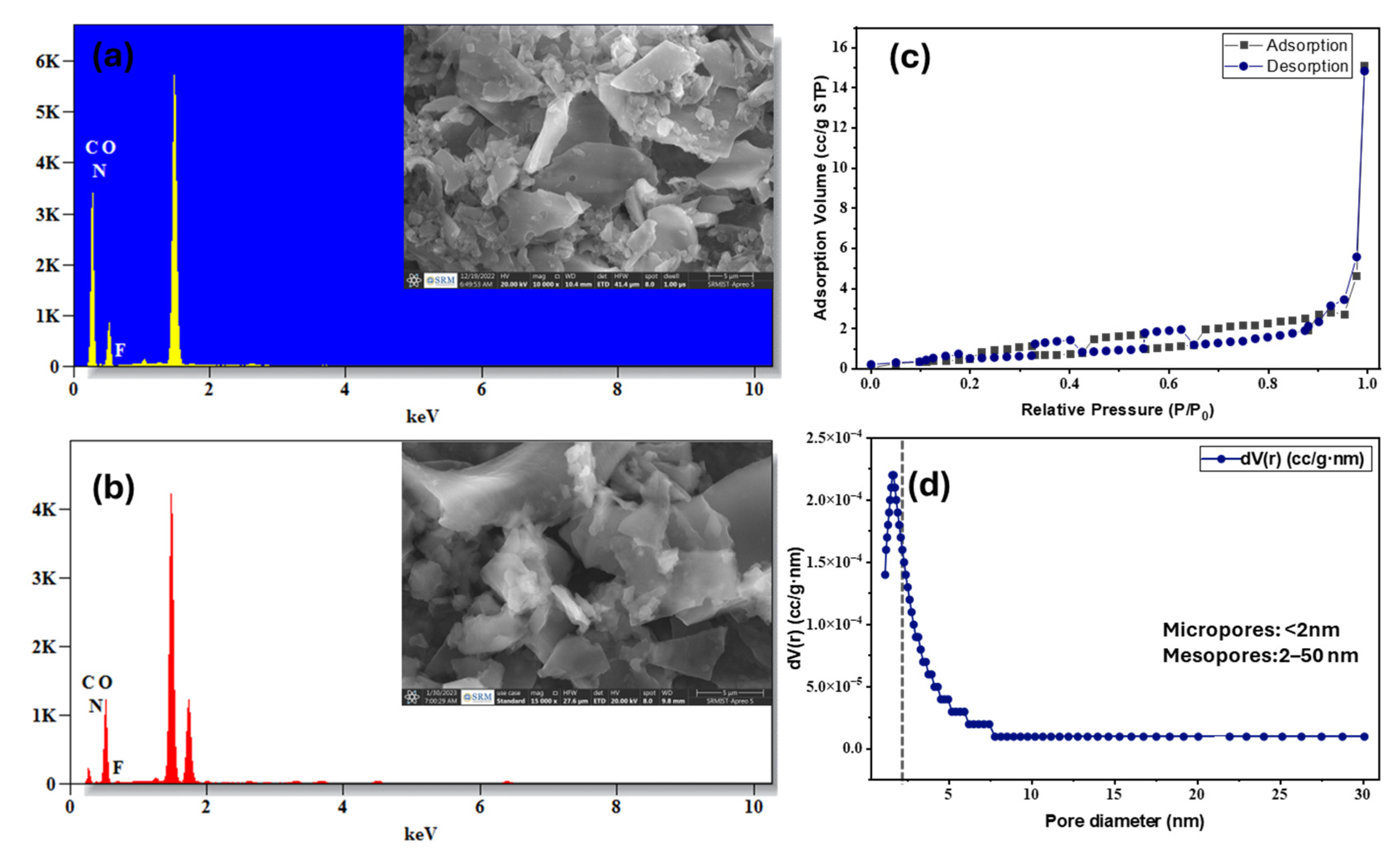
SBCT samples were subjected to SEM and energy-dispersive X-ray spectroscopy (EDX) analysis before and after the adsorption process and are presented in Figure 1a,b. SEM images revealed that the SBCT surface showed wrinkles and groove-like structures, significantly increasing the available pore size for PFOA adsorption. The presence of a rough and porous surface contributes to enhanced adsorption efficiency. Additionally, post-adsorption SEM images showed increased surface roughness and thickness, indicating successful chitosan aggregation on the SBCT composite surface. Before adsorption, fluorine was present in SBCT only at trace levels (~0.76 wt%), as can be seen in the EDX results for light elements (Figure 1a). However, after adsorption, elemental analysis showed that the fluorine content raised to 5.3 wt%, confirming successful PFOA uptake onto SBCT (Figure 1b). The increase in oxygen content observed in EDX after adsorption is consistent with FTIR results, which show prominent hydroxyl, amide, and C–O functional groups and their shifts after adsorption, indicating surface interaction through oxygen- and nitrogen-containing groups. The N2 adsorption–desorption isotherm (Figure 1c) exhibits a characteristic hysteresis loop, indicating the presence of mesoporous structures and capillary condensation behavior. The Barrett–Joyner–Halenda (BJH) pore size distribution (Figure 1d) shows that SBCT contains both micro- and mesopores. Micropores (<2 nm) contribute only slightly, while mesopores in the range of 2–50 nm dominate the pore structure. A clear peak at around 2–3 nm indicates that small mesopores provide most of the pore volume and internal surface area. The total pore volume is approximately 0.072 cm3/g, together with a surface area of 127.07 m2/g. This pore structure supports good accessibility of adsorption sites and facilitates the diffusion of PFOA molecules. A comparison of EDX results for various biochar–chitosan ratios (Figure S2) indicated that the 1:1 composite had elevated nitrogen content due to enhanced chitosan loading, while the 2:1 composite demonstrated a more balanced surface composition with increased exposed carbon and adequate surface-accessible amine groups. Excess chitosan in the 1:1 composite may lead to agglomeration and partial pore obstruction, but the 2:1 ratio maintains surface accessibility and good functionalization.
Figure 1.
SEM images with EDX spectra of SBCT: (a) before adsorption and (b) after adsorption, (c) N2 adsorption–desorption isotherms, and (d) BJH pore size distribution derived.
b. Point of zero charge (pZC)
The pZC of SBCT was measured as 6.1 (Figure S3). Below pH 6.1, the surface of SBCT acquires a positively charged character, enhancing electrostatic attraction with the anionic form of PFOA. Conversely, at pH above 6.1, electrostatic repulsion may hinder the adsorption efficacy of SBCT. These results indicate that SBCT can function as an effective adsorbent for removing PFOA from aqueous solutions in acidic pH.
c. Chemical Interactions with Functional Groups
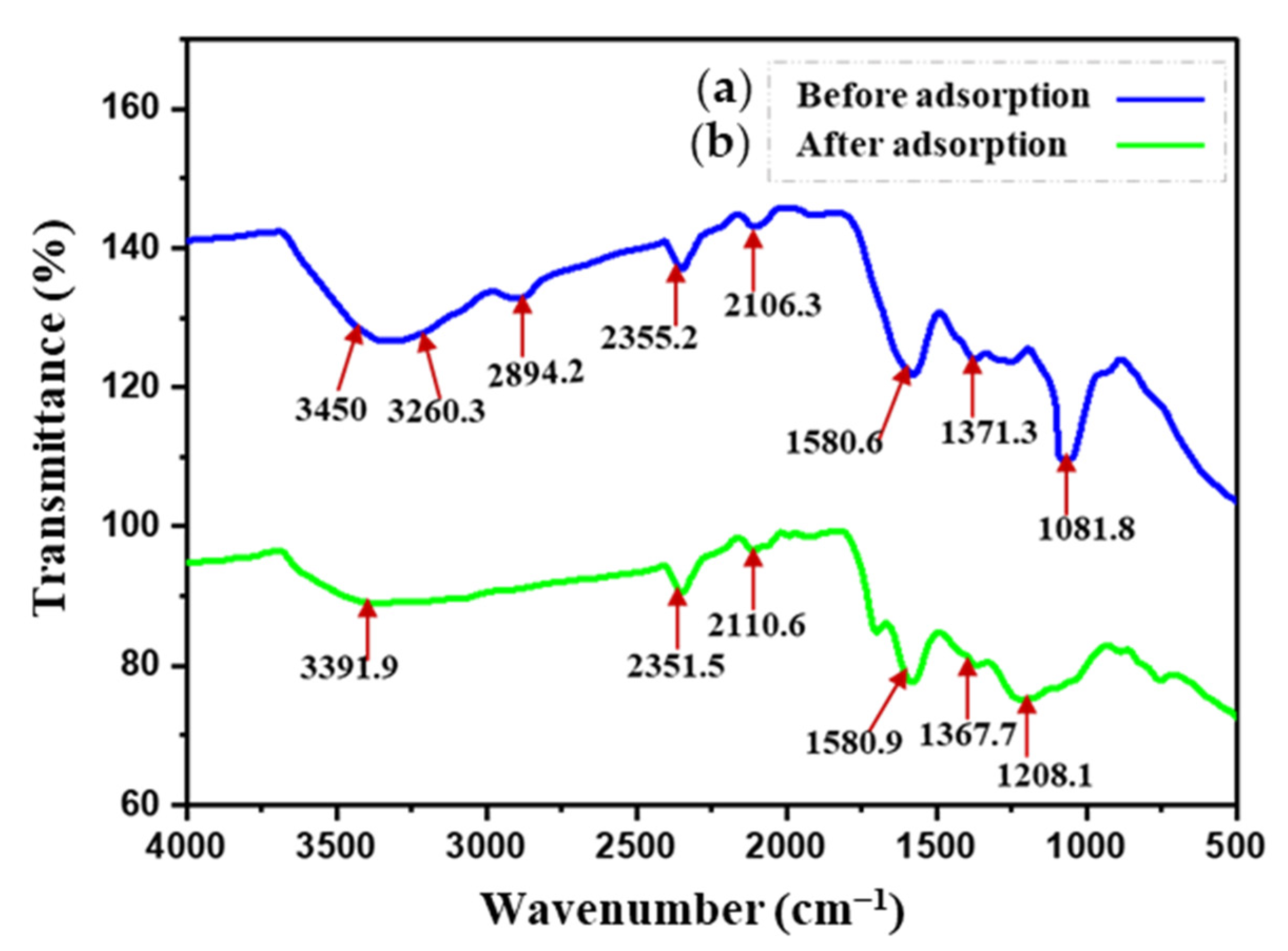
The FTIR spectra of the SBCT composite before and after adsorption are represented in Figure 2a,b, respectively. The broad absorption bands observed near 3260 cm−1 and 3450 cm−1 are attributed to the overlapping vibrational modes of N–H and O–H groups. The increased intensity of the O–H band represents the presence of hydroxyl or amine functionalities on the SBCT surface [27]. The absorption band observed at 1580 cm−1 is characteristic of the amide (CONH) group, consistent with findings reported [38]. The peak located between ~1150–1155 cm−1 is attributed to the β-glycosidic linkage in chitosan [54]. Additionally, the band near 1600 cm−1 corresponds to the stretching vibration of C=O groups, which are prevalent in carboxylic acids, amides, or ketones. The enhanced intensity of this peak following adsorption suggests effective interaction between PFOA and SBCT, likely facilitated by the carboxyl functional group of PFOA in aqueous media [51]. Peaks appear in this region of 1200–1140, corresponding to the C–F bonds in PFOA. This confirms PFOA adsorption [51]. The corresponding C–O Stretch in alcohols, esters, or ethers is given in the signals around 1050–1100 cm−1 [55]. A shift in the N–H absorption peaks toward lower wavenumbers was observed, suggesting that N–H groups might have played a role in the adsorption of PFOA. Thus, the interaction between SBCT and PFOA was collectively confirmed by the spectral changes, supporting the effectiveness of the adsorption mechanism.
Figure 2.
FTIR spectrum for SBCT (a) before and (b) after adsorption.
3.3. Factors Governing PFOA Adsorption
3.3.1. Contact Time
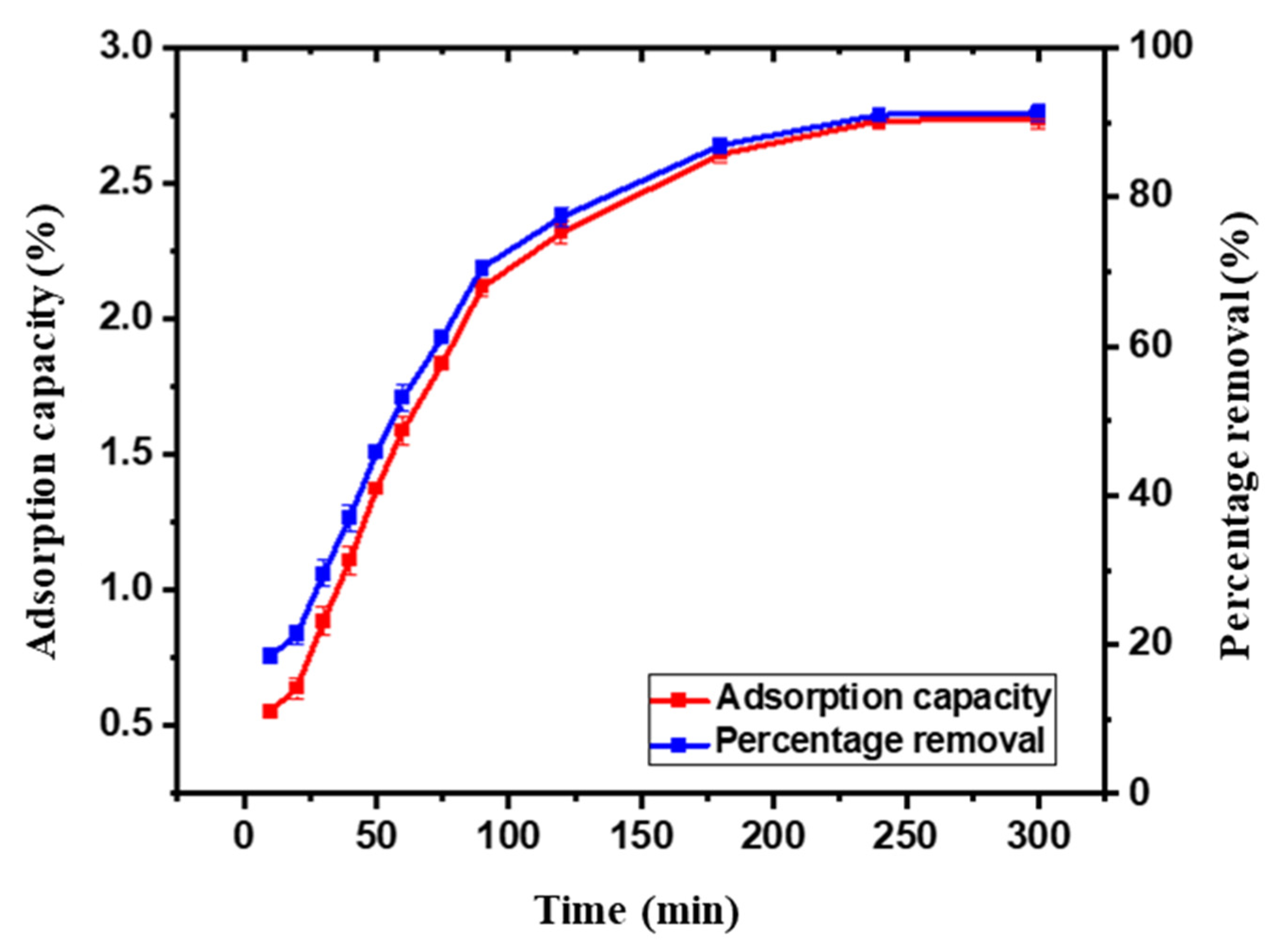
The SBCT composite at 0.02 g was added to a synthetic PFOA solution of 2 mg/L to evaluate the adsorption capacity of SBCT for PFOA, as illustrated in Figure 3. The adsorption capacity of 2.7 mg/g was attained at 240 min, with a maximum PFOA removal of 91%; a slight increase to 2.71 mg/g at 300 min indicates that equilibrium was effectively reached around 240 min. Therefore, all following batch adsorption studies were performed with a contact duration of 240 min. In comparison, unmodified pristine sugarcane bagasse biochar (SB) and pure chitosan (CT) demonstrated reduced adsorption capabilities of 1.59 mg/g and 2.05 mg/g, respectively. In comparison to the 1:1 composite, the optimized 2:1 SBCT exhibited approximately 13% more adsorption capacity, due to enhanced chitosan dispersion and improved accessibility to adsorption sites.
Figure 3.
Effect of contact time on adsorption capacity and PFOA removal percentage using SBCT. Error bars represent the standard deviation of duplicates. (Adsorbent dosage: 0.5 g, PFOA Concentration: 2 mg/L, Temp: 25 °C, Time: 240 min).
The SBCT composite was developed by integrating sugarcane bagasse biochar with chitosan at a 2:1 ratio, which most likely enhanced the adsorption capacity of PFOA through electrostatic interactions between protonated amine groups (NH3+) in chitosan and carboxyl groups (COO−) in anionic PFOA. The increased surface area, functional groups, hydrophobicity, and synergistic adsorption mechanisms improved the performance of SBCT, as supported by studies showing that chitosan-modified biochar demonstrates significantly higher adsorption capacities than pristine biochar or chitosan alone [38].
3.3.2. pH
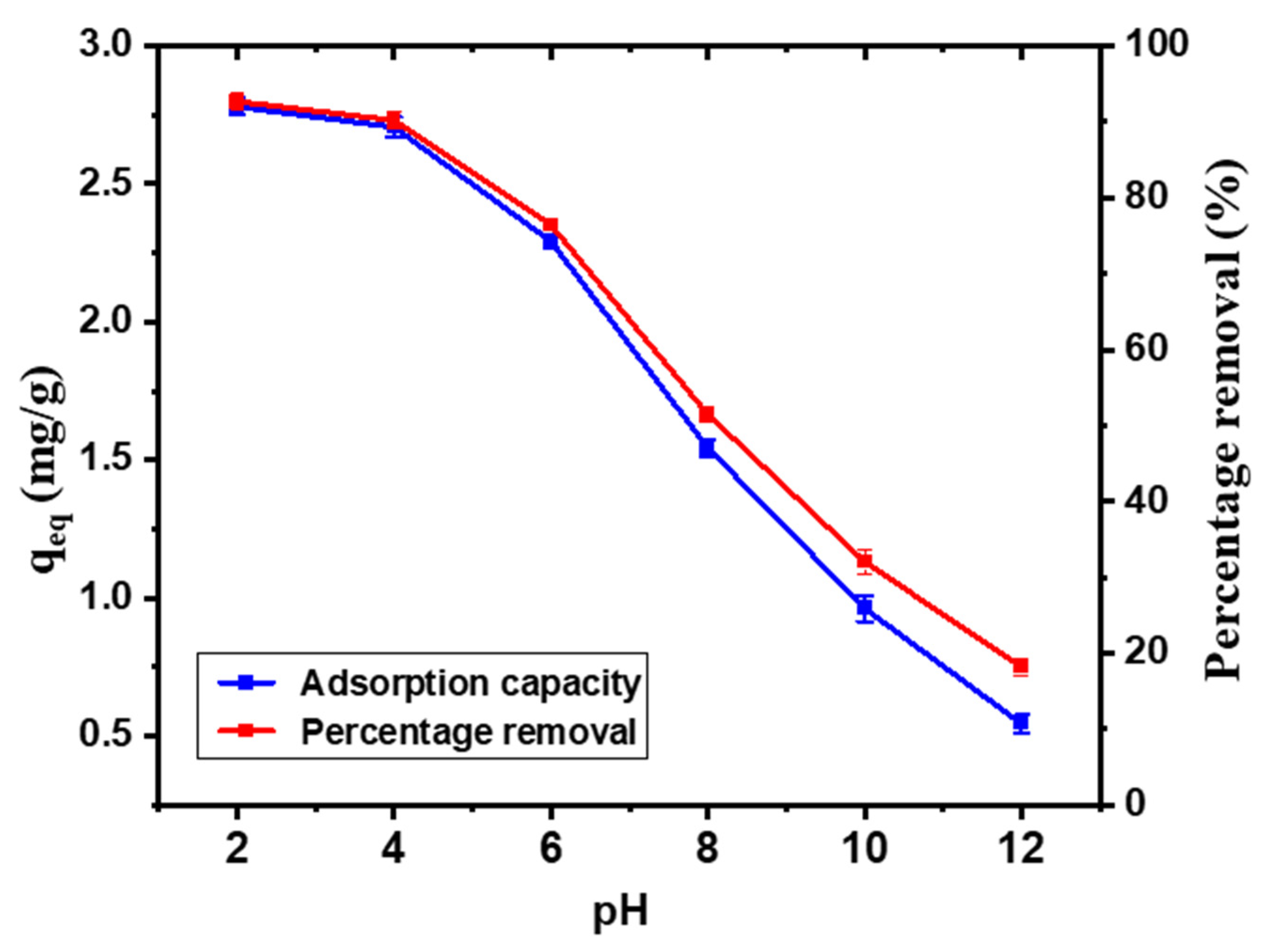
The effect of change in initial pH levels in the adsorption of PFOA, covering a range starting from acidic (pH 2) to alkaline (pH 12), is illustrated in Figure 4. The marked decline in PFOA adsorption with increasing pH is due to PFOA predominantly existing in its anionic form under aqueous conditions, bearing a carboxylate group. Hence, hydrogen bonding between the carbonyl functionalities (C=O) of PFOA and the positively charged –NH3+ moieties on the composite surface at lower pH leads to pronounced adsorption due to strong electrostatic interactions with the PFOA molecule and SBCT [51,56]. The adsorption process is dominant under acidic conditions associated with this interaction. Our observations are in line with other studies showing higher adsorption of perfluorinated compounds, including PFOA, at acidic pH values, viz., pH 3 [57,58,59], pH 4 [60], and pH 2 [51]. As pH increased, these bonds might have begun to disrupt in alkaline conditions, leading to a decrease in adsorption capacity. When the pH reached 8, the alkaline environment became unfavorable for PFOA adsorption. At pH 10, the adsorption capacity was lowest, likely due to the abundance of OH− ions in a strongly alkaline environment. The pZC of SBCT was around 6.1. Below this pH, in more acidic conditions, the surface became positively charged, promoting electrostatic attraction with anionic PFOA and enhancing adsorption. In contrast, at higher pH in alkaline conditions, the surface became negatively charged, thereby reducing adsorption efficiency [38].
Figure 4.
Effect of pH on adsorption capacity and percentage removal of PFOA using SBCT. Error bars represent the standard deviation of duplicates. (Adsorbent dosage: 0.5 g, PFOA Concentration: 2 mg/L, Temp: 25 °C, Time: 240 min).
3.3.3. Adsorbent Dosage and Initial Concentration
The adsorptive capacity of PFOA is significantly influenced by SBCT composite dosage and PFOA concentration. In this study, 0.01 g and 0.02 g of SBCT were used to evaluate the adsorbent dose effect on PFOA removal. PFOA showed a higher removal efficiency of 91% at 0.02 g, as illustrated in Figure S4. The PFOA concentration, ranging between 0.5 and 4 mg/L, was examined to reflect both common and severe environmental pollution levels. This concentration range falls within the range used in other studies [61,62] for PFOA removal. The results reflected that higher PFOA concentration led to a rise in the adsorption capacity. The maximum experimentally observed adsorption capacity (qmax) of 5.1 mg/g was observed at 4 mg/L of PFOA concentration, with a gradual increase with increasing concentrations. The maximum PFOA removal was observed at the lowest concentration tested (0.5 mg/L; Figure S5). The slight reduction in the removal efficiency at higher PFOA concentrations can be attributed to the increasing saturation tendency of active adsorption sites on the SBCT surface. This phenomenon is attributed to the aggregation of semi-micelles and micelles at higher concentrations, which can accumulate on the adsorbent surface and influence the adsorption process, as noted in other studies [59,60].
3.4. Adsorption Modeling of PFOA Using SBCT
3.4.1. Isotherm Study
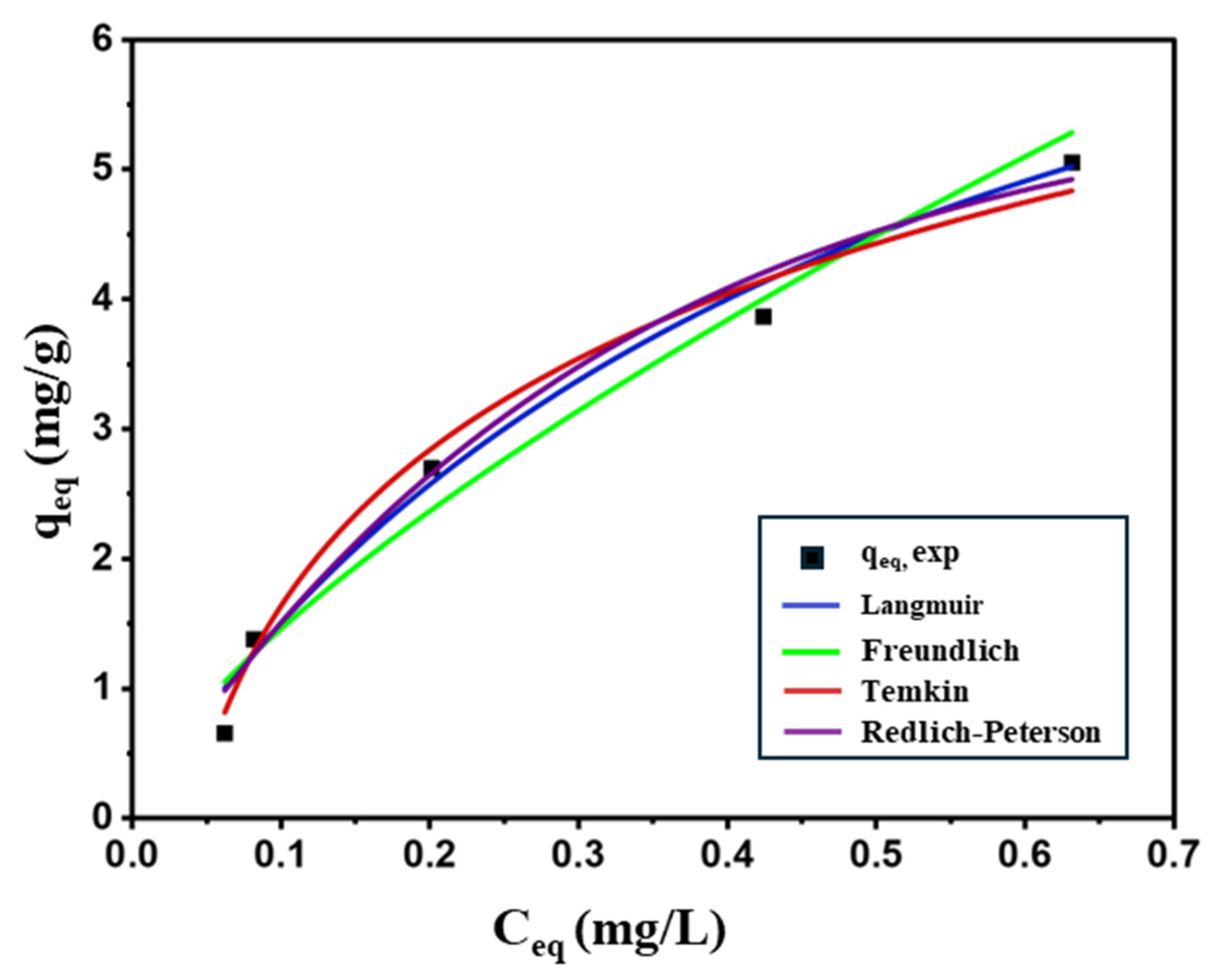
Isotherm models were applied to evaluate the adsorption of PFOA in aqueous solution and SBCT at equilibrium concentrations (Ceq) at room temperature (25 °C). The data were evaluated using a nonlinear regression model as outlined [63], and the results were used to estimate model parameters and the correlation coefficient (R2). Experimental data and model values are presented in Figure 5, with detailed results in Table 1. The Langmuir isotherm model assumes adsorption is a monolayer on a homogeneous surface with finite adsorption sites [63]. The model provided the best fit to the data (R2 = 0.95), exhibited the lowest root mean square error (RMSE) (0.19 mg/g) and χ2 (0.12) among all tested models, indicating superior agreement with the experimental data. The theoretically calculated maximum adsorption capacity (qmax) of SBCT is 9.01 mg/g, and the Langmuir constant (KLq) was 6.80 L/mg, indicating a strong affinity between SBCT and PFOA. The adsorption process is favorable, as confirmed by the separation factor RLq of 0.18, which falls between 0 and 1. The Freundlich model [64], suitable for heterogeneous surfaces, also fit the data reasonably well (R2 = 0.92), with a Freundlich constant (Kfd) of 7.28 and a 1/n value of 0.318, reflecting favorable adsorption intensity. The Temkin model is based on the assumption that the adsorption energy decreases with increasing surface area [65]. With the SBCT composite, the Temkin constants BTm = 1.73 and KTm = 25.51 L/mg, fitted with an R2 of 0.94, suggest substantial interaction between PFOA and SBCT. The Redlich–Peterson (R−P) isotherm model yielded a reasonably high correlation coefficient (R2 = 0.95); however, the fitted exponent, β = 1.30, exceeded the theoretical upper limit of unity and was associated with large uncertainty. This phenomenon is well-documented in literature and is frequently attributed to parameter coupling and over-parameterization, particularly in systems with limited experimental data. Under these circumstances, nonlinear optimization may converge to theoretically acceptable solutions that lack clear physical significance, instead of providing an improved physical description of the adsorption mechanism [66,67]. Furthermore, the RMSE (0.23 mg/g) and χ2 (0.21) values for the R–P model did not improve relative to those of the Langmuir model. Thus, the Langmuir model indicates that the adsorption properties of PFOA on the SBCT monolayer align with those of other adsorbents [24,68].
Figure 5.
Adsorption isotherms for PFOA onto SBCT.
Table 1.
Parameters of adsorption isotherm models.
3.4.2. Kinetic Study
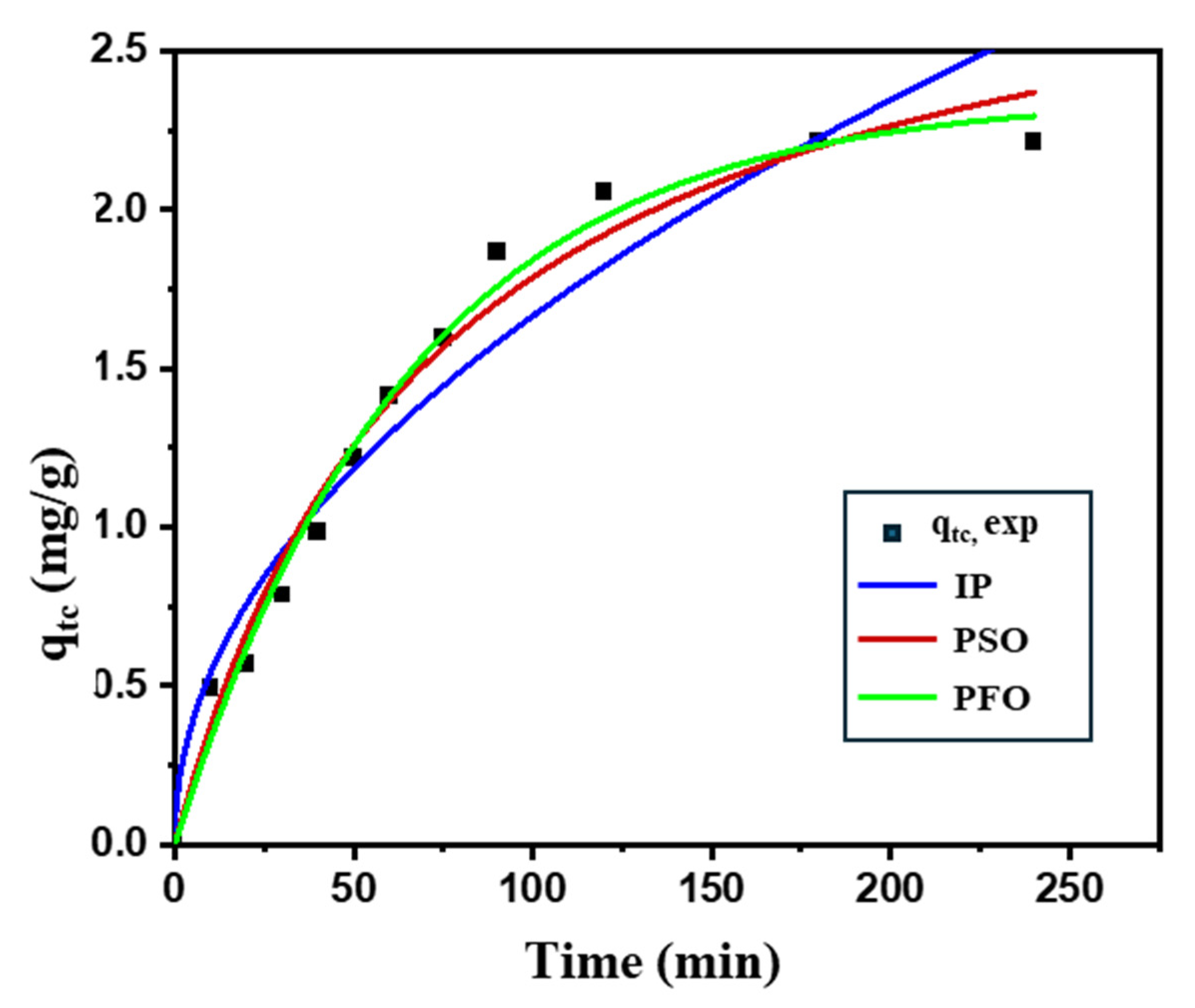
Three kinetic models were evaluated to understand the adsorption process of PFOA using SBCT. The parameters and the coefficient of determination were evaluated (Figure 6), and the values are summarized in Table 2. The pseudo-first-order model showed a strong correlation with the experimental data, with an R2 value of 0.992 and a rate constant (K1) of 0.014 min−1, indicating a good fit. The equilibrium adsorption capacity (qeq = 2.784 mg/g) closely matches the experimental value (qexp = 2.727 mg/g). Thus, the adsorptive mechanism is primarily driven by physisorption because the model assumes that the adsorption rate is directly proportional to the number of adsorptive sites available [69]. The R2 value of the pseudo-second-order model was 0.981, which is slightly lower than first-order kinetics with a rate constant (K2) of 0.004 g/mg/min. The qeq value of 3.477 mg/g derived from the second-order model is not close to the experimental values, suggesting that chemical interactions may be a contributing factor, though not a dominant mechanism [69]. The intraparticle diffusion rate constant (kdiff) was 0.166 mg/g/min−0.5, and the non-zero intercept (C = 0.167 mg/g) indicates the presence of boundary-layer resistance. The Weber–Morris plot does not pass through the origin, suggesting that intraparticle diffusion is not the sole rate-limiting step. The mesoporous pore structure of SBCT, as evidenced by BET and BJH analyses, facilitates diffusion of PFOA molecules into internal adsorption sites, while surface adsorption and boundary-layer resistance together govern the overall adsorption kinetics. The observed multi-linearity implies that the adsorption process proceeds through multiple stages, including an initial surface adsorption followed by intraparticle diffusion [45]. The observations are in line with the findings of other studies using adsorbents such as magnetic carbonized fiber [68] and chitosan-based hydrogel [51], where the pseudo-first-order model provided a superior fit, signifying that physisorption played a significant role during adsorption. The adsorption capacity of SBCT as explained by the kinetic profile of PFOA removal from aqueous medium suggests it’s future application as a promising adsorbent for water purification.
Figure 6.
Adsorption kinetics for PFOA onto SBCT.
Table 2.
Parameters of Kinetic Models.
3.4.3. Thermodynamic Parameters
The change in temperature impacting the adsorption process tested across the temperature range of 20 to 40 °C is presented in Table 3. The Gibbs free energy change (ΔG°) ranged between −6.65 kJ/mol and −5.72 kJ/mol, indicating that the adsorption process occurs spontaneously. The adsorption mechanism is consistent with physisorption rather than chemisorption, where the values of ΔG° are above −20 kJ/mol [46]. Further, the reaction is exothermic and physisorption-driven, supported by the low enthalpy change (ΔH°) of −21.8 kJ/mol, as chemisorption typically involves more significant heat changes (i.e., ΔH° < −80 kJ/mol). These thermodynamic results are consistent with kinetic data indicating a pseudo-first-order adsorption model representing physisorption. The negative entropy shift (ΔS° = −51.3 J/mol·K) indicates an increase in organized distribution at the solid–liquid interface during adsorption. Such systematic immobilization of PFOA molecules on the SBCT surface and the limited mobility of adsorbed species is a common phenomena in adsorption processes, when solute molecules move towards a more uniform surface layer. Similar thermodynamic behavior, characterized by negative ΔG° and ΔS°, has been reported for PFOA adsorption onto Chemically activated maize tassel [70] and iron-modified biochar [71].
Table 3.
Parameters of adsorption thermodynamic models.
3.5. Regeneration Experiments
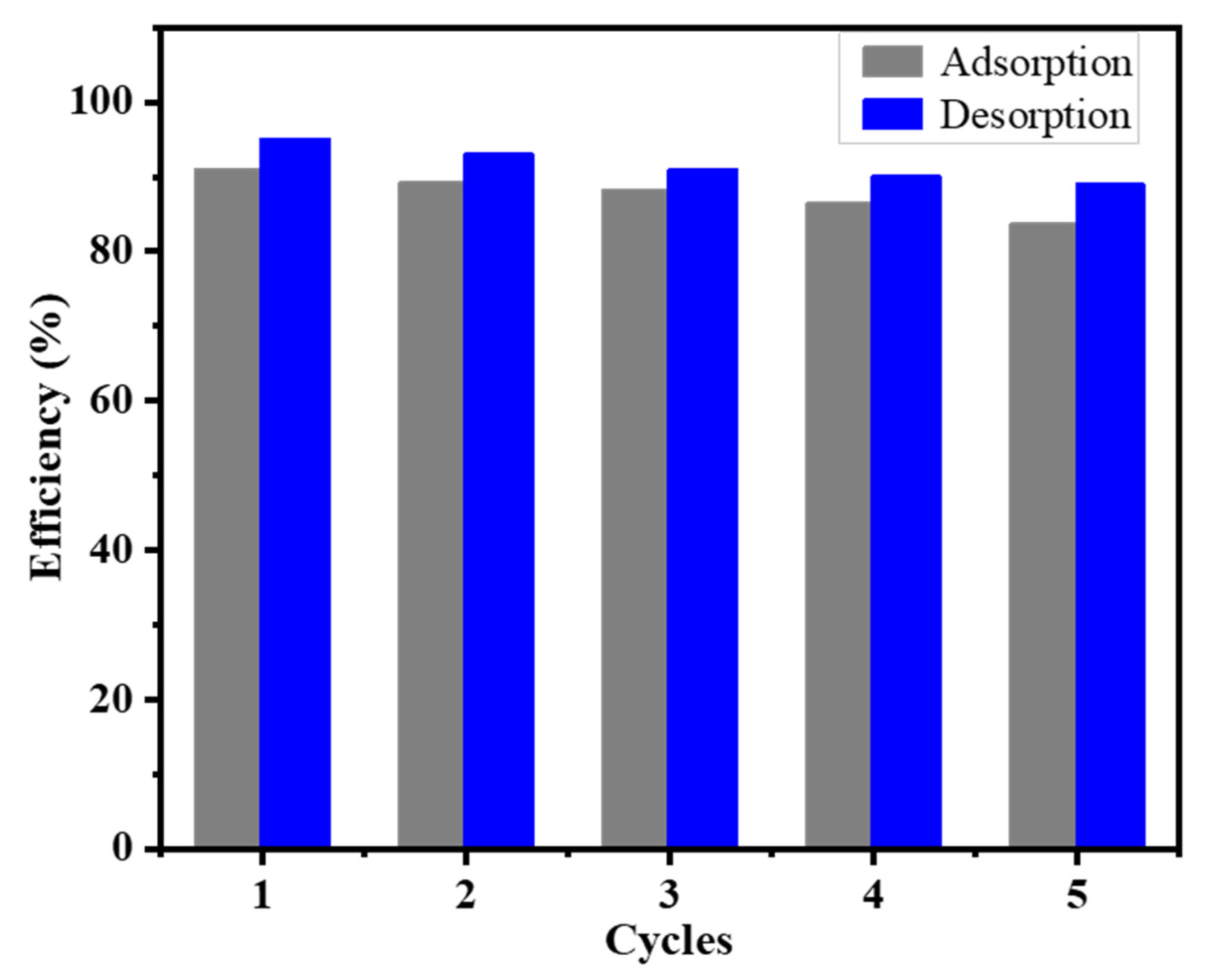
The regeneration capability of the adsorbent is a very important factor in determining its long-term viability in practical use. The stability and reusability of the SBCT composite were assessed by performing five adsorption–desorption cycles using three different methanol concentrations of 50%, 75%, and 100% along with deionized water (DI). Following the initial cycle, the adsorption efficiency gradually dropped. The adsorption capacity declined by up to 8% in the fifth cycle for 100% methanol and by 65% for DI water, demonstrating more effective desorption and better regeneration with methanol than with DI water. Figure 7 depicts the gradual loss of active adsorption sites with repeated use of the adsorbent. A comparative summary of PFAS regeneration efficiencies using methanol, ethanol, and alkaline solutions reported in the literature is provided in Table S1 to contextualize the regeneration strategy employed for the SBCT composite in this study. Methanol-based regeneration is effective, yet its environmental and operational implications, such as solvent handling, recovery, and disposal, require meticulous management; however, the minimal solvent volumes needed and the practicality of solvent recovery and reuse can minimize the environmental impacts thereby making the composite more sustainable.
Figure 7.
Regeneration and reuse of SBCT by washing with MeOH.
Hence, the regeneration study demonstrates that SBCT can retain a significant portion of its adsorption efficiency upon methanol regeneration. The composite material demonstrated its continued reusability, especially when regenerated using higher methanol concentrations, highlighting its potential for real-world practical applications [72].
3.6. Comparative Analysis with Other Studies
The comparison of PFOA removal using sugarcane Bagasse Biochar/Chitosan composite (SBCT) is provided in Table 4. The initial PFOA concentrations in the different studies vary, making it difficult to compare the adsorption capacities of the SBCT composite directly with different adsorption studies. The present study investigated the performance of SBCT under relatively low concentrations ranging between 0.5 and 4 mg/L. Rather than maximizing adsorption capacity at elevated concentrations, the SBCT composite is positioned as a sustainable and low-cost adsorbent that demonstrates effective PFOA removal at low concentrations, making it suitable for decentralized and resource-constrained treatment applications. The PFOA adsorption using adsorbents like Rice Husk Biochar [27] and Chitosan-Hydrogel [51] was evaluated at much higher concentrations of PFOA (100–2000 mg/L), naturally leading to higher adsorption capacities, which are not comparable with our results. The studies conducted at similar low initial PFOA concentrations, such as Granular activated carbon (GAC) ranges between 0.5 and 10 mg/L [73], Multiwalled carbon-nanotubes @ molecularly imprinted polymers (MWCNTs@MIPs) of 0.1 to 20 mg/L [72], and sulfur polymer-supported Powdered activated carbon (PAC) of 0.25 to 5 mg/L [62] is similar to our study. The SBCT developed in our study exhibited maximum adsorption capacity of 9.01 mg/g, which was comparable with MWCNTs@MIPs of 12.4 mg/g [72], and higher than sulfur-supported PAC of 0.355 mg/g [62], in addition, SBCT reached equilibrium within 4 h, significantly faster than GAC [73] for 120 h and comparable to MWCNTs@MIPs [72] of 2 h, with the advantages of low-cost, eco-friendly materials and simple synthesis without the need for complex modifications like molecular imprinting or sulfur polymer support. However, the maximum PFOA adsorption capacities will differ based on the testing conditions. The novel engineered SBCT composite stands out by combining environmental sustainability, fast kinetics, and effective PFOA removal even at low concentrations.
Table 4.
Comparison of adsorption kinetics and adsorption capacities of various adsorbents.
3.7. A Sustainable Technology for Water Treatment
Developed economies can afford advance techniques for removal of PFAS from water. However in developing countries, given the challenges of open drains or direct discharges releasing such persistent micropollutants in the water bodies, there is a basic need of a filtering medium using a low-cost adsorbent [25]. Cost-effective engineered SBCT composite can provide a solution for eliminating PFOA from wastewater or contaminated water bodies. This lab-scale study includes adsorption experiments using aqueous solutions, whereas real wastewater systems are far more complex. The presence of competing ions, dissolved organic matter, fluctuating pH, and variable contaminant loads may hinder adsorption efficiency and affect reproducibility under field conditions. It is to be noted, that the variability in the source, composition, and quality of raw materials, especially biochar precursors and biopolymer content, may affect the physicochemical properties and adsorption efficacy of the composite at larger scales. Consequently, the standardization of raw material selection and synthesis parameters will be crucial for ensuring uniform performance. Pilot-scale studies and long-term field trials using real wastewater matrices are required to validate the robustness and reliability of SBCT under realistic operating environments.
It is important to note that if not properly managed, saturated composites may pose environmental risks and serve as a secondary pollution source. The post-treatment of the adsorbent is necessary because the adsorption technology can only transfer PFOA from aqueous media to the solid phase. The application of advanced oxidation processes (AOPs) such as UV/H2O2 or ozone treatments or even bioremediation techniques can facilitate complete degradation of adsorbed contaminants by promoting sustainable reuse or safe disposal. Therefore, optimizing adsorbent recovery, integrating AOPs for contaminant destruction, and developing cost-effective regeneration protocols to ensure environmental safety and economic feasibility are necessary for the successful implementation of treatment. Our engineered SBCT composite can be modified based on the real-time conditions. From a scale-up perspective, the use of inexpensive raw materials from waste organic products, an uncomplicated synthesis pathway, and compatibility with decentralized treatment systems enhance the practical feasibility of SBCT for applications outside laboratory settings. Real-time application of our novel SBCT can contribute in advancing Sustainable Development Goals (SDG)—SDG 6 (Clean Water and Sanitation), SDG 14 (Life under water), and SDG 11 (Sustainable Cities and Communities).
4. Conclusions
We designed and prepared engineered biochar composite-SBCT for the effective removal of PFOA, which is effective even at a very low concentration (0.5 mg/L) from aqueous media. The SBCT composite achieved enhanced PFOA adsorption capacities under varied environmental conditions, outperforming many conventional materials. The removal of PFOA was effective under acidic pH conditions. The adsorption mechanism of PFOA on SBCT is further evaluated using an isotherm study and kinetic modeling, demonstrating favorable alignment with pseudo-first-order kinetics and the Langmuir isotherm model with a maximum adsorption capacity of 9.01 mg/g. Together with the kinetic analysis, our thermodynamic results confirm the physisorption phenomenon of SBCT engineered composite. In addition, it is evident that the electrostatic interactions enhanced PFOA affinity toward SBCT without altering the overall adsorption mechanism.
SBCT composite can be used as a low-cost and sustainable material with potential for further scale-up and process optimization.
Supplementary Materials
The following supporting information can be downloaded at: https://www.mdpi.com/article/10.3390/chemengineering10020030/s1. Figure S1. Calibration curve of perfluorooctanoic acid (PFOA) obtained using gas chromatography–electron capture detection (GC–ECD). Figure S2. SEM images with EDX spectra of SBCT composites: (a) SBCT-2:1 and (b) SBCT-1:1. Figure S3. Point of zero charge (pHpzc) of SBCT. Figure S4. Percentage removal of PFOA using 0.01 and 0.02 g adsorbent dosage (SBCT). Figure S5. Percentage removal of PFOA for different adsorbate concentrations (PFOA). Table S1. Regeneration of different spent adsorbents with adsorbed PFOA. References [68,75,79,80,81,82,83,84] are cited in the Supplementary Materials.
Author Contributions
K.P.: Methodology, Data curation, Software, Formal analysis, Writing: original draft; P.C.: Fund acquisition, Conceptualization, Methodology, Supervision, Writing: Review and editing. All authors have read and agreed to the published version of the manuscript.
Funding
K. Pavithra would like to acknowledge the support of the CSIR-Senior Research Fellowship for the financial support (CSIR Fellowship/141-4354-8502/2K23/1). Paromita Chakraborty was supported by the India–Norway cooperation project on capacity building for reducing plastic and chemical pollution in India (INOPOL) Project Nos: 220260, IND-22/0007.
Data Availability Statement
The original contributions presented in this study are included in the article. Further inquiries can be directed to the corresponding author.
Conflicts of Interest
The authors declare no conflicts of interest.
References
- Buck, R.C.; Franklin, J.; Berger, U.; Conder, J.M.; Cousins, I.T.; de Voogt, P.; Jensen, A.A.; Kannan, K.; Mabury, S.A.; van Leeuwen, S.P. Perfluoroalkyl and polyfluoroalkyl substances in the environment: Terminology, classification, and origins. Integr. Environ. Assess. Manag. 2011, 7, 513–541. [Google Scholar] [CrossRef]
- Gluge, J.; Scheringer, M.; Cousins, I.T.; DeWitt, J.C.; Goldenman, G.; Herzke, D.; Lohmann, R.; Ng, C.A.; Trier, X.; Wang, Z. An overview of the uses of per- and polyfluoroalkyl substances (PFAS). Environ. Sci. Process Impacts 2020, 22, 2345–2373. [Google Scholar] [CrossRef]
- Post, G.B.; Cohn, P.D.; Cooper, K.R. Perfluorooctanoic acid (PFOA), an emerging drinking water contaminant: A critical review of recent literature. Environ. Res. 2012, 116, 93–117. [Google Scholar] [CrossRef]
- Vierke, L.; Staude, C.; Biegel-Engler, A.; Drost, W.; Schulte, C. Perfluorooctanoic acid (PFOA)—Main concerns and regulatory developments in Europe from an environmental point of view. Environ. Sci. Eur. 2012, 24, 16. [Google Scholar] [CrossRef]
- OCED. Working Towards A Global Emission Inventory of PFASs: Focus on PFCAs—Status Quo and the Way Forward; OCED: Paris, France, 2015. [Google Scholar]
- Lenka, S.P.; Kah, M.; Padhye, L.P. A review of the occurrence, transformation, and removal of poly- and perfluoroalkyl substances (PFAS) in wastewater treatment plants. Water Res. 2021, 199, 117187. [Google Scholar] [CrossRef] [PubMed]
- Rahman, M.F.; Peldszus, S.; Anderson, W.B. Behaviour and fate of perfluoroalkyl and polyfluoroalkyl substances (PFASs) in drinking water treatment: A review. Water Res. 2014, 50, 318–340. [Google Scholar] [CrossRef] [PubMed]
- SC. Stockholm Convention on Persistent Organic Pollutants (POPs), The New POPs Under the Stockholm Convention. Available online: https://chm.pops.int/TheConvention/ThePOPs/TheNewPOPs/tabid/2511/Default.aspx (accessed on 24 March 2025).
- U.S. EPA. Technical Fact Sheet—PFOS and PFOA; U.S. EPA: San Francisco, CA, USA, 2017.
- Garg, S.; Kumar, P.; Mishra, V.; Guijt, R.; Singh, P.; Dumée, L.F.; Sharma, R.S. A review on the sources, occurrence and health risks of per-/poly-fluoroalkyl substances (PFAS) arising from the manufacture and disposal of electric and electronic products. J. Water Process Eng. 2020, 38, 101683. [Google Scholar] [CrossRef]
- Olsen, G.W.; Burris, J.M.; Ehresman, D.J.; Froehlich, J.W.; Seacat, A.M.; Butenhoff, J.L.; Zobel, L.R. Half-life of serum elimination of perfluorooctanesulfonate, perfluorohexanesulfonate, and perfluorooctanoate in retired fluorochemical production workers. Environ. Health Perspect. 2007, 115, 1298–1305. [Google Scholar] [CrossRef]
- Salvalaglio, M.; Muscionico, I.; Cavallotti, C. Determination of energies and sites of binding of PFOA and PFOS to human serum albumin. J. Phys. Chem. B 2010, 114, 14860–14874. [Google Scholar] [CrossRef]
- Castiglioni, S.; Valsecchi, S.; Polesello, S.; Rusconi, M.; Melis, M.; Palmiotto, M.; Manenti, A.; Davoli, E.; Zuccato, E. Sources and fate of perfluorinated compounds in the aqueous environment and in drinking water of a highly urbanized and industrialized area in Italy. J. Hazard. Mater. 2015, 282, 51–60. [Google Scholar] [CrossRef]
- Ji, B.; Kang, P.; Wei, T.; Zhao, Y. Challenges of aqueous per- and polyfluoroalkyl substances (PFASs) and their foreseeable removal strategies. Chemosphere 2020, 250, 126316. [Google Scholar] [CrossRef]
- Houtz, E.; Wang, M.; Park, J.-S. Identification and fate of aqueous film forming foam derived per-and polyfluoroalkyl substances in a wastewater treatment plant. Environ. Sci. Technol. 2018, 52, 13212–13221. [Google Scholar] [CrossRef]
- Filipovic, M.; Berger, U. Are perfluoroalkyl acids in waste water treatment plant effluents the result of primary emissions from the technosphere or of environmental recirculation? Chemosphere 2015, 129, 74–80. [Google Scholar] [CrossRef]
- Shivakoti, B.R.; Tanaka, S.; Fujii, S.; Kunacheva, C.; Boontanon, S.K.; Musirat, C.; Seneviratne, S.; Tanaka, H. Occurrences and behavior of perfluorinated compounds (PFCs) in several wastewater treatment plants (WWTPs) in Japan and Thailand. J. Environ. Monit. 2010, 12, 1255–1264. [Google Scholar] [CrossRef]
- Guo, R.; Sim, W.-J.; Lee, E.-S.; Lee, J.-H.; Oh, J.-E. Evaluation of the fate of perfluoroalkyl compounds in wastewater treatment plants. Water Res. 2010, 44, 3476–3486. [Google Scholar] [CrossRef] [PubMed]
- Gobelius, L.; Glimstedt, L.; Olsson, J.; Wiberg, K.; Ahrens, L. Mass flow of per-and polyfluoroalkyl substances (PFAS) in a Swedish municipal wastewater network and wastewater treatment plant. Chemosphere 2023, 336, 139182. [Google Scholar] [CrossRef]
- Chen, W.; Yang, F.; Hu, E.; Yang, C.; Sun, C.; Li, M. Occurrence, fate and risk assessment of per-and polyfluoroalkyl substances in wastewater treatment plants in Shaanxi, China. Environ. Pollut. 2022, 314, 120226. [Google Scholar] [CrossRef] [PubMed]
- Pan, C.-G.; Liu, Y.-S.; Ying, G.-G. Perfluoroalkyl substances (PFASs) in wastewater treatment plants and drinking water treatment plants: Removal efficiency and exposure risk. Water Res. 2016, 106, 562–570. [Google Scholar] [CrossRef] [PubMed]
- Chirikona, F.; Filipovic, M.; Ooko, S.; Orata, F. Perfluoroalkyl acids in selected wastewater treatment plants and their discharge load within the Lake Victoria basin in Kenya. Environ. Monit. Assess. 2015, 187, 238. [Google Scholar] [CrossRef]
- Bao, J.; Yu, W.-J.; Liu, Y.; Wang, X.; Jin, Y.-H.; Dong, G.-H. Perfluoroalkyl substances in groundwater and home-produced vegetables and eggs around a fluorochemical industrial park in China. Ecotoxicol. Environ. Saf. 2019, 171, 199–205. [Google Scholar] [CrossRef]
- Xu, C.; Chen, H.; Jiang, F. Adsorption of perflourooctane sulfonate (PFOS) and perfluorooctanoate (PFOA) on polyaniline nanotubes. Colloids Surf. A Physicochem. Eng. Asp. 2015, 479, 60–67. [Google Scholar] [CrossRef]
- Pavithra, K.; Sharma, B.M.; Chakraborty, P. An overview of the occurrence and remediation of perfluorooctanoic acid (PFOA) in wastewater-recommendations for cost-effective removal techniques in developing economies. Curr. Opin. Environ. Sci. Health 2024, 41, 100565. [Google Scholar] [CrossRef]
- Sanzana, S.; Fenti, A.; Iovino, P.; Panico, A. A review of PFAS remediation: Separation and degradation technologies for water and wastewater treatment. J. Water Process Eng. 2025, 74, 107793. [Google Scholar] [CrossRef]
- Deng, S.; Niu, L.; Bei, Y.; Wang, B.; Huang, J.; Yu, G. Adsorption of perfluorinated compounds on aminated rice husk prepared by atom transfer radical polymerization. Chemosphere 2013, 91, 124–130. [Google Scholar] [CrossRef]
- Liu, L.; Li, D.; Li, C.; Ji, R.; Tian, X. Metal nanoparticles by doping carbon nanotubes improved the sorption of perfluorooctanoic acid. J. Hazard. Mater. 2018, 351, 206–214. [Google Scholar] [CrossRef]
- Xie, R.; Beckman, M.T.; Almquist, C.B.; Berberich, J.A.; Danielson, N.D. Fixed-bed adsorption of perfluorooctanoic acid from water by a polyamine-functionalized polychlorotrifluoroethylene-ethylene polymer coated on activated carbon. J. Environ. Chem. Eng. 2024, 12, 113001. [Google Scholar] [CrossRef]
- Yin, S.; López, J.F.; Solís, J.J.C.; Wong, M.S.; Villagrán, D. Enhanced adsorption of PFOA with nano MgAl2O4@CNTs: Influence of pH and dosage, and environmental conditions. J. Hazard. Mater. Adv. 2023, 9, 100252. [Google Scholar] [CrossRef]
- Chen, X.; Xia, X.; Wang, X.; Qiao, J.; Chen, H. A comparative study on sorption of perfluorooctane sulfonate (PFOS) by chars, ash and carbon nanotubes. Chemosphere 2011, 83, 1313–1319. [Google Scholar] [CrossRef]
- Inyang, M.; Dickenson, E.R.V. The use of carbon adsorbents for the removal of perfluoroalkyl acids from potable reuse systems. Chemosphere 2017, 184, 168–175. [Google Scholar] [CrossRef]
- Liang, D.; Li, C.; Chen, H.; Sørmo, E.; Cornelissen, G.; Gao, Y.; Reguyal, F.; Sarmah, A.; Ippolito, J.; Kammann, C. A critical review of biochar for the remediation of PFAS-contaminated soil and water. Sci. Total Environ. 2024, 951, 174962. [Google Scholar] [CrossRef] [PubMed]
- Chavan, D.; Mayilswamy, N.; Chame, S.; Kandasubramanian, B. Biochar Adsorption: A Green Approach to PFAS Contaminant Removal. CleanMat 2024, 1, 52–77. [Google Scholar] [CrossRef]
- Hassan, M.; Du, J.; Liu, Y.; Naidu, R.; Zhang, J.; Ahsan, M.A.; Qi, F. Magnetic biochar for removal of perfluorooctane sulphonate (PFOS): Interfacial interaction and adsorption mechanism. Environ. Technol. Innov. 2022, 28, 102593. [Google Scholar] [CrossRef]
- Saheed, I.O.; Oh, W.D.; Suah, F.B.M. Chitosan modifications for adsorption of pollutants—A review. J. Hazard. Mater. 2021, 408, 124889. [Google Scholar] [CrossRef]
- Liu, S.; Huang, B.; Chai, L.; Liu, Y.; Zeng, G.; Wang, X.; Zeng, W.; Shang, M.; Deng, J.; Zhou, Z. Enhancement of As(v) adsorption from aqueous solution by a magnetic chitosan/biochar composite. RSC Adv. 2017, 7, 10891–10900. [Google Scholar] [CrossRef]
- Zhu, C.; Lang, Y.; Liu, B.; Zhao, H. Ofloxacin Adsorption on Chitosan/Biochar Composite: Kinetics, Isotherms, and Effects of Solution Chemistry. Polycycl. Aromat. Compd. 2018, 39, 287–297. [Google Scholar] [CrossRef]
- Zhou, Y.; Gao, B.; Zimmerman, A.R.; Fang, J.; Sun, Y.; Cao, X. Sorption of heavy metals on chitosan-modified biochars and its biological effects. Chem. Eng. J. 2013, 231, 512–518. [Google Scholar] [CrossRef]
- Jacob, M.M.; Ponnuchamy, M.; Kapoor, A.; Sivaraman, P. Bagasse based biochar for the adsorptive removal of chlorpyrifos from contaminated water. J. Environ. Chem. Eng. 2020, 8, 103904. [Google Scholar] [CrossRef]
- Rajapaksha, A.U.; Chen, S.S.; Tsang, D.C.; Zhang, M.; Vithanage, M.; Mandal, S.; Gao, B.; Bolan, N.S.; Ok, Y.S. Engineered/designer biochar for contaminant removal/immobilization from soil and water: Potential and implication of biochar modification. Chemosphere 2016, 148, 276–291. [Google Scholar] [CrossRef]
- Ponnusami, V.; Srivastava, S. Studies on application of teak leaf powders for the removal of color from synthetic and industrial effluents. J. Hazard. Mater. 2009, 169, 1159–1162. [Google Scholar] [CrossRef]
- Li, Z.; Sun, H. Cost-effective detection of perfluoroalkyl carboxylic acids with gas chromatography: Optimization of derivatization approaches and method validation. Int. J. Environ. Res. Public Health 2020, 17, 100. [Google Scholar] [CrossRef]
- Taguba, M.A.M.; Ong, D.C.; Ensano, B.M.B.; Kan, C.-C.; Grisdanurak, N.; Yee, J.-J.; de Luna, M.D.G. Nonlinear isotherm and kinetic modeling of Cu (II) and Pb (II) uptake from water by MnFe2O4/chitosan nanoadsorbents. Water 2021, 13, 1662. [Google Scholar] [CrossRef]
- Ait Ichou, A.; Benhiti, R.; Abali, M.; Dabagh, A.; Carja, G.; Soudani, A.; Chiban, M.; Zerbet, M.; Sinan, F. Characterization and sorption study of Zn2 [FeAl]-CO3 layered double hydroxide for Cu (II) and Pb (II) removal. J. Solid State Chem. 2023, 320, 123869. [Google Scholar] [CrossRef]
- Chen, H.; Zhao, J.; Wu, J.; Dai, G. Isotherm, thermodynamic, kinetics and adsorption mechanism studies of methyl orange by surfactant modified silkworm exuviae. J. Hazard. Mater. 2011, 192, 246–254. [Google Scholar] [CrossRef]
- Wang, B.; Gao, B.; Fang, J. Recent advances in engineered biochar productions and applications. Crit. Rev. Environ. Sci. Technol. 2018, 47, 2158–2207. [Google Scholar] [CrossRef]
- Tan, X.-F.; Liu, S.-B.; Liu, Y.-G.; Gu, Y.-L.; Zeng, G.-M.; Hu, X.-J.; Wang, X.; Liu, S.-H.; Jiang, L.-H. Biochar as potential sustainable precursors for activated carbon production: Multiple applications in environmental protection and energy storage. Bioresour. Technol. 2017, 227, 359–372. [Google Scholar] [CrossRef]
- Ahmad, M.; Rajapaksha, A.U.; Lim, J.E.; Zhang, M.; Bolan, N.; Mohan, D.; Vithanage, M.; Lee, S.S.; Ok, Y.S. Biochar as a sorbent for contaminant management in soil and water: A review. Chemosphere 2014, 99, 19–33. [Google Scholar] [CrossRef]
- Wang, J.; Zhuang, S. Removal of various pollutants from water and wastewater by modified chitosan adsorbents. Crit. Rev. Environ. Sci. Technol. 2017, 47, 2331–2386. [Google Scholar] [CrossRef]
- Long, L.; Hu, X.; Yan, J.; Zeng, Y.; Zhang, J.; Xue, Y. Novel chitosan-ethylene glycol hydrogel for the removal of aqueous perfluorooctanoic acid. J. Environ. Sci. 2019, 84, 21–28. [Google Scholar] [CrossRef] [PubMed]
- Elanchezhiyan, S.S.; Preethi, J.; Rathinam, K.; Njaramba, L.K.; Park, C.M. Synthesis of magnetic chitosan biopolymeric spheres and their adsorption performances for PFOA and PFOS from aqueous environment. Carbohydr. Polym. 2021, 267, 118165. [Google Scholar] [CrossRef] [PubMed]
- Loc, N.X.; Tuyen, P.T.T.; Mai, L.C.; Phuong, D.T.M. Chitosan-modified biochar and unmodified biochar for methyl orange: Adsorption characteristics and mechanism exploration. Toxics 2022, 10, 500. [Google Scholar] [CrossRef] [PubMed]
- Vasilieva, T.; Chuhchin, D.; Lopatin, S.; Varlamov, V.; Sigarev, A.; Vasiliev, M. Chitin and cellulose processing in low-temperature electron beam plasma. Molecules 2017, 22, 1908. [Google Scholar] [CrossRef] [PubMed]
- Hu, X.; Xue, Y.; Long, L.; Zhang, K. Characteristics and batch experiments of acid- and alkali-modified corncob biomass for nitrate removal from aqueous solution. Environ. Sci. Pollut. Res. Int. 2018, 25, 19932–19940. [Google Scholar] [CrossRef]
- Deng, S.; Zhang, Q.; Nie, Y.; Wei, H.; Wang, B.; Huang, J.; Yu, G.; Xing, B. Sorption mechanisms of perfluorinated compounds on carbon nanotubes. Environ. Pollut. 2012, 168, 138–144. [Google Scholar] [CrossRef]
- Du, Z.; Deng, S.; Chen, Y.; Wang, B.; Huang, J.; Wang, Y.; Yu, G. Removal of perfluorinated carboxylates from washing wastewater of perfluorooctanesulfonyl fluoride using activated carbons and resins. J. Hazard. Mater. 2015, 286, 136–143. [Google Scholar] [CrossRef]
- Tian, D.; Geng, D.; Tyler Mehler, W.; Goss, G.; Wang, T.; Yang, S.; Niu, Y.; Zheng, Y.; Zhang, Y. Removal of perfluorooctanoic acid (PFOA) from aqueous solution by amino-functionalized graphene oxide (AGO) aerogels: Influencing factors, kinetics, isotherms, and thermodynamic studies. Sci. Total Environ. 2021, 783, 147041. [Google Scholar] [CrossRef]
- Wang, F.; Shih, K. Adsorption of perfluorooctanesulfonate (PFOS) and perfluorooctanoate (PFOA) on alumina: Influence of solution pH and cations. Water Res. 2011, 45, 2925–2930. [Google Scholar] [CrossRef]
- Fagbayigbo, B.O.; Opeolu, B.O.; Fatoki, O.S.; Akenga, T.A.; Olatunji, O.S. Removal of PFOA and PFOS from aqueous solutions using activated carbon produced from Vitis vinifera leaf litter. Environ. Sci. Pollut. Res. Int. 2017, 24, 13107–13120. [Google Scholar] [CrossRef] [PubMed]
- Johnson, R.L.; Anschutz, A.J.; Smolen, J.M.; Simcik, M.F.; Penn, R.L. The adsorption of perfluorooctane sulfonate onto sand, clay, and iron oxide surfaces. J. Chem. Eng. Data 2007, 52, 1165–1170. [Google Scholar] [CrossRef]
- Lundquist, N.A.; Sweetman, M.J.; Scroggie, K.R.; Worthington, M.J.H.; Esdaile, L.J.; Alboaiji, S.F.K.; Plush, S.E.; Hayball, J.D.; Chalker, J.M. Polymer Supported Carbon for Safe and Effective Remediation of PFOA- and PFOS-Contaminated Water. ACS Sustain. Chem. Eng. 2019, 7, 11044–11049. [Google Scholar] [CrossRef]
- Langmuir, I. The adsorption of gases on plane surfaces of glass, mica and platinum. J. Am. Chem. Soc. 1918, 40, 1361–1403. [Google Scholar] [CrossRef]
- Freundlich, H. Uber die adsorption in Iosungen. Z. Phys. Chem. 1907, 57, 385–470. [Google Scholar] [CrossRef]
- Temkin, M. Kinetics of ammonia synthesis on promoted iron catalysts. Acta Physiochim. URSS 1940, 12, 327–356. [Google Scholar]
- Chu, K.H.; Hashim, M.A.; da Costa Santos, Y.T.; Debord, J.; Harel, M.; Bollinger, J.-C. The Redlich–Peterson isotherm for aqueous phase adsorption: Pitfalls in data analysis and interpretation. Chem. Eng. Sci. 2024, 285, 119573. [Google Scholar] [CrossRef]
- Tran, H.N.; You, S.-J.; Hosseini-Bandegharaei, A.; Chao, H.-P. Mistakes and inconsistencies regarding adsorption of contaminants from aqueous solutions: A critical review. Water Res. 2017, 120, 88–116. [Google Scholar] [CrossRef]
- Niu, B.; Yang, S.; Li, Y.; Zang, K.; Sun, C.; Yu, M.; Zhou, L.; Zheng, Y. Regenerable magnetic carbonized Calotropis gigantea fiber for hydrophobic-driven fast removal of perfluoroalkyl pollutants. Cellulose 2020, 27, 5893–5905. [Google Scholar] [CrossRef]
- Ho, Y.-S.; McKay, G. Sorption of dye from aqueous solution by peat. Chem. Eng. J. 1998, 70, 115–124. [Google Scholar] [CrossRef]
- Omo-Okoro, P.N.; Curtis, C.J.; Karásková, P.; Melymuk, L.; Oyewo, O.A.; Okonkwo, J.O. Kinetics, isotherm, and thermodynamic studies of the adsorption mechanism of PFOS and PFOA using inactivated and chemically activated maize tassel. Water Air Soil Pollut. 2020, 231, 485. [Google Scholar] [CrossRef]
- Guo, B.; Kan, E.; Zeng, S. Enhanced adsorption of aqueous perfluorooctanoic acid on iron-functionalized biochar: Elucidating the roles of inner-sphere complexation. Sci. Total Environ. 2024, 955, 176926. [Google Scholar] [CrossRef]
- Cao, F.; Wang, L.; Yao, Y.; Wu, F.; Sun, H.; Lu, S. Synthesis and application of a highly selective molecularly imprinted adsorbent based on multi-walled carbon nanotubes for selective removal of perfluorooctanoic acid. Environ. Sci. Water Res. Technol. 2018, 4, 689–700. [Google Scholar] [CrossRef]
- Zhang, D.; Luo, Q.; Gao, B.; Chiang, S.-Y.D.; Woodward, D.; Huang, Q. Sorption of perfluorooctanoic acid, perfluorooctane sulfonate and perfluoroheptanoic acid on granular activated carbon. Chemosphere 2016, 144, 2336–2342. [Google Scholar] [CrossRef]
- Yao, Y.; Volchek, K.; Brown, C.E.; Robinson, A.; Obal, T. Comparative study on adsorption of perfluorooctane sulfonate (PFOS) and perfluorooctanoate (PFOA) by different adsorbents in water. Water Sci. Technol. 2014, 70, 1983–1991. [Google Scholar] [CrossRef]
- Deng, S.; Nie, Y.; Du, Z.; Huang, Q.; Meng, P.; Wang, B.; Huang, J.; Yu, G. Enhanced adsorption of perfluorooctane sulfonate and perfluorooctanoate by bamboo-derived granular activated carbon. J. Hazard. Mater. 2015, 282, 150–157. [Google Scholar] [CrossRef]
- Gong, Y.; Wang, L.; Liu, J.; Tang, J.; Zhao, D. Removal of aqueous perfluorooctanoic acid (PFOA) using starch-stabilized magnetite nanoparticles. Sci. Total Environ. 2016, 562, 191–200. [Google Scholar] [CrossRef]
- Zhou, Y.; Xu, M.; Huang, D.; Xu, L.; Yu, M.; Zhu, Y.; Niu, J. Modulating hierarchically microporous biochar via molten alkali treatment for efficient adsorption removal of perfluorinated carboxylic acids from wastewater. Sci. Total Environ. 2021, 757, 143719. [Google Scholar] [CrossRef]
- Niu, B.; Yu, M.; Sun, C.; Wang, L.; Niu, Y.; Huang, H.; Zheng, Y. A comparative study for removal of perfluorooctanoic acid using three kinds of N-polymer functionalized Calotropis gigantea fiber. J. Nat. Fibers 2022, 19, 2119–2128. [Google Scholar] [CrossRef]
- Badruddoza, A.Z.M.; Bhattarai, B.; Suri, R.P. Environmentally friendly β-cyclodextrin–ionic liquid polyurethane-modified magnetic sorbent for the removal of PFOA, PFOS, and Cr (VI) from water. ACS Sustain. Chem. Eng. 2017, 5, 9223–9232. [Google Scholar] [CrossRef]
- Fagbayigbo, B.O.; Opeolu, B.O.; Fatoki, O.S. Adsorption of perfluorooctanoic acid (PFOA) and perfluorooctane sulfonate (PFOS) from water using leaf biomass (Vitis vinifera) in a fixed-bed column study. J. Environ. Health Sci. Eng. 2020, 18, 221–233. [Google Scholar] [CrossRef] [PubMed]
- Ateia, M.; Attia, M.F.; Maroli, A.; Tharayil, N.; Alexis, F.; Whitehead, D.C.; Karanfil, T. Rapid removal of poly-and perfluorinated alkyl substances by poly (ethylenimine)-functionalized cellulose microcrystals at environmentally relevant conditions. Environ. Sci. Technol. Lett. 2018, 5, 764–769. [Google Scholar] [CrossRef]
- Xiao, L.; Ling, Y.; Alsbaiee, A.; Li, C.; Helbling, D.E.; Dichtel, W.R. β-Cyclodextrin polymer network sequesters perfluorooctanoic acid at environmentally relevant concentrations. J. Am. Chem. Soc. 2017, 139, 7689–7692. [Google Scholar] [CrossRef] [PubMed]
- Chularueangaksorn, P.; Tanaka, S.; Fujii, S.; Kunacheva, C. Adsorption of perfluorooctanoic acid (PFOA) onto anion exchange resin, non-ion exchange resin, and granular-activated carbon by batch and column. Desalin. Water Treat. 2014, 52, 6542–6548. [Google Scholar] [CrossRef]
- Kawano, S.; Kida, T.; Takemine, S.; Matsumura, C.; Nakano, T.; Kuramitsu, M.; Adachi, K.; Akashi, M. Efficient Removal and Recovery of Perfluorinated Compounds from Water by Surface-tethered β-Cyclodextrins on Polystyrene Particles. Chem. Lett. 2013, 42, 392–394. [Google Scholar] [CrossRef]
Disclaimer/Publisher’s Note: The statements, opinions and data contained in all publications are solely those of the individual author(s) and contributor(s) and not of MDPI and/or the editor(s). MDPI and/or the editor(s) disclaim responsibility for any injury to people or property resulting from any ideas, methods, instructions or products referred to in the content. |
© 2026 by the authors. Licensee MDPI, Basel, Switzerland. This article is an open access article distributed under the terms and conditions of the Creative Commons Attribution (CC BY) license.