

A Preliminary Investigation into the Influence of Low-Intensity Natural Mid-Infrared and Far-Infrared/Near-Microwave Emissions on the Aroma and Flavor of a Young Dry Red Wine

Abstract
1. Introduction
2. Materials and Methods
2.1. Reagents, Samples, and Materials
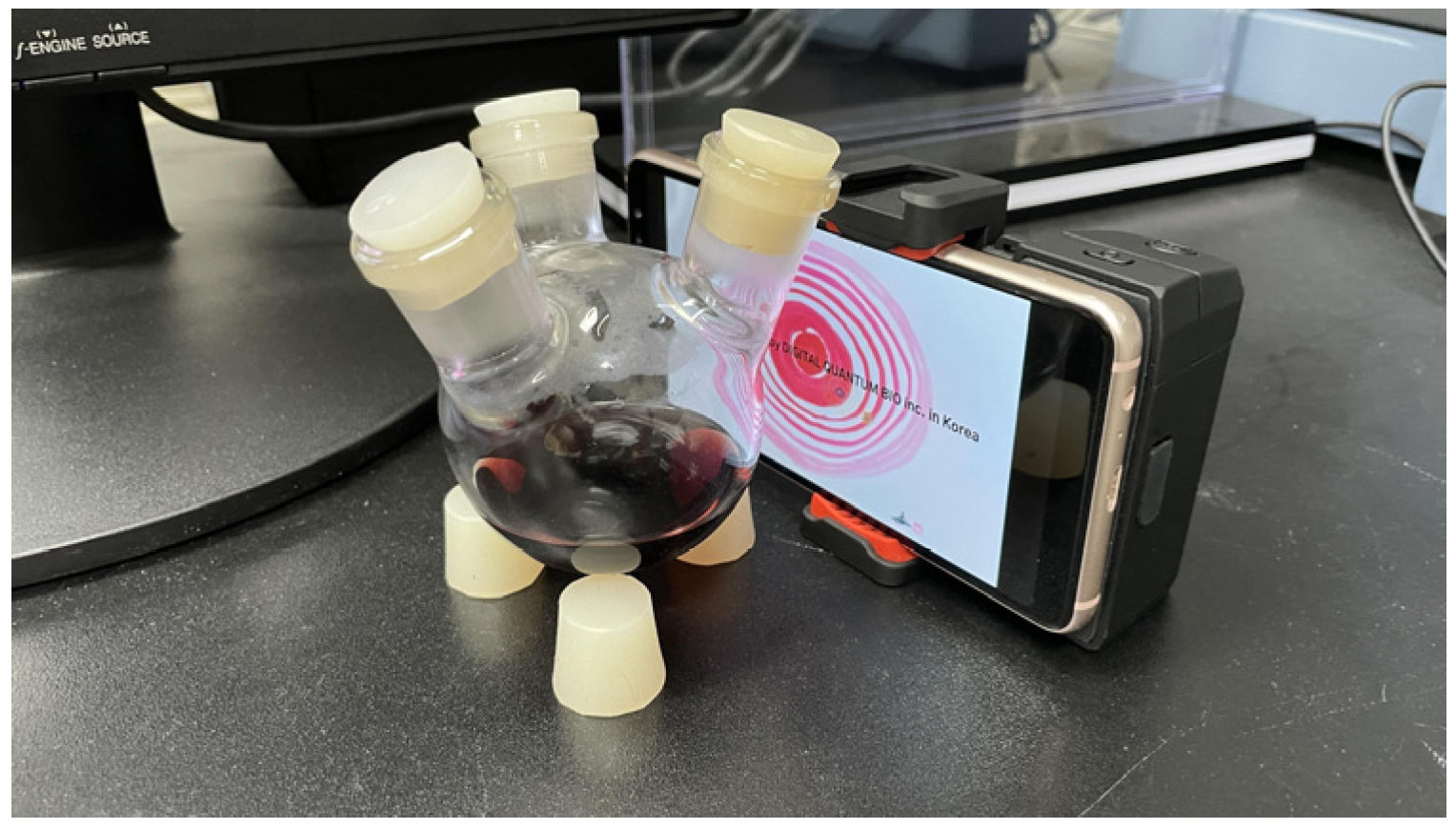
2.2. Generation and Characterization of Waveforms
2.3. HS-SPME-GC/MS Procedure
2.3.1. Sample Preparation and Wave Treatment of Wine
2.3.2. Triple SPME Procedure
2.3.3. GC/MS Instrumentation
2.3.4. GC/MS Analysis Procedure
2.3.5. Statistical Treatment of HS-SPME-GC/MS Results
3. Results
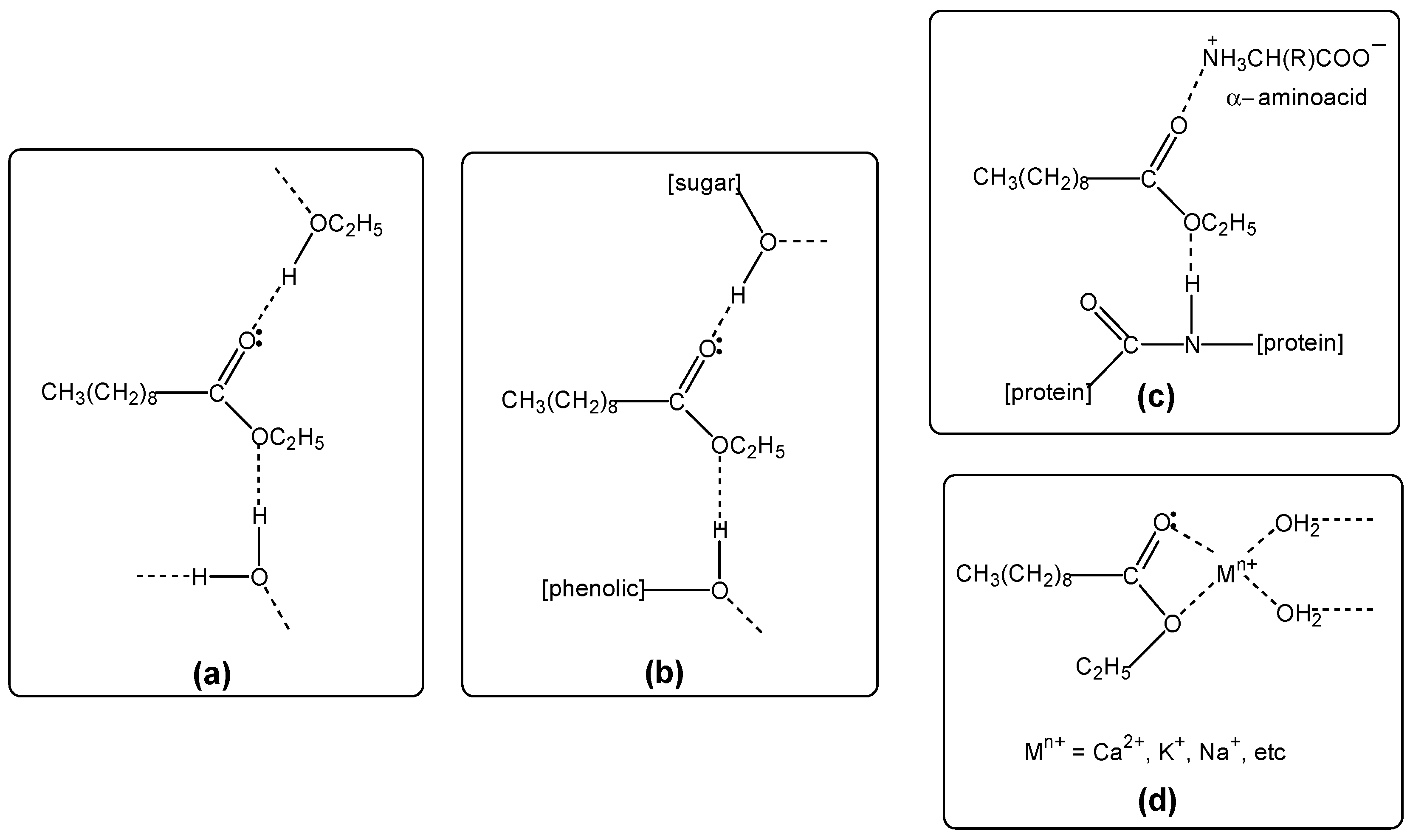
4. Discussion
5. Conclusions
6. Patents
Author Contributions
Funding
Data Availability Statement
Conflicts of Interest
References
- Feng, Y.; Yang, T.; Zhang, Y.; Zhang, A.; Gai, L.; Niu, D. Potential applications of pulsed electric fields in the fermented wineindustry. Front. Nutr. 2022, 9, 1048632. [Google Scholar] [CrossRef] [PubMed]
- Kumar, Y.; Marangon, M.; Marangon, C.M. The application of non-thermal technologies for wine processing, preservation, and quality enhancement. Beverages 2023, 9, 30. [Google Scholar] [CrossRef]
- Ozturk, B.; Anli, R.E. Pulsed electric field (PEF) applications on wine production: A review. BIO Web Conf. 2017, 9, 02008. [Google Scholar] [CrossRef]
- Yıldırım, H.K.; Dündar, E. New Techniques for wine aging. BIO Web Conf. 2017, 9, 02012. [Google Scholar] [CrossRef]
- Martín, J.F.G.; Sun, D.-W. Ultrasound and electric fields as novel techniques for assisting the wine aging process: The state-of-the-art research. Trends Food Sci. Technol. 2013, 33, 40–53. [Google Scholar] [CrossRef]
- Liu, L.; Loira, I.; Morata, A.; Suárez-Lepe, J.A.; González, M.C.; Rauhut, D. Shortening the ageing on lees process in wines by using ultrasound and microwave treatments both combined with stirring and abrasion techniques. Eur. Food Res. Technol. 2016, 242, 559–569. [Google Scholar] [CrossRef]
- García, R.M.; Díaz-Maroto, M.C.; Villena, M.A.; Pérez-Coello, M.S.; Alañón, M.E. Ultrasound and microwave techniques asphysical methods to accelerate oak wood aged aroma in red wine. LWT 2023, 179, 114597. [Google Scholar] [CrossRef]
- Natolino, A.; Roman, T.; Nicolini, G.; Celotti, E. Innovations on red winemaking process by ultrasound technology. Wine World Magazine 2021, 94, 23–26. [Google Scholar]
- Natrella, G.; Noviello, M.; Trani, A.; Faccia, M.; Gambacorta, G. The effect of ultrasound treatment on the volatile compounds of Anglianico, Nero di Troia, and Primitivo red wines. Foods 2023, 12, 648. [Google Scholar] [CrossRef]
- Romero-Díez, R.; Matos, M.; Rodrigues, L.; Bronze, M.R.; Rodríguez-Rojo, S.; Cocero, M.; Matias, A. Microwave and ultrasound pretreatments to enhance anthocyanins extraction from different wine lees. Food Chem. 2019, 272, 258–266. [Google Scholar] [CrossRef]
- Sánchez-Córdoba, C.; Durán-Guerrero, E.; Castro, R. Olfactometric and sensory evaluation of red wine subjected to ultrasound or microwaves during their maceration or aging stages. LWT 2021, 144, 111228. [Google Scholar] [CrossRef]
- Tan, J.; Li, Q.; Xue, H.; Tang, J. Ultrasound-assisted extraction of anthocyanins from grape skins: Optimization, identification, and antitumor activity. J. Food Sci. 2020, 85, 3731–3744. [Google Scholar] [CrossRef] [PubMed]
- Xie, Q.; Tang, Y.; Wu, X.; Luo, Q.; Zhang, W.; Liu, H.; Feng, Y.; Yue, X.; Ju, Y. Combined ultrasonic and low temperature pretreatment improve the content of of anthocyanins, phenols, and volatile substances of Merlot red wine. Ultrason. Sonochem. 2023, 100, 106636. [Google Scholar] [CrossRef] [PubMed]
- Zhang, Y.; Qiu, Q.; Xu, Y.; Zhu, J.; Yuan, M.; Chen, M. Fast aging technology of novel kiwifruit wine and dynamic changes of aroma components during storage. Food Sci. Technol. 2022, 43, e98422. [Google Scholar] [CrossRef]
- Comuzzo, P.; Voce, S.; Grazioli, C.; Tubaro, F.; Marconi, M.; Zanella, G.; Querzè, M. Pulsed electric field processing of red grapes (cv. Rondinella): Modifications of phenolic fraction and effects on wine evolution. Foods 2020, 9, 414. [Google Scholar] [CrossRef]
- Delso, C.; Berzosa, A.; Sanz, J.; Álvarez, I.; Raso, J. Pulsed electric field processing as an alternative to sulfite (SO2) for controlling Saccharomyces cerevisoae involved in the fermentation of Chardonnay wine. Food Res. Int. 2023, 165, 112525. [Google Scholar] [CrossRef]
- Delso, C.; Berzosa, A.; Sanz, J.; Álvarez, I.; Raso, J. Microbial decontamination of red wine by pulsed electric fields (PEF) after alcoholic and malolactic fermentation: Effect on Saccharomyces cerevisiae, Oenococcus oeni, and oenological parameters during storage. Foods 2023, 12, 278. [Google Scholar] [CrossRef]
- El Darra, N.; Rajha, H.N.; Ducasse, M.-A.; Turk, M.F.; Grimi, N.; Maroun, R.G.; Louka, N.; Vorobiev, E. Effect of pulsed electric field treatment during cold maceration and alcoholic fermentation on major red wine qualitative and quantitative parameters. Food Chem. 2016, 213, 352–360. [Google Scholar] [CrossRef]
- Evrendilek, G.A. Pulsed electric field processing of red wine: Effect on wine quality and microbial inactivation. Beverages 2022, 8, 78. [Google Scholar] [CrossRef]
- Galązka-Czarnecka, I.; Korzeniewska, E.; Czarnecki, A. Influence of pulsed electric field on the content of polyphenolic compounds in wine. In Proceedings of the 2018 Applications of Electromagnetics in Modern Techniques and Medicine (PTZE), Racławice, Poland, 9–12 September 2018; pp. 33–36. [Google Scholar]
- Puértolas, E.; Saldaña, G.; Condón, S.; Alvarez, I.; Raso, J. A comparison of the effect of macerating enzymes and pulsed electric fields technology on phenolic content and color of red wine. J. Food Sci. 2009, 74, c647–c652. [Google Scholar] [CrossRef]
- Silva, F.V.M.; Borgo, R.; Guanziroli, A.; Ricardo-da-Silva, J.M.; Aguiar-Macedo, M.; Redondo, L.M. Pilot scale continuous pulsed electric fields treatments for vinification and stabilization of Arinto and Moscatel Graudo (Vitis vinifera L.) white grape varieties. Beverages 2024, 10, 6–24. [Google Scholar] [CrossRef]
- van Wyk, S.; Silva, F.V.M.; Farid, M.M. Pulsed electric field treatment of red wine: Inactivation of Brettanomyces and potential hazard caused by metal ion dissolution. Innov. Food Sci. Emerg. Technol. 2019, 52, 57–65. [Google Scholar] [CrossRef]
- Casassa, L.F.; Fanzone, M.L.; Sari, S.E. Comparative phenolic, chromatic, and sensory composition of five monovarietal wines processed with microwave technology. Heliyon 2022, 8, e12332. [Google Scholar] [CrossRef] [PubMed]
- García, R.M.; Simancas, R.O.; Díaz-Maroto, M.C.; Pardo, M.E.A.; Pérez-Coello, M.S. Effect of microwave maceration and SO2 free vinification on volatile composition of red wines. Foods 2021, 10, 1164. [Google Scholar] [CrossRef] [PubMed]
- Yuan, J.-F.; Wang, T.-T.; Chen, Z.-Y.; Wang, D.-H.; Gong, M.-G.; Li, P.-Y. Microwave irradiation: Impacts on physicochemical properties of red wine. CyTA-J. Food 2020, 18, 281–290. [Google Scholar] [CrossRef]
- Kim, S.H.; Jung, H.J.; Lee, J.H. Changes in the levels of headspace volatiles, including acetaldehyde and formaldehyde, in red and white wine following light irradiation. J. Food Sci. 2021, 86, 834–841. [Google Scholar] [CrossRef]
- Mohammadi, X.; Matinfar, G.; Mandal, R.; Singh, A.; Fiutak, G.; Kitts, D.D.; Pratap-Singh, A. Kinetics of condensation reaction in model wine solution under pulsed light treatment. Food Chem. 2023, 405, 134600. [Google Scholar] [CrossRef]
- Mohammadi, X.; Kitts, D.D.; Singh, A.; Amiri, A.; Matinfar, G.; Pratap-Singh, A. Pulsed light treatment helps reduce sulfur dioxide required to preserve Malbec wines. Food Biosci. 2024, 61, 104776. [Google Scholar] [CrossRef]
- Pérez-López, A.J.; Rodríguez-López, M.I.; Burló, F.; Carbonelle-Barrachina, Á.A.; Galbadón, J.A.; Gómez-López, V.M. Evaluation of pulsed light to inactivate Brettanomyces bruxellensis in white wine and assessment of its effects on color and aromatic profile. Foods 2020, 9, 1903. [Google Scholar] [CrossRef]
- Santamera, A.; Escott, C.; Loira, I.; del Fresno, J.M.; Gonzalez, C.; Morata, A. Pulsed light: Challenges of a non-thermal sanitation technology in the winemaking industry. Beverages 2020, 6, 45. [Google Scholar] [CrossRef]
- Yin, H.; Wang, L.; Su, H.; Liang, Y.; Ji, P.; Wang, X.; Xi, Z. Effects of ultraviolet and infrared radiation absence or presence on the aroma volatile compounds in winegrape during veraison. Food Res. Int. 2023, 167, 112662. [Google Scholar] [CrossRef] [PubMed]
- ISO 20473:2007; Optics and Photonics—Spectral Bands. International Organization for Standardization: New York, NY, USA, 2007. Available online: https://www.iso.org (accessed on 3 March 2025).
- Lee, C.; Lee, Y.; Lee, J.-G.; Buglass, A.J. Development of a simultaneous multiple solid-phase microextraction-single shot-gas chromatography/mass spectrometry method and application to aroma profile analysis of commercial coffee. J. Chromatogr. A 2013, 1295, 24–41. [Google Scholar] [CrossRef]
- Leffingwell. Odor Detection Thresholds; Leffingwell: Whittier, CA, USA, 2009; Available online: http://www.leffingwell.com/odorback.htm (accessed on 3 March 2025).
- Garcia, M.; Esteve-Zarzosa, B.; Crespo, J.; Cabellos, J.M.; Arroyo, T. Influence of native Saccharomyces cerevisiae strains from D.O. ‘Vinos de Madrid’ in the volatile profile of white wines. Fermentation 2019, 5, 94. [Google Scholar] [CrossRef]
- Ma, T.-Z.; Gong, P.-F.; Lu, R.-R.; Zhang, B.; Morata, A.; Han, S.-Y. Effect of different clarification treatments on the volatile composition of and aromatic attributes of ‘Italian Riesling’ icewine. Molecules 2020, 25, 2657. [Google Scholar] [CrossRef] [PubMed]
- Brown, R.C.; Sefton, M.A.; Taylor, D.K.; Elsey, G.M. An odor detection threshold for all four possible stereoisomers of oak lactone in a white and a red wine. Aust. J. Grape Wine Res. 2006, 12, 115–118. [Google Scholar] [CrossRef]
- Escudero, A.; Campo, E.; Farina, L.; Cacho, J.; Ferreira, V. Analytical characteristics of the aroma of five premium red wines. Insights into the role of odor families and the concept of fruitiness in wines. J. Agric. Food Chem. 2007, 55, 4501–4510. [Google Scholar] [CrossRef]
- Sáenz-Navajas, M.-P.; Campo, E.; Culleré, L.; Fernández-Zurbano, P.; Valentin, D.; Ferreira, V. Effects of the nonvolatile matrix on the aroma perception of wine. J. Agric. Food Chem. 2010, 58, 5574–5585. [Google Scholar] [CrossRef]
- Tsachaki, M.; Gady, A.-L.; Kalopesas, M.; Linforth, R.S.T.; Athès, V.; Marin, M.; Taylor, A.J. Effect of ethanol, temperature, and gas flow rate on volatile release from aqueous solutions under dynamic headspace dilution conditions. J. Agric. Food Chem. 2008, 56, 5308–5315. [Google Scholar] [CrossRef]
- Tsachaki, M.; Linforth, R.S.T.; Taylor, A.J. Aroma release from wines under dynamic conditions. J. Agric. Food Chem. 2009, 57, 6976–6981. [Google Scholar] [CrossRef]
- McManus, J.P.; Davis, K.G.; Lilley, T.H.; Haslam, E. The association of proteins with polyphenols. Chem. Commun. 1981, 309b–311. [Google Scholar] [CrossRef]
- Valentová, H.; Skrovanková, S.; Panovská, Z.; Pokorný, J. Time-intensity studies of astringent taste. Food Chem. 2002, 78, 29–37. [Google Scholar] [CrossRef]
- Soares, S.I.; Goncalves, R.M.; Fernandes, I.; Mateus, N.; de Freitas, V. Mechanistic approach by which polysaccharides inhibit α-amylase/procyanidin aggregation. J. Agric. Food Chem. 2009, 57, 4352–4358. [Google Scholar] [CrossRef]



| Component | Retention Time/min | Semi-Quantitative Concentration/mg/L a (SD, %RSD) b Control Treated |
|---|---|---|
| 2-Methyl-1-propanol (isobutyl alcohol) | 19.738 | 161 (42.0, 26.1) 183 (66.0, 36.1) |
| 1-Butanol | 22.360 | 8 (1.8, 22.5) 9 (4.3, 47.8) |
| 1-Pentanol | 24.889 | 25 (5.0, 20) # 30 (6.0, 20.0) # |
| Ethyl hexanoate | 25.906 | 31 (6.5 21.0) * 50 (3.5, 7.0) * |
| Ethyl octanoate | 35.257 | 173 (44.0, 25.4) * 305 (43.0, 14.0) * |
| Acetic acid | 36.354 | 290 (85.8, 29.0) 290 (119.0, 41.0) |
| Furfural | 37.084 | 30 (6.3, 21.0) # 36 (5.3, 15.0) # |
| Vitispirane | 39.297 | 10 (2.5, 25.0) 11 (1.3, 11.8) |
| 2,3-Butanediol | 40.079 | 183 (45.5, 25) 162 (129.5, 80) |
| 1-Octanol | 40.546 | 21 (8.0, 38.1) 18 (5.5, 30.6) |
| β-Caryophyllene | 42.059 | 22 (11.3, 51.4) 13 (3.0, 23.1) |
| Ethyl decanoate | 43.721 | 175 (40.8, 23.3) * 255 (21.6, 8.5) * |
| Menthol | 43.946 | 419 (79.0, 18.9) # 287 (59.8, 20.8) # |
| γ-Butyrolactone | 44.158 | 9 (2.5, 27.8) 9 (2.8, 31.1) |
| Diethyl succinate | 45.462 | 541 (77.0, 14.2) # 436 (54.0, 12.4) # |
| α-Terpineol | 46.242 | 20 (2.0, 10.0) # 21.5 (1.0, 4.7) # |
| 1-Decanol (ISTD) | 49.482 | - - |
| Methyl 2-hydroxybenzoate (salicylate) | 49.490 | 17.0 (0.1, 0.6) * 20.0 (0.3, 1.5) * |
| p-anethole (p-propenylanisole) | 51.225 | 10 (2.4, 24.0) 8 (0.8, 10.0) |
| Heptanoic acid | 51.628 | 29 (5.0, 17.2) # 22 (2.3, 10.5) # |
| Butyl O-butyryllactate | 52.731 | 38 (21.0, 55.3) 40 (8.3, 20.8) |
| Benzyl alcohol | 52.977 | 20 (0.7, 3.5) * 15 (3.8, 25.3) * |
| Ethyl isopentyl succinate (Ethyl 3-methylbutyl succinate) | 53.666 | 14.8 (0.4, 2.7) * 13 (0.9, 6.9) * |
| 2-Phenylethanol | 54.199 | 321 (20.8, 6.5) * 244 (52.8, 21.6) * |
| 1-Dodecanol | 55.682 | 9 (0.7, 7.8) 11 (1.9, 17.3) |
| Oak, Quercus or Whiskey lactone (cis or trans-5-Butyl-4-methyl dihydro-2(3H)-furanone) | 55.964 | 7.3 (0.2, 2.7) * 5 (1.0, 20.0) * |
| Octanoic acid | 59.149 | 87 (2.6, 3.0) # 74 (19.3, 26.1) # |
| Decanoic acid | 70.564 | 39 (6.3, 16.2) 41 (8.3, 20.2) |
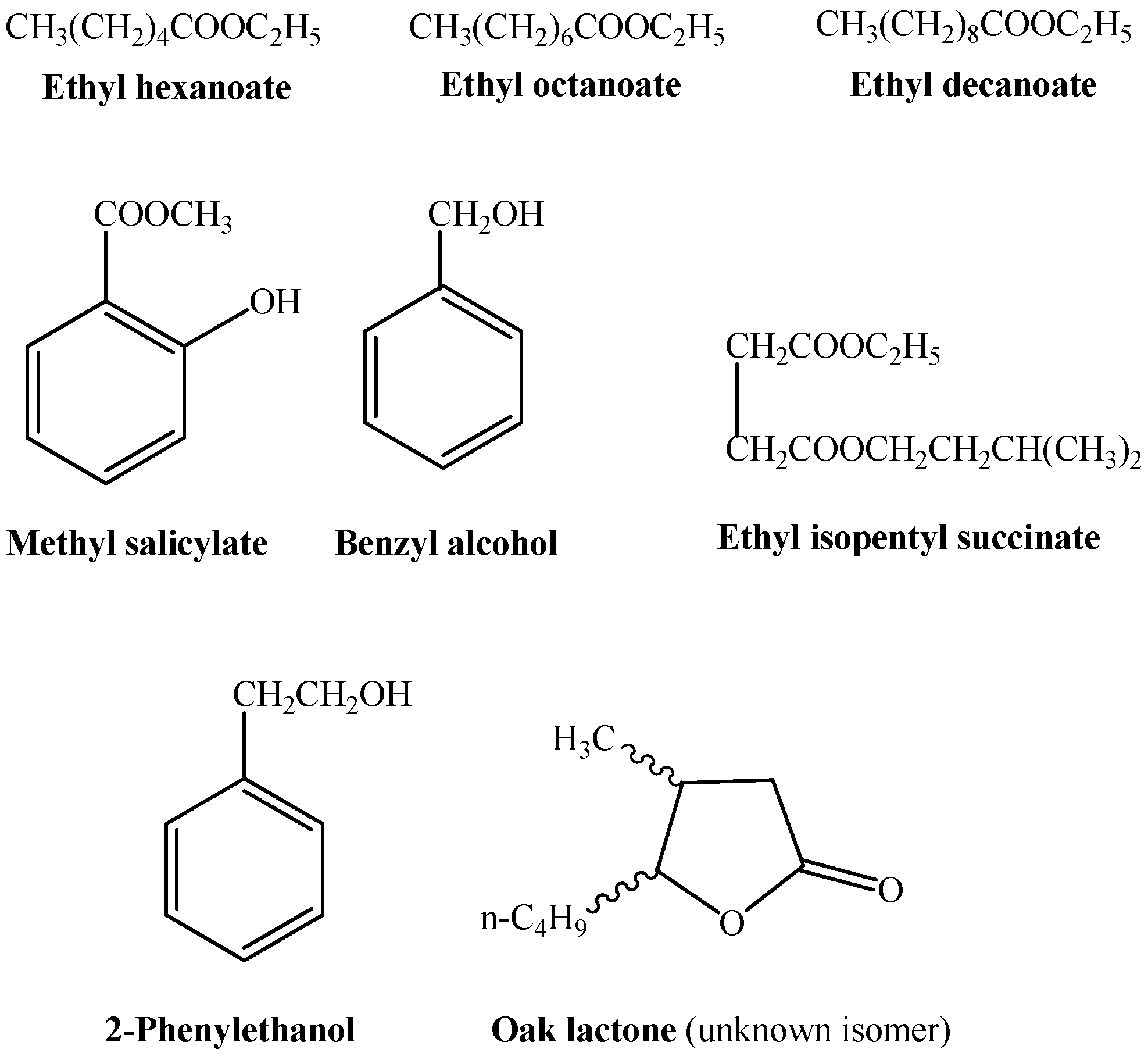
| Compound (CAS Reg, No.) | Increased ▲ or Decreased ▼ Level on Wave Treatment * | Common Aroma Descriptors | OTV ‡/mg/L (Media) |
|---|---|---|---|
| Ethyl hexanoate (123-66-0) | ▲ | Apple, pineapple | 0.001 (in water) a; 0.014 b |
| Ethyl octanoate (106-32-1) | ▲ | Orange, pineapple, brandy-like | 0.015 (in water) a; 0.24 c |
| Ethyl decanoate (110-38-3) | ▲ | Fruity, oily, brandy-like | 0.001 (in water) a; 0.510 (in wine) a |
| Methyl salicylate (119-36-8) | ▲ | Fruity, root beer, mint | 0.04 (in water) a |
| Benzyl alcohol (100-51-6) | ▼ | Floral-rose, toasted | 10 (in water) a |
| Ethyl isopentyl succinate (28024-16-0) | ▼ | Fatty, pungent, fruity | Unknown |
| 2-Phenylethanol (60-12-8) | ▼ | Rose, woody | 0.75–1.1 (in water) a |
| Oak lactone (unknown isomer) 55013-32-6 (cis) or 39638-67-0 (trans) | ▼ | Coconut, woody $ | 0.024 (cis-isomer); 0.054 (trans-isomer) (both in wine) d |
Disclaimer/Publisher’s Note: The statements, opinions and data contained in all publications are solely those of the individual author(s) and contributor(s) and not of MDPI and/or the editor(s). MDPI and/or the editor(s) disclaim responsibility for any injury to people or property resulting from any ideas, methods, instructions or products referred to in the content. |
© 2026 by the authors. Licensee MDPI, Basel, Switzerland. This article is an open access article distributed under the terms and conditions of the Creative Commons Attribution (CC BY) license.
Share and Cite
Lee, S.; Lee, C.; Jeong, H.; Kim, S.; Lee, E.K.; Buglass, A.J. A Preliminary Investigation into the Influence of Low-Intensity Natural Mid-Infrared and Far-Infrared/Near-Microwave Emissions on the Aroma and Flavor of a Young Dry Red Wine. ChemEngineering 2026, 10, 18. https://doi.org/10.3390/chemengineering10020018
Lee S, Lee C, Jeong H, Kim S, Lee EK, Buglass AJ. A Preliminary Investigation into the Influence of Low-Intensity Natural Mid-Infrared and Far-Infrared/Near-Microwave Emissions on the Aroma and Flavor of a Young Dry Red Wine. ChemEngineering. 2026; 10(2):18. https://doi.org/10.3390/chemengineering10020018
Chicago/Turabian StyleLee, Sanghoon, Changgook Lee, Hyunhee Jeong, Sejun Kim, Eok Kyun Lee, and Alan J. Buglass. 2026. "A Preliminary Investigation into the Influence of Low-Intensity Natural Mid-Infrared and Far-Infrared/Near-Microwave Emissions on the Aroma and Flavor of a Young Dry Red Wine" ChemEngineering 10, no. 2: 18. https://doi.org/10.3390/chemengineering10020018
APA StyleLee, S., Lee, C., Jeong, H., Kim, S., Lee, E. K., & Buglass, A. J. (2026). A Preliminary Investigation into the Influence of Low-Intensity Natural Mid-Infrared and Far-Infrared/Near-Microwave Emissions on the Aroma and Flavor of a Young Dry Red Wine. ChemEngineering, 10(2), 18. https://doi.org/10.3390/chemengineering10020018