
Article

Occurrence, Ecological Risk, and Human Exposure of Rubber Additives and Transformation Products in Surface Waters of Kaifeng, China

1
Henan Engineering Technology Research Center of Green Coating Materials, Kaifeng Engineering Technology Research Center of Aquatic Environmental Pollution Monitoring, Kaifeng Key Laboratory of Food Composition and Quality Assessment, School of Environmental Engineering, Yellow River Conservancy Technical University, Kaifeng 475004, China
2
Research and Development Center for Watershed Environmental Eco-Engineering, Advanced Institute of Natural Sciences, Beijing Normal University, Zhuhai 519087, China
3
College of Surveying and Mapping Engineering, Yellow River Conservancy Technical University, Kaifeng 475004, China
*
Authors to whom correspondence should be addressed.
These authors contributed equally to this work.
Toxics 2026, 14(6), 521; https://doi.org/10.3390/toxics14060521 (registering DOI)
Submission received: 30 April 2026 / Revised: 6 June 2026 / Accepted: 10 June 2026 / Published: 15 June 2026

Abstract

This study investigated rubber additives and relevant transformation products (RARTPs) in surface waters of Kaifeng, a city linking the Yellow River and Huaihe River basins. Seven of fifteen target analytes were detected in >10% of samples. The hydrolysis product 4-hydroxydiphenylamine (4OH) showed the highest detection frequency (70%), followed by 1,2-Dihydro-2,2,4-trimethylquinoline (TMQ, 57%) and N-(1,3-Dimethylbutyl)-N′-phenyl-p-phenylenediamine (6PPD, 27%). TMQ had the highest average concentration (6.16 ± 4.17 ng·L−1). Urban rivers (14.20 ± 4.72 ng·L−1) were contamination hotspots, driven by management practices (e.g., dredging of urban lakes). Although detected at lower levels (0.09 ± 0.21 ng·L−1), 6PPD-quinone (6PPD-Q) was associated with elevated risk (risk quotient, RQ ≥ 1) at 19% of sites. The chronic daily intake assessment showed that drinking water ingestion contributed 66.7% of total exposure in daily use, whereas dermal absorption dominated during swimming. Children, especially girls, were the most vulnerable subgroup. Although estimated chronic daily intakes (CDIs) from surface water accounted for only a negligible proportion of the daily urinary excretion of p-phenylenediamine antioxidants (PPDs) reported in a Chinese population, the ecological risk of 6PPD-Q warrants continued attention. These findings highlight the need for improved management of water bodies receiving urban runoff and aquaculture inputs, and further health risk assessment of RARTPs.

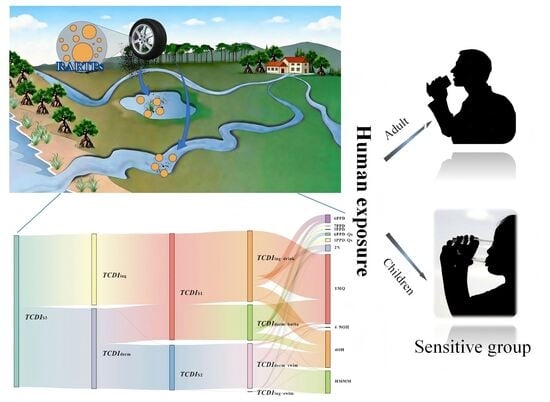
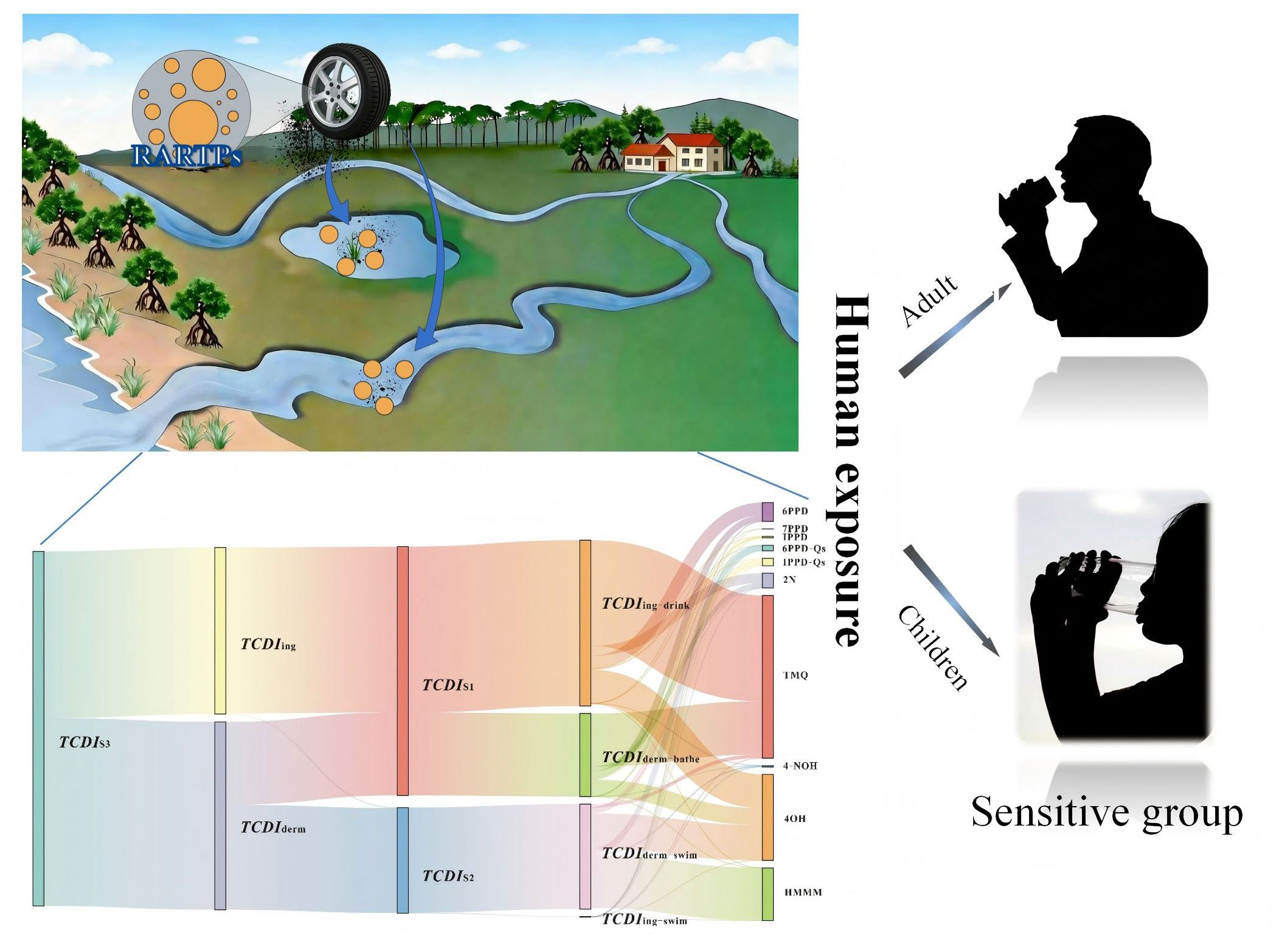
Graphical Abstract

1. Introduction

Rubber additives constitute a significant category of synthetic organic chemicals, widely employed in the production of rubber products—particularly tires—as antioxidants, vulcanization inhibitors, and bonding agents [1,2]. As the world’s leading producer, China’s rubber chemical production reached approximately 1.239 million metric tons in 2020, accounting for nearly 75% of global output, with a year-on-year increase of 0.65% [3]. Tire wear is a major emission pathway, with global annual per capita emissions estimated between 0.2 and 5.5 kg [4]. The widespread use of rubber additives in tires, coupled with the ubiquitous presence of tire wear particles, leads to the continuous release of these substances into environmental media [5]. Among them, p-phenylenediamines (PPDs) represent one of the most important classes, with 6PPD being the most widely used antioxidant in tires. Another important group, the non-p-phenylenediamine antioxidants (NON-PPDs), includes TMQ, which provides long-term thermal–oxidative protection and is frequently detected in the environment. Therefore, water bodies that receive road runoff, snowmelt, and atmospheric deposition have become the primary transport pathways and main collection sites for these compounds [6,7]. There are particular concerns about the ecological hazards posed by certain rubber additives. For instance, 6PPD was found to be highly toxic to aquatic organisms, with median lethal concentrations (LC50) of 162 μg·L−1 for larvae of the native Chinese species Gobiocypris rarus and 443 μg·L−1 for zebrafish [8,9,10]. Under environmental conditions, 6PPD can undergo specific transformation processes, leading to the formation of various degradation products with distinct environmental behaviors and toxicities. Under aerobic conditions, 6PPD reacts with ozone to produce 6PPD-quinone (6PPD-Q), a transformation product with significantly enhanced toxicity. Its LC50 for coho salmon reaches as high as 0.095 μg·L−1 [11], and this oxidation process has been demonstrated to substantially exacerbate the environmental risks posed by road runoff and atmospheric deposition to surface water bodies. In aqueous environments, 6PPD can also undergo hydrolysis, yielding several transformation products, among which 4-hydroxydiphenylamine (4OH) and 4-nitrosodiphenylamine (4-NOH) are notable examples.
To date, research on rubber additives and their relevant transformation products (RARTPs) has largely emphasized their contamination levels in various environmental media, e.g., atmospheric particles, dust, surface/groundwater, runoff, snow, drinking water, wastewater, sediment, soil, and even some animal-derived food products (egg, honey, and fish) [12,13,14,15,16,17,18,19], and the internal exposure amount of RARTPs among humans [19,20,21,22]. However, there remains a significant knowledge gap regarding the influence of heterogeneous land use and the inherent characteristics of water bodies on the occurrence and fate of RARTPs in surface water systems. Specifically, there is a lack of systematic research examining variations in the pollution traits and sources of RARTPs across water bodies exposed to vastly different anthropogenic pressures (e.g., urban runoff and aquaculture inputs). Understanding these spatial and functional determinants is essential to accurately assess the transport mechanisms and ecological risks of RARTPs at the watershed scale. In practice, there is a need for guidance and a reference for surface water safety.
Kaifeng (a city in northern China) is often referred to as the “Water City of the North.” Although it is geographically located within the Huaihe River basin, the vast majority of its water resources (surface water and groundwater) still originate from the Yellow River via irrigation canals and lateral seepage. Therefore, the water network in this region is characterized by the combined use of surface water and groundwater for a variety of purposes, including drinking water supply, aquaculture, landscape and recreational uses, and storm water drainage. This unique setting provides an ideal model system for investigating the effects of diverse water sources, land use types, and management practices on the occurrence and fate of RARTPs in surface waters. The objectives of this study were: (i) to characterize the occurrence and spatial distribution of 15 RARTP contaminants in the surface water in Kaifeng City, (ii) to evaluate the potential daily intake of these contaminants through multiple exposure pathways to provide guidance on drinking water safety, and (iii) to conduct an in-depth investigation into the effects of specific land use types, management measures, and physicochemical properties on the migration, transformation, and fate of RARTPs in surface water.

2. Materials and Methods

2.1. Sample Collection

Kaifeng is located on the alluvial plain in the middle and lower reaches of the Yellow River, featuring a flat and open terrain. Over the course of the city’s long history within Chinese civilization and natural sedimentation processes, a thick silt layer has gradually accumulated, interbedded with various soil types and alluvial deposits. Due to the Yellow River’s typical wandering behavior, the subsurface stratum consists primarily of silt, fine sand, sand, and light loam, resulting in high permeability but relatively low mechanical strength. The climate of Kaifeng is warm, continental, and semi-arid monsoon, with clearly defined seasons. The multi-year average annual temperature ranges from 13.1 °C to 14.5 °C, and the average annual precipitation is approximately 600 mm, mostly falling between June and September. Historical average relative humidity varies between 65% and 75%. Elevation gradually decreases from northwest to southeast. According to the Kaifeng Statistical Yearbook 2023 [23], the city had a population of 4.69 million and a population density of 751 persons per square kilometer in 2023. The total number of automobiles in Kaifeng reached 830,000 in the same year, a 4.0% increase from the previous year’s end.
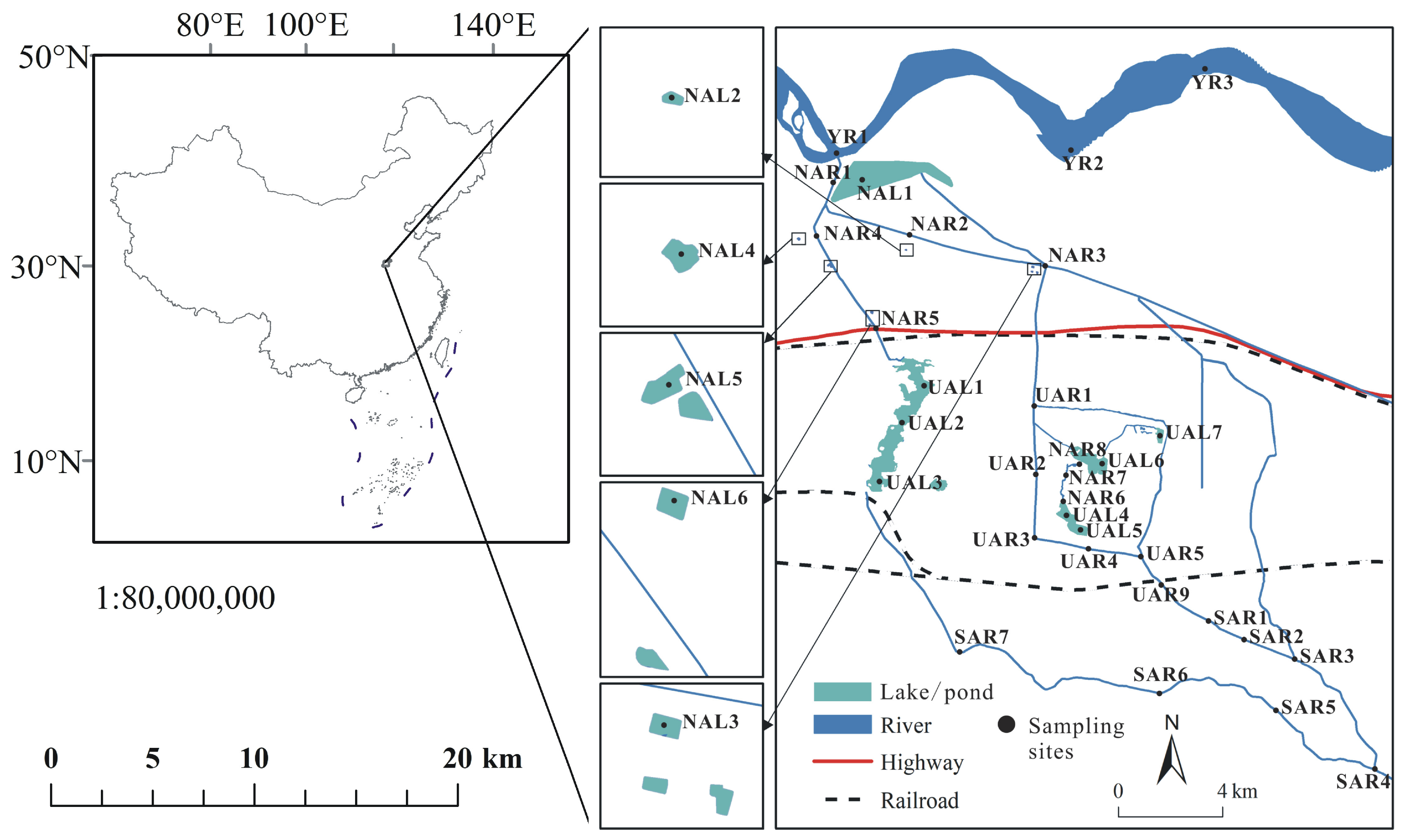
As shown in Figure 1, the sampling sites start from the south bank of the Yellow River and are divided from north to south into the “Yellow River” (YR), “northern area rivers” (NARs), “northern area lakes” (NALs), “urban area rivers” (UARs), “urban area lakes” (UALs), and “southern area rivers” (SARs) (see Supplementary Material Table S1 for details). A total of 37 surface water samples were collected on 23 and 24 August 2023. Among them, samples YR1, YR2, YR3, NAR1, and NAL1 were collected from drinking water sources.
Two liters of surface water was collected as a sample at each sampling site using polyethylene bottles. These bottles were pre-rinsed in the laboratory with tap water, methanol, and Milli-Q water, and then rinsed three times with surface water at the sampling sites. Each composite sample consists of three samples collected sequentially at the same sampling site (approximately 1 m below the water surface) and thoroughly mixed afterward. Water samples were transported to the laboratory at 4 °C. The analysis of all collected water samples was conducted within two days after collection.

2.2. Analytical Methods

Basic information of the target analytes, reagents, and standards used in this study, including their CAS registry numbers, molecular formulae, purity, suppliers, and key physicochemical properties, is summarized in Table S2.

2.2.1. Analysis of Surface Water Physiochemical Parameters

Total nitrogen (TN) and total organic carbon (TOC) are two of the physical characteristics of surface water. A total organic carbon analyzer (TOC-L CPH, SHIMADZU, Kyoto, Japan) was used to measure the TOC and TN contents in surface water samples. TOC was computed using the formula that states that TOC is equal to the total carbon (TC) amount minus the inorganic carbon (IC) amount.

2.2.2. Sample Extraction and Instrumental Analysis for RARTPs

  • Sample extraction
The process for extracting and instrumentally analyzing RARTPs is based on a previously published method [24,25]. In brief, for each 300 mL surface water sample, filtration was performed using a 0.7-micron GF (glass microfiber filter)/F membrane (Hangzhou Special Paper Industry Corp., Ltd., Hangzhou, China), and these filters were pre-cleaned for optimal filtration performance. The filtrates were subsequently extracted using an automatic high-flux solid-phase extractor (Fotector Plus, RayKol Group Corp., Ltd., Xiamen, China) coupled with Oasis hydrophilic–lipophilic balance solid-phase extraction cartridges (500 mg·6 mL−1, Waters, Milford, MA, USA).
2.
Instrumental analysis
For each cartridge, pre-treatment was performed sequentially with 10 mL of methanol followed by 10 mL of deionized water. Subsequently, the filtrate was injected into the cartridge at a flow rate of approximately 1.5 mL·min−1. Then, the cartridges were washed using 10 mL of mixed solvent (equal volumes of methanol and deionized water) and left to dry under nitrogen for 30 min. After drying, 15 mL of methanol and 10 mL of acetonitrile were used to elute the analytes from the HLB cartridges. The eluate was ultimately concentrated to 0.5 mL and diluted with deionized water to a final volume of 1 mL for analysis via ultra-high-performance liquid chromatography and mass spectrometry (UHPLC-MS/MS).
The analysis included seven p-phenylenediamine antioxidants (PPDs), namely 6PPD, 7PPD, 8PPD, CPPD, DNPD, DPPD, and IPPD, two p-phenylenediamine quinones (PPD-Qs), namely 6PPD-Q and IPPD-Q, two hydrolysis products (HPs), namely 4-NOH and 4OH, three non-p-phenylenediamine antioxidants (NON-PPDs), including 445, 2N, and TMQ, one binding agent (BA), namely HMMM, and was conducted utilizing an Agilent 1290 Infinity II ultra-high-performance liquid chromatograph equipped with ZORBAX Eclipse Plus C18 column (Rapid Resolution HD 2.1 × 100 mm, 1.8-micron), paired with an Agilent 6470 triple quadrupole mass spectrometer (UHPLC-MS/MS, Agilent Technologies Inc., Santa Clara, CA, USA). The injection volume is 2 μL. The mass spectrometer is equipped with an Agilent jet stream electrospray ionization (AJS ESI) probe, which measures all target compounds in positive ion mode. Methanol (A) and water containing 0.1% formic acid (B) served as the mobile phase, which was pumped at a flow rate of 0.3 mL·min−1. The gradient varied as follows: 0 min, 50% A; 3 min, 98% A; 8 min, 98% A; 8.1 min, 50% A; and 10 min, 50% A. The identification and quantification of all analytes were conducted using multiple reaction monitoring (MRM) mode. The complete MS method details, including precursor/product ions, retention time, collision energy, fragmentor, detection limits, and calibration curve linearity, are elucidated in Table 1 and Table S3.
3.
Quality Control/Quality Assurance
To minimize background errors in quality control/quality assurance, regular testing was conducted on blank samples and matrix samples using the standard addition method, sample replicates, method blanks, and field blanks. The recovery rates for these analytes all reached satisfactory levels, ranging from 52.7% to 115.6%. For each set of twenty samples, duplicate blank samples were analyzed to evaluate the extraction and analytical procedures. The relative variation for duplicate samples in each batch was consistently below 9.3%.

2.3. Risk Assessment

2.3.1. Ecological Risk Assessment for Surface Water Phase

For water samples, the LC50 method (i.e., the concentration causing 50% mortality in three representative aquatic organisms—algae, invertebrates, and fish) was employed to assess the ecological risk of RARTPs [18,26,27] (see Supplementary Material Text S1 for equations and risk categories).

2.3.2. Exposure Assessment of Chronic Daily Intakes (CDIs)

To describe the exposure of RARTPs (PPDs, PPD-Qs, HPs, NON-PPDs, and BA), the CDI assessment of RARTPs in surface water samples was performed following the models recommended by the U.S. Environmental Protection Agency [28,29]. This study emphasized the assessment of CDIs for RARTPs in surface water under three exposure scenarios. Scenario 1 considers exposure resulting from drinking and bathing with tap water sourced from drinking water supplies; Scenario 2 assesses exposure from swimming in other surface water bodies (in accordance with local customs); and Scenario 3 involves exposure resulting from a combination of daily use (drinking and bathing) and swimming in other surface water bodies (equations, variables, and parameters are given in Supplementary Materials) [30,31,32,33,34,35,36].

3. Results and Discussion

3.1. RARTPs in the Surface Water of the Study Area

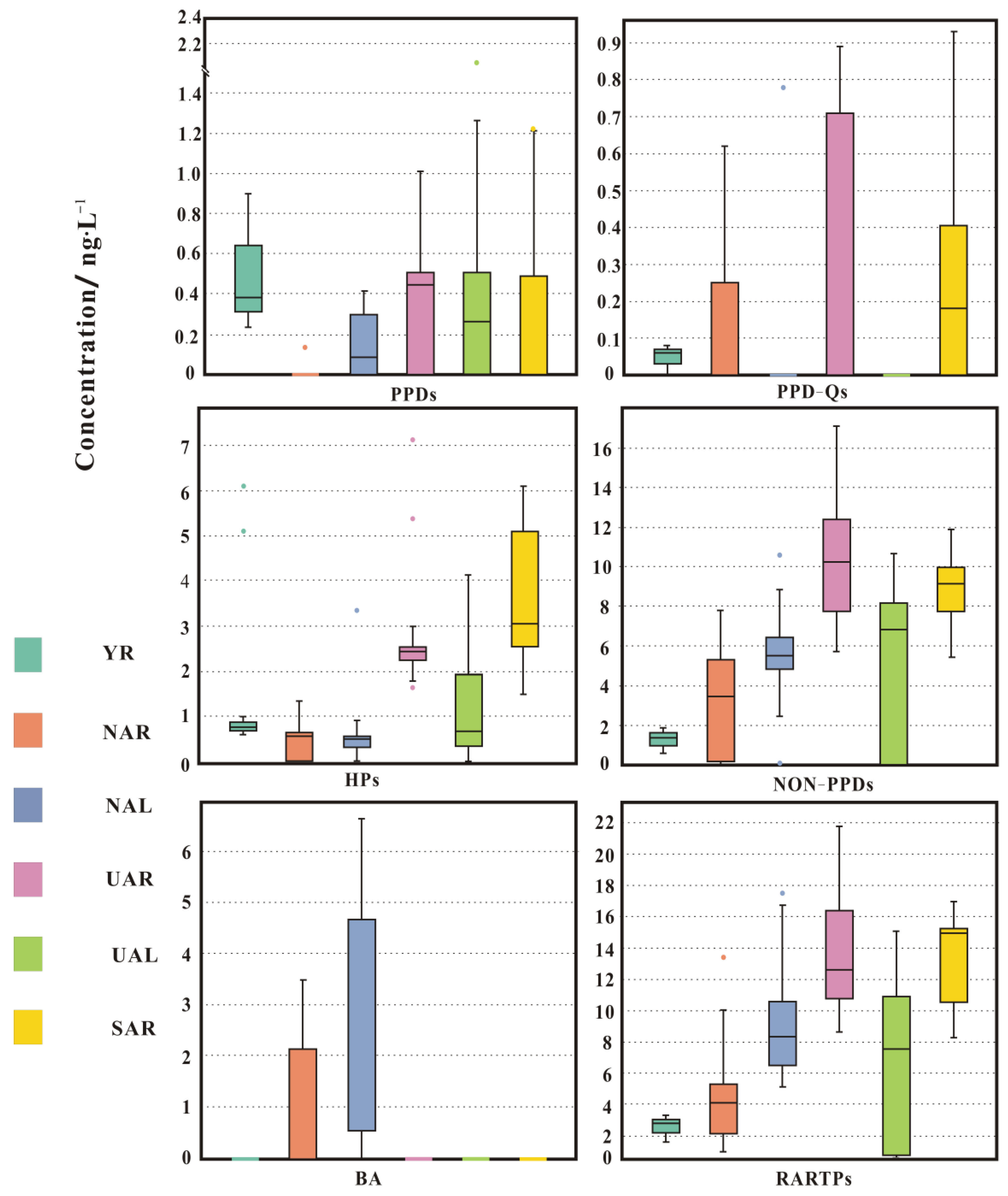
The spatial distributions and descriptive statistics for the concentrations of RARTPs in surface water samples are shown in Figure 2 and Table 2. For the study area, five of the 15 analytes were not detected (ND) (8PPD, CPPD, DNPD, DPPD, IPPD, and 445), and three were detected in no more than 10% of the samples (7PPD, 6PPD-Q, and 4-NOH), with the range of 5.41–8.11%. In over 10% of surface water samples, seven targets were found, with 4OH (hydrolysis product of 6PPD) identified as the most dominant congener, with the highest detection frequency of 70%, followed by NON-PPDs, TMQ (57%), 2N (27%) and the antioxidant 6PPD (27%). For RARTPs, the concentrations of TMQ (6.16 ± 4.17 ng·L−1, range: ND–16.52 ng·L−1), followed by 4OH (1.92 ± 1.82 ng·L−1, range: ND–7.14 ng·L−1) and HMMM (0.60 ± 1.55 ng·L−1, range: ND–6.63 ng·L−1), were among the highest. As the representative PPD, 6PPD ranged from ND to 1.64 ng·L−1. When compared with PPDs, PPD-Qs, and a BA, the concentrations of NON-PPDs and HPs were nearly an order of magnitude greater (Table 2).
The spatial distribution of RARTPs associated with enhanced human activity (Figure 2 and Table 3) reveals a distinct north-to-south gradient of pollutant concentrations within the river systems. Concentration levels were as follows: Yellow River (YR) (2.59 ± 0.88 ng·L−1) < northern area rivers (NARs) (5.16 ± 4.88 ng·L−1) < urban area rivers (UARs) (14.20 ± 4.72 ng·L−1), with the latter concentration approaching that of southern area rivers (SARs) (13.10 ± 3.26 ng·L−1). Additionally, significant differences exist in pollutant concentrations between rivers and lakes (or ponds) within the same region. On average, pollutant concentrations in northern area rivers are lower than those in northern area lakes (or ponds) (9.41 ± 4.49 ng·L−1). In contrast, the opposite trend is observed in urban areas, where pollutant concentrations in urban area rivers (UARs) are higher than in urban area lakes (UALs) (6.64 ± 6.21 ng·L−1). Thus, urban rivers represent critical hotspots for RARTP contamination.
Limited information is available on the occurrence of RARTPs in surface water. Table 4 and Table 5 review contents of 6PPD, IPPD, and 6PPD-Q detected in various water samples in China [18] and other countries [2,5,14,37,38,39]. The contents of 6PPD in surface water were higher in Kaifeng (ND–1.64 ng·L−1, 0.20 ± 0.38 ng·L−1) than those reported for the Liuxi River in Guangzhou (China) and for the stormwater from Don River and Highland Creek (Canada), but were markedly lower than the runoff concentrations in Saskatoon (Canada) (86–1400 ng·L−1) and the wastewater effluent in Leipzig (Germany) (ND–105 ng·L−1). The IPPD concentrations were ND–0.46 ng·L−1 (0.07 ± 0.14 ng·L−1), which were slightly lower than the surface water of Liuxi River, China (avg: 0.31 ng·L−1). The content of 6PPD-Q in the surface water in Kaifeng was slightly lower than that of surface water in the Liuxi River, and was much lower than those in various waters reported elsewhere. In addition, compared with the concentrations from existing sampling sites of urban surface water across major river basins in China (provincial capital and another major city) [40], the PPD levels in Kaifeng surface water were slightly lower than those in the Yellow River basin, and substantially lower than those in the Hai River, Yangtze River, and Pearl River basins. Overall, the contamination levels of RARTPs in Kaifeng surface water were relatively low, with the concentrations of the high-risk PPD-Qs being substantially lower than those reported in other major river basins of China and in international studies. However, it should be noted that the monitoring data in this study were collected exclusively during the summer season. Considering the strong seasonal variability in PPD-Q photochemistry and runoff events, future multi-seasonal monitoring is warranted to validate these findings.
In comparison with the concentrations of RARTPs documented in our prior study on the groundwater within the research area (Table 2) [24], the surface water pollutant levels of PPDs (ND–2.05 ng·L−1, 0.31 ± 0.44 ng·L−1), PPD-Qs (ND–0.93 ng·L−1, 0.18 ± 0.31 ng·L−1), and BA (ND–6.63 ng·L−1, 0.60 ± 1.55 ng·L−1) were lower than those of groundwater (PPDs, ND–44.63 ng·L−1, avg: 9.59 ng·L−1, PPD-Qs, ND–4.65 ng·L−1, avg: 0.72 ng·L−1, BA, ND–11.05 ng·L−1, avg: 1.59 ng·L−1). However, the content of NON-PPDs (ND–17.09 ng·L−1, 6.54 ± 4.40 ng·L−1) and HPs (ND–7.14 ng·L−1, 1.99 ± 1.89 ng·L−1) in the surface water was slightly higher than that of groundwater (ND).
Compared with the general pollutants in surface water reported in previous research, the pollutant levels of RARTPs were slightly lower than those of antibiotics (a few to hundreds of ng·L−1) [41,42], lower than those of short-chain chlorinated paraffins and perfluoroalkyl substances (dozens to thousands of ng·L−1) [43,44,45], polybrominated diphenyl ethers [46,47], neonicotinoid insecticides and PAHs (hundreds to thousands of ng·L−1) [48,49], and significantly lower than those of heavy metals (up to hundreds of mg·L−1) [50].
Differences in water sources, land use, and management practices can explain the spatial disparity in RARTP concentrations across water bodies. In the northern suburban area, fishponds are supplied primarily with local groundwater, which inherently contains elevated levels of the target pollutants. This leads to an increased accumulation of pollutants in fishponds. In contrast, the northern rivers serve as diversion channels, carrying water from the Yellow River, which is a source with relatively low pollutant loads. This results in markedly lower concentrations. The stark contrast between rivers and lakes in the city center reflects the impact of management measures. Urban lakes, which are maintained as landscape features, undergo regular dredging. This effectively removes historical pollutants and reduces pollutant concentrations in the water. In addition, the lower pollutant levels in urban lakes could also be explained by longer water residence times promoting degradation and dilution by cleaner water inputs. On the contrary, urban rivers continuously receive surface runoff and municipal wastewater discharges, thus exhibiting higher concentrations of pollutants. Overall, these findings show that the quality of source water and distinct management practices are key factors in determining the spatial distribution of RARTPs within heterogeneous urban water systems.
Due to the significant differences in environmental geochemical composition between surface water and groundwater, the concentrations of precursor chemicals (PPDs) and their oxidation products (PPD-Qs) are lower in surface water. Consequently, the levels of their hydrolysis products (HPs) are higher in surface water than in groundwater. This disparity in fate may stem from the eutrophication of the surface water. During summer sampling periods, algal blooms proliferate intensively and release colored dissolved organic matter, imparting a distinctive greenish hue to the water body and significantly altering its optical properties [51]. Phytoplankton pigment deposits significantly reduce the penetration of solar radiation by absorbing ultraviolet and visible light radiation (<280 nm) [52]. This shielding effect has been demonstrated to have a direct impact on photochemical pathways. In natural water bodies, the photolysis of organic pollutants primarily occurs indirectly through a process mediated by reactive species generated by ultraviolet irradiation [8,53,54]. Consequently, the oxidation of PPD into PPD-Qs is inhibited by the attenuation of UV light. Conversely, the hydrolysis pathway that results in the production of HPs is a non-photochemical, non-biological process that functions independently of light exposure conditions. High amounts of HPs accumulate as a result of hydrolysis becoming a comparatively more dominant process in shadowed surface water habitats. In contrast to the clearer groundwater environment, inhibited photochemical oxidation leads to a decrease in the formation of PPD-Qs.

3.2. Factors Controlling Pollution Patterns in Surface Water RARTPs

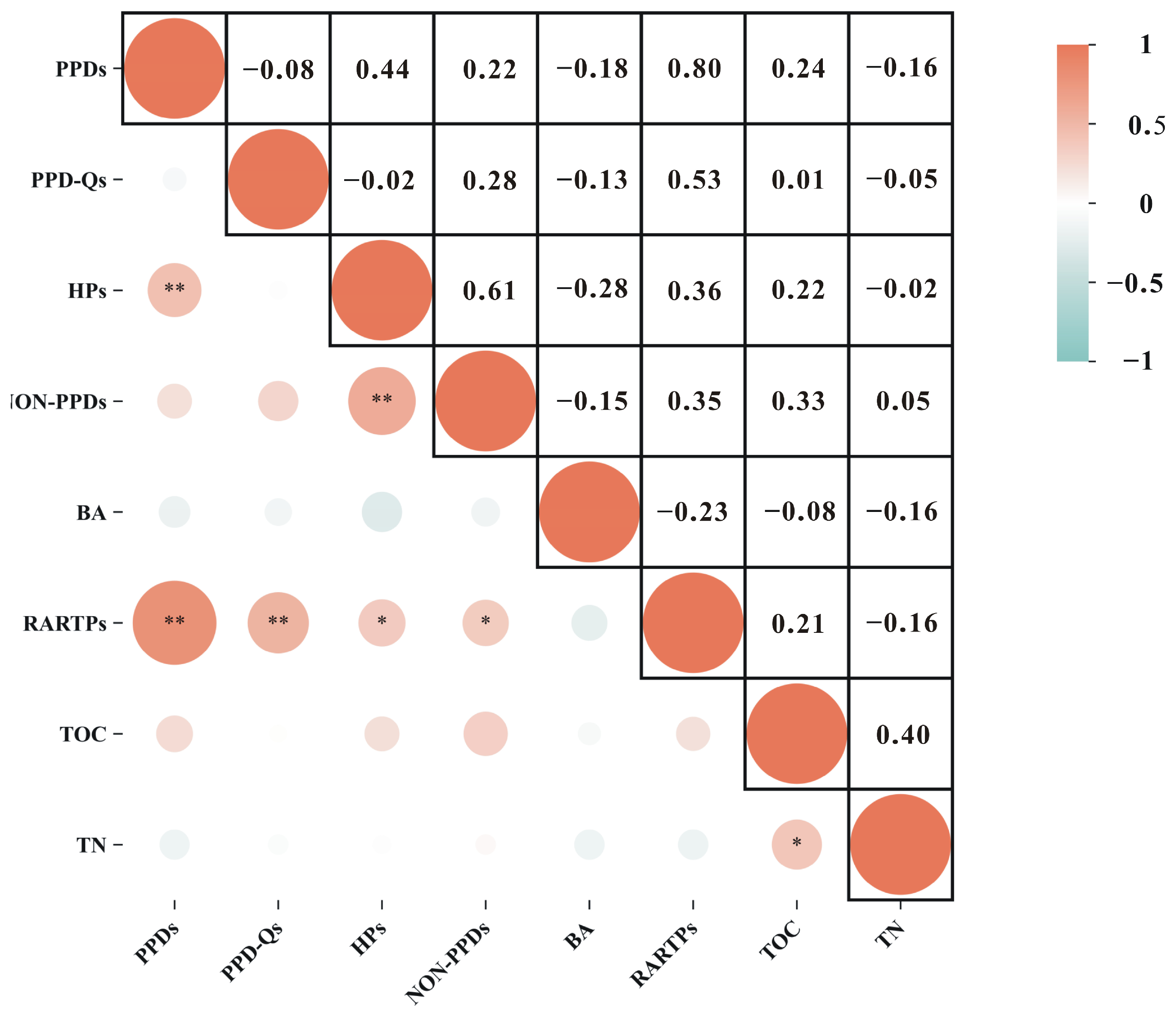
Figure 3 displays the Spearman correlations between PPDs, PPD-Qs, HPs, NON-PPDs, BA, total RARTPs, TOC, and TN. Within surface water throughout the research region, no significant correlation was found between PPDs and PPD-Qs (r = −0.08, p = 0.63), while a significant positive correlation was observed between PPDs and HPs (r = 0.44, p < 0.01). This supports the earlier conclusion that eutrophication-induced UV attenuation inhibits the photochemical conversion of PPDs to PPD-Qs, making hydrolysis a relatively more important pathway for HP formation in surface water.
No significant relationship was observed between the contents of PPDs and TOC (r = 0.24, p = 0.17) or TN (r = −0.16, p = 0.36), indicating that the presence of nutrient element TN did not significantly enhance the accumulation of highly toxic RARTPs. Previous studies indicated that TOC has essential implications in controlling the fate and behaviors of PAHs in soils and sediments [48,55]. Nevertheless, the amount of PPDs in the surface water of the study area was not primarily determined by TOC. This supports the earlier study [56] which found no correlation between TOC and the contents of sediment PPDs. As a result, one potential mechanism impacting PPD distribution could be the transformation of PPDs in natural environmental conditions.
The present study is constrained by a limited assessment of water physicochemical properties. The absence of key parameters (e.g., major ions, total Dissolved Solids, pH, oxidation-reduction potential, dissolved oxygen, conductivity, and turbidity) restricts a full elucidation of the hydrological and geochemical mechanisms driving RARTP behavior, as these factors may influence the speciation and transformation of organic pollutants [57,58]. To ensure a robust evaluation of the environmental fate and generalizability of RARTPs, future research must incorporate these essential physicochemical indicators alongside TN and TOC.

3.3. Ecological Risk Assessment

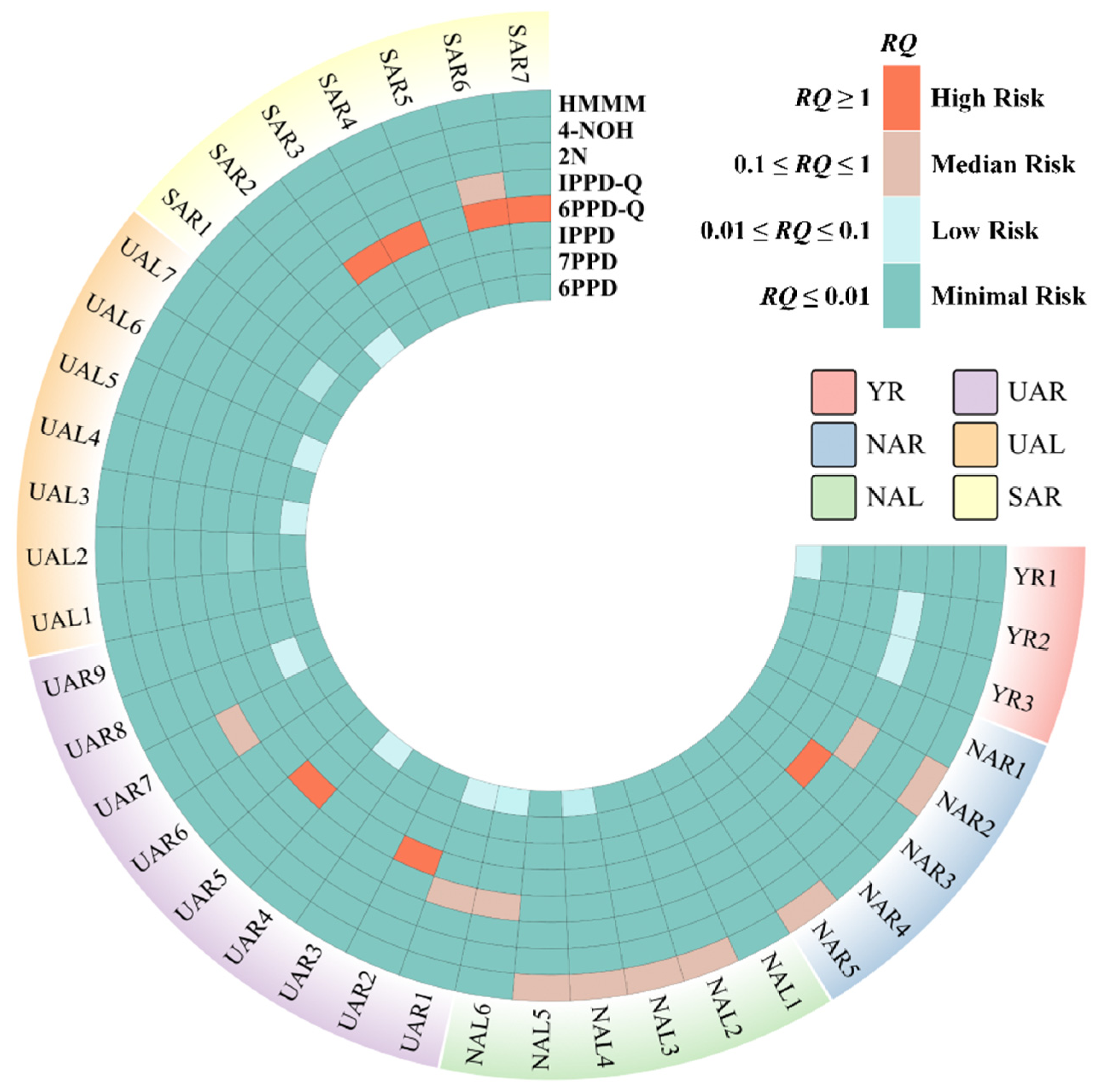
The ecological risks of RARTPs with a detection rate greater than 0 percent in surface water in the study area were evaluated according to Equation (S1) (6PPD, 7PPD, IPPD, 6PPD-Q, IPPD-Q, 2N, 4-NOH, and HMMM), and the risk quotients (RQs) for each site are shown in Figure 4. For the surface water of the study area, ecological risk caused by IPPD, 2N, and 4-NOH could be ignored (minimal risk, RQ < 0.01). In total, 16%, 3%, and 5% of the samples indicated a low risk of 6PPD, 7PPD, and IPPD-Q (0.01 ≤ RQ < 0.1). Additionally, 16% and 14% of the samples showed a median risk of HMMM and IPPD-Q (0.1 ≤ RQ < 1), respectively. Having the highest RQ value of 8.79, 6PPD-Q revealed high ecological risks (RQ ≥ 1) in 19% of the sampling sites. These findings are consistent with former research [18] that compared 6PPD-Q with other chemical additions or transformation products; 6PPD-Q was thought to be the primary cause of RARTP-mediated aquatic toxicity in source water. Thus, greater consideration should be given to 6PPD and its oxidation product, 6PPD-Q, since the high-risk probability of 6PPD-Q may result in greater toxicity even at lower concentrations. However, it is worth noting that the pronounced eutrophication observed in surface water bodies during the summer months may inhibit the photochemical oxidation of PPDs to PPD-Qs, thereby partially mitigating the potential aquatic risks posed by PPD-Qs under actual field conditions. Additionally, it has been reported that chronic exposure to environmentally relevant concentrations of 6PPD-Q might result in intestinal toxicity in organisms by interfering with the intestinal barrier’s ability to function [59]. Given that surface water in the study area could be used for irrigation, aquaculture, daily drinking, cleaning, etc., future studies should continue to focus on the potential environmental risks that could arise from RARTP contamination attribution in subsequent surface water use scenarios.

3.4. Exposure Assessment (Chronic Daily Intakes, CDIs)

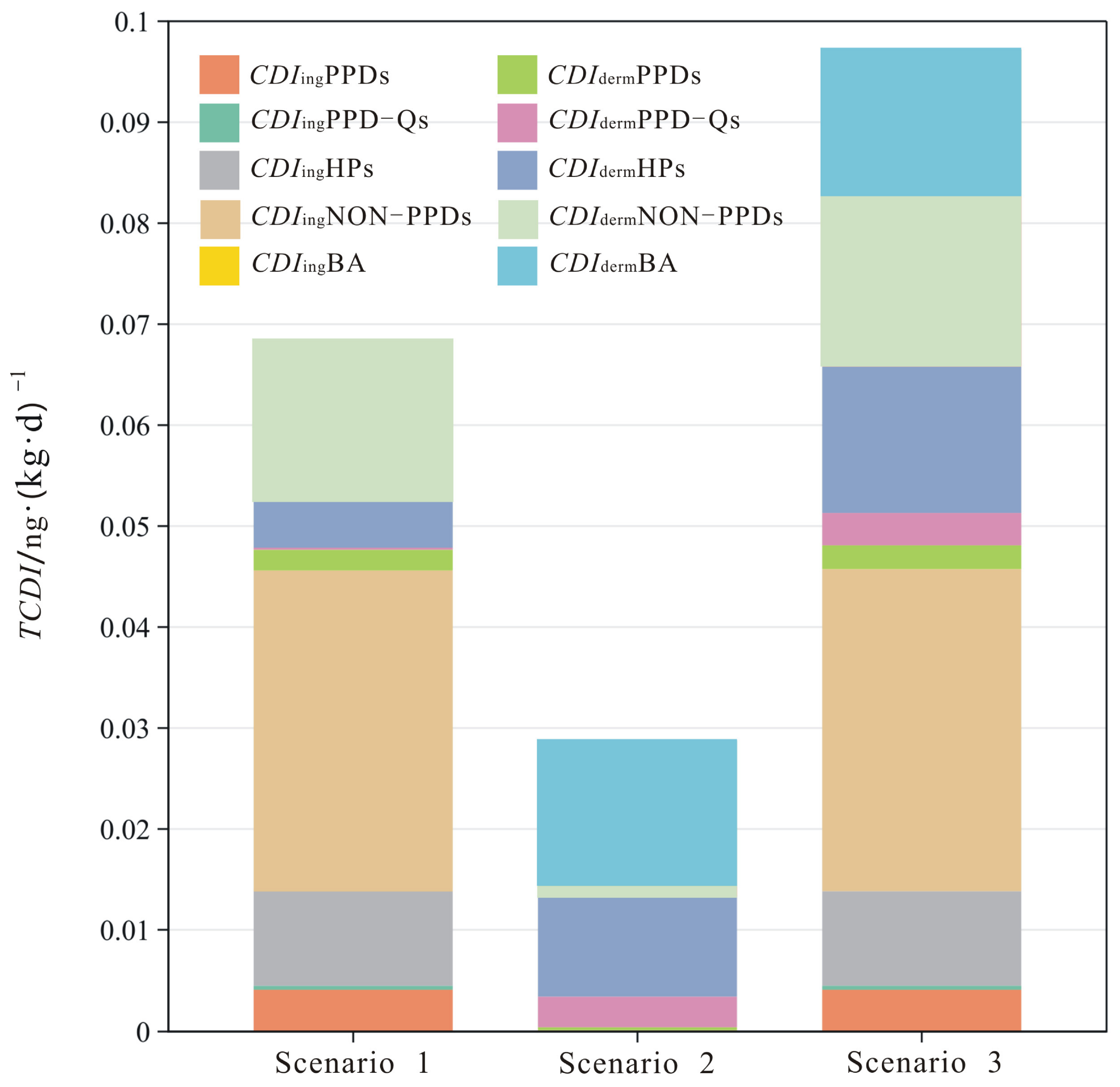
Equations (S2)–(S5) were applied to calculate the chronic daily intake (CDIing, CDIderm, and total chronic daily intake, TCDI) of RARTP pollutants (PPDs, PPD-Qs, HPs, NON-PPDs, and BA) in all surface waters for the local population (including different genders and age groups) under three exposure scenarios. As shown in Figure 5 and Figure 6, the TCDI assessment results for Scenarios 1, 2, and 3 were 6.84 × 10⁻² ng·(kg·d)−1, 2.88 × 10⁻² ng·(kg·d)−1, and 9.73 × 10⁻³ ng·(kg·d)−1, respectively.
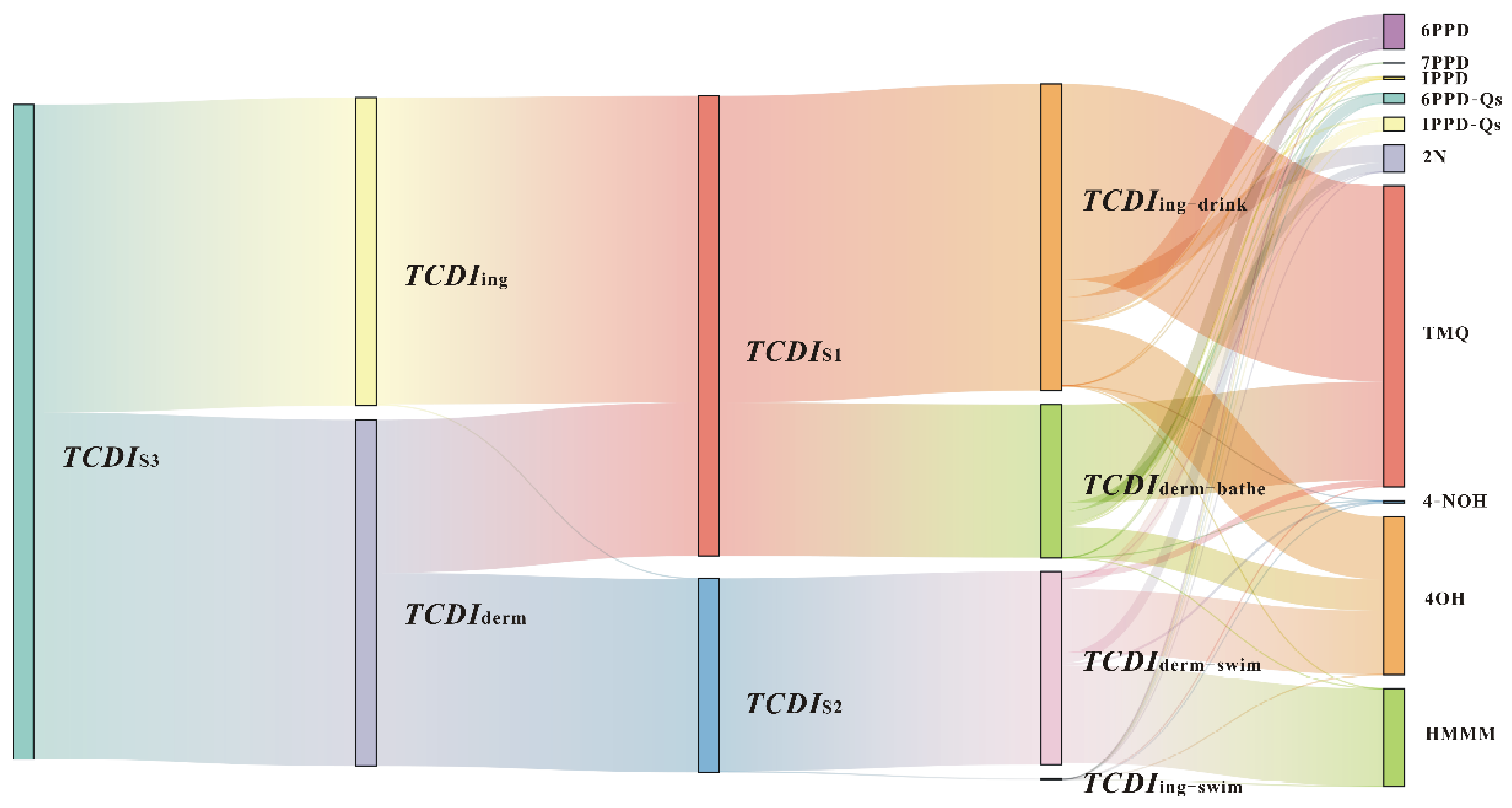
Regarding exposure pathways, in Scenario 1 (daily water consumption), CDIing-drink is 4.56 × 10⁻² ng·(kg·d)−1 and CDIderm-bathe is 2.28 × 10⁻² ng·(kg·d)−1, with CDIing-drink accounting for 66.7% of TCDI. Meanwhile, the CDIing-swim value in Scenario 2 was only 1.40 × 10⁻⁴ ng·(kg·d)−1, while dermal intake (CDIderm-swim) was 2.87 × 10⁻² ng·(kg·d)−1, implying that dermal intake accounts for only 0.5% of the total. Variations in exposure frequency between the two scenarios contributed to this significant difference. Specifically, under swimming conditions, both the unintentional water ingestion rate (IRswim) and the exposure frequency for swimming (EFswim) are significantly lower than those of daily drinking and bathing (EFdrink/bathe) (Table S4). This results in a much lower intake dose during swimming, even if the concentration of pollutants in the source water is relatively lower than in other surface water bodies.
Under the scenario where only daily water consumption is considered (Scenario 1), the highest exposure levels for RARTP pollutants were observed for non-PPDs (4.77 × 10⁻² ng·(kg·d)−1), followed by HPs (1.40 × 10⁻² ng·(kg·d)−1) and PPDs (6.16 × 10⁻³ ng·(kg·d)−1). The concentration of NON-PPD compounds remained the highest in Scenario 3 (combination of daily use and swimming), at 4.88 × 10⁻² ng·(kg·d)−1, followed by HP compounds (2.39 × 10⁻² ng·(kg·d)−1), BA (1.45 × 10⁻² ng·(kg·d)−1), PPDs (6.45 × 10⁻³ ng·(kg·d)−1), and PPD-Qs (3.60 × 10⁻³ ng·(kg·d)−1). Furthermore, across all RARTPs, CDITMQ contributed 46.0% to the TCDI value, followed by CDI4OH (24.2%), CDIHMMM (14.9%), and CDI6PPD (5.5%) (Figure 6).
The daily excretion (DE) and the chronic daily intake of PPDs in human urine were compared to comprehensively assess the exposure levels of the general population to RARTPs. In a study conducted in eastern China in 2019, the DE value of this population was 87.2 ng·(kg·d)−1 [22], whereas the average chronic daily intake (CDI) of PPDs from surface water in the study area was 5.37 × 10⁻³ ng·(kg·d)−1, accounting for only 0.01% of the population’s DE. Thus, for the local population, other environmental media (e.g., atmospheric particles, dust, and food) may play a more significant role in chronic RARTP exposure than surface water.
A Monte Carlo simulation was run 10,000 times to obtain the cumulative probability distributions of the computed TCDI for each population group under Scenario 3 (Table S5). Subgroup analyses revealed different patterns of chronic daily intake, with TCDI values showing a downward trend: girl (50th: 1.57 × 10⁻¹ ng·(kg·d)−1) > boy (50th: 1.42 × 10⁻¹ ng·(kg·d)−1) > male adult (50th: 1.16 × 10⁻¹ ng·(kg·d)−1) > female adult (50th: 1.10 × 10⁻¹ ng·(kg·d)−1). For the local adult population, the average weights were 38.0 kg (boys), 34.9 kg (girls), 66.6 kg (men), and 57.9 kg (women) [31,32,33,35]. The central tendency exposure (50th) values of the daily RARTP intake were 5.97, 4.96, 7.73, and 6.37 ng·d−1, and reasonable maximum exposure (90th) values were 7.49, 5.72, 14.19, and 8.80 ng·d−1, respectively.
It was indicated by the ecological risk assessment (Section 3.3) that a high ecological risk (RQ ≥ 1) is posed by 6PPD-Q at 19% of the sampling sites. Given the extremely low LC50 of 6PPD-Q (0.095 μg·L−1), concerns are raised about potential health risks to the local population from daily use and swimming in the surface water bodies within the study area. However, current toxicological knowledge regarding 6PPD-Q is largely derived from model organisms such as fish and zebrafish, with documented effects including acute lethality, developmental toxicity, and reproductive impairment, while direct evidence of specific adverse health outcomes in humans (particularly in children) remains lacking [60,61,62,63]. Unfortunately, it was not possible to conduct a human health risk assessment in this study due to the lack of key parameters such as the slope factor (SF) or the carcinogenic reference dose (RfD). Future investigations should therefore establish risk thresholds to develop a comprehensive understanding of the health risks associated with RARTP contamination in water.
Furthermore, it has been indicated in previous studies that children are a sensitive group with respect to environmental pollution, including heavy metals, PAHs, and disinfection by-products (DBPs) through drinking water, groundwater, food, suspended particles, dust, and soil [64,65,66,67,68,69]. Additionally, Chen et al. [65] found that females are more susceptible than males to the negative effects of DBPs in tap water throughout childhood, but this risk decreases with age. Their findings align with the results of this study, which show that CDI scores follow a decreasing trend across the following subgroups: girls > boys > adult men > adult women. Regardless of gender, the chronic daily intake of RARTPs from surface water is higher for children than for adults. Accordingly, the chronic daily intake profile for each subgroup may be significantly influenced by both the intake rate per kilogram of body weight and individual body weight. As a result, the potential health risks that children, especially girls, face from exposure to surface water RARTPs require more attention.
The present exposure assessment acknowledges certain limitations and uncertainties. Assuming direct surface water ingestion may not accurately represent the actual exposure pathways for local people as municipal tap water is prevalent for the study area. This study did not consider water treatment effects, where ozonation may transform PPDs into more toxic PPD-Qs, while activated carbon reduces overall loads. Future research should investigate these transformations and removal efficiencies to refine exposure risk assessments. In addition, from a health perspective, the Chinese population typically drinks boiled water, as untreated water is associated with greater health risks than boiled water [70]. Furthermore, a former study noted that there is a growing trend among Chinese residents to use filtered tap water or bottled/barreled water [24]. Given that the concentrations of RARTPs within different types of drinking water may exhibit variations, estimates of exposure levels are expected to fluctuate significantly.
In addition to drinking, swimming is another significant route of exposure, mainly through dermal contact and unintentional water ingestion. However, there are significant differences in exposure levels across different age and gender groups. A survey of Chinese children showed that the proportion of children engaged in swimming exhibits an age-related pattern of increase followed by a decrease, peaking at 21.7% among 9 to 11 year-olds; within this age group, engagement rates were generally higher among boys than girls. Furthermore, among children with swimming habits, the average duration of swimming sessions increases with age [33]. These demographic differences suggest that exposure assessments based on a single or generalized swimming scenario struggle to accurately reflect the true risks for various subgroups. Therefore, future studies should incorporate swimming frequency, duration, and accidental water ingestion rates specific to different ages and genders to improve the accuracy of RARTP exposure assessments.
Variability and uncertainty associated with surface water RARTP exposure pathways—which have the greatest impact on the estimated chronic daily intake—were assessed using sensitivity analysis. Figure S1 shows the percentile contribution to the variance for the sensitivity analysis results regarding CDIing and CDIderm. Regarding direct ingestion routes (CDIing-drink and CDIing-swim), Cw was the primary determinant for both males and females, accounting for an average of 78% of the total variation in CDIing. BW contributed −40% to CDIing-drink, while IRswim contributed 61% to CDIing-swim. Cw remained the predominant influencing factor in both transdermal absorption pathways (CDIderm-bathe and CDIderm-swim), accounting for an average of 69% of the variance. In terms of CDIderm-bathe, BW (for male, −65%) and SA (for female, 52%) also exhibited notable influences on the total variance. Based on the sensitivity analysis results, it is crucial to improve the accuracy of Cw, given its consistent dominance in contributing to exposure variance across all pathways. Despite this, notable contributions from IRswim and SA indicate that specific parameters related to recreational water activities should also be carefully identified.

4. Conclusions

The occurrence, spatial distribution, ecological risk, and chronic daily intake of RARTPs were systematically characterized in surface waters of Kaifeng, a major city adjacent to the Yellow River that serves as a hydrological link between the Yellow River and the Huaihe River basins. Consistent with the current production and use of rubber additives, 6PPD remained the predominant PPD, while its hydrolysis product 4OH and the NON-PPD antioxidant TMQ were detected at higher concentrations and frequencies. Across the study area, urban rivers stand out as the most significant pollution hotspots. Human activities, including urban runoff, municipal wastewater discharge, and aquaculture pond operation using diverted Yellow River water, were identified as key contributors to RARTP pollution. Management practices such as regular dredging of urban lakes effectively reduced pollutant levels, whereas urban rivers continuously received contamination from surface runoff and wastewater. The ecological risk caused by 6PPD-Q to surface water deserves attention (RQ ≥ 1 at 19% of sites). Exposure assessment revealed that ingestion of drinking water dominates daily exposure (66.7%), while dermal contact becomes more important under swimming scenarios. Children, especially girls, were the most vulnerable population due to their higher intake rate per kilogram of body weight. Although the estimated chronic daily intake from surface water accounted for only a minor fraction of the total internal exposure reported in a Chinese population, the high toxicity of 6PPD-Q and its widespread detection call for further research. Future studies should incorporate age- and sex-specific behaviors, and establish health-based reference doses to enable a comprehensive human health risk assessment of these unregulated contaminants in surface water.

Supplementary Materials

The following supporting information can be downloaded at: https://www.mdpi.com/article/10.3390/toxics14060521/s1, Figure S1: Sensitivity analysis results on surface water RARTP chronic daily intake assessment for population groups: (A) ingestion via drinking; (B) dermal absorption via bathing; (C) unintentional water ingestion via swimming; (D) dermal absorption via swimming; Table S1: Information of the sampling sites; Table S2: Basic information of the target analytes, reagents, and standards; Table S3: The calibration curves, IDL, IQL, and relative standard deviations (RSDs) of RARTPs; Table S4: Variables and parameters for calculating chronic daily intake; Table S5: Cumulative probability evaluation results of TCDI under Scenario 3 based on Monte Carlo simulation of surface water RARTPs for population groups in the study area (ng·(kg·d)−1); Text S1: Supporting Methodology (Potential ecological risk assessment and Estimated chronic daily intakes) [71].

Author Contributions

Conceptualization, X.C., C.S., and J.H.; methodology, L.D.; validation, X.Y. and H.W.; formal analysis, X.C.; investigation, Z.W.; resources, X.C.; data curation, J.J.; writing—original draft preparation, X.C., C.S., and J.H.; writing—review and editing, X.Y.; visualization, Z.W.; funding acquisition, X.C. All authors have read and agreed to the published version of the manuscript.

Funding

This research was funded by the Henan Province Science and Technology Development Project, grant number 262102320149, Key Scientific Research Projects Program of Higher Education in Henan Province, grant number 26A610009, Henan Provincial Science and Technology R & D Program Joint Fund (Discipline Category), grant number 252103810088, Kaifeng Science and Technology Development Project, grant number 2503018, and the Scientific Research Fund of Yellow River Conservancy Technical University, grant number 2026BJ13.

Institutional Review Board Statement

Not applicable.

Informed Consent Statement

Not applicable.

Data Availability Statement

The original contributions presented in this study are included in the article/Supplementary Material. Further inquiries can be directed to the corresponding author.

Acknowledgments

We sincerely appreciate Zhenxing Yan, Chengkun Zhang, Wenjie Huang, Yuanhao Feng, Ke Wang and Pengyuan Liu, who made great efforts in sample collection. Special thanks are cordially given to Xing Chen, for her constructive and thoughtful suggestions regarding our manuscript. Thanks to the anonymous reviewers for their constructive comments on this paper.

Conflicts of Interest

The authors declare no conflicts of interest.

Abbreviations

RARTPsRubber additives and relevant transformation products
PPDsp-Phenylenediamine antioxidants
PPD-Qsp-Phenylenediamine quinones
HPsHydrolysis products
N-PPDsNon-p-Phenylenediamine Antioxidants
BABinding agent
6PPDN-(1,3-Dimethylbutyl)-N′-phenyl-p-phenylenediamine
7PPDN,N′-bis(1,4-dimethylpentyl)-p-phenylenediamine
8PPDN-(1-Methylheptyl)-N′-phenyl-p-phenylenediamine
CPPDN-Cyclohexyl-N′-phenyl-p-phenylenediamine
DNPDN,N′-Bis(2-naphthyl)-p-phenylenediamine
DPPDN,N-Diphenyl-p-phenylenediamine
IPPDN-isopropyl-N′-phenyl-p-phenylenediamine
6PPD-QN-(1,3-Dimethylbutyl)-N′-phenyl-p-phenylenediamine quinone
IPPD-QN-isopropyl-N′-phenyl-p-phenylenediamine quinone
4-NOH4-Nitrosodiphenylamine
4OH4-Hydroxydiphenylamine
4454,4′-Bis(α,α-dimethylbenzyl) diphenylamine
2N4-Aminodiphenylamine
TMQ1,2-Dihydro-2,2,4-trimethylquinoline
HMMM2,4,6-Tris[bis(methoxymethyl)amino]-1,3,5-triazine
6PPD-Q-d5N-(1,3-Dimethylbutyl)-N′-phenyl-p-phenylenediamine quinone-d5
BP-d10Benzophenone-d10
TCDITotal chronic daily intake
CDIsChronic daily intakes
RQRisk quotient
LC50Median lethal concentration
YRYellow River
NARNorthern area river
NALNorthern area lake
UARUrban area river
UALUrban area lake
SARSouthern area river
TNTotal nitrogen
TOCTotal organic carbon
TCTotal carbon
ICInorganic carbon
HLBHydrophilic–lipophilic balance
CDIing-drinkChronic daily intake through drinking water ingestion
CDIderm-batheChronic daily intake through dermal absorption during bathing
CDIing-swimChronic daily intake through incidental water ingestion during swimming
CDIderm-swimChronic daily intake through dermal absorption during swimming
IRswimUnintentional water ingestion rate during swimming
EFswimExposure frequency for swimming
EFdrink/batheExposure frequency for drinking
DEDaily excretion
SAExposed skin area
BWAverage body weight

References

  1. Alhelou, R.; Seiwert, B.; Reemtsma, T. Hexamethoxymethylmelamine—A precursor of persistent and mobile contaminants in municipal wastewater and the water cycle. Water Res. 2019, 165, 114973. [Google Scholar] [CrossRef]
  2. Tian, Z.; Zhao, H.; Peter, K.; Gonzalez, M.; Wetzel, J.; Wu, C.; Hu, X.; Prat, J.; Mudrock, E.; Hettinger, R.; et al. A ubiquitous tire rubber derived chemical induces acute mortality in coho salmon. Science 2020, 371, 185–189. [Google Scholar] [CrossRef] [PubMed]
  3. China BaoGao. The Oversupply Problem in China’s Rubber Additives Industry Became Prominent Under the Influence of Multiple Factors, and Its Export Rate Hit a New Low. 23 September 2021. Available online: https://baijiahao.baidu.com/s?id=1711674596817491151&wfr=spider&for=pc (accessed on 4 April 2024). (In Chinese)
  4. Baensch-Baltruschat, B.; Kocher, B.; Stock, F.; Reifferscheid, G. Tyre and road wear particles (TRWP)—A review of generation, properties, emissions, human health risk, ecotoxicity, and fate in the environment. Sci. Total Environ. 2020, 733, 137823. [Google Scholar] [CrossRef] [PubMed]
  5. Seiwert, B.; Nihemaiti, M.; Troussier, M.; Weyrauch, S.; Reemtsma, T. Abiotic oxidative transformation of 6-PPD and 6-PPD quinone from tires and occurrence of their products in snow from urban roads and in municipal wastewater. Water Res. 2022, 212, 118122. [Google Scholar] [CrossRef]
  6. Zhang, Y.-J.; Xu, T.-T.; Ye, D.-M.; Lin, Z.-Z.; Wang, F.; Guo, Y. Widespread N-(1,3 -Dimethylbutyl)-N’-phenyl-p-phenylenediamine quinone in size-fractioned atmospheric particles and dust of different indoor environments. Environ. Sci. Technol. Lett. 2022, 9, 420–425. [Google Scholar] [CrossRef]
  7. Zhang, X.; Peng, Z.-F.; Hou, S.-J.; Sun, Q.-N.; Yuan, H.; Yin, D.; Zhang, W.-F.; Zhang, Y.-H.; Tang, J.-W.; Zhang, S.-S.; et al. Ubiquitous occurrence of p-Phenylenediamine (PPD) antioxidants and PPD-quinones in fresh atmospheric snow and their amplification effects on associated aqueous contamination. J. Hazard. Mater. 2024, 465, 133409. [Google Scholar] [CrossRef]
  8. Di, S.; Liu, Z.; Zhao, H.; Li, Y.; Qi, P.; Wang, Z.; Xu, H.; Jin, Y.; Wang, X. Chiral perspective evaluations: Enantioselective hydrolysis of 6PPD and 6PPD-quinone in water and enantioselective toxicity to Gobiocypris rarus and Oncorhynchus mykiss. Environ. Int. 2022, 166, 107374. [Google Scholar] [CrossRef]
  9. Nathaniel, L.-S.; Jay, W.-D.; Julann, A.-S.; Blake, E.-F.; Tiffany, L.-L.; Jana, S.-L.; James, R.-C.; Barbara, L.-F.; David, H.-B.; John, P.-I.; et al. The Origin Story for 6PPD-quinone in Ecotoxicology. Environ. Sci. Technol. Lett. 2026, 13, 644–655. [Google Scholar] [CrossRef]
  10. Varshney, S.; Gora, A.-H.; Siriyappagouder, P.; Kiron, V.; Olsvik, P.-A. Toxicological effects of 6PPD and 6PPD quinone in zebrafish larvae. J. Hazard. Mater. 2022, 424, 127623. [Google Scholar] [CrossRef]
  11. Tian, Z.; Gonzalez, M.; Rideout, C.A.; Zhao, H.-N.; Hu, X.; Wetzel, J.; Mudrock, E.; James, C.-A.; McIntyre, J.-K.; Kolodziej, E.-P. 6PPD-Quinone: Revised toxicity assessment and quantification with a commercial standard. Environ. Sci. Technol. Lett. 2022, 9, 140–146. [Google Scholar] [CrossRef]
  12. Cao, G.-D.; Wang, W.; Zhang, J.; Wu, P.-F.; Qiao, H.; Li, H.; Huang, G.; Yang, Z.; Cai, Z. Occurrence and fate of substituted p-Phenylenediamine-derived quinones in Hong Kong wastewater treatment plants. Environ. Sci. Technol. 2023, 57, 15635–15643. [Google Scholar] [CrossRef]
  13. Cao, G.-D.; Qiao, H.; Wu, H.-J.; Ding, C.; Hu, L.-Y.; Dong, A.-B.; Shi, J.-B. Underestimate of human exposure to p-phenylenediamine derived quinones in diet: Evidence from a cross-country survey of contaminants in chicken eggs. J. Hazard. Mater. 2026, 504, 141259. [Google Scholar] [CrossRef]
  14. Challis, J.-K.; Popick, H.; Prajapati, S.; Harder, P.; Giesy, J.-P.; McPhedran, K.; Brinkmann, M. Occurrences of tire rubber-derived contaminants in cold climate urban runoff. Environ. Sci. Technol. Lett. 2021, 8, 961–967. [Google Scholar] [CrossRef]
  15. Dos Santos, M.-M.; Snyder, S.-A. Occurrence of polymer additives 1,3-Diphenylguanidine (DPG), N-(1,3-dimethylbutyl)-N′-phenyl-1,4-benzenediamine (6PPD), and chlorinated byproducts in drinking water: Contribution from plumbing polymer materials. Environ. Sci. Technol. Lett. 2023, 10, 885–890. [Google Scholar] [CrossRef]
  16. Ji, J.; Li, C.; Zhang, B.; Wu, W.; Wang, J.; Zhu, J.; Liu, D.; Gao, R.; Ma, Y.; Pang, S. Exploration of emerging environmental pollutants 6PPD and 6PPDQ in honey and fish samples. Food Chem. 2022, 396, 133640. [Google Scholar] [CrossRef] [PubMed]
  17. Zhang, H.-Y.; Han, Y.; Hu, L.-X.; Chen, Y.-J.; Ying, G.-G.; Zhao, J.-L. A comprehensive reconnaissance and risk assessment of rubber additives and their transformation products (RATPs) in groundwater: 1,3-Diphenyl-guanidine (DPG) as a pressing ecological concern. Water Res. 2025, 277, 123279. [Google Scholar] [CrossRef] [PubMed]
  18. Zhang, H.-Y.; Huang, Z.; Liu, Y.-H.; Hu, L.-X.; He, L.-Y.; Liu, Y.-S.; Zhao, J.-L.; Ying, G.-G. Occurrence and risks of 23 tire additives and their transformation products in an urban water system. Environ. Int. 2023, 171, 107715. [Google Scholar] [CrossRef]
  19. Zhang, J.; Liu, H.; Zhao, H.; Dai, Q.; Wang, W.; Wang, F.; Cao, G.; Zhou, Y.; Xu, S.; Cai, Z. Patterns, variability, and predictors of p-phenylenediamine quinones and parent p-phenylenediamines in pregnant women across three trimesters. Environ. Int. 2025, 203, 109729. [Google Scholar] [CrossRef]
  20. Han, M.; Xia, K.; Xue, Y.; Yue, F.; Li, J.; Kang, F.; Zhu, B.; Hu, L.; Liu, Q.; Xie, Z. Emergence of more potent PPD-Qs beyond 6PPD-Q in human blood and cerebrospinal fluid. Environ. Sci. Technol. Lett. 2025, 12, 496–502. [Google Scholar] [CrossRef]
  21. Du, B.; Liang, B.; Li, Y.; Shen, M.; Liu, L.-Y.; Zeng, L. First report on the occurrence of N-(1, 3-dimethylbutyl)-N′-phenyl-p-phenylenediamine (6PPD) and 6PPD-quinone as pervasive pollutants in human urine from South China. Environ. Sci. Technol. Lett. 2022, 9, 1056–1062. [Google Scholar] [CrossRef]
  22. Mao, W.-L.; Jin, H.-B.; Guo, R.-Y.; Chen, P.; Zhong, S.-Y.; Wu, X.-L. Occurrence of p-phenylenediamine antioxidants in human urine. Sci. Total Environ. 2024, 914, 170045. [Google Scholar] [CrossRef]
  23. Kaifeng Bureau of Statistics (KBS). Kaifeng Statistical Yearbook 2023. 11 January 2024. Available online: http://tjj.kaifeng.gov.cn/kfstjjwz/ctjnj/pc/content/content_1785198747780960256.html (accessed on 21 May 2026). (In Chinese)
  24. Chen, X.; Sun, S.-Y.; Xu, P.; Du, L.-N.; Sun, C.-Y.; Feng, F.; Feng, T.; Yao, X.-D.; Cui, Z.-Y.; Liang, D.-F.; et al. Rubber additives and relevant oxidation products in groundwater in a central China region: Levels, influencing factors and exposure. Environ. Pollut. 2024, 363, 125155. [Google Scholar] [CrossRef]
  25. T/ZGM 008-2024; Determination of 12 Rubber Additives and Their Oxidation Products in Surface Water Liquid Chromatography-Tandem Mass Spectrometry. Membrane Industry Association of China (MIAC): Beijing, China, 2024. (In Chinese)
  26. European Commission (EC). Technical Guidance Document in Support of Commission Directive 93/67/EEC on Risk Assessment for New Notified Substances and Commission Regulation (EC) No1488/94 on Risk Assessment for Existing Substances Part II; Office for Official Publications of the European Communities: Greece, Italy, 2003. [Google Scholar]
  27. Hernando, M.-D.; Mezcua, M.; Fernandez-Alba, A.-R.; Barcelo, D. Environmental risk assessment of pharmaceutical residues in wastewater effluents, surface waters and sediments. Talanta 2006, 69, 334–342. [Google Scholar] [CrossRef]
  28. Meng, F.-L.; Liu, D.-X.; Bu, T.-X.; Zhang, M.-Y.; Peng, J.-B.; Ma, J.-H. Assessment of pollution and health risks from exposure to heavy metals in soil, wheat grains, drinking water, and atmospheric particulate matter. J. Environ. Manag. 2025, 376, 124448. [Google Scholar] [CrossRef]
  29. Zhang, R.-L.; Zhao, S.-Z.; Liu, X.; Tian, L.-L.; Mo, Y.-Z.; Yi, X.; Liu, S.-Y.; Liu, J.-Q.; Li, J.; Zhang, G. Aquatic environmental fates and risks of benzotriazoles, benzothiazoles, and p-phenylenediamines in a catchment providing water to a megacity of China. Environ. Res. 2023, 216, 114721. [Google Scholar] [CrossRef]
  30. Zhang, X.-L.; Zhang, Z.-H.; Xu, Z.-J.; Gu, D.-Q.; Zheng, W. Landscape pattern change and its cumulative environmental effects of coastal wetlands in southern Laizhou Bay. Chin. J. Ecol. 2009, 28, 2437–2443. [Google Scholar]
  31. Wang, B.-B.; Duan, X.-L. Exposure Factors Handbook of Chinese Population (0–5 Years); China Environmental Science Press: Beijing, China, 2016. (In Chinese) [Google Scholar]
  32. Zhao, X.-G.; Duan, X.-L. Exposure Factors Handbook of Chinese Population (6–17 Years); China Environmental Science Press: Beijing, China, 2016. (In Chinese) [Google Scholar]
  33. Zhao, X.-G.; Duan, X.-L. Report of Environmental Exposure Related Activity Patterns Research of Chinese Population (Children); China Environmental Science Press: Beijing, China, 2016. (In Chinese) [Google Scholar]
  34. Liu, Q.-C.; Hu, L.-M.; Sun, J. Analysis of Exposure Parameters for Child Swimmers in Indoor Swimming Pools during Summer in Shenzhen. Appl. Prev. Med. 2025, 31, 461–464+470. (In Chinese) [Google Scholar]
  35. Duan, X.-L. Exposure Factors Handbook of Chinese Population; China Environmental Science Press: Beijing, China, 2013. (In Chinese) [Google Scholar]
  36. He, X.-T.; Liu, Q.-C.; Sun, J. Investigation of exposure parameters among 215 adult swimmers in summer indoor swimming pool in Baoan district, Shenzhen in 2023. Mod. Dis. Control Prev. 2023, 34, 945–949. (In Chinese) [Google Scholar] [CrossRef]
  37. Johannessen, C.; Helm, P.; Metcalfe, C.-D. Detection of selected tire wear compounds in urban receiving waters. Environ. Pollut. 2021, 287, 117659. [Google Scholar] [CrossRef] [PubMed]
  38. Johannessen, C.; Helm, P.; Lashuk, B.; Yargeau, V.; Metcalfe, C.-D. The Tire Wear Compounds 6PPD-Quinone and 1,3-Diphenylguanidine in an Urban Watershed. Arch. Environ. Contam. Toxicol. 2021, 82, 171–179. [Google Scholar] [CrossRef] [PubMed]
  39. Monaghan, J.; Jaeger, A.; Agua, A.-R.; Stanton, R.-S.; Pirrung, M.; Gill, C.-G.; Krogh, E.-T. A Direct Mass Spectrometry Method for the Rapid Analysis of Ubiquitous Tire-Derived Toxin N -(1,3-Dimethylbutyl)-N′-phenyl-p-phenylenediamine Quinone (6-PPDQ). Environ. Sci. Technol. Lett. 2021, 8, 1051–1056. [Google Scholar] [CrossRef] [PubMed]
  40. Geng, N.-B.; Hou, S.-J.; Sun, S.; Cao, R.; Zhang, H.-J.; Lu, X.-B.; Zhang, S.-S.; Chen, J.-P.; Zhang, Y.-H. A Nationwide Investigation of Substituted p-Phenylenediamines (PPDs) and PPD-Quinones in the Riverine Waters of China. Environ. Sci. Technol. 2025, 59, 3183–3192. [Google Scholar] [CrossRef]
  41. Mu, Y.; Tang, B.; Cheng, X. Source apportionment and predictable driving factors contribute to antibiotics profiles in Changshou Lake of the Three Gorges Reservoir area, China. J. Hazard. Mater. 2024, 466, 133522. [Google Scholar] [CrossRef]
  42. Tang, J.; Han, Y.; Zha, Y.; Li, X. Distribution, seasonal characteristics, ecological risks and human health risks of 9 antibiotics in the main water environment of Anhui province, China. Front. Environ. Sci. 2024, 12, 1408363. [Google Scholar] [CrossRef]
  43. Cui, Q.-K.; Han, D.-F.; Qin, H.-W.; Lia, H.-J.; Liu, Y.-C.; Guo, W.-J.; Song, M.; Li, J.-W.; Sun, Y.-Q.; Luo, J.-J.; et al. Investigating the levels, spatial distribution, and trophic transfer patterns of short-chain chlorinated paraffins in the Southern Bohai Sea, China. Water Res. 2024, 253, 121337. [Google Scholar] [CrossRef]
  44. Fu, Y.; Ji, Y.-Y.; Tian, Y.-W.; Zhang, F.; Sheng, N.; Dai, J.-Y.; Pan, Y.-T. Unveiling Priority Emerging PFAS in Taihu Lake Using Integrated Nontarget Screening, Target Analysis, and Risk Characterization. Environ. Sci. Technol. 2024, 58, 18980–18991. [Google Scholar] [CrossRef] [PubMed]
  45. Zhang, Y.; Jiang, C.; Zhang, L.; Cheng, H.; Wang, N. Occurrence and Risk Assessment of Perfluoroalkyl Substances in Surface Water of Hefei City, Southeast China. Water 2024, 16, 1245. [Google Scholar] [CrossRef]
  46. Adegunwa, A.-O.; Ore, O.-T.; Tayo, A.-S.; Adebiyi, F.-M. Occurrence, source identification and risk assessment of polybrominated diphenyl ethers in water and sediments of Osun River, Nigeria. BMC. Environ. Sci. 2024, 1, 6. [Google Scholar] [CrossRef]
  47. Olaniyan, O.O.; Adeniji, A.-O.; Okoh, A.-I.; Okoh, O.-O. Occurrence and risk assessment of polybrominated diphenyl ethers in surficial water and sediment from Buffalo River estuary, South Africa. Mar. Pollut. Bull. 2024, 209, 117176. [Google Scholar] [CrossRef]
  48. Chen, X.; Liu, X.-R.; Liu, M.; Yang, Y.; Wu, S.-X.; Wang, C. Molecular characterization of PAHs based on land use analysis and multivariate source apportionment in multiple phases of the Yangtze estuary, China. Environ. Sci.-Proc. Impacts 2018, 20, 531–543. [Google Scholar] [CrossRef]
  49. Yang, Y.-Y.; Zhang, Q.; Li, K.-X.; Liu, Y.-N.; Guo, F.; Xia, X.-H. LC-HRMS Screening, Risk Assessment, and Source Tracing of Neonicotinoid Insecticides and Their Transformation Products in China’s Coastal Urban Rivers. Environ. Sci. Technol. 2026, 60, 8749–8761. [Google Scholar] [CrossRef]
  50. Nisa, F.-U.; Umar, R. Heavy metal pollution and health risk assessment using deterministic and Monte Carlo simulation approaches in the Himalayan spring. Environ. Earth Sci. 2024, 83, 278. [Google Scholar] [CrossRef]
  51. Johannessen, S.-C.; Miller, W.-L.; Cullen, J.-J. Calculation of UV attenuation and colored dissolved organic matter absorption spectra from measurements of ocean color. J. Geophys. Res. 2003, 108, 3301. [Google Scholar] [CrossRef]
  52. Zhang, Y.-L.; Zhang, E.-L.; Yan, Y.; van Dijk, M.-A.; Feng, L.-Q.; Shi, Z.-Q.; Liu, M.-L.; Qin, B.-Q. Characteristics and sources of chromophoric dissolved organic matter in lakes of the Yungui Plateau, China, differing in trophic state and altitude. Limnol. Oceanogr. 2010, 55, 2645–2659. [Google Scholar] [CrossRef]
  53. Li, C.-G.; Zhang, Y.-L.; Yin, S.-Q.; Wang, Q.; Li, Y.-Y.; Liu, Q.; Liu, Q.-Q.; Luo, X.-X.; Chen, L.-Y.; Zheng, H.; et al. First insights into 6PPD-quinone formation from 6PPD photodegradation in water environment. J. Hazard. Mater. 2023, 459, 132127. [Google Scholar] [CrossRef] [PubMed]
  54. Chen, J.-F.; Liu, H.; Song, D.-H.; Wang, M.; Tang, T.; Zeng, S.-H.; Wu, S.-L.; Du, X.-D.; Tao, X.-Q.; Dang, Z.; et al. Photolysis of Hexa(methoxymethyl)melamine in aquatic systems: Critical roles of UV-shielding effect, hydrated electron and 3DOM* induced by dissolved organic matter. Water Res. 2025, 289, 124867. [Google Scholar] [CrossRef]
  55. Wang, Q.; Liu, M.; Yu, Y.; Du, F.; Wang, X. Black carbon in soils from different land use areas of Shanghai, China: Level, sources and relationship with polycyclic aromatic hydrocarbons. Appl. Geochem. 2014, 47, 36–43. [Google Scholar] [CrossRef]
  56. Zeng, L.; Li, Y.; Sun, Y.; Liu, L.-Y.; Shen, M.; Du, B. Widespread occurrence and transport of p-Phenylenediamines and their quinones in sediments across urban rivers, estuaries, coasts, and deep-sea regions. Environ. Sci. Technol. 2023, 57, 2393–2403. [Google Scholar] [CrossRef]
  57. Tan, Y.-D.; Wang, Y.-Y.; Bing, X.-J.; Jiang, J.; Guo, G.-H.; Cui, F.-X.; Wang, K.; Meng, Z.-R.; Liu, Y.-X.; Zhu, Y.-R. Coupling effect of cyanobacterial blooms with migration and transformation of typical pollutants in lake or reservoir: Enhanced or decreased? Environ. Res. 2025, 267, 120734. [Google Scholar] [CrossRef]
  58. Zeng, J.-W.; Liu, K.; Liu, X.; Tang, Z.-E.; Wang, X.-J.; Fu, R.-C.; Lin, X.-J.; Liu, N.; Qiu, J.-R. Driving factor, source identification, and health risk of PFAS contamination in groundwater based on the self-organizing map. Water Res. 2024, 267, 122458. [Google Scholar] [CrossRef] [PubMed]
  59. Hua, X.; Feng, X.; Liang, G.-Y.; Chao, J.; Wang, D.-Y. Long-term exposure to tire-derived 6-PPD quinone causes intestinal toxicity by affecting functional state of intestinal barrier in Caenorhabditis elegans. Sci. Total Environ. 2023, 861, 160591. [Google Scholar] [CrossRef] [PubMed]
  60. Brinkmann, M.; Montgomery, D.; Selinger, S.; Miller, J.-G.; Stock, E.; Alcaraz, A.-J.; Challis, J.-K.; Weber, L.; Janz, D.; Hecker, M.; et al. Acute Toxicity of the Tire Rubber-Derived Chemical 6PPD-quinone to Four Fishes of Commercial, Cultural, and Ecological Importance. Environ. Sci. Technol. Lett. 2022, 9, 333–338. [Google Scholar] [CrossRef]
  61. Greer, J.-B.; Dalsky, E.-M.; Lane, R.-F.; Hansen, J.-D. Tire-Derived Transformation Product 6PPD-Quinone Induces Mortality and Transcriptionally Disrupts Vascular Permeability Pathways in Developing Coho Salmon. Environ. Sci. Technol. 2023, 57, 11. [Google Scholar] [CrossRef]
  62. Zhang, J.; Cao, G.; Wang, W.; Qiao, H.; Chen, Y.; Wang, X.; Wang, F.; Liu, W.; Cai, Z. Stable isotope-assisted mass spectrometry reveals in vivo distribution, metabolism, and excretion of tire rubber-derived 6PPD-quinone in mice. Sci. Total Environ. 2024, 912, 169291. [Google Scholar] [CrossRef]
  63. Yao, K.-Z.; Kang, Q.-M.; Liu, W.-B.; Chen, D.-N.; Wang, L.-F.; Li, S. Chronic exposure to tire rubber-derived contaminant 6PPD-quinone impairs sperm quality and induces the damage of reproductive capacity in male mice. J. Hazard. Mater. 2024, 470, 134165. [Google Scholar] [CrossRef]
  64. Chen, X.; Liu, M.; Ma, J.-H.; Liu, X.-R.; Liu, D.-X.; Chen, Y.-F.; Li, Y.-M.; Qadder, A. Health risk assessment of soil heavy metals in housing units built on brownfields in a city in China. J. Soils Sediments 2017, 17, 1741–1750. [Google Scholar] [CrossRef]
  65. Chen, X.; Huang, S.; Chen, X.; Du, L.-N.; Wang, Z.-W.; Liang, Y.-Y.; Zhang, W.; Feng, J.-L. Novel insights into impacts of the “7.20” extreme rainstorm event on water supply security of Henan Province, China: Levels and health risks of tap water disinfection by-products. J. Hazard. Mater. 2023, 452, 131323. [Google Scholar] [CrossRef]
  66. Du, Y.; Zhao, L.; Ban, J.; Zhu, J.; Wang, S.; Zhu, X.; Zhang, Y.; Huang, Z.; Li, T. Cumulative health risk assessment of disinfection by-products in drinking water by different disinfection methods in typical regions of China. Sci. Total Environ. 2021, 770, 144662. [Google Scholar] [CrossRef]
  67. Jiang, Y.-L.; Ma, J.-H.; Ruan, X.-L.; Chen, X. Compound health risk assessment of cumulative heavy metal exposure: A case study of a village near a battery factory in Henan Province, China. Environ. Sci.-Proc. Impacts 2020, 22, 1408–1422. [Google Scholar] [CrossRef]
  68. Xia, Z.; Duan, X.; Qiu, W.; Liu, D.; Wang, B.; Tao, S.; Jiang, Q.; Lu, B.; Song, Y.; Hu, X. Health risk assessment on dietary exposure to polycyclic aromatic hydrocarbons (PAHs) in Taiyuan. China Sci. Total Environ. 2010, 408, 5331–5337. [Google Scholar] [CrossRef] [PubMed]
  69. Zheng, N.; Liu, J.; Wang, Q.; Liang, Z. Health risk assessment of heavy metal exposure to street dust in the zinc smelting district, Northeast of China. Sci. Total Environ. 2010, 408, 726–733. [Google Scholar] [CrossRef] [PubMed]
  70. Wang, G.-S.; Deng, Y.-C.; Lin, T.-F. Cancer risk assessment from trihalomethanes in drinking water. Sci. Total Environ. 2007, 387, 86–95. [Google Scholar] [CrossRef] [PubMed]
  71. Liu, A.-X.; Lang, Y.-H.; Xue, L.-D.; Liu, J. Ecological risk analysis of polycyclic aromatic hydrocarbons (PAHs) in surface sediments from Laizhou Bay. Environ. Monit. Assess. 2009, 159, 429–436. [Google Scholar] [CrossRef]
Figure 1. Map of sampling sites in Kaifeng, China.
Toxics 14 00521 g001
Figure 2. Box plots showing the concentrations of RARTPs in surface water from all sampling locations (YR: the Yellow River, NAR: northern area river, NAL: northern area lake, UAR: urban area river, UAL: urban area lake, SAR: southern area river).
Toxics 14 00521 g002
Figure 3. Spearman’s correlations of PPDs, PPD-Qs, HPs, NON-PPDs, BA, total RARTPs, TOC, and TN; The color intensity and size of the circles are proportional to the absolute r value; ** correlation is significant at the 0.01 level; * correlation is significant at the 0.05 level.
Toxics 14 00521 g003
Figure 4. Distribution of risk quotients of target RARTP pollutants (6PPD, 7PPD, IPPD, 6PPD-Q, IPPD-Q, 2N, 4-NOH, and HMMM) in surface water samples.
Toxics 14 00521 g004
Figure 5. Scenario-specific CDIs of local residents exposed to RARTPs from surface water in the study area (for Scenario 1, CDIing represents CDIing-drink, and CDIderm represents CDIderm-bath; for Scenario 2, CDIing represents CDIing-swim, and CDIderm represents CDIderm-swim; for Scenario 3, CDIing represents the combination of CDIing-drink and CDIing-swim, and CDIderm represents CDIderm-bath and CDIderm-swim).
Toxics 14 00521 g005
Figure 6. Relative contribution of individual RARTPs and exposure pathways to scenario-specific TCDI values for local residents.
Toxics 14 00521 g006
Table 1. Precursor and product ions ([M + H]+), retention time, collision energy, and fragmentor details of the target compounds for the multiple reaction monitoring mass spectrometer method.
Compound NameRetention Time (min)Precursor IonFragmentorProduct Ion 1Collision Energy 1Product Ion 2Collision Energy 2
p-Phenylenediamine Antioxidants (PPDs)6PPD3.2269.19116184.225107.157
7PPD3.6283.21131184.32518517
8PPD3.9297.23131184.42910760
CPPD3.0267.181311851793.141
DNPD5.4361.16190234.137218.933
DPPD4.7161.13151184.133107.157
IPPD1.1227.15111184.217107.145
p-Phenylenediamine Quinones (PPD-Qs)6PPD-Q4.8299.1714621517187.133
IPPD-Q3.8257.22136187.12977.160
Hydrolysis products (HPs)4-NOH3.6199.0865181.229128.149
4OH2.9186.081111092992.321
Non-p-Phenylenediamine Antioxidants (N-PPDs)4456.5406.25136196.24991.260
2N1.01185.11211082980.360
TMQ4.1174.12131144.33391.141
Binding Agent (BA)HMMM3.2391.491177.129359.15
Surrogate Standard6PPD-Q-d54.8304.2151220.117192.133
Internal StandardBP-d104.1193.221068237109.917
Table 2. RARTP concentrations (ng·L−1) in surface/groundwater samples in the study area.
Surface Water Samples (n = 37)Groundwater Samples (n = 51) [24]
DF aMeanSD95thRange
AntioxidantsPPDs6PPD27.03%0.200.381.22ND–1.64ND–42.96, avg: 4.05
7PPD8.11%0.030.120.41ND–0.58ND
8PPD0%ND b-NDNDND
CPPD0%ND-NDNDND–4.45, avg: 0.68
DNPD0%ND-NDNDND
DPPD0%ND-NDNDND
IPPD21.62%0.070.140.44ND–0.46ND–3.86, avg: 3.16
ΣPPDs0.310.441.22ND–2.05ND–44.63, avg: 9.59
NON-PPDs4450%ND-NDNDND
2N27.03%0.370.491.71ND–1.78ND
TMQ56.76%6.164.1713.24ND–16.52-
ΣNON-PPDs6.544.4013.62ND–17.09ND
Binding agentBAHMMM16.22%0.601.555.33ND–6.63ND–11.05, avg: 1.59
Transformation productsPPD-Qs6PPD-Q8.11%0.090.210.71ND–0.84ND–2.86, avg: 0.83
IPPD-Q16.22%0.090.230.78ND–0.89ND–1.79, avg: 0.30
ΣPPD-Qs0.180.310.89ND–0.93ND–4.65, avg: 0.72
HPs4-NOH5.41%0.070.130.37ND–0.40ND
4OH70.27%1.921.825.74ND–7.14-
ΣHPs1.991.896.10ND–7.14ND
a Detection frequency (%); b not detected.
Table 3. RARTP concentrations (ng·L−1) in surface water samples from different areas (n = 37).
Northern Area (n = 14)Urban Area (n = 16)Southern Area (n = 7)
YR (n = 3)NAR (n = 5)NAL (n = 6)UAR (n = 9)UAL (n = 7)SAR (n = 7)
MeanSDRangeMeanSDRangeMeanSDRangeMeanSDRangeMeanSDRangeMeanSDRange
6PPD0.430.45ND–0.90ND-ND0.130.20ND–0.410.170.28ND–0.740.340.60ND–1.640.220.46ND–1.22
7PPDND-NDND-NDND-ND0.070.19ND–0.580.100.17NDND-ND
8PPDND-NDND-NDND-NDND-NDND-NDND-ND
CPPDND-NDND-NDND-NDND-NDND-NDND-ND
DNPDND-NDND-NDND-NDND-NDND-NDND-ND
DPPDND-NDND-NDND-NDND-NDND-NDND-ND
IPPD0.080.14ND–0.240.030.06ND–0.130.030.07ND–0.160.130.19ND–0.440.040.10ND–0.260.090.18ND–0.47
ΣPPDs0.510.340.24–0.900.030.06ND–0.130.150.19ND–0.410.370.36ND–1.010.480.73ND–2.050.310.50ND–1.22
445ND-NDND-NDND-NDND-NDND-NDND-ND
2N0.220.38ND–0.650.10.15ND–0.34ND-ND0.510.48ND–1.710.090.19ND–0.491.050.430.41–1.78
TMQ1.030.420.56–1.353.233.38ND–7.785.483.41ND–10.589.823.465.29–16.524.734.56ND–10.187.761.974.68–10.77
ΣNON-PPDs1.250.650.56–1.843.333.35ND–7.785.483.41ND–10.5810.343.615.71–17.094.834.68ND–10.678.822.135.41–11.87
HMMMND-ND1.121.60ND–3.472.792.73ND–6.63ND-NDND-NDND-ND
6PPD-QND-ND0.050.11ND–0.25ND-ND0.170.34ND–0.84ND-ND0.220.23ND–0.55
IPPD-Q0.050.04ND–0.080.130.28ND–0.620.130.32ND–0.780.160.33ND–0.89ND-ND0.060.15ND–0.39
ΣPPD-Qs0.050.04ND–0.080.170.27ND–0.620.130.32ND–0.780.340.41ND–0.89ND-ND0.270.34ND–0.93
4-NOHND-NDND-NDND-NDND-NDND-ND0.310.070.21–0.40
4OH0.790.200.60–1.000.510.56ND–1.350.861.23ND–3.343.121.851.64–7.141.341.62ND–4.133.381.661.28–5.74
ΣHPs0.790.200.60–1.000.510.56ND–1.350.861.23ND–3.343.161.831.64–7.141.341.62ND–4.133.701.721.49–6.10
ΣRARTPs2.590.881.62–3.335.164.880.98–13.369.414.495.10–17.4814.204.728.63–21.776.646.210.62–15.0813.103.268.26–16.95
Table 4. Comparison of 6PPD, IPPD, and 6PPD-Q in various water samples of Kaifeng and other representative areas (ng·L1).
Study AreaSample Type6PPDIPPD6PPD-QReference
Kaifeng, Chinasurface waterND–1.64
(0.20 ± 0.38)
ND–0.46
(0.07 ± 0.14)
ND–0.84
(0.09 ± 0.21)
This study
Liuxi River, Chinasurface waterNDND–2.14
(avg: 0.31)
ND–1.42[18]
Don River, Canadasurface water during storm eventsND-110–540[37]
Highland Creek, CanadaND-210–720
Seattle, U.S.runoff--0.8–19000[2]
Los Angeles, U.S.runoff--4100–6100
San Francisco, U.S.runoff--1000–3500
Saskatoon, Canadianrunoff86–1400 (avg: 593)--[14]
Seattle, U.S.watersheds--<0.3–3200[2]
Don River, Toronto, Canadaduring rain events and a snow melt event--300–2300[38]
Nanaimo, BC, Canadastormwater--50–5500[39]
City of Leipzig, Germanywastewater treatment plantsND–105--[5]
Table 5. Concentrations of some RARTPs in Chinese riverine waters [40].
Songhua–Liao River Basin
(n = 10)
Huang River Basin
(n = 6)
Hai River Basin
(n = 5)
Yangtze River Basin
(n = 13)
Pearl River Basin
(n = 5)
Tarim River Basin
(n = 2)
Brahmaputra River Basin
(n = 2)
Southeast River Basin
(n = 2)
6PPD0.11–3.67
(avg: 1.09)
0.35–1.17
(avg: 0.66)
0.17–1.63
(avg: 0.67)
0.11–4.15
(avg: 1.23)
0.07–15.3
(avg: 3.75)
0.19–7.38 (avg: 3.78)0.36–0.51
(avg: 0.43)
0.25–0.46
(avg: 0.36)
7PPD--------
8PPD--------
CPPD0.56–55.6
(avg: 8.43)
0.74–6.16 (avg: 2.14)0.99–5.22 (avg: 3.31)0.16–7.00
(avg: 2.80)
1.90–11.3
(avg: 5.46)
2.00–7.61 (avg: 4.81)1.08–1.92 (avg: 1.50)1.03–1.30 (avg: 1.16)
DNPD0.31–16.6
(avg: 5.21)
0.30–29.3
(avg: 12.2)
1.26–11.0
(avg: 4.30)
0.28–17.9
(avg: 5.27)
1.70–9.00
(avg: 4.68)
1.50–6.06
(avg: 3.78)
3.97–14.1
(avg: 9.05)
1.32–3.48
(avg: 2.44)
DPPD0.79–5.42
(avg: 2.28)
0.53–1.37 (avg: 0.96)0.99–48.4 (avg: 10.9)0.36–3.94
(avg: 1.39)
0.87–5.65
(avg: 2.27)
2.40–8.05 (avg: 5.23)0.85–1.15 (avg: 1.00)0.89–3.20 (avg: 2.09)
IPPD2.73–106
(avg: 25.0)
2.52–19.3 (avg: 9.45)4.67–19.0 (avg: 11.8)1.85–68.2
(avg: 23.9)
2.83–165
(avg: 44.4)
7.15–182 (avg: 94.5)2.91–5.60 (avg: 4.25)2.93–2.96 (avg: 2.95)
Disclaimer/Publisher’s Note: The statements, opinions and data contained in all publications are solely those of the individual author(s) and contributor(s) and not of MDPI and/or the editor(s). MDPI and/or the editor(s) disclaim responsibility for any injury to people or property resulting from any ideas, methods, instructions or products referred to in the content.