
Hybrid Biochar from Corn Stover and Sewage Sludge for VOCs Adsorption: A Sustainable Waste Utilization Approach

 ,
,
Abstract
1. Introduction
2. Materials and Methods
2.1. Materials Used in the Experiments
2.2. Experimental Methods
2.3. Test Methods for Sample Properties
2.3.1. Testing and Analyzing Methods for Specific Surface Area and Diameter of Hole
2.3.2. Test Methods for Functional Groups
2.3.3. Scanning Electron Microscopy (SEM)
2.4. Response Surface Method Experimental Design
2.5. Dynamics Analysis
2.6. Adsorption Isotherms
3. Results and Discussion
3.1. Features of Biochar
3.1.1. Parameter Optimization Using Response Surface Methodology
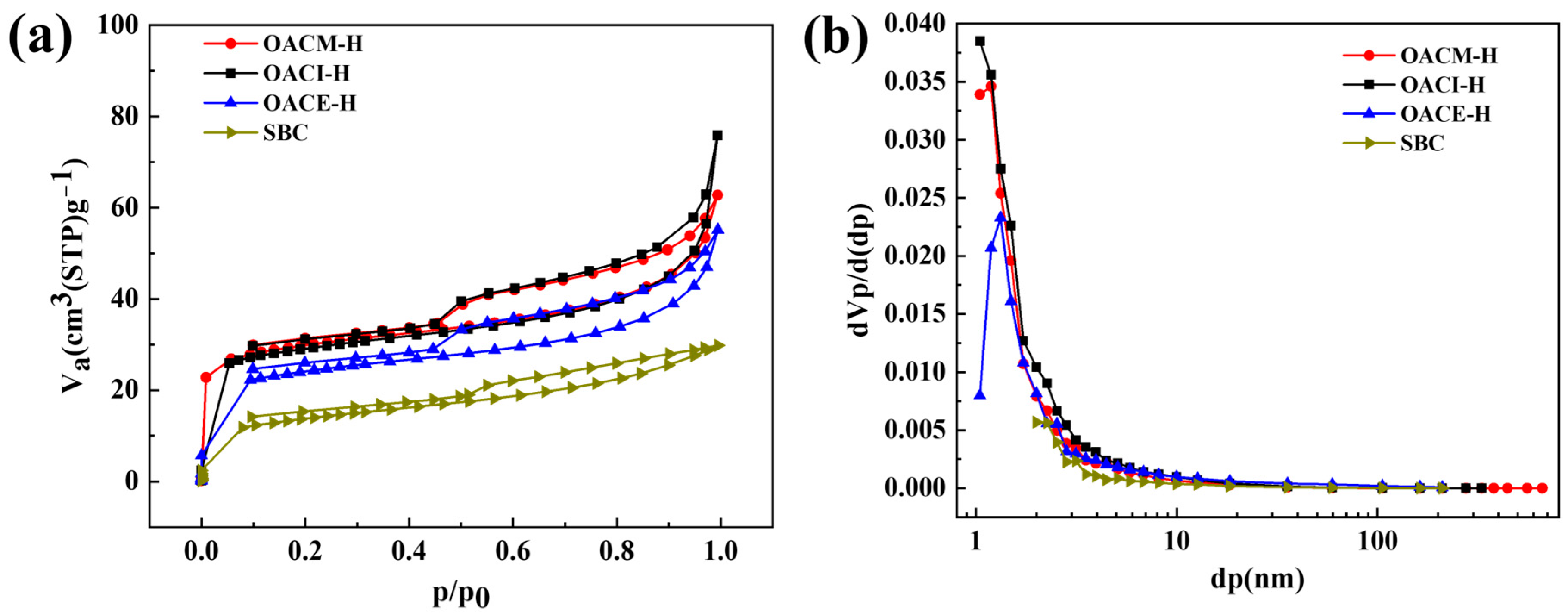
3.1.2. Analysis of Surface Area and Pore Characteristics
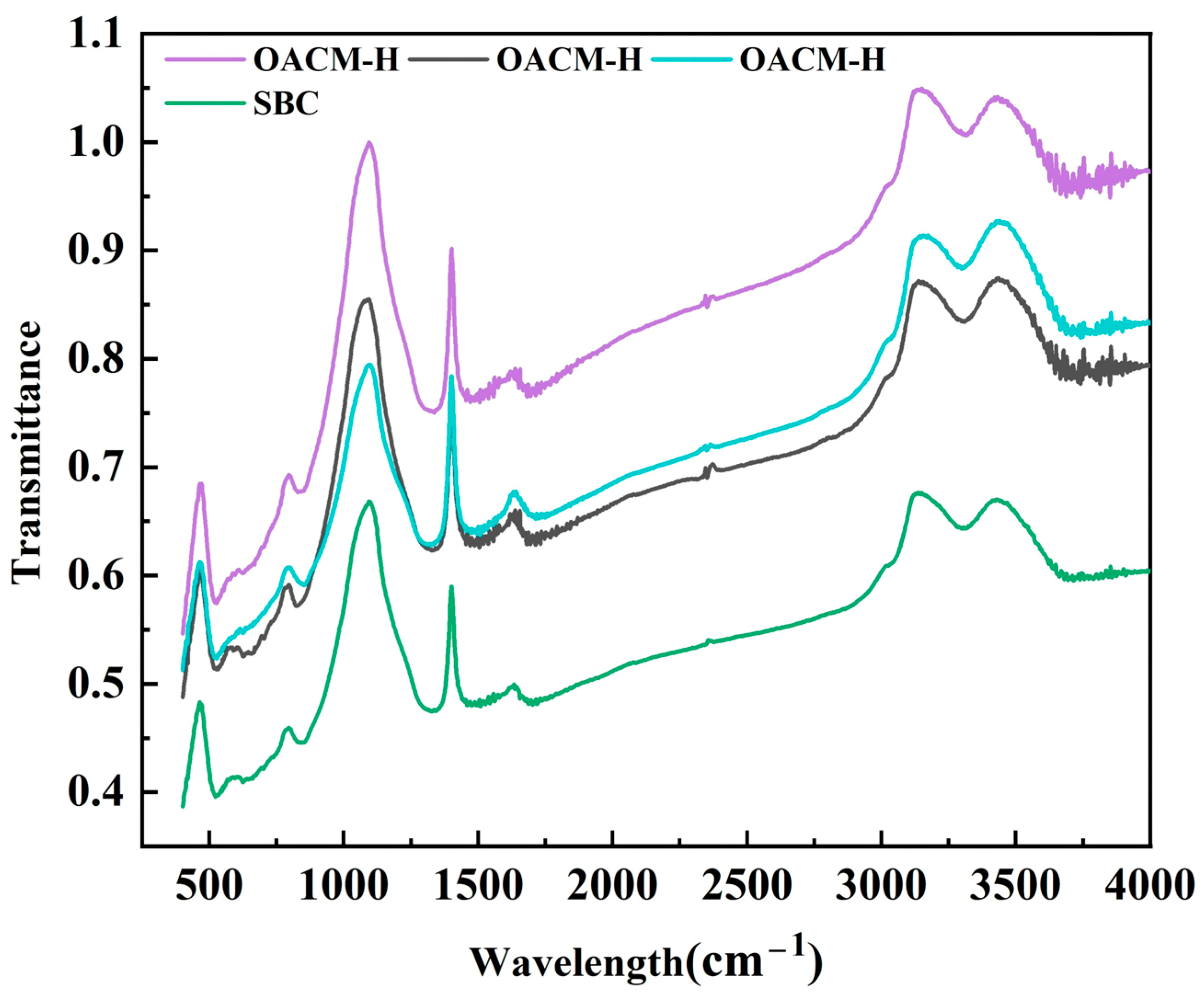
3.1.3. Analysis of Surface Chemical Functionalities
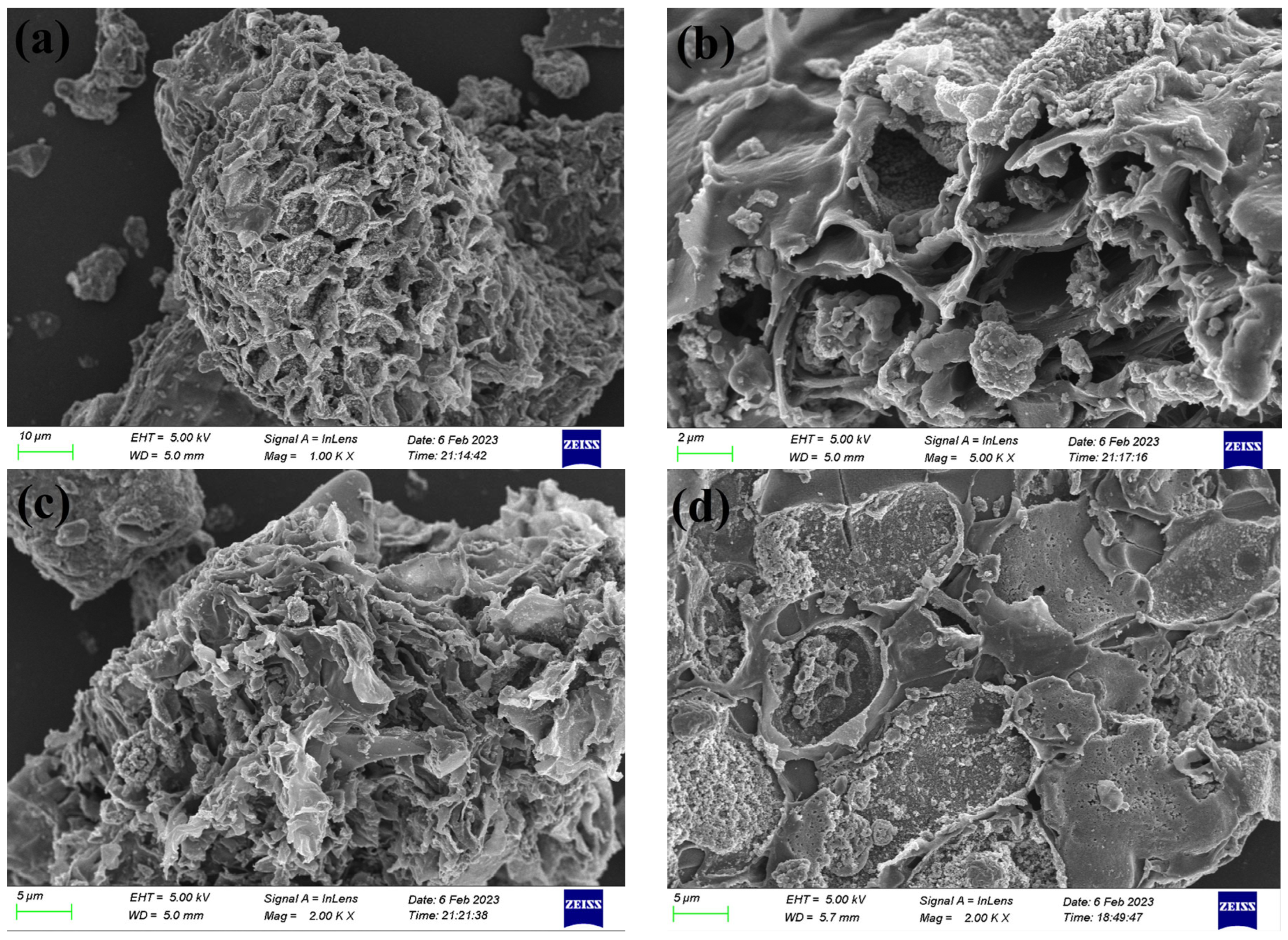
3.1.4. SEM Analysis
3.2. Adsorption Characterization of Sludge-Derived Biochar Produced via Water Vapor-Induced Activation
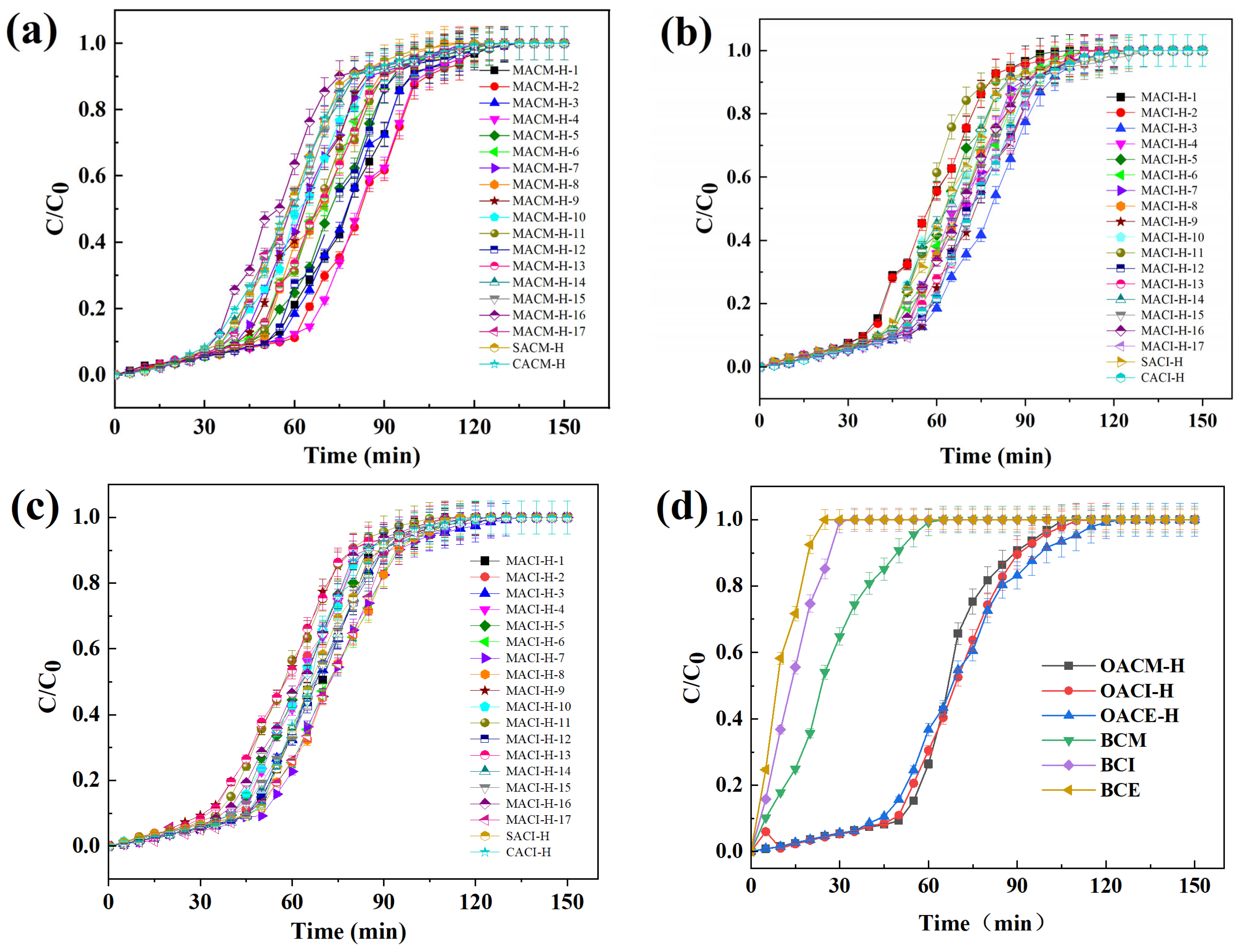
3.2.1. Penetration Curves
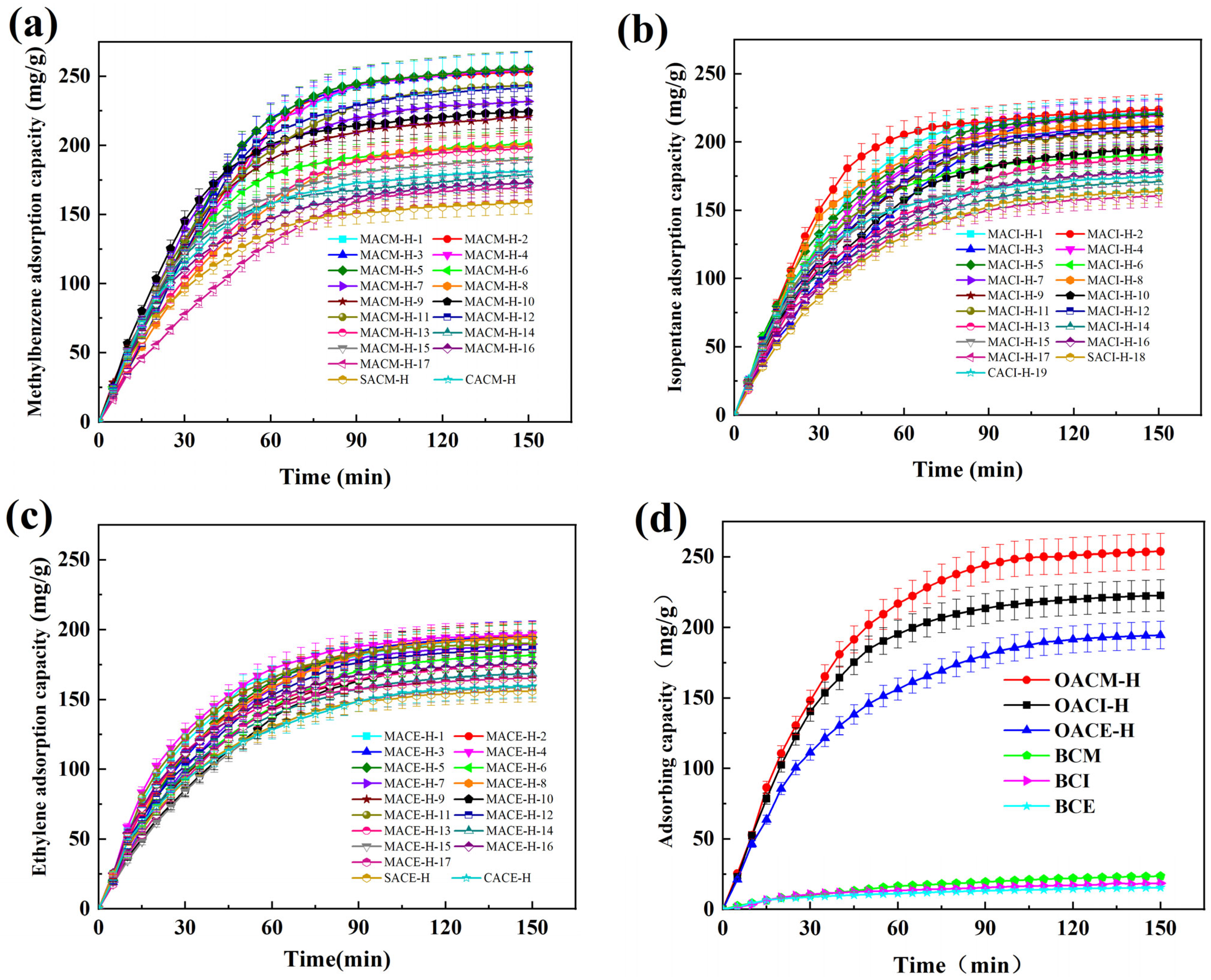
3.2.2. Adsorption Curves
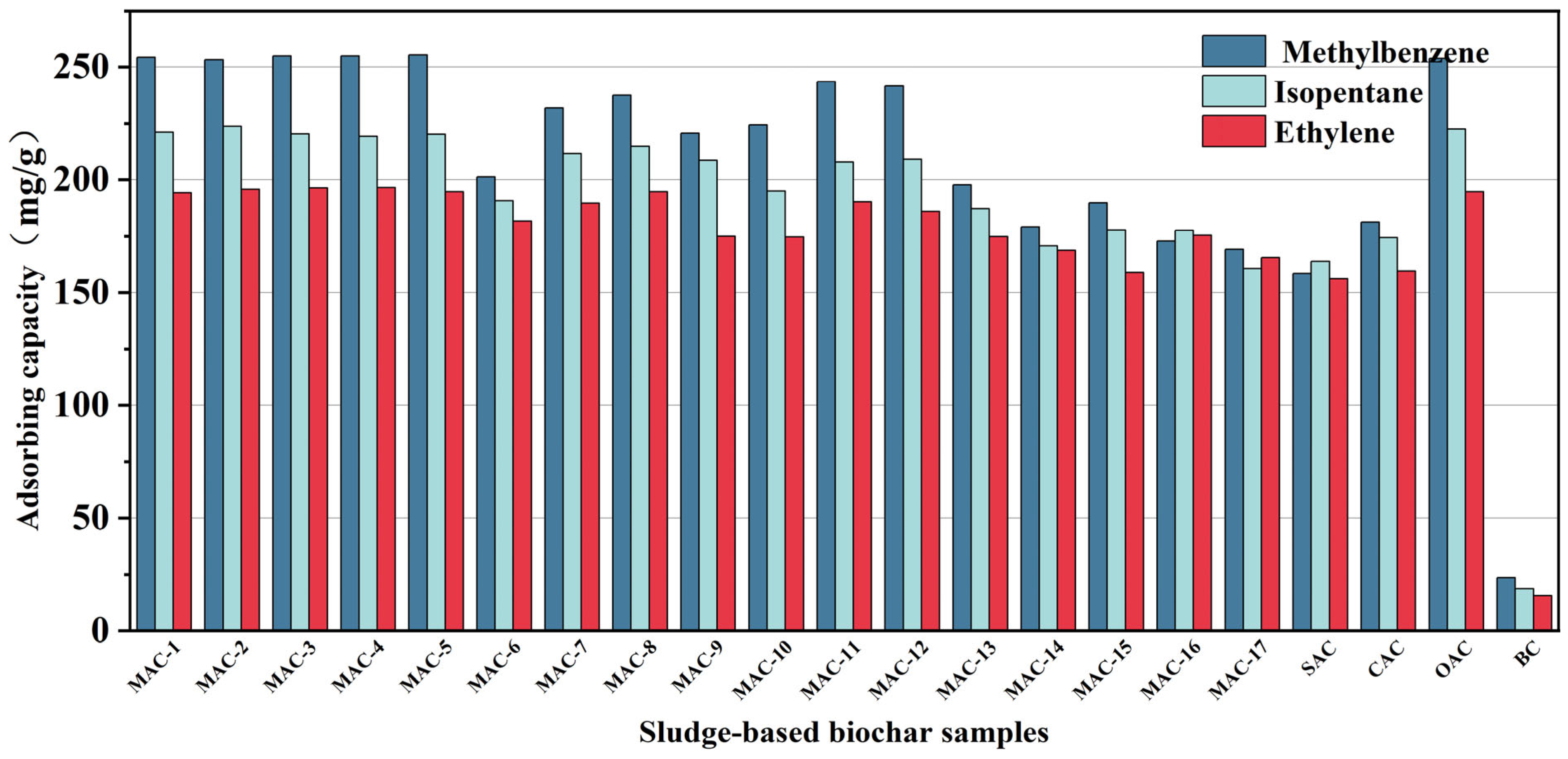
3.2.3. Saturated Adsorption Capacity
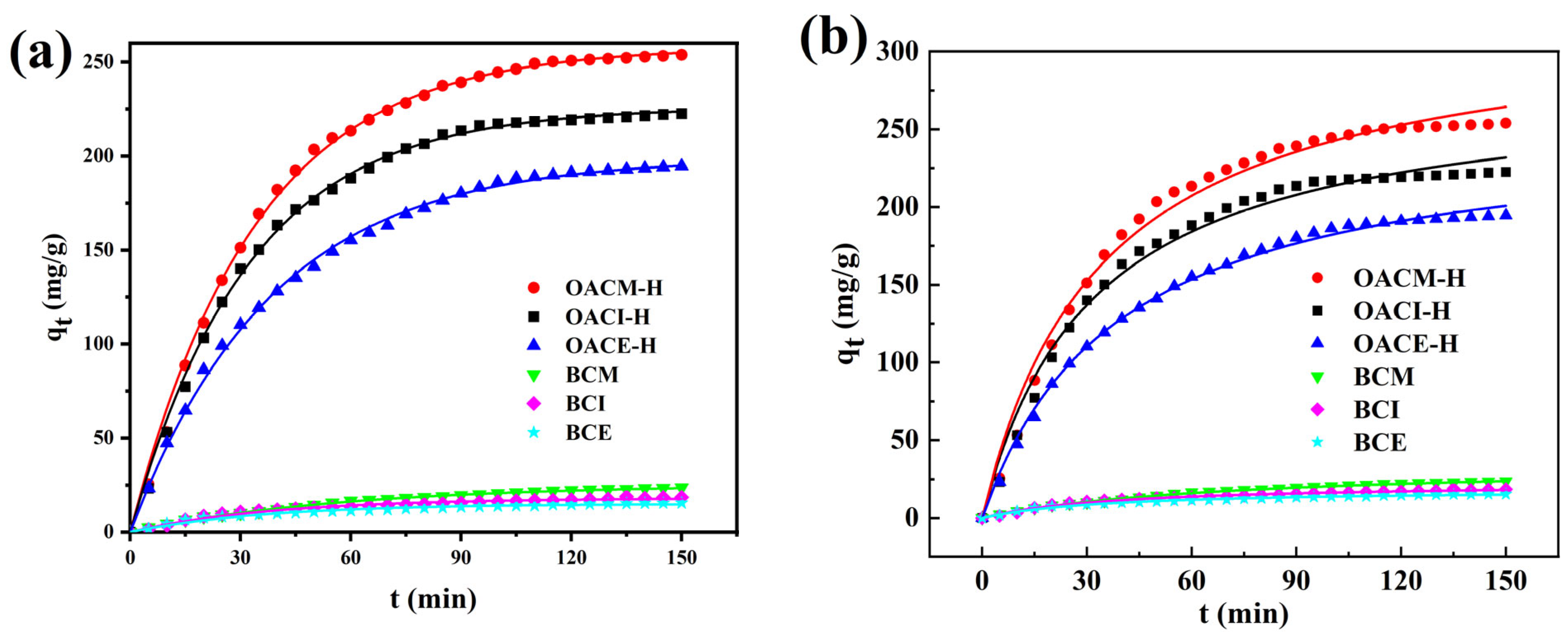
3.2.4. Kinetic Analysis
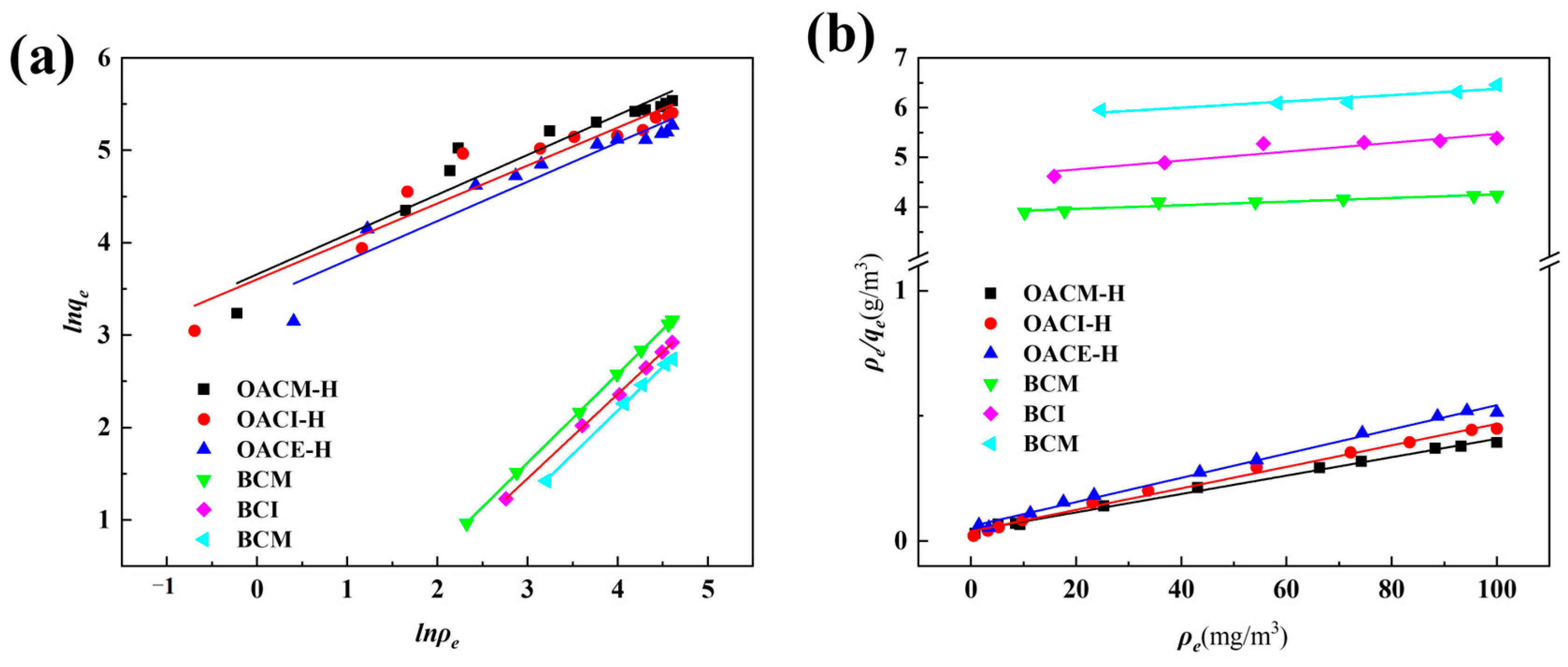
3.2.5. Isothermal Adsorption Modeling Analysis
3.2.6. Dualistic Competitive Adsorption Studies
4. Conclusions
- (1)
- During the preparation of sludge–straw hybrid carbon, the biochar’s specific surface area and pore volume increased, while the average pore diameter decreased after carbonization and activation treatments compared to the raw materials. Nevertheless, the composition of functional groups on the biochar surface demonstrated remarkable stability, consistently featuring N-O, C-O-C, C=C, -OH, and various other functional groups.
- (2)
- The ability of straw–sludge biochar to adsorb VOCs ranked as follows: methylbenzene showed the highest uptake, followed by isopentane, and finally ethylene. Water vapor activation significantly enhanced adsorption, with the optimized biochar group showing the highest efficiency, followed by the response surface group, single-feedstock biochar, and unactivated biochar. Notably, compared to the BC group, the maximum saturated adsorption capacities in the response surface group increased by 10.81 times for methylbenzene, 12.39 times for isopentane, and 12.36 times for ethylene. This represents increases of 112.21%, 74.53%, and 66.72% compared to the SAC group, and further improvements of 74.25%, 62.98%, and 55.25% over the CAC group. The adsorption properties of volatile organic compounds on sludge-derived biochar resembled chemisorption, closely mirroring the characteristics of monomolecular layer adsorption and highlighting the intricate dynamics involved.
- (3)
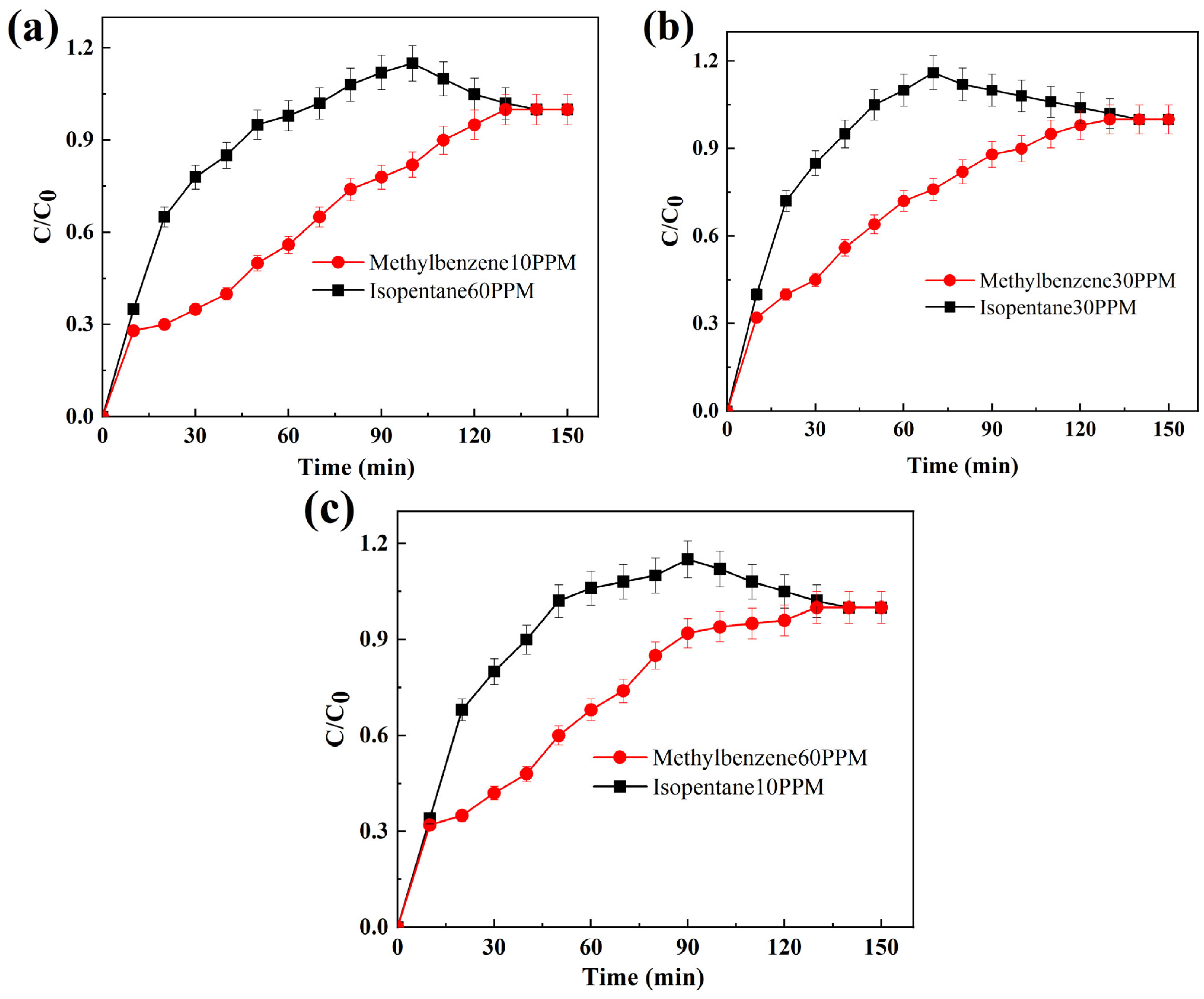
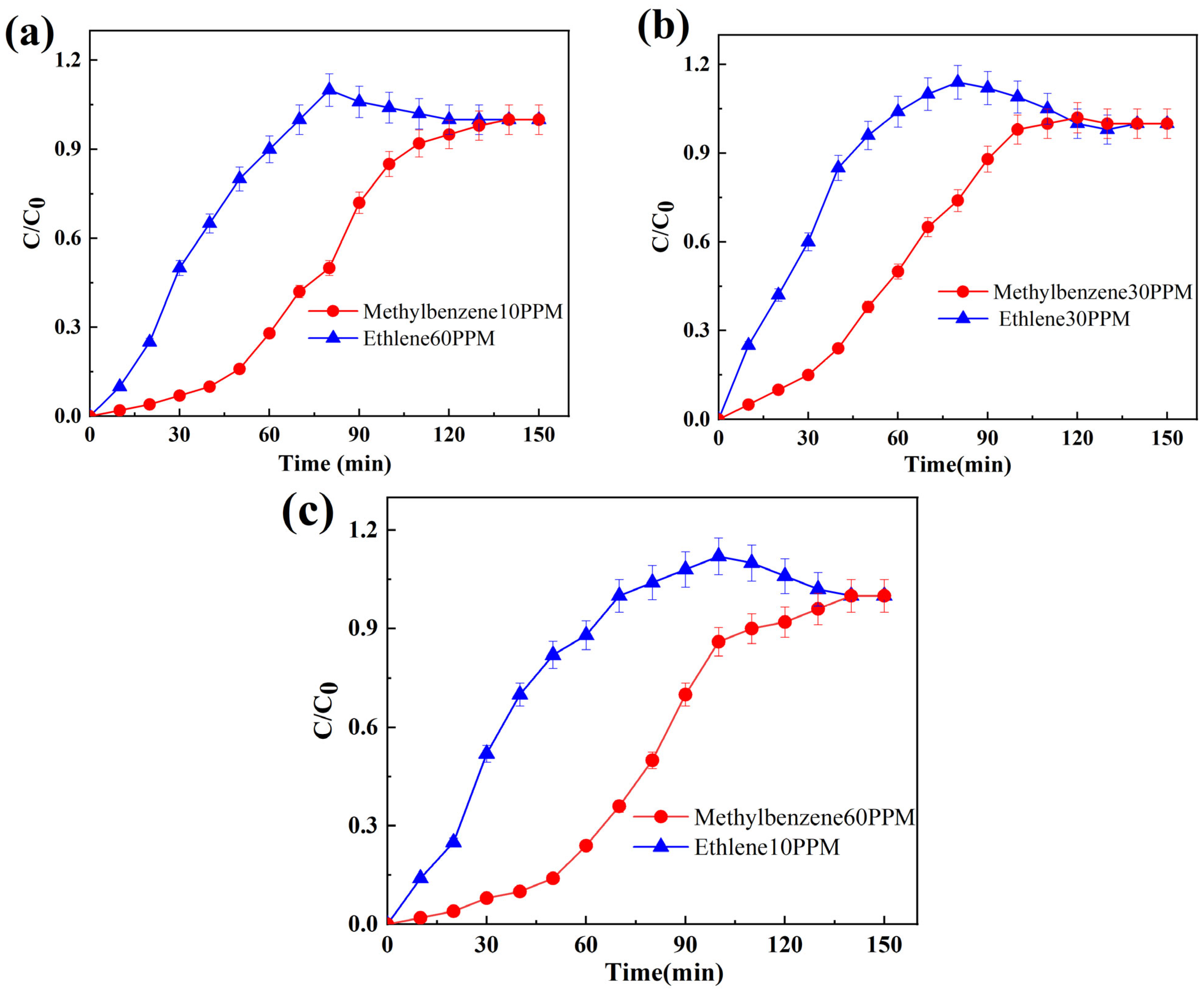
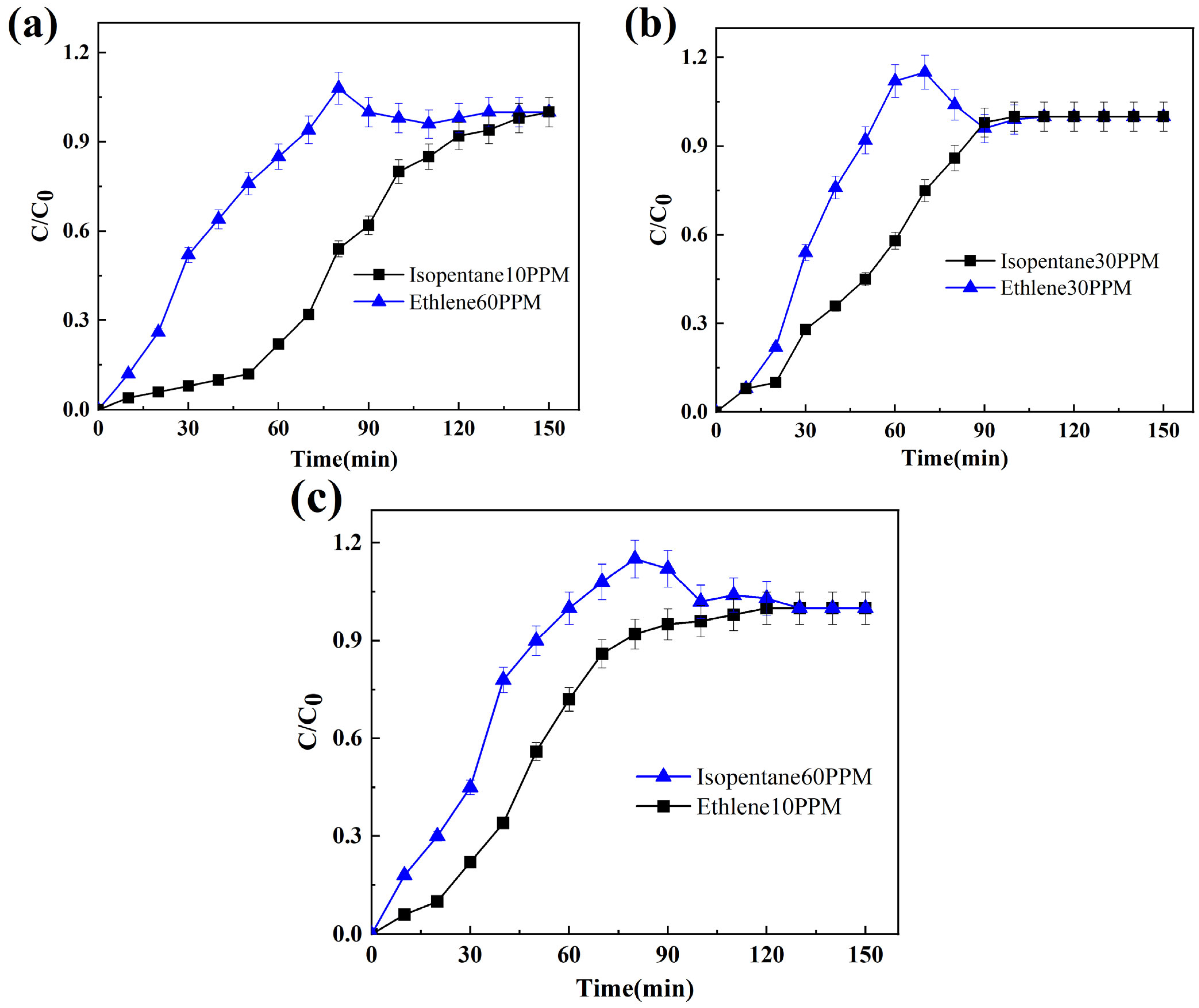
- In competitive adsorption, the order of adsorption capacity magnitude of volatile organic compounds (VOCs) on water vapor-activated SBC was as follows: methylbenzene > isopentane > ethylene. Furthermore, the higher the boiling point, the higher the adsorption capacity. Additionally, the difference between boiling point values influences the adsorption strength, where compounds with higher boiling points displace those with lower boiling points more effectively.
- (4)
- A blended biochar made from sludge and corn stover offers a cost-effective and sustainable alternative for removing VOCs. This adsorbent is suitable for treating exhaust gases rich in aromatic and aliphatic VOCs. Its applications include biomass power plants, chemical industrial parks, and wastewater treatment plants, offering a highly promising solution for achieving synergies between waste resource recovery and exhaust gas purification.
Author Contributions
Funding
Institutional Review Board Statement
Informed Consent Statement
Data Availability Statement
Conflicts of Interest
References
- Zhang, X.; Xue, Z.; Li, H.; Yan, L.; Yang, Y.; Wang, Y.; Duan, J.; Li, L.; Chai, F.; Cheng, M.; et al. Ambient volatile organic compounds pollution in China. J. Environ. Sci. 2017, 55, 69–75. [Google Scholar] [CrossRef] [PubMed]
- Mozaffar, A.; Zhang, Y.-L. Atmospheric Volatile Organic Compounds (VOCs) in China: A Review. Curr. Pollut. Rep. 2020, 6, 250–263. [Google Scholar] [CrossRef]
- Acton, W.J.F.; Huang, Z.; Davison, B.; Drysdale, W.S.; Fu, P.; Hollaway, M.; Langford, B.; Lee, J.; Liu, Y.; Metzger, S.; et al. Surface–atmosphere fluxes of volatile organic compounds in Beijing. Atmos. Chem. Phys. 2020, 20, 15101–15125. [Google Scholar] [CrossRef]
- Khan, F.I.; Kr. Ghoshal, A. Removal of Volatile Organic Compounds from polluted air. J. Loss Prev. Process Ind. 2000, 13, 527–545. [Google Scholar] [CrossRef]
- Zhu, J.; Li, Y.; Xu, L.; Liu, Z. Removal of toluene from waste gas by adsorption-desorption process using corncob-based activated carbons as adsorbents. Ecotoxicol. Environ. Saf. 2018, 165, 115–125. [Google Scholar] [CrossRef]
- Cheng, N.; Wang, B.; Wu, P.; Lee, X.; Xing, Y.; Chen, M.; Gao, B. Adsorption of emerging contaminants from water and wastewater by modified biochar: A review. Environ. Pollut. 2021, 273, 116448. [Google Scholar] [CrossRef]
- Gyamfi, B.A.; Ozturk, I.; Bein, M.A.; Bekun, F.V. An investigation into the anthropogenic effect of biomass energy utilization and economic sustainability on environmental degradation in E7 economies. Biofuels Bioprod. Biorefining 2021, 15, 840–851. [Google Scholar] [CrossRef]
- Kang, Y.; Yang, Q.; Bartocci, P.; Wei, H.; Liu, S.S.; Wu, Z.; Zhou, H.; Yang, H.; Fantozzi, F.; Chen, H. Bioenergy in China: Evaluation of domestic biomass resources and the associated greenhouse gas mitigation potentials. Renew. Sustain. Energy Rev. 2020, 127, 109842. [Google Scholar] [CrossRef]
- Long, H.; Li, X.; Wang, H.; Jia, J. Biomass resources and their bioenergy potential estimation: A review. Renew. Sustain. Energy Rev. 2013, 26, 344–352. [Google Scholar] [CrossRef]
- Jia, W.; Li, S.; Wang, J.; Lee, J.T.E.; Lin, C.S.K.; Mašek, O.; Zhang, H.; Yuan, X. Sustainable valorisation of food waste into engineered biochars for CO2 capture towards a circular economy. Green Chem. 2024, 26, 1790–1805. [Google Scholar] [CrossRef]
- He, S.; Shi, G.; Xiao, H.; Sun, G.; Shi, Y.; Chen, G.; Dai, H.; Yuan, B.; Chen, X.; Yang, X. Self S-doping activated carbon derived from lignin-based pitch for removal of gaseous benzene. Chem. Eng. J. 2021, 410, 128286. [Google Scholar] [CrossRef]
- Shi, G.; He, S.; Chen, G.; Ruan, C.; Ma, Y.; Chen, Q.; Jin, X.; Liu, X.; He, C.; Du, C.; et al. Crayfish shell-based micro-mesoporous activated carbon: Insight into preparation and gaseous benzene adsorption mechanism. Chem. Eng. J. 2022, 428, 131148. [Google Scholar] [CrossRef]
- Gao, Q.; Ni, L.; Ren, H.; Su, M.; Rong, S.; Liu, Z. Innovative green preparation of activated carbon by combining microwave pyrolysis and self-activation: Pyrolysis behavior, carbon characteristics and arsenic adsorption properties. Ind. Crops Prod. 2024, 220, 119256. [Google Scholar] [CrossRef]
- Zhang, Z.; Jiang, C.; Li, D.; Lei, Y.; Yao, H.; Zhou, G.; Wang, K.; Rao, Y.; Liu, W.; Xu, C.; et al. Micro-mesoporous activated carbon simultaneously possessing large surface area and ultra-high pore volume for efficiently adsorbing various VOCs. Carbon 2020, 170, 567–579. [Google Scholar] [CrossRef]
- Ukalska-Jaruga, A.; Smreczak, B.; Klimkowicz-Pawlas, A. Soil organic matter composition as a factor affecting the accumulation of polycyclic aromatic hydrocarbons. J. Soils Sediments 2019, 19, 1890–1900. [Google Scholar] [CrossRef]
- Khan, A.; Szulejko, J.E.; Samaddar, P.; Kim, K.-H.; Liu, B.; Maitlo, H.A.; Yang, X.; Ok, Y.S. The potential of biochar as sorptive media for removal of hazardous benzene in air. Chem. Eng. J. 2019, 361, 1576–1585. [Google Scholar] [CrossRef]
- Zhang, X.; Xiang, W.; Wang, B.; Fang, J.; Zou, W.; He, F.; Li, Y.; Tsang, D.C.W.; Ok, Y.S.; Gao, B. Adsorption of acetone and cyclohexane onto CO2 activated hydrochars. Chemosphere 2020, 245, 125664. [Google Scholar] [CrossRef]
- Shih, Y.-h.; Li, M.-s. Adsorption of selected volatile organic vapors on multiwall carbon nanotubes. J. Hazard. Mater. 2008, 154, 21–28. [Google Scholar] [CrossRef]
- Welham, N.J.; Berbenni, V.; Chapman, P.G. Increased chemisorption onto activated carbon after ball-milling. Carbon 2002, 40, 2307–2315. [Google Scholar] [CrossRef]
- Cheng, A.; Harriott, P. Kinetics of oxidation and chemisorption of oxygen for porous carbons with high surface area. Carbon 1986, 24, 143–150. [Google Scholar] [CrossRef]
- Lashaki, M.J.; Fayaz, M.; Wang, H.; Hashisho, Z.; Philips, J.H.; Anderson, J.E.; Nichols, M. Effect of Adsorption and Regeneration Temperature on Irreversible Adsorption of Organic Vapors on Beaded Activated Carbon. Environ. Sci. Technol. 2012, 46, 4083–4090. [Google Scholar] [CrossRef]
- Kottis, T.; Soursos, N.; Govatsi, K.; Sygellou, L.; Vakros, J.; Manariotis, I.D.; Mantzavinos, D.; Lianos, P. Biochar from olive tree twigs and spent malt rootlets as electrodes in Zn-air batteries. J. Colloid Interface Sci. 2024, 665, 10–18. [Google Scholar] [CrossRef]
- Zhou, X.; Liu, S.; Hu, Y.; He, J.; Zhang, W.; Hong, R.; Cao, Z.; Wu, D.; Liu, C.; Cheng, J. Green synthesis of porous bamboo-based activated carbon with high VOCs adsorption performance via steam activation method. J. Porous Mater. 2024, 31, 737–746. [Google Scholar] [CrossRef]
- Wu, C.; Zhang, C.; Bai, L.; Shen, L.; Wang, B.; Liu, J.; Yang, L. Characteristics of Volatile Organic Compounds Emitted from Biomass-pelletsfired Boilers. Environ. Sci. 2017, 38, 2238–2245. [Google Scholar] [CrossRef]
- Pan, X.; Zhang, N.; Yang, L.; He, C.; Ma, X.; Liu, X.; Liu, L.; Hou, T.; Jiao, Y. Preparation of a Novel Straw–Sludge Activated Biochar and Its Adsorption Mechanisms for Removal of VOCs. ACS Omega 2023, 8, 39329–39344. [Google Scholar] [CrossRef]
- Behera, S.K.; Meena, H.; Chakraborty, S.; Meikap, B.C. Application of response surface methodology (RSM) for optimization of leaching parameters for ash reduction from low-grade coal. Int. J. Min. Sci. Technol. 2018, 28, 621–629. [Google Scholar] [CrossRef]
- Ezzati, R. Derivation of Pseudo-First-Order, Pseudo-Second-Order and Modified Pseudo-First-Order rate equations from Langmuir and Freundlich isotherms for adsorption. Chem. Eng. J. 2020, 392, 123705. [Google Scholar] [CrossRef]
- Alawa, B.; Singh, S.; Chakma, S.; Kishor, R.; Stålsby Lundborg, C.; Diwan, V. Development of novel biochar adsorbent using agricultural waste biomass for enhanced removal of ciprofloxacin from water: Insights into the isotherm, kinetics, and thermodynamic analysis. Chemosphere 2025, 375, 144252. [Google Scholar] [CrossRef]
- Quan, Y.-h.; Miao, C.; Li, T.; Wang, N.; Wu, M.-m.; Zhang, N.; Zhao, J.-x.; Ren, J. Effect of preparation methods on the structure and catalytic performance of CeO2 for toluene combustion. J. Fuel Chem. Technol. 2021, 49, 211–219. [Google Scholar] [CrossRef]
- Chen, J.; Zhou, J.; Zheng, W.; Leng, S.; Ai, Z.; Zhang, W.; Yang, Z.; Yang, J.; Xu, Z.; Cao, J.; et al. A complete review on the oxygen-containing functional groups of biochar: Formation mechanisms, detection methods, engineering, and applications. Sci. Total Environ. 2024, 946, 174081. [Google Scholar] [CrossRef]
- Liu, B.; Yu, L.; Wang, H.; Ma, X.; Zeng, Z.; Li, L. Experimental and molecular perspective on VOCs adsorption and separation: Study of the surface heterogeneity and oxygen functionalizing. Chem. Eng. J. 2022, 435, 135069. [Google Scholar] [CrossRef]
- Zheng, G.; Wei, K.; Kang, X.; Fan, W.; Ma, N.L.; Verma, M.; Ng, H.S.; Ge, S. A new attempt to control volatile organic compounds (VOCs) pollution—Modification technology of biomass for adsorption of VOCs gas. Environ. Pollut. 2023, 336, 122451. [Google Scholar] [CrossRef]
- Chu, K.H. Breakthrough curve analysis by simplistic models of fixed bed adsorption: In defense of the century-old Bohart-Adams model. Chem. Eng. J. 2020, 380, 122513. [Google Scholar] [CrossRef]
- Zhang, X.; Xiang, W.; Miao, X.; Li, F.; Qi, G.; Cao, C.; Ma, X.; Chen, S.; Zimmerman, A.R.; Gao, B. Microwave biochars produced with activated carbon catalyst: Characterization and sorption of volatile organic compounds (VOCs). Sci. Total Environ. 2022, 827, 153996. [Google Scholar] [CrossRef]
- Rodríguez-Reinoso, F.; Molina-Sabio, M.; González, M.T. The use of steam and CO2 as activating agents in the preparation of activated carbons. Carbon 1995, 33, 15–23. [Google Scholar] [CrossRef]
- Yang, X.; Yi, H.; Tang, X.; Zhao, S.; Yang, Z.; Ma, Y.; Feng, T.; Cui, X. Behaviors and kinetics of toluene adsorption-desorption on activated carbons with varying pore structure. J. Environ. Sci. 2018, 67, 104–114. [Google Scholar] [CrossRef]
- Vega, E.; Lemus, J.; Anfruns, A.; Gonzalez-Olmos, R.; Palomar, J.; Martin, M.J. Adsorption of volatile sulphur compounds onto modified activated carbons: Effect of oxygen functional groups. J. Hazard. Mater. 2013, 258–259, 77–83. [Google Scholar] [CrossRef]
- Chen, Q.; Zheng, J.; Xu, J.; Dang, Z.; Zhang, L. Insights into sulfamethazine adsorption interfacial interaction mechanism on mesoporous cellulose biochar: Coupling DFT/FOT simulations with experiments. Chem. Eng. J. 2019, 356, 341–349. [Google Scholar] [CrossRef]
- Erdogan, F.O. Freundlich, Langmuir, Temkin, DR and Harkins-Jura Isotherm Studies on the Adsorption of CO2 on Various Porous Adsorbents. Int. J. Chem. React. Eng. 2019, 17, 20180134. [Google Scholar] [CrossRef]
- Li, X.; Wang, C.; Zhang, J.; Liu, J.; Liu, B.; Chen, G. Preparation and application of magnetic biochar in water treatment: A critical review. Sci. Total Environ. 2020, 711, 134847. [Google Scholar] [CrossRef]
- Zhang, J.; Shao, J.; Zhang, X.; Jiang, H.; Zhang, S.; Zhang, S.; Yang, H.; Chen, H. Molecular simulation of different VOCs adsorption on nitrogen-doped biochar. Fuel 2024, 372, 132127. [Google Scholar] [CrossRef]



| Sludge | Corn Stover | |
|---|---|---|
| Proximate analysis (wt%) | ||
| Moisture Content | 93.4 | 4.8 |
| Ash | 38 | 8 |
| Volatile Matter | 17.38 | 74.98 |
| Fixed Carbon | 44.62 | 17.02 |
| Ultimate analysis (wt%) | ||
| C | 30.7 | 41.49 |
| H | 4.71 | 5.7 |
| N | 20.94 | 43.67 |
| O | 5.01 | 1 |
| Controlling Factor | Notation | Code Number | ||
|---|---|---|---|---|
| −1 | 0 | 1 | ||
| Material proportion | A | 0.25 | 0.50 | 0.75 |
| Activation temperature (°C) | B | 700 | 800 | 900 |
| Activation time (min) | C | 60 | 120 | 180 |
| Group | A | B (°C) | C (min) | Adsorption Capacity (mg/g) | ||
|---|---|---|---|---|---|---|
| Methylbenzene | Isopentane | Ethylene | ||||
| MAC-1 | 0.50 | 800 | 120 | 254.41 | 221.13 | 194.08 |
| MAC-2 | 0.50 | 800 | 120 | 253.24 | 223.74 | 195.71 |
| MAC-3 | 0.50 | 800 | 120 | 254.98 | 220.46 | 196.24 |
| MAC-4 | 0.50 | 800 | 120 | 254.93 | 219.26 | 196.45 |
| MAC-5 | 0.50 | 800 | 120 | 255.46 | 220.23 | 194.59 |
| MAC-6 | 0.50 | 700 | 60 | 201.25 | 190.76 | 181.67 |
| MAC-7 | 0.50 | 900 | 60 | 231.78 | 211.67 | 189.68 |
| MAC-8 | 0.50 | 900 | 180 | 237.56 | 214.79 | 194.59 |
| MAC-9 | 0.50 | 700 | 180 | 220.68 | 208.68 | 175.04 |
| MAC-10 | 0.75 | 800 | 60 | 224.35 | 194.87 | 174.74 |
| MAC-11 | 0.75 | 900 | 120 | 243.4 | 207.89 | 190.35 |
| MAC-12 | 0.75 | 800 | 180 | 241.65 | 209.14 | 185.91 |
| MAC-13 | 0.75 | 700 | 120 | 197.77 | 187.18 | 174.8 |
| MAC-14 | 0.25 | 800 | 60 | 178.98 | 170.71 | 168.63 |
| MAC-15 | 0.25 | 800 | 180 | 189.87 | 177.58 | 158.91 |
| MAC-16 | 0.25 | 900 | 120 | 172.86 | 177.47 | 175.5 |
| MAC-17 | 0.25 | 700 | 120 | 169.11 | 160.55 | 165.45 |
| SBC | - | - | - | 23.62 | 18.57 | 15.48 |
| Notation | Explain |
|---|---|
| AC | Activated biochar |
| MAC | Response surface group mixed activated biochar |
| SAC | Sludge-based activated biochar |
| CAC | Corn stover activated biochar |
| OAC | Optimal activated biochar |
| SBC | Sludge-based biochar |
| CBC | Corn stover biochar |
| -H | H2O activation |
| M | Methylbenzene |
| I | Isopentane |
| E | Ethylene |
| MAC-1~17 | Activated biochar from groups 1 to 17 |
| MAC-H-1~17 | Activated biochar prepared by H2O activation from groups 1 to 17 |
| OACM | Optimal group activated biochar for methylbenzene adsorption |
| OACI | Optimal group activated biochar for isopentane adsorption |
| OACE | Optimal group activated biochar for ethylene adsorption |
| VOCs | Source | Sum of Squares | DF | Mean Square | F Value | p-Value Prob > F |
|---|---|---|---|---|---|---|
| Methylbenzene | Model | 15,610.86 | 9 | 1734.54 | 2428.84 | <0.0001 |
| A | 4819.17 | 1 | 4819.17 | 6748.19 | <0.0001 | |
| B | 1171.04 | 1 | 1171.04 | 1639.78 | <0.0001 | |
| C | 356.44 | 1 | 356.44 | 499.12 | <0.0001 | |
| AB | 438.48 | 1 | 438.48 | 614 | <0.0001 | |
| AC | 10.27 | 1 | 10.27 | 14.38 | 0.0068 | |
| BC | 46.58 | 1 | 46.58 | 65.23 | <0.0001 | |
| A2 | 5597.8 | 1 | 5597.8 | 7838.5 | <0.0001 | |
| B2 | 2104.57 | 1 | 2104.57 | 2946.99 | <0.0001 | |
| C2 | 374.38 | 1 | 374.38 | 524.24 | <0.0001 | |
| Residual | 5 | 7 | 0.7141 | |||
| Cor. Total | 15,615.86 | 16 | ||||
| Isopentane | Model | 6444.46 | 9 | 716.05 | 194.85 | <0.0001 |
| A | 1589.63 | 1 | 1589.63 | 432.57 | <0.0001 | |
| B | 522.45 | 1 | 522.45 | 142.17 | <0.0001 | |
| C | 222.39 | 1 | 222.39 | 60.52 | 0.0001 | |
| AB | 3.59 | 1 | 3.59 | 0.9772 | 0.3558 | |
| AC | 13.69 | 1 | 13.69 | 3.73 | 0.0949 | |
| BC | 54.76 | 1 | 54.76 | 14.9 | 0.0062 | |
| A2 | 3311.85 | 1 | 3311.85 | 901.22 | <0.0001 | |
| B2 | 391.75 | 1 | 391.75 | 106.6 | <0.0001 | |
| C2 | 98.77 | 1 | 98.77 | 26.88 | 0.0013 | |
| Residual | 25.72 | 7 | 3.67 | |||
| Cor. Total | 6470.19 | 16 | ||||
| Ethene | Model | 2351.89 | 9 | 261.32 | 114.6 | <0.0001 |
| A | 410.55 | 1 | 410.55 | 180.05 | <0.0001 | |
| B | 353.25 | 1 | 353.25 | 154.92 | <0.0001 | |
| C | 0.0091 | 1 | 0.0091 | 0.004 | 0.9514 | |
| AB | 7.56 | 1 | 7.56 | 3.32 | 0.1114 | |
| AC | 109.1 | 1 | 109.1 | 47.85 | 0.0002 | |
| BC | 33.29 | 1 | 33.29 | 14.6 | 0.0065 | |
| A2 | 1083.73 | 1 | 1083.73 | 475.27 | <0.0001 | |
| B2 | 34.1 | 1 | 34.1 | 14.95 | 0.0062 | |
| C2 | 225.81 | 1 | 225.81 | 99.03 | <0.0001 | |
| Residual | 15.96 | 7 | 2.28 | |||
| Cor. Total | 2367.85 | 16 |
| Statistical Projects | Value | ||
|---|---|---|---|
| Methylbenzene | Isopentane | Ethene | |
| Std.Dev | 0.85 | 1.92 | 1.51 |
| Mean | 222.49 | 200.95 | 183.08 |
| C.V% | 0.38% | 0.95% | 0.82% |
| PRESS | 38.43 | 246.56 | 193.28 |
| R-Squared | 0.9997 | 0.9960 | 0.9933 |
| Adj R-Squared | 0.9994 | 0.9909 | 0.9846 |
| Pred R-Square | 0.9975 | 0.9619 | 0.9184 |
| Adeq Precisior | 131.132 | 40.075 | 30.900 |
| Types of VOC | Ratio | Activation Temperature (°C) | Activation Time (min) | Predicted Amount of Adsorption (mg/g) | Actual Amount of Adsorption (mg/g) | Relative Error (%) |
|---|---|---|---|---|---|---|
| methylbenzene | 0.60 | 868.48 | 123.95 | 259.57 | 253.84 | 2.26 |
| isopentane | 0.60 | 855.71 | 157.85 | 224.43 | 222.57 | 0.84 |
| ethene | 0.62 | 847.65 | 139.56 | 198.44 | 194.63 | 1.96 |
| Sorbent | Specific Surface Area (m2/g) | Micropore Volume (cm3/g) | Mesopore Volume (cm3/g) | Total Pore Volume (cm3/g) | Average Pore Diameter (nm) |
|---|---|---|---|---|---|
| OACM-H | 158.97 | 0.0748 | 00.0691 | 0.1509 | 2.5864 |
| OACI-H | 133.64 | 0.0631 | 0.0684 | 0.1396 | 3.3843 |
| OACE-H | 134.73 | 0.0285 | 0.1151 | 0.1436 | 3.2082 |
| SAC | 82.53 | 0.0343 | 0.0254 | 0.0846 | 5.0123 |
| CAC | 80.71 | 0.0131 | 0.0265 | 0.0803 | 4.9854 |
| SBC | 45.29 | 0.0038 | 0.0133 | 0.0456 | 7.0577 |
| Adsorbent | Quasi-First-Order Kinetic Model | Quasi-Second-Order Kinetic Model | ||||
|---|---|---|---|---|---|---|
| qe (mg/g) | k1 | R2 | qe (mg/g) | k2 | R2 | |
| OACM-H | 257.9886 | 0.0295 | 0.9977 | 323.6855 | 0.00009 | 0.9880 |
| OACI-H | 225.8140 | 0.0309 | 0.9978 | 280.2891 | 0.00013 | 0.9831 |
| OACE-H | 198.8720 | 0.0260 | 0.9988 | 252.7448 | 0.00011 | 0.9968 |
| BCI | 18.0388 | 0.0255 | 0.9833 | 22.9060 | 0.00111 | 0.9882 |
| BCE | 15.0130 | 0.0273 | 0.9798 | 18.6979 | 0.00149 | 0.9921 |
| BCM | 25.4021 | 0.0170 | 0.9979 | 35.0140 | 0.00040 | 0.9987 |
| Adsorbent | Freundlich Isothermal Adsorption Model | Langmuir Isothermal Adsorption Model | ||||
|---|---|---|---|---|---|---|
| kF | n | R2 | qm | kL | R2 | |
| OACM-H | 38.7992 | 2.3217 | 0.9219 | 272.2910 | 0.0888 | 0.9950 |
| OACI-H | 36.7375 | 2.4348 | 0.9215 | 233.0053 | 0.1098 | 0.9929 |
| OACE-H | 29.4679 | 2.3495 | 0.9128 | 206.8158 | 0.0815 | 0.9943 |
| BCM | 0.2924 | 1.0455 | 0.9994 | 24.1215 | 0.0137 | 0.9732 |
| BCI | 0.2641 | 1.0784 | 0.9996 | 17.4635 | 0.0244 | 0.9638 |
| BCE | 0.1879 | 1.0613 | 0.9992 | 14.9654 | 0.0258 | 0.9583 |
Disclaimer/Publisher’s Note: The statements, opinions and data contained in all publications are solely those of the individual author(s) and contributor(s) and not of MDPI and/or the editor(s). MDPI and/or the editor(s) disclaim responsibility for any injury to people or property resulting from any ideas, methods, instructions or products referred to in the content. |
© 2026 by the authors. Licensee MDPI, Basel, Switzerland. This article is an open access article distributed under the terms and conditions of the Creative Commons Attribution (CC BY) license.
Share and Cite
Zhang, Z.; Zhang, N.; Pan, X.; Zhao, B.; Liu, J.; Tian, S.; Hao, L.; Zhao, Z. Hybrid Biochar from Corn Stover and Sewage Sludge for VOCs Adsorption: A Sustainable Waste Utilization Approach. Toxics 2026, 14, 516. https://doi.org/10.3390/toxics14060516
Zhang Z, Zhang N, Pan X, Zhao B, Liu J, Tian S, Hao L, Zhao Z. Hybrid Biochar from Corn Stover and Sewage Sludge for VOCs Adsorption: A Sustainable Waste Utilization Approach. Toxics. 2026; 14(6):516. https://doi.org/10.3390/toxics14060516
Chicago/Turabian StyleZhang, Zhen, Ninglu Zhang, Xiaohui Pan, Bingchao Zhao, Jun Liu, Shujian Tian, Liyu Hao, and Zihao Zhao. 2026. "Hybrid Biochar from Corn Stover and Sewage Sludge for VOCs Adsorption: A Sustainable Waste Utilization Approach" Toxics 14, no. 6: 516. https://doi.org/10.3390/toxics14060516
APA StyleZhang, Z., Zhang, N., Pan, X., Zhao, B., Liu, J., Tian, S., Hao, L., & Zhao, Z. (2026). Hybrid Biochar from Corn Stover and Sewage Sludge for VOCs Adsorption: A Sustainable Waste Utilization Approach. Toxics, 14(6), 516. https://doi.org/10.3390/toxics14060516