Dynamics of Endocrine Disruptor Exposure in Early Life: A Mother–Infant Hair Biomonitoring Study

 , and
, and Highlights
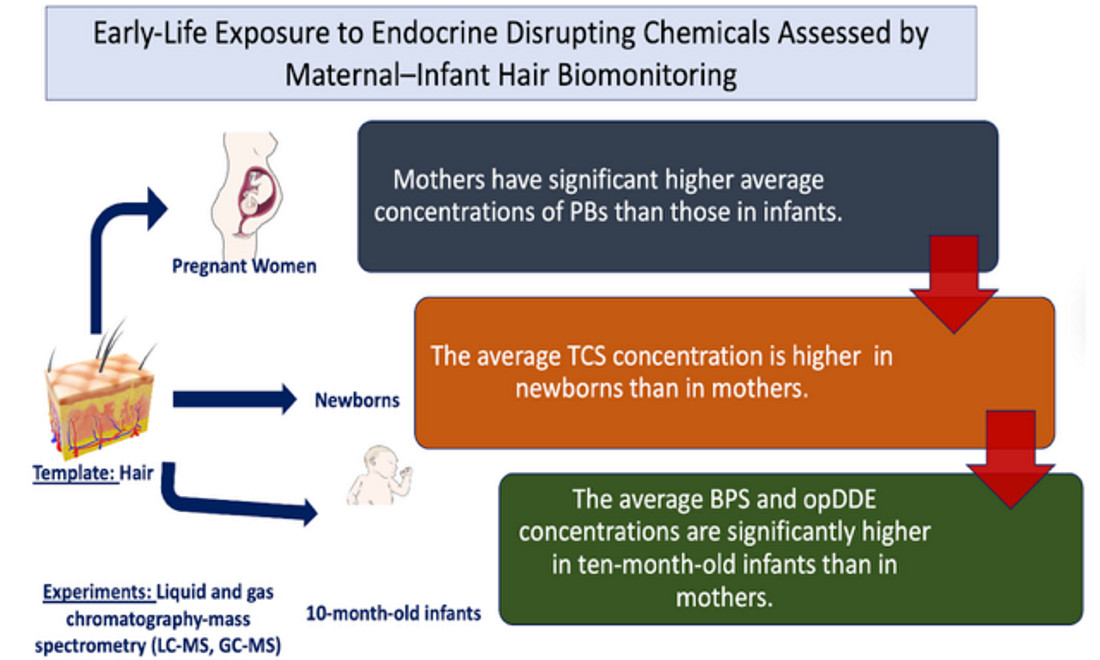
- Higher paraben concentrations in mothers' hair than in those of infants at birth.
- Higher TCS levels in newborns compared to their mothers.
- Exposure of infants to BPS and DDT metabolites (opDDE, ppDDE, and opDDD) at follow-up exceeded that of their mothers.
- No differences in analyte levels depending on infant sex or feeding type.
- Significant pairwise comparisons between MeP, EthP, BenP, and ButP levels in mothers and in newborns were identified.
- Significant pairwise comparisons for BPS and TCS in mothers, newborns at birth, and at follow-up were observed.
- The main findings indicate that EDC concentrations in the hair of pregnant women and their infants at birth and at a 10-month follow-up are critical for assessing prenatal and postnatal environmental exposures in early life.
Abstract
1. Introduction
2. Materials and Methods
2.1. Hair Sampling
- Mother and infant at birth: pairwise comparison between the mother and her infant immediately after delivery;
- Mother and infant at follow-up sampling time: pairwise comparison between the mother and her infant at the follow-up;
- Infant at birth and at follow-up sampling time: pairwise comparison within the same infant, comparing concentrations at birth and at follow-up.
2.2. Chemicals and Reagents
2.3. Extraction of PBs, BPS, and TCS from Hair
2.4. Extraction of Organochlorine Compounds from Hair
2.5. Instrumental Analysis
2.5.1. Liquid Chromatography-Mass Spectrometry
2.5.2. Gas Chromatography–Mass Spectrometry
2.6. Statistical Analysis
3. Results
3.1. Method Validation
3.2. Demographics
3.3. Maternal Environmental Exposure and Use of Cosmetic Products
3.4. Biomonitoring Data
3.5. Feeding Methods Comparison
3.6. Sex Comparison
3.7. Pairwise Comparison for Mothers and Infants
4. Discussion
5. Conclusions
Author Contributions
Funding
Institutional Review Board Statement
Informed Consent Statement
Data Availability Statement
Conflicts of Interest
References
- World Health Organization. World Health Organization Global Assessment of the State-of-the-Science of Endocrine Disruptors; World Health Organization: Geneva, Switzerland, 2002. [Google Scholar]
- Metcalfe, C.D.; Bayen, S.; Desrosiers, M.; Muñoz, G.; Sauvé, S.; Yargeau, V. An Introduction to the Sources, Fate, Occurrence and Effects of Endocrine Disrupting Chemicals Released into the Environment. Environ. Res. 2022, 207, 112658. [Google Scholar] [CrossRef] [Scilit] [PubMed]
- Katsikantami, I.; Sifakis, S.; Tzatzarakis, M.N.; Vakonaki, E.; Kalantzi, O.-I.; Tsatsakis, A.M.; Rizos, A.K. A Global Assessment of Phthalates Burden and Related Links to Health Effects. Environ. Int. 2016, 97, 212–236. [Google Scholar] [CrossRef] [Scilit] [PubMed]
- Petrakis, D.; Vassilopoulou, L.; Mamoulakis, C.; Psycharakis, C.; Anifantaki, A.; Sifakis, S.; Docea, A.O.; Tsiaoussis, J.; Makrigiannakis, A.; Tsatsakis, A.M. Endocrine Disruptors Leading to Obesity and Related Diseases. Int. J. Environ. Res. Public Health 2017, 14, 1282. [Google Scholar] [CrossRef] [Scilit] [PubMed]
- Sifakis, S.; Androutsopoulos, V.P.; Tsatsakis, A.M.; Spandidos, D.A. Human Exposure to Endocrine Disrupting Chemicals: Effects on the Male and Female Reproductive Systems. Environ. Toxicol. Pharmacol. 2017, 51, 56–70. [Google Scholar] [CrossRef] [Scilit]
- Skakkebaek, N.E.; Rajpert-De Meyts, E.; Buck Louis, G.M.; Toppari, J.; Andersson, A.-M.; Eisenberg, M.L.; Jensen, T.K.; Jørgensen, N.; Swan, S.H.; Sapra, K.J.; et al. Male Reproductive Disorders and Fertility Trends: Influences of Environment and Genetic Susceptibility. Physiol. Rev. 2016, 96, 55–97. [Google Scholar] [CrossRef] [Scilit]
- Heffernan, A.L.; Baduel, C.; Toms, L.M.L.; Calafat, A.M.; Ye, X.; Hobson, P.; Broomhall, S.; Mueller, J.F. Use of Pooled Samples to Assess Human Exposure to Parabens, Benzophenone-3 and Triclosan in Queensland, Australia. Environ. Int. 2015, 85, 77–83. [Google Scholar] [CrossRef] [Scilit]
- North, E.J.; Halden, R.U. Plastics and Environmental Health: The Road Ahead. Rev. Environ. Health 2013, 28, 1–8. [Google Scholar] [CrossRef] [Scilit]
- Yang, Z.; Zhang, J.; Wang, M.; Wang, X.; Liu, H.; Zhang, F.; Fan, H. Prenatal Endocrine-Disrupting Chemicals Exposure and Impact on Offspring Neurodevelopment: A Systematic Review and Meta-Analysis. Neurotoxicology 2024, 103, 335–357. [Google Scholar] [CrossRef] [Scilit]
- Toledano, J.M.; Puche-Juarez, M.; Moreno-Fernandez, J.; Gonzalez-Palacios, P.; Rivas, A.; Ochoa, J.J.; Diaz-Castro, J. Implications of Prenatal Exposure to Endocrine-Disrupting Chemicals in Offspring Development: A Narrative Review. Nutrients 2024, 16, 1556. [Google Scholar] [CrossRef] [Scilit]
- Potiris, A.; Daponte, N.; Moustakli, E.; Zikopoulos, A.; Kokkosi, E.; Arkouli, N.; Anagnostaki, I.; Vogiatzoglou, A.L.; Tzeli, M.; Sarella, A.; et al. Prenatal Dietary Exposure to Endocrine Disruptors and Its Lasting Impact on Offspring Health. Toxics 2025, 13, 864. [Google Scholar] [CrossRef] [Scilit]
- Dai, J.; Wang, G.; Wu, C.; Pan, Z.; Li, H.; Shen, L.; Wu, Y. Exposure to Endocrine-Disrupting Chemicals and Congenital Heart Diseases: The Pooled Results Based on the Current Evidence. Pediatr. Cardiol. 2025, 46, 628–638. [Google Scholar] [CrossRef] [Scilit] [PubMed]
- Bansal, A.; Henao-Mejia, J.; Simmons, R.A. Immune System: An Emerging Player in Mediating Effects of Endocrine Disruptors on Metabolic Health. Endocrinology 2018, 159, 32–45. [Google Scholar] [CrossRef] [Scilit] [PubMed]
- Lee, H.-R.; Jeung, E.-B.; Cho, M.-H.; Kim, T.-H.; Leung, P.C.K.; Choi, K.-C. Molecular Mechanism(s) of Endocrine-Disrupting Chemicals and Their Potent Oestrogenicity in Diverse Cells and Tissues That Express Oestrogen Receptors. J. Cell. Mol. Med. 2013, 17, 1–11. [Google Scholar] [CrossRef] [Scilit] [PubMed]
- González, N.; Cunha, S.C.; Ferreira, R.; Fernandes, J.O.; Marquès, M.; Nadal, M.; Domingo, J.L. Concentrations of Nine Bisphenol Analogues in Food Purchased from Catalonia (Spain): Comparison of Canned and Non-Canned Foodstuffs. Food Chem. Toxicol. 2020, 136, 110992. [Google Scholar] [CrossRef] [Scilit]
- Ahn, C.; Jeung, E.-B. Endocrine-Disrupting Chemicals and Disease Endpoints. Int. J. Mol. Sci. 2023, 24, 5342. [Google Scholar] [CrossRef] [Scilit]
- Welshons, W.V.; Nagel, S.C.; vom Saal, F.S. Large Effects from Small Exposures. III. Endocrine Mechanisms Mediating Effects of Bisphenol A at Levels of Human Exposure. Endocrinology 2006, 147, S56–S69. [Google Scholar] [CrossRef] [Scilit]
- Golub, M.S.; Wu, K.L.; Kaufman, F.L.; Li, L.-H.; Moran-Messen, F.; Zeise, L.; Alexeeff, G.V.; Donald, J.M. Bisphenol A: Developmental Toxicity from Early Prenatal Exposure. Birth Defects Res. B Dev. Reprod. Toxicol. 2010, 89, 441–466. [Google Scholar] [CrossRef] [Scilit]
- Edginton, A.N.; Ritter, L. Predicting Plasma Concentrations of Bisphenol A in Children Younger than 2 Years of Age after Typical Feeding Schedules, Using a Physiologically Based Toxicokinetic Model. Environ. Health Perspect. 2009, 117, 645–652. [Google Scholar] [CrossRef] [Scilit]
- Ackerman, L.K.; Noonan, G.O.; Heiserman, W.M.; Roach, J.A.; Limm, W.; Begley, T.H. Determination of Bisphenol A in U.S. Infant Formulas: Updated Methods and Concentrations. J. Agric. Food Chem. 2010, 58, 2307–2313. [Google Scholar] [CrossRef] [Scilit]
- Nachman, R.M.; Fox, S.D.; Golden, W.C.; Sibinga, E.; Groopman, J.D.; Lees, P.S.J. Serial Free Bisphenol A and Bisphenol A Glucuronide Concentrations in Neonates. J. Pediatr. 2015, 167, 64–69. [Google Scholar] [CrossRef] [Scilit]
- Bellisario, V.; Cocchi, E.; Tassinari, R.; Squillacioti, G.; Musso, T.; Sottemano, S.; Zorzi, M.; Dalmasso, P.; Coscia, A.; Medana, C.; et al. Bisphenol A and S in the Urine of Newborns: Plastic for Non-Food Use Still without Rules. Biology 2021, 10, 188. [Google Scholar] [CrossRef] [Scilit] [PubMed]
- Akash, M.S.H.; Rasheed, S.; Rehman, K.; Imran, M.; Assiri, M.A. Toxicological Evaluation of Bisphenol Analogues: Preventive Measures and Therapeutic Interventions. RSC Adv. 2023, 13, 21613–21628. [Google Scholar] [CrossRef] [Scilit] [PubMed]
- Rochester, J.R.; Bolden, A.L. Bisphenol S and F: A Systematic Review and Comparison of the Hormonal Activity of Bisphenol A Substitutes. Environ. Health Perspect. 2015, 123, 643–650. [Google Scholar] [CrossRef] [Scilit] [PubMed]
- Moreman, J.; Lee, O.; Trznadel, M.; David, A.; Kudoh, T.; Tyler, C.R. Acute Toxicity, Teratogenic, and Estrogenic Effects of Bisphenol A and Its Alternative Replacements Bisphenol S, Bisphenol F, and Bisphenol AF in Zebrafish Embryo-Larvae. Environ. Sci. Technol. 2017, 51, 12796–12805. [Google Scholar] [CrossRef] [Scilit]
- Sanchis, Y.; Coscollà, C.; Corpas-Burgos, F.; Vento, M.; Gormaz, M.; Yusà, V. Bettermilk project Biomonitoring of Bisphenols A, F, S and Parabens in Urine of Breastfeeding Mothers: Exposure and Risk Assessment. Environ. Res. 2020, 185, 109481. [Google Scholar] [CrossRef] [Scilit]
- Frederiksen, H.; Jensen, T.K.; Jørgensen, N.; Kyhl, H.B.; Husby, S.; Skakkebæk, N.E.; Main, K.M.; Juul, A.; Andersson, A.-M. Human Urinary Excretion of Non-Persistent Environmental Chemicals: An Overview of Danish Data Collected between 2006 and 2012. Reproduction 2014, 147, 555–565. [Google Scholar] [CrossRef] [Scilit]
- Moos, R.K.; Koch, H.M.; Angerer, J.; Apel, P.; Schröter-Kermani, C.; Brüning, T.; Kolossa-Gehring, M. Parabens in 24 h Urine Samples of the German Environmental Specimen Bank from 1995 to 2012. Int. J. Hyg. Environ. Health 2015, 218, 666–674. [Google Scholar] [CrossRef] [Scilit]
- Liao, Y.; Li, J.; Li, X.; Zhu, Z.; Gao, Y.; Wei, Y.; Wang, B.; Chen, C.; Nong, C.; Liu, J.; et al. Assessment of Human Parabens Exposure and Health Risk Based on Global Biomonitoring Data. Environ. Res. 2025, 285, 122461. [Google Scholar] [CrossRef] [Scilit]
- Martins, F.C.; Oliveira, M.M.; Gaivão, I.; Videira, R.A.; Peixoto, F. The Administration of Methyl and Butyl Parabens Interferes with the Enzymatic Antioxidant System and Induces Genotoxicity in Rat Testis: Possible Relation to Male Infertility. Drug Chem. Toxicol. 2024, 47, 322–329. [Google Scholar] [CrossRef] [Scilit]
- Güzel Bayülken, D.; Ayaz Tüylü, B.; Sinan, H.; Sivas, H. Investigation of Genotoxic Effects of Paraben in Cultured Human Lymphocytes. Drug Chem. Toxicol. 2019, 42, 349–356. [Google Scholar] [CrossRef] [Scilit]
- Xu, X.; Wu, H.; Terry, P.D.; Zhao, L.; Chen, J. Impact of Paraben Exposure on Adiposity-Related Measures: An Updated Literature Review of Population-Based Studies. Int. J. Environ. Res. Public Health 2022, 19, 16268. [Google Scholar] [CrossRef] [Scilit] [PubMed]
- Hager, E.; Chen, J.; Zhao, L. Minireview: Parabens Exposure and Breast Cancer. Int. J. Environ. Res. Public Health 2022, 19, 1873. [Google Scholar] [CrossRef] [Scilit] [PubMed]
- Khanna, S.; Dash, P.R.; Darbre, P.D. Exposure to Parabens at the Concentration of Maximal Proliferative Response Increases Migratory and Invasive Activity of Human Breast Cancer Cells in Vitro. J. Appl. Toxicol. 2014, 34, 1051–1059. [Google Scholar] [CrossRef] [Scilit] [PubMed]
- Golestanzadeh, M.; Ebrahimpour, K.; Daniali, S.S.; Zarean, E.; Yazdi, M.; Basirat, Z.; Goodarzi-Khoigani, M.; Kelishadi, R. Association between Parabens Concentrations in Human Amniotic Fluid and the Offspring Birth Size: A Sub-Study of the PERSIAN Birth Cohort. Environ. Res. 2022, 212, 113502. [Google Scholar] [CrossRef] [Scilit]
- Fadaei, S.; Pourzamani, H.; Ebrahimpour, K.; Feizi, A.; Daniali, S.S.; Kelishadi, R. Association of Maternal Urinary Concentration of Parabens and Neonatal Anthropometric Indices. J. Environ. Health Sci. Eng. 2020, 18, 617–628. [Google Scholar] [CrossRef] [Scilit]
- Yueh, M.-F.; Tukey, R.H. Triclosan: A Widespread Environmental Toxicant with Many Biological Effects. Annu. Rev. Pharmacol. Toxicol. 2016, 56, 251–272. [Google Scholar] [CrossRef] [Scilit]
- Hatzidaki, E.; Pagkalou, M.; Katsikantami, I.; Vakonaki, E.; Kavvalakis, M.; Tsatsakis, A.M.; Tzatzarakis, M.N. Endocrine-Disrupting Chemicals and Persistent Organic Pollutants in Infant Formulas and Baby Food: Legislation and Risk Assessments. Foods 2023, 12, 1697. [Google Scholar] [CrossRef] [Scilit]
- Eskenazi, B.; Chevrier, J.; Rosas, L.G.; Anderson, H.A.; Bornman, M.S.; Bouwman, H.; Chen, A.; Cohn, B.A.; de Jager, C.; Henshel, D.S.; et al. The Pine River Statement: Human Health Consequences of DDT Use. Environ. Health Perspect. 2009, 117, 1359–1367. [Google Scholar] [CrossRef] [Scilit]
- Płotka, J.; Narkowicz, S.; Polkowska, Z.; Biziuk, M.; Namieśnik, J. Effects of Addictive Substances during Pregnancy and Infancy and Their Analysis in Biological Materials. Rev. Environ. Contam. Toxicol. 2014, 227, 55–77. [Google Scholar] [CrossRef] [Scilit]
- Predieri, B.; Alves, C.A.D.; Iughetti, L. New Insights on the Effects of Endocrine-Disrupting Chemicals on Children. J. Pediatr. 2022, 98, S73–S85. [Google Scholar] [CrossRef] [Scilit]
- Raybaud, C.; Ahmad, T.; Rastegar, N.; Shroff, M.; Al Nassar, M. The Premature Brain: Developmental and Lesional Anatomy. Neuroradiology 2013, 55, 23–40. [Google Scholar] [CrossRef] [Scilit] [PubMed]
- Pan, Y.; Jia, C.; Zhu, Z.; Su, Z.; Wei, X.; Yin, R.; Ma, C.; Sun, W.; Wu, H.; Wu, F.; et al. Occurrence and Health Risks of Multiple Emerging Bisphenol S Analogues in Pregnant Women from South China. J. Hazard. Mater. 2024, 478, 135431. [Google Scholar] [CrossRef] [Scilit] [PubMed]
- Borghese, M.M.; Huang, R.; MacPherson, S.; Gaudreau, E.; Gagné, S.; Ashley-Martin, J.; Fisher, M.; Booij, L.; Bouchard, M.F.; Arbuckle, T.E. A Descriptive Analysis of First Trimester Urinary Concentrations of 14 Bisphenol Analogues in the MIREC Canadian Pregnancy Cohort. Int. J. Hyg. Environ. Health 2023, 253, 114225. [Google Scholar] [CrossRef] [Scilit] [PubMed]
- Li, X.; Chen, Q.; Wu, D.; Xiao, Z.; Shi, C.; Dong, Y.; Jia, L. High Levels of BPA and BPF Exposure during Pregnancy Are Associated with Lower Birth Weight in Shenyang in Northeast China. Chem. Res. Toxicol. 2024, 37, 1199–1209. [Google Scholar] [CrossRef] [Scilit]
- Sol, C.M.; van Zwol-Janssens, C.; Philips, E.M.; Asimakopoulos, A.G.; Martinez-Moral, M.-P.; Kannan, K.; Jaddoe, V.W.V.; Trasande, L.; Santos, S. Maternal Bisphenol Urine Concentrations, Fetal Growth and Adverse Birth Outcomes: A Population-Based Prospective Cohort. Environ. Health 2021, 20, 60. [Google Scholar] [CrossRef] [Scilit]
- Moos, R.K.; Angerer, J.; Dierkes, G.; Brüning, T.; Koch, H.M. Metabolism and Elimination of Methyl, Iso- and n-Butyl Paraben in Human Urine after Single Oral Dosage. Arch. Toxicol. 2016, 90, 2699–2709. [Google Scholar] [CrossRef] [Scilit]
- Karzi, V.; Tzatzarakis, M.N.; Hatzidaki, E.; Katsikantami, I.; Alegakis, A.; Vakonaki, E.; Kalogeraki, A.; Kouvidi, E.; Xezonaki, P.; Sifakis, S.; et al. Determination of Prenatal Exposure to Parabens and Triclosan and Estimation of Maternal and Fetal Burden. Toxicol. Rep. 2021, 8, 808–815. [Google Scholar] [CrossRef] [Scilit]
- Gubhaju, L.; Sutherland, M.R.; Horne, R.S.C.; Medhurst, A.; Kent, A.L.; Ramsden, A.; Moore, L.; Singh, G.; Hoy, W.E.; Black, M.J. Assessment of Renal Functional Maturation and Injury in Preterm Neonates during the First Month of Life. Am. J. Physiol. Renal Physiol. 2014, 307, F149–F158. [Google Scholar] [CrossRef] [Scilit]
- Katsikantami, I.; Tzatzarakis, M.N.; Karzi, V.; Stavroulaki, A.; Xezonaki, P.; Vakonaki, E.; Alegakis, A.K.; Sifakis, S.; Rizos, A.K.; Tsatsakis, A.M. Biomonitoring of Bisphenols A and S and Phthalate Metabolites in Hair from Pregnant Women in Crete. Sci. Total Environ. 2020, 712, 135651. [Google Scholar] [CrossRef] [Scilit]
- Karzi, V.; Tzatzarakis, M.; Katsikantami, I.; Stavroulaki, A.; Alegakis, A.; Vakonaki, E.; Xezonaki, P.; Sifakis, S.; Rizos, A.; Tsatsakis, A. Investigating Exposure to Endocrine Disruptors via Hair Analysis of Pregnant Women. Environ. Res. 2019, 178, 108692. [Google Scholar] [CrossRef] [Scilit]
- Karzi, V.; Tzatzarakis, M.N.; Vakonaki, E.; Alegakis, T.; Katsikantami, I.; Sifakis, S.; Rizos, A.; Tsatsakis, A.M. Biomonitoring of Bisphenol A, Triclosan and Perfluorooctanoic Acid in Hair Samples of Children and Adults. J. Appl. Toxicol. 2018, 38, 1144–1152. [Google Scholar] [CrossRef] [Scilit] [PubMed]
- Tzatzarakis, M.N.; Vakonaki, E.; Kavvalakis, M.P.; Barmpas, M.; Kokkinakis, E.N.; Xenos, K.; Tsatsakis, A.M. Biomonitoring of Bisphenol A in Hair of Greek Population. Chemosphere 2015, 118, 336–341. [Google Scholar] [CrossRef] [Scilit] [PubMed]
- Gonkowski, S.; Tzatzarakis, M.; Vakonaki, E.; Meschini, E.; Rytel, L. Exposure Assessment to Bisphenol A (BPA) and Its Analogues Bisphenol S (BPS) and Bisphenol F (BPF) in Wild Boars by Hair Analysis. Sci. Total Environ. 2023, 905, 167076. [Google Scholar] [CrossRef] [Scilit]
- Tsatsakis, A.M.; Tzatzarakis, M.N.; Tutudaki, M.; Babatsikou, F.; Alegakis, A.K.; Koutis, C. Assessment of Levels of Organochlorine Pesticides and Their Metabolites in the Hair of a Greek Rural Human Population. Hum. Exp. Toxicol. 2008, 27, 933–940. [Google Scholar] [CrossRef] [Scilit] [PubMed]
- Tzatzarakis, M.N.; Barbounis, E.G.; Kavvalakis, M.P.; Vakonaki, E.; Renieri, E.; Vardavas, A.I.; Tsatsakis, A.M. Rapid Method for the Simultaneous Determination of DDTs and PCBs in Hair of Children by Headspace Solid Phase Microextraction and Gas Chromatography-Mass Spectrometry (HSSPME/GC-MS). Drug Test. Anal. 2014, 6, 85–92. [Google Scholar] [CrossRef] [Scilit]
- Cai, F.-S.; Tang, B.; Zheng, J.; Yan, X.; Luo, W.-K.; He, M.; Luo, X.-J.; Ren, M.-Z.; Yu, Y.-J.; Mai, B.-X. Fetal Exposure to Organic Contaminants Revealed by Infant Hair: A Preliminary Study in South China. Environ. Pollut. 2023, 316, 120536. [Google Scholar] [CrossRef] [Scilit]
- Boxer, E.; Zhong, Y.; Levasseur, J.; Stapleton, H.M.; Hoffman, K. Young Infants’ Exposure to Parabens: Lotion Use as a Potential Source of Exposure. J. Expo. Sci. Environ. Epidemiol. 2025, 35, 1003–1010. [Google Scholar] [CrossRef] [Scilit]
- Gálvez-Ontiveros, Y.; González-Palacios, P.; Ramírez, V.; Monteagudo, C.; Samaniego-Sánchez, C.; Rivas, A.; Zafra-Gómez, A. Hair as an Indicator of Prolonged Paraben Exposure and Its Relation to Weight Gain in a Sample of Spanish Children: A Proof-of-Concept Study. Nutrients 2025, 17, 1593. [Google Scholar] [CrossRef] [Scilit]
- Ostrea, E.M.; Bielawski, D.M.; Posecion, N.C.; Corrion, M.; Villanueva-Uy, E.; Jin, Y.; Janisse, J.J.; Ager, J.W. A Comparison of Infant Hair, Cord Blood and Meconium Analysis to Detect Fetal Exposure to Environmental Pesticides. Environ. Res. 2008, 106, 277–283. [Google Scholar] [CrossRef] [Scilit]
- Pycke, B.F.G.; Geer, L.A.; Dalloul, M.; Abulafia, O.; Halden, R.U. Maternal and Fetal Exposure to Parabens in a Multiethnic Urban U.S. Population. Environ. Int. 2015, 84, 193–200. [Google Scholar] [CrossRef] [Scilit]
- Kang, S.; Kim, S.; Park, J.; Kim, H.-J.; Lee, J.; Choi, G.; Choi, S.; Kim, S.; Kim, S.Y.; Moon, H.-B.; et al. Urinary Paraben Concentrations among Pregnant Women and Their Matching Newborn Infants of Korea, and the Association with Oxidative Stress Biomarkers. Sci. Total Environ. 2013, 461–462, 214–221. [Google Scholar] [CrossRef] [Scilit] [PubMed]
- Calafat, A.M.; Ye, X.; Wong, L.-Y.; Bishop, A.M.; Needham, L.L. Urinary Concentrations of Four Parabens in the U.S. Population: NHANES 2005–2006. Environ. Health Perspect. 2010, 118, 679–685. [Google Scholar] [CrossRef] [Scilit] [PubMed]
- Street, M.E.; Bernasconi, S. Endocrine-Disrupting Chemicals in Human Fetal Growth. Int. J. Mol. Sci. 2020, 21, 1430. [Google Scholar] [CrossRef] [Scilit] [PubMed]
- Kotta-Loizou, I.; Pritsa, A.; Antasouras, G.; Vasilopoulos, S.N.; Voulgaridou, G.; Papadopoulou, S.K.; Coutts, R.H.A.; Lechouritis, E.; Giaginis, C. Fetus Exposure to Drugs and Chemicals: A Holistic Overview on the Assessment of Their Transport and Metabolism across the Human Placental Barrier. Diseases 2024, 12, 114. [Google Scholar] [CrossRef] [Scilit]
- Balwierz, R.; Biernat, P.; Jasińska-Balwierz, A.; Siodłak, D.; Kusakiewicz-Dawid, A.; Kurek-Górecka, A.; Olczyk, P.; Ochędzan-Siodłak, W. Potential Carcinogens in Makeup Cosmetics. Int. J. Environ. Res. Public Health 2023, 20, 4780. [Google Scholar] [CrossRef] [Scilit]
- de Paula, A.C.; Uliana, F.; da Silva Filho, E.A.; Luz, P.P. Nail Polishes: A Review on Composition, Presence of Toxic Components, and Inadequate Labeling. Dermatol. Res. Pract. 2025, 2025, 6330337. [Google Scholar] [CrossRef] [Scilit]
- Nakiwala, D.; Vernet, C.; Lyon-Caen, S.; Lavorel, A.; Rolland, M.; Cracowski, C.; Pin, I.; Calafat, A.M.; Slama, R.; Philippat, C.; et al. Use of Personal Care Products during Pregnancy in Relation to Urinary Concentrations of Select Phenols: A Longitudinal Analysis from the SEPAGES Feasibility Study. Int. J. Hyg. Environ. Health 2020, 227, 113518. [Google Scholar] [CrossRef] [Scilit]
- Alnuqaydan, A.M. The Dark Side of Beauty: An in-Depth Analysis of the Health Hazards and Toxicological Impact of Synthetic Cosmetics and Personal Care Products. Front. Public Health 2024, 12, 1439027. [Google Scholar] [CrossRef] [Scilit]
- Kang, H.; Kim, S.; Lee, H.; Jeong, Y.; Lee, J.; Lee, I.; Moon, H.-B.; Choi, K.; Kim, K.-T. Parabens, Bisphenols, and Other Environmental Phenols Exposure from Cosmetics Use in Korean Adolescent Girls: Findings from a 2-Day Intervention Study. Environ. Res. 2025, 282, 122039. [Google Scholar] [CrossRef] [Scilit]
- Dualde, P.; Pardo, O.; Corpas-Burgos, F.; Kuligowski, J.; Gormaz, M.; Vento, M.; Pastor, A.; Yusà, V. Biomonitoring of Parabens in Human Milk and Estimated Daily Intake for Breastfed Infants. Chemosphere 2020, 240, 124829. [Google Scholar] [CrossRef] [Scilit]
- Iribarne-Durán, L.M.; Artacho-Cordón, F.; Peña-Caballero, M.; Molina-Molina, J.M.; Jiménez-Díaz, I.; Vela-Soria, F.; Serrano, L.; Hurtado, J.A.; Fernández, M.F.; Freire, C.; et al. Presence of Bisphenol A and Parabens in a Neonatal Intensive Care Unit: An Exploratory Study of Potential Sources of Exposure. Environ. Health Perspect. 2019, 127, 117004. [Google Scholar] [CrossRef]
- Ashrap, P.; Watkins, D.J.; Calafat, A.M.; Ye, X.; Rosario, Z.; Brown, P.; Vélez-Vega, C.M.; Alshawabkeh, A.; Cordero, J.F.; Meeker, J.D. Elevated Concentrations of Urinary Triclocarban, Phenol and Paraben among Pregnant Women in Northern Puerto Rico: Predictors and Trends. Environ. Int. 2018, 121, 990–1002. [Google Scholar] [CrossRef] [Scilit]
- Rodrigo, L.; Bressa, C.; Larrosa, M.; Ramírez, V.; Gil-Izquierdo, Á.; Sánchez-Muñoz, C.; Martínez-Burgos, M.A.; Zafra-Gómez, A.; Rivas, A. Associations between Chronic Exposure to Bisphenols and Parabens and Gut Microbiota in Children. Environ. Res. 2025, 285, 122643. [Google Scholar] [CrossRef] [Scilit]
- Bousoumah, R.; Leso, V.; Iavicoli, I.; Huuskonen, P.; Viegas, S.; Porras, S.P.; Santonen, T.; Frery, N.; Robert, A.; Ndaw, S. Biomonitoring of Occupational Exposure to Bisphenol A, Bisphenol S and Bisphenol F: A Systematic Review. Sci. Total Environ. 2021, 783, 146905. [Google Scholar] [CrossRef] [Scilit]
- Khalid, M.; Abdollahi, M. Environmental Distribution of Personal Care Products and Their Effects on Human Health. Iran. J. Pharm. Res. 2021, 20, 216–253. [Google Scholar] [CrossRef] [Scilit]
- Li, J.; Wu, C.; Zhao, H.; Zhou, Y.; Cao, G.; Yang, Z.; Hong, Y.; Xu, S.; Xia, W.; Cai, Z. Exposure Assessment of Bisphenols in Chinese Women during Pregnancy: A Longitudinal Study. Environ. Sci. Technol. 2019, 53, 7812–7820. [Google Scholar] [CrossRef] [Scilit]


| Rt (min) | Target Ion | Q1 Ion | Standards Linearity R2 | Spiked Linearity R2 | LOD (pg/mg) | LOQ (pg/mg) | % Recovery ±SD (n = 3) | % Accuracy ±SD (n = 3) | Precision (% RSD) (n = 3) | |
|---|---|---|---|---|---|---|---|---|---|---|
| BPS | 13.1 | 249.1 | 285.1 | 0.9973 | 0.9901 | 0.6 | 1.9 | 92.8 ± 13.3 | 114.2 ± 14.1 | 12.4 |
| MeP | 14.1 | 151.1 | 194.0 | 0.9965 | 0.9937 | 0.7 | 2.3 | 98.5 ± 7.0 | 84.5 ± 11.1 | 20.4 |
| EthP | 15.9 | 165.1 | 208.1 | 0.9958 | 0.9874 | 0.7 | 2.4 | 102.2 ± 20.1 | 117.6 ± 9.7 | 15.9 |
| ProP | 17.6 | 179.0 | 239.0 | 0.9979 | 0.9812 | 0.7 | 2.2 | 94.9 ± 19.8 | 115.2 ± 12.6 | 15.5 |
| BenP | 19.05 | 227.1 | 287.2 | 0.9980 | 0.9934 | 0.8 | 2.6 | 101.1 ± 22.1 | 113.7 ± 7.5 | 17.9 |
| ButP | 19.1 | 193.1 | 236.1 | 0.9952 | 0.9911 | 0.3 | 1.0 | 81.9 ± 18.3 | 122.4 ± 8.8 | 18.2 |
| TCS | 23.2 | 287.0 | 289.0 | 0.9980 | 0.9972 | 0.7 | 2.5 | 102.7 ± 18.3 | 84.5 ± 25.9 | 18.6 |
| HCB | 15.31 | 284.0 | 249.0 | 0.9842 | 0.9981 | 0.08 | 0.27 | 84.2 ± 14.1 | 103.0 ± 13.4 | 18.2 |
| opDDE | 22.40 | 246.0 | 318.0 | 0.9869 | 0.9952 | 0.06 | 0.21 | 73.8 ± 8.5 | 100.4 ± 10.7 | 16.0 |
| ppDDE | 23.75 | 246.0 | 318.0 | 0.9849 | 0.9924 | 0.08 | 0.26 | 72.6 ± 21.4 | 103.1 ± 14.2 | 17.4 |
| opDDD | 24.05 | 235.0 | 165.0 | 0.9808 | 0.9974 | 0.07 | 0.24 | 68.2 ± 26.1 | 97.2 ± 9.5 | 16.8 |
| Area | |||||||
|---|---|---|---|---|---|---|---|
| Rural | Urban | Total | |||||
| Mean | SD | Mean | SD | Mean | SD | ||
| Age (year) | 30.7 | 3.7 | 34.1 | 4.8 | 33.1 | 4.7 | |
| Height (cm) | 165.50 | 4.26 | 165.83 | 6.07 | 165.73 | 5.54 | |
| Weight before (kg) | 66.5 | 11.8 | 69.1 | 14.8 | 68.3 | 13.9 | |
| Weight at gestation week (kg) | 76.7 | 12.0 | 78.9 | 12.2 | 78.2 | 12.1 | |
| ΔWeight, gestational weight gain from pre-pregnancy to gestation week (kg) | 10.25 | 5.35 | 9.76 | 8.06 | 9.91 | 7.29 | |
| BMI before (kg/m2) | 24.29 | 4.37 | 25.11 | 5.03 | 24.86 | 4.82 | |
| ΒΜΙ at gestation week (kg) | 28.06 | 4.61 | 28.71 | 4.35 | 28.52 | 4.40 | |
| ΔBMI, Change in BMI from pre-pregnancy to gestation week (kg/m2) | 3.77 | 1.99 | 3.60 | 2.92 | 3.65 | 2.65 | |
| Gestation Week | 35.03 | 3.46 | 34.7 | 2.4 | 34.8 | 2.8 | |
| n | % | n | % | n | % | ||
| Education | Primary | 0 | 0.0% | 2 | 4.9% | 2 | 3.4% |
| Secondary | 13 | 72.2% | 14 | 34.1% | 27 | 45.8% | |
| University | 5 | 27.8% | 25 | 61.0% | 30 | 50.8% | |
| Working Sector | Public | 3 | 16.7% | 6 | 14.6% | 9 | 15.3% |
| Private | 8 | 44.4% | 31 | 75.6% | 39 | 66.1% | |
| Self-Employment | 0 | 0.0% | 2 | 4.9% | 2 | 3.3% | |
| Unemployment | 7 | 38.9% | 2 | 4.9% | 9 | 15.3% | |
| Rural (21) | Urban (47) | Total (68) | ||||
|---|---|---|---|---|---|---|
| Mean (SD) | Min–Max | Mean (SD) | Min–Max | Mean (SD) | Min–Max | |
| Weight (g) | 2336 (740) | 850–3490 | 2273 (526) | 900–3760 | 2292 (593) | 850–3760 |
| Height (cm) | 46 (5) | 35–52 | 46 (3) | 35–54 | 46 (4) | 35–54 |
| HC (cm) | 32 (3) | 23–35 | 32 (2) | 26–35 | 32 (2) | 23–35 |
| n | % | n | % | n | % | |
| Boy | 14 | 66.7% | 31 | 66% | 45 | 66.2% |
| Girl | 7 | 33.3% | 16 | 33% | 23 | 33.8% |
| Disorders | ||||||
| Genital | 0 | 0.0% | 1 | 2.1% | 1 | 1.5% |
| Respiratory | 2 | 9.5% | 10 | 21.3% | 12 | 17.6% |
| Any | 2 | 9.5% | 11 | 23.4% | 13 | 19.1% |
| Product | Every Day Before | Every Day During | Weekly Before | Weekly During | Monthly Before | Monthly During | Never Before | Never During | x2p * |
|---|---|---|---|---|---|---|---|---|---|
| Body deodorant | 47 (79.7) | 34 (57.6) | 9 (15.3) | 18 (30.5) | 0 (0.0) | 2 (3.4) | 3 (5.1) | 5 (8.5) | <0.001 |
| Shower gel | 38 (64.4) | 38 (64.4) | 20 (33.9) | 20 (33.9) | 0 (0.0) | 0 (0.0) | 1 (1.7) | 1 (1.7) | <0.001 |
| Shampoo | 25 (42.4) | 22 (37.3) | 34 (57.6) | 37 (62.7) | 0 (0.0) | 0 (0.0) | 0 (0.0) | 0 (0.0) | 0.453 |
| Perfume | 33 (55.9) | 17 (28.8) | 14 (23.7) | 15 (25.4) | 6 (10.2) | 9 (15.3) | 6 (10.2) | 18 (30.5) | <0.001 |
| Make-up | 28 (47.5) | 14 (23.7) | 14 (23.7) | 16 (27.1) | 15 (25.4) | 20 (33.9) | 2 (3.4) | 9 (15.3) | 0.007 |
| Nail polish | 4 (6.8) | 1 (1.7) | 11 (18.6) | 1 (1.7) | 30 (50.8) | 22 (37.3) | 14 (23.7) | 35 (59.3) | <0.001 |
| Hair spray/gel | 6 (10.2) | 2 (3.4) | 17 (28.8) | 10 (16.9) | 13 (22.0) | 9 (15.3) | 23 (39.0) | 38 (64.4) | 0.004 |
| Body cream/lotion | 13 (22.0) | 7 (11.9) | 28 (47.5) | 21 (35.6) | 6 (10.2) | 8 (13.6) | 12 (20.3) | 23 (39.0) | 0.003 |
| Sunscreen | 14 (23.7) | 9 (15.3) | 17 (28.8) | 11 (18.6) | 12 (20.3) | 10 (16.9) | 16 (27.1) | 29 (49.2) | 0.019 |
| Hair dye | 1 (1.7) | 0 (0.0) | 0 (0.0) | 0 (0.0) | 39 (66.1) | 9 (15.3) | 19 (32.2) | 50 (84.7) | 0.066 |
| Analyte | Mothers | Infants at Birth | Infants at Follow-Up |
|---|---|---|---|
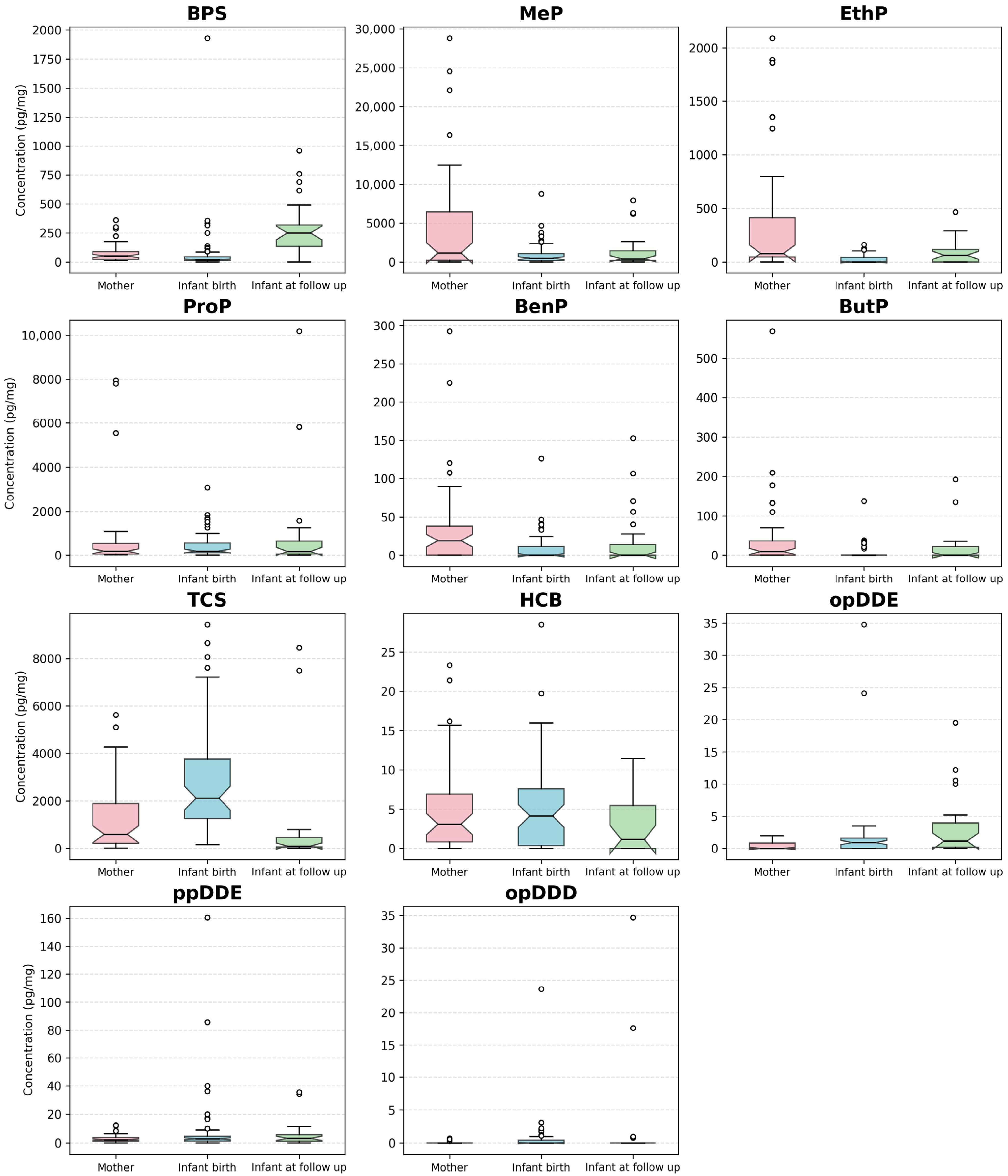
| BPS | 100.0% (75.42 ± 83.64; 12.32–362.21) | 87.1% (79.24 ± 251.21; 0.0–1930.62) | 87.5% (289.2 ± 250.98; 0.0–960.44) |
| MeP | 100.0% (4184.16 ± 6565.91; 24.19–28811.82) | 100.0% (1035.56 ± 1465.96; 17.15–8777.84) | 95.8% (1412.87 ± 2219.13; 0.0–7956.63) |
| EthP | 92.6% (335.93 ± 539.63; 0.0–2090.94) | 38.7% (25.54 ± 39.87; 0.0–162.39) | 70.8% (85.88 ± 108.2; 0.0–468.1) |
| ProP | 100.0% (691.99 ± 1622.63; 17.9–7939.76) | 95.2% (460.62 ± 589.22; 0.0–3070.01) | 83.3% (1003.41 ± 2292.79; 0.0–10182.51) |
| BenP | 61.1% (37.82 ± 64.76; 0.0–292.78) | 25.8% (8.45 ± 19.64; 0.0–126.18) | 29.2% (19.39 ± 39.86; 0.0–152.98) |
| ButP | 50.0% (38.31 ± 86.54; 0.0–568.64) | 17.7% (6.64 ± 19.92; 0.0–137.67) | 37.5% (21.19 ± 46.24; 0.0–191.93) |
| TCS | 100.0% (1303.09 ± 1529.56; 19.43–5619.14) | 100.0% (2840.14 ± 2302.38; 160.27–9435.74) | 87.0% (881.47 ± 2251.94; 0.0–8450.6) |
| HCB | 76.0% (5.06 ± 5.96; 0.0–23.33) | 75.0% (5.58 ± 5.79; 0.0–28.52) | 63.6% (3.04 ± 3.75; 0.0–11.43) |
| opDDE | 44.0% (0.43 ± 0.53; 0.0–1.94) | 73.3% (1.95 ± 5.32; 0.0–34.79) | 72.7% (3.44 ± 5.12; 0.0–19.53) |
| ppDDE | 90.0% (3.07 ± 3.03; 0.0–12.33) | 88.3% (8.71 ± 23.71; 0.0–160.66) | 77.3% (6.37 ± 9.79; 0.0–35.62) |
| opDDD | 8.0% (0.04 ± 0.14; 0.0–0.71) | 31.7% (0.71 ± 3.08; 0.0–23.62) | 18.2% (2.46 ± 8.12; 0.0–34.73) |
| SumDDTs | 90.0% (3.53 ± 3.2; 0.0–14.27) | 91.8% (11.98 ± 33.92; 0.0–225.65) | 95.5% (12.34 ± 19.66; 0.0–82.53) |
| Analyte | Breastfed | Mixed | p-Value * |
|---|---|---|---|
| BPS | 218.73 (130.17–594.16) | 276.98 (150.56–319.51) | 0.841 |
| MeP | 953.15 (119.11–4812.35) | 414.67 (229.73–1347.93) | 0.920 |
| EthP | 0.00 (0.00–30.74) | 68.60 (35.36–116.55) | 0.081 |
| ProP | 157.37 (21.16–759.75) | 280.84 (87.12–799.70) | 0.651 |
| BenP | 0.00 (0.00–35.40) | 0.00 (0.00–27.82) | 0.686 |
| ButP | 10.27 (0.00–28.10) | 0.00 (0.00–20.58) | 0.729 |
| TCS | 154.66 (39.34–388.89) | 100.61 (81.56–456.87) | 0.457 |
| HCB | 0.45 (0.00–8.51) | 1.87 (0.00–5.73) | 0.702 |
| opDDE | 1.67 (1.25–2.24) | 1.00 (0.00–5.19) | 0.612 |
| ppDDE | 0.00 (0.00–4.40) | 4.28 (1.57–7.48) | 0.251 |
| SumDDT | 2.24 (1.25–6.07) | 5.33 (4.41–12.67) | 0.257 |
| At Birth | At Follow-Up | |||||
|---|---|---|---|---|---|---|
| Analyte | Boys | Girls | p-Value * | Boys | Girls | p-Value * |
| BPS | 18.78 (13.25–44.47) | 23.86 (16.90–47.92) | 0.252 | 282.69 (149.44–616.46) | 227.88 (84.65–271.28) | 0.290 |
| MeP | 584.04 (165.62–1099.20) | 451.74 (268.75–1344.53) | 0.821 | 505.93 (238.22–2614.89) | 288.81 (94.60–949.39) | 0.215 |
| EthP | 0.00 (0.00–39.22) | 0.00 (0.00–66.69) | 0.560 | 65.07 (0.00–152.81) | 35.36 (0.00–72.12) | 0.290 |
| ProP | 206.84 (105.13–558.97) | 175.22 (126.24–510.43) | 0.976 | 272.43 (42.31–1233.81) | 145.06 (61.14–540.38) | 0.640 |
| BenP | 0.00 (0.00–0.00) | 0.00 (0.00–16.66) | 0.681 | 0.00 (0.00–0.00) | 0.00 (0.00–27.82) | 0.519 |
| ButP | 0.00 (0.00–0.00) | 0.00 (0.00–10.35) | 0.298 | 0.00 (0.00–20.54) | 20.58 (0.00–26.28) | 0.263 |
| TCS | 2158.79 (1242.35–4022.91) | 2086.61 (1384.41–3510.68) | 0.940 | 92.08 (54.61–456.87) | 181.03 (32.93–483.75) | 0.875 |
| HCB | 4.41 (1.91–6.99) | 3.28 (0.00–9.85) | 0.752 | 2.49 (0.00–7.18) | 0.42 (0.00–2.92) | 0.238 |
| opDDE | 0.88 (0.30–1.62) | 0.95 (0.00–1.83) | 0.764 | 1.71 (0.00–4.41) | 0.91 (0.72–5.62) | 0.815 |
| ppDDE | 2.72 (1.29–4.56) | 3.12 (1.33–5.14) | 0.695 | 3.76 (1.54–7.48) | 2.41 (0.58–4.58) | 0.402 |
| opDDD | 0.00 (0.00–0.36) | 0.00 (0.00–1.03) | 0.154 | 0.00 (0.00–0.77) | 0.00 (0.00–0.00) | 0.297 |
| SumDDΤ | 3.58 (2.26–8.53) | 4.44 (2.13–10.14) | 0.481 | 5.33 (3.12–12.67) | 4.52 (2.07–7.91) | 0.365 |
| Analyte | Group | N | Mean (SD) (pg/mg) | Median (IQR) (pg/mg) | Wilcoxon Signed Ranks Test—p Values (Pair) |
|---|---|---|---|---|---|
| BPS | Mother | 54 | 75.42 (83.64) | 51.08 (22.76–89.65) | 0.001 */<0.0001 **/0.001 *** |
| Infant at birth | 62 | 79.24 (251.21) | 19.35 (13.98–46.64) | ||
| Infant at follow-up | 24 | 289.20 (250.98) | 250.40 (100.85–319.09) | ||
| MeP | Mother | 54 | 4184.16 (6565.91) | 1151.80 (214.56–7066.58) | 0.006/0.065/0.075 |
| Infant at birth | 62 | 1035.56 (1465.96) | 487.63 (184.85–1180.18) | ||
| Infant at follow-up | 24 | 1412.87 (2219.13) | 414.67 (146.31–1588.05) | ||
| EthP | Mother | 54 | 335.93 (539.63) | 79.51 (45.80–435.60) | <0.0001/0.001/0.122 |
| Infant at birth | 62 | 25.54 (39.87) | 0.00 (0.00–44.34) | ||
| Infant at follow-up | 24 | 85.88 (108.20) | 62.10 (0.00–116.53) | ||
| ProP | Mother | 54 | 691.99 (1622.63) | 188.04 (51.65–570.52) | 0.160/0.726/0.151 |
| Infant at birth | 62 | 460.62 (589.22) | 195.23 (111.72–570.22) | ||
| Infant at follow-up | 24 | 1003.41 (2292.79) | 175.22 (47.02–747.77) | ||
| BenP | Mother | 54 | 37.82 (64.76) | 19.15 (0.00–40.07) | 0.001/0.070/0.594 |
| Infant at birth | 62 | 8.45 (19.64) | 0.00 (0.00–15.44) | ||
| Infant at follow-up | 24 | 19.39 (39.86) | 0.00 (0.00–23.23) | ||
| ButP | Mother | 54 | 38.31 (86.54) | 9.79 (0.00–36.86) | <0.0001/0.070/0.424 |
| Infant at birth | 62 | 6.64 (19.92) | 0.00 (0.00–0.00) | ||
| Infant at follow-up | 24 | 21.19 (46.24) | 0.00 (0.00–24.41) | ||
| TCS | Mother | 54 | 1303.09 (1529.56) | 595.12 (211.46–2011.26) | <0.0001/0.014/0.001 |
| Infant at birth | 62 | 2840.14 (2302.38) | 2115.46 (1252.67–3777.59) | ||
| Infant at follow-up | 23 | 881.47 (2251.94) | 97.15 (54.61–456.87) | ||
| HCB | Mother | 50 | 5.06 (5.96) | 3.09 (0.55–7.16) | 0.168/0.179/0.904 |
| Infant at birth | 60 | 5.58 (5.79) | 4.13 (0.11–7.95) | ||
| Infant at follow-up | 22 | 3.04 (3.75) | 1.13 (0.00–5.76) | ||
| opDDE | Mother | 50 | 0.43 (0.53) | 0.00 (0.00–0.84) | 0.007/0.003/0.079 |
| Infant at birth | 60 | 1.95 (5.32) | 0.90 (0.00–1.64) | ||
| Infant at follow-up | 22 | 3.44 (5.12) | 1.13 (0.00–4.60) | ||
| ppDDE | Mother | 50 | 3.07 (3.03) | 2.26 (1.23–4.05) | 0.147/0.232/0.874 |
| Infant at birth | 60 | 8.71 (23.71) | 2.88 (1.31–4.90) | ||
| Infant at follow-up | 22 | 6.37 (9.79) | 3.21 (0.87–6.33) | ||
| opDDD | Mother | 50 | 0.04 (0.14) | 0.00 (0.00–0.00) | 0.002/0.080/0.953 |
| Infant at birth | 60 | 0.71 (3.08) | 0.00 (0.00–0.42) | ||
| Infant at follow-up | 22 | 2.46 (8.12) | 0.00 (0.00–0.00) | ||
| ΣDDT | Mother | 50 | 3.53 (3.20) | 3.04 (1.50–4.45) | 0.008/0.006/0.702 |
| Infant at birth | 49 | 11.98 (33.92) | 3.81 (2.19–8.57) | ||
| Infant at follow-up | 22 | 12.34 (19.66) | 5.06 (2.24–12.19) |
Disclaimer/Publisher’s Note: The statements, opinions and data contained in all publications are solely those of the individual author(s) and contributor(s) and not of MDPI and/or the editor(s). MDPI and/or the editor(s) disclaim responsibility for any injury to people or property resulting from any ideas, methods, instructions or products referred to in the content. |
© 2026 by the authors. Licensee MDPI, Basel, Switzerland. This article is an open access article distributed under the terms and conditions of the Creative Commons Attribution (CC BY) license.
Share and Cite
Kalligiannaki, A.; Baliou, S.; Vakonaki, E.; Panteris, E.; Hatzidaki, E.; Tzatzarakis, M.N. Dynamics of Endocrine Disruptor Exposure in Early Life: A Mother–Infant Hair Biomonitoring Study. Toxics 2026, 14, 175. https://doi.org/10.3390/toxics14020175
Kalligiannaki A, Baliou S, Vakonaki E, Panteris E, Hatzidaki E, Tzatzarakis MN. Dynamics of Endocrine Disruptor Exposure in Early Life: A Mother–Infant Hair Biomonitoring Study. Toxics. 2026; 14(2):175. https://doi.org/10.3390/toxics14020175
Chicago/Turabian StyleKalligiannaki, Aikaterini, Stella Baliou, Elena Vakonaki, Eleftherios Panteris, Eleftheria Hatzidaki, and Manolis N. Tzatzarakis. 2026. "Dynamics of Endocrine Disruptor Exposure in Early Life: A Mother–Infant Hair Biomonitoring Study" Toxics 14, no. 2: 175. https://doi.org/10.3390/toxics14020175
APA StyleKalligiannaki, A., Baliou, S., Vakonaki, E., Panteris, E., Hatzidaki, E., & Tzatzarakis, M. N. (2026). Dynamics of Endocrine Disruptor Exposure in Early Life: A Mother–Infant Hair Biomonitoring Study. Toxics, 14(2), 175. https://doi.org/10.3390/toxics14020175