Advances and Challenges in Understanding Atmospheric Oxidizing Capacity in China: Insights from Chemical Mechanisms and Model Applications

 , and
, and Highlights
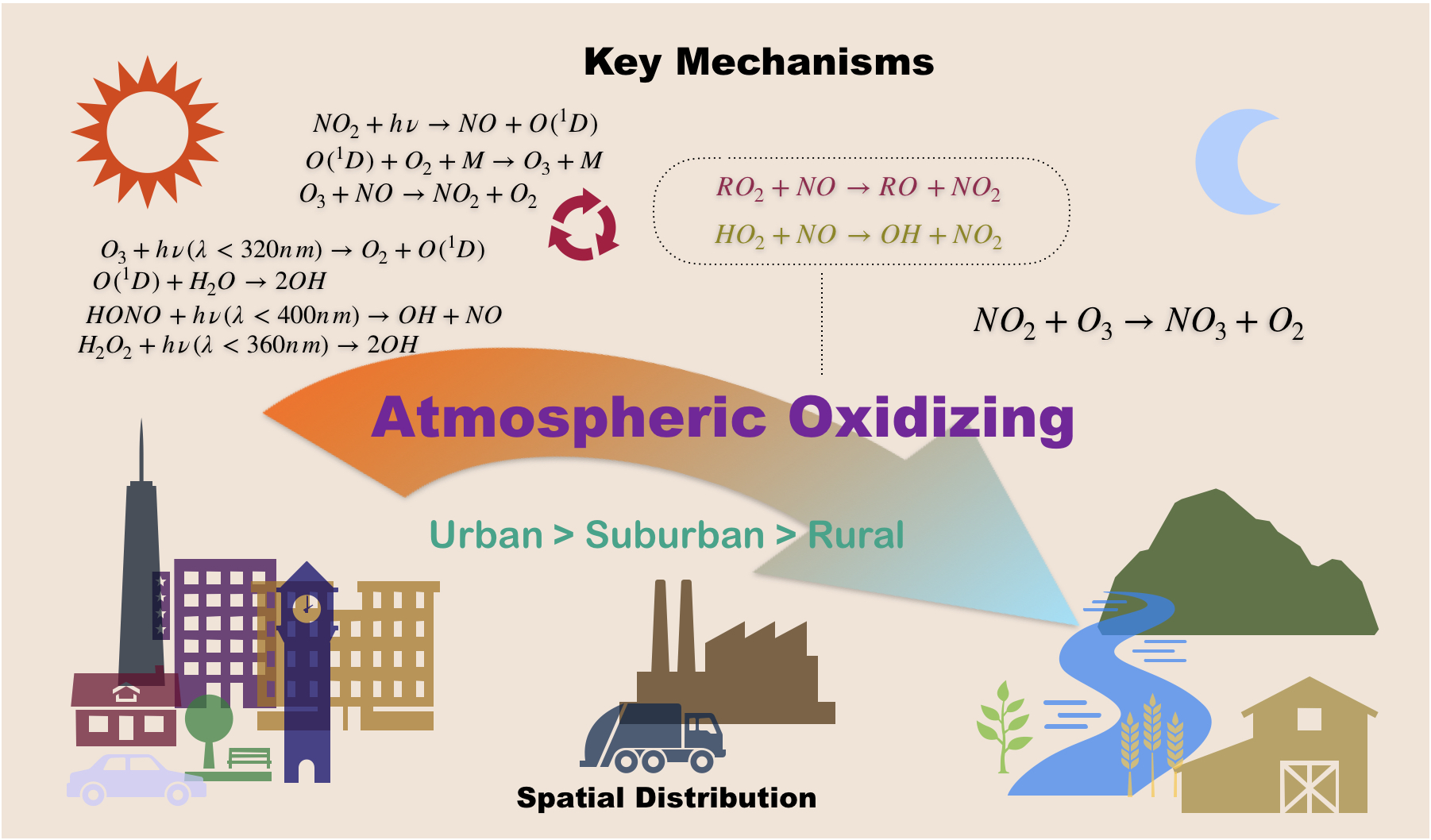
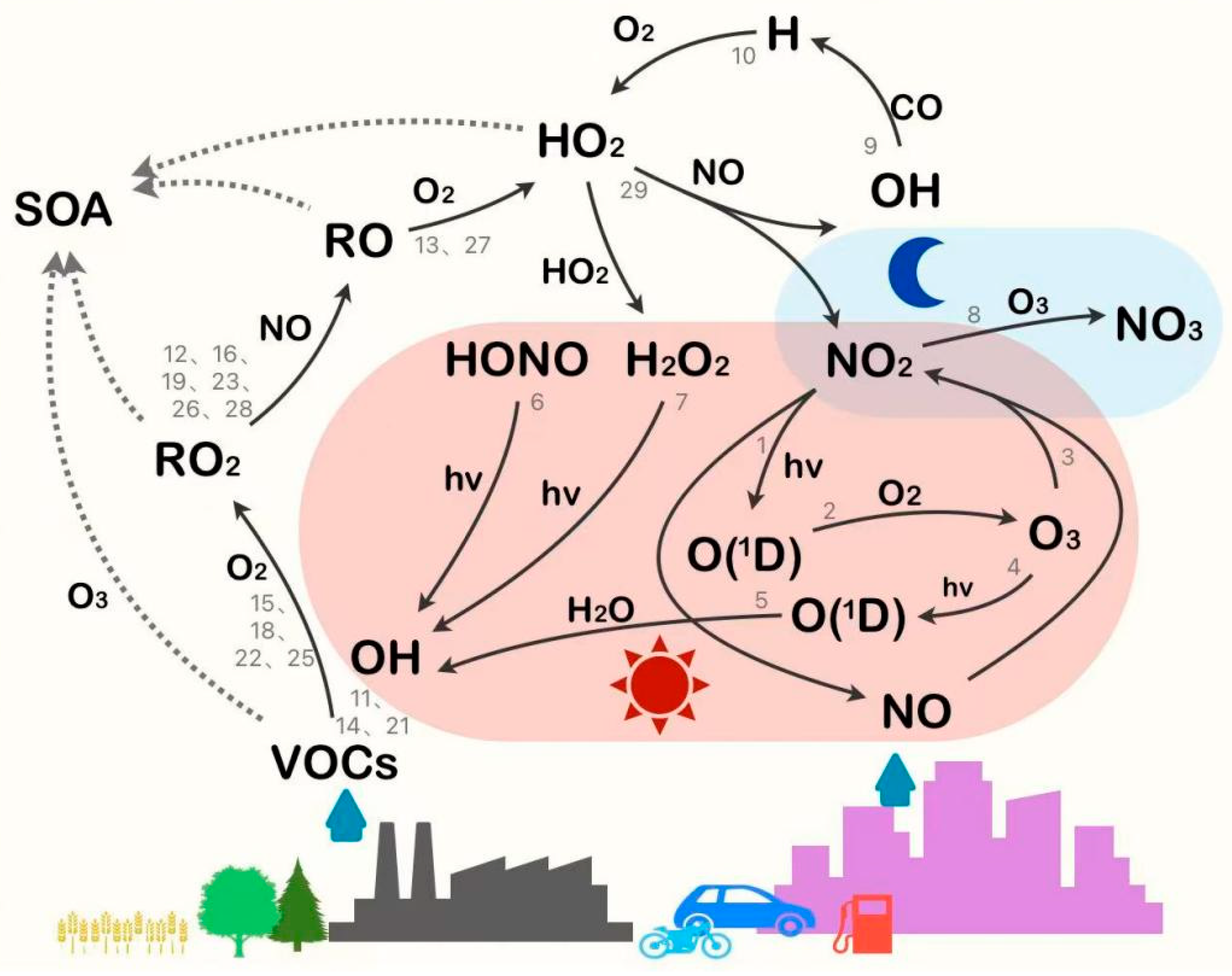
- This study identifies the key formation pathways governing atmospheric oxidation capacity (AOC).
- It reveals and elucidates the distinct spatial distribution patterns of AOC across urban, suburban, and rural environments.
- The work underscores the necessity for enhancing multi-scale observational networks and optimizing related models in future research.
- The scoping review synthesizes recent knowledge regarding AOC, enabling the readers to acquire a profound understanding of the intricate nature of air pollution.
- Direct scientific evidence for formulating targeted spatial strategies to mitigate complex air pollution is provided.
Abstract
1. Introduction
2. Characterization of Atmospheric Oxidizing Capacity and Its Key Chemical Processes
2.1. Characterization
2.2. Key Processes
2.3. Key Influencing Factors Other than Anthropogenic VOCs
2.3.1. Meteorological Influences
2.3.2. Aerosol Effects
2.3.3. Biogenic VOC Emissions
3. The Regional Characteristics of the AOC
3.1. Urban Areas
3.2. Suburban Areas
3.3. Rural Areas
4. Modeling Studies on Atmospheric Oxidizing Capacity
4.1. Chemical Transport Models (CTMs): Core Tools for Research
4.1.1. Key Features of WRF-Chem and CMAQ
4.1.2. Case Studies: Applications of CTMs in Oxidation and SOA Research
4.2. Machine Learning Models
5. Limitations of Current Studies
5.1. Insufficient Observational Data and Uncertainties in Model Simulations
5.2. Imperfect Chemical Mechanisms
5.3. Key Knowledge Gaps
6. Conclusions and Recommendations
Supplementary Materials
Author Contributions
Funding
Institutional Review Board Statement
Informed Consent Statement
Data Availability Statement
Conflicts of Interest
References
- Seinfeld, J.H.; Pandis, S.N. Atmospheric Chemistry and Physics: From Air Pollution to Climate Change, 3rd ed.; Wiley: Hoboken, NJ, USA, 2016. [Google Scholar]
- Lu, K.; Guo, S.; Tan, Z.; Wang, H.; Shang, D.; Liu, Y.; Li, X.; Wu, Z.; Hu, M.; Zhang, Y. Exploring atmospheric free-radical chemistry in China: The self-cleansing capacity and the formation of secondary air pollution. Natl. Sci. Rev. 2019, 6, 579–594. [Google Scholar] [CrossRef] [Scilit] [PubMed]
- World Health Organization. WHO Global Air Quality Guidelines: Particulate Matter (PM2.5 and PM10), Ozone, Nitrogen Dioxide, Sulfur Dioxide and Carbon Monoxide: Executive Summary. Available online: https://iris.who.int/handle/10665/345334 (accessed on 22 September 2021).
- Hallquist, M.; Wenger, J.C.; Baltensperger, U.; Rudich, Y.; Simpson, D.; Claeys, M.; Dommen, J.; Donahue, N.M.; George, C.; Goldstein, A.H.; et al. The formation, properties and impact of secondary organic aerosol: Current and emerging issues. Atmos. Chem. Phys. 2009, 9, 5155–5236. [Google Scholar] [CrossRef] [Scilit]
- Wang, H.; Wang, H.; Lu, X.; Lu, K.; Zhang, L.; Tham, Y.J.; Shi, Z.; Aikin, K.; Fan, S.; Brown, S.S.; et al. Increased night-time oxidation over China despite widespread decrease across the globe. Nat. Geosci. 2023, 16, 217–223. [Google Scholar] [CrossRef] [Scilit]
- Luo, Y.; Zhao, T.; Meng, K.; Zhang, L.; Wu, M.; Bai, Y.; Kumar, K.R.; Cheng, X.; Yang, Q.; Liang, D. Distinct responses of urban and rural O3 pollution with secondary particle changes to anthropogenic emission reductions: Insights from a case study over North China. Sci. Total Environ. 2024, 950, 175340. [Google Scholar] [CrossRef] [Scilit]
- Xu, L.; Du, L.; Tsona, N.T.; Ge, M. Anthropogenic Effects on Biogenic Secondary Organic Aerosol Formation. Adv. Atmos. Sci. 2021, 38, 1053–1084. [Google Scholar] [CrossRef] [Scilit]
- Feng, T.; Zhao, S.; Bei, N.; Liu, S.; Li, G. Increasing atmospheric oxidizing capacity weakens emission mitigation effort in Beijing during autumn haze events. Chemosphere 2021, 281, 130855. [Google Scholar] [CrossRef] [Scilit]
- Zhou, X.; Gao, X.; Chang, Y.; Zhao, S.; Li, Y. Influence of atmospheric oxidation capacity on atmospheric particulate matters concentration in Lanzhou. Sci. Total Environ. 2024, 914, 169664. [Google Scholar] [CrossRef] [Scilit]
- Monks, P. Gas-Phase Radical Chemistry in the Troposphere. Chem. Soc. Rev. 2005, 34, 376–395. [Google Scholar] [CrossRef] [Scilit]
- Wang, G.; Iradukunda, Y.; Shi, G.; Sanga, P.; Niu, X.; Wu, Z. Hydroxyl, hydroperoxyl free radicals determination methods in atmosphere and troposphere. J. Environ. Sci. 2021, 99, 324–335. [Google Scholar] [CrossRef] [Scilit] [PubMed]
- Jia, C.; Tong, S.; Zhang, X.; Li, F.; Zhang, W.; Li, W.; Wang, Z.; Zhang, G.; Tang, G.; Liu, Z.; et al. Atmospheric oxidizing capacity in autumn Beijing: Analysis of the O3 and PM2.5 episodes based on observation-based model. J. Environ. Sci. 2023, 124, 557–569. [Google Scholar] [CrossRef] [Scilit] [PubMed]
- He, L.; Duan, Y.; Zhang, Y.; Yu, Q.; Huo, J.; Chen, J.; Cui, H.; Li, Y.; Ma, W. Effects of VOC emissions from chemical industrial parks on regional O3-PM2.5 compound pollution in the Yangtze River Delta. Sci. Total Environ. 2024, 906, 167503. [Google Scholar] [CrossRef] [Scilit]
- Tan, Z.; Lu, K.; Jiang, M.; Su, R.; Wang, H.; Lou, S.; Fu, Q.; Zhai, C.; Tan, Q.; Yue, D.; et al. Daytime atmospheric oxidation capacity in four Chinese megacities during the photochemically polluted season: A case study based on box model simulation. Atmos. Chem. Phys. 2019, 19, 3493–3513. [Google Scholar] [CrossRef] [Scilit]
- Kovacs, T.A.; Brune, W.H. Total OH Loss Rate Measurement. J. Atmos. Chem. 2001, 39, 105–122. [Google Scholar] [CrossRef] [Scilit]
- Yang, X. A Review of the Direct Measurement of Total OH Reactivity: Ambient Air and Vehicular Emission. Sustainability 2023, 15, 16246. [Google Scholar] [CrossRef] [Scilit]
- Taheri, A.; Khorsandi, B.; Alavi Moghaddam, M.R. Analysis of local and regional contributions of oxidant (OX = O3 + NO2) levels based on monitoring data, a review. Int. J. Environ. Sci. Technol. 2024, 21, 8211–8230. [Google Scholar] [CrossRef] [Scilit]
- Taheri, A.; Khorsandi, B.; Alavi Moghaddam, M.R. A long-term analysis of oxidant (OX = O3 + NO2) and its local and regional levels in Tehran, Iran, a high NOx-saturated condition. Sci. Rep. 2025, 15, 2521. [Google Scholar] [CrossRef] [Scilit]
- Liu, Z.; Wang, Y.; Hu, B.; Lu, K.; Tang, G.; Ji, D.; Yang, X.; Gao, W.; Xie, Y.; Liu, J.; et al. Elucidating the quantitative characterization of atmospheric oxidation capacity in Beijing, China. Sci. Total Environ. 2021, 771, 145306. [Google Scholar] [CrossRef] [Scilit]
- Yang, Y.; Wang, Y.; Huang, W.; Yao, D.; Zhao, S.; Wang, Y.; Ji, D.; Zhang, R.; Wang, Y. Parameterized atmospheric oxidation capacity and speciated OH reactivity over a suburban site in the North China Plain: A comparative study between summer and winter. Sci. Total Environ. 2021, 773, 145264. [Google Scholar] [CrossRef] [Scilit]
- Friedlander, S.K.; Seinfeld, J.H. Dynamic model of photochemical smog. Environ. Sci. Technol. 1969, 3, 1175–1181. [Google Scholar] [CrossRef] [Scilit]
- Liu, Y.; Wang, H.; Jing, S.; Zhou, M.; Lou, S.; Qu, K.; Qiu, W.; Wang, Q.; Li, S.; Gao, Y.; et al. Vertical Profiles of Volatile Organic Compounds in Suburban Shanghai. Adv. Atmos. Sci. 2021, 38, 1177–1187. [Google Scholar] [CrossRef] [Scilit]
- Wang, P.; Zhu, S.; Vrekoussis, M.; Brasseur, G.P.; Wang, S.; Zhang, H. Is atmospheric oxidation capacity better in indicating tropospheric O3 formation? Front. Environ. Sci. Eng. 2022, 16, 65. [Google Scholar] [CrossRef] [Scilit] [PubMed]
- Yang, X.; Li, Y.; Ma, X.; Tan, Z.; Lu, K.; Zhang, Y. Unclassical Radical Generation Mechanisms in the Troposphere: A Review. Environ. Sci. Technol. 2024, 58, 15888–15909. [Google Scholar] [CrossRef] [Scilit] [PubMed]
- Wang, G.; Jia, S.; Li, R.; Ma, S.; Chen, X.; Wu, Z.; Shi, G.; Niu, X. Seasonal variation characteristics of hydroxyl radical pollution and its potential formation mechanism during the daytime in Lanzhou. J. Environ. Sci. 2020, 95, 58–64. [Google Scholar] [CrossRef] [Scilit] [PubMed]
- Yang, X.; Lu, K.; Ma, X.; Liu, Y.; Wang, H.; Hu, R.; Li, X.; Lou, S.; Chen, S.; Dong, H.; et al. Observations and modeling of OH and HO2 radicals in Chengdu, China in summer 2019. Sci. Total Environ. 2021, 772, 144829. [Google Scholar] [CrossRef] [Scilit]
- Xue, M.; Ma, J.; Tang, G.; Tong, S.; Hu, B.; Zhang, X.; Li, X.; Wang, Y. ROx Budgets and O3 Formation during Summertime at Xianghe Suburban Site in the North China Plain. Adv. Atmos. Sci. 2021, 38, 1209–1222. [Google Scholar] [CrossRef] [Scilit]
- Wang, F.; Du, W.; Lv, S.; Ding, Z.; Wang, G. Spatial and Temporal Distributions and Sources of Anthropogenic NMVOCs in the Atmosphere of China: A Review. Adv. Atmos. Sci. 2021, 38, 1085–1100. [Google Scholar] [CrossRef] [Scilit]
- Atkinson, R.; Arey, J. Atmospheric Degradation of Volatile Organic Compounds. Chem. Rev. 2003, 103, 4605–4638. [Google Scholar] [CrossRef] [Scilit]
- Cai, B.; Cheng, H.; Kang, T. Establishing the emission inventory of biogenic volatile organic compounds and quantifying their contributions to O3 and PM2.5 in the Beijing-Tianjin-Hebei region. Atmos. Environ. 2024, 318, 120206. [Google Scholar] [CrossRef] [Scilit]
- Bianchi, F.; Kurtén, T.; Riva, M.; Mohr, C.; Rissanen, M.P.; Roldin, P.; Berndt, T.; Crounse, J.D.; Wennberg, P.O.; Mentel, T.F.; et al. Highly Oxygenated Organic Molecules (HOM) from Gas-Phase Autoxidation Involving Peroxy Radicals: A Key Contributor to Atmospheric Aerosol. Chem. Rev. 2019, 119, 3472–3509. [Google Scholar] [CrossRef] [Scilit]
- Li, J.; Chen, T.; Zhang, H.; Jia, Y.; Chu, Y.; Yan, Y.; Zhang, H.; Ren, Y.; Li, H.; Hu, J.; et al. Nonlinear effect of NOx concentration decrease on secondary aerosol formation in the Beijing-Tianjin-Hebei region: Evidence from smog chamber experiments and field observations. Sci. Total Environ. 2024, 912, 168333. [Google Scholar] [CrossRef] [Scilit]
- Fu, Z.; Guo, S.; Xie, H.-B.; Zhou, P.; Boy, M.; Yao, M.; Hu, M. A Near-Explicit Reaction Mechanism of Chlorine-Initiated Limonene: Implications for Health Risks Associated with the Concurrent Use of Cleaning Agents and Disinfectants. Environ. Sci. Technol. 2024, 58, 19762–19773. [Google Scholar] [CrossRef] [Scilit]
- Xiao, M.; Wang, M.; Mentler, B.; Garmash, O.; Lamkaddam, H.; Molteni, U.; Simon, M.; Ahonen, L.; Amorim, A.; Baccarini, A.; et al. Anthropogenic organic aerosol in Europe produced mainly through second-generation oxidation. Nat. Geosci. 2025, 18, 239–245. [Google Scholar] [CrossRef] [Scilit] [PubMed]
- Tang, X.; Lin, X.; Garcia, G.A.; Loison, J.-C.; Gouid, Z.; Abdallah, H.H.; Fittschen, C.; Hochlaf, M.; Gu, X.; Zhang, W.; et al. Identifying isomers of peroxy radicals in the gas phase: 1-C3H7O2 vs. 2-C3H7O2. Chem. Commun. 2020, 56, 15525–15528. [Google Scholar] [CrossRef] [Scilit] [PubMed]
- Wen, Z.; Lin, X.; Tang, X.; Long, B.; Wang, C.; Zhang, C.; Fittschen, C.; Yang, J.; Gu, X.; Zhang, W. Vacuum ultraviolet photochemistry of the conformers of the ethyl peroxy radical. Phys. Chem. Chem. Phys. 2021, 23, 22096–22102. [Google Scholar] [CrossRef] [Scilit] [PubMed]
- Li, Y.; Ma, X.; Lu, K.; Gao, Y.; Xu, W.; Yang, X.; Zhang, Y. Investigation of the Cyclohexene Oxidation Mechanism Through the Direct Measurement of Organic Peroxy Radicals. Environ. Sci. Technol. 2024, 58, 19807–19817. [Google Scholar] [CrossRef] [Scilit]
- Shi, Y.; Xu, Y.; Jia, L. Development and Application of Atmospheric Chemical Mechanisms. Clim. Environ. Res. 2012, 17, 112–124. (In Chinese) [Google Scholar]
- Jimenez, P.; Baldasano, J.M.; Dabdub, D. Comparison of photochemical mechanisms for air quality modeling. Atmos. Environ. 2003, 37, 4179–4194. [Google Scholar] [CrossRef] [Scilit]
- Liu, Y.; Li, J.; Ma, Y.; Zhou, M.; Tan, Z.; Zeng, L.; Lu, K.; Zhang, Y. A review of gas-phase chemical mechanisms commonly used in atmospheric chemistry modelling. J. Environ. Sci. 2023, 123, 522–534. [Google Scholar] [CrossRef] [Scilit]
- Xue, L.; Gu, R.; Wang, T.; Wang, X.; Saunders, S.; Blake, D.; Louie, P.K.K.; Luk, C.W.Y.; Simpson, I.; Xu, Z.; et al. Oxidative capacity and radical chemistry in the polluted atmosphere of Hong Kong and Pearl River Delta region: Analysis of a severe photochemical smog episode. Atmos. Chem. Phys. 2016, 16, 9891–9903. [Google Scholar] [CrossRef] [Scilit]
- Xu, Z.; Huang, X.; Nie, W.; Chi, X.; Xu, Z.; Zheng, L.; Sun, P.; Ding, A. Influence of synoptic condition and holiday effects on VOCs and ozone production in the Yangtze River Delta region, China. Atmos. Environ. 2017, 168, 112–124. [Google Scholar] [CrossRef] [Scilit]
- He, H.; Li, Z.; Dickerson, R.R. Ozone Pollution in the North China Plain during the 2016 Air Chemistry Research in Asia (ARIAs) Campaign: Observations and a Modeling Study. Air 2024, 2, 178–208. [Google Scholar] [CrossRef] [Scilit]
- Ding, D.; Xing, J.; Wang, S.; Chang, X.; Hao, J. Impacts of emissions and meteorological changes on China’s ozone pollution in the warm seasons of 2013 and 2017. Front. Environ. Sci. Eng. 2019, 13, 76. [Google Scholar] [CrossRef] [Scilit]
- Bei, N.; Li, X.; Wang, Q.; Liu, S.; Wu, J.; Liang, J.; Liu, L.; Wang, R.; Li, G. Impacts of Aerosol-Radiation Interactions on the Wintertime Particulate Pollution under Different Synoptic Patterns in the Guanzhong Basin, China. Adv. Atmos. Sci. 2021, 38, 1141–1152. [Google Scholar] [CrossRef] [Scilit]
- Li, K.; Jacob, D.J.; Shen, L.; Lu, X.; De Smedt, I.; Liao, H. Increases in surface ozone pollution in China from 2013 to 2019: Anthropogenic and meteorological influences. Atmos. Chem. Phys. 2020, 20, 11423–11433. [Google Scholar] [CrossRef] [Scilit]
- Zhou, X.; Gao, X.; Chang, Y.; Zhao, S.; Li, P. The pattern and mechanism of an unhealthy air pollution event in Lanzhou, China. Urban Clim. 2023, 48, 101409. [Google Scholar] [CrossRef] [Scilit]
- Bai, K.; Wu, C.; Li, J.; Li, K.; Guo, J.; Wang, G. Characteristics of Chemical Speciation in PM1 in Six Representative Regions in China. Adv. Atmos. Sci. 2021, 38, 1101–1114. [Google Scholar] [CrossRef] [Scilit]
- An, J.; Lv, H.; Xue, M.; Zhang, Z.; Hu, B.; Wang, J.; Zhu, B. Analysis of the Effect of Optical Properties of Black Carbon on Ozone in an Urban Environment at the Yangtze River Delta, China. Adv. Atmos. Sci. 2021, 38, 1153–1164. [Google Scholar] [CrossRef] [Scilit]
- Lyu, X.; Li, H.; Lee, S.-C.; Xiong, E.; Guo, H.; Wang, T.; de Gouw, J. Significant Biogenic Source of Oxygenated Volatile Organic Compounds and the Impacts on Photochemistry at a Regional Background Site in South China. Environ. Sci. Technol. 2024, 58, 20081–20090. [Google Scholar] [CrossRef] [Scilit]
- Pfannerstill, E.Y.; Arata, C.; Zhu, Q.; Schulze, B.C.; Ward, R.; Woods, R.; Harkins, C.; Schwantes, R.H.; Seinfeld, J.H.; Bucholtz, A.; et al. Temperature-dependent emissions dominate aerosol and ozone formation in Los Angeles. Science 2024, 384, 1324–1329. [Google Scholar] [CrossRef] [Scilit]
- Chen, T.; Zhang, P.; Ma, Q.; Chu, B.; Liu, J.; Ge, Y.; He, H. Smog Chamber Study on the Role of NOx in SOA and O3 Formation from Aromatic Hydrocarbons. Environ. Sci. Technol. 2022, 56, 13654–13663. [Google Scholar] [CrossRef] [Scilit]
- Pullinen, I.; Schmitt, S.; Kang, S.; Sarrafzadeh, M.; Schlag, P.; Andres, S.; Kleist, E.; Mentel, T.F.; Rohrer, F.; Springer, M.; et al. Impact of NOx on secondary organic aerosol (SOA) formation from α-pinene and β-pinene photooxidation: The role of highly oxygenated organic nitrates. Atmos. Chem. Phys. 2020, 20, 10125–10147. [Google Scholar] [CrossRef] [Scilit]
- Cui, M.; An, X.; Xing, L.; Li, G.; Tang, G.; He, J.; Long, X.; Zhao, S. Simulated Sensitivity of Ozone Generation to Precursors in Beijing during a High O3 Episode. Adv. Atmos. Sci. 2021, 38, 1223–1237. [Google Scholar] [CrossRef] [Scilit]
- Shao, B.; Cui, Y.; He, Q.; Guo, L.; Gao, J.; Zhao, J.; Wang, X. Parameterized atmospheric oxidation capacity during summer at an urban site in Taiyuan and implications for O3 pollution control. Atmos. Pollut. Res. 2024, 15, 102181. [Google Scholar] [CrossRef] [Scilit]
- Kang, Y.; Tang, G.; Li, Q.; Liu, B.; Cao, J.; Hu, Q.; Wang, Y. Evaluation and Evolution of MAX-DOAS-observed Vertical NO2 Profiles in Urban Beijing. Adv. Atmos. Sci. 2021, 38, 1188–1196. [Google Scholar] [CrossRef] [Scilit]
- Zhu, Q.; Cao, L.-M.; Tang, M.-X.; Huang, X.-F.; Saikawa, E.; He, L.-Y. Characterization of Organic Aerosol at a Rural Site in the North China Plain Region: Sources, Volatility and Organonitrates. Adv. Atmos. Sci. 2021, 38, 1115–1127. [Google Scholar] [CrossRef] [Scilit]
- Yu, K.; Zhu, Q.; Du, K.; Huang, X.F. Characterization of nighttime formation of particulate organic nitrates based on high-resolution aerosol mass spectrometry in an urban atmosphere in China. Atmos. Chem. Phys. 2019, 19, 5235–5249. [Google Scholar] [CrossRef] [Scilit]
- Ma, F.; Wang, H.; Ding, Y.; Zhang, S.; Wu, G.; Li, Y.; Gong, D.; Ristovski, Z.; He, C.; Wang, B. Amplified Secondary Organic Aerosol Formation Induced by Anthropogenic–Biogenic Interactions in Forests Around Megacities. J. Geophys. Res. Atmos. 2024, 129, e2024JD041679. [Google Scholar] [CrossRef] [Scilit]
- Yang, C.; Hong, Z.; Chen, J.; Xu, L.; Zhuang, M.; Huang, Z. Characteristics of secondary organic aerosols tracers in PM2.5 in three central cities of the Yangtze river delta, China. Chemosphere 2022, 293, 133637. [Google Scholar] [CrossRef] [Scilit]
- Du, W.; Wang, X.; Yang, F.; Bai, K.; Wu, C.; Liu, S.; Wang, F.; Lv, S.; Chen, Y.; Wang, J.; et al. Particulate Amines in the Background Atmosphere of the Yangtze River Delta, China: Concentration, Size Distribution, and Sources. Adv. Atmos. Sci. 2021, 38, 1128–1140. [Google Scholar] [CrossRef] [Scilit]
- Gao, Z.; Zhou, X. A review of the CAMx, CMAQ, WRF-Chem and NAQPMS models: Application, evaluation and uncertainty factors. Environ. Pollut. 2024, 343, 123183. [Google Scholar] [CrossRef] [Scilit]
- da Costa, T.F.; Carvalho, J.B.B.; Pedruzzi, R.; Albuquerque, T.T.A.; Martins, E.M. A Systematic Review of Tropospheric Ozone Modeling Using Community Multiscale Air Quality Model (CMAQ). J. Braz. Chem. Soc. 2024, 35, e-20240042. [Google Scholar] [CrossRef] [Scilit]
- Binkowski, F.S.; Roselle, S.J. Models-3 Community Multiscale Air Quality (CMAQ) model aerosol component 1. Model description. J. Geophys. Res. Atmos. 2003, 108, 4183. [Google Scholar] [CrossRef] [Scilit]
- Wesely, M.L. Parameterization of surface resistances to gaseous dry deposition in regional-scale numerical models. Atmos. Environ. 1989, 23, 1293–1304. [Google Scholar] [CrossRef] [Scilit]
- Li, G.; Zhang, R.; Fan, J.; Tie, X. Impacts of black carbon aerosol on photolysis and ozone. J. Geophys. Res. Atmos. 2005, 110, D23206. [Google Scholar] [CrossRef] [Scilit]
- Tie, X.; Madronich, S.; Walters, S.; Zhang, R.; Rasch, P.; Collins, W. Effect of clouds on photolysis and oxidants in the troposphere. J. Geophys. Res. Atmos. 2003, 108, 4642. [Google Scholar] [CrossRef] [Scilit]
- Nenes, A.; Pandis, S.N.; Pilinis, C. ISORROPIA: A New Thermodynamic Equilibrium Model for Multiphase Multicomponent Inorganic Aerosols. Aquat. Geochem. 1998, 4, 123–152. [Google Scholar] [CrossRef] [Scilit]
- Donahue, N.M.; Robinson, A.L.; Stanier, C.O.; Pandis, S.N. Coupled Partitioning, Dilution, and Chemical Aging of Semivolatile Organics. Environ. Sci. Technol. 2006, 40, 2635–2643. [Google Scholar] [CrossRef] [Scilit]
- Robinson, A.L.; Donahue, N.M.; Shrivastava, M.K.; Weitkamp, E.A.; Sage, A.M.; Grieshop, A.P.; Lane, T.E.; Pierce, J.R.; Pandis, S.N. Rethinking Organic Aerosols: Semivolatile Emissions and Photochemical Aging. Science 2007, 315, 1259–1262. [Google Scholar] [CrossRef] [Scilit]
- Emery, C.; Liu, Z.; Russell, A.G.; Odman, M.T.; Yarwood, G.; Kumar, N. Recommendations on statistics and benchmarks to assess photochemical model performance. J. Air Waste Manag. Assoc. 2017, 67, 582–598. [Google Scholar] [CrossRef] [Scilit]
- Dong, J.-Q.; Hu, D.-M.; Yan, Y.-L.; Peng, L.; Zhang, P.-H.; Niu, Y.-Y.; Duan, X.-L. Revealing Driving Factors of Urban O3 Based on Explainable Machine Learning. Environ. Sci. 2023, 44, 3660–3668. (In Chinese) [Google Scholar]
- Wang, Z.; Li, J.; Wu, L.; Zhu, M.; Zhang, Y.; Ye, Z. Deep learning-based gas-phase chemical kinetics kernel emulator: Application in a global air quality simulation case. Front. Environ. Sci. 2022, 10, 955980. [Google Scholar] [CrossRef] [Scilit]
- Qiu, Y.; Feng, J.; Zhang, Z.; Zhao, X.; Li, Z.; Ma, Z.; Liu, R.; Zhu, J. Regional aerosol forecasts based on deep learning and numerical weather prediction. npj Clim. Atmos. Sci. 2023, 6, 71. [Google Scholar] [CrossRef] [Scilit]
- Chen, C.; Zhang, Z.; Wei, L.; Qiu, Y.; Xu, W.; Song, S.; Sun, J.; Li, Z.; Chen, Y.; Ma, N.; et al. The importance of hydroxymethanesulfonate (HMS) in winter haze episodes in North China Plain. Environ. Res. 2022, 211, 113093. [Google Scholar] [CrossRef] [Scilit] [PubMed]
- Takeuchi, M.; Berkemeier, T.; Eris, G.; Ng, N.L. Non-linear effects of secondary organic aerosol formation and properties in multi-precursor systems. Nat. Commun. 2022, 13, 7883. [Google Scholar] [CrossRef] [Scilit] [PubMed]
- Ji, Y.; Shi, Q.; Li, Y.; An, T.; Zheng, J.; Peng, J.; Gao, Y.; Chen, J.; Li, G.; Wang, Y.; et al. Carbenium ion-mediated oligomerization of methylglyoxal for secondary organic aerosol formation. Proc. Natl. Acad. Sci. USA 2020, 117, 13294–13299. [Google Scholar] [CrossRef] [Scilit] [PubMed]
- Wang, Y.; Zhao, J.; Liu, H.; Li, Y.; Dong, W.; Wu, Y. Photooxidation of Methacrolein in Fe(III)-Oxalate Aqueous System and Its Atmospheric Implication. Adv. Atmos. Sci. 2021, 38, 1252–1263. [Google Scholar] [CrossRef] [Scilit]
- Wang, G.; Zhang, S.; Wu, C.; Zhu, T.; Xu, X.; Ge, S.; Sun, H.; Sun, Z.; Wang, J.; Ji, Y.; et al. Atmospheric sulfate aerosol formation enhanced by interfacial anions. Proc. Natl. Acad. Sci. USA Nexus 2025, 4, pgaf058. [Google Scholar] [CrossRef] [Scilit]
- Chen, T.; Ren, Y.; Zhang, Y.; Ma, Q.; Chu, B.; Liu, P.; Zhang, P.; Zhang, C.; Ge, Y.; Mellouki, A.; et al. Additional HONO and OH Generation from Photoexcited Phenyl Organic Nitrates in the Photoreaction of Aromatics and NOx. Environ. Sci. Technol. 2024, 58, 5911–5920. [Google Scholar] [CrossRef] [Scilit]
- Wang, Y.-L.; Song, W.; Yang, W.; Sun, X.-C.; Tong, Y.-D.; Wang, X.-M.; Liu, C.-Q.; Bai, Z.-P.; Liu, X.-Y. Influences of Atmospheric Pollution on the Contributions of Major Oxidation Pathways to PM2.5 Nitrate Formation in Beijing. J. Geophys. Res. Atmos. 2019, 124, 4174–4185. [Google Scholar] [CrossRef] [Scilit]
- Guan, Q.; Cai, A.; Wang, F.; Yang, L.; Xu, C.; Liu, Z. Spatio-temporal variability of particulate matter in the key part of Gansu Province, Western China. Environ. Pollut. 2017, 230, 189–198. [Google Scholar] [CrossRef] [Scilit]
- Hu, H.; Liang, Y.; Li, T.; She, Y.; Wang, Y.; Yang, T.; Zhou, M.; Li, Z.; Li, C.; Xiao, H.; et al. Pathway-specific responses of isoprene-derived secondary organic aerosol formation to anthropogenic emission reductions in a megacity in eastern China. EGUsphere 2025, 25, 17889–17906. [Google Scholar] [CrossRef] [Scilit]
- Shi, X.; Ge, Y.; Zheng, J.; Ma, Y.; Ren, X.; Zhang, Y. Budget of nitrous acid and its impacts on atmospheric oxidative capacity at an urban site in the central Yangtze River Delta region of China. Atmos. Environ. 2020, 238, 117725. [Google Scholar] [CrossRef] [Scilit]
- Gao, L.; Yue, X.; Meng, X.; Du, L.; Lei, Y.; Tian, C.; Qiu, L. Comparison of Ozone and PM2.5 Concentrations over Urban, Suburban, and Background Sites in China. Adv. Atmos. Sci. 2020, 37, 1297–1309. [Google Scholar] [CrossRef] [Scilit]
- Zhang, X.; Tong, S.; Jia, C.; Zhang, W.; Wang, Z.; Tang, G.; Hu, B.; Liu, Z.; Wang, L.; Zhao, P.; et al. Elucidating HONO formation mechanism and its essential contribution to OH during haze events. npj Clim. Atmos. Sci. 2023, 6, 55. [Google Scholar] [CrossRef]
- Duan, J.; Huang, R.J.; Gu, Y.; Lin, C.; Zhong, H.; Xu, W.; Liu, Q.; You, Y.; Ovadnevaite, J.; Ceburnis, D.; et al. Measurement report: Large contribution of biomass burning and aqueous-phase processes to the wintertime secondary organic aerosol formation in Xi’an, Northwest China. Atmos. Chem. Phys. 2022, 22, 10139–10153. [Google Scholar] [CrossRef] [Scilit]
- Liu, T.; Hong, Y.; Li, M.; Xu, L.; Chen, J.; Bian, Y.; Yang, C.; Dan, Y.; Zhang, Y.; Xue, L.; et al. Atmospheric oxidation capacity and ozone pollution mechanism in a coastal city of southeastern China: Analysis of a typical photochemical episode by an observation-based model. Atmos. Chem. Phys. 2022, 22, 2173–2190. [Google Scholar] [CrossRef] [Scilit]
- Chen, G.; Liu, T.; Chen, J.; Xu, L.; Hu, B.; Yang, C.; Fan, X.; Li, M.; Hong, Y.; Ji, X.; et al. Atmospheric oxidation capacity and O3 formation in a coastal city of southeast China: Results from simulation based on four-season observation. J. Environ. Sci. 2024, 136, 68–80. [Google Scholar] [CrossRef] [Scilit]
- Zhu, J.; Wang, S.; Wang, H.; Jing, S.; Lou, S.; Saiz-Lopez, A.; Zhou, B. Observationally constrained modeling of atmospheric oxidation capacity and photochemical reactivity in Shanghai, China. Atmos. Chem. Phys. 2020, 20, 1217–1232. [Google Scholar] [CrossRef] [Scilit]
- Dawidowski, L.; Gelman Constantin, J.; Herrera Murillo, J.; Gómez-Marín, M.; Nogueira, T.; Blanco Jiménez, S.; Díaz-Suárez, V.; Baraldo Victorica, F.; Lichtig, P.; Díaz Resquin, M.; et al. Carbonaceous fraction in PM2.5 of six Latin American cities: Seasonal variations, sources and secondary organic carbon contribution. Sci. Total Environ. 2024, 948, 174630. [Google Scholar] [CrossRef] [Scilit]
- Ma, S.; Wang, N.; Zhang, J.; Ye, D.; Wang, L. Ammonia chemistry and oxidation dynamics as dual driving factors of PM2.5 nitrate pollution: Insights from the spatiotemporal disparities in central China. J. Environ. Manag. 2025, 392, 126594. [Google Scholar] [CrossRef] [Scilit]
- Azmi, S.; Sharma, M. Global PM2.5 and secondary organic aerosols (SOA) levels with sectorial contribution to anthropogenic and biogenic SOA formation. Chemosphere 2023, 336, 139195. [Google Scholar] [CrossRef] [Scilit]
- Ge, Y.; Shi, X.; Ma, Y.; Zhang, W.; Ren, X.; Zheng, J.; Zhang, Y. Seasonality of nitrous acid near an industry zone in the Yangtze River Delta region of China: Formation mechanisms and contribution to the atmospheric oxidation capacity. Atmos. Environ. 2021, 254, 118420. [Google Scholar] [CrossRef] [Scilit]
- Wang, R.; Wang, L.; Yang, Y.; Zhan, J.; Ji, D.; Hu, B.; Ling, Z.; Xue, M.; Zhao, S.; Yao, D.; et al. Comparative analysis for the impacts of VOC subgroups and atmospheric oxidation capacity on O3 based on different observation-based methods at a suburban site in the North China Plain. Environ. Res. 2024, 248, 118250. [Google Scholar] [CrossRef] [Scilit]
- Hong, Y.; Xu, X.; Liao, D.; Liu, T.; Ji, X.; Xu, K.; Liao, C.; Wang, T.; Lin, C.; Chen, J. Measurement report: Effects of anthropogenic emissions and environmental factors on the formation of biogenic secondary organic aerosol (BSOA) in a coastal city of southeastern China. Atmos. Chem. Phys. 2022, 22, 7827–7841. [Google Scholar] [CrossRef] [Scilit]
- Elshorbany, Y.; Zhu, Y.; Wang, Y.; Zhou, X.; Sanderfield, S.; Ye, C.; Hayden, M.; Peters, A.J. Seasonal dependency of the atmospheric oxidizing capacity of the marine boundary layer of Bermuda. Atmos. Environ. 2022, 289, 119326. [Google Scholar] [CrossRef] [Scilit]
- Kang, S.; Hong, S.; Lee, Y.; Park, G.; Park, T.; Ban, J.; Kim, K.; Kim, Y.; Choi, Y.; Park, J.; et al. Seasonal chemical characteristics and formation of potential secondary aerosols of a remote area in South Korea using an oxidation flow reactor. Atmos. Environ. 2025, 355, 121216. [Google Scholar] [CrossRef] [Scilit]



| Step in Photochemical Smog Formation | Reaction Equations |
|---|---|
| NO2 absorbs UV radiation (300–400 nm) O3 reacts with NO | |
| Reactive hydrocarbons initiate chain reactions, forming radicals and products such as formaldehyde, acrolein, and peroxyacetyl nitrate (PAN) | |
| Radical termination |
Disclaimer/Publisher’s Note: The statements, opinions and data contained in all publications are solely those of the individual author(s) and contributor(s) and not of MDPI and/or the editor(s). MDPI and/or the editor(s) disclaim responsibility for any injury to people or property resulting from any ideas, methods, instructions or products referred to in the content. |
© 2026 by the authors. Licensee MDPI, Basel, Switzerland. This article is an open access article distributed under the terms and conditions of the Creative Commons Attribution (CC BY) license.
Share and Cite
Li, P.; Ren, Y.; Bi, F.; Long, F.; Li, J.; Zhang, H.; Wu, Z.; Li, H. Advances and Challenges in Understanding Atmospheric Oxidizing Capacity in China: Insights from Chemical Mechanisms and Model Applications. Toxics 2026, 14, 159. https://doi.org/10.3390/toxics14020159
Li P, Ren Y, Bi F, Long F, Li J, Zhang H, Wu Z, Li H. Advances and Challenges in Understanding Atmospheric Oxidizing Capacity in China: Insights from Chemical Mechanisms and Model Applications. Toxics. 2026; 14(2):159. https://doi.org/10.3390/toxics14020159
Chicago/Turabian StyleLi, Peixuan, Yanqin Ren, Fang Bi, Fangyun Long, Junling Li, Haijie Zhang, Zhenhai Wu, and Hong Li. 2026. "Advances and Challenges in Understanding Atmospheric Oxidizing Capacity in China: Insights from Chemical Mechanisms and Model Applications" Toxics 14, no. 2: 159. https://doi.org/10.3390/toxics14020159
APA StyleLi, P., Ren, Y., Bi, F., Long, F., Li, J., Zhang, H., Wu, Z., & Li, H. (2026). Advances and Challenges in Understanding Atmospheric Oxidizing Capacity in China: Insights from Chemical Mechanisms and Model Applications. Toxics, 14(2), 159. https://doi.org/10.3390/toxics14020159