Bioactive Properties of Peptides Obtained from the Enzymatic Hydrolysis of Mesquite (Prosopis laevigata) Cotyledon Proteins

 , , ,
, , , 
Abstract
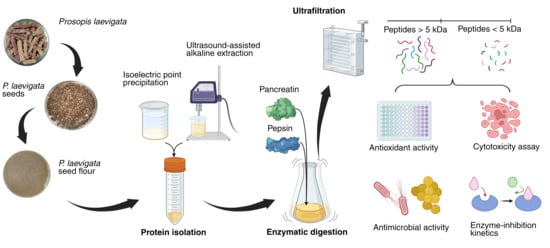
1. Introduction
2. Materials and Methods
2.1. Plant Material
2.2. Seed Flour Preparation
2.3. Protein Extraction
2.3.1. Determination of the pI of P. laevigata Cotyledon Proteins
2.3.2. Alkaline Extraction Assisted with Ultrasound
2.4. Protein Concentration
2.5. Electrophoresis Analysis
2.6. FTIR Spectroscopy
2.7. Enzymatic Hydrolysis
2.8. Peptide Fractionation
2.9. Antioxidant Assays
2.9.1. ABTS Scavenging Activity
2.9.2. Ferric-Reducing Antioxidant Power Assay
2.10. Cell Viability Assay
2.11. Antimicrobial Assay
2.12. Enzyme Inhibition Assay
3. Results and Discussion
3.1. Proximate Analysis
3.2. Protein Extraction
3.3. Relative Molecular Weight Profile of Proteins and Peptides
3.4. Structural Analysis of Protein
3.5. Antioxidant Assays
3.6. Antiproliferative Effect of P. laevigata Peptides
3.7. Antimicrobial Assay
3.8. Enzyme Inhibition Assay
4. Conclusions
Supplementary Materials
Author Contributions
Funding
Institutional Review Board Statement
Informed Consent Statement
Data Availability Statement
Acknowledgments
Conflicts of Interest
Abbreviations
| ABTS | 2,2′-Azino-bis(3-ethylbenzthiazoline-6-sulfonic Acid) |
| BPs | Bioactive peptides |
| DNS | 3,5-dinitrosalicylic acid |
| FBS | Fetal bovine serum |
| FRAP | Ferric-reducing antioxidant power |
| FTIR | Fourier-transform infrared spectroscopy |
| MTS | 3-(4,5-Dimethylthiazol-2-yl)-5-(3-carboxymethoxyphenyl)-2-(4-sulfophenyl)-2H-tetrazolium |
| SC50 | Scavenging concentration 50 |
References
- Akbarian, M.; Khani, A.; Eghbalpour, S.; Uversky, V.N. Bioactive Peptides: Synthesis, Sources, Applications, and Proposed Mechanisms of Action. Int. J. Mol. Sci. 2022, 23, 1445. [Google Scholar] [CrossRef]
- Patil, S.P.; Goswami, A.; Kalia, K.; Kate, A.S. Plant-Derived Bioactive Peptides: A Treatment to Cure Diabetes. Int. J. Pept. Res. Ther. 2020, 26, 955–968. [Google Scholar] [CrossRef] [PubMed]
- Burkart, A. A Monograph of the Genus Prosopis (Leguminosae Subfam. Mimosoideae). J. Arnold Arbor. 1976, 57, 219–249. [Google Scholar]
- Ruiz, A.P.; Schimpf, R.; Martínez, R.H. Fine Wood, Architectural Components, and Furniture from Prosopis. In Prosopis as a Heat Tolerant Nitrogen Fixing Desert Food Legume; Elsevier: Amsterdam, The Netherlands, 2022; pp. 199–212. [Google Scholar]
- Zhong, J.; Lu, P.; Wu, H.; Liu, Z.; Sharifi-Rad, J.; Setzer, W.N.; Suleria, H.A.R. Current Insights into Phytochemistry, Nutritional, and Pharmacological Properties of Prosopis Plants. Evid. Based Complement. Altern. Med. 2022, 2022, 2218029. [Google Scholar] [CrossRef]
- Batista-Roche, L.G.; Huerta-Ocampo, J.Á. Mezquite: Una Planta Alergénica de Relevancia Clínica En México. TIP Rev. Espec. En Cienc. Quím.-Biológicas 2021, 24, 1–15. [Google Scholar] [CrossRef]
- Sharifi-Rad, J.; Kobarfard, F.; Ata, A.; Ayatollahi, S.A.; Khosravi-Dehaghi, N.; Jugran, A.K.; Tomas, M.; Capanoglu, E.; Matthews, K.R.; Popović-Djordjević, J.; et al. Prosopis Plant Chemical Composition and Pharmacological Attributes: Targeting Clinical Studies from Preclinical Evidence. Biomolecules 2019, 9, 777. [Google Scholar] [CrossRef]
- Cattaneo, F.; Sayago, J.E.; Alberto, M.R.; Zampini, I.C.; Ordoñez, R.M.; Chamorro, V.; Pazos, A.; Isla, M.I. Anti-Inflammatory and Antioxidant Activities, Functional Properties and Mutagenicity Studies of Protein and Protein Hydrolysate Obtained from Prosopis alba Seed Flour. Food Chem. 2014, 161, 391–399. [Google Scholar] [CrossRef]
- Cattaneo, F.; Costamagna, M.S.; Zampini, I.C.; Sayago, J.; Alberto, M.R.; Chamorro, V.; Pazos, A.; Thomas-Valdés, S.; Schmeda-Hirschmann, G.; Isla, M.I. Flour from Prosopis alba Cotyledons: A Natural Source of Nutrient and Bioactive Phytochemicals. Food Chem. 2016, 208, 89–96. [Google Scholar] [CrossRef]
- Franco, Y.L.L.; Toledo-Guillén, A.R.; Lizardi-Mendoza, J. Biopolymers from Mesquite Tree (Prosopis spp.). In Advances in Physicochemical Properties of Biopolymers (Part 1); Masuelli, M., Renard, D., Eds.; Bentham Science Publishers: Singapore, 2017; pp. 273–294. [Google Scholar]
- Solanki, D.S.; Kumar, S.; Parihar, K.; Tak, A.; Gehlot, P.; Pathak, R.; Singh, S.K. Characterization of a Novel Seed Protein of Prosopis cineraria Showing Antifungal Activity. Int. J. Biol. Macromol. 2018, 116, 16–22. [Google Scholar] [CrossRef]
- Ibieta, G.; Ortiz-Sempértegui, J.; Peñarrieta, J.M.; Linares-Pastén, J.A. Bioactive Peptides as Functional Food Ingredients: Production, Mechanisms of Action, Market Trends, and Future Perspectives with Emphasis on Andean Crops. J. Funct. Foods 2025, 135, 107109. [Google Scholar] [CrossRef]
- Baindara, P.; Mandal, S.M. Plant-Derived Antimicrobial Peptides: Novel Preservatives for the Food Industry. Foods 2022, 11, 2415. [Google Scholar] [CrossRef]
- Horwitz, W.; AOAC International (Eds.) Official Methods of Analysis of AOAC International, 18th ed.; current through rev. 1, 2006; AOAC International: Gaithersburg, MD, USA, 2006. [Google Scholar]
- Bradford, M.M. A Rapid and Sensitive Method for the Quantitation of Microgram Quantities of Protein Utilizing the Principle of Protein-Dye Binding. Anal. Biochem. 1976, 72, 248–254. [Google Scholar] [CrossRef] [PubMed]
- Laemmli, U.K. Cleavage of Structural Proteins during the Assembly of the Head of Bacteriophage T4. Nature 1970, 227, 680–685. [Google Scholar] [CrossRef]
- Haider, S.R.; Reid, H.J.; Sharp, B.L. Tricine-SDS-PAGE. In Protein Electrophoresis; Kurien, B.T., Scofield, R.H., Eds.; Methods in Molecular Biology; Humana Press: Totowa, NJ, USA, 2012; Volume 869, pp. 81–91. [Google Scholar]
- Kong, J.; Yu, S. Fourier Transform Infrared Spectroscopic Analysis of Protein Secondary Structures. Acta Biochim. Biophys. Sin. 2007, 39, 549–559. [Google Scholar] [CrossRef] [PubMed]
- Miller, L.M.; Bourassa, M.W.; Smith, R.J. FTIR Spectroscopic Imaging of Protein Aggregation in Living Cells. Biochim. Biophys. Acta BBA-Biomembr. 2013, 1828, 2339–2346. [Google Scholar] [CrossRef] [PubMed]
- Sedlacek, P.; Slaninova, E.; Enev, V.; Koller, M.; Nebesarova, J.; Marova, I.; Hrubanova, K.; Krzyzanek, V.; Samek, O.; Obruca, S. What Keeps Polyhydroxyalkanoates in Bacterial Cells Amorphous? A Derivation from Stress Exposure Experiments. Appl. Microbiol. Biotechnol. 2019, 103, 1905–1917. [Google Scholar] [CrossRef]
- Liu, H.; Chen, Y.; Hu, T.; Zhang, S.; Zhang, Y.; Zhao, T.; Yu, H.; Kang, Y. The Influence of Light-Emitting Diodes on the Phenolic Compounds and Antioxidant Activities in Pea Sprouts. J. Funct. Foods 2016, 25, 459–465. [Google Scholar] [CrossRef]
- Marín-Morales, M.S.; Ibarra-Herrera, C.C.; Luna-Vital, D.A.; Monribot-Villanueva, J.L.; Guerrero-Analco, J.A. Biological Activity of Extracts and Hydrolysates from Early- and Adult-Stage Edible Grasshopper Sphenarium Purpurascens. Front. Nutr. 2022, 9, 1028543. [Google Scholar] [CrossRef]
- Flores-Cabrera, R.E.; Guzmán-Cuesta, X.; Huerta-Rodriguez, E.; Sayeg-Sánchez, G.; Rocha-Pizaña, M.D.R. Inhibición Del Crecimiento de Células Cancerosas Caco-2 Por Extractos de Prunus Serotina, Obtenidos Mediante Sonicación. J. BioProcess Chem. Technol. 2025, 17, 1–8. [Google Scholar]
- Hudzicki, J. Kirby-Bauer Disk Diffusion Susceptibility Test Protocol. Am. Soc. Microbiol. 2009, 15, 1–23. [Google Scholar]
- Zhou, H.; Safdar, B.; Li, H.; Yang, L.; Ying, Z.; Liu, X. Identification of a Novel α-Amylase Inhibitory Activity Peptide from Quinoa Protein Hydrolysate. Food Chem. 2023, 403, 134434. [Google Scholar] [CrossRef]
- Jain, A.; Jain, R.; Jain, S. Basic Techniques in Biochemistry, Microbiology and Molecular Biology: Principles and Techniques; Springer Protocols Handbooks; Springer: New York, NY, USA, 2020. [Google Scholar]
- Cornish-Bowden, A. A Simple Graphical Method for Determining the Inhibition Constants of Mixed, Uncompetitive and Non-Competitive Inhibitors (Short Communication). Biochem. J. 1974, 137, 143–144. [Google Scholar] [CrossRef] [PubMed]
- Choge, S.; Pasiecznik, N.; Harvey, M.; Wright, J.; Awan, S.; Harris, P. Prosopis Pods as Human Food, with Special Reference to Kenya. Water SA 2009, 33, 1–6. [Google Scholar] [CrossRef]
- Gonzales-Barron, U.; Dijkshoorn, R.; Maloncy, M.; Finimundy, T.; Calhelha, R.C.; Pereira, C.; Stojković, D.; Soković, M.; Ferreira, I.C.F.R.; Barros, L.; et al. Nutritive and Bioactive Properties of Mesquite (Prosopis pallida) Flour and Its Technological Performance in Breadmaking. Foods 2020, 9, 597. [Google Scholar] [CrossRef] [PubMed]
- González-Montemayor, A.M.; Solanilla-Duque, J.F.; Flores-Gallegos, A.C.; López-Badillo, C.M.; Ascacio-Valdés, J.A.; Rodríguez-Herrera, R. Green Bean, Pea and Mesquite Whole Pod Flours Nutritional and Functional Properties and Their Effect on Sourdough Bread. Foods 2021, 10, 2227. [Google Scholar] [CrossRef] [PubMed]
- Sciammaro, L.; Ferrero, C.; Puppo, M.C. Chemical and Nutritional Properties of Different Fractions of Prosopis alba Pods and Seeds. J. Food Meas. Charact. 2016, 10, 103–112. [Google Scholar] [CrossRef]
- Briones-Labarca, V.; Muñoz, C.; Maureira, H. Effect of High Hydrostatic Pressure on Antioxidant Capacity, Mineral and Starch Bioaccessibility of a Non Conventional Food: Prosopis chilensis Seed. Food Res. Int. 2011, 44, 875–883. [Google Scholar] [CrossRef]
- And, A.M.; Alli, I. Composition and Properties of Seeds and Pods of the Tree Legume Prosopis juliflora (DC). J. Sci. Food Agric. 1988, 44, 99–110. [Google Scholar] [CrossRef]
- Cabanos, C.; Matsuoka, Y.; Maruyama, N. Soybean Proteins/Peptides: A Review on Their Importance, Biosynthesis, Vacuolar Sorting, and Accumulation in Seeds. Peptides 2021, 143, 170598. [Google Scholar] [CrossRef]
- Celmeli, T.; Sari, H.; Canci, H.; Sari, D.; Adak, A.; Eker, T.; Toker, C. The Nutritional Content of Common Bean (Phaseolus Vulgaris L.) Landraces in Comparison to Modern Varieties. Agronomy 2018, 8, 166. [Google Scholar] [CrossRef]
- Holmquist-Donquis, I.; Ruíz de Rey, G. [Functional properties of mesquite bean protein (Prosopis juliflora)]. Arch. Latinoam. Nutr. 1997, 47, 343–351. [Google Scholar]
- Pelegrine, D.H.G.; Gasparetto, C.A. Whey Proteins Solubility as Function of Temperature and pH. LWT-Food Sci. Technol. 2005, 38, 77–80. [Google Scholar] [CrossRef]
- Guo, S.; Zhu, X.; Jańczewski, D.; Lee, S.S.C.; He, T.; Teo, S.L.M.; Vancso, G.J. Measuring Protein Isoelectric Points by AFM-Based Force Spectroscopy Using Trace Amounts of Sample. Nat. Nanotechnol. 2016, 11, 817–823. [Google Scholar] [CrossRef]
- Liu, H.X.; Zhang, R.S.; Yao, X.J.; Liu, M.C.; Hu, Z.D.; Fan, B.T. Prediction of the Isoelectric Point of an Amino Acid Based on GA-PLS and SVMs. J. Chem. Inf. Comput. Sci. 2004, 44, 161–167. [Google Scholar] [CrossRef]
- Mirón-Mérida, V.A.; Soria-Hernández, C.; Richards-Chávez, A.; Ochoa-García, J.C.; Rodríguez-López, J.L.; Chuck-Hernández, C. The Effect of Ultrasound on the Extraction and Functionality of Proteins from Duckweed (Lemna minor). Molecules 2024, 29, 1122. [Google Scholar] [CrossRef]
- Sengar, A.S.; Thirunavookarasu, N.; Choudhary, P.; Naik, M.; Surekha, A.; Sunil, C.K.; Rawson, A. Application of Power Ultrasound for Plant Protein Extraction, Modification and Allergen Reduction—A Review. Appl. Food Res. 2022, 2, 100219. [Google Scholar] [CrossRef]
- Arora, B.; Sharma, S.; Gaur, S.N.; Jain, V.K.; Lavasa, S.; Arora, N. Identification of a Vicilin-like Major Allergen from Prosopis juliflora Exhibiting Cross- Reactivity with Legume Food Allergens. Mol. Immunol. 2021, 137, 84–93. [Google Scholar] [CrossRef]
- Chang, L.; Lan, Y.; Bandillo, N.; Ohm, J.-B.; Chen, B.; Rao, J. Plant Proteins from Green Pea and Chickpea: Extraction, Fractionation, Structural Characterization and Functional Properties. Food Hydrocoll. 2022, 123, 107165. [Google Scholar] [CrossRef]
- Souza, P.F.N. The Forgotten 2S Albumin Proteins: Importance, Structure, and Biotechnological Application in Agriculture and Human Health. Int. J. Biol. Macromol. 2020, 164, 4638–4649. [Google Scholar] [CrossRef] [PubMed]
- Borres, M.P.; Maruyama, N.; Sato, S.; Ebisawa, M. Recent Advances in Component Resolved Diagnosis in Food Allergy. Allergol. Int. 2016, 65, 378–387. [Google Scholar] [CrossRef] [PubMed]
- Bueno-Díaz, C.; Martín-Pedraza, L.; Parrón, J.; Cuesta-Herranz, J.; Cabanillas, B.; Pastor-Vargas, C.; Batanero, E.; Villalba, M. Characterization of Relevant Biomarkers for the Diagnosis of Food Allergies: An Overview of the 2S Albumin Family. Foods 2021, 10, 1235. [Google Scholar] [CrossRef] [PubMed]
- Costantini, S.; Colonna, G.; Facchiano, A.M. Amino Acid Propensities for Secondary Structures Are Influenced by the Protein Structural Class. Biochem. Biophys. Res. Commun. 2006, 342, 441–451. [Google Scholar] [CrossRef] [PubMed]
- Sen, C.; Logashree, V.; Makde, R.D.; Ghosh, B. Amino Acid Propensities for Secondary Structures and Its Variation across Protein Structures Using Exhaustive PDB Data. Comput. Biol. Chem. 2024, 110, 108083. [Google Scholar] [CrossRef] [PubMed]
- Bai, M.; Qin, G.; Sun, Z.; Long, G. Relationship between Molecular Structure Characteristics of Feed Proteins and Protein In Vitro Digestibility and Solubility. Asian-Australas. J. Anim. Sci. 2015, 29, 1159–1165. [Google Scholar] [CrossRef]
- Dash, P.; Ghosh, G. Amino Acid Composition, Antioxidant and Functional Properties of Protein Hydrolysates from Cucurbitaceae Seeds. J. Food Sci. Technol. 2017, 54, 4162–4172. [Google Scholar] [CrossRef]
- Orsini Delgado, M.C.; Tironi, V.A.; Añón, M.C. Antioxidant Activity of Amaranth Protein or Their Hydrolysates under Simulated Gastrointestinal Digestion. LWT-Food Sci. Technol. 2011, 44, 1752–1760. [Google Scholar] [CrossRef]
- Zu, X.; Huang, Y.; Zhao, Y.; Xiong, G.; Liao, T.; Li, H. Peptide Extraction from Silver Carp (Hypophthalmichthys Molitrix) Scales via Enzymatic Hydrolysis and Membrane Filtration. Ital. J. Food Sci. 2023, 35, 44–53. [Google Scholar] [CrossRef]
- Lopes, C.; Akel Ferruccio, C.; De Albuquerque Sales, A.C.; Tavares, G.M.; De Castro, R.J.S. Effects of Processing Technologies on the Antioxidant Properties of Common Bean (Phaseolus vulgaris L.) and Lentil (Lens culinaris) Proteins and Their Hydrolysates. Food Res. Int. 2023, 172, 113190. [Google Scholar] [CrossRef]
- Mundi, S.; Aluko, R. Inhibitory Properties of Kidney Bean Protein Hydrolysate and Its Membrane Fractions Against Renin, Angiotensin Converting Enzyme, and Free Radicals. J. Nutr. Food Sci. 2014, 2, 1008–1019. [Google Scholar]
- Ajibola, C.F.; Fashakin, J.B.; Fagbemi, T.N.; Aluko, R.E. Effect of Peptide Size on Antioxidant Properties of African Yam Bean Seed (Sphenostylis stenocarpa) Protein Hydrolysate Fractions. Int. J. Mol. Sci. 2011, 12, 6685–6702. [Google Scholar] [CrossRef]
- Matemu, A.; Nakamura, S.; Katayama, S. Health Benefits of Antioxidative Peptides Derived from Legume Proteins with a High Amino Acid Score. Antioxidants 2021, 10, 316. [Google Scholar] [CrossRef]
- Bakwo Bassogog, C.B.; Nyobe, C.E.; Sabine, F.Y.; Bruno Dupon, A.A.; Ngui, S.P.; Minka, S.R.; Laure, N.J.; Mune Mune, M.A. Protein Hydrolysates of Moringa Oleifera Seed: Antioxidant and Antihyperglycaemic Potential as Ingredient for the Management of Type-2 Diabetes. Heliyon 2024, 10, e28368. [Google Scholar] [CrossRef]
- Hu, R.; Xu, J.; Qi, G.; Wang, W.; Sun, X.S.; Li, Y. Antioxidative Hydrolysates from Corn Gluten Meal May Effectively Reduce Lipid Oxidation and Inhibit HepG2 Cancer Cell Growth. J. Agric. Food Res. 2022, 7, 100252. [Google Scholar] [CrossRef]
- Xu, S.; Shen, Y.; Xu, J.; Qi, G.; Chen, G.; Wang, W.; Sun, X.; Li, Y. Antioxidant and Anticancer Effects in Human Hepatocarcinoma (HepG2) Cells of Papain-Hydrolyzed Sorghum Kafirin Hydrolysates. J. Funct. Foods 2019, 58, 374–382. [Google Scholar] [CrossRef]
- Chen, H.; Qi, X.; Guan, K.; Gu, Y.; Wang, R.; Li, Q.; Ma, Y. Peptides Released from Bovine α-Lactalbumin by Simulated Digestion Alleviated Free Fatty Acids-Induced Lipid Accumulation in HepG2 Cells. J. Funct. Foods 2021, 85, 104618. [Google Scholar] [CrossRef]
- Gong, H.; Gao, J.; Wang, Y.; Luo, Q.W.; Guo, K.R.; Ren, F.Z.; Mao, X.Y. Identification of Novel Peptides from Goat Milk Casein That Ameliorate High-Glucose-Induced Insulin Resistance in HepG2 Cells. J. Dairy Sci. 2020, 103, 4907–4918. [Google Scholar] [CrossRef]
- Xie, Z.; Zhai, Y.; Zhang, Y.; He, M.; Wang, X.; Yu, S.; Xiao, H.; Song, Y. Antioxidant and Anti-HepG2 Cell Activities of a Novel Bioactive Peptide from Cowhide Collagen in Vitro. J. Future Foods 2024, 4, 248–257. [Google Scholar] [CrossRef]
- Al Bouni, M.A.; Lima, R.M.; Jenei, S.; Tiricz, H.; Tímár, E.; Domonkos, I.; Kondorosi, É.; Endre, G. A Plant-Derived Antimicrobial Peptide with Multiple Mechanisms of Action Exhibiting Antibacterial and Antibiofilm Activities Comparable to or Superior to Polymyxin B. Curr. Res. Microb. Sci. 2026, 10, 100535. [Google Scholar] [CrossRef] [PubMed]
- Li, J.; Hu, S.; Jian, W.; Xie, C.; Yang, X. Plant Antimicrobial Peptides: Structures, Functions, and Applications. Bot. Stud. 2021, 62, 5. [Google Scholar] [CrossRef] [PubMed]
- Lima, A.M.; Azevedo, M.I.G.; Sousa, L.M.; Oliveira, N.S.; Andrade, C.R.; Freitas, C.D.T.; Souza, P.F.N. Plant Antimicrobial Peptides: An Overview about Classification, Toxicity and Clinical Applications. Int. J. Biol. Macromol. 2022, 214, 10–21. [Google Scholar] [CrossRef]
- Habinshuti, I.; Chen, X.; Yu, J.; Mukeshimana, O.; Duhoranimana, E.; Karangwa, E.; Muhoza, B.; Zhang, M.; Xia, S.; Zhang, X. Antimicrobial, Antioxidant and Sensory Properties of Maillard Reaction Products (MRPs) Derived from Sunflower, Soybean and Corn Meal Hydrolysates. LWT 2019, 101, 694–702. [Google Scholar] [CrossRef]
- Song, W.; Kong, X.; Hua, Y.; Li, X.; Zhang, C.; Chen, Y. Antioxidant and Antibacterial Activity and in Vitro Digestion Stability of Cottonseed Protein Hydrolysates. LWT 2020, 118, 108724. [Google Scholar] [CrossRef]
- Attaallah, R.; Amine, A. The Kinetic and Analytical Aspects of Enzyme Competitive Inhibition: Sensing of Tyrosinase Inhibitors. Biosensors 2021, 11, 322. [Google Scholar] [CrossRef] [PubMed]
- Pesaresi, A. Mixed and Non-Competitive Enzyme Inhibition: Underlying Mechanisms and Mechanistic Irrelevance of the Formal Two-Site Model. J. Enzym. Inhib. Med. Chem. 2023, 38, 2245168. [Google Scholar] [CrossRef]
- Zhu, J.; Chen, X.; Luo, J.; Liu, Y.; Wang, B.; Liang, Z.; Li, L. Insight into the Binding Modes and Mechanisms of Inhibition between Soybean-Peptides and α-Amylase Based on Spectrofluorimetry and Kinetic Analysis. LWT 2021, 142, 110977. [Google Scholar] [CrossRef]
- Wang, J.; Wu, T.; Fang, L.; Liu, C.; Liu, X.; Li, H.; Shi, J.; Li, M.; Min, W. Anti-Diabetic Effect by Walnut (Juglans Mandshurica Maxim.)-Derived Peptide LPLLR through Inhibiting α-Glucosidase and α-Amylase, and Alleviating Insulin Resistance of Hepatic HepG2 Cells. J. Funct. Foods 2020, 69, 103944. [Google Scholar] [CrossRef]
- Ogunyemi, O.M.; Gyebi, G.A.; Saheed, A.; Paul, J.; Nwaneri-Chidozie, V.; Olorundare, O.; Adebayo, J.; Koketsu, M.; Aljarba, N.; Alkahtani, S.; et al. Inhibition Mechanism of Alpha-Amylase, a Diabetes Target, by a Steroidal Pregnane and Pregnane Glycosides Derived from Gongronema Latifolium Benth. Front. Mol. Biosci. 2022, 9, 866719. [Google Scholar] [CrossRef]
- Wang, X.; He, L.; Huang, Z.; Zhao, Q.; Fan, J.; Tian, Y.; Huang, A. Isolation, Identification and Characterization of a Novel Antimicrobial Peptide from Moringa oleifera Seeds Based on Affinity Adsorption. Food Chem. 2023, 398, 133923. [Google Scholar] [CrossRef]



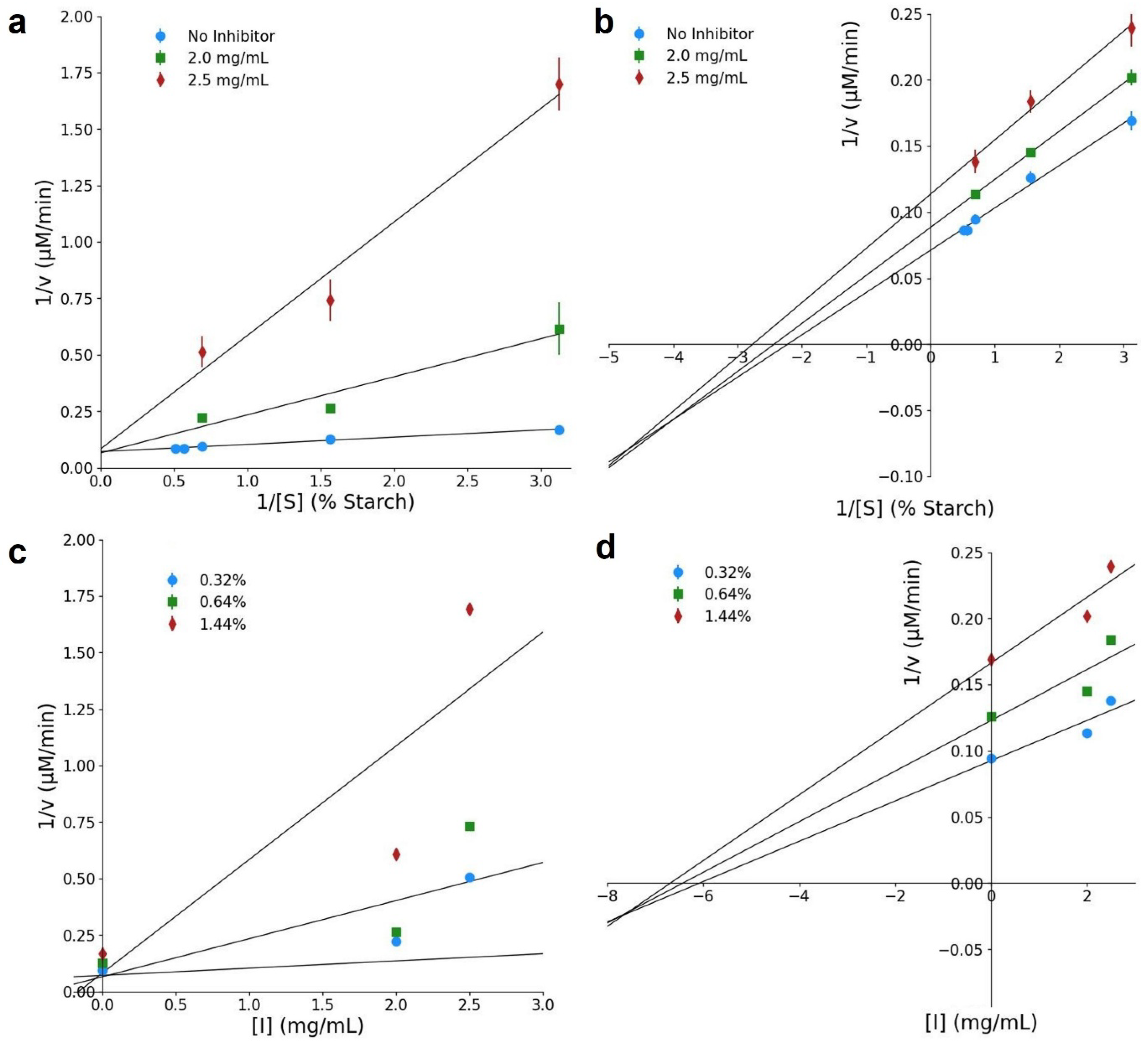
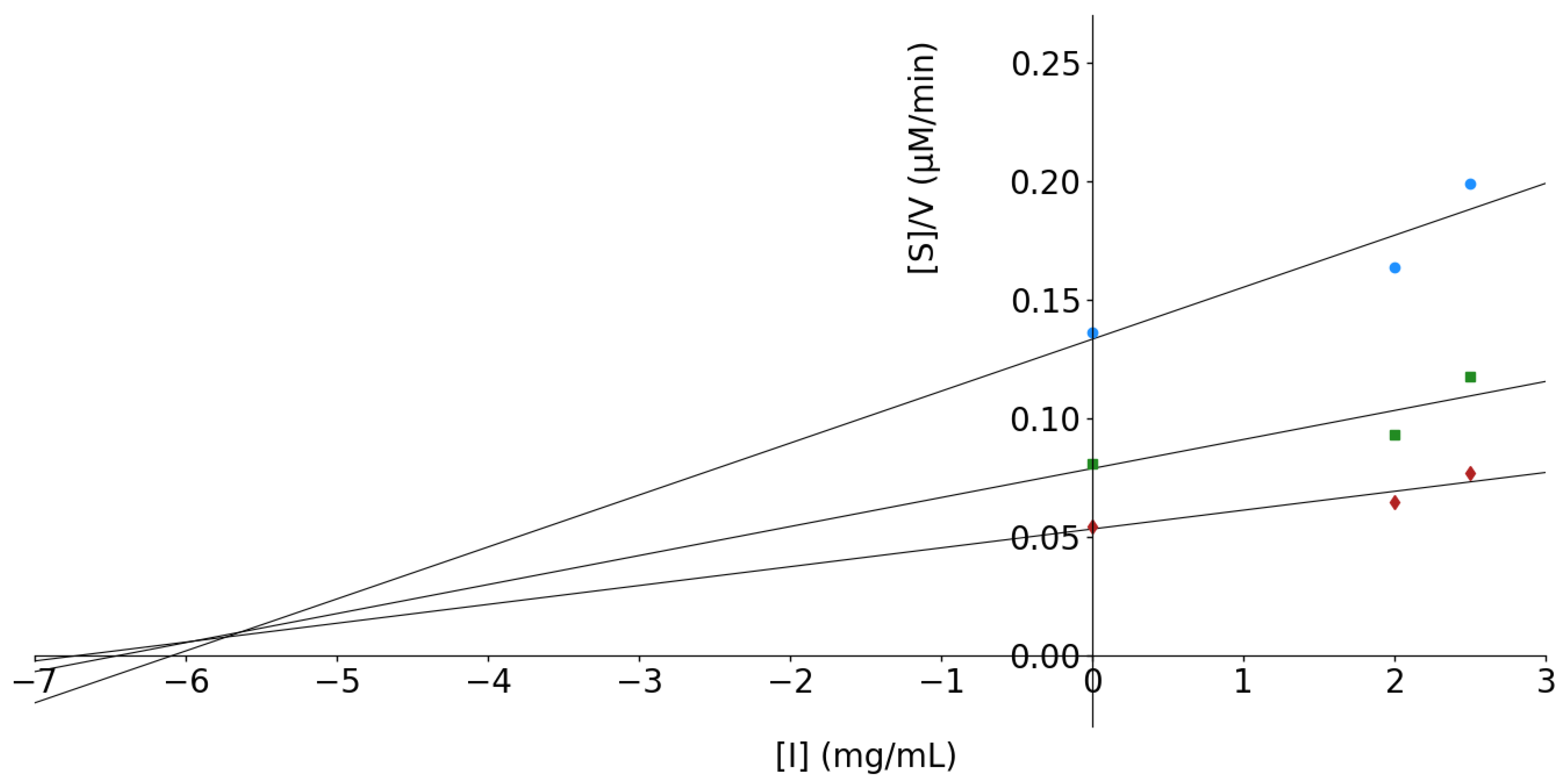
| Peptide Size (kDa) | Kinetic Parameter | Inhibitor Concentration (mg/mL) | ||
|---|---|---|---|---|
| 0 | 2 | 2.5 | ||
| <5 | vmax (µM/min) | 14.00 | 14.61 | 13.65 |
| KM (mg/mL) | 0.45 | 3.77 | 11.9 | |
| Ki (mg/mL) | 0.25 | |||
| >5 | vmax (µM/min) | 14.00 | 11.31 | 8.80 |
| KM (mg/mL) | 0.45 | 0.41 | 0.36 | |
| Ki (mg/mL) | 7.69 | |||
| Ki′ (mg/mL) | 5.81 | |||
Disclaimer/Publisher’s Note: The statements, opinions and data contained in all publications are solely those of the individual author(s) and contributor(s) and not of MDPI and/or the editor(s). MDPI and/or the editor(s) disclaim responsibility for any injury to people or property resulting from any ideas, methods, instructions or products referred to in the content. |
© 2026 by the authors. Licensee MDPI, Basel, Switzerland. This article is an open access article distributed under the terms and conditions of the Creative Commons Attribution (CC BY) license.
Share and Cite
Sanchez-Jimenez, O.; Huerta-Rodriguez, E.; Rocha-Pizaña, M.d.R.; Luna-Vital, D.A.; Mata-Gómez, M.A. Bioactive Properties of Peptides Obtained from the Enzymatic Hydrolysis of Mesquite (Prosopis laevigata) Cotyledon Proteins. Foods 2026, 15, 1399. https://doi.org/10.3390/foods15081399
Sanchez-Jimenez O, Huerta-Rodriguez E, Rocha-Pizaña MdR, Luna-Vital DA, Mata-Gómez MA. Bioactive Properties of Peptides Obtained from the Enzymatic Hydrolysis of Mesquite (Prosopis laevigata) Cotyledon Proteins. Foods. 2026; 15(8):1399. https://doi.org/10.3390/foods15081399
Chicago/Turabian StyleSanchez-Jimenez, Omar, Erick Huerta-Rodriguez, Maria del Refugio Rocha-Pizaña, Diego A. Luna-Vital, and Marco A. Mata-Gómez. 2026. "Bioactive Properties of Peptides Obtained from the Enzymatic Hydrolysis of Mesquite (Prosopis laevigata) Cotyledon Proteins" Foods 15, no. 8: 1399. https://doi.org/10.3390/foods15081399
APA StyleSanchez-Jimenez, O., Huerta-Rodriguez, E., Rocha-Pizaña, M. d. R., Luna-Vital, D. A., & Mata-Gómez, M. A. (2026). Bioactive Properties of Peptides Obtained from the Enzymatic Hydrolysis of Mesquite (Prosopis laevigata) Cotyledon Proteins. Foods, 15(8), 1399. https://doi.org/10.3390/foods15081399