Application of the Briggs–Rauscher Oscillatory Reaction for Tartrazine Determination in Food Dye: Spectroscopic, Microscopic, and Analytical Characterization

 ,
,  ,
,  and
and
Abstract
1. Introduction
2. Materials and Methods
2.1. The Experimental Conditions for the Clock Briggs–Rauscher Reaction
2.2. UV-Vis Measurements
Standard Calibration Curve of Tartrazine
2.3. The Preparation of the Samples for Micro-Raman and FTIR-ATR Spectrometry, Optical, and SEM Microscopy
2.4. Micro-Raman Spectrometry
2.5. FTIR Spectroscopy-ATR
2.6. Optical Microscope
2.7. Scanning Electron Microscopy (SEM)
3. Results
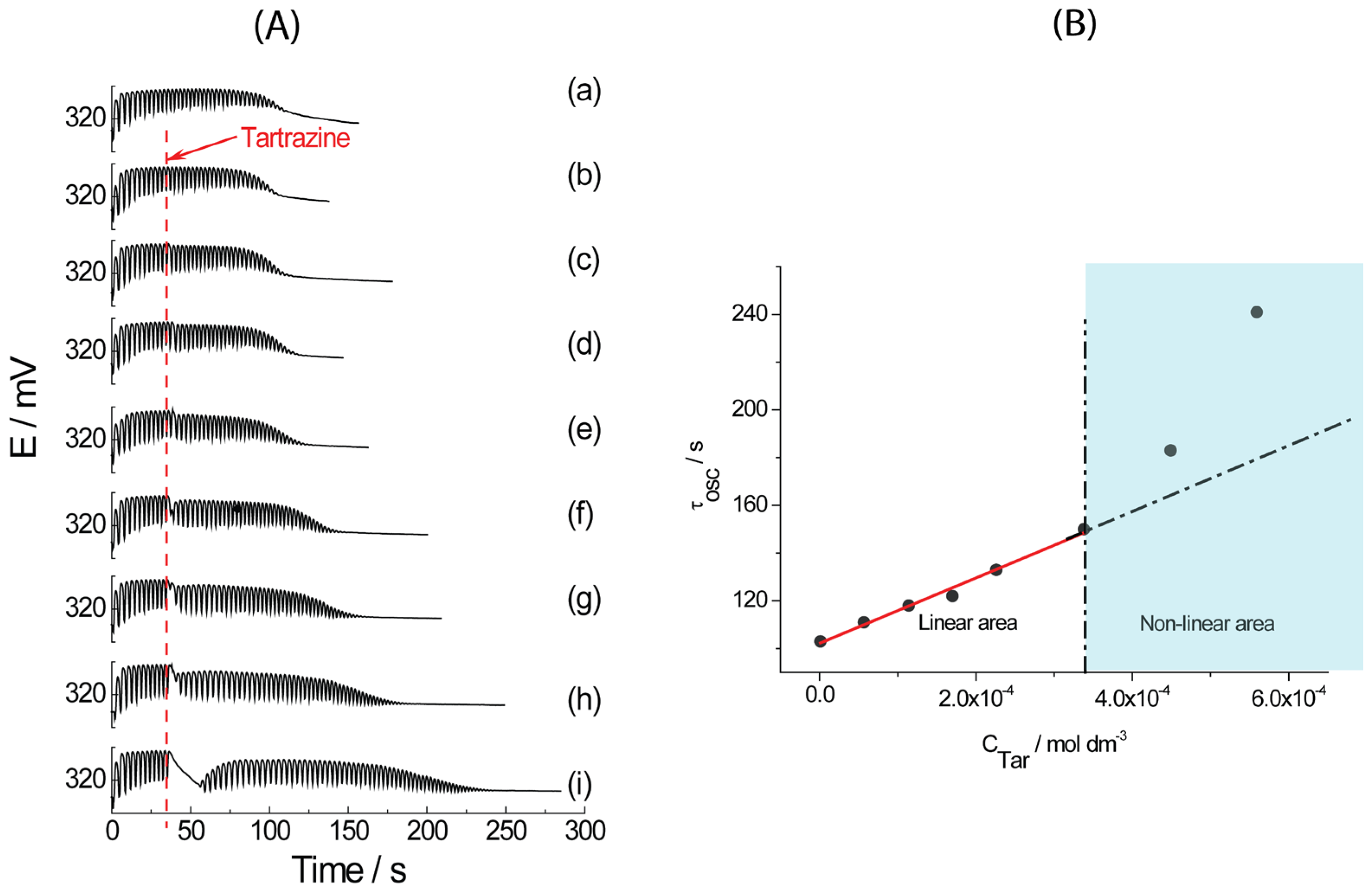
3.1. The Tartrazine Influence on Briggs–Rauscher Oscillatory Reaction Dynamics
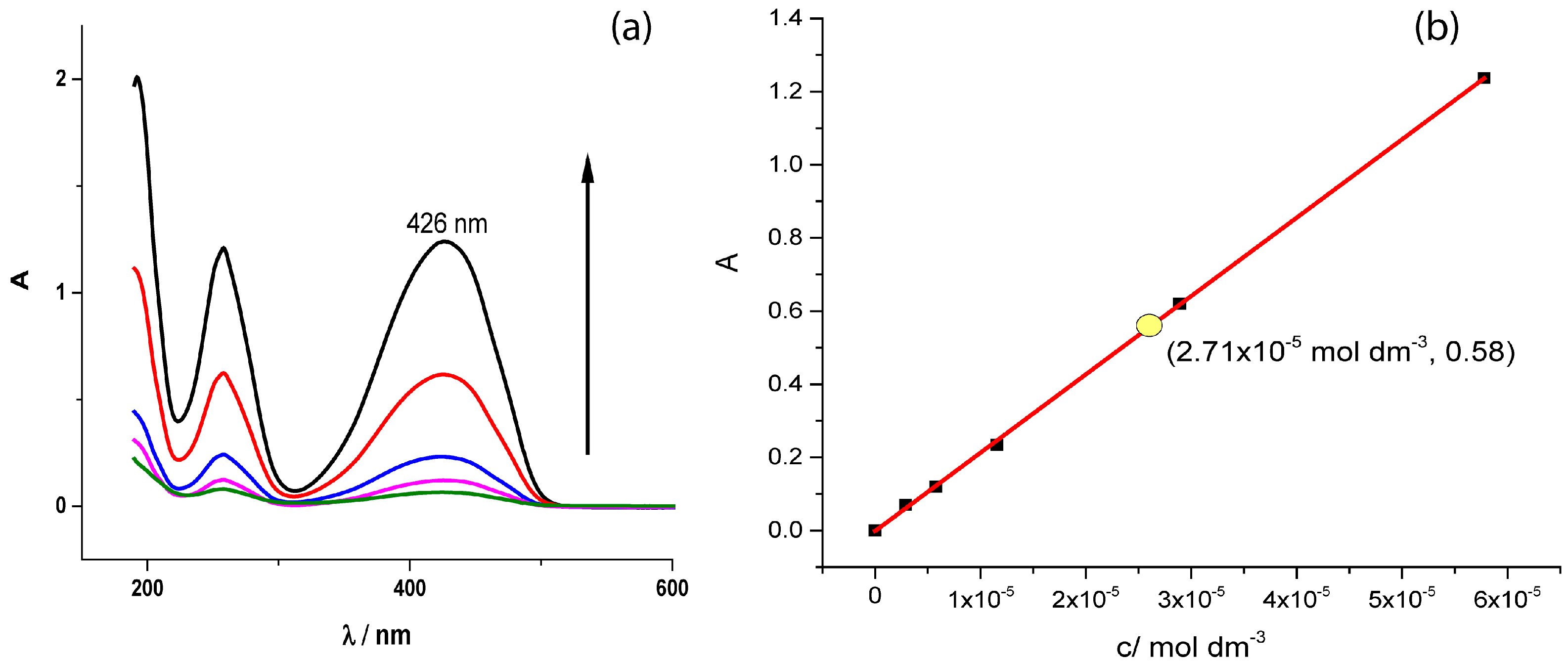
3.2. UV-Vis Spectrometry-Determining Tartrazine Concentration in a Commercial Food Dye
3.3. The Comparative Analysis Between the BR and UV-Vis Methods for Determining Tartrazine
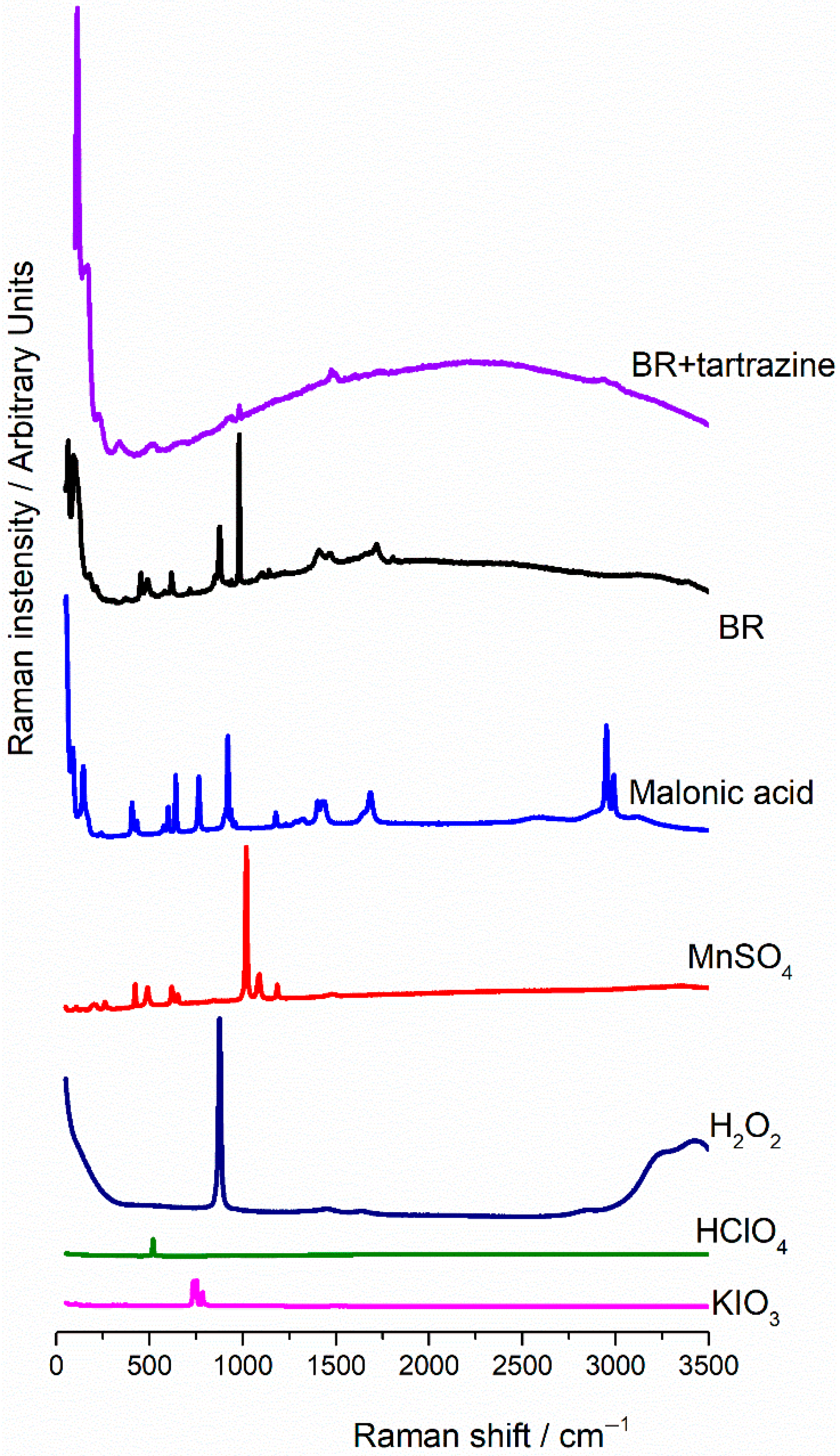
3.4. Raman Spectroscopy Characterization of the BR Reaction, Its Components, and Tartrazine Added in the BR Reaction
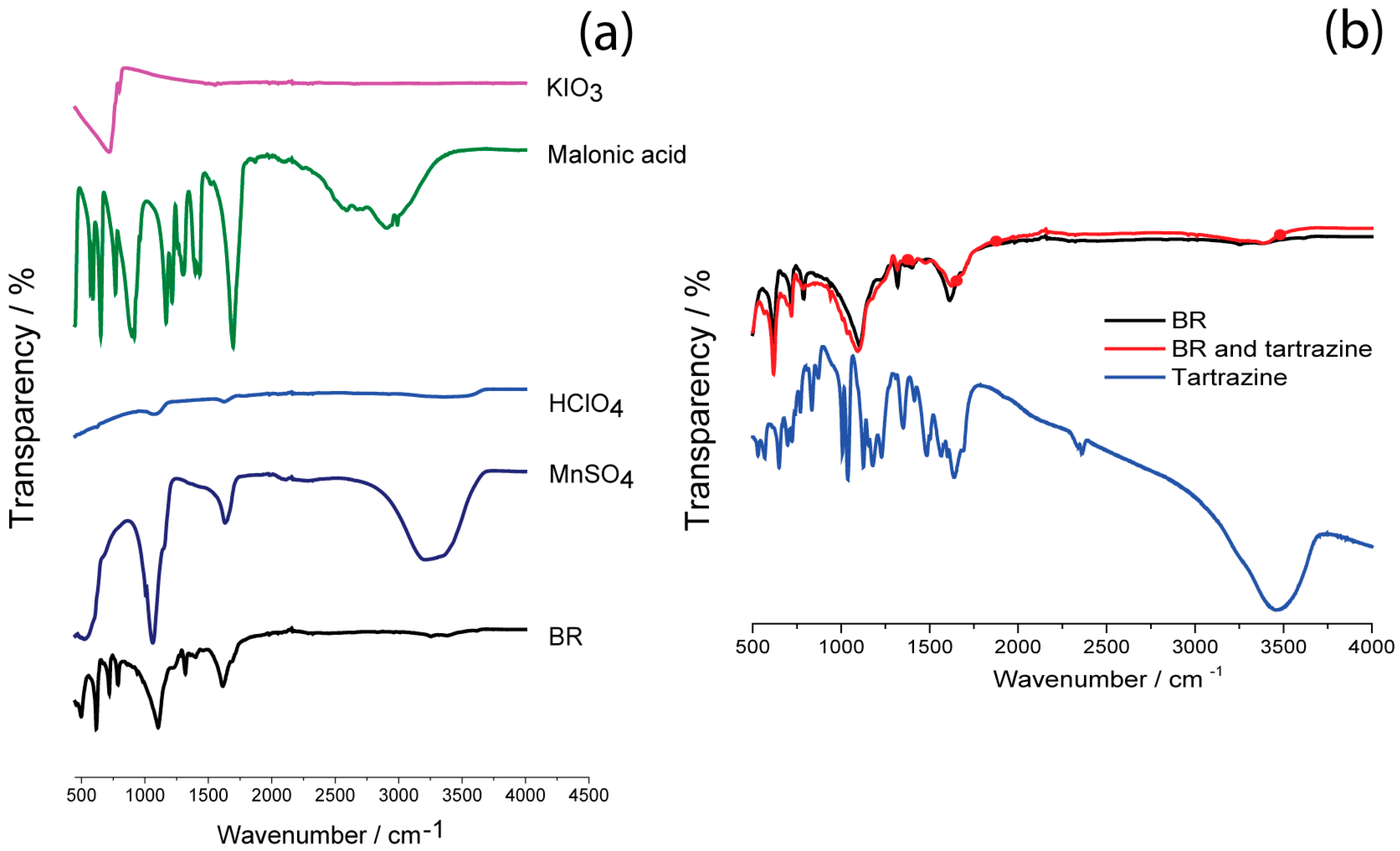
3.5. FTIR Spectroscopy Characterization of the BR Reaction, Its Components, and Tartrazine Added in the BR Reaction
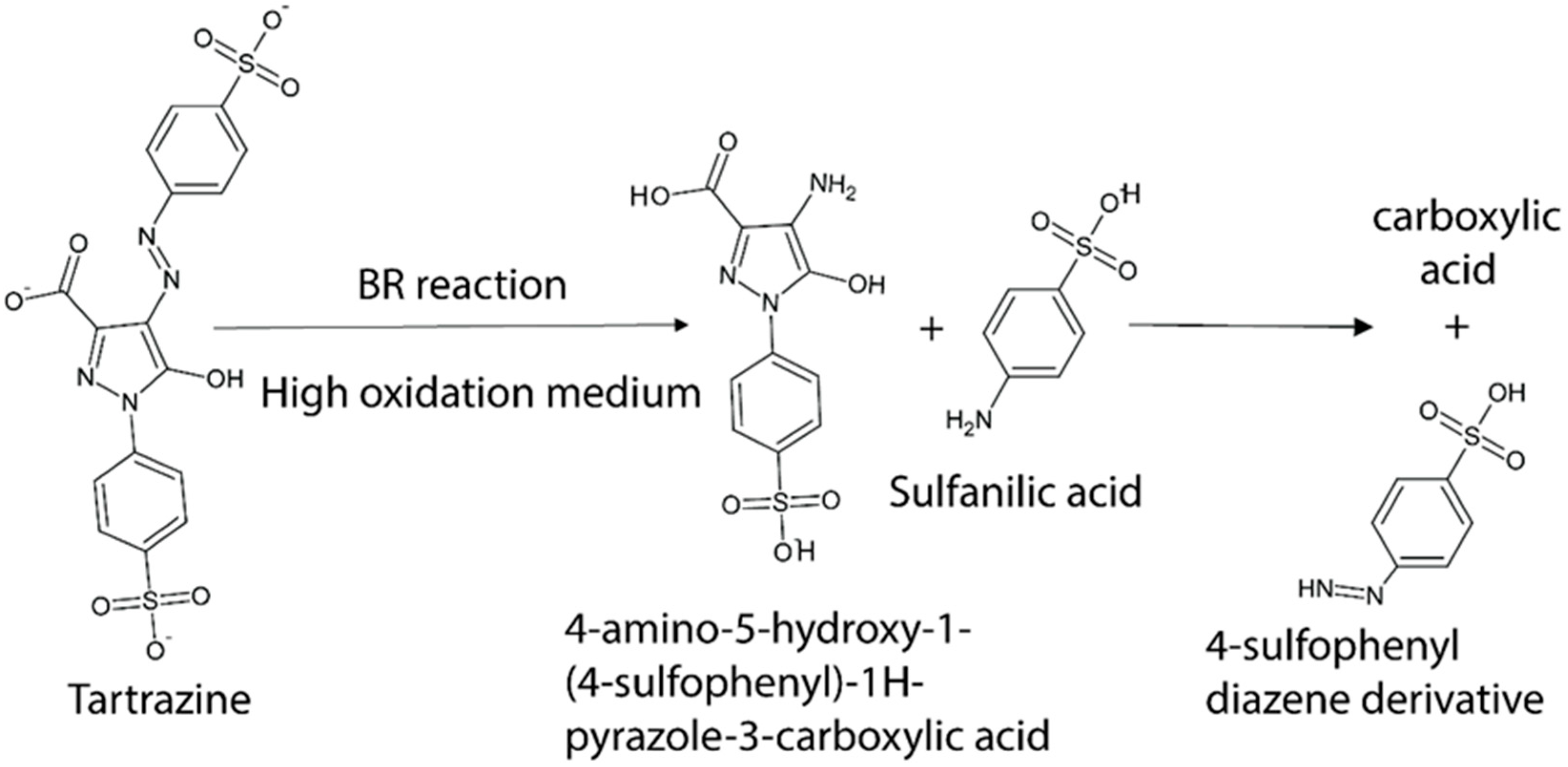
3.6. The Proposed Mechanism of Tartrazine Degradation in the Briggs–Rauscher Reaction
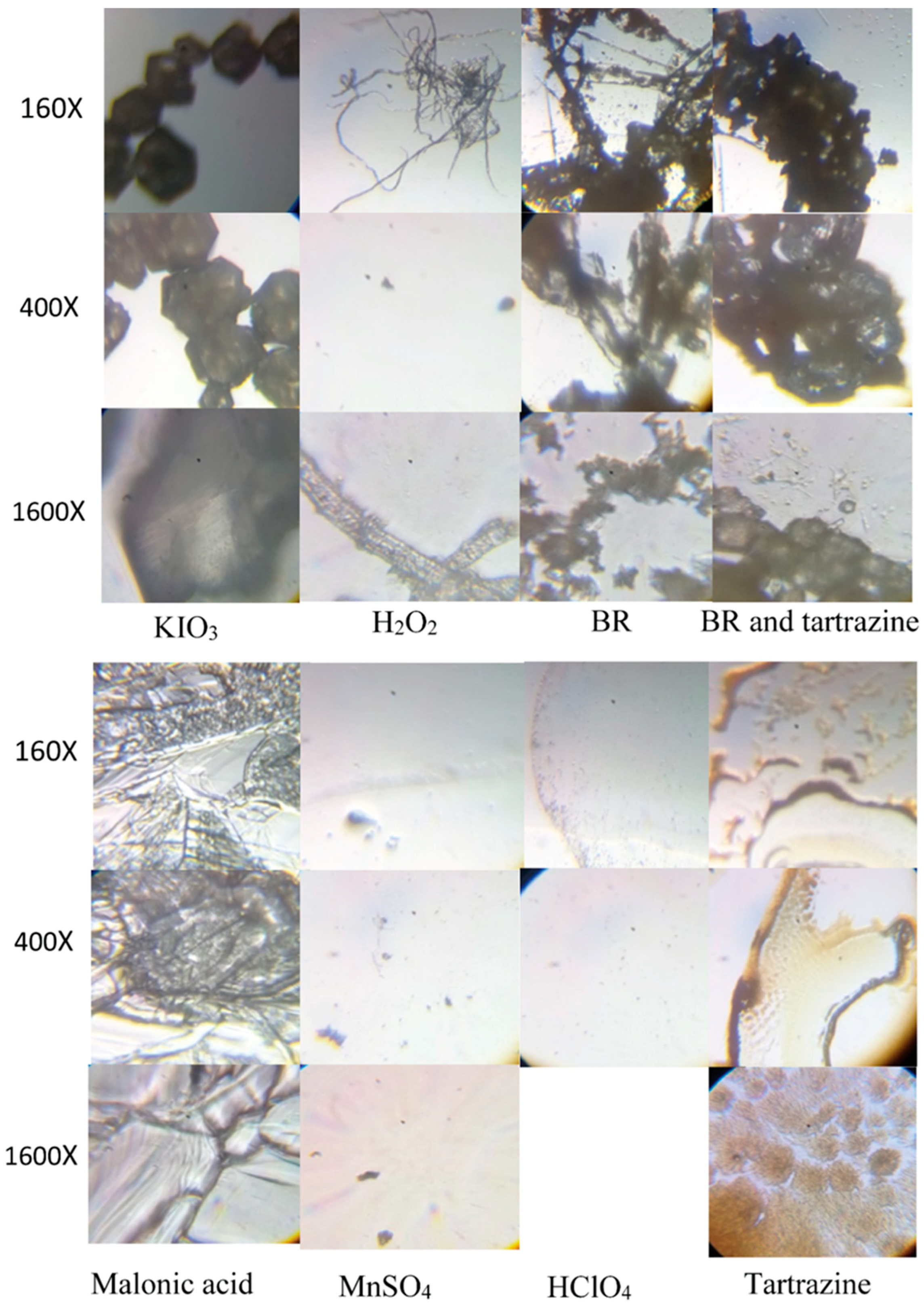
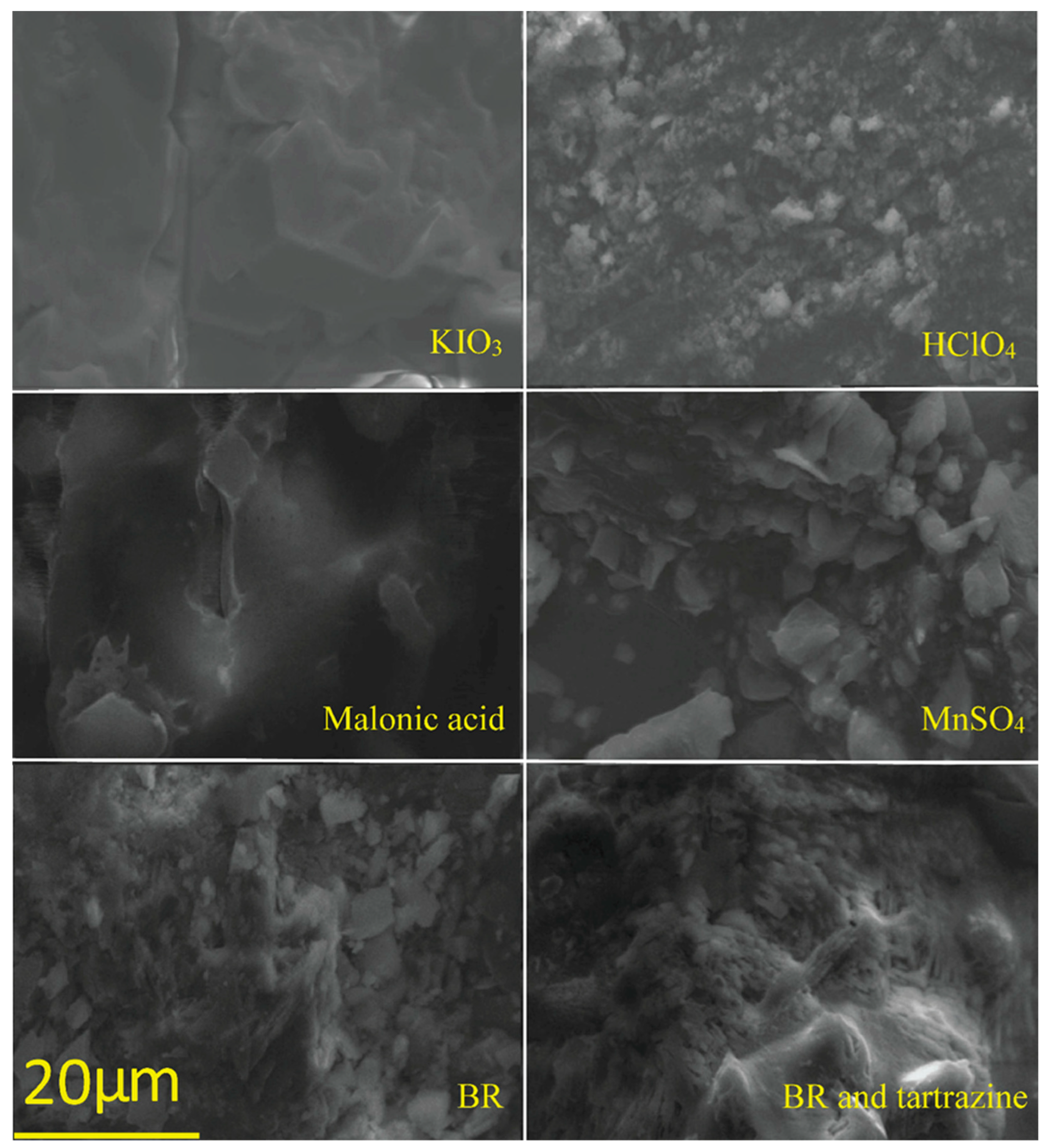
3.7. The Microscopic Characterization of the BR Reaction and Its Components, Tartrazine, and the BR Reaction Containing Tartrazine
4. Conclusions
Author Contributions
Funding
Institutional Review Board Statement
Informed Consent Statement
Data Availability Statement
Acknowledgments
Conflicts of Interest
References
- European Food Safety Authority (EFSA). Scientific opinion on the appropriateness of the food azo-colours Tartrazine (E102), Sunset Yellow FCF (E110), Carmoisine (E122), Amaranth (E123), Ponceau 4R (E124), Allura Red AC (E129), Brilliant Black BN (E151), Brown FK (E154), Brown HT (E155) and Litholrubine BK (E180) for inclusion in the list of food ingredients set up in Annex IIIa of Directive 2000/13/EC. EFSA J. 2010, 8, 1778. [Google Scholar] [CrossRef]
- Vander Leek, T.K. Food Additives and Reactions: Antioxidants, Benzoates, Parabens, Colorings, Flavorings, Natural Protein-Based Additives in Encyclopedia of Food Allergy; Sicherer, S.H., Ed.; Elsevier Science: Amsterdam, The Netherlands, 2024; pp. 861–881. [Google Scholar] [CrossRef]
- König, J. Food Colour Additives of Synthetic Origin in Colour Additives for Foods and Beverages; Scotter, M.J., Ed.; Woodhead Publishing: Cambridge, UK, 2015; pp. 35–60. [Google Scholar] [CrossRef]
- Ramesh, M.; Muthuraman, A. Flavoring and Coloring Agents: Health Risks and Potential Problems in Natural and Artificial Flavoring Agents and Food Dyes; Grumezescu, A.M., Holban, A.M., Eds.; Academic Press: Cambridge, MA, USA, 2018; pp. 1–28. [Google Scholar] [CrossRef]
- Abud, M.A.; Simon, R. Food Additives and Reactions: Part 1 in Encyclopedia of Food Allergy; Sicherer, S.H., Ed.; Elsevier: Amsterdam, The Netherlands, 2024; pp. 828–839. [Google Scholar] [CrossRef]
- Choulis, N.H. Miscellaneous Drugs, Materials, Medical Devices, and Techniques in Side Effects of Drugs Annua; Aronson, J.K., Ed.; Elsevier: Amsterdam, The Netherlands, 2010; Volume 32, pp. 891–902. [Google Scholar] [CrossRef]
- Walton, K.; Walker, R.; van de Sandt, J.J.M.; Castell, J.V.; Knapp, A.G.A.A.; Kozianowski, G.; Roberfroid, M.; Schilter, B. The application of in vitro data in the derivation of the Acceptable Daily Intake of food additives. Food Chem. Toxicol. 1999, 37, 1175–1197. [Google Scholar] [CrossRef] [PubMed]
- Visternicu, M.; Săvucă, A.; Rarinca, V.; Burlui, V.; Plavan, G.; Ionescu, C.; Ciobica, A.; Balmus, I.-M.; Albert, C.; Hogas, M. Toxicological Effects of Tartrazine Exposure: A Review of In Vitro and Animal Studies with Human Health Implications. Toxics 2025, 13, 771. [Google Scholar] [CrossRef]
- Amchova, P.; Siska, F.; Ruda-Kucerova, J. Safety of tartrazine in the food industry and potential protective factors. Heliyon 2024, 10, e38111. [Google Scholar] [CrossRef] [PubMed]
- Briggs, T.S.; Rauscher, W.C. An oscillating iodine clock. J. Chem. Educ. 1973, 50, 496. [Google Scholar] [CrossRef]
- Cervellati, R.; Renzulli, C.; Guerra, M.C.; Speroni, E. Evaluation of antioxidant activity of some natural polyphenolic compounds using the Briggs-Rauscher reaction method. J. Agric. Food Chem. 2002, 50, 7504–7509. [Google Scholar] [CrossRef]
- Stanisavljev, D.; Milenković, M.C.; Mojović, M.; Popović-Bijelić, A. Oxygen centered radicals in iodine chemical oscillators. J. Phys. Chem. A 2011, 115, 7955–7958. [Google Scholar] [CrossRef]
- Stanisavljev, D.R.; Milenković, M.C.; Popović-Bijelić, A.D.; Mojović, M.D. Radicals in the Bray-Liebhafsky oscillatory reaction. J. Phys. Chem. A 2013, 117, 3292–3295. [Google Scholar] [CrossRef]
- Madduri, S.B.; Kommalapati, R.R. Photocatalytic Degradation of Azo Dyes in Aqueous Solution Using TiO2 Doped with rGO/CdS under UV Irradiation. Processes 2024, 12, 1455. [Google Scholar] [CrossRef]
- Dragoi, M. Degradation of some azo dyes by Fenton process. An overview. Ann. Univ. Craiova Ser. Chem. 2023, 29, 13–19. [Google Scholar] [CrossRef]
- Pagnacco, M.; Maksimović, J.P.; Nikolić, N.T.; Bajuk Bogdanović, D.V.; Kragović, M.M.; Stojmenović, M.D.; Blagojević, S.N.; Senćanski, J.V. Indigo Carmine in a Food Dye: Spectroscopic Characterization and Determining Its Micro-Concentration through the Clock Reaction. Molecules 2022, 27, 4853. [Google Scholar] [CrossRef]
- Maslowska, J.; Janiak, J. Voltammetric and Spectrophotometric Studies on Tartrazine—A Food Colorant. Chem. Anal. 1996, 41, 855–864. [Google Scholar]
- Massart, D.L.; Vandeginste, B.G.M.; Deming, S.N.; Michotte, Y.; Kaufman, L. (Eds.) Sensitivity and Limit of Detection. In Data Handling in Science and Technology; Elsevier: Amsterdam, The Netherlands, 2003; Volume 2, pp. 107–114. [Google Scholar] [CrossRef]
- Chowdhry, B.Z.; Mendham, A.P.; Tetteh, J.; Withnall, R. Kinetic Resonance Raman Spectroscopy of the Briggs-Rauscher Oscillator. ChemPhysChem 2002, 5, 443–446. [Google Scholar] [CrossRef]
- Zhang, Y.; Hu, G.; Hu, L.; Song, J. Identification of Two Aliphatic Position Isomers between α- and β-Ketoglutaric Acid by Using a Briggs-Rauscher Oscillating System. Anal. Chem. 2015, 87, 10040–10046. [Google Scholar] [CrossRef] [PubMed]
- Zhou, Y.; Uddin, W.; Hu, G. Kinetic identification of three metal ions by using a Briggs-Rauscher oscillating system. Microchem. J. 2021, 160, 105617. [Google Scholar] [CrossRef]
- Leulescu, M.; Rotaru, A.; Pălărie, I.; Moanţă, A.; Cioateră, N.; Popescu, M.; Morîntale, E.; Viorica Bubulică, M.; Florian, G.; Hărăbor, A.; et al. Tartrazine: Physical, thermal and biophysical properties of the most widely employed synthetic yellow food-colouring azo dye. J. Therm. Anal. Calorim. 2018, 134, 209–231. [Google Scholar] [CrossRef]
- Ibrahim, M.; Nada, A.; Eldin Kamal, D. Density functional theory and FTIR spectroscopic study of carboxyl group. Indian J. Pure Appl. Phys. 2005, 43, 911–917. [Google Scholar]
- Beach, E.S.; Malecky, R.T.; Gil, R.R.; Horwitz, C.P.; Collins, T.J. Fe-TAML/hydrogen peroxide degradation of concentrated solutions of the commercial azo dye tartrazine. Catal. Sci. Technol. 2011, 1, 437–443. [Google Scholar] [CrossRef]
- Jagadale, T.; Kulkarni, M.; Pravarthana, D.; Ramadan, W.; Thakur, P. Photocatalytic degradation of azo dyes using Au:TiO2, gamma-Fe2O3:TiO2 functional nanosystems. J. Nanosci. Nanotechnol. 2012, 12, 928–936. [Google Scholar] [CrossRef]
- Pay, R.; Sharrock, A.V.; Elder, R.; Maré, A.; Bracegirdle, J.; Torres, D.; Malone, N.; Vorster, J.; Kelly, L.; Ryan, A.; et al. Preparation, analysis and toxicity characterisation of the redox metabolites of the azo food dye tartrazine. Food Chem. Toxicol. 2023, 182, 114193. [Google Scholar] [CrossRef]
- Friday Amaku, J.; Oyedotun, K.O.; Maxakato, N.W.; Akpomie, K.G.; Sunday Okeke, E.; Olisah, C.; Malloum, A.; Adegoke, K.A.; Ighalo, J.O.; Conradie, J.; et al. Aqueous Phase Removal of Tartrazine. Chem. Afr. 2024, 7, 1685–1705. [Google Scholar] [CrossRef]
- State, R.G.; van Staden, J.F.; Stefan-van Staden, R.-I. Review-Recent Trends on the Electrochemical Sensors Used for the Determination of Tartrazine and Sunset Yellow FCF from Food and Beverage Products. J. Electrochem. Soc. 2022, 169, 017509. [Google Scholar] [CrossRef]



| Curve Equation | BR Reaction τosc = (137,000 ± 8000) × C + (102 ± 2) | UV-Vis Method A = (21,400 ± 200) × C + (0.001 ± 0.005) |
|---|---|---|
| LOD | (4.3 ± 0.3) × 10−5 | (1.1 ± 0.1) × 10−6 |
| LOQ | (1.3 ± 0.1) × 10−4 | (3.0 ± 0.2) × 10−6 |
Disclaimer/Publisher’s Note: The statements, opinions and data contained in all publications are solely those of the individual author(s) and contributor(s) and not of MDPI and/or the editor(s). MDPI and/or the editor(s) disclaim responsibility for any injury to people or property resulting from any ideas, methods, instructions or products referred to in the content. |
© 2026 by the authors. Licensee MDPI, Basel, Switzerland. This article is an open access article distributed under the terms and conditions of the Creative Commons Attribution (CC BY) license.
Share and Cite
Senćanski, J.V.; Maksimović, J.P.; Bajuk-Bogdanović, D.V.; Radulović, A.M.; Jevtić, T.V.; Potkonjak, N.I.; Pagnacco, M.C. Application of the Briggs–Rauscher Oscillatory Reaction for Tartrazine Determination in Food Dye: Spectroscopic, Microscopic, and Analytical Characterization. Foods 2026, 15, 1181. https://doi.org/10.3390/foods15071181
Senćanski JV, Maksimović JP, Bajuk-Bogdanović DV, Radulović AM, Jevtić TV, Potkonjak NI, Pagnacco MC. Application of the Briggs–Rauscher Oscillatory Reaction for Tartrazine Determination in Food Dye: Spectroscopic, Microscopic, and Analytical Characterization. Foods. 2026; 15(7):1181. https://doi.org/10.3390/foods15071181
Chicago/Turabian StyleSenćanski, Jelena V., Jelena P. Maksimović, Danica V. Bajuk-Bogdanović, Aleksandra M. Radulović, Tihomir V. Jevtić, Nebojša I. Potkonjak, and Maja C. Pagnacco. 2026. "Application of the Briggs–Rauscher Oscillatory Reaction for Tartrazine Determination in Food Dye: Spectroscopic, Microscopic, and Analytical Characterization" Foods 15, no. 7: 1181. https://doi.org/10.3390/foods15071181
APA StyleSenćanski, J. V., Maksimović, J. P., Bajuk-Bogdanović, D. V., Radulović, A. M., Jevtić, T. V., Potkonjak, N. I., & Pagnacco, M. C. (2026). Application of the Briggs–Rauscher Oscillatory Reaction for Tartrazine Determination in Food Dye: Spectroscopic, Microscopic, and Analytical Characterization. Foods, 15(7), 1181. https://doi.org/10.3390/foods15071181