Beyond Sustainable: Geo-Adaptive Design of Carbon-Based Adsorbents Through Aligning Pesticide Remediation with Regional Agricultural Practices and Food Safety Needs



Abstract
1. Introduction
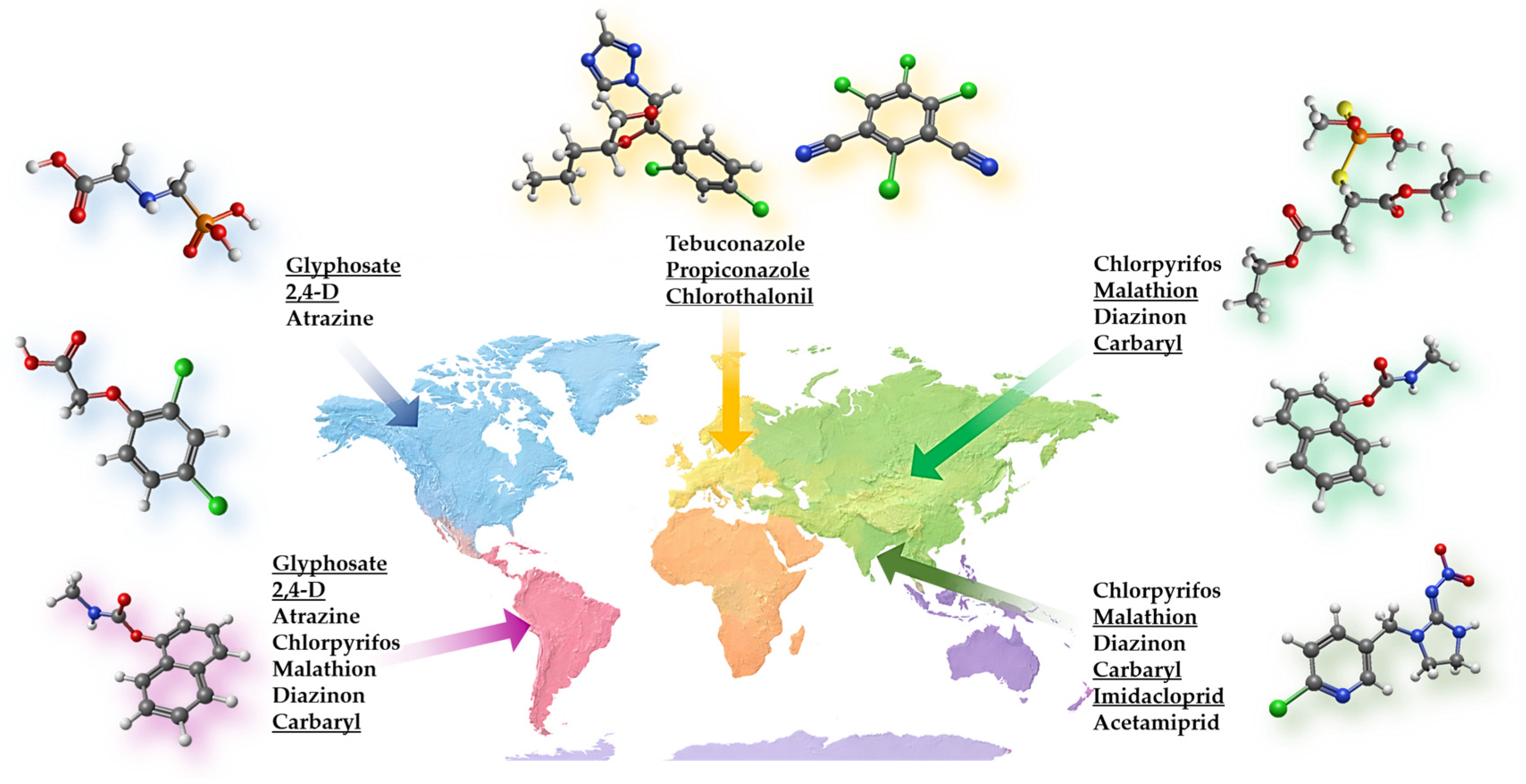
2. Global Diversity of Pesticide Use and Residues
3. Matching Adsorbent Chemistry to Regional Contaminant Profiles
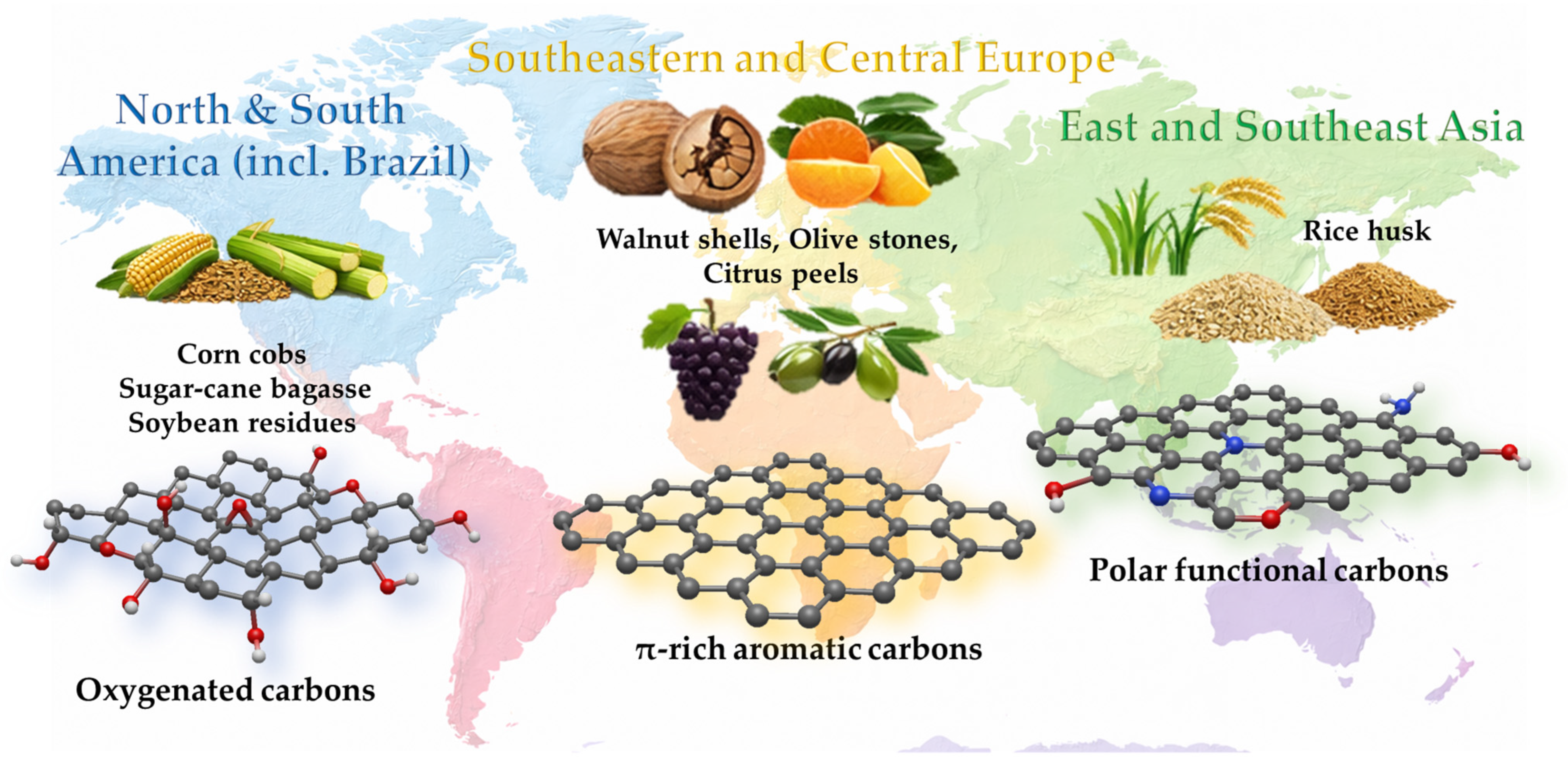
4. Utilizing Regional Biomass as Precursors for Sustainable Carbon-Based Adsorbents
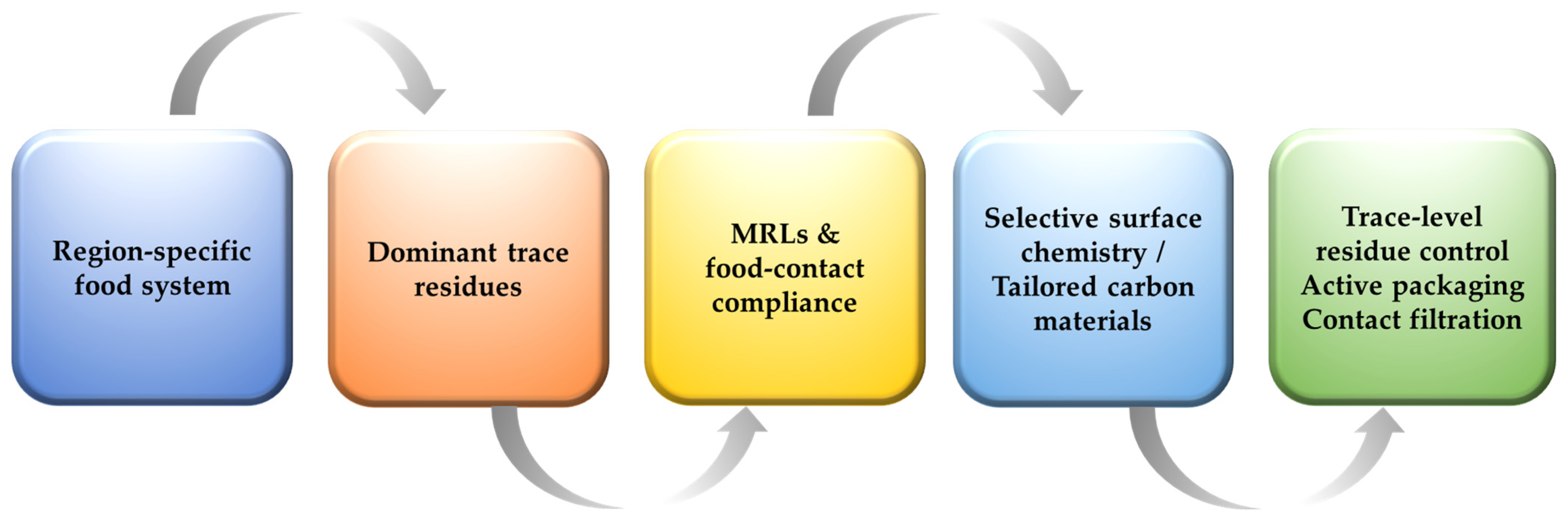
5. Towards Geo-Adaptive Food Safety Systems
6. Challenges, Limitations, and Future Perspectives
7. Conclusions
Author Contributions
Funding
Institutional Review Board Statement
Informed Consent Statement
Data Availability Statement
Acknowledgments
Conflicts of Interest
Abbreviations
| AGROFIT | Brazilian pesticide registration information system |
| ANVISA | National Health Surveillance Agency (Brazil) |
| CIBRC | Central Insecticides Board and Registration Committee (India) |
| EFSA | European Food Safety Authority |
| EPA | Environmental Protection Agency (United States) |
| FIFRA | Federal Insecticide, Fungicide, and Rodenticide Act (United States) |
| MAPA | Ministry of Agriculture, Livestock and Food Supply (Brazil) |
| MARA | Ministry of Agriculture and Rural Affairs (China) |
| MRL | Maximum Residue Limit |
References
- Sharma, S.; Kaur, I.; Nagpal, A.K. Chapter Three—Pesticides in agriculture: Food security vs. food safety. In Advances in Food Security and Sustainability; Sharma, A., Kumar, M., Sharma, P., Eds.; Elsevier: Amsterdam, The Netherlands, 2024; Volume 9, pp. 59–73. [Google Scholar]
- Zhou, W.; Li, M.; Achal, V. A comprehensive review on environmental and human health impacts of chemical pesticide usage. Emerg. Contam. 2025, 11, 100410. [Google Scholar] [CrossRef]
- Macieira, A.; Fernandes, V.C.; Brandão, T.R.S.; Delerue-Matos, C.; Teixeira, P. Environmental and Food Safety Assessment of Pre-Harvest Activities in Local Small-Scale Fruit and Vegetable Farms in Northwest Portugal: Hazard Identification and Compliance with Good Agricultural Practices (GAPs). Foods 2025, 14, 2129. [Google Scholar] [CrossRef] [PubMed]
- Lazarević-Pašti, T.; Tasić, T.; Milanković, V.; Pašti, I.A. Food Safety in the Age of Climate Change: The Rising Risk of Pesticide Residues and the Role of Sustainable Adsorbent Technologies. Foods 2025, 14, 3797. [Google Scholar] [CrossRef]
- Terzić, T.; Milankovic, V.; Unterweger, C.; Fuerst, C.; Breitenbach, S.; Pasti, I.; Lazarević-Pašti, T. Highly Porous Cellulose-Based Carbon Fibers as Effective Adsorbents for Chlorpyrifos Removal: Insights and Applications. C 2024, 10, 58. [Google Scholar] [CrossRef]
- Zlatković, M.; Kurtić, R.; Pašti, I.A.; Tasić, T.; Milanković, V.; Potkonjak, N.; Unterweger, C.; Lazarević-Pašti, T. Application of Carbon Materials Derived from Nocino Walnut Liqueur Pomace Residue for Chlorpyrifos Removal from Water. Materials 2025, 18, 3072. [Google Scholar] [CrossRef]
- Anicijevic, V.; Mitrović, T.; Terzić, T.; Lazarević-Pašti, T. Graphene Oxide-Based Materials for the Remediation of Neurotoxic Organophosphates. Processes 2025, 13, 4028. [Google Scholar] [CrossRef]
- Lazarević-Pašti, T.; Anićijević, V.; Baljozović, M.; Anićijević, D.V.; Gutić, S.; Vasić, V.; Skorodumova, N.V.; Pašti, I.A. The impact of the structure of graphene-based materials on the removal of organophosphorus pesticides from water. Environ. Sci. Nano 2018, 5, 1482–1494. [Google Scholar] [CrossRef]
- Soffian, M.S.; Abdul Halim, F.Z.; Aziz, F.; Rahman, M.A.; Mohamed Amin, M.A.; Awang Chee, D.N. Carbon-based material derived from biomass waste for wastewater treatment. Environ. Adv. 2022, 9, 100259. [Google Scholar] [CrossRef]
- Dhokpande, S.R.; Deshmukh, S.M.; Khandekar, A.R.; Sankhe, A.A. A review of carbon-based adsorbents for the removal of organic and inorganic components. Rev. Inorg. Chem. 2024, 44, 655–670. [Google Scholar] [CrossRef]
- Bose, S.; Senthil Kumar, P.; Rangasamy, G.; Prasannamedha, G.; Kanmani, S. A review on the applicability of adsorption techniques for remediation of recalcitrant pesticides. Chemosphere 2023, 313, 137481. [Google Scholar] [CrossRef] [PubMed]
- Pongwiwanna, D.; Tangsathitkulchai, C. The Use of High Surface Area Mesoporous-Activated Carbon from Longan Seed Biomass for Increasing Capacity and Kinetics of Methylene Blue Adsorption from Aqueous Solution. Molecules 2021, 26, 6521. [Google Scholar] [CrossRef]
- Reljic, S.; Cuadrado-Collados, C.; Oliveira Jardim, E.; Farrando-Perez, J.; Martinez-Escandell, M.; Silvestre-Albero, J. Activated carbon materials with a rich surface chemistry prepared from L-cysteine amino acid. Fluid Phase Equilibria 2022, 558, 113446. [Google Scholar] [CrossRef]
- Giannakoudakis, D.A.; Ioannidis, I.; Ioannou, K.; Salonikidou, E.D.; Florides, F.; Zeiler, S.; Kostoglou, N.; Barczak, M.; Triantafyllidis, K.; Pashalidis, I.; et al. Ultrahigh surface area nanoporous carbon for air and water purification: Pushing the boundaries and unveiling the key physicochemical features. Chem. Eng. J. 2025, 524, 169457. [Google Scholar] [CrossRef]
- Choudhary, M.; Chakinala, N.; Saini, P.; Surolia, P.K.; Chakinala, A.G. Carbon foams derived from biomass with ultra-high adsorption capacity for the removal of tetracycline. Mater. Adv. 2025, 6, 7450–7468. [Google Scholar] [CrossRef]
- Wu, T.; He, C.; Chang, H.; Bian, C.; Zhou, R.; Dong, Z.; Li, Y.; Li, B. Adsorption-desorption mechanisms and migration behavior of fluchlordiniliprole in four different soils under varied conditions. Ecotoxicol. Environ. Saf. 2024, 285, 117026. [Google Scholar] [CrossRef]
- Zhang, Y.; Bedoussac, L.; Zhang, C.; Cong, W.-F.; Guinet, M.; Nandillon, R.; Munier-Jolain, N. Pesticide use is affected more by crop species than by crop diversity at the cropping system level. Eur. J. Agron. 2024, 159, 127263. [Google Scholar] [CrossRef]
- Ricci, B.; Lavigne, C.; Alignier, A.; Aviron, S.; Biju-Duval, L.; Bouvier, J.C.; Choisis, J.-P.; Franck, P.; Joannon, A.; Ladet, S.; et al. Local pesticide use intensity conditions landscape effects on biological pest control. Proc. R. Soc. B Biol. Sci. 2019, 286, 20182898. [Google Scholar] [CrossRef]
- Lehmann, J.; Joseph, S. Biochar for Environmental Management: Science and Technology; Earthscan: Barcelona, Spain, 2009. [Google Scholar]
- Namaswa, T.; Burslem, D.F.R.P.; Smith, J.; Afzal, W.; Wardle, J.; Oduor, N.; Kubok, L.; Muthike, G.; Malei, F. Availability and spatial distribution of crop and forest biomass residues for biochar production in Kenya. Sci. Rep. 2026; in press. [Google Scholar]
- Olguín-Hernández, L.; Carrillo-Rodríguez, J.; Mayek-Pérez, N.; Aquino-Bolaños, T.; Vera-Guzmán, A.; Chávez-Servia, J.L. Patterns and Relationships of Pesticide Use in Agricultural Crops of Latin America: Review and Analysis of Statistical Data. Agronomy 2024, 14, 2889. [Google Scholar] [CrossRef]
- Khoury, D.; Chimjarn, S.; Delhomme, O.; Millet, M. Seasonal and spatial detection of pesticide residues in the ambient air of the Alsace region across different land use conditions. Environ. Int. 2025, 202, 109677. [Google Scholar] [CrossRef]
- Chilipweli, P.; Nyanza, E.; Ngowi, A. Patterns, Practices, and Socio-Environmental Dynamics of Pesticide Use in the Horticultural Value Chain: Insights from Smallholder Farmers and Agro-Input Sellers in Iringa and Njombe, Southern Highlands, Tanzania. Agrochemicals 2025, 4, 21. [Google Scholar] [CrossRef]
- Udias, A.; Galimberti, F.; Dorati, C.; Pistocchi, A. Emissions of pesticides in the European Union: A new regional-level dataset. Sci. Data 2023, 10, 869. [Google Scholar] [CrossRef]
- Malaj, E.; Freistadt, L.; Morrissey, C.A. Spatio-Temporal Patterns of Crops and Agrochemicals in Canada Over 35 Years. Front. Environ. Sci. 2020, 8, 556452. [Google Scholar] [CrossRef]
- Zhan, Y.; Zhang, M. Spatial and temporal patterns of pesticide use on California almonds and associated risks to the surrounding environment. Sci. Total Environ. 2014, 472, 517–529. [Google Scholar] [CrossRef] [PubMed]
- Désert, M.; Ravier, S.; Gille, G.; Quinapallo, A.; Armengaud, A.; Pochet, G.; Savelli, J.-L.; Wortham, H.; Quivet, E. Spatial and temporal distribution of current-use pesticides in ambient air of Provence-Alpes-Côte-d’Azur Region and Corsica, France. Atmos. Environ. 2018, 192, 241–256. [Google Scholar] [CrossRef]
- Kos, T.; Zorica, M.; Gašparović Pinto, A.; Rot, T.; Pasković, I.; Šerić Jelaska, L.; Broznić, D. Copper and pesticide residues in mediterranean soils: A case study of four crops in Zadar County, Croatia. Int. J. Environ. Sci. Technol. 2025, 23, 65. [Google Scholar] [CrossRef]
- McGinley, J.; Healy, M.G.; Ryan, P.C.; Harmon O’Driscoll, J.; Mellander, P.E.; Morrison, L.; Siggins, A. Impact of historical legacy pesticides on achieving legislative goals in Europe. Sci. Total Environ. 2023, 873, 162312. [Google Scholar] [CrossRef]
- Shao, X.; Liu, Z.; Xu, X.; Li, Z.; Qian, X. Overall status of neonicotinoid insecticides in China: Production, application and innovation. J. Pestic. Sci. 2013, 38, 1–9. [Google Scholar] [CrossRef]
- Chen, Y.; Zang, L.; Liu, M.; Zhang, C.; Shen, G.; Du, W.; Sun, Z.; Fei, J.; Yang, L.; Wang, Y.; et al. Ecological risk assessment of the increasing use of the neonicotinoid insecticides along the east coast of China. Environ. Int. 2019, 127, 550–557. [Google Scholar] [CrossRef]
- Kang, D.; Kim, J.Y.; Jang, H.; Mok, S.; Choi, Y.; Lee, S.-H.; Park, T.J.; Kim, S.D.; Moon, H.-B.; Jeon, J. Spatiotemporal trends and ecological risks of neonicotinoid insecticides in Korean surface waters. J. Hazard. Mater. 2025, 498, 139642. [Google Scholar] [CrossRef]
- Zhang, S.; Jiang, J.-Q. Occurrence and Distribution of Neonicotinoid Pesticides in Chinese Waterways: A Review. Environments 2023, 10, 206. [Google Scholar] [CrossRef]
- Zhang, J.; Guo, J.; Wu, C.; Qi, X.; Jiang, S.; Lu, D.; Feng, C.; Liang, W.; Chang, X.; Zhang, Y.; et al. Exposure to carbamate and neurodevelopment in children: Evidence from the SMBCS cohort in China. Environ. Res. 2019, 177, 108590. [Google Scholar] [CrossRef]
- Thummajitsakul, S.; Thongkerd, N.; Pholmeesap, B.; Phankham, P.; Silprasit, K. Assessment of Organophosphate and Carbamate Insecticides and Heavy Metal Contamination in Canal-Grown Water Morning Glory (Ipomoea aquatica Forssk) in Nakhon Nayok Province, Thailand. Appl. Environ. Res. 2020, 42, 26–42. [Google Scholar] [CrossRef]
- Ospina, M.; Schütze, A.; Morales-Agudelo, P.; Vidal, M.; Wong, L.-Y.; Calafat, A.M. Exposure to glyphosate in the United States: Data from the 2013–2014 National Health and Nutrition Examination Survey. Environ. Int. 2022, 170, 107620. [Google Scholar] [CrossRef]
- Medalie, L.; Baker, N.T.; Shoda, M.E.; Stone, W.W.; Meyer, M.T.; Stets, E.G.; Wilson, M. Influence of land use and region on glyphosate and aminomethylphosphonic acid in streams in the USA. Sci. Total Environ. 2020, 707, 136008. [Google Scholar] [CrossRef]
- Available online: https://www.epa.gov/pesticide-registration/about-pesticide-registration (accessed on 25 January 2026).
- Available online: https://www.epa.gov/enforcement/federal-insecticide-fungicide-and-rodenticide-act-fifra-and-federal-facilities (accessed on 25 January 2026).
- Available online: https://www.efsa.europa.eu/en/topics/topic/pesticides (accessed on 25 January 2026).
- Gensch, L.; Jantke, K.; Rasche, L.; Schneider, U.A. Pesticide risk assessment in European agriculture: Distribution patterns, ban-substitution effects and regulatory implications. Environ. Pollut. 2024, 348, 123836. [Google Scholar] [CrossRef] [PubMed]
- Available online: https://english.moa.gov.cn/ (accessed on 25 January 2026).
- Available online: https://www.india.gov.in/ (accessed on 25 January 2026).
- Available online: https://www.gov.br/agricultura/pt-br (accessed on 25 January 2026).
- Available online: https://www.gov.br/agricultura/pt-br/assuntos/insumos-agropecuarios/insumos-agricolas/agrotoxicos/agrofit (accessed on 25 January 2026).
- Available online: https://www.gov.br/anvisa/pt-br (accessed on 25 January 2026).
- Bolan, S.; Padhye, L.P.; Jasemizad, T.; Govarthanan, M.; Karmegam, N.; Wijesekara, H.; Amarasiri, D.; Hou, D.; Zhou, P.; Biswal, B.K.; et al. Impacts of climate change on the fate of contaminants through extreme weather events. Sci. Total Environ. 2024, 909, 168388. [Google Scholar] [CrossRef] [PubMed]
- Steffens, K.; Larsbo, M.; Moeys, J.; Jarvis, N.; Lewan, E. Predicting pesticide leaching under climate change: Importance of model structure and parameter uncertainty. Agric. Ecosyst. Environ. 2013, 172, 24–34. [Google Scholar] [CrossRef]
- Yasir, M.; Hossain, A.; Pratap-Singh, A. Pesticide Degradation: Impacts on Soil Fertility and Nutrient Cycling. Environments 2025, 12, 272. [Google Scholar] [CrossRef]
- Lakshmipathy, K.; Sindhu, S.; Singh, A.; Chikkaballapur Krishnappa, S.; Duggonahally Veeresh, C. A review on pesticides degradation by using ultraviolet light treatment in agricultural commodities. eFood 2024, 5, e129. [Google Scholar] [CrossRef]
- Samia, B.; Socorro, J.; Durand, A.; Quivet, E.; Wortham, H. Photolytic degradation of commonly used pesticides adsorbed on silica particles. Sci. Total Environ. 2024, 949, 174964. [Google Scholar] [CrossRef] [PubMed]
- Porta, G.M.; Casse, L.; Manzoni, A.; Riva, M.; Maggi, F.; Guadagnini, A. Pesticides application rate maps in the European Union at a 250 m spatial resolution. Sci. Data 2025, 12, 725. [Google Scholar] [CrossRef] [PubMed]
- Available online: https://creativecommons.org/licenses/by/4.0/ (accessed on 25 January 2026).
- Garud, A.; Pawar, S.; Patil, M.S.; Kale, S.R.; Patil, S. A Scientific Review of Pesticides: Classification, Toxicity, Health Effects, Sustainability, and Environmental Impact. Cureus 2024, 16, e67945. [Google Scholar] [CrossRef]
- Available online: https://www.health.vic.gov.au/environmental-health/pesticide-classes-and-associated-hazards (accessed on 25 January 2026).
- Blachnio, M.; Kusmierek, K.; Swiatkowski, A.; Derylo-Marczewska, A. Adsorption of Phenoxyacetic Herbicides from Water on Carbonaceous and Non-Carbonaceous Adsorbents. Molecules 2023, 28, 5404. [Google Scholar] [CrossRef]
- Auta, M.; Baba, I.A.; Yahya, M.D.; Abdulkareem, A.S.; Iyaka, Y.A.; Olutoye, M.A.; Abdurahim, A.A.; Obayomi, K.S. Graphene-based materials for the treatment of contaminants in groundwater: A systematic review. FlatChem 2026, 56, 100999. [Google Scholar] [CrossRef]
- Panda, D.; Nandi, A.; Datta, S.K.; Saha, H.; Majumdar, S. Selective detection of carbon monoxide (CO) gas by reduced graphene oxide (rGO) at room temperature. RSC Adv. 2016, 6, 47337–47348. [Google Scholar] [CrossRef]
- Wang, F.; Haftka, J.; Sinnige, T.; Hermens, J.; Chen, W. Adsorption of polar, nonpolar, and substituted aromatics to colloidal graphene oxide nanoparticles. Environ. Pollut. 2014, 186, 226–233. [Google Scholar] [CrossRef]
- Srinivas Rao, C.; Venkateswarlu, V.; Surender, T.; Eddleston, M.; Buckley, N.A. Pesticide poisoning in south India: Opportunities for prevention and improved medical management. Trop. Med. Int. Health 2005, 10, 581–588. [Google Scholar] [CrossRef]
- Balali-Mood, M.; Balali-Mood, K.; Moodi, M.; Balali-Mood, B. Health aspects of organophosphorous pesticides in asian countries. Iran. J. Public Health 2012, 41, 1–14. [Google Scholar]
- Krishnan, J.; Moffett, J.; Namboodiri, A. Organophosphate Insecticides: A Brief Overview of Global Use and Their Treatment with Short-Duration Isoflurane. Agrochemicals 2025, 4, 22. [Google Scholar] [CrossRef]
- Thabit, T.M.A.; Abdelkareem, E.M.; Bouqellah, N.A.; Shokr, S.A. Triazole Fungicide Residues and Their Inhibitory Effect on Some Trichothecenes Mycotoxin Excretion in Wheat Grains. Molecules 2021, 26, 1784. [Google Scholar] [CrossRef]
- Marciano, L.P.A.; Costa, L.F.; Cardoso, N.S.; Freire, J.; Feltrim, F.; Oliveira, G.S.; Paula, F.B.A.; Silvério, A.C.P.; Martins, I. Biomonitoring and risk assessment of human exposure to triazole fungicides. Regul. Toxicol. Pharmacol. 2024, 147, 105565. [Google Scholar] [CrossRef]
- Vulpe, C.B.; Iachimov-Datcu, A.D.; Pujicic, A.; Agachi, B.V. A Systematic Review on the Toxicology of European Union-Approved Triazole Fungicides in Cell Lines and Mammalian Models. J. Xenobiotics 2025, 15, 208. [Google Scholar] [CrossRef] [PubMed]
- Abrantes, N.; Pereira, J.L.; González, A.-B.M.; Campos, I.; Navarro, I.; de la Torre, A.; Martínez, M.Á.; Osman, R.; Khurshid, C.; Harkes, P.; et al. Towards a comprehensive methodology for ecotoxicological assessment: Prioritizing plant protection products for mixture testing in edge-of-field surface waterbodies. Sci. Total Environ. 2024, 956, 177322. [Google Scholar] [CrossRef] [PubMed]
- Ahmad, T.; Esposito, F.; Cirillo, T. Valorization of agro-food by-products: Advancing sustainability and sustainable development goals 2030 through functional compounds recovery. Food Biosci. 2024, 62, 105194. [Google Scholar] [CrossRef]
- Afzal, R.A.; Annamalai, P.K.; Tebyetekerwa, M.; Burey, P.; Bell, J.; Nanjundan, A.K.; Martin, D.J. Sustainable carbon for energy storage applications: Investigation on chemical refinements of sorghum biomass for tuneability of carbon structures and supercapacitor performance. RSC Sustain. 2025, 3, 1691–1704. [Google Scholar] [CrossRef]
- Merum, D.; Kang, M. From biomass to energy storage: Sustainable carbon materials for next-generation supercapacitors. Adv. Ind. Eng. Chem. 2025, 1, 26. [Google Scholar] [CrossRef]
- Choma, J.; Szczęśniak, B.; Jaroniec, M. Mechanochemical Preparation of Biomass-Derived Porous Carbons. Molecules 2025, 30, 3125. [Google Scholar] [CrossRef]
- Zhu, K.; Ma, J.; Cong, J.; Zhang, T.; Lei, H.; Xu, H.; Luo, Z.; Li, M. The road to reuse of walnut by-products: A comprehensive review of bioactive compounds, extraction and identification methods, biomedical and industrial applications. Trends Food Sci. Technol. 2024, 143, 104264. [Google Scholar] [CrossRef]
- Acoglu Celik, B.; Celik, M.A.; Jūrienė, L.; Jovaišaitė, J.; Kazernavičiūtė, R.; Bekar, E.; Yolci Omeroglu, P.; Venskutonis, P.R.; Kamiloglu, S. Biorefining of Walnut Shells into Polyphenol-Rich Extracts Using Ultrasound-Assisted, Enzyme-Assisted, and Pressurized Liquid Extraction Coupled with Chemometrics. Foods 2025, 14, 2245. [Google Scholar] [CrossRef]
- Fordos, S.; Abid, N.; Gulzar, M.; Pasha, I.; Oz, F.; Shahid, A.; Khan, M.K.I.; Mousavi Khaneghah, A.; Aadil, R.M. Recent development in the application of walnut processing by-products (walnut shell and walnut husk). Biomass Convers. Biorefinery 2023, 13, 14389–14411. [Google Scholar] [CrossRef]
- Nishide, R.N.; Truong, J.H.; Abu-Omar, M.M. Organosolv Fractionation of Walnut Shell Biomass to Isolate Lignocellulosic Components for Chemical Upgrading of Lignin to Aromatics. ACS Omega 2021, 6, 8142–8150. [Google Scholar] [CrossRef]
- Zhang, G.; Fang, L.; Cheng, Z.; Taozhong, S.; Ma, X.; Li, Q.; Hua, R. Highly Efficient Adsorption Characteristics and Mechanism of Nutshell Biochars for Aromatic Organophosphorus Insecticides. Agronomy 2023, 13, 543. [Google Scholar] [CrossRef]
- Xiao, F.; Pignatello, J. π+–π Interactions between (Hetero)aromatic Amine Cations and the Graphitic Surfaces of Pyrogenic Carbonaceous Materials. Environ. Sci. Technol. 2015, 49, 906–914. [Google Scholar] [CrossRef]
- Zheng, K.; Shang, X.; Qin, Z.; Zhang, Y.; Shi, J.; Zou, X.; Zhang, M. Recent Advances in SERS-Based Detection of Organophosphorus Pesticides in Food: A Critical and Comprehensive Review. Foods 2025, 14, 3683. [Google Scholar] [CrossRef] [PubMed]
- Donner, M.; Erraach, Y.; López-i-Gelats, F.; Manuel-i-Martin, J.; Yatribi, T.; Radić, I.; El Hadad-Gauthier, F. Circular bioeconomy for olive oil waste and by-product valorisation: Actors’ strategies and conditions in the Mediterranean area. J. Environ. Manag. 2022, 321, 115836. [Google Scholar] [CrossRef]
- Castagna, A.; Aouatif, A.; Guendouz, A.; Scieuzo, C.; Falabella, P.; Matthes, J.; Schmid, M.; Drissner, D.; Allais, F.; Morad, C.; et al. Transforming Agricultural Waste from Mediterranean Fruits into Renewable Materials and Products with a Circular and Digital Approach. Materials 2025, 18, 1464. [Google Scholar] [CrossRef] [PubMed]
- Enaime, G.; Dababat, S.; Wichern, M.; Lübken, M. Olive mill wastes: From wastes to resources. Environ. Sci. Pollut. Res. 2024, 31, 20853–20880. [Google Scholar] [CrossRef] [PubMed]
- Roque, M.L.; Botelho, C.; Barros, A.N. From Waste to Resource: Chemical Characterization of Olive Oil Industry By-Products for Sustainable Applications. Molecules 2025, 30, 3212. [Google Scholar] [CrossRef]
- Qu, D.; Yu, Y.; Zhu, M.; Lei, C.; Wang, B.; Wang, X.; Zhou, X. Investigating olive pomace activated carbon for degrading organic dyes in water. Sci. Rep. 2025, 15, 15062. [Google Scholar] [CrossRef]
- Ramos, P.B.; Mamani, A.; Sardella, M.F.; Arencibia, A.; Sanz, R.; Sanz-Pérez, E.S.; Bavio, M.A.; Erans, M. Olive Mill Waste-Derived Activated Carbon for CO2 Capture Using Realistic Conditions. Energy Fuels 2025, 39, 5442–5452. [Google Scholar] [CrossRef]
- Rahimi, V.; Pimentel, C.; Gómez-Díaz, D.; Freire, M.; Lazzari, M.; González-Álvarez, J. Development and Characterization of Biomass-Derived Carbons for the Removal of Cu and Pb from Aqueous Solutions. C 2024, 11, 2. [Google Scholar] [CrossRef]
- Al-sareji, O.J.; Grmasha, R.A.; Meiczinger, M.; Al-Juboori, R.A.; Somogyi, V.; Stenger-Kovács, C.; Hashim, K.S. A sustainable and highly efficient fossil-free carbon from olive stones for emerging contaminants removal from different water matrices. Chemosphere 2024, 351, 141189. [Google Scholar] [CrossRef]
- Dorosh, O.; Fernandes, V.C.; Moreira, M.M.; Delerue-Matos, C. Occurrence of pesticides and environmental contaminants in vineyards: Case study of Portuguese grapevine canes. Sci. Total Environ. 2021, 791, 148395. [Google Scholar] [CrossRef]
- El-Sheikh, E.A.; Ramadan, M.M.; El-Sobki, A.E.; Shalaby, A.A.; McCoy, M.R.; Hamed, I.A.; Ashour, M.B.; Hammock, B.D. Pesticide Residues in Vegetables and Fruits from Farmer Markets and Associated Dietary Risks. Molecules 2022, 27, 8072. [Google Scholar] [CrossRef]
- Nguyen, T.T.; Rosello, C.; Bélanger, R.; Ratti, C. Fate of Residual Pesticides in Fruit and Vegetable Waste (FVW) Processing. Foods 2020, 9, 1468. [Google Scholar] [CrossRef]
- Zannini, D.; Monteforte, M.; Gargiulo, L.; Marino, T.; Gomez d’Ayala, G.; Santagata, G.; Dal Poggetto, G. Citrus Wastes as Source of Pectin and Bioactive Compounds Extracted via One-Pot Microwave Process: An In Situ Path to Modulated Property Control. Polymers 2025, 17, 659. [Google Scholar] [CrossRef] [PubMed]
- Rawat, S.; Pavithra, T.; Sunil, C.K. Citrus byproduct valorization: Pectin extraction, characterization, and research advances in biomaterial derivation for applications in active film packaging. Discov. Food 2024, 4, 149. [Google Scholar] [CrossRef]
- Imran, M.; Chew, J.W. Upcycling citrus waste into porous carbon and aerogel materials: State-of-the-art and prospects. Carbon Capture Sci. Technol. 2025, 16, 100462. [Google Scholar] [CrossRef]
- Tiwari, B.; Joshi, A.; Mohan, P.; Kishore Sharma, R.; Singh, G. Oxygen-Rich Non-Graphitic Carbon Derived from Citrus sinensis for High-Energy Density Pseudocapacitive Charge Storage. ChemistrySelect 2020, 5, 14993–15003. [Google Scholar] [CrossRef]
- Edwards, J.W.; Lee, S.-G.; Heath, L.M.; Pisaniello, D.L. Worker exposure and a risk assessment of Malathion and Fenthion used in the control of Mediterranean fruit fly in South Australia. Environ. Res. 2007, 103, 38–45. [Google Scholar] [CrossRef]
- Pappas, C.J.; Kyriakidis, N.V. A comparison of dimethoate degradation in lemons and mandarins on the trees with two GC systems. Food Chem. 2003, 80, 23–28. [Google Scholar] [CrossRef]
- Propper, C.R.; Sedlock, J.L.; Smedley, R.E.; Frith, O.; Shuman-Goodier, M.E.; Grajal-Puche, A.; Stuart, A.M.; Singleton, G.R. Balancing food security, vertebrate biodiversity, and healthy rice agroecosystems in Southeast Asia. Crop Environ. 2024, 3, 43–50. [Google Scholar] [CrossRef]
- Ishida, S.; Kudo, S.; Asano, S.; Hayashi, J.-i. Multi-step pre-treatment of rice husk for fractionation of components including silica. Front. Chem. 2025, 13, 1538797. [Google Scholar] [CrossRef]
- Nguyen, N.T.; Tran, N.T.; Phan, T.P.; Nguyen, A.T.; Nguyen, M.X.T.; Nguyen, N.N.; Ko, Y.H.; Nguyen, D.H.; Van, T.T.T.; Hoang, D. The extraction of lignocelluloses and silica from rice husk using a single biorefinery process and their characteristics. J. Ind. Eng. Chem. 2022, 108, 150–158. [Google Scholar] [CrossRef]
- Wang, L.; Schnepp, Z.; Titirici, M.M. Rice husk-derived carbon anodes for lithium ion batteries. J. Mater. Chem. A 2013, 1, 5269–5273. [Google Scholar] [CrossRef]
- Wang, Q.; Zhu, X.; Liu, Y.; Fang, Y.; Zhou, X.; Bao, J. Rice husk-derived hard carbons as high-performance anode materials for sodium-ion batteries. Carbon 2018, 127, 658–666. [Google Scholar] [CrossRef]
- Negm, N.A.; Altalhi, A.A.; Ahmed, H.M.; Mohamed, E.A. Synergistic effect of rice husk-derived activated carbon modified by Ni/Al-layered double hydroxides for lead removal from industrial wastewater. Sci. Rep. 2024, 14, 28411. [Google Scholar] [CrossRef] [PubMed]
- Askaruly, K.; Idrissov, N.; Abdisattar, A.; Azat, S.; Kuli, Z.; Yeleuov, M.; Malchik, F.; Daulbayev, C.; Yszhan, Y.; Sarsembayeva, B.; et al. Utilizing rice husk-derived Si/C composites to enhance energy capacity and cycle sustainability of lithium-ion batteries. Diam. Relat. Mater. 2024, 149, 111631. [Google Scholar] [CrossRef]
- Chen, Z.; Wang, X.; Xue, B.; Li, W.; Ding, Z.; Yang, X.; Qiu, J.; Wang, Z. Rice husk-based hierarchical porous carbon for high performance supercapacitors: The structure-performance relationship. Carbon 2020, 161, 432–444. [Google Scholar] [CrossRef]
- Alam, M.; Hossain, M.; Hossain, M.; Johir, M.A.H.; Hossen, J.; Rahman, M.S.; Zhou, J.; Hasan, A.T.M.; Karmakar, A. The Potentiality of Rice Husk-Derived Activated Carbon: From Synthesis to Application. Processes 2020, 8, 203. [Google Scholar] [CrossRef]
- Nandya, T.V.; Sulaeman, A.P.; Solihudin; Kusuma, H.D.; Kurnia, I.; Edwin, R.; Laksmono, J.A. Valorization of tar-modified rice husk activated carbon for high-performance supercapacitor electrodes. Results Mater. 2025, 28, 100800. [Google Scholar] [CrossRef]
- Craddock, H.A.; Huang, D.; Turner, P.C.; Quirós-Alcalá, L.; Payne-Sturges, D.C. Trends in neonicotinoid pesticide residues in food and water in the United States, 1999–2015. Environ. Health A Glob. Access Sci. Source 2019, 18, 7. [Google Scholar] [CrossRef]
- Yu, Z.; Li, X.-F.; Wang, S.; Liu, L.-Y.; Zeng, E.Y. The human and ecological risks of neonicotinoid insecticides in soils of an agricultural zone within the Pearl River Delta, South China. Environ. Pollut. 2021, 284, 117358. [Google Scholar] [CrossRef]
- Putri, Z.S.; Aslan; Yusmur, A.; Yamamuro, M. Neonicotinoid contamination in tropical estuarine waters of Indonesia. Heliyon 2022, 8, e10330. [Google Scholar] [CrossRef]
- Song, S.; Zhang, T.; Huang, Y.; Zhang, B.; Guo, Y.; He, Y.; Huang, X.; Bai, X.; Kannan, K. Urinary Metabolites of Neonicotinoid Insecticides: Levels and Recommendations for Future Biomonitoring Studies in China. Environ. Sci. Technol. 2020, 54, 8210–8220. [Google Scholar] [CrossRef]
- Escudero-Curiel, S.; Giráldez, A.; Pazos, M.; Sanromán, M. From Waste to Resource: Valorization of Lignocellulosic Agri-Food Residues through Engineered Hydrochar and Biochar for Environmental and Clean Energy Applications—A Comprehensive Review. Foods 2023, 12, 3646. [Google Scholar] [CrossRef]
- Thaha, A.; Ghamari, M.; Jothiprakash, G.; Velusamy, S.; Karthikeyan, S.; Ramesh, D.; Sundaram, S. High Impact Biomass Valorization for Second Generation Biorefineries in India: Recent Developments and Future Strategies for Sustainable Circular Economy. Biomass 2025, 5, 16. [Google Scholar] [CrossRef]
- Liu, W.; Mei, J.; Liu, G.; Kou, Q.; Yi, T.; Xiao, S. Nitrogen-Doped Hierarchical Porous Carbon from Wheat Straw for Supercapacitors. ACS Sustain. Chem. Eng. 2018, 6, 11595–11605. [Google Scholar] [CrossRef]
- Yu, Y.; Zhang, H.; Zhang, Y.; Zhang, B.; Jin, Y.; Chen, S.; Liang, D.; Tang, S.; Li, J.; Chen, G.; et al. Fungus-mediated preparation of porous carbon based on wheat straw: Efficient removal of chromium and enhanced electrochemical properties. Ind. Crops Prod. 2024, 218, 118958. [Google Scholar] [CrossRef]
- Chen, F.; Ma, L.; Ren, J.; Zhang, M.; Luo, X.; Li, B.; Song, Z.; Zhou, X. Wheat Straw-Derived N-, O-, and S-Tri-doped Porous Carbon with Ultrahigh Specific Surface Area for Lithium-Sulfur Batteries. Materials 2018, 11, 989. [Google Scholar] [CrossRef]
- Hou, J.; Liang, J.; Xie, Y.; Zhang, X.; Xiao, L.; Fan, X. High-performance porous carbon derived from wheat straw for supercapacitors with excellent cycling stability and energy density. Mater. Today Commun. 2025, 46, 112744. [Google Scholar] [CrossRef]
- Anderson, W.; Seager, R.; Baethgen, W.; Cane, M. Crop production variability in North and South America forced by life-cycles of the El Niño Southern Oscillation. Agric. For. Meteorol. 2017, 239, 151–165. [Google Scholar] [CrossRef]
- Parven, A.; Meftaul, I.M.; Venkateswarlu, K.; Megharaj, M. Herbicides in modern sustainable agriculture: Environmental fate, ecological implications, and human health concerns. Int. J. Environ. Sci. Technol. 2025, 22, 1181–1202. [Google Scholar] [CrossRef]
- Razzak, S.A.; Uddin, S.; Hasan, A.; Nawaz, A.; Siddiquee, M.N.; Bari, M.A.A.; Hossain, M.M. Biomass-derived carbon materials as sustainable platforms for advanced biomedical applications. Environ. Surf. Interfaces 2026, 4, 45–70. [Google Scholar] [CrossRef]
- Almaraz-Vega, E.; Morales-Vargas, A.I.; Gómez Delgado, G.; Castellanos-Arteaga, L.; Iñiguez Gómez, O.; Flores Salcedo, C.C. Sustainable Carbon Nanomaterials from Biomass Precursors: Green Synthesis Strategies and Environmental Applications. Nanomaterials 2026, 16, 75. [Google Scholar] [CrossRef] [PubMed]
- Briceño, S.; Arevalo-Fester, J.E. Sustainable Nanomaterials for Glyphosate Remediation. ACS Appl. Eng. Mater. 2025, 3, 3655–3677. [Google Scholar] [CrossRef]
- Adeola, A.O.; Paramo, L.; Duarte, M.P.; Fuoco, G.; Naccache, R. Unraveling glyphosate sequestration: The role of natural organic matter fractions in soil-water contamination and retention. J. Environ. Manag. 2025, 393, 127264. [Google Scholar] [CrossRef]
- Cruz, J.; Medina, G.; Júnior, J.R. Brazil’s Agribusiness Economic Miracle: Exploring Food Supply Chain Transformations for Promoting Win–Win Investments. Logistics 2022, 6, 23. [Google Scholar] [CrossRef]
- Bajwa, U.; Sandhu, K.S. Effect of handling and processing on pesticide residues in food—A review. J. Food Sci. Technol. 2014, 51, 201–220. [Google Scholar] [CrossRef]
- Flamminii, F.; Minetti, S.; Mollica, A.; Cichelli, A.; Cerretani, L. The Effect of Washing, Blanching and Frozen Storage on Pesticide Residue in Spinach. Foods 2023, 12, 2806. [Google Scholar] [CrossRef] [PubMed]
- Alemran, A.; Bhatia, A.; Banerjee, S. Waste treatment in food processing industries. In Sustainable Solutions for Environmental Pollution; Elsevier: Amsterdam, The Netherlands, 2026. [Google Scholar]



| Pesticide (Active Substance) | Pesticide Group | Main Crop Applications | USA | EU | China | India | Brazil | Comment—Regional Usage Pattern |
|---|---|---|---|---|---|---|---|---|
| Glyphosate | Herbicide (phosphonate) | Cereals (maize, wheat), soybean, oilseed crops, orchards, vineyards, non-selective weed control in crop fields | YES | YES (L) | YES | YES | YES | Dominant in the Americas and Brazil |
| 2,4-D | Herbicide (phenoxy) | Cereals (wheat, maize), pasture and grassland systems, some fruit orchards | YES | YES | YES | YES | YES | Widely used in cereals (Americas, Asia) |
| Atrazine | Herbicide (triazine) | Maize, sorghum, sugarcane | YES | NO | YES | YES | YES | Banned in the EU; common in Brazil and the USA |
| Chlorpyrifos | Insecticide (organophosphate) | Fruits, vegetables, citrus, orchard crops, cereals | YES (L) | NO | YES | YES | YES | Still widely used in Asia and Latin America |
| Malathion | Insecticide (organophosphate) | Fruits, vegetables, citrus, stored grains | YES | YES | YES | YES | YES | Typical for fruit and vegetable production (warm regions) |
| Diazinon | Insecticide (organophosphate) | Fruits, vegetables, orchards, turf, and horticultural crops | NO | NO | YES | YES | YES | Phased out in the EU and USA; present elsewhere |
| Imidacloprid | Insecticide (neonicotinoid) | Vegetables, fruits, rice, potatoes, horticultural crops | YES | YES (SL) | YES | YES | YES | Dominant in Asia; restricted in the EU |
| Acetamiprid | Insecticide (neonicotinoid) | Fruits, vegetables, tea, citrus, horticultural crops | YES | YES | YES | YES | YES | One of the few neonicotinoids permitted in the EU |
| Carbaryl | Insecticide (carbamate) | Fruits, vegetables, orchards, cereals | YES | NO | YES | YES | YES | Legacy insecticide, still used outside the EU |
| Mancozeb | Fungicide (dithiocarbamate) | Fruits, vegetables, potatoes, vineyards | YES | YES | YES | YES | YES | Widely used in fruit and vegetable production |
| Chlorothalonil | Fungicide (chloronitrile) | Vegetables, potatoes, cereals, fruits | YES | NO | YES | YES | YES | Withdrawn in the EU; common elsewhere |
| Tebuconazole | Fungicide (triazole) | Cereals, vineyards, fruits | YES | YES | YES | YES | YES | Dominant in the EU and Brazil |
| Propiconazole | Fungicide (triazole) | Cereals, oilseed crops, fruits | YES | YES | YES | YES | YES | Similar to tebuconazole |
| Paraquat | Herbicide (bipyridylium) | Cereals, soybean, oilseed crops, plantation crops (e.g., banana, coffee), non-selective weed control | YES | NO | YES | YES | YES | Banned in the EU; common in Brazil and India |
| Dominant Pesticide Class | Representative Active Substances | Regions Where It Is Commonly Used | Key Chemical Characteristics | Preferred Adsorbent Surface Features | Implications for Geo-Adaptive Design |
|---|---|---|---|---|---|
| Herbicides (phosphonate, phenoxy, triazine) | Glyphosate, 2,4-D, atrazine | USA, Brazil, parts of China, and India | Highly polar or ionic; limited aromaticity; strong hydration | Oxygen-containing functional groups; charged or polar surfaces; moderate porosity | Emphasis on surface functionality over hydrophobicity; adsorption driven by hydrogen bonding and electrostatic interactions |
| Insecticides (organophosphates) | Chlorpyrifos, malathion, diazinon | China, India, South America; legacy use in the EU | Moderate polarity; ester and phosphoryl groups; partial aromatic character | Mixed surface chemistry with both aromatic domains and polar sites | Balanced surface heterogeneity enables multiple interaction mechanisms |
| Insecticides (neonicotinoids) | Imidacloprid, acetamiprid | Asia, India; restricted use in the EU | Polar heterocycles; high water solubility | Polar surfaces with accessible functional groups; controlled pore accessibility | Targeting polar adsorption without excessive surface oxidation |
| Fungicides (triazoles, chlorinated) | Tebuconazole, propiconazole, chlorothalonil | EU, Mediterranean regions, Brazil | Aromatic rings; moderate hydrophobicity; high chemical stability | Extended π-conjugated domains; relatively hydrophobic graphitic surfaces | Preservation of aromatic character is critical; excessive oxidation may reduce affinity |
| Carbamate insecticides | Carbaryl | India, China, South America | Moderate polarity; aromatic backbone | Combination of π-rich domains and hydrogen-bond-active sites | Adsorbents should allow complementary interaction modes |
| Region | Dominant Agricultural Byproducts | Key Biomass Characteristics | Typical Carbon Material Features | Target Pesticide Classes | Food System Relevance |
|---|---|---|---|---|---|
| Southeastern & Central Europe | Walnut shells, nut residues | High lignin content; low ash | Aromatic carbon frameworks; pronounced π-conjugation; moderate surface polarity | Organophosphate insecticides; triazole fungicides | Relevant for fruit, vegetable, and orchard production |
| Mediterranean Europe | Olive stones, olive pomace, grape pomace | Mixed lignocellulosic composition; residual lipids | Balanced micro/mesoporosity; moderately hydrophobic surfaces | Fungicides (triazoles, chlorinated); insecticides | Vineyard, olive oil, fruit, and vegetable chains |
| Mediterranean Europe | Citrus peels and pomace | Pectin- and cellulose-rich; high oxygen content | Oxygenated surfaces; moderate polarity; accessible porosity | Organophosphates; selected fungicides | Citrus fruit washing, juice, and beverage processing |
| East & Southeast Asia | Rice husks | High silica content; rigid structure | Hierarchical porosity; polar surface sites; enhanced accessibility | Neonicotinoids; carbamates; polar insecticides | Rice-based food processing and irrigation waters |
| North & South America (incl. Brazil) | Corn cobs, sugarcane bagasse, soybean residues | Cellulose-rich; variable mineral content | Tunable porosity after activation; adaptable surface functionality | Herbicides (glyphosate, phenoxy, triazines) | Large-scale cereal and oilseed processing |
| South & Southeast Asia | Rice straw, wheat straw, fruit pomace | Heterogeneous composition; seasonal variability | Mixed micro/mesoporosity; moderate polarity | Organophosphates; neonicotinoids | Diverse crops and decentralized food systems |
| Global | Fruit peels, juice pomace | High moisture; pectin-rich | Oxygenated surface groups; lower graphitization | Water-soluble pesticide residues | Juice, beverage, and fresh produce processing |
Disclaimer/Publisher’s Note: The statements, opinions and data contained in all publications are solely those of the individual author(s) and contributor(s) and not of MDPI and/or the editor(s). MDPI and/or the editor(s) disclaim responsibility for any injury to people or property resulting from any ideas, methods, instructions or products referred to in the content. |
© 2026 by the authors. Licensee MDPI, Basel, Switzerland. This article is an open access article distributed under the terms and conditions of the Creative Commons Attribution (CC BY) license.
Share and Cite
Lazarević-Pašti, T.; Pašti, I.A. Beyond Sustainable: Geo-Adaptive Design of Carbon-Based Adsorbents Through Aligning Pesticide Remediation with Regional Agricultural Practices and Food Safety Needs. Foods 2026, 15, 1110. https://doi.org/10.3390/foods15061110
Lazarević-Pašti T, Pašti IA. Beyond Sustainable: Geo-Adaptive Design of Carbon-Based Adsorbents Through Aligning Pesticide Remediation with Regional Agricultural Practices and Food Safety Needs. Foods. 2026; 15(6):1110. https://doi.org/10.3390/foods15061110
Chicago/Turabian StyleLazarević-Pašti, Tamara, and Igor A. Pašti. 2026. "Beyond Sustainable: Geo-Adaptive Design of Carbon-Based Adsorbents Through Aligning Pesticide Remediation with Regional Agricultural Practices and Food Safety Needs" Foods 15, no. 6: 1110. https://doi.org/10.3390/foods15061110
APA StyleLazarević-Pašti, T., & Pašti, I. A. (2026). Beyond Sustainable: Geo-Adaptive Design of Carbon-Based Adsorbents Through Aligning Pesticide Remediation with Regional Agricultural Practices and Food Safety Needs. Foods, 15(6), 1110. https://doi.org/10.3390/foods15061110