Phytosterol Profiling as a Tool for Edible Oil Authentication: Challenges and Prospects

 ,
,
Abstract
1. Introduction
2. Analytical Techniques for Phytosterol Profiling
2.1. Sample Preparation and Separation
2.2. Gas Chromatography-Based Methods
2.3. Liquid Chromatography–Mass Spectrometry (LC-MS)
2.4. Data Processing and Chemometric/Machine Learning Tools for Sterol-Based Authentication
3. Applications in Edible Oil Authentication
3.1. Olive Oil
3.2. Camellia Seed Oil
3.3. Sesame Oil
3.4. Other Oils
4. Critical Evaluation of Phytosterol-Based Authentication
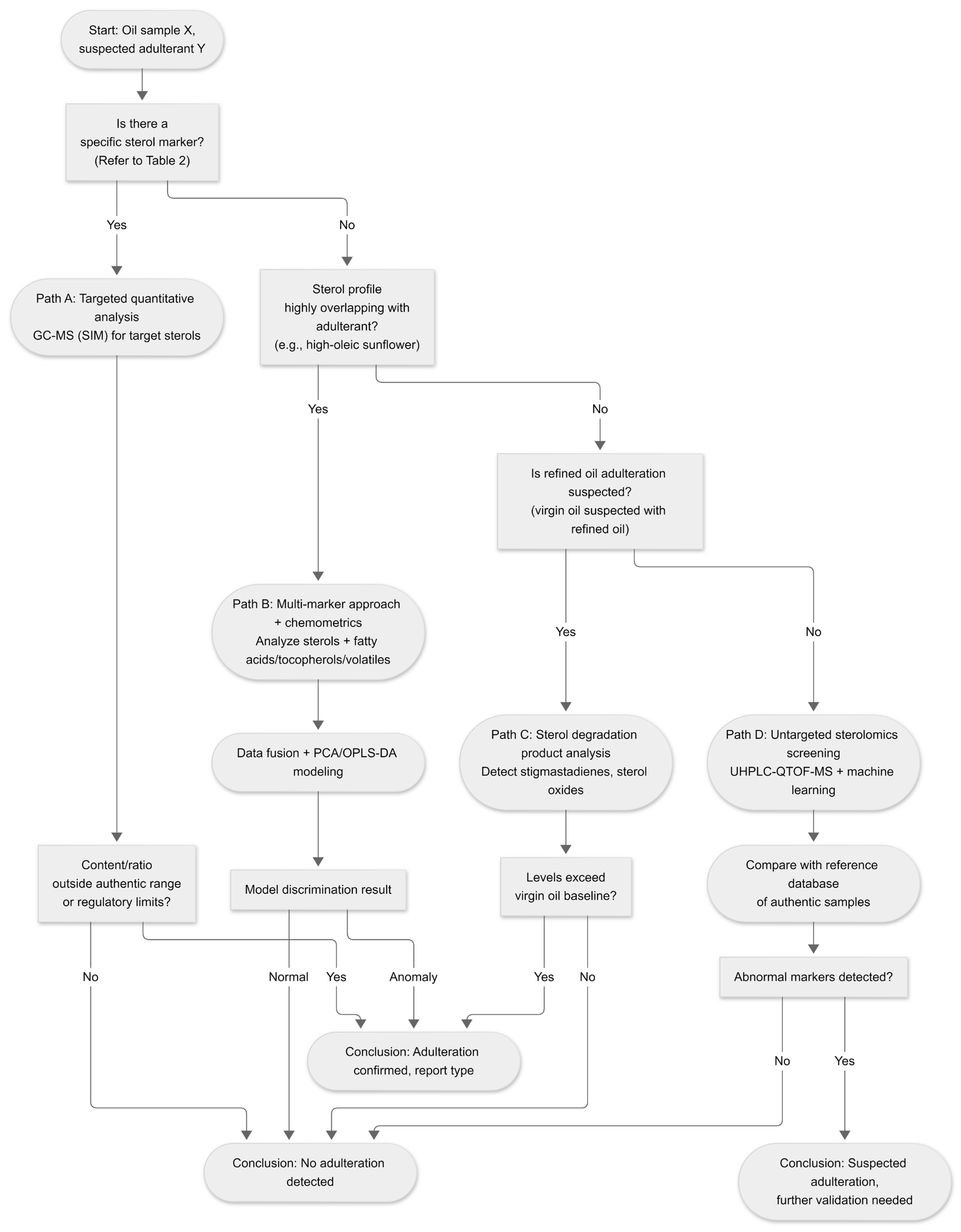
4.1. Applicability of Phytosterol Markers: When Do Sterols Work as Stand-Alone Markers?
4.2. Robustness and Limitations: Confounding Factors and Failure Modes
4.3. Regulatory Relevance and Standardization Pathways
5. Challenges and Future Prospects
6. Conclusions
Author Contributions
Funding
Institutional Review Board Statement
Informed Consent Statement
Data Availability Statement
Acknowledgments
Conflicts of Interest
References
- Kwasi Bannor, R.; Arthur, K.K.; Oppong, D.; Oppong-Kyeremeh, H. A comprehensive systematic review and bibliometric analysis of food fraud from a global perspective. J. Agric. Food Res. 2023, 14, 100686. [Google Scholar] [CrossRef]
- Rodríguez-Sánchez, D.G.; Marín-Obispo, L.M.; Velázquez-Garza, F.E.; Garza-Aguilar, S.M.; Gonzalez Viejo, C.; Fuentes, S.; Colin-Oviedo, Á.; Díaz de la Garza, R.I.; Hernández-Brenes, C. Joint Metabolites for Avocado Oil Identity: Fatty Acid Profiles and Fatty Alcohol Esters as Unique Derivatives. J. Agric. Food Chem. 2025, 73, 1529–1541. [Google Scholar] [CrossRef] [PubMed]
- Bai, G.; Ma, C.; Chen, X. Phytosterols in edible oil: Distribution, analysis and variation during processing. Grain Oil Sci. Technol. 2021, 4, 33–44. [Google Scholar] [CrossRef]
- Zhang, T.; Xie, L.; Liu, R.; Chang, M.; Zhang, H.; Jin, Q.; Wang, X. Revisiting the 4,4-dimethylsterols profile from different kinds of vegetable oils by using GC-MS. LWT 2020, 124, 109163. [Google Scholar] [CrossRef]
- Shi, T.; Wu, G.; Jin, Q.; Wang, X. Detection of camellia oil adulteration using chemometrics based on fatty acids GC fingerprints and phytosterols GC–MS fingerprints. Food Chem. 2021, 352, 129422. [Google Scholar] [CrossRef]
- Xu, B.; Zhang, L.; Wang, H.; Luo, D.; Li, P. Characterization and authentication of four important edible oils using free phytosterol profiles established by GC-GC-TOF/MS. Anal. Methods 2014, 6, 6860–6870. [Google Scholar] [CrossRef]
- Zhang, T.; Liu, R.; Chang, M.; Jin, Q.; Zhang, H.; Wang, X. Health benefits of 4,4-dimethyl phytosterols: An exploration beyond 4-desmethyl phytosterols. Food Funct. 2020, 11, 93–110. [Google Scholar] [CrossRef]
- Zhang, T.; Xie, L.; Guo, Y.; Wang, Z.; Guo, X.; Liu, R.; Jin, Q.; Chang, M.; Wang, X. 4,4-Dimethylsterols Reduces Fat Accumulation via Inhibiting Fatty Acid Amide Hydrolase In Vitro and In Vivo. Research 2024, 7, 0377. [Google Scholar] [CrossRef]
- Schlag, S.; Schäfer, S.; Sommer, K.; Vetter, W. A sterol database: GC/MS data and occurrence of 150 sterols in seventy-four oils. Food Chem. 2024, 460, 140778. [Google Scholar] [CrossRef]
- Bian, Y.; Zhang, Y.; Ruan, L.-Y.; Feng, X.-S. Phytosterols in Plant-Derived Foods: Recent Updates in Extraction and Analysis Methods. Crit. Rev. Anal. Chem. 2024, 1–19. [Google Scholar] [CrossRef]
- Azadmard-Damirchi, S.; Dutta, P.C. Novel solid-phase extraction method to separate 4-desmethyl-, 4-monomethyl-, and 4,4′-dimethylsterols in vegetable oils. J. Chromatogr. A 2006, 1108, 183–187. [Google Scholar] [CrossRef]
- Gorassini, A.; Verardo, G.; Bortolomeazzi, R. Polymeric reversed phase and small particle size silica gel solid phase extractions for rapid analysis of sterols and triterpene dialcohols in olive oils by GC-FID. Food Chem. 2019, 283, 177–182. [Google Scholar] [CrossRef] [PubMed]
- Jafarian-asl, P.; Niazmand, R.; Jahani, M. Solid-phase extraction of phytosterols from rapeseed oil deodorizer distillates with magnetic graphene oxide nanocomposite. J. Exp. Nanosci. 2020, 15, 307–321. [Google Scholar] [CrossRef]
- Zhang, Z.; Tan, W.; Hu, Y.; Li, G. Simultaneous determination of trace sterols in complicated biological samples by gas chromatography–mass spectrometry coupled with extraction using β-sitosterol magnetic molecularly imprinted polymer beads. J. Chromatogr. A 2011, 1218, 4275–4283. [Google Scholar] [CrossRef] [PubMed]
- García-González, A.; Velasco, J.; Velasco, L.; Ruiz-Méndez, M.V. An Analytical Simplification for Faster Determination of Fatty Acid Composition and Phytosterols in Seed Oils. Food Anal. Methods 2018, 11, 1234–1242. [Google Scholar] [CrossRef]
- Xu, B.; Zhang, L.; Ma, F.; Zhang, W.; Wang, X.; Zhang, Q.; Luo, D.; Ma, H.; Li, P. Determination of free steroidal compounds in vegetable oils by comprehensive two-dimensional gas chromatography coupled to time-of-flight mass spectrometry. Food Chem. 2018, 245, 415–425. [Google Scholar] [CrossRef]
- Millán, L.; Sampedro, M.C.; Sánchez, A.; Delporte, C.; Van Antwerpen, P.; Goicolea, M.A.; Barrio, R.J. Liquid chromatography–quadrupole time of flight tandem mass spectrometry–based targeted metabolomic study for varietal discrimination of grapes according to plant sterols content. J. Chromatogr. A 2016, 1454, 67–77. [Google Scholar] [CrossRef]
- Jiang, K.; Gachumi, G.; Poudel, A.; Shurmer, B.; Bashi, Z.; El-Aneed, A. The Establishment of Tandem Mass Spectrometric Fingerprints of Phytosterols and Tocopherols and the Development of Targeted Profiling Strategies in Vegetable Oils. J. Am. Soc. Mass Spectrom. 2019, 30, 1700–1712. [Google Scholar] [CrossRef]
- Thanh, T.T.; Vergnes, M.-F.; Kaloustian, J.; El-Moselhy, T.F.; Amiot-Carlin, M.-J.; Portugal, H. Effect of storage and heating on phytosterol concentrations in vegetable oils determined by GC/MS. J. Sci. Food Agric. 2006, 86, 220–225. [Google Scholar] [CrossRef]
- ISO 12228-1:2014; Determination of Individual and Total Sterols Contents. Gas Chromatographic Method. Part 1: Animal and Vegetable Fats and Oils. International Organization for Standardization: Geneva, Switzerland, 2014.
- Nestola, M.; Schmidt, T.C. Fully automated determination of the sterol composition and total content in edible oils and fats by online liquid chromatography–gas chromatography–flame ionization detection. J. Chromatogr. A 2016, 1463, 136–143. [Google Scholar] [CrossRef]
- Fang, N.; Yu, S.; Badger, T.M. Characterization of triterpene alcohol and sterol ferulates in rice bran using LC-MS/MS. J. Agric. Food Chem. 2003, 51, 3260–3267. [Google Scholar] [CrossRef] [PubMed]
- Yuan, C.; Xie, Y.; Jin, R.; Ren, L.; Zhou, L.; Zhu, M.; Ju, Y. Simultaneous Analysis of Tocopherols, Phytosterols, and Squalene in Vegetable Oils by High-Performance Liquid Chromatography. Food Anal. Methods 2017, 10, 3716–3722. [Google Scholar] [CrossRef]
- Slavin, M.; Yu, L. A single extraction and HPLC procedure for simultaneous analysis of phytosterols, tocopherols and lutein in soybeans. Food Chem. 2012, 135, 2789–2795. [Google Scholar] [CrossRef] [PubMed]
- Duan, Y.-X.; Liu, Z.-H.; Han, Y.; Zhang, T.; Zhang, X. Free Phytosterol Analysis and Characterization in Tobacco by Ultra Performance Liquid Chromatography-Atmospheric Pressure Chemical Ionization-Mass Spectrometry. Asian J. Chem. 2014, 26, 7148–7150. [Google Scholar] [CrossRef]
- Tan, J.; Niu, X.; Yang, G.; Wang, L.; Duan, Y.; Han, Y.; Zhang, K.; Zhang, C. Quantitative Determination of Free Phytosterols in Tobacco Leaves by UPLC-MS/MS. J. Liq. Chromatogr. Relat. Technol. 2013, 36, 591–599. [Google Scholar] [CrossRef]
- Hashim, S.N.N.S.; Boysen, R.I.; Yang, Y.; Schwarz, L.J.; Danylec, B.; Hearn, M.T.W. Parallel enrichment of polyphenols and phytosterols from Pinot noir grape seeds with molecularly imprinted polymers and analysis by capillary high-performance liquid chromatography electrospray ionisation tandem mass spectrometry. Talanta 2020, 208, 120397. [Google Scholar] [CrossRef]
- Yoon, B.-H.; Truong, V.-L.; Jeong, W.-S. Phytosterols: Extraction Methods, Analytical Techniques, and Biological Activity. Molecules 2025, 30, 2488. [Google Scholar] [CrossRef]
- Evtyugin, D.D.; Evtuguin, D.V.; Casal, S.; Domingues, M.R. Advances and challenges in plant sterol research: Fundamentals, analysis, applications and production. Molecules 2023, 28, 6526. [Google Scholar] [CrossRef]
- Ishida, N. A method for simultaneous analysis of phytosterols and phytosterol esters in tobacco leaves using non aqueous reversed phase chromatography and atmospheric pressure chemical ionization mass spectrometry detector. J. Chromatogr. A 2014, 1340, 99–108. [Google Scholar] [CrossRef]
- Teng, Y.C.; Gielen, M.C.; de Gruijter, N.M.; Ciurtin, C.; Rosser, E.C.; Karu, K. Phytosterols in human serum as measured using a liquid chromatography tandem mass spectrometry. J. Steroid Biochem. Mol. Biol. 2024, 241, 106519. [Google Scholar] [CrossRef]
- Zheng, Y.; Fang, D.; Lv, Y.; Deng, B.; Li, X.; Luo, Y.; Hussain, D.; Ma, L.; Chen, D. Current analytical strategies for the determination of phytosterols in vegetable oils. J. Food Compos. Anal. 2024, 131, 106279. [Google Scholar] [CrossRef]
- Sarah, S.; Yining, H.; Walter, V. GC/EI-MS method for the determination of phytosterols in vegetable oils. Anal. Bioanal. Chem. 2021, 414, 1061–1071. [Google Scholar]
- Xu, Q.; Wang, D.; Lv, X.; Chen, H.; Wei, F. Comprehensive profiling and evaluation of free/conjugated Phytosterols in crops using chemical derivatization coupled with UHPLC-ESI-QTOF-MS/MS. Food Chem. 2025, 463, 141316. [Google Scholar] [CrossRef] [PubMed]
- Kesen, S. Monitoring Fatty Acid and Sterol Profile of Nizip Yaglik Olive Oil Adulterated by Cotton and Sunflower Oil. J. Oleo Sci. 2019, 68, 817–826. [Google Scholar] [CrossRef]
- Senizza, B.; Ganugi, P.; Trevisan, M.; Lucini, L. Combining untargeted profiling of phenolics and sterols, supervised multivariate class modelling and artificial neural networks for the origin and authenticity of extra-virgin olive oil: A case study on Taggiasca Ligure. Food Chem. 2023, 404, 134543. [Google Scholar] [CrossRef]
- Zhang, Y.; Deng, Y.; Zhang, C.; Xie, P.; Huang, L. A novel approach for authentication of extra virgin olive oil adulterated with corn, soybean, sunflower, and rapeseed oils using binary indicators based on the linoleic acid and stigmasterol ratio. J. Food Compos. Anal. 2025, 141, 107298. [Google Scholar] [CrossRef]
- Chen, Z.; Fu, J.; Dou, X.; Deng, Z.; Wang, X.; Ma, F.; Yu, L.; Yun, Y.-H.; Li, P.; Zhang, L. Comprehensive adulteration detection of sesame oil based on characteristic markers. Food Chem. X 2023, 18, 100745. [Google Scholar] [CrossRef]
- Al-Ismail, K.M.; Alsaed, A.K.; Ahmad, R.; Al-Dabbas, M. Detection of olive oil adulteration with some plant oils by GLC analysis of sterols using polar column. Food Chem. 2010, 121, 1255–1259. [Google Scholar] [CrossRef]
- Mathison, B.; Holstege, D. A Rapid Method to Determine Sterol, Erythrodiol, and Uvaol Concentrations in Olive Oil. J. Agric. Food Chem. 2013, 61, 4506–4513. [Google Scholar] [CrossRef]
- Jabeur, H.; Zribi, A.; Makni, J.; Rebai, A.; Abdelhedi, R.; Bouaziz, M. Detection of Chemlali Extra-Virgin Olive Oil Adulteration Mixed with Soybean Oil, Corn Oil, and Sunflower Oil by Using GC and HPLC. J. Agric. Food Chem. 2014, 62, 4893–4904. [Google Scholar] [CrossRef]
- Youseff, R.; Soubh, L.; Alassaf, Z. Detection of vegetable oils adulteration using desmethylsterols composition. Int. J. Pharm. Sci. 2014, 28, 229–233. [Google Scholar]
- Srigley, C.T.; Oles, C.J.; Kia, A.R.F.; Mossoba, M.M. Authenticity Assessment of Extra Virgin Olive Oil: Evaluation of Desmethylsterols and Triterpene Dialcohols. J. Am. Oil Chem. Soc. 2016, 93, 171–181. [Google Scholar] [CrossRef]
- Damirchi, S.A.; Savage, G.P.; Dutta, P.C. Sterol fractions in hazelnut and virgin olive oils and 4,4′-dimethylsterols as possible markers for detection of adulteration of virgin olive oil. J. Am. Oil Chem. Soc. 2005, 82, 717–725. [Google Scholar] [CrossRef]
- Azadmard-Damirchi, S.; Dutta, P.C. Free and esterified 4,4′-dimethylsterols in hazelnut oil and their retention during refining processes. J. Am. Oil Chem. Soc. 2007, 84, 297–304. [Google Scholar] [CrossRef]
- Valli, E.; Milani, A.; Srbinovska, A.; Moret, E.; Moret, S.; Bendini, A.; Moreda, W.; Toschi, T.G.; Lucci, P. In-House Validation of an SPE-GC-FID Method for the Detection of Free and Esterified Hydroxylated Minor Compounds in Virgin Olive Oils. Foods 2021, 10, 1260. [Google Scholar] [CrossRef]
- Manai-Djebali, H.; Oueslati, I.; Martínez-Cañas, M.A.; Zarrouk, M.; Sánchez-Casas, J. Improvement of the Sterol and Triacylglycerol Compositions of Chemlali Virgin Olive Oils through Controlled Crossing with Mediterranean Cultivars. J. Oleo Sci. 2018, 67, 379–388. [Google Scholar] [CrossRef]
- Ruiz-Aracama, A.; Goicoechea, E.; Guillén, M.D. Direct study of minor extra-virgin olive oil components without any sample modification. 1H NMR multisupression experiment: A powerful tool. Food Chem. 2017, 228, 301–314. [Google Scholar] [CrossRef]
- Drira, M.; Kelebek, H.; Guclu, G.; Jabeur, H.; Selli, S.; Bouaziz, M. Targeted analysis for detection the adulteration in extra virgin olive oil’s using LC-DAD/ESI–MS/MS and combined with chemometrics tools. Eur. Food Res. Technol. 2020, 246, 1661–1677. [Google Scholar] [CrossRef]
- Uncu, O.; Ozen, B. Importance of some minor compounds in olive oil authenticity and quality. Trends Food Sci. Technol. 2020, 100, 164–176. [Google Scholar] [CrossRef]
- Gordon, M.H.; Firman, C. Effects of heating and bleaching on formation of stigmastadienes in olive oil. J. Sci. Food Agric. 2001, 81, 1530–1532. [Google Scholar] [CrossRef]
- Dong, Y.-Y.; Hu, Z.-Y.; Zhu, Q.-S.; Zhu, Z.-W.; Guo, P.; Zhang, W.-Z.; Wang, D. Fingerprint analysis of triterpenoids in identification of authenticity of Camellia oil. Acta Agric. Jiangxi 2020, 32, 105–109. [Google Scholar]
- Li, Y.; Wu, M.; Zhai, L.; Zhang, H.; Shen, L. Qualitative and quantitative analysis of β-sitosterol marker in virgin camellia oil and virgin olive oil. Food Qual. Saf. 2023, 7, fyad034. [Google Scholar] [CrossRef]
- Hu, Y.; Wei, C.; Wang, X.; Wang, W.; Jiao, Y. Using three-dimensional fluorescence spectroscopy and machine learning for rapid detection of adulteration in camellia oil. Spectrochim. Acta Part A Mol. Biomol. Spectrosc. 2025, 329, 125524. [Google Scholar] [CrossRef] [PubMed]
- Deme, T.; Haki, G.D.; Retta, N.; Woldegiorgis, A.; Geleta, M.; Mateos, H.; Lewandowski, P.A. Sterols as a biomarker in tracing niger and sesame seeds oils adulterated with palm oil. Heliyon 2021, 7, e06797. [Google Scholar] [CrossRef] [PubMed]
- Sandra, B.; Dragutin, V.; Iva, T.; Dunja, E.; Jasenka, G.; Klara, K.; Marko, O.; Dubravka, Š. Assessment of Pumpkin Seed Oil Adulteration Supported by Multivariate Analysis: Comparison of GC-MS, Colourimetry and NIR Spectroscopy Data. Foods 2022, 11, 835. [Google Scholar] [CrossRef] [PubMed]
- Dowlatabadi, M.; Mortazavi, S.A.; Ravansalar, H.; Saeidi Asl, M.R.; Pedram Nia, A. Comparative analysis of molecular and chromatographic methods for detecting palm oil adulteration in yogurt. Sci. Rep. 2025, 15, 29568. [Google Scholar] [CrossRef]
- Zhao, H.; Wang, Y.; Xu, X.; Ren, H.; Li, L.; Xiang, L.; Zhong, W. Detection of Adulterated Vegetable Oils Containing Waste Cooking Oils Based on the Contents and Ratios of Cholesterol, β-Sitosterol, and Campesterol by Gas Chromatography/Mass Spectrometry. J. AOAC Int. 2019, 98, 1645–1654. [Google Scholar] [CrossRef]
- Crews, C.; Hough, P.; Brereton, P.; Godward, J.; Lees, M.; Guiet, S.; Winkelmann, W. Quantitation of the Main Constituents of Some Authentic Sesame Seed Oils of Different Origin. J. Agric. Food Chem. 2006, 54, 6266–6270. [Google Scholar] [CrossRef]
- Crews, C.; Hough, P.; Godward, J.; Brereton, P.; Lees, M.; Guiet, S.; Winkelmann, W. Quantitation of the Main Constituents of Some Authentic Grape-Seed Oils of Different Origin. J. Agric. Food Chem. 2006, 54, 6261–6265. [Google Scholar] [CrossRef]
- Creydt, M.; Lautner, S.; Fromm, J.; Fischer, M. Wood profiling by non-targeted liquid chromatography high-resolution mass spectrometry: Part 2, Detection of the geographical origin of spruce wood (Picea abies) by determination of metabolite pattern. J. Chromatogr. A 2022, 1663, 462737. [Google Scholar] [CrossRef]
- Beltrán Sanahuja, A.; Maestre Pérez, S.E.; Grané Teruel, N.; Valdés García, A.; Prats Moya, M.S. Variability of Chemical Profile in Almonds (Prunus dulcis) of Different Cultivars and Origins. Foods 2021, 10, 153. [Google Scholar] [CrossRef]
- Bohacenko, I.; Kopicova, Z. Detection of olive oils authenticity by determination of their sterol content using LC/GC. Czech J. Food Sci. 2001, 19, 97–103. [Google Scholar] [CrossRef]
- Jabeur, H.; Drira, M.; Rebai, A.; Bouaziz, M. Putative Markers of Adulteration of Higher-Grade Olive Oil with Less Expensive Pomace Olive Oil Identified by Gas Chromatography Combined with Chemometrics. J. Agric. Food Chem. 2017, 65, 5375–5383. [Google Scholar] [CrossRef] [PubMed]
- Peng, D.; Bi, Y.; Ren, X.; Yang, G.; Sun, S.; Wang, X. Detection and quantification of adulteration of sesame oils with vegetable oils using gas chromatography and multivariate data analysis. Food Chem. 2015, 188, 415–421. [Google Scholar] [CrossRef] [PubMed]
- Tang, F.; Green, H.S.; Wang, S.C.; Hatzakis, E. Analysis and Authentication of Avocado Oil Using High Resolution NMR Spectroscopy. Molecules 2021, 26, 310. [Google Scholar] [CrossRef]
- Wocheslander, S.; Eisenreich, W.; Scholz, B.; Lander, V.; Engel, K.-H. Identification of Acyl Chain Oxidation Products upon Thermal Treatment of a Mixture of Phytosteryl/-stanyl Linoleates. J. Agric. Food Chem. 2016, 64, 9214–9223. [Google Scholar] [CrossRef]
- Zhang, X.; Julien-David, D.; Miesch, M.; Geoffroy, P.; Raul, F.; Roussi, S.; Aoudé-Werner, D.; Marchioni, E. Identification and quantitative analysis of β-sitosterol oxides in vegetable oils by capillary gas chromatography–mass spectrometry. Steroids 2005, 70, 896–906. [Google Scholar] [CrossRef]
- Devkar, S.T.; Suryapujary, S.M.; Jagtap, S.D.; Katyare, S.S.; Hegde, M.V. Effect of macronutrient deficiency on withanolides content in the roots of Withania somnifera and its correlationship with molybdenum content. Pharm. Biol. 2015, 53, 518–523. [Google Scholar] [CrossRef]
- Soha, S.; Mortazavian, A.M.; Piravi-Vanak, Z.; Mohammadifar, M.A.; Sahafar, H.; Nanvazadeh, S. Adequacy of the Measurement Capability of Fatty Acid Compositions and Sterol Profiles to Determine Authenticity of Milk Fat Through Formulation of Adulterated Butter. Recent Pat. Food Nutr. Agric. 2015, 7, 134–140. [Google Scholar] [CrossRef][Green Version]
- Calderón, C.; Lämmerhofer, M. Nutritional lipidomics for the characterization of lipids in food. Adv. Food Nutr. Res. 2023, 105, 97–172. [Google Scholar] [CrossRef]
- Llano, S.M.; Muñoz-Jiménez, A.M.; Jiménez-Cartagena, C.; Londoño-Londoño, J.; Medina, S. Untargeted metabolomics reveals specific withanolides and fatty acyl glycoside as tentative metabolites to differentiate organic and conventional Physalis peruviana fruits. Food Chem. 2018, 244, 120–127. [Google Scholar] [CrossRef]
- Lim, K.; Pan, K.; Yu, Z.; Xiao, R.H. Pattern recognition based on machine learning identifies oil adulteration and edible oil mixtures. Nat. Commun. 2020, 11, 5353. [Google Scholar] [CrossRef]



| Analytical Technique | Sample Preparation | Target Phytosterol Forms | Main Advantages | Main Limitations | Typical Applications | References |
|---|---|---|---|---|---|---|
| GC–FID | Saponification; extraction; derivatization | Free phytosterols (main sterols) | Good sensitivity and reproducibility; widely used | Requires derivatization; limited structural specificity | Routine sterol quantification | [12,21,32] |
| GC-MS/GC–MS (SIM) | Saponification; SPE or similar cleanup; derivatization | Free andminor Sterols; Structural profiling | MS gives structural information; high selectivity | Derivatization needed; limited to volatile forms | Detailed profiling and authentication | [9,33] |
| Online LC–GC–FID | Automated Saponification & transfer to GC | Free sterols | High throughput; reduced manual steps | High equipment cost; still FID lacks structural information | Routine high-volume sterol analysis | [21] |
| LC–MS/LC–MS/MS (APCI/ESI) | Minimal cleanup; no derivatization | Free sterols; sterol esters; POPs | Avoids derivatization sensitive & selective | Matrix effect; optimization needed | Comprehensive sterol & oxidation product analysis | [22,23,24] |
| UHPLC-ESI-QTOF-MS | Optional derivatization; reversed-phase LC | Free & conjugated sterols | High resolution; untargeted potential | Data interpretation complexity | Expanded sterol profiling & detailed compound detection | [25,26,34] |
| Oil Type | Adulterant | Phytosterol-Based Marker(s) | Detection Method | Sensitivity | References |
|---|---|---|---|---|---|
| Olive oil | Sunflower oil | Increased Δ7-stigmasterol relative to authentic sterol profile | GC-FID/GC-MS | LOD ≥ 2% | [46] |
| Soybean oil Corn oil | altered campesterol/stigmasterol ratios | GC-FID | LOD ≥ 4% | [39] | |
| Rapeseed oil | Brassicasterol appearance | GC/LC | LOD ≥ 5% | [63] | |
| Refined olive oil/pomace oil | Uvaol; erythrodiol | GC-FID/GC-MS | LOD ≥ 10% | [64] | |
| Refined vegetable or olive oils | Stigmastadienes (e.g., 3,5-stigmastadiene) | GC-FID/GC-MS | Virgin olive oil: <0.01 mg/kg; refined oils: 0.3–0.9 mg/kg | [50,51] | |
| Hazelnut Oil | lupeol in total or only in esterified forms of 4,4′-dimethylsterols | GC-MS | LOD ≥ 2% | [44] | |
| Camellia seed oil | Common vegetable oils | β-amyrin and lanosterol | GC-FID/GC-MS | LOD ≥ 30% | [5,52] |
| Virgin olive oil | β-Sitosterol (14.1–30.2 mg/100 g) | GC-MS | virgin olive oil (94.3–173.2 mg/100 g) | [53] | |
| Multiple adulterants | Fluorescent phytosterols & flavonoids | 3D fluorescence spectroscopy (EEM) | The correct discrimination rate is 97.78% | [54] | |
| Sesame oil | Rapeseed oil | Brassicasterol appearance | GC-FID | LOD ≥ 5% | [38,65] |
| Cottonseed oil | sitosterol, campesterol, and stigmasterol | GC-MS | LOD ≥ 10% | [55] | |
| Avocado oil | Common vegetable oils | β-sitosterol, Δ5-avenasterol | 1H NMR spectroscopy | LOD ≥ 5% | [66] |
Disclaimer/Publisher’s Note: The statements, opinions and data contained in all publications are solely those of the individual author(s) and contributor(s) and not of MDPI and/or the editor(s). MDPI and/or the editor(s) disclaim responsibility for any injury to people or property resulting from any ideas, methods, instructions or products referred to in the content. |
© 2026 by the authors. Licensee MDPI, Basel, Switzerland. This article is an open access article distributed under the terms and conditions of the Creative Commons Attribution (CC BY) license.
Share and Cite
Cheng, K.; Zhou, T.; Wang, W.; Zhang, J.; Zhou, X.; Hu, B.; Zhang, T. Phytosterol Profiling as a Tool for Edible Oil Authentication: Challenges and Prospects. Foods 2026, 15, 1101. https://doi.org/10.3390/foods15061101
Cheng K, Zhou T, Wang W, Zhang J, Zhou X, Hu B, Zhang T. Phytosterol Profiling as a Tool for Edible Oil Authentication: Challenges and Prospects. Foods. 2026; 15(6):1101. https://doi.org/10.3390/foods15061101
Chicago/Turabian StyleCheng, Kaili, Tong Zhou, Wei Wang, Jiuliang Zhang, Xiaoting Zhou, Bing Hu, and Tao Zhang. 2026. "Phytosterol Profiling as a Tool for Edible Oil Authentication: Challenges and Prospects" Foods 15, no. 6: 1101. https://doi.org/10.3390/foods15061101
APA StyleCheng, K., Zhou, T., Wang, W., Zhang, J., Zhou, X., Hu, B., & Zhang, T. (2026). Phytosterol Profiling as a Tool for Edible Oil Authentication: Challenges and Prospects. Foods, 15(6), 1101. https://doi.org/10.3390/foods15061101