Innovative Systems Biology in Baijiu Fermentation: Unveiling Omics Landscapes and Microbial Synergy


Abstract
1. Introduction
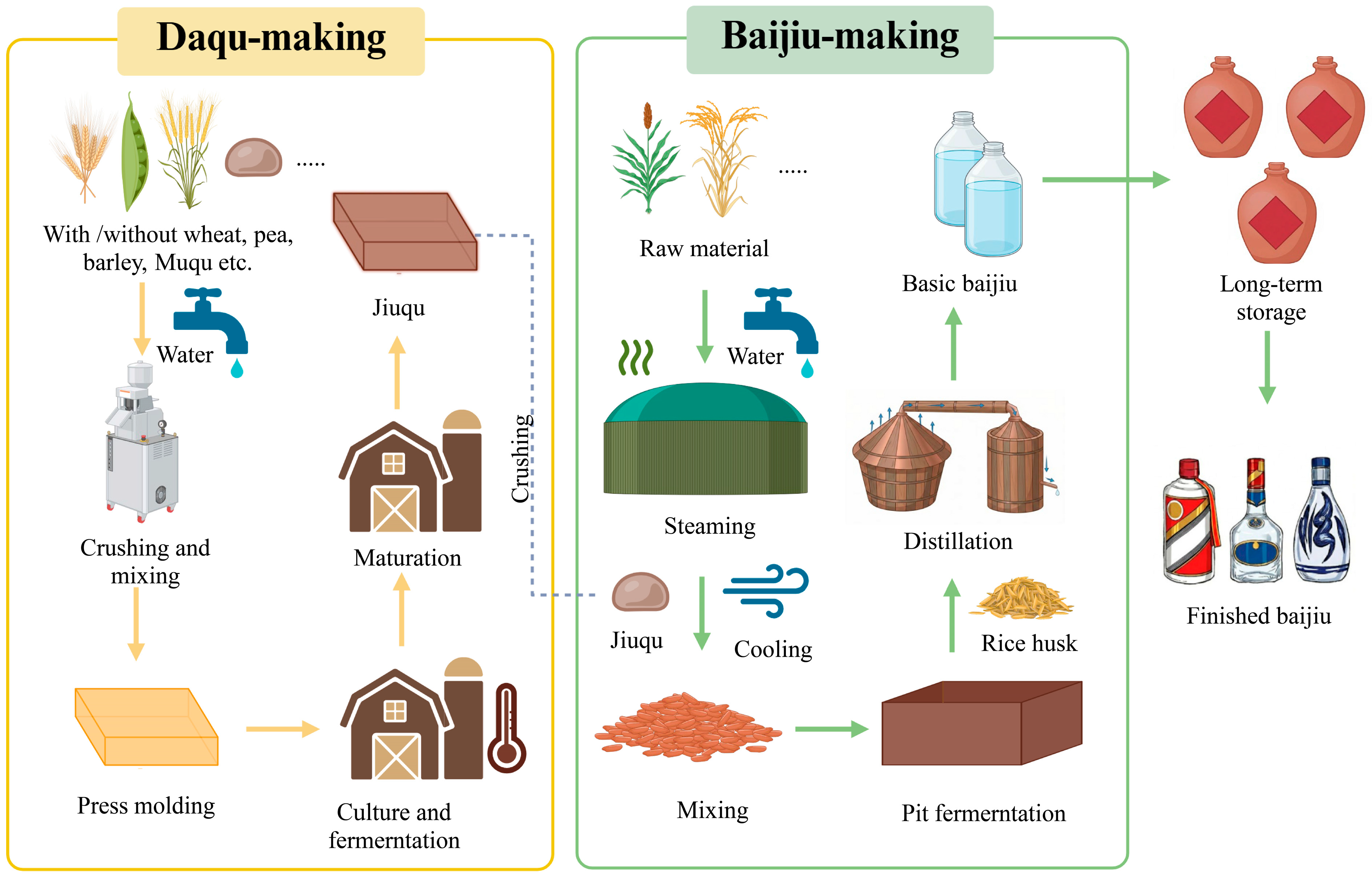
2. The Microbial Landscape of Baijiu
2.1. Microbial Ecology of Daqu
2.2. The Microbial Ecology of Pit Mud
2.3. Microbial Diversity in Baijiu Fermentation System
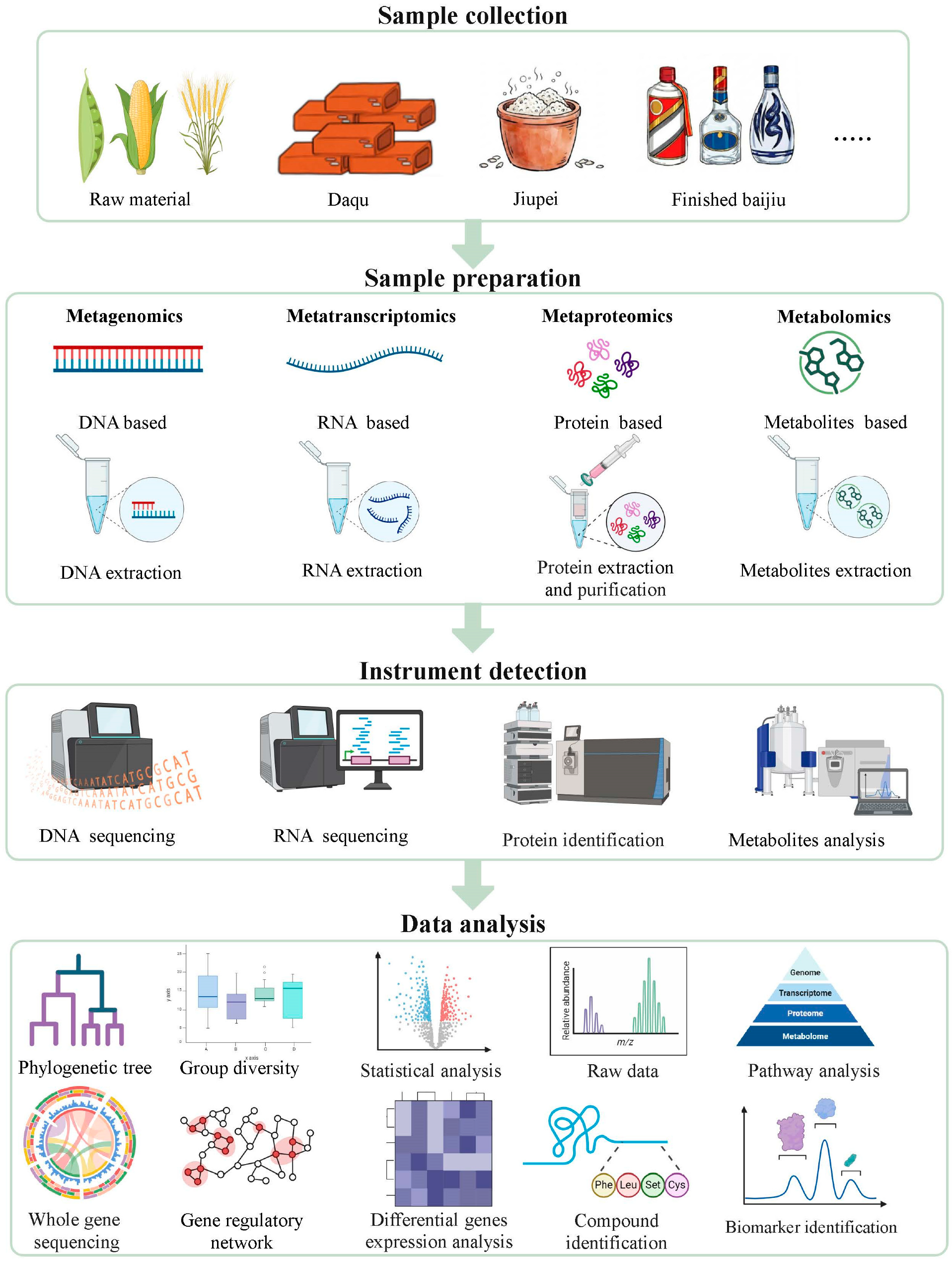
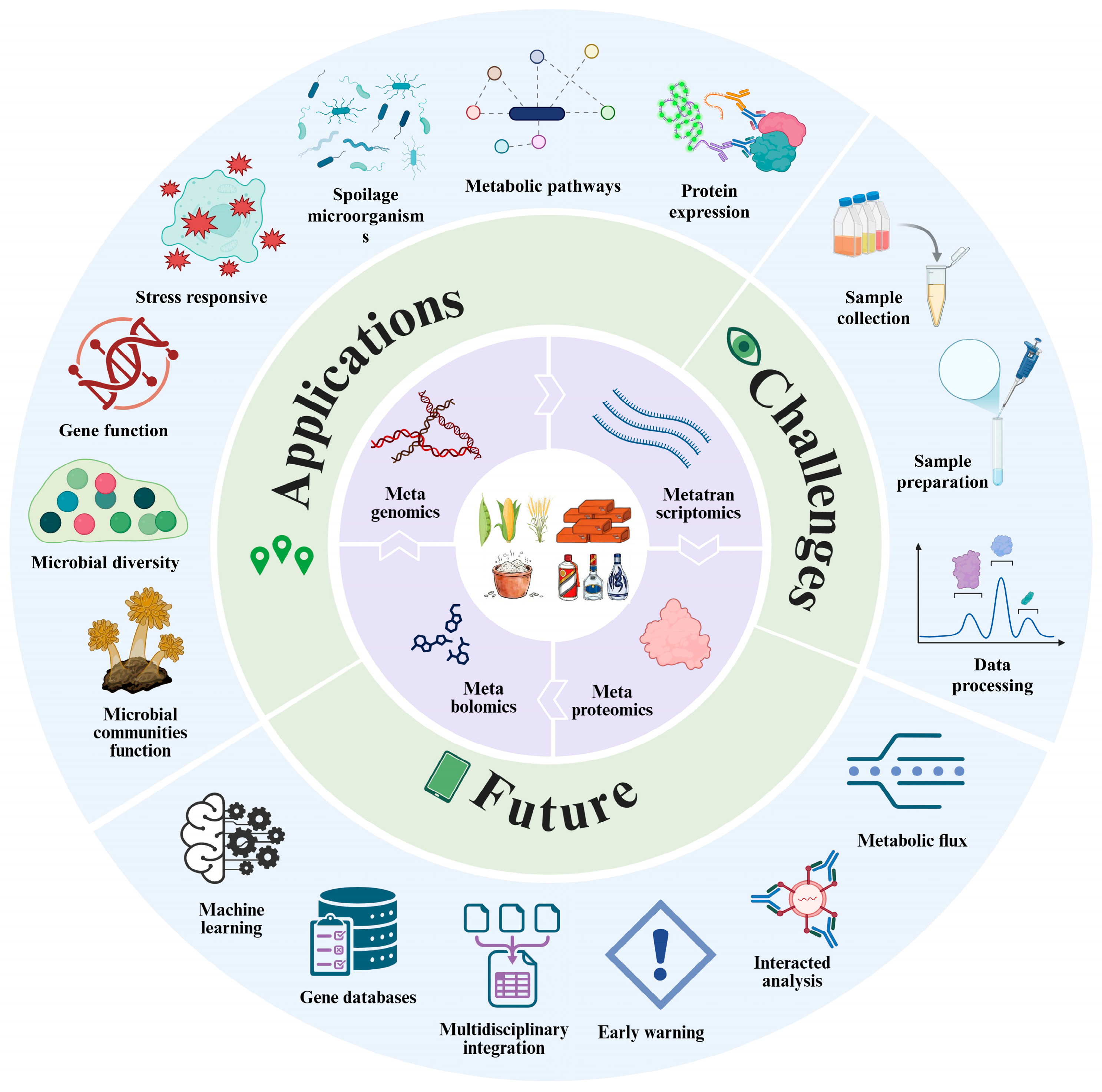
3. Overview of Multi-Omics Technologies Applied to Baijiu
3.1. Metagenomics
3.1.1. Microbial Diversity and Taxonomic Resolution
3.1.2. Functional Properties of Microbial Communities
3.1.3. Baijiu Virome
3.1.4. Spoilage Microorganisms and Off-Odors
3.2. Metatranscriptomics
3.2.1. Metabolic Pathways
3.2.2. Baijiu Virome
3.2.3. Stress Response and Interactions
3.3. Metaproteomics
3.3.1. Protein Expression Profiles and Functional Landscapes
3.3.2. Stress Response and Microbial Adaptations
3.3.3. Identification of Key Functional Microorganisms
3.4. Metabolomics
3.4.1. Dynamic Changes and Characterization of Metabolites
3.4.2. Metabolic Pathway Elucidation and Functional Decoding
3.4.3. Quality and Safety Inspection
3.5. Multi-Omics Strategies and Data Integration in Baijiu Research
4. Current Challenges and Future Perspectives
4.1. Current Challenges in Baijiu Multi-Omics
4.1.1. Matrix Interference and Extraction Efficiency
4.1.2. Proteomic and Metabolomic Obstacles
4.1.3. Bioinformatic Hurdles and Lack of Standardization
4.2. Future Directions and Perspectives
4.2.1. Enhancing Spatiotemporal Resolution and Multi-Modal Characterization
4.2.2. AI-Driven Data Fusion and Predictive Modeling
4.2.3. Regional Ecological Decoding and Database Construction
4.2.4. Industrial Valorization and Biosafety Frameworks
5. Conclusions
Author Contributions
Funding
Institutional Review Board Statement
Informed Consent Statement
Data Availability Statement
Conflicts of Interest
Abbreviations
| Abbreviation | Full name |
| VBNC | Viable but non-culturable |
| HTS | High-throughput sequencing |
| HTQ | High-temperature Daqu |
| LAB | Lactic acid bacteria |
| PM | Pit Mud |
| SCFAs | Short-chain fatty acids |
| MCFAs | Medium-chain fatty acids |
| IHT | Interspecies hydrogen transfer |
| ITS | Internal Transcribed Spacer |
| MAGs | Metagenome-assembled genomes |
| TMA | Trimethylamine |
| DMTS | Dimethyl trisulfide |
| MTQ | Medium-temperature Daqu |
| LTQ | Low-temperature Daqu |
| SSF | Solid-state fermentation |
| LC | Liquid chromatography |
| ICAT | Isotope-coded affinity tags |
| HRMS | High-resolution mass spectrometry |
| PPI | Protein–Protein Interaction |
| AP | Available phosphorus |
| SOD | superoxide dismutase |
| GAPDH | glyceraldehyde-3-phosphate dehydrogenase |
| ALDH | aldehyde dehydrogenase |
| GC-MS | gas chromatography-mass spectrometry |
| LC-MS | liquid chromatography-mass spectrometry |
| PCA | Principal Component Analysis |
| PLS-DA | Partial Least Squares-Discriminant Analysis |
| VOCs | Volatile organic compounds |
| SCB | Sichuan Basin |
| YHRB | Yangtze-Huaihe River Basin |
| DMs | Differential metabolites |
| PAEs | Phthalate esters |
| EC | Ethyl carbamate |
| ML | Machine learning |
| MLP | Multilayer Perceptron |
| RDA | Redundancy Analysis |
| CCA | Canonical Correspondence Analysis |
| SVM | Support Vector Machines |
| RF | Random Forests |
| MSI | Mass Spectrometry Imaging |
| MFA | Metabolic Flux Analysis |
| AI | Artificial intelligence |
References
- Auchtung, J.M.; Hallen-Adams, H.E.; Hutkins, R. Microbial interactions and ecology in fermented food ecosystems. Nat. Rev. Microbiol. 2025, 23, 622–634. [Google Scholar] [CrossRef]
- Wu, Q.; Zhu, Y.; Fang, C.; Wijffels, R.H.; Xu, Y. Can we control microbiota in spontaneous food fermentation?—Chinese liquor as a case example. Trends Food Sci. Technol. 2021, 110, 321–331. [Google Scholar] [CrossRef]
- Lin, M.; Yang, B.; Dai, M.; Xu, Y.; Li, X.; Sun, B. East meets west in alcoholic beverages: Flavor comparison, microbial metabolism and health effects. Food Biosci. 2023, 56, 103385. [Google Scholar] [CrossRef]
- Tamang, J.P.; Cotter, P.D.; Endo, A.; Han, N.S.; Kort, R.; Liu, S.Q.; Mayo, B.; Westerik, N.; Hutkins, R. Fermented foods in a global age: East meets West. Compr. Rev. Food Sci. Food Saf. 2020, 19, 184–217. [Google Scholar] [CrossRef]
- Kang, J.; Xue, Y.; Chen, X.; Han, B.Z. Integrated multi-omics approaches to understand microbiome assembly in Jiuqu, a mixed-culture starter. Compr. Rev. Food Sci. Food Saf. 2022, 21, 4076–4107. [Google Scholar] [CrossRef] [PubMed]
- Hawaz, H.; Bottari, B.; Scazzina, F.; Carini, E. Eastern African traditional fermented foods and beverages: Advancements, challenges, and perspectives on food technology, nutrition, and safety. Compr. Rev. Food Sci. Food Saf. 2025, 24, e70137. [Google Scholar] [CrossRef]
- Jin, R.; Song, J.; Liu, C.; Lin, R.; Liang, D.; Aweya, J.J.; Weng, W.; Zhu, L.; Shang, J.; Yang, S. Synthetic microbial communities: Novel strategies to enhance the quality of traditional fermented foods. Compr. Rev. Food Sci. Food Saf. 2024, 23, e13388. [Google Scholar] [CrossRef] [PubMed]
- Liu, H.; Sun, B. Effect of Fermentation Processing on the Flavor of Baijiu. J. Agric. Food Chem. 2018, 66, 5425–5432. [Google Scholar] [CrossRef] [PubMed]
- Xu, Y.; Zhao, J.; Liu, X.; Zhang, C.; Zhao, Z.; Li, X.; Sun, B. Flavor mystery of Chinese traditional fermented baijiu: The great contribution of ester compounds. Food Chem. 2022, 369, 130920. [Google Scholar] [CrossRef]
- Zhu, Y.; Tramper, J. Koji—Where East meets West in fermentation. Biotechnol. Adv. 2013, 31, 1448–1457. [Google Scholar] [CrossRef]
- GB/T 10781.4-2024; Quality Requirements for Baijiu—Part 4: Jiangxiangxing Baijiu. State Administration for Market Regulation: Beijing, China; Standardization Administration of the People’s Republic of China: Beijing, China, 2024.
- Tu, W.; Cao, X.; Cheng, J.; Li, L.; Zhang, T.; Wu, Q.; Xiang, P.; Shen, C.; Li, Q. Chinese Baijiu: The Perfect Works of Microorganisms. Front. Microbiol. 2022, 13, 919044. [Google Scholar] [CrossRef]
- Qin, D.; Lv, S.; Shen, Y.; Shi, J.; Jiang, Y.; Cheng, W.; Wang, D.; Li, H.; Zhang, Y.; Cheng, H.; et al. Decoding the key compounds responsible for the empty cup aroma of soy sauce aroma type baijiu. Food Chem. 2024, 434, 137466. [Google Scholar] [CrossRef]
- Zhu, L.; Song, X.; Li, X.; Geng, X.; Zheng, F.; Li, H.; Sun, J.; Huang, M.; Sun, B. Interactions between kafirin and pickle-like odorants in soy sauce flavor Baijiu: Aroma profile change and binding mechanism. Food Chem. 2023, 400, 133854. [Google Scholar] [CrossRef]
- Kang, J.; Huang, X.; Li, R.; Zhang, Y.; Chen, X.X.; Han, B.Z. Deciphering the core microbes and their interactions in spontaneous Baijiu fermentation: A comprehensive review. Food Res. Int. 2024, 188, 114497. [Google Scholar] [CrossRef]
- Xu, Y.; Sun, B.; Fan, G.; Teng, C.; Xiong, K.; Zhu, Y.; Li, J.; Li, X. The brewing process and microbial diversity of strong flavour Chinese spirits: A review. J. Inst. Brew. 2017, 123, 5–12. [Google Scholar] [CrossRef]
- Xu, Y.; Zhu, Y.; Li, X.; Sun, B. Dynamic balancing of intestinal short-chain fatty acids: The crucial role of bacterial metabolism. Trends Food Sci. Technol. 2020, 100, 118–130. [Google Scholar] [CrossRef]
- Pan, F.; Qiu, S.; Lv, Y.; Li, D. Exploring the controllability of the Baijiu fermentation process with microbiota orientation. Food Res. Int. 2023, 173, 113249. [Google Scholar] [CrossRef] [PubMed]
- Bansal, S.; Rodriguez, C.Z.; Thompson-Witrick, K.A.; Wang, Y.; Taft, D.H.; Zhang, B. Machine learning-powered multi-omics for food microbiology and smarter food safety. Trends Food Sci. Technol. 2025, 163, 105145. [Google Scholar] [CrossRef]
- Ko, K.K.K.; Chng, K.R.; Nagarajan, N. Metagenomics-enabled microbial surveillance. Nat. Microbiol. 2022, 7, 486–496. [Google Scholar] [CrossRef]
- Ojala, T.; Haekkinen, A.E.L.A.; Kankuri, E.; Kankainen, M. Current concepts, advances, and challenges in deciphering the human microbiota with metatranscriptomics. Trends Genet. 2023, 39, 686–702. [Google Scholar] [CrossRef]
- Van Den Bossche, T.; Armengaud, J.; Benndorf, D.; Blakeley Ruiz, J.A.; Brauer, M.; Cheng, K.; Creskey, M.; Figeys, D.; Grenga, L.; Griffin, T.J.; et al. The microbiologist’s guide to metaproteomics. iMeta 2025, 4, e70031. [Google Scholar] [CrossRef]
- Alseekh, S.; Aharoni, A.; Brotman, Y.; Contrepois, K.V.; D’Auria, J.; Ewald, J.; Ewald, J.C.; Fraser, P.D.; Giavalisco, P.; Hall, R.D.; et al. Mass spectrometry-based metabolomics: A guide for annotation, quantification and best reporting practices. Nat. Methods 2021, 18, 747–756. [Google Scholar] [CrossRef] [PubMed]
- Li, Y.; He, W.; Liu, S.; Hu, X.; He, Y.; Song, X.; Yin, J.; Nie, S.; Xie, M. Innovative omics strategies in fermented fruits and vegetables: Unveiling nutritional profiles, microbial diversity, and future prospects. Compr. Rev. Food Sci. Food Saf. 2024, 23, e70030. [Google Scholar] [CrossRef] [PubMed]
- Shang, W.; Wei, G.; Li, H.; Zhao, G.; Wang, D. Advances in High-Resolution Mass Spectrometry-Based Metabolomics: Applications in Food Analysis and Biomarker Discovery. J. Agric. Food Chem. 2025, 73, 3305–3325. [Google Scholar] [CrossRef] [PubMed]
- Shilo, S.; Segal, E. Endocrinology in the multi-omics era. Nat. Rev. Endocrinol. 2023, 20, 73–74. [Google Scholar] [CrossRef]
- Liu, S.H.; Huang, F.F.; Li, J.; Huang, J.A.; Liu, Z.H.; Xiong, L.G.; Du, H. The atlas of dark tea: Mapping complexities of their microbiome. Trends Food Sci. Technol. 2024, 154, 104780. [Google Scholar] [CrossRef]
- Liu, G.; Bi, J.; Chen, Q. Recent advances on peach aroma: Key aroma-active compounds and their metabolic pathways, analysis strategies, and innovative processing tools. Trends Food Sci. Technol. 2025, 159, 104992. [Google Scholar] [CrossRef]
- Yang, L.; Fan, W.; Xu, Y. Metaproteomics insights into traditional fermented foods and beverages. Compr. Rev. Food Sci. Food Saf. 2020, 19, 2506–2529. [Google Scholar] [CrossRef]
- Yang, L.; Fan, W.; Xu, Y. Qu-omics elucidates the formation and spatio-temporal differentiation mechanism underlying the microecology of high temperature Daqu. Food Chem. 2024, 438, 137988. [Google Scholar] [CrossRef]
- Afshari, R.; Pillidge, C.J.; Dias, D.A.; Osborn, A.M.; Gill, H. Cheesomics: The future pathway to understanding cheese flavour and quality. Crit. Rev. Food Sci. Nutr. 2020, 60, 33–47. [Google Scholar] [CrossRef]
- Carisma, N.A.S.; Calingacion, M.N. Metabolomics and (craft) beers—Recent advances. Food Res. Int. 2025, 205, 116010. [Google Scholar] [CrossRef]
- Liu, Y.; Zhang, P.; Li, H.; Yang, C.; Li, M.; Huang, R.; Han, S.; Hou, J.; Pan, C. Microbial origin of fermented grains in different fermentation stages of Taorong-type Baijiu. Food Res. Int. 2025, 203, 115863. [Google Scholar] [CrossRef]
- Mu, Y.; Liu, L.; He, J.; Zhang, H.; Yu, S.; Zhu, Z.; Huang, Y.; Mou, M.; Zhang, C. Investigating the variations in microbiome and volatilome characteristics of sauce-flavor Muqu across different grades and production rounds. Food Chem. 2025, 492, 145394. [Google Scholar] [CrossRef] [PubMed]
- Zhang, P.; Liu, Y.; Li, H.; Hui, M.; Pan, C. Strategies and Challenges of Microbiota Regulation in Baijiu Brewing. Foods 2024, 13, 1954. [Google Scholar] [CrossRef] [PubMed]
- Du, H.; Wang, X.; Zhang, Y.; Xu, Y. Exploring the impacts of raw materials and environments on the microbiota in Chinese Daqu starter. Int. J. Food Microbiol. 2019, 297, 32–40. [Google Scholar] [CrossRef]
- Wang, B.; Wu, Q.; Xu, Y.; Sun, B. Specific Volumetric Weight-Driven Shift in Microbiota Compositions With Saccharifying Activity Change in Starter for Chinese Baijiu Fermentation. Front. Microbiol. 2018, 9, 2349. [Google Scholar] [CrossRef]
- Wang, B.; Wu, Q.; Xu, Y.; Sun, B. Synergistic Effect of Multiple Saccharifying Enzymes on Alcoholic Fermentation for Chinese Baijiu Production. Appl. Environ. Microbiol. 2020, 86, e00013–e00020. [Google Scholar] [CrossRef]
- Liu, W.H.; Chai, L.J.; Wang, H.M.; Lu, Z.M.; Zhang, X.J.; Xiao, C.; Wang, S.T.; Shen, C.H.; Shi, J.S.; Xu, Z.H. Bacteria and filamentous fungi running a relay race in Daqu fermentation enable macromolecular degradation and flavor substance formation. Int. J. Food Microbiol. 2023, 390, 110118. [Google Scholar] [CrossRef] [PubMed]
- Qiu, F.; Du, B.; Zhang, C.; Zhu, L.; Yan, Y.; Li, W.; Leng, W.; Pang, Z.; Li, X.; Sun, B. Effects of Saccharomyces cerevisiae on microbial community and flavor metabolites in solid-state fermentation of strong-flavor Baijiu. Food Biosci. 2024, 59, 103925. [Google Scholar] [CrossRef]
- Zhang, G.; Xiao, P.; Yuan, M.; Li, Y.; Xu, Y.; Li, H.; Sun, J.; Sun, B. Roles of sulfur-containing compounds in fermented beverages with 2-furfurylthiol as a case example. Front. Nutr. 2023, 10, 1196816. [Google Scholar] [CrossRef]
- Dong, W.; Peng, Y.; Ma, J.; Hu, Y.; Chen, S.; Zhao, S. Yeasts in traditional Baijiu fermentation: Diversity, functions, microbial interactions and applications. Front. Microbiol. 2025, 16, 1652173. [Google Scholar] [CrossRef] [PubMed]
- Huang, Y.; Li, D.; Mu, Y.; Zhu, Z.; Wu, Y.; Qi, Q.; Mu, Y.; Su, W. Exploring the heterogeneity of community and function and correspondence of “species-enzymes” among three types of Daqu with different fermentation peak-temperature via high-throughput sequencing and metagenomics. Food Res. Int. 2024, 176, 113805. [Google Scholar] [CrossRef] [PubMed]
- Li, H.; Liu, S.; Liu, Y.; Hui, M.; Pan, C. Functional microorganisms in Baijiu Daqu: Research progress and fortification strategy for application. Front. Microbiol. 2023, 14, 1119675. [Google Scholar] [CrossRef]
- Zhu, C.; Cheng, Y.; Shi, Q.; Ge, X.; Yang, Y.; Huang, Y. Metagenomic analyses reveal microbial communities and functional differences between Daqu from seven provinces. Food Res. Int. 2023, 172, 113076. [Google Scholar] [CrossRef]
- Ali, A.; Wu, Y.; Li, W.; Chen, X.; Patil, P.J.; Han, M.; Shah, H.; Zhao, L.; Li, X. Biotechnological approaches for targeted strain screening and enhancement of Daqu for quality baijiu production. Food Biosci. 2024, 61, 104885. [Google Scholar] [CrossRef]
- Chen, P.; Zhang, D.; Mkunga, J.J.; Zhai, W.; Shan, C.; Yang, X.; Cai, W. Exploration of Core Microorganisms and Synthetic Microbial Communities in Low-Temperature Daqu. Microorganisms 2025, 13, 2044. [Google Scholar] [CrossRef]
- Kang, J.; Hu, Y.; Jia, L.; Zhang, M.; Zhang, Z.; Huang, X.; Chen, X.; Han, B.Z. Response of microbial community assembly and succession pattern to abiotic factors during the second round of light-flavor Baijiu fermentation. Food Res. Int. 2022, 162, 111915. [Google Scholar] [CrossRef]
- Hao, S.; Ren, Q.; Wang, J.; Li, L.; Huang, M. Two novel Planococcus species isolated from baijiu pit mud with potential application in brewing. Front. Microbiol. 2023, 14, 1139810. [Google Scholar] [CrossRef]
- Mu, Y.; Huang, J.; Zhou, R.; Zhang, S.; Qin, H.; Tang, H.; Pan, Q.; Tang, H. Response and assembly of abundant and rare taxa in Zaopei under different combination patterns of Daqu and pit mud: From microbial ecology to Baijiu brewing microecosystem. Food Sci. Hum. Wellness 2024, 13, 1439–1452. [Google Scholar] [CrossRef]
- Wang, H.; Zhou, W.; Gao, J.; Ren, C.; Xu, Y. Revealing the Characteristics of Glucose- and Lactate-Based Chain Elongation for Caproate Production by Caproicibacterium lactatifermentans Through Transcriptomic, Bioenergetic, and Regulatory Analyses. mSystems 2022, 7, e0053422. [Google Scholar] [CrossRef]
- Qiu, F.; Li, W.; Zhang, Y.; Li, H.; Chen, X.; Niu, J.; Li, X.; Sun, B. Effect of Saccharomyces cerevisiae inoculation on the co-fermentation of Clostridium kluyveri and Clostridium tyrobutyricum: A strategy for controlling acidity and enhancing aroma in strong-flavor Baijiu. Int. J. Food Microbiol. 2025, 435, 111172. [Google Scholar] [CrossRef]
- Sun, L.; Zhang, X.; Li, X.; Cao, Z.; Hui, M.; Pan, C. Quality Control Strategies for Pit Mud Based on the Synergistic Effects of Flavor, Microorganisms and Physicochemical Factors. Foods 2025, 14, 3326. [Google Scholar] [CrossRef]
- Xie, J.; Hong, J.; Zhang, C.; Yuan, X.; Zhao, Z.; Zhao, D.; Wang, S.; Sun, B.; Ao, R.; Sun, J.; et al. Machine learning-assisted identification of core flavor compounds and prediction of core microorganisms in fermentation grains and pit mud during the fermentation process of strong-flavor Baijiu. Food Chem. 2025, 495, 146426. [Google Scholar] [CrossRef]
- Miao, Z.; Hao, H.; Yan, R.; Wang, X.; Wang, B.; Sun, J.; Li, Z.; Zhang, Y.; Sun, B. Individualization of Chinese alcoholic beverages: Feasibility towards a regulation of organic acids. LWT-Food Sci. Technol. 2022, 172, 114168. [Google Scholar] [CrossRef]
- Ren, H.; Cai, Z.; Du, C.; Li, Z.; Guo, X.; Wang, Y.; Ma, D.; Zhang, B.; Zheng, Y. Interrelated spatiotemporal variations between bacterial community and physicochemical factors in pit mud of Chinese strong-flavor Baijiu. LWT-Food Sci. Technol. 2024, 192, 115630. [Google Scholar] [CrossRef]
- Zhu, K.; Xiao, Q.; Yuan, S.; Liu, J.; Shang, H.; Guo, M.; Zhao, J. The relationship between microbial diversity and the physicochemical characteristics of pit mud of Strong-flavor Baijiu. Sci. Rep. 2025, 15, 29454. [Google Scholar] [CrossRef] [PubMed]
- Tong, Y.; Jiang, M.; Li, X.; Deng, B.; Zhang, S.; Wang, S.; Liu, M.; Yu, J.; Song, P. Age-dependent microbial succession and functional differentiation in pit mud and Zaopei of strong-flavor Baijiu. LWT 2025, 237, 118748. [Google Scholar] [CrossRef]
- Deng, M.; Hu, X.; Zhang, Y.; Zhang, X.; Ni, H.; Fu, D.; Chi, L. Illuminating the Characteristics and Assembly of Prokaryotic Communities Across a pH Gradient in Pit Muds for the Production of Chinese Strong-Flavor Baijiu. Foods 2024, 13, 1196. [Google Scholar] [CrossRef] [PubMed]
- Amit, G.; Bashan, A. Top-down identification of keystone taxa in the microbiome. Nat. Commun. 2023, 14, 3951. [Google Scholar] [CrossRef]
- Wang, X.W.; Sun, Z.; Jia, H.; Michel-Mata, S.; Angulo, M.T.; Dai, L.; He, X.; Weiss, S.T.; Liu, Y.Y. Identifying keystone species in microbial communities using deep learning. Nat. Ecol. Evol. 2024, 8, 22–31. [Google Scholar] [CrossRef]
- Yuan, S.; Du, H.; Zhao, D.; Qiao, Z.; Zheng, J.; Yu, X.; Xu, Y. Stochastic Processes Drive the Assembly and Metabolite Profiles of Keystone Taxa during Chinese Strong-Flavor Baijiu Fermentation. Microbiol. Spectr. 2023, 11, e0510322. [Google Scholar] [CrossRef]
- Jin, G.; Zhu, Y.; Xu, Y. Mystery behind Chinese liquor fermentation. Trends Food Sci. Technol. 2017, 63, 18–28. [Google Scholar] [CrossRef]
- Farag, M.A.; Baky, M.H.; von Bergen, M.; Hegazi, N.M. The use of omics in monitoring food gut microbiota interaction outcomes: A review of novel trends and technologies. Curr. Opin. Food Sci. 2023, 52, 101064. [Google Scholar] [CrossRef]
- Zhang, X.; Li, L.; Butcher, J.; Stintzi, A.; Figeys, D. Advancing functional and translational microbiome research using meta-omics approaches. Microbiome 2019, 7, 112–154. [Google Scholar] [CrossRef]
- Yang, L.; Xian, C.; Li, P.; Wang, X.; Song, D.; Zhao, L.; Zhang, C. The spatio-temporal diversity and succession of microbial community and its environment driving factors during stacking fermentation of Maotai-flavor baijiu. Food Res. Int. 2023, 169, 112892. [Google Scholar] [CrossRef]
- Fu, J.; Chen, L.; Yang, S.; Li, Y.; Jin, L.; He, X.; He, L.; Ao, X.; Liu, S.; Liu, A.; et al. Metagenome and analysis of metabolic potential of the microbial community in pit mud used for Chinese strong-flavor liquor production. Food Res. Int. 2021, 143, 110294. [Google Scholar] [CrossRef]
- Zhu, Q.; Chen, L.; Peng, Z.; Zhang, Q.; Huang, W.; Yang, F.; Du, G.; Zhang, J.; Wang, L. Analysis of environmental driving factors on Core Functional Community during Daqu fermentation. Food Res. Int. 2022, 157, 111286. [Google Scholar] [CrossRef]
- Hou, Q.; Wang, Y.; Cai, W.; Ni, H.; Zhao, H.; Zhang, Z.; Liu, Z.; Liu, J.; Zhong, J.A.; Guo, Z. Metagenomic and physicochemical analyses reveal microbial community and functional differences between three types of low-temperature Daqu. Food Res. Int. 2022, 156, 111167. [Google Scholar] [CrossRef]
- Huang, Y.; Yi, Z.; Jin, Y.; Huang, M.; He, K.; Liu, D.; Luo, H.; Zhao, D.; He, H.; Fang, Y.; et al. Metatranscriptomics Reveals the Functions and Enzyme Profiles of the Microbial Community in Chinese Nong-Flavor Liquor Starter. Front. Microbiol. 2017, 8, 1747. [Google Scholar] [CrossRef]
- Du, R.; Wu, Q.; Xu, Y. Chinese Liquor Fermentation: Identification of Key Flavor-Producing Lactobacillus spp. by Quantitative Profiling with Indigenous Internal Standards. Appl. Environ. Microbiol. 2020, 86, e00456-20. [Google Scholar] [CrossRef]
- Wei, J.; Nie, Y.; Du, H.; Xu, Y. Serine Improves Lactic Acid Stress Tolerance and Ethanol Production in Zygosaccharomyces bailii in Baijiu Fermentation. J. Agric. Food Chem. 2023, 71, 20295–20303. [Google Scholar] [CrossRef]
- Zhang, H.; Du, H.; Xu, Y.; Zhou, N.Y. Volatile Organic Compound-Mediated Antifungal Activity of Pichia spp. and Its Effect on the Metabolic Profiles of Fermentation Communities. Appl. Environ. Microbiol. 2021, 87, e02992-20. [Google Scholar] [CrossRef]
- Liu, M.K.; Tang, Y.M.; Guo, X.J.; Zhao, K.; Penttinen, P.; Tian, X.H.; Zhang, X.Y.; Ren, D.Q.; Zhang, X.P. Structural and Functional Changes in Prokaryotic Communities in Artificial Pit Mud during Chinese Baijiu Production. mSystems 2020, 5, e00829-19. [Google Scholar] [CrossRef]
- Zhao, J.; Yang, Y.; Chen, L.; Zheng, J.; Lv, X.; Li, D.; Fang, Z.; Shen, C.; Mallawaarachchi, V.; Lin, Y.; et al. Quantitative metaproteomics reveals composition and metabolism characteristics of microbial communities in Chinese liquor fermentation starters. Front. Microbiol. 2023, 13, 1098268. [Google Scholar] [CrossRef]
- Wang, Y.; Quan, S.; Zhao, Y.; Xia, Y.; Zhang, R.; Ran, M.; Wu, Z.; Zhang, W. The active synergetic microbiota with Aspergillus as the core dominates the metabolic network of ester synthesis in medium-high temperature Daqu. Food Microbiol. 2023, 115, 104336. [Google Scholar] [CrossRef] [PubMed]
- Chen, L.; Peng, Q.; Chen, Y.; Che, F.; Chen, Z.; Feng, S. Analysis of dominant microorganisms and core enzymes in Qingke Baijiu Daqu by high-throughput sequencing and proteomics. Food Res. Int. 2025, 204, 115941. [Google Scholar] [CrossRef]
- Yang, Y.; Wang, S.T.; Lu, Z.M.; Zhang, X.J.; Chai, L.J.; Shen, C.H.; Shi, J.S.; Xu, Z.H. Metagenomics unveils microbial roles involved in metabolic network of flavor development in medium-temperature daqu starter. Food Res. Int. 2021, 140, 110037. [Google Scholar] [CrossRef]
- Zhang, Y.; Shen, Y.; Cheng, W.; Wang, X.; Xue, Y.; Chen, X.; Han, B.Z. Understanding the Shifts of Microbial Community and Metabolite Profile From Wheat to Mature Daqu. Front. Microbiol. 2021, 12, 714726. [Google Scholar] [CrossRef]
- Zhang, G.; Xiao, P.; Lv, S.; Xu, L.; Zhang, F.; Xu, Y.; Li, H.; Sun, J.; Sun, B. Deciphering the formation mechanism of 2-furfurylthiol by multi-omics approach. Food Biosci. 2025, 63, 105527. [Google Scholar] [CrossRef]
- Dong, W.; Guo, R.; Sun, X.; Li, H.; Zhao, M.; Zheng, F.; Sun, J.; Huang, M.; Wu, J. Assessment of phthalate ester residues and distribution patterns in Baijiu raw materials and Baijiu. Food Chem. 2019, 283, 508–516. [Google Scholar] [CrossRef]
- Jia, W.; Li, Y.; Du, A.; Fan, Z.; Zhang, R.; Shi, L.; Luo, C.; Feng, K.; Chang, J.; Chu, X. Foodomics analysis of natural aging and gamma irradiation maturation in Chinese distilled Baijiu by UPLC-Orbitrap-MS/MS. Food Chem. 2020, 315, 126308. [Google Scholar] [CrossRef]
- Wang, Z.; Wang, S.; Liao, P.; Chen, L.; Sun, J.; Sun, B.; Zhao, D.; Wang, B.; Li, H. HS-SPME Combined with GC-MS/O to Analyze the Flavor of Strong Aroma Baijiu Daqu. Foods 2022, 11, 116. [Google Scholar] [CrossRef]
- Hu, Y.; Huang, X.; Yang, B.; Zhang, X.; Han, Y.; Chen, X.X.; Han, B.Z. Contrasting the microbial community and metabolic profile of three types of light-flavor Daqu. Food Biosci. 2021, 44, 101395. [Google Scholar] [CrossRef]
- Liu, Y.X.; Qin, Y.; Chen, T.; Lu, M.; Qian, X.; Guo, X.; Bai, Y. A practical guide to amplicon and metagenomic analysis of microbiome data. Protein Cell 2021, 12, 315–330. [Google Scholar] [CrossRef]
- Neu, A.T.; Allen, E.E.; Roy, K. Defining and quantifying the core microbiome: Challenges and prospects. Proc. Natl. Acad. Sci. USA 2021, 118, e2104429118. [Google Scholar] [CrossRef]
- Rizo, J.; Guillén, D.; Farrés, A.; Díaz-Ruiz, G.; Sánchez, S.; Wacher, C.; Rodríguez-Sanoja, R. Omics in traditional vegetable fermented foods and beverages. Crit. Rev. Food Sci. Nutr. 2020, 60, 791–809. [Google Scholar] [CrossRef] [PubMed]
- Wang, L.; Tang, P.; Zhang, P.; Lu, J.; Chen, Y.; Xiao, D.; Guo, X. Unraveling the aroma profiling of Baijiu: Sensory characteristics of aroma compounds, analytical approaches, key odor-active compounds in different Baijiu, and their synthesis mechanisms. Trends Food Sci. Technol. 2024, 146, 104376. [Google Scholar] [CrossRef]
- Pomerantz, A.; Sahlin, K.; Vasiljevic, N.; Seah, A.; Lim, M.; Humble, E.; Kennedy, S.; Krehenwinkel, H.; Winter, S.; Ogden, R.; et al. Rapid in situ identification of biological specimens via DNA amplicon sequencing using miniaturized laboratory equipment. Nat. Protoc. 2022, 17, 1415–1443. [Google Scholar] [CrossRef]
- Miao, Z.; Bai, Y.; Wang, X.; Han, C.; Wang, B.; Li, Z.; Sun, J.; Zheng, F.; Zhang, Y.; Sun, B. Unravelling Metabolic Heterogeneity of Chinese Baijiu Fermentation in Age-Gradient Vessels. Foods 2023, 12, 3425. [Google Scholar] [CrossRef]
- Xiao, P.; Lv, S.; Xu, L.; Shen, Y.; Zhang, F.; Xu, Y.; Wang, B.; Li, H. Characterization of Microbial Community Succession and Flavor Formation During Fermentation in Chinese Northern Strong-Flavor Daqu. J. Food Biochem. 2025, 2025, 9279456. [Google Scholar] [CrossRef]
- Nilsson, R.H.; Anslan, S.; Bahram, M.; Wurzbacher, C.; Baldrian, P.; Tedersoo, L.; Naturvetenskapliga, F.; Faculty, O.S.; Department, O.B.A.E.; Göteborgs, U.; et al. Mycobiome diversity: High-throughput sequencing and identification of fungi. Nat. Rev. Microbiol. 2019, 17, 95–109. [Google Scholar] [CrossRef]
- De Filippis, F.; Parente, E.; Ercolini, D. Metagenomics insights into food fermentations. Microb. Biotechnol. 2017, 10, 91–102. [Google Scholar] [CrossRef] [PubMed]
- Luo, Y.; Liao, H.; Wu, L.; Wu, M.; Luo, Y.; Yao, Y.; Ji, W.; Gao, L.; Xia, X. Temperature adaptability drives functional diversity and horizontal gene transfer within microbial communities in Daqu solid-state fermentation. Bioresour. Technol. 2025, 433, 132770. [Google Scholar] [CrossRef]
- Tang, Q.; Zhang, Y.; Huang, J.; Zhou, R. Synthetic and natural microbial communities in high-temperature Daqu production: Insights into metabolic pathways and volatile organic compounds. Food Res. Int. 2025, 219, 116962. [Google Scholar] [CrossRef]
- Xia, Y.; Zhu, M.; Du, Y.; Wu, Z.; Gomi, K.; Zhang, W. Metaproteomics reveals protein composition of multiple saccharifying enzymes in nongxiangxing daqu and jiangxiangxing daqu under different thermophilic temperatures. Int. J. Food Sci. Technol. 2022, 57, 5102–5113. [Google Scholar] [CrossRef]
- Taş, N.; de Jong, A.E.; Li, Y.; Trubl, G.; Xue, Y.; Dove, N.C. Metagenomic tools in microbial ecology research. Curr. Opin. Biotechnol. 2021, 67, 184–191. [Google Scholar] [CrossRef]
- Fan, Y.; Huang, X.; Chen, J.; Han, B. Formation of a Mixed-Species Biofilm Is a Survival Strategy for Unculturable Lactic Acid Bacteria and Saccharomyces cerevisiae in Daqu, a Chinese Traditional Fermentation Starter. Front. Microbiol. 2020, 11, 138. [Google Scholar] [CrossRef] [PubMed]
- Li, H.Z.; Peng, J.; Yang, K.; Zhang, Y.; Chen, Q.L.; Zhu, Y.G.; Cui, L. Single-cell exploration of active phosphate-solubilizing bacteria across diverse soil matrices for sustainable phosphorus management. Nat. Food 2024, 5, 673–683. [Google Scholar] [CrossRef]
- Liang, P.; Liu, B.; Wang, Y.; Liu, K.; Zhao, Y.; Huang, W.E.; Li, B. Isolation and Culture of Single Microbial Cells by Laser Ejection Sorting Technology. Appl. Environ. Microbiol. 2022, 88, e0116521. [Google Scholar] [CrossRef]
- Zhang, J.; Ren, L.; Zhang, L.; Gong, Y.; Xu, T.; Wang, X.; Guo, C.; Zhai, L.; Yu, X.; Li, Y.; et al. Single-cell rapid identification, in situ viability and vitality profiling, and genome-based source-tracking for probiotics products. iMeta 2023, 2, e117. [Google Scholar] [CrossRef] [PubMed]
- Zhang, Y.T.; Deng, Y.K.; Zou, Y.F.; Han, B.L.; Pu, J.Z.; Rao, J.Q.; Huang, D.; Luo, H.B. Linking Microbial Functional Gene Abundance and Daqu Extracellular Enzyme Activity: Implications for Carbon Metabolism During Fermentation. Foods 2022, 11, 3623. [Google Scholar] [CrossRef]
- Du, R.; Xiong, W.; Xu, L.; Xu, Y.; Wu, Q. Metagenomics reveals the habitat specificity of biosynthetic potential of secondary metabolites in global food fermentations. Microbiome 2023, 11, 115. [Google Scholar] [CrossRef]
- Gan, S.H.; Yang, F.; Sahu, S.K.; Luo, R.Y.; Liao, S.L.; Wang, H.Y.; Jin, T.; Wang, L.; Zhang, P.F.; Liu, X.; et al. Deciphering the Composition and Functional Profile of the Microbial Communities in Chinese Moutai Liquor Starters. Front. Microbiol. 2019, 10, 1540. [Google Scholar] [CrossRef] [PubMed]
- Wu, Q.; Li, L.; Xiang, P.; Zhang, T.; Peng, L.; Zou, L.; Li, Q. Phages in Fermented Foods: Interactions and Applications. Fermentation 2023, 9, 201. [Google Scholar] [CrossRef]
- Zhang, H.; Zhang, H.; Du, H.; Yu, X.; Xu, Y. The insights into the phage communities of fermented foods in the age of viral metagenomics. Crit. Rev. Food Sci. Nutr. 2024, 65, 1656–1668. [Google Scholar] [CrossRef]
- Ledormand, P.; Desmasures, N.; Dalmasso, M. Phage community involvement in fermented beverages: An open door to technological advances? Crit. Rev. Food Sci. Nutr. 2021, 61, 2911–2920. [Google Scholar] [CrossRef]
- Maske, B.L.; de Melo Pereira, G.V.C.; Vale, A.D.S.; Souza, D.S.M.; De Dea Lindner, J.; Soccol, C.R. Viruses in fermented foods: Are they good or bad? Two sides of the same coin. Food Microbiol. 2021, 98, 103794. [Google Scholar] [CrossRef]
- Somerville, V.; Berthoud, H.L.N.; Schmidt, R.S.; Bachmann, H.P.; Meng, Y.H.L.N.; Fuchsmann, P.; von Ah, U.; Engel, P. Functional strain redundancy and persistent phage infection in Swiss hard cheese starter cultures. ISME J. 2022, 16, 388–399. [Google Scholar] [CrossRef] [PubMed]
- Huang, X.; Li, R.; Xu, J.; Kang, J.; Chen, X.; Han, B.; Xue, Y. Integrated multi-omics uncover viruses, active fermenting microbes and their metabolic profiles in the Daqu microbiome. Food Res. Int. 2025, 208, 116061. [Google Scholar] [CrossRef] [PubMed]
- Du, H.; Chen, B.; Fu, W.; Yang, F.; Lv, X.; Tan, Y.; Xi, X.; Wang, L.; Xu, Y. Composition and function of viruses in sauce-flavor baijiu fermentation. Int. J. Food Microbiol. 2023, 387, 110055. [Google Scholar] [CrossRef] [PubMed]
- Zhang, H.; Zhang, H.; Du, H.; Zhang, Y.; Zhang, M.; Yu, X.; Xu, Y. Metagenomic insights into viral dynamics and function in Baijiu. Curr. Res. Food Sci. 2025, 11, 101189. [Google Scholar] [CrossRef]
- Jochheim, A.; Jochheim, F.A.; Kolodyazhnaya, A.; Morice, É.; Steinegger, M.; Söding, J. Strain-resolved de-novo metagenomic assembly of viral genomes and microbial 16S rRNAs. Microbiome 2024, 12, 187. [Google Scholar] [CrossRef] [PubMed]
- Liao, M.E.; Xie, Y.; Shi, M.; Cui, J. Over two decades of research on the marine RNA virosphere. iMeta 2022, 1, e59. [Google Scholar] [CrossRef]
- Okoye, C.O.; Abhadiomhen, S.E.; Ezenwanne, B.C.; Chen, X.; Jiang, H.; Wu, Y.; Jiang, J. Machine learning-based predictive modeling of foodborne pathogens and antimicrobial resistance in food microbiomes using omics techniques: A systematic review. Food Res. Int. 2025, 221, 117255. [Google Scholar] [CrossRef] [PubMed]
- Ratiner, K.; Ciocan, D.; Abdeen, S.K.; Elinav, E. Utilization of the microbiome in personalized medicine. Nat. Rev. Microbiol. 2024, 22, 291–308. [Google Scholar] [CrossRef]
- Wang, J.; den Bakker, H.C.; Denes, T.G. A critical review of metagenomic approaches for foodborne pathogen surveillance. Crit. Rev. Food Sci. Nutr. 2025, 65, 8488–8501. [Google Scholar] [CrossRef]
- Tang, P.; Li, Q.; Li, C.; Xiao, D.; Wang, X.; Guo, X. Analysis and formation mechanism of Key aroma compounds with ammonia-like off-flavors in Jiang-flavored high-temperature daqu: Substances composition and main microorganisms. Food Biosci. 2025, 73, 107656. [Google Scholar] [CrossRef]
- Yang, L.; Chen, R.; Liu, C.; Chen, L.; Yang, F.; Wang, L. Spatiotemporal accumulation differences of volatile compounds and bacteria metabolizing pickle like odor compounds during stacking fermentation of Maotai-flavor baijiu. Food Chem. 2023, 426, 136668. [Google Scholar] [CrossRef]
- Yang, L.; Zhang, C.; Han, Y.; Chen, L.; Yang, F.; Tu, H. Spatiotemporal heterogeneity of volatile substances and excavation of pickle like odor production microorganism during the pit fermentation of Jiang flavoured Baijiu. LWT-Food Sci. Technol. 2025, 219, 117430. [Google Scholar] [CrossRef]
- Lewis, W.H.; Ettema, T.J.G. Culturing the uncultured. Nat. Biotechnol. 2019, 37, 1278–1279. [Google Scholar] [CrossRef] [PubMed]
- Yang, L.; Zeng, S.; Zhou, M.; Li, Y.; Li, Y.; Jiang, Z.; Cheng, P.; Zhang, C. Comprehensive genomic and metabolomic analysis revealed the physiological characteristics and pickle like odor compounds metabolic pathways of Bacillus amyloliquefaciens ZZ7 isolated from fermented grains of Maotai-flavor baijiu. Front. Microbiol. 2023, 14, 1295393. [Google Scholar] [CrossRef]
- Wong, K.K.; Wu, B.G.; Chung, M.; Li, Q.; Darawshy, F.; Tsay, J.C.J.; Holub, M.; Barnett, C.R.; Kwok, B.; Kugler, M.C.; et al. Microbial contribution to metabolic niche formation varies across the respiratory tract. Cell Host Microbe 2025, 33, 1073–1088. [Google Scholar] [CrossRef]
- Kukurba, K.R.; Montgomery, S.B. RNA Sequencing and Analysis. Cold Spring Harb. Protoc. 2015, 2015, 951–969. [Google Scholar] [CrossRef]
- Mu, Y.; Yao, S.; Huang, Y.; Zhu, Z.; Li, D.; Song, Y.; Liu, Z.; Zhang, C.; Yu, S. Unveiling the metabolic heterogeneity and formation mechanism in Chinese typical Daqu based on Qu-omics. Food Res. Int. 2025, 202, 115735. [Google Scholar] [CrossRef]
- Yi, Z.; Jin, Y.; Xiao, Y.; Chen, L.; Tan, L.; Du, A.; He, K.; Liu, D.; Luo, H.; Fang, Y.; et al. Unraveling the Contribution of High Temperature Stage to Jiang-Flavor Daqu, a Liquor Starter for Production of Chinese Jiang-Flavor Baijiu, with Special Reference to Metatranscriptomics. Front. Microbiol. 2019, 10, 472. [Google Scholar] [CrossRef] [PubMed]
- Song, Z.; Du, H.; Zhang, Y.; Xu, Y. Unraveling Core Functional Microbiota in Traditional Solid-State Fermentation by High-Throughput Amplicons and Metatranscriptomics Sequencing. Front. Microbiol. 2017, 8, 1294. [Google Scholar] [CrossRef]
- Xu, S.; Hu, W.; Zhou, H.; Xu, B.; Wang, R.; Liu, W.; Zhang, H.; Xu, Q.; Liu, Y.X.; Li, X. Metatranscriptomic insights into the mechanism of ‘Multiple Qu’ utilization in Jian-flavor Baijiu fermentation. Food Res. Int. 2025, 200, 115463. [Google Scholar] [CrossRef]
- Lamas, A.; Regal, P.; Vázquez, B.; Miranda, J.M.; Franco, C.M.; Cepeda, A. Transcriptomics: A powerful tool to evaluate the behavior of foodborne pathogens in the food production chain. Food Res. Int. 2019, 125, 108543. [Google Scholar] [CrossRef] [PubMed]
- Zhong, Q.; Yang, L.; Li, L.; Shen, W.; Li, Y.; Xu, H.; Zhong, Z.; Chen, M.; Le, S. Transcriptomic Analysis Reveals the Dependency of Pseudomonas aeruginosa Genes for Double-Stranded RNA Bacteriophage phiYY Infection Cycle. iScience 2020, 23, 101437. [Google Scholar] [CrossRef] [PubMed]
- Wu, Y.; Hou, Y.; Chen, H.; Wang, J.; Zhang, C.; Zhao, Z.; Ao, R.; Huang, H.; Hong, J.; Zhao, D.; et al. “Key Factor” for Baijiu Quality: Research Progress on Acid Substances in Baijiu. Foods 2022, 11, 2959. [Google Scholar] [CrossRef]
- Wang, D.; Wu, C.; Hu, J.; Hu, F.; Liu, L.; Huang, H.; Yang, J.; Zhao, W.; Xie, D.; Zhang, J.; et al. Exploring the impact mechanisms on different mechanized airing approaches during second round heap fermentation of sauce-flavor Baijiu: From physicochemical parameters, microbial diversity to volatile flavor compounds. Food Res. Int. 2025, 199, 115359. [Google Scholar] [CrossRef]
- Wang, N.; Li, L.; Ma, Y.; Shen, C.; Ao, Z.; Song, C.; Mehmood, M.A.; Zhang, P.; Liu, Y.; Sun, X.; et al. Combined transcriptomics and metabolomics analyses reveal the molecular mechanism of heat tolerance in Pichia kudriavzevii. Front. Microbiol. 2025, 16, 1572004. [Google Scholar] [CrossRef]
- Deng, N.; Du, H.; Xu, Y. Cooperative Response of Pichia kudriavzevii and Saccharomyces cerevisiae to Lactic Acid Stress in Baijiu Fermentation. J. Agric. Food Chem. 2020, 68, 4903–4911. [Google Scholar] [CrossRef]
- Zhang, H.; Wang, L.; Tan, Y.; Wang, H.; Yang, F.; Chen, L.; Hao, F.; Lv, X.; Du, H.; Xu, Y. Effect of Pichia on shaping the fermentation microbial community of sauce-flavor Baijiu. Int. J. Food Microbiol. 2021, 336, 108898. [Google Scholar] [CrossRef]
- Balkir, P.; Kemahlioglu, K.; Yucel, U. Foodomics: A new approach in food quality and safety. Trends Food Sci. Technol. 2021, 108, 49–57. [Google Scholar] [CrossRef]
- Wen, L.; Yang, L.; Chen, C.; Li, J.; Fu, J.; Liu, G.; Kan, Q.; Ho, C.T.; Huang, Q.; Lan, Y.; et al. Applications of multi-omics techniques to unravel the fermentation process and the flavor formation mechanism in fermented foods. Crit. Rev. Food Sci. Nutr. 2023, 64, 8367–8383. [Google Scholar] [CrossRef]
- Ferrocino, I.; Rantsiou, K.; McClure, R.; Kostic, T.; de Souza, R.S.C.; Lange, L.; FitzGerald, J.; Kriaa, A.; Cotter, P.; Maguin, E.; et al. The need for an integrated multi-OMICs approach in microbiome science in the food system. Compr. Rev. Food Sci. Food Saf. 2023, 22, 1082–1103. [Google Scholar] [CrossRef]
- Schiebenhoefer, H.; Schallert, K.; Renard, B.Y.; Trappe, K.; Schmid, E.; Benndorf, D.; Riedel, K.; Muth, T.; Fuchs, S. A complete and flexible workflow for metaproteomics data analysis based on MetaProteomeAnalyzer and Prophane. Nat. Protoc. 2020, 15, 3212–3239. [Google Scholar] [CrossRef] [PubMed]
- Li, L.; Wang, T.; Ning, Z.; Zhang, X.; Butcher, J.; Serrana, J.M.; Simopoulos, C.; Mayne, J.; Stintzi, A.; Mack, D.R.; et al. Revealing proteome-level functional redundancy in the human gut microbiome using ultra-deep metaproteomics. Nat. Commun. 2023, 14, 3428. [Google Scholar] [CrossRef]
- Wen, M.; Zhu, M.; Han, Z.; Ho, C.T.; Granato, D.; Zhang, L. Comprehensive applications of metabolomics on tea science and technology: Opportunities, hurdles, and perspectives. Compr. Rev. Food Sci. Food Saf. 2023, 22, 4890–4924. [Google Scholar] [CrossRef]
- Abiraami, T.V.; Singh, S.; Nain, L. Soil metaproteomics as a tool for monitoring functional microbial communities: Promises and challenges. Rev. Environ. Sci. Bio-Technol. 2020, 19, 73–102. [Google Scholar] [CrossRef]
- Dai, M.; Wang, X.; Wang, H.; Wu, M.; Lai, J.; Zong, E.; Zheng, J.; Xu, Y.; Sun, B. Butyrogenic and caprogenic bacteria from pit mud of strong-aroma baijiu engage in mutualistic cross-feeding and promoting caproic acid biosynthesis. Int. J. Food Microbiol. 2025, 443, 111434. [Google Scholar] [CrossRef]
- Zheng, Q.; Lin, B.; Wang, Y.; Zhang, Q.; He, X.; Yang, P.; Zhou, J.; Guan, X.; Huang, X. Proteomic and high-throughput analysis of protein expression and microbial diversity of microbes from 30- and 300-year pit muds of Chinese Luzhou-flavor liquor. Food Res. Int. 2015, 75, 305–314. [Google Scholar] [CrossRef]
- Cheng, S.; Han, Q.; Qin, Y.; Chen, L.; Mao, Y.; Yang, J.; Zheng, R.; Han, J.; Qin, Z.; Chen, C.; et al. Thermal desorption-photoionization ion mobility-electronic nose (TD-PIM-Nose) with distance-probability joint decision SVM algorithm: A novel system for Daqu Grade identification. Food Chem. 2025, 463, 141360. [Google Scholar] [CrossRef]
- Wang, G.; Wang, B.; Xie, K.; Cao, R.; Sun, J.; Chen, S.; Xu, Y. Characterization of the content characteristics of pyrazines and volatile phenols in Chinese Baijiu Daqu by QuEChERS-UPLC-MS/MS approach. Food Res. Int. 2025, 204, 115891. [Google Scholar] [CrossRef]
- Xing, S.; Shi, G.; Lu, J.; Fang, C.; Li, C.; Yuan, S.; Shi, F.; Lin, L.; Zhang, C. The discrepancy in amino acids within high-temperature Daqu: A novel metabolic marker for the quality evaluation of Daqu. Food Chem. 2025, 470, 142645. [Google Scholar] [CrossRef]
- Wang, Y.; Huang, Y.; Li, B.; Zhang, C. Total Protein Extraction and Activities Development of Major Enzymes in Fermentation Starter of Chinese Liquor. J. Biotech Res. 2019, 10, 126–135. [Google Scholar]
- Wu, C.; Deng, J.; He, G.; Zhou, R. Metaproteomic Characterization of Daqu, a Fermentation Starter Culture of Chinese Liquor. J. Proteom. Bioinform. 2016, 9, 49–52. [Google Scholar] [CrossRef]
- Yang, L.; Fan, W.; Xu, Y. Effects of storage period and season on the microecological characteristics of Jiangxiangxing high-temperature Daqu. Food Res. Int. 2024, 196, 115034. [Google Scholar] [CrossRef]
- Tronchoni, J.; Medina, V.; Guillamón, J.M.; Querol, A.; Pérez-Torrado, R. Transcriptomics of cryophilic Saccharomyces kudriavzevii reveals the key role of gene translation efficiency in cold stress adaptations. BMC Genom. 2014, 15, 432. [Google Scholar] [CrossRef] [PubMed]
- Yang, Y.; Niu, M.S.; Yu, H.; Shi, W.; Chai, L.J.; Lu, Z.M.; Liu, X.T.; Shen, C.H.; Xu, Z.H.; Wang, S.T.; et al. Exploring the contribution of temperature-adapted microbiota to enzyme profile of saccharification in Daqu using metagenomics and metaproteomics. LWT 2024, 197, 115916. [Google Scholar] [CrossRef]
- Tu, H.; Zhou, G.; Tan, F.; Yang, F.; Han, Y.; Li, J.; Liu, Y.; Wu, Y.; Chen, J.; Wang, L. Temperature-Driven Deterministic-Dominated Microbial Assembly Underpins Seasonal Divergence in Baijiu High-Temperature Daqu. Food Biosci. 2025, 74, 107985. [Google Scholar] [CrossRef]
- Yang, L.; Fan, W.; Xu, Y. GC × GC-TOF/MS and UPLC-Q-TOF/MS based untargeted metabolomics coupled with physicochemical properties to reveal the characteristics of different type daqus for making soy sauce aroma and flavor type baijiu. LWT 2021, 146, 111416. [Google Scholar] [CrossRef]
- Yang, L.; Fan, W.; Xu, Y. Chameleon-like microbes promote microecological differentiation of Daqu. Food Microbiol. 2023, 109, 104144. [Google Scholar] [CrossRef]
- Li, C.; Yang, F.; Han, Y.; Yang, C.; Qin, X.; Zheng, H.; Chen, L.; Lu, J.; Zhang, C.; Lu, F.; et al. Aldehyde metabolism in Maotai-flavor Baijiu: Insights from integrated metagenomic and metaproteomic analyses. Food Res. Int. 2025, 221, 117518. [Google Scholar] [CrossRef]
- Hall, R.D.; Auria, J.C.D.; Silva Ferreira, A.C.; Gibon, Y.; Kruszka, D.; Mishra, P.; van de Zedde, R. High-throughput plant phenotyping: A role for metabolomics? Trends Plant Sci. 2022, 27, 549–563. [Google Scholar] [CrossRef]
- Chen, H.; Hong, J.; Huang, H.; Zhao, D.; Sun, B.; Sun, J.; Huang, M.; Sun, X. Based on metabolomics, chemometrics, and modern separation omics: Identifying key in-pathway and out-pathway points for pesticide residues during solid-state fermentation of baijiu. Food Chem. 2024, 451, 138767. [Google Scholar] [CrossRef]
- Utpott, M.; Rodrigues, E.; Rios, A.D.O.; Mercali, G.D.; Flôres, S.H. Metabolomics: An analytical technique for food processing evaluation. Food Chem. 2022, 366, 130685. [Google Scholar] [CrossRef] [PubMed]
- Yin, X.L.; Peng, Z.X.; Pan, Y.; Lv, Y.; Long, W.; Gu, H.W.; Fu, H.; She, Y. UHPLC-QTOF-MS-based untargeted metabolomic authentication of Chinese red wines according to their grape varieties. Food Res. Int. 2024, 178, 113923. [Google Scholar] [CrossRef] [PubMed]
- Shi, W.; Chai, L.J.; Fang, G.Y.; Mei, J.L.; Lu, Z.M.; Zhang, X.J.; Xiao, C.; Wang, S.T.; Shen, C.H.; Shi, J.S.; et al. Spatial heterogeneity of the microbiome and metabolome profiles of high-temperature Daqu in the same workshop. Food Res. Int. 2022, 156, 111298. [Google Scholar] [CrossRef]
- Yin, X.; Zhang, M.; Wang, S.; Wang, Z.; Wen, H.; Sun, Z.; Zhang, Y. Characterization and discrimination of the taste and aroma of Tibetan Qingke baijiu using electronic tongue, electronic nose and gas chromatography–mass spectrometry. Food Chem. X 2024, 22, 101443. [Google Scholar] [CrossRef]
- Sarmad, S.; Viant, M.R.; Dunn, W.B.; Goodacre, R.; Wilson, I.D.; Chappell, K.E.; Griffin, J.L.; O’Donnell, V.B.; Naicker, B.; Lewis, M.R.; et al. A proposed framework to evaluate the quality and reliability of targeted metabolomics assays from the UK Consortium on Metabolic Phenotyping (MAP/UK). Nat. Protoc. 2023, 18, 1017–1027. [Google Scholar] [CrossRef]
- Shen, S.; Zhan, C.; Yang, C.; Fernie, A.R.; Luo, J. Metabolomics-centered mining of plant metabolic diversity and function: Past decade and future perspectives. Mol. Plant. 2023, 16, 43–63. [Google Scholar] [CrossRef]
- Ye, D.; Li, X.; Shen, J.; Xia, X. Microbial metabolomics: From novel technologies to diversified applications. Trac-Trends Anal. Chem. 2022, 148, 116540. [Google Scholar] [CrossRef]
- Mu, Y.; Huang, Y.; Li, D.; Zhu, Z.; Yu, S.; Xie, F. Revealing the comprehensive effect of mechanization on sauce-flavor Daqu through high-throughput sequencing and multi-dimensional metabolite profiling. Food Res. Int. 2024, 191, 114645. [Google Scholar] [CrossRef] [PubMed]
- Guan, T.; Wei, X.; Qiu, X.; Liu, Y.; Yu, J.; Hou, R.; Liu, M.; Mao, Y.; Liu, Q.; Tian, L.; et al. Precipitation and temperature drive microbial community changes affecting flavor quality of Nongxiangxing Daqu. Food Chem. X 2024, 24, 102063. [Google Scholar] [CrossRef]
- Jiang, X.; Peng, Z.; Zhu, Q.; Zheng, T.; Liu, X.; Yang, J.; Zhang, J.; Li, J. Exploration of seasonal fermentation differences and the possibility of flavor substances as regulatory factors in Daqu. Food Res. Int. 2023, 168, 112686. [Google Scholar] [CrossRef]
- Zhang, Y.; Xu, J.; Ding, F.; Deng, W.; Wang, X.; Xue, Y.; Chen, X.; Han, B.Z. Multidimensional profiling indicates the shifts and functionality of wheat-origin microbiota during high-temperature Daqu incubation. Food Res. Int. 2022, 156, 111191. [Google Scholar] [CrossRef]
- Chen, L.; Qin, X.; Wang, G.; Teng, M.; Zheng, Y.; Yang, F.; Du, H.; Wang, L.; Xu, Y. Oxygen influences spatial heterogeneity and microbial succession dynamics during Baijiu stacking process. Bioresour. Technol. 2024, 403, 130854. [Google Scholar] [CrossRef]
- Li, S.; Han, Y.; Yan, M.; Qiu, S.; Lu, J. Machine Learning and Multi-Omics Integration to Reveal Biomarkers and Microbial Community Assembly Differences in Abnormal Stacking Fermentation of Sauce-Flavor Baijiu. Foods 2025, 14, 245. [Google Scholar] [CrossRef] [PubMed]
- Ren, H.; Li, Z.; Zhou, Q.; Zhao, H.; Ma, D.; Guo, X.; Cai, Z.; Li, Y.; Zhang, Z.; Zheng, Y. Multi-omics analysis of microbial spatiotemporal succession and metabolite differences in pit mud of varying cellar ages and spatial positions. Food Chem. X 2025, 26, 102287. [Google Scholar] [CrossRef] [PubMed]
- Yang, L.; Shi, S.; Ma, J.; Li, L.; Wang, H.; Zhang, C. The influence of stacking fermentation on pit fermentation and the assembly mode of microbial communities of heap and pit in Maotai flavor Baijiu. Food Biosci. 2025, 68, 106451. [Google Scholar] [CrossRef]
- Song, X.; Jing, S.; Zhu, L.; Ma, C.; Song, T.; Wu, J.; Zhao, Q.; Zheng, F.; Zhao, M.; Chen, F. Untargeted and targeted metabolomics strategy for the classification of strong aroma-type baijiu (liquor) according to geographical origin using comprehensive two-dimensional gas chromatography-time-of-flight mass spectrometry. Food Chem. 2020, 314, 126098. [Google Scholar] [CrossRef]
- Duan, J.; Qin, D.; Gao, L.; He, F.; Zhang, Y.; Li, H.; Sun, J.; Ren, F.; Sun, B. Unveiling the mystery of baijiu blending based on flavoromics. Food Res. Int. 2026, 225, 118127. [Google Scholar] [CrossRef]
- He, Y.; Liu, Y.; Sun, J.; Qiao, M.; Wang, L.; Zhao, Q.; Xiao, D.; Guo, X. Characterization of the key aroma-active compounds causing the Douchi aroma in high-temperature Daqu via integrated molecular sensory science, metabolomics, and molecular docking. Food Chem. 2025, 493, 146125. [Google Scholar] [CrossRef]
- Mei, X.; Lu, Y.; Zhang, L.; Kang, C.; Cui, Y.; Zhang, L.; Wang, J.; Song, Z. Widely targeted metabolomics bridges the sensory characteristics and bioactive components of three typical Lonicera japonica flower tea. Food Chem. 2025, 481, 144009. [Google Scholar] [CrossRef]
- Tan, H.R.; Zhou, W. Metabolomics for tea authentication and fraud detection: Recent applications and future directions. Trends Food Sci. Technol. 2024, 149, 104558. [Google Scholar] [CrossRef]
- Vitale, G.A.; Geibel, C.; Minda, V.; Wang, M.; Aron, A.T.; Petras, D. Connecting metabolome and phenotype: Recent advances in functional metabolomics tools for the identification of bioactive natural products. Nat. Prod. Rep. 2024, 41, 885–904. [Google Scholar] [CrossRef]
- Mozumder, N.H.M.R.; Lee, J.E.; Hong, Y.S. A Comprehensive Understanding of Camellia sinensis Tea Metabolome: From Tea Plants to Processed Teas. Annu. Rev. Food Sci. Technol. 2025, 16, 379–402. [Google Scholar] [CrossRef] [PubMed]
- Xu, Y.; Wang, X.; Liu, X.; Li, X.; Zhang, C.; Li, W.; Sun, X.; Wang, W.; Sun, B. Discovery and development of a novel short-chain fatty acid ester synthetic biocatalyst under aqueous phase from Monascus purpureus isolated from Baijiu. Food Chem. 2021, 338, 128025. [Google Scholar] [CrossRef] [PubMed]
- Xu, Y.; Huang, H.; Lu, H.; Wu, M.; Lin, M.; Zhang, C.; Zhao, Z.; Li, W.; Zhang, C.; Li, X.; et al. Characterization of an Aspergillus niger for Efficient Fatty Acid Ethyl Ester Synthesis in Aqueous Phase and the Molecular Mechanism. Front. Microbiol. 2022, 12, 820380. [Google Scholar] [CrossRef] [PubMed]
- Luo, S.; Zhang, Q.; Yang, F.; Lu, J.; Peng, Z.; Pu, X.; Zhang, J.; Wang, L. Analysis of the Formation of Sauce-Flavored Daqu Using Non-targeted Metabolomics. Front. Microbiol. 2022, 13, 857966. [Google Scholar] [CrossRef] [PubMed]
- Huang, Q.; Qiu, X.; Guan, T.; Yu, J.; Mao, Y.; Li, Y.; Rao, Y.; Shang, H.; Zhao, Y. The influence of different geographical origins and grades on the flavor of Qingxiangxing Baijiu: An integrated analysis using descriptive sensory evaluation, GC×GC–MS, E-nose, and ICP-MS. Food Chem. X 2025, 25, 102141. [Google Scholar] [CrossRef]
- Tortorella, S.; Bartels, B.; Suman, M.; Heeren, R.M.A.; Righetti, L. Mass spectrometry imaging in food safety and authenticity: Overcoming challenges and exploring opportunities. Trends Food Sci. Technol. 2025, 155, 104803. [Google Scholar] [CrossRef]
- Cheng, W.; Guo, Y.; Jiang, C.; Li, N.; Pan, T.; Chen, X. Comprehensive Insights into Ethyl Carbamate in Baijiu: Occurrence, Metabolic Pathways, Advanced Detection Techniques, and Innovative Mitigation Strategies. J. Agric. Food Chem. 2025, 73, 19852–19866. [Google Scholar] [CrossRef]
- Ge, Y.; Lv, J.; Wang, B.; Sun, B.; Sun, J. Research Progress on the Exposure Risk and Formation Mechanism of Ethyl Carbamate in Chinese Baijiu. Food Chem. 2025, 491, 145304. [Google Scholar] [CrossRef]
- Li, S.; Li, T.; Han, Y.; Yan, P.; Li, G.; Ren, T.; Yan, M.; Lu, J.; Qiu, S. Machine learning discrimination and prediction of different quality grades of sauce-flavor baijiu based on biomarker and key flavor compounds screening. Food Chem. X 2024, 24, 101877. [Google Scholar] [CrossRef]
- Li, S.; Han, Y.; Wang, L.; Zhang, Y.; Wang, F.; Ou, Y.; Li, H.; Yang, L.; Qiu, S.; Lu, J. Machine learning-enhanced flavoromics: Identifying key aroma compounds and predicting sensory quality in sauce-flavor baijiu. Food Chem. 2025, 475, 143328. [Google Scholar] [CrossRef]
- Shi, X.; Fan, C.; Hui, M.; Tian, Q.; Zhang, F.; Pan, C. Multiomics analysis of microbial succession and flavor formation mechanism during the fermentation process of Maotai-flavour Baijiu. Food Chem. X 2025, 32, 103236. [Google Scholar] [CrossRef]
- Deshmukh, M.T.; Wankhede, P.R.; Chakole, N.; Kale, P.D.; Jadhav, M.R.; Kulkarni, M.B.; Bhaiyya, M. Towards intelligent food safety: Machine learning approaches for aflatoxin detection and risk prediction. Trends Food Sci. Technol. 2025, 161, 105055. [Google Scholar] [CrossRef]
- Ge, X.; Zhou, Y.; Li, Q.; Tan, Y.; Luo, Y.; Hong, H. Machine learning for food flavor prediction and regulation: Models, data integration, and future perspectives. J. Adv. Res. 2025; in press. [Google Scholar] [CrossRef]
- Li, J.; Qian, J.; Chen, J.; Ruiz Garcia, L.; Dong, C.; Chen, Q.; Liu, Z.; Xiao, P.; Zhao, Z. Recent advances of machine learning in the geographical origin traceability of food and agro-products: A review. Compr. Rev. Food Sci. Food Saf. 2025, 24, e70082. [Google Scholar] [CrossRef]
- Yuan, Y.; Ji, Z.; Fan, Y.; Xu, Q.; Shi, C.; Lyu, J.; Ertbjerg, P. Deep learning-assisted fluorescence spectroscopy for food quality and safety analysis. Trends Food Sci. Technol. 2025, 156, 104821. [Google Scholar] [CrossRef]
- Osinomumu, I.O.; Reddy, U.; Doretto, G.; Adjeroh, D.A. A survey of machine learning techniques in flavor prediction and analysis. Trends Food Sci. Technol. 2025, 166, 105339. [Google Scholar] [CrossRef]
- Reel, P.S.; Reel, S.; Pearson, E.; Trucco, E.; Jefferson, E. Using machine learning approaches for multi-omics data analysis: A review. Biotechnol. Adv. 2021, 49, 107739. [Google Scholar] [CrossRef] [PubMed]
- Yang, L.; Xian, C.; Li, S.; Wang, Y.; Wu, X.; Chen, Q.; Zhao, W.; Zhao, C.; Li, X.; He, J.; et al. Machine learning combined with GC-FID for discrimination of different categories of maotai-flavor baijiu. Food Chem. X 2025, 28, 102555. [Google Scholar] [CrossRef]
- Lai, J.; Zhang, X.; Deng, J.; Wang, X.; Lu, H.; Zong, E.; Huang, M.; Huang, Z.; Xu, Y.; Sun, B. A novel carboxylesterase HylD3 with efficient hydrolytic activity against phthalate esters: Enzymatic characterization, catalytic mechanism, and recycling catalysis through immobilization. Bioresour. Technol. 2026, 442, 133731. [Google Scholar] [CrossRef] [PubMed]
- Xu, Y.; Minhazul, K.A.H.M.; Wang, X.; Liu, X.; Li, X.; Meng, Q.; Li, H.; Zhang, C.; Sun, X.; Sun, B. Biodegradation of phthalate esters by Paracoccus kondratievae BJQ0001 isolated from Jiuqu (Baijiu fermentation starter) and identification of the ester bond hydrolysis enzyme. Environ. Pollut. 2020, 263, 114506. [Google Scholar] [CrossRef]
- Xu, Y.; Liu, X.; Zhao, J.; Huang, H.; Wu, M.; Li, X.; Li, W.; Sun, X.; Sun, B. An efficient phthalate ester-degrading Bacillus subtilis: Degradation kinetics, metabolic pathway, and catalytic mechanism of the key enzyme. Environ. Pollut. 2021, 273, 116461. [Google Scholar] [CrossRef] [PubMed]
- Bahule, C.E.; Martins, L.H.D.S.; Chaúque, B.J.M.; Lopes, A.S. Metaproteomics as a tool to optimize the maize fermentation process. Trends Food Sci. Technol. 2022, 129, 258–265. [Google Scholar] [CrossRef]
- Okeke, E.S.; Ita, R.E.; Egong, E.J.; Udofia, L.E.; Mgbechidinma, C.L.; Akan, O.D. Metaproteomics insights into fermented fish and vegetable products and associated microbes. Food Chem. Mol. Sci. 2021, 3, 100045. [Google Scholar] [CrossRef]
- Xiang, F.; Qin, J.; Ding, C.; Ma, X.; Gu, F.; Jiang, Y.; Abubakar, B.Z.; Hu, H.; Adhikari, B.; Shi, H.; et al. Application of foodomics technologies in the study of peanut quality: A review. Trends Food Sci. Technol. 2024, 155, 104793. [Google Scholar] [CrossRef]
- Ma, A.; Qi, X. Mining plant metabolomes: Methods, applications, and perspectives. Plant Commun. 2021, 2, 100238. [Google Scholar] [CrossRef] [PubMed]
- Perez De Souza, L.; Alseekh, S.; Scossa, F.; Fernie, A.R. Ultra-high-performance liquid chromatography high-resolution mass spectrometry variants for metabolomics research. Nat. Methods 2021, 18, 733–746. [Google Scholar] [CrossRef] [PubMed]



| Omic Approach | Sample | Summary of the Results | Reference |
|---|---|---|---|
| Metagenomics | Daqu | This study utilized metagenomics to elucidate the microbial and metabolic differences among various Daqu types from seven provinces. Distinct core functional microbiota were found to drive specific metabolic pathways, including the generation of esters, alcohols, and acids—thereby dictating the functional differentiation responsible for flavor formation. | [45] |
| Metagenomics | Jiupei | Resolved spatio-temporal heterogeneity during stacking fermentation of Sauce-flavor Baijiu. Revealed that the pile core exhibited higher diversity with round-dependent succession (e.g., lactobacilli to Acetobacter), while the pile surface enriched thermotolerant microbes (e.g., Kroppenstedtia). Moisture and pH were identified as key drivers for community assembly in the core and surface, respectively. | [66] |
| Metagenomics | Pit mud | Reconstructed 703 Metagenome-Assembled Genomes (MAGs) via deep sequencing, identifying core taxa including Firmicutes (406), Euryarchaeota (130), and Bacteroidetes (74). | [67] |
| Metagenomics | High-temperature Daqu | Identified a core functional group comprising 7 bacterial and 4 fungal genera (including Kroppenstedtia, Thermoactinomyces, Aspergillus, etc.). Bacterial genera were found to have the most significant impact on Daqu flavor. | [68] |
| Metagenomics | Low-temperature Daqu | Detected 1286 genera with a bacteria-to-fungi ratio > 4:1 (Bacillus dominant). Revealed functional complementarity among three Daqu types: Houhuo Daqu dominates flavor generation, while Qingcha and Hongxin Daqu specialize in macromolecule degradation to support fermentation. | [69] |
| Metatranscriptomics | Medium-temperature Daqu | lactobacilli, Staphylococcus, and Pichia were metabolically active in the early stage. Thermotolerant filamentous fungi became transcriptionally active in the high-temperature/late stage, serving as key saccharifying agents and producers of aromatic compounds. | [39] |
| Metatranscriptomics | Jiuqu | Identified fungi as the most active community members. CAZymes and glycolysis/starch metabolism enzymes were highly expressed at 50 °C and 62 °C. Upregulation of TCA cycle enzymes at 62 °C was critical for flavor derivative formation | [70] |
| Metatranscriptomics | Jiupei | Quantified absolute abundance of LAB using internal standards. Confirmed LAB as active functional microbes significantly correlated with eight flavor compounds, actively transcribing genes for flavor biosynthesis. | [71] |
| Metatranscriptomics | Jiupei | Demonstrated that serine upregulates glucose transport and cell structure genes in lactate-stressed Zygosaccharomyces bailii. This transcriptional reprogramming restored membrane integrity (>30%) and mitochondrial potential, significantly boosting ATP (+296.6%) and ethanol yield (+226.6%). | [72] |
| Metatranscriptomics | Jiupei | Identified the Ehrlich pathway as the primary route for 2-phenylethanol synthesis by Pichia. Revealed potential antifungal mechanisms involving inhibition of protein synthesis and induction of DNA damage. | [73] |
| Metaproteomics | Pit mud | Key enzymes for ADP and purine metabolism in dominant taxa (Paenibacillus, Kroppenstedtia, Nocibacillus) showed strong spatial specificity. This metabolic bias was identified as a direct response to local phosphorus limitation. | [74] |
| Metaproteomics | Daqu | Seasonal temperature differences significantly affected enzyme abundance. Compared to winter, Eurotiales and other fungi in summer Daqu significantly upregulated cellulase, α-amylase, and glucoamylase expression. | [75] |
| Metaproteomics | Jiuqu | Identified functional saccharifying enzymes in situ. lactobacilli, Pichia, and Rhizopus were core contributors of glycosidases. α-amylase and glucoamylase (from Aspergillus, Rhizomucor, and Rhizopus) were confirmed as key enzymes for starch hydrolysis and ethanol production. | [38] |
| Metaproteomics | Medium-high-temperature Daqu | Aspergillus, Bacillus, Leuconostoc, and Pediococcus highly expressed ester synthesis enzymes at both transcriptional and translational levels. An Aspergillus centered synergistic community dominated the ester synthesis metabolic network. | [76] |
| Metaproteomics | Daqu | Identified 422 enzymes, saccharifying enzymes showed the highest activity among hydrolases. Correlation analysis indicated a positive relationship between Erwinia and saccharification power. | [77] |
| Metabolomics | High-temperature Daqu | Identified key volatile compounds defining Daqu flavor during incubation, including 3-methylbutanol, 1-hexanol, 1-octen-3-ol, phenylethyl alcohol, ethyl hexanoate, hexanal, and benzaldehyde. | [78] |
| Metabolomics | High-temperature Daqu | Fresh Daqu showed significant differences in amylase and protease activities between the inner and outer layers. After storage, the metabolic profiles of the inner and outer layers converged and became similar. | [79] |
| Metabolomics | Jiupei | KEGG enrichment analysis revealed that furfuryl thiol, a key sulfur compound, is synthesized from cysteine via thioester intermediates, identifying it as a critical product of the cysteine metabolic pathway. | [80] |
| Metabolomics | Raw materials, Finished baijiu | Screened 12 core pollutants via non-targeted metabolomics. Elucidated the distribution of plasticizers across the raw material-fermentation-distillation chain and revealed the dynamic distribution of DBP and DEHP during distillation. | [81] |
| Metabolomics | Base baijiu | Monitored 29 differential metabolites during aging. Distinguished metabolic fingerprints between natural aging and γ-irradiation, and tracked the degradation of carcinogenic plasticizers under specific interventions. | [82] |
| Metabolomics | Medium-temperature Daqu | Identified 139 compounds across six stages. Esters formed in early-mid stages, while pyrazines appeared in late stages. Key aroma compounds were identified, including guaiacol, 4-ethyl-2-methoxy phenol, and various pyrazines. | [83] |
| Metabolomics | Low-temperature Daqu | Identified acetate, betaine, choline, 1,7-dimethylxanthine, proline, erythritol, lactate, arabinitol, and syringate as chemical biomarkers for low-temperature Daqu. | [84] |
Disclaimer/Publisher’s Note: The statements, opinions and data contained in all publications are solely those of the individual author(s) and contributor(s) and not of MDPI and/or the editor(s). MDPI and/or the editor(s) disclaim responsibility for any injury to people or property resulting from any ideas, methods, instructions or products referred to in the content. |
© 2026 by the authors. Licensee MDPI, Basel, Switzerland. This article is an open access article distributed under the terms and conditions of the Creative Commons Attribution (CC BY) license.
Share and Cite
Song, D.; Song, L.; Luo, Y.; Chen, J.; Zhang, C.; Yang, L. Innovative Systems Biology in Baijiu Fermentation: Unveiling Omics Landscapes and Microbial Synergy. Foods 2026, 15, 871. https://doi.org/10.3390/foods15050871
Song D, Song L, Luo Y, Chen J, Zhang C, Yang L. Innovative Systems Biology in Baijiu Fermentation: Unveiling Omics Landscapes and Microbial Synergy. Foods. 2026; 15(5):871. https://doi.org/10.3390/foods15050871
Chicago/Turabian StyleSong, Dandan, Lulu Song, Yangli Luo, Juan Chen, Chunlin Zhang, and Liang Yang. 2026. "Innovative Systems Biology in Baijiu Fermentation: Unveiling Omics Landscapes and Microbial Synergy" Foods 15, no. 5: 871. https://doi.org/10.3390/foods15050871
APA StyleSong, D., Song, L., Luo, Y., Chen, J., Zhang, C., & Yang, L. (2026). Innovative Systems Biology in Baijiu Fermentation: Unveiling Omics Landscapes and Microbial Synergy. Foods, 15(5), 871. https://doi.org/10.3390/foods15050871