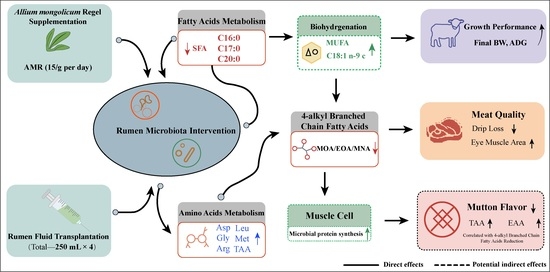
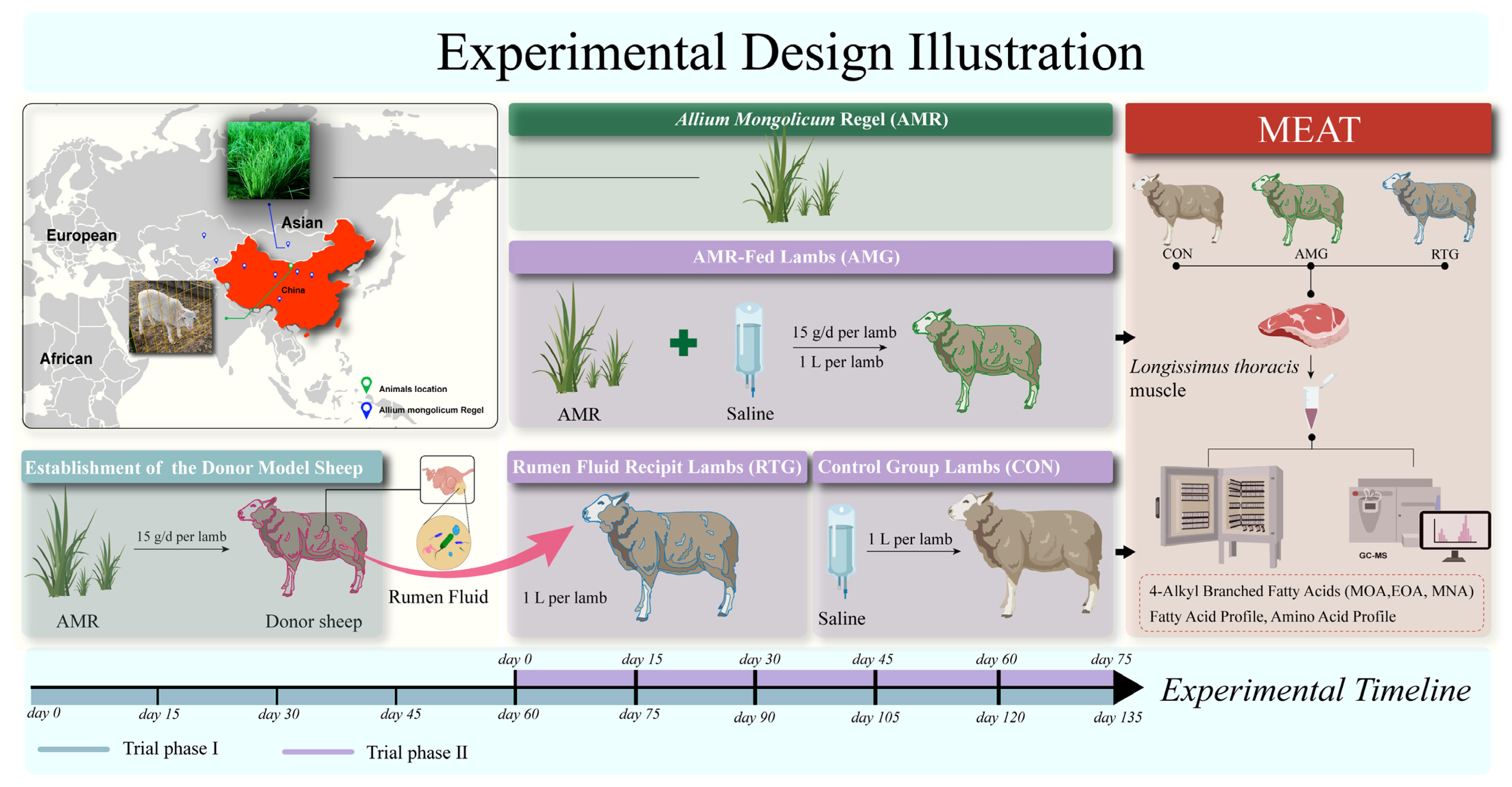
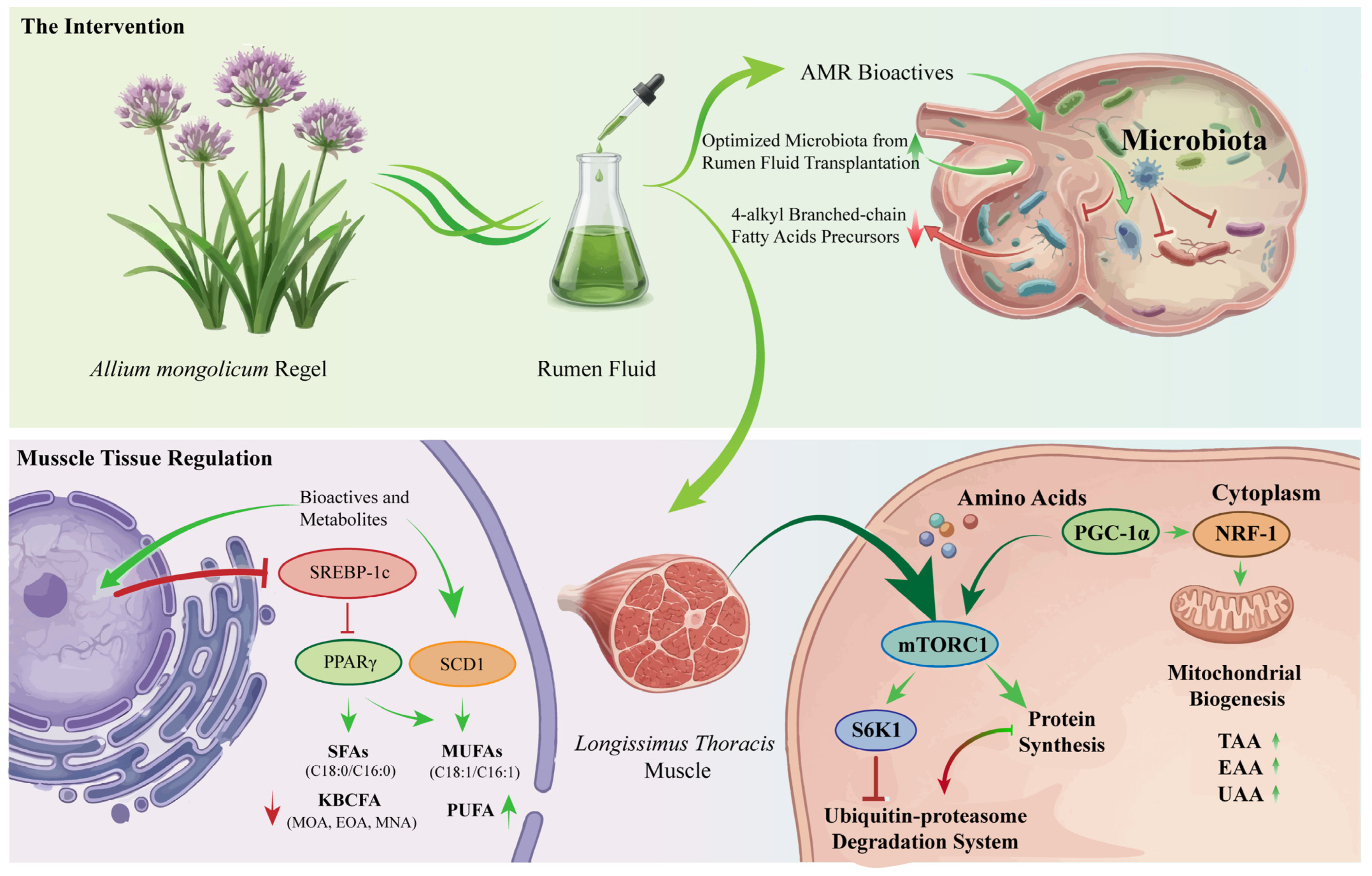
1. Introduction
Three major 4-alkyl branched-chain fatty acids (KBCFA)—4-methyloctanoic acid (MOA), 4-ethyloctanoic acid (EOA), and 4-methylnonanoic acid (MNA)—serve as the primary contributors to the characteristic mutton taint [
1]. Although some consumer segments appreciate this flavor, its intensity often lowers acceptance in mainstream markets, thereby constraining the commercial viability of lamb products [
2]. To address these challenges, phytogenic feed additives have been proposed as a potential solution. These additives contain bioactive compounds capable of enhancing meat quality, improving nutritional profiles, and potentially mitigating mutton taint attributes [
3,
4].
Allium mongolicum Regel (AMR), an
Allium species prevalent in the arid desert regions of Asia and Central Asia [
5], contains abundant bioactive constituents, including flavonoids, polysaccharides, and organic acids [
6]. Ding et al. [
7] reported that AMR markedly decreased drip loss and cooking loss in lamb muscle. Additionally, supplementation with the ethanol extract of AMR decreased the content of C18:0 and the proportion of n-6 to n-3 fatty acids within the ovine
longissimus thoracis (LT) tissues and increased the levels of C16:1 as well as C22:6 n-3 [
8]. Moreover, AMR can modulate flavor formation in lamb by decreasing the precursors of key flavor compounds. For example, AMR lowered the concentrations of the abundance of MOA and MNA within the rumen and hepatic tissues of Small-tailed Han sheep, leading to reduced KBCFA deposition in the LT muscle; it also modulated the microbiota [
8,
9]. Another study confirmed that supplementation with AMR powder, water-soluble extract, or ethanol extract reduced KBCFA concentrations in the LT muscle [
10]. Notably, some active compounds abundant in AMR can resist microbial degradation, improving their bioavailability and metabolic efficiency in the rumen [
11]. This may inhibit microbial populations or enzymes that produce odorous precursors [
12], indicating that remodeling the microbial community has the potential to influence lamb meat quality [
13]. Nevertheless, earlier investigations have predominantly concentrated on the aggregate outcomes of AMR dietary inclusion. It remains ambiguous whether the decline in taint-associated KBCFAs is attributed directly to the uptake of AMR bioactive constituents or if it is indirectly facilitated by the modulation of rumen microbial populations.
Rumen fluid transplantation (RFT) has been applied to manage metabolic disorders in ruminants [
14,
15], this indirect approach to microbiota modulation is an effective nutritional intervention. It can alter rumen fermentation patterns [
16], thus modulating the metabolic pathways of proteins and lipids [
17], and ultimately improve fatty acid balance, flavor, antioxidant capacity, and overall meat characteristics [
18]. While the benefits of AMR are well-documented, to our knowledge, no study has utilized RFT to decouple the microbial effects from the direct impacts of AMR supplementation. Therefore, it is necessary to verify whether the AMR-shaped microbiota alone is sufficient to reduce KBCFA deposition and improve meat quality in recipient lambs.
Therefore, we hypothesized that dynamic changes in rumen fluid are key factors influencing the content of KBCFA and quality of lamb meat. Consequently, the primary goal of this investigation was to partially transplant rumen fluid from donor lambs supplemented with AMR into recipient lambs and to compare this group with lambs directly fed AMR.
2. Materials and Methods
2.1. Ethics Statement for Animal Use
All animal-related procedures were reviewed and received official authorization from the Animal Welfare Committee at Inner Mongolia Agricultural University (Approval No. NND2022049) and were performed in strict accordance with the ethical directives issued by the Ministry of Science and Technology of China regarding the ethical treatment of animals in research.
2.2. AMR Powder Preparation
Allium mongolicum Regel was harvested from semi-arid steppe rangelands in Inner Mongolia, Alxa League, China, at the optimal harvest stage. The fresh specimens underwent dehydration in a forced-air oven (DHG-9070, Shanghai Yiheng Instrument Group Co., Ltd, Shanghai, China) set at 65 °C in order to maintain the integrity and bioactivity of the key constituents. The dried material was then ground using a DFT-300 mill (Shanghai Xinnuo Instrument Group Co., Ltd, Shanghai, China) and subsequently filtered through an 80-mesh screen (Shaoxing Shangyu Instrument Co., Ltd., Zhejiang, Shaoxing, China) to obtain AMR powder. The resulting powder was sealed in bags and kept refrigerated at 4 °C prior to utilization.
2.3. Experimental Design and Animals Management
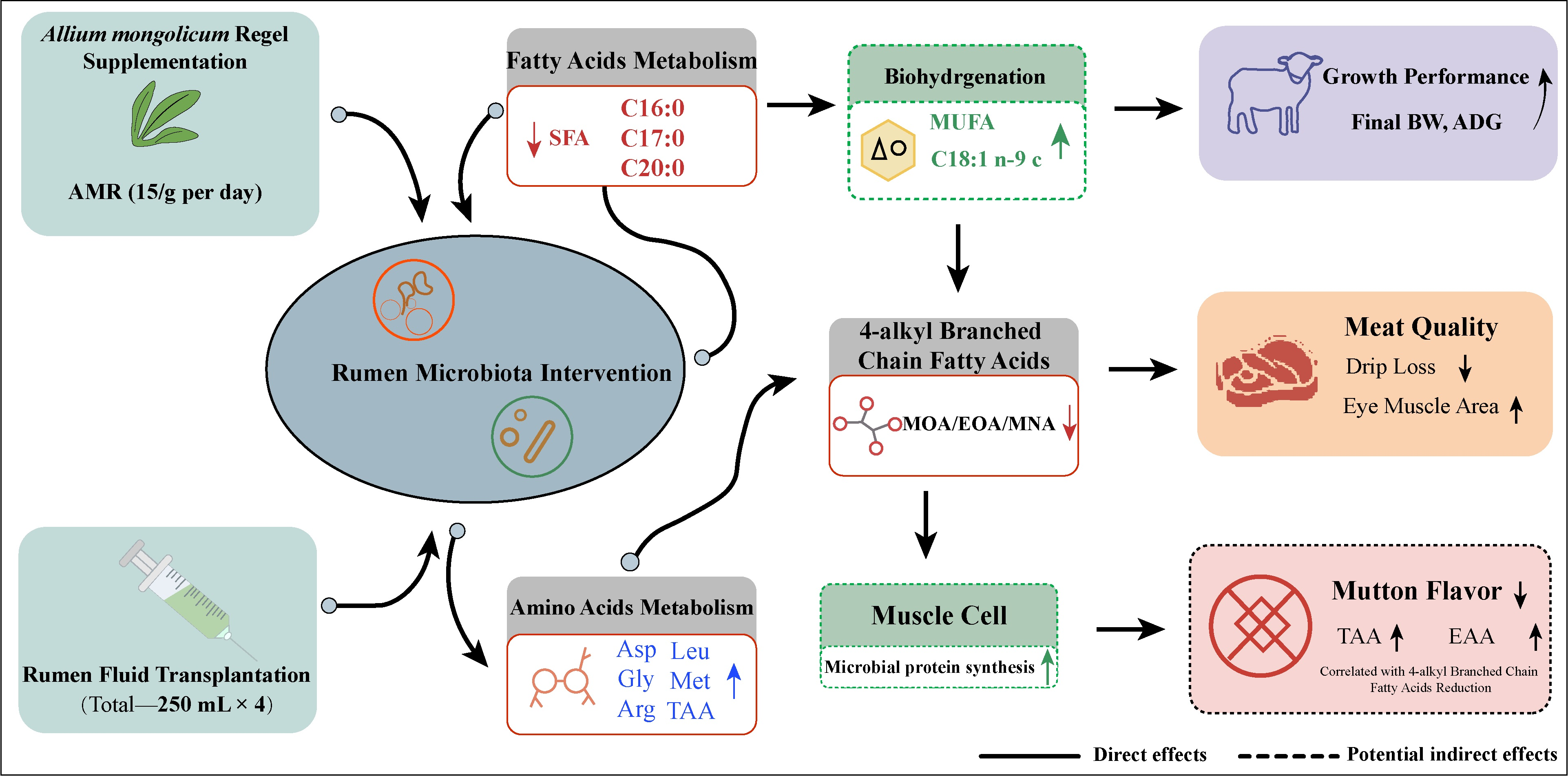
This experiment took place at the Fuchuan Commercial Meat Breeding Sheep Co., a commercial farm located in Inner Mongolia, Bayannuur, China. The trial followed a two-phase design: Phase I established the rumen fluid donor animals, and Phase II involved rumen fluid infusion into the recipients. The overall experimental calendar spanned 135 days.
During Phase I, twelve three-month-old male crossbred lambs (Small-tailed Han × Dorper; BW 25 ± 1 kg) were chosen to act as the donors for rumen fluid. These animals received a standard basal ration enriched with 15 g daily of AMR powder over a 135-day period. Prior research indicates that supplementation with 15 g/day of AMR, under specific management conditions, alters the rumen microbiota and regulates KBCFA levels in LT muscle [
19]. During Phase II, 30 male crossbred lambs (3 months; Small-tailed Han × Dorper; average BW 23 ± 2 kg) were allocated randomly to three experimental groups employing a fully randomized layout (10 animals per group): (1) CON, basal diet with oral saline infusion; (2) AMG group, fed a basal diet with the addition of 15 g/d AMR per lamb plus an oral saline infusion; (3) RTG group, fed a basal diet and receiving oral infusions of rumen fluid from the donor animals. Due to site constraints, animals in Phases I and II were managed under stall-feeding conditions that were similar but not identical. Lambs within each treatment were housed in three pens (containing 3, 3, and 4 lambs per pen, respectively). The individual animal was considered the experimental unit. Phase II consisted of an initial 15-day acclimatization phase succeeded by a feeding trial lasting 60 days, totalling 75 days. The acclimatization stage for Phase II began on the 60th day of Phase I; AMR feeding and RFT were initiated on day 16 of Phase II.
Rumen fluid transplantation was used as an intervention and was performed according to the procedure described by Liu et al. [
16]. Collection of ruminal fluid was carried out from all donor lambs (Phase I) 2 h before morning feeding. At the time of collection, donors were fasted to ensure a stable rumen environment and reduce the risk of reflux. Rumen contents were collected via a ruminal cannula (A1164K, Wuhan Anscitech Farming Technology Co., Ltd, Hubei, Wuhan, China) equipped with a metal filter to separate the liquid phase from large feed particles. From each donor, the initial 100 mL fraction was disposed of to mitigate potential salivary contamination. The subsequent 300 mL aliquot of ruminal fluid was collected from each donor. The fluids from all 12 donors were immediately combined into a sizable, CO
2-flushed vessel and mixed thoroughly to create a composite inoculum. On transplantation days, recipient lambs (Phase II) were fasted for ten hours prior to infusion. The composite rumen fluid was infused immediately after preparation. Subjects belonging to the CON and AMG cohorts received an administration of 250 mL saline solution, whereas lambs in RTG received 250 mL of the pooled rumen fluid. The transplantation procedures were carried out at 15-day intervals for four rounds. Throughout Phase II, the CON and AMG lambs were given a total aggregate volume amounting to 1 L of saline, and RTG lambs received 1 L rumen fluid. The nutrient composition and fatty acids profiles of the basal diet are listed in
Table 1 and
Table 2, respectively, while the methodological details are illustrated in
Figure 1.
2.4. Sample Collection
At the end of the feeding trial, the animals underwent a 12 h fasting period (water provided ad libitum) prior to slaughter. In each group, the heaviest and lightest animals were excluded to minimize body-weight variation. From the remaining animals, six lambs per group were randomly selected for sampling. Animals were transported to a commercial meat processing facility (Inner Mongolia Little Sheep Meat Industry Co., Ltd., Inner Mongolia, Bayannur, China) where they were slaughtered according to standard humane procedures and local regulations.
Hot carcass weight was recorded immediately after slaughter, and samples of the LT muscle were dissected from the left carcass flank at the 12th–13th rib interface at 45 min postmortem. For meat quality measurements, LT samples intended for pH and color analyses were kept at 4 °C and evaluated at 45 min and 24 h postmortem. For the physicochemical traits, fatty acid profile, and KBCFA quantification, roughly 150 g of LT tissue was cleaned of observable connective tissues and subcutaneous fat layers, then vacuum-sealed, flash-frozen using liquid nitrogen, and vacuum packaged at −80 °C pending analysis.
2.5. Chemical Analysis of Feed Samples
Representative feed samples were collected from each diet throughout the experimental period. Specifically, weekly samples were taken, pooled by every 7 days for each treatment, and stored at −20 °C until analysis. Before analysis, samples were oven-dried at 65 °C for 48 h until they achieved a stable weight, followed by grinding to fit through a 1.0 mm screen using a laboratory mill.
Nutrient composition was determined following AOAC (2005) [
20] methods: dry matter (DM; AOAC method 930.15), ash content (method 942.05), crude protein (CP; calculated as Kjeldahl N × 6.25; method 990.03), as well as ether extract (EE; method 920.39). Calcium (Ca; method 968.05) and phosphorus (P; method 975.16) were quantified utilizing a microplate reader (Multiskan FC, Thermo Fisher Scientific Inc., Waltham, MA, USA). The content of neutral detergent fiber (NDF; method 2002.04) and acid detergent fiber (ADF; method 973.19) were determined via an Ankom fiber analysis system (ANKOM A200i, ANKOM Technology, Macedon, NY, USA).
2.6. Assessment of Growth Parameters
The determination of growth indices followed the protocol described previously [
21]. Briefly, the lambs’ body mass was measured before the morning meal at the study’s onset (initial body weight, IBW) and conclusion (final body weight, FBW), and subsequently every two weeks to track growth trends. The average daily gain (ADG) was computed based on the equation below:
The amounts of feed offered and the remaining leftovers were logged daily per pen. The daily dry matter intake (DMI) was determined via the subsequent equation:
The feed-to-gain ratio (F/G) was calculated as follows:
2.7. Carcass Attributes and LT Muscle Characteristics
Immediately following slaughter, the dressed carcass weight was documented in adherence to the protocol of Coleman et al. [
22]. After chilling, backfat thickness (BFT) was measured by vertical probing positioned at the interface of the 12th and 13th ribs utilizing a calibrated vernier caliper (Mitutoyo 500–196, Mitutoyo Precision Measuring Instruments, Kanagawa, Kawasaki, Japan; accuracy ± 0.02 mm). For eye muscle area (EMA), carcasses were transversely sectioned at the 12th rib; the exposed muscle surface was traced onto tracing paper, and dimensions were measured in triplicate. EMA was then calculated using the following formula:
where H is the maximum vertical height, and W represents the maximum horizontal width.
2.8. pH and Meat Color Measurements in the LT Muscle
A handheld pH-STAR device (2128W, Spectrum, California, USA) was utilized to measure LT muscle pH in triplicate at 45 min and 24 h post-slaughter. The device was calibrated at 20 ± 1 °C with standard buffer solutions (pH 4.01 and 7.00). After being refrigerated for 1 h at 4 °C, the color (DP18198, Beijing Yodp Technology Co., Ltd, Beijing, China) indices (
L*,
a* and
b*) of the LT muscle were evaluated per the method of Pestana et al. [
23]. Measurements were taken at three distinct surface points per sample using a calibrated colorimeter (DS-700C-1, CHNSpec Technology Co., Ltd., Zhejiang, Hangzhou, China), and the mean of the three readings was used for analysis. The device settings included a D65 illuminant, 2° observer, an 11 mm aperture size, an 8 mm measuring zone, and a pulsed xenon lamp. Furthermore, saturation (Chroma,
C*) and hue angle (
h°) were computed using the equations below:
2.9. Evaluation of Physical Quality Traits in LT Muscle Samples
The assessment of drip loss, cooking loss, and shear force was conducted in accordance with the protocols [
24,
25]. Each LT muscle sample (2 × 2 × 4 cm) was recorded for initial weight (W1) and subsequently hung inside airtight vessels at 4 °C for a 24 h duration, ensuring no contact with the container walls. Upon completion, surface fluid was absorbed using filter paper, after which the concluding mass (W2) was documented. The drip loss percentage was derived using the equation below:
Vacuum-sealed samples were submerged in a water bath preheated to 80 °C. Heating was maintained until the central core temperature reached 70 °C. After cooling and surface blotting, specimens were weighed again to obtain W4. Cooking loss percentage was determined by
To quantify shear force values, visible connective tissue and fat were removed from each LT muscle sample, followed by cooking. Measurements were conducted using a specialized meat quality testing instrument for meat quality analysis (C-LM4, Tenovo International Co., Limited, Beijing, China). The muscle was sectioned into square-shaped strips of 1 cm2 cross-sectional size, aligned parallel to the fibers, followed by shear application. The mean shear force (N) per sample was calculated as the average of five peak-force measurements.
2.10. Proximate Composition in the LT Muscle
For proximate composition, LT muscle samples were trimmed of fascia and adipose tissue and freeze-dried (FDL-1000, Tokyo EYELA Co., Ltd., Tokyo, Japan). CP (990.03) and EE (920.39) were determined according to AOAC (2005) [
20]. The moisture level was quantified via desiccation via oven-drying at 105 °C until a constant mass was reached. Ash levels were assessed by combustion in a muffle furnace heated to 600 °C until weight stabilization.
2.11. Quantification of KBCFA Levels in the LT Muscle
The qualitative and quantitative analysis of KBCFA was conducted following the protocol of Watkins et al. [
26] utilizing a GC-MS platform system (Trace 1310 GC coupled with ISQ LT Single-Quadrupole Mass Spectrometer, Thermo Fisher Scientific, Waltham, MA, USA). Chromatographic separation was accomplished using a DB-WAX capillary column (30 m × 0.25 mm × 0.25 μm; Agilent Technologies). Injection was carried out using a 1 μL aliquot in splitless mode, while the injection inlet was maintained at a constant temperature of 250 °C. High-purity helium (>99.999%) functioned as the carrier gas, supplied at a consistent flow of 1.0 mL/min. The oven temperature program was set to operate as follows: initiated at 50 °C (2 min hold), subsequently increasing to 180 °C at a rate of 10 °C/min, and ultimately ramping to 240 °C at 5 °C/min with a final holding of 10 min. Mass spectrometry analysis utilized electron ionization (EI) at 70 eV. The temperatures for the ion source and transfer line were set to 230 °C and 250 °C, respectively.
To optimize detection sensitivity for the analytes of interest, data collection was conducted employing Selected Ion Monitoring (SIM) mode. In this research, the specific ions m/z 99 and m/z 113 exhibited the greatest abundance and specificity. The limits of detection (LOD) were determined to be 0.15 mg/kg (MOA), and 0.11 mg/kg for both EOA and MNA. The limits of quantification (LOQ) were computed as threefold the LOD values.
2.12. Fatty Acid Profile in the LT Muscle
Total lipid isolation was performed on roughly 2.0 g of freeze-dried LT muscle tissue, strictly adhering to the chloroform–methanol (2:1,
v/
v) procedure described by Folch et al. [
27]. Following solvent evaporation under nitrogen flow and weighing, the lipids underwent a dual-stage transmethylation process to generate methyl esters of fatty acids (Sinopharm Group Beijing Co., Ltd, Beijing, China; FAMEs). Specifically, approximately 20 mg of extracted lipid was dissolved into 2 mL of 0.5 M methanolic NaOH (Sinopharm Group Beijing Co., Ltd, Beijing, China) and heated at 80 °C for a duration of 15 min to complete saponification. Upon cooling, methylation was induced, adding 2 mL of 14% BF
3-methanol (Sinopharm Group Beijing Co., Ltd, Beijing, China), followed by incubation at 80 °C for 5 min. The resulting FAMEs were then recovered using 2 mL of n-hexane. Internal standardization was achieved using Undecanoic acid (C11:0).
The analysis of the FAMEs was conducted on a gas chromatography platform (Trace 1310, Thermo ScientificTM, Waltham, MA, USA) equipped with an FID and employing a fused silica capillary column (SP-2560, 100 m × 0.25 mm × 0.20 μm; Supelco, Bellefonte, PA, USA). The injector and detector temperatures were fixed at 260 °C. The oven program initiated at 140 °C (5 min hold), increased to 240 °C at 4 °C/min, and ended with a 15 min hold. Nitrogen acted as the carrier gas, supplied at 1.0 mL/min with a 100:1 split ratio. The identification of specific fatty acids relied on matching their retention times against a commercial FAME reference standard (Supelco 37 Component FAME Mix, Sigma-Aldrich).
2.13. Amino Acid Composition of the LT Muscle
The freeze-dried LT muscle samples (0.50 g and 0.20 g) were used to determine the concentrations of amino acids from hydrolyzed protein (HPAA) and free amino acids (FAA), respectively. For protein-hydrolysate amino acids, a 0.50 g sample aliquot was purged with nitrogen for 2 min, followed by acid hydrolysis utilizing 6 M HCl (Sinopharm Group Beijing Co., Ltd, Beijing, China) at 110 °C for a 24 h period. Once cooled to ambient temperature, the mixture underwent filtration followed by dilution to a total volume of 25 mL in a volumetric flask. A 0.50 mL portion underwent evaporation under a mild nitrogen flow until nearly dry. To ensure complete acid removal, the addition of 200 μL ultrapure water and the evaporation process were performed 2–3 times. The resulting residue was reconstituted in 2.5 mL of 0.02 mol/L HCl with the aid of 5 min of sonication. Subsequently, a 1.0 mL aliquot was filtered through a 0.22 μm membrane prior to analysis.
For FAA, samples were homogenized in 0.02 M HCl followed by centrifugation at 13,000× g (15 min, 4 °C). The obtained supernatant was mixed with 0.50 mL of 10% (w/v) sulfosalicylic acid for deproteinization and subjected to centrifugation again under identical conditions. The clarified supernatant was subsequently passed through a 0.22 μm filter for analysis.
Quantification was achieved via ion-exchange chromatography coupled with ninhydrin detection utilizing an L-8900 amino acid analyzer (Hitachi, Japan), in the procedure detailed by Li et al. [
28]. The categories analyzed included: essential amino acids (EAA: Thr, Val, Met, Ile, Leu, Phe, Lys, His, Arg) and umami-related amino acids (UAA: Asp, Glu, Gly, Ala, Arg, Met).
2.14. Statistical Analysis
Data regarding the meat quality traits, physicochemical indices, KBCFA, and fatty/amino acid profiles were analyzed using one-way ANOVA with the SAS software package (v. 9.21; SAS Institute Inc., Cary, NC, USA). Before conducting the analysis, the Shapiro–Wilk test was employed to confirm the assumptions of normal distribution and homogeneity of variance. Data were screened for outliers using externally studentized residuals. Regarding growth metrics, given the absence of significant variations in IBW across groups, a one-way ANOVA was conducted without including initial weight as a covariate. Duncan’s multiple range test was utilized to compare group means, chosen for its efficacy in distinguishing between multiple treatment conditions. The results are presented as mean values. A probability level of
p < 0.05 was considered statistically significant. The statistical analysis followed the linear model structure described by Hu et al. [
29], as detailed below:
In this equation, Yij signifies the response variable, where μ denotes the overall mean (n = 6), Ti indicates the fixed effect corresponding to the specific diet treatment (CON, AMG, RTG), and εij represents the random error term.




 ,
,