Integrated Molecular Informatics and Sensory-Omics Study of Core Trace Components and Microbial Communities in Sauce-Aroma High-Temperature Daqu from Chishui River Basin


Abstract
1. Introduction
2. Materials and Methods
2.1. Samples and Reagents
2.2. Experimental Procedures
2.2.1. Pretreatment of Sauce-Aroma High-Temperature Daqu
2.2.2. HS-SPME and GC-MS Conditions for Sauce-Aroma High-Temperature Daqu
2.2.3. Molecular Docking
2.2.4. Sensory Evaluation of Sauce-Aroma High-Temperature Daqu
2.3. Metagenomic Sequencing
2.4. Statistical Analysis
3. Results and Discussion
3.1. Volatile Components in Daqu Determined by HS-SPME-GC-MS
3.2. Importance Analysis of Trace Components in Sauce-Aroma High-Temperature Daqu
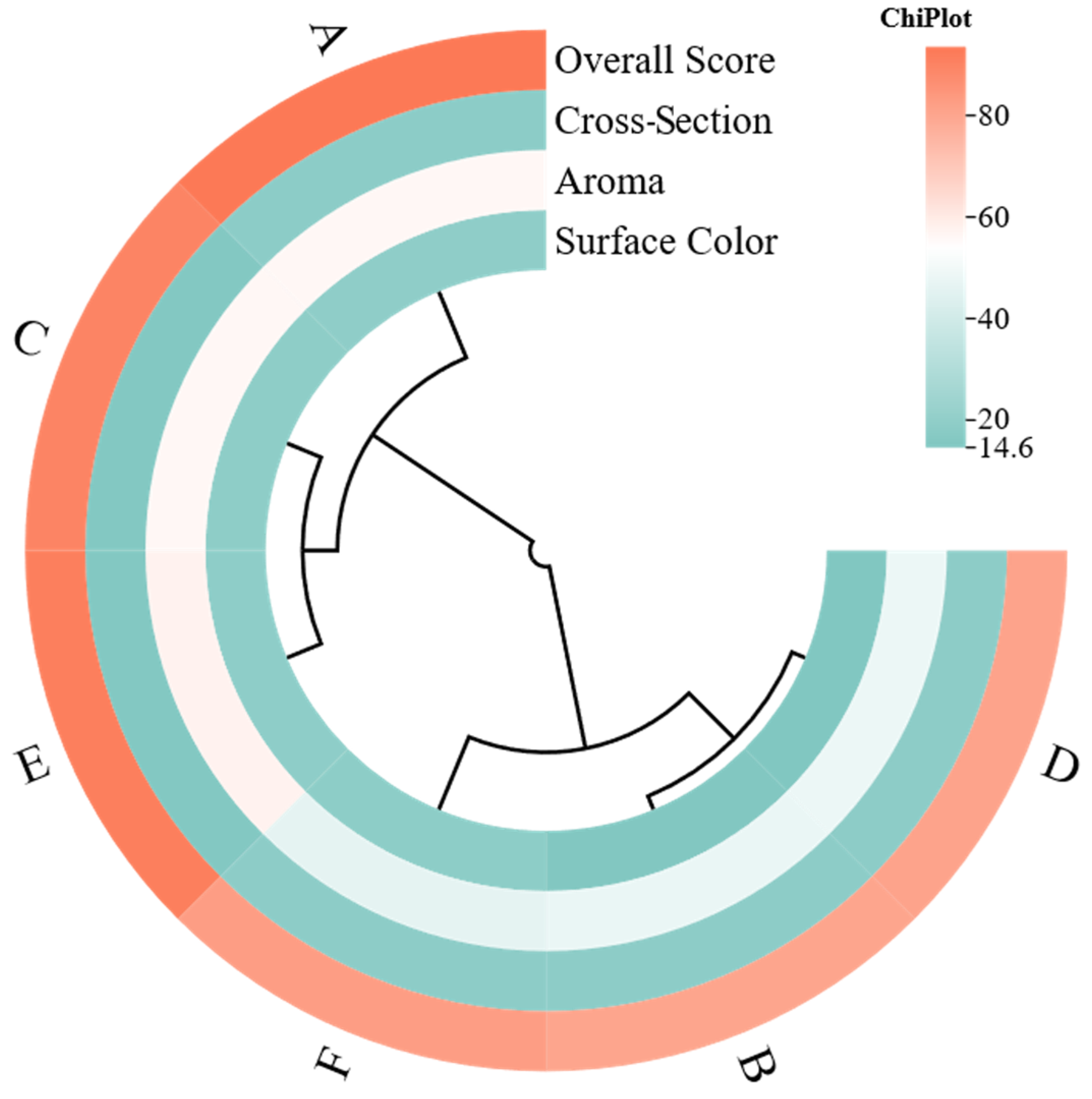
3.3. Sensory Evaluation Analysis of Sauce-Aroma High-Temperature Daqu
3.4. Correlation Analysis Between Sensory Scores and Key Trace Components in Sauce-Aroma High-Temperature Daqu
3.5. Mechanisms by Which 14 Core Trace Components Activated the Olfactory Receptor
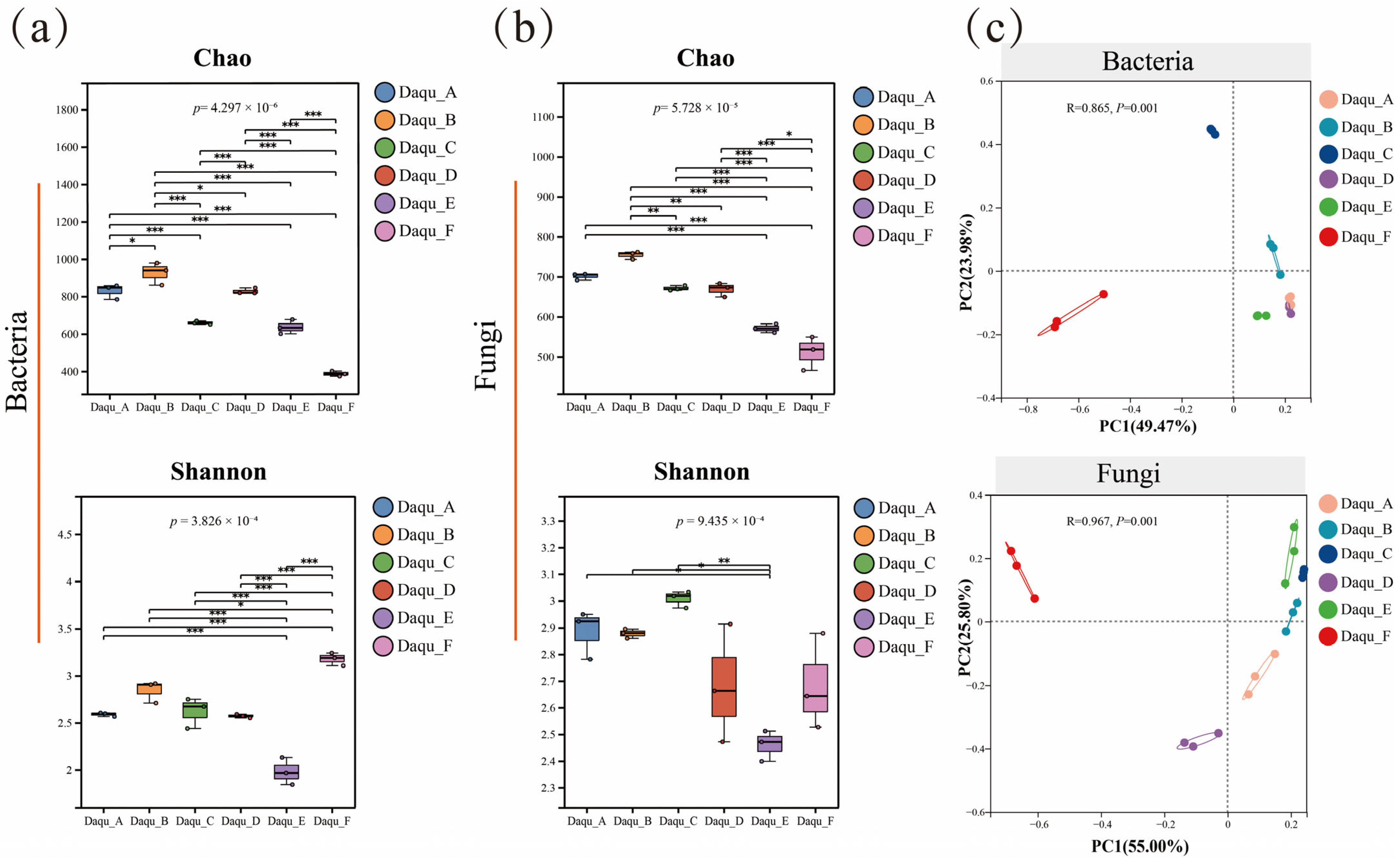
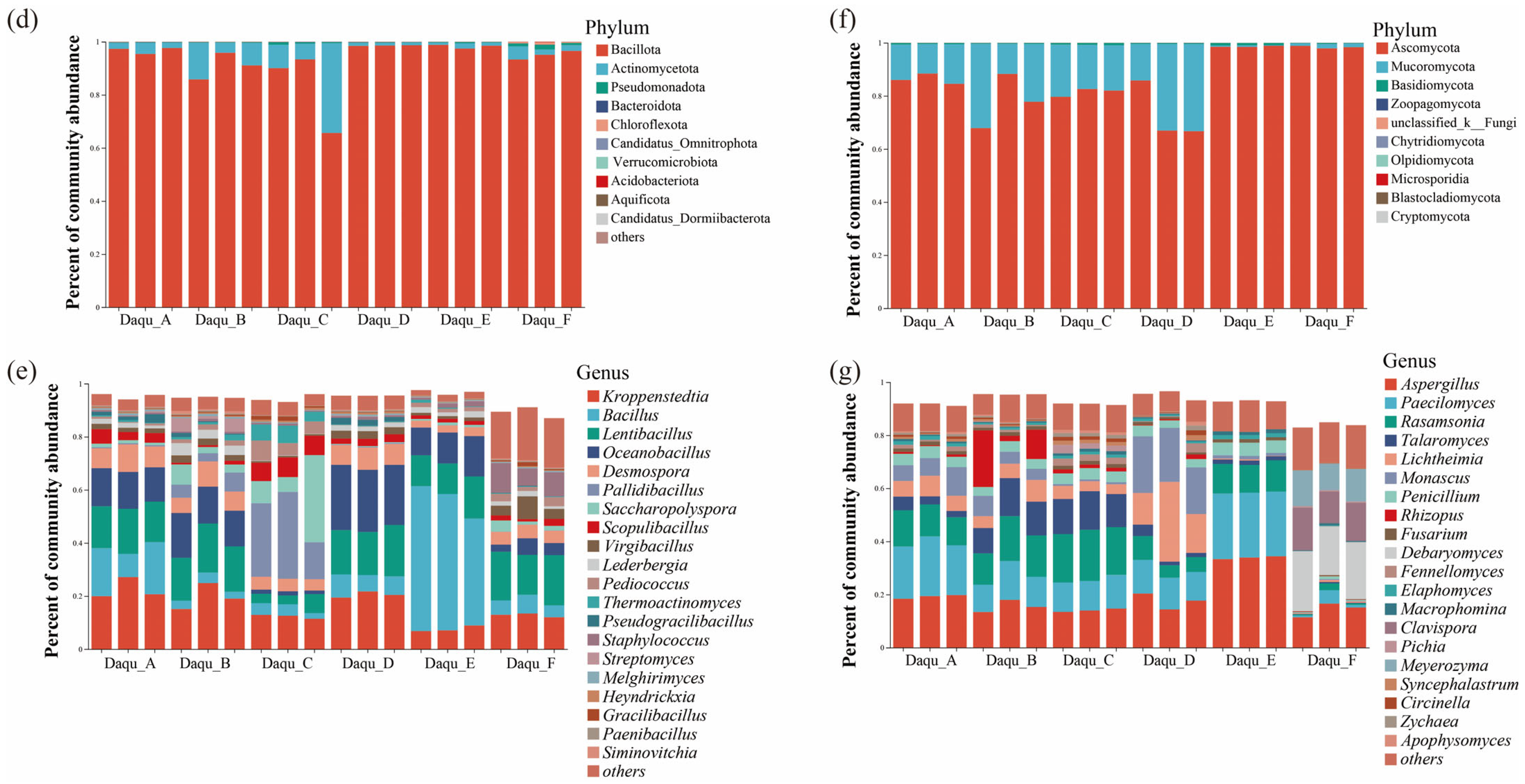
3.6. Microbial Community Composition Analysis of Sauce-Aroma High-Temperature Daqu
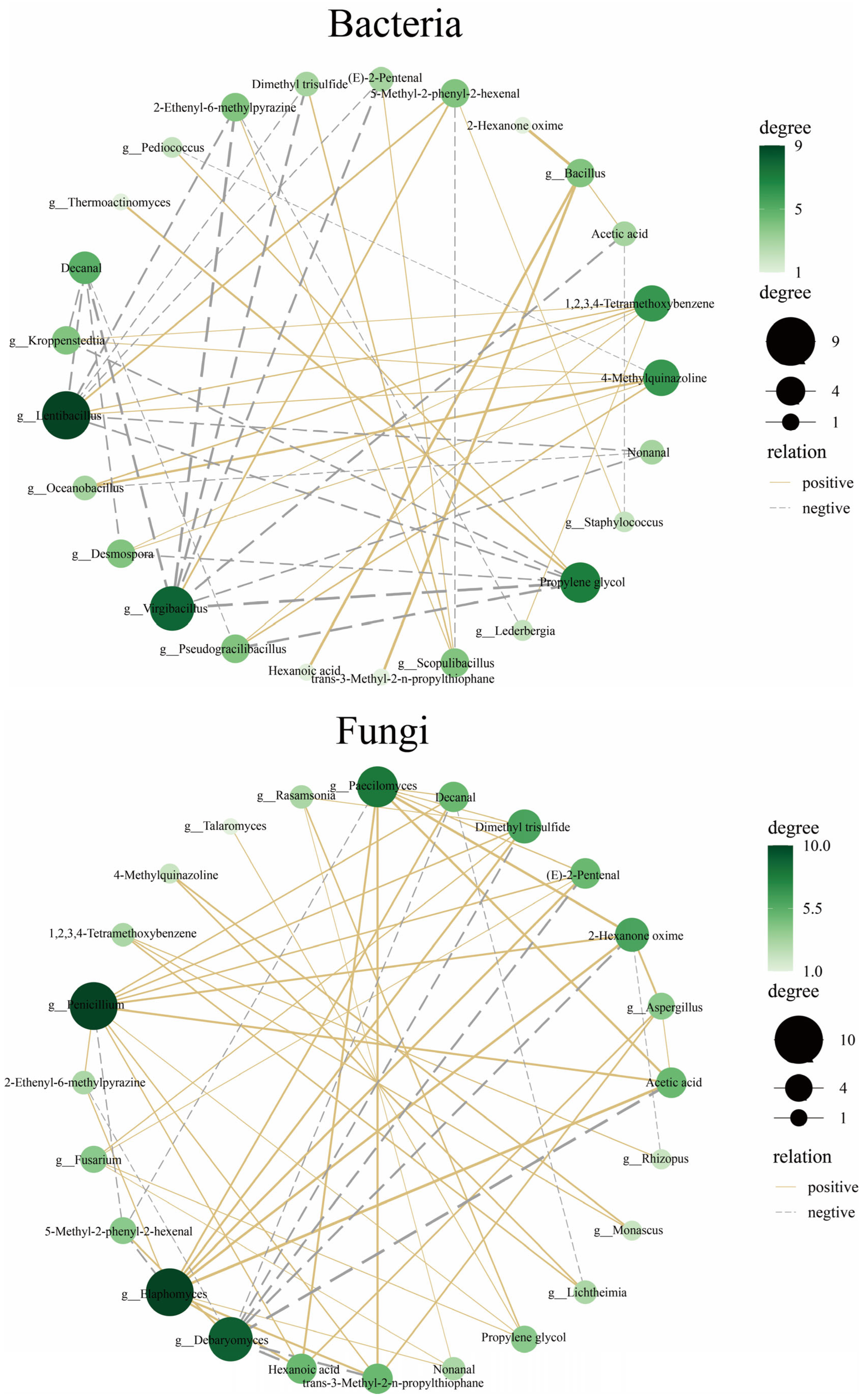
3.7. Correlations Between Dominant Bacterial and Fungal Genera and 14 Key Compounds in Sauce-Aroma High-Temperature Daqu Samples
3.8. Discussion
4. Limitations and Prospects
5. Conclusions
Supplementary Materials
Author Contributions
Funding
Institutional Review Board Statement
Informed Consent Statement
Data Availability Statement
Conflicts of Interest
Abbreviations
| AC III | Adenylyl cyclase III |
| ANOSIM | Analysis of similarities |
| bp | base pairs |
| cAMP | cyclic adenosine monophosphate |
| CD-HIT | Cluster Database at High Identity with Tolerance |
| Ecoul | Coulomb (electrostatic) interaction energy term |
| EI | electron ionization |
| Emodel | Glide Emodel |
| Evdw | van der Waals interaction energy term |
| GC-MS | gas chromatography–mass spectrometry |
| Gαolf | alpha subunit of the olfactory G protein, G(olf) |
| HS-SPME-GC-MS | headspace solid-phase microextraction–gas chromatography–mass spectrometry |
| MEGAHIT | MEGAHIT (metagenome assembly program name) |
| miniGs | engineered mini Gs protein |
| m/z | mass-to-charge ratio |
| NIST | National Institute of Standards and Technology |
| OPLS-DA | orthogonal partial least squares discriminant analysis |
| OPLS4 | Optimized Potentials for Liquid Simulations 4 |
| ORF/ORFs | open reading frame(s) |
| OR51E2 | olfactory receptor family 51 subfamily E member 2 |
| PCoA | principal coordinates analysis |
| RCSB PDB | Research Collaboratory for Structural Bioinformatics Protein Data Bank |
| RMSD | root mean square deviation |
| SP (Glide) | standard precision |
| SPME | solid-phase microextraction |
| VIP | variable importance in projection |
| vdW | van der Waals |
References
- Wang, J.; Li, Q.; Sun, Y.; Liu, J.; Jiang, Z.; Zheng, Z.; Liu, L.; Min, X.; Yu, Y.; Zheng, Q. Why does distilled liquor (Baijiu) have a yellowish color: A comprehensive analysis. Food Chem. 2025, 463, 141469. [Google Scholar] [CrossRef] [Scilit] [PubMed]
- Ali, A.; Wu, Y.; Li, W.; Chen, X.; Patil, P.J.; Han, M.; Shah, H.; Zhao, L.; Li, X. Biotechnological approaches for targeted strain screening and enhancement of Daqu for quality baijiu production. Food Biosci. 2024, 61, 104885. [Google Scholar] [CrossRef] [Scilit]
- Huang, Y.; Wang, L.; Li, Y.; Chen, Y.; Chen, G.; Jia, L.; Ge, Y. Comparative analysis of key flavor compounds in various baijiu types using E- nose, HS-SPME-GC-MS/MS, and HS-GC-IMS technologies. Food Chem. X 2025, 29, 102689. [Google Scholar] [CrossRef] [Scilit]
- Wang, L.; Tang, P.; Zhang, P.; Lu, J.; Chen, Y.; Xiao, D.; Guo, X. Unraveling the aroma profiling of Baijiu: Sensory characteristics of aroma compounds, analytical approaches, key odor-active compounds in different Baijiu, and their synthesis mechanisms. Trends Food Sci. Technol. 2024, 146, 104376. [Google Scholar] [CrossRef] [Scilit]
- Gong, J.; Ma, Y.; Li, L.; Cheng, Y.; Huang, Y. Comparative characterization and contribution of key aroma compounds in the typical base liquor of Jiang-flavor Baijiu from different distributions in the Chinese Chishui River basin. Food Chem. X 2023, 20, 100932. [Google Scholar] [CrossRef] [Scilit]
- Liu, S.; Jiang, Z.; Ma, D.; Liu, X.; Li, Y.; Ren, D.; Zhu, Y.; Zhao, H.; Qin, H.; Huang, M.; et al. Distance decay pattern of fermented-related microorganisms in the sauce-flavor Baijiu producing region. Food Biosci. 2023, 51, 102305. [Google Scholar] [CrossRef] [Scilit]
- Pan, F.; Qiu, S.; Lv, Y.; Li, D. Exploring the controllability of the Baijiu fermentation process with microbiota orientation. Food Res. Int. 2023, 173, 113249. [Google Scholar] [CrossRef] [Scilit]
- Zhou, J.; Li, X.; Li, S.; Ding, H.; Lang, Y.; Xu, P.; Wang, C.; Wu, Y.; Liu, X.; Qiu, S. Airborne microorganisms and key environmental factors shaping their community patterns in the core production area of the Maotai-flavor Baijiu. Sci. Total Environ. 2024, 912, 169010. [Google Scholar] [CrossRef] [Scilit]
- Ren, T.; Su, W.; Mu, Y.; Qi, Q.; Zhang, D. Study on the correlation between microbial communities with physicochemical properties and flavor substances in the Xiasha round of cave-brewed sauce-flavor Baijiu. Front. Microbiol. 2023, 14, 1124817. [Google Scholar] [CrossRef] [Scilit] [PubMed]
- Niu, J.; Yang, Y.; Zhao, L.; Cao, N.; Xiong, X.; Yun, Z.; Yang, F.; Xu, Y.; Tu, H.; Zhong, K.; et al. Sensory Lexicon Construction and Quantitative Descriptive Analysis of Jiang-Flavor Baijiu. Food Sci. Nutr. 2025, 13, e4652. [Google Scholar] [CrossRef] [Scilit]
- Chen, C.; Ni, D.; Yang, Y.; Tian, J.; Yang, F.; Ye, X. Characterizing the microbial community constructure and the metabolites among different colour Moutai Daqu. Food Chem. X 2025, 26, 102223. [Google Scholar] [CrossRef] [Scilit]
- Ding, H.; Yang, J.; Cheng, M.; Li, X.; Zeng, M.; Yang, W.; Wu, Q.; Luo, X.; Zhao, J.; Li, X.; et al. Comparative characterization of key compounds of Sauce-flavored rounded-Baijiu in northern and southern China and the potential possibility of similar quality of their combined products. Food Chem. X 2024, 24, 101970. [Google Scholar] [CrossRef] [Scilit]
- Li, H.; Liu, S.; Liu, Y.; Hui, M.; Pan, C. Functional microorganisms in Baijiu Daqu: Research progress and fortification strategy for application. Front. Microbiol. 2023, 14, 1119675. [Google Scholar] [CrossRef] [Scilit]
- Shi, W.; Chai, L.; Fang, G.; Mei, J.; Lu, Z.; Zhang, X.; Xiao, C.; Wang, S.; Shen, C.; Shi, J.; et al. Spatial heterogeneity of the microbiome and metabolome profiles of high-temperature Daqu in the same workshop. Food Res. Int. 2022, 156, 111298. [Google Scholar] [CrossRef] [Scilit]
- Zhu, Q.; Chen, L.; Peng, Z.; Zhang, Q.; Huang, W.; Yang, F.; Du, G.; Zhang, J.; Wang, L. Analysis of environmental driving factors on Core Functional Community during Daqu fermentation. Food Res. Int. 2022, 157, 111286. [Google Scholar] [CrossRef] [Scilit] [PubMed]
- Du, J.; Zhang, Y.; Ning, Z.; Jiang, S.; Liu, J.; Ni, X.; Li, Q.; Yang, Q. Comparative analysis of pyrazine compounds in soy sauce aroma Baijiu from different regions and their impact on flavor profiles. J. Food Compos. Anal. 2025, 148, 108447. [Google Scholar] [CrossRef] [Scilit]
- Zhao, Y.; Tian, S.; Zhang, S.; Yu, Y.; Wu, Q. Antioxidant peptides from the mixed-distillate of Baijiu fermented grains and soy sauce residue interact with flavor substances in sauce-aroma Baijiu. LWT-Food Sci. Technol. 2025, 228, 117955. [Google Scholar] [CrossRef] [Scilit]
- Zhao, T.; Chen, S.; Li, H.; Xu, Y. Identification of 2-Hydroxymethyl-3,6-diethyl-5-methylpyrazine as a Key Retronasal Burnt Flavor Compound in Soy Sauce Aroma Type Baijiu Using Sensory-Guided Isolation Assisted by Multivariate Data Analysis. J. Agric. Food. Chem. 2018, 66, 10496–10505. [Google Scholar] [CrossRef] [Scilit]
- Huang, Y.; Tian, J.; Hu, X.; Yang, H.; Xie, L.; Zhou, Y.; Xia, Y.; Huang, D.; He, K. Predicting the composition of aroma components in Baijiu using hyperspectral imaging combined with a replication allocation strategy-enhanced stacked ensemble learning model. Spectrochim. Acta Part A Mol. Biomol. Spectrosc. 2025, 341, 126398. [Google Scholar] [CrossRef] [Scilit]
- Li, C.; Zhang, X.; Wang, S.; Lu, Z.; Chai, L.; Xu, H.; Shi, J.; Wang, S.; Yang, B.; Shen, C.; et al. Investigation on quality discrepancies of Soy Sauce Aroma Baijiu: Flavor chemical characteristics in single-source and cross-source samples. Food Control 2025, 175, 111305. [Google Scholar] [CrossRef] [Scilit]
- Zhao, Y.; Huang, X.; Wang, J.; Zhang, X.; Wang, Z.; Tian, S.; Yu, Y.; Wu, Q.; Li, X. Enrichment of oligopeptides in sauce-aroma Baijiu by optimized distillation with soy sauce byproduct and their effect on Baijiu flavor. LWT 2024, 201, 116208. [Google Scholar] [CrossRef] [Scilit]
- Wang, L.; Shen, Y.; Wang, X.; Gan, L.; Zhong, K.; He, Q.; Luo, A.; Gao, H. The spatial differences of the Chinese sauce aroma liquor Daqu and identification by FT-MIR spectroscopy. Food Control 2023, 154, 109990. [Google Scholar] [CrossRef] [Scilit]
- Wu, X.; Zhao, X.; Wang, L.; Chen, B.; Li, F.; Tang, Z.; Wu, F. Unraveling the regional environmental ecology dominated baijiu fermentation microbial community succession and associated unique flavor. Front. Microbiol. 2024, 15, 1487359. [Google Scholar] [CrossRef] [Scilit]
- Wang, L.; Cheng, Y.; Hu, X.; Huang, Y. Analysis of bacterial diversity and functional differences of Jiang-flavored Daqu produced in different seasons. Front. Nutr. 2023, 9, 1078132. [Google Scholar] [CrossRef] [Scilit] [PubMed]
- Niu, J.; Yang, S.; Shen, Y.; Cheng, W.; Li, H.; Sun, J.; Huang, M.; Sun, B. What Are the Main Factors That Affect the Flavor of Sauce-Aroma Baijiu. Foods 2022, 11, 3534. [Google Scholar] [CrossRef] [Scilit]
- Gong, L.; Qin, S.; Zheng, X.; Zhao, J.; Liu, M.; Zhao, M. Traceability between microbial community and environmental microbial Community in Maotai-flavor Daqu. Food Chem. X 2025, 27, 102321. [Google Scholar] [CrossRef] [Scilit] [PubMed]
- Tu, W.; Cao, X.; Cheng, J.; Li, L.; Zhang, T.; Wu, Q.; Xiang, P.; Shen, C.; Li, Q. Chinese Baijiu: The Perfect Works of Microorganisms. Front. Microbiol. 2022, 13, 91904. [Google Scholar] [CrossRef] [Scilit]
- Hu, Y.; Lei, X.; Zhang, X.; Guan, T.; Wang, L.; Zhang, Z.; Yu, X.; Tu, J.; Peng, N.; Liang, Y.; et al. Characteristics of the Microbial Community in the Production of Chinese Rice-Flavor Baijiu and Comparisons with the Microflora of Other Flavors of Baijiu. Front. Microbiol. 2021, 12, 673670. [Google Scholar] [CrossRef] [Scilit]
- Xu, Y.; Zhao, J.; Liu, X.; Zhang, C.; Zhao, Z.; Li, X.; Sun, B. Flavor mystery of Chinese traditional fermented baijiu: The great contribution of ester compounds. Food Chem. 2022, 369, 130920. [Google Scholar] [CrossRef] [Scilit]
- Zhang, P.; Liu, Y.; Li, H.; Hui, M.; Pan, C. Strategies and Challenges of Microbiota Regulation in Baijiu Brewing. Foods 2024, 13, 1954. [Google Scholar] [CrossRef] [Scilit] [PubMed]
- Chen, Y.; Li, K.; Liu, T.; Li, R.; Fu, G.; Wan, Y.; Zheng, F. Analysis of Difference in Microbial Community and Physicochemical Indices Between Surface and Central Parts of Chinese Special-Flavor Baijiu Daqu. Front. Microbiol. 2021, 11, 592421. [Google Scholar] [CrossRef] [Scilit]
- Xu, Y.; Wu, M.; Niu, J.; Lin, M.; Zhu, H.; Wang, K.; Li, X.; Sun, B. Characteristics and Correlation of the Microbial Communities and Flavor Compounds during the First Three Rounds of Fermentation in Chinese Sauce-Flavor Baijiu. Foods 2023, 12, 207. [Google Scholar] [CrossRef] [Scilit]
- Duan, J.; Yang, S.; Li, H.; Qin, D.; Shen, Y.; Li, H.; Sun, J.; Zheng, F.; Sun, B. Why the key aroma compound of soy sauce aroma type baijiu has not been revealed yet? LWT 2022, 154, 112735. [Google Scholar] [CrossRef] [Scilit]
- Wang, L.; Shen, Y.; Chen, B.; Nie, H.; Gan, L.; Luo, A.; He, Q.; Zhong, K.; Gao, H. Spatial environments of stack and layer shape the quality of Chinese sauce aroma Daqu: Characteristics, functions, and relationships. Int. J. Food Microbiol. 2025, 440, 111287. [Google Scholar] [CrossRef] [Scilit] [PubMed]
- Wu, J.; Chen, R.; Li, X.; Fu, Z.; Xian, C.; Zhao, W.; Zhao, C.; Wu, X. Comprehensive identification of key compounds in different quality grades of soy sauce-aroma type baijiu by HS-SPME-GC-MS coupled with electronic nose. Front. Nutr. 2023, 10, 1132527. [Google Scholar] [CrossRef] [Scilit]
- Huang, H.; Wu, Y.; Chen, H.; Hou, Y.; Wang, J.; Hong, J.; Zhao, D.; Sun, J.; Huang, M.; Sun, B. Identification of regionalmarkers based on the flavor molecular matrix analysis of sauce-aroma style baijiu. J. Sci. Food Agric. 2023, 103, 7434–7444. [Google Scholar] [CrossRef] [Scilit] [PubMed]
- Xu, L.; Du, R.; Wu, Q.; Xu, Y. Species-level distribution of microbiota with secondary metabolic potential in Chinese Baijiu fermentation. Food Biosci. 2024, 59, 104231. [Google Scholar] [CrossRef] [Scilit]
- Yan, Y.; Chen, S.; Nie, Y.; Xu, Y. Quantitative Analysis of Pyrazines and Their Perceptual Interactions in Soy Sauce Aroma Type Baijiu. Foods 2021, 10, 441. [Google Scholar] [CrossRef] [Scilit]
- Wang, X.; Liu, G.; Chen, Y.; Dong, W.; Su, Z.; Liu, M.; Xu, N.; Song, X.; Lv, H.; Feng, X.; et al. Construction of synthetic microbial community for pyrazines metabolism in sauce-flavor Baijiu. Syst. Microbiol. Biomanuf. 2025, 5, 679–691. [Google Scholar] [CrossRef] [Scilit]
- Tang, Q.; Zhang, Y.; Huang, J.; Zhou, R. Synthetic and natural microbial communities in high-temperature Daqu production: Insights into metabolic pathways and volatile organic compounds. Food Res. Int. 2025, 219, 116962. [Google Scholar] [CrossRef] [Scilit]
- Shang, C.; Li, Y.; Zhang, J.; Gan, S. Analysis of Bacterial Diversity in Different Types of Daqu and Fermented Grains from Danquan Distillery. Front. Microbiol. 2022, 13, 883122. [Google Scholar] [CrossRef] [Scilit]
- Ren, Q.; Jiang, F.; Zhang, Q.; Wang, L.; Zhou, Z.; Zhao, Z.; Li, L.; Yang, F. Study on the Influence of Sorghum Waxy Characteristics on the Fermentation and Flavor of Sauce-Aroma Baijiu. J. Am. Soc. Brew. Chem. 2025, 83, 499–510. [Google Scholar] [CrossRef] [Scilit]
- Xiao, Z.; Li, Q.; Niu, Y.; She, Y.; Sun, Z.; Zhang, J.; Wang, Z.; Zhou, R.; Zhu, J. Mechanism of the interaction between olfactory receptors and characteristic aroma compounds in sweet orange juice. LWT 2024, 207, 116660. [Google Scholar] [CrossRef] [Scilit]
- Harini, K.; Sowdhamini, R. Computational Approaches for Decoding Select Odorant-Olfactory Receptor Interactions Using Mini-Virtual Screening. PLoS ONE 2015, 10, e0131077. [Google Scholar] [CrossRef] [Scilit]
- Wen, F.; Wang, M.; Zhang, L.; Duan, W.; Sun, B.; Xie, J.; Huang, M.; Sun, S.; Yang, R.; Zhang, Y. Molecular Mechanism Analysis of the Activation of Human Olfactory Receptor OR9Q2 by 4-Methylphenol. Foods 2025, 14, 3738. [Google Scholar] [CrossRef] [Scilit]
- Wu, Y.; Yin, R.; Guo, L.; Song, Y.; He, X.; Huang, M.; Ren, Y.; Zhong, X.; Zhao, D.; Li, J.; et al. The Identification and Analysis of Novel Umami Peptides in Lager Beer and Their Multidimensional Effects on the Sensory Attributes of the Beer Body. Foods 2025, 14, 2743. [Google Scholar] [CrossRef] [Scilit] [PubMed]
- Wu, Y.; Yin, R.; Gao, Z.; Guo, L.; Song, Y.; Zhao, D.; Sun, J.; Huang, M.; Sun, B. Mining umami peptides in lager and multidimensional sensory evaluation of the beer body integrating computational biology with modern sensomics. Food Chem. X 2025, 31, 103132. [Google Scholar] [CrossRef] [Scilit]
- Unver, Y.; Tuluk, M.; Kahriman, N.; Emirik, M.; Bektas, E.; Direkel, S. New Chalcone Derivatives with Schiff Base-Thiophene: Synthesis, Biological Activity, and Molecular Docking Studies. Russ. J. Gen. Chem. 2019, 89, 794–799. [Google Scholar] [CrossRef] [Scilit]
- Khan, H.; Sabbah, D.A.; Zafar, M.; Mubarak, M.S. Molecular modeling studies of coruscanone (A) core nucleus as potential antifungal agents. Life Sci. 2018, 209, 332–340. [Google Scholar] [CrossRef] [Scilit]
- Coghe, S.; Benoot, K.; Delvaux, F.; Vanderhaegen, B.; Delvaux, F.R. Ferulic acid release and 4-vinylguaiacol formation during brewing and fermentation: Indications for feruloyl esterase activity in Saccharomyces cerevisiae. J. Agric. Food Chem. 2004, 52, 602–608. [Google Scholar] [CrossRef] [Scilit] [PubMed]
- Chen, Y.; Qin, C.; Li, Q.; Hu, K.; Li, J.; Liu, S. Research Progress in Phenolic Acid Decarboxylase Derived from Microorganisms. Food Sci. 2024, 45, 323–332. [Google Scholar]
- Mukai, N.; Masaki, K.; Fujii, T.; Kawamukai, M.; Iefuji, H. PAD1 and FDC1 are essential for the decarboxylation of phenylacrylic acids in Saccharomyces cerevisiae. J. Biosci. Bioeng. 2010, 109, 564–569. [Google Scholar] [CrossRef] [Scilit] [PubMed]
- Mukai, N.; Masaki, K.; Fujii, T.; Iefuji, H. Single nucleotide polymorphisms of PAD1 and FDC1 show a positive relationship with ferulic acid decarboxylation ability among industrial yeasts used in alcoholic beverage production. J. Biosci. Bioeng. 2014, 118, 50–55. [Google Scholar] [CrossRef] [Scilit]
- Liu, S.; Bischoff, K.M.; Anderson, A.M.; Rich, J.O. Novel Feruloyl Esterase from Lactobacillus fermentum NRRL B-1932 and Analysis of the Recombinant Enzyme Produced in Escherichia coli. Appl. Environ. Microbiol. 2016, 82, 5068–5076. [Google Scholar] [CrossRef] [Scilit] [PubMed]
- Sun, L.; Lv, S.; Yu, F.; Li, S.; He, L. Biosynthesis of 4-vinylguaiacol from crude ferulic acid by Bacillus licheniformis DLF-17056. J. Biotechnol. 2018, 281, 144–149. [Google Scholar] [CrossRef] [Scilit] [PubMed]
- Aljawish, A.; Chevalot, I.; Jasniewski, J.; Paris, C.; Scher, J.; Muniglia, L. Laccase-catalysed oxidation of ferulic acid and ethyl ferulate in aqueous medium: A green procedure for the synthesis of new compounds. Food Chem. 2014, 145, 1046–1054. [Google Scholar] [CrossRef] [Scilit]
- Richard, P.; Viljanen, K.; Penttila, M. Overexpression of PAD1 and FDC1 results in significant cinnamic acid decarboxylase activity in Saccharomyces cerevisiae. AMB Express 2015, 5, 1046–1054. [Google Scholar] [CrossRef] [Scilit]
- Tang, J.; Tang, X.; Tang, M.; Zhang, X.; Xu, X.; Yi, Y. Analysis of the Bacterial Communities in Two Liquors of Soy Sauce Aroma as Revealed by High-Throughput Sequencing of the 16S rRNA V4 Hypervariable Region. BioMed Res. Int. 2017, 2017, 6271358. [Google Scholar] [CrossRef] [Scilit]
- Yang, L.; Fan, W.; Xu, Y. GC × GC-TOF/MS and UPLC-Q-TOF/MS based untargeted metabolomics coupled with physicochemical properties to reveal the characteristics of different type daqus for making soy sauce aroma and flavor type baijiu. LWT 2021, 146, 111416. [Google Scholar] [CrossRef] [Scilit]
- Xiao, Z.; Yu, D.; Niu, Y.; Ma, N.; Zhu, J. Characterization of different aroma-types of chinese liquors based on their aroma profile by gas chromatography-mass spectrometry and sensory evaluation. Flavour Frag. J. 2016, 31, 217–227. [Google Scholar] [CrossRef] [Scilit]
- Song, X.; Zhu, L.; Jing, S.; Li, Q.; Ji, J.; Zheng, F.; Zhao, Q.; Sun, J.; Chen, F.; Zhao, M.; et al. Insights into the Role of 2-Methyl-3-furanthiol and 2-Furfurylthiol as Markers for the Differentiation of Chinese Light, Strong, and Soy Sauce Aroma Types of Baijiu. J. Agric. Food. Chem. 2020, 68, 7946–7954. [Google Scholar] [CrossRef] [Scilit]
- Zhu, C.; Wei, J.; Yang, Y.; Ge, X.; Yang, M.; Wu, Q.; Huang, Y. Regional fingerprint, enrichment and flavor contribution of Bacillus community in Daqu for Chinese Baijiu. Food Res. Int. 2025, 211, 116460. [Google Scholar] [CrossRef] [Scilit]
- Xu, J.; Zhang, T.; Chen, H.; Dai, Y.; Li, Z.; He, J.; Ju, R.; Hou, A. Study on the Fermented Grain Characteristics and Volatile Flavor Substances during the Tuqu Fermentation of Hunan Light-Flavor Baijiu. Foods 2024, 13, 899. [Google Scholar] [CrossRef] [Scilit] [PubMed]
- Tang, P.; Wang, L.; Zhao, Q.; Lu, J.; Qiao, M.; Li, C.; Xiao, D.; Guo, X. Characterization of key aroma compounds and relationship between aroma compounds and sensory attributes in different quality of high temperature Daqu. LWT 2024, 194, 115801. [Google Scholar] [CrossRef] [Scilit]
- Shui, M.; Feng, T.; Tong, Y.; Zhuang, H.; Lo, C.; Sun, H.; Chen, L.; Song, S. Characterization of Key Aroma Compounds and Construction of Flavor Base Module of Chinese Sweet Oranges. Molecules 2019, 24, 2384. [Google Scholar] [CrossRef] [Scilit] [PubMed]
- Duan, J.; Cheng, W.; Lv, S.; Deng, W.; Hu, X.; Li, H.; Sun, J.; Zheng, F.; Sun, B. Characterization of key aroma compounds in soy sauce flavor baijiu by molecular sensory science combined with aroma active compounds reverse verification method. Food Chem. 2024, 443, 138487. [Google Scholar] [CrossRef] [Scilit]
- Yang, S.; Zhang, G.; Xu, L.; Duan, J.; Li, H.; Sun, J.; Sun, B. Investigation on the interaction between 1,3-dimethyltrisulfide and aroma-active compounds in sesame-flavor baijiu by Feller Additive Model, Odor Activity Value and Partition Coefficient. Food Chem. 2023, 410, 135451. [Google Scholar] [CrossRef] [Scilit]
- Sun, J.; Wang, Z.; Sun, B. Low Quantity but Critical Contribution to Flavor: Review of The Current Understanding of Volatile Sulfur-containing Compounds in Baijiu. J. Food Compos. Anal. 2021, 103, 104079. [Google Scholar] [CrossRef] [Scilit]
- Wang, Z.; Wang, S.; Liao, P.; Chen, L.; Sun, J.; Sun, B.; Zhao, D.; Wang, B.; Li, H. HS-SPME Combined with GC-MS/O to Analyze the Flavor of Strong Aroma Baijiu Daqu. Foods 2022, 11, 116. [Google Scholar] [CrossRef] [Scilit]
- Niu, M.; Ma, L.; Yang, Y.; Jia, J.; Xiang, L.; Tu, T.; Zhao, X.; Shen, C.; Wang, S. Uncovering the key volatile compounds affecting the roasted aroma in sauce-flavor baijiu and their perceptual interactions. LWT 2025, 237, 118705. [Google Scholar] [CrossRef] [Scilit]
- Yu, G.; Jia, X. Unlocking key odor-active compounds in cold-pressed, roasted, microwaved and steam-exploded flaxseed oils using a sensomics approach. LWT 2025, 231, 118347. [Google Scholar] [CrossRef] [Scilit]
- Abeyrathne, E.D.N.S.; Nam, K.; Ahn, D.U. Analytical Methods for Lipid Oxidation and Antioxidant Capacity in Food Systems. Antioxidants 2021, 10, 1587. [Google Scholar] [CrossRef] [Scilit]
- Buettner, A.; Schieberle, P. Evaluation of key aroma compounds in hand-squeezed grapefruit juice (Citrus paradisi Macfayden) by quantitation and flavor reconstitution experiments. J. Agric. Food Chem. 2001, 49, 1358–1363. [Google Scholar] [CrossRef] [Scilit]
- Kim, M.; Sowndhararajan, K.; Choi, H.J.; Park, S.J.; Kim, S. Olfactory Stimulation Effect of Aldehydes, Nonanal, and Decanal on the Human Electroencephalographic Activity, According to Nostril Variation. Biomedicines 2019, 7, 57. [Google Scholar] [CrossRef] [Scilit]
- Pignoli, G.; Bou, R.; Rodriguez-Estrada, M.T.; Decker, E.A. Suitability of saturated aldehydes as lipid oxidation markers in washed turkey meat. Meat Sci. 2009, 83, 412–416. [Google Scholar] [CrossRef] [Scilit]
- Cicha-Wojciechowicz, D.; Frank, S.; Steinhaus, M.; Majcher, M.A. Key Odorants Forming Aroma of Polish Mead: Influence of the Raw Material and Manufacturing Processes. J. Agric. Food Chem. 2024, 72, 10548–10557. [Google Scholar] [CrossRef] [Scilit]
- Chen, G.; Xue, Y.; Zhu, G.; Xie, H.; Zhang, J.; Xiao, W.; He, C.; Huang, J.; Liu, Z.; Wang, C. Characterization of the influence of extraction factors on instant Pu-erh tea: Focusing on changes in sensory quality and aroma profile. Food Chem. X 2024, 24, 101925. [Google Scholar] [CrossRef] [Scilit]
- Han, W.; Zihan, C.; Hui, Q.; Mengyang, H.; Guoli, X.; Xingfei, L.; Yuqing, C.; Yi, D.; Suyi, Z.; Jing, Y.; et al. Seasonal influence on the microbial diversity and flavor substances in the strong flavor Daqu fermentation. Food Chem. Mol. Sci. 2025, 11, 100332. [Google Scholar] [CrossRef] [Scilit] [PubMed]
- Ma, S.; Shang, Z.; Chen, J.; Shen, Y.; Li, Z.; Huang, D.; Luo, H. Differences in structure, volatile metabolites, and functions of microbial communities in Nongxiangxing daqu from different production areas. LWT 2022, 166, 113784. [Google Scholar] [CrossRef] [Scilit]
- Zhu, B.; An, H.; Li, L.; Zhang, H.; Lv, J.; Hu, W.; Xue, F.; Liu, L.; He, S.; Li, D. Characterization of Flavor Profiles of Cigar Tobacco Leaves Grown in China via Headspace-Gas Chromatography-Ion Mobility Spectrometry Coupled with Multivariate Analysis and Sensory Evaluation. ACS Omega 2024, 9, 15996–16005. [Google Scholar] [CrossRef] [Scilit] [PubMed]
- Tao, Y.; Bu, C.; Zou, L.; Hu, Y.; Zheng, Z.; Ouyang, J. A comprehensive review on microbial production of 1,2-propanediol: Micro-organisms, metabolic pathways, and metabolic engineering. Biotechnol. Biofuels 2021, 14, 216. [Google Scholar] [CrossRef] [Scilit]
- Xu, T.; Zhu, A.; Zhong, S.; Wang, Y.; Wang, C.; Zhang, J.; Chen, Y.; Wang, R.; Zhang, C. Physicochemical properties and bioturbation analysis of high-temperature Daqu by functional microflora. Front. Microbiol. 2025, 16, 1601675. [Google Scholar] [CrossRef] [Scilit]
- Yang, L.; Fan, W.; Xu, Y. Chameleon-like microbes promote microecological differentiation of Daqu. Food Microbiol. 2023, 109, 104144. [Google Scholar] [CrossRef] [Scilit]
- Yang, L.; Fan, W.; Xu, Y. Qu-omics elucidates the formation and spatio-temporal differentiation mechanism underlying the microecology of high temperature Daqu. Food Chem. 2024, 438, 137988. [Google Scholar] [CrossRef] [Scilit] [PubMed]
- An, Y.; Qian, Y.; Chen, S.; Qian, M.C. Aroma Comparison of Tibetan “Qjngke” Liquor with Other Chinese Baijiu. In Sex, Smoke, and Spirits: The Role of Chemistry; Guthrie, B., Beauchamp, J.D., Buettner, A., Toth, S., Qian, M.C., Eds.; American Chemical Society: Washington, DC, USA, 2019; pp. 225–252. [Google Scholar]
- Yi, Z.; Jin, Y.; Xiao, Y.; Chen, L.; Tan, L.; Du, A.; He, K.; Liu, D.; Luo, H.; Fang, Y.; et al. Unraveling the Contribution of High Temperature Stage to Jiang-Flavor Daqu, a Liquor Starter for Production of Chinese Jiang-Flavor Baijiu, with Special Reference to Metatranscriptomics. Front. Microbiol. 2019, 10, 472. [Google Scholar] [CrossRef] [Scilit] [PubMed]
- Wang, L. Research trends in Jiang-flavor baijiu fermentation: From fermentation microecology to environmental ecology. J. Food Sci. 2022, 87, 1362–1374. [Google Scholar] [CrossRef] [Scilit] [PubMed]
- Wen, Z.; Han, P.; Han, D.; Song, L.; Wei, Y.; Zhu, H.; Chen, J.; Guo, Z.; Bai, F. Microbial community assembly patterns at the species level in different parts of the medium temperature Daqu during fermentation. Curr. Res. Food Sci. 2024, 9, 100883. [Google Scholar] [CrossRef] [Scilit]
- Wang, Z.; Li, P.; Luo, L.; Simpson, D.J.; Ganzle, M.G. Daqu Fermentation Selects for Heat-Resistant Enterobacteriaceae and Bacilli. Appl. Environ. Microbiol. 2018, 84, e01483-18. [Google Scholar] [CrossRef] [Scilit]
- Dong, W.; Yu, X.; Wang, L.; Zou, M.; Ma, J.; Liu, J.; Feng, Y.; Zhao, S.; Yang, Q.; Hu, Y.; et al. Unveiling the microbiota of sauce-flavor Daqu and its relationships with flavors and color during maturation. Front. Microbiol. 2024, 15, 1345772. [Google Scholar] [CrossRef] [Scilit]
- Ali, A.; Wu, Y.; Li, W.; Duan, Z.; Zhang, R.; Liu, J.; Patil, P.J.; Shah, H.; Li, X. Insight into microorganisms and flavor substances in traditional Chinese fermented food starter: Daqu. Process Biochem. 2024, 146, 433–450. [Google Scholar] [CrossRef] [Scilit]
- Luo, Y.; Liao, H.; Luo, Y.; Gao, L.; Xia, X. Temperature-driven microbial assembly and flavor compound dynamics in high-temperature Daqu: Adaptive co-evolution for efficient Tetramethylpyrazine production. Int. J. Food Microbiol. 2025, 441, 111325. [Google Scholar] [CrossRef] [Scilit]
- Tang, P.; Li, Q.; Shan, Q.; Qin, L.; Kang, X.; Li, C.; Xiao, D.; Guo, X. Physicochemical properties, microbial community evolution, and flavor compounds during the mechanized production of Jiangxiangxing high-temperature daqu. LWT 2025, 232, 118418. [Google Scholar] [CrossRef] [Scilit]
- Xiao, C.; Lu, Z.; Zhang, X.; Wang, S.; Ao, L.; Shen, C.; Shi, J.; Xu, Z. Bio-Heat Is a Key Environmental Driver Shaping the Microbial Community of Medium-Temperature Daqu. Appl. Environ. Microbiol. 2017, 83, e01550–e01617. [Google Scholar] [CrossRef] [Scilit] [PubMed]
- Yuan, H.; Zheng, J.; Ding, L.; Wang, H.; Jiang, Q.; Zhang, C.; Xie, T.; Nan, G.; Li, L.; Lou, K. Temperature-Driven Divergence in Microbial Consortia and Physicochemical Functionality: A Comparative Study of High- and Medium-Temperature Daqu. Microorganisms 2025, 13, 1312. [Google Scholar] [CrossRef] [Scilit] [PubMed]
- Zou, T.; Mu, Y.; Qi, Q.; Ren, T.; Su, W. Analysis of microbial community succession and its metabolic characteristics in the first and second rounds of cave-brewed sauce-flavor Baijiu. Food Biosci. 2024, 60, 104485. [Google Scholar] [CrossRef] [Scilit]
- Shi, G.; Fang, C.; Xing, S.; Guo, Y.; Li, X.; Han, X.; Lin, L.; Zhang, C. Heterogenetic mechanism in high-temperature Daqu fermentation by traditional craft and mechanical craft: From microbial assembly patterns to metabolism phenotypes. Food Res. Int. 2024, 187, 114327. [Google Scholar] [CrossRef] [Scilit]
- Cheng, W.; Chen, X.; Lan, W.; Liu, G.; Xue, X.; Li, R.; Pan, T.; Li, N.; Zhou, D.; Chen, X. Insights into the influence of physicochemical parameters on the microbial community and volatile compounds during the ultra-long fermentation of compound-flavor Baijiu. Front. Microbiol. 2023, 14, 1272559. [Google Scholar] [CrossRef] [Scilit]
- Odoemelam, C.S.; Steuber, V.; Schmuker, M. Computational modelling of olfactory receptors. Biochim. Et Biophys. Acta (BBA)-Gen. Subj. 2025, 1869, 130825. [Google Scholar] [CrossRef] [Scilit]
- Yuan, S.; Dahoun, T.; Brugarolas, M.; Pick, H.; Filipek, S.; Vogel, H. Computational modeling of the olfactory receptor Olfr73 suggests a molecular basis for low potency of olfactory receptor-activating compounds. Commun. Biol. 2019, 2, 141. [Google Scholar] [CrossRef] [Scilit]
- Zeng, S.; Zhang, L.; Li, P.; Pu, D.; Fu, Y.; Zheng, R.; Xi, H.; Qiao, K.; Wang, D.; Sun, B.; et al. Molecular mechanisms of caramel-like odorant-olfactory receptor interactions based on a computational chemistry approach. Food Res. Int. 2023, 171, 113063. [Google Scholar] [CrossRef] [Scilit]



| Sensory Dimension | Score | Evaluation Focus | Scoring Criteria |
|---|---|---|---|
| Surface color | 20 points | Overall surface color and uniformity, degree of yellow-brown or dark-brown, proportion of gray-white, abnormal mold bloom and cracks | Premium grade: Surface was mainly yellow-brown or dark-brown, 17–20 points. Good grade: Surface was largely yellow-brown or dark-brown with only a small amount of gray-white, 14–16 points. Standard grade: Surface appeared gray-white or showed a high proportion of gray-white, 12–13 points. Further deductions were applied when obvious abnormal mold spots or abnormal dampness were present. |
| Aroma | 60 points | Clarity and harmony of sauce aroma, Daqu aroma, douchi aroma, or toasted aroma; intensity of composite aroma; off-odor and moldy spoilage cues | Premium grade: Sauce aroma, Daqu aroma, and douchi aroma were prominent, and composite aroma was evident, 54–60 points. Good grade: Sauce aroma, Daqu aroma, and toasted aroma were relatively clear, and composite aroma was distinct, 42–53 points. Standard grade: Daqu aroma and sauce aroma were present, But composite aroma was weak, and minor off-odors could occur, 36–41 points. Samples with obvious off-odors were downgraded further. |
| Cross-section | 20 points | Consistency of cross-section color, gray-white or gray-yellow appearance, uniformity of pores and structure, extent of mycelial appearance, dryness of the core | Premium grade: Cross-section color was consistent, mycelia were obvious, and the core was relatively dry, 17–20 points. Good grade: Cross-section was relatively consistent, mycelia were fairly obvious, and the core contained a small amount of moisture, 14–16 points. Standard grade: Cross-section consistency was moderate, and contaminating microbes could be observed or the core moisture was high, 12–13 points. Further deductions were applied when contamination and a wet core were evident. |
| Overall grade | 100 | Overall sensory quality score | Premium grade: Total score was greater than 90 points. Good grade: Total score was 70–90 points. Standard grade: Total score was 60–70 points. Samples below 60 points were considered unqualified. |
| Number | Compound Name | VIP |
|---|---|---|
| 1 | 2-Pentanol | 1.263 |
| 2 | Butyl acrylate | 1.260 |
| 3 | (Z)-Oxacyclopentadec-6-en-2-one | 1.241 |
| 4 | γ-Linolenic acid | 1.232 |
| 5 | 5-Butyl-4-methyl-2(3H)-furanone | 1.226 |
| 6 | Hexanoic acid | 1.210 |
| 7 | trans-3-Methyl-2-n-propylthiophane | 1.190 |
| 8 | Ethyl octanoate | 1.184 |
| 9 | Benzoic acid | 1.178 |
| 10 | 1-Pentanol | 1.176 |
| 11 | 4-Octanone | 1.176 |
| 12 | 2-Pentylfuran | 1.174 |
| 13 | Ethyl 2-methylbutanoate | 1.174 |
| 14 | 1,2,3,4,5-Pentamethoxybenzene | 1.173 |
| 15 | 3-Octanol | 1.173 |
| 16 | 1,4-Dimethoxybenzene | 1.172 |
| 17 | Ethyl 4-methylpentanoate | 1.171 |
| 18 | 2-Hexanone oxime | 1.161 |
| 19 | (E)-2-Pentenal | 1.149 |
| 20 | (E)-2-Nonenal | 1.143 |
| 21 | Dimethyl trisulfide | 1.142 |
| 22 | Cyclohept-4-en-1-ol | 1.136 |
| 23 | Methyl 3,4-dimethylbenzoate | 1.133 |
| 24 | 2-Methylpropanal | 1.109 |
| 25 | β-Methylcinnamaldehyde | 1.109 |
| 26 | 2-Ethenyl-6-methylpyrazine | 1.105 |
| 27 | 2-Propanamine | 1.105 |
| 28 | Allyl acetate | 1.104 |
| 29 | Acetic acid | 1.098 |
| 30 | Propylene glycol | 1.097 |
| 31 | Octanal | 1.095 |
| 32 | 4,5-Dihydro-5,5,7-trimethyl-6H-[1,2,5] oxadiazolo[3,4-b] [1,4] diazepine | 1.092 |
| 33 | 2-Hydroxy-3-pentanone | 1.091 |
| 34 | Benzyl methyl sulfide | 1.089 |
| 35 | 1,2,3-Trimethoxybenzene | 1.088 |
| 36 | 1,3-Hexadienylbenzene | 1.087 |
| 37 | Octyloxirane | 1.085 |
| 38 | 2-Phenyl-1H-imidazole | 1.085 |
| 39 | 2-Phenylethyl nicotinate | 1.084 |
| 40 | Ethyl 2-methylpropanoate | 1.084 |
| 41 | 2-Dodecanone | 1.083 |
| 42 | 2,3,5-Trimethyl-6-propylpyrazine | 1.082 |
| 43 | 2-Nonanone | 1.082 |
| 44 | 2-Methyl-1-propanol | 1.080 |
| 45 | Methyl linoleate | 1.080 |
| 46 | 7-Oxooctanoic acid | 1.075 |
| 47 | Propionic acid | 1.075 |
| 48 | Ethyl 4-hydroxybenzoate | 1.072 |
| 49 | Methyl 6-nonynoate | 1.069 |
| 50 | N, N-Dimethylmethylamine | 1.069 |
| 51 | 4-Methylhexanoic acid | 1.067 |
| 52 | Angelic acid | 1.064 |
| 53 | Cyclotridecanone | 1.061 |
| 54 | Methyl anthranilate | 1.060 |
| 55 | Hexanal | 1.058 |
| 56 | Menthol | 1.057 |
| 57 | Decyloctyl ether | 1.056 |
| 58 | Ethyl pentadecanoate | 1.055 |
| 59 | Acetaldehyde | 1.051 |
| 60 | Octanoic acid | 1.051 |
| 61 | 2-Methylpropanoic acid | 1.046 |
| 62 | (Z)-Undec-6-en-2-one | 1.040 |
| 63 | Ethyl valerate | 1.039 |
| 64 | Ethyl oleate | 1.039 |
| 65 | Ethyl linoleate | 1.038 |
| 66 | Ethyl butyrate | 1.035 |
| 67 | (E)-2-Methyl-2-pentenoic acid | 1.035 |
| 68 | 2-Phenylethyl 2-methylpropanoate | 1.031 |
| 69 | 1-Pentadecene | 1.030 |
| 70 | Nonanal | 1.028 |
| 71 | 3-Methylbutanoic acid | 1.025 |
| 72 | Nonanoic acid | 1.024 |
| 73 | 3-Methyl-1-butanol | 1.024 |
| 74 | 3,7-Dimethyl-1,6-octadien-3-yl formate | 1.024 |
| 75 | 2-Octanone | 1.024 |
| 76 | 4-Methylquinazoline | 1.022 |
| 77 | 3-Methyl-2,5-piperazinedione | 1.021 |
| 78 | (Z)-Benzaldehyde oxime | 1.016 |
| 79 | Decanal | 1.015 |
| 80 | Ethyl acetate | 1.014 |
| 81 | 2-Methylhexanoic acid | 1.013 |
| 82 | Acetone | 1.012 |
| 83 | N-(2-Methylpropyl) acetamide | 1.012 |
| 84 | 3-Methyltridecane | 1.012 |
| 85 | 2-Acetyl-3,4,6-trimethylpyrazine | 1.010 |
| 86 | 2-(Phenylpiperidin-1-ylmethyl) cyclohexanol | 1.007 |
| 87 | 5-Methyl-2-phenyl-2-hexenal | 1.007 |
| 88 | 1,2,3,4-Tetramethoxybenzene | 1.003 |
| 89 | Methylpyrazine | 1.003 |
| 90 | 2,3-Butanedione | 1.000 |
| Compound Name | r: Surface Color | r: Aroma | r: Cross-Section | r: Overall Score | p: Surface Color | p: Aroma | p: Cross- Section | p: Overall Score |
|---|---|---|---|---|---|---|---|---|
| 2-Pentanol | 0.357 | 0.404 | 0.263 | 0.577 | 0.488 | 0.427 | 0.615 | 0.230 |
| Butyl acrylate | 0.357 | 0.404 | 0.263 | 0.577 | 0.488 | 0.427 | 0.615 | 0.230 |
| (Z)-Oxacyclopentadec-6-en-2-one | 0.357 | 0.404 | 0.263 | 0.577 | 0.488 | 0.427 | 0.615 | 0.230 |
| γ-Linolenic acid | 0.357 | 0.404 | 0.263 | 0.577 | 0.488 | 0.427 | 0.615 | 0.230 |
| 5-Butyl-4-methyl-2(3H)-furanone | 0.238 | 0.538 | −0.118 | 0.553 | 0.650 | 0.271 | 0.824 | 0.255 |
| Hexanoic acid | 0.537 | 0.709 | −0.181 | 0.801 | 0.272 | 0.115 | 0.732 | 0.055 |
| trans-3-Methyl-2-n-propylthiophane | 0.528 | 0.689 | −0.131 | 0.794 | 0.281 | 0.130 | 0.805 | 0.059 |
| Ethyl octanoate | 0.134 | 0.314 | 0.230 | 0.404 | 0.801 | 0.544 | 0.662 | 0.427 |
| Benzoic acid | 0.310 | 0.386 | −0.616 | 0.298 | 0.550 | 0.450 | 0.193 | 0.566 |
| 1-Pentanol | 0.310 | 0.386 | −0.616 | 0.298 | 0.550 | 0.450 | 0.193 | 0.566 |
| 4-Octanone | 0.642 | 0.346 | 0.167 | 0.599 | 0.169 | 0.502 | 0.752 | 0.209 |
| 2-Pentylfuran | 0.416 | 0.158 | −0.471 | 0.165 | 0.412 | 0.765 | 0.345 | 0.755 |
| Ethyl 2-methylbutanoate | 0.310 | 0.386 | −0.616 | 0.298 | 0.550 | 0.450 | 0.193 | 0.566 |
| 1,2,3,4,5-Pentamethoxybenzene | 0.310 | 0.386 | −0.616 | 0.298 | 0.550 | 0.450 | 0.193 | 0.566 |
| 3-Octanol | −0.032 | −0.183 | 0.742 | 0.025 | 0.952 | 0.728 | 0.091 | 0.963 |
| 1,4-Dimethoxybenzene | 0.310 | 0.386 | −0.616 | 0.298 | 0.550 | 0.450 | 0.193 | 0.566 |
| Ethyl 4-methylpentanoate | 0.310 | 0.386 | −0.616 | 0.298 | 0.550 | 0.450 | 0.193 | 0.566 |
| 2-Hexanone oxime | 0.542 | 0.744 | −0.348 | 0.789 | 0.266 | 0.090 | 0.500 | 0.062 |
| (E)-2-Pentenal | 0.717 | 0.926 | −0.504 | 0.978 | 0.109 | 0.008 | 0.308 | 0.001 |
| (E)-2-Nonenal | 0.399 | 0.429 | 0.195 | 0.597 | 0.433 | 0.396 | 0.712 | 0.211 |
| Dimethyl trisulfide | 0.685 | 0.866 | −0.409 | 0.937 | 0.133 | 0.026 | 0.421 | 0.006 |
| Cyclohept-4-en-1-ol | −0.497 | −0.162 | 0.028 | −0.321 | 0.316 | 0.759 | 0.958 | 0.534 |
| Methyl 3,4-dimethylbenzoate | 0.310 | 0.386 | −0.616 | 0.298 | 0.550 | 0.450 | 0.193 | 0.566 |
| 2-Methylpropanal | 0.453 | −0.105 | −0.239 | −0.002 | 0.367 | 0.843 | 0.648 | 0.997 |
| β-Methylcinnamaldehyde | 0.427 | 0.519 | −0.541 | 0.485 | 0.399 | 0.291 | 0.267 | 0.329 |
| 2-Ethenyl-6-methylpyrazine | 0.373 | 0.706 | −0.866 | 0.548 | 0.467 | 0.117 | 0.026 | 0.260 |
| 2-Propanamine | −0.302 | −0.129 | 0.483 | −0.093 | 0.561 | 0.808 | 0.332 | 0.860 |
| Allyl acetate | −0.227 | 0.049 | 0.463 | 0.093 | 0.665 | 0.926 | 0.356 | 0.860 |
| Acetic acid | 0.433 | 0.914 | −0.483 | 0.871 | 0.391 | 0.011 | 0.332 | 0.024 |
| Propylene glycol | 0.194 | 0.515 | −0.849 | 0.312 | 0.713 | 0.296 | 0.032 | 0.548 |
| Octanal | 0.528 | 0.624 | −0.242 | 0.702 | 0.282 | 0.185 | 0.644 | 0.120 |
| 4,5-Dihydro-5,5,7-trimethyl-6H-[1,2,5] oxadiazolo[3,4-b] [1,4] diazepine | −0.654 | −0.350 | 0.323 | −0.470 | 0.159 | 0.497 | 0.532 | 0.347 |
| 2-Hydroxy-3-pentanone | 0.710 | 0.278 | −0.012 | 0.510 | 0.114 | 0.593 | 0.983 | 0.301 |
| Benzyl methyl sulfide | −0.654 | −0.350 | 0.323 | −0.470 | 0.159 | 0.497 | 0.532 | 0.347 |
| 1,2,3-Trimethoxybenzene | 0.413 | 0.317 | −0.541 | 0.292 | 0.416 | 0.540 | 0.268 | 0.574 |
| 1,3-Hexadienylbenzene | −0.654 | −0.350 | 0.323 | −0.470 | 0.159 | 0.497 | 0.532 | 0.347 |
| Octyloxirane | −0.654 | −0.350 | 0.323 | −0.470 | 0.159 | 0.497 | 0.532 | 0.347 |
| 2-Phenyl-1H-imidazole | −0.033 | 0.312 | −0.180 | 0.228 | 0.950 | 0.547 | 0.732 | 0.664 |
| 2-Phenylethyl nicotinate | −0.654 | −0.350 | 0.323 | −0.470 | 0.159 | 0.497 | 0.532 | 0.347 |
| Ethyl 2-methylpropanoate | −0.654 | −0.350 | 0.323 | −0.470 | 0.159 | 0.497 | 0.532 | 0.347 |
| 2-Dodecanone | −0.654 | −0.350 | 0.323 | −0.470 | 0.159 | 0.497 | 0.532 | 0.347 |
| 2,3,5-Trimethyl-6-propylpyrazine | −0.165 | 0.094 | 0.456 | 0.155 | 0.754 | 0.859 | 0.363 | 0.769 |
| 2-Nonanone | −0.699 | −0.301 | 0.559 | −0.375 | 0.122 | 0.562 | 0.249 | 0.463 |
| 2-Methyl-1-propanol | −0.248 | −0.677 | 0.316 | −0.631 | 0.635 | 0.140 | 0.542 | 0.180 |
| Methyl linoleate | 0.222 | −0.361 | 0.662 | −0.071 | 0.672 | 0.482 | 0.152 | 0.893 |
| 7-Oxooctanoic acid | −0.418 | −0.102 | 0.454 | −0.119 | 0.410 | 0.847 | 0.366 | 0.823 |
| Propionic acid | 0.101 | 0.142 | 0.346 | 0.264 | 0.849 | 0.789 | 0.502 | 0.613 |
| Ethyl 4-hydroxybenzoate | −0.654 | −0.350 | 0.323 | −0.470 | 0.159 | 0.497 | 0.532 | 0.347 |
| Methyl 6-nonynoate | −0.654 | −0.350 | 0.323 | −0.470 | 0.159 | 0.497 | 0.532 | 0.347 |
| N, N-Dimethylmethylamine | 0.149 | −0.054 | −0.352 | −0.095 | 0.778 | 0.919 | 0.494 | 0.858 |
| 4-Methylhexanoic acid | −0.634 | −0.276 | 0.594 | −0.319 | 0.176 | 0.597 | 0.214 | 0.538 |
| Angelic acid | 0.491 | −0.109 | 0.486 | 0.210 | 0.323 | 0.837 | 0.329 | 0.690 |
| Cyclotridecanone | −0.536 | −0.212 | 0.418 | −0.273 | 0.273 | 0.687 | 0.409 | 0.601 |
| Methyl anthranilate | −0.020 | 0.155 | −0.424 | 0.019 | 0.970 | 0.769 | 0.402 | 0.971 |
| Hexanal | −0.239 | 0.300 | 0.163 | 0.238 | 0.648 | 0.564 | 0.757 | 0.649 |
| Menthol | 0.493 | −0.074 | 0.481 | 0.242 | 0.321 | 0.889 | 0.334 | 0.644 |
| Decyloctyl ether | 0.592 | 0.514 | −0.431 | 0.571 | 0.216 | 0.296 | 0.394 | 0.237 |
| Ethyl pentadecanoate | 0.472 | 0.690 | −0.546 | 0.659 | 0.344 | 0.129 | 0.263 | 0.155 |
| Acetaldehyde | 0.556 | −0.116 | −0.229 | 0.028 | 0.251 | 0.827 | 0.663 | 0.957 |
| Octanoic acid | 0.412 | 0.179 | 0.213 | 0.374 | 0.417 | 0.734 | 0.685 | 0.465 |
| 2-Methylpropanoic acid | 0.097 | 0.798 | −0.434 | 0.655 | 0.856 | 0.057 | 0.390 | 0.158 |
| (Z)-Undec-6-en-2-one | −0.595 | −0.272 | 0.387 | −0.358 | 0.213 | 0.603 | 0.448 | 0.486 |
| Ethyl valerate | 0.446 | 0.308 | 0.106 | 0.476 | 0.376 | 0.552 | 0.841 | 0.340 |
| Ethyl oleate | 0.202 | −0.291 | 0.575 | −0.037 | 0.701 | 0.576 | 0.232 | 0.944 |
| Ethyl linoleate | 0.975 | 0.511 | −0.325 | 0.735 | 0.001 | 0.300 | 0.530 | 0.096 |
| Ethyl butyrate | 0.462 | 0.690 | −0.724 | 0.606 | 0.356 | 0.129 | 0.104 | 0.202 |
| (E)-2-Methyl-2-pentenoic acid | 0.465 | −0.085 | −0.172 | 0.040 | 0.353 | 0.873 | 0.744 | 0.940 |
| 2-Phenylethyl 2-methylpropanoate | 0.451 | 0.674 | −0.677 | 0.600 | 0.370 | 0.142 | 0.140 | 0.208 |
| 1-Pentadecene | −0.418 | −0.206 | 0.444 | −0.218 | 0.409 | 0.696 | 0.378 | 0.679 |
| Nonanal | 0.807 | 0.766 | −0.608 | 0.832 | 0.052 | 0.076 | 0.201 | 0.040 |
| 3-Methylbutanoic acid | −0.179 | 0.381 | 0.049 | 0.304 | 0.735 | 0.456 | 0.926 | 0.558 |
| Nonanoic acid | −0.334 | 0.011 | 0.197 | −0.054 | 0.518 | 0.983 | 0.708 | 0.918 |
| 3-Methyl-1-butanol | 0.060 | −0.445 | 0.101 | −0.364 | 0.910 | 0.376 | 0.850 | 0.478 |
| 3,7-Dimethyl-1,6-octadien-3-yl formate | −0.251 | −0.052 | 0.465 | −0.009 | 0.632 | 0.922 | 0.353 | 0.986 |
| 2-Octanone | 0.072 | 0.411 | −0.659 | 0.225 | 0.892 | 0.418 | 0.154 | 0.669 |
| 4-Methylquinazoline | −0.921 | −0.532 | 0.465 | −0.696 | 0.009 | 0.277 | 0.353 | 0.125 |
| 3-Methyl-2,5-piperazinedione | 0.333 | 0.531 | −0.646 | 0.433 | 0.519 | 0.278 | 0.166 | 0.390 |
| (Z)-Benzaldehyde oxime | 0.333 | 0.531 | −0.646 | 0.433 | 0.519 | 0.278 | 0.166 | 0.390 |
| Decanal | 0.501 | 0.740 | −0.830 | 0.637 | 0.311 | 0.092 | 0.041 | 0.174 |
| Ethyl acetate | 0.555 | 0.397 | −0.587 | 0.405 | 0.253 | 0.436 | 0.221 | 0.426 |
| 2-Methylhexanoic acid | 0.367 | −0.396 | 0.021 | −0.230 | 0.474 | 0.437 | 0.969 | 0.661 |
| Acetone | 0.333 | 0.531 | −0.646 | 0.433 | 0.519 | 0.278 | 0.166 | 0.390 |
| N-(2-Methylpropyl) acetamide | 0.333 | 0.531 | −0.646 | 0.433 | 0.519 | 0.278 | 0.166 | 0.390 |
| 3-Methyltridecane | −0.062 | 0.239 | −0.400 | 0.088 | 0.906 | 0.648 | 0.432 | 0.868 |
| 2-Acetyl-3,4,6-trimethylpyrazine | 0.333 | 0.531 | −0.646 | 0.433 | 0.519 | 0.278 | 0.166 | 0.390 |
| 2-(Phenylpiperidin-1-ylmethyl) cyclohexanol | 0.333 | 0.531 | −0.646 | 0.433 | 0.519 | 0.278 | 0.166 | 0.390 |
| 5-Methyl-2-phenyl-2-hexenal | −0.511 | −0.887 | 0.423 | −0.890 | 0.301 | 0.018 | 0.403 | 0.017 |
| 1,2,3,4-Tetramethoxybenzene | −0.998 | −0.602 | 0.511 | −0.776 | 0.000 | 0.206 | 0.300 | 0.070 |
| Methylpyrazine | 0.191 | −0.173 | −0.035 | −0.102 | 0.717 | 0.743 | 0.948 | 0.848 |
| 2,3-Butanedione | 0.695 | 0.241 | −0.007 | 0.472 | 0.126 | 0.646 | 0.990 | 0.345 |
| Compound Name | Docking Score | Glide Ecoul | Glide Emodel | Glide Evdw |
|---|---|---|---|---|
| Acetic acid | −6.655 | −14.562 | −41.101 | −4.830 |
| 4-Methylquinazoline | −4.714 | −0.531 | −21.129 | −15.929 |
| 5-Methyl-2-phenyl-2-hexenal | −4.578 | −0.318 | −20.426 | −17.022 |
| Propylene glycol | −4.022 | −10.972 | −21.636 | −8.251 |
| Dimethyl trisulfide | −3.950 | −0.414 | −16.924 | −13.611 |
| 1,2,3,4-Tetramethoxybenzene | −3.845 | −0.720 | −21.225 | −18.566 |
| trans-3-Methyl-2-n-propylthiophane | −3.774 | −0.534 | −15.895 | −13.695 |
| 2-Ethenyl-6-methylpyrazine | −3.414 | −1.282 | −17.958 | −13.849 |
| Hexanoic acid | −2.121 | −5.397 | −18.345 | −13.009 |
| 2-Hexanone oxime | −1.666 | −0.736 | −16.098 | −14.212 |
| (E)-2-Pentenal | −1.027 | −0.136 | −9.989 | −10.705 |
| 2-Hexanone oxime | −0.871 | −0.726 | −13.351 | −12.092 |
| Nonanal | −0.508 | −0.645 | −13.211 | −14.471 |
| Decanal | 1.952 | −0.735 | −14.879 | −17.428 |
Disclaimer/Publisher’s Note: The statements, opinions and data contained in all publications are solely those of the individual author(s) and contributor(s) and not of MDPI and/or the editor(s). MDPI and/or the editor(s) disclaim responsibility for any injury to people or property resulting from any ideas, methods, instructions or products referred to in the content. |
© 2026 by the authors. Licensee MDPI, Basel, Switzerland. This article is an open access article distributed under the terms and conditions of the Creative Commons Attribution (CC BY) license.
Share and Cite
Song, D.; Song, L.; Zhong, X.; Wu, Y.; Zhang, Y.; Yang, L. Integrated Molecular Informatics and Sensory-Omics Study of Core Trace Components and Microbial Communities in Sauce-Aroma High-Temperature Daqu from Chishui River Basin. Foods 2026, 15, 599. https://doi.org/10.3390/foods15030599
Song D, Song L, Zhong X, Wu Y, Zhang Y, Yang L. Integrated Molecular Informatics and Sensory-Omics Study of Core Trace Components and Microbial Communities in Sauce-Aroma High-Temperature Daqu from Chishui River Basin. Foods. 2026; 15(3):599. https://doi.org/10.3390/foods15030599
Chicago/Turabian StyleSong, Dandan, Lulu Song, Xian Zhong, Yashuai Wu, Yuchao Zhang, and Liang Yang. 2026. "Integrated Molecular Informatics and Sensory-Omics Study of Core Trace Components and Microbial Communities in Sauce-Aroma High-Temperature Daqu from Chishui River Basin" Foods 15, no. 3: 599. https://doi.org/10.3390/foods15030599
APA StyleSong, D., Song, L., Zhong, X., Wu, Y., Zhang, Y., & Yang, L. (2026). Integrated Molecular Informatics and Sensory-Omics Study of Core Trace Components and Microbial Communities in Sauce-Aroma High-Temperature Daqu from Chishui River Basin. Foods, 15(3), 599. https://doi.org/10.3390/foods15030599