Enhancement Effect of Lemon Flower on the Flavor Quality of White Tea and Its Formation Mechanism

Abstract
1. Introduction
2. Materials and Methods
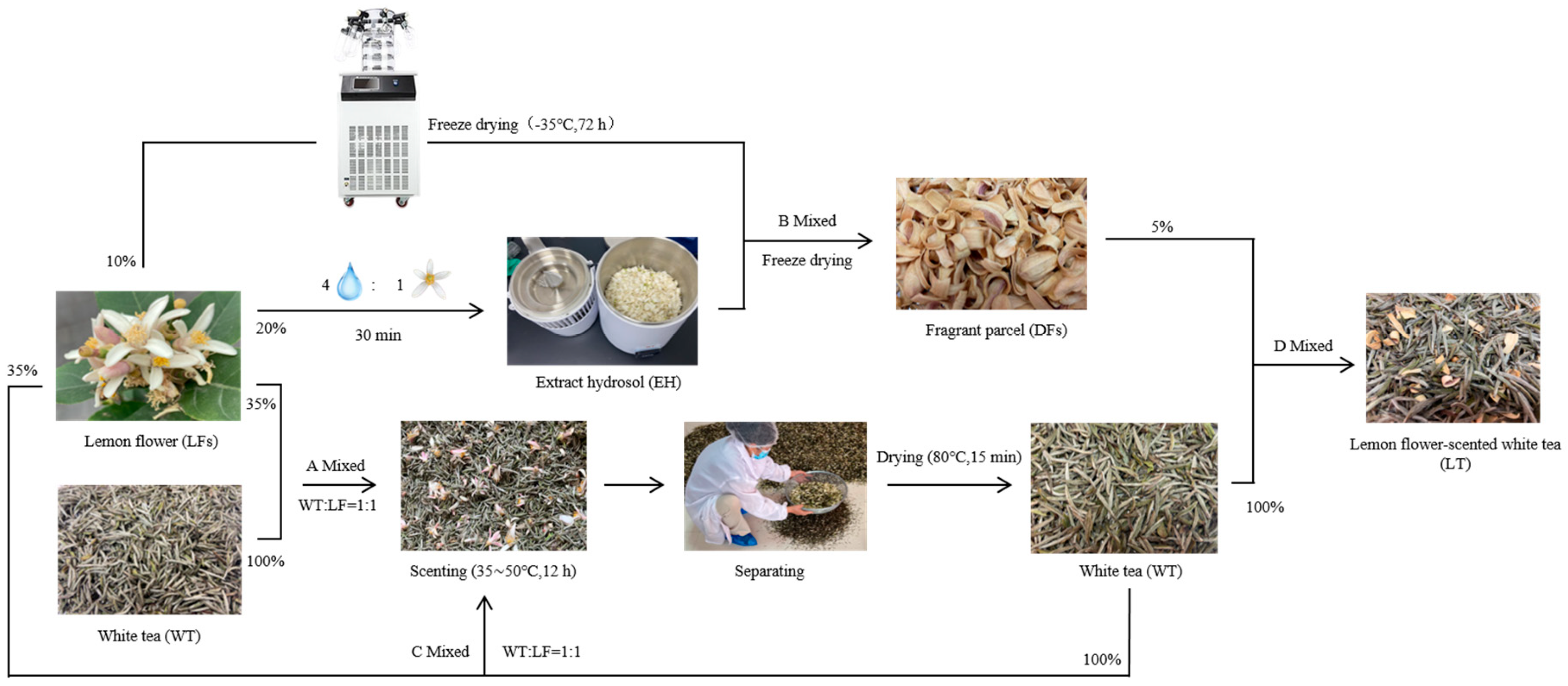
2.1. Sample Preparation and Collection
2.2. Sensory Evaluation
2.3. Electronic Tongue Analysis
2.4. Electronic Nose Data Collection and Analysis
2.5. Determination of Taste Compounds
2.6. Volatile Compound Analysis
2.6.1. Headspace Solid-Phase Microextraction (HS-SPME) Procedure
2.6.2. GC-MS Conditions
2.6.3. Qualitative and Quantitative Analyses of Volatile Compounds
2.6.4. Relative Odor Activity Values (rOAVs)
2.7. Statistical Analysis
3. Results and Discussion
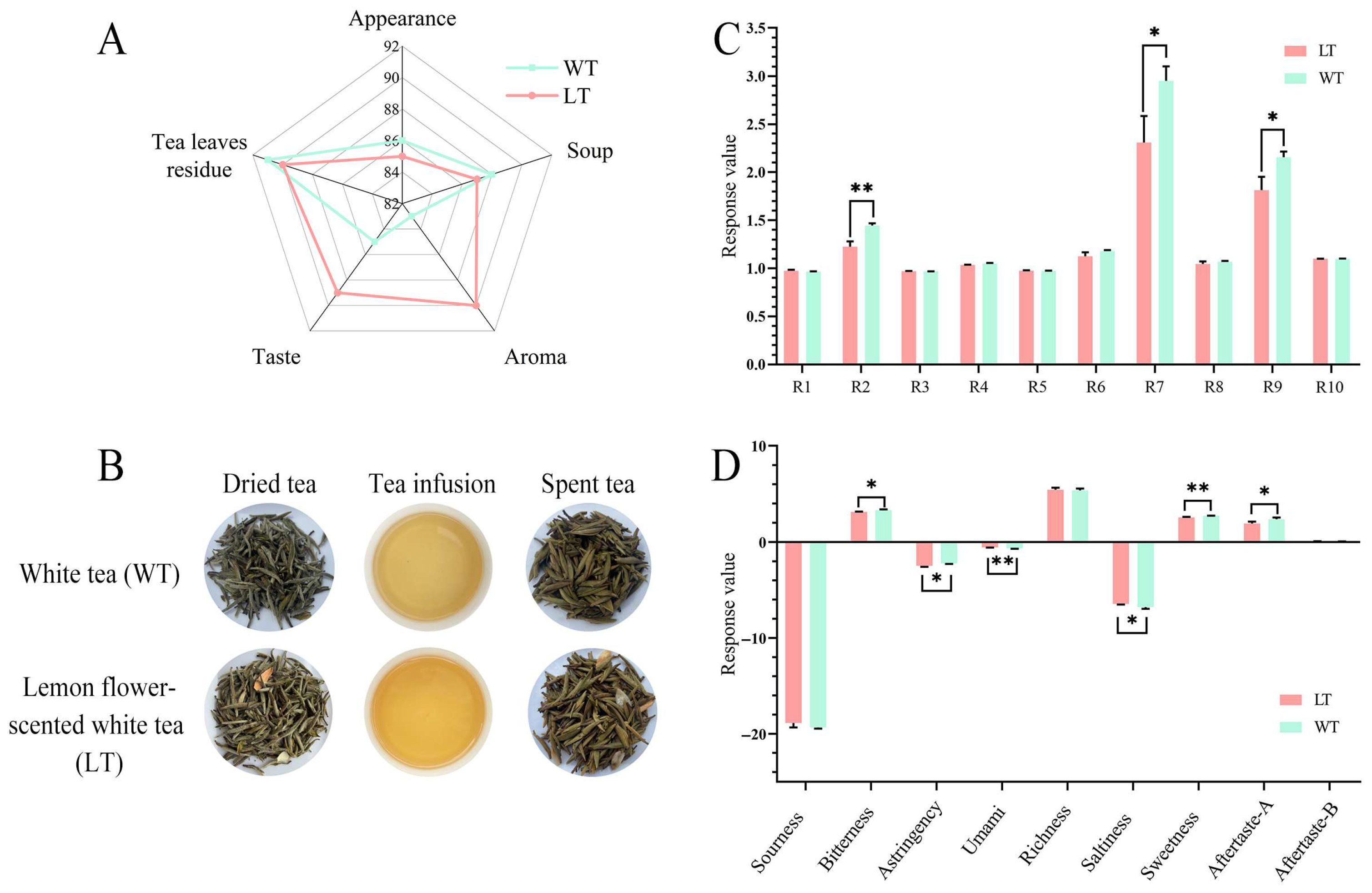
3.1. Sensory Evaluation of WT and LT
3.2. Taste Profile Evolution Revealed by E-Tongue
3.3. Aroma Profile Reorganization Captured by E-Nose
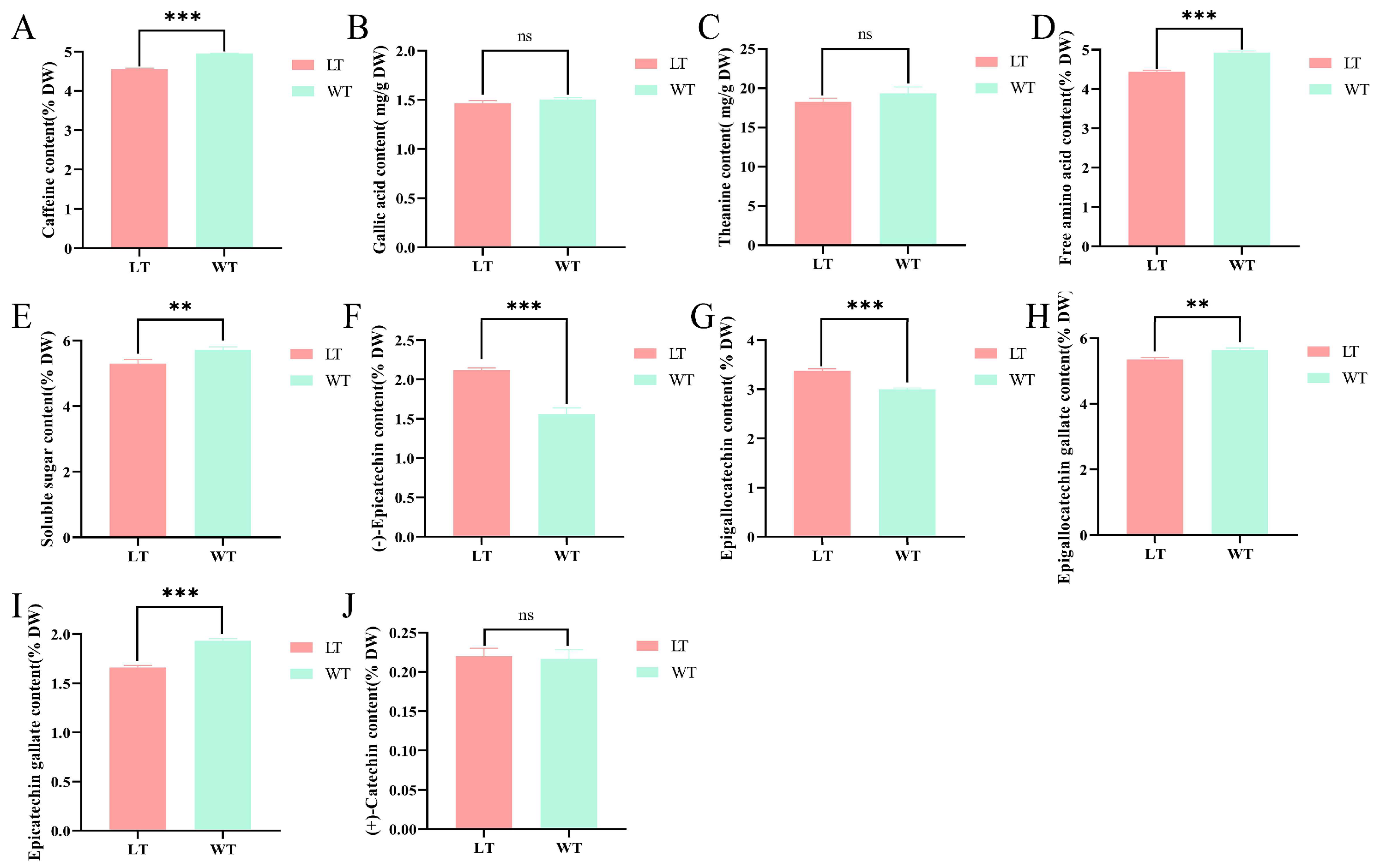
3.4. Dynamic Changes in Non-Volatile Taste Compounds
3.4.1. Bitterness and Astringency
3.4.2. Umami and Sweetness
3.5. Analysis of Volatile Compounds in WT and LT
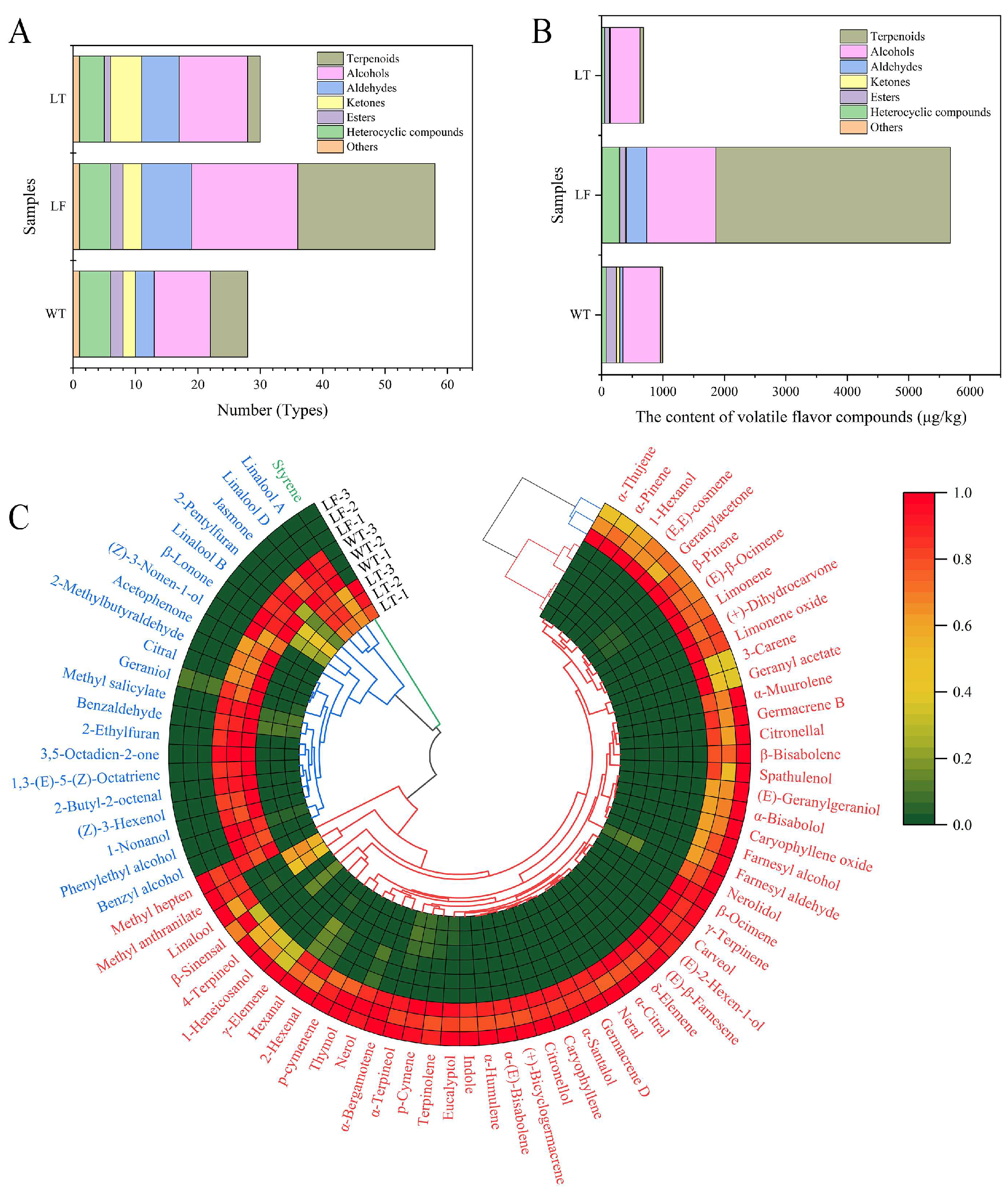
3.5.1. Composition and Comparative Analysis of VOCs
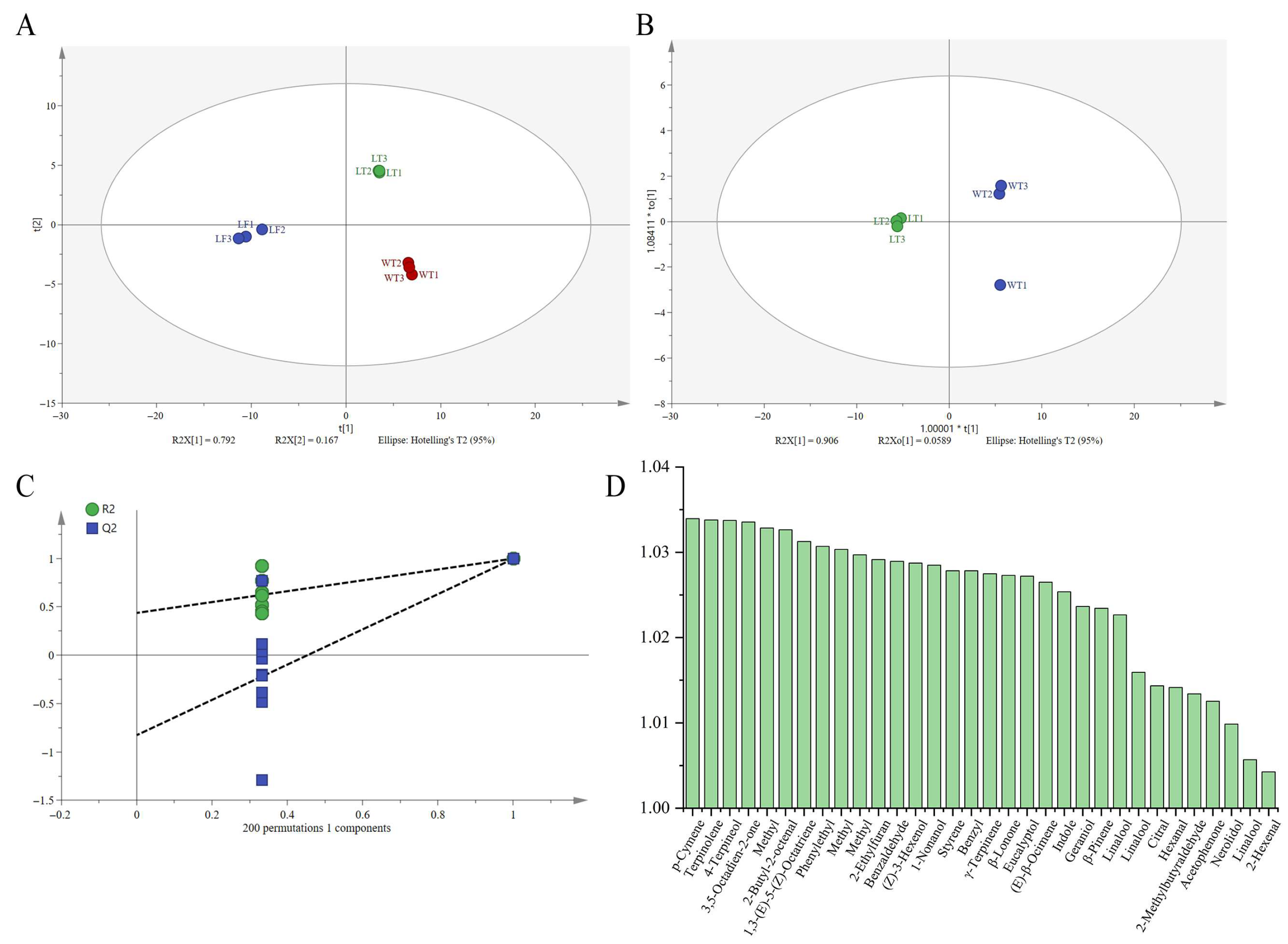
3.5.2. Screening of Key Volatile Flavor Compounds
4. Discussion
4.1. Flavor Modulation Through Lemon Flower Scenting: From Sensory Perception to Chemical Basis
4.2. Aroma Profile Reconstruction: Incorporation, Loss, and Synergy
5. Conclusions
Supplementary Materials
Author Contributions
Funding
Institutional Review Board Statement
Informed Consent Statement
Data Availability Statement
Conflicts of Interest
References
- Giannetti, V.; Boccacci, M.M.; Livi, G.; Biancolillo, A.; Marini, F. Characterization of the aroma profile of edible flowers using HS-SPME/GC–MS and chemometrics. Food Res. Int. 2024, 178, 114001. [Google Scholar] [CrossRef] [Scilit] [PubMed]
- Faisal, Z.; Saeed, F.; Afzaal, M.; Akram, N.; Shah, Y.A.; Islam, F.; Ateeq, H. Phytochemical profile and food applications of edible flowers: A comprehensive treatise. J. Food Process Preserv. 2022, 46, e17061. [Google Scholar] [CrossRef] [Scilit]
- Zhang, H.; Chen, M.; Wen, H.; Wang, Z.; Chen, J.; Fang, L.; Zhang, H.; Xie, Z.; Jiang, D.; Cheng, Y. Transcriptomic and metabolomic analyses provide insight into the volatile compounds of citrus leaves and flowers. BMC Plant Biol. 2020, 20, 7. [Google Scholar] [CrossRef] [Scilit] [PubMed]
- Pellizzeri, V.; Costa, R.; Grasso, E.; Dugo, G. Valuable products from the flowers of lemon (Citrus limon (L.) Osbeck) and grapefruit (Citrus paradisi Macfad.) Italian trees. Food Bioprod. Process. 2020, 123, 123–133. [Google Scholar] [CrossRef] [Scilit]
- Kellil, A.; Suhag, R.; Tenuta, M.C.; Bolchini, S.; Merkyte, V.; Scampicchio, M.; Morozova, K.; Ferrentino, G. Sequential extraction of antioxidants from Citrus aurantium L. flower and kinetic evaluation of their effect on oil microparticle oxidative stability. Food Chem. X 2025, 27, 102448. [Google Scholar] [CrossRef] [Scilit]
- Zhang, J.; Xin, W.; Zou, Y.; Yan, J.; Tang, W.; Ji, Y.; Li, W. Dynamic changes and correlation analysis of microorganisms and flavonoids/amino acids during white tea storage. Food Chem. 2024, 455, 139932. [Google Scholar] [CrossRef] [Scilit]
- Zheng, Z.; Wu, W.; Wang, Z.; Zhang, P.; Ma, B.; Huang, Y.; Sun, W. Molecular sensory basis of the unique “cocoa aroma” in white tea: An integrated study combining HS-SPME-GC–MS, GC-O, molecular docking, and addition tests. Food Res. Int. 2025, 211, 116413. [Google Scholar] [CrossRef] [Scilit]
- Zhou, C.; Chen, Y.; Chen, M.; Xu, M.; Zhao, D.; Huang, L.; Chen, W. Flavor changes of Yunnan large-leaf cultivar white tea during different aging periods. Food Chem. X 2025, 29, 102846. [Google Scholar] [CrossRef] [Scilit]
- Han, B.; Wei, Y.; Fan, R.; Zhang, S.; Ren, X.; Zhou, W.; Zhang, D.; Xu, Q.; Bian, M. Metabolomic analysis of volatile and non-volatile compounds in mulberry leaf white tea processed with different withering methods. Food Chem. 2025, 482, 144103. [Google Scholar] [CrossRef] [Scilit]
- Wang, P.; Zhao, B.; Yin, Z.; Gao, X.; Liu, M. Structure elucidation and anticancer activity of a heteropolysaccharide from white tea. Carbohydr. Polym. 2024, 333, 121976. [Google Scholar] [CrossRef] [Scilit]
- Shen, S.J.; Rana, M.M.; Liu, L.G.; Ling, L.T.; Gruber, M.Y.; Wei, S. Differential contribution of jasmine floral volatiles to the aroma of scented green tea. J. Food Qual. 2017, 2017, 5849501. [Google Scholar] [CrossRef] [Scilit]
- An, H.; Liu, J.; Chen, Y.; Huang, Y.; Chen, J.; Liu, Z.; Li, S.; Huang, J. Characterization of key volatile compounds in jasmine tea infusion with different amount of flowers. Food Chem. X 2023, 19, 100750. [Google Scholar] [CrossRef] [Scilit]
- Zhao, Y.; Li, S.; Du, X.; Xu, W.; Bian, J.; Chen, S.; He, C.; Xu, J.; Ye, S.; Feng, D. Insights into momentous aroma dominating the characteristic flavor of jasmine tea. Food Sci. Nutr. 2023, 11, 7841–7854. [Google Scholar] [CrossRef] [Scilit] [PubMed]
- Wang, J.; Yi, G.; Zhao, T.; Huang, X.; Zhao, Y.; Zhu, M.; Liu, Z.; Wang, K. Jasmine tea: Unveiling the secrets of processing, flavor characteristics, and potential health benefits. Crit. Rev. Food Sci. Nutr. 2025, 1–18. [Google Scholar] [CrossRef] [Scilit] [PubMed]
- An, H.; Ou, X.; Chen, Y.; Huang, Y.; Ying, J.; Jiang, Y.; Yuan, Y.; Tan, Y.; Xie, Y.; Liu, Z. Scenting: An effective processing technology for enriching key flavor compounds and optimizing flavor quality of decaffeinated tea. Food Chem. 2025, 467, 142372. [Google Scholar] [CrossRef] [Scilit] [PubMed]
- Zhang, Z.; Yin, Z.; Xie, G.; Chen, J.; Chen, K.; Dai, J.; Liu, D. Metabolic regulation and quality enha2ancement mechanisms in Dendrobium officinale flower tea aroma-crafting processes revealed by fuzzy mathematics and metabolomics. Food Chem. X 2025, 29, 102785. [Google Scholar] [CrossRef] [Scilit]
- Zhang, Y.; Yin, J.; Chen, J.; Wang, F.; Du, Q.; Jiang, Y.; Xu, Y. Improving the sweet aftertaste of green tea infusion with tannase. Food Chem. 2016, 192, 470–476. [Google Scholar] [CrossRef] [Scilit]
- Jabalpurwala, F.A.; Smoot, J.M.; Rouseff, R.L. A comparison of citrus blossom volatiles. Phytochemistry 2009, 70, 1428–1434. [Google Scholar] [CrossRef] [Scilit]
- GB/T 23776-2018; Sensory Evaluation Methods for Tea. Inspection and Quarantine of the People’s Republic of China, the Standardization Administration of China: Beijing, China, 2018.
- GB/T 8314-2013; Determination of Total Free Amino Acids in Tea. Inspection and Quarantine of the People’s Republic of China, the Standardization Administration of China: Beijing, China, 2013.
- GB/T 8312-2013; Determination of Caffeine in Tea. Inspection and Quarantine of the People’s Republic of China, the Standardization Administration of China: Beijing, China, 2013.
- GB/T 8313-2018; Determination Method for the Contents of Tea Polyphenols and Catechins in Tea. Inspection and Quarantine of the People’s Republic of China, the Standardization Administration of China: Beijing, China, 2018.
- GB/T 23193-2017; Determination of Theanine in Tea—High Performance Liquid Chromatography Method. Inspection and Quarantine of the People’s Republic of China, the Standardization Administration of China: Beijing, China, 2017.
- Zhou, S.; Zhang, J.; Ma, S.; Ou, C.; Feng, X.; Pan, Y.; Gong, S.; Fan, F.; Chen, P.; Chu, Q. Recent advances on white tea: Manufacturing, compositions, aging characteristics and bioactivities. Trends Food Sci. Technol. 2023, 134, 41–55. [Google Scholar] [CrossRef] [Scilit]
- Ho, C.; Zheng, X.; Li, S. Tea aroma formation. Food Sci. Hum. Wellness 2015, 4, 9–27. [Google Scholar] [CrossRef] [Scilit]
- Deng, S.; Zhang, G.; Aluko, O.O.; Mo, Z.; Mao, J.; Zhang, H.; Liu, X.; Ma, M.; Wang, Q.; Liu, H. Bitter and astringent substances in green tea: Composition, human perception mechanisms, evaluation methods and factors influencing their formation. Food Res. Int. 2022, 157, 111262. [Google Scholar] [CrossRef] [Scilit]
- Jia, H.; Zhang, J.; Guo, Y.; Li, Y.; Wang, Y.; Yin, X.; Lu, M.; Long, Y.; Dai, Q.; Deng, W. Endophytic bacterium V4 from albino tea plant enhances umami taste as well as flowery and roasted aromas in dried tea. Food Res. Int. 2025, 218, 116950. [Google Scholar] [CrossRef] [Scilit]
- Jiang, Z.; Zhao, Z.; Han, Z.; Ke, J.; Qin, C.; Ho, C.; Zhai, X.; Wang, Y.; Zhang, L.; Wan, X. Discovery and identification of novel color compound formed from EGCG upon heating: Integrated multispectral, sensory evaluation, metabolomics, and nuclear magnetic resonance. Food Chem. 2025, 490, 145070. [Google Scholar] [CrossRef] [Scilit]
- Jiang, Z.; Zhang, H.; Han, Z.; Zhai, X.; Qin, C.; Wen, M.; Lai, G.; Ho, C.; Zhang, L.; Wan, X. Study on in vitro preparation and taste properties of N-ethyl-2-pyrrolidinone-substituted flavan-3-ols. J. Agric. Food Chem. 2022, 70, 3832–3841. [Google Scholar] [CrossRef] [Scilit] [PubMed]
- Ding, Y.; Chen, X.; Zeng, R.; Jiang, H. Rapid determination of free amino acids in Huangshan Maofeng tea using NIR spectra: Analysis and comparison of variable selection methods. Infrared Phys. Technol. 2025, 148, 105848. [Google Scholar] [CrossRef] [Scilit]
- Deng, S.; Cao, Q.; Gao, Y.; Wu, W.; Chen, J.; Wang, F.; Zou, Q.; Xu, F.; Cao, X.; Sun, W. Elucidating the effect of brewing temperature on the sensory quality of Longjing tea based on multi-scale molecular sensory science. Food Chem. X 2025, 28, 102635. [Google Scholar] [CrossRef] [Scilit] [PubMed]
- Wang, H.; Chen, L.; Xu, A.; Zhao, Y.; Wang, Y.; Liu, Z.; Xu, P. Thermochemical reactions in tea drying shape the flavor of tea: A review. Food Res. Int. 2024, 197, 115188. [Google Scholar] [CrossRef] [Scilit] [PubMed]
- Huang, Y.; Xiao, X.; Cong, L.; Wu, M.; Huang, Y.; Yao, Y. A fermented tea with high levels of gallic acid processed by anaerobic solid-state fermentation. LWT Food Sci. Technol. 2016, 71, 260–267. [Google Scholar] [CrossRef] [Scilit]
- Li, W.; Zhang, Z.; Chen, R.; Sun, L.; Lai, X.; Li, Q.; Hao, M.; Zhang, S.; Li, Q.; Sun, S. Metabolomics-based analysis of the effects of differences in soluble sugars on the sweetness quality of six major tea types in China. Food Funct. 2025, 16, 3707–3720. [Google Scholar] [CrossRef] [Scilit]
- Dai, Y.; Liu, Y.; Li, Y.; Li, Q.; Liu, Z.; Zhang, T.; Yang, T.; Fang, S.; Zhang, B.; Pan, K. Solid-State Fermentation of Ganoderma lucidum on the Soluble Sugar Metabolism of Three Summer–Autumn Black Tea Varieties. J. Food Process Preserv. 2024, 2024, 8856934. [Google Scholar] [CrossRef] [Scilit]
- Wang, J.; Shi, J.; Zhu, Y.; Ma, W.; Yan, H.; Shao, C.; Wang, M.; Zhang, Y.; Peng, Q.; Chen, Y. Insights into crucial odourants dominating the characteristic flavour of citrus-white teas prepared from Citrus reticulata Blanco ‘Chachiensis’ and Camellia sinensis ‘Fudingdabai’. Food Chem. 2022, 377, 132048. [Google Scholar] [CrossRef] [Scilit]
- Cheng, Y.; Han, L.; Shao, L.; Wang, H.; Guo, Z.; Li, G. Comparative investigation on the aroma profiles of edible citrus flowers in the main organs and different developmental stages. Food Chem. X 2024, 23, 101568. [Google Scholar] [CrossRef] [Scilit]
- Bao, S.; An, Q.; Yang, Y.; Li, X.; Chen, G.; Chen, Y.; Chen, J.; Liu, Z.; Huang, J. Tea plant varieties influence the aroma characteristics of Zhenghe white tea: Based on Zhenghe Dabaicha and Fuan Dabaicha. Food Res. Int. 2025, 208, 116278. [Google Scholar] [CrossRef] [Scilit] [PubMed]
- Chen, Q.; Zhu, Y.; Yan, H.; Chen, M.; Xie, D.; Wang, M.; Ni, D.; Lin, Z. Identification of aroma composition and key odorants contributing to aroma characteristics of white teas. Molecules 2020, 25, 6050. [Google Scholar] [CrossRef] [Scilit]
- Xie, Y.; Yang, Z.; Zhu, Y.; Chen, X.; Lei, M.; Jin, X.; Jin, W.; Fu, C.; Yu, L. Investigation of rose-honey aroma formation during tea infusion fermentation by Pantoea camelliae Z09 through GC–MS and GC-IMS. Food Chem. X 2025, 29, 102766. [Google Scholar] [CrossRef] [Scilit] [PubMed]
- Ma, Y.; Hu, Y.; Peng, H.; Yang, Z.; Zheng, Y.; Wang, J. An investigation into the key volatile compounds that dominate the characteristic aroma and flavor of pomelo flower–green tea. Food Chem. X 2025, 29, 102641. [Google Scholar] [CrossRef] [Scilit]
- Su, W.; Liu, Z.; Huang, S.; Wang, D.; Feng, X.; Liu, Y.; Ni, L. Insight into aroma dynamic changes during the whole manufacturing process of smoked Lapsang Souchong tea. Food Chem. 2025, 463, 141498. [Google Scholar] [CrossRef] [Scilit] [PubMed]
- Yan, H.; Li, W.; Zhu, Y.; Lin, Z.; Chen, D.; Zhang, Y.; Lv, H.; Dai, W.; Ni, D.; Lin, Z. Comprehensive comparison of aroma profiles and chiral free and glycosidically bound volatiles in Fujian and Yunnan white teas. Food Chem. 2024, 448, 139067. [Google Scholar] [CrossRef] [Scilit] [PubMed]
- Chen, G.; Zhu, G.; Xie, H.; Zhang, J.; Huang, J.; Liu, Z.; Wang, C. Characterization of the key differential aroma compounds in five dark teas from different geographical regions integrating GC–MS, ROAV and chemometrics approaches. Food Res. Int. 2024, 194, 114928. [Google Scholar] [CrossRef] [Scilit]
- Feng, Z.; Li, M.; Li, Y.; Yin, J.; Wan, X.; Yang, X. Characterization of the key aroma compounds in infusions of four white teas by the sensomics approach. Eur. Food Res. Technol. 2022, 248, 1299–1309. [Google Scholar] [CrossRef] [Scilit]
- Göksu Sürücü, C.; Tolun, A.; Halisçelik, O.; Artık, N. Brewing method-dependent changes of volatile aroma constituents of green tea (Camellia sinensis L.). Food Sci. Nutr. 2024, 12, 7186–7201. [Google Scholar] [CrossRef] [Scilit] [PubMed]
- Ye, J.; Ye, Y.; Yin, J.; Jin, J.; Liang, Y.; Liu, R.; Tang, P.; Xu, Y. Bitterness and astringency of tea leaves and products: Formation mechanism and reducing strategies. Trends Food Sci. Technol. 2022, 123, 130–143. [Google Scholar] [CrossRef] [Scilit]
- Paiva, L.; Rego, C.; Lima, E.; Marcone, M.; Baptista, J. Comparative Analysis of the Polyphenols, Caffeine, and Antioxidant Activities of Green Tea, White Tea, and Flowers from Azorean Camellia sinensis Varieties Affected by Different Harvested and Processing Conditions. Antioxidants 2021, 10, 183. [Google Scholar] [CrossRef] [Scilit] [PubMed]
- Ye, Y.; Yan, J.; Cui, J.; Mao, S.; Li, M.; Liao, X.; Tong, H. Dynamic changes in amino acids, catechins, caffeine and gallic acid in green tea during withering. J. Food Compos. Anal. 2018, 66, 98–108. [Google Scholar] [CrossRef] [Scilit]
- Qin, J.; Li, N.; Tu, P.; Ma, Z.; Zhang, L. Change in tea polyphenol and purine alkaloid composition during solid-state fungal fermentation of postfermented tea. J. Agric. Food. Chem. 2012, 60, 1213–1217. [Google Scholar] [CrossRef] [Scilit]
- An, J.; Wicaksana, F.; Woo, M.W.; Liu, C.; Tian, J.; Yao, Y. Current food processing methods for obtaining umami peptides from protein-rich foods: A review. Trends Food Sci. Technol. 2024, 153, 104704. [Google Scholar] [CrossRef] [Scilit]
- Wang, H.; Yang, Y.; Chen, L.; Xu, A.; Wang, Y.; Xu, P.; Liu, Z. Identifying the structures and taste characteristics of two novel Maillard reaction products in tea. Food Chem. 2024, 431, 137125. [Google Scholar] [CrossRef] [Scilit]
- Paparella, A.; Shaltiel-Harpaza, L.; Ibdah, M. β-Ionone: Its occurrence and biological function and metabolic engineering. Plants 2021, 10, 754. [Google Scholar] [CrossRef] [Scilit]
- Cherri-Martin, M.; Jullien, F.; Heizmann, P.; Baudino, S. Fragrance heritability in hybrid tea roses. Sci. Hortic. 2007, 113, 177–181. [Google Scholar] [CrossRef] [Scilit]
- Chen, C.; Sheng, M.; Yuan, H.; Pan, X.; Tian, H.; Lou, X. Perceptual interaction of aroma compounds and their effects on the enhancement of flavor quality in foods: A review. Trends Food Sci. Technol. 2025, 165, 105315. [Google Scholar] [CrossRef] [Scilit]
- Ni, R.; Zhan, P.; Tian, H.; Abudalimu, A.; Wang, P.; He, W.; Zhang, R. Recent advances on aroma-food ingredient interactions: A review. Trends Food Sci. Technol. 2026, 169, 105550. [Google Scholar] [CrossRef] [Scilit]
- Mitropoulou, A.; Hatzidimitriou, E.; Paraskevopoulou, A. Aroma release of a model wine solution as influenced by the presence of non-volatile components. Effect of commercial tannin extracts, polysaccharides and artificial saliva. Food Res. Int. 2011, 44, 1561–1570. [Google Scholar] [CrossRef] [Scilit]
- Rodríguez-Bencomo, J.J.; Muñoz-González, C.; Andújar-Ortiz, I.; Martín-Álvarez, P.J.; Moreno-Arribas, M.V.; Pozo-Bayón, M.Á. Assessment of the effect of the non-volatile wine matrix on the volatility of typical wine aroma compounds by headspace solid phase microextraction/gas chromatography analysis. J. Sci. Food Agric. 2011, 91, 2484–2494. [Google Scholar] [CrossRef] [Scilit]
- Wang, X.; Li, Y.; Song, H.; Tao, Y.; Russo, N. Phenolic matrix effect on aroma formation of terpenes during simulated wine fermentation—Part I: Phenolic acids. Food Chem. 2021, 341, 128288. [Google Scholar] [CrossRef] [Scilit]



| Num. | VOCs | VIP | Odor Threshold (μg/kg) | rOAV | |
|---|---|---|---|---|---|
| LT | WT | ||||
| 1 | p-Cymene | 1.03394 | 5.01 | 9.77 | - |
| 2 | Methyl salicylate | 1.03354 | 40 | 2.36 | 1.78 |
| 3 | 3,5-Octadien-2-one | 1.03263 | 0.15 | - | 100 |
| 4 | Phenylethyl alcohol | 1.03069 | 45 | 0.68 | 1.01 |
| 5 | Methyl anthranilate | 1.03033 | 3 | 100 | - |
| 6 | 1-Nonanol | 1.02847 | 1.1 | - | 2.15 |
| 7 | Styrene | 1.02783 | 3.6 | 4.73 | - |
| 8 | Benzyl alcohol | 1.02782 | 2.54 | - | 4.81 |
| 9 | β-Lonone | 1.02729 | 0.12 | 87.36 | 28.69 |
| 10 | Eucalyptol | 1.02719 | 4.6 | 4.75 | - |
| 11 | Geraniol | 1.02364 | 1.1 | 87.21 | 66.70 |
| 12 | Linalool oxide A | 1.01593 | 100 | 1.21 | 0.15 |
| 13 | Hexanal | 1.01413 | 5 | 1.87 | 0.30 |
| 14 | Linalool | 1.00567 | 50 | 40.89 | 2.38 |
Disclaimer/Publisher’s Note: The statements, opinions and data contained in all publications are solely those of the individual author(s) and contributor(s) and not of MDPI and/or the editor(s). MDPI and/or the editor(s) disclaim responsibility for any injury to people or property resulting from any ideas, methods, instructions or products referred to in the content. |
© 2026 by the authors. Licensee MDPI, Basel, Switzerland. This article is an open access article distributed under the terms and conditions of the Creative Commons Attribution (CC BY) license.
Share and Cite
Wang, J.; Hu, Y.; Hu, D.; Lu, Z.; Xiang, L.; Xiang, J.; Hong, M.; Ling, L.; Ma, Y. Enhancement Effect of Lemon Flower on the Flavor Quality of White Tea and Its Formation Mechanism. Foods 2026, 15, 596. https://doi.org/10.3390/foods15030596
Wang J, Hu Y, Hu D, Lu Z, Xiang L, Xiang J, Hong M, Ling L, Ma Y. Enhancement Effect of Lemon Flower on the Flavor Quality of White Tea and Its Formation Mechanism. Foods. 2026; 15(3):596. https://doi.org/10.3390/foods15030596
Chicago/Turabian StyleWang, Jun, Yiwen Hu, Deyu Hu, Zhihong Lu, Li Xiang, Jinsong Xiang, Min Hong, Lili Ling, and Yanyan Ma. 2026. "Enhancement Effect of Lemon Flower on the Flavor Quality of White Tea and Its Formation Mechanism" Foods 15, no. 3: 596. https://doi.org/10.3390/foods15030596
APA StyleWang, J., Hu, Y., Hu, D., Lu, Z., Xiang, L., Xiang, J., Hong, M., Ling, L., & Ma, Y. (2026). Enhancement Effect of Lemon Flower on the Flavor Quality of White Tea and Its Formation Mechanism. Foods, 15(3), 596. https://doi.org/10.3390/foods15030596