Bioactive Nanoemulsions for Enhancing Sausage and Meat Patty Shelf-Life

 ,
,  ,
,  , ,
, ,  , , and
Abstract
1. Introduction
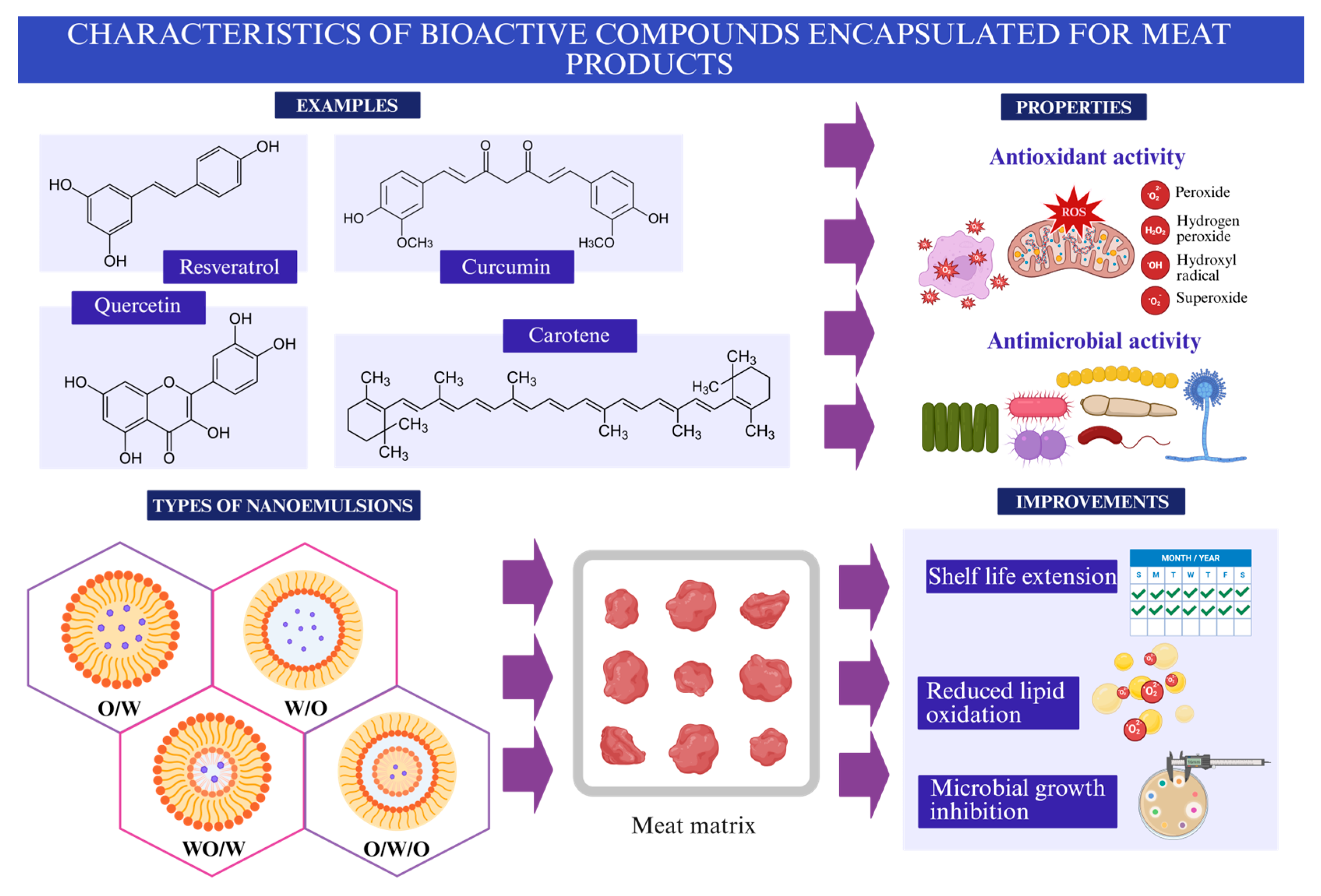
2. General Aspects of Nanoemulsions
3. Nanoemulsion Effects on Bioactive Compound Stability and Encapsulation
3.1. Factors Affecting Bioactive Compound Stability in NEs
3.2. Factors Influencing the Functionality of Bioactive Compounds in NEs

| NE Type | Bioactive Compound | Bioactivities | Factors Affecting Application | Key Findings | Ref. |
|---|---|---|---|---|---|
| Solubilization | |||||
| W/O | Vitamin E | AO, supports immune and skin health | Susceptible to oxidation, heat, or light; hydrophobic, so difficult to disperse in low-fat foods | Prevention of degradation; facilitates incorporation into foods and beverages | [42] |
| W/O | Essential oils | AO, AM | Susceptible to oxidation and off-flavor | ↑ shelf-life and bioavailability | [46] |
| C | Polyphenols | AO, AM, AI | Appearance; film acceptability | ↑ shelf-life and bioavailability | [47] |
| O/W | Essential oils | AO | Dispersion of oil | ↑ tenderness | [48] |
| W/C | β-Carotene | AO, COL | Susceptible to oxidation and heat-induced isomerization | ↑ antioxidant and sensorial acceptance | [40] |
| O/W | Carvacrol | AO, AM | Stability | ↑ shelf-life and bioactivity | [18] |
| Improved absorption | |||||
| AG-NE | Andrographolide | AI | ↓ water solubility | ↑ bioavailability | [49] |
| Starch | Chrysin | AI | ↓ water solubility | ↑ bioavailability and permeability | [50] |
| Starch | Quercetin | AO, AI | Susceptible to oxidation; ↓ solubility | ↑ antioxidant and bioavailability; stable at↓ temperatures | [41] |
| Starch | Coenzyme Q10 | AO | ↓ stability | ↑ bioavailability | [51] |
| O/W | Lipophilic substances | AM | ↓ solubility | ↑ bioavailability | [52] |
| Controlled/sustained release | |||||
| O/W | Curcumin | AO, AI | Sensitive to pH, light, and heat; ↓ solubility | pH and light protection; resistance to gastric conditions; ↑ bioavailability | [36] |
| O/W | Lycopene | AO, PA | Sensitive to light and heat | ↑ antioxidant and bioaccessibility | [36] |
| W/O | EO | AM, AO | Susceptible to oxidation and off-flavor | ↑ antioxidant and shelf-life | [53] |
| O/W | DHA/EPA FAs | CP, AM | Susceptible to oxidation and off-flavor | ↑ antioxidant and sensorial acceptance | [45] |
| O/W | Resveratrol | AO, CP | Isomerize to inactive form; ↓ solubility and metabolism efficacy | ↑ antioxidant and bioavailability | [37] |
| O/W | Essential oils | AO, AM | Susceptible to oxidation and off-flavor | ↓ dose; ↑ release control | [54] |
| G/C | Essential oils | AO, AM | Susceptible to oxidation and off-flavor | ↑ shelf-life and sensory acceptance | [55] |
| Interaction with biological membranes | |||||
| O/W | Lipophilic substances | AM | ↓ solubility | ↑ bioavailability | [52] |
| O/W | Lipophilic substances | AM, AO | ↓ solubility and stability | ↑ bioavailability | [52] |
| O/W | β-carotene | AO | Toxicological risks | ↑ bioavailability and solubilization | [56] |
4. Application of Nanoemulsions in Sausages and Meat Patties
4.1. Impact of Nanoemulsions on the Physicochemical Quality of Meat Products
4.2. Use of Nanoemulsions as Natural Preservatives in Sausages and Meat Patties
4.2.1. Effect of Nanoemulsions on Oxidative Stability and Shelf-Life
4.2.2. Effect of Nanoemulsions on Microbial Safety and Preservation
4.3. Impact of Nanoemulsions on Functional Properties of Meat Products
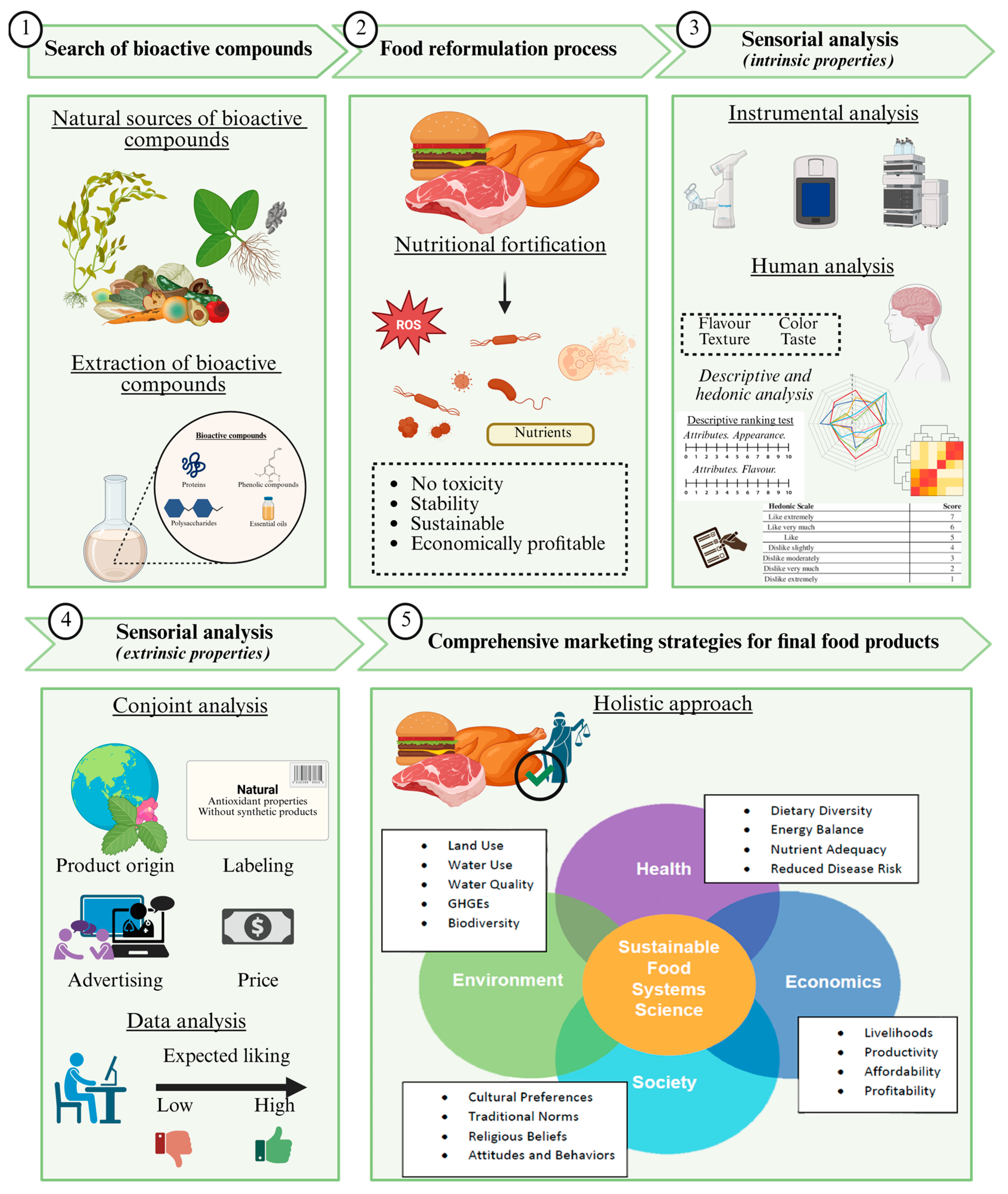
5. Limitations of Incorporating Bioactive Compounds: Consumer Acceptance and Perception
6. Conclusions
Author Contributions
Funding
Institutional Review Board Statement
Informed Consent Statement
Data Availability Statement
Conflicts of Interest
Abbreviations
| Generic | |
| SFA | Saturated fatty acid |
| NEs | Nanoemulsions |
| O/W | Oil-in-water |
| HEM | High-energy method |
| LEM | Low-energy method |
| PIT | Phase inversion temperature |
| SE | Spontaneous emulsification |
| HPH | High-pressure valve homogenization |
| MFH | High-pressure microfluidics |
| USH | Ultrasonic homogenization |
| RSH | Rotor–stator homogenization |
| PIC | Phase inversion composition |
| SD/E | Solvent displacement/evaporation |
| DS | Droplet size |
| ZP | Zeta potential |
| IT | Interfacial tension |
| W/O | Water-in-oil |
| DO | Digestible oils |
| IO | Indigestible oils |
| IF | Interfacial film |
| GRAS | Generally regarded as safe |
| PUFAs | Polyunsaturated fatty acids |
| TVB-N | Total volatile basic-nitrogen |
| TBARS | Thiobarbituric acid reactive substances |
| MIC | Minimum inhibitory concentration |
| PV | Peroxide value |
| MBC | Minimum bactericidal concentration |
| PEFs | Pulse electric fields |
| Compounds | |
| Fe | Iron |
| Cu | Copper |
| Zn | Zinc |
| Mn | Manganese |
| MCTs | Medium-chain triglycerides |
| LCTs | Long-chain triglycerides |
| BHT | Butyl-hydroxy-toluene |
| BHA | Butyl-hydroxy-anisole |
| TBH-Q | Tert-butyl-hydroquinone |
| PG | Propyl-gallate |
| ALA | Alpha-linolenic acid |
| Se | Selenium |
| RES | Resveratrol |
| CEO | Clove essential oil |
References
- Fraser, E.D.G. The Challenge of Feeding a Diverse and Growing Population. Physiol. Behav. 2020, 221, 112908. [Google Scholar] [CrossRef]
- Whitton, C.; Bogueva, D.; Marinova, D.; Phillips, C.J.C. Are We Approaching Peak Meat Consumption? Analysis of Meat Consumption from 2000 to 2019 in 35 Countries and Its Rela-Tionship to Gross Domestic Product. Animals 2021, 11, 3466. [Google Scholar] [CrossRef]
- Sans, P.; Combris, P. World Meat Consumption Patterns: An Overview of the Last Fifty Years (1961–2011). Meat Sci. 2015, 109, 106–111. [Google Scholar] [CrossRef] [PubMed]
- Font-i-Furnols, M. Meat Consumption, Sustainability and Alternatives: An Overview of Motives and Barriers. Foods 2023, 12, 2144. [Google Scholar] [CrossRef] [PubMed]
- Simonin, H.; Duranton, F.; de Lamballerie, M. New Insights into the High-Pressure Processing of Meat and Meat Products. Compr. Rev. Food Sci. Food Saf. 2012, 11, 285–306. [Google Scholar] [CrossRef]
- IndexBox World. Sausages and Similar Products of Meat—Market Analysis, Forecast, Size, Trends and Insights. 2024. Available online: https://www.indexbox.io/store/eu-sausages-and-similar-products-of-meat-market-report-analysis-and-forecast-to-2020/ (accessed on 9 September 2025).
- Pereira, P.M.d.C.C.; Vicente, A.F.d.R.B. Meat Nutritional Composition and Nutritive Role in the Human Diet. Meat Sci. 2013, 93, 586–592. [Google Scholar] [CrossRef]
- Domínguez, R.; Pateiro, M.; Gagaoua, M.; Barba, F.J.; Zhang, W.; Lorenzo, J.M. A Comprehensive Review on Lipid Oxidation in Meat and Meat Products. Antioxidants 2019, 8, 429. [Google Scholar] [CrossRef]
- Karwowska, M.; Łaba, S.; Szczepański, K. Food Loss and Waste in Meat Sector—Why the Consumption Stage Generates the Most Losses? Sustainability 2021, 13, 6227. [Google Scholar] [CrossRef]
- Ujilestari, T.; Febrisiantosa, A.; Sholikin, M.M.; Wahyuningsih, R.; Wahyono, T. Nanoemulsion Application in Meat Product and Its Functionality: Review. J. Anim. Sci. Technol. 2023, 65, 275–292. [Google Scholar] [CrossRef]
- Ursachi, C.Ș.; Perța-Crișan, S.; Munteanu, F.D. Strategies to Improve Meat Products’ Quality. Foods 2020, 9, 1883. [Google Scholar] [CrossRef]
- Radi, M.; Akhavan-Darabi, S.; Akhavan, H.R.; Amiri, S. The Use of Orange Peel Essential Oil Microemulsion and Nanoemulsion in Pectin-Based Coating to Extend the Shelf Life of Fresh-Cut Orange. J. Food Process. Preserv. 2018, 42, 9. [Google Scholar] [CrossRef]
- Gupta, A.; Eral, H.B.; Hatton, T.A.; Doyle, P.S. Nanoemulsions: Formation, Properties and Applications. Soft Matter 2016, 12, 2826–2841. [Google Scholar] [CrossRef] [PubMed]
- McClements, D.J. Edible Nanoemulsions: Fabrication, Properties, and Functional Performance. Soft Matter 2011, 7, 2297–2316. [Google Scholar] [CrossRef]
- Fuentes, K.; Matamala, C.; Martínez, N.; Zúñiga, R.N.; Troncoso, E. Comparative Study of Physicochemical Properties of Nanoemulsions Fabricated with Natural and Synthetic Surfactants. Processes 2021, 9, 2002. [Google Scholar] [CrossRef]
- McClements, D.J.; Jafari, S.M. General Aspects of Nanoemulsions and Their Formulation. In Nanoemulsions: Formulation, Applications, and Characterization; Elsevier Inc.: Amsterdam, The Netherlands, 2018; pp. 3–20. [Google Scholar]
- Moraes-Lovison, M.; Marostegan, L.F.P.; Peres, M.S.; Menezes, I.F.; Ghiraldi, M.; Rodrigues, R.A.F.; Fernandes, A.M.; Pinho, S.C. Nanoemulsions Encapsulating Oregano Essential Oil: Production, Stability, Antibacterial Activity and Incorporation in Chicken Pâté. LWT 2017, 77, 233–240. [Google Scholar] [CrossRef]
- Zaharioudakis, K.; Kollia, E.; Leontiou, A.; Moschovas, D.; Karydis-Messinis, A.; Avgeropoulos, A.; Zafeiropoulos, N.E.; Ragkava, E.; Kehayias, G.; Proestos, C.; et al. Carvacrol Microemulsion vs. Nanoemulsion as Novel Pork Minced Meat Active Coatings. Nanomaterials 2023, 13, 3161. [Google Scholar] [CrossRef]
- Ashrafi, A.; Ahari, H.; Asadi, G.; Mohammadi Nafchi, A. Enhancement of the Quality and Preservation of Frozen Burgers by Active Coating Containing Rosa canina L. Extract Nanoemulsions. Food Chem. X 2024, 23, 101749. [Google Scholar] [CrossRef]
- Abdou, E.S.; Galhoum, G.F.; Mohamed, E.N. Curcumin Loaded Nanoemulsions/pectin Coatings for Refrigerated Chicken Fillets. Food Hydrocoll. 2018, 83, 445–453. [Google Scholar] [CrossRef]
- Sneha, K.; Kumar, A. Nanoemulsions: Techniques for the Preparation and the Recent Advances in Their Food Applications. Innov. Food Sci. Emerg. Technol. 2022, 76, 102914. [Google Scholar] [CrossRef]
- Luu, N.A.; To, T.T.; Tran, N.H.; Vu, G.M.; Ngo, N.Y.L.; Tran, M.P.L.; Nguyen, N.M.; Dinh, T.N.N.; Dam, A.N.; Lieu, N.N.; et al. Optimization of Plant Oil-Based Nanoemulsions Prepared via Phase Inversion Temperature and Evaluation of Their Antioxidant Capacity. Oil Crop Sci. 2025, 10, 194–204. [Google Scholar] [CrossRef]
- Liu, Q.; Huang, H.; Chen, H.; Lin, J.; Wang, Q. Food-Grade Nanoemulsions: Preparation, Stability and Application in Encapsulation of Bioactive Compounds. Molecules 2019, 24, 4242. [Google Scholar] [CrossRef]
- Saffarionpour, S. Preparation of Food Flavor Nanoemulsions by High- and Low-Energy Emulsification Approaches. Food Eng. Rev. 2019, 11, 259–289. [Google Scholar] [CrossRef]
- Yukuyama, M.N.; Ghisleni, D.D.M.; Pinto, T.J.A.; Bou-Chacra, N.A. Nanoemulsion: Process Selection and Application in Cosmetics—A Review. Int. J. Cosmet. Sci. 2016, 38, 13–24. [Google Scholar] [CrossRef] [PubMed]
- Kumar, M.; Bishnoi, R.S.; Shukla, A.K.; Jain, C.P. Techniques for Formulation of Nanoemulsion Drug Delivery System: A Review. Prev. Nutr. Food Sci. 2019, 24, 225–234. [Google Scholar] [CrossRef] [PubMed]
- Davies, J.T. Drop Sizes of Emulsions Related to Turbulent Energy Dissipation Rates. Chem. Eng. Sci. 1985, 40, 839–842. [Google Scholar] [CrossRef]
- Kavinila, S.; Nimbkar, S.; Moses, J.A.; Anandharamakrishnan, C. Emerging Applications of Microfluidization in the Food Industry. J. Agric. Food Res. 2023, 12, 100537. [Google Scholar] [CrossRef]
- Komaiko, J.S.; Mcclements, D.J. Formation of Food-Grade Nanoemulsions Using Low-Energy Preparation Methods: A Review of Available Methods. Compr. Rev. Food Sci. Food Saf. 2016, 15, 331–352. [Google Scholar] [CrossRef]
- Davies, J.T. A Physical Interpretation of Drop Sizes in Homogenizers and Agitated Tanks, Including the Dispersion of Viscous Oils. Chem. Eng. Sci. 1987, 42, 1671–1676. [Google Scholar] [CrossRef]
- Anton, N.; Benoit, J.P.; Saulnier, P. Design and Production of Nanoparticles Formulated from Nano-Emulsion templates—A Review. J. Control. Release 2008, 128, 185–199. [Google Scholar] [CrossRef]
- Dickinson, E. Properties of Emulsions Stabilized with Milk Proteins: Overview of Some Recent Developments. J. Dairy Sci. 1997, 80, 2607–2619. [Google Scholar] [CrossRef]
- Solans, C.; Izquierdo, P.; Nolla, J.; Azemar, N.; Garcia-Celma, M.J. Nano-Emulsions. Curr. Opin. Colloid Interface Sci. 2005, 10, 102–110. [Google Scholar] [CrossRef]
- Mushtaq, A.; Mohd Wani, S.; Malik, A.R.; Gull, A.; Ramniwas, S.; Ahmad Nayik, G.; Ercisli, S.; Alina Marc, R.; Ullah, R.; Bari, A. Recent Insights into Nanoemulsions: Their Preparation, Properties and Applications. Food Chem. X 2023, 18, 100684. [Google Scholar] [CrossRef] [PubMed]
- Ramachandraiah, K.; Han, S.G.; Chin, K.B. Nanotechnology in Meat Processing and Packaging: Potential Applications—A Review. Asian-Australas. J. Anim. Sci. 2015, 28, 290–302. [Google Scholar] [CrossRef] [PubMed]
- Ling, J.K.U.; Chan, Y.S.; Nandong, J. Insights into the Release Mechanisms of Antioxidants from Nanoemulsion Droplets. J. Food Sci. Technol. 2022, 59, 1677–1691. [Google Scholar] [CrossRef]
- Herneisey, M.; Williams, J.; Mirtic, J.; Liu, L.; Potdar, S.; Bagia, C.; Cavanaugh, J.E.; Janjic, J.M. Development and Characterization of Resveratrol Nanoemulsions Carrying Dual-Imaging Agents. Ther. Deliv. 2016, 7, 795–808. [Google Scholar] [CrossRef]
- Lohith Kumar, D.H.; Sarkar, P. Encapsulation of Bioactive Compounds Using Nanoemulsions. Environ. Chem. Lett. 2018, 16, 59–70. [Google Scholar] [CrossRef]
- Ostertag, F.; Weiss, J.; McClements, D.J. Low-Energy Formation of Edible Nanoemulsions: Factors Influencing Droplet Size Produced by Emulsion Phase Inversion. J. Colloid Interface Sci. 2012, 388, 95–102. [Google Scholar] [CrossRef]
- Baek, E.J.; Garcia, C.V.; Shin, G.H.; Kim, J.T. Improvement of Thermal and UV-Light Stability of β-Carotene-Loaded Nanoemulsions by Water-Soluble Chitosan Coating. Int. J. Biol. Macromol. 2020, 165, 1156–1163. [Google Scholar] [CrossRef]
- Siraj, A.; Naqash, F.; Shah, M.A.; Fayaz, S.; Majid, D.; Dar, B.N. Nanoemulsions: Formation, Stability and an Account of Dietary Polyphenol Encapsulation. Int. J. Food Sci. Technol. 2021, 56, 4193–4205. [Google Scholar] [CrossRef]
- Banasaz, S.; Morozova, K.; Ferrentino, G.; Scampicchio, M. Encapsulation of Lipid-Soluble Bioactives by Nanoemulsions. Molecules 2020, 25, 3966. [Google Scholar] [CrossRef]
- Oehlke, K.; Adamiuk, M.; Behsnilian, D.; Gräf, V.; Mayer-Miebach, E.; Walz, E.; Greiner, R. Potential Bioavailability Enhancement of Bioactive Compounds Using Food-Grade Engineered Nanomaterials: A Review of the Existing Evidence. Food Funct. 2014, 5, 1341–1359. [Google Scholar] [CrossRef] [PubMed]
- Dickinson, E. Interfacial Structure and Stability of Food Emulsions as Affected by Protein-Polysaccharide Interactions. Soft Matter 2008, 4, 932–942. [Google Scholar] [CrossRef] [PubMed]
- Islam, F.; Saeed, F.; Afzaal, M.; Hussain, M.; Ikram, A.; Khalid, M.A. Food Grade Nanoemulsions: Promising Delivery Systems for Functional Ingredients. J. Food Sci. Technol. 2023, 60, 1461–1471. [Google Scholar] [CrossRef] [PubMed]
- da Silva, B.D.; do Rosário, D.K.A.; Weitz, D.A.; Conte-Junior, C.A. Essential Oil Nanoemulsions: Properties, Development, and Application in Meat and Meat Products. Trends Food Sci. Technol. 2022, 121, 1–13. [Google Scholar] [CrossRef]
- Chaudhary, S.; Kumar, V.; Sharma, V.; Sharma, R.; Kumar, S. Chitosan Nanoemulsion: Gleam into the Futuristic Approach for Preserving the Quality of Muscle Foods. Int. J. Biol. Macromol. 2022, 199, 121–137. [Google Scholar] [CrossRef]
- Lee, J.; Kim, H.; Choi, M.-J.; Cho, Y. Improved Physicochemical Properties of Pork Patty Supplemented with Oil-in-Water Nanoemulsion. Food Sci. Anim. Resour. 2020, 40, 262–273. [Google Scholar] [CrossRef]
- Yen, C.-C.; Chen, Y.-C.; Wu, M.-T.; Wang, C.-C.; Wu, Y.-T. Nanoemulsion as a Strategy for Improving the Oral Bioavailability and Anti-Inflammatory Activity of Andrographolide. Int. J. Nanomed. 2018, 13, 669–680. [Google Scholar] [CrossRef]
- Lee, Y.; Byun, E.-B. Enhanced Bioaccessibility and Anti-Inflammatory Effect of Chrysin Nanoemulsion. J. Funct. Foods 2025, 128, 106820. [Google Scholar] [CrossRef]
- Niu, Z.; Acevedo-Fani, A.; McDowell, A.; Barnett, A.; Loveday, S.M.; Singh, H. Nanoemulsion Structure and Food Matrix Determine the Gastrointestinal Fate and in Vivo Bioavailability of Coenzyme Q10. J. Control. Release 2020, 327, 444–455. [Google Scholar] [CrossRef]
- Odriozola-Serrano, I.; Oms-Oliu, G.; Martín-Belloso, O. Nanoemulsion-Based Delivery Systems to Improve Functionality of Lipophilic Components. Front. Nutr. 2014, 1, 24. [Google Scholar] [CrossRef]
- Flekka, K.; Dimaki, V.D.; Mourelatou, E.; Avgoustakis, K.; Lamari, F.N.; Hatziantoniou, S. Stability and Retention of Nanoemulsion Formulations Incorporating Lavender Essential Oil. Cosmetics 2024, 11, 65. [Google Scholar] [CrossRef]
- Ojeda-Piedra, S.A.; Zambrano-Zaragoza, M.L.; González-Reza, R.M.; García-Betanzos, C.I.; Real-Sandoval, S.A.; Quintanar-Guerrero, D. Nano-Encapsulated Essential Oils as a Preservation Strategy for Meat and Meat Products Storage. Molecules 2022, 27, 8187. [Google Scholar] [CrossRef] [PubMed]
- Pérez-Córdoba, L.J.; Pinheiro, A.C.; de Núñez de Villavicencio-Ferrer, M.; Trindade, M.A.; Sobral, P.J.A. Applying Gelatine:chitosan Film Loaded with Nanoemulsified Garlic Essential Oil/α-Tocopherol as Active Packaging of Sliced Omega-3-Rich Mortadella. Int. J. Food Sci. Technol. 2022, 57, 6378–6388. [Google Scholar] [CrossRef]
- Wooster, T.J.; Moore, S.C.; Chen, W.; Andrews, H.; Addepalli, R.; Seymour, R.B.; Osborne, S.A. Biological Fate of Food Nanoemulsions and the Nutrients They Carry—Internalisation, Transport and Cytotoxicity of Edible Nanoemulsions in Caco-2 Intestinal Cells. RSC Adv. 2017, 7, 40053–40066. [Google Scholar] [CrossRef]
- Kara, A.; Çağlak, E.; Karslı, B. Protective Effects of Hydrocolloid Nanoemulsion Coatings against Myofibrillar Protein Oxidation in Frozen Trout. Front. Nutr. 2025, 12, 1663357. [Google Scholar] [CrossRef]
- Huang, M.; Wang, H.; Xu, X.; Lu, X.; Song, X.; Zhou, G. Effects of Nanoemulsion-Based Edible Coatings with Composite Mixture of Rosemary Extract and ε-Poly-L-Lysine on the Shelf Life of Ready-to-Eat Carbonado Chicken. Food Hydrocoll. 2020, 102, 105576. [Google Scholar] [CrossRef]
- de Meneses, A.C.; Sayer, C.; Puton, B.M.S.; Cansian, R.L.; Araújo, P.H.H.; de Oliveira, D. Production of Clove Oil Nanoemulsion with Rapid and Enhanced Antimicrobial Activity against Gram-Positive and Gram-Negative Bacteria. J. Food Process Eng. 2019, 42, e13209. [Google Scholar] [CrossRef]
- Jafarinia, S.; Fallah, A.A.; Dehkordi, S.H. Effect of Virgin Olive Oil Nanoemulsion Combined with Ajowan (Carum copticum) Essential Oil on the Quality of Lamb Loins Stored under Chilled Condition. Food Sci. Hum. Wellness 2022, 11, 904–913. [Google Scholar] [CrossRef]
- Xiong, Y.; Li, S.; Warner, R.D.; Fang, Z. Effect of Oregano Essential Oil and Resveratrol Nanoemulsion Loaded Pectin Edible Coating on the Preservation of Pork Loin in Modified Atmosphere Packaging. Food Control 2020, 114, 107226. [Google Scholar] [CrossRef]
- Wooster, T.J.; Golding, M.; Sanguansri, P. Impact of Oil Type on Nanoemulsion Formation and Ostwald Ripening Stability Tim. Langmuir 2008, 24, 12758–12765. [Google Scholar] [CrossRef]
- Noori, S.; Zeynali, F.; Almasi, H. Antimicrobial and Antioxidant Efficiency of Nanoemulsion-Based Edible Coating Containing Ginger (Zingiber officinale) Essential Oil and Its Effect on Safety and Quality Attributes of Chicken Breast Fillets. Food Control 2018, 84, 312–320. [Google Scholar] [CrossRef]
- Zixiang, W.; Jingjing, Z.; Huachen, Z.; Ning, Z.; Ruiyan, Z.; Lanjie, L.; Guiqin, L. Effect of Nanoemulsion Loading a Mixture of Clove Essential Oil and Carboxymethyl Chitosan-Coated ε-Polylysine on the Preservation of Donkey Meat during Refrigerated Storage. J. Food Process. Preserv. 2021, 45, e15733. [Google Scholar] [CrossRef]
- Mahmud, J.; Muranyi, P.; Salmieri, S.; Shankar, S.; Lacroix, M. UV-C-Activated Riboflavin Crosslinked Gelatin Film with Bioactive Nanoemulsion for Enhanced Preservation of Fresh Beef in Modified Atmosphere Packaging. Foods 2024, 13, 3504. [Google Scholar] [CrossRef] [PubMed]
- Liu, Q.; Zhang, M.; Bhandari, B.; Xu, J.; Yang, C. Effects of Nanoemulsion-Based Active Coatings with Composite Mixture of Star Anise Essential Oil, Polylysine, and Nisin on the Quality and Shelf Life of Ready-to-Eat Yao Meat Products. Food Control 2020, 107, 106771. [Google Scholar] [CrossRef]
- Lavelli, V.; D’Incecco, P.; Pellegrino, L. Vitamin D Incorporation in Foods: Formulation Strategies, Stability, and Bioaccessibility as Affected by the Food Matrix. Foods 2021, 10, 1989. [Google Scholar] [CrossRef]
- Chaijan, M.; Srirattanachot, K.; Nisoa, M.; Cheong, L.Z.; Panpipat, W. Practical Use of β-Carotene-Loaded Nanoemulsion as a Functional Colorant in Sausages Made from Goat Meat Surimi-like Material. Int. J. Food Sci. Technol. 2021, 56, 4000–4008. [Google Scholar] [CrossRef]
- Snoussi, A.; Chouaibi, M.; Ben Haj Koubaier, H.; Bouzouita, N. Encapsulation of Tunisian Thyme Essential Oil in O/W Nanoemulsions: Application for Meat Preservation. Meat Sci. 2022, 188, 108785. [Google Scholar] [CrossRef]
- Soussi, E.; Rigane, K.; Ben Hsouna, A.; Kačániová, M.; Mnif, W.; Algarni, Z.; Chouaibi, M. Encapsulation of Capsaicin in Oil-In-Water Nanoemulsion: Optimization by a Mixture Design and Its Application in Merguez Sausage Preservation. Food Sci. Nutr. 2025, 13, e70042. [Google Scholar] [CrossRef]
- Feng, X.; Tjia, J.Y.Y.; Zhou, Y.; Liu, Q.; Fu, C.; Yang, H. Effects of Tocopherol Nanoemulsion Addition on Fish Sausage Properties and Fatty Acid Oxidation. LWT 2020, 118, 108737. [Google Scholar] [CrossRef]
- Lotfy, T.M.R.; Shawir, S.M.S.; Badawy, M.E.I. The Impacts of Chitosan-Essential Oil Nanoemulsions on the Microbial Diversity and Chemical Composition of Refrigerated Minced Meat. Int. J. Biol. Macromol. 2023, 239, 124237. [Google Scholar] [CrossRef]
- Sun, Y.; Zhang, M.; Bhandari, B.; Bai, B. Nanoemulsion-Based Edible Coatings Loaded with Fennel Essential Oil/cinnamaldehyde: Characterization, Antimicrobial Property and Advantages in Pork Meat Patties Application. Food Control 2021, 127, 108151. [Google Scholar] [CrossRef]
- Hojati, N.; Amiri, S.; Radi, M. Effect of Cinnamaldehyde Nanoemulsion on the Microbiological Property of Sausage. J. Food Meas. Charact. 2022, 16, 2478–2485. [Google Scholar] [CrossRef]
- Sepahvand, S.; Amiri, S.; Radi, M.; Akhavan, H.R. Antimicrobial Activity of Thymol and Thymol-Nanoemulsion Against Three Food-Borne Pathogens Inoculated in a Sausage Model. Food Bioprocess Technol. 2021, 14, 1936–1945. [Google Scholar] [CrossRef]
- Xin, K.; Liang, J.; Tian, K.; Yu, Q.; Tang, D.; Han, L. Changes in Selenium-Enriched Chicken Sausage Containing Chitosan Nanoemulsion and Quality Changes in the Nanoemulsion during Storage. LWT 2023, 173, 114277. [Google Scholar] [CrossRef]
- Qiu, L.; Zhang, M.; Chitrakar, B.; Adhikari, B.; Yang, C. Effects of Nanoemulsion-Based Chicken Bone Gelatin-Chitosan Coatings with Cinnamon Essential Oil and Rosemary Extract on the Storage Quality of Ready-to-Eat Chicken Patties. Food Packag. Shelf Life 2022, 34, 100933. [Google Scholar] [CrossRef]
- Zou, B.; Shao, C.; Shao, L.; Zhao, Y.; Dai, R.; Liu, Y. Preparation of Lemon Essential Oil Nanoemulsion and Its Effect on the Microbial Community of Pork Patties. J. Food Sci. 2023, 88, 2286–2300. [Google Scholar] [CrossRef]
- Esfahani Mehr, A.; Hosseini, S.E.; Seyadain Ardebili, S.M. Effects of Nutmeg and Ginger Essential Oils and Their Nanoemulsions on the Formation of Heterocyclic Aromatic Amines and Polycyclic Aromatic Hydrocarbons in Beef Patties during 90 Days Freezing Storage. J. Food Meas. Charact. 2019, 13, 2041–2050. [Google Scholar] [CrossRef]
- Ansarian, E.; Aminzare, M.; Hassanzad Azar, H.; Mehrasbi, M.R.; Bimakr, M. Nanoemulsion-Based Basil Seed Gum Edible Film Containing Resveratrol and Clove Essential Oil: In Vitro Antioxidant Properties and Its Effect on Oxidative Stability and Sensory Characteristic of Camel Meat during Refrigeration Storage. Meat Sci. 2022, 185, 108716. [Google Scholar] [CrossRef]
- Wang, L.; Liu, T.; Liu, L.; Liu, Y.; Wu, X. Impacts of Chitosan Nanoemulsions with Thymol or Thyme Essential Oil on Volatile Compounds and Microbial Diversity of Refrigerated Pork Meat. Meat Sci. 2022, 185, 108706. [Google Scholar] [CrossRef]
- Pinelli, J.J.; Helena de Abreu Martins, H.; Guimarães, A.S.; Isidoro, S.R.; Gonçalves, M.C.; Junqueira de Moraes, T.S.; Ramos, E.M.; Piccoli, R.H. Essential Oil Nanoemulsions for the Control of Clostridium Sporogenes in Cooked Meat Product: An Alternative? LWT 2021, 143, 111123. [Google Scholar] [CrossRef]
- Almaráz-Buendia, I.; Hernández-Escalona, A.; González-Tenorio, R.; Santos-Ordoñez, N.; Espino-García, J.J.; Martínez-Juárez, V.; Meza-Nieto, M.A.; Campos Montiel, R.G. Producing an Emulsified Meat System by Partially Substituting Pig Fat with Nanoemulsions That Contain Antioxidant Compounds: The Effect on Oxidative Stability, Nutritional Contribution, and Texture Profile. Foods 2019, 8, 357. [Google Scholar] [CrossRef] [PubMed]
- Amiri, S.; Sepahvand, S.; Radi, M.; Abedi, E. A Comparative Study between the Performance of Thymol-Nanoemulsion and Thymol-Loaded Nanostructured Lipid Carriers on the Textural, Microbial, and Sensory Characteristics of Sausage. Curr. Res. Food Sci. 2024, 8, 100704. [Google Scholar] [CrossRef] [PubMed]
- Wang, N.; Zheng, D.; He, J.; Liu, X.; Liu, T. Preparation and Characterization of a Thymol Nanoemulsion-Loaded Multifunctional Sustained-Release Corn Straw Cellulose Nanocrystal/acetylated Starch-Based Aerogel and Its Application in Chilled Meat Preservation. Carbohydr. Polym. 2025, 348, 19. [Google Scholar] [CrossRef] [PubMed]
- Khan, M.R.; Sadiq, M.B.; Mehmood, Z. Development of Edible Gelatin Composite Films Enriched with Polyphenol Loaded Nanoemulsions as Chicken Meat Packaging Material. CYTA-J. Food 2020, 18, 137–146. [Google Scholar] [CrossRef]
- Pabast, M.; Shariatifar, N.; Beikzadeh, S.; Jahed, G. Effects of Chitosan Coatings Incorporating with Free or Nano-Encapsulated Satureja Plant Essential Oil on Quality Characteristics of Lamb Meat. Food Control 2018, 91, 185–192. [Google Scholar] [CrossRef]
- Mahmud, J.; Muranyi, P.; Shankar, S.; Sarmast, E.; Salmieri, S.; Lacroix, M. Physiological and Antimicrobial Properties of a Novel Nanoemulsion Formulation Containing Mixed Surfactant and Essential Oils: Optimization Modeling by Response Surface Methodology. Colloids Surf. A Physicochem. Eng. Asp. 2024, 686, 14. [Google Scholar] [CrossRef]
- Peñuñuri-Pacheco, N.; Moreno-García, Y.A.; González-Ríos, H.; Astiazarán-García, H.; López-Franco, Y.L.; Tortoledo-Ortiz, O.; Pérez-Báez, A.J.; Dávila-Ramírez, J.L.; Lizardi-Mendoza, J.; Valenzuela-Melendres, M. Optimization of the Encapsulation of Vitamin D3 in Oil in Water Nanoemulsions: Preliminary Application in a Functional Meat Model System. Foods 2024, 13, 2842. [Google Scholar] [CrossRef]
- Isvand, A.; Karimaei, S.; Amini, M. Assessment of Chitosan Coating Enriched with Citrus Limon Essential Oil on the Quality Characteristics and Shelf Life of Beef Meat during Cold Storage. Int. J. Food Microbiol. 2024, 423, 8. [Google Scholar] [CrossRef]
- Balta, I.; Brinzan, L.; Stratakos, A.C.; Linton, M.; Kelly, C.; Pinkerton, L.; Corcionivoschi, N. Geraniol and Linalool Loaded Nanoemulsions and Their Antimicrobial Activity. Bull. Univ. Agric. Sci. Vet. Med. 2017, 74, 157. [Google Scholar] [CrossRef]
- Olvera-Aguirre, G.; Piñeiro-Vázquez, Á.T.; Sanginés-García, J.R.; Sánchez Zárate, A.; Ochoa-Flores, A.A.; Segura-Campos, M.R.; Vargas-Bello-Pérez, E.; Chay-Canul, A.J. Using Plant-Based Compounds as Preservatives for Meat Products: A Review. Heliyon 2023, 9, e17071. [Google Scholar] [CrossRef]
- Wen, L.; He, H.; Liu, Y.; Wang, W.; Du, P.; Hu, P.; Cao, J.; Ma, Y. Research Progress on Natural Preservatives of Meat and Meat Products: Classifications, Mechanisms and Applications. J. Sci. Food Agric. 2024, 104, 7085–7095. [Google Scholar] [CrossRef]
- Bekhit, A.E.-D.A.; Holman, B.W.B.; Giteru, S.G.; Hopkins, D.L. Total Volatile Basic Nitrogen (TVB-N) and Its Role in Meat Spoilage: A Review. Trends Food Sci. Technol. 2021, 109, 280–302. [Google Scholar] [CrossRef]
- de Souza, M.P.; de Amorim, F.D.; Ferreira, M.R.A.; Soares, L.A.L.; de Melo, M.A. Oxidative and Storage Stability in Beef Burgers from the Use of Bioactive Compounds from the Agro-Industrial Residues of Passion Fruit (Passiflora edulis). Food Biosci. 2022, 48, 101823. [Google Scholar] [CrossRef]
- Hugo, C.J.; Hugo, A. Current Trends in Natural Preservatives for Fresh Sausage Products. Trends Food Sci. Technol. 2015, 45, 12–23. [Google Scholar] [CrossRef]
- Kim, S.-J.; Cho, A.R.; Han, J. Antioxidant and Antimicrobial Activities of Leafy Green Vegetable Extracts and Their Applications to Meat Product Preservation. Food Control 2013, 29, 112–120. [Google Scholar] [CrossRef]
- Carreira-Casais, A.; Lourenço-Lopes, C.; Otero, P.; Carpena, M.; Gonzalez Pereira, A.; Echave, J.; Soria-Lopez, A.; Chamorro, F.; Prieto, M.A.; Simal-Gandara, J. Application of Green Extraction Techniques for Natural Additives Production. Nat. Food Addit 2021. [Google Scholar] [CrossRef]
- Bellucci, E.R.B.; Bis-Souza, C.V.; Domínguez, R.; Bermúdez, R.; Barretto, A.C.d.S. Addition of Natural Extracts with Antioxidant Function to Preserve the Quality of Meat Products. Biomolecules 2022, 12, 1506. [Google Scholar] [CrossRef]
- Yu, H.H.; Chin, Y.-W.; Paik, H.-D. Application of Natural Preservatives for Meat and Meat Products against Food-Borne Pathogens and Spoilage Bacteria: A Review. Foods 2021, 10, 2418. [Google Scholar] [CrossRef]
- Zagoskina, N.V.; Zubova, M.Y.; Nechaeva, T.L.; Kazantseva, V.V.; Goncharuk, E.A.; Katanskaya, V.M.; Baranova, E.N.; Aksenova, M.A. Polyphenols in Plants: Structure, Biosynthesis, Abiotic Stress Regulation, and Practical Applications (Review). Int. J. Mol. Sci. 2023, 24, 13874. [Google Scholar] [CrossRef]
- Munekata, P.E.S.; Domínguez, R.; Franco, D.; Bermúdez, R.; Trindade, M.A.; Lorenzo, J.M. Effect of Natural Antioxidants in Spanish Salchichón Elaborated with Encapsulated N-3 Long Chain Fatty Acids in Konjac Glucomannan Matrix. Meat Sci. 2017, 124, 54–60. [Google Scholar] [CrossRef]
- Andrés, A.I.; Petrón, M.J.; Adámez, J.D.; López, M.; Timón, M.L. Food by-Products as Potential Antioxidant and Antimicrobial Additives in Chill Stored Raw Lamb Patties. Meat Sci. 2017, 129, 62–70. [Google Scholar] [CrossRef] [PubMed]
- Sharma, P.; Yadav, S. Effect of Incorporation of Pomegranate Peel and Bagasse Powder and Their Extracts on Quality Characteristics of Chicken Meat Patties. Food Sci. Anim. Resour. 2020, 40, 388–400. [Google Scholar] [CrossRef] [PubMed]
- Munekata, P.E.S.; Calomeni, A.V.; Rodrigues, C.E.C.; Fávaro-Trindade, C.S.; Alencar, S.M.; Trindade, M.A. Peanut Skin Extract Reduces Lipid Oxidation in Cooked Chicken Patties. Poult. Sci. 2015, 94, 442–446. [Google Scholar] [CrossRef] [PubMed]
- Bellucci, E.R.B.; Munekata, P.E.S.; Pateiro, M.; Lorenzo, J.M.; da Silva Barretto, A.C. Red Pitaya Extract as Natural Antioxidant in Pork Patties with Total Replacement of Animal Fat. Meat Sci. 2021, 171, 108284. [Google Scholar] [CrossRef]
- Shin, S.-H.; Chang, Y.; Lacroix, M.; Han, J. Control of Microbial Growth and Lipid Oxidation on Beef Product Using an Apple Peel-Based Edible Coating Treatment. LWT 2017, 84, 183–188. [Google Scholar] [CrossRef]
- Kumar, P.; Mehta, N.; Malav, O.P.; Kumar Chatli, M.; Rathour, M.; Kumar Verma, A. Antioxidant and Antimicrobial Efficacy of Watermelon Rind Extract (WMRE) in Aerobically Packaged Pork Patties Stored under Refrigeration Temperature (4 ± 1 °C). J. Food Process. Preserv. 2018, 42. [Google Scholar] [CrossRef]
- Cedran, M.F.; Rodrigues, F.J.; Sato, H.H.; Bicas, J.L. Powdered jaboticaba peel and pequi oil: Effect on the encapsulation of L. reuteri by double emulsion-extrusion technique and evaluation of in vitro prebiotic effects. Microbe 2025, 9, 100558. [Google Scholar] [CrossRef]
- de Almeida, P.L.; de Lima, S.N.; Costa, L.L.; de Oliveira, C.C.; Damasceno, K.A.; dos Santos, B.A.; Campagnol, P.C.B. Effect of Jabuticaba Peel Extract on Lipid Oxidation, Microbial Stability and Sensory Properties of Bologna-Type Sausages during Refrigerated Storage. Meat Sci. 2015, 110, 9–14. [Google Scholar] [CrossRef]
- Manzoor, A.; Ahmad, S.; Yousuf, B. Effect of Bioactive-Rich Mango Peel Extract on Physicochemical, Antioxidant and Functional Characteristics of Chicken Sausage. Appl. Food Res. 2022, 2, 100183. [Google Scholar] [CrossRef]
- Fernandes, R.P.P.; Trindade, M.A.; Lorenzo, J.M.; de Melo, M.P. Assessment of the Stability of Sheep Sausages with the Addition of Different Concentrations of Origanum Vulgare Extract during Storage. Meat Sci. 2018, 137, 244–257. [Google Scholar] [CrossRef]
- Wagh, R.V.; Chatli, M.K.; Ruusunen, M.; Puolanne, E.; Ertbjerg, P. Effect of Various Phyto-Extracts on Physico-Chemical, Colour, and Oxidative Stability of Pork Frankfurters. Asian-Australas. J. Anim. Sci. 2015, 28, 1178–1186. [Google Scholar] [CrossRef]
- Babiker, E.E.; Al-Juhaimi, F.Y.; Alqah, H.A.; Adisa, A.R.; Adiamo, O.Q.; Mohamed Ahmed, I.A.; Alsawmahi, O.N.; Ghafoor, K.; Ozcan, M.M. The Effect of Acacia Nilotica Seed Extract on the Physicochemical, Microbiological and Oxidative Stability of Chicken Patties. J. Food Sci. Technol. 2019, 56, 3910–3920. [Google Scholar] [CrossRef] [PubMed]
- Pasukamonset, P.; Kwon, O.; Adisakwattana, S. Oxidative Stability of Cooked Pork Patties Incorporated with Clitoria Ternatea Extract (Blue Pea Flower Petal) During Refrigerated Storage. J. Food Process. Preserv. 2017, 41, e12751. [Google Scholar] [CrossRef]
- de Florio Almeida, J.; dos Reis, A.S.; Heldt, L.F.S.; Pereira, D.; Bianchin, M.; de Moura, C.; Plata-Oviedo, M.V.; Haminiuk, C.W.I.; Ribeiro, I.S.; da Luz, C.F.P.; et al. Lyophilized Bee Pollen Extract: A Natural Antioxidant Source to Prevent Lipid Oxidation in Refrigerated Sausages. LWT-Food Sci. Technol. 2017, 76, 299–305. [Google Scholar] [CrossRef]
- Vargas-Sánchez, R.D.; Torrescano-Urrutia, G.R.; Torres-Martínez, B.d.M.; Pateiro, M.; Lorenzo, J.M.; Sánchez-Escalante, A. Propolis Extract as Antioxidant to Improve Oxidative Stability of Fresh Patties during Refrigerated Storage. Foods 2019, 8, 614. [Google Scholar] [CrossRef]
- Botsaris, G.; Orphanides, A.; Yiannakou, E.; Gekas, V.; Goulas, V. Antioxidant and Antimicrobial Effects of Pistacia Lentiscus L. Extracts in Pork Sausages. Food Technol. Biotechnol. 2015, 53, 472–478. [Google Scholar] [CrossRef]
- Zhang, Q.Q.; Jiang, M.; Rui, X.; Li, W.; Chen, X.H.; Dong, M.S. Effect of Rose Polyphenols on Oxidation, Biogenic Amines and Microbial Diversity in Naturally Dry Fermented Sausages. Food Control 2017, 78, 324–330. [Google Scholar] [CrossRef]
- Brodowska, M.; Guzek, D.; Godziszewska, J.; Górska-Horczyczak, E.; Pogorzelska, E.; Sakowska, A.; Wojtasik-Kalinowska, I.; Gantner, M.; Wierzbicka, A. Cherry (Prunus Cerasus Cv Montmorency) Extract with Standardised Antioxidant Potential as Preservative for Refrigerated Storage of Ground Pork. Int. J. Food Sci. Technol. 2017, 52, 2555–2563. [Google Scholar] [CrossRef]
- Martínez, L.; Bastida, P.; Castillo, J.; Ros, G.; Nieto, G. Green Alternatives to Synthetic Antioxidants, Antimicrobials, Nitrates, and Nitrites in Clean Label Spanish Chorizo. Antioxidants 2019, 8, 184. [Google Scholar] [CrossRef]
- Soriano, A.; Alañón, M.E.; Alarcón, M.; García-Ruíz, A.; Díaz-Maroto, M.C.; Pérez-Coello, M.S. Oak Wood Extracts as Natural Antioxidants to Increase Shelf Life of Raw Pork Patties in Modified Atmosphere Packaging. Food Res. Int. 2018, 111, 524–533. [Google Scholar] [CrossRef]
- Jayawardana, B.C.; Warnasooriya, V.B.; Thotawattage, G.H.; Dharmasena, V.A.K.I.; Liyanage, R. Black and Green Tea (Camellia sinensis L.) Extracts as Natural Antioxidants in Uncured Pork Sausages. J. Food Process. Preserv. 2019, 43, e13870. [Google Scholar] [CrossRef]
- Azizkhani, M.; Tooryan, F. Antioxidant and Antimicrobial Activities of Rosemary Extract, Mint Extract and a Mixture of Tocopherols in Beef Sausage during Storage at 4C. J. Food Saf. 2015, 35, 128–136. [Google Scholar] [CrossRef]
- Zamuz, S.; López-Pedrouso, M.; Barba, F.J.; Lorenzo, J.M.; Domínguez, H.; Franco, D. Application of Hull, Bur and Leaf Chestnut Extracts on the Shelf-Life of Beef Patties Stored under MAP: Evaluation of Their Impact on Physicochemical Properties, Lipid Oxidation, Antioxidant, and Antimicrobial Potential. Food Res. Int. 2018, 112, 263–273. [Google Scholar] [CrossRef] [PubMed]
- Lorenzo, J.M.; Vargas, F.C.; Strozzi, I.; Pateiro, M.; Furtado, M.M.; Sant’Ana, A.S.; Rocchetti, G.; Barba, F.J.; Dominguez, R.; Lucini, L.; et al. Influence of Pitanga Leaf Extracts on Lipid and Protein Oxidation of Pork Burger during Shelf-Life. Food Res. Int. 2018, 114, 47–54. [Google Scholar] [CrossRef]
- de Carvalho, F.A.L.; Lorenzo, J.M.; Pateiro, M.; Bermúdez, R.; Purriños, L.; Trindade, M.A. Effect of Guarana (Paullinia cupana) Seed and Pitanga (Eugenia uniflora L.) Leaf Extracts on Lamb Burgers with Fat Replacement by Chia Oil Emulsion during Shelf Life Storage at 2 °C. Food Res. Int. 2019, 125, 108554. [Google Scholar] [CrossRef]
- Basanta, M.F.; Rizzo, S.A.; Szerman, N.; Vaudagna, S.R.; Descalzo, A.M.; Gerschenson, L.N.; Pérez, C.D.; Rojas, A.M. Plum (Prunus salicina) Peel and Pulp Microparticles as Natural Antioxidant Additives in Breast Chicken Patties. Food Res. Int. 2018, 106, 1086–1094. [Google Scholar] [CrossRef]
- Bellucci, E.R.B.; dos Santos, J.M.; Carvalho, L.T.; Borgonovi, T.F.; Lorenzo, J.M.; da Silva-Barretto, A.C. Açaí Extract Powder as Natural Antioxidant on Pork Patties during the Refrigerated Storage. Meat Sci. 2022, 184, 108667. [Google Scholar] [CrossRef]
- Baldin, J.C.; Michelin, E.C.; Polizer, Y.J.; Rodrigues, I.; de Godoy, S.H.S.; Fregonesi, R.P.; Pires, M.A.; Carvalho, L.T.; Fávaro-Trindade, C.S.; de Lima, C.G.; et al. Microencapsulated Jabuticaba (Myrciaria cauliflora) Extract Added to Fresh Sausage as Natural Dye with Antioxidant and Antimicrobial Activity. Meat Sci. 2016, 118, 15–21. [Google Scholar] [CrossRef]
- Vargas-Ramella, M.; Lorenzo, J.M.; Zamuz, S.; Valdés, M.E.; Moreno, D.; Balcázar, M.C.G.; Fernández-Arias, J.M.; Reyes, J.F.; Franco, D. The Antioxidant Effect of Colombian Berry (Vaccinium Meridionale Sw.) Extracts to Prevent Lipid Oxidation during Pork Patties Shelf-Life. Antioxidants 2021, 10, 1290. [Google Scholar] [CrossRef]
- Baldin, J.C.; Munekata, P.E.S.; Michelin, E.C.; Polizer, Y.J.; Silva, P.M.; Canan, T.M.; Pires, M.A.; Godoy, S.H.S.; Fávaro-Trindade, C.S.; Lima, C.G.; et al. Effect of Microencapsulated Jabuticaba (Myrciaria cauliflora) Extract on Quality and Storage Stability of Mortadella Sausage. Food Res. Int. 2018, 108, 551–557. [Google Scholar] [CrossRef]
- Šojić, B.; Tomović, V.; Kocić-Tanackov, S.; Kovačević, D.B.; Putnik, P.; Mrkonjić, Ž.; Đurović, S.; Jokanović, M.; Ivić, M.; Škaljac, S.; et al. Supercritical Extracts of Wild Thyme (Thymus serpyllum L.) by-Product as Natural Antioxidants in Ground Pork Patties. LWT 2020, 130, 109661. [Google Scholar] [CrossRef]
- Joseph, S.; Chatli, M.K.; Biswas, A.K.; Sahoo, J. Efficacy of Pink Guava Pulp as an Antioxidant in Raw Pork Emulsion. J. Food Sci. Technol. 2014, 51, 1492–1500. [Google Scholar] [CrossRef] [PubMed]
- Joseph, S.; Chatli, M.K.; Biswas, A.K.; Sahoo, J. Oxidative Stability of Pork Emulsion Containing Tomato Products and Pink Guava Pulp during Refrigerated Aerobic Storage. J. Food Sci. Technol. 2014, 51, 3208–3216. [Google Scholar] [CrossRef] [PubMed]
- Cunha, L.C.M.; Monteiro, M.L.G.; Costa-Lima, B.R.C.; Guedes-Oliveira, J.M.; Alves, V.H.M.; Almeida, A.L.; Tonon, R.V.; Rosenthal, A.; Conte-Junior, C.A. Effect of Microencapsulated Extract of Pitaya (Hylocereus costaricensis) Peel on Color, Texture and Oxidative Stability of Refrigerated Ground Pork Patties Submitted to High Pressure Processing. Innov. Food Sci. Emerg. Technol. 2018, 49, 136–145. [Google Scholar] [CrossRef]
- Kulkarni, S.; DeSantos, F.A.; Kattamuri, S.; Rossi, S.J.; Brewer, M.S. Effect of Grape Seed Extract on Oxidative, Color and Sensory Stability of a Pre-Cooked, Frozen, Re-Heated Beef Sausage Model System. Meat Sci. 2011, 88, 139–144. [Google Scholar] [CrossRef]
- Ko, C.-Y.; Lai, Y.-J.; Zeng, Y.-M.; Lin, R.-H.; Deng, J.-R.; Chiou, R.Y.-Y.; Wu, S.-C. Stilbenes: A Potential Preservative for Sausage Products. J. Food Process. Preserv. 2018, 42, e13456. [Google Scholar] [CrossRef]
- Pateiro, M.; Vargas, F.C.; Chincha, A.A.I.A.; Sant’Ana, A.S.; Strozzi, I.; Rocchetti, G.; Barba, F.J.; Domínguez, R.; Lucini, L.; do Amaral Sobral, P.J.; et al. Guarana Seed Extracts as a Useful Strategy to Extend the Shelf Life of Pork Patties: UHPLC-ESI/QTOF Phenolic Profile and Impact on Microbial Inactivation, Lipid and Protein Oxidation and Antioxidant Capacity. Food Res. Int. 2018, 114, 55–63. [Google Scholar] [CrossRef]
- Awad, A.M.; Kumar, P.; Ismail-Fitry, M.R.; Jusoh, S.; Ab Aziz, M.F.; Sazili, A.Q. Overview of Plant Extracts as Natural Preservatives in Meat. J. Food Process. Preserv. 2022, 46, e16796. [Google Scholar] [CrossRef]
- Hadidi, M.; Orellana-Palacios, J.C.; Aghababaei, F.; Gonzalez-Serrano, D.J.; Moreno, A.; Lorenzo, J.M. Plant by-Product Antioxidants: Control of Protein-Lipid Oxidation in Meat and Meat Products. LWT 2022, 169, 114003. [Google Scholar] [CrossRef]
- Ferreira, J.P.; Alves, D.; Neves, O.; Silva, J.; Gibbs, P.A.; Teixeira, P.C. Effects of the Components of Two Antimicrobial Emulsions on Food-Borne Pathogens. Food Control 2010, 21, 227–230. [Google Scholar] [CrossRef]
- Acevedo-Fani, A.; Soliva-Fortuny, R.; Martín-Belloso, O. Nanoemulsions as Edible Coatings. Curr. Opin. Food Sci. 2017, 15, 43–49. [Google Scholar] [CrossRef]
- Domínguez, R.; Pateiro, M.; Munekata, P.E.S.; McClements, D.J.; Lorenzo, J.M. Encapsulation of Bioactive Phytochemicals in Plant-Based Matrices and Application as Additives in Meat and Meat Products. Molecules 2021, 26, 3984. [Google Scholar] [CrossRef] [PubMed]
- Liu, Q.; Chen, J.; Qin, Y.; Jiang, B.; Zhang, T. Encapsulation of Pterostilbene in Nanoemulsions: Influence of Lipid Composition on Physical Stability, in Vitro Digestion, Bioaccessibility, and Caco-2 Cell Monolayer Permeability. Food Funct. 2019, 10, 6604–6614. [Google Scholar] [CrossRef] [PubMed]
- Das, A.K.; Nanda, P.K.; Bandyopadhyay, S.; Banerjee, R.; Biswas, S.; McClements, D.J. Application of Nanoemulsion-based Approaches for Improving the Quality and Safety of Muscle Foods: A Comprehensive Review. Compr. Rev. Food Sci. Food Saf. 2020, 19, 2677–2700. [Google Scholar] [CrossRef]
- Das, J.K. Quality Improvement of Meat Products Through Nanoemulsion-Based Delivery of Plant Bioactive Compounds. Ph.D. Thesis, Deemed University, Izatnagar, India, 2023. [Google Scholar]
- Heck, R.T.; Vendruscolo, R.G.; de Araújo Etchepare, M.; Cichoski, A.J.; de Menezes, C.R.; Barin, J.S.; Lorenzo, J.M.; Wagner, R.; Campagnol, P.C.B. Is It Possible to Produce a Low-Fat Burger with a Healthy N−6/n−3 PUFA Ratio without Affecting the Technological and Sensory Properties? Meat Sci. 2017, 130, 16–25. [Google Scholar] [CrossRef]
- Cáceres, E.; García, M.L.; Selgas, M.D. Effect of Pre-Emulsified Fish Oil—As Source of PUFA N-3—On Microstructure and Sensory Properties of Mortadella, a Spanish Bologna-Type Sausage. Meat Sci. 2008, 80, 183–193. [Google Scholar] [CrossRef]
- Oliveira, T.S.; Almeida, R.C.d.C.; Silva, V.d.L.; Ribeiro, C.V.D.M.; Bezerra, L.R.; Ferreira Ribeiro, C.D. Enhancing Beef Hamburger Quality: A Comprehensive Review of Quality Parameters, Preservatives, and Nanoencapsulation Technologies of Essential and Edible Oils. Foods 2025, 14, 147. [Google Scholar] [CrossRef]
- Lorenzo, J.M.; González-Rodríguez, R.M.; Sánchez, M.; Amado, I.R.; Franco, D. Effects of Natural (Grape Seed and Chestnut Extract) and Synthetic Antioxidants (Buthylatedhydroxytoluene, BHT) on the Physical, Chemical, Microbiological and Sensory Characteristics of Dry Cured Sausage “chorizo“. Food Res. Int. 2013, 54, 611–620. [Google Scholar] [CrossRef]
- Yadav, S.; Malik, K.; Moore, J.M.; Kamboj, B.R.; Malik, S.; Malik, V.K.; Arya, S.; Singh, K.; Mahanta, S.; Bishnoi, D.K. Valorisation of Agri-Food Waste for Bioactive Compounds: Recent Trends and Future Sustainable Challenges. Molecules 2024, 29, 2055. [Google Scholar] [CrossRef]
- Drewnowski, A.; Gomez-Carneros, C. Bitter Taste, Phytonutrients, and the Consumer: A Review. Am. J. Clin. Nutr. 2000, 72, 1424–1435. [Google Scholar] [CrossRef]
- Urlass, S.; Wu, Y.; Nguyen, T.T.L.; Winberg, P.; Turner, M.S.; Smyth, H. Unravelling the Aroma and Flavour of Algae for Future Food Applications. Trends Food Sci. Technol. 2023, 138, 370–381. [Google Scholar] [CrossRef]
- Culas, M.S.; Popovich, D.G.; Rashidinejad, A. Recent Advances in Encapsulation Techniques for Cinnamon Bioactive Compounds: A Review on Stability, Effectiveness, and Potential Applications. Food Biosci. 2024, 57, 103470. [Google Scholar] [CrossRef]
- Taglieri, I.; Tonacci, A.; Flamini, G.; Díaz-Guerrero, P.; Ascrizzi, R.; Bachi, L.; Procissi, G.; Billeci, L.; Venturi, F. Novel Perspectives for Sensory Analysis Applied to Piperaceae and Aromatic Herbs: A Pilot Study. Foods 2025, 14, 110. [Google Scholar] [CrossRef] [PubMed]
- Naveena, B.M.; Sen, A.R.; Vaithiyanathan, S.; Babji, Y.; Kondaiah, N. Comparative Efficacy of Pomegranate Juice, Pomegranate Rind Powder Extract and BHT as Antioxidants in Cooked Chicken Patties. Meat Sci. 2008, 80, 1304–1308. [Google Scholar] [CrossRef]
- Horita, C.N.; Farías-Campomanes, A.M.; Barbosa, T.S.; Esmerino, E.A.; da Cruz, A.G.; Bolini, H.M.A.; Meireles, M.A.A.; Pollonio, M.A.R. The Antimicrobial, Antioxidant and Sensory Properties of Garlic and Its Derivatives in Brazilian Low-Sodium Frankfurters along Shelf-Life. Food Res. Int. 2016, 84, 1–8. [Google Scholar] [CrossRef]
- Viuda-Martos, M.; Fernández-López, J.; Sayas-Barbera, E.; Sendra, E.; Navarro, C.; Pérez-Álvarez, J.A. Citrus Co-Products as Technological Strategy to Reduce Residual Nitrite Content in Meat Products. J. Food Sci. 2009, 74, R93–R100. [Google Scholar] [CrossRef]
- Pereira, A.G.; Fraga, M.; Oliveira, P.G.; Jimenez-Lopez, C.; Lourenço-Lopes, C.; Barros, L.; Ferreira, I.C.F.R.; Prieto, M.A.; Simal-Gandara, J. Identification, Quantification, and Method Validation of Anthocyanins. In Anthocyanins: Antioxidant Properties, Sources and Health Benefits; Nova Science Publishers Inc.: Hauppauge, NY, USA, 2020. [Google Scholar]
- Arruda, H.S.; Silva, E.K.; Peixoto Araujo, N.M.; Pereira, G.A.; Pastore, G.M.; Marostica Junior, M.R. Anthocyanins Recovered from Agri-Food By-Products Using Innovative Processes: Trends, Challenges, and Perspectives for Their Application in Food Systems. Molecules 2021, 26, 2632. [Google Scholar] [CrossRef]
- Khoo, H.E.; Azlan, A.; Tang, S.T.; Lim, S.M. Anthocyanidins and Anthocyanins: Colored Pigments as Food, Pharmaceutical Ingredients, and the Potential Health Benefits. Food Nutr. Res. 2017, 61, 1361779. [Google Scholar] [CrossRef]
- Garcia-Lomillo, J.; González-SanJosé, M.L.; Skibsted, L.H.; Jongberg, S. Effect of Skin Wine Pomace and Sulfite on Protein Oxidation in Beef Patties During High Oxygen Atmosphere Storage. Food Bioprocess Technol. 2016, 9, 532–542. [Google Scholar] [CrossRef]
- Gómez, I.; Janardhanan, R.; Ibañez, F.C.; Beriain, M.J. The Effects of Processing and Preservation Technologies on Meat Quality: Sensory and Nutritional Aspects. Foods 2020, 9, 1416. [Google Scholar] [CrossRef]
- Yogesh, K.; Ahmad, T.; Manpreet, G.; Mangesh, K.; Das, P. Characteristics of Chicken Nuggets as Affected by Added Fat and Variable Salt Contents. J. Food Sci. Technol. 2013, 50, 191–196. [Google Scholar] [CrossRef] [PubMed]
- Zahid, M.A.; Choi, J.Y.; Seo, J.-K.; Parvin, R.; Ko, J.; Yang, H.-S. Effects of Clove Extract on Oxidative Stability and Sensory Attributes in Cooked Beef Patties at Refrigerated Storage. Meat Sci. 2020, 161, 107972. [Google Scholar] [CrossRef] [PubMed]
- Lara, M.S.; Gutierrez, J.I.; Timón, M.; Andrés, A.I. Evaluation of Two Natural Extracts (Rosmarinus officinalis L. and Melissa officinalis L.) as Antioxidants in Cooked Pork Patties Packed in MAP. Meat Sci. 2011, 88, 481–488. [Google Scholar] [CrossRef] [PubMed]
- Fernandes, R.P.P.; Trindade, M.A.; Lorenzo, J.M.; Munekata, P.E.S.; de Melo, M.P. Effects of Oregano Extract on Oxidative, Microbiological and Sensory Stability of Sheep Burgers Packed in Modified Atmosphere. Food Control 2016, 63, 65–75. [Google Scholar] [CrossRef]
- Bañón, S.; Díaz, P.; Rodríguez, M.; Garrido, M.D.; Price, A. Ascorbate, Green Tea and Grape Seed Extracts Increase the Shelf Life of Low Sulphite Beef Patties. Meat Sci. 2007, 77, 626–633. [Google Scholar] [CrossRef]
- Kyriakopoulou, K.; Keppler, J.K.; van der Goot, A.J. Functionality of Ingredients and Additives in Plant-Based Meat Analogues. Foods 2021, 10, 600. [Google Scholar] [CrossRef]
- Uruakpa, F. Gelling Behavior of Plant Proteins and Polysaccharides in Food Systems. J. Food Sci. Eng. 2012, 2, 247–256. [Google Scholar] [CrossRef]
- Ang, J.I.T.F. Water Retention Capacity and Viscosity Effect of Powdered Cellulose. J. Food Sci. 1991, 56, 1682–1684. [Google Scholar] [CrossRef]
- Marczak, A.; Mendes, A.C. Dietary Fibers: Shaping Textural and Functional Properties of Processed Meats and Plant-Based Meat Alternatives. Foods 2024, 13, 1952. [Google Scholar] [CrossRef]
- Perez-Jiménez, M.; Chaya, C.; Pozo-Bayón, M.Á. Individual Differences and Effect of Phenolic Compounds in the Immediate and Prolonged in-Mouth Aroma Release and Retronasal Aroma Intensity during Wine Tasting. Food Chem. 2019, 285, 147–155. [Google Scholar] [CrossRef]
- Zhu, F.; Cai, Y.-Z.; Sun, M.; Corke, H. Effect of Phenolic Compounds on the Pasting and Textural Properties of Wheat Starch. Starch-Stärke 2008, 60, 609–616. [Google Scholar] [CrossRef]
- Montoro-Alonso, S.; Expósito-Almellón, X.; Martínez-Baena, D.; Martínez-Martí, J.; Rueda-Robles, A.; Pérez-Gálvez, R.; Quirantes-Piné, R.; Lozano-Sánchez, J. Bioactive Enrichment and Sustainable Processing of Vegetable Oils: New Frontiers in Agri-Food Technology. Foods 2025, 14, 769. [Google Scholar] [CrossRef] [PubMed]
- Han, K.; Yang, H.; Fan, D.; Deng, J. Advances in Nanotechnology Research in Food Production, Nutrition, and Health. Nutrients 2025, 17, 2443. [Google Scholar] [CrossRef] [PubMed]
- Jin, W.; Xu, W.; Liang, H.; Li, Y.; Liu, S.; Li, B. Nanoemulsions for Food: Properties, Production, Characterization, and Applications. In Emulsions; Grumezescu, A.M., Ed.; Nanotechnology in the Agri-Food Industry; Academic Press: Cambridge, MA, USA, 2016; pp. 1–36. [Google Scholar]
- Hessel, V.; Escribà-Gelonch, M.; Schmidt, S.; Tran, N.N.; Davey, K.; Al-Ani, L.A.; Muhd Julkapli, N.; Abdul Wahab, Y.; Khalil, I.; Woo, M.W.; et al. Nanofood Process Technology: Insights on How Sustainability Informs Process Design. ACS Sustain. Chem. Eng. 2023, 11, 11437–11458. [Google Scholar] [CrossRef]
- Aswathanarayan, J.B.; Vittal, R.R. Nanoemulsions and Their Potential Applications in Food Industry. Front. Sustain. Food Syst. 2019, 3, 95. [Google Scholar] [CrossRef]
- Singh, A.K.; Pal, P.; Pandey, B.; Goksen, G.; Sahoo, U.K.; Lorenzo, J.M.; Sarangi, P.K. Development of “Smart Foods” for Health by Nanoencapsulation: Novel Technologies and Challenges. Food Chem. X 2023, 20, 100910. [Google Scholar] [CrossRef]
- Dasgupta, N.; Ranjan, S.; Gandhi, M. Nanoemulsions in Food: Market Demand. Environ. Chem. Lett. 2019, 17, 1003–1009. [Google Scholar] [CrossRef]
- Aminzare, M.; Hashemi, M.; Ansarian, E.; Bimakr, M.; Azar, H.H.; Mehrasbi, M.R.; Daneshamooz, S.; Raeisi, M.; Jannat, B.; Afshari, A. Using Natural Antioxidants in Meat and Meat Products as Preservatives: A Review. Adv. Anim. Vet. Sci. 2019, 7, 417–426. [Google Scholar] [CrossRef]
- Pérez-Pérez, V.; Jiménez-Martínez, C.; González-Escobar, J.L.; Corzo-Ríos, L.J. Exploring the Impact of Encapsulation on the Stability and Bioactivity of Peptides Extracted from Botanical Sources: Trends and Opportunities. Front. Chem. 2024, 12, 1423500. [Google Scholar] [CrossRef]
- Rezagholizade-shirvan, A.; Soltani, M.; Shokri, S.; Radfar, R.; Arab, M.; Shamloo, E. Bioactive Compound Encapsulation: Characteristics, Applications in Food Systems, and Implications for Human Health. Food Chem. X 2024, 24, 101953. [Google Scholar] [CrossRef]
- Milinčić, D.D.; Salević-Jelić, A.S.; Kostić, A.Ž.; Stanojević, S.P.; Nedović, V.; Pešić, M.B. Food Nanoemulsions: How Simulated Gastrointestinal Digestion Models, Nanoemulsion, and Food Matrix Properties Affect Bioaccessibility of Encapsulated Bioactive Compounds. Crit. Rev. Food Sci. Nutr. 2024, 64, 8091–8113. [Google Scholar] [CrossRef] [PubMed]
- Emam-Djomeh, Z.; Ebrahimi Pure, A.; Ebrahimi Pure, M. Chapter 3—In Vitro Assays for Predicting the Safety of Food-Based Nanomaterials. In Safety and Regulatory Issues of Nanoencapsulated Food Ingredients; Jafari, S.M., Ed.; Nanoencapsulation in the Food Industry; Academic Press: Cambridge, MA, USA, 2021; Volume 7, pp. 119–142. [Google Scholar]
- Zhang, A.-Q.; Liu, M.-Q.; Li, X.-Y.; Xu, D.; Yin, Y.-Q.; Song, N.-N.; Zhang, Y.-H. Nanoemulsion: A Novel Delivery Approach for Thermosensitive IgG on Inhibiting Milk Fat Oxidation. Food Res. Int. 2023, 165, 112545. [Google Scholar] [CrossRef] [PubMed]
- Ghosh, S.; Coupland, J.N. Factors Affecting the Freeze–thaw Stability of Emulsions. Food Hydrocoll. 2008, 22, 105–111. [Google Scholar] [CrossRef]
- Liu, L.; Gerard, G.; Peng, Z.; Yu, Z. The Use of Corn Stover-Derived Nanocellulose as a Stabilizer of Oil-in-Water Emulsion. Polymers 2023, 15, 757. [Google Scholar] [CrossRef]
- Cavdar Dincturk, H.; Akkuzu, N.; Günal-Köroğlu, D.; Can Karaca, A.; Capanoglu, E. Molecular Insights into Bioactive Interactions Within Protein- and Polysaccharide-Based Colloids: Implications for Stability, Functionality, and Bioavailability. Foods 2026, 15, 112. [Google Scholar] [CrossRef]
- Nooshkam, M.; Varidi, M.; Zareie, Z.; Alkobeisi, F. Behavior of Protein-Polysaccharide Conjugate-Stabilized Food Emulsions under Various Destabilization Conditions. Food Chem. X 2023, 18, 100725. [Google Scholar] [CrossRef]
- Rosenberg, A.; Solomonov, A.; Cohen, H.; Eliaz, D.; Kellersztein, I.; Brookstein, O.; Kozell, A.; Wang, L.; Wagner, H.D.; Daraio, C.; et al. From Basic Principles of Protein–Polysaccharide Association to the Rational Design of Thermally Sensitive Materials. ACS Appl. Mater. Interfaces 2024, 16, 9210–9223. [Google Scholar] [CrossRef]
- Singh, U.; Pramanik, A.; Sinha, A.; Pal, A.K.; Rajput, P.; Chaubey, K.K.; Yadav, S.; Shrivastava, C.; Hariharan, S.; Bachheti, R.K.; et al. Safety Regulation of Nanoemulsion in the Food, Agriculture and Biomedical Sector BT. In Current Trends in Green Nano-Emulsions: Food, Agriculture and Biomedical Sectors; Husen, A., Bachheti, R.K., Bachheti, A., Eds.; Springer Nature: Singapore, 2023; pp. 299–311. [Google Scholar]
- Gupta, R.K.; Guha, P.; Srivastav, P.P. Investigating the Toxicological Effects of Nanomaterials in Food Packaging Associated with Human Health and the Environment. J. Hazard. Mater. Lett. 2024, 5, 100125. [Google Scholar] [CrossRef]
- Committee, E.S.; More, S.; Bampidis, V.; Benford, D.; Bragard, C.; Halldorsson, T.; Hernández-Jerez, A.; Hougaard Bennekou, S.; Koutsoumanis, K.; Lambré, C.; et al. Guidance on Risk Assessment of Nanomaterials to Be Applied in the Food and Feed Chain: Human and Animal Health. EFSA J. 2021, 19, e06768. [Google Scholar] [CrossRef]
- Grieger, K.D.; Hansen, S.F.; Mortensen, N.P.; Cates, S.; Kowalcyk, B. International Implications of Labeling Foods Containing Engineered Nanomaterials. J. Food Prot. 2016, 79, 830–842. [Google Scholar] [CrossRef]
- Rollin, F.; Kennedy, J.; Wills, J. Consumers and New Food Technologies. Trends Food Sci. Technol. 2011, 22, 99–111. [Google Scholar] [CrossRef]


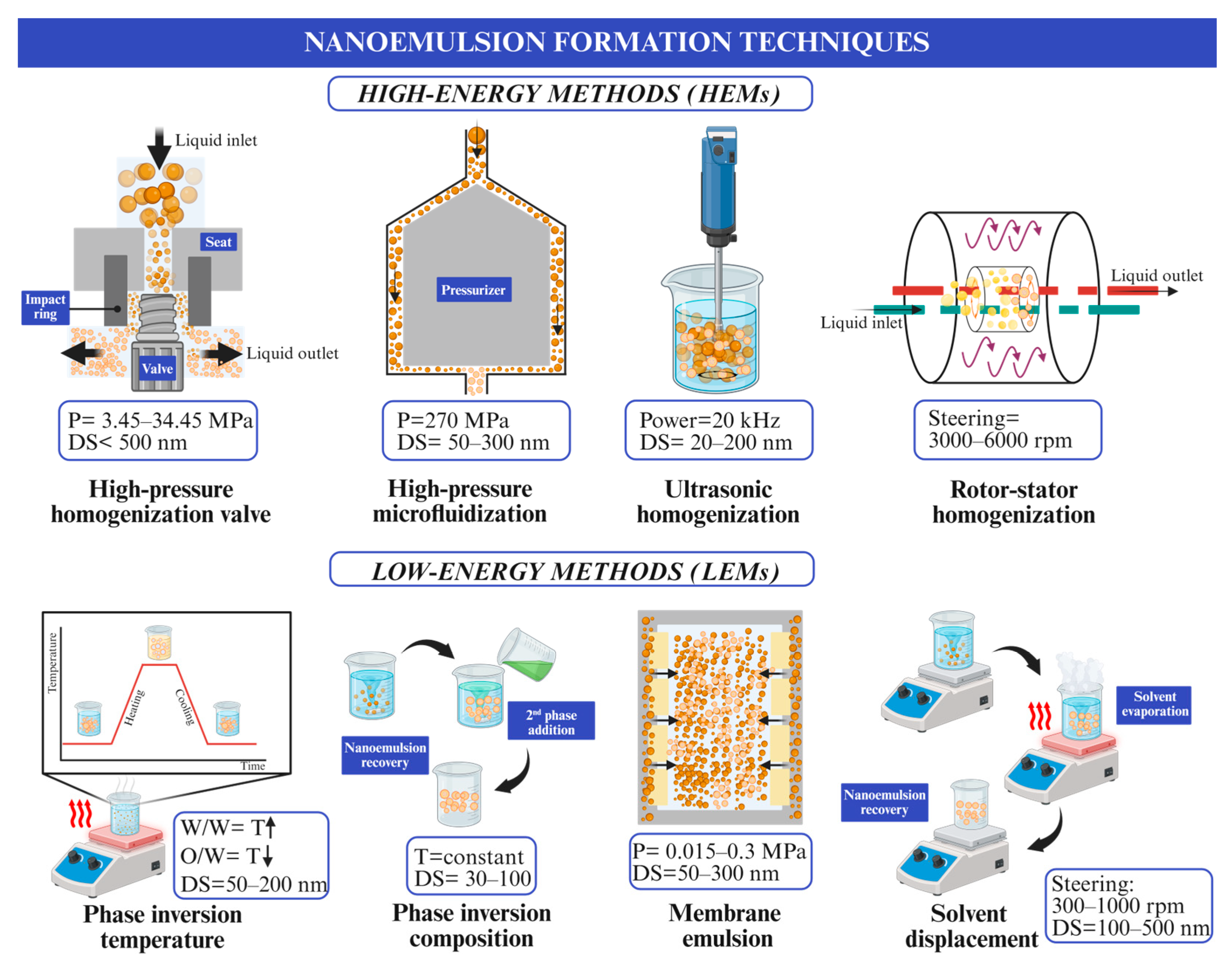
| Method | Conditions | DS (nm) | Advantages | Limitations | PDI | EE (%) |
|---|---|---|---|---|---|---|
| HEM | ||||||
| HPH | 3.45–34.45 MPa | <500 | Scalable, uniform DS, low coalescence rate | Multiple passes; viscosity ratio > 80 between phases increases DS | 02–04 | 75–85 |
| MFH | 270 MPa | 50–300 | Ultra-small droplets and highly stable DS | High cost and time; recoalescence; requires precise control | 01–03 | 90–90 |
| USH | 20 kHz | 20–200 | Low surfactant requirement | Heat generation limits processing; not scalable | 02–04 | 70–85 |
| RSH | 3000–60,000 rpm | 100–500 | Simple, cost-effective | Produces coarse emulsions (coalescence of droplets) | 03–05 | 60–75 |
| LEM | ||||||
| PIT | ↓T for O/W ↑T for W/O | 50–200 | Cost-effective, scalable, good control | Limited to non-ionic surfactants; high quantity of surfactants | 02–04 | 70–80 |
| PIC | T = constant | <60 | Precise droplet control | Time-consuming | 01–03 | 75–90 |
| SE | T = constant | 30–100 | No external energy needed, scalable | Requires large quantities of specific surfactants | 02–04 | 60–80 |
| ME | 0.015–0.3 MPa, 0.1–10 μm | 50–300 | Uniform DS | Low throughput, costly membranes | 01–02 | 70–85 |
| SD/E | 300–1000 rpm, 0.1–10 mL/min | 100–500 | Good for hydrophobic molecules | Solvent residue concerns | 02–05 | 65–80 |
| Active Ingredient | Type of NE | DS (nm) | Emulsifier | Meat Product | Storage Conditions | Results | Ref. |
|---|---|---|---|---|---|---|---|
| Physicochemical quality | |||||||
| Essential oil | W/O (II) | 165.7 | Canola oil | Pork patties | nd | Improved texture and sensorial profile | [48] |
| Rosemary extract | Gelatin, chitosan (II) | 257 | Gelatin, chitosan | Carbonado chicken | 6 days, 4 °C | Improved shelf-life and sensorial profile | [58] |
| Clove essential oil | 2.25% CMC + 0.5% CEO + 0.125% ε-PL (II) | 257.7 | CMC | Chilled meat | 10 days, 4 °C | ↑ SL (refrigerated); significant preservation by maintaining pH stability | [64] |
| Riboflavin | 1% NE UV-C induced photocrosslinking (II) | N.S. | Tween 80 and Span 80 | Fresh beef | 26 days | ↑ SL up to 26 days; ↓ meat reddening, lipid oxidation, moisture vapor transmission, and solubility; ↑ tensile strength | [65] |
| Rosa canina L. extract | O/W (II) | Chia seed gum | Burger | 90 days, −14 °C | ↑ SL, color, and sensorial acceptance | [19] | |
| Polylysine and nisin | NEAC with 1.5% SPI (II) | 97.1 | SPI and lecithin | Yao meat | 45 days, 4 °C | ↑ SL from 8 to 16 days; no effect on meat sample moisture | [66] |
| Oxidative stability | |||||||
| Curcumin | O/W (II) | N.S | Tween 80 | Harbin red sausage | 6 days, RT | ↓ pH; stabilization of L* value, WL, WHC, and aw; ↓ lipid oxidation and proteolysis | [67] |
| β-carotene | UAE coarse W/O NE (II) | 260 | Tween 80: Span 80 1:2 | Goat meat sausage | 15 days, 4 °C | ↓ spoilage and lipid oxidation; ↑ color likeness score | [68] |
| TEO | O/W (II) | 80 | Gum Arabic | Bovine meat | 30 days, 4 °C | ↓ pH, TVB-N, TBARS, and hardness; ↑ SL for 30 days | [69] |
| Capsaicin | O/W (II) | 632 | Sunflower oil | Sausages | 30 days, 4 °C | ↓ TVB-N amount and protein decomposition; ↑ SL for 30 days; ↑ pH, color parameters, TVB-N, TBARS amounts, and textural properties; antioxidant effects | [70] |
| Tocopherol | Ultrasonicated O/W NE (II) | ~500 | Tween 80 | Fish sausages | 16 days, 4 °C | ↑ SL; antioxidant effect; stable DS (no significant aggregation or creaming) | [71] |
| Mentha, pomegranate, thyme, and lemon EOs and chitosan | O/O (II) | 100–170 | Tween 80 | Minced meat | 10 days, 4 °C | ↑ antioxidant effect; ↑ SL up to 10 days | [72] |
| Fennel EO and cinnamaldehyde | O/W (II) | 295.7 | Tween 80 | Pork meat patties | 10 days, 4 °C | ↑ SL by 4 days; ↑ TBARS value and TVB-N content; maintained moisture, flavor, and texture | [73] |
| Microbial growth | |||||||
| CA | UAE coarse O/W NE (II) | 146.1 | Tween 80 | Sausages | 4 weeks, 4 °C | ↓ microbiological growth (S. aureus MIC 0.25 mg/mL; E. coli MIC 0.20 mg/mL; C. perfringens MIC 0.25 mg/mL) due to interfacial cross-linking with proteins | [74] |
| Thymol | UAE coarse O/W NE (II) | 86.39 | Tween 80 | Sausages | 4 weeks, 4 °C | ↓ microbiological growth (S. aureus, E. coli, and C. perfringens); ↑ color quality | [75] |
| Chitosan | UAE O/W (II) | 440 | Tween | Chicken sausages | 30 days, 4 °C | ↑ SL from 20 to 30 days; potential food additive to preserve the quality | [76] |
| Curcumin | O/W (II) | N.S | Tween 80 | Harbin red sausages | 6 days, RT | ↓ growth of TAB and bacteria abundance; ↑ SL up to 6 days | [67] |
| Mentha, pomegranate, thyme, and lemon EOs and chitosan | O/O (II) | 100–170 | Tween 80 | Minced meat | 10 days, 4 °C | ↑ antimicrobial against E. coli; ↑ SL up to 10 days | [72] |
| Carvacrol | NE with 2.5% carvacrol (II) | ~21 | Lecithin and casein | Minced pork | 9 days, 4 °C | ↑ SL; ↓ mesophilic, lactic, and psychotropic bacteria; maintained color stability | [18] |
| Fennel EO and cinnamaldehyde | O/W (II) | 295.7 | Tween 80 | Pork meat patties | 10 days, 4 °C | ↓ TVC, ↑ SL by 4 days | [73] |
| Cinnamon EO and rosemary extract | O/W (II) | 183.6 | Tween 80 | Chicken patties | 12 days, 4 °C | ↓ TVC of E. coli, S. subtillis, and S. aureus; ↑ SL by 4 days; ↓ TVB-N, moisture, and TBARS values | [77] |
| Lemon EO | O/W (II) | 500 | Sodium caseinate | Pork patties | 30 days, 4 °C | ↑ quality and microbiological status; ↓ TVB-N levels | [78] |
| Nutmeg and ginger EOs | O/W (II) | 129 | Tween 80 | Beef patties | 90 days, −18 °C | ↑ quality and SL by 45 days; ↓ concentrations of HCAs and PAHs | [79] |
| Resveratrol + Clove EO | NE-based basil seed gum (BSG) edible film (ST) | 242.1–770.4 | Tween 80, Basil seed gum | Minced camel meat | 20 days, 4 °C | ↑ oxidative stability; ↑ sensory acceptability | [80] |
| Combined effect | |||||||
| Chitosan–thymol EOs | O/W (II) | N.S | Tween 20 | Pork meat | 12 days, 4 °C | Antimicrobial against Pseudomonas, Lactococcus, and Acinetobacter; ↑ SL; ↓ TVB-N, pH, and TBAR values; better protection against color degradation | [81] |
| Chitosan–thyme EOs | |||||||
| Oregano, cinnamon, lemon, cardamom, and pepper EOs | O/W (II) | 2–47 | Tween 80 | Mortadella | 20 days, 14 °C | ↑ SL to 20 days; effective against Clostridium sporogenes; no changes in technological properties; unsatisfactory sensory effects | [82] |
| Xoconostle | W/O (II) | N.S | N.S | Sausages | 60 days, 4 °C | ↑ hardness, chewiness, antioxidant capacity; ↓ lipid oxidation | [83] |
| Thymol | W/O (II) | 86.39 | Lipids | Sausages | 4 weeks, 4 °C | ↑ redness, antioxidant capacity, and color stability | [84] |
| TEO | O/W (II) | 80 | Gum Arabic | Bovine meat | 30 days, 4 °C | ↓ microbiological growth; ↑ SL for 30 days | [69] |
| TMO (1%, w/v) | CSCNC-AS aerogels (mass ratio of 1:5) (II) | 78.65 | Tween 80 | Chilled meat | 12 days, 4 °C | ↓ microbiological growth; ↑ SL for 8 days; stable structure at various T; sustained release of TMO; ↑ thermal stability and water absorption | [85] |
| Curcumin, GA, and QUE | NE-loaded gelatin composite films (ST) | 100 | Tween 80 and Span 80 | Fresh broiler chicken | 17 days, 4 °C | ↑ SL: 135 days at 25 °C; ↓ ZP (−28.1 mV, PDI: 0.328) due to polyphenol encapsulation | [86] |
| Thymol, γ-terpinene, and ρ-cymene | ONE + 1% AEO and ONE + 2% AEO (II) | 181 | Tween 80 (3%) | Lamb loins | 12 days, 4 °C | ↓ microbiological growth; ↑ stability and SL from 8 to 12 days; antioxidant effect | [60] |
| SKEO | Chitosan-based coating (ST) | 93 | Triton | Lamb meat | 20 days, 4 °C | ↓ microbiological growth; ↑ SL (refrigerated); maintained quality | [87] |
| Origanum vulgare | PIT NE 5 g EO/100 g (II) | 35 | Cremophor RH40 and Span 80 | Chicken pâté | 8 days, 4 °C | ↓ microbiological growth; stable for 5 g EO/100 g; physicochemical properties not altered | [17] |
| Clove oil and crodamol | NE (ultrasonic emulsification) (II) | 135 | Tween 80 | N.S. | 60 days, 4 °C | ↑ antimicrobial and antioxidant potential | [59] |
| EOS | Optimized NE (via RSM and MF) (II) | 38.11 | Tween 80 and Span 80 | Fresh meat | 30 days, 4 °C | ↑ SL from 5 to 30 days at 4 °C and 30 °C; high encapsulation efficiency (83.8%); ζ potential: 37.8 mV | [88] |
| OEO and resveratrol | PEC edible coating under HOMAP (ST) | 50 | Tween 80 and ethanol | Fresh pork loin | 15 days, 4 °C | ↑ SL by minimizing pH changes and ↓ lipid and protein oxidation; ↓ microbial growth; ↑ preservation function and stability of the coating system | [61] |
| VD3 | NE with 1.54% PP, 9.12% SO, and 0.4% salt (II) | 485 | PP, SO, and salt | Beef | N.S. | ↑ stability after cooking; ζ potential and VD3 retention of −37.76 mV and 55.1% | [89] |
| Limonene, β-Pinene, and Terpinene | Nano-CS-CLEO 2% and 4% (II) | N.S. | Tween 80 | Beef | 16 days, 4 °C | ↓ microbiological growth; ↑ SL; ↓ TBARS, ↑ antioxidant effect and organoleptic retention | [90] |
| Rosemary extract | NE-based edible gelatin-chitosan coating (ST) | 257 | ε-poly-L-lysine | Carbonado chicken | 16 days, 4 °C | ↓ pH changes at 4 °C for 16 days; sustained release of the active compound on the meat surface | [64] |
| Zingiber officinale EO (6% wt) | NE-based edible coating (ST) | 57 | Sodium caseinate | Fresh chicken | 12 days, 4 °C | ↑ SL; ↓ total aerobic psychrophilic bacteria and yeasts; ↓color and cooking loss changes | [63] |
| Geraniol and linalool | NE with 6 g of MCT oil (II) | 68.2–174 | Tween 80 | Meat simulation medium | 7 days, 2–5 °C | ↑ SL; ↓ E. coli and L. innocua (~3 log CFU/mL); P. lundensis (~1.2 log CFU/mL) | [91] |
| Source | Meat Product | Formulation | Storage | Results | Ref. |
|---|---|---|---|---|---|
| Polyphenols | |||||
| Beer residue extract, chestnuts, leaves, and peanut skin | Spanish salchichón | Powder, 2.0% | - | ↓ PO, VC | [102] |
| Pomegranate, red grape, tomato, and olive pomaces | Lamb patties | Extracts, 0.1% | 7 days, 2 °C | ↑ PAA; ↓ MG | [103] |
| Pomegranate peel and bagasse | Chicken patties | Powder, 2% | 16 days, 4 °C | ↓ PO, LO | [104] |
| Peanut skin | Chicken patties | Extract, 3% | 15 days, 1 °C | ↓ LO, a* | [105] |
| Red pitaya extract | Pork patties | Powder, 0.1% | 18 days, 2 °C, MA, fluorescence light | ↑ CL, PAA; fat replacement | [106] |
| Apple peel | Raw beef patties | Edible coating, 3% | 10 days, 4 °C | ↓MG, LO | [107] |
| Watermelon rind | Cooked pork patties | Extract, 0.10% | 28 days, 4 °C | ↑ CA; ↓ MG, LO | [108] |
| Jaboticaba peel | Beef burgers | Emulsion, 10% | 120 days, −18 °C | ↑ CA; ↓ PO, LO | [109] |
| Jaboticaba peel | Meat | Extract, 8 g/L | 30 days, 4 °C | ↑ CL | [110] |
| Mango peel | Chicken sausages | Powder, 4% | 10 days, 4 °C | ↓ PO, LO | [111] |
| Oregano | Sheep sausages | Extract, 6630.98 mg/kg | 135 days, −20 °C | ↓ VC, LO | [112] |
| Sea buckthorn, grape seeds, fenugreek seeds, green tea, and Acacia catechu | Pork frankfurters | Extract, 0.30, 0.10, 0.12, 0.03, and 0.10%, respectively | 20 days, 4 °C | ↓ LO | [113] |
| Acacia nilotica seeds | Chicken patties | Extract, 150 mg/100 mL | 15 days, 4 °C | ↓ MG, PAA | [114] |
| Blue pea flower petal | Cooked pork patties | Extract, 0.08–0.16% | 12 days, 4 °C | ↓ VC, LO | [115] |
| Bee pollen | Pork sausages | Extract, 0.02% | 30 days, 4 °C | ↓ PO, LO | [116] |
| Propolis | Beef and pork patties | Extract, 2% | 9 days, 4 °C | ↑ CL; ↓ PO, LO | [117] |
| Mastic leaves and fruit | Pork sausages | Extract, 300 ppm | 21 days, 4 °C | ↓ MG, LO | [118] |
| Rose | Fermented sausages | Extract, 0.3% | 16 days, 10 °C | ↓ MG, LO, BAM | [119] |
| Cherry powder extract | Pork patties | Powder, 20 ppm | 8 days, 4 °C, PP | ↑ CL, CA; ↓ LO | [120] |
| Citrus, rosemary, and acerola by-products | Spanish chorizo | Powder, 0.3% | 50 days, 4 °C | ↓ MG, LO | [121] |
| Oak wood | Pork patties | Extract, 1% | 8 days, 4 °C, MA | ↑ CL, CA; ↓ MG, LO, VC | [122] |
| Black and green tea | Uncured pork sausages | Extract, 0.30 and 0.05% | 5 days, 4 °C | ↓ PO, LO | [123] |
| Rosemary | Beef sausages | Extract, 25 ppm | 25 days, 4 °C | ↑ PAA | [124] |
| Mint | Beef sausages | Extract, 62 ppm | 25 days, 4 °C | ↑ PAA, AM | [124] |
| Hull, bur, and leaf chestnut | Beef patties | Extract, 1000 ppm | 18 days, 2 °C | ↓ LO | [125] |
| Hydroxycinnamic acids, tyrosols | |||||
| Pitanga leaves | Pork burgers | Powder, 250 ppm | 18 days, 2 °C, MA, polystyrene film | ↑ a*; ↓ MG, LO | [126] |
| Pitanga leaves | Lamb burgers | Powder, 250 ppm | 2 °C, MA | ↑ CL; ↓ PO, LO | [127] |
| Guarana seeds | Lamb burgers | Emulsion, 250 ppm | 18 days, 2 °C, PE | ↑ CL; ↓ PO, LO | [127] |
| Anthocyanidins | |||||
| Plum peel and pulp | Breast chicken patties | Powder, 2% | 10 days, 4 °C PE, dark | ↑ CL, a*; ↓ LO | [128] |
| Açaí extract | Pork patties | Powder, 250 ppm | 10 days, 2 °C, PE, dark | ↑ CL, a*; ↓ LO | [129] |
| Jaboticaba residue | Fresh sausages | Powder, 2% | 15 days, 1 °C, aerobic conditions, dark | ↓ LO, CA (2%) | [130] |
| Colombian berry | Pork patties | Extract, 250–750 ppm | 10 days, 4 °C, MA | ↑ CL, a*; ↓ LO | [131] |
| Jaboticaba fruits | Mortadella sausages | Powder, 2% | 56 days, 4 °C | ↑ T, F | [132] |
| Jaboticaba residue | Fresh sausages | Powder, 2% | 15 days, 1 °C | ↓ LO | [130] |
| Flavonoids, tannins, terpenoids | |||||
| Thyme by-products | Pork patties | Powder, 0.93% | 9 days, 4 °C | ↑ CL; ↓ PO | [133] |
| β-carotene, lycopene | |||||
| Pink guava pulp | Raw pork emulsion | Paste, 10% | 18 days, 2 °C, MA | ↑ CL; ↓ LO | [134] |
| Tomato by-products and pink guava | Pork emulsion | Powder, 10% | 9 days, 4 °C, aerobic packaging, dark | ↑ CL; ↓ LO | [135] |
| Pitaya leaves | Pork patties | Powder, 100–1000 ppm | 9 days, 4 °C, aerobic packaging | ↓ PO | [136] |
| Resveratrol | |||||
| Grape seed | Beef sausages | Powder, 300 ppm | 4 months −18 °C, PVC | ↓ LO | [137] |
| Stilbenes | |||||
| Peanut kernels | Pork sausages | Extract, 0.01% | 8 days, 4 and 25 °C | ↓ MG, LO | [138] |
| Catechins, epicatechins | |||||
| Guarana seed | Pork patties | Powder, 250 ppm | 18 days, 2 °C, MA | ↑ CL; ↓ PO, LO | [139] |
Disclaimer/Publisher’s Note: The statements, opinions and data contained in all publications are solely those of the individual author(s) and contributor(s) and not of MDPI and/or the editor(s). MDPI and/or the editor(s) disclaim responsibility for any injury to people or property resulting from any ideas, methods, instructions or products referred to in the content. |
© 2026 by the authors. Licensee MDPI, Basel, Switzerland. This article is an open access article distributed under the terms and conditions of the Creative Commons Attribution (CC BY) license.
Share and Cite
Pereira, A.G.; Perez-Vazquez, A.; Barciela, P.; Jorge, A.O.S.; Yuksek, E.N.; Nogueira-Marques, R.; Seyyedi-Mansour, S.; Prieto, M.A. Bioactive Nanoemulsions for Enhancing Sausage and Meat Patty Shelf-Life. Foods 2026, 15, 430. https://doi.org/10.3390/foods15030430
Pereira AG, Perez-Vazquez A, Barciela P, Jorge AOS, Yuksek EN, Nogueira-Marques R, Seyyedi-Mansour S, Prieto MA. Bioactive Nanoemulsions for Enhancing Sausage and Meat Patty Shelf-Life. Foods. 2026; 15(3):430. https://doi.org/10.3390/foods15030430
Chicago/Turabian StylePereira, Antia G., Ana Perez-Vazquez, Paula Barciela, Ana O. S. Jorge, Ezgi Nur Yuksek, Rafael Nogueira-Marques, Sepidar Seyyedi-Mansour, and Miguel A. Prieto. 2026. "Bioactive Nanoemulsions for Enhancing Sausage and Meat Patty Shelf-Life" Foods 15, no. 3: 430. https://doi.org/10.3390/foods15030430
APA StylePereira, A. G., Perez-Vazquez, A., Barciela, P., Jorge, A. O. S., Yuksek, E. N., Nogueira-Marques, R., Seyyedi-Mansour, S., & Prieto, M. A. (2026). Bioactive Nanoemulsions for Enhancing Sausage and Meat Patty Shelf-Life. Foods, 15(3), 430. https://doi.org/10.3390/foods15030430