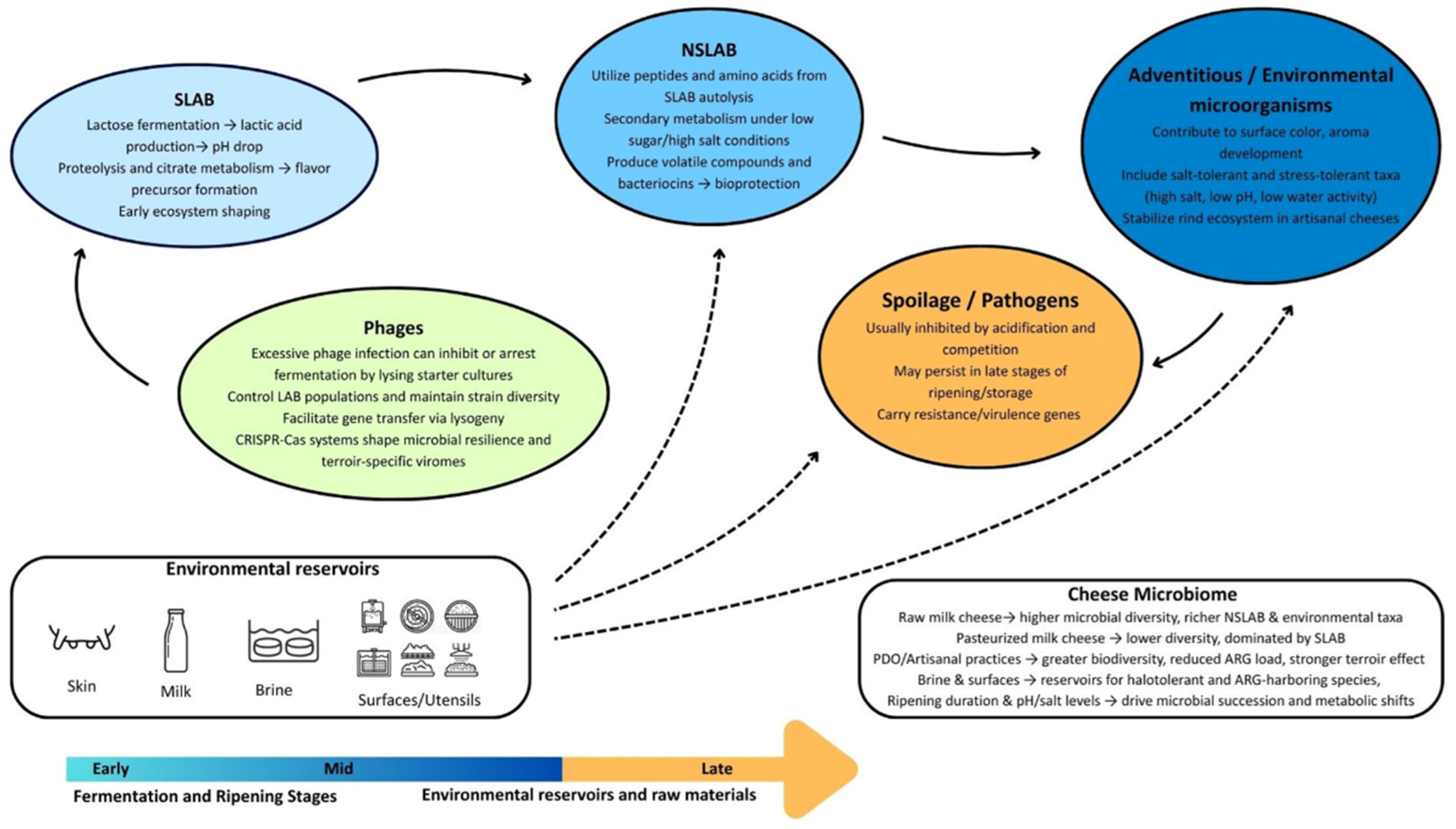
Advances in Shotgun Metagenomics for Cheese Microbiology: From Microbial Dynamics to Functional Insights

 , ,
, , 

 and
and 
Abstract
1. Introduction
2. The Literature Search Strategy
3. Wet-Lab Design Considerations in Cheese Shotgun Metagenomics

| Wet-Lab Bias | Impact on Cheese Metagenome | Suggested Mitigation Practices | References |
|---|---|---|---|
| DNA extraction difficulties due to high protein and fat content | Decrease in DNA yield leading to underrepresentation or overrepresentation of certain microorganisms with a concurrent bias in relative abundance. | Application of experimental protocols adjusted for dairy matrices including protein and fat removal steps, as well as mechanical and enzymatic cell lysis. Different kits evaluation on test samples. | [15,23,24,25] |
| Host DNA interference | Host DNA (e.g., bovine, ovine, caprine) can appear in high levels in the extracted DNA, thus interfering with the coverage of microbial reads, especially those found in low abundance. | Application of host DNA depletion kits in combination with in silico host read removal (e.g., map reads against reference-host genomes). | [16,24] |
| Inability to distinguish viable, VBNC, and dead cells | DNA from VBNC or dead cells may persist in the cheese matrix during ripening and lead to miscalculation and overestimation of actual abundance of the respective taxa. | Integration of shotgun metagenomics with viability-informed approaches (e.g., PMA treatment), acknowledging matrix-specific limitations. Additionally, apply multi-omics approaches including culturomics for validation of actually active taxa. | [19] |
| High heterogeneity across different cheese parts (e.g., core, rind, surface) | Distinct microenvironments (e.g., oxygen availability, salt, aw) create compartment-specific microbiomes, and analyzing only one compartment may miss capturing important taxa. Homogenization of the different compartments may introduce biases in microbiome composition. | Rind and core sampling should be conducted separately, with adequate replicate subsampling to capture variability, avoiding unnecessary over-mixing of distinct cheese compartments. | [13,20,21] |
| Lack of absolute quantification (CFU/g vs. relative abundance) | Microbial composition is usually expressed as relative abundance. Thus true microbial loads cannot be directly estimated, limiting ecological interpretations. | Application of absolute quantification techniques (e.g., spike-in controls, flow cytometry, qPCR) to calculate absolute microbial loads. | [22] |
4. Bioinformatic Tools for Shotgun Metagenomics
4.1. Quality Control: Ensuring Data Accuracy
4.2. Taxonomic Profiling: Identifying the Participants in the Cheese Microbiome
4.3. Assembly, Annotation, and Functional Assignment
4.4. Specialized Prediction Tools
4.5. Mixed Pipelines
4.6. MAGs: From Contigs to Genomes
4.7. Statistics and Visualization
5. Shotgun Metagenomics for the Analysis of Cheese Microbiome
5.1. SLAB Dominance Across Different Cheese Types and NSLAB Enrichment
5.2. Environmental Reservoirs Shape Communities: Adventitious and Miscellaneous Microorganisms Beyond NSLAB
5.3. Rind Ecology: Halophiles/Halotolerants and Their Functions
5.4. Yeasts as Adventitious Taxa in the Cheese Environment
5.5. Technological and Ecological Drivers of Cheese Microbiome Structure
5.6. Microbial Succession During Ripening
5.7. Spoilage Microbiota and Food Safety Considerations
6. Functional Insights from Shotgun Metagenomics of Cheese
6.1. Metabolic Pathways and Sensory Attributes
6.2. Resistome and Mobile Genetic Elements
6.3. Bacteriocins
6.4. Phage–Host Ecology, CRISPR, and Anti-CRISPR
7. Interpretive Limitations of Shotgun Metagenomics
8. Future Perspectives
9. Conclusions
Author Contributions
Funding
Institutional Review Board Statement
Informed Consent Statement
Data Availability Statement
Conflicts of Interest
Abbreviations
| Abbreviation | Meaning |
| AI | Artificial intelligence |
| ANI | Average Nucleotide Identity |
| ARG | Antimicrobial resistance gene |
| BGC | Biosynthetic gene cluster |
| BUSCO | Benchmarking Universal Single-Copy Orthologs |
| CAZyme | Carbohydrate-active enzyme |
| COG | Cluster of Orthologous Groups |
| CRISPR | Clustered Regularly Interspaced Short Palindromic Repeats |
| EC | Enzyme Commission Number |
| GTDB-Tk | Genome Taxonomy Database Toolkit |
| GO | Gene Ontology |
| HMM | Hidden Markov Model |
| HMMER | Hidden Markov Model Software for Sequence Analysis |
| HMP | Human Microbiome Project |
| KEGG | Kyoto Encyclopedia of Genes and Genomes |
| KO | KEGG Orthology |
| LAB | Lactic acid bacteria |
| LCA | Lowest common ancestor |
| LEfSe | Linear Discriminant Analysis Effect Size |
| MAG | Metagenome-assembled genome |
| NGS | Next-generation sequencing |
| NSLAB | Non-starter lactic acid bacteria |
| OTU | Operational taxonomic unit |
| PDO | Protected Designation of Origin |
| PKS | Polyketide Synthase |
| QC | Quality control |
| R | Statistical Programming Language |
| RiPP | Ribosomally synthesized and post-translationally modified peptide |
| R-M | Restriction–Modification System |
| SIMCA | Soft Independent Modeling of Class Analogy |
References
- Marchesi, J.R.; Ravel, J. The vocabulary of microbiome research: A proposal. Microbiome 2015, 3, 31. [Google Scholar] [CrossRef] [PubMed]
- Berg, G.; Rybakova, D.; Fischer, D.; Cernava, T.; Verges, M.C.; Charles, T.; Chen, X.; Cocolin, L.; Eversole, K.; Corral, G.H.; et al. Microbiome definition re-visited: Old concepts and new challenges. Microbiome 2020, 8, 103. [Google Scholar] [CrossRef]
- Yeluri Jonnala, B.R.; McSweeney, P.L.H.; Sheehan, J.J.; Cotter, P.D. Sequencing of the Cheese Microbiome and Its Relevance to Industry. Front. Microbiol. 2018, 9, 1020. [Google Scholar] [CrossRef]
- Ndoye, B.; Rasolofo, E.A.; LaPointe, G.; Roy, D. A review of the molecular approaches to investigate the diversity and activity of cheese microbiota. Dairy Sci. Technol. 2011, 91, 495–524. [Google Scholar] [CrossRef]
- Johnson, J.S.; Spakowicz, D.J.; Hong, B.Y.; Petersen, L.M.; Demkowicz, P.; Chen, L.; Leopold, S.R.; Hanson, B.M.; Agresta, H.O.; Gerstein, M.; et al. Evaluation of 16S rRNA gene sequencing for species and strain-level microbiome analysis. Nat. Commun. 2019, 10, 5029. [Google Scholar] [CrossRef]
- Bukin, Y.S.; Galachyants, Y.P.; Morozov, I.V.; Bukin, S.V.; Zakharenko, A.S.; Zemskaya, T.I. The effect of 16S rRNA region choice on bacterial community metabarcoding results. Sci. Data 2019, 6, 190007. [Google Scholar] [CrossRef]
- Quince, C.; Walker, A.W.; Simpson, J.T.; Loman, N.J.; Segata, N. Shotgun metagenomics, from sampling to analysis. Nat. Biotechnol. 2017, 35, 833–844. [Google Scholar] [CrossRef]
- Langille, M.G.; Zaneveld, J.; Caporaso, J.G.; McDonald, D.; Knights, D.; Reyes, J.A.; Clemente, J.C.; Burkepile, D.E.; Vega Thurber, R.L.; Knight, R.; et al. Predictive functional profiling of microbial communities using 16S rRNA marker gene sequences. Nat. Biotechnol. 2013, 31, 814–821. [Google Scholar] [CrossRef]
- Douglas, G.M.; Langille, M.G.I. A primer and discussion on DNA-based microbiome data and related bioinformatics analyses. Peer Community J. 2021, 1, e5. [Google Scholar] [CrossRef]
- Decadt, H.; Vermote, L.; Díaz-Muñoz, C.; Weckx, S.; De Vuyst, L. Decarboxylase activity of the non-starter lactic acid bacterium Loigolactobacillus rennini gives crack defects in Gouda cheese through the production of γ-aminobutyric acid. Appl. Environ. Microbiol. 2024, 90, e0165523. [Google Scholar] [CrossRef] [PubMed]
- Santamarina-Garcia, G.; Yap, M.; Crispie, F.; Amores, G.; Lordan, C.; Virto, M.; Cotter, P.D. Shotgun metagenomic sequencing reveals the influence of artisanal dairy environments on the microbiomes, quality, and safety of Idiazabal, a raw ewe milk PDO cheese. Microbiome 2024, 12, 262. [Google Scholar] [CrossRef]
- de Sant’Anna, F.M.; Chakrawarti, A.; Haley, B.J.; Barlow, J. The resistome of pasteurized and raw milk cheeses from the state of Vermont. Int. J. Food Microbiol. 2025, 441, 111333. [Google Scholar] [CrossRef]
- Bertuzzi, A.S.; Walsh, A.M.; Sheehan, J.J.; Cotter, P.D.; Crispie, F.; McSweeney, P.L.H.; Kilcawley, K.N.; Rea, M.C. Omics-based insights into flavor development and microbial succession within surface-ripened cheese. mSystems 2018, 3, e00211-17. [Google Scholar] [CrossRef]
- Magliulo, R.; Valentino, V.; Balivo, A.; Esposito, A.; Genovese, A.; Ercolini, D.; De Filippis, F. Microbiome signatures associated with flavor development differentiate Protected Designation of origin water Buffalo Mozzarella cheese from different production areas. Food Res. Int. 2024, 192, 114798. [Google Scholar] [CrossRef] [PubMed]
- Quigley, L.; O’Sullivan, O.; Beresford, T.P.; Paul Ross, R.; Fitzgerald, G.F.; Cotter, P.D. A comparison of methods used to extract bacterial DNA from raw milk and raw milk cheese. J. Appl. Microbiol. 2012, 113, 96–105. [Google Scholar] [CrossRef]
- Yap, M.; Feehily, C.; Walsh, C.J.; Fenelon, M.; Murphy, E.F.; McAuliffe, F.M.; van Sinderen, D.; O’Toole, P.W.; O’Sullivan, O.; Cotter, P.D. Evaluation of methods for the reduction of contaminating host reads when performing shotgun metagenomic sequencing of the milk microbiome. Sci. Rep. 2020, 10, 21665. [Google Scholar] [CrossRef] [PubMed]
- Papadimitriou, K.; Anastasiou, R.; Georgalaki, M.; Bounenni, R.; Paximadaki, A.; Charmpi, C.; Alexandraki, V.; Kazou, M.; Tsakalidou, E. Comparison of the microbiome of artisanal homemade and industrial Feta cheese through amplicon sequencing and shotgun metagenomics. Microorganisms 2022, 10, 1073. [Google Scholar] [CrossRef] [PubMed]
- Tsouggou, N.; Slavko, A.; Tsipidou, O.; Georgoulis, A.; Dimov, S.G.; Yin, J.; Vorgias, C.E.; Kapolos, J.; Papadelli, M.; Papadimitriou, K. Investigation of the microbiome of industrial PDO Sfela cheese and its artisanal variants using 16S rDNA amplicon sequencing and shotgun metagenomics. Foods 2024, 13, 1023. [Google Scholar] [CrossRef]
- Mohamed, H.M.; Barzideh, Z.; Siddiqi, M.; LaPointe, G. Taxonomy, sequence variance and functional profiling of the microbial community of long-ripened Cheddar cheese using shotgun metagenomics. Microorganisms 2023, 11, 2052. [Google Scholar] [CrossRef]
- Alexa, E.A.; Cobo-Diaz, J.F.; Renes, E.; TF, O.C.; Kilcawley, K.; Mannion, D.; Skibinska, I.; Ruiz, L.; Margolles, A.; Fernandez-Gomez, P.; et al. The detailed analysis of the microbiome and resistome of artisanal blue-veined cheeses provides evidence on sources and patterns of succession linked with quality and safety traits. Microbiome 2024, 12, 78. [Google Scholar] [CrossRef]
- Kothe, C.I.; Bolotin, A.; Kraiem, B.F.; Dridi, B.; Food Microbiome, T.; Renault, P. Unraveling the world of halophilic and halotolerant bacteria in cheese by combining cultural, genomic and metagenomic approaches. Int. J. Food Microbiol. 2021, 358, 109312. [Google Scholar] [CrossRef]
- Fontana, F.; Longhi, G.; Alessandri, G.; Lugli, G.A.; Mancabelli, L.; Tarracchini, C.; Viappiani, A.; Anzalone, R.; Ventura, M.; Turroni, F.; et al. Multifactorial microvariability of the Italian raw milk cheese microbiota and implication for current regulatory scheme. mSystems 2023, 8, e0106822. [Google Scholar] [CrossRef]
- Escobar-Zepeda, A.; Sanchez-Flores, A.; Quirasco Baruch, M. Metagenomic analysis of a Mexican ripened cheese reveals a unique complex microbiota. Food Microbiol. 2016, 57, 116–127. [Google Scholar] [CrossRef] [PubMed]
- Ganda, E.; Beck, K.L.; Haiminen, N.; Silverman, J.D.; Kawas, B.; Cronk, B.D.; Anderson, R.R.; Goodman, L.B.; Wiedmann, M. DNA Extraction and Host Depletion Methods Significantly Impact and Potentially Bias Bacterial Detection in a Biological Fluid. mSystems 2021, 6, e0061921. [Google Scholar] [CrossRef] [PubMed]
- Ianni, A.; Di Domenico, M.; Bennato, F.; Peserico, A.; Martino, C.; Rinaldi, A.; Candeloro, L.; Grotta, L.; Camma, C.; Pomilio, F.; et al. Metagenomic and volatile profiles of ripened cheese obtained from dairy ewes fed a dietary hemp seed supplementation. J. Dairy Sci. 2020, 103, 5882–5892. [Google Scholar] [CrossRef]
- Sadurski, J.; Polak-Berecka, M.; Staniszewski, A.; Wasko, A. Step-by-Step Metagenomics for Food Microbiome Analysis: A Detailed Review. Foods 2024, 13, 2216. [Google Scholar] [CrossRef]
- Ewels, P.; Magnusson, M.; Lundin, S.; Käller, M. MultiQC: Summarize analysis results for multiple tools and samples in a single report. Bioinformatics 2016, 32, 3047–3048. [Google Scholar] [CrossRef]
- Martin, M. Cutadapt removes adapter sequences from high-throughput sequencing reads. EMBnet. J. 2011, 17, 3. [Google Scholar] [CrossRef]
- Krueger, F.; James, F.; Ewels, P.; Afyounian, E.; Weinstein, M.; Schuster-Boeckler, B.; Hulselmans, G.; sclamons. FelixKrueger/TrimGalore: v0.6.10-Add Default Decompression Path (Version 0.6.10). Zenodo. 2023. Available online: https://zenodo.org/records/7598955 (accessed on 5 November 2025).
- Bolger, A.M.; Lohse, M.; Usadel, B. Trimmomatic: A flexible trimmer for Illumina sequence data. Bioinformatics 2014, 30, 2114–2120. [Google Scholar] [CrossRef] [PubMed]
- Langmead, B.; Salzberg, S.L. Fast gapped-read alignment with Bowtie 2. Nat. Methods 2012, 9, 357–359. [Google Scholar] [CrossRef]
- Li, H.; Durbin, R. Fast and accurate short read alignment with Burrows-Wheeler transform. Bioinformatics 2009, 25, 1754–1760. [Google Scholar] [CrossRef] [PubMed]
- Quinlan, A.R.; Hall, I.M. BEDTools: A flexible suite of utilities for comparing genomic features. Bioinformatics 2010, 26, 841–842. [Google Scholar] [CrossRef]
- Danecek, P.; Bonfield, J.K.; Liddle, J.; Marshall, J.; Ohan, V.; Pollard, M.O.; Whitwham, A.; Keane, T.; McCarthy, S.A.; Davies, R.M.; et al. Twelve years of SAMtools and BCFtools. GigaScience 2021, 10, giab008. [Google Scholar] [CrossRef] [PubMed]
- De Coster, W.; Rademakers, R. NanoPack2: Population-scale evaluation of long-read sequencing data. Bioinformatics 2023, 39, btad311. [Google Scholar] [CrossRef] [PubMed]
- Chen, S.; Zhou, Y.; Chen, Y.; Gu, J. fastp: An ultra-fast all-in-one FASTQ preprocessor. Bioinformatics 2018, 34, i884–i890. [Google Scholar] [CrossRef]
- Bushnell, B. BBMap: A Fast, Accurate, Splice-Aware Aligner. Lawrence Berkeley National Lab. (LBNL), Report No. LBNL-7065E. 2014. Available online: https://escholarship.org/uc/item/1h3515gn (accessed on 5 November 2025).
- Truong, D.T.; Franzosa, E.A.; Tickle, T.L.; Scholz, M.; Weingart, G.; Pasolli, E.; Tett, A.; Huttenhower, C.; Segata, N. MetaPhlAn2 for enhanced metagenomic taxonomic profiling. Nat. Methods 2015, 12, 902–903. [Google Scholar] [CrossRef]
- Blanco-Míguez, A.; Beghini, F.; Cumbo, F.; McIver, L.J.; Thompson, K.N.; Zolfo, M.; Manghi, P.; Dubois, L.; Huang, K.D.; Thomas, A.M.; et al. Extending and improving metagenomic taxonomic profiling with uncharacterized species using MetaPhlAn 4. Nat. Biotechnol. 2023, 41, 1633–1644. [Google Scholar] [CrossRef]
- Truong, D.T.; Tett, A.; Pasolli, E.; Huttenhower, C.; Segata, N. Microbial strain-level population structure and genetic diversity from metagenomes. Genome Res. 2017, 27, 626–638. [Google Scholar] [CrossRef]
- Scholz, M.; Ward, D.V.; Pasolli, E.; Tolio, T.; Zolfo, M.; Asnicar, F.; Truong, D.T.; Tett, A.; Morrow, A.L.; Segata, N. Strain-level microbial epidemiology and population genomics from shotgun metagenomics. Nat. Methods 2016, 13, 435–438. [Google Scholar] [CrossRef]
- Wood, D.E.; Lu, J.; Langmead, B. Improved metagenomic analysis with Kraken 2. Genome Biol. 2019, 20, 257. [Google Scholar] [CrossRef]
- Lu, J.; Breitwieser, F.P.; Thielen, P.; Salzberg, S.L. Bracken: Estimating species abundance in metagenomics data. PeerJ Comput. Sci. 2017, 3, e104. [Google Scholar] [CrossRef]
- Menzel, P.; Ng, K.L.; Krogh, A. Fast and sensitive taxonomic classification for metagenomics with Kaiju. Nat. Commun. 2016, 7, 11257. [Google Scholar] [CrossRef]
- Li, D.; Liu, C.-M.; Luo, R.; Sadakane, K.; Lam, T.-W. MEGAHIT: An ultra-fast single-node solution for large and complex metagenomics assembly via succinct de Bruijn graph. Bioinformatics 2015, 31, 1674–1676. [Google Scholar] [CrossRef] [PubMed]
- Nurk, S.; Meleshko, D.; Korobeynikov, A.; Pevzner, P.A. metaSPAdes: A new versatile metagenomic assembler. Genome Res. 2017, 27, 824–834. [Google Scholar] [CrossRef]
- Peng, Y.; Leung, H.C.M.; Yiu, S.M.; Chin, F.Y.L. IDBA-UD: A de novo assembler for single-cell and metagenomic sequencing data with highly uneven depth. Bioinformatics 2012, 28, 1420–1428. [Google Scholar] [CrossRef] [PubMed]
- Gemayel, K.; Lomsadze, A.; Borodovsky, M. MetaGeneMark-2: Improved gene prediction in metagenomes. bioRxiv 2022. [Google Scholar] [CrossRef]
- Seemann, T. Prokka: Rapid prokaryotic genome annotation. Bioinformatics 2014, 30, 2068–2069. [Google Scholar] [CrossRef]
- Finn, R.D.; Clements, J.; Eddy, S.R. HMMER web server: Interactive sequence similarity searching. Nucleic Acids Res. 2011, 39, W29–W37. [Google Scholar] [CrossRef] [PubMed]
- Aramaki, T.; Blanc-Mathieu, R.; Endo, H.; Ohkubo, K.; Kanehisa, M.; Goto, S.; Ogata, H. KofamKOALA: KEGG Ortholog assignment based on profile HMM and adaptive score threshold. Bioinformatics 2019, 36, 2251–2252. [Google Scholar] [CrossRef]
- Buchfink, B.; Xie, C.; Huson, D.H. Fast and sensitive protein alignment using DIAMOND. Nat. Methods 2015, 12, 59–60. [Google Scholar] [CrossRef]
- Cantalapiedra, C.P.; Hernández-Plaza, A.; Letunic, I.; Bork, P.; Huerta-Cepas, J. eggNOG-mapper v2: Functional annotation, orthology assignments, and domain prediction at the metagenomic scale. Mol. Biol. Evol. 2021, 38, 5825–5829. [Google Scholar] [CrossRef] [PubMed]
- Steinegger, M.; Söding, J. MMseqs2 enables sensitive protein sequence searching for the analysis of massive data sets. Nat. Biotechnol. 2017, 35, 1026–1028. [Google Scholar] [CrossRef]
- Hyatt, D.; Chen, G.-L.; LoCascio, P.F.; Land, M.L.; Larimer, F.W.; Hauser, L.J. Prodigal: Prokaryotic gene recognition and translation initiation site identification. BMC Bioinform. 2010, 11, 119. [Google Scholar] [CrossRef]
- Silva, G.G.Z.; Green, K.T.; Dutilh, B.E.; Edwards, R.A. SUPER-FOCUS: A tool for agile functional analysis of shotgun metagenomic data. Bioinformatics 2015, 32, 354–361. [Google Scholar] [CrossRef]
- Kanehisa, M.; Sato, Y.; Morishima, K. BlastKOALA and GhostKOALA: KEGG tools for functional characterization of genome and metagenome sequences. J. Mol. Biol. 2016, 428, 726–731. [Google Scholar] [CrossRef]
- Beghini, F.; McIver, L.J.; Blanco-Míguez, A.; Dubois, L.; Asnicar, F.; Maharjan, S.; Mailyan, A.; Manghi, P.; Scholz, M.; Thomas, A.M.; et al. Integrating taxonomic, functional, and strain-level profiling of diverse microbial communities with bioBakery 3. eLife 2021, 10, e65088. [Google Scholar] [CrossRef]
- Caspi, R.; Billington, R.; Keseler, I.M.; Kothari, A.; Krummenacker, M.; Midford, P.E.; Ong, W.K.; Paley, S.; Subhraveti, P.; Karp, P.D. The MetaCyc database of metabolic pathways and enzymes—A 2019 update. Nucleic Acids Res. 2019, 48, D445–D453. [Google Scholar] [CrossRef]
- van Heel, A.J.; de Jong, A.; Song, C.; Viel, J.H.; Kok, J.; Kuipers, O.P. BAGEL4: A user-friendly web server to thoroughly mine RiPPs and bacteriocins. Nucleic Acids Res. 2018, 46, W278–W281. [Google Scholar] [CrossRef] [PubMed]
- Medema, M.H.; Blin, K.; Cimermancic, P.; de Jager, V.; Zakrzewski, P.; Fischbach, M.A.; Weber, T.; Takano, E.; Breitling, R. antiSMASH: Rapid identification, annotation and analysis of secondary metabolite biosynthesis gene clusters in bacterial and fungal genome sequences. Nucleic Acids Res. 2011, 39, W339–W346. [Google Scholar] [CrossRef] [PubMed]
- Yin, Y.; Mao, X.; Yang, J.; Chen, X.; Mao, F.; Xu, Y. dbCAN: A web resource for automated carbohydrate-active enzyme annotation. Nucleic Acids Res. 2012, 40, W445–W451. [Google Scholar] [CrossRef]
- Elcheninov, A.G.; Zayulina, K.S.; Klyukina, A.A.; Kremneva, M.K.; Kublanov, I.V.; Kochetkova, T.V. Metagenomic Insights into the taxonomic and functional features of traditional fermented milk products from Russia. Microorganisms 2023, 12, 16. [Google Scholar] [CrossRef]
- Price, M. Erroneous predictions of auxotrophies by CarveMe. Nat. Ecol. Evol. 2023, 7, 194–195. [Google Scholar] [CrossRef]
- Ebrahim, A.; Lerman, J.A.; Palsson, B.O.; Hyduke, D.R. COBRApy: COnstraints-based reconstruction and analysis for Python. BMC Syst. Biol. 2013, 7, 74. [Google Scholar] [CrossRef] [PubMed]
- Bonin, N.; Doster, E.; Worley, H.; Pinnell, L.J.; Bravo, J.E.; Ferm, P.; Marini, S.; Prosperi, M.; Noyes, N.; Morley, P.S.; et al. MEGARes and AMR++, v3.0: An updated comprehensive database of antimicrobial resistance determinants and an improved software pipeline for classification using high-throughput sequencing. Nucleic Acids Res. 2022, 51, D744–D752. [Google Scholar] [CrossRef] [PubMed]
- Kaminski, J.; Gibson, M.K.; Franzosa, E.A.; Segata, N.; Dantas, G.; Huttenhower, C. High-Specificity Targeted Functional Profiling in Microbial Communities with ShortBRED. PLoS Comput. Biol. 2015, 11, e1004557. [Google Scholar] [CrossRef]
- Gupta, S.K.; Padmanabhan, B.R.; Diene, S.M.; Lopez-Rojas, R.; Kempf, M.; Landraud, L.; Rolain, J.-M. ARG-ANNOT, a New Bioinformatic Tool To Discover Antibiotic Resistance Genes in Bacterial Genomes. Antimicrob. Agents Chemother. 2014, 58, 212–220. [Google Scholar] [CrossRef] [PubMed]
- Florensa, A.F.; Kaas, R.S.; Clausen, P.T.L.C.; Aytan-Aktug, D.; Aarestrup, F.M. ResFinder—An open online resource for identification of antimicrobial resistance genes in next-generation sequencing data and prediction of phenotypes from genotypes. Microb. Genom. 2022, 8, 000748. [Google Scholar] [CrossRef]
- Couvin, D.; Bernheim, A.; Toffano-Nioche, C.; Touchon, M.; Michalik, J.; Néron, B.; Rocha, E.P.C.; Vergnaud, G.; Gautheret, D.; Pourcel, C. CRISPRCasFinder, an update of CRISRFinder, includes a portable version, enhanced performance and integrates search for Cas proteins. Nucleic Acids Res. 2018, 46, W246–W251. [Google Scholar] [CrossRef]
- Biswas, A.; Gagnon, J.N.; Brouns, S.J.J.; Fineran, P.C.; Brown, C.M. CRISPRTarget. RNA Biol. 2013, 10, 817–827. [Google Scholar] [CrossRef]
- Guo, J.; Bolduc, B.; Zayed, A.A.; Varsani, A.; Dominguez-Huerta, G.; Delmont, T.O.; Pratama, A.A.; Gazitúa, M.C.; Vik, D.; Sullivan, M.B.; et al. VirSorter2: A multi-classifier, expert-guided approach to detect diverse DNA and RNA viruses. Microbiome 2021, 9, 37. [Google Scholar] [CrossRef]
- Kieft, K.; Zhou, Z.; Anantharaman, K. VIBRANT: Automated recovery, annotation and curation of microbial viruses, and evaluation of viral community function from genomic sequences. Microbiome 2020, 8, 90. [Google Scholar] [CrossRef] [PubMed]
- Nayfach, S.; Camargo, A.P.; Schulz, F.; Eloe-Fadrosh, E.; Roux, S.; Kyrpides, N.C. CheckV assesses the quality and completeness of metagenome-assembled viral genomes. Nat. Biotechnol. 2021, 39, 578–585. [Google Scholar] [CrossRef] [PubMed]
- Arndt, D.; Grant, J.R.; Marcu, A.; Sajed, T.; Pon, A.; Liang, Y.; Wishart, D.S. PHASTER: A better, faster version of the PHAST phage search tool. Nucleic Acids Res. 2016, 44, W16–W21. [Google Scholar] [CrossRef] [PubMed]
- Song, W.; Sun, H.-X.; Zhang, C.; Cheng, L.; Peng, Y.; Deng, Z.; Wang, D.; Wang, Y.; Hu, M.; Liu, W.; et al. Prophage Hunter: An integrative hunting tool for active prophages. Nucleic Acids Res. 2019, 47, W74–W80. [Google Scholar] [CrossRef]
- Krawczyk, P.S.; Lipinski, L.; Dziembowski, A. PlasFlow: Predicting plasmid sequences in metagenomic data using genome signatures. Nucleic Acids Res. 2018, 46, e35. [Google Scholar] [CrossRef]
- Carattoli, A.; Hasman, H. PlasmidFinder and in silico pMLST: Identification and typing of plasmid replicons in Whole-Genome Sequencing (WGS). In Horizontal Gene Transfer: Methods and Protocols; de la Cruz, F., Ed.; Springer: New York, NY, USA, 2020; pp. 285–294. [Google Scholar]
- Schwengers, O.; Barth, P.; Falgenhauer, L.; Hain, T.; Chakraborty, T.; Goesmann, A. Platon: Identification and characterization of bacterial plasmid contigs in short-read draft assemblies exploiting protein sequence-based replicon distribution scores. Microb. Genom. 2020, 6, e000398. [Google Scholar] [CrossRef]
- Camargo, A.P.; Roux, S.; Schulz, F.; Babinski, M.; Xu, Y.; Hu, B.; Chain, P.S.G.; Nayfach, S.; Kyrpides, N.C. Identification of mobile genetic elements with geNomad. Nat. Biotechnol. 2024, 42, 1303–1312. [Google Scholar] [CrossRef]
- Néron, B.; Littner, E.; Haudiquet, M.; Perrin, A.; Cury, J.; Rocha, E.P.C. IntegronFinder 2.0: Identification and analysis of integrons across bacteria, with a focus on antibiotic resistance in Klebsiella. Microorganisms 2022, 10, 700. [Google Scholar] [CrossRef] [PubMed]
- Johansson, M.H.K.; Bortolaia, V.; Tansirichaiya, S.; Aarestrup, F.M.; Roberts, A.P.; Petersen, T.N. Detection of mobile genetic elements associated with antibiotic resistance in Salmonella enterica using a newly developed web tool: MobileElementFinder. J. Antimicrob. Chemother. 2020, 76, 101–109. [Google Scholar] [CrossRef]
- Huson, D.H.; Auch, A.F.; Qi, J.; Schuster, S.C. MEGAN analysis of metagenomic data. Genome Res. 2007, 17, 377–386. [Google Scholar] [CrossRef]
- Kultima, J.R.; Sunagawa, S.; Li, J.; Chen, W.; Chen, H.; Mende, D.R.; Arumugam, M.; Pan, Q.; Liu, B.; Qin, J.; et al. MOCAT: A metagenomics assembly and gene prediction toolkit. PLoS ONE 2012, 7, e47656. [Google Scholar] [CrossRef]
- Jing, G.; Sun, Z.; Wang, H.; Gong, Y.; Huang, S.; Ning, K.; Xu, J.; Su, X. Parallel-META 3: Comprehensive taxonomical and functional analysis platform for efficient comparison of microbial communities. Sci. Rep. 2017, 7, 40371. [Google Scholar] [CrossRef]
- Xie, Y.; Wu, G.; Tang, J.; Luo, R.; Patterson, J.; Liu, S.; Huang, W.; He, G.; Gu, S.; Li, S.; et al. SOAPdenovo-Trans: De novo transcriptome assembly with short RNA-Seq reads. Bioinformatics 2014, 30, 1660–1666. [Google Scholar] [CrossRef]
- Gu, S.; Fang, L.; Xu, X. Using SOAPaligner for Short Reads Alignment. Curr. Protoc. Bioinform. 2013, 44, 11.11.1–11.11.17. [Google Scholar] [CrossRef] [PubMed]
- Douglas, G.M.; Beiko, R.G.; Langille, M.G.I. Predicting the functional potential of the microbiome from marker genes using PICRUSt. In Microbiome Analysis: Methods and Protocols; Beiko, R.G., Hsiao, W., Parkinson, J., Eds.; Springer: New York, NY, USA, 2018; pp. 169–177. [Google Scholar]
- Knights, D.; Kuczynski, J.; Charlson, E.S.; Zaneveld, J.; Mozer, M.C.; Collman, R.G.; Bushman, F.D.; Knight, R.; Kelley, S.T. Bayesian community-wide culture-independent microbial source tracking. Nat. Methods 2011, 8, 761–763. [Google Scholar] [CrossRef] [PubMed]
- Alneberg, J.; Bjarnason, B.S.; de Bruijn, I.; Schirmer, M.; Quick, J.; Ijaz, U.Z.; Lahti, L.; Loman, N.J.; Andersson, A.F.; Quince, C. Binning metagenomic contigs by coverage and composition. Nat. Methods 2014, 11, 1144–1146. [Google Scholar] [CrossRef] [PubMed]
- Kang, D.D.; Li, F.; Kirton, E.; Thomas, A.; Egan, R.; An, H.; Wang, Z. MetaBAT 2: An adaptive binning algorithm for robust and efficient genome reconstruction from metagenome assemblies. PeerJ 2019, 7, e7359. [Google Scholar] [CrossRef]
- Wu, Y.-W.; Simmons, B.A.; Singer, S.W. MaxBin 2.0: An automated binning algorithm to recover genomes from multiple metagenomic datasets. Bioinformatics 2015, 32, 605–607. [Google Scholar] [CrossRef]
- Parks, D.H.; Imelfort, M.; Skennerton, C.T.; Hugenholtz, P.; Tyson, G.W. CheckM: Assessing the quality of microbial genomes recovered from isolates, single cells, and metagenomes. Genome Res. 2015, 25, 1043–1055. [Google Scholar] [CrossRef]
- Simão, F.A.; Waterhouse, R.M.; Ioannidis, P.; Kriventseva, E.V.; Zdobnov, E.M. BUSCO: Assessing genome assembly and annotation completeness with single-copy orthologs. Bioinformatics 2015, 31, 3210–3212. [Google Scholar] [CrossRef]
- Chaumeil, P.-A.; Mussig, A.J.; Hugenholtz, P.; Parks, D.H. GTDB-Tk: A toolkit to classify genomes with the Genome Taxonomy Database. Bioinformatics 2019, 36, 1925–1927. [Google Scholar] [CrossRef]
- Uritskiy, G.V.; DiRuggiero, J.; Taylor, J. MetaWRAP—A flexible pipeline for genome-resolved metagenomic data analysis. Microbiome 2018, 6, 158. [Google Scholar] [CrossRef]
- Eren, A.M.; Esen, Ö.C.; Quince, C.; Vineis, J.H.; Morrison, H.G.; Sogin, M.L.; Delmont, T.O. Anvi’o: An advanced analysis and visualization platform for ‘omics data. PeerJ 2015, 3, e1319. [Google Scholar] [CrossRef]
- Krakau, S.; Straub, D.; Gourlé, H.; Gabernet, G.; Nahnsen, S. nf-core/mag: A best-practice pipeline for metagenome hybrid assembly and binning. NAR Genom. Bioinform. 2022, 4, lqac007. [Google Scholar] [CrossRef]
- Katoh, K.; Toh, H. Recent developments in the MAFFT multiple sequence alignment program. Brief. Bioinform. 2008, 9, 286–298. [Google Scholar] [CrossRef] [PubMed]
- Guindon, S.; Dufayard, J.-F.; Lefort, V.; Anisimova, M.; Hordijk, W.; Gascuel, O. New algorithms and methods to estimate maximum-likelihood phylogenies: Assessing the performance of PhyML 3.0. Syst. Biol. 2010, 59, 307–321. [Google Scholar] [CrossRef] [PubMed]
- Letunic, I.; Bork, P. Interactive Tree of Life (iTOL) v6: Recent updates to the phylogenetic tree display and annotation tool. Nucleic Acids Res. 2024, 52, W78–W82. [Google Scholar] [CrossRef] [PubMed]
- Laczny, C.C.; Kiefer, C.; Galata, V.; Fehlmann, T.; Backes, C.; Keller, A. BusyBee Web: Metagenomic data analysis by bootstrapped supervised binning and annotation. Nucleic Acids Res. 2017, 45, W171–W179. [Google Scholar] [CrossRef]
- Gerhardt, K.; Ruiz-Perez, C.A.; Rodriguez-R, L.M.; Conrad, R.E.; Konstantinidis, K.T. RecruitPlotEasy: An advanced read recruitment plot tool for assessing metagenomic population abundance and genetic diversity. Front. Bioinform. 2022, 1, 826701. [Google Scholar] [CrossRef]
- McMurdie, P.J.; Holmes, S. Phyloseq: A bioconductor package for handling and analysis of high-throughput phylogenetic sequence data. Pac. Symp. Biocomput. 2012, 235–246. [Google Scholar]
- Gu, Z. Complex heatmap visualization. iMeta 2022, 1, e43. [Google Scholar] [CrossRef]
- Dray, S.; Dufour, A.-B. The ade4 package: Implementing the duality diagram for ecologists. J. Stat. Softw. 2007, 22, 1–20. [Google Scholar] [CrossRef]
- Paradis, E.; Claude, J.; Strimmer, K. APE: Analyses of phylogenetics and evolution in R language. Bioinformatics 2004, 20, 289–290. [Google Scholar] [CrossRef]
- Segata, N.; Izard, J.; Waldron, L.; Gevers, D.; Miropolsky, L.; Garrett, W.S.; Huttenhower, C. Metagenomic biomarker discovery and explanation. Genome Biol. 2011, 12, R60. [Google Scholar] [CrossRef]
- Bastian, M.; Heymann, S.; Jacomy, M. Gephi: An open source software for exploring and manipulating networks. Proc. Int. AAAI Conf. Web Soc. Media 2009, 3, 361–362. [Google Scholar] [CrossRef]
- Chong, J.; Liu, P.; Zhou, G.; Xia, J. Using MicrobiomeAnalyst for comprehensive statistical, functional, and meta-analysis of microbiome data. Nat. Protoc. 2020, 15, 799–821. [Google Scholar] [CrossRef]
- Edalati, A.; Tahaei, M.; Kobyzev, I.; Nia, V.P.; Clark, J.J.; Rezagholizadeh, M. KronA: Parameter-efficient tuning with kronecker adapter. In Enhancing LLM Performance: Efficacy, Fine-Tuning, and Inference Techniques; Passban, P., Way, A., Rezagholizadeh, M., Eds.; Springer Nature: Cham, Switzerland, 2025; pp. 49–65. [Google Scholar]
- Breitwieser, F.P.; Salzberg, S.L. Pavian: Interactive analysis of metagenomics data for microbiome studies and pathogen identification. Bioinformatics 2019, 36, 1303–1304. [Google Scholar] [CrossRef] [PubMed]
- Asnicar, F.; Weingart, G.; Tickle, T.L.; Huttenhower, C.; Segata, N. Compact graphical representation of phylogenetic data and metadata with GraPhlAn. PeerJ 2015, 3, e1029. [Google Scholar] [CrossRef] [PubMed]
- Cardin, M.; Mounier, J.; Coton, E.; Cardazzo, B.; Perini, M.; Bertoldi, D.; Pianezze, S.; Segato, S.; Di Camillo, B.; Cappellato, M.; et al. Discriminative power of DNA-based, volatilome, near infrared spectroscopy, elements and stable isotopes methods for the origin authentication of typical Italian mountain cheese using sPLS-DA modeling. Food Res. Int. 2024, 178, 113975. [Google Scholar] [CrossRef]
- Quijada, N.M.; Cobo-Diaz, J.F.; Valentino, V.; Barcenilla, C.; De Filippis, F.; Cabrera-Rubio, R.; Carlino, N.; Pinto, F.; Dzieciol, M.; Calvete-Torre, I.; et al. The food-associated resistome is shaped by processing and production environments. Nat. Microbiol. 2025, 10, 1854–1867. [Google Scholar] [CrossRef] [PubMed]
- Salamandane, A.; Leech, J.; Almeida, R.; Silva, C.; Crispie, F.; Cotter, P.D.; Malfeito-Ferreira, M.; Brito, L. Metagenomic analysis of the bacterial microbiome, resistome and virulome distinguishes Portuguese Serra da Estrela PDO cheeses from similar non-PDO cheeses: An exploratory approach. Food Res. Int. 2024, 189, 114556. [Google Scholar] [CrossRef]
- Tan, G.; Lin, K.; Hu, M.; Wang, Y.; Li, X.; Li, X.; Chen, S.; Zhang, Q.; Zheng, Z. Uncovering the resistome and mobilome across different types of ready-to-eat fermented foods. Food Res. Int. 2025, 213, 116577. [Google Scholar] [CrossRef] [PubMed]
- Kothe, C.I.; Renault, P. Metagenomic driven isolation of poorly culturable species in food. Food Microbiol. 2025, 129, 104722. [Google Scholar] [CrossRef]
- Leech, J.; Cabrera-Rubio, R.; Walsh, A.M.; Macori, G.; Walsh, C.J.; Barton, W.; Finnegan, L.; Crispie, F.; O’Sullivan, O.; Claesson, M.J.; et al. Fermented-food metagenomics reveals substrate-associated differences in taxonomy and health-associated and antibiotic resistance determinants. mSystems 2020, 5(6), e00522-20. [Google Scholar] [CrossRef]
- Walsh, A.M.; Macori, G.; Kilcawley, K.N.; Cotter, P.D. Meta-analysis of cheese microbiomes highlights contributions to multiple aspects of quality. Nat. Food 2020, 1, 500–510. [Google Scholar] [CrossRef]
- Lordan, R.; Walsh, A.; Crispie, F.; Finnegan, L.; Demuru, M.; Tsoupras, A.; Cotter, P.D.; Zabetakis, I. Caprine milk fermentation enhances the antithrombotic properties of cheese polar lipids. J. Funct. Foods 2019, 61, 103507. [Google Scholar] [CrossRef]
- Esquivel-Lopez, A.; Rocha-Mendoza, D.; Serrano-Maldonado, C.E.; Escobar-Zepeda, A.; Quirasco, M. Heterologous expression of bacteriocins from the metagenome mining of Cotija cheese. Probiotics Antimicrob. Proteins 2025, 17, 3700–3712. [Google Scholar] [CrossRef] [PubMed]
- Cardin, M.; Cardazzo, B.; Coton, M.; Carraro, L.; Lucchini, R.; Novelli, E.; Coton, E.; Mounier, J. Ecological diversity and associated volatilome of typical mountain Caciotta cheese from Italy. Int. J. Food Microbiol. 2024, 411, 110523. [Google Scholar] [CrossRef] [PubMed]
- Suarez, N.; Weckx, S.; Minahk, C.; Hebert, E.M.; Saavedra, L. Metagenomics-based approach for studying and selecting bioprotective strains from the bacterial community of artisanal cheeses. Int. J. Food Microbiol. 2020, 335, 108894. [Google Scholar] [CrossRef]
- Somerville, V.; Lutz, S.; Schmid, M.; Frei, D.; Moser, A.; Irmler, S.; Frey, J.E.; Ahrens, C.H. Long-read based de novo assembly of low-complexity metagenome samples results in finished genomes and reveals insights into strain diversity and an active phage system. BMC Microbiol. 2019, 19, 143. [Google Scholar] [CrossRef]
- Almeida, M.; Hébert, A.; Abraham, A.-L.; Rasmussen, S.; Monnet, C.; Pons, N.; Delbès, C.; Loux, V.; Batto, J.-M.; Leonard, P.; et al. Construction of a dairy microbial genome catalog opens new perspectives for the metagenomic analysis of dairy fermented products. BMC Genom. 2014, 15, 1101. [Google Scholar] [CrossRef]
- Kothe, C.I.; Mohellibi, N.; Renault, P. Revealing the microbial heritage of traditional Brazilian cheeses through metagenomics. Food Res. Int. 2022, 157, 111265. [Google Scholar] [CrossRef]
- Vermote, L.; Verce, M.; De Vuyst, L.; Weckx, S. Amplicon and shotgun metagenomic sequencing indicates that microbial ecosystems present in cheese brines reflect environmental inoculation during the cheese production process. Int. Dairy J. 2018, 87, 44–53. [Google Scholar] [CrossRef]
- Beuvier, E.; Duboz, G. The Microbiology of Traditional Hard and Semihard Cooked Mountain Cheeses. Microbiol. Spectr. 2013, 1, CM-0006-2012. [Google Scholar] [CrossRef] [PubMed]
- Egger, L.; Menard, O.; Abbuhl, L.; Duerr, D.; Stoffers, H.; Berthoud, H.; Meola, M.; Badertscher, R.; Blaser, C.; Dupont, D.; et al. Higher microbial diversity in raw than in pasteurized milk Raclette-type cheese enhances peptide and metabolite diversity after in vitro digestion. Food Chem. 2021, 340, 128154. [Google Scholar] [CrossRef]
- Wolfe, B.E.; Button, J.E.; Santarelli, M.; Dutton, R.J. Cheese rind communities provide tractable systems for in situ and in vitro studies of microbial diversity. Cell 2014, 158, 422–433. [Google Scholar] [CrossRef]
- Indio, V.; Gonzales-Barron, U.; Oliveri, C.; Lucchi, A.; Valero, A.; Achemchem, F.; Manfreda, G.; Savini, F.; Serraino, A.; De Cesare, A. Comparative analysis of the microbiome composition of artisanal cheeses produced in the Mediterranean area. Ital. J. Food Saf. 2024, 13, 12818. [Google Scholar] [CrossRef] [PubMed]
- Quijada, N.M.; Dzieciol, M.; Schmitz-Esser, S.; Wagner, M.; Selberherr, E. Metatranscriptomic Analyses Unravel Dynamic Changes in the Microbial and Metabolic Transcriptional Profiles in Artisanal Austrian Hard-Cheeses During Ripening. Front. Microbiol. 2022, 13, 813480. [Google Scholar] [CrossRef]
- Fox, P.F.; Guinee, T.P.; Cogan, T.M.; McSweeney, P.L.H. Fundamentals of Cheese Science; Springer: Berlin/Heidelberg, Germany, 2017. [Google Scholar]
- Falardeau, J.; Yildiz, E.; Yan, Y.; Castellarin, S.D.; Wang, S. Microbiome and physicochemical features associated with differential Listeria monocytogenes growth in soft, surface-ripened cheeses. Appl. Environ. Microbiol. 2023, 89, e02004–02022. [Google Scholar] [CrossRef] [PubMed]
- Quigley, L.; O’Sullivan, D.J.; Daly, D.; O’Sullivan, O.; Burdikova, Z.; Vana, R.; Beresford, T.P.; Ross, R.P.; Fitzgerald, G.F.; McSweeney, P.L.; et al. Thermus and the pink discoloration defect in cheese. mSystems 2016, 1, e00023-16. [Google Scholar] [CrossRef]
- Caille, C.; Boukraa, M.; Rannou, C.; Villiere, A.; Cataneo, C.; Lethuaut, L.; Lagadec-Marquez, A.; Bechaux, J.; Prost, C. Analysis of Volatile Compounds in Processed Cream Cheese Models for the Prediction of “Fresh Cream” Aroma Perception. Molecules 2023, 28, 7224. [Google Scholar] [CrossRef]
- Rozman, V.; Stopnišek, N.; Lorbeg, P.M.; Obermajer, T.; Kušar, D.; Matijašić, B.B. Exploring the resistome of probiotics, starter cultures, and cheeses via metagenomic analysis. Food Control 2025, 172, 111173. [Google Scholar] [CrossRef]
- Queiroz, L.L.; Lacorte, G.A.; Isidorio, W.R.; Landgraf, M.; de Melo Franco, B.D.G.; Pinto, U.M.; Hoffmann, C. High level of interaction between phages and bacteria in an artisanal raw milk cheese microbial community. mSystems 2023, 8, e0056422. [Google Scholar] [CrossRef]
- Valentino, V.; Magliulo, R.; Balivo, A.; Krysmann, A.M.; Calvanese, C.M.; Esposito, A.; Sequino, G.; Genovese, A.; Porcellato, D.; Ercolini, D.; et al. Microbiome profiling of Grana Padano and Parmigiano Reggiano cheeses reveals cheese-specific biomarkers, psychobiotic potential, and bioprotective activities. npj Biofilms Microbiomes 2025, 11, 177. [Google Scholar] [CrossRef]
- Shi, H.; An, F.; Lin, H.; Li, M.; Wu, J.; Wu, R. Advances in fermented foods revealed by multi-omics: A new direction toward precisely clarifying the roles of microorganisms. Front. Microbiol. 2022, 13, 1044820. [Google Scholar] [CrossRef] [PubMed]
- Sharma, A.; Bansal, S.; Moore, M.D.; Luo, Y.; Schneider, K.R.; Zhang, B. Exploring the Frontiers of Nanopore Sequencing in Food Safety and Food Microbiology. Annu. Rev. Food Sci. Technol. 2025, 16, 219–244. [Google Scholar] [CrossRef]
- Mayo, B.; Rodríguez, J.; Vázquez, L.; Flórez, A.B. Microbial Interactions within the Cheese Ecosystem and Their Application to Improve Quality and Safety. Foods 2021, 10, 602. [Google Scholar] [CrossRef] [PubMed]
- Yee, C.S.; Zahia-Azizan, N.A.; Abd Rahim, M.H.; Mohd Zaini, N.A.; Raja-Razali, R.B.; Ushidee-Radzi, M.A.; Ilham, Z.; Wan-Mohtar, W.A.A.Q.I. Smart Fermentation Technologies: Microbial Process Control in Traditional Fermented Foods. Fermentation 2025, 11, 323. [Google Scholar] [CrossRef]
- Lecomte, M.; Cao, W.; Aubert, J.; Sherman, D.J.; Falentin, H.; Frioux, C.; Labarthe, S. Revealing the dynamics and mechanisms of bacterial interactions in cheese production with metabolic modelling. Metab. Eng. 2024, 83, 24–38. [Google Scholar] [CrossRef]
- Zhang, Y.; Zhu, X.; Wang, N.; Liu, X.; Wang, L.; Ning, K. Synergy of traditional practices and modern technology: Advancing the understanding and applications of microbial resources and processes in fermented foods. Trends Food Sci. Technol. 2025, 157, 104891. [Google Scholar] [CrossRef]
- Milani, C.; Longhi, G.; Alessandri, G.; Fontana, F.; Viglioli, M.; Tarracchini, C.; Mancabelli, L.; Lugli, G.A.; Petraro, S.; Argentini, C.; et al. Functional modulation of the human gut microbiome by bacteria vehicled by cheese. Appl. Environ. Microbiol. 2025, 91, e0018025. [Google Scholar] [CrossRef] [PubMed]

| Workflow Step | Bioinformatic Tools | Common Application in Cheese-Focused Studies | Strengths | Limitations | References |
|---|---|---|---|---|---|
| Quality control and removal of host DNA | FastQC, MultiQC, fastp, Cutadapt/TrimGalore/Trimmomatic, KneadData (with Bowtie2/BWA) | Quality control of raw sequencing reads, trimming of adapters and low-quality bases, removal of host-derived reads | Widely used, fast, and easily integrated into reproducible pipelines. Well-established preprocessing step in cheese metagenomics studies | Excessive trimming or filtering can lead to reduction in effective coverage. Dependent on accurate host reference genomes | [11,19,114,115,116,117,118] |
| Read-based taxonomic profiling | MetaPhlAn3/4, Kraken2 (coupled with Bracken), Kaiju | Identification of cheese microbial taxa and estimation of their relative abundance | Fast, assembly-free methods. MetaPhlAn supports robust species-level resolution. Kraken2/Bracken provides high sensitivity and improved abundance estimation. Kaiju enhances viral identification | Strongly dependent on the database used, thus exhibiting limited performance for poorly represented or novel taxa. Provide only relative abundances | [11,12,14,25,63,114,118,119,120] |
| Assembly and MAGs recovery | MEGAHIT, metaSPAdes, CONCOCT, MetaBAT2, MaxBin2, MetaWRAP, CheckM, GTDB-Tk | Assembly of metagenomic contigs and recovery of MAGs to explore microbial taxa and their functional potential | Enables recovery of high-quality genomes, identification of novel or low-abundance taxa. Provides improved functional analysis | Requires high sequencing depth and substantial computational resources, sensitivity to uneven coverage and contamination, MAG recovery favors genomes with high coverage and completeness | [10,12,14,20,63] |
| Functional profiling | HUMAnN, DIAMOND (SEED/KEGG), eggNOG-mapper, GhostKOALA | Identification of genes and metabolic pathways in cheese microbiomes, including functions involved in flavor development, proteolysis and lipolysis, vitamin biosynthesis | Enable comprehensive functional characterization of cheese ecosystems. Functions can be linked to specific taxa (HUMAnN), orthology-based tools (e.g., eggNOG-mapper) can provide broad functional annotation across multiple databases | Strongly dependent on reference databases and homology thresholds, predictive functional potential and not actual metabolic activity | [20,22,23,114,115,120,121] |
| Specialized functional prediction | BAGEL4, antiSMASH, dbCAN, ABRicate, CRISPRCasFinder | Detection of bacteriocin and RiPP clusters, secondary metabolite BGCs, CAZymes, ARGs, virulence-associated factors, CRISPR -Cas systems, and phages | Reveal technological potential, safety-related traits, and phage–host interactions relevant to cheese quality and starter culture stability | Represent predictive functional potential rather than actual expression or activity | [63,118,119,122] |
| Microbial Group | Key Taxa | References |
|---|---|---|
| SLAB | ||
| S. thermophilus, Lc. lactis, Lc. cremoris, Lb. delbrueckii (subsp. bulgaricus/lactis), Lb. helveticus | [11,12,14,17,18,19,22,114,116,119,125,126,132] | |
| NSLAB | ||
| Lcb. paracasei, Lcb. rhamnosus, Lpl. plantarum, Leu. mesenteroides, Leu. pseudomesenteroides, Lc. raffinolactis, P. parvulus, Liql. ghanensis, E. durans, E. italicus, E. faecium, T. halophilus | [12,14,18,19,116,119,124] | |
| Yeasts | ||
| Ascomycota | D. hansenii, K. marxianus, G. candidum, Ko. ohmeri, Di. catenulata, Pichia, Candida, Rhodotorula, Moniliella | [13,17,118,119,126,127] |
| Basidiomycota | Trichosporon | [127] |
| Adventitious taxa | ||
| Actinomycetota | Corynebacterium, Brevibacterium, Brachybacterium | [11,12,20,133] |
| Bacillota | Staph. equorum, Clostridium | [11,12] |
| Pseudomonadota | H. hibernica, H. alkaliphila, V. casei, V. litoralis, Psychrobacter, Pseudoalteromonas, Chromohalobacter, Acinetobacter | [11,12,20,21] |
| Spoilage | ||
| Bacillota | Loil. rennini, Br. thermosphacta | [10,135] |
| Deinococcota | Thermus | [136] |
| Pathogens | ||
| Bacillota | Staph. aureus, L. monocytogenes, B. cereus | [12,17] |
| Pseudomonadota | E. coli, Sal. enterica, Kl. pneumoniae | [20,117] |
Disclaimer/Publisher’s Note: The statements, opinions and data contained in all publications are solely those of the individual author(s) and contributor(s) and not of MDPI and/or the editor(s). MDPI and/or the editor(s) disclaim responsibility for any injury to people or property resulting from any ideas, methods, instructions or products referred to in the content. |
© 2026 by the authors. Licensee MDPI, Basel, Switzerland. This article is an open access article distributed under the terms and conditions of the Creative Commons Attribution (CC BY) license.
Share and Cite
Tsouggou, N.; Korozi, E.; Pemaj, V.; Drosinos, E.H.; Kapolos, J.; Papadelli, M.; Skandamis, P.N.; Papadimitriou, K. Advances in Shotgun Metagenomics for Cheese Microbiology: From Microbial Dynamics to Functional Insights. Foods 2026, 15, 259. https://doi.org/10.3390/foods15020259
Tsouggou N, Korozi E, Pemaj V, Drosinos EH, Kapolos J, Papadelli M, Skandamis PN, Papadimitriou K. Advances in Shotgun Metagenomics for Cheese Microbiology: From Microbial Dynamics to Functional Insights. Foods. 2026; 15(2):259. https://doi.org/10.3390/foods15020259
Chicago/Turabian StyleTsouggou, Natalia, Evagelina Korozi, Violeta Pemaj, Eleftherios H. Drosinos, John Kapolos, Marina Papadelli, Panagiotis N. Skandamis, and Konstantinos Papadimitriou. 2026. "Advances in Shotgun Metagenomics for Cheese Microbiology: From Microbial Dynamics to Functional Insights" Foods 15, no. 2: 259. https://doi.org/10.3390/foods15020259
APA StyleTsouggou, N., Korozi, E., Pemaj, V., Drosinos, E. H., Kapolos, J., Papadelli, M., Skandamis, P. N., & Papadimitriou, K. (2026). Advances in Shotgun Metagenomics for Cheese Microbiology: From Microbial Dynamics to Functional Insights. Foods, 15(2), 259. https://doi.org/10.3390/foods15020259