1. Introduction
Alzheimer’s disease (AD) is a neurodegenerative disease characterized by progressive cognitive decline and accounts for approximately 60–70% of dementia cases [
1,
2]. The number of people living with dementia is increasing worldwide; approximately 57 million people were estimated to have dementia in 2021, with nearly 10 million new cases occurring each year [
2]. The global economic cost of dementia reached USD 1.3 trillion in 2019 and is projected to increase to USD 2.8 trillion by 2030 [
3]. In addition, the number of people with dementia is estimated to increase from 57.4 million in 2019 to 152.8 million by 2050 [
4]. Thus, dementia, including AD, represents a major medical, social, and economic challenge. Pathologically, AD is characterized in part by senile plaque formation involving the accumulation of amyloid-β (Aβ) [
5]. Aβ progressively assembles from monomers into oligomers, protofibrils, and mature fibrils, and these aggregation processes are thought to be associated with neurotoxicity and AD pathogenesis [
6,
7]. In particular, Aβ42 is more aggregation-prone than Aβ40 [
8] and has been widely studied as an important target molecule in AD-related aggregation research. Therefore, identifying substances that modulate Aβ42 aggregation and deposition is an important research objective for understanding Aβ-related pathology and exploring candidates for preventive intervention.
Recent clinical application of anti-Aβ antibodies that remove Aβ deposits, such as lecanemab [
9] and donanemab [
10], has advanced. However, these therapies are mainly intended for patients with early AD and slow the progression of cognitive decline, rather than sufficiently restoring cognitive impairment that has already occurred. Indeed, lecanemab significantly slowed cognitive and functional decline in patients with early AD, but its effect was limited to delaying disease progression [
9]. Donanemab has also been reported to slow clinical progression in early symptomatic AD [
10,
11]. These findings indicate that interventions targeting Aβ deposition can have clinical efficacy, while also highlighting the difficulty of sufficiently reversing disease progression after symptom onset. The accumulation of Aβ and changes in neurodegeneration-related biomarkers associated with AD development are thought to begin decades before cognitive impairment becomes apparent [
12,
13]. Therefore, it is important to explore preventive approaches that can modulate Aβ-related processes before symptoms become clinically evident.
Foods and food-derived components have attracted broad interest in functional food research for AD prevention because they are consumed on a daily basis. Epidemiological studies have reported associations between dietary patterns, such as the Mediterranean diet, MIND diet, and Japanese dietary pattern, and cognitive decline or dementia risk [
14,
15,
16,
17]. In addition, dementia prevention studies based on multidomain lifestyle interventions combining dietary improvement, physical activity, cognitive training, and vascular risk management have been developed internationally. In trials and initiatives such as the FINGER trial, World-Wide FINGERS, and U.S. POINTER, nutrition and dietary habits are positioned as important components of preventive intervention [
18,
19,
20]. Furthermore, rosmarinic acid has been shown to suppress Aβ aggregation in AD model mice [
21], and extracts of
Perilla frutescens var.
acuta (L.) Britt. (Lamiaceae) have been suggested to suppress Aβ deposition and neuroinflammation in 5XFAD mice [
22]. These findings suggest that food-derived components may influence Aβ-related processes in vivo.
On the other hand, studies of dietary patterns and lifestyle interventions cannot readily identify which food samples or food-derived components directly affect Aβ42 aggregation. In addition, foods are complex multicomponent matrices, and their Aβ42 aggregation-inhibitory activity may vary depending on food type, processing conditions, extraction conditions, storage conditions, and other factors. Therefore, as a first step toward functional food research and active component analysis, an in vitro screening system that enables cross-category comparison of diverse food samples under uniform conditions is important.
The amount of Aβ aggregates has commonly been evaluated using Aβ-binding dyes, such as thioflavin T (ThT) and Congo red. However, in dye-binding assays, fluorescence intensity can be affected by coexisting sample-derived components or by inner filter effects caused by inhibitor candidates themselves, which may lead to false-positive results [
23]. This represents a major challenge in screening for novel active compounds. To address this issue, we previously developed a microliter-scale high-throughput screening (MSHTS) method [
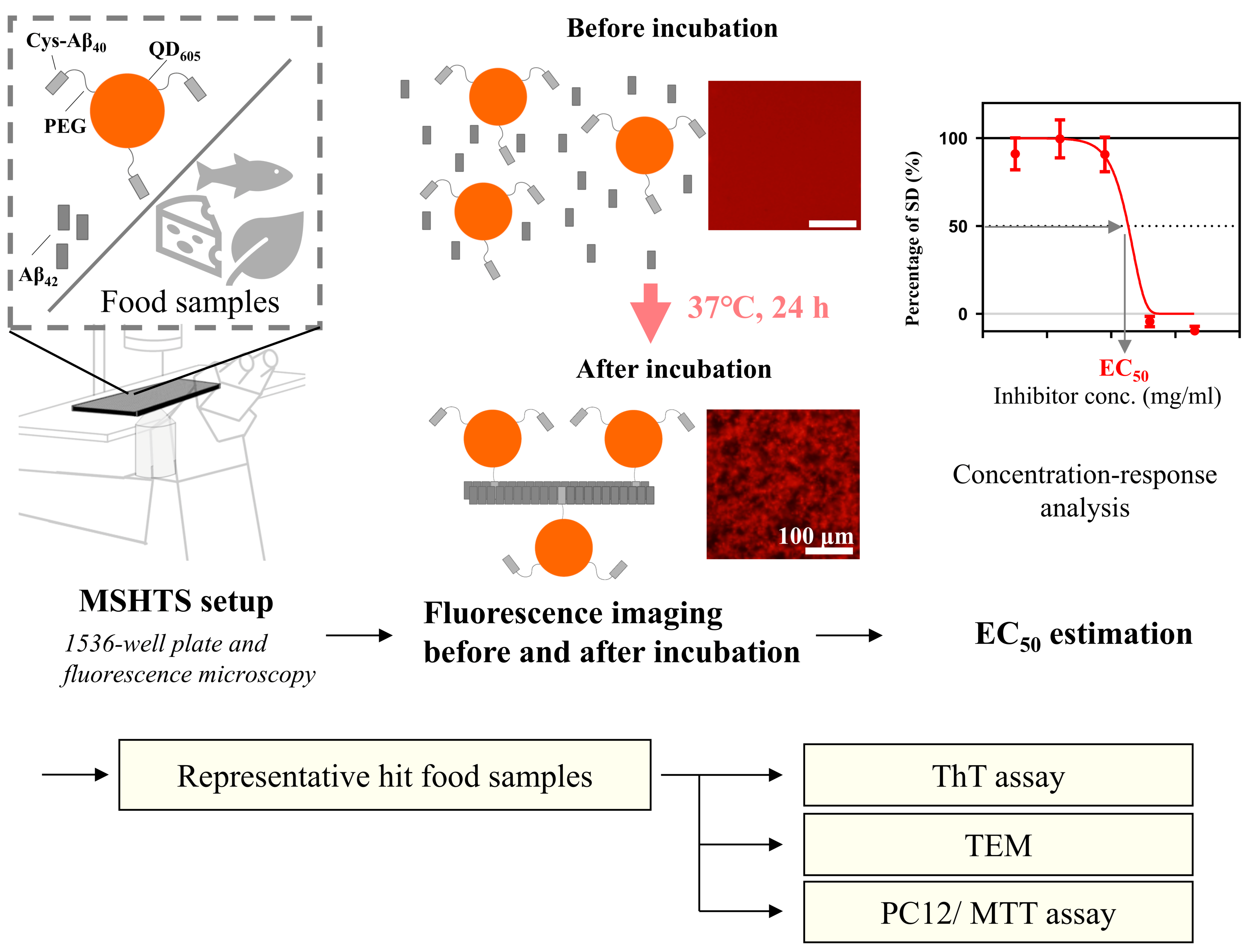
24] based on visualization of Aβ aggregates using QDAβ [
25]. In this method, QDAβ is co-aggregated with unlabeled Aβ42, and Aβ42 aggregation-inhibitory activity is evaluated by quantifying the heterogeneity of fluorescence images as the standard deviation of pixel intensity. Furthermore, automated MSHTS combined with an automated dispensing system has enabled comparison of many samples under uniform assay conditions [
26]. We have previously applied the MSHTS method to food-, plant-, and natural product-derived samples. For example, in a study of commercial dressings and soy sauce, soy sauce-based dressings and raw soy sauce were reported to show Aβ42 aggregation-inhibitory activity [
27]. In
Perilla frutescens var.
crispa leaf extracts, cultivation conditions were shown to affect Aβ aggregation-inhibitory activity [
28]. In addition, an automated MSHTS approach was used to search for fractions with Aβ aggregation-inhibitory activity in a library of 210 mushroom extracts [
29]. These recent method-related applications indicate that MSHTS is a useful primary screening platform for evaluating the Aβ aggregation-inhibitory activity of complex food-, plant-, and natural-product-derived samples.
However, previous studies have mainly focused on specific food groups, plant materials, or extract libraries, and systematic cross-category comparisons of diverse food samples under the same assay conditions remain limited. In addition, food samples are complex matrices, and screening hits require validation using assays that capture different aspects of Aβ42 aggregation and cellular responses. Therefore, cross-category comparison of food samples using the same automated MSHTS platform, followed by stepwise validation of representative hits using independent aggregation assays and a cell-based assay, is important for prioritizing food-derived candidates for functional food research and active component analysis. These points highlight the unmet need for a standardized cross-category screening approach that compares diverse food samples under the same assay conditions and links primary screening hits to downstream validation using independent aggregation assays and a cell-based assay. We hypothesized that cross-category screening under uniform automated MSHTS conditions would identify food-derived candidates with distinct Aβ42 aggregation-inhibitory activity, and that representative hits could be prioritized by stepwise validation using orthogonal aggregation and cell-based assays.
In this study, we used automated MSHTS to compare the Aβ42 aggregation-inhibitory activity of food samples across multiple food categories and to identify food-derived candidates that modulate Aβ42 aggregation. Representative hit foods were then subjected to stepwise validation using the ThT assay, transmission electron microscopy (TEM), and MTT assay with differentiated PC12 cells to examine whether their aggregation-inhibitory effects were supported by independent assays and whether they showed increased cell viability in Aβ42-treated cells. These analyses showed that diverse food samples include candidates capable of suppressing Aβ42 aggregation, some of which also showed increased cell viability in Aβ42-treated cells, providing a basis for further functional and active-component analyses.
2. Materials and Methods
2.1. Preparation of Food Extract Samples
Food sample selection and preparation were performed with Air Water Inc. (Osaka, Japan); the complete sample list is shown in
Table S1. The primary automated MSHTS dataset consisted of 120 food-sample preparations from 115 food items, because some foods were evaluated under different preparation or storage conditions; these condition-specific preparations were treated as separate samples. Food samples were homogenized using a hand mixer (HB865GJP, T-fal, Rumilly, France) in turbo mode until a homogeneous slurry or powder was obtained. The homogenized samples were frozen in liquid nitrogen and stored at −80 °C until freeze-drying using a freeze dryer (FDU-2200, EYELA, Tokyo, Japan). After freeze-drying, 1 g of each lyophilized sample was placed in a 15 mL screw-cap glass tube (No. N-16, Maruemu, Osaka, Japan), mixed with 50% ethanol as the extraction solvent, and shaken at 200 rpm for 15 h using a multi-shaker (MMS-5020, EYELA, Tokyo, Japan). A 50% ethanol solution was used as the extraction solvent because it can extract a broad range of water-soluble to moderately polar food-derived components, including polyphenols and other small molecules, while remaining compatible with the downstream in vitro screening workflow after drying and reconstitution. In addition, in a preliminary comparison of extraction solvents using tea-related samples, 50% ethanol extracts showed high Aβ42 aggregation-inhibitory activity among the tested solvent conditions (
Figure S5). Based on these preliminary results and workflow compatibility, 50% ethanol was selected as the standardized extraction solvent for the present screening. The extracts were centrifuged at 1800×
g, and supernatants were filtered through PTFE membrane filters (TORAST Disc GLCTD-PTFE1322, Shimadzu GLC, Tokyo, Japan). Filtrate aliquots (1 mL) were dried using a centrifugal evaporator (CVE-3000, EYELA, Tokyo, Japan). The dried extracts were dissolved in DMSO at 100 mg/mL, intermittently sonicated for a total of 300 s (5 min) at room temperature without active temperature control to facilitate dissolution of poorly soluble components, vortexed, and stored at −80 °C until use.
2.2. Preparation of Soy Sauce Samples
Commercial soy sauce (Tokkyu Honjoyu, Nihon Shoyu Kogyo Co., Ltd., Hokkaido, Japan) and raw soy sauce (salt content, 16.2%; Nihon Shoyu Kogyo Co., Ltd.) were purchased and processed separately from the dried food extracts. Soy sauce samples were centrifuged at 15,000× g for 30 min at 4 °C using a centrifuge (MX-307, TOMY Digital Biology Co., Ltd., Tokyo, Japan), and the supernatants were collected after removal of precipitates.
Because soy sauce samples were liquid, their concentrations were initially prepared on a volume/volume basis. For comparison with dried food extracts, the concentrations of soy sauce and raw soy sauce were determined using the Lowry method [
30]. The concentrations of undiluted soy sauce and raw soy sauce were calculated as 30.30 mg/mL and 20.89 mg/mL, respectively, and these values were used to convert
v/
v concentrations to mg/mL for EC
50 calculation.
2.3. Preparation of Aβ Peptides
Human Aβ42 peptide (4349-v, Peptide Institute, Inc., Osaka, Japan) and Cys-linked Aβ40 peptide (23519, AnaSpec, Fremont, CA, USA) were purchased commercially. Human Aβ42 was dissolved in 1,1,1,3,3,3-hexafluoro-2-propanol (HFIP; 083-04233, FUJIFILM Wako Pure Chemical Corporation, Osaka, Japan) at 1 mg/mL, incubated at room temperature for 1 h, and sonicated for 10 min to monomerize the peptide. The solution was then dried as a thin film in a clean bench. The dried peptide film was dissolved in dimethyl sulfoxide (DMSO; 041-29351, FUJIFILM Wako Pure Chemical Corporation, Osaka, Japan) to prepare 1 or 2.5 mM Aβ42 stock solutions. The solution was mixed by pipetting for 15 min, aliquoted into 1.5 mL tubes (SARSTEDT, Nümbrecht, Germany), and stored at −80 °C until use.
2.4. Preparation of QDAβ Nanoprobe
The QDAβ nanoprobe was prepared using QD-PEG-NH
2 (Qdot™ 605 ITK™ Amino (PEG) quantum dot; Q21501MP, Thermo Fisher Scientific, Waltham, MA, USA) according to our previous reports [
24,
25,
26], with the key steps summarized here. Briefly, the buffer of QD-PEG-NH
2 was exchanged to PBS using a centrifugal concentrator. The quantum dots were reacted with the heterobifunctional crosslinker Sulfo-EMCS, and excess crosslinker was removed using a desalting column. Cys-linked Aβ40 dissolved in DMSO was then added to the activated quantum dots to conjugate Aβ40 to the QD surface. Unreacted maleimide groups were quenched with 2-mercaptoethanol, and the reaction mixture was further purified by buffer exchange and desalting. The concentration of QDAβ was determined from the absorbance at 350 nm.
2.5. MSHTS System
2.5.1. Evaluation of Aβ42 Aggregation-Inhibitory Activity by MSHTS
Aβ42 aggregation-inhibitory activity was evaluated using a microliter-scale high-throughput screening (MSHTS) method with QDAβ as described previously, with minor modifications. Food extract samples were diluted to 2 mg/mL in assay buffer containing 1× PBS, 10% ethanol, and 2% DMSO. Soy sauce samples were prepared separately at 20% in 1× PBS and 10% ethanol. Assay buffer containing 1× PBS and 10% ethanol was used for dilution and as the negative control. For the Aβ/QDAβ mixture, frozen Aβ42 stock solution in DMSO was thawed at room temperature and mixed by pipetting. QDAβ, 10× PBS, and ultrapure water were then added to prepare an Aβ solution containing 50 µM Aβ42, 50 nM QDAβ, and 1× PBS. The solution was centrifuged at 20,400× g for 1 min at 4 °C, and the supernatant was used for the assay. The Aβ solution was mixed with each food sample solution at a 1:1 ratio, yielding final concentrations of 25 µM Aβ42 and 25 nM QDAβ. For automated MSHTS, food samples and assay buffer were dispensed into 384-well plates, and five-fold serial dilutions were prepared using an automated workstation (JANUS G3, PerkinElmer, Waltham, MA, USA). Diluted samples were transferred to 1536-well black plates (782096, Greiner Bio-One, Kremsmünster, Austria) at 2.5 µL per well, with four replicate wells for each concentration. The Aβ/QDAβ solution was then dispensed at 2.5 µL per well and mixed with the sample solution. The plates were sealed to prevent evaporation and centrifuged at 1530× g for 5 min at 37 °C to remove bubbles and equalize the liquid surface. Fluorescence images were acquired before incubation using an inverted fluorescence microscope (ECLIPSE Ti-E, Nikon Corporation, Tokyo, Japan) equipped with a color CMOS camera (DS-Ri2, Nikon Corporation, Tokyo, Japan), a 4× objective lens, and a TRITC filter set. Images were obtained with the exposure conditions adjusted to complete imaging of all wells within 1 h. The plates were then incubated at 37 °C for 24 h, and fluorescence images were acquired again under the same conditions. For manual MSHTS used in follow-up or reference experiments, food extract samples were serially diluted five-fold, and soy sauce samples were serially diluted ten-fold in assay buffer. Each diluted sample was mixed with the Aβ/QDAβ solution at a 1:1 ratio, centrifuged at 10,000× g for 2 min at 4 °C to remove insoluble particles, and 5 µL of the supernatant was transferred to a 1536-well black plate. Fluorescence images were obtained before and after 24 h incubation at 37 °C using the same inverted fluorescence microscope described above.
2.5.2. Quantification of Aβ42 Aggregation from MSHTS Images
Aβ42 aggregation was quantified from QDAβ fluorescence images using the standard deviation (SD) of fluorescence intensity as an index of aggregate formation. For automated MSHTS images, SD values were calculated from the central region of each well using NIS-Elements AR (version 4.51.00) software. For manual MSHTS images, the central 200 × 200 pixel region was analyzed using ImageJ (version 1.54g). The mean SD value was calculated from replicate wells for each sample concentration. Aggregation levels were normalized by defining the pre-incubation SD value as 0% and the post-incubation SD value of the Aβ42-alone control as 100%. Concentration–response curves were generated using a five-parameter logistic model in GraphPad Prism (version 11.0.1). EC50 was defined as the sample concentration at which the normalized aggregation level reached 50%. Lower EC50 values indicate higher Aβ42 aggregation-inhibitory activity.
2.6. Transmission Electron Microscopy
Aβ42 aggregates formed in the presence or absence of selected food samples were observed by TEM. Food sample solutions and the Aβ42/QDAβ solution were prepared as described for MSHTS. The Aβ42/QDAβ solution contained 50 µM Aβ42, 50 nM QDAβ, and 1× PBS. Each food sample solution was mixed with an equal volume of the Aβ42/QDAβ solution, and the Aβ42-alone control was prepared by mixing assay buffer with the Aβ42/QDAβ solution at the same ratio. Unless otherwise indicated, food samples were used at a final concentration of 0.2 mg/mL. The mixtures were centrifuged at 10,000× g for 2 min at 4 °C, aliquoted into PCR tubes, and incubated at 37 °C for 24 h. For negative staining, 10 µL of each sample solution was applied to a collodion-coated copper grid (U1005, EM Japan Co., Ltd., Tokyo, Japan) and allowed to adsorb for 5 min at room temperature. The excess solution was removed with filter paper. The grid surface was then briefly contacted with drops of ultrapure water twice, followed by 1% phosphotungstic acid (79690-25G, Sigma-Aldrich, St. Louis, MO, USA) twice. After removal of excess staining solution with filter paper, the grids were air-dried for 5 min. TEM observations were performed using an H-7600 transmission electron microscope (Hitachi High-Technologies, Tokyo, Japan) operated at 60 kV. TEM observation was used as a qualitative morphological assessment to support the aggregation assay results; quantitative fibril length or aggregate density analysis was not performed.
2.7. ThT Assay
Aβ42 fibrillar aggregation was evaluated using a ThT fluorescence assay. Food extract samples were diluted from 2 mg/mL stock solutions with assay buffer (10% ethanol and 1× PBS) by five-fold serial dilution to obtain five concentrations. Soy sauce samples were diluted separately by ten-fold serial dilution to obtain five concentrations. Assay buffer was used as the Aβ42-alone control. Aβ42 solution was prepared immediately before use. Frozen 1 mM Aβ42 stock solution in DMSO was thawed at room temperature and mixed by pipetting for 10 min. A premixed solution containing 10× PBS and ultrapure water was then added to the Aβ42 stock solution and mixed for 1 min to prepare an Aβ42 solution containing 50 µM Aβ42 and 1× PBS. Each diluted food sample solution was mixed with an equal volume of the Aβ42 solution, yielding a final Aβ42 concentration of 25 µM. Aliquots of the mixtures were dispensed into PCR tubes in triplicate and incubated at 37 °C for 24 h. Immediately before fluorescence measurement, ThT solution was prepared at 5 µM in 50 mM glycine-NaOH buffer (pH 8.5) using 100 µM ThT stock solution. ThT was purchased from FUJIFILM Wako Pure Chemical Corporation (202-01002, Osaka, Japan). After incubation, 190 µL of ThT solution was added to 10 µL of each sample mixture and mixed. The resulting 200 µL mixture was transferred to a 96-well plate (195-96F, Watson Co., Ltd., Tokyo, Japan), and fluorescence intensity was measured using a microplate reader (SH-9000Lab, Corona Electric Co., Ltd., Hitachinaka, Japan) with excitation at 455 nm and emission at 490 nm. EC50 values were estimated by fitting concentration–response curves using a five-parameter logistic model in GraphPad Prism. Parallel Aβ42-free control samples containing each food sample and ThT were measured under the same conditions. The raw fluorescence value of each Aβ42-free food-sample control was subtracted from the corresponding raw fluorescence value of the Aβ42-containing sample condition before generating concentration–response curves and estimating EC50 values.
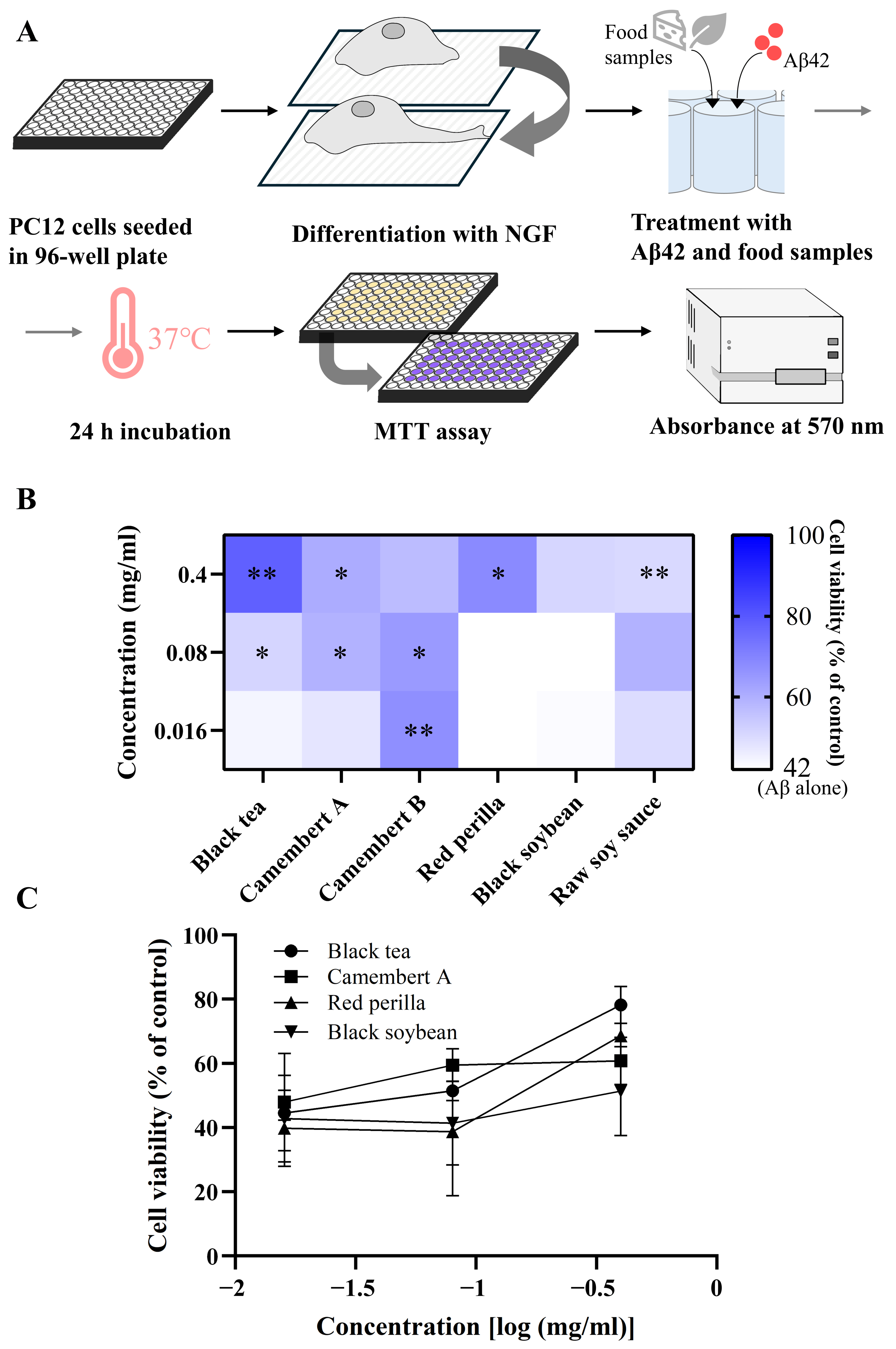
2.8. MTT Assay
PC12 cells were cultured in high-glucose D-MEM containing L-glutamine, phenol red, and sodium pyruvate (041-30081, FUJIFILM Wako Pure Chemical Corporation, Osaka, Japan), supplemented with 10% fetal bovine serum (FBS; 536-90165, HyClone) and 0.5% penicillin–streptomycin (P4333, Sigma-Aldrich, St. Louis, MO, USA). Cells were maintained at 37 °C in a humidified atmosphere containing 5% CO2. For the MTT assay, 96-well tissue culture plates (3860-096, IWAKI, Shizuoka, Japan) were coated with poly-D-lysine (PDL). Poly-D-lysine hydrobromide (molecular weight 70,000–150,000; P0899-5mg, Sigma-Aldrich, St. Louis, MO, USA) was dissolved in ultrapure water at 5 mg/mL, filtered, aliquoted, and stored at 4 °C. Before cell seeding, the PDL stock solution was diluted to 0.1 mg/mL with sterile water, added to each well at 50 µL/well, and incubated for 5 min. After removal of the solution, each well was washed twice with 50 µL sterile water for 5 min each and air-dried at room temperature for 1 day. After drying, PC12 cells were seeded at 7000 cells/well in 200 µL culture medium and incubated for 4 h at 37 °C under 5% CO2. Nerve growth factor (NGF; mouse NGF 2.5S, 93928-24-6, Cosmo Bio Co., Ltd., Tokyo, Japan) was prepared in sterile PBS and added to each well to obtain a final concentration of 5 ng/mL. Cells were then treated with NGF for 24 h at 37 °C under 5% CO2 before Aβ42 exposure. This 24 h NGF treatment was used to prepare NGF-treated PC12 cells for exploratory cell-viability testing, rather than to establish a fully mature neuronal phenotype. After differentiation, the medium was removed, and 60 µL/well of sample/Aβ42 solution was carefully added to avoid detaching the cells. The final treatment solution contained 0.4, 0.08, or 0.016 mg/mL food sample and 2.5 µM Aβ42. Cells were incubated for 24 h at 37 °C under 5% CO2. After treatment, MTT solution prepared at 15 mg/mL in 1× PBS was added at 6 µL/well to 60 µL/well of cell-treatment solution, corresponding to a final working concentration of approximately 1.36 mg/mL, and cells were incubated for 4 h at 37 °C under 5% CO2. The supernatant was then removed as completely as possible without aspirating the formazan crystals. SDS solution (10% SDS in 0.01 M HCl) was added at 50 µL/well, and the plates were incubated overnight at 37 °C under 5% CO2 to solubilize the formazan. Absorbance at 570 nm was measured using a microplate reader (SH-9000Lab, Corona Electric Co., Ltd., Hitachinaka, Japan). Each condition was measured in triplicate wells (n = 3 wells per condition). For statistical comparison of the MTT assay, each Aβ42-containing food-sample condition was compared with the Aβ42-alone group using two-sided Welch’s t-test. To reduce sample-dependent interference with the MTT readout, Aβ42-free sample-matched control wells were measured in parallel for each food sample concentration. The absorbance value of each Aβ42-free sample-matched control was subtracted from the corresponding Aβ42-containing condition before normalization. Cell viability was calculated by normalizing the corrected absorbance to the DMSO control without Aβ42. The MTT assay was interpreted as an exploratory comparison of Aβ42-containing conditions with the Aβ42-alone group, rather than as an independent evaluation of the cytotoxicity or metabolic effects of each food sample alone.
2.9. Summary of Solvent Conditions
To improve reproducibility, the solvent conditions used in each assay are summarized here. In the MSHTS assay, food extract samples were prepared in 1× PBS containing 10% ethanol and 2% DMSO before mixing with the Aβ42/QDAβ solution at a 1:1 ratio. Thus, the aggregation reaction contained 25 µM Aβ42, 25 nM QDAβ, 5% ethanol, and 1× PBS. The Aβ42 stock solution contributed 2.5% DMSO to the final aggregation reaction, and food-extract stocks contributed additional sample-dependent DMSO up to 1% at the highest food-extract concentration. Soy sauce samples were prepared separately in 1× PBS containing 10% ethanol and mixed with the Aβ42/QDAβ solution at a 1:1 ratio. In the ThT assay, food extract and soy sauce samples were diluted in 1× PBS containing 10% ethanol and mixed with the Aβ42 solution at a 1:1 ratio, resulting in 25 µM Aβ42 and 5% ethanol during Aβ42 incubation. As in the MSHTS assay, the Aβ42 stock solution contributed 2.5% DMSO to the final Aβ42 incubation mixture, and food-extract stocks contributed additional sample-dependent DMSO up to 1% at the highest food-extract concentration. In the MTT assay, the final cell-treatment solution contained 2.5 µM Aβ42; 0.4, 0.08, or 0.016 mg/mL food sample; and 1.4% DMSO.
2.10. Statistical Analysis
Data are presented as mean ± SD unless otherwise indicated. In the automated MSHTS assay, each concentration was measured in four replicate wells. In the ThT assay, each concentration was measured in triplicate. In the MTT assay, each condition was measured in triplicate wells (
n = 3 wells per condition). These measurements were technical replicates within the same experimental run, and independent biological replicate experiments were not performed. EC
50 values estimated from MSHTS and ThT assays were compared descriptively using mean ± SD values and fold differences. Because these comparisons were intended to evaluate assay-level consistency rather than to test predefined statistical hypotheses, formal statistical tests and confidence interval estimation were not performed for EC
50 comparisons. For the MTT assay, each Aβ42-containing food-sample condition at each concentration was compared with the Aβ42-alone group using two-sided Welch’s
t-test. Welch’s
t-test was used because equal variances between groups were not assumed. No correction for multiple comparisons was applied; therefore, the statistical results of the MTT assay were interpreted as exploratory. Exact
p-values for the MTT assay comparisons are provided in
Table S4.
4. Discussion
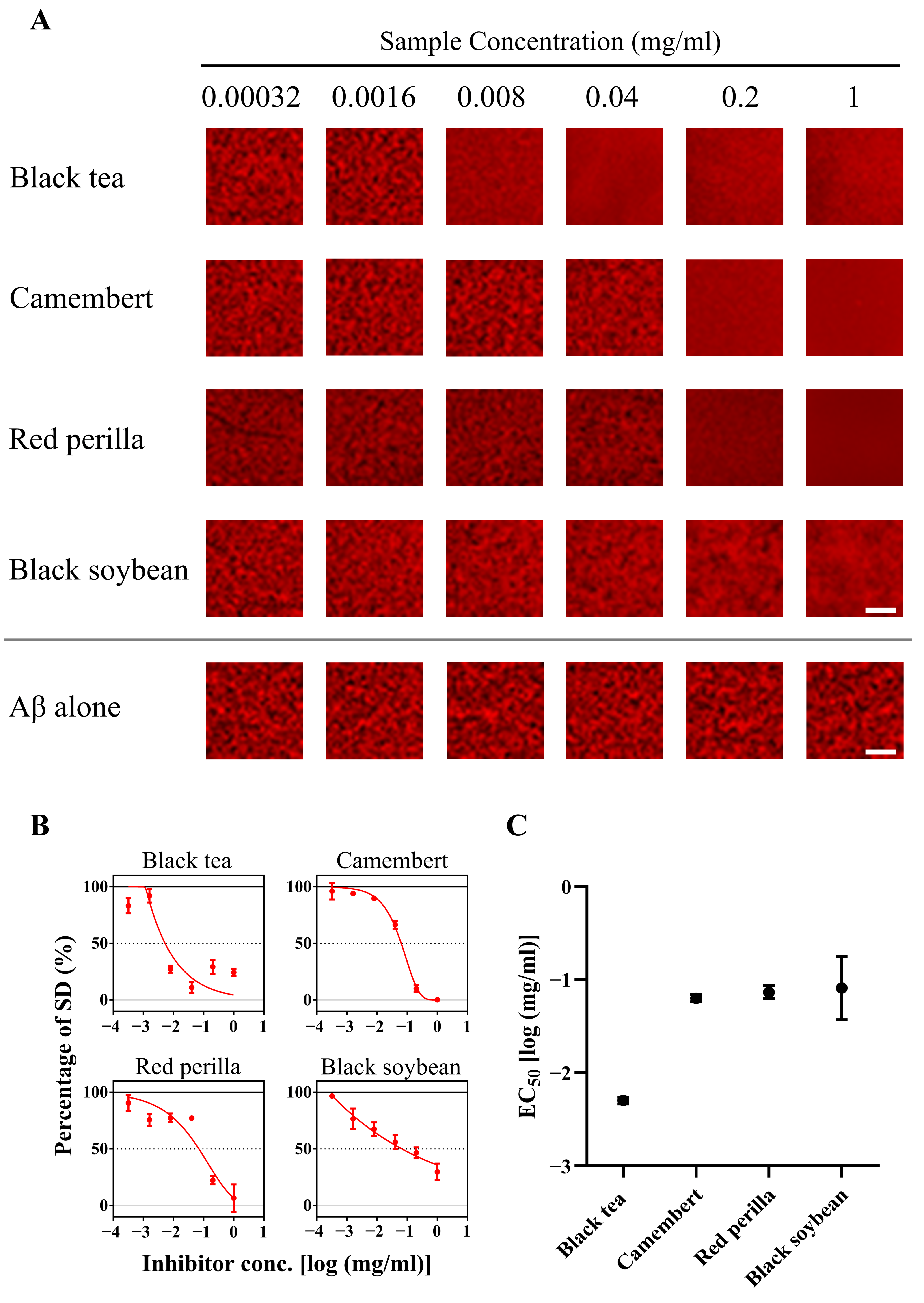
In this study, we used automated MSHTS to systematically evaluate the Aβ42 aggregation-inhibitory activity of food samples across multiple food categories. The results showed that Aβ42 aggregation-inhibitory activity varied markedly among food samples and that some samples exhibited high inhibitory activity. In particular, Black tea, Camembert, Red perilla, and Black soybean were selected as representative hit foods for subsequent analyses. The significance of this study lies in the primary selection of Aβ42 aggregation-modulating candidates by comparing diverse food samples on the same automated MSHTS platform, rather than evaluating a single food or a specific food category. Compared with previous high-throughput QDAβ/MSHTS studies that established the image-based assay and automated screening workflow [
24,
25,
26], and previous food-, plant-, or natural-product-focused applications that evaluated specific food groups or extract libraries [
27,
28,
29], the contribution of the present study is the use of this established platform for standardized cross-category comparison of diverse food samples, followed by downstream validation using independent aggregation assays and a cell-based assay. Foods are complex multicomponent matrices, and their measured Aβ42 aggregation-inhibitory activity may vary depending on component composition, processing conditions, extraction conditions, and other factors. Therefore, cross-category screening such as that performed in this study provides a useful basis for efficiently selecting candidate samples that can be further investigated in functional food research and active component analysis. Previous reviews have described Aβ aggregation and amyloid fibrillation as targets of aggregation-modulating agents, including small molecules, naturally occurring compounds, and nanomaterials [
31].
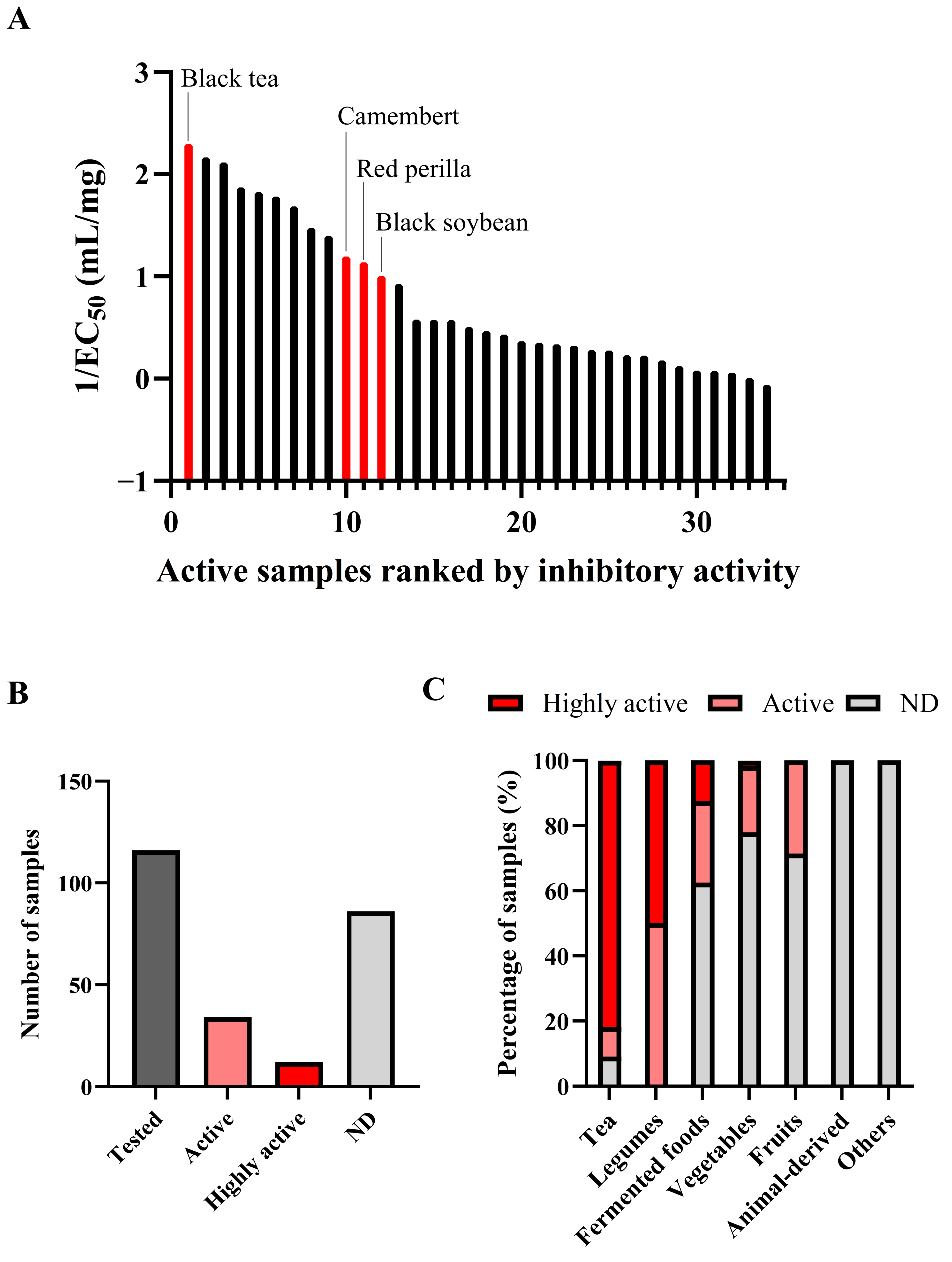
Several of the representative hits identified in this study were also consistent with previous findings on food-derived or naturally occurring Aβ aggregation modulators. In the automated MSHTS, tea samples, including Black tea, accounted for most of the highly active samples, and additional validation showed that Green tea and Roasted green tea exhibited comparable Aβ42 aggregation-inhibitory activity (
Figure 2A and
Figure S1,
Table S1). Tea consumption has been suggested to be associated with AD prevention in several studies [
32,
33], and polyphenolic components in tea have also been reported to possess Aβ aggregation-inhibitory activity [
34]. In addition, among Black tea samples with different storage conditions, samples incubated at 37 °C for 3 days showed higher Aβ42 aggregation-inhibitory activity, and N
2-filled conditions also tended to slightly increase this activity (
Table S1). Tea processing and fermentation are known to alter the phytochemical profile of tea, including the formation of black-tea polyphenols such as theaflavins [
35]. In addition, theaflavins have been reported to inhibit Aβ fibrillogenesis [
36]. These findings suggest that the Aβ42 aggregation-inhibitory activity of tea samples may be influenced not only by food type but also by component changes associated with storage or processing conditions.
For Camembert, fermented dairy-derived peptides and fermented foods have been reported to affect neural function [
37,
38], suggesting that components generated during fermentation may be relevant to AD-related biological activity. For Black soybean, soybean isoflavones have been reported to alleviate Aβ burden and neuroinflammation in AD models [
39,
40]. In addition, the inclusion of Red perilla among the representative hits is consistent with previous reports on the Aβ aggregation-inhibitory activity of
Perilla frutescens var.
crispa leaf extracts [
28].
Although the present study did not identify the active components responsible for the observed effects, several possible mechanisms may explain the Aβ42 aggregation-inhibitory activity of the representative hit foods. Food-derived polyphenols may influence Aβ42 assembly in a structure-dependent manner, including modulation of β-sheet-rich fibril formation and interactions with aggregation-prone peptide species [
34]. In addition, polyphenols have been discussed as multifunctional compounds with antioxidant, metal-chelating, and anti-amyloidogenic properties, which may indirectly affect Aβ aggregation and Aβ-associated cellular responses [
41].
At the level of individual representative hits, these considerations suggest distinct candidate component classes for future active-component analysis. For Black tea, the catechin/theaflavin-rich tea polyphenol axis discussed above represents a plausible candidate class, consistent with the strong activity of Black tea in MSHTS and the supporting ThT/TEM results [
34,
35,
36]. For Red perilla, rosmarinic acid and other polyphenolic constituents are plausible candidates related to the observed Aβ42 aggregation-inhibitory activity [
42]. For Black soybean, isoflavones and anthocyanins are plausible candidates related to the observed Aβ42 aggregation-inhibitory activity, because soybean isoflavones have been reported to inhibit Aβ fibrillization and oligomerization in vitro, and anthocyanin-rich extracts or anthocyanin compounds have been reported to modulate Aβ aggregation and Aβ-associated toxicity [
43,
44]. For Camembert, dairy- or fermentation-derived peptides, such as tryptophan-related dipeptides and β-lactolin, may be considered candidate component classes, although their presence in the tested extract and direct involvement in Aβ42 aggregation inhibition require future verification [
37,
38]. These hit-specific considerations suggest that the inhibitory activity detected in this study may reflect multiple component-dependent mechanisms rather than a single common mechanism shared by all hit foods.
On the other hand, this study also showed that food groups attracting attention in functional food research do not necessarily exhibit Aβ42 aggregation-inhibitory activity. In the Vegetables category, Red perilla was the only highly active sample among 59 items, and no Aβ42 aggregation-inhibitory activity was detected in more than 70% of the samples (
Figure 2C). In the Fruits category, no highly active sample was identified, and more than 70% of the samples were classified as ND. In addition, processed foods, such as vegetable and fruit juices, which accounted for a large proportion of the Others category, did not show detectable Aβ42 aggregation-inhibitory activity in this assay system. Based on these results, the previously reported inverse association between fruit and vegetable intake and cognitive impairment risk [
45] may involve multiple pathways other than direct inhibition of Aβ42 aggregation, such as antioxidant activity, anti-inflammatory effects, metabolic regulation, vascular function, and gut microbiota-related mechanisms [
46,
47]. Furthermore, in the Animal-derived category, including fish and meat, no samples showed Aβ42 aggregation-inhibitory activity in automated MSHTS (
Figure 2C). Fish and meat intake has been reported to be associated with cognitive function measures, whereas its association with incident dementia risk appears limited [
48]. These findings suggest that even if these food groups influence cognitive function, their effects are not necessarily manifested as direct inhibition of Aβ42 aggregation. Taken together, the present screening results may provide a basis for distinguishing between the cognitive function-related effects of foods and their direct inhibitory effects on Aβ42 aggregation.
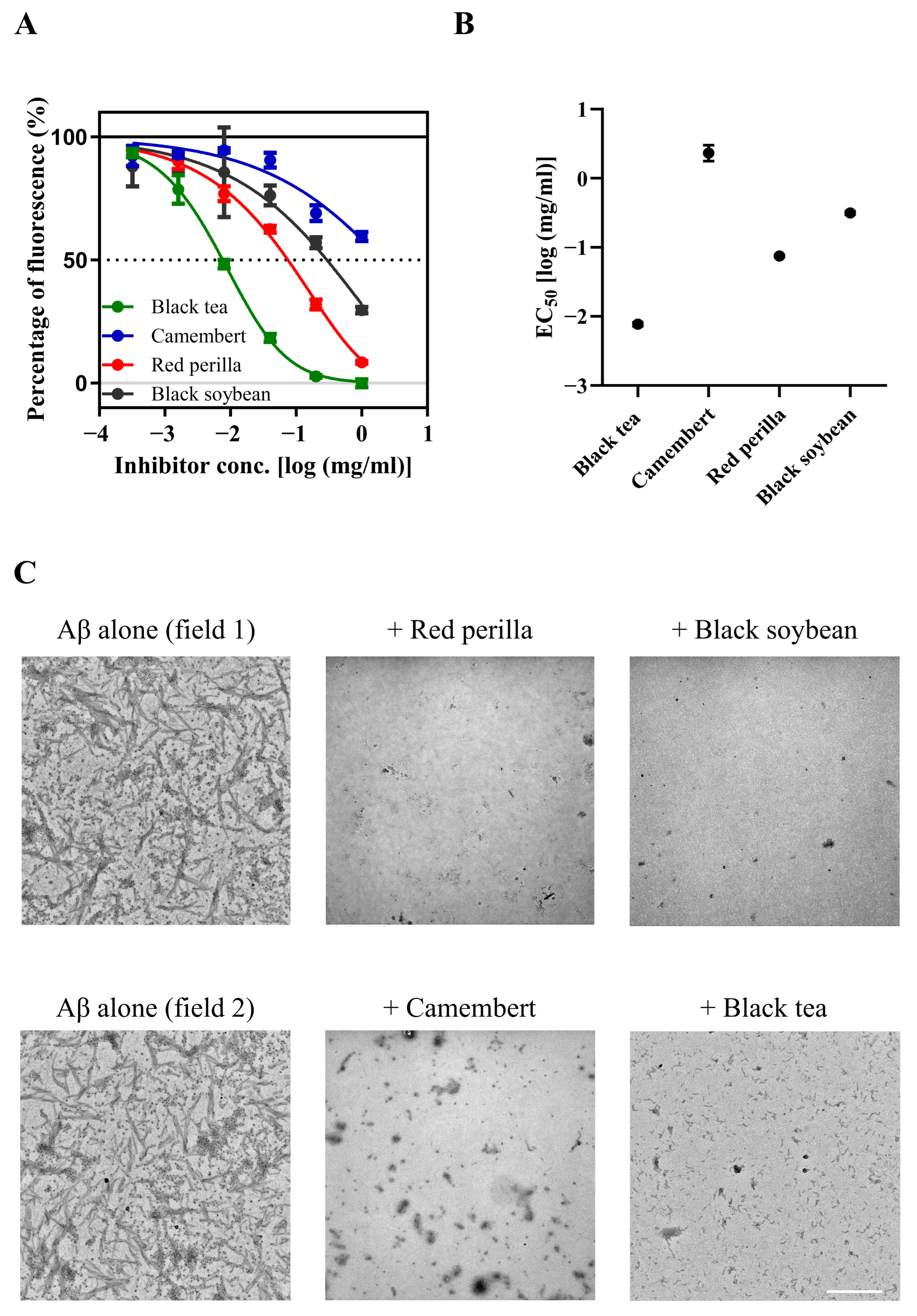
The Aβ42 aggregation-inhibitory activities of representative hit foods identified by the automated MSHTS method were generally supported by the ThT assay and TEM observation (
Figure 4). In the ThT assay, the formation of ThT-positive aggregates was reduced, and TEM observation also showed a decrease in the fibrillar structures observed under the Aβ42-alone condition. In addition, the EC
50 values estimated by the MSHTS method and the ThT assay were within a similar concentration range for many samples (
Table S2). For example, for Black tea, Red perilla, Green tea, Roasted green tea, and raw soy sauce, the EC
50 values estimated by the two methods differed by approximately two-fold or less, and even for Black soybean, the difference was limited to approximately three-fold. In contrast, the EC
50 values obtained by the two methods did not completely coincide, with Camembert showing an approximately 36-fold difference. This discrepancy may be attributable to differences in the aggregate species detected by the two methods. The MSHTS method mainly reflects relatively large QDAβ-containing aggregates that are detected as spatial heterogeneity in fluorescence microscopy images [
24], whereas the ThT assay may reflect a broader range of aggregate species, from soluble or small ThT-positive assemblies that are difficult to clearly detect in microscopy images to mature fibrils [
49]. Taken together, the Aβ42 aggregation-inhibitory activities of the representative hit foods were generally confirmed by the ThT assay and TEM observation, consistent with the trends indicated by the MSHTS method. Therefore, rather than indicating the superiority of one assay over another, the MSHTS method, ThT assay, and TEM observation can be positioned as complementary approaches for evaluating different aspects of Aβ42 aggregation behavior.
In the cell-based evaluation, many of the food samples tested in the MTT assay showed increased cell viability in Aβ42-treated cells, at least within some concentration ranges (
Figure 5 and
Figure S3). This result indicates that some of the candidate Aβ42 aggregation modulators identified by the MSHTS method may also affect Aβ42-induced cellular responses. However, the strength of Aβ42 aggregation-inhibitory activity did not completely correspond to the improvement in cell viability. Black soybean showed Aβ42 aggregation-inhibitory activity in both the MSHTS method and the ThT assay, but did not show a clear improvement in cell viability in the MTT assay. In addition, Camembert A and B were follow-up samples different from the Camembert hit identified in the primary automated MSHTS screen, and showed lower Aβ42 aggregation-inhibitory activity than the primary hit (
Table S3). Nevertheless, increased cell viability was observed under some conditions. These results suggest that Aβ42 aggregation-inhibitory activity may serve as a useful primary indicator for predicting cellular responses, but that it alone cannot fully explain the cellular effects of food samples. This discrepancy may be attributable not only to the total amount of Aβ42 aggregates, but also to the properties of aggregate species involved in cytotoxicity and to the cellular effects of the food samples themselves. Because Aβ cytotoxicity can depend on the properties of aggregate species such as soluble oligomers, Aβ42 aggregate species that contribute to cytotoxicity may remain even when aggregation-inhibitory activity is detected by the MSHTS method or the ThT assay [
50]. On the other hand, although food-derived polyphenols generally exhibit antioxidant activity, they have also been reported to exert pro-oxidant cellular effects under cell culture conditions, for example through H
2O
2 generation [
51,
52]. Therefore, changes in cell viability induced by food samples may reflect not only Aβ42 aggregation-inhibitory activity, but also both qualitative changes in Aβ42 aggregate species and the cellular effects of the food components themselves. Thus, Aβ42 aggregation-inhibitory activity should be regarded as a primary screening indicator for selecting food-derived candidates for further evaluation, rather than as a direct predictor of cellular efficacy. The present results indicate that evaluating both Aβ42 aggregation-inhibitory activity and the cellular effects of food components themselves is important for narrowing down food-derived candidates that modulate Aβ42 aggregation.
This study has several limitations. First, the food sample set used in this study was not designed to comprehensively or randomly represent each food category. Therefore, although the category-wise distribution of Aβ42 aggregation-inhibitory activity may suggest food groups that are more frequently represented among active samples, it does not allow conclusions regarding the efficacy or inefficacy of entire food categories. Accordingly, the category-wise analysis in this study should be interpreted not as evidence of general superiority or inferiority among food categories, but as the distribution of candidate foods within the sample set evaluated under the same conditions. In addition, because this study evaluated food extracts, it remains unclear which components, or groups of components, were responsible for the observed inhibitory activity. Moreover, preliminary compositional analyses, such as total polyphenol content, catechin or theaflavin levels, isoflavone content, or peptide fraction analysis, were not performed in this study. Therefore, future studies should combine the MSHTS-based screening platform with compositional profiling and fractionation analyses to identify the active components or component combinations responsible for the observed Aβ42 aggregation-modulating activity. In particular, food extracts may contain diverse constituents, including polyphenols, proteins, peptides, carbohydrates, organic acids, and salts; therefore, the observed effects cannot be interpreted as the action of a single component. Furthermore, the effective concentrations observed in the present assays should be interpreted as concentrations of crude food extracts or food-derived samples used for in vitro primary screening and follow-up validation, rather than as concentrations expected to be achieved through dietary intake. Because the tested samples were not purified compounds, the concentrations of the active constituents responsible for the observed effects are unknown. In addition, this study was based on purified Aβ42 aggregation assays and a cell-based assay under defined in vitro conditions, and did not evaluate digestion, intestinal absorption, metabolism, systemic bioavailability, blood–brain barrier penetration, or concentrations achievable in vivo. The reported variability reflects technical replicate measurements within a single experimental run and does not capture inter-experimental reproducibility. This limitation is particularly important for the MTT assay. Thus, the mechanistic bridge from in vitro aggregation inhibition to dietary preventive potential requires future identification of active constituents and evaluation of their digestion, absorption, metabolism, tissue distribution, and in vivo activity. Therefore, the present results should be positioned as candidate-level findings indicating that food-derived samples can affect Aβ42 aggregation under in vitro assay conditions, rather than as direct evidence for dietary efficacy or preventive effects in vivo.