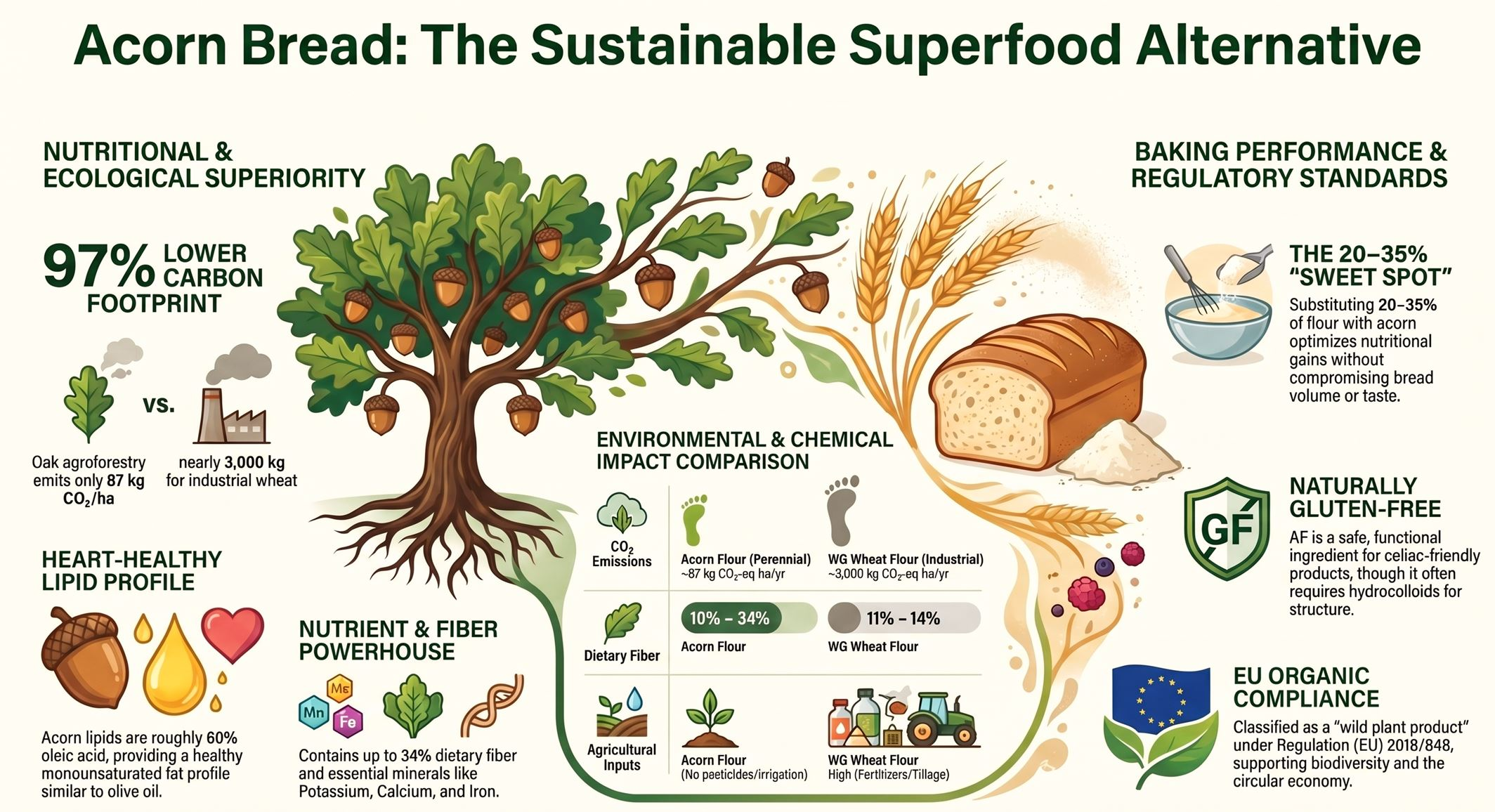
Acorn Bread: The Synergy of Acorn Flour, Sustainability, and EU Organic Standards



Abstract
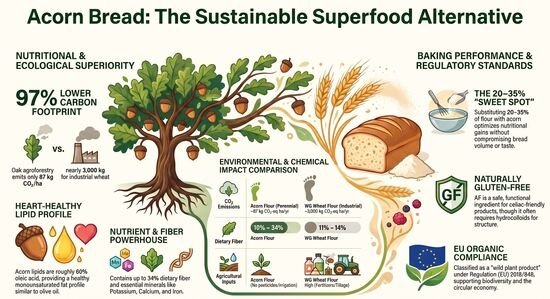
1. Introduction
2. Materials and Methods
2.1. Search Strategy and Information Sources
2.2. Inclusion and Exclusion Criteria
- Peer-reviewed research articles and reviews focusing on the nutritional and phytochemical characterization of Quercus species.
- Studies investigating the technological and rheological impact of AF substitution in wheat-based and gluten-free (GF) bread formulations.
- Research addressing environmental sustainability metrics (e.g., CO2 emissions) of oak agroforestry compared to industrial cereal systems.
- Legal analyses regarding EU organic production standards and the commercialization of wild-collected forest products.
2.3. Selection Process and Data Extraction
3. Potential of Acorns as Functional Food Ingredients
3.1. Ethnobotanical and Historical Perspective of Acorns
3.2. Sustainability and Food Security Relevance of Acorns
- They originate from long-lived perennial systems.
- Oak forests require minimal agricultural inputs.
- Harvesting does not require land conversion.
3.3. Nutritional Composition of Acorns
3.4. Phytochemicals and Bioactive Compounds in Acorns
3.5. Functional Food Potential of Acorns
- Modulation of glycemic response;
- Contribution to antioxidant capacity (AOC);
- Improvement of lipid profile in composite formulations;
- Enhancement of mineral density;
- GF applicability.

| Product Category | Type of Acorn Ingredient | Level of Incorporation | Main Objective | Key Findings | References |
|---|---|---|---|---|---|
| Bread | AF | 10–45% | Nutritional enrichment, GF formulation, and dough rheology improvement | ↑ DF; ↑ AOC; ↓ volume at >30%; ↑ firmness; ↑ viscoelasticity; ↑ cohesiveness; ↑ fatty acids; ↑ minerals | [23,24,31,32,33,34,35] |
| Wheat bread | AF | 5–50% | Technological assessment, nutritional enrichment | ↑ dough development; ↓ volume; ↑ water absorption; ↑ DF | [14,77,78,79] |
| Biscuits | AF | 15–45% | Nutritional enrichment, GF formulation, technological assessment | ↓ energy value; ↑ AOC; ↑ DF; ↓ volume | [43,68,69] |
| Iranian toast | AF | 10–50% | Nutritional enrichment, technological and rheological assessment | ↑ DF; ↑ fat; ↓ degree of softening; ↓ water absorption; ↓ dough extensibility; ↑ dough stability; ↑ development time; ↑ resistance to extension, ↑ AOC | [44] |
| Pasta | AF | 4–25% | Bioavailability, functional (antioxidant) and rheological evaluation | ↑ initial polyphenol content; ↑ flavonoid content; ↑ AOC; ↑ free phenolic acids during digestion, improved pasting, mixing and texture | [41,80] |
| Cake | AF | 3–40% | Evaluation of chemical and physical properties | ↑ crude DF; ↑ mineral content; ↑ fat; ↑ AOC; ↓ protein, ↓ volume as AF increased; ↑ density and firmness | [42,81,82] |
| Pita bread | AF | 5–15% | Evaluation of rheological and physicochemical properties | ↑ DF; ↑ ash; ↑ fat; ↑ protein; ↑ water absorption, ↑ dough stability; ↓ arrival time and dough development time; ↑ firmness | [83] |
| Muffins | AF | 0–70% | Nutritional enrichment, technological evaluation and potential health benefits | ↑ AOC; ↓ volume; inflammation improvement | [84,85] |
| Chocolate spread | Acorn oil extract | 14% | Oleogel rheology improvement | ↑ physical stability | [70] |
| Coffee | Roasted/boiled-roasted ground acorn kernels | 100% | Nutritional enrichment | ↑ mineral content; ↑ AOC | [71,72,73] |
| Coffee | Ethanol extracts of raw peeled acorns | 100% | Potential health benefit evaluation | ↑ cholinesterase inhibitors | [74] |
| Beer | AF | 0.2 g/L | Sensory properties assessment | ↑ sensory attributes | [75] |
| Milk pudding | AF | 1–7% | Physicochemical properties assessment | ↑ AOC; ↑ mineral content; ↑ DF; ↑ hardness; ↑ gumminess | [76] |
3.6. Acorn Flour: Production and Nutritional Profile
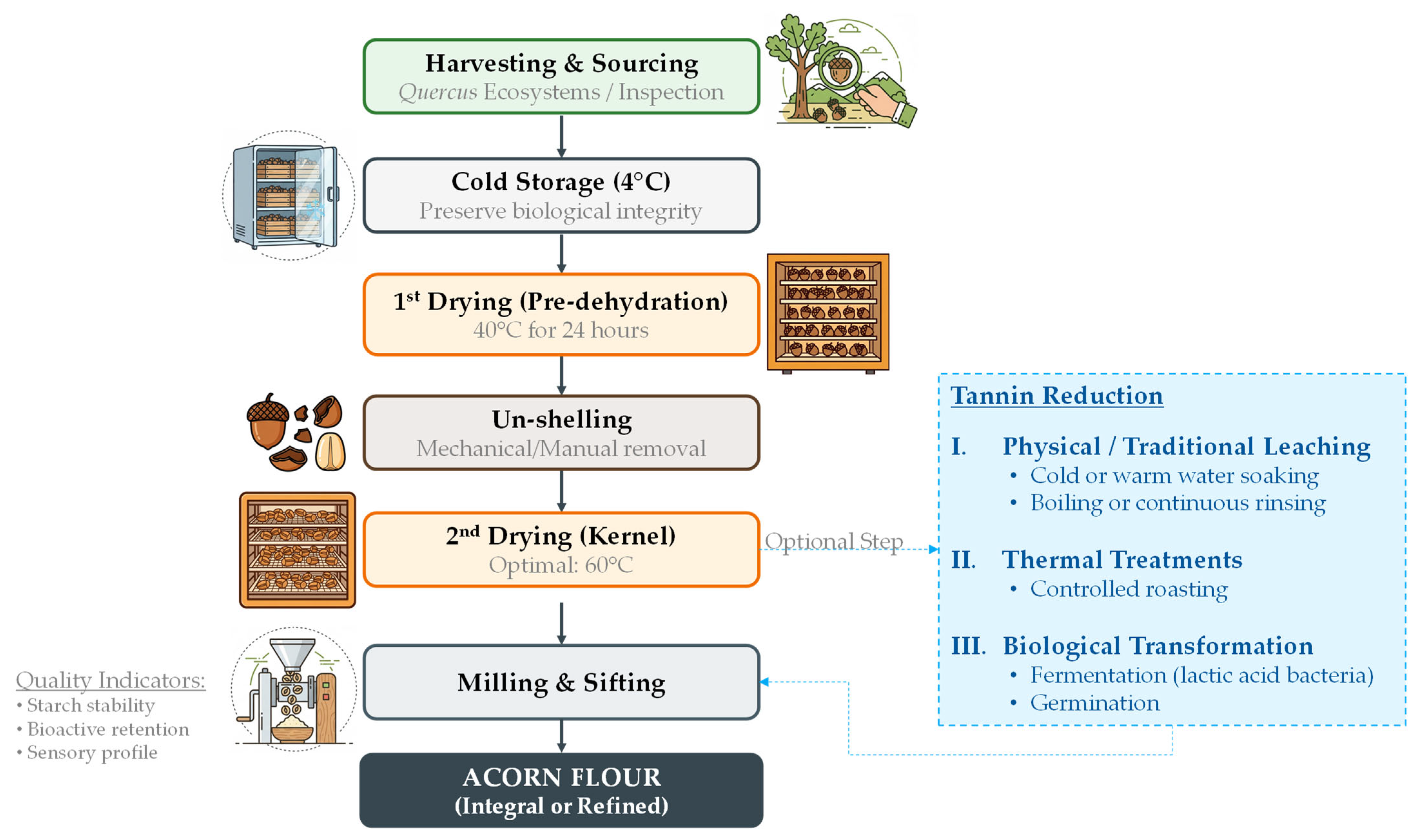
- Raw Material Sourcing: The process begins with the collection of mature acorns from Quercus ecosystems, followed by systematic inspection to remove rotten or infested specimens. Post-harvest handling is critical, as acorns are prone to rapid spoilage due to their high moisture and lipid content. Therefore, raw materials not immediately processed are stored at 4 °C to preserve biological and chemical stability [88,89,90].
- 1st Drying and Un-shelling: Unlike wheat, which undergoes tempering (moisture conditioning), acorns require pre-dehydration at approximately 40 °C for 24 h. This step reduces kernel moisture, limits microbial activity, and facilitates mechanical or manual removal of the pericarp and cupule [89].
- 2nd Drying: After shell removal, acorn kernels undergo a secondary drying phase to further stabilize the material and improve milling efficiency. Reported drying temperatures range from 40 °C to 70 °C; however, 60 °C is often identified as optimal, as it enhances flour consistency, paste stability, and gel-forming capacity, which are critical for baking applications [88].
- Optional Valorization (Debittering and Biotransformation): To enhance palatability, an optional debittering step may be included, involving leaching in water or alkaline solutions to reduce water-soluble tannins responsible for bitterness [4,91]. While these approaches are effective, they may also lead to the loss of soluble nutrients such as minerals and simple sugars. In contrast, thermal treatments primarily induce structural modifications of phenolic compounds (e.g., polymerization or binding to macromolecules), thereby reducing their astringency without complete removal. Emerging strategies such as fermentation (e.g., lactic acid bacteria) and germination promote enzymatic degradation of tannins and modification of the food matrix. These processes enhance functional properties, including water and oil absorption capacity, and reduce tannin bioavailability through interactions with proteins and dietary fiber [90].
- Milling: The final stage involves grinding the processed kernels in laboratory or industrial mills [88,89,90]. Depending on the degree of processing, two main types of flour can be obtained: refined flour, produced exclusively from the kernel, and WG (integral) flour, which utilizes the entire acorn and represents a more sustainable, low-input alternative with higher fiber content [4,92].
| Quercus Species | Sample Type/Matrix | CH (%) | Lipids (%) | Proteins (%) | DF (%) | Ash (%) | Source |
|---|---|---|---|---|---|---|---|
| Q. calliprinos | Whole acorn kernel | 77.86 | 2.31 | 4.94 | 13.11 | 1.78 | [13] |
| Q. canariensis | Dehulled kernel flour (air-dried, milled) | 77.49–84.87 | 3.65–4.73 | 4.59–7.43 | 2.40–2.60 | 2.00–2.70 | [60] |
| Q. cerris | Whole acorn kernels [94]; dehulled roasted kernel flour (milled, 2–3 mm) [99] | 44.10–60.40 | 4.00–5.47 | 6.30–10.49 | 9.11–26.90 | 2.40–2.52 | [94,99] |
| Q. faginea | Acorn pulp—dried and ground for analysis | 81.71 | 7.35 | 7.03 | 1.73 | 2.18 | [59] |
| Q. ilex | Dehulled kernel flour (air-dried, milled) [60]; dehulled kernel flour (dried or roasted, milled) [15] | 75.22–81.99 | 7.96–13.86 | 3.34–5.00 | 2.67–20.90 | 1.70–1.96 | [15,60] |
| Q. ithaburensis | Whole acorn kernel | 58.94 | 0.76 | 2.84 | 34.26 | 3.21 | [13] |
| Q. nigra | Whole acorn (lyophilized, ground) | 91.84 | 2.02 | 5.26 | n.d. | 1.25 | [100] |
| Q. petraea | Whole acorn kernel [13]; dried whole acorn flour (30 °C, milled) | 62.70 | 4.14 | 9.27 | 34.26 | 2.35 | [13,14] |
| Q. pubescens | Dehulled, testa-removed kernel flour (milled, <250 µm) | 78.29 | 5.40 | 6.50 | n.d. | 1.91 | [93] |
| Q. pyrenaica | Dehulled kernel flour (milled, sieved 1 mm; dehulling variants) [101]; kernel flour and leached kernel flour (milled) [17] | 71.11–85.80 | 4.60–7.19 | 6.40–8.60 | 19.70–26.10 | 2.10–2.82 | [17,101] |
| Q. robur | Whole acorn kernels [14,94]; kernel flour and leached kernel flour (milled) [17]; dried acorn tissues (embryo and seed coat), milled (not true flour) [102] | 59.17–76.30 | 5.79–6.08 | 6.09–10.44 | 8.61–20.50 | 1.95–2.84 | [14,17,94,102] |
| Q. rotundifolia | Kernel flour and leached kernel flour (milled) [17]; dehulled kernel flour (dried or roasted, milled) [3] | 74.56–78.03 | 11.27–11.75 | 4.28–4.52 | 11.40–17.90 | 1.60–2.00 | [3,17] |
| Q. rubra | Whole acorn kernels [14] | 56.17 | 3.09 | 5.37 | n.d. | 3.56 | [14] |
| Q. suber | Dehulled kernel flour (air-dried, milled) [60]; lyophilized acorn tissues (whole, kernel, pericarp), milled [62] | 75.39–85.15 | 5.20–5.47 | 5.19–7.63 | 1.90–2.50 | 2.13–2.70 | [60,62] |
| Compound (Unit) | Lipid-Rich AF | Starch-Rich AF | Fiber-Rich AF | WG Wheat Flour | WG Rye Flour | Rice Flour | Corn Flour |
|---|---|---|---|---|---|---|---|
| Water (%) | 4.94–11.76 [15,17,60] | 3.81–11.77 [17,60,93] | 5.20–7.36 [13,94] | 11.70–14.70 [18,109] | 10.00–14.45 [18,110,111] | 8.35–12.80 [20,106] | 10.10–14.00 [16,20,105] |
| Carbohydrates (%) | 70.33–84.09 [3,15,17] | 71.11–84.87 [17,60,93] | 44.10–62.70 [14,94,99] | 63.90–82.40 [109,112] | 82.70 [109] | 79.17–82.13 [106] | 74.30–92.01 [16,105] |
| Sugars (%) | 1.70–34.11 [17,60,108] | 1.20–18.54 [17,60] | 5.21 [13] | 2.10 [112] | 1.80 [111] | n.d. | 0.60 [16] |
| Proteins (%) | 3.34–5.19 [3,15,60] | 4.59–10.44 [17,60,93,94] | 2.84–10.49 [13,94,99] | 9.89–14.60 [20,109,110] | 7.31–13.80 [109,110,111] | 6.89–9.43 [20,106] | 5.50–9.40 [16,20,105] |
| Lipids (%) | 7.03–13.86 [15,59,60] | 3.65–7.19 [17,60,93,94] | 0.76–5.47 [13,14,94] | 1.51–3.63 [20,109,112] | 1.31–2.10 [109,110,111] | 0.16–2.45 [20,106] | 2.48–12.23 [16,20,105] |
| Main fatty acids (%) | |||||||
| Palmitic acid | 12.52–15.10 [15,60,61] | 13.12–14.76 [17,60] | n.d. | 16.30–19.74 [18,20] | 13.40–19.41 [18,113] | 22.43 [20] | 9.20–12.62 [20,114] |
| Oleic acid | 59.85–67.00 [3,15,61] | 20.82–56.84 [17,60] | n.d. | 12.73–14.00 [18,20] | 16.20–17.34 [18,113] | 40.01 [20] | 19.50–30.50 [20,114] |
| Linoleic acid | 14.29–16.12 [3,15,61] | 6.62–24.07 [17,60] | n.d. | 60.79–61.60 [18,20] | 54.58–55.80 [18,113] | 29.38 [20] | 53.00–65.30 [20,114] |
| DF (%) | 10.89–22.81 [3,15,17] | 6.40–31.16 [17,93,101] | 26.90–34.26 [13,99] | 11.42–14.10 [18,20,110] | 16.71–19.00 [18,111,115], | 0.21–0.87 [20,106] | 2.62–7.30 [16,20] |
| Ash (%) | 1.60–2.73 [3,21,60] | 1.91–2.99 [17,93,94] | 0.95–3.21 [13,14,33] | 1.32–1.74 [20,109,110] | 1.27–2.00 [109,110,111] | 0.25–1.25 [20,106] | 0.02–1.20 [16,20,105] |
| Tannins (%) | 3.05–3.81 [61,108,116] | 0.57–3.39 [14,17] | 1.05–3.73 [13,14] | 0.57 [117] | 0.146 [117] | n.d. | 0.427 [117] |
| Vitamins (mg/100 g) | |||||||
| E | 17.06 [17] | 15.96–20.71 [17] | 15.45 [99] | 0.63 [18] | 0.77 [18] | 20.90–29.90 [118] | 94.10 [117] |
| B1 | 0.02 [119] | n.d. | n.d. | 0.27–0.86 [18,112,120] | 0.343–0.42 [18,115] | 0.01–0.13 [119] | 0.39 [16] |
| B2 | 0.13 [119] | n.d. | n.d. | 0.09–0.24 [18,112,120] | 0.102–0.128 [18,115] | 0.10 [119] | 0.20 [16] |
| B6 | 0.03 [119] | n.d. | n.d. | 0.01 [16] | n.d. | 0.15 [119] | 0.62 [16] |
| Minerals (mg/100 g) | |||||||
| Calcium (Ca) | 15.42–240 [17,59,60] | 28.24–164 [17,60,102] | 30.77–380 [13,14,33] | 30.77–39.00 [18,20,121] | 36.90–37.00 [18,121] | 5.07 [20] | 3.32–7.00 [16,20] |
| Iron (Fe) | 0.17–3.00 [3,17,60] | 0.20–19.7 [17,19,102] | 0.76–2.54 [14,33] | 2.69–3.40 [18,20,121] | 2.30–2.36 [18,121] | 0.60 [20] | 0.91–2.70 [16,20] |
| Potassium (K) | 650.0–1150 [3,60] | 713.1–1095 [17,19,102] | 148.8–1030 [13,14,33] | 360.0–399.77 [18,20,121] | 440.0–480.0 [18,121] | 97.37 [20] | 148.70–287.0 [16,20] |
| Zinc (Zn) | 0.37–1.30 [3,17,60] | 0.13–10.40 [17,19,102] | 0.62 [14] | 1.75–3.90 [18,20,121] | 2.35–3.00 [18,121] | 1.78 [20] | 0.66–2.20 [16,20] |
4. Innovative Food Product: Acorn Bread
- -
- It does not require novel food authorization in many jurisdictions.
- -
- It can diversify plant-based ingredient portfolios for bakery products.
- -
- It contributes bioactive compounds, including polyphenols, tocopherols, and carotenoids [31].
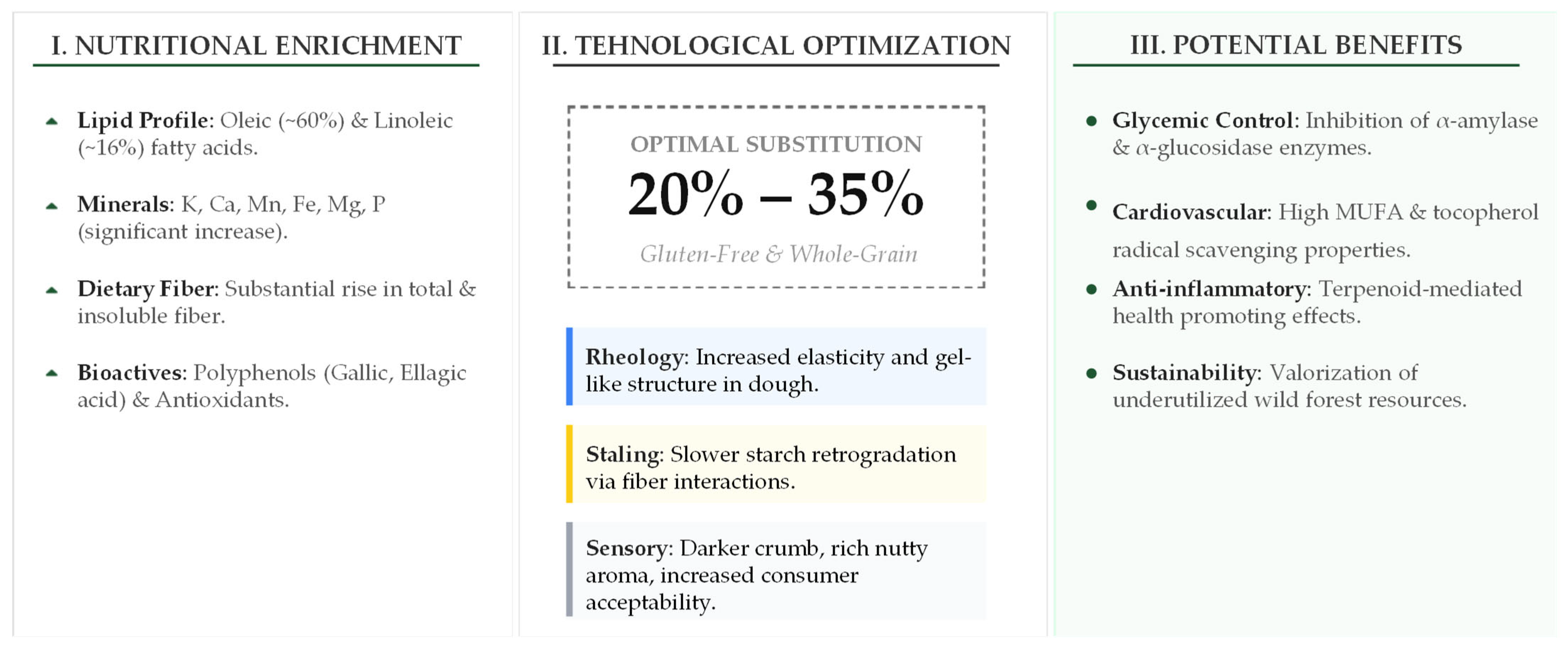
- Impact on Nutritional and Bioactive Profiles: AF significantly enhances the functional value of bread, particularly by introducing healthy lipid fractions (MUFAs and PUFAs) and essential minerals. Research by Beltrão Martins et al. (2020a, 2022b) [3,23] shows that Q. rotundifolia is especially effective in increasing the antioxidant potential of GFB. Additionally, the integration of sourdough fermentation is a crucial strategy for mitigating the high glycemic index often associated with GF products by reducing starch hydrolysis [23,24].
- Rheological and Textural Challenges: Technologically, incorporating AF presents a trade-off between nutrition and structure. In wheat-based systems, AF tends to weaken the gluten network, resulting in lower loaf volumes and increased crumb firmness [78,79]. In contrast, in GF formulations, the high DF and starch content of acorns can strengthen the dough matrix, as shown by the increased storage modulus and stability observed by Korus et al. (2015) and Szabłowska and Tańska (2025a) [31,77].
- Sensory Acceptance and Substitution Thresholds: The literature suggests a sensory threshold for acorn substitution. Lower levels (up to 23%) generally improve color through enhanced browning and provide desirable nutty notes, while higher concentrations (>30%) often introduce bitterness and excessive density. This is particularly evident in Q. ithaburensis and generic species, where high substitution levels negatively affected physical quality despite nutritional gains [33].
4.1. Breadmaking Process with Acorn Flour
- Sifting—incorporates air and removes impurities, improving hydration and dough consistency [132].
- Flour blends—AF is often combined with rice flour, buckwheat, or other starches to optimize dough structure and sensory attributes [23,24,33,34,35]. Rice flour provides a neutral taste, white color, hypoallergenic carbohydrates, and ease of digestion, while buckwheat contributes protein and favorable amino acid profiles [134,135].
- Fermentation—typically yeast-based (Saccharomyces cerevisiae) or sourdough; parameters such as temperature (30–37 °C) and relative humidity (~85%) are critical for optimal gas production. Mixed fermentation strategies combining sourdough and prebiotics (e.g., inulin) have shown enhanced gas retention and crumb structure [24,34,35].
4.2. Acorn Bread Properties
4.2.1. Nutritional Profile
- -
- -
- -
4.2.2. Sensory Attributes
4.2.3. Rheological and Technological Characteristics
4.3. Functional and Potential Health Benefits
- -
- -
- -
4.4. Consumer and Sustainability Perspective
5. Sustainability and Organic Production Perspective of Acorn Bread in the EU
5.1. Introduction and the EU Strategic Framework
5.2. Ecological Characteristics and Environmental Impact
5.3. Regulatory Compliance and Organic Certification
5.4. Circularity, Nutrition, and Public Health
5.5. Technological Feasibility in Organic Systems
5.6. Socio-Economic Benefits and Short Food Supply Chains (SFSC)
5.7. Critical Research Gaps and Future Directions
- Empirical LCA Data: Comparative Life Cycle Assessments (cradle-to-gate) are needed to quantify the energy demands of debittering and milling compared to conventional flour.
- Standardization: Establishing species-specific quality benchmarks for tannin content and microbiological safety of forest-harvested nuts is essential for industrial scalability.
- Safety Thresholds: Validating protocols to ensure the absence of mycotoxins and heavy metals in wild-harvested batches.
6. Conclusions
Author Contributions
Funding
Institutional Review Board Statement
Informed Consent Statement
Data Availability Statement
Conflicts of Interest
Abbreviations
| AF | Acorn flour |
| AFB | Acorn flour bread |
| AOC | Antioxidant capacity |
| DF | Dietary fiber |
| DM | Dry matter |
| dw | Dry weight |
| EU | European Union |
| FAME | Fatty acid methyl-esters |
| FSFS | Framework for Sustainable food systems |
| GF | Gluten-free |
| GFB | Gluten-free bread |
| MUFAs | Monounsaturated fatty acids |
| NUS | Neglected and underutilized species |
| PRISMA | Preferred Reporting Items for Systematic Reviews and Meta-Analyses |
| SFS | Sustainable food systems |
| UFAs | Unsaturated fatty acids |
| WG | Whole grain |
References
- Tejerina, D.; García-Torres, S.; Cabeza de Vaca, M.; Vázquez, F.M.; Cava, R. Acorns (Quercus rotundifolia Lam.) and Grass as Natural Sources of Antioxidants and Fatty Acids in the “montanera” Feeding of Iberian Pig: Intra- and Inter-Annual Variations. Food Chem. 2011, 124, 997–1004. [Google Scholar] [CrossRef] [Scilit]
- Sánchez-Burgos, J.A.; Ramírez-Mares, M.V.; Larrosa, M.M.; Gallegos-Infante, J.A.; González-Laredo, R.F.; Medina-Torres, L.; Rocha-Guzmán, N.E. Antioxidant, Antimicrobial, Antitopoisomerase and Gastroprotective Effect of Herbal Infusions from Four Quercus Species. Ind. Crops Prod. 2013, 42, 57–62. [Google Scholar] [CrossRef] [Scilit]
- Martins, R.B.; Gouvinhas, I.; Nunes, M.C.; Ferreira, L.M.; Peres, J.A.; Raymundo, A.; Barros, A.I.R.N.A. Acorn Flour from Holm Oak (Quercus rotundifolia): Assessment of Nutritional, Phenolic, and Technological Profile. Curr. Res. Food Sci. 2022, 5, 2211–2218. [Google Scholar] [CrossRef] [Scilit]
- Rodrigues Monteiro, E.; Margarida Fonseca, A.; Cunhal Sendim, A.; Cátia Vasconcelos, A.; Santos Ribeiro, V. Valorização Da Bolota Para Consumo Humano Em Portugal [Valorization of Acorns for Human Consumption in Portugal]. Acta Port. De Nutr. 2023, 35, 42–46. [Google Scholar] [CrossRef] [Scilit]
- Szabłowska, E.; Tańska, M. Acorn Flour Properties Depending on the Production Method and Laboratory Baking Test Results: A Review. Compr. Rev. Food Sci. Food Saf. 2021, 20, 980–1008. [Google Scholar] [CrossRef] [Scilit]
- Rasheed Tantray, Y.; Saleem Wani, M.; Hussain, A. Genus Quercus: An Overview. Int. J. Adv. Res. Sci. Eng. 2017, 6, 1880–1886. [Google Scholar]
- Alonso, N.; Pérez Jordà, G.; Rovira, N.; López Reyes, D. Gathering and Consumption of Wild Fruits in the East of the Iberian Peninsula from the 3rd to the 1st Millennium BC. Quat. Int. 2016, 404, 69–85. [Google Scholar] [CrossRef] [Scilit]
- Teira-Brión, A.; Kaal, J.; Lantes-Suárez, Ó.; Oliveira, C.; Rodríguez-Corral, J.; Romero-Vidal, N.; Rey-Castiñeira, J. Shared Technologies for Pottery and Acorns Processing? Multidisciplinary and Functional Approach to Modular Kilns. J. Archaeol. Sci. Rep. 2023, 48, 103877. [Google Scholar] [CrossRef] [Scilit]
- Zocchi, D.M.; Bondioli, C.; Hamzeh Hosseini, S.; Miara, M.D.; Musarella, C.M.; Mohammadi, D.; Khan Manduzai, A.; Dilawer Issa, K.; Sulaiman, N.; Khatib, C.; et al. Food Security beyond Cereals: A Cross-Geographical Comparative Study on Acorn Bread Heritage in the Mediterranean and the Middle East. Foods 2022, 11, 3898. [Google Scholar] [CrossRef] [Scilit] [PubMed]
- Rosenberg, D. The Possible Use of Acorns in Past Economies of the Southern Levant: A Staple Food or a Negligible Food Source? Levant 2008, 40, 167–175. [Google Scholar] [CrossRef] [Scilit]
- Correia, P.R.; Nunes, M.C.; Beirão-da-Costa, M.L. The Effect of Starch Isolation Method on Physical and Functional Properties of Portuguese Nut Starches. II. Q. Rotundifolia Lam. and Q. Suber Lam. Acorns Starches. Food Hydrocoll. 2013, 30, 448–455. [Google Scholar] [CrossRef] [Scilit]
- Vinha, A.F.; Barreira, J.C.M.; Costa, A.S.G.; Oliveira, M.B.P.P. A New Age for Quercus spp. Fruits: Review on Nutritional and Phytochemical Composition and Related Biological Activities of Acorns. Compr. Rev. Food Sci. Food Saf. 2016, 15, 947–981. [Google Scholar] [CrossRef] [Scilit] [PubMed]
- Rababah, T.M.; Ereifej, K.I.; Al-Mahasneh, M.A.; Alhamad, M.N.; Alrababah, M.A.; Muhammad, A.H. The Physicochemical Composition of Acorns for Two Mediterranean Quercus Species. Jordan J. Agric. Sci. 2008, 4, 131–137. [Google Scholar]
- Sikora, F.; Ochmian, I.; Sobolewska, M. Acorn Flour as A Functional Ingredient: Impacts on Health and Baking Properties in Wheat—Based Products. Acta Univ. Cibiniensis. Ser. E Food Technol. 2024, 28, 171–182. [Google Scholar] [CrossRef] [Scilit]
- Silva, S.; Costa, E.M.; Borges, A.; Carvalho, A.P.; Monteiro, M.J.; Pintado, M.M.E. Nutritional Characterization of Acorn Flour (a Traditional Component of the Mediterranean Gastronomical Folklore). J. Food Meas. Charact. 2016, 10, 584–588. [Google Scholar] [CrossRef] [Scilit]
- Gwirtz, J.A.; Garcia-Casal, M.N. Processing Maize Flour and Corn Meal Food Products. Ann. N. Y. Acad. Sci. 2014, 1312, 66–75. [Google Scholar] [CrossRef] [Scilit] [PubMed]
- Rodrigues, C.V.; Maia, M.L.; Babo, P.; Pintado, M. Impact of Leaching on the Nutritional Composition of Acorn Species. J. Food Compos. Anal. 2026, 149, 108788. [Google Scholar] [CrossRef] [Scilit]
- Pferdmenges, L.E.; Lohmayer, R.; Frommherz, L.; Brühl, L.; Hüsken, A.; Mayer-Miebach, E.; Meinhardt, A.K.; Ostermeyer, U.; Sciurba, E.; Zentgraf, H.; et al. Overview of the Nutrient Composition of Selected Milling Products from Rye, Spelt and Wheat in Germany. J. Food Compos. Anal. 2025, 140, 101221. [Google Scholar] [CrossRef] [Scilit]
- Migaskó, H.S.; Ecseri, K.; Pető, J. Nutrient Composition of Oak Acorn Flour. Gradus 2020, 7, 50–52. [Google Scholar] [CrossRef] [Scilit]
- Hager, A.S.; Wolter, A.; Jacob, F.; Zannini, E.; Arendt, E.K. Nutritional Properties and Ultra-Structure of Commercial Gluten Free Flours from Different Botanical Sources Compared to Wheat Flours. J. Cereal Sci. 2012, 56, 239–247. [Google Scholar] [CrossRef] [Scilit]
- Inácio, L.G.; Bernardino, R.; Bernardino, S.; Afonso, C. Acorns: From an Ancient Food to a Modern Sustainable Resource. Sustainability 2024, 16, 9613. [Google Scholar] [CrossRef] [Scilit]
- Sork, V.L.; Bramble, J.; Sexton, O. Ecology of Mast-Fruiting in Three Species of North American Deciduous Oaks. Ecology 1993, 74, 528–541. [Google Scholar] [CrossRef] [Scilit]
- Martins, R.B.; Gouvinhas, I.; Nunes, M.C.; Peres, J.A.; Raymundo, A.; Barros, A.I.R.N.A. Acorn Flour as a Source of Bioactive Compounds in Gluten-Free Bread. Molecules 2020, 25, 3568. [Google Scholar] [CrossRef] [Scilit]
- Martins, R.B.; Nunes, M.C.; Ferreira, L.M.M.; Peres, J.A.; Barros, A.I.R.N.A.; Raymundo, A. Impact of Acorn Flour on Gluten-Free Dough Rheology Properties. Foods 2020, 9, 560. [Google Scholar] [CrossRef] [Scilit] [PubMed]
- Saffarzadeh, A.V.L.C.J. Determination of the Chemical Composition of Acorn (Quercus branti), Pistacia Atlantica and Pistacia Khinjuk Seeds as Non-Conventional Feedstuffs. Acta Agrar. Kaposváriensis 1999, 3, 59–69. [Google Scholar]
- Rakić, S.; Petrović, S.; Kukić, J.; Jadranin, M.; Tešević, V.; Povrenović, D.; Šiler-Marinković, S. Influence of Thermal Treatment on Phenolic Compounds and Antioxidant Properties of Oak Acorns from Serbia. Food Chem. 2007, 104, 830–834. [Google Scholar] [CrossRef] [Scilit]
- Jiang, F.D.G.J. Natural Phenolic Compounds as Cardiovascular Therapeutics: Potential Role of Their Antiinflammatory Effects. Curr. Vasc. Pharmacol. 2003, 1, 135–156. [Google Scholar] [CrossRef] [Scilit] [PubMed]
- Halliwell, B.; Rafter, J.; Jenner, A. Health Promotion by Flavonoids, Tocopherols, Tocotrienols, and Other Phenols: Direct or Indirect Effects? Antioxidant or Not? Am. J. Clin. Nutr. 2005, 81, 268–276. [Google Scholar] [CrossRef] [Scilit]
- Ullah, M.F.K.W. Food as Medicine: Potential Therapeutic Tendencies of Plant Polyphenolic Compounds. Asian Pac. J. Cancer Prev. 2008, 9, 187–196. [Google Scholar]
- Chung, K.T.; Wong, T.Y.; Wei, C.I.; Huang, Y.W.; Lin, Y. Tannins and Human Health: A Review. Crit. Rev. Food Sci. Nutr. 1998, 38, 421–464. [Google Scholar] [CrossRef] [Scilit]
- Korus, J.; Witczak, M.; Ziobro, R.; Juszczak, L. The Influence of Acorn Flour on Rheological Properties of Gluten-Free Dough and Physical Characteristics of the Bread. Eur. Food Res. Technol. 2015, 240, 1135–1143. [Google Scholar] [CrossRef] [Scilit]
- Pasqualone, A.; Makhlouf, F.Z.; Barkat, M.; Difonzo, G.; Summo, C.; Squeo, G.; Caponio, F. Effect of Acorn Flour on the Physico-Chemical and Sensory Properties of Biscuits. Heliyon 2019, 5, e02242. [Google Scholar] [CrossRef] [Scilit]
- Levent, A.; Aktaş, K. Nutritional Composition and Staling Properties of Gluten-Free Bread-Added Fermented Acorn Flour. Food Sci. Nutr. 2024, 12, 1955–1964. [Google Scholar] [CrossRef] [Scilit]
- Beltrão Martins, R.; Garzón, R.; Peres, J.A.; Barros, A.I.R.N.A.; Raymundo, A.; Rosell, C.M. Acorn Flour and Sourdough: An Innovative Combination to Improve Gluten Free Bread Characteristics. Eur. Food Res. Technol. 2022, 248, 1691–1702. [Google Scholar] [CrossRef] [Scilit]
- Shiri, A.; Ehrampoush, M.H.; Yasini Ardakani, S.A.; Shamsi, F.; Mollakhalili-Meybodi, N. Technological Characteristics of Inulin Enriched Gluten-Free Bread: Effect of Acorn Flour Replacement and Fermentation Type. Food Sci. Nutr. 2021, 9, 6139–6151. [Google Scholar] [CrossRef] [Scilit] [PubMed]
- Plessas, S.; Mantzourani, I.; Alexopoulos, A.; Smaoui, S.; Varzakas, T. Modernising Gluten-Free Bread: Functional Fortification Strategies and the Pivotal Role of Sourdough in Quality Enhancement. Transl. Food Sci. 2026, 2, vxaf020. [Google Scholar] [CrossRef] [Scilit]
- The European Parliament and the Council of the European Union REGULATION (EU) 2018/848 OF THE EUROPEAN PARLIAMENT AND OF THE COUNCIL of 30 May 2018 on Organic Production and Labelling of Organic Products and Repealing Council Regulation (EC) No 834/2007. Off. J. Eur. Union 2018, L 150, 1–92.
- Bratu, I.; Dinca, L.; Constandache, C.; Murariu, G. Resilience and Decline: The Impact of Climatic Variability on Temperate Oak Forests. Climate 2025, 13, 119. [Google Scholar] [CrossRef] [Scilit]
- United Nations. Transforming Our World: The 2030 Agenda for Sustainable Development; United Nations: New York, NY, USA, 2015. [Google Scholar]
- Torbica, A.; Hadnadev, M.; Dapčević, T. Rheological, Textural and Sensory Properties of Gluten-Free Bread Formulations Based on Rice and Buckwheat Flour. Food Hydrocoll. 2010, 24, 626–632. [Google Scholar] [CrossRef] [Scilit]
- Zhang, Q.; Yu, J.; Li, K.; Bai, J.; Zhang, X.; Lu, Y.; Sun, X.; Li, W. The Rheological Performance and Structure of Wheat/Acorn Composite Dough and the Quality and in Vitro Digestibility of Its Noodles. Foods 2021, 10, 2727. [Google Scholar] [CrossRef] [Scilit]
- Mokhtari, Z.; Ziaiifar, A.M.; Alami, M.; Kashaninejad, M.; Aghajanzadeh, S.; Dezyani, A.; Arjeh, E. Development of Rice Cake Fortified With Acorn Flour and Inulin Using Superheated Steam Technology: Analysis of Physicochemical, Structural, and Baking Properties. Food Sci. Nutr. 2025, 13, e4759. [Google Scholar] [CrossRef] [Scilit]
- Korus, A.; Gumul, D.; Krystyjan, M.; Juszczak, L.; Korus, J. Evaluation of the Quality, Nutritional Value and Antioxidant Activity of Gluten-Free Biscuits Made from Corn-Acorn Flour or Corn-Hemp Flour Composites. Eur. Food Res. Technol. 2017, 243, 1429–1438. [Google Scholar] [CrossRef] [Scilit]
- Mousavi, B.; Ghaderi, S.; Hesarinejad, M.A.; Pourmahmoudi, A. Effect of Varying Levels of Acorn Flour on Antioxidant, Staling and Sensory Properties of Iranian Toast. Int. J. Food Stud. 2021, 10, 322–333. [Google Scholar] [CrossRef] [Scilit]
- Gezici, S.; Sekeroglu, N. Neuroprotective Potential and Phytochemical Composition of Acorn Fruits. Ind. Crops Prod. 2019, 128, 13–17. [Google Scholar] [CrossRef] [Scilit]
- Sibbel, A. The Sustainability of Functional Foods. Soc. Sci. Med. 2007, 64, 554–561. [Google Scholar] [CrossRef] [Scilit] [PubMed]
- Spiertz, H. Food Production, Crops and Sustainability: Restoring Confidence in Science and Technology. Curr. Opin. Environ. Sustain. 2010, 2, 439–443. [Google Scholar] [CrossRef] [Scilit]
- Boukhelkhal, M.; Moulai-Mostefa, N. Physicochemical Characterization of Starch Isolated from Soft Acorns of Holm Oak (Quercus ilex subsp. ballota (Desf.) Samp.) Grown in Algeria. J. Food Meas. Charact. 2017, 11, 1995–2005. [Google Scholar] [CrossRef] [Scilit]
- European Parliament. Council of the European Union Regulation (EC) No 1924/2006 on Nutrition and Health Claims Made on Foods. Off. J. Eur. Union 2006, 404, 9–25. [Google Scholar]
- Al-Rousan, W.M.; Ajo, R.Y.; Al-Ismail, K.M.; Attlee, A.; Shaker, R.R.; Osaili, T.M. Characterization of Acorn Fruit Oils Extracted from Selected Mediterranean Quercus Species. Grasas Y Aceites 2013, 64, 554–560. [Google Scholar] [CrossRef] [Scilit]
- Charef, M.; Yousfi, M.; Saidi, M.; Stocker, P. Determination of the Fatty Acid Composition of Acorn (Quercus), Pistacia lentiscus Seeds Growing in Algeria. J. Am. Oil Chem. Soc. 2008, 85, 921–924. [Google Scholar] [CrossRef] [Scilit]
- Cintra, D.E.; Ropelle, E.R.; Moraes, J.C.; Pauli, J.R.; Morari, J.; de Souza, C.T.; Grimaldi, R.; Stahl, M.; Carvalheira, J.B.; Saad, M.J.; et al. Unsaturated Fatty Acids Revert Diet-Induced Hypothalamic Inflammation in Obesity. PLoS ONE 2012, 7, e30571. [Google Scholar] [CrossRef] [Scilit]
- Roman, O.; Heyd, B.; Broyart, B.; Castillo, R.; Maillard, M.N. Oxidative Reactivity of Unsaturated Fatty Acids from Sunflower, High Oleic Sunflower and Rapeseed Oils Subjected to Heat Treatment, under Controlled Conditions. LWT-Food Sci. Technol. 2013, 52, 49–59. [Google Scholar] [CrossRef] [Scilit]
- Deehan, E.C.; Mocanu, V.; Madsen, K.L. Effects of Dietary Fibre on Metabolic Health and Obesity. Nat. Rev. Gastroenterol. Hepatol. 2024, 21, 301–318. [Google Scholar] [CrossRef] [Scilit] [PubMed]
- Alahmari, L.A. Dietary Fiber Influence on Overall Health, with an Emphasis on CVD, Diabetes, Obesity, Colon Cancer, and Inflammation. Front. Nutr. 2024, 11, 1510564. [Google Scholar] [CrossRef] [Scilit]
- Djordjević, M.; Djordjević, M.; Šoronja-Simović, D.; Nikolić, I.; Šereš, Z. Delving into the Role of Dietary Fiber in Gluten-Free Bread Formulations: Integrating Fundamental Rheological, Technological, Sensory, and Nutritional Aspects. Polysaccharides 2022, 3, 59–82. [Google Scholar] [CrossRef] [Scilit]
- Ariyarathna, P.; Mizera, P.; Walkowiak, J.; Dziedzic, K. Physicochemical and Functional Properties of Soluble and Insoluble Dietary Fibers in Whole Grains and Their Health Benefits. Foods 2025, 14, 2447. [Google Scholar] [CrossRef] [Scilit]
- Mudgil, D.; Barak, S. Composition, Properties and Health Benefits of Indigestible Carbohydrate Polymers as Dietary Fiber: A Review. Int. J. Biol. Macromol. 2013, 61, 1–6. [Google Scholar] [CrossRef] [Scilit]
- Cañellas Rey de Viñas, I.; Gómez, S.R.; Ayans, A.S.M. Caracterización y Evolución Anual Del Valor Bromatológico de Las Quercíneas Mediterráneas [Characterization and Annual Evolution of the Bromatological Value of Mediterranean Oaks]. In Pastos, Desarrollo y Conservación; Belén Robles Cruz, A., Ramos Font, M., Eds.; Junta de Andalucía: Granada, Spain, 2003; pp. 455–462. ISBN 84-8474-100-1. [Google Scholar]
- Haddada, A.; Saadellaoui, W.; Hammami, N.; Kahlaoui, S.; Klibi, N.; Hannachi, H.; Stambouli-Essassi, S. Nutritional Profile of Acorn Flour from Three Tunisian Quercus L. Species: Interspecific and Intraspecific Variation. EuroMediterr. J. Environ. Integr. 2025, 10, 3425–3438. [Google Scholar] [CrossRef] [Scilit]
- Cantos, E.; Espín, J.C.; López-Bote, C.; de la Hoz, L.; Ordóñez, J.A.; Tomás-Barberán, F.A. Phenolic Compounds and Fatty Acids from Acorns (Quercus spp.), the Main Dietary Constituent of Free-Ranged Iberian Pigs. J. Agric. Food Chem. 2003, 51, 6248–6255. [Google Scholar] [CrossRef] [Scilit] [PubMed]
- Vinha, A.F.; Costa, A.S.G.; Barreira, J.C.M.; Pacheco, R.; Oliveira, M.B.P.P. Chemical and Antioxidant Profiles of Acorn Tissues from Quercus spp.: Potential as New Industrial Raw Materials. Ind. Crops Prod. 2016, 94, 143–151. [Google Scholar] [CrossRef] [Scilit]
- Rakić, S.; Povrenović, D.; Tešević, V.; Simić, M.; Maletić, R. Oak Acorn, Polyphenols and Antioxidant Activity in Functional Food. J. Food Eng. 2006, 74, 416–423. [Google Scholar] [CrossRef] [Scilit]
- Lin, Y.; Lu, Y.; Song, Z.; Huang, D. Characterizations of the Endogenous Starch Hydrolase Inhibitors in Acorns of Quercus fabri Hance. Food Chem. 2018, 258, 111–117. [Google Scholar] [CrossRef] [Scilit]
- Molina-García, L.; Martínez-Expósito, R.; Fernández-De Córdova, M.L.; Llorent-Martínez, E.J. Determination of the Phenolic Profile and Antioxidant Activity of Leaves and Fruits of Spanish Quercus coccifera. J. Chem. 2018, 2018, 2573270. [Google Scholar] [CrossRef] [Scilit]
- Choubey, S.; Varughese, L.R.; Kumar, V.; Beniwal, V. Medicinal Importance of Gallic Acid and Its Ester Derivatives: A Patent Review. Pharm. Pat. Anal. 2015, 4, 305–315. [Google Scholar] [CrossRef] [Scilit]
- Szabłowska, E.; Tańska, M. Acorns as a Source of Valuable Compounds for Food and Medical Applications: A Review of Quercus Species Diversity and Laboratory Studies. Appl. Sci. 2024, 14, 2799. [Google Scholar] [CrossRef] [Scilit]
- Mokhtari, Z.; Ziaiifar, A.M.; Dezyani, A.; Hassanzadeh, H. Development and Characterization of Gluten-Free Cakes: Combined Effects of Acorn Flour and Inulin as Functional Ingredients. Cereal Res. Commun. 2025, 54, 601–616. [Google Scholar] [CrossRef] [Scilit]
- Parsaei, M.; Goli, M.; Abbasi, H. Oak Flour as a Replacement of Wheat and Corn Flour to Improve Biscuit Antioxidant Activity. Food Sci. Nutr. 2018, 6, 253–258. [Google Scholar] [CrossRef] [Scilit] [PubMed]
- Shahamati, M.; Ahmadi, P.; Tabibiazar, M.; Fazelioskouei, T.; Azadmard-Damirchi, S.; Zargaraan, A. Characterization of Acorn Oil and Its Application on Carnauba Wax-Based Oleogel and Chocolate Spread. Int. J. Biol. Macromol. 2024, 260, 129571. [Google Scholar] [CrossRef] [Scilit]
- Sekeroglu, N.; Ozkutlu, F.; Kilic, E. Mineral Composition of Acorn Coffees. Indian J. Pharm. Educ. Res. 2017, 51, S504–S507. [Google Scholar] [CrossRef] [Scilit]
- Coelho, M.; Silva, S.; Rodríguez-Alcalá, L.M.; Oliveira, A.; Costa, E.M.; Borges, A.; Martins, C.; Rodrigues, A.S.; Pintado, M.M.E. Quercus Based Coffee-like Beverage: Effect of Roasting Process and Functional Characterization. J. Food Meas. Charact. 2018, 12, 471–479. [Google Scholar] [CrossRef] [Scilit]
- Rakic, S.; Kukic-Markovic, J.; Petrovic, S.; Teševic, V.; Jankovic, S.; Povrenovic, D. Oak Kernels—Volatile Constituents and Coffee-Like Beverages. J. Agric. Sci. 2018, 10, 117. [Google Scholar] [CrossRef] [Scilit]
- Şenol, F.S.; Şekeroğlu, N.; Gezıcı, S.; Kiliç, E.; Erdoğan Orhan, İ. Neuroprotective Potential of the Fruit (Acorn) from Quercus coccifera L. Turk. J. Agric. For. 2018, 42, 82–87. [Google Scholar] [CrossRef] [Scilit]
- Cinkmanis, I.; Straumite, E.; Cakste, I. Sensory Evaluation of Beer Drinks. Proc. Latv. Univ. Agric. 2014, 31, 25–32. [Google Scholar] [CrossRef] [Scilit]
- Castro, L.M.G.; Sousa, S.C.; Machado, M.; Alexandre, E.M.C.; Saraiva, J.A.; Pintado, M. Valorization of Resistant Starch from Acorns as a New Ingredient for Chocolate Milk Puddings. Explor. Food Foodomics 2025, 3, 101092. [Google Scholar] [CrossRef] [Scilit]
- Szabłowska, E.; Tańska, M. Effects of Acorn Flour Addition on Baking Characteristics of Wheat Flour. Foods 2025, 14, 190. [Google Scholar] [CrossRef] [Scilit]
- Hrušková, M.; Švec, I.; Kadlčíková, I. Effect of Chestnut and Acorn Flour on Wheat/Wheat-Barley Flour Properties and Bread Quality. Int. J. Food Stud. 2019, 8, 41–57. [Google Scholar] [CrossRef]
- Sikora, F.; Ochmian, I.; Sobolewska, M.; Iwański, R. Effect of Apple, Chestnut, and Acorn Flours on the Technological and Sensory Properties of Wheat Bread. Appl. Sci. 2025, 15, 8067. [Google Scholar] [CrossRef] [Scilit]
- Kasprzak-Drozd, K.; Mołdoch, J.; Gancarz, M.; Wójtowicz, A.; Kowalska, I.; Oniszczuk, T.; Oniszczuk, A. In Vitro Digestion of Polyphenolic Compounds and the Antioxidant Activity of Acorn Flour and Pasta Enriched with Acorn Flour. Int. J. Mol. Sci. 2024, 25, 5404. [Google Scholar] [CrossRef] [Scilit]
- Molavi, H.; Keramat, J.; Raisee, B. Evaluation of the Cake Quality Made from Acorn-Wheat Flour Blends as a Functional Food. J. Food Biosci. Technol. 2015, 5, 53–60. [Google Scholar]
- Gal, R.-B.; Jianu, C.; Velciov, A.-B.; Poiană, M.-A.; Negrea, M.; Cocan, I.; Riviș, A.; Hădărugă, N.; Stoin, D. Quality Parameters Assessment of Cakes Produced from Acorn-Rice Flour Mixtures. J. Agroaliment. Proc. Technol. 2023, 29, 375–382. [Google Scholar]
- Ajo, R.Y. Effect of Acorn Flour Substitution on Arabic Bread Properties. Pak. J. Agric. Sci. 2018, 55, 913–919. [Google Scholar]
- Szabłowska, E.; Tańska, M. Effect of Microwave-Assisted Processing of Acorn Flour on Muffin Quality. Appl. Sci. 2025, 15, 6204. [Google Scholar] [CrossRef] [Scilit]
- Sadeghi-Dehsahraei, H.; Babajafari, S.; Ashrafi, M.; Mohammadi-Sartang, M. Comparison of the Effect of Consuming the Prepared Cakes with Acorn Flour and Wheat Flour Following a Hypocaloric Diet on Serum Levels of Leptin, Endothelin, Inflammatory Factors, and Oxidative Stress Parameters in Obese and Overweight Patients with Metabolic Syndrome: A Double-Blind Clinical Trial. Food Sci. Nutr. 2024, 12, 8043–8052. [Google Scholar] [CrossRef] [Scilit]
- Correia, P.R.; Beirão-Da-Costa, M.L. Starch Isolation from Chestnut and Acorn Flours through Alkaline and Enzymatic Methods. Food Bioprod. Process. 2012, 90, 309–316. [Google Scholar] [CrossRef] [Scilit]
- Akcan, T.; Gökçe, R.; Asensio, M.; Estévez, M.; Morcuende, D. Acorn (Quercus spp.) as a Novel Source of Oleic Acid and Tocopherols for Livestock and Humans: Discrimination of Selected Species from Mediterranean Forest. J. Food Sci. Technol. 2017, 54, 3050–3057. [Google Scholar] [CrossRef] [Scilit]
- Correia, P.R.; Beirão-Da-Costa, M.L. Effect of Drying Temperatures on Starch-Related Functional and Thermal Properties of Acorn Flours. J. Food Sci. 2011, 76, 284–294. [Google Scholar] [CrossRef] [Scilit]
- Correia, P.R.; Leitão, A.E.; Beirão-Da-Costa, M.L. Effect of Drying Temperatures on Chemical and Morphological Properties of Acorn Flours. Int. J. Food Sci. Technol. 2009, 44, 1729–1736. [Google Scholar] [CrossRef] [Scilit]
- Amina, M.; Djamel, F.; Djamel, H. Influence of Fermentation and Germination Treatments on Physicochemical and Functional Properties of Acorn Flour. Bulg. J. Agric. Sci. 2018, 24, 719–726. [Google Scholar]
- Papoti, V.T.; Kizaki, N.; Skaltsi, A.; Karayannakidis, P.D.; Papageorgiou, M. The Phytochemical Rich Potential of Acorn (Quercus aegilops) Products and by Products. Food Sci. Biotechnol. 2018, 27, 819–828. [Google Scholar] [CrossRef] [Scilit]
- Sacchelli, S.; Cavuta, T.; Borghi, C.; Cipollaro, M.; Fratini, R.; Bernetti, I. Financial Analysis of Acorns Chain for Food Production. Forests 2021, 12, 784. [Google Scholar] [CrossRef] [Scilit]
- Lukinac, J.; Medaković, D.; Koceva Komlenić, D.; Šušak, A.; Jukić, M. Application of Quercus Pubescens Acorn Flour and Xanthan Gum in Gluten-Free Cookies: RSM Optimization and Quality Evaluation. Foods 2026, 15, 966. [Google Scholar] [CrossRef] [Scilit]
- Rakić, S. Effect of Oak Acorn Extracts on Lipide Oxidation Kinetics. J. Agric. Sci. 2000, 45, 139–143. [Google Scholar]
- Genevois, C.E.; Grenóvero, M.S.; de Escalada Pla, M.F. Use of Different Proportions of Rice Milling Fractions as Strategy for Improving Quality Parameters and Nutritional Profile of Gluten-Free Bread. J. Food Sci. Technol. 2021, 58, 3913–3923. [Google Scholar] [CrossRef] [Scilit]
- Martínez, M.M.; Díaz, Á.; Gómez, M. Effect of Different Microstructural Features of Soluble and Insoluble Fibres on Gluten-Free Dough Rheology and Bread-Making. J. Food Eng. 2014, 142, 49–56. [Google Scholar] [CrossRef] [Scilit]
- Yulistiani, R.; Ambarwati, P.; Pratiwi, Y.S.; Wardianto, M.R. Utilization of Rice Flour and Soy Flour with the Addition of Xanthan Gum for Making Gluten-Free White Bread. J. Tek. Pertan. Lampung (J. Agric. Eng.) 2025, 14, 2080–2090. [Google Scholar] [CrossRef] [Scilit]
- Fetriyuna, F.; Salma, A.N.; Harlina, P.W.; Yarlina, V.P.; Purwestri, R.C. The Role of Xanthan Gum and Hydroxypropyl Methylcellulose in Gluten-Free Bread: A Study of Physical Characteristics, Texture, and Nutrition. Food Sci. Nutr. 2026, 14, e71292. [Google Scholar] [CrossRef] [Scilit]
- Pinto, D.; Diaz Franco, S.; Silva, A.M.; Cupara, S.; Koskovac, M.; Kojicic, K.; Soares, S.; Rodrigues, F.; Sut, S.; Dall’Acqua, S.; et al. Chemical Characterization and Bioactive Properties of a Coffee-like Beverage Prepared from Quercus Cerris Kernels. Food Funct. 2019, 10, 2050–2060. [Google Scholar] [CrossRef] [Scilit]
- Pinheiro Pacheco, A.R. Análise Nutricional, Físico-Química e Atividade de Frutos de Quercus sp. Visando a Sua Valorização [Nutritional, Physicochemical and Activity Analysis of Quercus sp. Fruits Aiming at Their Valorization]. Master’s Thesis, University of Porto, Porto, Portugal, 2015. [Google Scholar]
- Castro, L.M.G.; Ribeiro, T.B.; Machado, M.; Alexandre, E.M.C.; Saraiva, J.A.; Pintado, M. Unraveling the Effect of Dehulling Methods on the Nutritional Composition of Acorn quercus spp. J. Food Compos. Anal. 2022, 106, 104354. [Google Scholar] [CrossRef] [Scilit]
- Nikolić, N.; Orlović, S.; Krstić, B.; Kevrešan, Ž. Variability of Acorn Nutrient Concentrations in Pedunculate Oak (Quercus robur L.) Genotypes. J. For. Sci. 2006, 52, 51–60. [Google Scholar] [CrossRef] [Scilit]
- Özcan, T. Total Protein and Amino Acid Compositions in the Acorns of Turkish quercus L. Taxa. Genet. Resour. Crop Evol. 2006, 53, 419–429. [Google Scholar] [CrossRef] [Scilit]
- Laze, A.; Arapi, V.; Ceca, E.; Gusho, K.; Pezo, L.; Brahushi, F.; Kneževic, D. Chemical Composition and Amino Acid Content in Different Genotypes of Wheat Flour. Period. Polytech. Chem. Eng. 2019, 63, 618–628. [Google Scholar] [CrossRef] [Scilit]
- Agume Ntso, A.S.; Njintang, Y.N.; Mbofung, C.M.F. Physicochemical and Pasting Properties of Maize Flour as a Function of the Interactive Effect of Natural-Fermentation and Roasting. J. Food Meas. Charact. 2016, 11, 451–459. [Google Scholar] [CrossRef] [Scilit]
- Ronie, M.E.; Abdul Aziz, A.H.; Mohd Noor, N.Q.I.; Yahya, F.; Mamat, H. Characterisation of Bario Rice Flour Varieties: Nutritional Compositions and Physicochemical Properties. Appl. Sci. 2022, 12, 9064. [Google Scholar] [CrossRef] [Scilit]
- Lončarić, P.; Jukić, M.; Cozmuta, A.M.; Cozmuta, L.G.M.; Uivarasan, A.M.; Pichler, A.; Lučan Čolić, M.; Lukinac, J. FTIR-Based Study of Starch Retrogradation and Protein Structure in Chickpea-Enriched Gluten-Free Bread During Storage. Foods 2026, 15, 412. [Google Scholar] [CrossRef] [Scilit]
- Rtibi, K.; Hammami, I.; Selmi, S.; Grami, D.; Sebai, H.; Amri, M.; Marzouki, L. Phytochemical Properties and Pharmacological Effects of Quercus ilex L. Aqueous Extract on Gastrointestinal Physiological Parameters in Vitro and in Vivo. Biomed. Pharmacother. 2017, 94, 787–793. [Google Scholar] [CrossRef] [Scilit] [PubMed]
- Cardoso, R.V.C.; Fernandes, Â.; Heleno, S.A.; Rodrigues, P.; Gonzaléz-Paramás, A.M.; Barros, L.; Ferreira, I.C.F.R. Physicochemical Characterization and Microbiology of Wheat and Rye Flours. Food Chem. 2019, 280, 123–129. [Google Scholar] [CrossRef] [Scilit]
- Litwinek, D.; Buksa, K.; Kowaclzyk, M.; Boreczek, J.; Gambuś, H. Ocena Jakości Handlowych Mąk Całoziarnowych—Pszennej Orkiszowej, Pszennej Zwyczajnej i Żytniej Oraz Uzyskanych z Nich Zakwasów Spontanicznych [Assessment of the Commercial Quality of Wholegrain Flours—Spelt Wheat, Common Wheat and Rye—And of the Spontaneous Sourdoughs Obtained from Them]. Żywność Nauka Technol. Jakość 2017, 24, 76–89. [Google Scholar]
- Kołodziejczyk, P.; Michniewicz, J.; Buchowski, M.S.; Paschke, H. Effects of Fibre-Rich Rye Milling Fraction on the Functional Properties and Nutritional Quality of Wholemeal Rye Bread. J. Food Sci. Technol. 2020, 57, 222–232. [Google Scholar] [CrossRef] [Scilit]
- Kumar, P.; Yadava, R.K.; Gollen, B.; Kumar, S.; Kant Verma, R.; Yadav, S. Nutritional Contents and Medicinal Properties of Wheat: A Review. Life Sci. Med. Res. 2011, 22, 1–10. [Google Scholar]
- Sujka, K.; Koczoń, P.; Ceglińska, A.; Reder, M.; Ciemniewska-Zytkiewicz, H. The Application of FT-IR Spectroscopy for Quality Control of Flours Obtained from Polish Producers. J. Anal. Methods Chem. 2017, 2017, 4315678. [Google Scholar] [CrossRef] [Scilit]
- Goffman, F.D.; Böhme, T. Relationship between Fatty Acid Profile and Vitamin E Content in Maize Hybrids (Zea mays L.). J. Agric. Food Chem. 2001, 49, 4990–4994. [Google Scholar] [CrossRef] [Scilit]
- Kalnina, S.; Rakcejeva, T.; Gramatina, I.; Kunkulberga, D. Investigation of Total Dietary Fiber, B1 and B2 Vitamin Content of Flour Blend for Pasta Production. In Proceedings of the 9th Baltic Conference on Food Science and Technology “Food for Consumer Well-Being”; LLU, Faculty of Food Technology: Jelgava, Latvia, 2014; pp. 133–137. [Google Scholar]
- Ferraz De Oliveira, M.I.; Machado, M.G.; Cancela D’abreu, M. Acorn Chemical Composition Depending on Shedding Date and Quercus Species. In Proceedings of the 7th International Symposium on the Mediterranean Pig; De Pedro, E.J., Cabezas, A.B., Eds.; International Centre for Advanced Mediterranean Agronomic Studies: Saragossa, Spain, 2012; pp. 229–234. [Google Scholar]
- Miladinović, B.; Ilić, K.; Stojanović, D.; Kostić, M.; Milutinović, M.; Branković, S.; Kitić, D. Antioxidant Activity, Total Phenol and Tannin Content of Different Varieties of Flours. Acta Medica Median. 2020, 59, 100–107. [Google Scholar] [CrossRef] [Scilit]
- Iqbal, S.Z.; Mustafa, H.G.; Asi, M.R.; Jinap, S. Variation in Vitamin E Level and Aflatoxins Contamination in Different Rice Varieties. J. Cereal Sci. 2014, 60, 352–355. [Google Scholar] [CrossRef] [Scilit]
- Rybicka, I.; Gliszczyn’ska, A.; Wigło, G.-S. Gluten-Free Flours from Different Raw Materials as the Source of Vitamin B1, B2, B3 and B6. J. Nutr. Sci. Vitaminol. 2017, 63, 125–132. [Google Scholar] [CrossRef] [Scilit]
- Rohi, M.; Pasha, I.; Butt, M.S.; Nawaz, H. Variation in the Levels of B-Vitamins and Protein Content in Wheat Flours. Pak. J. Nutr. 2013, 12, 441–447. [Google Scholar] [CrossRef] [Scilit]
- Ertl, K.; Goessler, W. Grains, Whole Flour, White Flour, and Some Final Goods: An Elemental Comparison. Eur. Food Res. Technol. 2018, 244, 2065–2075. [Google Scholar] [CrossRef] [Scilit]
- Claudia, P. Acorn Bread: A Traditional Food of the Past in Sardinia (Italy). J. Cult. Herit. 2013, 14, 117–124. [Google Scholar] [CrossRef] [Scilit]
- Gifford, E.W. California Balanophagy; California Indian Library Collections Project: 1936; University of California Press: Berkeley, CA, USA, 1936. [Google Scholar]
- Chestnut, V.K. Plants Used by the Indians of Mendocino County, California. U.S. Natl. Herb. Contr. 1902, 7, 295–422. [Google Scholar]
- Barrett, S.A.; Gifford, E.W. Miwok Material Culture; Public Museum of the City of Milwaukee: Milwaukee, WI, USA, 1933; Volume 2. [Google Scholar]
- Barrett, S.A. Material Aspects of Pomo Culture; Public Museum of the City of Milwaukee: Milwaukee, WI, USA, 1952; Volume 2. [Google Scholar]
- Lamacchia, C.; Camarca, A.; Picascia, S.; Di Luccia, A.; Gianfrani, C. Cereal-Based Gluten-Free Food: How to Reconcile Nutritional and Technological Properties of Wheat Proteins with Safety for Celiac Disease Patients. Nutrients 2014, 6, 575–590. [Google Scholar] [CrossRef] [Scilit]
- Størdal, K.; Kurppa, K. Celiac Disease, Non-Celiac Wheat Sensitivity, Wheat Allergy—Clinical and Diagnostic Aspects. Semin. Immunol. 2025, 77, 101930. [Google Scholar] [CrossRef] [Scilit] [PubMed]
- Rosell, C.M.; Barro, F.; Sousa, C.; Mena, C. Cereals for Developing Gluten Free Products and Analytical Tools for Gluten Detection. J. Cereal Sci. 2014, 59, 354–364. [Google Scholar] [CrossRef] [Scilit]
- Bai, J.C.; Ciacci, C.; Melberg, J. World Gastroenterology Organisation Global Guidelines: Celiac Disease February 2017. J. Clin. Gastroenterol. 2017, 51, 755–768. [Google Scholar] [CrossRef] [Scilit] [PubMed]
- Pongjaruvat, W.; Methacanon, P.; Seetapan, N.; Fuongfuchat, A.; Gamonpilas, C. Influence of Pregelatinised Tapioca Starch and Transglutaminase on Dough Rheology and Quality of Gluten-Free Jasmine Rice Breads. Food Hydrocoll. 2014, 36, 143–150. [Google Scholar] [CrossRef] [Scilit]
- Gibson, M.; Newsham, P. Bread. In Food Science and the Culinary Arts; Elsevier: Amstedram, The Netherlands, 2018; pp. 121–131. [Google Scholar]
- Chesterton, A.K.S.; De Abreu, D.A.P.; Moggridge, G.D.; Sadd, P.A.; Wilson, D.I. Evolution of Cake Batter Bubble Structure and Rheology during Planetary Mixing. Food Bioprod. Process. 2013, 91, 192–206. [Google Scholar] [CrossRef] [Scilit]
- Abdul, R. Gluten-Free Breads. In Gluten-Free Cereal Products and Beverages; Arendt, E., Dal Bello, F., Eds.; Elsevier/Academic Press: Cork, Ireland, 2008; pp. 292–308. ISBN 9780123737397. [Google Scholar]
- Ren, Y.; Linter, B.R.; Linforth, R.; Foster, T.J. A Comprehensive Investigation of Gluten Free Bread Dough Rheology, Proving and Baking Performance and Bread Qualities by Response Surface Design and Principal Component Analysis. Food Funct. 2020, 11, 5333–5345. [Google Scholar] [CrossRef] [Scilit]
- Horstmann, S.W.; Axel, C.; Arendt, E.K. Water Absorption as a Prediction Tool for the Application of Hydrocolloids in Potato Starch-Based Bread. Food Hydrocoll. 2018, 81, 129–138. [Google Scholar] [CrossRef] [Scilit]
- Mondal, A.; Datta, A.K. Bread Baking—A Review. J. Food Eng. 2008, 86, 465–474. [Google Scholar] [CrossRef] [Scilit]
- Torrinha, Á.; Oliveira, M.; Marinho, S.; Paíga, P.; Delerue-Matos, C.; Morais, S. Mineral Content of Various Portuguese Breads: Characterization, Dietary Intake, and Discriminant Analysis. Molecules 2019, 24, 2787. [Google Scholar] [CrossRef] [Scilit]
- Švec, I.; Hrušková, M.; Kadlčíková, I. Features of Flour Composites Based on the Wheat or Wheat-Barley Flour Combined with Acorn and Chestnut. Croat. J. Food Sci. Technol. 2018, 10, 89–97. [Google Scholar] [CrossRef] [Scilit]
- Purlis, E. Browning Development in Bakery Products—A Review. J. Food Eng. 2010, 99, 239–249. [Google Scholar] [CrossRef] [Scilit]
- Taib, M.; Bouyazza, L.; Lyoussi, B. Acorn Oil: Chemistry and Functionality. J. Food Qual. 2020, 2020, 8898370. [Google Scholar] [CrossRef] [Scilit]
- Denk, T.; Grimm, G.W.; Manos, P.S.; Deng, M.; Hipp, A. An Updated Infrageneric Classification of the Oaks: Review of Previous Taxonomic Schemes and Synthesis of Evolutionary Patterns. In Oaks Physiological Ecology. Exploring the Functional Diversity of Genus quercus L.; Gil-Pelegrín, E., Peguero-Pina, J., Sancho-Knapik, D., Eds.; Springer: Berlin/Heidelberg, Germany, 2017; pp. 13–38. [Google Scholar]
- Vinha, A.F.; Barreira, J.C.M.; Ferreira, I.C.F.R.; Oliveira, M.B.P.P. Therapeutic, Phytochemistry, and Pharmacology of Acorns (Quercus Nuts): A Review. In Bioactive Compounds in Underutilized Fruits and Nuts; Murthy, H.N., Bapat, V.A., Eds.; Springer: Berlin/Heidelberg, Germany, 2020; pp. 273–287. [Google Scholar]
- Wu, M.; Yang, Q.; Wu, Y.; Ouyang, J. Inhibitory Effects of Acorn (Quercus variabilis Blume) Kernel-Derived Polyphenols on the Activities of α-Amylase, α-Glucosidase, and Dipeptidyl Peptidase IV. Food Biosci. 2021, 43, 101224. [Google Scholar] [CrossRef] [Scilit]
- Nogueira, A.; Soares, C.; Grosso, C.; Ramalhosa, M.J. Acorns as a Functional Food for Cardiovascular Disease Prevention: Chemical Characterization and Bioactivity. Biol. Life Sci. Forum 2022, 18, 59. [Google Scholar] [CrossRef] [Scilit]
- Sasani, N.; Kazemi, A.; Babajafari, S.; Amiri-Ardekani, E.; Rezaiyan, M.; Barati-Boldaji, R.; Mazloomi, S.M.; Clark, C.C.T.; Ashrafi-Dehkordi, E. The Effect of Acorn Muffin Consumption on Glycemic Indices and Lipid Profile in Type 2 Diabetic Patients: A Randomized Double-Blind Placebo-Controlled Clinical Trial. Food Sci. Nutr. 2023, 11, 883–891. [Google Scholar] [CrossRef] [Scilit]
- Jiang, Q.; Im, S.; Wagner, J.G.; Hernandz, M.L.; Peden, D.B. Gamma-Tocopherol, a Major Form of Vitamin E in Diets: Insights into 1 Antioxidant and Anti-Inflammatory Effects, Mechanisms, and Roles in 2 Disease Management. Free Radic. Biol. Med. 2022, 178, 347–359. [Google Scholar] [CrossRef] [Scilit]
- Pahrudin Arrozi, A.; Shukri, S.N.S.; Wan Ngah, W.Z.; Mohd Yusof, Y.A.; Ahmad Damanhuri, M.H.; Jaafar, F.; Makpol, S. Comparative Effects of Alpha- and Gamma-Tocopherol on Mitochondrial Functions in Alzheimer’s Disease In Vitro Model. Sci. Rep. 2020, 10, 8962. [Google Scholar] [CrossRef] [Scilit]
- Huang, Y.; Xu, J.; Wang, Y.; Lei, Y.; Mai, Y.; He, X. Q43, a New Triterpenoid Extracted from Chinese Acorn, Exhibits Pronounced Anti-Neuroinflammatory Activity through the MAPK and NF-ΚB Pathways. J. Funct. Foods 2021, 83, 104566. [Google Scholar] [CrossRef] [Scilit]
- Xu, J.; Wang, X.; Su, G.; Yue, J.; Sun, Y.; Cao, J.; Zhang, X.; Zhao, Y. The Antioxidant and Anti-Hepatic Fibrosis Activities of Acorns (Quercus liaotungensis) and Their Natural Galloyl Triterpenes. J. Funct. Foods 2018, 46, 567–578. [Google Scholar] [CrossRef] [Scilit]
- Mai, Y.; Wang, Z.; Wang, Y.; Xu, J.; He, X. Anti-Neuroinflammatory Triterpenoids from the Seeds of Quercus serrata Thunb. Fitoterapia 2020, 142, 104523. [Google Scholar] [CrossRef] [Scilit]
- European Comission. The European Green Deal; European Comission: Brussels, Belgium, 2019. [Google Scholar]
- European Comission. A Farm to Fork Strategy for a Fair, Healthy and Environmentally-Friendly Food System CONTENTS; European Comission: Brussels, Belgium, 2020. [Google Scholar]
- Torralba, M.; Fagerholm, N.; Burgess, P.J.; Moreno, G.; Plieninger, T. Do European Agroforestry Systems Enhance Biodiversity and Ecosystem Services? A Meta-Analysis. Agric. Ecosyst. Environ. 2016, 230, 150–161. [Google Scholar] [CrossRef] [Scilit]
- Rajaniemi, M.; Mikkola, H.; Ahokas, J. Greenhouse Gas Emissions from Oats, Barley, Wheat and Rye Production. Agron. Res. Biosyst. Eng. Spec. Issue 2011, 1, 189–195. [Google Scholar]
- Mondani, F.; Aleagha, S.; Khoramivafa, M.; Ghobadi, R. Evaluation of Greenhouse Gases Emission Based on Energy Consumption in Wheat Agroecosystems. Energy Rep. 2017, 3, 37–45. [Google Scholar] [CrossRef] [Scilit]
- Balaganesh, B.; Subramani, M.; Sinduja, M.; Bose, S.; Vunnam, V. Carbon Sequestration Potential of Oak Tree. In Compendium of Agriculture and Allied Sciences; JPS Scientific Publications: Tamil Nadu, India, 2022; Volume 3, ISBN 9789391342838. [Google Scholar]
- Farm Advisory Service (FAS). Trees and Carbon Capture—The Science. FAS Inf. Note FAS Scotl. UK 2022. Available online: https://www.fas.scot/downloads/information-note-trees-and-carbon-capture/ (accessed on 2 May 2026).
- Brunori, A.M.E.; Sdringola, P.; Dini, F.; Ilarioni, L.; Nasini, L.; Regni, L.; Proietti, P.; Proietti, S.; Vitone, A.; Pelleri, F. Carbon Balance and Life Cycle Assessment in an Oak Plantation for Mined Area Reclamation. J. Clean. Prod. 2017, 144, 69–78. [Google Scholar] [CrossRef] [Scilit]
- Anderson, J.W.; Baird, P.; Davis, R.H.; Ferreri, S.; Knudtson, M.; Koraym, A.; Waters, V.; Williams, C.L. Health Benefits of Dietary Fiber. Nutr. Rev. 2009, 67, 188–205. [Google Scholar] [CrossRef] [Scilit] [PubMed]
- European Parliament. Short Food Supply Chains and Local Food Systems in the EU; European Parliament: Strasbourg, France, 2016. [Google Scholar]


| Acorn Species | Substitution Level | Matrix and Process Conditions | Main Effects on Dough and Bread Quality | Reference |
|---|---|---|---|---|
| Q. rotundifolia | 23%, 35% | GF (buckwheat/rice); Baking: 180 °C, 50 min | Enhanced bioactive profile (lipids, minerals); 23% addition optimized sensory acceptance. | [23] |
| Q. rotundifolia | 23%, 35% | GF (rice); Sourdough fermentation | The synergistic effect of acorn and sourdough reduced starch hydrolysis and improved fatty acid profile. | [34] |
| Q. rubra, Q. robur, Q. petraea | 5%, 10%, 15% | Wheat bread (type 650 flour); double fermentation, standard baking | Increased crumb hardness and density at higher levels; darker crust/crumb (especially red oak); reduced sensory acceptance due to bitterness (tannins); acceptable quality at 5% substitution | [79] |
| Q. ilex and Q. rotundifolia | 23%, 35% | GF (buckwheat/rice); Rheological characterization | Increased dough viscoelasticity and firmness; significantly modified pasting properties. | [24,33] |
| Q. ithaburensis | 15%, 30%, 45% | GF (rice/corn); Fermented vs. raw flour | Fermentation enhanced nutritional density but negatively impacted loaf volume and texture. | [33] |
| Quercus sp. (n.d.) | 20%, 40%, 60% | GF (corn/potato starch); Double fermentation | Strengthened starch network; increased storage modulus; improved overall sensory scores. | [31] |
| Quercus sp. | 10%, 30%, 50% | GF (rice); Inulin addition; 4 h incubation | Improved crust browning; significant changes in crumb technological and antioxidant parameters. | [35] |
| Quercus sp. | 5%, 10% | Wheat and Wheat-Barley composites | Increased water absorption; weakened gluten network; bitter/acidic notes at >10% substitution. | [78] |
| Q. robur/ Q. petraea | 0–100% | Wheat-acorn blends (up to 50:50) | Enhanced dough stability and development time; reduced specific volume and flowability. | [77] |
Disclaimer/Publisher’s Note: The statements, opinions and data contained in all publications are solely those of the individual author(s) and contributor(s) and not of MDPI and/or the editor(s). MDPI and/or the editor(s) disclaim responsibility for any injury to people or property resulting from any ideas, methods, instructions or products referred to in the content. |
© 2026 by the authors. Licensee MDPI, Basel, Switzerland. This article is an open access article distributed under the terms and conditions of the Creative Commons Attribution (CC BY) license.
Share and Cite
Lončarić, P.; Jukić, M.; Velić, D.; Lukinac, J. Acorn Bread: The Synergy of Acorn Flour, Sustainability, and EU Organic Standards. Foods 2026, 15, 1625. https://doi.org/10.3390/foods15101625
Lončarić P, Jukić M, Velić D, Lukinac J. Acorn Bread: The Synergy of Acorn Flour, Sustainability, and EU Organic Standards. Foods. 2026; 15(10):1625. https://doi.org/10.3390/foods15101625
Chicago/Turabian StyleLončarić, Petra, Marko Jukić, Darko Velić, and Jasmina Lukinac. 2026. "Acorn Bread: The Synergy of Acorn Flour, Sustainability, and EU Organic Standards" Foods 15, no. 10: 1625. https://doi.org/10.3390/foods15101625
APA StyleLončarić, P., Jukić, M., Velić, D., & Lukinac, J. (2026). Acorn Bread: The Synergy of Acorn Flour, Sustainability, and EU Organic Standards. Foods, 15(10), 1625. https://doi.org/10.3390/foods15101625