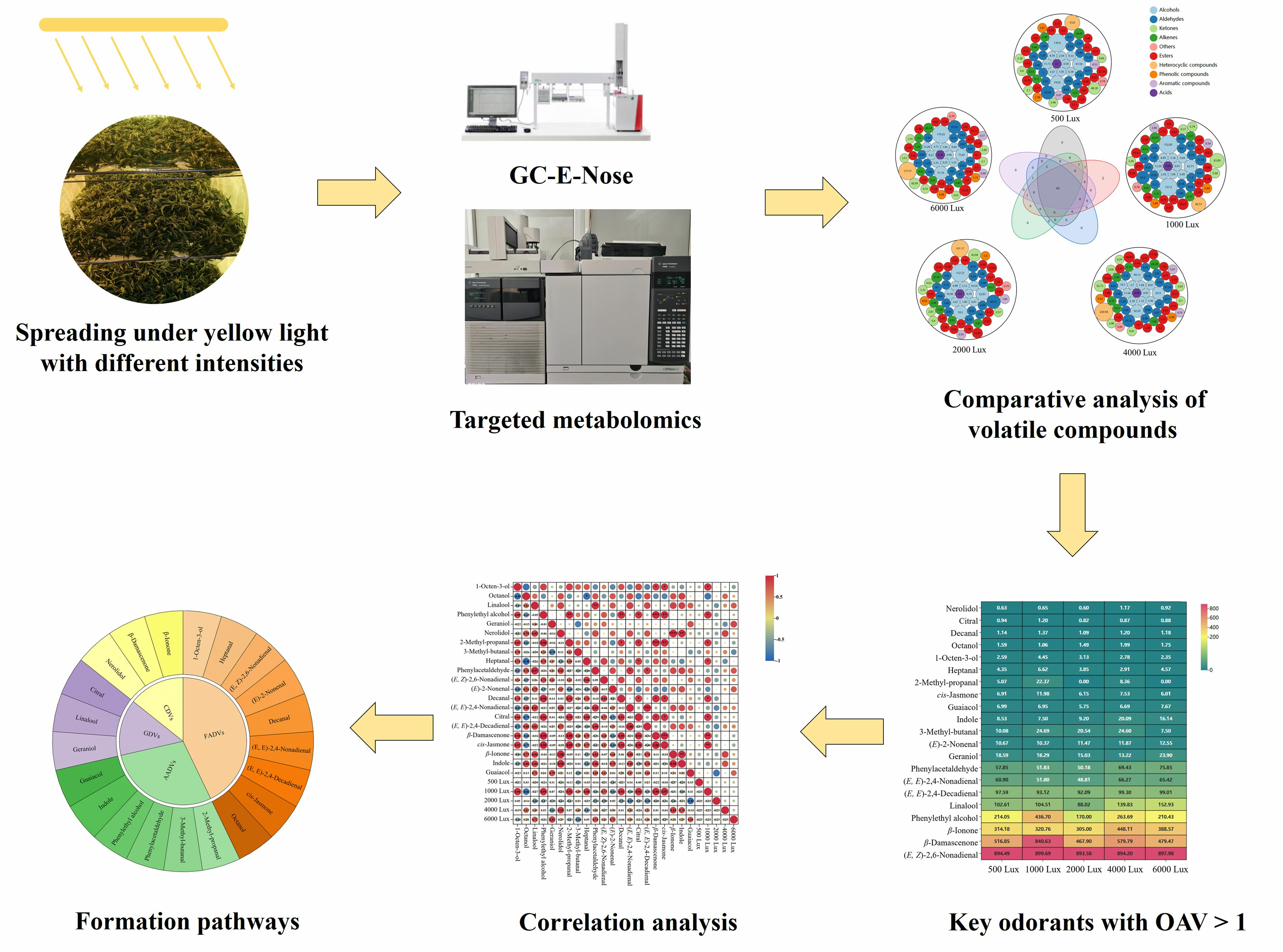
Decoding Light-Spreading Intensity Effects on the Sensory Quality and Volatile Compounds of Green Tea: An Integrated GC-E-Nose and Targeted Metabolomics Analysis

 ,
, Abstract
Share and Cite
Wang, Q.; Hu, J.; Tang, J.; Zhou, X.; Yuan, H.; Jiang, Y.; Xie, J.; Yang, Y. Decoding Light-Spreading Intensity Effects on the Sensory Quality and Volatile Compounds of Green Tea: An Integrated GC-E-Nose and Targeted Metabolomics Analysis. Foods 2025, 14, 1313. https://doi.org/10.3390/foods14081313
Wang Q, Hu J, Tang J, Zhou X, Yuan H, Jiang Y, Xie J, Yang Y. Decoding Light-Spreading Intensity Effects on the Sensory Quality and Volatile Compounds of Green Tea: An Integrated GC-E-Nose and Targeted Metabolomics Analysis. Foods. 2025; 14(8):1313. https://doi.org/10.3390/foods14081313
Chicago/Turabian StyleWang, Qiwei, Jiajing Hu, Jiahao Tang, Xianxiu Zhou, Haibo Yuan, Yongwen Jiang, Jialing Xie, and Yanqin Yang. 2025. "Decoding Light-Spreading Intensity Effects on the Sensory Quality and Volatile Compounds of Green Tea: An Integrated GC-E-Nose and Targeted Metabolomics Analysis" Foods 14, no. 8: 1313. https://doi.org/10.3390/foods14081313
APA StyleWang, Q., Hu, J., Tang, J., Zhou, X., Yuan, H., Jiang, Y., Xie, J., & Yang, Y. (2025). Decoding Light-Spreading Intensity Effects on the Sensory Quality and Volatile Compounds of Green Tea: An Integrated GC-E-Nose and Targeted Metabolomics Analysis. Foods, 14(8), 1313. https://doi.org/10.3390/foods14081313