


Abstract
Fermentable oligosaccharides, di- and monosaccharides, and polyols defined as FODMAPs readily trigger the symptoms of irritable bowel syndrome (IBS), which affects up to 23% of the population, through several mechanisms. A low-FODMAP diet is a short-term solution due to significant nutrient deficiencies, especially in dietary fibre (DF). IBS patients must avoid cereals, especially wholegrain cereals such as wheat and rye, which are an important natural source of DF and therefore FODMAPs (part of soluble DF). This study is the first of its kind to employ biotechnological tools for the creation of wholegrain low-FODMAP cookies and crackers based on wholegrain wheat and rye flours with high FODMAP contents. Endogenous enzymes activated via prolonged dough resting and exogenously activated enzymes originating from chicory extract, wheat malt, and baker’s yeast were employed. The prolonged dough resting time and the addition of wheat malt reduced the FODMAP content in the wholegrain wheat and rye cookies by 46% and 99.5%, respectively. The best result was achieved in the wholegrain wheat crackers, with a FODMAP content reduction of 59.3% based on the combination of a prolonged dough resting time and the addition of wheat malt and baker’s yeast. In the wholegrain rye crackers, a prolonged resting time alone was sufficient to achieve an 83.6% reduction in the total oligosaccharide content.
1. Introduction
The label FODMAP defines fermentable oligosaccharides, di- and monosaccharides, and polyols that are poorly absorbed in the small intestine and thus rapidly fermented in the colon by indigenous microorganisms; they readily trigger the symptoms of irritable bowel syndrome (IBS) [1]. FODMAPs can affect individuals, especially those with IBS or other gastrointestinal disorders, via several mechanisms, leading to symptoms such as bloating, gas, constipation, diarrhoea, and abdominal pain [2,3]. These mechanisms include an increase in gas and water retention and production, leading to luminal distension, the modulation of visceral hypersensitivity, increases in intestinal permeability, the induction of microbiota changes, and the production of short-chain fatty acids (SCFAs), as well as alterations in motility [4]. IBS is the disorder most often disorder diagnosed by gastroenterologists and affects between 9% and 23% of the population [5]. The implementation of a low-FODMAP diet, i.e., a dietary approach restricting the intake of poorly absorbable, fermentable carbohydrates, has become accepted in the treatment of IBS among both gastroenterologists and dieticians because it significantly reduces the symptoms of IBS [6].
These fermentable oligosaccharides include fructans, fructooligosaccharides (FOS), inulin and galactans (mainly galactooligosaccharides (GOS)), raffinose, stachyose, and verbascose. The disaccharides that are classified as FODMAPs include lactose, the monosaccharides include fructose, and the polyols include sorbitol, mannitol, xylitol, and maltitol. According to the most recent evidence, melibiose is also included in the FODMAP category [7,8]. FODMAPs are found in a wide variety of foods, including lactose in milk and yoghurt; fructose in honey and fruits; inulin and FOS in garlic, onion, rye, wheat, banana, and tomato; GOS in legumes; and polyols in stone fruits, mushrooms, and several artificial sweeteners [9]. Wheat and rye are major contributors to the dietary intake of low-molecular-weight fructans, but wholegrain products are also major contributors to the intake of dietary fibre [10].
To comply with the FODMAP recommendations, the cut-off value for each specific FODMAP compound and category is definable and ranges from 0.15 to 1 g per serving/meal for IBS patients. However, diet therapy based on the avoidance of FODMAPs restricts food choices too extensively, eliminating staple foods, likely including wheat derivatives and various vegetables, legumes, and fruits. With this dietary regimen, IBS patients could suffer from a reduced intake of fibre, minerals, vitamins, and phytochemicals. In addition to this unbalanced nutritional status, the drastic reduction in FODMAPs interferes with the intestinal microbiota and colonocyte metabolism [11].
Wheat and wheat-based products only account for one-fourth of the daily calorie intake in the European population, and a significant portion of this comprises bakery products that are designated as staple foods. However, due to the naturally occurring FODMAPs in cereals such as wheat or rye (where fructans and FOS predominate), products made from these grains must be largely avoided by IBS patients [8,12]. Cookies are eaten worldwide, meaning that they are the most consumed confectionary products, and they are suitable for all age groups [13].
Recent research has focused on boosting the nutritional profile of cookies, especially in terms of enriching their dietary fibre content from various sources (mostly the by-products from fruit processing) [14]. An increased fibre content was shown to improve the textural properties of cookies, including their hardness, fracturability, and chewiness [15]. These findings suggest that fortifying low-FODMAP biscuits with high fibre contents could potentially serve as a beneficial intervention for alleviating IBS symptoms [16].
Crackers are considered popular snack products and are in clear demand amongst consumers. Crackers are generally defined as thin, dry, and crisp bakery products, usually made of wheat flour, salt, shortening (or fat), and leavening agents (yeast or chemical rising agents, or a combination of both) [17]. There are only two cracker products labelled as “low-FODMAP” [18]. Although cookies and crackers have similar major ingredients, the main difference, aside from their sugar content, is the application of chemical (cookies) and chemical and/or biological raising agents (crackers).
Taking into the account that the majority of the current research on the creation of low-FODMAP cookies and crackers is based on choosing low-FODMAP ingredients, the challenging task in this study was to create low-FODMAP cookies and crackers from flours with high FODMAP contents (wholegrain wheat and wholegrain rye). Our main goal was to create low-FODMAP products that have high nutritional value, high fibre content, and satisfactory sensory quality and thus do not differ from the standard and most consumed products of these types. In order to achieve this, the application of biotechnological tools, coupled with process optimization, was used and evaluated. The biotechnological tools included endogenous and exogenous enzymes and fermentation [3,19]. Endogenous enzymes originating from wholegrain flour were activated by means of prolonged dough resting, while the exogenous enzymes originated from chicory (in chicory root extract), wheat malt, and bakers’ yeast.
2. Materials and Methods
2.1. Materials
The wholegrain wheat flour, wholegrain rye flour, chicory root, fresh baker’s yeast (Saccharomyces cerevisiae), salt (NaCl), shortening (vegetable fat with a melting point of 36–38 °C, Puratos, Beograd, Serbia), sucrose, and chemical rising agents (sodium hydrogen carbonate and ammonium hydrogen carbonate) that were used in this study were acquired from a local market. The wheat cultivars Nataša and Izalco (cultivars developed by the Institute of Field and Vegetable Crops, Novi Sad, Serbia) were used for the production of wheat malt.
2.2. Production of Chicory Extract
The herbal extract of chicory (Cichoriae Radix) was produced from dried chicory roots, obtained from the Institute of Medicinal Plant Research “Dr. Josif Pančić”. The dried chicory roots were first washed with distilled water and mixed with 100 mM of sodium acetate buffer (pH 5) in a 1:10 ratio (w/w). The mixture was left for 72 h at 4 °C and subsequently filtered through cheesecloth (cotton gauze). The obtained chicory extract was frozen and kept at −20 °C before use. The chicory extract had an FEH activity of 6.5 ± 0.8 U ((μmoL fructose liberated × h−1)/g raw plant material), which was determined using the method proposed by Krivorotova and Sereikaite [20].
2.3. Production of Wheat Malt
The production of wheat malt from two domestic varieties was achieved according to the modified standard MEBAK procedure described by Krstanović et al. [21]. Micromalting (steeping and germination) was performed in a controlled-atmosphere incubator (Bluepard MGC-250 Plant Growth Chamber, Shanghai Bluepard Instruments Co., Ltd., Shanghai, China) at 14.5 °C and with a humidity of 85% to achieve a grain moisture content of 44.5%. After steeping, the grains were left to germinate once the grain moisture was adjusted to 44% (by means of spraying). Then, the produced malt was kilned at 40 °C for 24 h (Memmert IN160, Memmert GmbH+Co. KG, Schwabach, Germany), transferred into paper bags, and kept at room temperature for 30 days to stabilize their enzyme activity and moisture content. Wheat malt from the variety Nataša was added as a 30% substitution for wholegrain wheat flour, while wheat malt from the variety Izalco was added as a 5% substitution for wholegrain rye flour.
2.4. Cookie Preparation Procedure
The cookie samples were prepared using the procedure described in Table 1. After the mixing and resting phase, all doughs were laminated to 6 mm, and a No. 4 (diameter: 4 cm) round mould was used to shape the cookies. After baking, the cookies were left to cool and placed in plastic bags for further analysis.

Table 1.
Procedures for wholegrain cookie preparation.
2.5. Cracker Preparation Procedure
Cracker samples were prepared using the procedure described in Table 2. After the fermentation and resting phase, all the doughs were laminated to 6 mm, and a No. 3 (diameter: 3 cm) round mould was used to shape the crackers. After baking, the crackers were left to cool and placed in plastic bags for further analysis.
Table 2.
Procedures for wholegrain cracker preparation.
2.6. Quantification of FODMAPs Using HPAEC-PAD Method
All the samples (final samples after baking) were then freeze-dried and ground. A total of 50 mL of ultrapure water was added to 0.5 g of ground sample, and after that, the samples were placed in a boiling water bath for 10 min. Afterwards, the samples were cooled to room temperature and centrifuged at 8000 rpm for 10 min at 4 °C, and the separated supernatant was frozen at −20 °C (to enable the separation of any fat present, thus avoiding the use of organic solvents). The frozen supernatant was thawed and then centrifuged at a speed of 8000 rpm for 5 min at 4 °C. Finally, 5 mL of the prepared sample was transferred to vials for the HPAEC-PAD procedure.
Targeted carbohydrates were separated and quantified using a Dionex ICS-6000+ system (Sunnivale, CA, USA) and an electrochemical detector (ED) with a gold working electrode and a AgCl reference electrode.
For monosaccharides, disaccharides, and polyols, the eluents consisted of 10 mM NaOH, 200 mM NaOH, and ultrapure water. The separation of monosaccharides, disaccharides, and polyols was performed on a Thermo Scientific Dionex CarboPac PA20 analytical column (3 × 150 mm), with an appropriate protective column, using an isocratic elution according to the method of Weitzhandler et al. [22].
The separation of oligosaccharides (FOS and GOS) was carried out using a Thermo Scientific Dionex CarboPac PA200 analytical column (3 × 250 mm), with an appropriate guard column, using a gradient elution according to the method of Ispiryan et al. [23]. The eluents that were used for separation were 200 mM NaOH, 500 mM NaOH, 500 mM NaOAc, and ultrapure water. Separation was performed at a temperature of 30 °C on both columns, while detection was performed at 25 °C.
For the quantification of FODMAPs, an extrapure 50% sodium hydroxide solution (in water) (Fisher Chemical™, Bruxelles, Belgium), sodium acetate (99%+, NaOAc) (Thermo Scientific, Leipzig, Germany), and standards were used. The standards included fructose, galactose, glucose, sucrose, mannitol, sorbitol, 1-kestose, nystose, stachyose hydrate (Sigma-Aldrich, Taufkirchen, Germany), xylitol, rhamnose monohydrate, raffinose pentahydrate (Roth, Lichtentanne, Germany), lactose monohydrate, melibiose, maltitol (Thermo Scientific, Germany), verbascose, and 1,1,1-kestopentaose (Megazyme, Republic of Ireland, Wicklow, Ireland). All the carbohydrate reference standards were of >98% purity, except for 1,1,1-kestopentaose (80% purity). Ultrapure water, with a resistivity of 18.2 MΩ·cm and a total organic carbon (TOC) content of <5 ppb (ASTM Type I), was used for the preparation of the HPAEC-PAD eluents, all standard solutions, and samples; it was obtained using an Adrona Crystal-pure water purification system (Riga, Latvia).
2.7. Total Fructans
The total fructan content was determined using the Megazyme fructan assay kit, K-FRUC (Megazyme Ltd., Wicklow, Ireland), as a reference method.
2.8. Textural Properties
The biscuits’ fracture strength was measured on a TA-XTplus (Stable Micro Systems, Godalming, Surrey, UK) texturometer using a 3-point bending test. A 3-point bending rig and a 30 kg cell were used with the following test settings: pre- and post-test speeds: 1 and 10 mm/s, respectively; test speed: 3 mm/s; probe distance: 8 mm; and distance between the supports: 24 mm. The maximum force recorded at sample fracture was interpreted as the “hardness”, while the mean distance that the probe travelled until the point of fracture was the “fracturability”. A shorter probe distance indicates higher fracturability of a sample. For each sample, 3 replicates were analysed.
2.9. Sensory Analyses
The sensory analysis of the crackers and cookies was carried out in a sensory testing laboratory with appropriate control of the environmental conditions (under artificial daylight and temperature control (22 °C)) according to the ISO 8589:2007 standard [24]. A panel of seven highly trained and experienced assessors (3 male and 4 female), between 22 and 55 years old, who had more than two years of experience in the examination of commercial wholegrain products and products developed within scientific research projects was selected. The panel was trained over ten sessions of 2 h per day. The training included the identification of sensory descriptors (Table 3) and evaluation of the intensity of relevant sensory attributes. During descriptive sensory assessments, panellists were asked to score seven parameters, appearance, colour, porosity, aroma, taste, odour, and aftertaste, evaluating the intensity of each attribute on a 9-point scale from 9 (“extremely good”) to 1 (“extremely bad”). In total, three crackers and three cookies were evaluated in two separate sessions, 24 h after baking. All of the samples were coded with random three-digit numbers and served with water with a low mineral content to rinse the palate between individual samples. Prior to the assessment, a two-hour session was held to select relevant sensory attributes (Table 3).
Table 3.
Sensory descriptors and their definition.
2.10. Statistical Analyses
The experiments were performed in triplicates. Values are expressed as means ± standard deviation. The statistical calculations were carried out using MS Excel 2010.
3. Results and Discussion
3.1. FODMAP Compounds Reduction During Creation of Cookies and Crackers
Instead of avoiding FODMAP-containing food products, the FODMAP content of foods can be reduced by means of bioprocessing, such as enzymatic treatment, fermentation, or germination. During fermentation and germination, several enzymatic processes take place, leading to polymer degradation, the generation of metabolites, and other major changes. Germinated seeds or malt, which are also used as additives (as partial flour substitutes), could be considered as a valuable source of endogenous enzymes that have the potential to reduce the contents of specific FODMAPs. By using enzymatic treatment, the FODMAPs can be targeted more specifically than when using fermentation and germination [25]. In order to fully address the issue of the complexity and variety of cut-off values for each FODMAP category in terms of contents per serving and g/100 g of product “as is”, the currently available definitions from regulation authorities for the markets of Europe, USA, Canada, and Australia are summarized in Table 4 [26,27,28,29,30].
Table 4.
Serving sizes and cut-off values for FODMAP compounds per serving and per g/100 g “as is” for cookies and crackers.
The contents of different categories of FODMAP compounds in the created cookies and crackers are presented in Table 5 and Table 6, respectively.
Table 5.
Contents of different categories of FODMAP compounds in cookies (g/100 g “as is”) *.
Table 6.
Contents of different categories of FODMAP compounds in crackers (g/100 g “as is”) *.
In regard to other literature data and the definition of low/high levels of FODMAPs, the higher values of specific FODMAP categories were used in each sample for the determination of low- or high-FODMAP status (rating based on Table 1). In addition, the presence of significant amounts of GOS in the cereal-based products was evident, which clearly affects their low–high-FODMAP status. This contrasts with previous findings that FOS are the predominant FODMAP oligosaccharides in grains and grain-based products [31].
Based on the results regarding the contents of FODMAP compounds in the cookie and cracker samples, obtained using three different processes for FODMAP content reduction, it is evident that the prolonged dough resting time after kneading (the mixing of all ingredients) only activated the endogenous enzymes of the flour and yeast efficiently in the case of yeast cracker production. The substitution of some of the flour with wheat malt in the dough proved to be a more effective procedure for reducing the FODMAP content, because with this method, an ingredient with the already activated enzymes was added into the formulation of cookies and crackers. However, the level of enzymatic activity of wheat malt significantly depends on the wheat variety. Thus, in the case of malt produced from the wheat variety Nataša, high enzymatic activity was achieved with the 30% substitution of wholegrain wheat flour, resulting in the creation of low-FODMAP cookies, while its combination with the fresh baker’s yeast enabled the production of low-FODMAP wholegrain wheat yeast crackers.
The substitution of wholegrain rye flour with 5% malt produced from the wheat variety Izalco did not result in a reduction in FODMAP content below the cut-off value for cookies with a dough resting time of 90 min. Our hypothesis was that the resting time of 90 min was not sufficient for the malt enzymes to reach their full potential, and the degradation of FODMAP compounds was insufficient. This was confirmed by the successful creation of low-FODMAP wholegrain rye cookies after the dough resting time (after kneading) was extended to 120 and 150 min.
Aqueous extract from chicory root, a natural source of inulin and enzymes for the degradation of inulin and its products, introduced a sufficient number of enzymes into the formulation of the wholegrain wheat crackers, thus resulting in the creation of a low-FODMAP product. It is intriguing to employ herbs and their extracts as food supplements due to their rising consumption. These herbs could provide potent biochemicals including antioxidants, anticarcinogens, and antimutagens [13].
The addition of fresh baker’s yeast, without additional sources of fructanases, was sufficient for the creation of low-FODMAP crackers from both wholegrain wheat and wholegrain rye flour. An understanding of baker’s yeast metabolism is a crucial aspect of the development of a FODMAP reduction strategy for crackers. S. cerevisiae possesses invertase [32], which has a higher affinity towards short-chain fructans and quickly degrades fructans, with a degree of polymerization (DP) of up to 5 in the first hour of fermentation. However, the degradation of fructans with higher DPs is slower [33], leading to the necessity for a prolonged dough resting time. According to Struyf et al. [34], yeast invertase can degrade fructooligosaccharides with a DP > 4 and also has the ability to degrade branched fructan structures, such as the branched graminan- and neo-type fructans that are present in wheat. During the first 60 min of fermentation, any remaining tri- and tetrasaccharides were mostly hydrolysed, and the pentasaccharide content was reduced to about 50%. Additionally, fructosyltransferase and fructose-bisphosphate aldolase, often called aldolase, contribute to the yeast’s ability to reduce the content of FOS compounds [35,36]. Furthermore, the yeast α-galactosidases is responsible for GOS reductions [37]. Although inulin is not present in wheat flour, the inulinase that is found in bakers’ yeast might be of importance for the hydrolysis of wheat fructans, since some of the cereal fructans have been reported to have an “inulin-type” structure, specifically chains with (2→I)-fructofuranosidic linkages between the fructose units [38].
3.2. Texture Properties of Wholegrain Crackers and Cookies
The textural properties (hardness and fracturability) of the wholegrain wheat and wholegrain rye cookies and crackers are presented in Figure 1 and Figure 2, respectively.
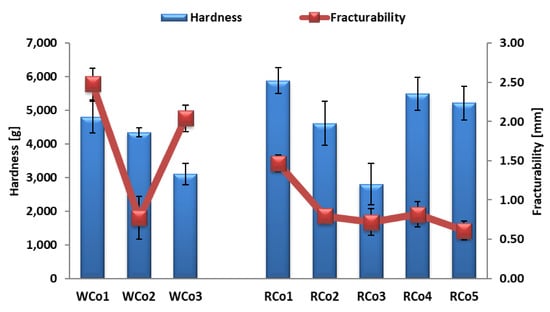
Figure 1.
Textural properties of produced low-FODMAP wholegrain cookies.
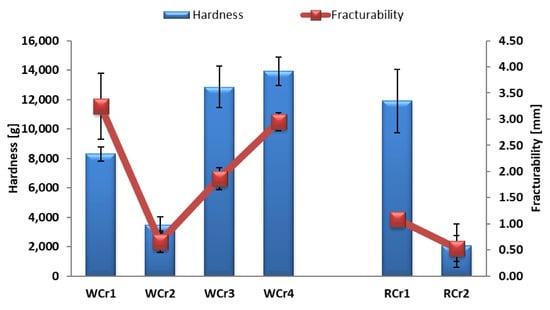
Figure 2.
Textural properties of produced low-FODMAP wholegrain crackers.
The addition of dietary fibre sources into the low-FODMAP cookie formulation resulted in less hardness in comparison to the results for the high-FODMAP cookies, which was similar to the findings of Sahin et al. [39]. The same trend was observed for both the wholegrain wheat and wholegrain rye cookies. The addition of sprouted whole wheat flour also increased the hardness of the wholegrain cookies in research conducted by Jribi et al. [40].
The wholegrain wheat low-FODMAP crackers had a higher degree of hardness than the control sample (WCr1), while the opposite trend was observed for the wholegrain rye low-FODMAP crackers.
3.3. Sensory Profile of Cookies and Crackers
The created low-FODMAP cookies and crackers are presented in Figure 3. The results of the descriptive sensory analyses of the three low-FODMAP cookies and three low-FODMAP crackers are shown in Figure 4 and Figure 5, respectively.
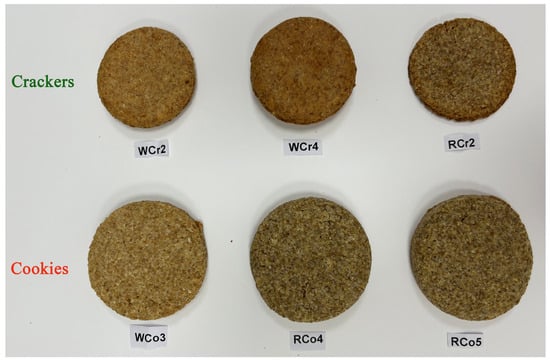
Figure 3.
Low-FODMAP cookies and crackers.
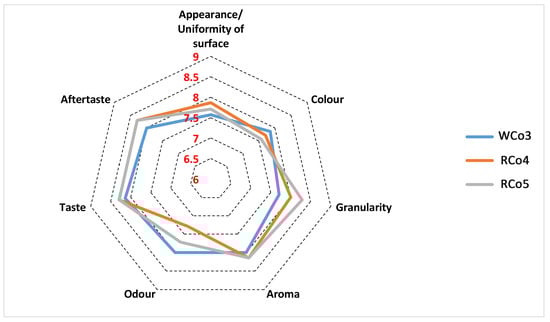
Figure 4.
Acceptability of appearance, colour, granularity, aroma, odour, taste, and aftertaste of cookies based on descriptive sensory analysis with 9-point scale from 9 (“extremely good”) to 1 (“extremely bad”). WCo3—wholegrain wheat cookies with the addition of 30% wheat malt from the variety Nataša; RCo4—Wholegrain rye cookies with the addition of 5% wheat malt from the variety Izalco and prolonged resting time of 120 min; RCo5—Wholegrain rye cookies with the addition of 5% wheat malt from the variety Izalco and prolonged resting time of 150 min.
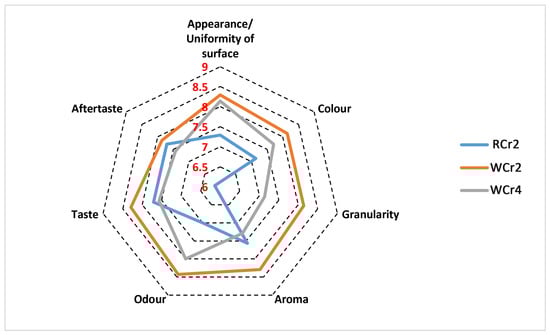
Figure 5.
Acceptability of appearance, colour, granularity, aroma, odour, taste, and aftertaste of crackers based on descriptive sensory analysis with 9-point scale from 9 (“extremely good”) to 1 (“extremely bad”). RCr2—wholegrain rye crackers with the addition of 1.83% of fresh baker’s yeast; WCr2—Wholegrain wheat crackers with the addition of chicory extract; WCr4—Wholegrain rye cookies with the addition of 1.83% of fresh baker’s yeast.
Regarding the sensory properties of the evaluated cookie samples, no significant differences were found between the samples. For all samples, their appearance, colour, and odour achieved an average value > 7, while aroma, taste, and aftertaste (perceived as a positive characteristic) had an average score > 8. The obtained results suggest that both Nataša and Izalco can be used in cookie formulations as substitutes (using 30 and 5%, respectively) for wholegrain wheat and rye flour in order to reduce FODMAPs without altering sensory properties.
There was a statistically significant difference (p < 0.05) between the appearance/uniformity of the surface and colour of cracker WCr2, with an average value > 8 compared with cracker RCr2, which had average values of 7.29 and 7.14. Further, the granularity of cracker WCr2 had a statistically significantly higher score, with an average value of 8.14, than cracker RCr2, which had an average value of 5.86. No significant difference was found between the crackers in terms of taste and aftertaste, which were all scored with average values > 7. The sample WCr2 had the highest average values for aroma and odour: 8.28 and 8.42, respectively. Based on the obtained results of the sensory analysis, it can be observed that the addition of chicory extract had no negative impact on the taste and aftertaste, with scored values > 8, and the sample with chicory extract had the highest average value for aroma (8.28). The addition of malt did not negatively affect either the aroma, taste, or aftertaste (perceived as a positive characteristic) of the cracker samples, which were all rated highly, with average scores > 8. The obtained results are in agreement with the findings of Ivanišová et al. [41], who recommended the application of chicory fibre in the production of biscuits to adjust the sensory properties of bakery products.
4. Conclusions
In the current literature, the only method for producing low-FODMAP cookies and crackers are fortification, the substitution of some of the wheat and/or rye flour with a cereal flour that is low in FODMAP compounds, or the use of commercially available fibre preparations and vital gluten as fillers to dilute the content of FODMAP compounds in wheat and rye flour. This study is the first of its kind to employ biotechnological tools (based on the exploitation of endogenous and exogenous enzymes from several plant materials and fermentation) coupled with process optimization to reduce the FODMAP content in flours with a high FODMAP content (wholegrain wheat and wholegrain rye) and create wholegrain low-FODMAP cookies and crackers. The created low-FODMAP cookies and crackers, produced using wholegrain wheat and rye, also had excellent sensory properties, and the addition of aqueous chicory extract and wheat malts had a positive effect on their overall appeal. Aside from the chicory extract and wheat malts, the baker’s yeast and prolonged dough resting time had an exceptional effect on the reduction in FODMAP content, with a moderate influence on the sensory properties and neutral (passable) overall appeal.
We also clearly identified significant amounts of GOS in the cereal-based products, in contrast to previous findings that FOS are the predominant FODMAP oligosaccharide in grains and grain-based products. In addition, the inclusion of melibiose and verbascose to the total GOS content provided better insight into the total FODMAP content and thus enhanced the definition of low- and high-FODMAP foods. In terms of the oligosaccharide fraction of the compounds classified as FODMAPs, and taking into account the significant content of GOS (identified in the analysed samples) and differences in FOS and total fructans as FODMAP constituents, the general conclusion is that in order to define high-FODMAP foods, the most reliable criterion is the content of total oligosaccharides (the sum of FOS and GOS).
In order to bring the developed low-FODMAP cookies and crackers closer to commercialization, further development will focus on the analysis of their shelf life its extension, conducting consumer acceptance tests on a large scale (above 300 participants and, if possible, in several countries), and the determination of their biological activity.
Author Contributions
Conceptualization, Methodology, Validation, Formal Analysis, Resources, Writing—Original Draft, Writing—Review and Editing, Visualization, Supervision, Project Administration, Funding Acquisition, A.M.T.; Methodology and Investigation, B.F.; Investigation, V.V., U.M., G.R. and M.M.; Writing—Original Draft, Writing—Review and Editing, Visualization, Formal Analysis, Investigation, M.R. All authors have read and agreed to the published version of the manuscript.
Funding
This research was supported by the Science Fund of the Republic of Serbia, IDEAS program, Grant No. 7736059, project “Biotechnological tools for optimization of short and medium chain carbohydrates content in cereal-based food to prevent gastrointestinal disorders–GutFriendlyCarbs”.
Institutional Review Board Statement
This study was conducted in accordance with the Declaration of Helsinki and approved by the Institutional Ethics Committee of the Faculty of Sciences Novi Sad of the University of Novi Sad (Code on Academic Integrity of the Faculty of Sciences, University of Novi Sad No. 0601-351/5; approval no. 0601-379 on 30 July 2020).
Informed Consent Statement
Informed consent was obtained from all subjects involved in the study.
Data Availability Statement
The original contributions presented in the study are included in the article; further inquiries can be directed to the corresponding author.
Conflicts of Interest
The authors declare no conflicts of interest.
References
- Dieterich, W.; Zopf, Y. Gluten and FODMAPS—Sense of a Restriction/When Is Restriction Necessary? Nutrients 2019, 11, 1957. [Google Scholar] [CrossRef]
- Morariu, I.-D.; Avasilcai, L.; Vieriu, M.; Lupu, V.V.; Morariu, B.-A.; Lupu, A.; Morariu, P.-C.; Pop, O.-L.; Starcea, I.M.; Trandafir, L. Effects of a Low-FODMAP Diet on Irritable Bowel Syndrome in Both Children and Adults—A Narrative Review. Nutrients 2023, 15, 2295. [Google Scholar] [CrossRef] [PubMed]
- Torbica, A.; Radosavljević, M.; Belović, M.; Tamilselvan, T.; Prabhasankar, P. Biotechnological tools for cereal and pseudocereal dietary fibre modification in the bakery products creation–Advantages, disadvantages and challenges. Trends Food Sci. Technol. 2022, 129, 194–209. [Google Scholar] [CrossRef]
- Bertin, L.; Zanconato, M.; Crepaldi, M.; Marasco, G.; Cremon, C.; Barbara, G.; Barberio, B.; Zingone, F.; Savarino, E.V. The Role of the FODMAP Diet in IBS. Nutrients 2024, 16, 370. [Google Scholar] [CrossRef]
- Zeeshan, M.H.; Vakkalagadda, N.P.; Sree, G.S.; kishore Anne, K.; Parkash, O.; Fawwad, S.B.U.; Haider, S.M.W.; Mumatz, H.; Hasan, M. Irritable bowel syndrome in adults: Prevalence and risk factors. Ann. Med. Surg. 2022, 81, 104408. [Google Scholar] [CrossRef]
- Laatikainen, R.; Jalanka, J.; Loponen, J.; Hongisto, S.M.; Hillilä, M.; Koskenpato, J.; Korpela, R.; Salonen, A. Randomised clinical trial: Effect of low-FODMAP rye bread versus regular rye bread on the intestinal microbiota of irritable bowel syndrome patients: Association with individual symptom variation. BMC Nutr. 2019, 5, 12. [Google Scholar] [CrossRef]
- Atzler, J.J.; Sahin, A.W.; Gallagher, E.; Zannini, E.; Arendt, E.K. Characteristics and properties of fibers suitable for a low FODMAP diet—An overview. Trends Food Sci. Technol. 2021, 112, 823–836. [Google Scholar] [CrossRef]
- Ispiryan, L.; Zannini, E.; Arendt, E.K. FODMAP modulation as a dietary therapy for IBS: Scientific and market perspective. Compr. Rev. Food Sci. Food Saf. 2022, 21, 1491–1516. [Google Scholar] [CrossRef]
- Mezzomo, T.R.; Sampaio, I.R.; Fiori, L.S.; Schieferdecker, M.E.M. Content of poorly absorbed short-chain carbohydrates (FODMAP) in enteral homemade diets. Nutr. Clin. Pract. 2019, 34, 264–271. [Google Scholar] [CrossRef]
- Loponen, J.; Gänzle, M.G. Use of sourdough in low FODMAP baking. Foods 2018, 7, 96. [Google Scholar] [CrossRef] [PubMed]
- Acín Albiac, M.; Di Cagno, R.; Filannino, P.; Cantatore, V.; Gobbetti, M. How fructophilic lactic acid bacteria may reduce the FODMAPs content in wheat-derived baked goods: A proof of concept. Microb. Cell Factories 2020, 19, 182. [Google Scholar] [CrossRef] [PubMed]
- Oka, P.; Parr, H.; Barberio, B.; Black, C.J.; Savarino, E.V.; Ford, A.C. Articles Global prevalence of irritable bowel syndrome according to Rome III or IV criteria: A systematic review and meta-analysis. Lancet Gastroenterol. Hepatol. 2020, 5, 908–917. [Google Scholar] [CrossRef]
- Gawade, D.S.; Patil, K.W.; Jayram, G.H. Development of value-added cookies supplemented with giloy and tulsi powder. Mater. Today Proc. 2023, 73, 530–534. [Google Scholar] [CrossRef]
- Mrabet, A.; Hamdi, A.; Rodríguez-Arcos, R.; Guillén-Bejarano, R.; Jiménez-Araujo, A. Date seed by-products as source of bioactive ingredient for healthy cookies. Food Biosci. 2024, 61, 104543. [Google Scholar] [CrossRef]
- Karunanithi, S.; Guha, P.; Srivastav, P.P. Valorization of betel leaves byproducts: A novel ingredient for sustainable cookie development. Food Chem. Adv. 2024, 5, 100799. [Google Scholar] [CrossRef]
- Koc, F.; Atzler, J.; Sahin, A.W.; Arendt, E.; Ross, R.P.; Stanton, C. Biscuits for the gut: A symphony of FODMAPs and dietary fibre in gut microbiome for irritable bowel syndrome (IBS) management. Innov. Food Sci. Emerg. Technol. 2024, 97, 103832. [Google Scholar] [CrossRef]
- Batista, A.P.; Niccolai, A.; Bursic, I.; Sousa, I.; Raymundo, A.; Rodolfi, L.; Biondi, N.; Tredici, M.R. Microalgae as Functional Ingredients in Savory Food Products: Application to Wheat Crackers. Foods 2019, 8, 611. [Google Scholar] [CrossRef]
- Radoš, K.; Čukelj Mustač, N.; Varga, K.; Drakula, S.; Voučko, B.; Ćurić, D.; Novotni, D. Development of High-Fibre and Low-FODMAP Crackers. Foods 2022, 11, 2577. [Google Scholar] [CrossRef] [PubMed]
- Jiménez-Pulido, I.J.; Rico, D.; Martinez-Villaluenga, C.; Pérez-Jiménez, J.; Luis, D.D.; Martín-Diana, A.B. Sprouting and Hydrolysis as Biotechnological Tools for Development of Nutraceutical Ingredients from Oat Grain and Hull. Foods 2022, 11, 2769. [Google Scholar] [CrossRef] [PubMed]
- Krivorotova, T.; Sereikaite, J. Determination of fructan exohydrolase activity in the crude extracts of plants. Electron. J. Biotechnol. 2014, 17, 329–333. [Google Scholar] [CrossRef]
- Krstanović, V.; Habschied, K.; Dvojković, K.; Mastanjević, K. Research on the Malting Properties of Domestic Wheat Varities. Fermentation 2020, 7, 1. [Google Scholar] [CrossRef]
- Weitzhandler, M.; Barreto, V.; Pohl, C.; Jandik, P.; Cheng, J.; Avdalovic, N. CarboPac™ PA20: A new monosaccharide separator column with electrochemical detection with disposable gold electrodes. J. Biochem. Bioph. Meth. 2004, 60, 309–317. [Google Scholar] [CrossRef]
- Ispiryan, L.; Heitmann, M.; Hoehnel, A.; Zannini, E.; Arendt, E.K. Optimization and validation of an HPAEC-PAD method for the quantification of FODMAPs in cereals and cereal-based products. J. Agric. Food Chem. 2019, 67, 4384–4392. [Google Scholar] [CrossRef] [PubMed]
- ISO 8589:2007; Sensory Analysis—General Guidance for the Design of Test Rooms. ISO: Geneva, Switzerland, 2015.
- Nyyssölä, A.; Nisov, A.; Lille, M.; Nikinmaa, M.; Rosa-Sibakov, N.; Ellilä, S.; Valkonen, M.; Nordlund, E. Enzymatic reduction of galactooligosaccharide content of faba bean and yellow pea ingredients and food products. Future Foods 2021, 4, 100047. [Google Scholar] [CrossRef]
- EatforHealth.gov.au. Available online: https://www.eatforhealth.gov.au/food-essentials/how-much-do-we-need-each-day/serve-sizes (accessed on 10 December 2024).
- European Snack Association. Available online: https://www.esasnacks.eu/PDF/PortionSize2019.pdf (accessed on 10 December 2024).
- Food and Nutrition—Canada. Available online: https://www.canada.ca/en/health-canada/services/technical-documents-labelling-requirements/table-reference-amounts-food/nutrition-labelling.html#a (accessed on 10 December 2024).
- Food-Based Dietary Guidelines Recommendations for Starchy Foods. Available online: https://knowledge4policy.ec.europa.eu/health-promotion-knowledge-gateway/food-based-dietary-guidelines-europe-table-1_en (accessed on 10 December 2024).
- U.S. Food & Drug Administration. Available online: https://www.accessdata.fda.gov/scripts/cdrh/cfdocs/cfcfr/CFRSearch.cfm?fr=101.12 (accessed on 10 December 2024).
- Biesiekierski, J.R.; Rosella, O.; Rose, R.; Liels, K.; Barrett, J.S.; Shepherd, S.J.; Gibson, P.R.; Muir, J.G. Quantification of fructans, galacto-oligosacharides and other short-chain carbohydrates in processed grains and cereals. J. Hum. Nutr. Diet. 2011, 24, 154–176. [Google Scholar] [CrossRef] [PubMed]
- Ribeiro, M.; Ferreira, D.; Siopa, J.; Rodriguez-Quijano, M.; Nunes, F.M. Natural variation in the content and degree of polymerization of fructans in wheat: Potential for selection of genotypes with beneficial health composition. J. Agr. Food Chem. 2022, 70, 10929–10939. [Google Scholar] [CrossRef]
- Lovell, R.M.; Ford, A.C. Effect of Gender on Prevalence of Irritable Bowel Syndrome in the Community: Systematic Review and Meta-Analysis. Am. J. Gastroenterol. 2012, 107, 991–1000. [Google Scholar] [CrossRef]
- Struyf, N.; Laurent, J.; Verspreet, J.; Verstrepen, K.J.; Courtin, C.M. Saccharomyces cerevisiae and Kluyveromyces marxianus cocultures allow reduction of fermentable oligo-, di-, and monosaccharides and polyols levels in whole wheat bread. J. Agr. Food Chem. 2017, 65, 8704–8713. [Google Scholar] [CrossRef]
- Martins, G.N.; Ureta, M.M.; Tymczyszyn, E.E.; Castilho, P.C.; Gomez-Zavaglia, A. Technological aspects of the production of fructo and galacto-oligosaccharides. Enzymatic synthesis and hydrolysis. Front. Nutr. 2019, 6, 78. [Google Scholar] [CrossRef]
- Rópolo, A.S.; Feliziani, C.; Touz, M.C. Chapter One-Unusual proteins in Giardia duodenalis and their role in survival. In Advances in Parasitology; Ortega-Pierres, M.G., Ed.; Academic Press: Cambridge, MA, USA, 2019; pp. 1–50. [Google Scholar] [CrossRef]
- Nyyssölä, A.; Ellilä, S.; Nordlund, E.; Poutanen, K. Reduction of FODMAP content by bioprocessing. Trends Food Sci. Technol. 2020, 99, 257–272. [Google Scholar] [CrossRef]
- Nilsson, U.; Öste, R.; Jägerstad, M. Cereal fructans: Hydrolysis by yeast invertase, in vitro and during fermentation. J. Cereal Sci. 1987, 6, 53–60. [Google Scholar] [CrossRef]
- Sahin, A.W.; Atzler, J.J.; Crofton, E.; Gallagher, E.; Zannini, E.; Walter, J.; Arendt, E.K. Impact of different fibre ingredients on a low-FODMAP biscuit model system. Food Funct. 2023, 14, 7082–7095. [Google Scholar] [CrossRef] [PubMed]
- Jribi, S.; Sahagún, M.; Belorio, M.; Debbabi, H.; Gomez, M. Effect of sprouting time on dough and cookies properties. J. Food Meas. Charact. 2020, 14, 1595–1600. [Google Scholar] [CrossRef]
- Ivanišová, E.; Drevková, B.; Tokár, M.; Terentjeva, M.; Krajčovič, T.; Kačániová, M. Physicochemical and sensory evaluation of biscuits enriched with chicory fiber. Food Sci. Technol. Int. 2020, 26, 38–43. [Google Scholar] [CrossRef]
Disclaimer/Publisher’s Note: The statements, opinions and data contained in all publications are solely those of the individual author(s) and contributor(s) and not of MDPI and/or the editor(s). MDPI and/or the editor(s) disclaim responsibility for any injury to people or property resulting from any ideas, methods, instructions or products referred to in the content. |
© 2025 by the authors. Licensee MDPI, Basel, Switzerland. This article is an open access article distributed under the terms and conditions of the Creative Commons Attribution (CC BY) license (https://creativecommons.org/licenses/by/4.0/).