Beer Aroma Compounds: Key Odorants, Off-Flavour Compounds and Improvement Proposals

 , ,
, ,  ,
,  ,
,  , , ,
, , ,  ,
,  and
and 
Abstract
1. Introduction
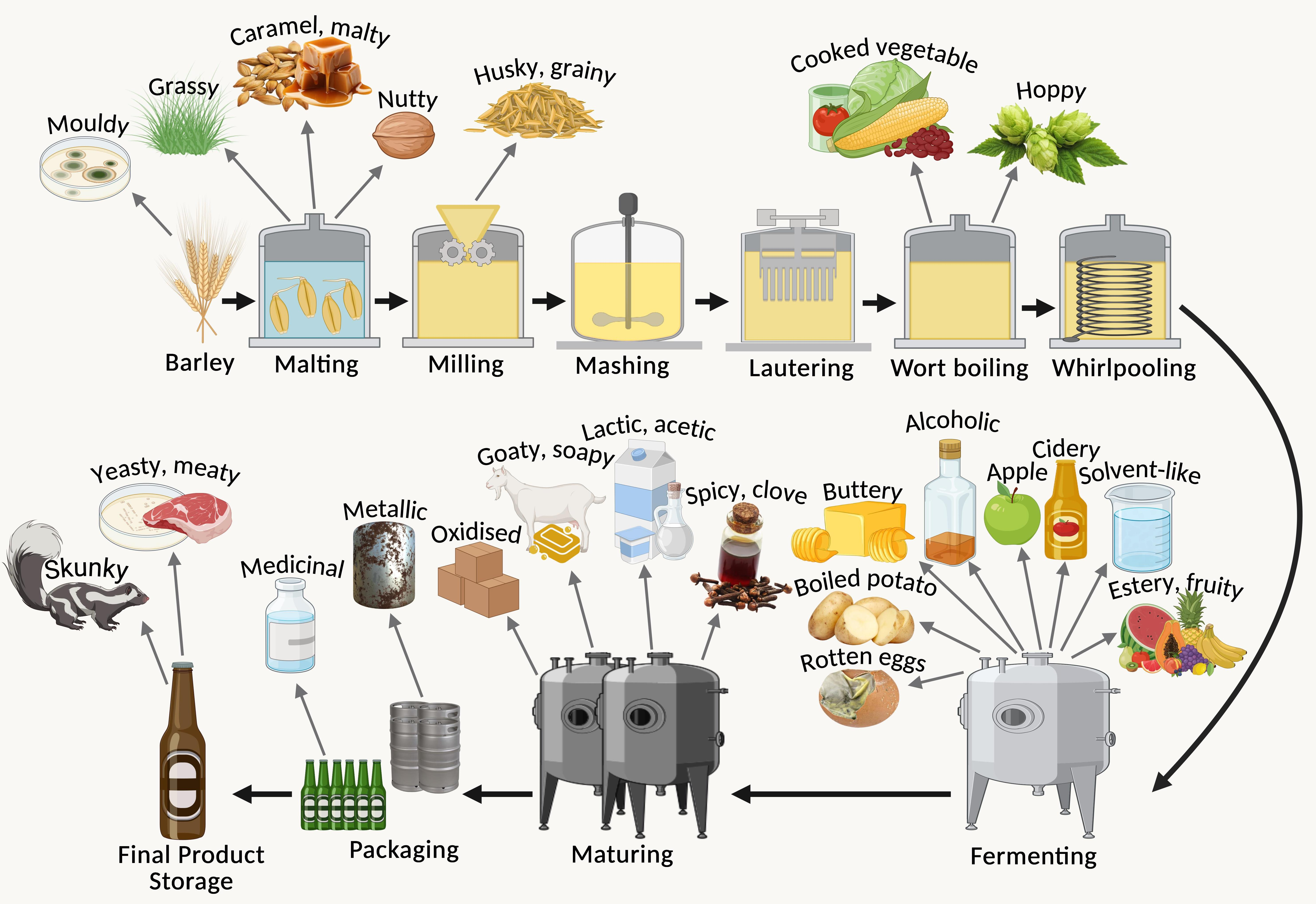
2. Key Odours and Common Off-Flavours Found in Beers and Their Sources
2.1. Apple
2.2. Alcoholic
2.3. Boiled Potato
2.4. Buttery
2.5. Caramel, Malty
2.6. Cidery
2.7. Cooked Vegetable
2.8. Estery, Fruity
2.9. Grassy
2.10. Hoppy
2.11. Husky, Grainy
2.12. Medicinal
2.13. Metallic
2.14. Mouldy
2.15. Nutty
2.16. Oxidised
2.17. Rotten Eggs
2.18. Skunky
2.19. Solvent-like
2.20. Sour Milk, Lactic, Acetic
2.21. Spicy, Clove
2.22. Sweaty, Goaty, Rancid, Soapy
2.23. Yeasty, Meaty
3. Strategies for Controlling Off-Flavours That Appear in Beer During Manufacturing and Storage

| No. | Descriptor | Compound/Source | Beer Styles Commonly Associated | Origin | Corrective or Preventive Actions | Reference |
|---|---|---|---|---|---|---|
| 1. | Apple | Acetaldehyde | Young beers (any style), lagers, Bavarian wheat beers | Stressed or incomplete fermentation. | Proper yeast management involves ensuring the correct concentration of healthy yeast is pitched, within the range of 26 to 35 × 106 cells/mL. | [21,56,130,131,132,133,134,135,136,137,138] |
| Insufficient oxygen supply during the yeast’s growth phase can lead to higher acetaldehyde levels. | Wort aeration with oxygen to maintain cell viability (7–12 mg O2/L). | |||||
| Pitching rates of yeast and wort composition. | Ensure a wort zinc concentration range from 0.48 to 1.07 mg/L. | |||||
| Zinc deficiencies in wort can lead to excess acetaldehyde production. | Provide adequate Free Amino Nitrogen (FAN) concentrations in the wort to support yeast growth and fermentation (100–140 mg/L in normal gravity 10–12 °P wort). | |||||
| Leaving non-viable yeast in maturation for extended periods of time. | Concentrations of acetaldehyde can be lowered by prolonged maturation with healthy yeast | |||||
| Microbial contamination of beer (Zymomonas or Acetobacter). | Proper sanitation to avoid bacterial infection. | |||||
| Use of adjunct sugars. | Avoid the use of adjuncts with high glucose concentrations, which will inhibit the fermentation rate and the yeast growth. | |||||
| 2. | Alcoholic | Ethanol, Isoamyl alcohol, Active-amyl alcohol, n-Propanol, Isobutanol, Butanol | High-gravity ales, Belgian ales (e.g., Tripel, Dubbel), barleywine, Imperial stout, strong lagers | High fermentation temperature. | Lower fermentation temperatures and higher pressure to reduce the extent of higher alcohol production. | [22,24,137,139] |
| Addition of higher amounts of fermentable sugars in the wort (e.g., glucose syrup). | Avoid adding large amounts of fermentable sugars, which will expose the yeast to various stresses. | |||||
| Selection of yeast strain. | An adequate concentration in the range of 130–150 mg/L of FAN in wort to support optimum yeast growth and fermentation efficiency. | |||||
| Low content of FAN to support optimal yeast growth. | ||||||
| Oxygenation and agitation during fermentation. | ||||||
| Lower pressures during fermentation encourage yeast growth. | ||||||
| 3. | Boiled potato | Methional | Any aged beers | Developed during wort boiling. | Selection of malt: a higher proteolytic malt modification will transcribe into an increase in free and bound aldehyde content at the end of wort boiling. | [20,140,141] |
| Insufficient yeast reducing activity (due to weak or stressed metabolism). | During fermentation, if the yeast metabolism is optimal, then there is a reducing activity which will transform methional to the corresponding alcohol. | |||||
| During storage, the methional can also be reduced, and the presence of oxygen causes a minor reduction. | ||||||
| 4. | Buttery | Diacetyl | Any beer styles | Any of the precursors that stay in the beer after yeast removal is liable to be converted. | Worts with a lower FAN content produce less diacetyl (but worts with FAN values < 122 mg/L will trigger the opposite response) as α-acetolactate production is related to valine metabolism. | [32,34,35,142,143] |
| Low values for valine in wort. | Valine supplementation (100 to 300 mg/L) can decrease the diacetyl concentrations. | |||||
| Short times for the secondary fermentation. | Yeast cells possess the enzymes required to assimilate and reduce diacetyl. Yeast should not be stressed or rushed, also, a slight temperature increase towards the end of fermentation can help with the diacetyl clean up. | |||||
| Diacetyl will be reduced through a regular maturation below threshold values in up to 15 days. | ||||||
| 5. | Caramel, Malty | Furans and furan derivatives. Heterocycles and pyrazines. Carbonyl compounds and related Maillard reaction products. | Ales (Belgian, English, German), stout, porters, barleywines, Munich dunkel, Weizen bock, Helles, bock, amber lager, dark lager | Compounds are developed during the malt kilning and the wort boiling. | The strategic selection of malt is crucial: caramel malt provides enhanced caramel notes, while roasted malt contributes more roasted or malty flavours. Caramel malts are produced with an additional step before kilning called stewing, where the high moisture content of steeped grains is combined with a temperature of 60 °C. This process leads to saccharification, followed by increasing the temperature to 120 °C for caramelisation, and finally to 180 °C for pyrolysis in a roasting drum. Roasted malts are produced similarly to pilsner malts, except the final kilning temperature is raised to around 200–220 °C. | [37,38,39,144,145] |
| Beer storage and ageing. | Adjusting malting parameters such as time and temperature during kilning will alter the malt’s composition. The presence of sulphur compounds inhibits the Maillard reaction, and sulphur dioxide reduces the colour of the malt. | |||||
| Controlling the brewing steps: wort boiling time, temperature, pH, and the amino acids and sugars present, will influence the volatile compound formation. | ||||||
| Ageing and storage can alter the beer: duration, temperature and oxygen exposure can create new caramel and aroma notes. | ||||||
| Furfural is formed in considerable amounts during mashing and hopping steps, but almost all is reduced by yeast during fermentation; is formed again during storage and ageing. | ||||||
| 6. | Cidery | Acetaldehydes, Ethyl esters | Lambic, Gueuze | Choice of yeast strain. | Acetaldehydes can be prevented by aeration of the wort before adding yeast. | [145,146,147] |
| Weak or incomplete fermentation. | Avoiding exposure to oxygen during fermentation | |||||
| Composition of the fermentation medium and fermentation conditions. | Avoid bottling or kegging the beer too early. | |||||
| 7. | Cooked vegetable | Dimethyl sulphide | Any beer styles | Precursor SMM is produced during the grain germination, in the seed germ and rootlets and is converted during malt kilning and wort boiling. | To reduce SMM levels, consider replacing malt with adjuncts, the use of rootlet inhibitors, increasing the intensity of kilning and choosing a 2-row variety instead of a 6-row. | [46,47,48] |
| Precursor DMSO also originates from malt but is reduced to DMS by yeast during fermentation. | Intensive wort boiling will reduce the DMS concentration. | |||||
| DMSO reduction into DMS is elevated at low temperatures, high pitching wort pH, low free amino nitrogen levels and high original gravity. | Location of the brewery can affect the conversion of SMM; a wort that boils at a lower temperature in an area with increased elevation will have significantly less conversion of SMM into DMS in the kettle. | |||||
| The amount of DMS produced by yeasts varies between strains. | ||||||
| DMS produced during fermentation can be eliminated by CO2 stripping. | ||||||
| At higher fermentation temperatures, the diffusion rate of CO2 is increased, which helps to eliminate DMS from green beer. | ||||||
| Saccharomyces pastorianus var. carlbergensis reduces less DMSO than Saccharomyces cerevisiae. | ||||||
| 8. | Estery, fruity | Isoamyl acetate, ethyl hexanoate, ethyl octanoate, phenylethyl acetate, 3-sulfanyl-4-methyl-pentan-1-ol, 4-methyl-4-sulfanyl-2-pentanone, 3-sulfanylhexan-1-ol, γ-lactones, γ-decalactone, oak-lactone. | English ales (English Bitter, Pale Ale, Mild Ale), Belgian ales (Dubbel, Tripel, Saison), Wheat beers (Hefeweizen, Weizen bock), sour beers, wild ales | Esters are synthesised during fermentation, and the amount depends on the yeast strain and the fermentation temperature. | Selection of yeast, a greater retention of esters inside the cells is characteristic of lager yeast strains. | [35,42,145,148] |
| Ester production increases when there is a high aeration, a high amount of nutrients and low pitching rates for yeast. | Lower fermentation temperature slows down yeast metabolism and reduces ester synthesis. | |||||
| High-gravity worts or high sugar concentrations promotes ester formation. | Avoiding overstressing or underpitching the yeast to have lower concentration of esters. | |||||
| Lactones originate from malt, hops and yeast metabolism, and oak-lactone is mainly present in beers aged in oak casks. | Different varieties of hops give a particular flavour profile. | |||||
| 9. | Grassy | Hexanal | Any Beer Styles (Especially pale lagers) | Use of large quantities of hops that are fresh, poorly stored, or not properly dried. | Proper storage techniques for raw materials and beer. | [9,35] |
| Improper storage of malt. | Selection of hops. | |||||
| Yeast can remove aldehydes by reduction to their saturated alcohol counterparts. | ||||||
| 10. | Hoppy | Linalool, geraniol, β-damascenone, β-citronellol, esters, organic acids, myrcene, α-humulene, β-caryophyllene and β-farnesene. | German Pils, Czech Pilsners, Kölsch, American pale ale, India pale ale | Early kettle addition causes extensive loss of the volatiles by evaporation during boiling. | Late hopping and dry-hopping additions preserve polar oxygenated terpenoids (e.g., humulene epoxides or linalool oxides). | [57,61,145] |
| Dry hopping at warmer temperatures (around 20 °C) increases the extraction of myrcene. | Dry hop at cool temperatures (10–14 °C). | |||||
| Long dry hop duration (more than 3 days) increases the extraction of harsh, green flavours. | To avoid astringency and a green, harsh character, keep the contact time shorter, 1–3 days. | |||||
| Oxygen exposure during dry hopping oxidises hop oils. | Add hops to the tank while running CO2 into it and avoid introducing oxygen. | |||||
| Agitate hops to improve extraction. | ||||||
| 11. | Husky, grainy | Isobutyraldehyde, ethyl nicotinate, o-aminoacetophenone | Pale lager, cream ales, wheat beers, Belgian ales, German pils, Czech pale lager | Use of freshly made malt. | Use of malt that has gone through an appropriate rest phase. | [43,63,145] |
| Isobutyraldehyde can appear if malt has been crushed too finely, mashed for too long, sparged with water at too hot a temperature or oversparged. | Avoid crushing malt too finely, mashing for too long, overheating or oversparging. | |||||
| Ethyl nicotinate formation is a spontaneous chemical condensation reaction between nicotinic acid and ethanol during beer ageing. | Storing beer at low temperatures. | |||||
| 12. | Medicinal | Chlorophenols, bromophenol | Any beer styles | Production of chlorophenols from chlorination. | Thoroughly drain and rinse equipment to remove chlorine-based cleaning agents. | [69,149] |
| Inadvertent steam leaks (through heat exchangers) into product steam or hot liquor supplies. | Use sulphite systems instead of chlorine-based ones if possible. | |||||
| Condensate residues left after steam sterilisation of mains, vessels, kegs, and casks. | Prevent steam leaks and ensure proper maintenance of heat exchangers. | |||||
| Concentration of chlorophenolic compounds in boiler feed water. | Control and monitor brewing water quality to avoid build-up of contamination. | |||||
| In situ generation from active chlorine residues or boiler feed additives. | Avoid continued use of chlorine and chloramine in the brewing water. Tap water needs to be filtered, boiled, or left to stand for some time to eliminate free chlorine, which is typically found at 0.05–0.25 mg/L. | |||||
| Yeast strains with low phenol production should be selected, and the use of wild yeast should be avoided. Additionally, malt should not be ground too finely to minimise the release of phenolic compounds. | ||||||
| 13. | Metallic | Iron (Fe2+), Copper | Any beer styles | Contamination from brewery equipment and containers (e.g., pipes, tanks, kegs, cans) used during fermentation, conditioning, filtration, carbonation, and storage. | Avoid fittings, containers, vessels, tanks, and sealants that can corrode. | [52,70,72] |
| Poor plumbing system in the municipality or brewery. | Use food-grade, stainless steel containers. | |||||
| Copper can enter the water if the pH of the water is acidic, and the pipes are made of copper. | Most of the iron entering the mash is retained and subsequently removed with the spent grains during wort filtration. | |||||
| Pilsner malt produces a sweet wort with a lower iron concentration than wort made with roasted malts. | ||||||
| 14. | Mouldy | geosmine, 2-methyl isoborneol, 1-octen-3-one, chloranisoles, TCA, 2-Ethyl-fenchol | Any beer styles | Malting equipment contaminated by microorganisms. Some dormant microorganisms are activated during steeping, and germination provides high levels of moisture and solubilised or partially solubilised nutrients. | Proper cleaning and sanitisation of malting and brewing equipment. | [73,74,76,150] |
| TCA develops on the premises of the brewery, or it comes from the packaging materials. | Good storage conditions for the malt, the moisture content of the malt kept should be kept at around 4.5%. | |||||
| Preventive measures include optimising carbon filtration of source water, improving cleaning-in-place procedures, packaging processes, and raw material storage, and upgrading the brewery’s ventilation and pasteurisation systems. | ||||||
| 15. | Nutty | 2-acetylfuran, 2-Pentylfuran, 2-acetylpyrrole, 4-methylthiazole | Mild ale, brown ale, Scottish ales, English porters, Vienna lager, Märzen, bocks | Pyrroles, pyrazines, and thiazoles are all formed during the kilning due to the Maillard reaction. | The Maillard reaction occurs in temperatures above 50 °C. | [45,82,145] |
| 2-acetylpyrrole appears during the roasting of the malt. | 2-acetylpyrrole decreases with a higher roasting temperature. | |||||
| Maillard reaction products are also formed during mashing and wort boiling. | The Maillard products depend on the level of malt modification and ratio of nitrogen, carbohydrates, and sulphur (e.g., the incorporation of sulphur forms thiazoles). | |||||
| 16. | Oxidised | trans-2-nonenal | Any beer styles (especially in pale lagers and aged beers) | Spring barley contains higher levels of polyunsaturated fatty acids. | The crop year, barley variety, and the application of a zinc-containing fertiliser can affect the antioxidant content that suppresses aldehyde formation. | [68,87] |
| Use of malt with a high lipoxygenase activity. | Winter barley exhibits higher antioxidant activity because it has a thicker husk. | |||||
| High temperatures, elevated oxygen levels and the presence of pro-oxidants, such as transition metal ions (copper and iron), accelerate the rate of autoxidation. | During germination recirculate air enriched with CO2 to suppress oxidation. | |||||
| 17. | Rotten Eggs | Hydrogen Sulphide | Most common in lagers and young beers | Hydrogen sulphide can be produced by certain brewing yeast strains during fermentation. | Picking a yeast strain with a reduced production of hydrogen sulphide. Lager yeast will produce more sulphur compounds, but the smell will also dissipate after fermentation. | [35,73,91,151,152,153] |
| Use of sugar syrups in wort production decreases the malt ratio, thereby reducing the nitrogen content of the wort. | Avoid the nitrogen starvation of bottom-fermenting yeasts during the exponential growth as this will produce more hydrogen sulphide. | |||||
| Pectinatus are anaerobic bacteria that can contaminate packaged beer and produce hydrogen sulphide. | Pectinatus spp. appear to only tolerate beers with ethanol up to 4.4% (w/v) and a pH of 4.0–4.5. | |||||
| Pectinatus is usually isolated from non-pasteurised, packaged beer that has lower alcohol levels and slightly higher pH. | Improved brewery hygiene and increased vigilance for spoilage bacteria are highly important. | |||||
| Storage conditions of the packed product. | Pectinatus spp. grows between 15 and 40 °C, with an optimum at 32 °C. | |||||
| 18. | Skunky | 3-methyl-2-butene-1-thiol (MBT) | Any beer styles | Exposure of beer to UV lights (photooxidation) causes a reaction between the light, riboflavin in the beer and the hop-derived iso-α-acids. | Sunstruck flavours occur especially when the beer bottle is translucent or green, and without UV protection, the colour for the best protection is brown. | [95,154] |
| Hop polyphenol and tannin extracts have been shown to enhance beer’s light and storage stability by inhibiting oxidative and light-induced off-flavours. | ||||||
| Compounds such as tryptophan, ascorbic acid, and tryptophol can act as off-flavour inhibitors by scavenging radicals and reducing the formation of light-struck compounds. | ||||||
| 19. | Solvent-like | Ethyl acetate Fusel alcohols (see row no. 2 for origin and corrective actions) | High-gravity beers, British strong ale, Imperial stout, barleywine | Selection of the strain of yeast. | Top fermenting strains generally produce more esters and higher alcohols than bottom fermenting strains. | [100,145,146,155,156] |
| Composition of the fermentation medium. | Fermentation temperature should be reduced (the highest content of ethyl acetate is produced at 20 °C). | |||||
| Fermentation conditions. | Ensure adequate levels of unsaturated fatty acids in wort, as they regulate acetate ester production. | |||||
| Control the carbon-to-nitrogen ratio in the fermentation medium (increased carbon or nitrogen content is correlated to higher acetate ester production). | ||||||
| Reduce wort gravity to lower acetate ester formation (high-gravity brewing increases acetate ester production). | ||||||
| Increase wort aeration to decrease ester concentration. | ||||||
| 20. | Sour milk, lactic, acetic | Lactic acid Acetic acid | Sour beers, American wild ale, mixed-fermentation sour beers, Berliner weisse gose, lambic, gueuze, Flanders red ale, oud bruin | Lactic Acid Contamination through ingredients, equipment, storage, and packaging. | Practice proper hygiene and sanitation practices to prevent contamination by lactic acid bacteria in ingredients, equipment, storage, and packaging. | [107,112,145,157,158] |
| Acetic Acid Contamination. | Practice proper sanitation to control microbial contamination by Acetobacter or Glucanobacter in wort, beer dispensing systems or cask-conditioned ales. | |||||
| Wild Yeast Contamination. | Practice proper sanitation and proper yeast management to prevent wild yeast growth. | |||||
| Exposure to Oxygen. | Minimise headspace in fermenters to reduce oxygen contact. Ensure proper CO2 or nitrogen purging of tanks, hoses, pipes, and kegs during all stages (fermentation, filtration, packaging). | |||||
| Fermentation Conditions. | Maintain controlled fermentation conditions to prevent contamination and ensure quality. | |||||
| Insufficient Pasteurisation. | Pasteurise the beer at a minimum of 15 pasteurisation units (1 PU = 1 min at 60 °C to reduce microbial contamination. | |||||
| Storage and Packaging. | Ensure proper storage and packaging by preventing exposure to oxygen, controlling temperature, and using sealed and sanitised containers. | |||||
| 21. | Spicy, clove | Eugenol 4-vinyl guaiacol 4-vinylphenol | Hefeweizen, dunkles Weissbier, Weizenbock, saison, Belgian Witbier, Belgian Dubbel, Belgian dark strong ale, Belgian tripel, lambic, gueuze | Microbial contamination. | Implement an efficient CIP (clean-in-place) system to prevent contamination. | [80,116,145] |
| Oxidation product in aged beer. | Minimise oxygen exposure during packaging and storage to prevent oxidation. | |||||
| Wild yeast infection (e.g., Saccharomyces diastaticus). | Practice good sanitation to avoid a wild yeast infection. | |||||
| Malted and unmalted wheat. | Avoid using malted and unmalted wheat, as they contribute to 4-VG and 4-VP formation. | |||||
| Ferulic Acid Rest for 4-VG. | Avoid performing a ferulic acid rest during mashing, as it increases 4-VG production by releasing additional free ferulic acid into wort. | |||||
| 22. | Sweaty, goaty, rancid, soapy | Caproic acid Caprylic acid Capric acid Valeric acid Isovaleric acid | Mixed-fermentation sours, lambic, gueuze, Brett beers | Microbial contamination with Brettanomyces. | Practice good sanitation practices to prevent contamination. | [103,121,123,125,126] |
| By-product of the yeast metabolism. | Select an appropriate strain and type of yeast to minimise undesired by-products. | |||||
| Use of encapsulated yeast. | Use free yeast instead of encapsulated yeast to control yeast metabolism better. | |||||
| The use of old, oxidised hops. | Use fresh hops that are properly stored to avoid oxidation and off-flavours. | |||||
| 23. | Yeasty, meaty | Yeast 5-Methyl-4-hydroxy-3(2H)-furanone (MHF) | Any beer styles (most likely in bottle-conditioned or cask conditioned beers) | Yeast autolysis. | Check yeast count (0.5–2 × 10⁶ cells/mL) for cask and bottle-conditioned beer. | [127,128] |
| Strain of yeast. | Limit the time the beer spends on yeast in the tank. | |||||
| Prolonged contact with the yeast. | Ensure pitched yeast has >90% viability. | |||||
| For MHF, the type of malt used. | Select the appropriate yeast strain for the fermentation process. | |||||
| Limit the time beer spends on yeast to prevent autolysis. | ||||||
| To avoid MHFs, use lager and ale malts, as they have no furanones. | ||||||
| Avoid using stewed malt kilned at elevated temperatures, as they have the highest levels of furanones. |
4. Conclusions
Author Contributions
Funding
Institutional Review Board Statement
Informed Consent Statement
Data Availability Statement
Conflicts of Interest
Abbreviations
| OAV | Odour activity value |
| HDMF | 4-hydroxy-2,5-dimethylfuran-3(2H)-one |
| DMS | Dimethyl sulphide |
| SMM | s-methylmethionine |
| DMSO | Dimethyl sulfoxide |
| TCP | trichlorophenol |
| MBT | 3-methyl-2 butene-1-thiol |
| LAB | Lactic acid bacteria |
| 4-VG | 4-vinyl guaiacol |
| 4-VP | 4-vinylphenol |
| MHF | 5-methyl-4-hydroxy-3(2H)-furanone |
| FAN | Free amino nitrogen |
References
- Humia, B.V.; Santos, K.S.; Barbosa, A.M.; Sawata, M.; Mendonça, M.D.C.; Padilha, F.F. Beer Molecules and Its Sensory and Biological Properties: A Review. Molecules 2019, 24, 1568. [Google Scholar] [CrossRef] [PubMed]
- Orlandi, A.C.D.A.L.; Reitenbach, A.F.; Carmo, T.S.; Ghesti, G.F. Portable Solutions for Quality Control of Beers: A Review. Food Sci. Technol. 2024, 44, e00051. [Google Scholar] [CrossRef]
- Sowndhararajan, K.; Kim, S. Influence of Fragrances on Human Psychophysiological Activity: With Special Reference to Human Electroencephalographic Response. Sci. Pharm. 2016, 84, 724–751. [Google Scholar] [CrossRef] [PubMed]
- Wu, J.; Liu, Y.; Zhao, H.; Huang, M.; Sun, Y.; Zhang, J.; Sun, B. Recent Advances in the Understanding of Off-Flavors in Alcoholic Beverages: Generation, Regulation, and Challenges. J. Food Compos. Anal. 2021, 103, 104117. [Google Scholar] [CrossRef]
- Edgar Herkenhoff, M.; Brödel, O.; Frohme, M. Aroma Component Analysis by HS-SPME/GC–MS to Characterize Lager, Ale, and Sour Beer Styles. Food Res. Int. 2024, 194, 114763. [Google Scholar] [CrossRef]
- Stewart, G. Saccharomyces Species in the Production of Beer. Beverages 2016, 2, 34. [Google Scholar] [CrossRef]
- Walker, G.; Stewart, G. Saccharomyces Cerevisiae in the Production of Fermented Beverages. Beverages 2016, 2, 30. [Google Scholar] [CrossRef]
- He, Y.; Dong, J.; Yin, H.; Zhao, Y.; Chen, R.; Wan, X.; Chen, P.; Hou, X.; Liu, J.; Chen, L. Wort Composition and Its Impact on the Flavour-Active Higher Alcohol and Ester Formation of Beer—A Review: Wort Composition and Impact on Higher Alcohol and Ester Formation. J. Inst. Brew. 2014, 120, 157–163. [Google Scholar] [CrossRef]
- Olaniran, A.O.; Hiralal, L.; Mokoena, M.P.; Pillay, B. Flavour-Active Volatile Compounds in Beer: Production, Regulation and Control: Flavour-Active Volatile Compounds in Beer: Production, Regulation and Control. J. Inst. Brew. 2017, 123, 13–23. [Google Scholar] [CrossRef]
- Papazian, C. Beer Styles: Their Origins and Classification. In Handbook of Brewing; CRC Press: Boca Raton, FL, USA, 2017; pp. 35–52. [Google Scholar]
- Briggs, D.; Boulton, C.; Brookes, P.; Stevens, R. Brewing: Science and Practice; CRC Press: Boca Raton, FL, USA, 2004; ISBN 978-0-8493-2547-2. [Google Scholar]
- Czerny, M.; Christlbauer, M.; Christlbauer, M.; Fischer, A.; Granvogl, M.; Hammer, M.; Hartl, C.; Hernandez, N.M.; Schieberle, P. Re-Investigation on Odour Thresholds of Key Food Aroma Compounds and Development of an Aroma Language Based on Odour Qualities of Defined Aqueous Odorant Solutions. Eur. Food Res. Technol. 2008, 228, 265–273. [Google Scholar] [CrossRef]
- Attchelouwa, C.K.; N’guessan, F.K.; Marcotte, S.; Amoikon, T.L.S.; Charmel, M.; Djè, M.K. Characterisation of Volatile Compounds Associated to Sensory Changes during the Storage of Traditional Sorghum Beer by HS-GC/FID and SPME-GC/MS. J. Agric. Food Res. 2020, 2, 100088. [Google Scholar] [CrossRef]
- Krautwurst, D. Human Olfactory Receptor Families and Their Odorants. Chem. Biodivers. 2008, 5, 842–852. [Google Scholar] [CrossRef] [PubMed]
- Ridgway, K.; Lalljie, S.P.D.; Smith, R.M. Analysis of Food Taints and Off-Flavours: A Review. Food Addit. Contam. Part A 2010, 27, 146–168. [Google Scholar] [CrossRef] [PubMed]
- Piornos, J.A.; Delgado, A.; De La Burgade, R.C.J.; Methven, L.; Balagiannis, D.P.; Koussissi, E.; Brouwer, E.; Parker, J.K. Orthonasal and Retronasal Detection Thresholds of 26 Aroma Compounds in a Model Alcohol-Free Beer: Effect of Threshold Calculation Method. Food Res. Int. 2019, 123, 317–326. [Google Scholar] [CrossRef] [PubMed]
- Hughes, P. 2—Beer Flavor. In Beer, A Quality Perspective; Volume Handbook of Alcoholic Beverages; Elsevier: Amsterdam, The Netherlands, 2009; pp. 61–83. ISBN 978-0-12-669201-3. [Google Scholar]
- Zea, L.; Serratosa, M.P.; Mérida, J.; Moyano, L. Acetaldehyde as Key Compound for the Authenticity of Sherry Wines: A Study Covering 5 Decades. Comp. Rev. Food Sci. Food Safe 2015, 14, 681–693. [Google Scholar] [CrossRef]
- Liu, C.; Li, Q.; Niu, C.; Zheng, F.; Zhao, Y. Simultaneous Determination of Diethylacetal and Acetaldehyde during Beer Fermentation and Storage Process. J. Sci. Food Agric. 2018, 98, 4733–4741. [Google Scholar] [CrossRef] [PubMed]
- Piornos, J.A.; Balagiannis, D.P.; Methven, L.; Koussissi, E.; Brouwer, E.; Parker, J.K. Elucidating the Odor-Active Aroma Compounds in Alcohol-Free Beer and Their Contribution to the Worty Flavor. J. Agric. Food Chem. 2020, 68, 10088–10096. [Google Scholar] [CrossRef]
- Langos, D.; Granvogl, M.; Schieberle, P. Characterization of the Key Aroma Compounds in Two Bavarian Wheat Beers by Means of the Sensomics Approach. J. Agric. Food Chem. 2013, 61, 11303–11311. [Google Scholar] [CrossRef]
- Liu, S.-Q. 17—Impact of Yeast and Bacteria on Beer Appearance and Flavour. In Brewing Microbiology; Woodhead Publishing: Cambridge, UK, 2015; pp. 357–374. ISBN 978-1-78242-331-7. [Google Scholar]
- Zhang, K.; Yang, J.; Qiao, Z.; Cao, X.; Luo, Q.; Zhao, J.; Wang, F.; Zhang, W. Assessment of β-Glucans, Phenols, Flavor and Volatile Profiles of Hulless Barley Wine Originating from Highland Areas of China. Food Chem. 2019, 293, 32–40. [Google Scholar] [CrossRef]
- Willaert, R. Biochemistry of Beer Fermentation. In Food Biochemistry and Food Processing; Simpson, B.K., Ed.; Wiley: Hoboken, NJ, USA, 2012; pp. 627–653. ISBN 978-0-8138-0874-1. [Google Scholar]
- Blanco, C.A.; Andrés-Iglesias, C.; Montero, O. Low-Alcohol Beers: Flavor Compounds, Defects, and Improvement Strategies. Crit. Rev. Food Sci. Nutr. 2016, 56, 1379–1388. [Google Scholar] [CrossRef]
- Li, J.; Yuan, M.; Meng, N.; Li, H.; Sun, J.; Sun, B. Influence of Nitrogen Status on Fermentation Performances of Non- Saccharomyces Yeasts: A Review. Food Sci. Hum. Wellness 2024, 13, 556–567. [Google Scholar] [CrossRef]
- Kobayashi, M.; Shimizu, H.; Shioya, S. Beer Volatile Compounds and Their Application to Low-Malt Beer Fermentation. J. Biosci. Bioeng. 2008, 106, 317–323. [Google Scholar] [CrossRef] [PubMed]
- Poelmans, E.; Taylor, J.E. Belgium’s Historic Beer Diversity: Should We Raise a Pint to Institutions? J. Inst. Econ. 2019, 15, 695–713. [Google Scholar] [CrossRef]
- Kishimoto, T.; Noba, S.; Yako, N.; Kobayashi, M.; Watanabe, T. Simulation of Pilsner-Type Beer Aroma Using 76 Odor-Active Compounds. J. Biosci. Bioeng. 2018, 126, 330–338. [Google Scholar] [CrossRef] [PubMed]
- Krogerus, K.; Gibson, B.R. 125th Anniversary Review: Diacetyl and Its Control during Brewery Fermentation: Diacetyl and Its Control during Brewery Fermentation. J. Inst. Brew. 2013, 119, 86–97. [Google Scholar] [CrossRef]
- Wang, J.-Y.; Wang, X.-J.; Hui, X.; Hua, S.-H.; Li, H.; Gao, W.-Y. Determination of Diacetyl in Beer by a Precolumn Derivatization-HPLC-UV Method Using 4-(2,3-Dimethyl-6-Quinoxalinyl)-1,2-Benzenediamine as a Derivatizing Reagent. J. Agric. Food Chem. 2017, 65, 2635–2641. [Google Scholar] [CrossRef]
- Krogerus, K.; Gibson, B.R. Influence of Valine and Other Amino Acids on Total Diacetyl and 2,3-Pentanedione Levels during Fermentation of Brewer’s Wort. Appl. Microbiol. Biotechnol. 2013, 97, 6919–6930. [Google Scholar] [CrossRef]
- Habschied, K.; Krstanović, V.; Šarić, G.; Ćosić, I.; Mastanjević, K. Pseudo-Lager—Brewing with Lutra® Kveik Yeast. Fermentation 2022, 8, 410. [Google Scholar] [CrossRef]
- Ferreira, I.; Guido, L. Impact of Wort Amino Acids on Beer Flavour: A Review. Fermentation 2018, 4, 23. [Google Scholar] [CrossRef]
- Palmer, J.J. How to Brew: Everything You Need to Know to Brew Great Beer Every Time, 4th ed.; Brewers Publications: Boulder, CO, USA, 2017; ISBN 978-1-938469-36-7. [Google Scholar]
- Reglitz, K.; Féchir, M.; Mall, V.; Voigt, J.; Steinhaus, M. The Impact of Caramel and Roasted Wheat Malts on Aroma Compounds in Top-fermented Wheat Beer. J. Inst. Brew. 2022, 128, 138–149. [Google Scholar] [CrossRef]
- Su, X.; Yu, M.; Wu, S.; Ma, M.; Su, H.; Guo, F.; Bian, Q.; Du, T. Sensory Lexicon and Aroma Volatiles Analysis of Brewing Malt. npj Sci. Food 2022, 6, 20. [Google Scholar] [CrossRef] [PubMed]
- Vanderhaegen, B.; Neven, H.; Verstrepen, K.J.; Delvaux, F.R.; Verachtert, H.; Derdelinckx, G. Influence of the Brewing Process on Furfuryl Ethyl Ether Formation during Beer Aging. J. Agric. Food Chem. 2004, 52, 6755–6764. [Google Scholar] [CrossRef] [PubMed]
- Coghe, S.; Derdelinckx, G.; Delvaux, F. Effect of Non-Enzymatic Browning on Flavour, Colour and Antioxidative Activity of Dark Specialty Malts—A Review. Monatsschrift Brauwiss. 2004, 57, 25–38. [Google Scholar]
- Féchir, M.; Reglitz, K.; Mall, V.; Voigt, J.; Steinhaus, M. Molecular Insights into the Contribution of Specialty Barley Malts to the Aroma of Bottom-Fermented Lager Beers. J. Agric. Food Chem. 2021, 69, 8190–8199. [Google Scholar] [CrossRef] [PubMed]
- Paszkot, J.; Gasiński, A.; Kawa-Rygielska, J. Evaluation of Volatile Compound Profiles and Sensory Properties of Dark and Pale Beers Fermented by Different Strains of Brewing Yeast. Sci. Rep. 2023, 13, 6725. [Google Scholar] [CrossRef]
- Holt, S.; Miks, M.H.; De Carvalho, B.T.; Foulquié-Moreno, M.R.; Thevelein, J.M. The Molecular Biology of Fruity and Floral Aromas in Beer and Other Alcoholic Beverages. FEMS Microbiol. Rev. 2019, 43, 193–222. [Google Scholar] [CrossRef]
- Stewart, G.G. The Production of Secondary Metabolites with Flavour Potential during Brewing and Distilling Wort Fermentations. Fermentation 2017, 3, 63. [Google Scholar] [CrossRef]
- Verstrepen, K.J.; Derdelinckx, G.; Dufour, J.-P.; Winderickx, J.; Thevelein, J.M.; Pretorius, I.S.; Delvaux, F.R. Flavor-Active Esters: Adding Fruitiness to Beer. J. Biosci. Bioeng. 2003, 96, 110–118. [Google Scholar] [CrossRef]
- Parker, D.K. Beer: Production, Sensory Characteristics and Sensory Analysis. In Alcoholic Beverages; Elsevier: Amsterdam, The Netherlands, 2012; pp. 133–158. ISBN 978-0-85709-051-5. [Google Scholar]
- Baldus, M.; Klie, R.; Biermann, M.; Kreuschner, P.; Hutzler, M.; Methner, F.-J. On the Behaviour of Dimethyl Sulfoxide in the Brewing Process and Its Role as Dimethyl Sulfide Precursor in Beer. BrewingScience 2018, 71, 1–11. [Google Scholar] [CrossRef]
- Bamforth, C.W. Dimethyl Sulfide—Significance, Origins, and Control. J. Am. Soc. Brew. Chem. 2014, 72, 165–168. [Google Scholar] [CrossRef]
- Stafisso, A.; Marconi, O.; Perretti, G.; Fantozzi, P. Determination of Dimethyl Sulphide in Brewery Samples by Headspace Gas Chromatography Mass Spectrometry (HS-GC/MS). Ital. J. Food Sci. 2011, 23, 19. [Google Scholar]
- Scheuren, H.; Tippmann, J.; Methner, F.-J.; Sommer, K. Decomposition Kinetics of Dimethyl Sulphide: Decomposition Kinetics of Dimethyl Sulphide. J. Inst. Brew. 2014, 120, 474–476. [Google Scholar] [CrossRef]
- Svoboda, Z.; Mikulíková, R.; Běláková, S.; Benešová, K. Optimization of Determination of Dimethyl Sulfide in Wort and Beer. Kvasný Průmysl 2017, 63, 121–125. [Google Scholar] [CrossRef]
- Alves, V.; Gonçalves, J.; Figueira, J.A.; Ornelas, L.P.; Branco, R.N.; Câmara, J.S.; Pereira, J.A.M. Beer Volatile Fingerprinting at Different Brewing Steps. Food Chem. 2020, 326, 126856. [Google Scholar] [CrossRef] [PubMed]
- Mosher, M.; Trantham, K. Brewing Science: A Multidisciplinary Approach; Springer International Publishing: Cham, Switzerland, 2017; ISBN 978-3-319-46393-3. [Google Scholar]
- Xu, Y.; Wang, D.; Li, G.; Hao, J.; Jiang, W.; Liu, Z.; Qin, Q. Flavor Contribution of Esters in Lager Beers and an Analysis of Their Flavor Thresholds. J. Am. Soc. Brew. Chem. 2017, 75, 201–206. [Google Scholar] [CrossRef]
- Hiralal, L.; Olaniran, A.O.; Pillay, B. Aroma-Active Ester Profile of Ale Beer Produced under Different Fermentation and Nutritional Conditions. J. Biosci. Bioeng. 2014, 117, 57–64. [Google Scholar] [CrossRef]
- Roberts, R.; Khomenko, I.; Eyres, G.T.; Bremer, P.; Silcock, P.; Betta, E.; Biasioli, F. Online Monitoring of Higher Alcohols and Esters throughout Beer Fermentation by Commercial Saccharomyces cerevisiae and Saccharomyces pastorianus Yeast. J. Mass Spectrom. 2023, 58, e4959. [Google Scholar] [CrossRef]
- Saison, D.; De Schutter, D.P.; Uyttenhove, B.; Delvaux, F.; Delvaux, F.R. Contribution of Staling Compounds to the Aged Flavour of Lager Beer by Studying Their Flavour Thresholds. Food Chem. 2009, 114, 1206–1215. [Google Scholar] [CrossRef]
- Rettberg, N.; Biendl, M.; Garbe, L.-A. Hop Aroma and Hoppy Beer Flavor: Chemical Backgrounds and Analytical Tools—A Review. J. Am. Soc. Brew. Chem. 2018, 76, 1–20. [Google Scholar] [CrossRef]
- Lafontaine, S.R.; Shellhammer, T.H. Investigating the Factors Impacting Aroma, Flavor, and Stability in Dry-Hopped Beers. MBAA TQ 2019, 56, 13–23. [Google Scholar] [CrossRef]
- Eyres, G.; Dufour, J.-P. Hop Essential Oil: Analysis, Chemical Composition and Odor Characteristics. In Beer in Health and Disease Prevention; Elsevier: Amsterdam, The Netherlands, 2009; pp. 239–254. ISBN 978-0-12-373891-2. [Google Scholar]
- Surendran, S.; Qassadi, F.; Surendran, G.; Lilley, D.; Heinrich, M. Myrcene—What Are the Potential Health Benefits of This Flavouring and Aroma Agent? Front. Nutr. 2021, 8, 699666. [Google Scholar] [CrossRef]
- Janish, S. Dry Hop Best Practices: Using Science as a Guide for Process and Recipe Development. MBAA TQ 2021, 58, 59–65. [Google Scholar]
- Van Opstaele, F.; De Rouck, G.; De Clippeleer, J.; Aerts, G.; De Cooman, L. Analytical and Sensory Assessment of Hoppy Aroma and Bitterness of Conventionally Hopped and Advanced Hopped Pilsner Beers. Cerevisia 2011, 36, 47–59. [Google Scholar] [CrossRef]
- Habschied, K.; Košir, I.J.; Krstanović, V.; Kumrić, G.; Mastanjević, K. Beer Polyphenols—Bitterness, Astringency, and Off-Flavors. Beverages 2021, 7, 38. [Google Scholar] [CrossRef]
- Baert, J.J.; De Clippeleer, J.; Hughes, P.S.; De Cooman, L.; Aerts, G. On the Origin of Free and Bound Staling Aldehydes in Beer. J. Agric. Food Chem. 2012, 60, 11449–11472. [Google Scholar] [CrossRef]
- De Clippeleer, J.; De Rouck, G.; De Cooman, L.; Aerts, G. Influence of the Hopping Technology on the Storage-Induced Appearance of Staling Aldehydes in Beer. J. Inst. Brew. 2010, 116, 381–398. [Google Scholar] [CrossRef]
- Vanderhaegen, B.; Neven, H.; Coghe, S.; Verstrepen, K.J.; Verachtert, H.; Derdelinckx, G. Evolution of Chemical and Sensory Properties during Aging of Top-Fermented Beer. J. Agric. Food Chem. 2003, 51, 6782–6790. [Google Scholar] [CrossRef]
- Li, H.; Zhao, M.; Cui, C.; Sun, W.; Zhao, H. Antioxidant Activity and Typical Ageing Compounds: Their Evolutions and Relationships during the Storage of Lager Beers. Int. J. Food Sci. Tech. 2016, 51, 2026–2033. [Google Scholar] [CrossRef]
- Filipowska, W.; Jaskula-Goiris, B.; Ditrych, M.; Bustillo Trueba, P.; De Rouck, G.; Aerts, G.; Powell, C.; Cook, D.; De Cooman, L. On the Contribution of Malt Quality and the Malting Process to the Formation of Beer Staling Aldehydes: A Review. J. Inst. Brew. 2021, 127, 107–126. [Google Scholar] [CrossRef]
- Taylor, D.G. Water. In Handbook of Brewing; Stewart, G.G., Russell, I., Anstruther, A., Eds.; CRC Press: Boca Raton, FL, USA, 2017; pp. 67–106. ISBN 978-1-351-22833-6. [Google Scholar]
- Van Mieghem, T.; Delvaux, F.; Dekleermaeker, S.; Britton, S.J. Top of the Ferrous Wheel—The Influence of Iron Ions on Flavor Deterioration in Beer. J. Am. Soc. Brew. Chem. 2023, 81, 493–503. [Google Scholar] [CrossRef]
- Epke, E.M.; Lawless, H.T. Retronasal Smell and Detection Thresholds of Iron and Copper Salts. Physiol. Behav. 2007, 92, 487–491. [Google Scholar] [CrossRef] [PubMed]
- Pohl, P. Metals in Beer. In Beer in Health and Disease Prevention; Elsevier/Academic Press: Amsterdam, The Netherlands, 2009; ISBN 978-0-12-373891-2. [Google Scholar]
- Vaughan, A.; O’Sullivan, T.; Sinderen, D. Enhancing the Microbiological Stability of Malt and Beer—A Review. J. Inst. Brew. 2005, 111, 355–371. [Google Scholar] [CrossRef]
- Tangni, E.K.; Larondelle, Y. Malts, Moulds and Mycotoxins. In Proceedings of the Bacteria, Yeasts and Moulds in Malting and Brewing, Katholieke Universiteit Leuven, Leuven, Belgium, 15 September 2002. [Google Scholar]
- Plutowska, B.; Wardencki, W. Application of Gas Chromatography–Olfactometry (GC–O) in Analysis and Quality Assessment of Alcoholic Beverages—A Review. Food Chem. 2008, 107, 449–463. [Google Scholar] [CrossRef]
- Cravero, M.C. Musty and Moldy Taint in Wines: A Review. Beverages 2020, 6, 41. [Google Scholar] [CrossRef]
- Dhanasekaran, D.; Chandraleka, S.; Sivaranjani, G.; Latha, S. Microbial Organic Compounds Generating Taste and Odor in Water. In Nanoscience and Biotechnology for Environmental Applications; Gothandam, K.M., Ranjan, S., Dasgupta, N., Lichtfouse, E., Eds.; Environmental Chemistry for a Sustainable World; Springer International Publishing: Cham, Switzerland, 2019; Volume 22, pp. 225–248. ISBN 978-3-319-97921-2. [Google Scholar]
- Mavrikou, S.; Kintzios, S. Biosensor-Based Approaches for Detecting Ochratoxin A and 2,4,6-Trichloroanisole in Beverages. Beverages 2018, 4, 24. [Google Scholar] [CrossRef]
- Cacho, J.I.; Campillo, N.; Viñas, P.; Hernández-Córdoba, M. Cloud Point Extraction and Gas Chromatography with Direct Microvial Insert Thermal Desorption for the Determination of Haloanisoles in Alcoholic Beverages. Talanta 2016, 160, 282–288. [Google Scholar] [CrossRef]
- Gonzalez Viejo, C.; Fuentes, S.; Hernandez-Brenes, C. Smart Detection of Faults in Beers Using Near-Infrared Spectroscopy, a Low-Cost Electronic Nose and Artificial Intelligence. Fermentation 2021, 7, 117. [Google Scholar] [CrossRef]
- Valentoni, A.; Santoru, A.; Sanna, M.; Fanari, M.; Porcu, M.C.; Fadda, A.; Sanna, D.; Pretti, L. Evolution of Sensory Analysis Attributes and Volatile Aging Markers in Bottle Fermented Craft Beers during Storage at Different Temperatures. Food Chem. Adv. 2022, 1, 100151. [Google Scholar] [CrossRef]
- Olšovská, J.; Štěrba, K.; Slabý, M.; Vrzal, T. Novel Method for Determination of Heterocyclic Compounds and Their Impact in Brewing Technology. Kvasny Prumysl 2021, 67, 417–427. [Google Scholar] [CrossRef]
- Dong, L.; Hou, Y.; Li, F.; Piao, Y.; Zhang, X.; Zhang, X.; Li, C.; Zhao, C. Characterization of Volatile Aroma Compounds in Different Brewing Barley Cultivars: Characterization of Volatile Aroma Compounds in Brewing Barley. J. Sci. Food Agric. 2015, 95, 915–921. [Google Scholar] [CrossRef]
- Jeleń, H.; Gracka, A. Characterization of Aroma Compounds: Structure, Physico—Chemical and Sensory Properties. In Flavour; Guichard, E., Salles, C., Morzel, M., Le Bon, A., Eds.; Wiley: Hoboken, NJ, USA, 2016; pp. 126–153. ISBN 978-1-118-92941-4. [Google Scholar]
- Mertens, T.; Kunz, T.; Gibson, B.R. Transition Metals in Brewing and Their Role in Wort and Beer Oxidative Stability: A Review. J. Inst. Brew. 2022, 128, 77–95. [Google Scholar] [CrossRef]
- Depraetere, S.A.; Delvaux, F.; Schutter, D.D.; Williams, I.S.; Winderickx, J.; Delvaux, F.R. The Influence of Wort Aeration and Yeast Preoxygenation on Beer Staling Processes. Food Chem. 2008, 107, 242–249. [Google Scholar] [CrossRef]
- Ditrych, M.; Aerts, G.; Andersen, M.L. Technological Strategies for Controlling Aldehyde Formation in Beer: A Review of Brewing-Related Flavour Instability. BrewingScience 2025, 78, 77–102. [Google Scholar] [CrossRef]
- Scherer, R.; Wagner, R.; Kowalski, C.H.; Godoy, H.T. (E)-2-Nonenal Determination in Brazilian Beers Using Headspace Solid-Phase Microextraction and Gas Chromatographic Coupled Mass Spectrometry (HS-SPME-GC-MS). Ciênc. Tecnol. Aliment. 2010, 30, 161–165. [Google Scholar] [CrossRef][Green Version]
- Oka, K.; Hayashi, T.; Matsumoto, N.; Yanase, H. Decrease in Hydrogen Sulfide Content during the Final Stage of Beer Fermentation Due to Involvement of Yeast and Not Carbon Dioxide Gas Purging. J. Biosci. Bioeng. 2008, 106, 253–257. [Google Scholar] [CrossRef]
- Li, H.; Jia, S.; Zhang, W. Rapid Determination of Low-Level Sulfur Compounds in Beer by Headspace Gas Chromatography with a Pulsed Flame Photometric Detector. J. Am. Soc. Brew. Chem. 2008, 66, 188–191. [Google Scholar] [CrossRef]
- Suzuki, K. 125th Anniversary Review: Microbiological Instability of Beer Caused by Spoilage Bacteria. J. Inst. Brew. 2011, 117, 131–155. [Google Scholar] [CrossRef]
- Song, Y.; Gibney, P.; Cheng, L.; Liu, S.; Peck, G. Yeast Assimilable Nitrogen Concentrations Influence Yeast Gene Expression and Hydrogen Sulfide Production During Cider Fermentation. Front. Microbiol. 2020, 11, 1264. [Google Scholar] [CrossRef]
- Heidorn, M. Fast Determination of Iso-α-Acids in Untreated Beer Samples with Specific Separation into Cis—And Trans -Isomers. J. Am. Soc. Brew. Chem. 2013, 71, 109–113. [Google Scholar] [CrossRef]
- Pozdrik, R.; Roddick, F.A.; Rogers, P.J.; Nguyen, T. Spectrophotometric Method for Exploring 3-Methyl-2-Butene-1-Thiol (MBT) Formation in Lager. J. Agric. Food Chem. 2006, 54, 6123–6129. [Google Scholar] [CrossRef]
- Lusk, L.T.; Murakami, A.; Nielsen, L.; Kay, S.; Ryder, D. Beer Photooxidation Creates Two Compounds with Aromas Indistinguishable from 3-Methyl-2-Butene-1-Thiol. J. Am. Soc. Brew. Chem. 2009, 67, 189–192. [Google Scholar] [CrossRef]
- Ting, P.L.; Ryder, D.S. The Bitter, Twisted Truth of the Hop: 50 Years of Hop Chemistry. J. Am. Soc. Brew. Chem. 2017, 75, 161–180. [Google Scholar] [CrossRef]
- Noba, S.; Yako, N.; Sakai, H.; Kobayashi, M.; Watanabe, T. Identification of a Precursor of 2-Mercapto-3-Methyl-1-Butanol in Beer. Food Chem. 2018, 255, 282–289. [Google Scholar] [CrossRef] [PubMed]
- Kinčl, T.; Dostálek, P.; Brányik, T.; Olšovská, J. High-Gravity Brewing without Adjuncts—The Effect on Beer Parameters. LWT 2021, 148, 111755. [Google Scholar] [CrossRef]
- Dragone, G.; Mussatto, S.I.; Almeida E Silva, J.B. Influence of Temperature on Continuous High Gravity Brewing with Yeasts Immobilized on Spent Grains. Eur. Food Res. Technol. 2008, 228, 257–264. [Google Scholar] [CrossRef][Green Version]
- Ceccaroni, D.; Marconi, O.; Sileoni, V.; Wray, E.; Perretti, G. Rice Malting Optimization for the Production of Top—Fermented Gluten—Free Beer. J. Sci. Food Agric. 2019, 99, 2726–2734. [Google Scholar] [CrossRef]
- Lettisha, H.; Balakrishna, P.; Ademola, O.O. Stability Profile of Flavour-Active Ester Compounds in Ale and Lager Beer during Storage. Afr. J. Biotechnol. 2013, 12, 491–498. [Google Scholar] [CrossRef]
- Canonico, L.; Galli, E.; Ciani, E.; Comitini, F.; Ciani, M. Exploitation of Three Non-Conventional Yeast Species in the Brewing Process. Microorganisms 2019, 7, 11. [Google Scholar] [CrossRef]
- Capece, A.; Romaniello, R.; Siesto, G.; Romano, P. Conventional and Non-Conventional Yeasts in Beer Production. Fermentation 2018, 4, 38. [Google Scholar] [CrossRef]
- Ramsey, I.; Yang, Q.; Fisk, I.; Ford, R. Understanding the Sensory and Physicochemical Differences between Commercially Produced Non-Alcoholic Lagers, and Their Influence on Consumer Liking. Food Chem. X 2021, 9, 100114. [Google Scholar] [CrossRef]
- Siebert, K.J. Modeling the Flavor Thresholds of Organic Acids in Beer as a Function of Their Molecular Properties. Food Qual. Prefer. 1999, 10, 129–137. [Google Scholar] [CrossRef]
- Liu, S.-Q.; Quek, A.Y.H. Evaluation of Beer Fermentation with a Novel Yeast Williopsis Saturnus. Food Technol. Biotechnol. 2016, 54, 403–412. [Google Scholar] [CrossRef] [PubMed]
- Paradh, A.D. Gram-Negative Spoilage Bacteria in Brewing. In Brewing Microbiology; Elsevier: Amsterdam, The Netherlands, 2015; pp. 175–194. ISBN 978-1-78242-331-7. [Google Scholar]
- Peyer, L.C.; Bellut, K.; Lynch, K.M.; Zarnkow, M.; Jacob, F.; De Schutter, D.P.; Arendt, E.K. Impact of Buffering Capacity on the Acidification of Wort by Brewing-Relevant Lactic Acid Bacteria: Impact of Buffering Capacity on the Acidification of Wort by Brewing-Relevant Lactic Acid Bacteria. J. Inst. Brew. 2017, 123, 497–505. [Google Scholar] [CrossRef]
- Choi, E.-J.; Park, J.-W.; Kim, J.H.; Kim, W.J. Biological Acidification and Beer Quality: Addition of Lactic Acid Bacteria Isolated from Malt: Biological Acidification and Beer Quality: Addition of Lactic Acid Bacteria Isolated from Malt. J. Inst. Brew. 2020, 126, 176–183. [Google Scholar] [CrossRef]
- Spitaels, F.; Wieme, A.D.; Janssens, M.; Aerts, M.; Daniel, H.-M.; Van Landschoot, A.; De Vuyst, L.; Vandamme, P. The Microbial Diversity of Traditional Spontaneously Fermented Lambic Beer. PLoS ONE 2014, 9, e95384. [Google Scholar] [CrossRef]
- Dysvik, A.; La Rosa, S.L.; De Rouck, G.; Rukke, E.-O.; Westereng, B.; Wicklund, T. Microbial Dynamics in Traditional and Modern Sour Beer Production. Appl. Environ. Microbiol. 2020, 86, e00566-20. [Google Scholar] [CrossRef]
- Bouchez, A.; De Vuyst, L. Acetic Acid Bacteria in Sour Beer Production: Friend or Foe? Front. Microbiol. 2022, 13, 957167. [Google Scholar] [CrossRef]
- Dysvik, A.; Liland, K.H.; Myhrer, K.S.; Westereng, B.; Rukke, E.-O.; De Rouck, G.; Wicklund, T. Pre-Fermentation with Lactic Acid Bacteria in Sour Beer Production: Pre-Fermentation with Lactic Acid Bacteria in Sour Beer Production. J. Inst. Brew. 2019, 125, 342–356. [Google Scholar] [CrossRef]
- Pet’ka, J.; Leitner, E.; Parameswaran, B. Musk Strawberries: The Flavour of a Formerly Famous Fruit Reassessed. Flavour. Fragr. J. 2012, 27, 273–279. [Google Scholar] [CrossRef]
- Daenen, L.; Sterckx, F.; Delvaux, F.R.; Verachtert, H.; Derdelinckx, G. Evaluation of the Glycoside Hydrolase Activity of a Brettanomyces Strain on Glycosides from Sour Cherry (Prunus cerasus L.). Used Prod. Spec. Fruit Beers FEMS Yeast Res. 2008, 8, 1103–1114. [Google Scholar] [CrossRef]
- Lentz, M. The Impact of Simple Phenolic Compounds on Beer Aroma and Flavor. Fermentation 2018, 4, 20. [Google Scholar] [CrossRef]
- Bossaert, S.; Winne, V.; Van Opstaele, F.; Buyse, J.; Verreth, C.; Herrera-Malaver, B.; Verstrepen, K.J.; De Rouck, G.; Crauwels, S.; Lievens, B. Impact of Wood Species on Microbial Community Composition, Beer Chemistry and Sensory Characteristics during Barre-ageing of Beer. Int. J. Food Sci. Tech. 2022, 57, 1122–1136. [Google Scholar] [CrossRef]
- Michel, M.; Meier-Dörnberg, T.; Jacob, F.; Methner, F.; Wagner, R.S.; Hutzler, M. Review: Pure Non—Saccharomyces Starter Cultures for Beer Fermentation with a Focus on Secondary Metabolites and Practical Applications. J. Inst. Brew. 2016, 122, 569–587. [Google Scholar] [CrossRef]
- Mantzourani, C.; Kokotou, M.G. Free Fatty Acid Determination in Alcoholic and Non-Alcoholic Beers via Liquid Chromatography–High-Resolution Mass Spectrometry Analysis. Separations 2025, 12, 114. [Google Scholar] [CrossRef]
- Ma, C.; He, Y.; Cao, Y.; Bai, X.; Li, H. Analysis of Flavour Compounds in Beer with Extruded Sorghum as an Adjunct Using Headspace Solid-Phase Micro-Extraction and Gas Chromatography-Mass Spectrometry: Flavour Compounds in Beer with Extruded Sorghum as an Adjunct. J. Inst. Brew. 2016, 122, 251–260. [Google Scholar] [CrossRef]
- Bolanos-Barbosa, A.D.; Rodríguez, C.F.; Acuña, O.L.; Cruz, J.C.; Reyes, L.H. The Impact of Yeast Encapsulation in Wort Fermentation and Beer Flavor Profile. Polymers 2023, 15, 1742. [Google Scholar] [CrossRef]
- Li, C.; Zhang, S.; Dong, G.; Bian, M.; Liu, X.; Dong, X.; Xia, T. Multi-Omics Study Revealed the Genetic Basis of Beer Flavor Quality in Yeast. LWT 2022, 168, 113932. [Google Scholar] [CrossRef]
- Horák, T.; Čulík, J.; Jurková, M.; Čejka, P.; Kellner, V. Determination of Free Medium-Chain Fatty Acids in Beer by Stir Bar Sorptive Extraction. J. Chromatogr. A 2008, 1196–1197, 96–99. [Google Scholar] [CrossRef]
- Postigo, V.; García, M.; Arroyo, T. Non-Conventional Saccharomyces Yeasts for Beer Production. In New Advances in Saccharomyces; Morata, A., Loira, I., González, C., Escott, C., Eds.; IntechOpen: London, UK, 2023; ISBN 978-0-85466-128-2. [Google Scholar]
- Small, E. 51. Hop (Humulus lupulus)—A Bitter Crop with Sweet Prospects. Biodiversity 2016, 17, 115–127. [Google Scholar] [CrossRef]
- Thompson Witrick, K.; Duncan, S.; Hurley, K.; O’Keefe, S. Acid and Volatiles of Commercially-Available Lambic Beers. Beverages 2017, 3, 51. [Google Scholar] [CrossRef]
- Wray, E. Common Faults in Beer. In The Craft Brewing Handbook; Elsevier: Amsterdam, The Netherlands, 2020; pp. 217–246. ISBN 978-0-08-102079-1. [Google Scholar]
- Mackie, A.E.; Slaughter, J.C. The Contribution of 4-Hydroxyfuranone Derivatives to the Aroma of Commercial Beers and Malts. J. Inst. Brew. 2000, 106, 209–214. [Google Scholar] [CrossRef]
- Schmelzle, A.; Lindemann, B.; Methner, F.-J. Sensory Descriptive Analysis and Investigation of Consumer Acceptance of Bavarian Wheat Beer. BrewingScience—Monatsschrift Brauwiss 2013, 66, 46–54. [Google Scholar]
- Brányik, T.; Vicente, A.A.; Dostálek, P.; Teixeira, J.A. A Review of Flavour Formation in Continuous Beer Fermentations. J. Inst. Brew. 2008, 114, 3–13. [Google Scholar] [CrossRef]
- De Nicola, R.; Walker, G.M. Zinc Interactions with Brewing Yeast: Impact on Fermentation Performance. J. Am. Soc. Brew. Chem. 2011, 69, 214–219. [Google Scholar] [CrossRef]
- Hill, A.E.; Stewart, G.G. Free Amino Nitrogen in Brewing. Fermentation 2019, 5, 22. [Google Scholar] [CrossRef]
- Jonkova, G.; Petkova, N. Effect of Some Technological Factors on the Content of Acetaldehyde in Beer. J. Univ. Chem. Technol. Metall. 2011, 46, 57–60. [Google Scholar]
- Kucharczyk, K.; Żyła, K.; Tuszyński, T. Simultaneous Optimization of Acetaldehyde and DMS Concentrations for Better Sensory Quality of Beer Fermented on an Industrial Scale. Foods 2020, 9, 1043. [Google Scholar] [CrossRef]
- Kucharczyk, K.; Tuszyński, T. The Effect of Wort Aeration on Fermentation, Maturation and Volatile Components of Beer Produced on an Industrial Scale: The Effect of Wort Aeration on Fermentation, Maturation and Volatile Components of Beer Produced on an Industrial Scale. J. Inst. Brew. 2017, 123, 31–38. [Google Scholar] [CrossRef]
- Lachenmeier, D.W.; Sohnius, E.-M. The Role of Acetaldehyde Outside Ethanol Metabolism in the Carcinogenicity of Alcoholic Beverages: Evidence from a Large Chemical Survey. Food Chem. Toxicol. 2008, 46, 2903–2911. [Google Scholar] [CrossRef]
- Piddocke, M.P.; Kreisz, S.; Heldt-Hansen, H.P.; Nielsen, K.F.; Olsson, L. Physiological Characterization of Brewer’s Yeast in High-Gravity Beer Fermentations with Glucose or Maltose Syrups as Adjuncts. Appl. Microbiol. Biotechnol. 2009, 84, 453–464. [Google Scholar] [CrossRef]
- Shen, N.; Wang, J.; Liu, C.; Li, Y.; Li, Q. Domesticating Brewing Yeast for Decreasing Acetaldehyde Production and Improving Beer Flavor Stability. Eur. Food Res. Technol. 2014, 238, 347–355. [Google Scholar] [CrossRef]
- Tokpohozin, S.E.; Fischer, S.; Becker, T. Selection of a New Saccharomyces Yeast to Enhance Relevant Sorghum Beer Aroma Components, Higher Alcohols and Esters. Food Microbiol. 2019, 83, 181–186. [Google Scholar] [CrossRef] [PubMed]
- Nobis, A.; Lehnhardt, F.; Gebauer, M.; Becker, T.; Gastl, M. The Influence of Proteolytic Malt Modification on the Aging Potential of Final Wort. Foods 2021, 10, 2320. [Google Scholar] [CrossRef] [PubMed]
- Sileoni, V.; Maranghi, S.; De Francesco, G.; Perretti, G.; Marconi, O. Flavour Stability of a Cold-Stored Unpasteurized Low-Alcohol Beer Produced by Saccharomycodes Ludwigii. Food Bioprocess. Technol. 2023, 16, 2471–2482. [Google Scholar] [CrossRef]
- Pires, E.J.; Teixeira, J.A.; Brányik, T.; Brandão, T.; Vicente, A.A. Continuous Beer Fermentation—Diacetyl as a Villain: Diacetyl as a Villain. J. Inst. Brew. 2015, 121, 55–61. [Google Scholar] [CrossRef]
- Gibson, B.; Vidgren, V.; Peddinti, G.; Krogerus, K. Diacetyl Control during Brewery Fermentation via Adaptive Laboratory Engineering of the Lager Yeast Saccharomyces pastorianus. J. Ind. Microbiol. Biotechnol. 2018, 45, 1103–1112. [Google Scholar] [CrossRef]
- Li, M.; Yang, Z.; Yang, M.; Shan, L.; Dong, J. Determination of Furfural in Beer by High-Performance Liquid Chromatography with Solid-Phase Extraction. J. Inst. Brew. 2009, 115, 226–231. [Google Scholar] [CrossRef]
- Beer Judge Certification Program. Beer Judge Certification Program 2021 Style Guidelines; Beer Judge Certification Program: Minneapolis, MN, USA, 2021; Available online: https://www.bjcp.org/wp-content/uploads/2025/02/2021_Guidelines_Beer_1.25.pdf (accessed on 26 November 2025).
- Saerens, S.M.G.; Delvaux, F.; Verstrepen, K.J.; Van Dijck, P.; Thevelein, J.M.; Delvaux, F.R. Parameters Affecting Ethyl Ester Production by Saccharomyces Cerevisiae during Fermentation. Appl. Environ. Microbiol. 2008, 74, 454–461. [Google Scholar] [CrossRef]
- Habschied, K.; Ćosić, I.; Šarić, G.; Krstanović, V.; Mastanjević, K. Sensory Analysis Coupled with Gas Chromatography/Mass Spectrometry Analysis in Craft Beer Evaluation. Fermentation 2023, 9, 747. [Google Scholar] [CrossRef]
- Kucharczyk, K.; Żyła, K.; Tuszyński, T. Volatile Esters and Fusel Alcohol Concentrations in Beer Optimized by Modulation of Main Fermentation Parameters in an Industrial Plant. Processes 2020, 8, 769. [Google Scholar] [CrossRef]
- Muriqi, S.; Červenka, L.; Sýs, M. Voltammetric Detection of Chlorophenols in Brewing Water and Beer Using Different Carbonaceous Composite Electrodes. Food Technol. Biotechnol. 2025, 63, 382. [Google Scholar] [CrossRef]
- McGarrity, M.J.; McRoberts, C.; Fitzpatrick, M. Identification, Cause, and Prevention of Musty off-Flavors in Beer. Master Brew. Assoc. Am. Tech. Q. 2003, 40, 44–47. [Google Scholar]
- Ogata, T. Hydrogen Sulphide Production by Bottom-Fermenting Yeast Is Related to Nitrogen Starvation Signalling: Hydrogen Sulphide Production Is Related to Nitrogen Starvation. J. Inst. Brew. 2013, 119, 228–236. [Google Scholar] [CrossRef]
- Dunn, B.; Kvitek, D.J.; Sherlock, G. Genetic Manipulation of Brewing Yeasts: Challenges and Opportunities. In Brewing Microbiology: Current Research, Omics and Microbial Ecology; Caister Academic Press: Norfolk, UK, 2017; ISBN 978-1-910190-61-6. [Google Scholar]
- Ziola, B.; Bergsveinson, J. Brewery- and Beer-Spoilage-Related Gram-Negative Bacteria: The Unpleasant, The Malodorous and The Outright Fetid. In Brewing Microbiology: Current Research, Omics and Microbial Ecology; Caister Academic Press: Norfolk, UK, 2017; ISBN 978-1-910190-61-6. [Google Scholar]
- Munoz-Insa, A.; Gastl, M.; Becker, T. Use of Polyphenol-Rich Hop Products to Reduce Sunstruck Flavor in Beer. J. Am. Soc. Brew. Chem. 2015, 73, 228–235. [Google Scholar] [CrossRef]
- Cioch-Skoneczny, M.; Zdaniewicz, M.; Pater, A.; Skoneczny, S. Impact of Triticale Malt Application on Physiochemical Composition and Profile of Volatile Compounds in Beer. Eur. Food Res. Technol. 2019, 245, 1431–1437. [Google Scholar] [CrossRef]
- Thesseling, F.A.; Bircham, P.W.; Mertens, S.; Voordeckers, K.; Verstrepen, K.J. A Hands—On Guide to Brewing and Analyzing Beer in the Laboratory. CP Microbiol. 2019, 54, e91. [Google Scholar] [CrossRef]
- Menz, G.; Andrighetto, C.; Lombardi, A.; Corich, V.; Aldred, P.; Vriesekoop, F. Isolation, Identification, and Characterisation of Beer-Spoilage Lactic Acid Bacteria from Microbrewed Beer from Victoria, Australia. J. Inst. Brew. 2010, 116, 14–22. [Google Scholar] [CrossRef]
- De Lima, A.C.; Brandao, L.R.; Botelho, B.G.; Rosa, C.A.; Aceña, L.; Mestres, M.; Boqué, R. Multivariate Analysis of the Influence of Microfiltration and Pasteurisation on the Quality of Beer during Its Shelf Life. Foods 2023, 13, 122. [Google Scholar] [CrossRef] [PubMed]

Disclaimer/Publisher’s Note: The statements, opinions and data contained in all publications are solely those of the individual author(s) and contributor(s) and not of MDPI and/or the editor(s). MDPI and/or the editor(s) disclaim responsibility for any injury to people or property resulting from any ideas, methods, instructions or products referred to in the content. |
© 2025 by the authors. Licensee MDPI, Basel, Switzerland. This article is an open access article distributed under the terms and conditions of the Creative Commons Attribution (CC BY) license (https://creativecommons.org/licenses/by/4.0/).
Share and Cite
Șutea, C.M.; Mudura, E.; Pop, C.R.; Salanță, L.C.; Fărcaș, A.C.; Balaș, P.C.; Gal, E.; Geană, E.-I.; Zhao, H.; Coldea, T.E. Beer Aroma Compounds: Key Odorants, Off-Flavour Compounds and Improvement Proposals. Foods 2025, 14, 4287. https://doi.org/10.3390/foods14244287
Șutea CM, Mudura E, Pop CR, Salanță LC, Fărcaș AC, Balaș PC, Gal E, Geană E-I, Zhao H, Coldea TE. Beer Aroma Compounds: Key Odorants, Off-Flavour Compounds and Improvement Proposals. Foods. 2025; 14(24):4287. https://doi.org/10.3390/foods14244287
Chicago/Turabian StyleȘutea, Corina Maria, Elena Mudura, Carmen Rodica Pop, Liana Claudia Salanță, Anca Corina Fărcaș, Petruț Cristian Balaș, Emese Gal, Elisabeta-Irina Geană, Haifeng Zhao, and Teodora Emilia Coldea. 2025. "Beer Aroma Compounds: Key Odorants, Off-Flavour Compounds and Improvement Proposals" Foods 14, no. 24: 4287. https://doi.org/10.3390/foods14244287
APA StyleȘutea, C. M., Mudura, E., Pop, C. R., Salanță, L. C., Fărcaș, A. C., Balaș, P. C., Gal, E., Geană, E.-I., Zhao, H., & Coldea, T. E. (2025). Beer Aroma Compounds: Key Odorants, Off-Flavour Compounds and Improvement Proposals. Foods, 14(24), 4287. https://doi.org/10.3390/foods14244287