Application of Membrane Technology to Obtain Bioactive Products from Orange Peel Extract

 , , , and
Abstract
1. Introduction
2. Materials and Methods
2.1. Raw Materials
2.2. Reactives
- NaOH 0.1 M (Sigma-Aldrich; Berlin, Germany)
- Iodine 0.05 M (Sigma-Aldrich; Berlin, Germany)
- pH standards (4.01; 7.00; 9.21) (Sigma-Aldrich; Berlin, Germany)
- Maltose, Sucrose, D(-)-Fructose, D(+)-Glucose and D-Sorbitol standards (Sigma-Aldrich; Berlin, Germany)
- Starch/phenolphthalein dissolution (1% volume) (Sigma-Aldrich; Berlin, Germany)
- Potassium/sodium calibration dissolutions
- 2-Propanol technical grade (Sigma-Aldrich; Berlin, Germany)
- Acetonitrile (Panreac; Barcelona, Spain)
- Water HPLC grade
- Formaldehyde 37–38% w/w stabilized with methanol (Sigma-Aldrich; Berlin, Germany)
- Hesperidine, eriocitrin and limonin standards (Sigma-Aldrich; Berlin, Germany)
2.3. Membranes
2.4. Equipment
- Tangential filtration plant (Gea Westfalia model F2013, GEA Group, Düsseldorf, Germany). The F2013 tangential filtration equipment is designed for filtering juices, pectins, vegetable broths and wastewater with a capacity of 300–500 Lh−1. The system consists of a single-stage centrifugal pump that drives the feed to the membrane module. The plant has a stainless-steel strainer to prevent the entry of particles, as well as pressure and temperature indicators (range 0–120 °C), an inductive flow meter (to monitor the material retained in recirculation) and a stainless-steel tank. The unit is basically operated manually.
- Triple System Model F1 membrane module (MMS AG Membrane Systems, Urdorf, Switzerland) [55]. The membrane module used to perform the tests was the Triple System Model F1, manufactured by MMS, which has a maximum operating pressure and temperature of 40 bar and 50 °C, respectively. The experimental unit has a feed tank with a capacity of 800 mL, into which the feed solution for each test is introduced. A pump drives the feed to the three flat membrane modules. The pressure required for the filtration process to take place is supplied to the system by nitrogen gas.
- Nanofiltration plant (tangential filtration plant like Gea Westfalia model F2013, equipped with nanofiltration membrane GEA Group, Düsseldorf, Germany).
2.5. Experimental Methods
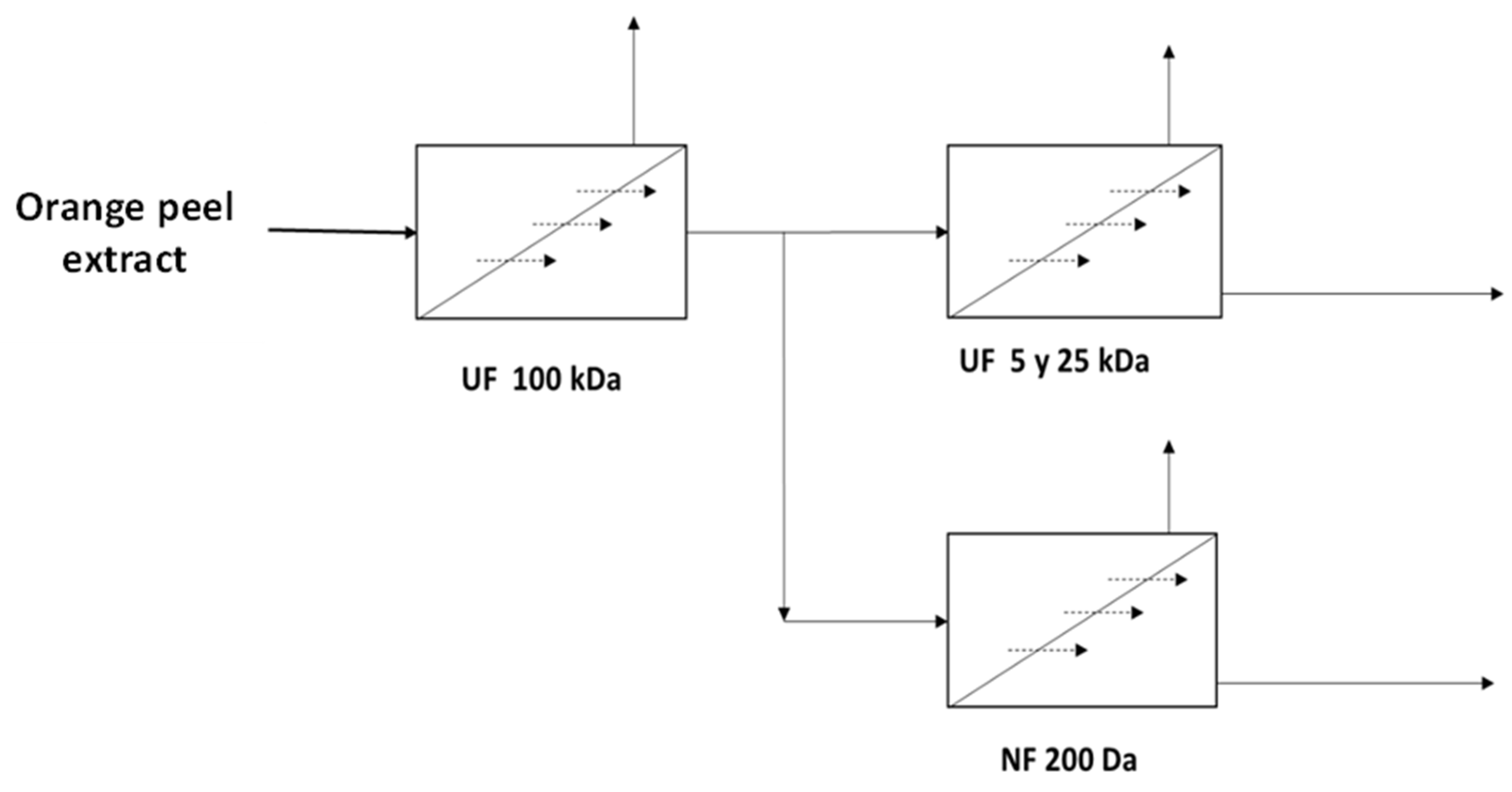
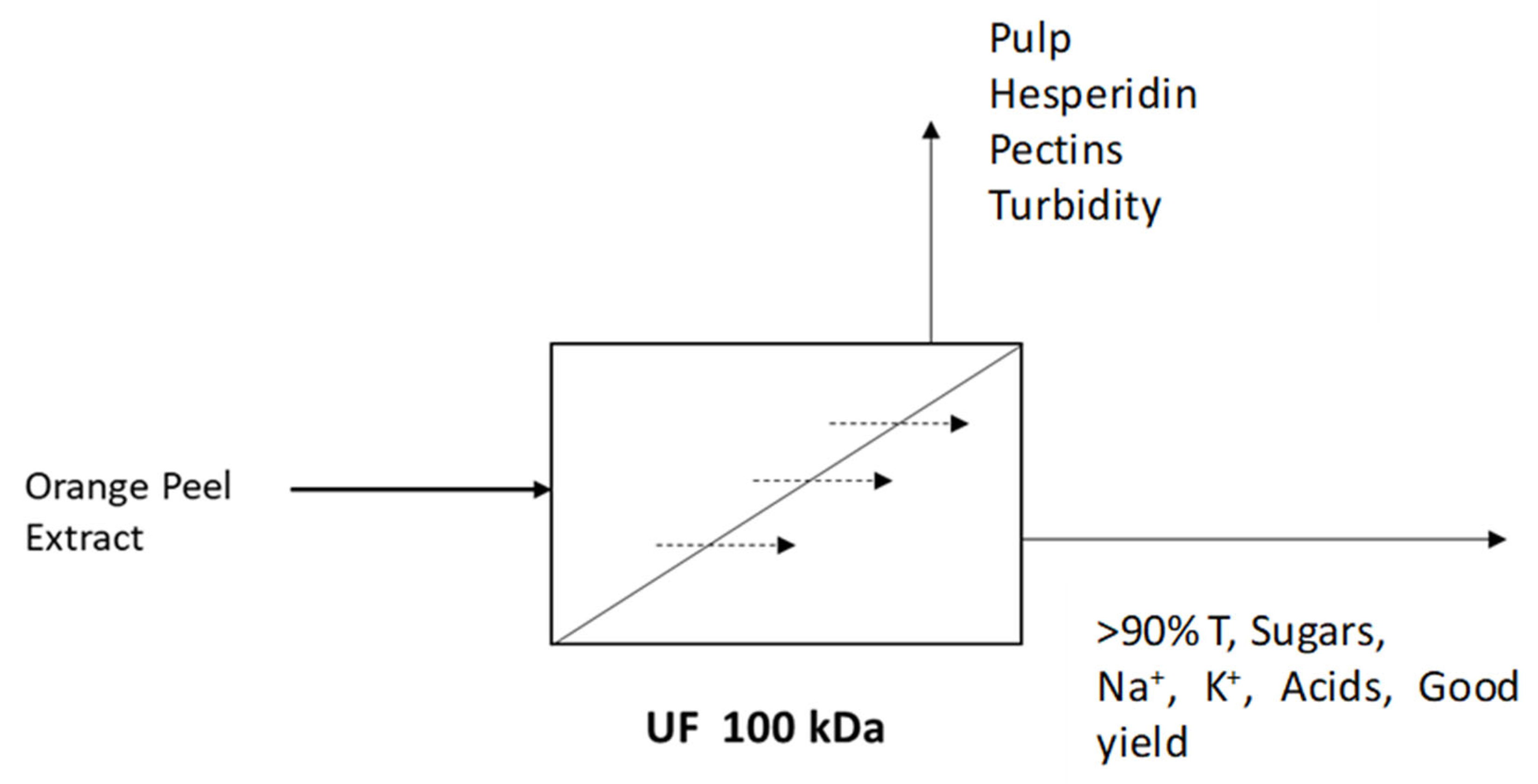
- Clarification through ultrafiltration 100 kDa
- Optimisation of the clarified orange peel extract (COPE) using UF membranes (5 and 25 kDa)
- ○
- Experimental series for initial membrane characterisation. Initially, the feed tank is filled with distilled water to determine the membrane’s permeability to the solvent.
- ○
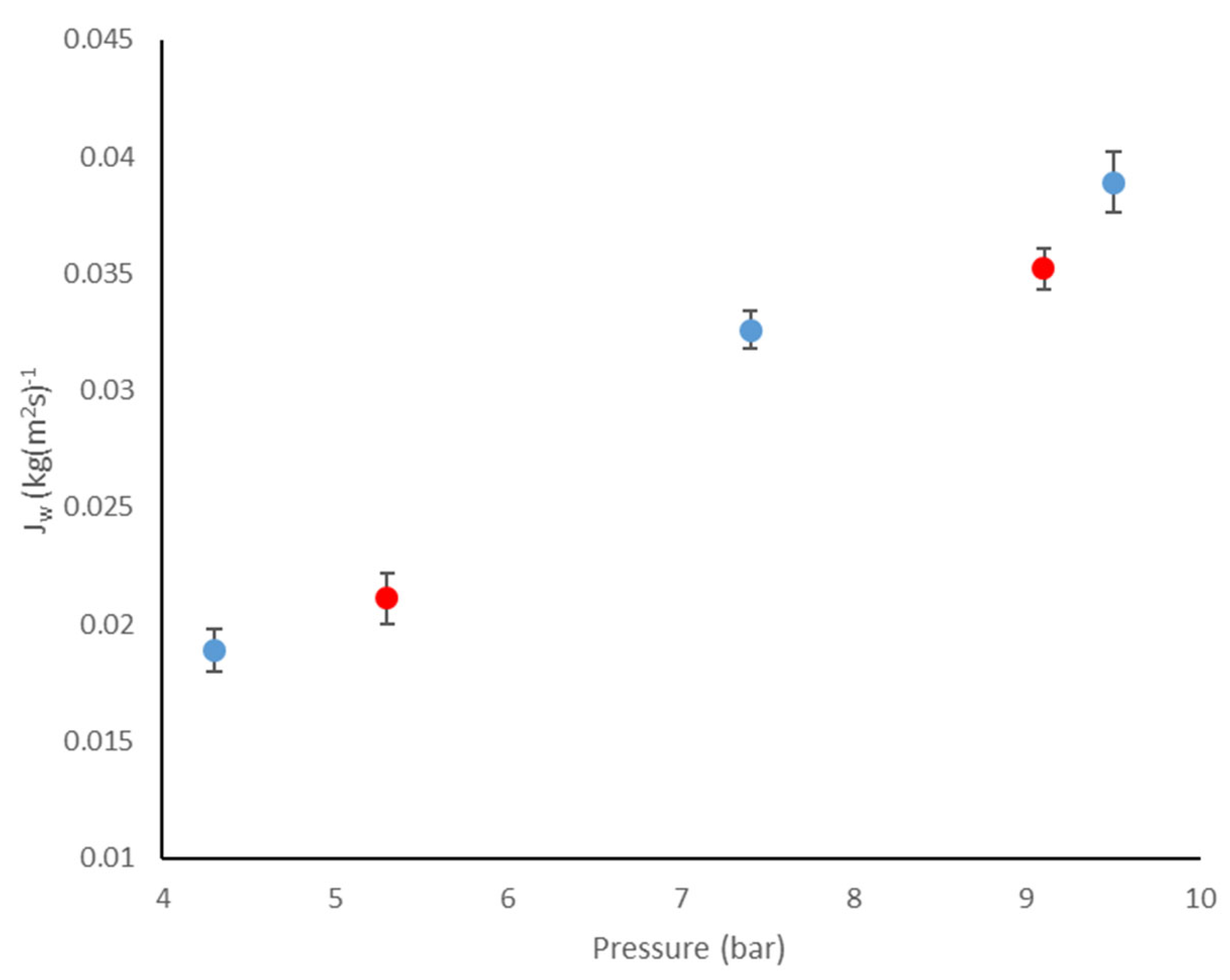
- Experimental series to determine the behaviour of the membrane towards the feed from the orange peel extract clarification. For each of the membranes tested (GR60PP and GR90PP), four tests are carried out, varying the operating pressure from 7 to 9 bar.
- ○
- Experimental series for the final characterisation of the membrane: this consists of the same tests as the first experimental series, except that these are carried out after the experiment with the orange peel extract (COPE) clarification solution has been completed.
- Separation of sugars by nanofiltration membrane
2.6. Analytical Methods
3. Results and Discussion
3.1. OPE Characterization
3.2. Clarification Through Ultrafiltration 100 kDa
3.3. Optimisation of the Clarified Orange Peel Extract (COPE) Using UF Membranes (5 and 25 kDa)
3.3.1. Determination of Permeability by Testing Distilled Water
3.3.2. Characterization of the Permeate and Concentrate Streams
3.3.3. Fouling Study

| Membranes | FI (%) | IF |
|---|---|---|
| GR60PP | 94.92 ± 1.42 | 0.095 ± 0.001 |
3.4. Separation of Sugars by Nanofiltration Membrane
4. Conclusions
Supplementary Materials
Author Contributions
Funding
Data Availability Statement
Conflicts of Interest
References
- USDA. Crop Production Reports. 2022. Available online: https://www.nass.usda.gov/Statistics_by_Subject/ (accessed on 22 September 2025).
- FAO. Crops and Livestock Products. 2023. Available online: https://www.fao.org/faostat/en/#data (accessed on 5 November 2025).
- Putnik, P.; Bursać Kovačević, D.; RežekJambrak, A.; Barba, F.; Cravotto, G.; Binello, A.; Lorenzo, J.; Shpigelman, A. Innovative “Green” and Novel Strategies for the Extraction of Bioactive Added Value Compounds from Citrus Wastes—A Review. Molecules 2017, 22, 680. [Google Scholar] [CrossRef] [Scilit]
- Olabinjo, O.O.; Ogunlowo, A.S.; Ajayi, O.O.; Olalusi, A.P. Analysis of Physical and Chemical Composition of Sweet Orange (Citrus sinensis) Peels. Int. J. Environ. Agric. Biotechnol. IJEAB 2017, 2, 2201–2206. [Google Scholar] [CrossRef] [Scilit]
- Ayala, J.R.; Montero, G.; Coronado, M.A.; García, C.; Curiel-Alvarez, M.A.; León, J.A.; Sagaste, C.A.; Montes, D.G. Characterization of Orange Peel Waste and Valorization to Obtain Reducing Sugars. Molecules 2021, 26, 1348. [Google Scholar] [CrossRef] [Scilit]
- Parmar, H.S.; Kar, A. Medicinal values of fruit peels from Citrus sinensis, Punica granatum, and Musa paradisiaca with respect to alterations in tissue lipid peroxidation and serum concentration of glucose, insulin, and thyroid hormones. J. Med. Food 2008, 11, 376–381. [Google Scholar] [CrossRef] [Scilit]
- Ezejiofor, T.; Eke, N.; Okechukwu, R.; Nwaoguikpe, R.; Duru, M. Waste to wealth: Industrial raw materials potential of peels of Nigerian sweet orange (Citrus sinensis). Afr. J. Biotechnol. 2011, 10, 6257–6264. [Google Scholar]
- Sathiyabama, R.G.; Gandhi, G.R.; Denadai, M.; Sridharan, G.; Jothi, G.; Sasikumar, P.; Quintans, J.S.S.; Narain, N.; Cuevas, L.E.; Coutinho, H.D.M.; et al. Evidence of insulin-dependent signalling mechanisms produced by Citrus sinensis (L.) Osbeck fruit peel in an insulin resistant diabetic animal model. Food Chem. Toxicol. 2018, 116 Pt B, 86–99. [Google Scholar] [CrossRef] [Scilit] [PubMed]
- Okoye, C.O.B.; Ibeto, C.N.; Ihedioha, J.N. Preliminary Studies on the Characterization of Orange Seed and Pawpaw Seed Oils. Am. J. Food Technol. 2011, 6, 422–426. [Google Scholar] [CrossRef] [Scilit]
- El-Safy, F.S.; Salem, R.H.; El-Ghany, M.A. Chemical and Nutritional Evaluation of Different Seed Flours as Novel Sources of Protein. World J. Dairy Food Sci. 2012, 7, 59–65. [Google Scholar]
- Malacrida, C.R.; Kimura, M.; Jorge, N. Phytochemicals and antioxidant activity of citrus seed oils. Food Sci. Technol. Res. 2012, 18, 399–404. [Google Scholar] [CrossRef] [Scilit]
- Adubofuor, J.; Akyereko, Y.G.; Batsa, V.; Apeku, O.D.; Amoah, I.; Diako, C. Nutrient Composition and Physical Properties of Two Orange Seed Varieties. Int. J. Food Sci. 2021, 2021, 6415620. [Google Scholar] [CrossRef] [Scilit] [PubMed]
- Afrin, S.M.; Acharjee, A.; Sit, N. Convective drying of orange pomace at different temperatures and characterization of the obtained powders. J. Food Sci. Technol. 2022, 59, 1040–1052. [Google Scholar] [CrossRef] [Scilit]
- Fernández-López, J.; Sendra-Nadal, E.; Navarro, C.; Sayas, E.; Viuda-Martos, M.; Pérez Alvarez, J.A. Storage stability of a high dietary fibre powder from orange by-products. Int. J. Food Sci. Technol. 2009, 44, 748–756. [Google Scholar] [CrossRef] [Scilit]
- de Moraes Crizel, T.; Jablonski, A.; de Oliveira Rios, A.; Rech, R.; Flôres, S.H. Dietary fiber from orange byproducts as a potential fat replacer. LWT-Food Sci. Technol. 2013, 53, 9–14. [Google Scholar] [CrossRef] [Scilit]
- Castro, L.A.; Lizi, J.M.; Chagas, E.G.L.; Carvalho, R.A.; Vanin, F.M. From Orange Juice By-Product in the Food Industry to a Functional Ingredient: Application in the Circular Economy. Foods 2020, 9, 593. [Google Scholar] [CrossRef] [Scilit]
- Garcia-Castello, E.M.; Mayor, L.; Chorques, S.; Argüelles, A.; Vidal-Brotóns, D.; Gras, M.L. Reverse osmosis concentration of press liquid from orange juice solid wastes: Flux decline mechanisms. J. Food Eng. 2011, 106, 199–205. [Google Scholar] [CrossRef] [Scilit]
- Chornomaz, P.M.; Pagliero, C.; Marchese, J.; Ochoa, N.A. Impact of structural and textural membrane properties on lemon juice clarification. Food Bioprod. Process. 2013, 91, 67–73. [Google Scholar] [CrossRef] [Scilit]
- Suri, S.; Singh, A.; Nema, P.K. Recent advances in valorization of citrus fruits processing waste: A way forward towards environmental sustainability. Food Sci. Biotechnol. 2021, 30, 1601–1626. [Google Scholar] [CrossRef] [Scilit]
- Russo, C.; Maugeri, A.; Lombardo, G.E.; Musumeci, L.; Barreca, D.; Rapisarda, A.; Cirmi, S.; Navarra, M. The second life of citrus fruit waste. A valuable source of bioactive compounds. Molecules 2021, 26, 5991. [Google Scholar] [CrossRef] [Scilit] [PubMed]
- Jebreen, A.M.Y.; Sahni, O.; Areesha. Citrus Peel Waste Management of Oranges. In Valorization of Citrus Food Waste; Chauhan, A., Islam, F., Imran, A., Aswal, J.S., Eds.; Springer: Cham, Switzerland, 2025; pp. 31–42. [Google Scholar] [CrossRef] [Scilit]
- Lucia, C.; Laudicina, V.A.; Badalucco, L.; Galati, A.; Palazzolo, E.; Torregrossa, M.; Viviani, G.; Corsino, S.F. Challenges and opportunities for citrus wastewater management and valorisation: A review. J. Environ. Manag. 2022, 321, 115924. [Google Scholar] [CrossRef] [Scilit] [PubMed]
- Cassano, A.; Conidi, C.; Ruby-Figueroa, R. Recovery of Bioactive Compounds in Citrus Wastewater by Membrane Operations. In Integrated Membrane Operations in the Food Production; Cassano, A., Drioli, E., Eds.; De Gruyter Brill: Berlin, Germany; Munich, Germany; Boston, MA, USA, 2014; pp. 255–280. [Google Scholar]
- Bhattacharjee, C.; Saxena, V.K.; Dutta, S. Fruit juice processing using membrane technology: A review. Innov. Food Sci. Emerg. Technol. 2017, 43, 136–153. [Google Scholar] [CrossRef] [Scilit]
- Urošević, T.; Povrenović, D.; Vukosavljević, P.; Urošević, I.; Stevanović, S. Recent developments in microfiltration and ultrafiltration of fruit juices. Food Bioprod. Process. 2017, 106, 147–161. [Google Scholar] [CrossRef] [Scilit]
- Pagliero, C.; Ochoa, N.A.; Marchese, J. Orange Juice Clarification by Microfiltration: Effect of Operational Variables on Membrane Fouling. Lat. Am. Appl. Res. 2011, 41, 279–284. [Google Scholar]
- Toker, R.; Karhan, M.; Tetik, N.; Turhan, I.; Oziyci, H.R. Effect of Ultrafiltration and Concentration Processes on the Physical and Chemical Composition of Blood Orange Juice. J. Food Process. Preserv. 2014, 38, 1321–1329. [Google Scholar] [CrossRef] [Scilit]
- Cassano, A.; Marchio, M.; Drioli, E. Clarification of blood orange juice by ultrafiltration: Analyses of operating parameters, membrane fouling and juice quality. Desalination 2007, 212, 15–27. [Google Scholar] [CrossRef] [Scilit]
- Saura, D.; Marti, N.; Valero, M.; González, E.; Carbonell, A.; Laencina, J. Separation of aromatics compounds during the clarification of lemon juice by cross-flow filtration. Ind. Crops Prod. 2011, 36, 543–548. [Google Scholar] [CrossRef] [Scilit]
- Galaverna, G.; Di Silvestro, G.; Cassano, A.; Sforza, S.; Dossena, A.; Drioli, E.; Marchelli, R. A new integrated membrane process for the production of concentrated blood orange juice: Effect on bioactive compounds and antioxidant activity. Food Chem. 2008, 106, 1021–1030. [Google Scholar] [CrossRef] [Scilit]
- Mirsaeedghazi, H.; Emam-Djomeh, Z. Clarification of bitter orange (Citrus aurantium) juice using microfiltration with mixed cellulose esters membrane. J. Food Process. Preserv. 2017, 41, e12738. [Google Scholar] [CrossRef] [Scilit]
- Maktouf, S.; Neifar, M.; Drira, S.J.; Baklouti, S.; Fendri, M.; Châabouni, S.E. Lemon juice clarification using fungal pectinolytic enzymes coupled to membrane ultrafiltration. Food Bioprod. Process. 2014, 92, 14–19. [Google Scholar] [CrossRef] [Scilit]
- Espamer, L.; Pagliero, C.; Ochoa, A.; Marchese, J. Clarification of lemon juice using membrane process. Desalination 2006, 200, 565–567. [Google Scholar] [CrossRef] [Scilit]
- Echavarría, A.P.; Falguera, V.; Torras, C.; Berdún, C.; Pagán, J.; Ibarz, A. Ultrafiltration and reverse osmosis for clarification and concentration of fruit juices at pilot plant scale. LWT-Food Sci. Technol. 2012, 46, 189–195. [Google Scholar] [CrossRef] [Scilit]
- Galanakis, C.M.; Markouli, E.; Gekas, V. Recovery and fractionation of different phenolic classes from winery sludge using ultrafiltration. Sep. Purif. Technol. 2013, 107, 245–251. [Google Scholar] [CrossRef] [Scilit]
- Galanakis, C.M.; Schieber, A. Editorial. Food Res. Int. 2014, 65 Pt C, 299–300. [Google Scholar] [CrossRef] [Scilit]
- Tripoli, E.; Guardia, M.L.; Giammanco, S.; Majo, D.D.; Giammanco, M. Citrus flavonoids: Molecular structure, biological activity and nutritional properties: A review. Food Chem. 2007, 104, 466–479. [Google Scholar] [CrossRef] [Scilit]
- Kawaii, S.; Tomono, Y.; Katase, E.; Ogawa, K.; Yano, M. Quantitation of flavonoid constituents in citrus fruits. J. Agric. Food Chem. 1999, 47, 3565–3571. [Google Scholar] [CrossRef] [Scilit]
- Ruby-Figueroa, R.; Cassano, A.; Drioli, E. Ultrafiltration of orange press liquor: Optimization for permeate flux and fouling index by response surface methodology. Sep. Purif. Technol. 2011, 80, 1–10. [Google Scholar] [CrossRef] [Scilit]
- Ruby-Figueroa, R.; Cassano, A.; Drioli, E. Ultrafiltration of orange press liquor: Optimization of operating conditions for the recovery of antioxidant compounds by response surface methodology. Sep. Purif. Technol. 2012, 98, 255–261. [Google Scholar] [CrossRef] [Scilit]
- Conidi, C.; Cassano, A.; Drioli, E. Recovery of phenolic compounds from orange press liquor by nanofiltration. Food Bioprod. Process. 2012, 90, 867–874. [Google Scholar] [CrossRef] [Scilit]
- Cassano, A.; Conidi, C.; Ruby-Figueroa, R. Recovery of Flavonoids from Orange Press Liquor by an Integrated Membrane Process. Membranes 2014, 4, 509–524. [Google Scholar] [CrossRef] [Scilit]
- Polidori, J.; Dhuique-Mayer, C.; Dornier, M. Crossflow microfiltration coupled with diafiltration to concentrate and purify carotenoids and flavonoids from citrus juices. Innov. Food Sci. Emerg. Technol. 2018, 45, 320–329. [Google Scholar] [CrossRef] [Scilit]
- Conidi, C.; Cassano, A.; Drioli, E. A membrane-based study for the recovery of polyphenols from bergamot juice. J. Membr. Sci. 2011, 375, 182–190. [Google Scholar] [CrossRef] [Scilit]
- Conidi, C.; Drioli, E.; Cassano, A. Membrane-based agro-food production processes for polyphenol separation, purification and concentration. Curr. Opin. Food Sci. 2018, 23, 149–164. [Google Scholar] [CrossRef] [Scilit]
- Navarro, A.R.; Dorado, L.; Maldonado, M.C. An eco-biotechnological process for the treatment of residual lemon pulp. Clean. Technol. Environ. Policy 2009, 11, 323–327. [Google Scholar] [CrossRef] [Scilit]
- Tripodo, M.M.; Lanuzza, F.; Micali, G.; Coppolino, R.; Nucita, F. Citrus waste recovery: A new environmentally friendly procedure to obtain animal feed. Bioresour. Technol. 2004, 91, 111–115. [Google Scholar] [CrossRef] [Scilit]
- Grampp, E. Hot clarification process improves production of apple juice concentrate. Food Technol. 1977, 31, 38–43. [Google Scholar]
- Dey, T.B.; Banerjee, R. Application of decolourized and partially purified polygalacturonase and α-amylase in apple juice clarification. Braz. J. Microbiol. 2014, 45, 97–104. [Google Scholar] [CrossRef] [Scilit]
- Jegatheesan, V.; Shu, L.; Keir, G.; Phong, D.D. Evaluating membrane technology for clarification of sugarcane juice. Rev. Environ. Sci. Biotechnol. 2012, 11, 109–124. [Google Scholar] [CrossRef] [Scilit]
- Garg, A.; Garg, S.; Zaneveld, L.J.; Singla, A.K. Chemistry and pharmacology of the Citrus bioflavonoid hesperidin. Phytother. Res. 2001, 15, 655–669. [Google Scholar] [CrossRef] [Scilit]
- Pyrzynska, K. Hesperidin: A Review on Extraction Methods, Stability and Biological Activities. Nutrients 2022, 14, 2387. [Google Scholar] [CrossRef] [Scilit] [PubMed]
- Martínez-Hernández, G.B.; Taboada-Rodríguez, A.; Marin-Iniesta, F. Plant Bioactive Compounds in Foods and Food Packages. Foods 2024, 13, 1419. [Google Scholar] [CrossRef] [Scilit]
- Stahel, W. The circular economy. Nature 2016, 531, 435–438. [Google Scholar] [CrossRef] [Scilit]
- Hidalgo, A.M.; Macario, J.A.; Abellán-Baeza, M.; Sánchez-Moya, T.; López-Nicolás, R.; Marín-Iniesta, F. Pomegranate Juice Clarification Using Ultrafiltration: Influence of the Type of Variety and Degree of Ripeness. Separations 2024, 11, 134. [Google Scholar] [CrossRef] [Scilit]
- International Fruit and Vegetable Juice Association. Methods of Analysis (Revised 2017) No. 8, Determination of Soluble Solids (Indirect Method by Refractometry). Available online: www.ifu-fruitjuice.com (accessed on 15 May 2018).
- International Fruit and Vegetable Juice Association. Methods of Analysis (2005) No. 33, Determination of Sodium, Potassium, Calcium and Magnesium. Available online: www.ifu-fruitjuice.com (accessed on 15 May 2018).
- International Fruit and Vegetable Juice Association. Methods of Analysis (2015) No. 11, Determination of pH. Available online: www.ifu-fruitjuice.com (accessed on 15 May 2018).
- John Bean Technologies Corporation. Chapter IV—Juice Quality Analysis: Ascorbic Acid by Iodine Titration. In Procedures for Analysis of Citrus Products, 7th ed.; Manual No. 054R10020.000-7; JBT FoodTech Citrus Systems: Lakeland, FL, USA, 2018. [Google Scholar]
- International Fruit and Vegetable Juice Association. Methods of Analysis (Revised 2017) No. 3, Tritable Acidity. Available online: www.ifu-fruitjuice.com (accessed on 15 May 2018).
- International Fruit and Vegetable Juice Association. Methods of Analysis (2005) No. 30, Determination of Formol Numbers. Available online: www.ifu-fruitjuice.com (accessed on 15 May 2018).
- International Fruit and Vegetable Juice Association. Methods of Analysis (Revised 2025) No. 60, Determination of Centrifugal Pulp. Available online: www.ifu-fruitjuice.com (accessed on 15 May 2018).
- Kelebek, H.; Selli, S.; Canbas, A.; Cabaroglu, T. HPLC Determination of Organic Acids, Sugars, Phenolic Compositions and Antioxidant Capacity of Orange Juice and Orange Wine Made from a Turkish Cv. Kozan. Microchem. J. 2009, 91, 187–192. [Google Scholar] [CrossRef] [Scilit]
- International Fruit and Vegetable Juice Association. IFU Recommendation No. 7: Determination of Turbidity (Nephelometric Method). 2003. Available online: www.ifu-fruitjuice.com (accessed on 15 May 2018).
- International Fruit and Vegetable Juice Association. Methods of Analysis (Revised 2019) No. 80, Spectrophotometric Colour Measurement. Available online: www.ifu-fruitjuice.com (accessed on 15 May 2018).
- John Bean Technologies Corporation. Capítulo IV—Juice Quality Analysis: Limonin by HPLC. In Procedures for Analysis of Citrus Products, 7th ed.; Manual No. 054R10020.000-7; JBT FoodTech Citrus Systems: Lakeland, FL, USA, 2018. [Google Scholar]
- Kashyap, D.R.; Vohra, P.K.; Chopra, S.; Tewari, R. Applications of pectinases in the commercial sector: A review. Bioresour. Technol. 2001, 77, 215–227. [Google Scholar] [CrossRef] [Scilit]
- Sánchez-Moya, T.; Hidalgo, A.M.; Ros-Berruezo, G.; López-Nicolás, R. Screening ultrafiltration membranes to separate lactose and protein from sheep whey: Application of simplified model. J. Food Sci. Technol. 2020, 57, 3193–3200. [Google Scholar] [CrossRef] [Scilit]
- Murcia, M.D.; Hidalgo, A.M.; Gómez, M.; León, G.; Gómez, E.; Martínez, M. Ultrafiltration Membranes Modified with Reduced Graphene Oxide: Effect on Methyl Green Removal from Aqueous Solution. Materials 2023, 16, 1369. [Google Scholar] [CrossRef] [Scilit]
- Galanakis, C.M. Separation of functional macromolecules and micromolecules: From ultrafiltration to the border of nanofiltration. Trends Food Sci. Technol. 2015, 42, 44–63. [Google Scholar] [CrossRef] [Scilit]
- Ma, X.; Su, Y.; Sun, Q.; Wang, Y.; Jiang, Z. Preparation of protein-adsorption-resistant polyethersulfone ultrafiltration membranes through surface segregation of amphiphilic comb copolymer. J. Membr. Sci. 2007, 292, 116–124. [Google Scholar] [CrossRef] [Scilit]
- Peng, J.; Su, Y.; Shi, Q.; Chen, W.; Jiang, Z. Protein fouling resistant membrane prepared by amphiphilic pegylated polyethersulfone. Bioresour. Technol. 2011, 102, 2289–2295. [Google Scholar] [CrossRef] [Scilit] [PubMed]
- Castro, B.N.; Gerla, P.E. Pasteurization of orange juice by membrane filtration. In Proceedings of the 4th MERCOSUR Congress on Processs System Engineering, 2nd MERCOSUR Congress on Chemical Engineering, Rio de Janeiro, Brazil, 13–17 August 2005. [Google Scholar]
- Luo, J.; Hang, X.; Zhai, W.; Qi, B.; Song, W.; Chen, X.; Wan, Y. Refining sugarcane juice by an integrated membrane process: Filtration behavior of polymeric membrane at high temperature. J. Membr. Sci. 2016, 509, 105–115. [Google Scholar] [CrossRef] [Scilit]
- AIJN. Available online: http://www.aijn.org/publications/code-of-practice/the-aijn-code-of-practice/ (accessed on 7 September 2019).
- Conidi, C.; Cassano, A.; Caiazzo, F.; Drioli, E. Separation and purification of phenolic compounds from pomegranate juice by ultrafiltration and nanofiltration membranes. J. Food Eng. 2017, 195, 1–13. [Google Scholar] [CrossRef] [Scilit]
- Ahmed, A.E.G.; Jordan, C.; Walcher, E.; Kuloglija, S.; Turetschek, R.; Lozar, A.; Tomasetig, D.; Harasek, M. Membrane processes for remediating water from sugar production by product stream. Membranes 2025, 15, 207. [Google Scholar] [CrossRef] [Scilit] [PubMed]
- Cassano, A.; Conidi, C.; Drioli, E. Comparison of the performance of UF membranes in olive mill wastewaters treatment. Water Res. 2011, 45, 3197–3204. [Google Scholar] [CrossRef] [Scilit]
- Warczok, J.; Ferrando, M.; López, F.; Güell, C. Concentration of apple and pear juices by nanofiltration at low pressures. J. Food Eng. 2004, 63, 63–70. [Google Scholar] [CrossRef] [Scilit]
- Álvarez-Quintana, S.; Carmona, F.J.; Palacio, L.; Hernández, A.; Prádanos, P. Water viscosity in confined nanoporous media and flow through nanofiltration membranes. Micropor. Mesopor. Mat. 2020, 303, 110289. [Google Scholar] [CrossRef] [Scilit]
- Ben Soltane, H.; Roizard, D.; Favre, E. Effect of pressure on the swelling and fluxes of dense PDMS membranes in nanofiltration: An experimental study. J. Membr. Sci. 2013, 435, 110–119. [Google Scholar] [CrossRef] [Scilit]
- García-Martín, N.; Perez-Magariño, S.; Ortega-Heras, M.; González-Huerta, C.; Mihnea, M.; González-Sanjosé, M.L.; Palacio, L.; Prádanos, P.; Hernández, A. Sugar reduction in musts with nanofiltration membranas to obtain low alcohol-content wines. Sep. Purif. Technol. 2010, 76, 158–170. [Google Scholar] [CrossRef] [Scilit]


| Compounds | Separation Efficiency | By-Product | Process | MWCO | Material | Configuration | References |
|---|---|---|---|---|---|---|---|
| Polyphenols | 58.30% | Orange press liqueur | UF | 100 kDa | Polysulfone | Hollow fiber | [39,40] |
| Anthocyanins and flavonoids | >90% | Orange press liqueur | NF | 180 Da | Polyamide-polysulfone | Spiral module | [41] |
| >80% | NF | 300 Da | Thin-layerpolypiperazine amide | ||||
| >80% | NF | 400 Da | Polyethersulfone | ||||
| >70% | NF | 1000 Da | Polyethersulfone | ||||
| Anthocyanins and flavonoids | >65% | Orange press liqueur | NF | Rejection Na2SO4 > 25–50% | Polyethersulfone | Spiral module | [42] |
| Carotenes and flavonoids | Orange and clementine juice | MF + DF | 0.2 µm | Ceramics | Tubular module | [43] | |
| Polyphenols and flavonoids | 91–97% flavonoids | Bergamot juice | UF + NF | 100 kDa + 450 Da | Polysulfone + TiO2 | Flat membrane Hollow fiber Tubular module | [44] |
| 43–62% polyph. 44% | 100 kDa + 750 Da | Polysulfone + TiO2 |
| Clarification Membrane | Optimization Membrane | Optimization Membrane | Sugar Separation Membrane | |
|---|---|---|---|---|
| Supply company | Pall Corporation (Port Washington, NY, USA) | Alfa Laval Iberia S.A (Madrid, Spain) | Alfa Laval Iberia S.A (Madrid, Spain) | Alfa Laval Iberia S.A (Madrid, Spain) |
| Commercial name | Membralox | GR60PP | GR90PP | NF |
| Membrane type | Multichannel ceramic | Thin composite polypropylene layer | Thin composite polypropylene layer | Polymeric |
| Chemical composition | Zirconium | Polysulfone | Polyetersulfone | Polyester |
| Surface area (m2) | 3 | 8.48 × 10⁻³ | 8.48 × 10⁻³ | 2.5 |
| Maximum pressure (bar) | 5 | 10 | 10 | 55 |
| Maximum temperature (°C) | 90 | 75 | 75 | 60 |
| pH range | 1–13 | 1–13 | 1–13 | 2–9 |
| MWCO (Da) | 100,000 | 25,000 | 5000 | 200 |
| Equipment | Model | Measure |
|---|---|---|
| Refractometer | Atago RX5000 α-BEV (Atago Co., Ltd., Tokyo, Japan) | Brix degrees |
| pH meter | Hach SensION (Hach Company, Loveland, CO, USA) | pH |
| Automatic calibrator | Methrom 916 Ti-Touch (Methrom AG, Herisam, Switzerland) | Acidity, formol index |
| Spectrophotometer | Thermo Scientific Genesys 10 (ThermoFisher Scientific, Waltham, MA, USA) | Absorbance, transmittance |
| Flame photometer | Jenway pfp7 (AntyliaScientifica, Vernon Hills, IL, USA) | Sodium, potassium |
| Turbidimeter | Hach 2100AN (Hach Company, Loveland, CO, USA) | Turbidity NTU |
| Centrifuge | Hettich rotofix 3 (Andreas Hettich Gmbh, Tutlingen, Germany) | Pulp content |
| HPLC | Merck LaChrom (Merck KGaA, Darmstadt, Germany) | Sugars |
| HPLC | Agilent 1100 series (Agilent Technologies, Santa Clara, CA, USA) | Limonin, eriocitrine, hesperidine |
| Laboratory scale | Radwag FS 4500 (Radwag, Radom, Poland) | Mass |
| Precision scale | Sartorius CP/245 (Sartorius AG, Gotinga, Germany) | Mass |
| Scale | Omron BF-508 (Omron Corporate, Kyoto, Japan) | Mass |
| Freezer | Beko (Beko Elektronik Karman, Istambul, Turkey) | - |
| Refrigerator | Beko (Beko Elektronik Karman, Istambul, Turkey) | - |
| Dry column height gauge | - | Height |
| Laboratory pasteurizer | Inoxpaser (Inoxpaser, S.L., Murcia, Spain) | - |
| Methods | Analytical Determinations |
|---|---|
| IFU nº 8. Determination of soluble solids (indirect method by refractometry) [56] | Brix degrees determination in juices |
| IFU nº 33. Determination of sodium, potassium, calcium and magnesium [57] | Sodium/potassium content determination |
| IFU nº 11. Determination of pH value [58] | pH determination |
| JBT. Cap IV. Nº 27. Ascorbic acid by iodine determination [59] | Vitamin C (ascorbic acid) determination |
| IFU nº 3. Tritable acidity and IFU nº 30. Determination of formol number [60,61] | Acid percentage and formol index determination |
| IFU nº 60. Determination of centrifugable pulp [62] | Pulp content in juices determination |
| Determination of sugars by HPLC [63] | Identification and quantification of sugars |
| IFU Recomendation nº 7. Turbidity measurements [58] | Turbidity test |
| IFU nº 80. Measurement of the color of clear and hazy juices [64] | Absorbance and transmittance measurement |
| JBT. Cap.IV, nº 30. Limonin by HPLC [65] | Limonin determination |
| Parameters | Raw Material (OPE) | Feed Solution (Diluted OPE) | Permeate Stream | Concentrate Stream |
|---|---|---|---|---|
| Brix | 49.47 ± 1.98 | 25.0 ± 1.1 | 22.0 ± 0.8 | 22.8 ± 0.9 |
| Acidity (%ACA) | 2.48 ± 0.08 | 1.19 ± 0.04 | 1.1 ± 0.1 | 1.16 ± 0.04 |
| pH | 3.51 ± 0.14 | 3.55 ± 0.14 | 3.60 ± 0.15 | 3.57 ± 0.15 |
| Formaldehyde index (mL100 mL−1) | 16.10 ± 0.80 | 15.75 ± 0.79 | 15.96 ± 0.79 | 15.88 ± 0.79 |
| * Pulp (%vv−1) | 0.6 ± 0.1 | 0.6 ± 0.1 | 0 | 1.1 ± 0.2 |
| * Potassium (mg L−1) | 1337 ± 20 | 1312 ± 19 | 1324 ± 20 | 1351 ± 20 |
| * Transmittance a 650 nm (%) | 0.10 ± 0.01 | 0.20 ± 0.01 | 95.8 ± 1.9 | 0.10 ± 0.01 |
| Color | Pale orange | Pale orange | Golden | Pale orange |
| Flavour | Orange peel | Orange peel | Bitter orange marmalade | Orange peel |
| Aroma | Citrus | Citrus | Citrus | Citrus |
| cleanliness/defects | OK | OK | OK | OK |
| t (min) | %T650 |
|---|---|
| Unclarified sample | 0.2 ± 0.01 |
| 15 | 98.02 ± 1.96 |
| 60 | 98.13 ± 1.96 |
| 120 | 97.91 ± 1.96 |
| 205 | 97.95 ± 1.96 |
| Final rejection | 0.1 ± 0.01 |
| Sugars | Diluted OPE (g L−1) | Clarified OPE (g L−1) | Orange Juice (g L−1) [66] |
|---|---|---|---|
| Fructose 2% | 24.42 ± 0.37 | 28.32 ± 0.42 | 20–27 * |
| Glucose | 26.15 ± 0.39 | 31.56 ± 0.47 | 18–25 * |
| Sucrose | 18.88 ± 0.28 | 20.30 ± 0.30 | 25–55 |
| Maltose | 0.00 | 0.00 | -- |
| Sorbitol | 0.00 | 0.00 | -- |
| Isomaltose | 0.00 | 0.00 | -- |
| % Sucrose | 27.19 ± 0.41 | 25.30 ± 0.38 | ≤55 |
| Glucose/fructose | 1.07 ± 0.02 | 1.11 ± 0.02 | 0.85–1.00 |
| Sugar-free extract | 48.70 ± 0.73 | 37.80 ± 0.58 | 24–40 |
| Parameters 2% | Diluted OPE (g L−1) | Clarified OPE (g L−1) | Orange Juice (g L−1): AIJN (Rev. June 2024) |
|---|---|---|---|
| Hesperidin (mg L−1) | 1203 ± 18 | 78.84 ± 1.18 | 250–700 |
| Limonin (mg L−1) | 2.10 ± 0.03 | 1.50 ± 0.02 | - |
| Eriocitrin (mg L−1) | 0 | 0 | - |
| Citric acid (g L−1) | 10.60 ± 0.16 | 10.00 ± 0.15 | 6.3–17 |
| D-Iso-citric acid (mg kg−1) | 97.07 ± 1.45 | 78.91 ± 1.18 | 65–200 |
| Citric/Iso-citric ratio | 109.20 ± 1.64 | 126.7 ± 1.9 | Max 130 |
| Total pectins (expressed as monogalacturonic acid) | 14,467 ± 217 | 1671 ± 25 | - |
| Water-soluble pectins (mg kg−1) | 9000 ± 135 | 1589 ± 24 | 200–500 |
| Membranes | Experimental Aw (sm−1) | Bibliography Aw (sm−1) | |
|---|---|---|---|
| GR60PP | 1.083 × 10⁻⁸ | 6.69 × 10⁻⁸ | 6,41 × 10⁻⁸ |
| GR90PP | 1.056 × 10⁻⁸ | 5.06 × 10⁻⁸ | -- |
| References | This work | [68] | [69] |
| Parameters | Feed Stream (COPE) | GR60PP Permeate | GR90PP Permeate |
|---|---|---|---|
| Brix degrees | 22.0 ± 0.8 | 19.5 ± 0.8 | 18.28 ± 0.70 |
| Acidity (%ACA) | 1.10 ± 0.04 | 1.00 ± 0.04 | 1.00 ± 0.04 |
| pH | 3.60 ± 0.14 | 3.63 ± 0.15 | 3.69 ± 0.15 |
| Formaldehyde index (ml 100 mL−1) | 15.96 ± 0.80 | 15.66 ± 0.78 | 15.84 ± 0.8 |
| * Potassium (mg L−1) | 1324 ± 20 | 1235 ± 18 | 1301 ± 19 |
| * Ascorbic acid (mg100 mL−1) | 70.4 ± 3.1 | 68.9 ± 2.8 | 71.1 ± 2.9 |
| * Transmittance a 650 nm (%) | 95.8 ± 1.9 | 97.4 ± 1.9 | 99.1 ± 2.0 |
| * Limonin (ppm) | 1.5 ± 0.1 | <1 ± 0.1 | <1 ± 0.1 |
| Color | Golden | Golden | Pale golden |
| Flavour | Bitter orange marmalade | Bitter orange marmalade | Bitter orange marmalade |
| Aroma | Citrus | Citrus | Citrus |
| Cleanliness/defects | OK | OK | OK |
| Parameters | Feed Stream (COPE) | GR60PP Permeate | GR90PP Permeate | GR60PP Concentrate | GR90PP Concentrate |
|---|---|---|---|---|---|
| Brix degrees | 22.0 ± 0.9 | 19.74 ± 0.79 | 18.40 ± 0.74 | 22.59 ± 0.90 | 22.24 ± 0.88 |
| Fructose (g L−1) | 55.63 ± 0.84 | 57.14 ± 0.85 | 52.85 ± 0.79 | 56.41 ± 0.85 | 57.04 ± 0.86 |
| Glucose (g L−1) | 61.99 ± 0.93 | 57.78 ± 0.87 | 55.64 ± 0.83 | 59.74 ± 0.89 | 60.90 ± 0.91 |
| Sucrose (g L−1) | 39.88 ± 0.60 | 36.40 ± 0.55 | 28.51 ± 0.43 | 42.48 ± 0.64 | 40.84 ± 0.61 |
| Sugars | Feed Stream (COPE) | GR60PP Permeate | GR90PP Permeate | GR60PP Concentrate | GR90PP Concentrate | Orange Juice Source: AIJN [75] |
|---|---|---|---|---|---|---|
| Fructose (g L−1) | 28.32 ± 0.42 | 32.42 ± 0.48 | 32.17 ± 0.48 | 27.97 ± 0.42 | 28.73 ± 0.42 | 20–27 * |
| Glucose (g L−1) | 31.56 ± 0.47 | 32.78 ± 0.49 | 33.87 ± 0.51 | 29.62 ± 0.44 | 30.67 ± 0.46 | 18–25 * |
| Sucrose (g L−1) | 20.30 ± 0.30 | 20.65 ± 0.31 | 17.35 ± 0.26 | 21.06 ± 0.32 | 20.57 ± 0.31 | 25–55 |
| Sucrose (%) | 25.30 ± 2.11 | 24.06 ± 0.36 | 20.81 ± 0.31 | 26.78 ± 0.40 | 25.72 ± 0.39 | ≤55 |
| Glucose/fructose | 1.11 ± 0.02 | 1.01 ± 0.02 | 1.05 ± 0.02 | 1.06 ± 0.02 | 1.07 ± 0.02 | 0.85–1.00 |
| Sugar-free extract | 37.80 ± 0.57 | 32.55 ± 0.49 | 34.85 ± 0.52 | 39.63 ± 0.59 | 38.47 ± 0.58 | 24–40 |
| GR60PP Permeate | GR90PP Permeate | GR60PP Concentrate | GR90PP Concentrate | |
|---|---|---|---|---|
| (%) Rejection | (%) Concentrate | |||
| Fructose | −14.48 ± 0.22 | −13.59 ± 0.20 | 1.24 ± 0.02 | −1.43 ± 0.02 |
| Glucose | −3.88 ± 0.06 | −7.31 ± 0.11 | 6.15 ± 0.10 | 2.82 ± 0.04 |
| Sucrose | −1.74 ± 0.02 | 14.51 ± 0.21 | −3.75 ± 0.06 | −1.31 ± 0.02 |
| Sample | Brix Degrees | Glucose g kg DM−1 | Fructose g kg DM−1 | Saccharose g kg DM−1 |
|---|---|---|---|---|
| Feed stream (COPE) | 18.99 ± 0.76 | 250.2 ± 3.75 | 249.2 ± 3.5 | 160.3 ± 1.2 |
| Permeate stream | 5.66 ± 0.22 | 359.8 ± 5.4 | 342.9 ± 5.8 | - |
| Concentrate stream | 39.78 ± 1.59 | 230.70 ± 3.46 | 224.50 ± 3.37 | 192 ± 3 |
| Membrane rejection (%) | - | −43.8 ± 0.7 | −37 ± 6 | 100 |
| Concentration coefficient | - | 1.44 ± 0.02 | 1.38 ± 0.02 | - |
Disclaimer/Publisher’s Note: The statements, opinions and data contained in all publications are solely those of the individual author(s) and contributor(s) and not of MDPI and/or the editor(s). MDPI and/or the editor(s) disclaim responsibility for any injury to people or property resulting from any ideas, methods, instructions or products referred to in the content. |
© 2025 by the authors. Licensee MDPI, Basel, Switzerland. This article is an open access article distributed under the terms and conditions of the Creative Commons Attribution (CC BY) license (https://creativecommons.org/licenses/by/4.0/).
Share and Cite
Hidalgo, A.M.; Macario Legaz, J.A.; Saura-Martínez, J.; Tortosa-Díaz, L.; López-Nicolás, R.; Marín-Iniesta, F. Application of Membrane Technology to Obtain Bioactive Products from Orange Peel Extract. Foods 2025, 14, 4202. https://doi.org/10.3390/foods14244202
Hidalgo AM, Macario Legaz JA, Saura-Martínez J, Tortosa-Díaz L, López-Nicolás R, Marín-Iniesta F. Application of Membrane Technology to Obtain Bioactive Products from Orange Peel Extract. Foods. 2025; 14(24):4202. https://doi.org/10.3390/foods14244202
Chicago/Turabian StyleHidalgo, Asunción M., José Antonio Macario Legaz, Jorge Saura-Martínez, Luis Tortosa-Díaz, Rubén López-Nicolás, and Fulgencio Marín-Iniesta. 2025. "Application of Membrane Technology to Obtain Bioactive Products from Orange Peel Extract" Foods 14, no. 24: 4202. https://doi.org/10.3390/foods14244202
APA StyleHidalgo, A. M., Macario Legaz, J. A., Saura-Martínez, J., Tortosa-Díaz, L., López-Nicolás, R., & Marín-Iniesta, F. (2025). Application of Membrane Technology to Obtain Bioactive Products from Orange Peel Extract. Foods, 14(24), 4202. https://doi.org/10.3390/foods14244202