


Mashua (Tropaeolum tuberosum Ruiz & Pavón): Nutritional Composition, Bioactive Compounds, and Functional Potential as an Andean Natural Ingredient
 , , , and
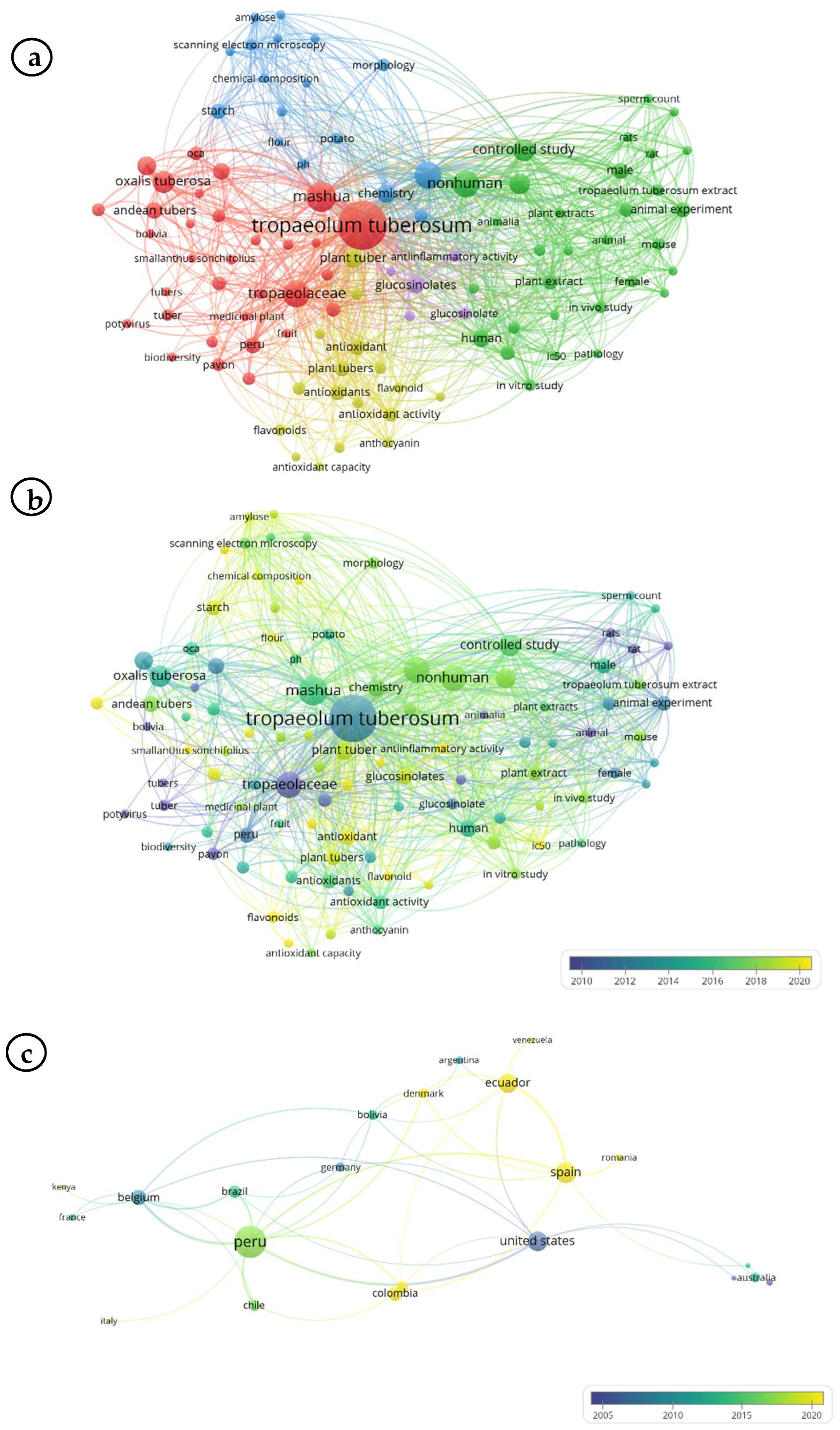
Abstract
1. Introduction
2. Methodology
3. Data Harmonization and Analysis of Variability
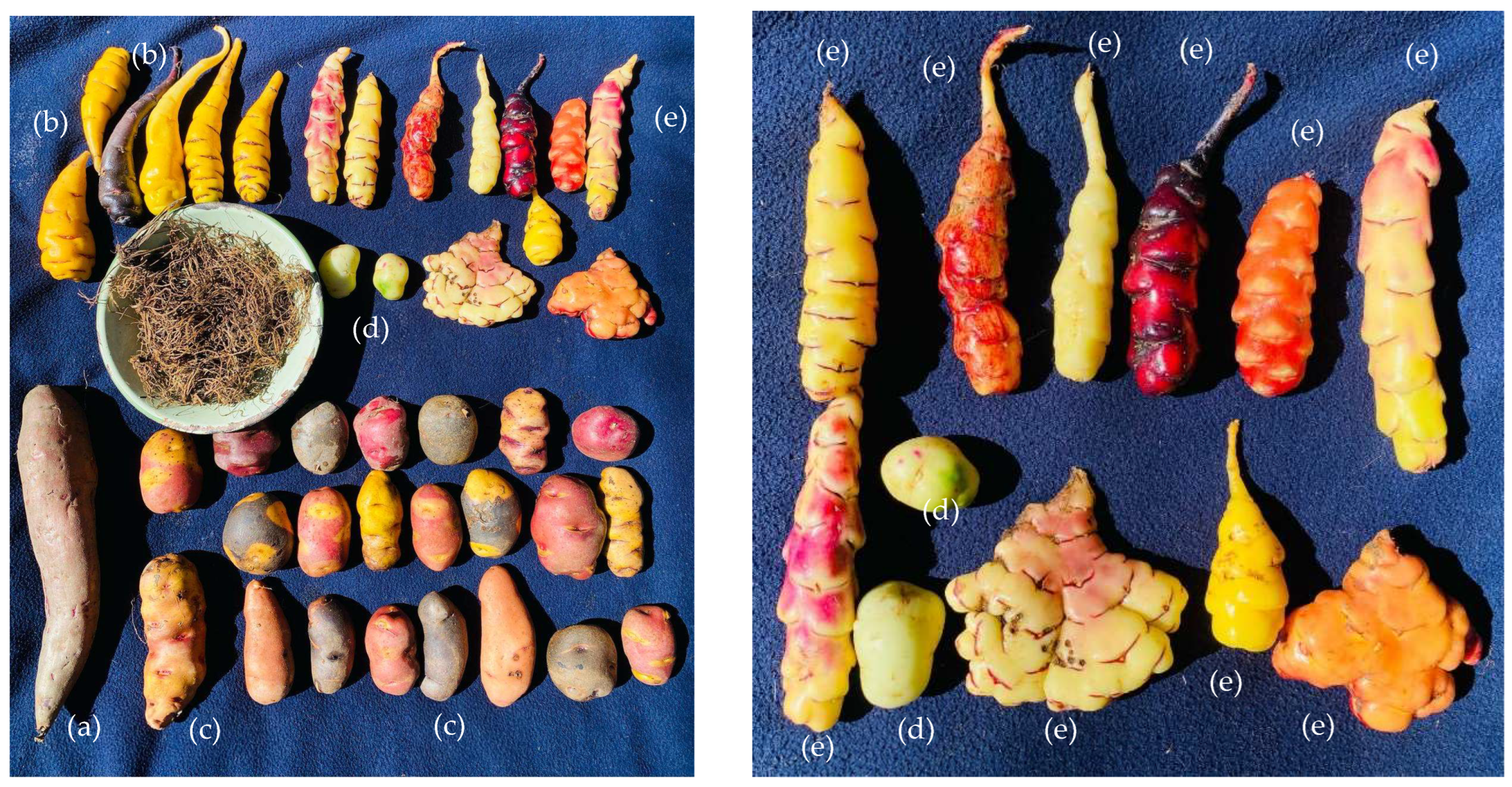
4. Andean Tubers and Roots
5. Tropaeolum Tuberosum
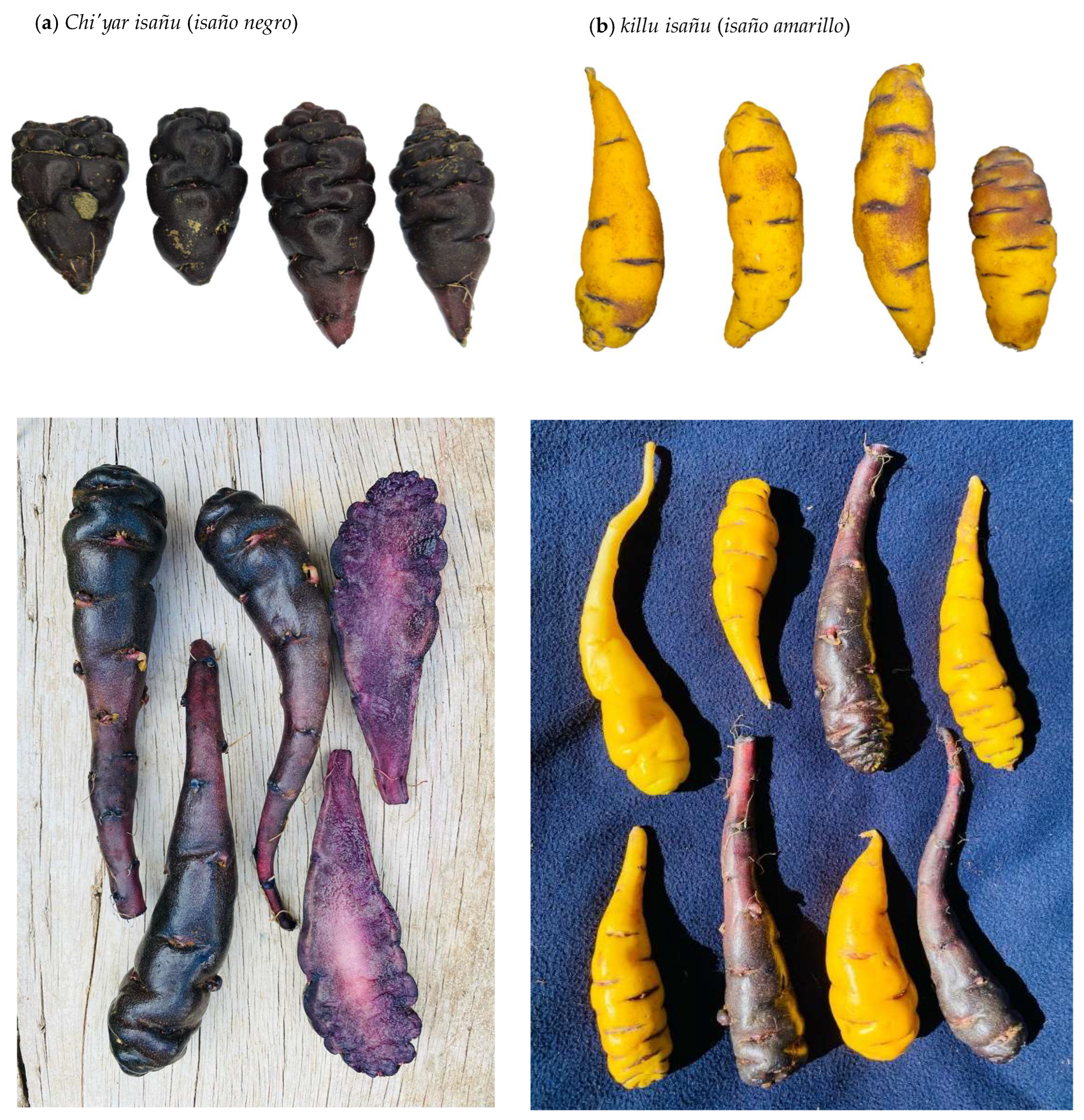
5.1. Morphology and Taxonomy
5.2. Nutritional Composition

| Accession/Ecotype | Origin/Location | Sample Type | Carbohydrates (g/100 g) | Proteins (g/100 g) | Fats (g/100 g) | Fiber (g/100 g) | Ash (g/100 g) | Moisture (%) | Ref. |
|---|---|---|---|---|---|---|---|---|---|
| INIAP-ECU-izaño | Ecuador | Tuber DW | 78.0 ± 0.5 | 12.0 ± 0.4 | 1.1 ± 0.2 | 6.8 ± 0.1 (TDF) | 3.7 | 86% | [10] |
| Purple | Collao, Peru | Tuber DW | 70.73 ± 0.16 | 11.72 ± 0.05 | 4.53 ± 0.06 | 6.36 ± 0.03 | 6.66 ± 0.08 | 89.72 ± 0.62 | [4] |
| Purple | Chucuito, Peru | Tuber DW | 76.99 ± 0.21 | 7.41 ± 0.01 | 4.40 ± 0.13 | 5.89 ± 0.02 | 5.32 ± 0.05 | 74.51 ± 0.07 | |
| Purple | Puno, Peru | Tuber DW | 75.96 ± 0.30 | 7.86 ± 0.01 | 4.57 ± 0.02 | 5.78 ± 0.14 | 5.84 ± 0.13 | 84.83 ± 0.47 | |
| Purple | Yunguyo, Peru | Tuber DW | 74.96 ± 0.02 | 8.16 ± 0.06 | 4.70 ± 0.01 | 5.79 ± 0.10 | 6.40 ± 0.03 | 86.72 ± 0.75 | |
| Yellow | Collao, Peru | Tuber DW | 74.40 ± 0.11 | 7.83 ± 0.03 | 4.60 ± 0.12 | 5.99 ± 0.12 | 7.18 ± 0.08 | 82.86 ± 0.20 | |
| Yellow | Chucuito, Peru | Tuber DW | 75.64 ± 0.31 | 7.58 ± 0.08 | 5.63 ± 0.02 | 5.93 ± 0.03 | 5.22 ± 0.35 | 86.33 ± 0.28 | |
| Yellow | Puno, Peru | Tuber DW | 76.82 ± 0.25 | 6.96 ± 0.09 | 4.70 ± 0.05 | 5.93 ± 0.04 | 5.60 ± 0.07 | 86.90 ± 0.71 | |
| Yellow | Yunguyo, Peru | Tuber DW | 73.79 ± 0.07 | 9.98 ± 0.02 | 4.79 ± 0.01 | 6.20 ± 0.06 | 5.23 ± 0.05 | 87.81 ± 0.21 | |
| Yellow–Purple | Collao, Peru | Tuber DW | 77.33 ± 0.03 | 7.54 ± 0.03 | 4.57 ± 0.06 | 5.23 ± 0.03 | 5.23 ± 0.09 | 76.11 ± 0.42 | |
| Yellow–Purple | Chucuito, Peru | Tuber DW | 77.50 ± 0.17 | 7.15 ± 0.04 | 4.62 ± 0.01 | 5.91 ± 0.06 | 4.81 ± 0.09 | 80.85 ± 0.49 | |
| Yellow–Purple | Puno, Peru | Tuber DW | 76.98 ± 0.20 | 7.31 ± 0.09 | 4.57 ± 0.07 | 5.85 ± 0.04 | 5.29 ± 0.01 | 81.00 ± 0.35 | |
| Yellow–Purple | Yunguyo, Peru | Tuber DW | 77.43 ± 0.06 | 7.95 ± 0.04 | 4.71 ± 0.04 | 5.79 ± 0.13 | 4.12 ± 0.02 | 83.48 ± 0.21 | |
| Wild Purple isaño | Peru (wild) | Tuber DW | 76.31 ± 0.07 | 9.15 ± 0.02 | 0.82 ± 0.01 | 6.42 ± 0.02 | 6.05 ± 0.05 | n.d. | [23] |
| Wild Yellow isaño | Peru (wild) | Tuber DW | 80.85 ± 1.15 | 7.14 ± 0.02 | 0.42 ± 0.01 | 5.53 ± 0.15 | 5.08 ± 0.04 | n.d. | |
| Wild Pink isaño | Peru (wild) | Tuber DW | 79.71 ± 0.01 | 7.58 ± 0.01 | 0.31 ± 0.02 | 6.35 ± 0.04 | 5.07 ± 0.14 | n.d. | |
| Zapallo (cold zone) | Ecuador (3331 m a.s.l.) | Tuber DW | 78.35 ± 1.43 | 9.88 ± 0.72 | 0.33 ± 0.02 | 5.26 ± 0.52 | n.d. | n.d. | [24] |
| Zapallo (temperate zone) | Ecuador (2865 m a.s.l.) | Tuber DW | 81.13 ± 2.25 | 9.73 ± 0.15 | 0.42 ± 0.07 | 4.51 ± 0.39 | n.d. | n.d. | |
| Zapallo (warm zone) | Ecuador (2064 m a.s.l.) | Tuber DW | 81.38 ± 1.95 | 7.10 ± 0.72 | 0.26 ± 0.05 | 4.51 ± 0.06 | n.d. | 13.58 ± 1.84 | |
| Poza Rondador Accession | Ecuador | Tuber FW | n.d. | 18.25 | n.d. | n.d. | n.d. | n.d. | [25] |
| Milicia Roja Accession | Ecuador | Tuber FW | n.d. | 16.25 | n.d. | n.d. | n.d. | n.d. | |
| Green–Yellow Accession | Ecuador | Tuber FW | n.d. | 14.13 | n.d. | n.d. | n.d. | n.d. | |
| Purple Accession | Ecuador | Tuber FW | n.d. | 12.56 | n.d. | n.d. | n.d. | n.d. | |
| Yellow Accession | Ecuador | Tuber FW | n.d. | 11.19 | n.d. | n.d. | n.d. | n.d. | |
| White Accession | Ecuador | Tuber FW | n.d. | 10.06 | n.d. | n.d. | n.d. | n.d. | |
| Santo jonk’ori | Huarina, Omasuyos | Tuber FW | 15.3 (calc.) | 2.1 ± 0.7 | 0.30 ± 0.05 | n.d. | 0.77 ± 0.05 | 81.5 ± 2.7 | [3] |
| Achakani | Huarina, Omasuyos | Tuber FW | 13.7 (calc.) | 2.3 ± 0.6 | 0.25 ± 0.02 | n.d. | 0.78 ± 0.07 | 83.0 ± 0.5 | |
| Ch’iyara | Huarina, Omasuyos | Tuber FW | 17.1 (calc.) | 1.5 ± 0.7 | 0.21 ± 0.03 | n.d. | 0.89 ± 0.06 | 80.3 ± 1.4 | |
| Black mashua | Huancavelica, Peru | Flour DW | 67.81 | 10.31 | 1.45 | 11.22 | n.d. | n.d. | [26] |
| Pulverized black mashua | Acobamba, Huancavelica | Dehydrated flour DW | 75.19 ± 0.20 | 9.01 ± 0.12 | 1.15 ± 0.10 | 6.54 ± 0.12 (CF) | n.d. | 7% | |
| Yellow Ecotype | Paucará, Huancavelica | Tuber FW | 9.97 (by diff.) | 0.98 ± 0.03 | 0.13 ± 0.03 | n.d. | n.d. | n.d. | [27] |
| Mashua flour | Ambato, Ecuador | Flour | 56.89 ± 0.25 | 9.12 ± 0.13 | 0.59 ± 0.07 | 9.60 ± 0.05 | n.d. | n.d. | [14] |
| Mashua | Peru | Tuber DW | 69.05 (41.35 starch + 27.70 sugar) | 9.21 ± 0.18 | 0.92 ± 0.04 | 15.59 (5.04 sol. + 10.55 insol.) | n.d. | n.d. | [20] |
| Mashua purée | Ecuador | Cooked purée FW | 36.56 ± 0.02 (NFE) | 4.97 ± 0.04 | 1.08 ± 0.01 | 2.50 ± 0.01 (CF) | n.d. | n.d. | [28] |
| Isolation of mashua starch | Peru | Starch DW | 99.56 ± 0.95 (starch) | traces | 0.02 ± 0.00 | 10.55 ± 0.03 (insol.) | n.d. | n.d. | [20] |
| Average Mashua values | General reference | Edible tuber FW | 9.7 | 1.5 | 0.1 | 0.8 (CF) | n.d. | ~85% | [19,29] |
5.2.1. Proteins and Amino Acids
5.2.2. Carbohydrates
5.2.3. Lipids and Fatty Acids
5.2.4. Vitamins
5.2.5. Mineral Content
5.3. Bioactive Compounds
5.3.1. Polyphenols
5.3.2. Flavonoids
5.3.3. Glucosinolates (GLS) and Isothiocyanates
| Variety/Ecotype/Accession | Total Glucosinolates (µmol/g Dry Weight) | Reference |
|---|---|---|
| Yellow–Yellow | 0.81–9.53 | [44] |
| White–Purple | 0.97–10.30 | |
| White–Red | 0.85–25.8 | |
| Purple–Purple | 1.18–7.75 | |
| ARB 5241 | 8.20 | [47] |
| AGM 5109 | 7.50 | |
| DP 0224 | 9.00 | |
| DP 0207 | 5.50 | |
| M6COL2C | 6.80 | |
| DP 0215 | 7.00 | |
| Black mashua | 36.50 | [17] |
| Yellow mashua | 90.00 | |
| Red mashua | 50.74 | |
| Kellu (Peru) | 29.7 | [11] |
| Chejchi (Peru) | 46.5 | |
| Chiar (Bolivia) | 4.4 | |
| Kellu (Bolivia) | 18.3 | |
| Keni Kellu (Bolivia) | 14.5 | |
| Jachir (Bolivia) | 63.5 | |
| Asuthi (Bolivia) | 35.7 | |
| ARB 5241 (purple) | 54.2 ± 4.9 | [48] |
| DP 0224 (purple) | 51.2 ± 4.3 | |
| Chiara (dark) | 48.0 ± 0.4 | |
| Isaño 02 | 32.4 ± 1.4 | |
| Zapallo | 29.4 ± 1.0 | |
| K’ello 01 | 38.7 ± 5.9 | |
| K’ello 19 | 12.9 ± 0.8 | |
| Isaño 20 | 19.9 ± 2.5 | |
| Wild mashua | 0.27–50.74 | [16] |
| Cultivated mashua | 0.3–25.8 | |
| Purple mashua varieties | 4.9–54.2 | [46] |
| Wild mashua varieties | 0.27–50.74 | |
| Cultivated | 0.3–25.8 |
5.3.4. Antioxidant Capacity
| Variety/Accession | Material and Preparation | DPPH | ABTS | FRAP | ORAC | Ref. |
|---|---|---|---|---|---|---|
| Tt-23 (P/P) | Whole tuber (FW) | 68.25 ± 1.80 µM TEAC/100 g | n.d. | 2299.03 ± 25.46 mM Fe2+/100 g | n.d. | [38] |
| Tt-03 (purple) | Whole tuber (FW) | 60.84 ± 1.53 µM TEAC/100 g | n.d. | 1242.52 ± 16.67 mM Fe2+/100 g | n.d. | |
| Tt-25 | Whole tuber (FW) | 60.28 ± 1.10 µM TEAC/100 g | n.d. | 1055.53 ± 4.66 mM Fe2+/100 g | n.d. | |
| Tt-02 | Whole tuber (FW) | 43.00 ± 1.44 µM TEAC/100 g | n.d. | 985.63 ± 4.62 mM Fe2+/100 g | n.d. | |
| Tt-19 | Whole tuber (FW) | 35.26 ± 1.08 µM TEAC/100 g | n.d. | 460.78 ± 4.20 mM Fe2+/100 g | n.d. | |
| Tt-11 | Whole tuber (FW) | 28.35 ± 0.65 µM TEAC/100 g | n.d. | 390.68 ± 14.30 mM Fe2+/100 g | n.d. | |
| ARB-5241 (P/Y) | Whole tuber (DW) | n.d. | 80–378 µmol TE/g | n.d. | 271–446 µmol TE/g | [34,36] |
| DP-0224 (P/P) | Whole tuber (DW) | n.d. | 80–378 µmol TE/g | n.d. | 221–359 µmol TE/g | [34,36,41] |
| AGM-5109 (P/Y) | Whole tuber (DW) | n.d. | 80–378 µmol TE/g | n.d. | 271–446 µmol TE/g | [34,36] |
| ARB-5576 (Y/Y) | Whole tuber (DW) | n.d. | 80–378 µmol TE/g | n.d. | 59–389 µmol TE/g | [36,41] |
| AVM-5562 (Y/Y) | Whole tuber (DW) | n.d. | 80–378 µmol TE/g | n.d. | 59–389 µmol TE/g | [36] |
| M6COL2C (Y/Y) | Whole tuber (DW) | n.d. | 80–378 µmol TE/g | n.d. | 59–389 µmol TE/g | |
| DP-0203 (Y/Y) | Whole tuber (DW) | n.d. | 80–378 µmol TE/g | n.d. | 59–389 µmol TE/g | |
| DP-0223 (Y/Y) | Whole tuber (DW) | n.d. | 80–378 µmol TE/g | n.d. | 59–389 µmol TE/g | |
| DP-0207 (Y/Y) | Whole tuber (DW) | n.d. | 80–378 µmol TE/g | n.d. | 59–389 µmol TE/g | |
| DP-0215 (Y/Y) | Whole tuber (DW) | n.d. | 80–378 µmol TE/g | n.d. | 59–389 µmol TE/g | |
| ARV-5366 (Y–P/P) | Whole tuber (FW) | n.d. | 3.82–39.15 µmol TE/g | n.d. | n.d. | [34] |
| DP-0224 (P/P) | Whole tuber (FW) | n.d. | 3.82–39.15 µmol TE/g | n.d. | n.d. | |
| Mashua | Separated pulp (FW) | 172.01 ± 3.41 µmol TE | 274.81 ± 6.49 µmol TE | 226.47 ± 0.37 µmol TE | n.d. | [53] |
| Mashua | Separated peel (FW) | 309.62 ± 0.43 µmol TE | 335.49 ± 9.48 µmol TE | 570.95 ± 4.47 µmol TE | n.d. | |
| Yellow mashua | Whole tuber (DW) | n.d. | n.d. | n.d. | 76.43 µmol Trolox/g | [55] |
| Yellow mashua | Whole tuber–SCF extract (DW) | n.d. | n.d. | n.d. | 5732.10 µmol Trolox/g | |
| White mashua | Whole tuber (DW) | n.d. | n.d. | n.d. | 101.66 µmol Trolox/g | |
| White mashua | Whole tuber–SCF extract (DW) | n.d. | n.d. | n.d. | 6596.10 µmol Trolox/g | |
| Pink mashua | Hydroalcoholic extract (50 µg/mL) | 19.82 ± 2.01% | 21.10 ± 1.54% | 66.38 ± 3.85 µM AA eq | n.d. | [12] |
| Pink mashua | Hydroalcoholic extract (250 µg/mL) | 63.10 ± 2.48% | 70.17 ± 1.40% | 115.27 ± 15.12 µM AA eq | n.d. | |
| Yellow mashua | Hydroalcoholic extract (50 µg/mL) | 31.99 ± 3.48% | 33.89 ± 1.76% | 74.16 ± 6.66 µM AA eq | n.d. | |
| Yellow mashua | Hydroalcoholic extract (250 µg/mL) | 75.45 ± 1.54% | 76.48 ± 1.35% | 270.83 ± 12.58 µM AA eq | n.d. | |
| Black mashua | Hydroalcoholic extract (50 µg/mL) | 47.37 ± 3.96% | 41.87 ± 1.79% | 74.72 ± 9.18 µM AA eq | n.d. | |
| Black mashua | Hydroalcoholic extract (250 µg/mL) | 83.81 ± 0.86% | 87.86 ± 1.76% | 474.71 ± 15.03 µM AA eq | n.d. | |
| Wild purple isaño | Whole tuber (DW) | 405.45 ± 0.94 µmol TE/g | n.d. | n.d. | n.d. | [23] |
| Wild yellow isaño | Whole tuber (DW) | 115.36 ± 0.77 µmol TE/g | n.d. | n.d. | n.d. | |
| Wild pink isaño | Whole tuber (DW) | 32.18 ± 0.14 µmol TE/g | n.d. | n.d. | n.d. | |
| Mashua | Whole tuber (FW) | 15.80 ± 0.2 µmol TE/g | 17.0 ± 0.2 µmol TE/g | n.d. | n.d. | [56] |
| Mashua | Whole tuber –ethanolic extract | n.d. | 2.18 ± 0.25 µg GAE/mg | n.d. | n.d. | [57] |
| ARB 5241 | Phenolic fraction I (FW) | n.d. | n.d. | n.d. | 1.2–6.5 µmol TE/g | [41] |
| ARB 5241 | Phenolic fraction II (FW) | n.d. | n.d. | n.d. | 0.2–2.7 µmol TE/g | |
| ARB 5241 | Phenolic fraction III (FW) | n.d. | n.d. | n.d. | 1.9–17.1 µmol TE/g | |
| ARB 5241 | Phenolic fraction IV (FW) | n.d. | n.d. | n.d. | 3.1–21.0 µmol TE/g | |
| ARB 5576 | Phenolic fraction I (FW) | n.d. | n.d. | n.d. | 6.5 µmol TE/g | |
| ARB 5576 | Phenolic fraction II (FW) | n.d. | n.d. | n.d. | 2.7 µmol TE/g | |
| ARB 5576 | Phenolic fraction III (FW) | n.d. | n.d. | n.d. | 17.1 µmol TE/g | |
| ARB 5576 | Phenolic fraction IV (FW) | n.d. | n.d. | n.d. | 21.0 µmol TE/g | |
| DP 0224 | Phenolic fraction I (FW) | n.d. | n.d. | n.d. | 4.2 µmol TE/g | |
| DP 0224 | Phenolic fraction II (FW) | n.d. | n.d. | n.d. | 2.6 µmol TE/g | |
| DP 0224 | Phenolic fraction III (FW) | n.d. | n.d. | n.d. | 17.6 µmol TE/g | |
| DP 0224 | Phenolic fraction IV (FW) | n.d. | n.d. | n.d. | 5.8 µmol TE/g | |
| Various genotypes | Whole tuber (DW) | n.d. | 16.2–45.7 µmol TE/g | n.d. | – | [49] |
| Mashua (ethanolic extract) | Whole tuber (DW) | 1.2–812.8 µmol TE/g | 3.7–1045.3 µmol TE/g | n.d. | 6.5–2326.2 µmol TE/g | [58] |
| Mashua (ethyl acetate fraction [EaF]) | Whole tuber–ethyl acetate fraction | – | 200.2 µmol TE/mL | – | – | [18] |
| INIAP-ECU Izaño | Whole tuber (DW) | 57.2 mM Trolox/100 g | – | – | 36.7 ± 1.6 µmol TE/g | [10,35] |
| Purple mashua (PME powder) | Whole tuber—freeze-dried powder | 18.07–47.83 µmol Trolox/g | – | – | – | [54] |
| Black mashua (optimized extract) | Whole tuber–optimized hydroalcoholic extract | 0.275 ± 0.003 mM Trolox eq/mL | – | – | – | [26] |
| Fresh mashua (Yunguyo and Puno) | Whole tuber (FW) | 2221.02 ± 2.0 µM Trolox eq/100 g | – | – | – | [26] |
| Santo Jonk’ori (Bolivia) | Whole tuber (FW) | – | 2.9 ± 0.6 µmol TE/g | 4.5 ± 0.5 µmol TE/g | – | [3] |
| Chakari (Bolivia) | Whole tuber (FW) | – | 4.2 ± 0.7 µmol TE/g | 7.0 ± 0.9 µmol TE/g | – | |
| Ch’iyara (Bolivia) | Whole tuber (FW) | – | 11.6 ± 0.9 µmol TE/g | 30.0 ± 1.5 µmol TE/g | – |
5.3.5. Other Components
6. Potential Food Applications of Mashua
6.1. Bakery and Snacks
6.2. Derivatives of Yogurt and Dairy Products
6.3. Alcoholic and Fermented Beverages
6.4. Other Foods and Contemporary Gastronomy
7. Traditional Uses of the mashua
7.1. Ancestral Food Use
7.2. Medicinal and Ethnobotanical Uses
7.3. Cultural and Culinary Values
8. Conclusions and Future Prospects
Funding
Institutional Review Board Statement
Informed Consent Statement
Data Availability Statement
Conflicts of Interest
References
- Arteaga-Cano, D.; Chacón-Calvo, L.; Samamé-Herrera, V.; Valverde-Cerna, D.; Paucar-Menacho, L.M. Mashua (Tropaeolum tuberosum): Nutritional composition, chemical characteristics, bioactivecompounds and beneficial properties for health. Agroindustrial Sci. 2022, 12, 95–101. [Google Scholar] [CrossRef]
- Apaza, T.L.; Pérez, V.T.; Serban, A.M.; Navarro, M.J.A.; Rumbero, A. Alkamides from Tropaeolum tuberosum inhibit inflammatory response induced by TNF–α and NF–κB. J. Ethnopharmacol. 2019, 235, 199–205. [Google Scholar] [CrossRef] [PubMed]
- Castañeta, G.; Miranda-Flores, D.; Bascopé, M.; Peñarrieta, J.M. Characterization of carotenoids, proximal analysis, phenolic compounds, anthocyanidins and antioxidant capacity of an underutilized tuber (Tropaeolum tuberosum) from Bolivia. Discov. Food 2024, 4, 9. [Google Scholar] [CrossRef]
- Coloma, A.; Flores-Mamani, E.; Quille-Calizaya, G.; Zaira-Churata, A.; Apaza-Ticona, J.; Calsina-Ponce, W.C.; Huata-Panca, P.; Inquilla-Mamani, J.; Huanca-Rojas, F. Characterization of Nutritional and Bioactive Compound in Three Genotypes of Mashua (Tropaeolum tuberosum Ruiz and Pavón) from Different Agroecological Areas in Puno. Int. J. Food Sci. 2022, 2022, 7550987. [Google Scholar] [CrossRef] [PubMed]
- Grau, A.; Ortega, R.; Nieto, H.M. Mashua (Tropaeolum tuberosum Ruíz & Pav.). International Plant Genetic Resources Institute. Available online: https://www.researchgate.net/publication/245539310_Mashua_Tropaeolum_tuberosum_Ruiz_Pav (accessed on 30 September 2025).
- Guevara-Freire, D.; Valle-Velástegui, L.; Barros-Rodríguez, M.; Vásquez, C.; Zurita-Vásquez, H.; Dobronski-Arcos, J.; Pomboza-Tamaquiza, P. Nutritional composition and bioactive components of mashua (Tropaeolum tuberosum Ruiz and Pavón). Trop. Subtrop. Agroecosyst. 2018, 21, 53–68. [Google Scholar] [CrossRef]
- King, S.R.; Gershoff, S.N. Nutritional evaluation of three underexploited andean tubers: Oxalis tuberosa (Oxalidaceae), Ullucus tuberosus (Basellaceae), and Tropaeolum tuberosum (Tropaeolaceae). Econ. Bot. 1987, 41, 503–511. [Google Scholar] [CrossRef]
- Leidi, E.O.; Altamirano, A.M.; Mercado, G.; Rodriguez, J.P.; Ramos, A.; Alandia, G.; Sørensen, M.; Jacobsen, S.-E. Andean Roots and Tubers Crops as Sources of Functional Foods; Elsevier Ltd.: Amsterdam, The Netherlands, 2018. [Google Scholar] [CrossRef]
- Luziatelli, G.; Alandia, G.; Rodríguez, J.P.; Manrique, I.; Jacobsen, S.E.; Sørensen, M. Ethnobotany of Andean minor tuber crops: Tradition and innovation—Oca (Oxalis tuberosa Molina—Oxalidaceae), Mashua (Tropaeolum tuberosum Ruíz & Pav.—Tropaeoleaceae) and Ulluco (Ullucus tuberosus Caldas—Basellaceae). In Varieties and Landraces: Cultural Practices and Traditional Uses: Volume 2: Underground Starchy Crops of South American Origin: Production, Processing, Utilization and Economic Perspectives; Elsevier: Amsterdam, The Netherlands, 2023; Volume 2, pp. 79–100. [Google Scholar] [CrossRef]
- Pacheco, M.T.; Hernández-Hernández, O.; Moreno, F.J.; Villamiel, M. Andean tubers grown in Ecuador: New sources of functional ingredients. Food Biosci. 2020, 35, 100601. [Google Scholar] [CrossRef]
- Choquechambi, L.A.; Callisaya, I.R.; Ramos, A.; Bosque, H.; Mújica, A.; Jacobsen, S.-E.; Sørensen, M.; Leidi, E.O. Assessing the nutritional value of root and tuber crops from Bolivia and Peru. Foods 2019, 8, 526. [Google Scholar] [CrossRef]
- Elena, J.H.M.; Irene, G.G.Y.; Iván, Y.G.; Migdalia, M.M. Chemical Study and Determination of the Antioxidant Activity of Three Varieties Tropaeolum tuberosum (Mashua). Am. J. Plant Sci. 2019, 10, 2279–2297. [Google Scholar] [CrossRef][Green Version]
- Valle-Parra, M.; Lalaleo, L.; Pomboza-Tamaquiza, P.; Ramírez-Estrada, K.; Becerra-Martínez, E.; Hidalgo, D. From morphological traits to the food fingerprint of Tropaeolum tuberosum through metabolomics by NMR. LWT 2020, 119, 108869. [Google Scholar] [CrossRef]
- Salazar, D.; Arancibia, M.; Ocaña, I.; Rodríguez-Maecker, R.; Bedón, M.; López-Caballero, M.E.; Montero, M.P. Characterization and technological potential of underutilized ancestral andean crop flours from ecuador. Agronomy 2021, 11, 1693. [Google Scholar] [CrossRef]
- Betalleluz-Pallardel, I.; Chirinos, R.; Rogez, H.; Pedreschi, R.; Campos, D. Phenolic compounds from Andean mashua (Tropaeolum tuberosum) tubers display protection against soybean oil oxidation. Food Sci. Technol. Int. 2012, 18, 271–280. [Google Scholar] [CrossRef] [PubMed]
- Campos, D.; Chirinos, R.; Ranilla, L.G.; Pedreschi, R. Bioactive Potential of Andean Fruits, Seeds, and Tubers. In Advances in Food and Nutrition Research; Academic Press Inc.: Cambridge, MA, USA, 2018; Volume 84, pp. 287–343. [Google Scholar] [CrossRef]
- Ticona, L.N.A.; Pérez, V.T.; Benito, P.B. Local/traditional uses, secondary metabolites and biological activities of Mashua (Tropaeolum tuberosum Ruíz & Pavón). J. Ethnopharmacol. 2020, 247, 112152. [Google Scholar] [CrossRef] [PubMed]
- Chirinos, R.; Pedreschi, R.; Cedano, I.; Campos, D. Antioxidants from Mashua (Tropaeolum tuberosum) Control Lipid Oxidation in Sacha Inchi (Plukenetia volubilis L.) Oil and Raw Ground Pork Meat. J. Food Process Preserv. 2015, 39, 2612–2619. [Google Scholar] [CrossRef]
- Lim, T.K. Tropaeolum tuberosum. In Edible Medicinal and Non-Medicinal Plants; Springer International Publishing: Berlin/Heidelberg, Germany, 2016; pp. 94–102. [Google Scholar] [CrossRef]
- Valcárcel-Yamani, B.; Rondán-Sanabria, G.G.; Finardi-Filho, F. The physical, chemical and functional characterization of starches from andean tubers: Oca (Oxalis tuberosa molina), olluco (Ullucus tuberosus caldas) and mashua (Tropaeolum tuberosum Ruiz & Pavón). Braz. J. Pharm. Sci. 2013, 49, 453–464. [Google Scholar] [CrossRef]
- Gross, R.; Koch, F.; Malaga, I.; de Miranda, A.F.; Schoeneberger, H.; Trugo, L.C. Chemical Composition and Protein Quality of Some Local Andean Food Sources. Food Chem. 1989, 34, 25–34. [Google Scholar] [CrossRef]
- Acurio, L.; Salazar, D.; Guanoquiza, I.; García-Segovia, P.; Martínez-Monzó, J.; Igual, M. Ecuadorian roots flours: Bioactive compounds and processing properties. J. Agric. Food Res. 2025, 19, 101740. [Google Scholar] [CrossRef]
- Quille-Calizaya, G.; Inquilla-Mamani, J.; Paza-Ticona, J.A.; Coloma-Paxi, A.; Flores-Mamani, E.; Zaira-Churata, A.; Huanca-Rojas, F.; Huata-Panca, P.; Calsina-Ponce, W.C.; Apaza-Chino, J. Chemical composition and bioactive components of three wild isaño genotypes (T. Tuberosum ssp. silvestre sparre). Rev. Gest. Soc. Ambient. 2024, 18, e07680. [Google Scholar] [CrossRef]
- Pomboza, P.; Villacís, L.; Villacrés, C.; Guerrero, D.; Curay, S. Effect of soil and climate conditions and altitude on bioactive compounds in mashua (Tropaeolum tuberosum Ruiz & Pav.) in the province of Tungurahua. J. Selva Andin. Biosph. 2025, 13, 21–29. [Google Scholar] [CrossRef]
- Valle-Parra, M.; Pomboza-Tamaquiza, P.; Buenaño-Sanchez, M.; Guevara-Freire, D.; Chasi-Vizuete, P.; Vásquez-Freitez, C.; Pérez-Salinas, M. Morphology, phenology, nutrients and yield of six accessions of Tropaeolum tuberosum Ruiz y Pav (mashua). Trop. Subtrop. Agroecosystems 2018, 21, 131–139. [Google Scholar] [CrossRef]
- Mendoza, E.; Marcía, J.; Chuquilín-Goicochea, R.; López, J.; Areche, F. Obtaining a natural dye from Tropaeolum tuberosum Ruíz & Pavón for application in yogurt. Revis Bionatura 2023, 8, 38. [Google Scholar] [CrossRef]
- Velásquez-Barreto, F.F.; Velezmoro, C. Rheological and viscoelastic properties of Andean tubers starches. Sci. Agropecu. 2018, 9, 189–197. [Google Scholar] [CrossRef]
- Acurio, L.; Salazar, D.; García, M.E.; García-Segovia, P.; Martínez-Monzó, J.; Igual, M. Characterization, mathematical modeling of moisture sorption isotherms and bioactive compounds of Andean root flours. Curr. Res. Food Sci. 2024, 8, 100752. [Google Scholar] [CrossRef]
- Acurio, L.; Salazar, D.; García-Segovia, P.; Martínez-Monzó, J.; Igual, M. Third-Generation Snacks Manufactured from Andean Tubers and Tuberous Root Flours: Microwave Expansion Kinetics and Characterization. Foods 2023, 12, 2168. [Google Scholar] [CrossRef] [PubMed]
- Daza, L.D.; Umaña, M.; Simal, S.; Váquiro, H.A.; Eim, V.S. Non-conventional starch from cubio tuber (Tropaeolum tuberosum): Physicochemical, structural, morphological, thermal characterization and the evaluation of its potential as a packaging material. Int. J. Biol. Macromol. 2022, 221, 954–964. [Google Scholar] [CrossRef]
- Pacheco, M.T.; Moreno, F.J.; Moreno, R.; Villamiel, M.; Hernandez-Hernandez, O. Morphological, technological and nutritional properties of flours and starches from mashua (Tropaeolum tuberosum) and melloco (Ullucus tuberosus) cultivated in Ecuador. Food Chem. 2019, 301, 125268. [Google Scholar] [CrossRef]
- Bellido-Valencia, O.; Huanca-Zúñiga, P.K.; Medina-Marroquín, L.A. Determination of the morphology of the starch granules and the optimum internal cooking temperature of four Andean crops: Oca (Oxalis tuberosa Molina), olluco (Ullucus tuberosus Loz), isaño (Tropaeolum tuberosum Ruiz & Pavon) and arracacha (Arracacia xanthorrhiza bancroft). Acta Univ. Cibiniensis Ser. E Food Technol. 2017, 21, 33–42. [Google Scholar] [CrossRef]
- Pico, C.; De la Vega, J.; Tubón, I.; Arancibia, M.; Casado, S. Nanoscopic Characterization of Starch Biofilms Extracted from the Andean Tubers Ullucus tuberosus, Tropaeolum tuberosum, Oxalis tuberosa, and Solanum tuberosum. Polymers 2022, 14, 4116. [Google Scholar] [CrossRef]
- Campos, D.; Noratto, G.; Chirinos, R.; Arbizu, C.; Roca, W.; Cisneros-Zevallos, L. Antioxidant capacity and secondary metabolites in four species of Andean tuber crops: Native potato (Solanum sp.), mashua (Tropaeolum tuberosum Ruiz & Pavón), Oca (Oxalis tuberosa Molina) and ulluco (Ullucus tuberosus Caldas). J. Sci. Food Agric. 2006, 86, 1481–1488. [Google Scholar] [CrossRef]
- Paucar-Menacho, L.M.; Peñas, E.; Hernandez-Ledesma, B.; Frias, J.; Martínez-Villaluenga, C. A comparative study on the phenolic bioaccessibility, antioxidant and inhibitory effects on carbohydrate-digesting enzymes of maca and mashua powders. LWT 2020, 131, 109798. [Google Scholar] [CrossRef]
- Chirinos, R.; Rogez, H.; Campos, D.; Pedreschi, R.; Larondelle, Y. Optimization of extraction conditions of antioxidant phenolic compounds from mashua (Tropaeolum tuberosum Ruíz & Pavón) tubers. Sep. Purif. Technol. 2007, 55, 217–225. [Google Scholar] [CrossRef]
- Pacheco, M.T.; Escribano-Bailón, M.T.; Moreno, F.J.; Villamiel, M.; Dueñas, M. Determination by HPLC-DAD-ESI/MSn of phenolic compounds in Andean tubers grown in Ecuador. J. Food Compos. Anal. 2019, 84, 103258. [Google Scholar] [CrossRef]
- Montes, H.B.; Reategui, O.; Muñoz, D.M.L.; Pineda, J.H.A.; Cuba, I.K.B. Phenolic compounds and In Vitro antioxidant activity of six accessions of mashua (Tropaeolum tuberosum R. & P.) from puno region, Peru. Rev. Fac. Nac. Agron. Medellin 2021, 74, 9707–9714. [Google Scholar] [CrossRef]
- Medina-Marroquín, L.A.; Yucra-Condori, H.R.; Gárate, J.; Mendoza, C.; Deflorio, E. Effect of heat processing on bioactive compounds of dehydrated (lyophilized) purple mashua (Tropaeolum tuberosum). Sci. Agropecu. 2023, 14, 321–333. [Google Scholar] [CrossRef]
- Jacobo-Velázquez, D.A.; Peña-Rojas, G.; Paredes-Avila, L.E.; Andía-Ayme, V.; Torres-Contreras, A.M.; Herrera-Calderon, O. Phytochemical Characterization of Twenty-Seven Peruvian Mashua (Tropaeolum tuberosum Ruíz & Pavón) Morphotypes and the Effect of Postharvest Methyl Jasmonate Application on the Accumulation of Antioxidants. Horticulturae 2022, 8, 471. [Google Scholar] [CrossRef]
- Chirinos, R.; Campos, D.; Costa, N.; Arbizu, C.; Pedreschi, R.; Larondelle, Y. Phenolic profiles of andean mashua (Tropaeolum tuberosum Ruíz & Pavón) tubers: Identification by HPLC-DAD and evaluation of their antioxidant activity. Food Chem. 2008, 106, 1285–1298. [Google Scholar] [CrossRef]
- Pinchao-Yandun, L.M.; Velasco-Arango, V.A.; Torres-León, C.; Ordoñez-Santos, L.E. Effect of Blanching Pretreatment on Bioactive Compounds and Surface Color in Underutilized Andean Tuber Tropaeolum Tuberosum (Cubio). Plant Foods Hum. Nutr. 2025, 80, 132. [Google Scholar] [CrossRef]
- Ortega, O.R.; Kliebenstein, D.J.; Arbizu, C.; Ortega, R.; Quiros, C.F. Glucosinolate survey of cultivated and feral mashua (Tropaeolum tuberosum Rufz & Pavón) in the cuzco region of Peru. Econ. Bot. 2006, 60, 254–264. [Google Scholar] [CrossRef]
- Martín, J.C.; Higuera, B.L. Glucosinolate composition of Colombian accessions of mashua (Tropaeolum tuberosum Ruíz & Pavón), structural elucidation of the predominant glucosinolate and assessment of its antifungal activity. J. Sci. Food Agric. 2016, 96, 4702–4712. [Google Scholar] [CrossRef] [PubMed]
- TJohns, T.; Towers, G.H.N. Isothiocyanates and thioureas in enzyme hydrolysates of Tropaeolum tuberosum. Phytochemistry 1981, 20, 2687–2689. [Google Scholar] [CrossRef]
- Aguilar-Galvez, A.; García-Ríos, D.; Lindo, J.; Ramírez-Guzmán, D.; Chirinos, R.; Pedreschi, R.; Campos, D. Impact of cold storage followed by drying of mashua tuber (Tropaeolum tuberosum) on the glucosinolate content and their transformation products. Int. J. Food Sci. Technol. 2022, 57, 7797–7805. [Google Scholar] [CrossRef]
- Salazar, D.; Arancibia, M.; Silva, D.R.; López-Caballero, M.E.; Montero, M.P. Exploring the potential of andean crops for the production of gluten-free muffins. Agronomy 2021, 11, 1642. [Google Scholar] [CrossRef]
- Campos, D.; Aguilar-Galvez, A.; García-Ríos, D.; Chirinos, R.; Limaymanta, E.; Pedreschi, R. Postharvest storage and cooking techniques affect the stability of glucosinolates and myrosinase activity of Andean mashua tubers (Tropaeolum tuberosum). Int. J. Food Sci. Technol. 2019, 54, 2387–2395. [Google Scholar] [CrossRef]
- Chirinos, R.; Campos, D.; Betalleluz, I.; Giusti, M.M.; Schwartz, S.J.; Tian, Q.; Pedreschi, R.; Larondelle, Y. High-performance liquid chromatography with photodiode array detection (HPLC-DAD)/HPLC-Mass Spectrometry (MS) profiling of anthocyanins from Andean mashua tubers (Tropaeolum tuberosum Ruíz and Pavón) and their contribution to the overall antioxidant activity. J. Agric. Food Chem. 2006, 54, 7089–7097. [Google Scholar] [CrossRef]
- Chirinos, R.; Campos, D.; Arbizu, C.; Rogez, H.; Rees, J.; Larondelle, Y.; Noratto, G.; Cisneros-Zevallos, L. Effect of genotype, maturity stage and post-harvest storage on phenolic compounds, carotenoid content and antioxidant capacity, of Andean mashua tubers (Tropaeolum tuberosum Ruiz & Pavón). J. Sci. Food Agric. 2007, 87, 437–446. [Google Scholar] [CrossRef]
- Chirinos, R.; Campos, D.; Warnier, M.; Pedreschi, R.; Rees, J.-F.; Larondelle, Y. Antioxidant properties of mashua (Tropaeolum tuberosum) phenolic extracts against oxidative damage using biological In Vitro assays. Food Chem. 2008, 111, 98–105. [Google Scholar] [CrossRef]
- Cutimbo, M.C.; Aro, J.M.A.; Tipacti Vivanco, Z.L. Estabilidad oxidativa del aceite de soya en almacenamiento y fritura con adición de extractos antioxidantes de mashua (Tropaeolum tuberosum) while frying potatoes. Rev. Investig. Altoandinas 2016, 18, 395–402. [Google Scholar] [CrossRef]
- Muñoz, A.M.; Jimenez-Champi, D.; Conteras-Lopez, E.; Fernandez-Jeri, Y.; Best, I.; Aguilar, L.; Ramos-Escudero, F. Valorization of extracts of Andean roots and tubers and its byproducts: Bioactive components and antioxidant activity In Vitro. Food Res. 2023, 7, 55–63. [Google Scholar] [CrossRef] [PubMed]
- Velásquez-Barreto, F.F.; Velezmoro-Sánchez, C.E. Microencapsulation of Purple Mashua Extracts Using Andean Tuber Starches Modified by Octenyl Succinic Anhydride. Int. J. Food Sci. 2022, 2022, 8133970. [Google Scholar] [CrossRef] [PubMed]
- Bayas-Chacha, F.; Bermeo-Sanchez, M.; Herrera-Chavez, B.; Bayas-Morejon, F. Antimicrobial and Antioxidant Properties of Tropaeolum tuberosum Extracts from Ecuador. Asian J. Plant Sci. 2022, 21, 321–327. [Google Scholar] [CrossRef]
- Inostroza, L.A.; Castro, A.J.; Hernández, E.M.; Carhuapoma, M.; Yuli, R.A.; Collado, A.; Córdova, J.S. Antioxidant activity Tropaeolum tuberosum Ruiz & Pavón (mashua) and its application as colorant for yogurt. Cienc. Investig. 2015, 18, 83–89. [Google Scholar] [CrossRef]
- Fuel, M.; Mesas, C.; Martínez, R.; Ortiz, R.; Quiñonero, F.; Prados, J.; Porres, J.M.; Melguizo, C. Antioxidant and antiproliferative potential of ethanolic extracts from Moringa oleifera, Tropaeolum tuberosum and Annona cherimola in colorrectal cancer cells. Biomed. Pharmacother. 2021, 143, 112248. [Google Scholar] [CrossRef]
- Chirinos, R.; Pedreschi, R.; Rogez, H.; Larondelle, Y.; Campos, D. Phenolic compound contents and antioxidant activity in plants with nutritional and/or medicinal properties from the Peruvian Andean region. Ind. Crops Prod. 2013, 47, 145–152. [Google Scholar] [CrossRef]
- Cuadrado, J.L.C.; Pinillos, E.O.; Tito, R.; Mirones, C.S.; Gamarra Mendoza, N.N. Insecticidal properties of capsaicinoids and glucosinolates extracted from capsicum chinense and Tropaeolum tuberosum. Insects 2019, 10, 132. [Google Scholar] [CrossRef]
- Velásquez-Barreto, F.F.; Bello-Pérez, L.A.; Nuñez-Santiago, C.; Yee-Madeira, H.; Velezmoro Sánchez, C.E. Relationships among molecular, physicochemical and digestibility characteristics of Andean tuber starches. Int. J. Biol. Macromol. 2021, 182, 472–481. [Google Scholar] [CrossRef]
- Pillajo, J.; Bravo-Vásquez, J.; Vernaza, M.G. Effect of cooking and salt concentration in the pre-treatment of salted mashua (Tropaeolum tuberosum) Chips Obtained by Vacuum Frying. Inf. Tecnol. 2019, 30, 13–21. [Google Scholar] [CrossRef]
- Mosquera, A.R.C.; Quicazan, M.M.C. Evaluation of lactic acid fermentation in a dairy and non-dairy beverage using two commercial starter cultures. Vitae 2022, 29, 1–8. [Google Scholar] [CrossRef]
- Coloma, A.; Mamani-Mamani, M.; Valencia-Sullca, C.; Paredes, J.M.; Callo, H.; Rafael, N.C.; Ponce, W.C.C.; Alvarado, U. Ultrasound-Assisted Kinetics of Alcoholic Fermentation at Varying Power Levels for the Production of Isaño Wine (Tropaeolum tuberosum). Fermentation 2025, 11, 268. [Google Scholar] [CrossRef]
- Morantes, M.; López-Molinello, A.; Prieto, L.; Povea, I.; Sáenz, S. Development of an Alcoholic Beverage from Cubio (Tropaeolum tuberosum Ruiz & Pav.) Using Saccharomyces bayanus Yeast. Ingenieria 2024, 29, e21059. [Google Scholar] [CrossRef]
- Luziatelli, G.; Sørensen, M.; Jacobsen, S.E. Current uses of Andean Roots and Tuber Crops in South American gourmet restaurants. Int. J. Gastron. Food Sci. 2020, 22, 100270. [Google Scholar] [CrossRef]
- Ordoñez-Araque, R.; Romero-Bastidas, M.; Dyrdahl, E.; Criollo-Feijoo, J.; Mosquera, A.; Ramos-Guerrero, L.; Vargas-Jentzsch, P.; Montalvo-Puente, C.; Ruales, J. Discovering the dietary practices of pre-Hispanic Quito-Ecuador: Consumption of ancient starchy foods during distinct chronological periods (3500–750 cal BP). J. Archaeol. Sci. Rep. 2025, 64, 105097. [Google Scholar] [CrossRef]
- Ortega, O.R.; Duran, E.; Arbizu, C.; Ortega, R.; Roca, W.; Potter, D.; Quiros, C.F. Pattern of genetic diversity of cultivated and non-cultivated mashua, Tropaeolum tuberosum, in the Cusco region of Perú. Genet. Resour. Crop Evol. 2007, 54, 807–821. [Google Scholar] [CrossRef]
- Aguilar-Galvez, A.; Pedreschi, R.; Carpentier, S.; Chirinos, R.; García-Ríos, D.; Campos, D. Proteomic analysis of mashua (Tropaeolum tuberosum) tubers subjected to postharvest treatments. Food Chem. 2020, 305, 125485. [Google Scholar] [CrossRef] [PubMed]
| Aspect | Details | References |
|---|---|---|
| Taxonomy | Tropaeolum tuberosum belongs to the family Tropaeolaceae. Classification: Kingdom Plantae, Magnoliophyta, Magnoliopsida, Brassicales, Tropaeolum, and T. tuberosum. | [2,14,15] |
| Common Names | Mashua in Peru, isaño in Bolivia, cubio in Colombia, and añu in Ecuador. | [3,14,16] |
| Morphological Characteristics | Perennial herbaceous plant producing multicolored conical tubers (yellow, red, purple, and black). The tubers have smooth and irregular surfaces. The leaves are rounded with slightly wavy margins. | [3,17,18] |
| Ecological Distribution | Native to the Andes, cultivated between 1500 and 4300 m above sea level. Its main distribution occurs in Peru, Bolivia, Ecuador, and Colombia. | [3,14] |
| Preferred Climate | Cool temperate; tolerant to light frosts and short heat peaks up to 30 °C. Optimal in areas with annual precipitation between 700 and 1400 mm. | [19] |
| Geographical Distribution | Originating from the Central Andes (Peru and Bolivia). It is cultivated from Venezuela to Argentina and Chile and experimentally in New Zealand, Canada, and the United States. | [19] |
| Variety/Accession (Ecotype) | Vitamin C (mg/100 g DW) | β-Carotene (µg/g DW) | K (mg/100 g DW) | P (mg/100 g DW) | Ca (mg/100 g DW) | Mg (mg/100 g DW) | Fe (mg/100 g DW) | Zn (mg/100 g DW) | Ref. |
|---|---|---|---|---|---|---|---|---|---|
| Yellow (cultivated) | 53–154 | 18.1–715.95 | n.d. | n.d. | n.d. | n.d. | n.d. | n.d. | [4] |
| Purple (cultivated) | 121–446 | ≈5.65 | n.d. | n.d. | n.d. | n.d. | n.d. | n.d. | |
| Yellow–Purple (cultivated) | 90–336 | 6.91–336.21 | n.d. | n.d. | n.d. | n.d. | n.d. | n.d. | |
| Wild–Purple | 213.19 | n.d. | 1695.04 | 134.10 | 34.78 | n.d. | 7.47 | 0.424 | [23] |
| Wild–Yellow | 220.05 | n.d. | 1788.87 | 161.55 | 35.16 | n.d. | 7.26 | 0.275 | |
| Wild–Pink | 101.89 | n.d. | 1797.21 | 164.15 | 45.14 | n.d. | 7.46 | 0.807 | |
| INIAP-ECU-Izaño (cultivated) | n.d. | n.d. | 3250 | 161 | 90 | n.d. | 2.8 | n.d. | [10] |
| White (ECU accession) | n.d. | n.d. | 620 | 240 | 80 | 120 | n.d. | 0.96 | [25] |
| Yellow (ECU accession) | n.d. | n.d. | 990 | 183 | 100 | 110 | n.d. | 0.963 | |
| Purple (ECU accession) | n.d. | n.d. | 820 | 245 | 25 | 140 | n.d. | 1.70 | |
| Milicia Roja (ECU accession) | n.d. | n.d. | 660 | 301 | 30 | 140 | n.d. | 2.713 | |
| Poza Rondador (ECU accession) | n.d. | n.d. | 2330 | 319 | 650 | 130 | n.d. | 0.833 | |
| Green–Yellow (ECU accession) | n.d. | n.d. | 1260 | 336 | 1430 | 30 | n.d. | 0.50 | |
| Various varieties (general range) | n.d. | n.d. | 1990 | 320 | 6 | 110 | 4.2 | 4.8 | [6,7,21] |
| Variety/Ecotype/Accession | Total Anthocyanins (C3G, mg/g) | Total Flavonoids (CE, mg/g) | Total Phenolic Compounds (GAE, mg/g) | Reference |
|---|---|---|---|---|
| Yellow | n.d. | 0.047–0.164 | 1.82–4.05 | [4] |
| Purple | 29.20–148.90 | 0.109–0.453 | 3.85–11.43 | |
| Yellow–Purple | 0.79 | 0.027–0.086 | 1.16–2.25 | |
| Fresh mashua (raw) | 12.44 | n.d. | 16.41 | [35] |
| Fresh mashua (raw) | n.d. | n.d. | 8.88 | |
| DP 0224 | 7.6–9.1 | 4.8–9.0 | 14.8–17.1 | [36] |
| ARB 5241 | 4.4–6.1 | 6.9–14.2 | 15.5–22.0 | |
| ARB 5241 | n.d. | n.d. | 22.2 | [18] |
| var. INIAP-ECU-izaño | n.d. | 0.04 | 0.088 | [37] |
| Santo Jonk’ori (1) | n.d. | 2.82 | 2.39 | [3] |
| Achakani isaño (2) | n.d. | 3.07 | 2.0 | |
| Ch’iyara isaño (3) | n.d. | 3.54 | 10.10 | |
| Tt-02 (yellow) | n.d. | 0.16 | 4.50 | [38] |
| Tt-03 (purple) | n.d. | 3.87 | 8.63 | |
| Tt-11 (yellow) | n.d. | 0.21 | 4.54 | |
| Tt-19 (yellow) | n.d. | 0.40 | 3.87 | |
| Tt-23 (purple) | n.d. | 3.98 | 11.04 | |
| Tt-25 (purple) | n.d. | 0.50 | 8.68 | |
| Kellu (Peru) | 0.01 | n.d. | 7.9 | [11] |
| Chejchi (Peru) | 1.03 | n.d. | 11.9 | |
| Chiar (Bolivia) | 3.63 | n.d. | 22.3 | |
| Kellu (Bolivia) | 0.08 | n.d. | 12.8 | |
| Keni Kellu (Bolivia) | 0.11 | n.d. | 13.1 | |
| Jachir (Bolivia) | 0.05 | n.d. | 9.7 | |
| Asuthi (Bolivia) | 0.37 | n.d. | 8.0 | |
| Yellow mashua | n.d. | 0.95 | 2.40 | [12] |
| Pink mashua | n.d. | 1.40 | 1.55 | |
| Black mashua | n.d. | 0.50 | 3.30 |
Disclaimer/Publisher’s Note: The statements, opinions and data contained in all publications are solely those of the individual author(s) and contributor(s) and not of MDPI and/or the editor(s). MDPI and/or the editor(s) disclaim responsibility for any injury to people or property resulting from any ideas, methods, instructions or products referred to in the content. |
© 2025 by the authors. Licensee MDPI, Basel, Switzerland. This article is an open access article distributed under the terms and conditions of the Creative Commons Attribution (CC BY) license (https://creativecommons.org/licenses/by/4.0/).
Share and Cite
Luera-Quiñones, S.; Correa, M.J.; Moreno-Rojo, C.; Salvador-Reyes, R.; Paucar-Menacho, L.M. Mashua (Tropaeolum tuberosum Ruiz & Pavón): Nutritional Composition, Bioactive Compounds, and Functional Potential as an Andean Natural Ingredient. Foods 2025, 14, 4198. https://doi.org/10.3390/foods14244198
Luera-Quiñones S, Correa MJ, Moreno-Rojo C, Salvador-Reyes R, Paucar-Menacho LM. Mashua (Tropaeolum tuberosum Ruiz & Pavón): Nutritional Composition, Bioactive Compounds, and Functional Potential as an Andean Natural Ingredient. Foods. 2025; 14(24):4198. https://doi.org/10.3390/foods14244198
Chicago/Turabian StyleLuera-Quiñones, Suny, María Jimena Correa, Cesar Moreno-Rojo, Rebeca Salvador-Reyes, and Luz María Paucar-Menacho. 2025. "Mashua (Tropaeolum tuberosum Ruiz & Pavón): Nutritional Composition, Bioactive Compounds, and Functional Potential as an Andean Natural Ingredient" Foods 14, no. 24: 4198. https://doi.org/10.3390/foods14244198
APA StyleLuera-Quiñones, S., Correa, M. J., Moreno-Rojo, C., Salvador-Reyes, R., & Paucar-Menacho, L. M. (2025). Mashua (Tropaeolum tuberosum Ruiz & Pavón): Nutritional Composition, Bioactive Compounds, and Functional Potential as an Andean Natural Ingredient. Foods, 14(24), 4198. https://doi.org/10.3390/foods14244198