Review

Mechanisms, Functions, Research Methods and Applications of Starch–Polyphenol Complexes in the Synergistic Regulation of Physiological Parameters

State Key Laboratory of Food Science and Resources, Nanchang University, Nanchang 330047, China
*
Author to whom correspondence should be addressed.
Foods 2025, 14(18), 3219; https://doi.org/10.3390/foods14183219
Submission received: 25 June 2025 / Revised: 4 September 2025 / Accepted: 10 September 2025 / Published: 17 September 2025
(This article belongs to the Section Food Nutrition)

Abstract

Metabolic illnesses such as obesity, type 2 diabetes and hyperuricemia are becoming more common, driving intensified research into nutritional interventions through targeted dietary modifications as a primary preventive strategy. The apparent fluctuation in blood glucose value is modulated by the digestive behavior of starch. Moreover, polyphenols—historically considered to be anti-nutrients due to their inhibition of digestive enzymes and sometimes astringent taste—can be used to significantly improve the functional properties of starch. This can be achieved primarily through α-amylase inhibition and the modulation of other enzyme activities, alongside the antioxidant and anti-inflammatory effects of polyphenols. Depending on their fine structure, starches are digested at different rates: rapidly digestible starch (RDS) spikes blood glucose; slowly digestible starch (SDS) smooths postprandial blood glucose peaks; resistant starch (RS) feeds gut microbes. The fine structure of starches, such as straight-chain starches, can form complexes with polyphenols through their ‘empty V-type’ structures under controlled processing conditions. Fourier-transform infrared spectroscopy (FTIR), X-ray diffraction (XRD) and in vitro digestion modeling analyses have revealed that the formation of starch–polyphenol complexes primarily occurs due to certain interactions (hydrophobic interactions and hydrogen bonding) which lead to stabilized structures, including V-type encapsulation; this significantly increases the content of RSs and slows down enzymatic digestion rates. These complexes lower the GI values of foods via molecular barrier effects, while synergistically boosting antioxidant and anti-inflammatory activities; their anti-digestive capabilities were found to be superior even to those of ordinary starch–lipid compounds. However, limitations persist in the research and application of starch–polyphenol complexes: human bioavailability validation; incomplete mechanistic understanding of multicomponent interactions; industrial scalability challenges due to polyphenol instability.
Keywords: starch–polyphenol complexes; empty V-type inclusion complexes; slowly digestible starch (SDS); resistant starch (RS); low glycemic index (GI) starch–polyphenol complexes; empty V-type inclusion complexes; slowly digestible starch (SDS); resistant starch (RS); low glycemic index (GI)
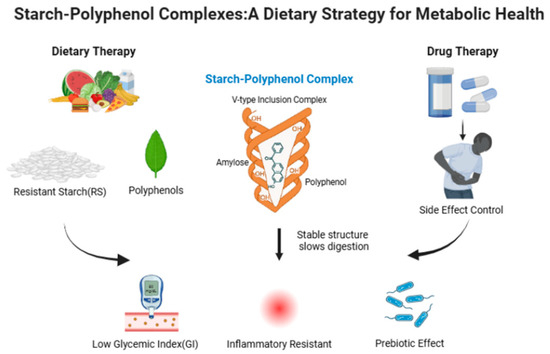
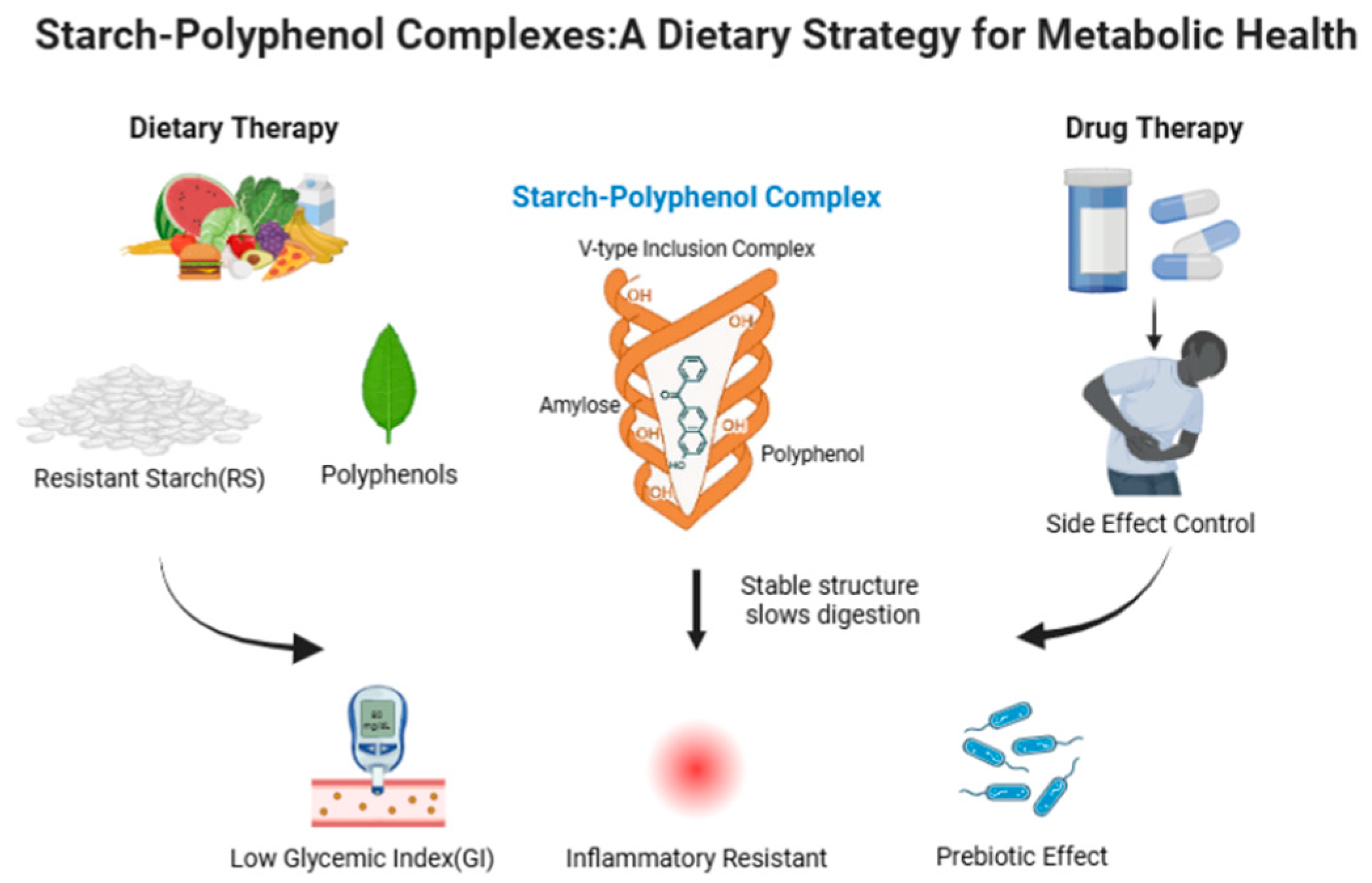
Graphical Abstract