


Unlocking Consumer Preferences: Sensory Descriptors Driving Greek Yogurt Acceptance and Innovation

 , , and
Abstract
1. Introduction
2. Material and Methods
2.1. Samples
2.2. Methods
Sensory Analysis
2.3. Descriptive Quantitative Analysis
Pre-Selection of Assessors
2.4. Quantitative Descriptive Analysis
2.5. Acceptance Analysis
2.6. Physical–Chemical Tests
2.6.1. pH
2.6.2. Soluble Solids
2.6.3. Instrumental Texture
2.7. Statistical Analysis of Data
3. Results
4. Conclusions
Author Contributions
Funding
Institutional Review Board Statement
Informed Consent Statement
Data Availability Statement
Conflicts of Interest
References
- Tamime, A.Y.; Robinson, R.K. Yoghurt: Science and Technology; CRC Press: Boca Raton, FL, USA, 2007. [Google Scholar]
- Tseng, M.; Wu, S. The Popularization of Greek Yogurt: Effects on Greek Yogurt Consumption Among U.S. Consumers. J. Food Prod. Mark. 2015, 21, 123–136. [Google Scholar]
- Ganapathy, R. Consumer Perception and Market Trends of Greek Yogurt in the U.S. Int. J. Food Sci. 2018, 23, 245–258. [Google Scholar]
- Bourrie, B.C.; Willing, B.P.; Cotter, P.D. The Microbiota and Health Promoting Characteristics of the Fermented Dairy Product Kefir. Front. Microbiol. 2016, 7, 647. [Google Scholar] [CrossRef] [PubMed]
- Gyawali, R.; Ibrahim, S.A. Addition of Pectin and Whey Protein Concentrate Minimizes the Generation of Acid Whey in Greek-Style Yogurt. J. Dairy Res. 2018, 85, 238–242. [Google Scholar] [CrossRef] [PubMed]
- Hutkins, R.W.; Nondorf, H.A. Fermented Milk Products with Reduced Lactose Content. Dairy Sci. Technol. 2012, 92, 181–197. [Google Scholar]
- Cheng, H. Volatile flavor compounds in yogurt: A review. Crit. Rev. Food Sci. Nutr. 2010, 50, 938–950. [Google Scholar] [CrossRef] [PubMed]
- USDA. The United States Department of Agriculture, National Nutrient Database for Standard Reference. 2021. Available online: https://fdc.nal.usda.gov/ (accessed on 14 June 2024).
- Sumi, K.; Tagawa, R.; Yamazaki, K.; Nakayama, K.; Ichimura, T.; Sanbongi, C.; Nakazato, K. Nutritional Value of Yogurt as a Protein Source: Digestibility/Absorbability and Effects on Skeletal Muscle. Nutrients 2023, 15, 4366. [Google Scholar] [CrossRef] [PubMed]
- Chandan, R.C. An Overview of Yogurt Production and Composition; Shah, N.P., Ed.; Yogurt in Health and Disease Prevention; Academic Press: Cambridge, MA, USA, 2017; pp. 31–47. [Google Scholar] [CrossRef]
- Ilić, N.; Belović, M.; Memiši, N.; Pestorić, M.; Škrobot, D.; Pezo, L.; Jevtić-Mučibabić, R.; Sanz, Y.; Brouzes, J. Rheological Properties and Sensory Profile of Yoghurt Produced with Novel Combination of Probiotic Cultures. Foods 2024, 13, 3021. [Google Scholar] [CrossRef]
- Marco, M.L.; Sanders, M.E.; Gänzle, M. The International Scientific Association for Probiotics and Prebiotics (ISAPP) consensus statement on fermented foods. Nat. Rev. Gastroenterol. Hepatol. 2021, 18, 196–208. [Google Scholar] [CrossRef]
- Sanders, M.E.; Merenstein, D.J.; Reid, G.; Gibson, G.R.; Rastall, R.A. Probiotics and prebiotics in intestinal health and disease: From biology to the clinic. Nat. Rev. Gastroenterol. Hepatol. 2019, 16, 642. [Google Scholar] [CrossRef] [PubMed]
- Euromonitor International. Global Yogurt Market Trends. Euromonitor International. October 2024. Available online: https://www.euromonitor.com/yoghurt-and-sour-milk-products (accessed on 2 January 2025).
- Wouters, J. Low Fat Yet Rich in Texture, Greek Yoghurt Proves Irresistible to Consumers. Wellness Foods Eur. 2012, 3, 4–8. [Google Scholar]
- Desai, N.T.; Shepard, L.; Drake, M.A. Sensory Properties and Drivers of Liking for Greek Yogurts. J. Dairy Sci. 2013, 96, 7454–7464. [Google Scholar] [CrossRef]
- Dou, D.; Wang, Z. Consumer Preferences for Greek Yogurt: A Review. J. Dairy Sci. 2018, 101, 144–152. [Google Scholar]
- Yildiz, F. Overview of Yogurt and other fermented dairy products. In Development and Manufacture of Yogurt and Other Functional Dairy Products; CRC Press: Boca Raton, FL, USA; Taylor & Francis Group: Abingdon, UK, 2010; 454p. [Google Scholar]
- Sarıtaş, S.; Mondragon Portocarrero, A.d.C.; Miranda, J.M.; Witkowska, A.M.; Karav, S. Functional Yogurt: Types and Health Benefits. Appl. Sci. 2024, 14, 11798. [Google Scholar] [CrossRef]
- Fisberg, M.; Machado, R. History of yogurt and current patterns of consumption. Nutr. Rev. 2015, 73, 4–7. [Google Scholar] [CrossRef]
- Ahansaz, N.; Tarrah, A.; Pakroo, S.; Corich, V.; Giacomini, A. Lactic Acid Bacteria in Dairy Foods: Prime Sources of Antimicrobial Compounds. Fermentation 2023, 9, 964. [Google Scholar] [CrossRef]
- Yang, J.; Lee, J. Application of Sensory Descriptive Analysis and Consumer Studies to Investigate Traditional and Authentic Foods: A Review. Foods 2019, 8, 54. [Google Scholar] [CrossRef] [PubMed]
- ASTM Manual on Consumer Sensory Evaluation; ASTM International: West Conshohocken, PA, USA, 1979.
- ISO 8589:2007; Sensory Analysis—General Guidance for the Design of Test Rooms. The International Organization for Standardization: Geneva, Switzerland, 2007.
- Macfie, H.J.; Bratchell, N.; Greenhoff, K.; Vallis, L.V. Designs to balance the effect of order of presentation and first-order carry-over effects in Hall tests. J. Sens. Stud. 1989, 4, 129–148. [Google Scholar] [CrossRef]
- Civille, G.V.; Carr, B.T.; Osdoba, K.E. Sensory Evaluation Techniques, 6th ed.; CRC Press: Boca Raton, FL, USA, 2024. [Google Scholar]
- ISO 8586; 2012 Sensory Analysis—General Guidelines for the Selection, Training and Monitoring of Selected Assessors and Expert Sensory Assessors. ISO: Geneva, Switzerland, 2014; Volume 2012.
- Moraes, P.C.B.; Bolini, H.M.A. Different sweeteners in beverages prepared with instant and roasted ground coffee: Ideal and equivalent sweetness. J. Sens. Stud. 2010, 25, 215–225. [Google Scholar] [CrossRef]
- Meilgaard, M.; Civille, G.V.; Carr, B.T. Sensory Evaluation Techniques, 4th ed.; CRC Press: Boca Raton, FL, USA, 2006; pp. 25–38. [Google Scholar]
- Stone, H.; Bleibaum, R.I.; Thomas, H.A. Sensory Evaluation Practices, 4th ed.; Academic Press: New York, NY, USA, 2012; 438p. [Google Scholar]
- AOAC—Association of Official Analytical Chemists. In Official Methods of Analysis of AOAC International, 16th ed.; AOAC: Washington, DC, USA, 1995.
- Rawson, H.L.; Marshall, V.M. Effect of “ropy” strains of Lactobacillus delbrueckii ssp. bulgaricus and Streptococcus thermophilus on rheology of stirred yogurt. Int. J. Food Sci. Technol. 1997, 32, 213–220. [Google Scholar] [CrossRef]
- Tenenhaus, M.; Pagès, J.; Ambroisine, L.; Guinot, C. PLS methodology to study relationshipsbetween hedonic judgements and product characteristics. Food Qual. Prefer. 2005, 16, 315–325. [Google Scholar] [CrossRef]
- Esmerino, E.A.; Tavares Filho, E.R.; Carr, B.T.; Ferraz, J.P.; Silva, H.L.A.; Pinto, L.P.F.; Freitas, M.Q.; Cruz, A.G.; Bolini, H.M.A. Consumer-Based Product Characterization Using Pivot Profile, Projective Mapping and Check-All-That-Apply (CATA): A Comparative Case with Greek Yogurt Samples. Food Res. Int. 2017, 99, 375–384. [Google Scholar] [CrossRef] [PubMed]
- Pappa, E.C.; Kondyli, E.; Pappas, A.C.; Kyriakaki, P.; Zoidis, E.; Papalamprou, L.; Karageorgou, A.; Simitzis, P.; Goliomytis, M.; Tsiplakou, E.; et al. Physicochemical Characteristics of Commercially Available Greek Yoghurts. Dairy 2024, 5, 436–450. [Google Scholar] [CrossRef]
- Kroger, M. Quality of yoghurt. J. Dairy. Sci. 1975, 59, 344–450. [Google Scholar] [CrossRef]
- Moineau-Jean, A.; Champagne, C.P.; Roy, D.; Raymond, Y.; LaPointe, G. Effect of Greek-style yoghurt manufacturing processes on starter and probiotic bacteria populations during storage. Int. Dairy J. 2019, 93, 35–44. [Google Scholar] [CrossRef]
- Mukisa, I.M.; Kyoshabire, R. Microbiological, physicochemical, and sensorial quality of small-scale produced stirred yoghurt on the market in Kampala city, Uganda. Nutr. Food Sci. 2010, 40, 409–418. [Google Scholar] [CrossRef]
- Brown, M.D.; Chambers, D.H. Sensory characteristics and comparison of commercial plain yogurts and 2 new production sample options. J. Food Sci. 2015, 80, S2957–S2969. [Google Scholar] [CrossRef] [PubMed]
- Lange, I.; Mleko, S.; Tomczyńska-Mleko, M.; Polischuk, G.; Janas, P.; Ozimek, L. Technology and factors influencing Greek-style yogurt—A Review. Ukr. Food J. 2020, 9, 7–35. [Google Scholar] [CrossRef]

| Ingredients | P1 | P2 | P3 | P4 | P5 | P6 | P7 | P8 |
|---|---|---|---|---|---|---|---|---|
| Sugar syrup | 15.0000 | 15.0000 | 15.0000 | 13.0000 | 15.0000 | 13.0000 | 15.0000 | 13.0000 |
| Skimmed milk powder | 1.4000 | 1.4000 | 1.4000 | 1.4000 | 1.4000 | 1.4000 | 1.4000 | 1.4000 |
| Cream milk | 11.2000 | 21.5000 | 13.2000 | 13.8000 | 13.2000 | 13.8000 | 13.2000 | 13.8000 |
| Milk Protein Concentrate 70 | 3.7000 | 4.8000 | 3.7000 | 3.7000 | 3.7000 | 3.7000 | 4.0000 | 3.7000 |
| Concentrated milk fat: 3.0%/SNF 8.5% | 68.6983 | 57.2983 | 65.8983 | 67.7983 | 65.8983 | 67.7983 | 65.9000 | 67.7983 |
| Culture Yoflex Premium 3.0 | 0.0017 | 0.0017 | 0.0017 | 0.0017 | 0.0017 | 0.0017 | 0.0017 | 0.0017 |
| Modifed starch | 0.0000 | 0.0000 | 0.6000 | 0.3000 | 0.6000 | 0.3000 | 0.6000 | 0.3000 |
| Tasteless and colorless gelatin | 0.0000 | 0.0000 | 0.2000 | 0.2000 | 0.2000 | 0.2000 | 0.2000 | 0.2000 |
| Descriptor Term | Definition | References |
|---|---|---|
| Yellow color | Light yellow color, like butter | None: Pasteurized fresh milkcCream “Fazenda Bela Vista” brand Moderate/Medium: 100 mL of pasteurized fresh milk cream “Fazenda Bela Vista ®” brand and 0.25 mL of prepared Oetker® pineapple gelatin, as per package instructions, without allowing it to set Strong: 200 mL of pasteurized fresh milk cream “Fazenda Bela Vista”® brand and 1 mL of prepared Oetker® pineapple gelatin, as per package instructions, without allowing it to set |
| Homogeneous appearance | Homogeneous, smooth, and lump-free appearance of the surface of the yogurt | Slight/Weak: 100 mL of Salute® brand plain liquid yogurt and 50 g of Nestlé ® cream without whey Moderate/Medium: 100 mL of Salute® brand plain liquid yogurt and 50 g of Nestlé® cream without whey slowly mixed with spoon on a glass plate for 10 s Strong: 100 g of Salute brand plain liquid yogurt and 100 g of Nestlé® cream without whey, blended |
| Syneresis | Separation of whey from yogurt, accompanied by a reduction in its volume and intensified by changes in temperature, pH, and mechanical factors | None: Greek yogurt Vigor® brand Moderate/Medium: Commercial lactose-free plain yogurt with skimmed milk Strong: Commercial whole plain yogurt containing 10% added water |
| Texture when picked up with a spoon | Force applied to place the spoon and remove a little of the product to be consumed | Slight/Weak: 100 g of pasteurized fresh milk cream “Fazenda Bela Vista”® brand and 100 g of Salute ® brand plain liquid yogurt Moderate/Medium: 100 g of milk cream Nestlé® Tetrapack package Strong: Canned Desert “Brigadeiro” Nestlé® |
| Filament formation when picked up with a spoon | Filaments formed between the product in the jar and the product in the spoon | None: Pasteurized fresh milk cream “Fazenda Bela Vista” brand Moderate/Medium: 100 mL of pasteurized fresh milk cream “Fazenda Bela Vista®” brand and 50 mL of Nestlé® condensed milk Strong: Nestlé® Condensed milk |
| Shine | Reflection of light on the surface of the product | Slight/Weak: None: Pasteurized fresh milk cream “Fazenda Bela Vista®” brand Moderate/Medium: Flan Danette white chocolate Strong: Orange blossom honey Melbee® brand |
| Surface uniformity | Regularity of the apparent texture on the surface of the product | Slight/Weak: Creme de leite fresco pasteurizado marca Fazenda Bella Vista® Moderate/Medium: Yogurt Grego marca Danone® Strong: 5 mg of butyric acid and 10 mg of caprylic acid in 1 liter of pasteurized fresh cream, Fazenda Bella Vista® brand |
| Acid aroma | Aroma that is felt when inhaling near a product that contains acids, especially lactic acid | None: Pasteurized fresh cream, Fazenda Bella Vista® brand Moderate/Medium: 100 g of creme de leite fresco pasteurizado marca Fazenda Bella Vista® and 1 mL of lactic acid Strong: 10 g of pasteurized fresh cream, Fazenda Bella Vista® brand, 1 mL of lactic acid, and 50 g of whipped yogurt, Salute® brand |
| Sweet aroma | Aroma that is felt when inhaling near sweet foods | None: Pasteurized fresh cream, Fazenda Bella Vista® brand Moderate/Medium: Pasteurized fresh cream, Fazenda Bella Vista® brand and 10 mL of Karo Corn® glucose Strong: Homogenized 100 g of pasteurized fresh cream, Fazenda Bella Vista® brand, 20 mL of Karo Corn® glucose, and 20 g of dulce de leche Itambé® brand |
| Milky aroma | Aroma that is felt when inhaling dairy products | None: Distilled water Moderate/Medium: Whole milk Sheffa® brand Strong: Homogenized 50 g of pasteurized fresh cream, Fazenda Bella Vista® brand, and 100 g of Ninho® powder milk |
| Vanilla aroma | Aroma that is felt when inhaling near vanilla essence or products containing vanilla | None: Whole milk Sheffa® brand Moderate/Medium: 0.5 mL of IFF® vanilla essence F in 50 mL of whole milk Sheffa® brand Strong: 1 IFF® vanilla essence F in 50 mL of whole milk Sheffa® brand |
| Aroma amanteigado (diacetil) | Aroma that is felt when inhaling near butter and buttery products (Diacetil) | None: Whole milk Sheffa® brand Moderate/Medium: 50 mL of whole milk Sheffa® brand and 0.0001 mL of diacetyl Sigma Aldrich® PA Strong: 50 mL of whole milk Sheffa® brand and 0.0025 mL of diacetyl Sigma Aldrich® PA |
| Caramel aroma | Aroma that is felt when inhaling near foods that contain caramelized sugar | None: Ninho® whole milk Moderate/Medium: 20 g of sucrose União® caramelized in 1 liter of Ninho® whole milk UHT Strong: 50 g of sucrose União® caramelized in 1 liter of Ninho® whole milk UHT |
| Cheese aroma | Aroma that is felt when inhaling near curdled (sour) milk | None: 100 g of pasteurized fresh milk cream “Fazenda Bela Vista®” brand Moderate/Medium: 2 mg of butanoic acid and 2 mg of caplilic acid in 100 g of pasteurized fresh milk cream “Fazenda Bela Vista” brand Strong: 5 mg of butanoic acid and 5 mg of caplilic acid in 100 g of pasteurized fresh milk cream “Fazenda Bela Vista®” brand |
| Mikky flavor | Characteristic flavor of instant whole milk powder dissolved in water | Slight/Weak: 50 g of Ninho Nestlé® instant whole milk powder in 1 liter of deionized water Moderate/Medium: 150 g of Ninho Nestlé® instant whole milk powder in 1 liter of deionized water Strong: 500 g of Ninho Nestlé® instant whole milk powder in 1 liter of deionized water |
| Metallic taste | Characteristic flavor of foods containing iron or some canned foods | None: Pasteurized fresh milk cream Verde Campo® brand Moderate/Medium: 50 mL of pasteurized fresh milk cream Verde Campo® brand and 0.0005 g of FeSO4·7H2O in 10 mL of whole milk Shefa® brand Strong: 50 mL of pasteurized fresh milk cream Verde Campo® brand and 0.001 g of FeSO4·7H2O in 10 mL of whole milk Shefa® brand |
| Cheese flavor (sour milk) | Sour milk flavor | None: Pasteurized fresh milk cream Verde Campo brand Moderate/Medium: 50 mL of pasteurized fresh milk cream Verde Campo® brand and 0.25 mg of butiric acid and 0.25 mg of caprilic acid diluted in 10 mL whole milk Shefa® brand Strong: 50 mL of pasteurized fresh milk cream Verde Campo® brand, 0.75 mg of butiric acid, and 0.75 mg of caprilic acid diluted in 10 mL of whole milk Shefa® brand |
| Cottage cheese flavor | Characteristic flavor of cream cheese | None: Deionized water Moderate/Medium: 200 mL of whole milk Shefa® with 30 g of cream cheese Danúbio® brand Strong: 100 g of cream cheese Danúbio® brand and 100 g of pasteurized fresh milk cream “Fazenda Bela Vista®” brand |
| Sulfurous flavor | Characteristic flavor of freshly peeled boiled egg white | None: Pasteurized fresh milk cream “Fazenda Bela Vista®” brand Moderate/Medium: 2 mg of dimethyl sulfide Sigma Aldrich PA in 1 liter of pasteurized fresh milk cream “Fazenda Bela Vista®” brand Strong: 5 mg of dimethyl sulfide Sigma Aldrich PA in 1 liter of pasteurized fresh milk cream “Fazenda Bela Vista®” brand |
| Oxidized oil flavor | The flavor of oxidized oil, known as rancid oil | None: Pasteurized fresh milk cream “Fazenda Bela Vista®” brand Moderate/Medium: 3 mg of butiric acid in 1 liter of pasteurized fresh milk cream “Fazenda Bela Vista®” brand Strong: 5 mg mg of butiric acid in 1 liter Pasteurized Fresh Milk Cream “Fazenda Bela Vista®” Brand |
| Sweetness | Characteristic taste of sucrose | None: 100 g plain yogurt Salute® brand + 4 g of sucrose Moderate/Medium: 100 g of plain yogurt Salute® brand and 10 g of sucrose Strong: 100 g of plain yogurt Salute® brand and 16 g of sucrose |
| Sourness | Acidic taste, also known as being sour, is present in dairy products such as yogurt, curd, and fermented milk | None: Pasteurized fresh milk cream “Fazenda Bela Vista” brand Moderate/Medium: 10 mg of lactic acid and 500 mL of pasteurized fresh milk cream “Fazenda Bela Vista®” brand Strong: 10 mg of lactic acid and 1000 mL of pasteurized fresh milk cream “Fazenda Bela Vista®” brand |
| Salty | Characteristic taste of salty foods such as cream cheese | None: Pasteurized fresh milk Verde Campo(R) Moderate/Medium: 50 mL of pasteurized fresh milk cream “Fazenda Bela Vista®” brand and Verde Campo® and 0.05 g of cream cheese Vigor® diluted in 10 mL of whole milk Shefa® UHT Strong: 50 mL of pasteurized fresh milk cream “Fazenda Bela Vista®” brand and 0.2 g of cream cheese Vigor® diluted in 10 mL of whole milk Shefa® UHT |
| Bitterness | Characteristic taste of products containing caffeine | None: Whole milk Ninho® UHT Moderate/Medium: 0.02 g of caffeine Sigma Aldrich PA in 100 mL of whole milk Ninho® UHT Strong: 0.04 g of caffeine Sigma Aldrich PA in 100 mL of whole milk Ninho® UHT |
| Astringency | A sensation of “tying” the mouth, such as green banana and cashew pulp | None: Whole milk Ninho UHT Moderate/Medium: 20 mL of whole milk Ninho® UHT and 0.1 g of tannic acid Sigma Aldrich PA Strong: 20 mL of whole milk Ninho® UHT and 0.5 g of tannic acid Sigma Aldrich PA |
| Vanilla flavor | Characteristic flavor of foods containing vanilla essence | None: Pasteurized fresh milk cream “Fazenda Bela Vista®” brand Moderate/Medium: 3 mL of vanilla essence IFF in 1000 mL of pasteurized fresh milk cream “Fazenda Bela Vista®” brand Strong: 10 mL of vanilla essence IFF in 1000 mL of pasteurized fresh milk cream “Fazenda Bela Vista®” brand |
| Flavor caramel | Characteristic flavor of sugar subjected to high temperatures, such as pudding syrups | None: Whole milk Ninho® UHT Moderate/Medium: 20 grams of caramelized sugar dissolved in 1000 mL of whole milk Ninho® UHT Strong: 50 g of inverted sucrose solved in 1000 mL of whole milk Ninho® UHT |
| Sweet aftertaste | Sweet taste that lingers after swallowing the food | None: 1000 mL of whole milk Ninho® UHT Moderate/Medium: 100 mL of whole milk Ninho® UHT and 0.2 g of sodium saccharin Sigma Aldrich Strong: 100 mL of whole milk Ninho® UHT and 0.5 g of sodium saccharin Sigma Aldrich |
| Bitter aftertaste | Bitter taste that lingers after swallowing the food | None: 1000 mL of whole milk Ninho® UHT Moderate/Medium: 100 mL of Whole Milk Ninho® UHT and 2 g of stevia from Steviafarma® Strong: 100 mL of whole milk Ninho® UHT and 4 g of stevia from Steviafarma® |
| Milk cream flavor | Characteristic flavor of milk cream | None: Water Moderate/Medium: 100 mL of whole milk Ninho® UHT and 50 g of fresh milk cream Nestle Strong: 100 mL of whole milk Ninho® UHT and 100 g of fresh milk cream Nestle® |
| Butter flavor | Characteristic flavor of whipped cream | Slight/Weak: Freshly prepared cream from the surface formed on fresh whole milk by Fazenda Bella Vista® after boiling and cooling, homogenized using a pistil in a mortar Moderate/Medium: 40 mg of diacetyl in 1 liter of fresh pasteurized cream by Fazenda Bella Vista® brand Strong: 100 mg of diacetyl in 1 liter of fresh pasteurized cream by Fazenda Bella Vista® brand |
| Creamy in the mouth | Creaminess in the mouth | Slight/Weak: 100 g in 1 liter of fresh pasteurized cream by Fazenda Bella Vista® brand and 200 mL of whole milk Ninho® UHT Moderate/Medium: 100 g of fresh pasteurized cream by Fazenda Bella Vista® brand and 50 mL of whole milk Ninho® UHT Strong: Chandelle® dessert |
| Yogurt coating inside the mouth | Sensation of certain foods sticking to the tongue and palate | None: Deionized water at room temperature Moderate/Medium: 100 g of fresh milk cream Nestle® and 100 mL of whole milk Ninho® Strong: Fresh milk cream Nestle® at room temperature |
| Mouth-filling | Characteristic of certain foods filling the mouth evenly and quickly | Slight/Weak: Cornstarch porridge prepared with 200 mL of milk, 10 g of cornstarch, 20 g of sugar, and 20 g of Nestlé® cream without whey Moderate/Medium: Cornstarch porridge prepared with 200 mL of milk, 15 g of cornstarch, 25 g of sugar, and 20 g of Nestlé® cream without whey Strong: Cornstarch porridge prepared with 200 mL of milk, 25 g of cornstarch, 25 g of sugar, 20 g of Nestlé® cream without whey, and 100 g of melted Nestlé® milk chocolate bar |
| Greasy | Slippery sensation between the tongue and palate when eating a high-fat food | None: Greek yogurt Danone® light Moderate/Medium: 100 g of Greek yogurt Danone® and 20 g of Nestlé® cream without whey Strong: 100 g of Greek yogurt Danone and 70 g of Nestlé® cream without whey |
| Aeration | Sensation of food containing air and lightness | None: Pasteurized fresh milk cream “Fazenda Bela Vista®” brand Moderate/Medium: Danone® Greek yogurt mixed in a blender for 1 min. Strong: Danone Greek® yogurt mixed in a blender for 3 min. |
| Viscous | Sensation of threads of creamy food forming between the tongue and the palate | None: Water Moderate/Medium: Vigor® light cream cheese Strong: Orange blossom honey Melbee® brand |
| Perception of lightness | Sensation of airy food, like whipped egg whites | Slight/Weak: Pasteurized fresh milk cream “Fazenda Bela Vista” brand Moderate/Medium: Egg whites freshly whipped in a planetary mixer, added with 10% cornstarch Strong: Egg white freshly whipped in a planetary mixer |
| Lump formation | Division that some creamy foods make with parts denser than others | None: Pasteurized fresh milk cream “Fazenda Bela Vista®” Moderate/Medium: 50 g of pasteurized fresh milk cream “Fazenda Bela Vista®” and 50 g of plain yogurt light Batavo® Strong: 10 g of pasteurized fresh milk cream “Fazenda Bela Vista®” and 50 g of plain yogurt light Batavo® |
| Homogeneity in the mouth | Uniformity of food in the mouth | Slight/Weak: Plain yogurt light Batavo® Moderate/Medium: Light cream cheese Danúbio® Strong: Dessert Chandelle® |
| Texture in mouth | Property of some foods that cause a sensation of firmness (or the opposite, softness) | Slight/Weak: Pasteurized fresh milk cream “Fazenda Bela Vista®” Moderate/Medium: Danone® plain yogurt Strong: Cheddar cheese Polenghi® |
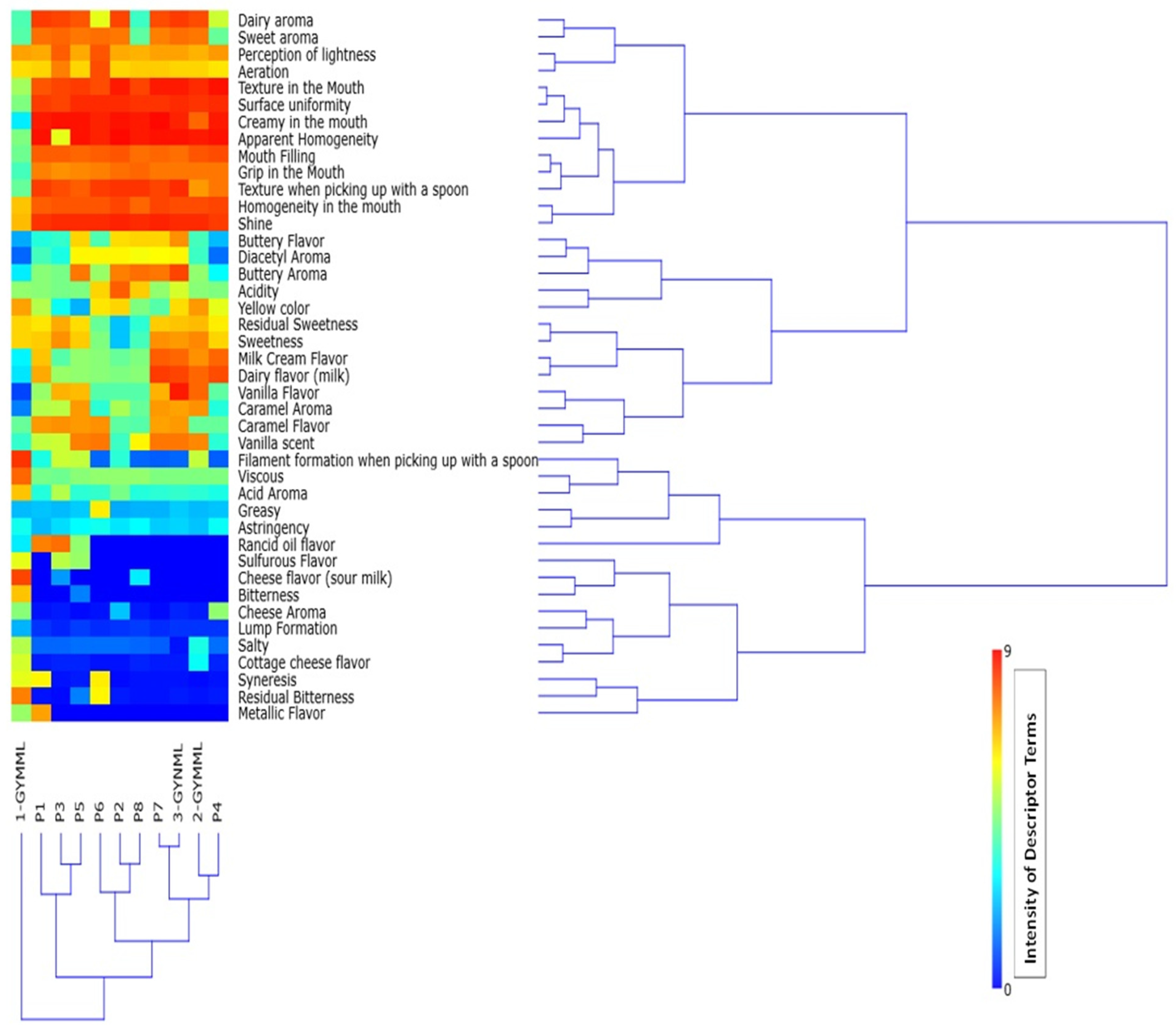
| Descriptor Terms | P1 | P2 | P3 | P4 | P5 | P6 | P7 | P8 | 1-GYMML | 2-GYMML | 3-GYNML |
|---|---|---|---|---|---|---|---|---|---|---|---|
| Yellow color | 5.1 c | 6.5 b | 3.1 f | 5.7 c | 2.1 g | 6.3 b | 4.0 e | 4.5 d | 7.1 a | 7.2 a | 6.4 b |
| Apparent homogeneity | 8.8 a | 8.9 a | 5.7 b | 8.8 a | 8.8 a | 8.6 a | 8.8 a | 8.7 a | 4.5 c | 8.7 a | 8.8 a |
| Syneresis | 6.1 a | 0.1 b | 0.2 b | 0.2 b | 0.3 b | 6.2 a | 0.2 b | 0.2 b | 5.7 a | 0.1 b | 0.2 b |
| Texture when picking up with a spoon | 8.3 a | 8.4 a | 8.1 a | 7.6 b | 7.9 a | 8.3 a | 8.2 a | 8.4 a | 4.2 c | 7.2 b | 8.5 a |
| Filament formation when picking up with a spoon | 3.3 c | 3.5 c | 5.4 b | 1.1 d | 5.3 b | 1.2 d | 1.1 d | 1.2 d | 8.4 a | 5.3 b | 1.2 d |
| Shine | 8.4 a | 8.6 a | 8.5 a | 8.3 a | 8.5 a | 8.5 a | 8.6 a | 8.5 a | 6.8 b | 8.5 a | 8.5 a |
| Surface uniformity | 8.3 a | 8.5 a | 8.2 a | 8.5 a | 8.5 a | 8.5 a | 8.4 a | 8.4 a | 4.5 b | 8.4 a | 8.5 a |
| Acid aroma | 3.4 d | 4.4 c | 5.1 b | 3.3 d | 3.5 d | 3.6 d | 3.5 d | 3.4 d | 6.7 a | 3.5 d | 3.6 d |
| Sweet aroma | 7.7 a | 7.6 a | 7.8 a | 4.2 b | 7.6 a | 7.7 a | 7.5 a | 4.1 b | 4.0 b | 7.6 a | 7.7 a |
| Dairy aroma | 8.3 a | 8.2 a | 8.2 a | 5.4 b | 8.0 a | 5.7 b | 8.1 a | 3.7 c | 3.9 c | 8.1 a | 8.3 a |
| Buttery aroma | 4.6 c | 7.5 b | 4.4 c | 3.0 d | 7.6 b | 4.8 c | 7.6 b | 7.7 b | 2.8 d | 4.7 c | 8.2 a |
| Vanilla aroma | 5.3 c | 3.7 d | 5.4 c | 3.5 d | 7.5 a | 7.6 a | 7.6 a | 6.1 b | 3.6 d | 7.4 a | 7.6 a |
| Diacetyl aroma | 3.8 b | 6.1 a | 3.3 c | 1.3 d | 6.1 a | 6.1 a | 6.0 a | 5.9 a | 1.2 d | 3.7 b | 6.1 a |
| Caramel aroma | 5.1 b | 5.0 b | 5.2 b | 3.4 d | 7.2 a | 3.5 d | 7.2 a | 4.2 c | 1.5 e | 7.3 a | 7.1 a |
| Cheese aroma | 0.2 b | 2.3 b | 0.3 b | 4.7 a | 0.1 b | 0.2 b | 0.1 b | 0.3 b | 4.6 a | 0.3 b | 0.4 b |
| Dairy flavor (milk) | 7.0 b | 4.5 c | 4.8 c | 8.1 a | 4.7 c | 4.6 c | 8.3 a | 4.6 c | 2.7 d | 7.8 a | 8.2 a |
| Metallic flavor | 7.1 a | 0.0 c | 0.0 c | 0.0 c | 0.0 c | 0.0 c | 0.0 c | 0.0 c | 4.8 b | 0.0 c | 0.0 c |
| Cheese flavor (sour milk) | 0.0 c | 0.0 c | 1.8 b | 0.0 c | 0.0 c | 0.0 c | 0.0 c | 2.8 b | 8.2 a | 0.0 c | 0.0 c |
| Cottage cheese flavor | 0.3 c | 0.2 c | 0.4 c | 0.4 c | 0.4 c | 0.2 c | 0.3 c | 0.4 c | 5.5 a | 3.1 b | 0.3 c |
| Sulfurous flavor | 0.0 d | 0.0 d | 5.2 b | 0.0 d | 4.8 c | 0.0 d | 0.0 d | 0.0 d | 5.7 a | 0.0 d | 0.0 d |
| Rancid oil flavor | 7.5 a | 0.0 d | 7.7 a | 0.0 d | 4.7 b | 0.0 d | 0.0 d | 0.0 d | 2.8 c | 0.0 f | 0.0 f |
| Sweetness | 6.6 b | 2.3 e | 7.3 a | 6.5 b | 6.6 b | 4.5 c | 7.3 a | 3.8 d | 6.5 b | 7.4 a | 7.2 a |
| Acidity | 4.6 d | 7.9 a | 4.4 d | 4.5 d | 4.5 d | 6.5 b | 4.7 d | 6.6 b | 4.7 d | 4.6 d | 5.5 c |
| Salty | 0.2 c | 0.3 c | 0.2 c | 0.3 c | 0.3 c | 0.3 c | 0.1 c | 0.2 c | 5.6 a | 4.3 b | 0.2 c |
| Bitterness | 0.0 c | 0.0 c | 0.0 c | 0.0 c | 1.5 b | 0.0 c | 0.0 c | 0.0 c | 6.7 a | 0.0 c | 0.0 c |
| Astringency | 2.2 c | 2.7 b | 2.6 b | 3.1 a | 3.0 a | 3.2 a | 2.4 b | 3.0 a | 3.2 a | 2.3 b | 2.5 b |
| Vanilla flavor | 4.8 d | 4.0 e | 6.9 c | 4.1 e | 6.8 c | 4.0 e | 6.9 c | 4.2 e | 0.8 f | 7.8 b | 8.7 a |
| Caramel flavor | 7.2 a | 4.1 b | 7.3 a | 4.2 b | 7.2 a | 7.3 a | 7.1 a | 4.0 b | 4.2 b | 4.2 b | 7.2 a |
| Residual sweetness | 6.3 b | 2.3 d | 7.0 a | 6.2 b | 6.4 b | 4.2 c | 6.6 b | 3.5 c,d | 6.5 b | 6.8 b | 6.7 b |
| Residual bitterness | 0.2 c | 0.3 c | 0.1 c | 0.3 c | 1.5 b | 6.1 a | 0.2 c | 0.2 c | 7.5 a | 0.2 c | 0.3 c |
| Milk cream flavor | 6.7 b | 4.2 c | 4.0 c | 7.8 a | 4.7 c | 4.6 c | 7.9 a | 4.5 c | 2.9 d | 7.3 a | 7.8 a |
| Buttery flavor | 3.4 c | 6.4 b | 3.6 c | 2.2 d | 6.5 b | 3.9 c | 6.5 b | 6.5 b | 2.0 d | 3.8 c | 7.3 a |
| Creamy in the mouth | 8.7 a | 8.8 a | 8.8 a | 8.7 a | 8.8 a | 8.6 a | 8.9 a | 8.7 a | 2.8 b | 7.8 a | 8.6 a |
| Grip in the mouth | 7.5 a | 7.7 a | 7.3 a | 7.6 a | 7.4 a | 7.5 a | 7.6 a | 7.8 a | 3.8 b | 7.6 a | 7.6 a |
| Mouth-filling | 7.9 a | 8.0 a | 7.9 a | 8.1 a | 7.8 a | 7.9 a | 7.8 a | 7.7 a | 4.3 b | 8.0 a | 7.7 a |
| Greasy | 2.3 b | 2.0 b | 2.2 b | 2.3 b | 2.4 b | 6.2 a | 2.1 b | 2.1 b | 2.2 b | 2.2 b | 2.4 b |
| Aeration | 6.5 c | 6.5 c | 7.5 b | 6.3 c | 6.5 c | 8.1 a | 6.6 c | 6.6 c | 6.4 c | 6.5 c | 6.5 c |
| Viscous | 4.4 b | 4.7 b | 4.3 b | 4.5 b | 4.6 b | 4.7 b | 4.5 b | 4.7 b | 7.8 a | 4.5 b | 4.5 b |
| Perception of lightness | 7.0 b | 7.0 b | 7.9 a | 7.2 b | 7.0 b | 8.0 a | 7.1 b | 6.9 b | 7.1 b | 6.9 b | 7.1 b |
| Lump formation | 0.6 b | 0.6 b | 0.4 b | 0.6 b | 0.7 b | 0.5 b | 0.5 b | 0.7 b | 2.1 a | 0.6 b | 0.6 b |
| Homogeneity in the mouth | 7.9 a | 8.2 a | 8.0 a | 8.2 a | 8.0 a | 8.0 a | 8.2 a | 7.8 a | 6.7 b | 8.1 a | 8.1 a |
| Texture in the mouth | 8.0 b | 8.7 a | 8.2 b | 8.8 a | 8.3 b | 8.1 b | 8.7 a | 8.2 b | 4.9 c | 8.5 a | 8.7 a |
| Question | Response | Consumers Participants % |
|---|---|---|
| Gender | Female | 54.7 |
| Male | 43.3 | |
| Others | 3 | |
| Education Level | Associate degree | 29 |
| Bachelor’s degree | 54.0 | |
| Master’s degree | 11 | |
| Doctorate | 6 | |
| Age | 18–25 | 25.0 |
| 26–30 | 28 | |
| 31–35 | 35.0 | |
| 36–40 | 12.0 | |
| 41–45 | 7.0 | |
| Employment status | College student | 18.0 |
| Unemployed | 3.0 | |
| University employed | 32.0 | |
| Self-employed | 34.0 | |
| Homemaker | 13.00 |
| Sample | °Brix | pH | Textura (F/g) |
|---|---|---|---|
| P1 | 20.63 a | 4.27 a | 27.651 c |
| P2 | 20.73 a | 4.09 a | 24.124 e |
| P3 | 20.43 a | 4.27 a | 28.648 b |
| P4 | 18.60 b | 4.26 a | 30.900 a |
| P5 | 20.57 a | 4.36 a | 28.170 b |
| P6 | 16.13 d | 4.16 a | 18.040 f |
| P7 | 18.00 b | 4.24 a | 25.149 d |
| P8 | 17.00 c | 4.15 a | 18.837 f |
| 1-GYMML | 20.20 a | 4.36 a | 14.468 g |
| 2-GYMML | 18.86 b | 4.22 a | 18.264 f |
| 3-GYNML | 18.30 b | 4.17 a | 21.384 e |
Disclaimer/Publisher’s Note: The statements, opinions and data contained in all publications are solely those of the individual author(s) and contributor(s) and not of MDPI and/or the editor(s). MDPI and/or the editor(s) disclaim responsibility for any injury to people or property resulting from any ideas, methods, instructions or products referred to in the content. |
© 2025 by the authors. Licensee MDPI, Basel, Switzerland. This article is an open access article distributed under the terms and conditions of the Creative Commons Attribution (CC BY) license (https://creativecommons.org/licenses/by/4.0/).
Share and Cite
Bolini, H.M.A.; Cardello, F.; de Medeiros, A.C.; Moskowitz, H. Unlocking Consumer Preferences: Sensory Descriptors Driving Greek Yogurt Acceptance and Innovation. Foods 2025, 14, 130. https://doi.org/10.3390/foods14010130
Bolini HMA, Cardello F, de Medeiros AC, Moskowitz H. Unlocking Consumer Preferences: Sensory Descriptors Driving Greek Yogurt Acceptance and Innovation. Foods. 2025; 14(1):130. https://doi.org/10.3390/foods14010130
Chicago/Turabian StyleBolini, Helena Maria Andre, Flavio Cardello, Alessandra Cazellatto de Medeiros, and Howard Moskowitz. 2025. "Unlocking Consumer Preferences: Sensory Descriptors Driving Greek Yogurt Acceptance and Innovation" Foods 14, no. 1: 130. https://doi.org/10.3390/foods14010130
APA StyleBolini, H. M. A., Cardello, F., de Medeiros, A. C., & Moskowitz, H. (2025). Unlocking Consumer Preferences: Sensory Descriptors Driving Greek Yogurt Acceptance and Innovation. Foods, 14(1), 130. https://doi.org/10.3390/foods14010130

