Article

Dynamic Changes in Volatiles, Soluble Sugars, and Fatty Acids in Glutinous Rice during Cooking

Rice Product Quality Supervision and Inspection Center, Ministry of Agriculture and Rural Affairs, China National Rice Research Institute, Hangzhou 310006, China
*
Author to whom correspondence should be addressed.
Foods 2023, 12(8), 1700; https://doi.org/10.3390/foods12081700
Submission received: 21 March 2023 / Revised: 16 April 2023 / Accepted: 17 April 2023 / Published: 19 April 2023
(This article belongs to the Special Issue Cereal-Based Staple Foods: Processing, Quality and Health Benefits)

Abstract

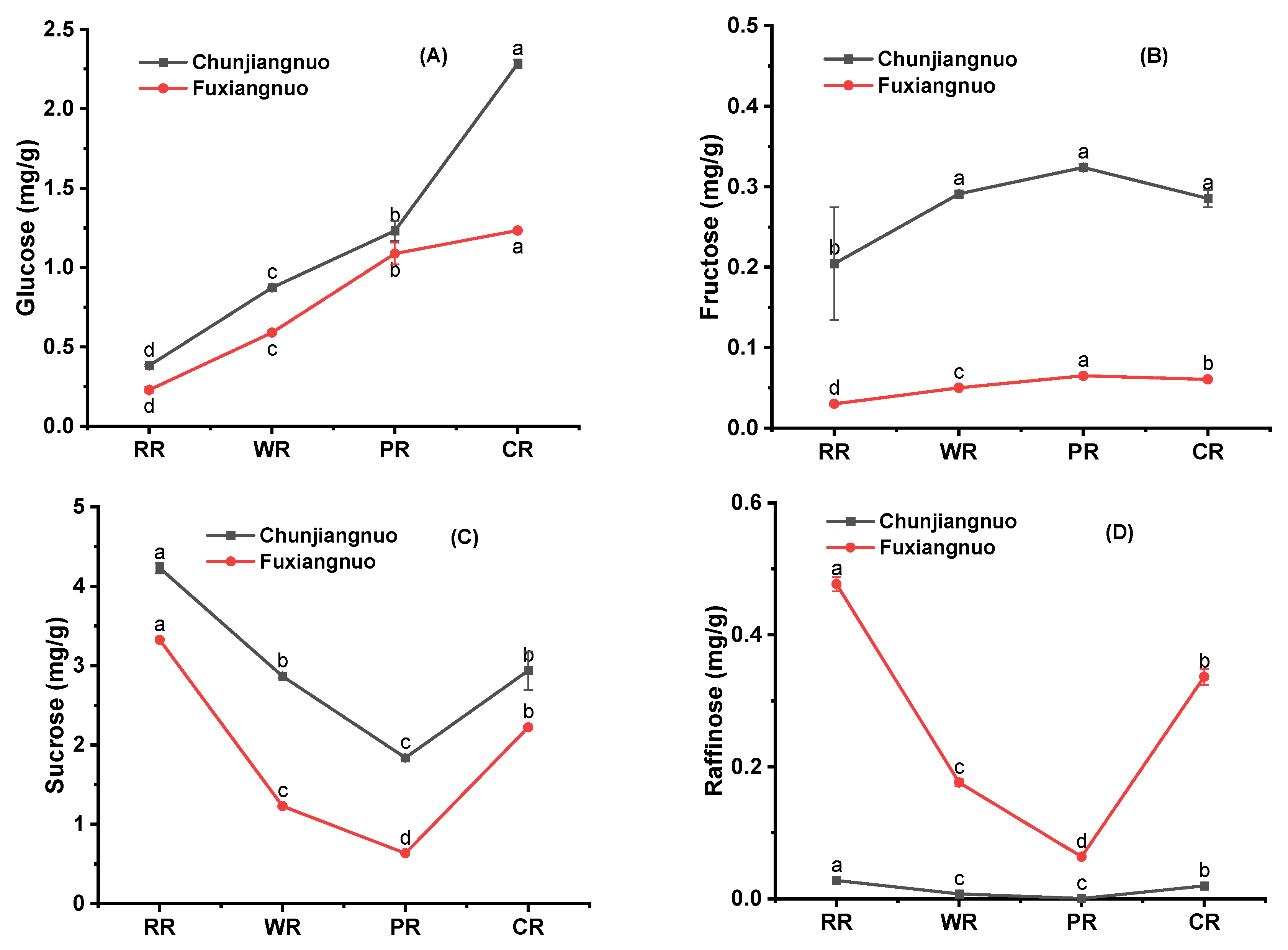
Cooking is an important process before rice is consumed and constitutes the key process for rice flavor formation. In this paper, dynamic changes in aroma- and sweetness-related compounds were tracked during the entire cooking process (including washing with water, presoaking, and hydrothermal cooking). The volatiles, fatty acids, and soluble sugars in raw rice, washed rice, presoaked rice, and cooked rice were compared. After being washed with water, the total volatiles decreased while aldehydes and unsaturated fatty acids increased. Meanwhile, oligosaccharides decreased and monosaccharides increased. The changes in fatty acids and soluble sugars caused by the presoaking process were similar to those in the water-washing process. However, different changes were observed for volatiles, especially aldehydes and ketone. After hydrothermal cooking, furans, aldehydes, alcohols, and esters increased while hydrocarbons and aromatics decreased. Moreover, all fatty acids increased; among these, oleic acids and linoleic acid increased most. Unlike with washing and presoaking, all soluble sugars except fructose increased after hydrothermal cooking. Principal component analysis showed that cooked rice possessed a volatile profile that was quite different from that of uncooked rice, while washed rice and presoaked rice possessed similar volatile profiles. These results indicated that hydrothermal cooking is the pivotal process for rice flavor formation.
Keywords: glutinous rice; water washing; presoaking; hydrothermal cooking; volatile profile; fatty acids; soluble sugars; flavor glutinous rice; water washing; presoaking; hydrothermal cooking; volatile profile; fatty acids; soluble sugars; flavor