Article

Mānuka Oil vs. Rosemary Oil: Antimicrobial Efficacies in Wagyu and Commercial Beef against Selected Pathogenic Microbes

1
School of Food and Advanced Technology, Massey University, Palmerston North 4442, New Zealand
2
Riddet Institute, Massey University, Palmerston North 4442, New Zealand
3
Food System Integrity Team, Hopkirk Research Institute, AgResearch Ltd., Palmerston North 4472, New Zealand
*
Author to whom correspondence should be addressed.
Foods 2023, 12(6), 1333; https://doi.org/10.3390/foods12061333
Submission received: 13 February 2023 / Revised: 9 March 2023 / Accepted: 14 March 2023 / Published: 21 March 2023
(This article belongs to the Special Issue Latest Research on Meat Microbiology, Meat Quality and Meat Safety)

Abstract

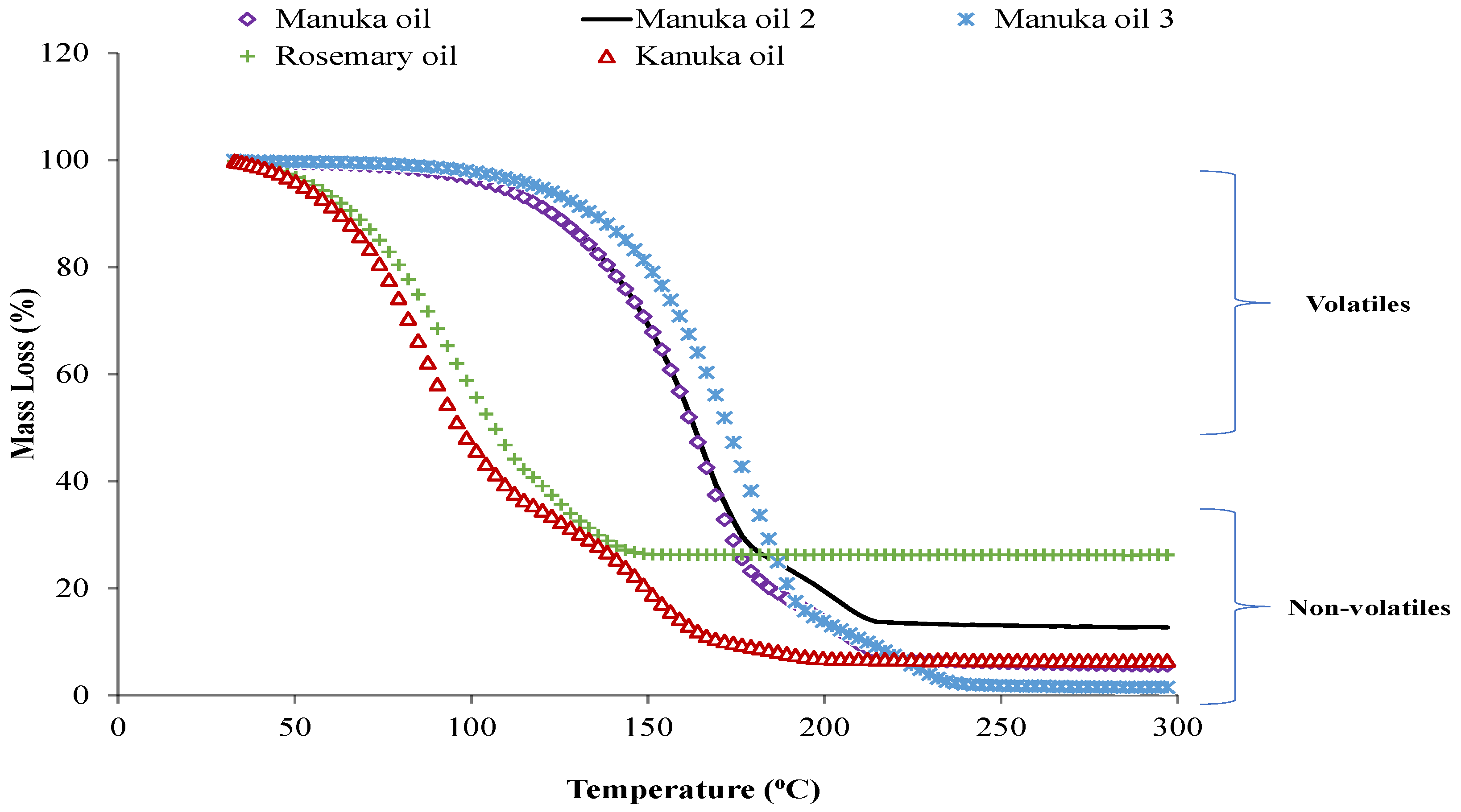
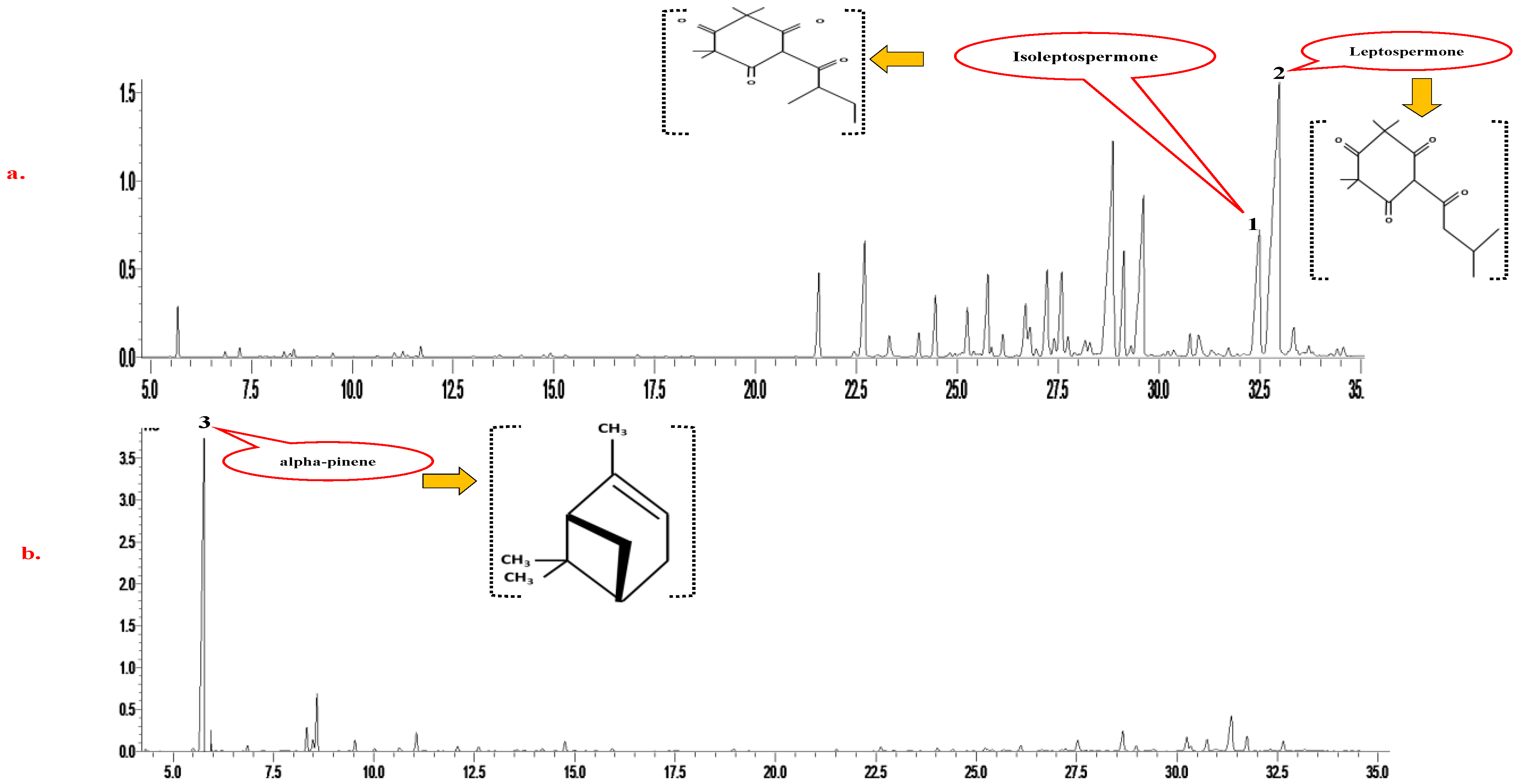
Essential oils possessing antimicrobial characteristics have acquired considerable interest as an alternative to chemical preservatives in food products. This research hypothesizes that mānuka (MO) and kānuka (KO) oils may possess antimicrobial characteristics and have the potential to be used as natural preservatives for food applications. Initial experimentation was conducted to characterize MOs (with 5, 25, and 40% triketone contents), rosemary oil (RO) along with kanuka oil (KO) for their antibacterial efficacy against selected Gram-negative (Salmonella spp. and Escherichia coli), and Gram-positive (Listeria monocytogenes and Staphylococcus aureus) bacteria through disc diffusion and broth dilution assays. All MOs showed a higher antimicrobial effect against L. monocytogenes and S. aureus with a minimum inhibitory concentration below 0.04%, compared with KO (0.63%) and RO (2.5%). In chemical composition, α-pinene in KO, 1, 8 cineole in RO, calamenene, and leptospermone in MO were the major compounds, confirmed through Gas-chromatography-mass spectrometry analysis. Further, the antimicrobial effect of MO and RO in vacuum-packed beef pastes prepared from New Zealand commercial breed (3% fat) and wagyu (12% fat) beef tenderloins during 16 days of refrigerated storage was compared with sodium nitrate (SN) and control (without added oil). In both meat types, compared with the SN-treated and control samples, lower growth of L. monocytogenes and S. aureus in MO- and RO- treated samples was observed. However, for Salmonella and E. coli, RO treatment inhibited microbial growth most effectively. The results suggest the potential use of MO as a partial replacement for synthetic preservatives like sodium nitrate in meats, especially against L. monocytogenes and S. aureus.
Keywords: antimicrobial agents; beef; food safety; kānuka oil; mānuka oil; meat products; natural preservatives; rosemary oil; wagyu antimicrobial agents; beef; food safety; kānuka oil; mānuka oil; meat products; natural preservatives; rosemary oil; wagyu