Article

Use of Machine Learning with Fused Spectral Data for Prediction of Product Sensory Characteristics: The Case of Grape to Wine


1
Australian Research Council Training Centre for Innovative Wine Production, The University of Adelaide, PMB 1, Glen Osmond, SA 5064, Australia
2
School of Agriculture, Food and Wine, and Waite Research Institute, The University of Adelaide, PMB 1, Glen Osmond, SA 5064, Australia
3
CSIRO Agriculture and Food, Locked Bag 2, Glen Osmond, SA 5064, Australia
*
Author to whom correspondence should be addressed.
Present address: Division of Bioeconomy and Health, RISE Research Institutes of Sweden, 412 76 Gothenburg, Sweden.
Foods 2023, 12(4), 757; https://doi.org/10.3390/foods12040757
Submission received: 14 December 2022 / Revised: 26 January 2023 / Accepted: 1 February 2023 / Published: 9 February 2023
(This article belongs to the Special Issue Food Flavor Chemistry and Sensory Evaluation)

Abstract

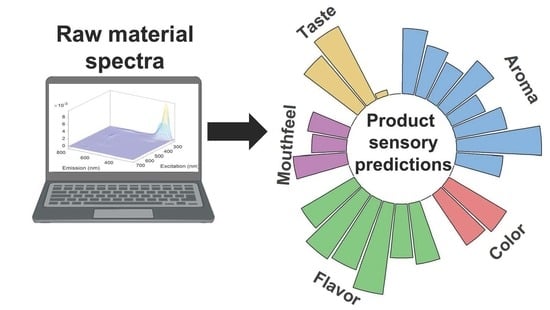
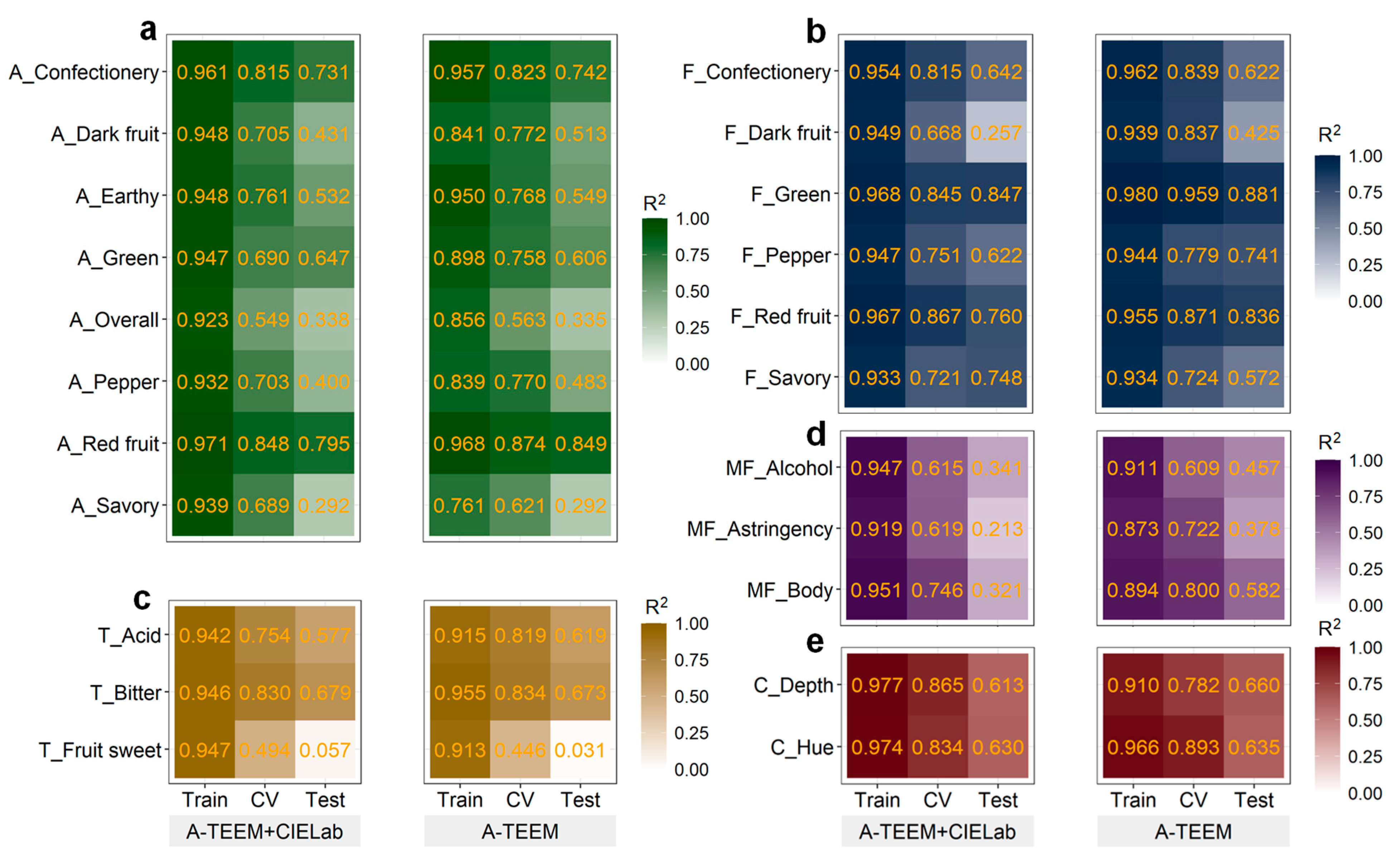
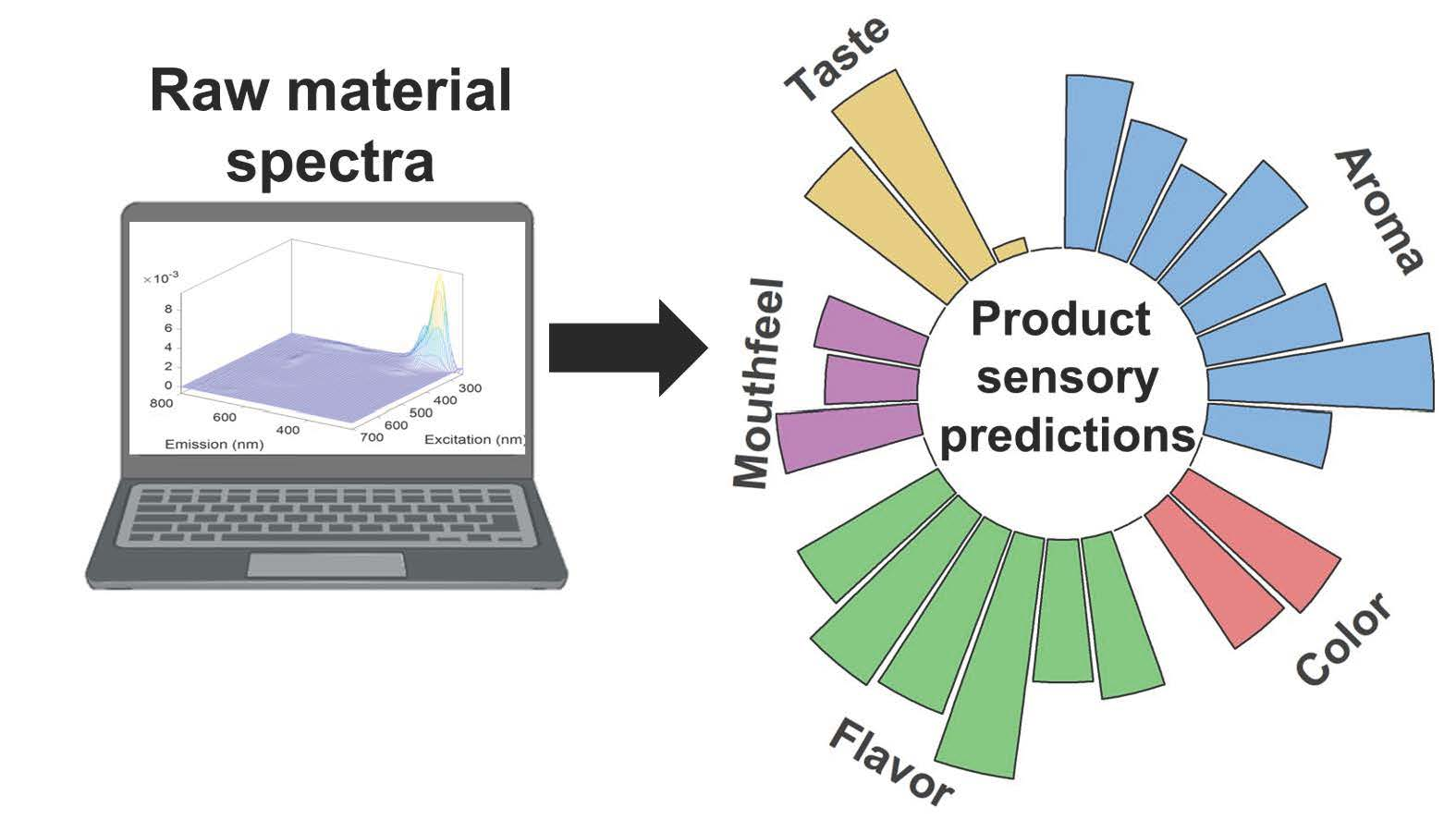
Generations of sensors have been developed for predicting food sensory profiles to circumvent the use of a human sensory panel, but a technology that can rapidly predict a suite of sensory attributes from one spectral measurement remains unavailable. Using spectra from grape extracts, this novel study aimed to address this challenge by exploring the use of a machine learning algorithm, extreme gradient boosting (XGBoost), to predict twenty-two wine sensory attribute scores from five sensory stimuli: aroma, colour, taste, flavour, and mouthfeel. Two datasets were obtained from absorbance-transmission and fluorescence excitation-emission matrix (A-TEEM) spectroscopy with different fusion methods: variable-level data fusion of absorbance and fluorescence spectral fingerprints, and feature-level data fusion of A-TEEM and CIELAB datasets. The results for externally validated models showed slightly better performance using only A-TEEM data, predicting five out of twenty-two wine sensory attributes with R2 values above 0.7 and fifteen with R2 values above 0.5. Considering the complex biotransformation involved in processing grapes to wine, the ability to predict sensory properties based on underlying chemical composition in this way suggests that the approach could be more broadly applicable to the agri-food sector and other transformed foodstuffs to predict a product’s sensory characteristics from raw material spectral attributes.
Keywords: A-TEEM; CIELAB; chemometrics; regression; wine; extreme gradient boosting A-TEEM; CIELAB; chemometrics; regression; wine; extreme gradient boosting
Graphical Abstract