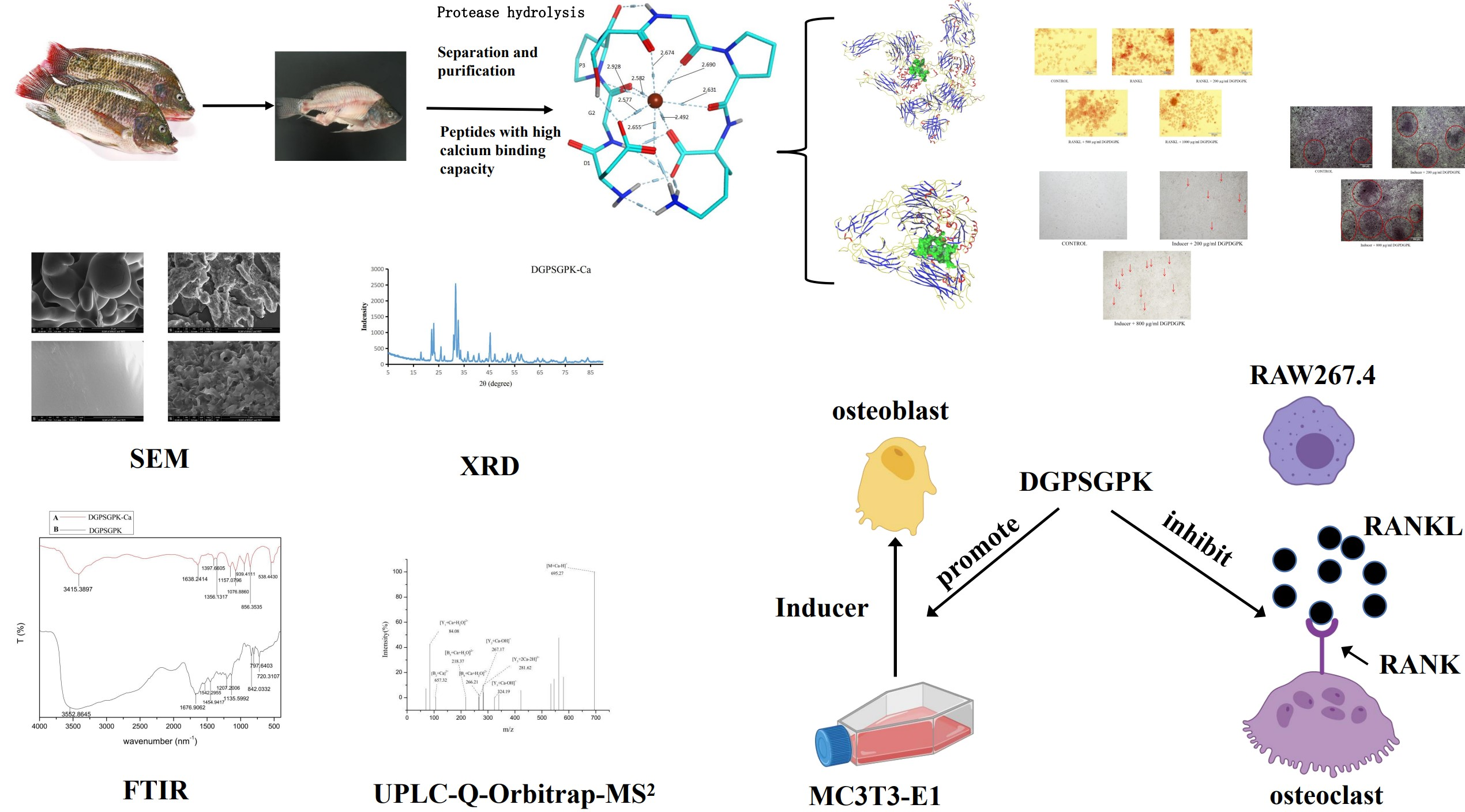
Purification and Characterization of a Novel Calcium-Binding Heptapeptide from the Hydrolysate of Tilapia Bone with Its Osteogenic Activity

Abstract
Share and Cite
He, J.; Guo, H.; Zhang, M.; Wang, M.; Sun, L.; Zhuang, Y. Purification and Characterization of a Novel Calcium-Binding Heptapeptide from the Hydrolysate of Tilapia Bone with Its Osteogenic Activity. Foods 2022, 11, 468. https://doi.org/10.3390/foods11030468
He J, Guo H, Zhang M, Wang M, Sun L, Zhuang Y. Purification and Characterization of a Novel Calcium-Binding Heptapeptide from the Hydrolysate of Tilapia Bone with Its Osteogenic Activity. Foods. 2022; 11(3):468. https://doi.org/10.3390/foods11030468
Chicago/Turabian StyleHe, Jinlun, Hao Guo, Mei Zhang, Meng Wang, Liping Sun, and Yongliang Zhuang. 2022. "Purification and Characterization of a Novel Calcium-Binding Heptapeptide from the Hydrolysate of Tilapia Bone with Its Osteogenic Activity" Foods 11, no. 3: 468. https://doi.org/10.3390/foods11030468
APA StyleHe, J., Guo, H., Zhang, M., Wang, M., Sun, L., & Zhuang, Y. (2022). Purification and Characterization of a Novel Calcium-Binding Heptapeptide from the Hydrolysate of Tilapia Bone with Its Osteogenic Activity. Foods, 11(3), 468. https://doi.org/10.3390/foods11030468