
Determination of the Formation Constants of Copper(II) Complexes Using Quantum Chemical Calculations

Abstract
1. Introduction
2. Results and Discussion
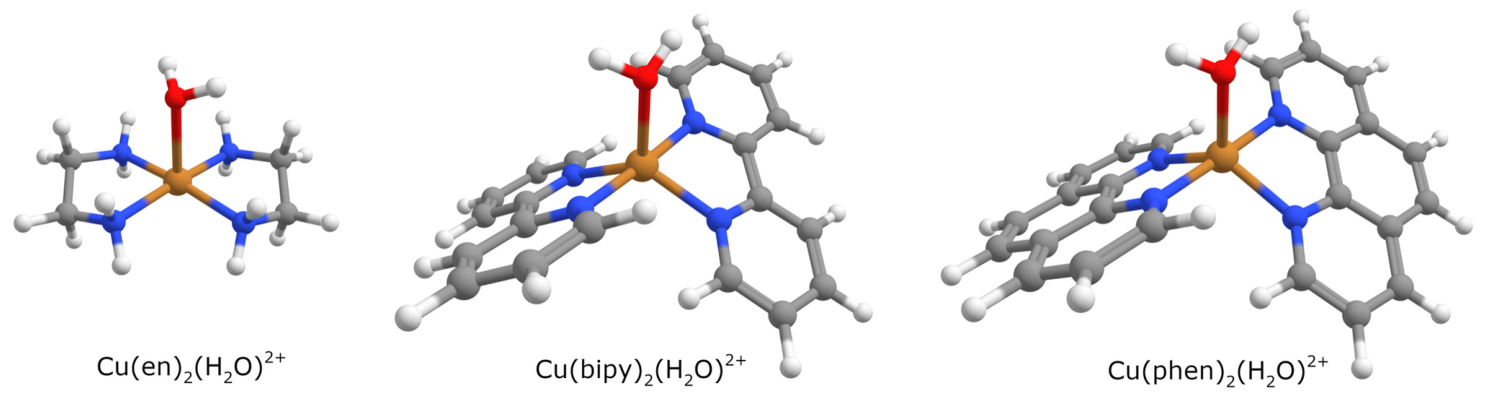
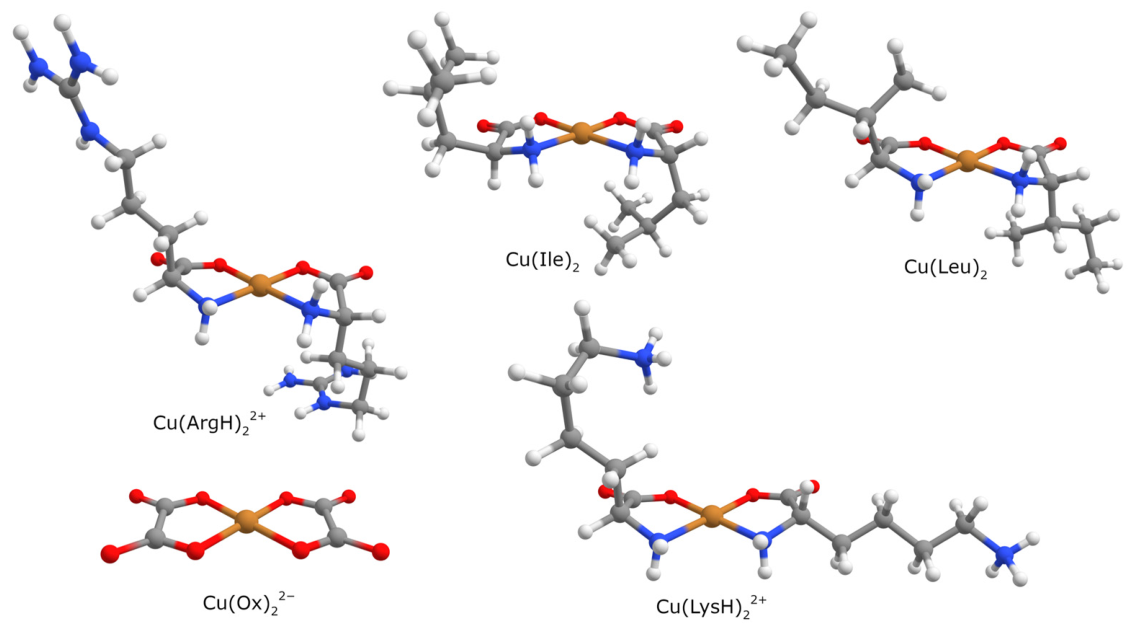
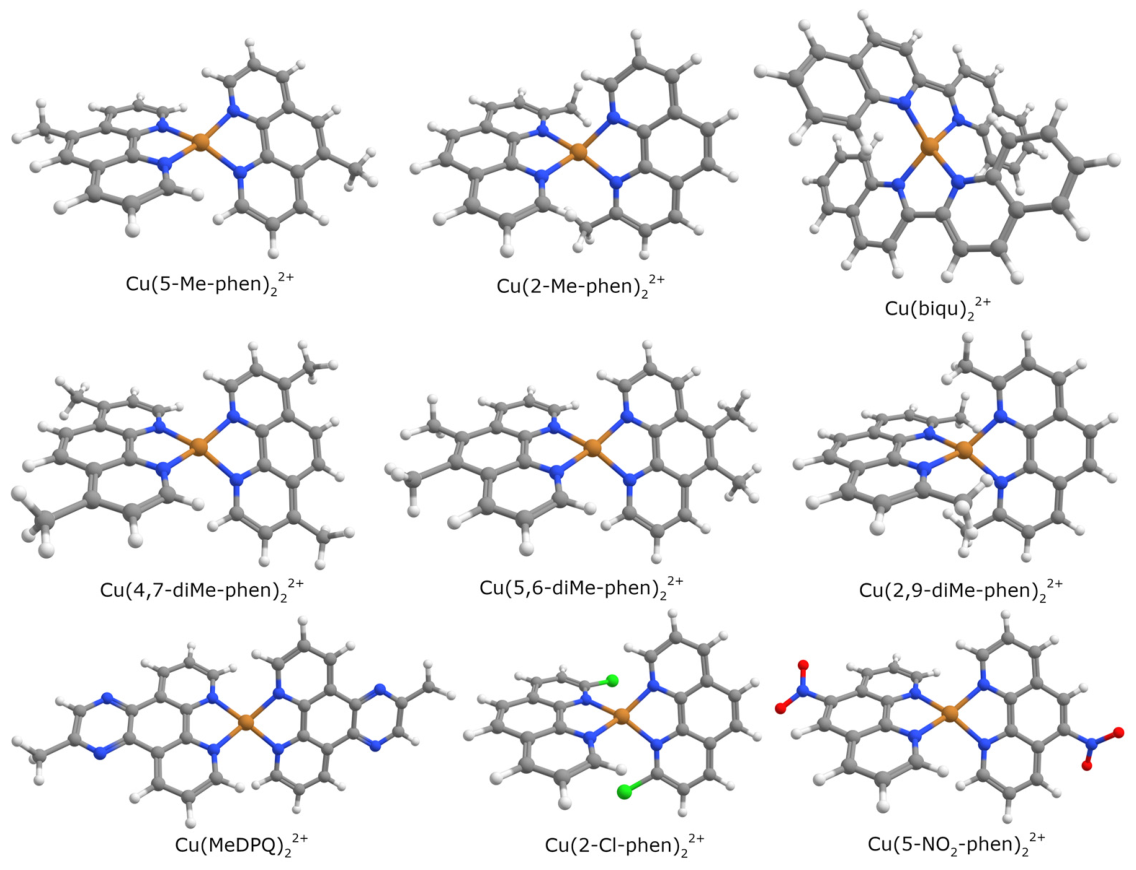
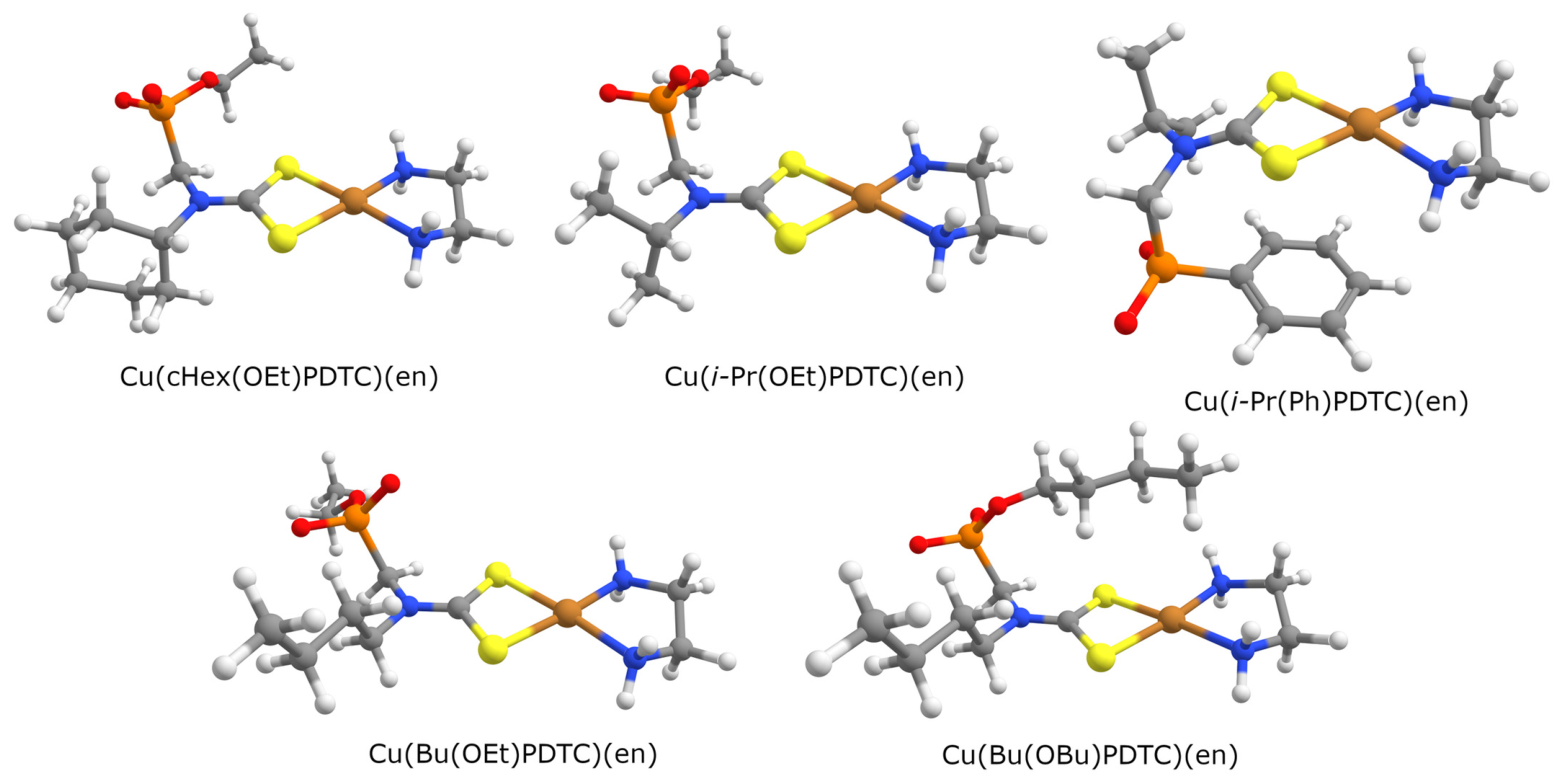
2.1. Copper(II) Bis-Homoligand Complexes
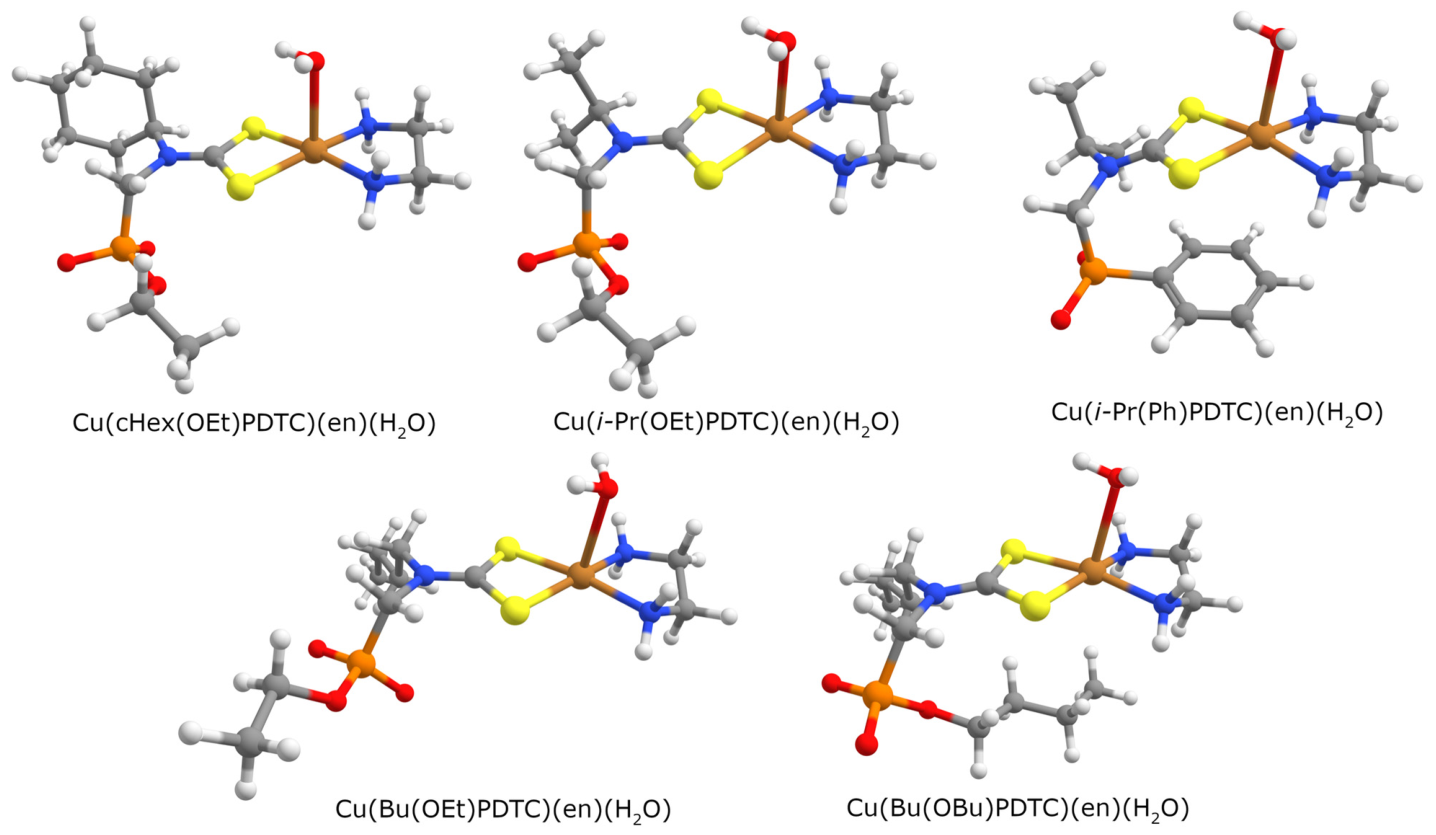
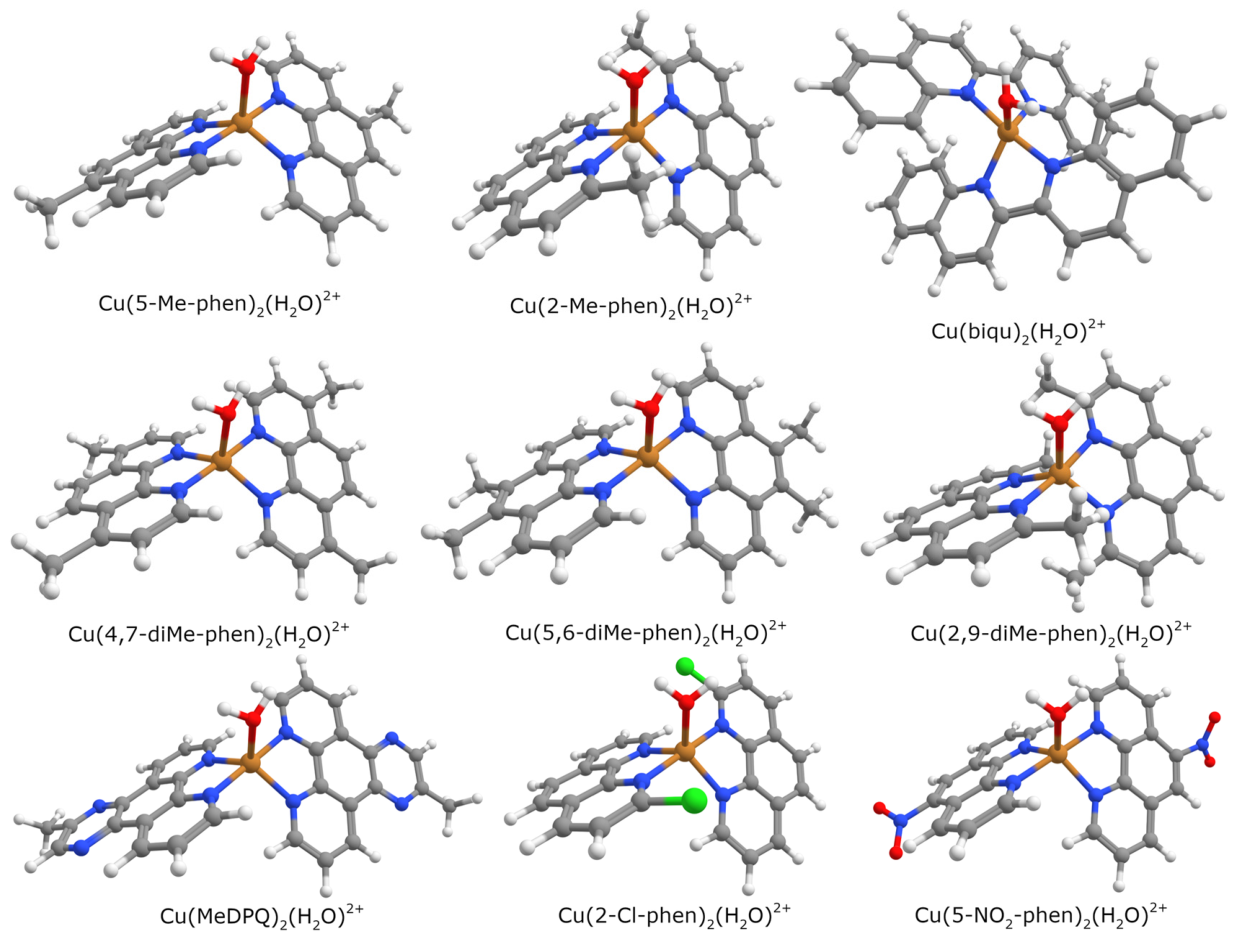
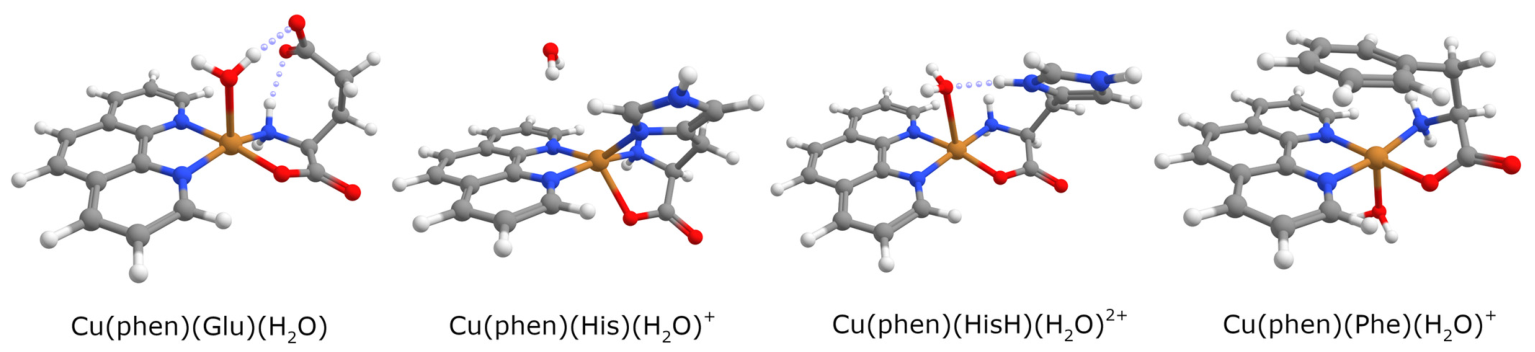
2.2. Copper(II) Bis-Homoligand Complexes with Additional Water Molecules
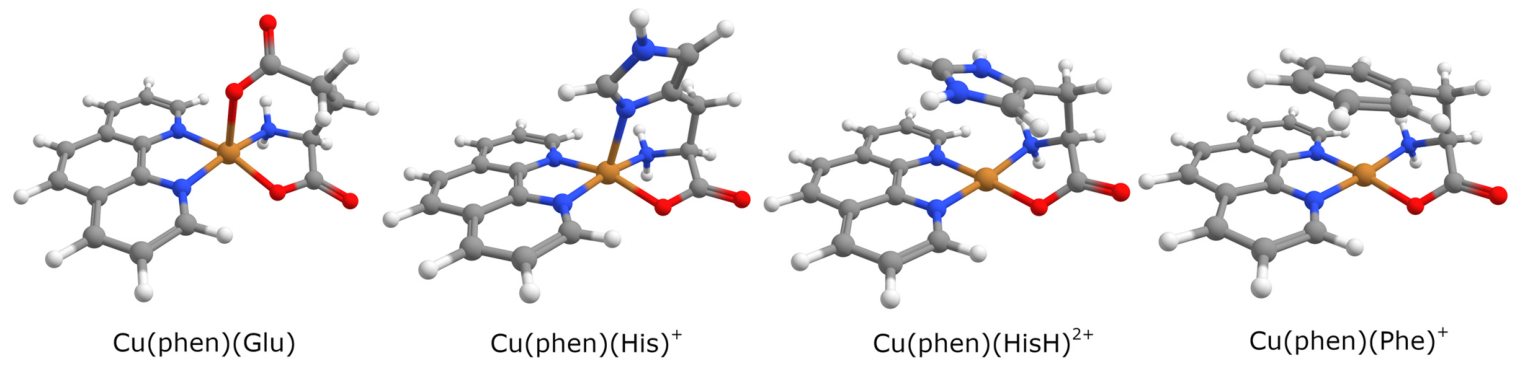
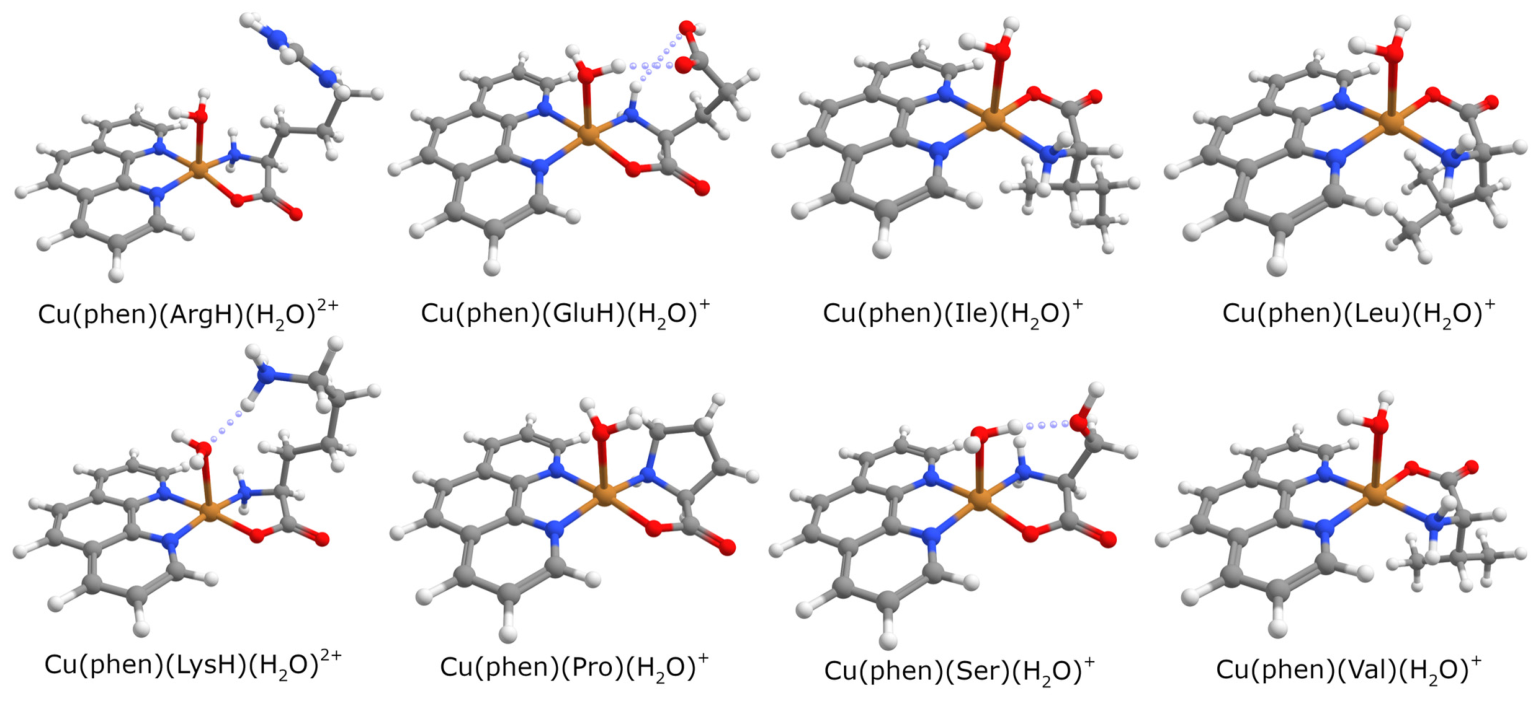
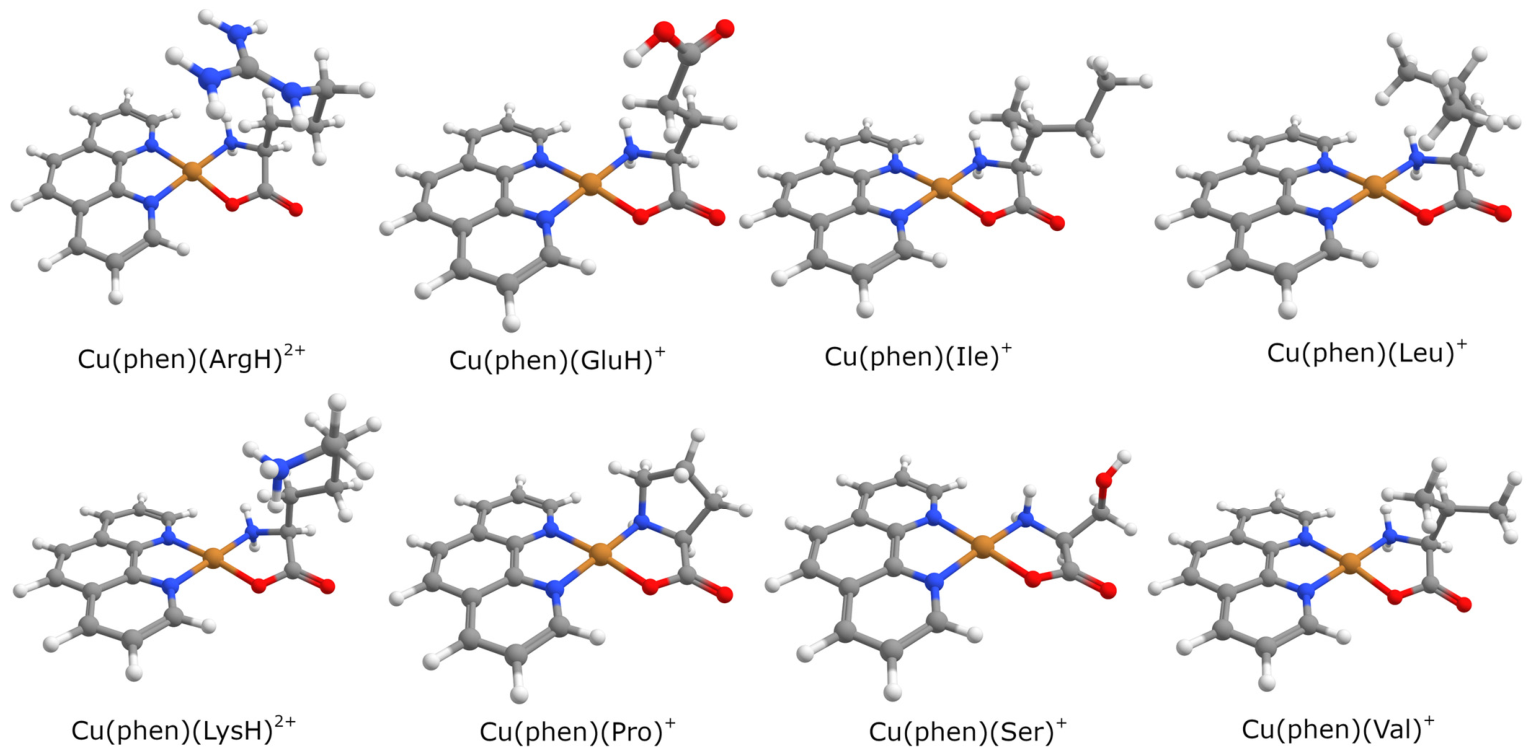
2.3. Copper(II) Heteroligand Complexes
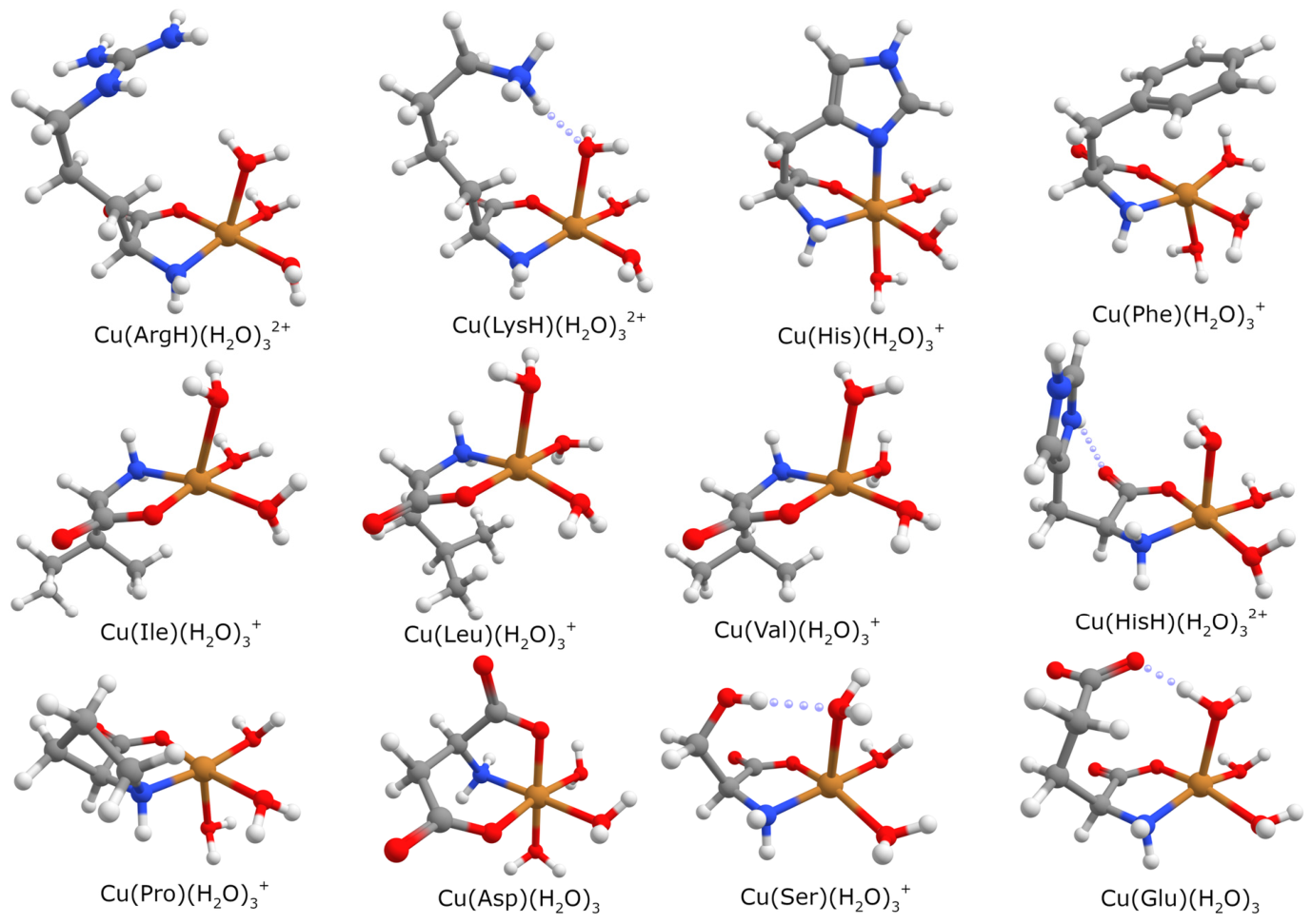
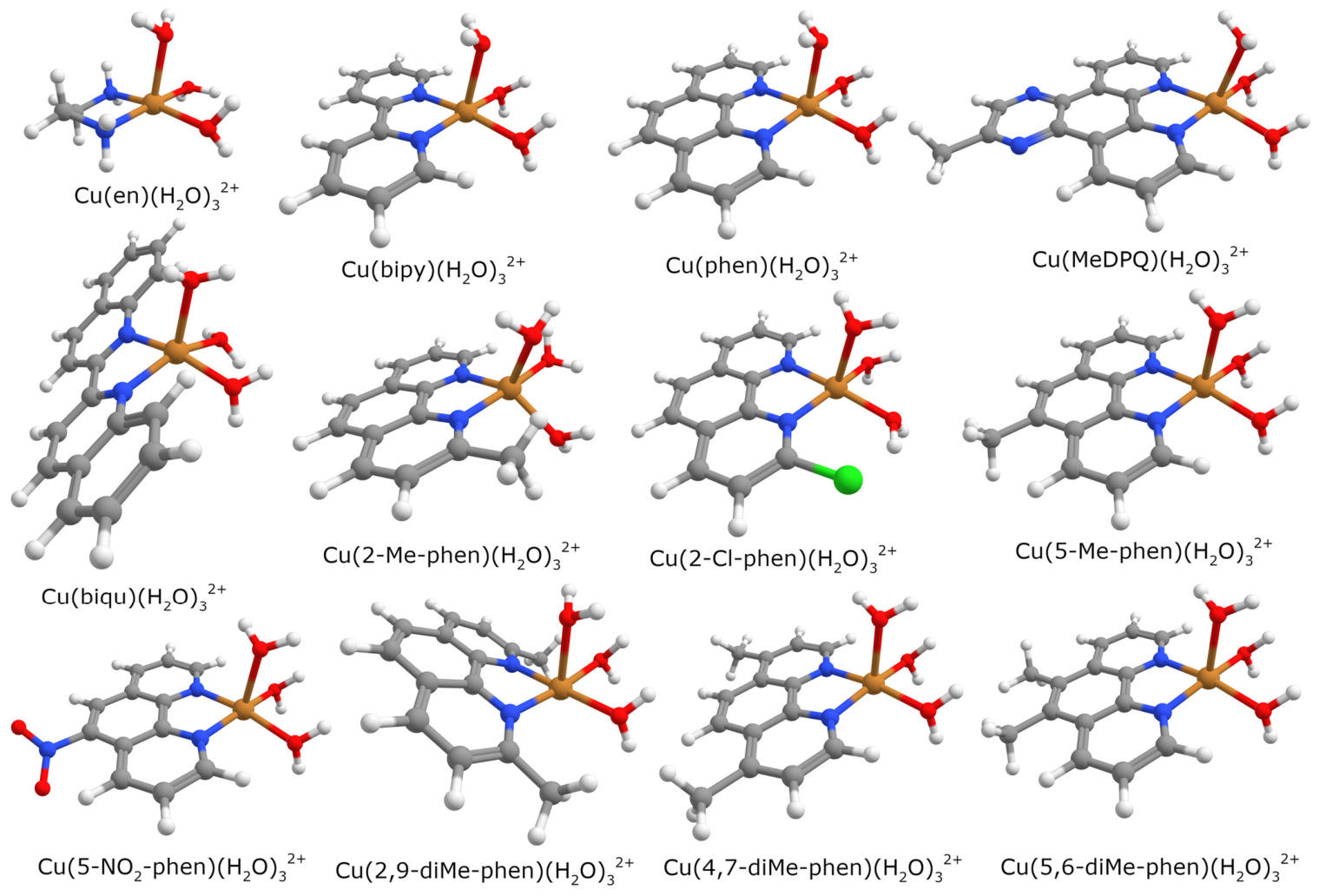
2.4. Copper(II) Monoligand Complexes
2.5. Statistical Analysis
3. Materials and Methods
4. Conclusions
- A ligand-exchange reaction involving a reference complex—for which the stability constant was experimentally determined—is used as the computational model.
- The reference ligand is selected to be structurally and solvationally similar to the ligand under study. Additionally, the reference complex must possess the same stoichiometry (including presence or absence coordinated water molecules) as the complex being characterized.
- Calculations are performed using two solvation models (C-PCM and SMD), and the resulting values are averaged.
- If the ligand contains conformationally labile groups, calculations are performed for several possible structures to assess the influence of the conformational state on the calculated stability constant.
Supplementary Materials
Author Contributions
Funding
Institutional Review Board Statement
Informed Consent Statement
Data Availability Statement
Acknowledgments
Conflicts of Interest
Abbreviations
| AmAc | amino acid |
| C-PCM | conductor-like polarizable continuum model |
| DFT | density functional theory |
| DiIm | diimine |
| en | ethylenediamine |
| PDTC | phosphorylated dithiocarbamate |
| Phen | 1,10-phenantroline |
| SMD | solvation model (based) on density |
Appendix A



| Complex | lgβ (C-PCM) | lgβ (SMD) | lgβ (Mean 1) | lgβ (Exp.) | ∆lgβ 2 |
|---|---|---|---|---|---|
| Reference—Cu(phen)(Leu)+, lgβ = 15.60 [18] | |||||
| Cu(phen)(GluH)+ | 11.04 | 9.71 | 10.37 | 10.96 [18] | −0.59 |
| Cu(phen)(Ile)+ | 15.12 | 15.48 | 15.30 | 15.61 [18] | −0.31 |
| Cu(phen)(Pro)+ | 18.64 | 16.60 | 17.62 | 16.18 [18] | 1.44 |
| Cu(phen)(Ser)+ | 14.79 | 14.36 | 14.58 | 15.34 [18] | −0.77 |
| Cu(phen)(Val)+ | 15.35 | 14.41 | 14.88 | 15.75 [18] | −0.87 |
| Cu(MeDPQ)(GluH)+ | 11.77 | 10.03 | 10.90 | 10.05 [18] | 0.85 |
| Cu(MeDPQ)(Ile)+ | 15.10 | 15.91 | 15.51 | 14.57 [18] | 0.94 |
| Cu(MeDPQ)(Leu)+ | 15.35 | 15.83 | 15.59 | 14.54 [18] | 1.05 |
| Cu(MeDPQ)(Pro)+ | 18.06 | 16.26 | 17.16 | 15.19 [18] | 1.97 |
| Cu(MeDPQ)(Ser)+ | 13.88 | 13.83 | 13.85 | 14.41 [18] | −0.56 |
| Cu(MeDPQ)(Val)+ | 14.53 | 14.68 | 14.60 | 14.74 [18] | −0.13 |
| Reference—Cu(phen)(ArgH)2+, lgβ = 15.24 [18] | |||||
| Cu(phen)(LysH)2+ | 12.58 | 14.17 | 13.38 | 15.31 [18] | −1.93 |
| Cu(MeDPQ)(ArgH)2+ | 14.65 | 16.08 | 15.36 | 14.22 [18] | 1.15 |
| Cu(MeDPQ)(LysH)2+ | 12.20 | 13.64 | 12.92 | 14.29 [18] | −1.37 |

| Complex | lgβ (C-PCM) | lgβ (SMD) | lgβ (Mean 1) | lgβ (Exp.) | ∆lgβ 2 |
|---|---|---|---|---|---|
| Reference—Cu(phen)(Glu)(H2O), lgβ = 16.05 [18] | |||||
| Cu(phen)(His)(H2O)+ | 12.03 | 15.39 | 13.71 | 16.56 [18] | −2.85 |
| Cu(phen)(Phe)(H2O)+ | 13.16 | 17.62 | 15.39 | 16.01 [18] | −0.62 |
| Cu(MeDPQ)(Glu)(H2O) | 15.46 | 16.91 | 16.18 | 15.11 [18] | 1.07 |
| Cu(MeDPQ)(His)(H2O)+ | 12.70 | 14.82 | 13.76 | 15.75 [18] | −1.98 |
| Cu(MeDPQ)(Phe)(H2O)+ | 13.21 | 17.42 | 15.32 | 14.29 [18] | 1.02 |
| Reference—Cu(en)2(H2O)2+, lgβ = 20.03 [21] | |||||
| Cu(phen)(HisH)(H2O)2+ | 10.78 | 11.08 | 10.93 | 12.74 [18] | −1.81 |
| Cu(MeDPQ)(HisH)(H2O)2+ | 11.12 | 11.31 | 11.22 | 11.73 [18] | −0.51 |


| Complex | lgβ (C-PCM) | lgβ (SMD) | lgβ (Mean 1) | lgβ (Exp.) | ∆lgβ 2 |
|---|---|---|---|---|---|
| Cu(cHex(OEt)PDTC)(en) | 18.09 | 24.00 | 21.05 | 21.33 [17] | −0.28 |
| Cu(iPr(OEt)PDTC)(en) | 17.52 | 23.40 | 20.46 | 21.74 [17] | −1.28 |
| Cu(Bu(OEt)PDTC)(en) | 16.13 | 21.75 | 18.94 | 21.32 [17] | −2.38 |
| Cu(Bu(OBu)PDTC)(en) | 17.09 | 22.47 | 19.78 | 21.15 [17] | −1.37 |
| Cu(iPr(Ph)PDTC)(en) | 17.26 | 24.22 | 20.74 | 21.72 [17] | −0.98 |


| ∆lgβ < | Metric | C-PCM | SMD | Mean |
|---|---|---|---|---|
| 1 | ME | −1.037 | 0.766 | −0.135 |
| MAE | 1.421 | 1.374 | 0.498 | |
| RMSE | 2.134 | 2.095 | 0.576 | |
| RMSE/MAE | 1.502 | 1.525 | 1.158 | |
| 2 | ME | −0.900 | 0.615 | −0.142 |
| MAE | 1.516 | 1.463 | 0.837 | |
| RMSE | 2.079 | 2.030 | 0.992 | |
| RMSE/MAE | 1.371 | 1.388 | 1.185 | |
| 3 | ME | −1.039 | 0.776 | −0.131 |
| MAE | 1.769 | 1.661 | 1.033 | |
| RMSE | 2.498 | 2.343 | 1.263 | |
| RMSE/MAE | 1.412 | 1.411 | 1.223 | |
| 4 | ME | −1.096 | 0.708 | −0.194 |
| MAE | 1.811 | 1.680 | 1.077 | |
| RMSE | 2.534 | 2.351 | 1.333 | |
| RMSE/MAE | 1.399 | 1.399 | 1.237 | |
| 5 | ME | −0.947 | 0.750 | −0.098 |
| MAE | 1.946 | 1.761 | 1.210 | |
| RMSE | 2.696 | 2.427 | 1.582 | |
| RMSE/MAE | 1.386 | 1.378 | 1.307 | |
| 6 | ME | −1.017 | 0.641 | −0.188 |
| MAE | 2.087 | 1.885 | 1.367 | |
| RMSE | 2.870 | 2.579 | 1.874 | |
| RMSE/MAE | 1.375 | 1.368 | 1.371 | |
| All presented data | ME | −1.593 | 0.250 | −0.671 |
| MAE | 2.606 | 2.143 | 1.788 | |
| RMSE | 3.933 | 2.975 | 2.842 | |
| RMSE/MAE | 1.509 | 1.388 | 1.589 |
References
- Vukovic, S.; Hay, B.P.; Bryantsev, V.S. Predicting Stability Constants for Uranyl Complexes Using Density Functional Theory. Inorg. Chem. 2015, 54, 3995–4001. [Google Scholar] [CrossRef] [Scilit] [PubMed]
- Devarajan, D.; Lian, P.; Brooks, S.C.; Parks, J.M.; Smith, J.C. Quantum Chemical Approach for Calculating Stability Constants of Mercury Complexes. ACS Earth Space Chem. 2018, 2, 1168–1178. [Google Scholar] [CrossRef] [Scilit]
- Gutten, O.; Rulíšek, L. Predicting the Stability Constants of Metal-Ion Complexes from First Principles. Inorg. Chem. 2013, 52, 10347–10355. [Google Scholar] [CrossRef] [Scilit] [PubMed]
- Holland, J.P. Predicting the Thermodynamic Stability of Zirconium Radiotracers. Inorg. Chem. 2020, 59, 2070–2082. [Google Scholar] [CrossRef] [Scilit] [PubMed]
- Casasnovas, R.; Ortega-Castro, J.; Donoso, J.; Frau, J.; Muñoz, F. Theoretical Calculations of Stability Constants and pKa Values of Metal Complexes in Solution: Application to Pyridoxamine–Copper(Ii) Complexes and Their Biological Implications in AGE Inhibition. Phys. Chem. Chem. Phys. 2013, 15, 16303. [Google Scholar] [CrossRef] [Scilit] [PubMed]
- Bay, M.V.; Hien, N.K.; Thanh, H.K.; Nam, P.C.; Quang, D.T. Prediction of Stability Constants of Cu2+ Complexes with Organic Fluorescent Ligands Using Thermodynamic Cycle in Combination with DFT Theory and SMD Solvent Model. Hue Univ. J. Sci. Nat. Sci. 2020, 129, 15–23. [Google Scholar] [CrossRef] [Scilit]
- Gentry, B.M.; Choi, T.H.; Belfield, W.S.; Keith, J.A. Computational Predictions of Metal–Macrocycle Stability Constants Require Accurate Treatments of Local Solvent and pH Effects. Phys. Chem. Chem. Phys. 2021, 23, 9189–9197. [Google Scholar] [CrossRef] [Scilit] [PubMed]
- Lutoshkin, M.A. Solvation Effects on the Sustainability of Lanthanum Complexes. J. Phys. Chem. A 2025, 129, 5490–5498. [Google Scholar] [CrossRef] [Scilit] [PubMed]
- García Alejo, A.; De Silva, N.; Liu, Y.; Windus, T.L.; Pérez García, M. Solvent Phase Optimizations Improve Correlations with Experimental Stability Constants for Aqueous Lanthanide Complexes. Solvent Extr. Ion Exch. 2023, 41, 241–251. [Google Scholar] [CrossRef] [Scilit]
- Herchel, R.; Pražáková, M.; Drahoš, B. Computational Insight into Manganese(II) Complexes Comprising Macrocyclic Ligands for Magnetic Resonance Imaging. Dalton Trans. 2025, 54, 14495–14504. [Google Scholar] [CrossRef] [Scilit] [PubMed]
- Kostelnik, T.I.; Scheiber, H.; Cappai, R.; Choudhary, N.; Lindheimer, F.; Guadalupe Jaraquemada-Peláez, M.D.; Orvig, C. Phosphonate Chelators for Medicinal Metal Ions. Inorg. Chem. 2021, 60, 5343–5361. [Google Scholar] [CrossRef] [Scilit] [PubMed]
- Lutoshkin, M.A.; Kuznetsov, B.N.; Levdanskiy, V.A. The Interaction of Morin and Morin-5’-Sulfonic Acid with Lead(II): Study of the 1:1 Complex Formation Process in Aqueous Solution. Main Group Met. Chem. 2019, 42, 67–72. [Google Scholar] [CrossRef] [Scilit]
- Roy, L.E.; Martin, L.R. Theoretical Prediction of Coordination Environments and Stability Constants of Lanthanum Lactate Complexes in Solution. Dalton Trans. 2016, 45, 15517–15522. [Google Scholar] [CrossRef] [Scilit] [PubMed]
- Gutten, O.; Beššeová, I.; Rulíšek, L. Interaction of Metal Ions with Biomolecular Ligands: How Accurate Are Calculated Free Energies Associated with Metal Ion Complexation? J. Phys. Chem. A 2011, 115, 11394–11402. [Google Scholar] [CrossRef] [Scilit] [PubMed]
- Lutoshkin, M.A.; Petrov, A.I.; Malyar, Y.N.; Kazachenko, A.S. Interaction of Rare-Earth Metals and Some Perfluorinated β-Diketones. Inorg. Chem. 2021, 60, 3291–3304. [Google Scholar] [CrossRef] [Scilit] [PubMed]
- Purgel, M.; Schuur, J.H. First Principle Determination of Stability Constants of Metal Complexes by Cellmetry Method. Int. J. Quantum Chem. 2023, 123, e27214. [Google Scholar] [CrossRef] [Scilit]
- Aksenin, N.S.; Bukharov, M.S.; Rodionov, A.A.; Kuzin, Y.I.; Gubaidullin, A.T.; Islamov, D.R.; Shtyrlin, V.G.; Serov, N.Y. Copper Complexes with Phosphorylated Dithiocarbamates in Aqueous Media: Complexation, Structures and Redox Activity. Inorganics 2026, 14, 114. [Google Scholar] [CrossRef] [Scilit]
- Ermolaev, A.V.; Shtyrlin, V.G.; Gizatullin, A.I.; Zhernakov, M.A.; Serov, N.Y.; Urazaeva, K.V.; Bukharov, M.S.; Gilyazetdinov, E.M.; Islamov, D.R.; Rodionov, A.A.; et al. Development of Comprehensive Approaches to Characterizing CuII Complexes: Structures in Solution and Solid-state, Dynamic Behavior, and Bioactivity. ChemistrySelect 2023, 8, e202303333. [Google Scholar] [CrossRef] [Scilit]
- Yadava, P.C.; Ghose, A.K.; Yadava, K.L.; Dey, A.K. Stability Constants of Oxalate Complexes of Copper (II) and Nickel (II) by Paper Electrophoresis. Chromatographia 1976, 9, 410–412. [Google Scholar] [CrossRef] [Scilit]
- McBryde, W.A.E. A Critical Review of Equilibrium Data for Proton- and Metal Complexes of 1,10-Phenanthroline, 2,2’-Bipyridyl and Related Compounds; IUPAC Chemical Data Series; Pergamon Press: Oxford, UK, 1978. [Google Scholar]
- Maes, A.; Peigneur, P.; Cremers, A. Stability of Metal Uncharged Ligand Complexes in Ion Exchangers. Part 2.—The Copper+ethylenediamine Complex in Montmorillonite and Sulphonic Acid Resin. J. Chem. Soc. Faraday Trans. 1 1978, 74, 182. [Google Scholar] [CrossRef] [Scilit]
- Murphy, J.M.; Powell, B.A.; Brumaghim, J.L. Stability Constants of Bio-Relevant, Redox-Active Metals with Amino Acids: The Challenges of Weakly Binding Ligands. Coord. Chem. Rev. 2020, 412, 213253. [Google Scholar] [CrossRef] [Scilit]
- Bregier-Jarzebowska, R.; Gasowska, A.; Lomozik, L. Complexes of Cu(II) Ions and Noncovalent Interactions in Systems with L-Aspartic Acid and Cytidine-5′-Monophosphate. Bioinorg. Chem. Appl. 2008, 2008, 253971. [Google Scholar] [CrossRef] [Scilit] [PubMed]
- Bukharov, M.S.; Shtyrlin, V.G.; Mukhtarov, A.S.; Mamin, G.V.; Stapf, S.; Mattea, C.; Krutikov, A.A.; Il’in, A.N.; Serov, N.Y. Study of Structural and Dynamic Characteristics of Copper(Ii) Amino Acid Complexes in Solutions by Combined EPR and NMR Relaxation Methods. Phys. Chem. Chem. Phys. 2014, 16, 9411–9421. [Google Scholar] [CrossRef] [Scilit] [PubMed]
- Bukharov, M.S.; Shtyrlin, V.G.; Gilyazetdinov, E.M.; Serov, N.Y.; Madzhidov, T.I. Hydration of Copper(II) Amino Acids Complexes. J. Comput. Chem. 2018, 39, 821–826. [Google Scholar] [CrossRef] [Scilit] [PubMed]
- James, B.R.; Williams, R.J.P. 383. The Oxidation–Reduction Potentials of Some Copper Complexes. J. Chem. Soc. 1961, 164, 2007–2019. [Google Scholar] [CrossRef] [Scilit]
- Bottari, E.; Festa, M.R.; Jasionowska, R. Copper(II) Complexes with Aspartate and Glutamate. Polyhedron 1989, 8, 1019–1027. [Google Scholar] [CrossRef] [Scilit]
- Neese, F. The ORCA Program System. WIREs Comput. Molec. Sci. 2012, 2, 73–78. [Google Scholar] [CrossRef] [Scilit]
- Neese, F. Software Update: The ORCA Program System—Version 6.0. Wiley Interdiscip. Rev. Comput. Mol. Sci. 2025, 15, e70019. [Google Scholar] [CrossRef] [Scilit]
- Becke, A.D. Density-Functional Thermochemistry. III. The Role of Exact Exchange. J. Chem. Phys. 1993, 98, 5648. [Google Scholar] [CrossRef] [Scilit]
- Lee, C.; Yang, W.; Parr, R.G. Development of the Colle-Salvetti Correlation-Energy Formula into a Functional of the Electron Density. Phys. Rev. B 1988, 37, 785–789. [Google Scholar] [CrossRef] [Scilit] [PubMed]
- Weigend, F.; Ahlrichs, R. Balanced Basis Sets of Split Valence, Triple Zeta Valence and Quadruple Zeta Valence Quality for H to Rn: Design and Assessment of Accuracy. Phys. Chem. Chem. Phys. 2005, 7, 3297. [Google Scholar] [CrossRef] [Scilit] [PubMed]
- Weigend, F. Accurate Coulomb-Fitting Basis Sets for H to Rn. Phys. Chem. Chem. Phys. 2006, 8, 1057. [Google Scholar] [CrossRef] [Scilit] [PubMed]
- Rappoport, D.; Furche, F. Property-Optimized Gaussian Basis Sets for Molecular Response Calculations. J. Chem. Phys. 2010, 133, 134105. [Google Scholar] [CrossRef] [Scilit] [PubMed]
- Grimme, S.; Antony, J.; Ehrlich, S.; Krieg, H. A Consistent and Accurate Ab Initio Parametrization of Density Functional Dispersion Correction (DFT-D) for the 94 Elements H-Pu. J. Chem. Phys. 2010, 132, 154104. [Google Scholar] [CrossRef] [Scilit] [PubMed]
- Grimme, S.; Ehrlich, S.; Goerigk, L. Effect of the Damping Function in Dispersion Corrected Density Functional Theory. J. Comput. Chem. 2011, 32, 1456–1465. [Google Scholar] [CrossRef] [Scilit] [PubMed]
- Cossi, M.; Rega, N.; Scalmani, G.; Barone, V. Energies, Structures, and Electronic Properties of Molecules in Solution with the C-PCM Solvation Model. J. Comput. Chem. 2003, 24, 669–681. [Google Scholar] [CrossRef] [Scilit] [PubMed]
- Marenich, A.V.; Cramer, C.J.; Truhlar, D.G. Universal Solvation Model Based on Solute Electron Density and on a Continuum Model of the Solvent Defined by the Bulk Dielectric Constant and Atomic Surface Tensions. J. Phys. Chem. B 2009, 113, 6378–6396. [Google Scholar] [CrossRef] [Scilit] [PubMed]
- Hanwell, M.D.; Curtis, D.E.; Lonie, D.C.; Vandermeersch, T.; Zurek, E.; Hutchison, G.R. Avogadro: An Advanced Semantic Chemical Editor, Visualization, and Analysis Platform. J. Cheminform. 2012, 4, 17. [Google Scholar] [CrossRef] [Scilit] [PubMed]
- Chemcraft—Graphical Software for Visualization of Quantum Chemistry Computations. Version 1.8, Build 780. Available online: https://www.chemcraftprog.com (accessed on 22 July 2025).


| Complex | lgβ (C-PCM) | lgβ (SMD) | lgβ (Mean 2) | lgβ (Exp.) | ∆lgβ 3 |
|---|---|---|---|---|---|
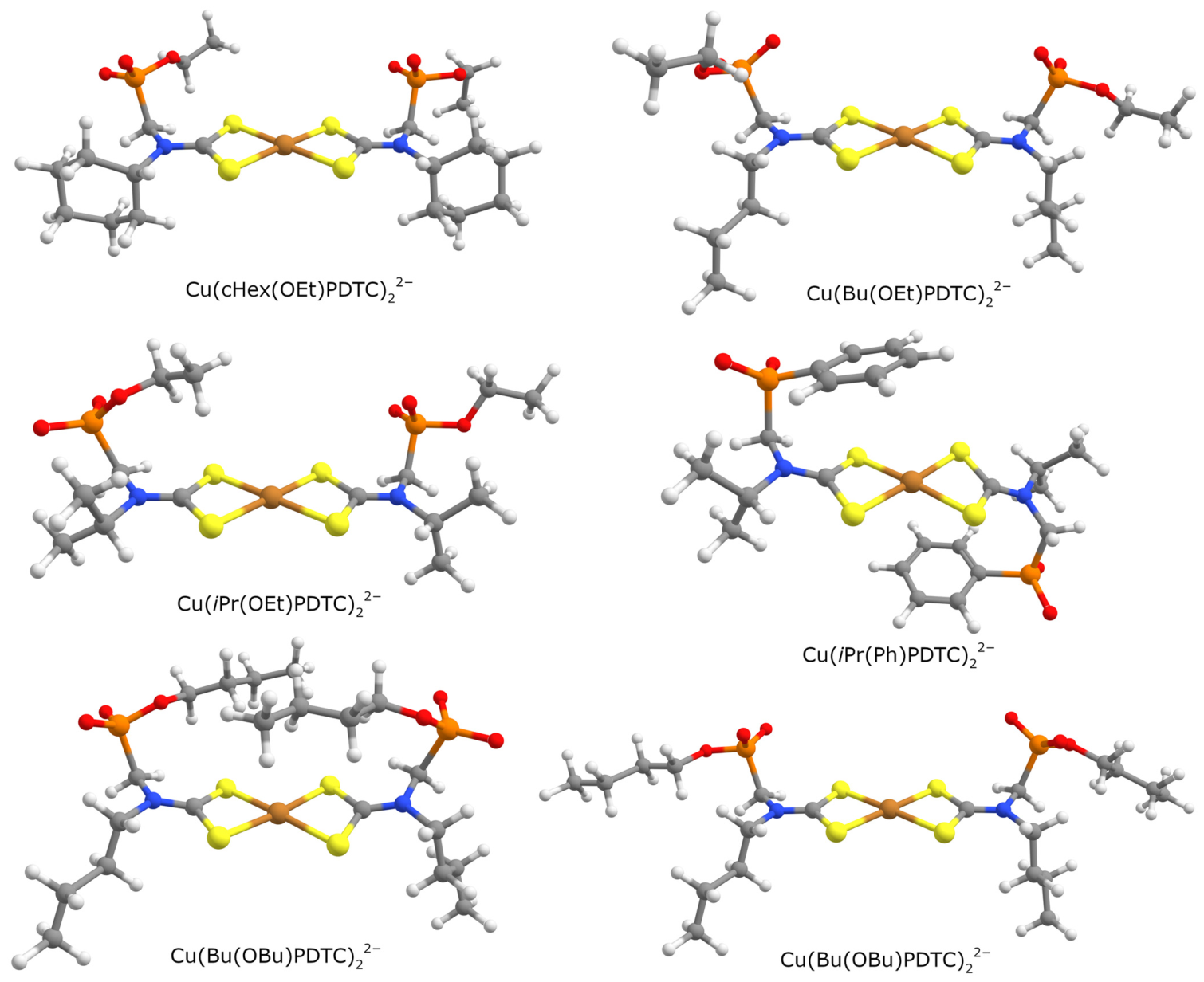
| Cu(cHex(OEt)PDTC)22− | 16.45 | 29.35 | 22.90 | 22.81 [17] | 0.09 |
| Cu(iPr(OEt)PDTC)22− | 16.80 | 28.59 | 22.70 | 22.87 [17] | −0.17 |
| Cu(Bu(OEt)PDTC)22− | 16.20 | 27.30 | 21.75 | 22.08 [17] | −0.33 |
| Cu(Bu(OBu)PDTC)22− * | 16.94 | 31.58 | 24.26 | 22.02 [17] | 2.24 |
| Cu(Bu(OBu)PDTC)22− * | 11.65 | 27.29 | 19.47 | 22.02 [17] | −2.55 |
| Cu(iPr(Ph)PDTC)22− | 17.39 | 30.44 | 23.91 | 23.15 [17] | 0.76 |
| Cu(ArgH)22+ | 8.88 | 11.32 | 10.10 | 13.40 [18] | −3.30 |
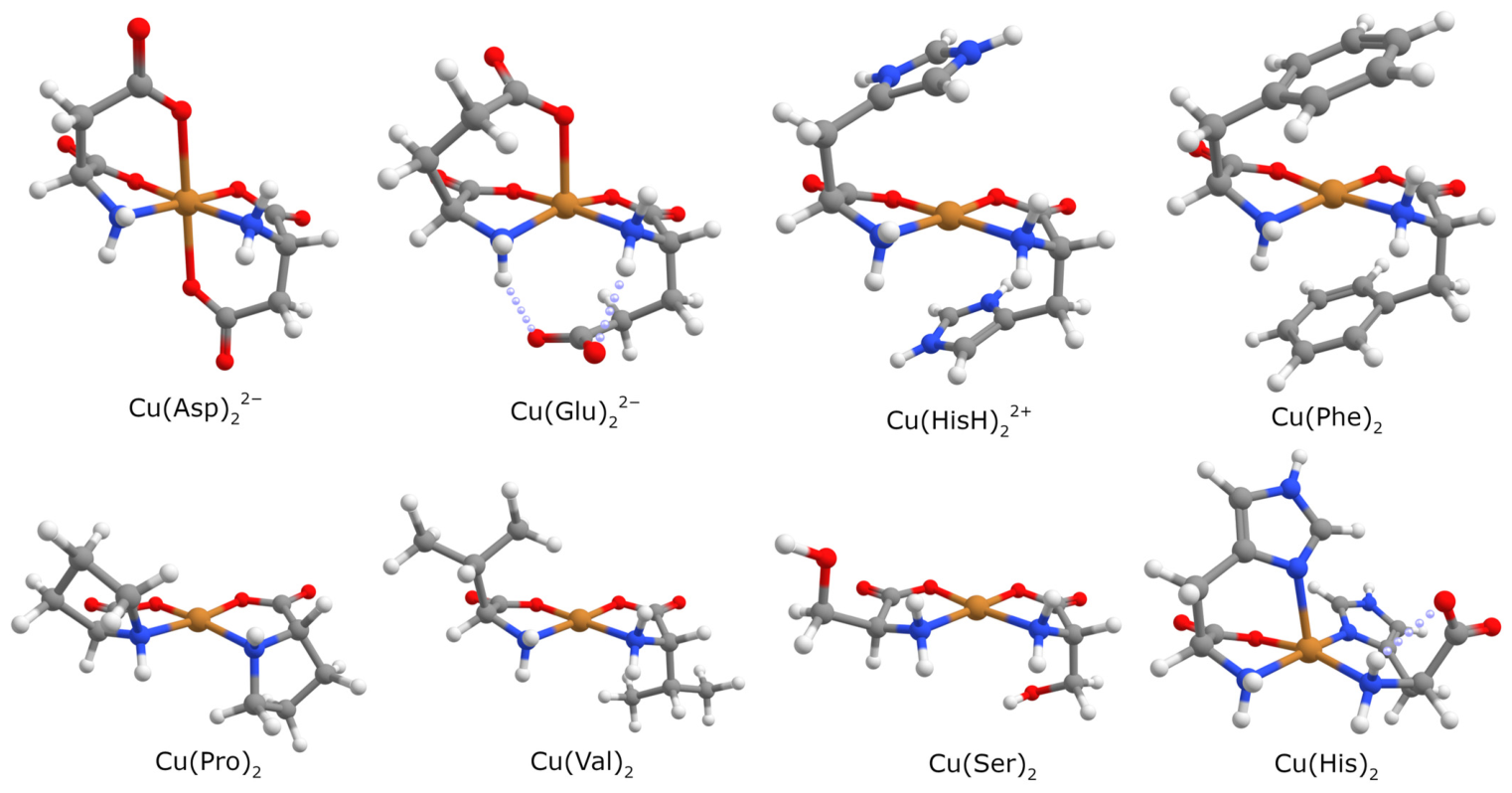
| Cu(Glu)22− | 15.33 | 13.51 | 14.42 | 14.37 [18] | 0.05 |
| Cu(His)2 | 14.55 | 16.29 | 15.42 | 17.12 [18] | −1.70 |
| Cu(HisH)22+ | −4.52 | 1.45 | −1.53 | 8.71 [18] | −10.24 |
| Cu(Ile)2 | 12.07 | 14.38 | 13.23 | 14.09 [18] | −0.86 |
| Cu(Leu)2 | 12.09 | 13.61 | 12.85 | 14.46 [18] | −1.61 |
| Cu(LysH)22+ | 4.96 | 9.45 | 7.21 | 13.61 [18] | −6.40 |
| Cu(Ox)22− | 10.06 | 6.33 | 8.20 | 10.00 [19] | −1.90 |
| Cu(Phe)2 | 12.44 | 17.22 | 14.83 | 14.23 [18] | 0.60 |
| Cu(Pro)2 | 17.95 | 15.32 | 16.64 | 15.46 [18] | 1.18 |
| Cu(Ser)2 | 10.36 | 10.38 | 10.37 | 13.58 [18] | −3.21 |
| Cu(Val)2 | 11.70 | 12.49 | 12.09 | 14.57 [18] | −2.48 |
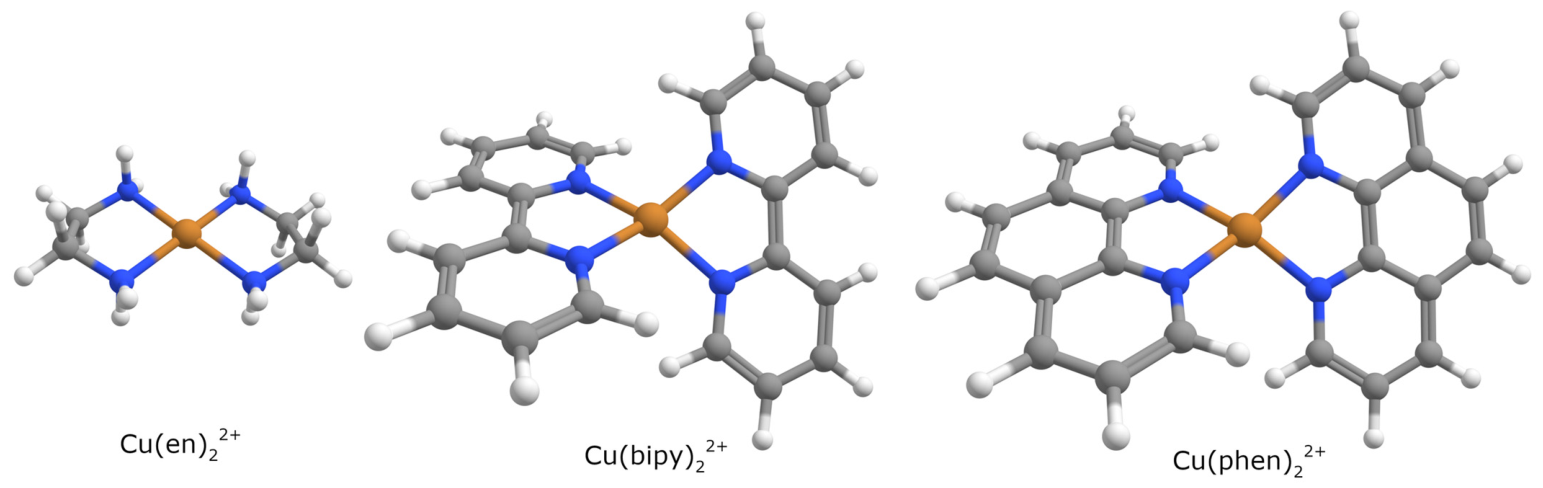
| Cu(phen)22+ | 0.58 | 5.44 | 3.01 | 14.28 [18] | −11.27 |
| Cu(bipy)22+ | 1.73 | 7.41 | 4.57 | 13.80 [20] | −9.23 |
| Cu(en)22+ | 7.26 | 11.90 | 9.58 | 20.03 [21] | −10.45 |
| Complex | lgβ (C-PCM) | lgβ (SMD) | lgβ (Mean 1) | lgβ (Exp.) | ∆lgβ 2 |
|---|---|---|---|---|---|
| Cu(iPr(OEt)PDTC)22− | 23.16 | 22.06 | 22.61 | 22.87 [17] | −0.16 |
| Cu(Bu(OEt)PDTC)22− | 22.57 | 20.77 | 21.67 | 22.08 [17] | −0.41 |
| Cu(Bu(OBu)PDTC)22− | 23.31 | 25.04 | 24.18 | 22.02 [17] | 2.16 |
| Cu(Bu(OBu)PDTC)22− | 18.01 | 20.75 | 19.38 | 22.02 [17] | −2.64 |
| Cu(iPr(Ph)PDTC)22− | 23.75 | 23.90 | 23.83 | 23.15 [17] | 0.68 |
| Complex | lgβ (C-PCM) | lgβ (SMD) | lgβ (Mean 1) | lgβ (Exp.) | ∆lgβ 2 |
|---|---|---|---|---|---|
| Cu(HisH)22+ | 8.26 | 9.58 | 8.92 | 8.71 [18] | 0.21 |
| Cu(bipy)22+ | 14.51 | 15.53 | 15.02 | 14.02 [20] | 1.00 |
| Cu(biqu)22+ | 13.54 | 13.61 | 13.58 | 7.73 [20] | 5.85 |
| Cu(MeDPQ)22+ | 10.25 | 13.17 | 11.71 | 12.47 [18] | −0.76 |
| Cu(phen)22+ | 13.35 | 13.57 | 13.46 | 14.28 [18] | −0.82 |
| Cu(2-Me-phen)22+ | 13.61 | 14.06 | 13.84 | 13.8 [20] | 0.04 |
| Cu(5-Me-phen)22+ | 13.75 | 14.73 | 14.24 | 15.02 [20] | −0.78 |
| Cu(2,9-diMe-phen)22+ | 14.15 | 14.40 | 14.27 | 11.7 [20] | 2.57 |
| Cu(4,7-diMe-phen)22+ | 16.06 | 20.55 | 18.30 | 16.02 [20] | 2.28 |
| Cu(5,6-diMe-phen)22+ | 14.52 | 14.62 | 14.57 | 15.7 [20] | −1.13 |
| Cu(2-Cl-phen)22+ | 4.58 | 5.41 | 4.99 | 10.45 [20] | −5.46 |
| Cu(5-NO2-phen)22+ | 7.35 | 8.85 | 8.10 | 13.47 [20] | −5.37 |
| Complex | lgβ (C-PCM) | lgβ (SMD) | lgβ (Mean 1) | lgβ (Exp.) | ∆lgβ 2 |
|---|---|---|---|---|---|
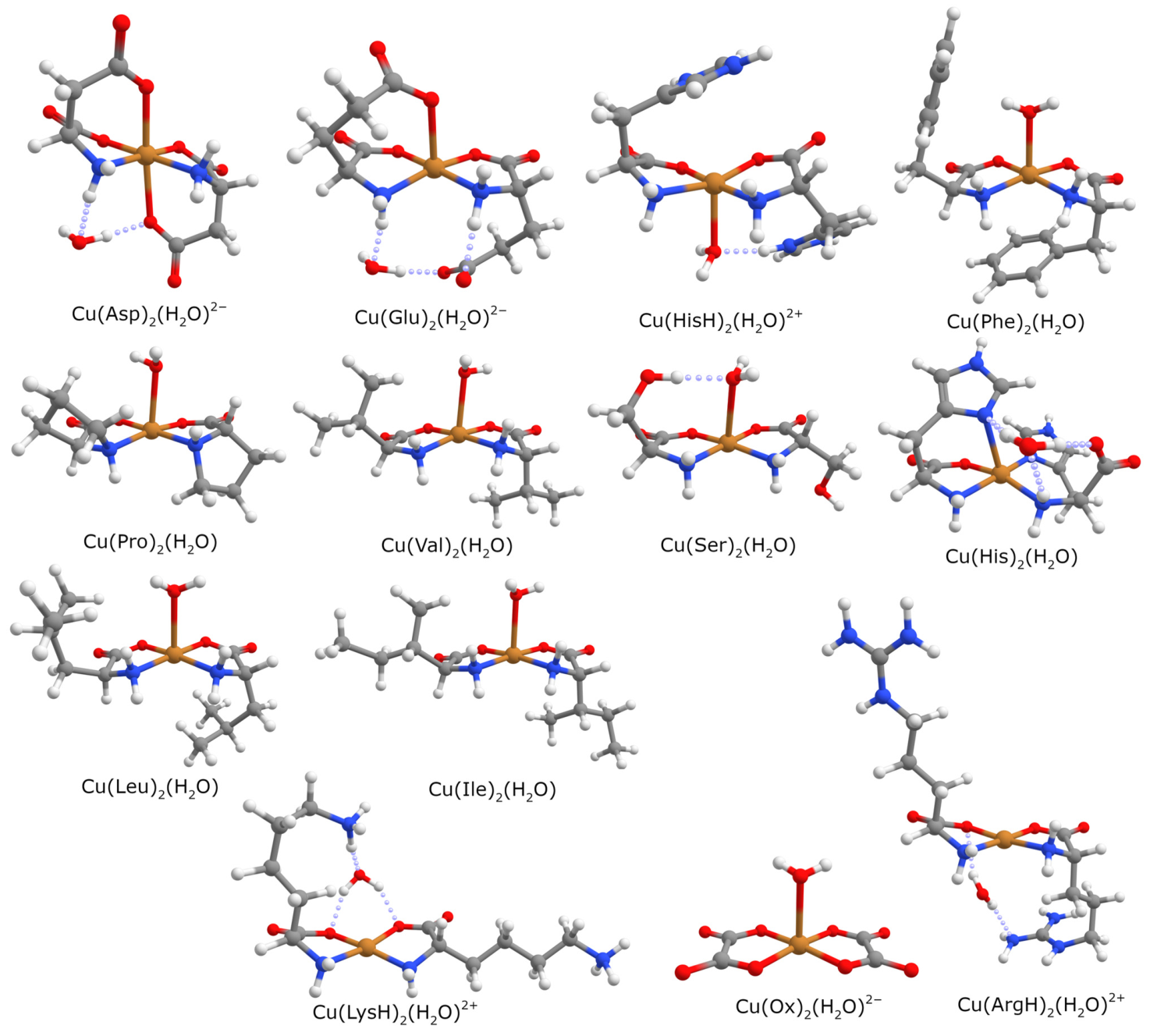
| Cu(ArgH)2(H2O)2+ | 11.15 | 12.49 | 11.82 | 13.40 [18] | −1.58 |
| Cu(Asp)2(H2O)2− | 21.36 | 18.42 | 19.89 | 15.69 3 | 4.20 |
| Cu(Glu)2(H2O)2− | 20.37 | 17.69 | 19.03 | 14.37 [18] | 4.66 |
| Cu(His)2(H2O) | 18.84 | 18.28 | 18.56 | 17.12 [18] | 1.44 |
| Cu(HisH)2(H2O)2+ | −2.60 | 2.79 | 0.10 | 8.71 [18] | −8.61 |
| Cu(Ile)2(H2O) | 13.34 | 14.44 | 13.89 | 14.09 [18] | −0.20 |
| Cu(LysH)2(H2O)2+ | 11.08 | 12.18 | 11.63 | 13.61 [18] | −1.98 |
| Cu(Ox)2(H2O)2− | 12.53 | 7.44 | 9.98 | 10.00 [19] | −0.02 |
| Cu(Phe)2(H2O) | 14.04 | 17.47 | 15.75 | 14.23 [18] | 1.52 |
| Cu(Pro)2(H2O) | 20.31 | 16.26 | 18.29 | 15.46 [18] | 2.83 |
| Cu(Ser)2(H2O) | 13.89 | 12.75 | 13.32 | 13.58 [18] | −0.26 |
| Cu(Val)2(H2O) | 13.06 | 12.87 | 12.97 | 14.57 [18] | −1.60 |
| Complex | lgβ (C-PCM) | lgβ (SMD) | lgβ (Mean 1) | lgβ (Exp.) | ∆lgβ 2 |
|---|---|---|---|---|---|
| Cu(HisH)2(H2O)2+ | 7.06 | 9.16 | 8.11 | 8.71 [18] | −0.60 |
| Cu(bipy)2(H2O)2+ | 14.83 | 15.89 | 15.36 | 14.02 [20] | 1.34 |
| Cu(biqu)2(H2O)2+ | 12.25 | 12.82 | 12.54 | 7.73 [20] | 5.81 |
| Cu(MeDPQ)2(H2O)2+ | 11.84 | 13.01 | 12.42 | 12.47 [18] | −0.05 |
| Cu(phen)2(H2O)2+ | 13.13 | 13.87 | 13.50 | 14.28 [18] | −0.78 |
| Cu(2-Me-phen)2(H2O)2+ | 13.79 | 13.70 | 13.74 | 13.8 [20] | −0.06 |
| Cu(5-Me-phen)2(H2O)2+ | 14.00 | 14.66 | 14.33 | 15.02 [20] | −0.69 |
| Cu(2,9-diMe-phen)2(H2O)2+ | 11.88 | 12.78 | 12.33 | 11.7 [20] | 0.63 |
| Cu(4,7-diMe-phen)2(H2O)2+ | 16.63 | 19.77 | 18.20 | 16.02 [20] | 2.18 |
| Cu(5,6-diMe-phen)2(H2O)2+ | 15.17 | 16.14 | 15.65 | 15.7 [20] | −0.05 |
| Cu(2-Cl-phen)2(H2O)2+ | 5.19 | 5.48 | 5.34 | 10.45 [20] | −5.11 |
| Cu(5-NO2-phen)2(H2O)2+ | 8.44 | 9.54 | 8.99 | 13.47 [20] | −4.48 |
| Complex | lgβ (C-PCM) | lgβ (SMD) | lgβ (Mean 1) | lgβ (Exp.) | ∆lgβ 2 |
|---|---|---|---|---|---|
| Reference—Cu(phen)(Glu), lgβ = 16.05 [18] | |||||
| Cu(phen)(His)+ | 15.63 | 15.26 | 15.45 | 16.56 [18] | −1.11 |
| Cu(phen)(Phe)+ | 13.86 | 16.91 | 15.39 | 16.01 [18] | −0.62 |
| Cu(MeDPQ)(Glu) | 15.65 | 16.20 | 15.93 | 15.11 [18] | 0.82 |
| Cu(MeDPQ)(His)+ | 15.46 | 15.15 | 15.31 | 15.75 [18] | −0.44 |
| Cu(MeDPQ)(Phe)+ | 13.50 | 16.59 | 15.05 | 14.29 [18] | 0.76 |
| Reference—Cu(en)22+, lgβ = 20.03 [21] | |||||
| Cu(phen)(HisH)2+ | 12.48 | 14.20 | 13.34 | 12.74 [18] | 0.60 |
| Cu(MeDPQ)(HisH)2+ | 11.49 | 13.70 | 12.59 | 11.73 [18] | 0.87 |
| Complex | lgβ (C-PCM) | lgβ (SMD) | lgβ (Mean 1) | lgβ (Exp.) | ∆lgβ 2 |
|---|---|---|---|---|---|
| Reference—Cu(phen)(Leu)(H2O)+, lgβ = 15.60 [18] | |||||
| Cu(phen)(GluH)(H2O)+ | 9.27 | 8.61 | 8.94 | 10.96 [18] | −2.02 |
| Cu(phen)(Ile)(H2O)+ | 14.77 | 15.46 | 15.12 | 15.61 [18] | −0.49 |
| Cu(phen)(Pro)(H2O)+ | 17.43 | 15.47 | 16.45 | 16.18 [18] | 0.27 |
| Cu(phen)(Ser)(H2O)+ | 14.62 | 14.40 | 14.51 | 15.34 [18] | −0.83 |
| Cu(phen)(Val)(H2O)+ | 14.72 | 14.04 | 14.38 | 15.75 [18] | −1.37 |
| Cu(MeDPQ)(GluH)(H2O)+ | 9.32 | 8.00 | 8.66 | 10.05 [18] | −1.39 |
| Cu(MeDPQ)(Ile)(H2O)+ | 14.72 | 15.99 | 15.36 | 14.57 [18] | 0.79 |
| Cu(MeDPQ)(Leu)(H2O)+ | 15.45 | 15.98 | 15.72 | 14.54 [18] | 1.18 |
| Cu(MeDPQ)(Pro)(H2O)+ | 16.91 | 15.62 | 16.27 | 15.19 [18] | 1.08 |
| Cu(MeDPQ)(Ser)(H2O)+ | 13.67 | 14.06 | 13.86 | 14.41 [18] | −0.55 |
| Cu(MeDPQ)(Val)(H2O)+ | 14.52 | 14.90 | 14.71 | 14.74 [18] | −0.03 |
| Reference—Cu(phen)(ArgH)(H2O)2+, lgβ = 15.24 [18] | |||||
| Cu(phen)(LysH)(H2O)2+ | 14.42 | 14.66 | 14.54 | 15.31 [18] | −0.77 |
| Cu(MeDPQ)(ArgH)(H2O)2+ | 15.25 | 15.39 | 15.32 | 14.22 [18] | 1.10 |
| Cu(MeDPQ)(LysH)(H2O)2+ | 15.03 | 14.33 | 14.68 | 14.29 [18] | 0.39 |
| Complex | lgβ (C-PCM) | lgβ (SMD) | lgβ (Mean 1) | lgβ (Exp.) | ∆lgβ 2 |
|---|---|---|---|---|---|
| Cu(cHex(OEt)PDTC)(en)(H2O) | 20.39 | 24.34 | 22.37 | 21.33 [17] | 1.04 |
| Cu(iPr(OEt)PDTC)(en)(H2O) | 19.87 | 23.54 | 21.70 | 21.74 [17] | −0.04 |
| Cu(Bu(OEt)PDTC)(en)(H2O) | 18.30 | 23.16 | 20.73 | 21.32 [17] | −0.59 |
| Cu(Bu(OBu)PDTC)(en)(H2O) | 19.04 | 26.34 | 22.69 | 21.15 [17] | 1.54 |
| Cu(iPr(Ph)PDTC)(en)(H2O) | 19.42 | 24.91 | 22.17 | 21.72 [17] | 0.45 |
| Complex | lgβ (C-PCM) | lgβ (SMD) | lgβ (Mean 1) | lgβ (Exp.) | ∆lgβ 2 |
|---|---|---|---|---|---|
| Reference—Cu(Leu)(H2O)3+, lgβ = 7.77 [18] | |||||
| Cu(ArgH)(H2O)32+ | 5.72 | 5.34 | 5.53 | 7.21 [18] | −1.68 |
| Cu(Asp)(H2O)3 | 12.57 | 10.87 | 11.72 | 8.40 [27] | 3.32 |
| Cu(Glu)(H2O)3 | 11.54 | 10.10 | 10.82 | 8.10 [18] | 2.72 |
| Cu(His)(H2O)3+ | 9.67 | 9.55 | 9.61 | 9.39 [18] | 0.22 |
| Cu(Ile)(H2O)3+ | 7.60 | 8.26 | 7.93 | 7.64 [18] | 0.29 |
| Cu(LysH)(H2O)32+ | 3.85 | 5.18 | 4.51 | 7.36 [18] | −2.85 |
| Cu(Ox)(H2O)3 | 8.61 | 4.91 | 6.76 | 2.40 [19] | 4.36 |
| Cu(Phe)(H2O)3+ | 8.05 | 9.92 | 8.99 | 7.42 [18] | 1.57 |
| Cu(Pro)(H2O)3+ | 11.30 | 9.19 | 10.24 | 8.39 [18] | 1.86 |
| Cu(Ser)(H2O)3+ | 6.74 | 6.95 | 6.84 | 7.38 [18] | −0.54 |
| Cu(Val)(H2O)3+ | 7.75 | 6.93 | 7.34 | 7.92 [18] | −0.58 |
| Reference—Cu(en)(H2O)32+, lgβ = 10.72 [21] | |||||
| Cu(HisH)(H2O)2+ | 4.86 | 5.43 | 5.15 | 4.80 [18] | 0.35 |
| Cu(bipy)(H2O)2+ | 8.58 | 7.70 | 8.14 | 8.20 [20] | −0.06 |
| Cu(biqu)(H2O)2+ | 3.79 | 2.07 | 2.93 | 4.27 [20] | −1.34 |
| Cu(MeDPQ) (H2O)2+ | 7.73 | 6.83 | 7.28 | 7.75 [18] | −0.07 |
| Cu(phen)(H2O)2+ | 7.67 | 7.11 | 7.39 | 8.35 [18] | −0.96 |
| Cu(2-Me-phen)(H2O)2+ | 6.24 | 6.64 | 6.44 | 7.40 [20] | −0.96 |
| Cu(5-Me-phen)(H2O)2+ | 7.99 | 7.94 | 7.97 | 8.55 [20] | −0.58 |
| Cu(2,9-diMe-phen)(H2O)2+ | 2.06 | 5.46 | 3.76 | 5.20 [20] | −1.44 |
| Cu(4,7-diMe-phen)(H2O)2+ | 9.09 | 10.68 | 9.88 | 8.76 [20] | 1.12 |
| Cu(5,6-diMe-phen)(H2O)2+ | 8.64 | 8.77 | 8.70 | 8.71 [20] | −0.01 |
| Cu(2-Cl-phen)(H2O)2+ | 1.89 | 1.64 | 1.76 | 5.07 [20] | −3.31 |
| Cu(5-NO2-phen)(H2O)2+ | 5.28 | 4.98 | 5.13 | 7.60 [20] | −2.47 |
| Metric | C-PCM | SMD | Mean |
|---|---|---|---|
| ME | −0.900 | 0.615 | −0.142 |
| MAE | 1.516 | 1.463 | 0.837 |
| RMSE | 2.079 | 2.030 | 0.992 |
| RMSE/MAE | 1.371 | 1.388 | 1.185 |
Disclaimer/Publisher’s Note: The statements, opinions and data contained in all publications are solely those of the individual author(s) and contributor(s) and not of MDPI and/or the editor(s). MDPI and/or the editor(s) disclaim responsibility for any injury to people or property resulting from any ideas, methods, instructions or products referred to in the content. |
© 2026 by the authors. Licensee MDPI, Basel, Switzerland. This article is an open access article distributed under the terms and conditions of the Creative Commons Attribution (CC BY) license.
Share and Cite
Aksenin, N.S.; Bukharov, M.S.; Shtyrlin, V.G.; Serov, N.Y. Determination of the Formation Constants of Copper(II) Complexes Using Quantum Chemical Calculations. Inorganics 2026, 14, 202. https://doi.org/10.3390/inorganics14080202
Aksenin NS, Bukharov MS, Shtyrlin VG, Serov NY. Determination of the Formation Constants of Copper(II) Complexes Using Quantum Chemical Calculations. Inorganics. 2026; 14(8):202. https://doi.org/10.3390/inorganics14080202
Chicago/Turabian StyleAksenin, Nikita S., Mikhail S. Bukharov, Valery G. Shtyrlin, and Nikita Yu. Serov. 2026. "Determination of the Formation Constants of Copper(II) Complexes Using Quantum Chemical Calculations" Inorganics 14, no. 8: 202. https://doi.org/10.3390/inorganics14080202
APA StyleAksenin, N. S., Bukharov, M. S., Shtyrlin, V. G., & Serov, N. Y. (2026). Determination of the Formation Constants of Copper(II) Complexes Using Quantum Chemical Calculations. Inorganics, 14(8), 202. https://doi.org/10.3390/inorganics14080202