Article

Anisotropy-Driven Long-Range Magnetic Ordering and Slow Magnetic Relaxation in One-Dimensional Solid-State Co(dca)2(py)2


by
Moritz Köller
,
Juan Medina-Jurado
and
Richard Dronskowski
*
Chair of Solid-State and Quantum Chemistry, Institute of Inorganic Chemistry, RWTH Aachen University, 52056 Aachen, Germany
*
Author to whom correspondence should be addressed.
Inorganics 2026, 14(7), 181; https://doi.org/10.3390/inorganics14070181
Submission received: 28 May 2026 / Revised: 29 June 2026 / Accepted: 30 June 2026 / Published: 4 July 2026
(This article belongs to the Special Issue State-of-the-Art Inorganic Chemistry in Germany, 2nd Edition)

Abstract

Single crystals of the one-dimensional coordination polymer Co(dca)2(py)2 (dca = dicyanamide, py = pyridine) were synthesized from methanolic solution and characterized by single-crystal X-ray diffraction, infrared spectroscopy, UV/Vis spectroscopy, thermal analysis, and magnetic susceptibility measurements. It crystallizes in the monoclinic space group I2/m with lattice parameters a = 7.3829(5) Å, b = 13.2221(7) Å, c = 8.4934(6) Å, and β = 114.766(9)°, and consists of octahedrally coordinated Co2+ ions linked by μ1,5-bridging dca ligands, resulting in linear chains. Magnetic data reveal behavior as a one-dimensional system and a transition into a magnetically ordered state at TC = 8.1 K, associated with weak ferromagnetic hysteresis behavior and slow magnetic relaxation. The results demonstrate the important role of magnetic anisotropy in stabilizing long-range order in this low-dimensional Co(II) coordination polymer.

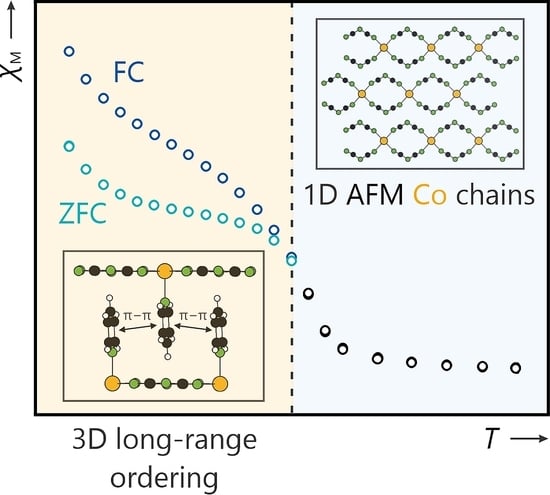
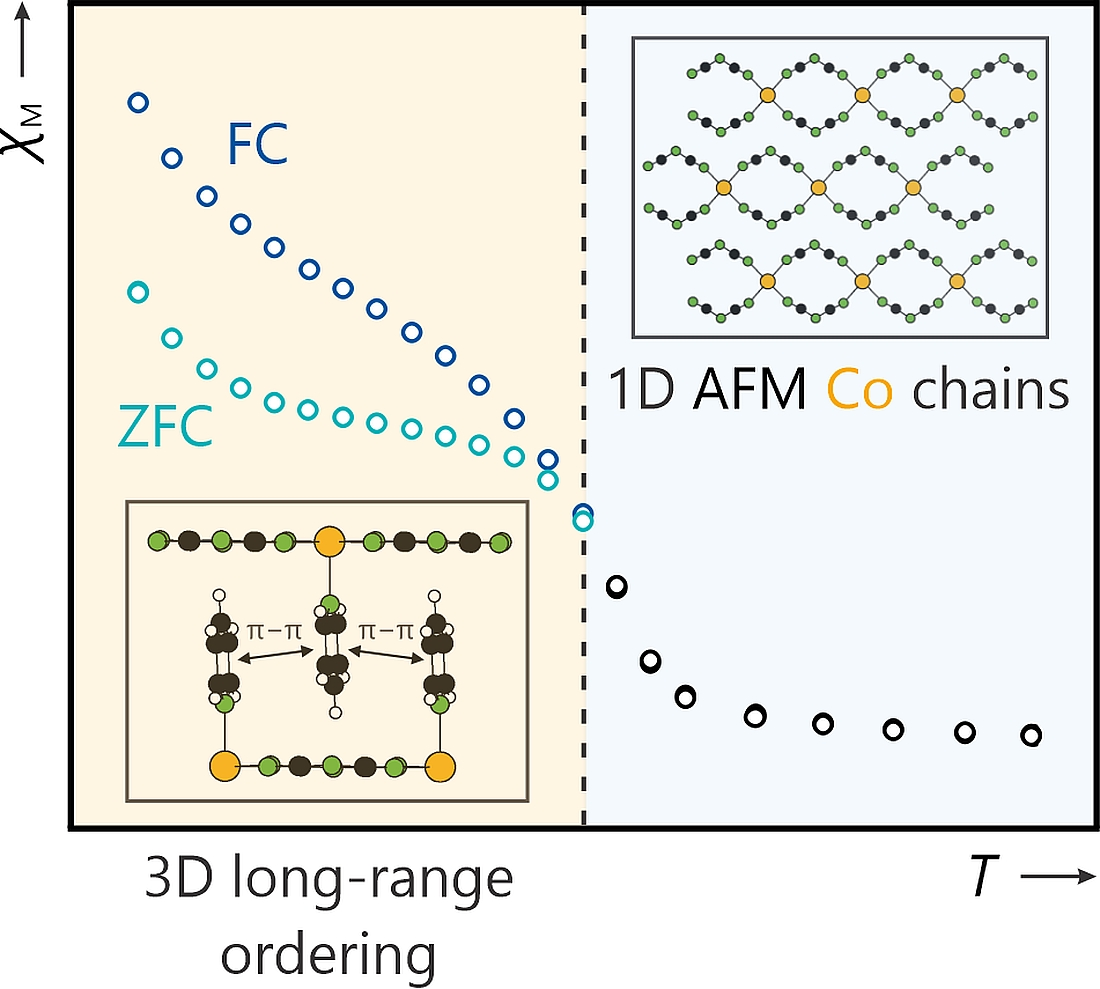
Graphical Abstract

1. Introduction

Already in 1964, the existence of transition-metal dicyanamide complexes with pyridine (py, C5H5N) as a neutral ligand given the general composition M(N(CN)2)2(C5H5N)2 was first described by Köhler for M = Mn, Fe, Co, Ni, Cu and Zn [1]. He precipitated the product by adding pyridine to an aqueous solution containing the corresponding metal salt and sodium dicyanamide as precursors. Based on elemental analyses, infrared spectroscopy, and rudimentary magnetic measurements, Köhler then proposed the formation of one-dimensional (1D) polymer-like structures with μ1,5-bridging dicyanamide anions (dca, N(CN)2). Unfortunately, no specific details regarding the crystal structures could be provided at that time [1].
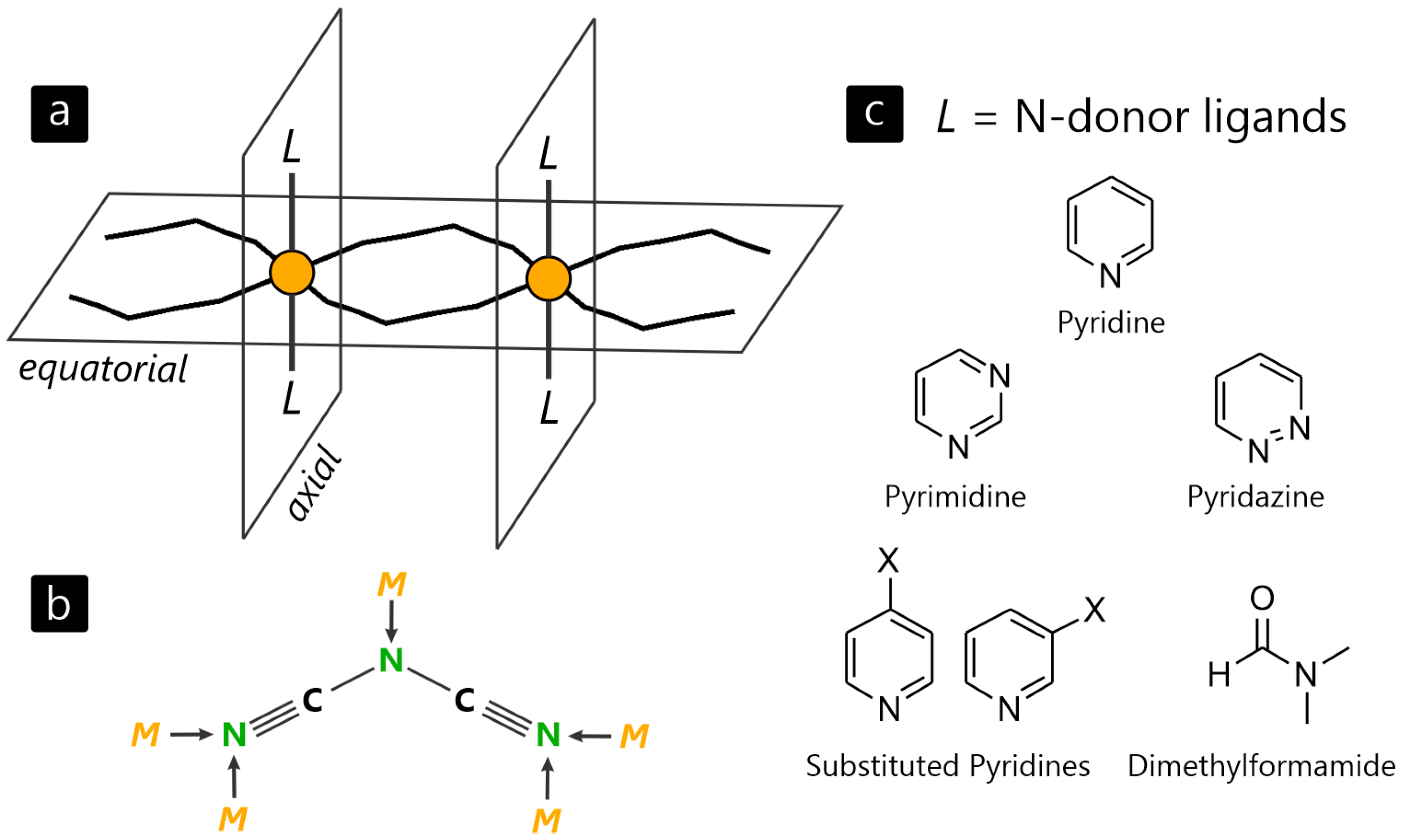
The first complete crystal-structure determination within this family was reported nearly simultaneously by two groups in 1999 using single-crystal X-ray diffraction of the manganese phase [2,3]. Accordingly, Mn(dca)2(py)2 crystallizes in the monoclinic space group P21/n (No. 14) and consists of linear 1D chains of Mn2+ cations bridged by pairs of dca ligands in the equatorial plane. The octahedral coordination sphere is completed by two pyridine ligands in the axial positions [2,3]. Thereby, Köhler’s pioneering work of proposing a chain-like structure was eventually confirmed. More than two decades later, the iron analogue was also structurally characterized [4]. In contrast to the manganese compound, Fe(dca)2(py)2 adopts a body-centered monoclinic structure in space group I2/m (No. 12), while retaining the characteristic 1D chain motif [4]. Beyond 3d transition metals, only one related compound incorporating a 4d metal has been reported to date, namely the cadmium analogue Cd(dca)2(py)2, which also adopts the 1D structure in the monoclinic space group C2/m (No. 12) [5]. Thus, all characterized compounds share the structural motif of 1D chains of metal cations, as depicted schematically in Figure 1a.
Building on these studies, the chemistry of transition-metal complexes incorporating the dicyanamide as a bridging ligand has attracted considerable attention in recent decades. This interest is largely driven by the ability of dca units to generate intriguing topological architectures and to mediate magnetic interactions between metal atoms [6,7,8,9,10,11,12]. Today, the boomerang-shaped dicyanamide anion is recognized as a highly versatile linker for both 3d and 4d metal cations. Its structural flexibility, arising from multiple coordination modes (Figure 1b), enables the formation of a wide variety of coordination polymers (CPs) ranging from 1D chains to 2D and 3D networks, depending on the metal center and the corresponding N-donor ligand. Such CPs have been extensively investigated for a wide range of metal atoms, with particular focus on iron(II), nickel(II), and copper(II) dicyanamide complexes [7]. For compounds of the type M(dca)2L2, the resulting dimensionality of the metal arrangement is significantly influenced by the N-donor ligand, typically substituted pyridines, ammonia, dimethylformamide, imidazole derivatives, and phenanthroline [12,13,14] (Figure 1c). Such CPs are considered promising candidates for applications, e.g., in catalysis [15,16], batteries [17,18,19], propellants [20,21], pharmacology [22,23,24], and magnetism [14].
The majority of dca-bridged metal(II) complexes exhibit weak antiferromagnetic coupling [3,9,11,12,25,26,27,28] even though there are fewer common examples, displaying strong antiferromagnetic [29] or even weak ferromagnetic [8] interactions. Notably, Mn(dca)2(py)2 and Fe(dca)2(py)2 do not show long-range magnetic ordering but, instead, exhibit only weak antiferromagnetic interactions [2,4]. Considering related systems, magnetic interactions in such compounds are almost exclusively antiferromagnetic. Furthermore, the particular combination of significant single-ion anisotropy, i.e., Co2+ ions in octahedral environments, and dominating intrachain magnetic coupling has led to the observation of single-chain magnet (SCM) behavior in 1D cobalt systems. Spins within SCMs are aligned along a chain that exhibits either ferro- or antiferromagnetic intrachain interactions [14]. These materials are of particular interest because they provide systems for investigating the relationship between crystal structure, magnetic exchange pathways, anisotropy, and slow magnetic relaxation in low-dimensional structures.
In this work, we ultimately resolve the missing crystal structure of Co(dca)2(py)2 that has remained elusive for over six decades. We report the synthesis and characterization of this material and focus on its magnetic behavior. Direct current (DC) magnetic measurements show that Co(dca)2(py)2 exhibits ferromagnetic interactions, which are strongly dominated by intrachain interactions, revealing behavior as a 1D system. Strikingly, the compound shows long-range ferromagnetic ordering below TC = 8.1 K, which is generally uncommon in dca-based systems. Besides a few binary 3d transition-metal dicyanamides [30], this behavior is rarely observed in CPs unless different bridging ligands are present, as reported for Co(NCS)2(py)2 and Co(NCSe)2(py)2 [31,32]. To the best of our knowledge, Co(dca)2(py)2 represents the first member within the M(dca)2(py)2 family showing long-range ordering. In addition, alternating current (AC) measurements revealed slow magnetic relaxation behavior, characteristic of single-chain magnets, with a relaxation time in the order of microseconds.

2. Results and Discussion

2.1. Preparation

Single crystals of Co(dca)2(py)2 were obtained from methanolic solutions containing CoCl2 ∙ 6 H2O, sodium dicyanamide, and pyridine in a 1:2:2 molar ratio via slow evaporation according to Equation (1). The resulting crystals are air-stable and appear in prismatic shape. Higher concentrations of reactants result in instantaneous precipitation of powderous Co(dca)2(py)2 from methanolic solutions while pyridine is added. More details of the procedure can be found in the experimental section.
CoCl2 + 2 Na(N(CN)2) + 2 C5H5N → Co(N(CN)2)2(C5H5N)2 + 2 NaCl

2.2. Crystal Structure

Co(dca)2(py)2 crystallizes in the monoclinic space group I2/m (No. 12) with lattice parameters a = 7.3829(5) Å, b = 13.2221(7) Å, c = 8.4934(6) Å and β = 114.766(9)°. Crystallographic details are summarized in Table 1. Selected bond lengths and angles are summarized in Table 2. Atomic coordinates and anisotropic displacement parameters for Co(dca)2(py)2 are listed in Table 3.
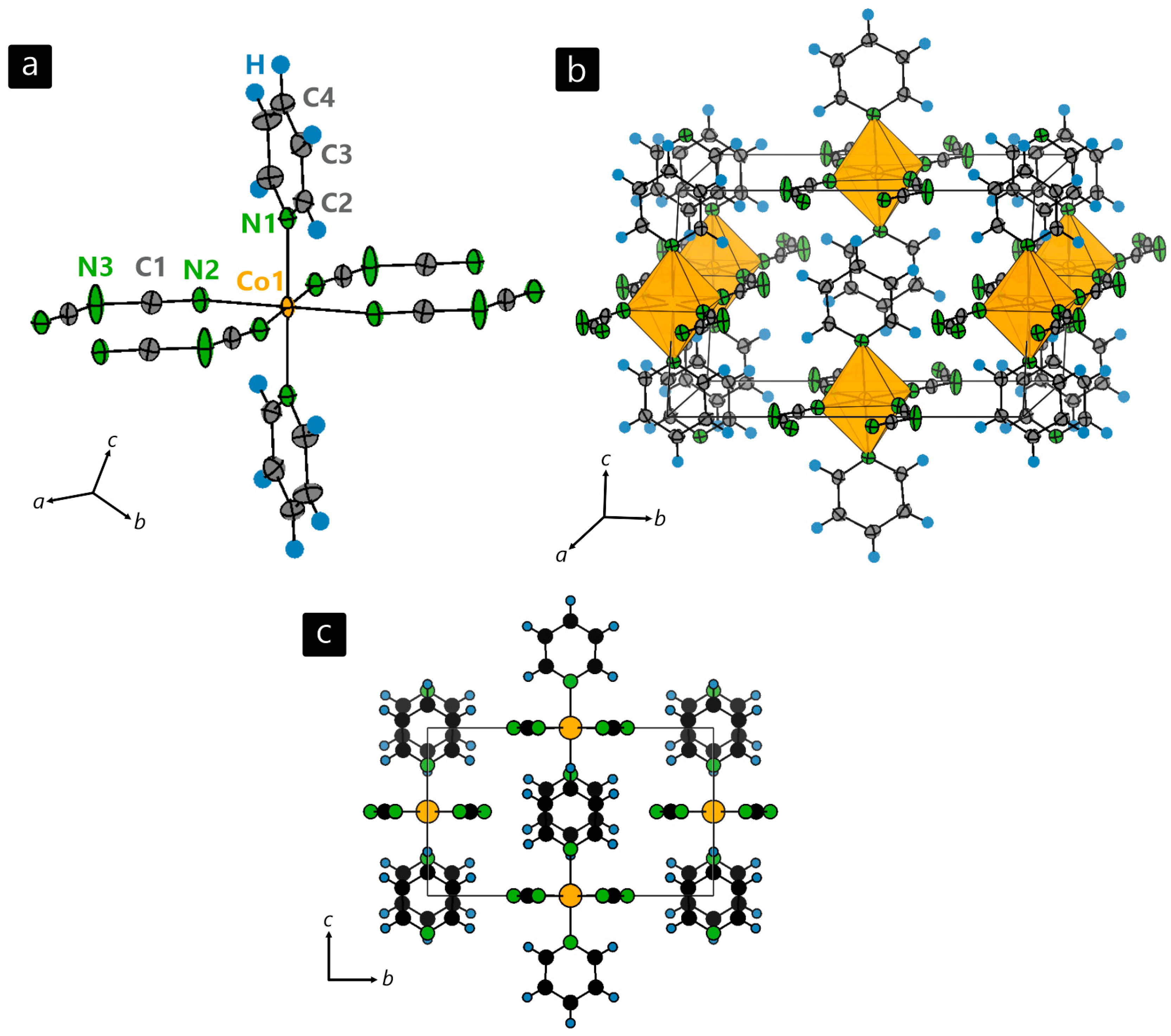
In the crystal structure, each Co2+ cation is coordinated by four dca units in the equatorial plane and two pyridine ligands occupying axial positions, as shown in Figure 2a. The resulting CoN6 polyhedron, highlighted in Figure 2b, is close to an ideal octahedral coordination environment, with equatorial Co−N bond lengths of 2.130(6) Å and slightly elongated axial Co−N distances of 2.145(6) Å. The μ1,5-bridging mode of the dca ligands links adjacent cobalt atoms into 1D polymeric chains that propagate parallel to the crystallographic a-axis (Figure 2c). Considering this 1D motif, there are four chains crossing through the unit cell.
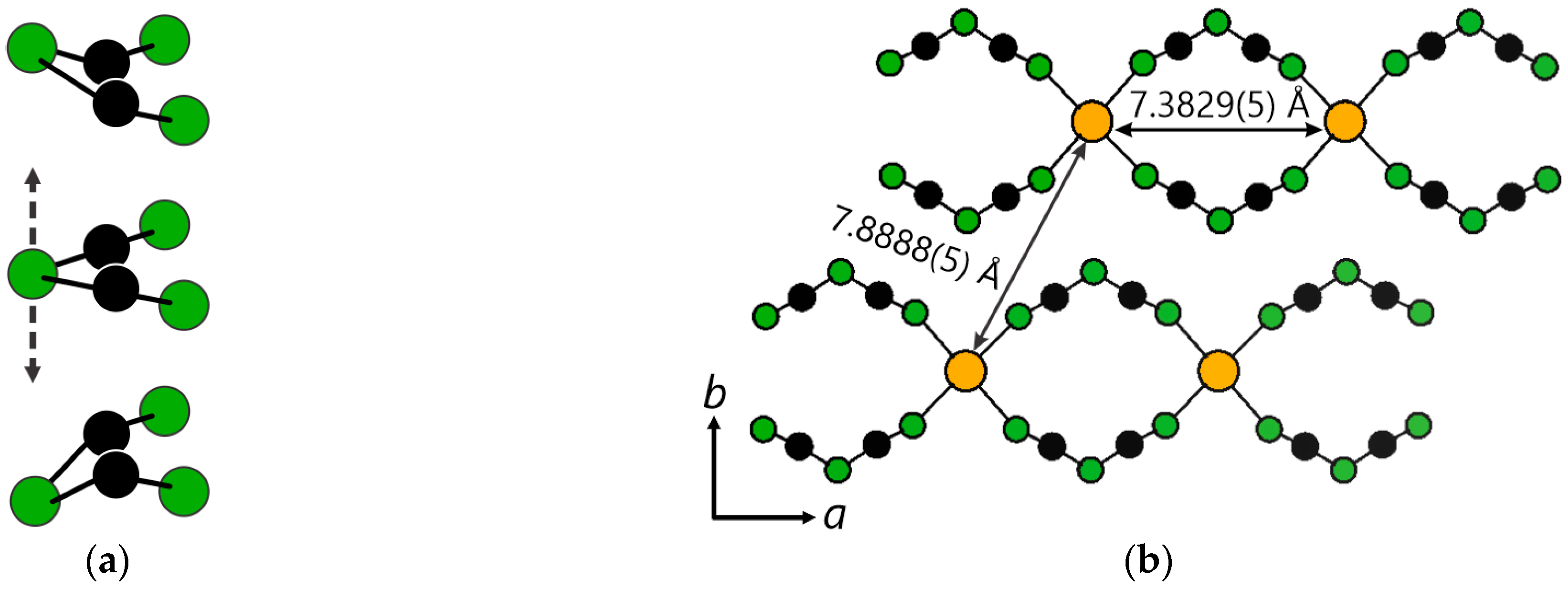
The crystal structure of Co(dca)2(py)2 exhibits an elongated anisotropic displacement ellipsoid at the central nitrogen atom (N3) of the dca unit. This is attributed to the restricted out-of-plane distortion in the end-to-end bridging mode of the dca ligand, which leads to enhanced flexibility at the N3 site, resulting in a broader distribution of the electron density (Figure 3a). Such behavior is often described as “wagging” and commonly observed in dca-bridged CPs. Due to the propagation of the chains parallel to the crystallographic a-axis, the intrachain distance between two cobalt atoms corresponds to the lattice parameter a, i.e., dintra ≈ 7.38 Å, while the nearest interchain distances for two cobalt atoms are dinter ≈ 7.89, 8.49 and 8.61 Å (Figure 3b).

2.3. Infrared Spectroscopy

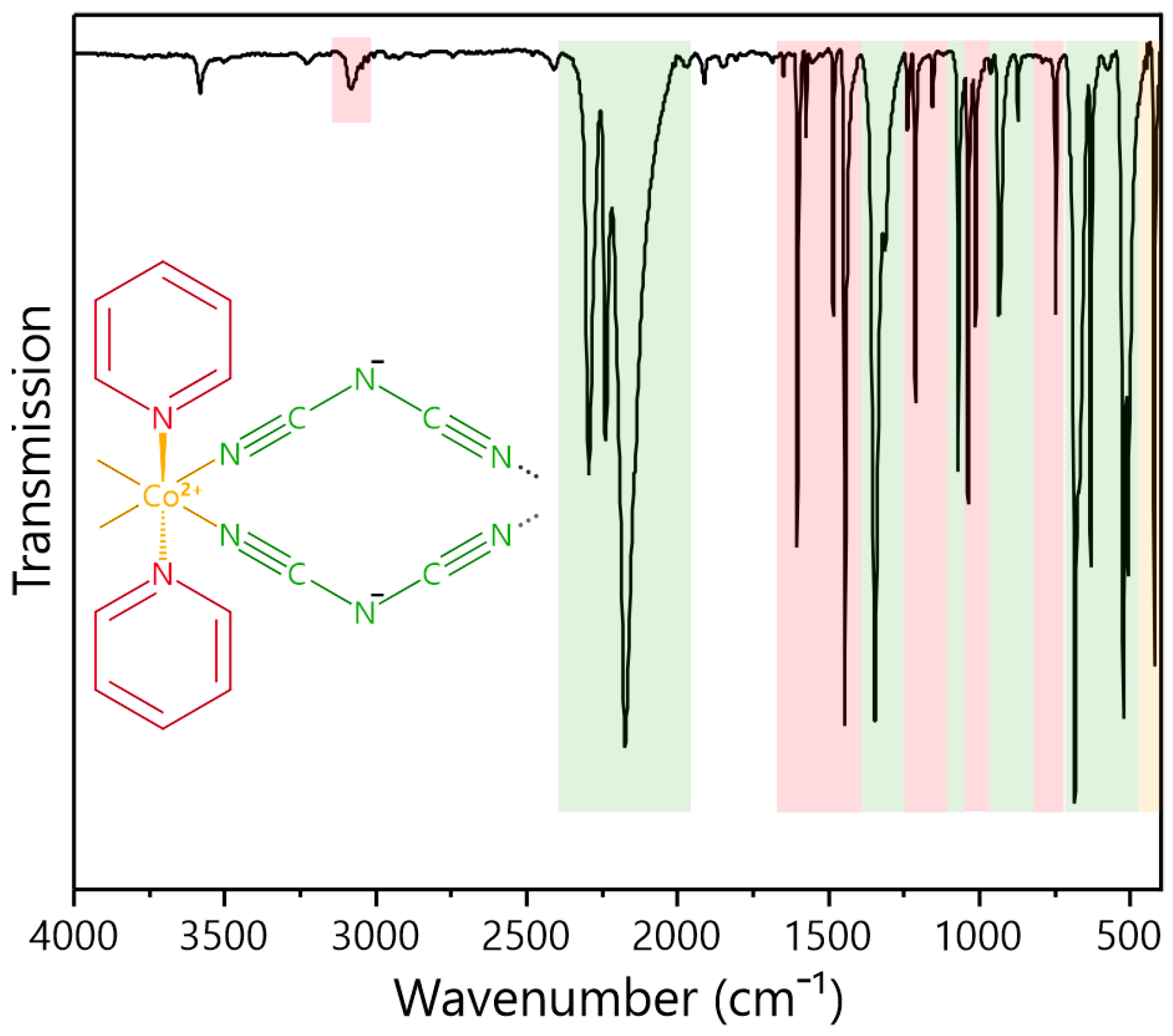
The presence of the dca unit and pyridine was confirmed by their vibrational bands in the IR spectrum, as depicted in Figure 4. The characteristic vibrations for dca are in line with those that have been reported for related compounds, i.e., Fe(dca)2(py)2 [4] and Co(dca)2(NH3)2 [33]. The remaining bands were assigned to the pyridine ligand and metal−N vibrations at small wavenumbers. The detailed assignment is listed in Table S1.

2.4. Optical Properties

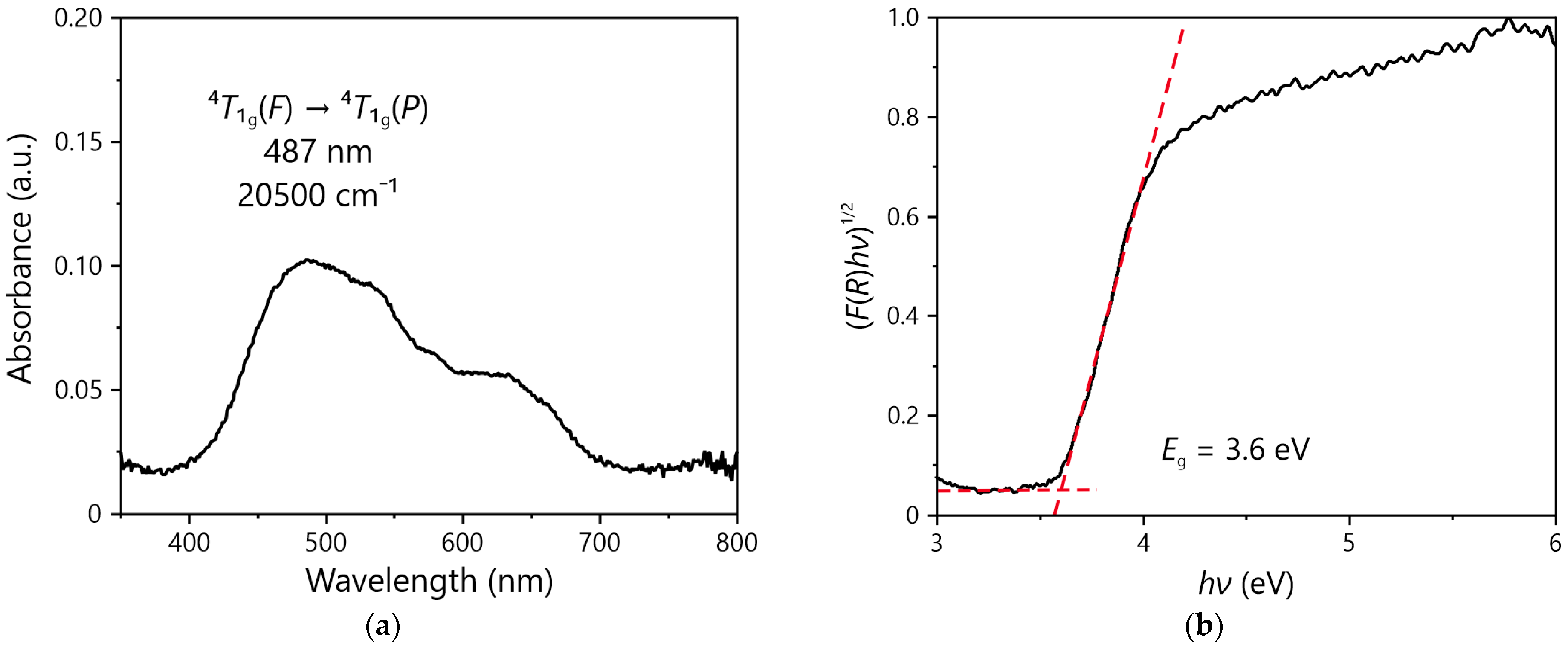
For the investigation of the optical properties of Co(dca)2 (py)2, UV/Vis spectroscopy of a powdery sample was performed (Figure 5a). The broad absorption centered near 500 nm is assigned to the spin-allowed 4T1g(F)  4T1g(P) d−d transition of octahedral Co2+ (d7, high-spin). The lower energy band at ≈ 625 nm is attributed to the spin-allowed 4T1g(F) → 4A2g(F) d−d transition.
The Tauc method was used to estimate the optical band gap, assuming an indirect electronic transition in combination with the Kubelka–Munk approximation [34]. The (F(R))1/2 versus plot (Figure 5b) exhibits a well-defined linear region, whose extrapolation to the energy axis yields a band gap energy (Eg) of 3.6 eV. This relatively large value is consistent with insulating behavior and is in line with determined values for other dca-based CPs [35,36].

2.5. Thermal Behavior

The thermal stability of Co(dca)2(py)2 was examined by thermogravimetric analysis (TGA) under a N2 atmosphere. As shown in Figure S1, the thermogravimetric curve shows that the decomposition takes place in two steps. The first one (−41.5 wt.-% at 200 °C) corresponds to the elimination of the two pyridine units leading to the formation of Co(dca)2. Subsequently, the decomposition of this binary dca-compound starts at ≈ 550 °C, leaving products like cobalt and cobalt oxides behind, with a relative mass of 24.0 wt.-%.

2.6. Magnetic Properties

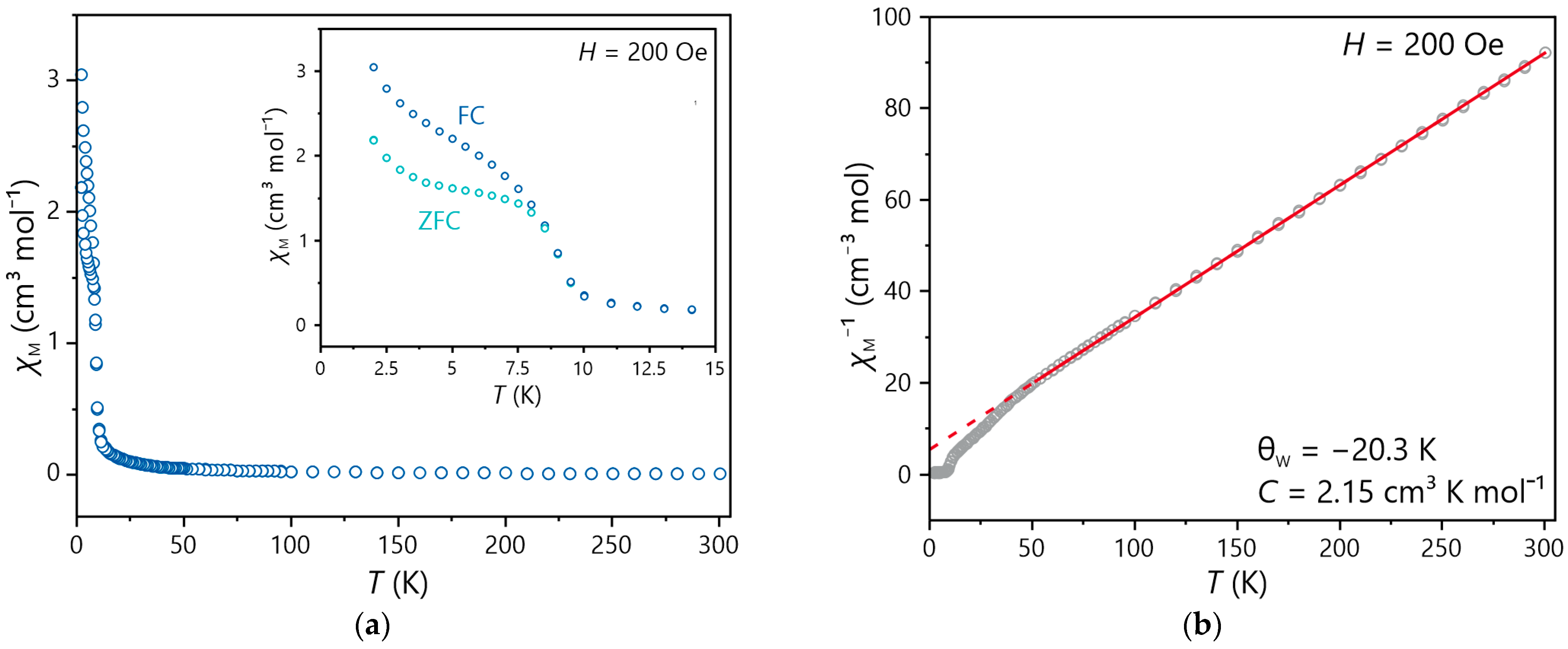
The magnetic behavior of Co(dca)2(py)2 was studied using a superconducting quantum interference device (SQUID) magnetometer. Magnetization was measured under zero-field-cooled (ZFC) and field-cooled (FC) conditions in the temperature range of 4–300 K. DC measurements at H = 200 Oe reveal that the molar susceptibility increases upon cooling in the low-temperature region and exhibits a clear divergence between the FC and ZFC curves below T = 8.1 K, as depicted in Figure 6a. This behavior points towards the onset of long-range magnetic ordering, which may indicate either a ferro- or ferrimagnetic ground state. Due to the presence of only one type of magnetic ion in the structure, ferrimagnetism can be excluded here, leaving ferromagnetism as the only option for Co(dca)2(py)2. A Curie–Weiss fit of the inverse susceptibility in the temperature range 50–300 K (Figure 6b) yields a negative Weiss constant of θW = −20.3 K. It is well established, however, that for octahedrally coordinated Co2+ complexes the negative Weiss constant is overestimated due to zero-field splitting, resulting in the θW not being directly associated with antiferromagnetic interactions. This issue was also observed in the related Co(NCS)2(py)2 [31]. The calculated effective moment of 4.15 μB is in the range of the spin-only value (3.87 μB) for a high-spin Co2+ cation (S = 3/2, g = 2.0) [37].
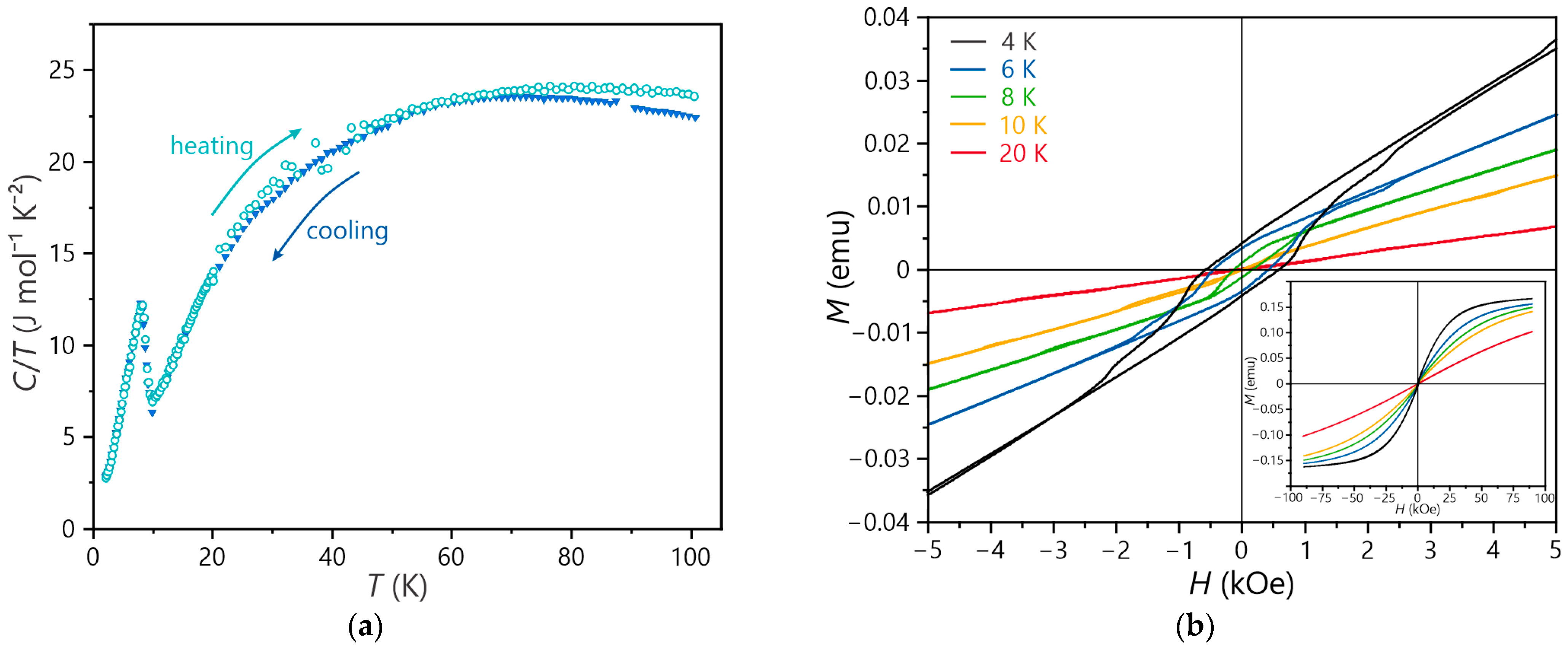
Spin-canted antiferromagnetism can be discarded in this particular system because FC and ZFC curves display almost the same ferromagnetic behavior. In order to confirm the transition to a ferromagnetic state, the specific heat capacity was measured. The curve C/T vs. T clearly reveals a peak at T = 8.2 K (Figure 7a), in line with the divergence of the FC and ZFC susceptibilities observed in the DC measurement, therefore confirming the transition into a magnetically ordered state. Furthermore, the correspondence between cooling and heating curves indicates that this magnetic transition is reversible, while the absence of further anomalies suggests phase purity. Moreover, field-dependent magnetization measurements, depicted in Figure 7b, reveal different hysteretic behavior as a function of temperature. While at temperatures above TC = 8.1 K, no hysteresis is detected; below this point, coercive fields of 795 Oe at 4 K and 575 Oe at 6 K are observed, consistent with a ferromagnetic state.
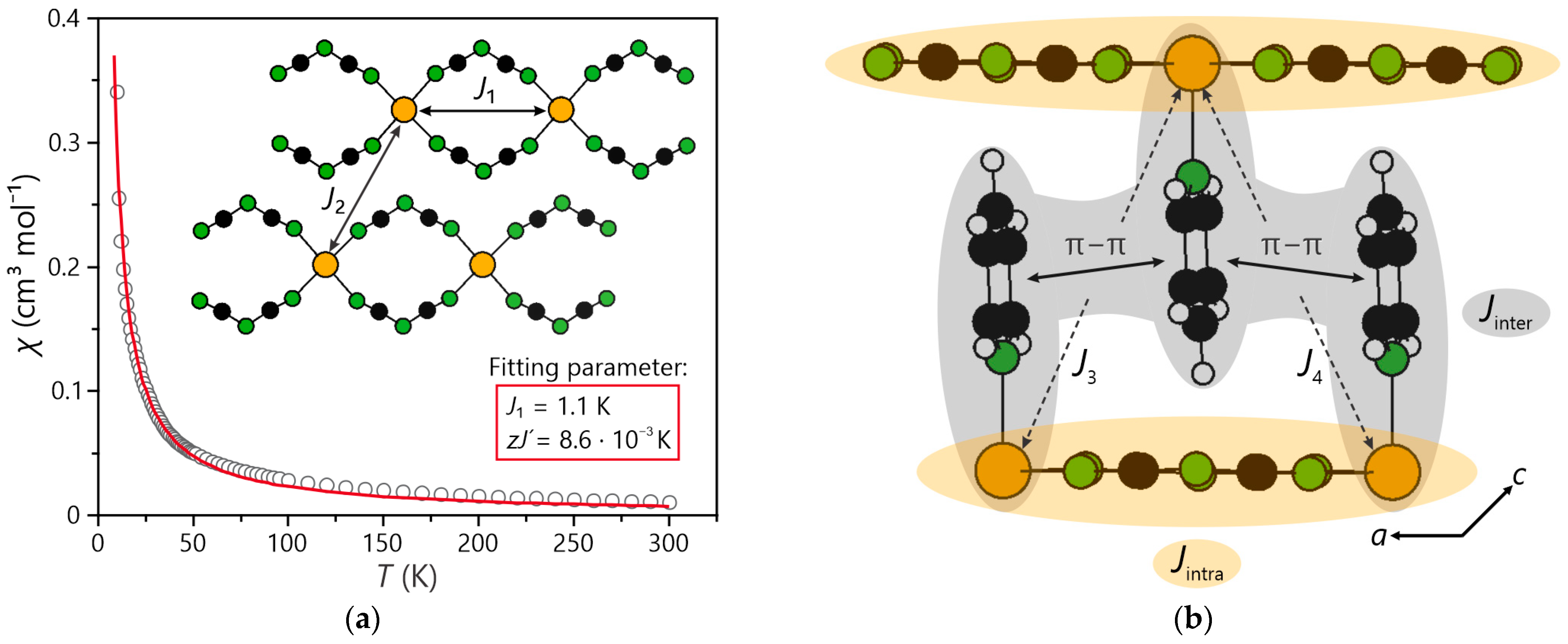
Since Co(dca)2(py)2 is characterized as a linear CP, it is reasonable to model the interactions as a 1D system. For that purpose and to investigate the nature of the magnetic interactions, the susceptibility data (Figure 8a) were fitted in the temperature range of T = 10–300 K with a simple 1D chain model derived from Fisher equations using the mean-field approximation [38], given in Equations (2)–(4).
χ t o t a l = χ c h a i n 1 2 z J N A g 2 μ B 2   ·   χ c h a i n
χ c h a i n = N A g 2 μ B 2 3 k T   ·   1 + u 1 u   · S S + 1
u = coth J 1 ·   S S + 1 k T k T J 1 · S S + 1
Here, χtotal is the susceptibility of the system with weakly interacting chains, and χchain is the susceptibility of the isolated chains. J1 is a measure of the intrachain interactions, while zJ′ sums up the interchain interactions (zJ′ = J2 + J3 + J4 + …), as shown in Figure 8a,b. The obtained fitting parameters J1 and zJ′ are positive, indicating ferromagnetic interactions, almost exclusively intrachain, i.e., within the same chain, because the contribution from the intrachain interactions J1 is several orders of magnitude higher than the one of zJ′ (J1/zJ′ = 1.1 K/8.6 × 10−3 K ≈ 128). This is particularly interesting because, despite the similar distances (dintradinter) between the Co2+ cations, the magnetic communication is dominated almost exclusively by the intrachain interactions. The explanation for that arises from the ability of the dca ligands to mediate ferromagnetic coupling. The only interactions available for zJ′ are the weak dipole interactions between Co2+ ions from different chains, which are reflected in their negligible influence on the ferromagnetic interactions. Furthermore, the significant contribution of intrachain interactions, in combination with weak π−π interactions resulting from the interlocked pyridine rings (Figure 8b), also suggests a stabilizing effect on the long-range ordering at low temperatures.
Magnetic ordering is a rare phenomenon in low-dimensional dca-based CPs, and considering only related 1D Co(II) compounds, ordering has been observed so far solely in combination with shorter bridging ligands, i.e., thiocyanate (NCS) [31] and isoselenocyanate (NCSe) [32], incorporating also the neutral ligand pyridine. Table 4 gives an overview of the magnetic behavior compared to other CP materials that are related to Co(dca)2(py)2.
The magnetic behavior of Co(dca)2(py)2 differs significantly from that of the related Mn(II) and Fe(II) analogues or other related 1D Co(II) compounds with substituted-pyridine ligands, highlighting the decisive role of magnetic anisotropy in this 1D system. In general, Co(II) systems are more likely to exhibit magnetic ordering, compared to their Mn(II) or Fe(II) analogues, due to the strong anisotropy of the Co2+ cation, primarily arising from strong spin–orbit coupling and unquenched orbital angular momentum. A manganese system with weak exchange can remain dynamically disordered because isotropic spins fluctuate strongly. In contrast, a Co(II) system can lock in the long-range order because anisotropy stabilizes the ordered state even when J is small. An example for that is the rutile-type α-Co(dca)2, which is known for its long-range ferromagnetic order, unlike several related binary systems like Mn(dca)2, Fe(dca)2, or Ni(dca)2, which exhibit, at most, antiferromagnetic order in the case of manganese [12].
In addition, high-spin octahedral Co(II) is very sensitive to the local structure, where even small changes can significantly modify the magnetic anisotropy. In Co(dca)2(py)2, the plain pyridine system may exhibit a favorable Ising-like anisotropy that stabilizes long-range order, whereas substituted pyridine ligands or pyridine derivatives increase chain separations, alter the packing, or introduce disorder to the structure, which disrupts the exchange pathways in low-dimensional systems. As a consequence, introducing changes compared to plain pyridine is pushing the system back into disorder. Another structure-sensitive aspect relates to the exchange pathways through the dca anion, because the magnetic exchange is strongly dependent on the structure of the bridging ligand, including bond lengths, (torsion) angles, and coordination modes.
The absence of comparable ordering phenomena in related compounds (Table 4) suggests that the ordered state is highly sensitive to subtle structural and electronic changes. Substitution at the pyridine ligand likely modifies the local coordination environment of Co(II), the ligand-field symmetry, and the weak interchain exchange pathways, thereby disturbing the sensitive balance between intrachain exchange and magnetic anisotropy required to stabilize long-range magnetic order in these low-dimensional systems.
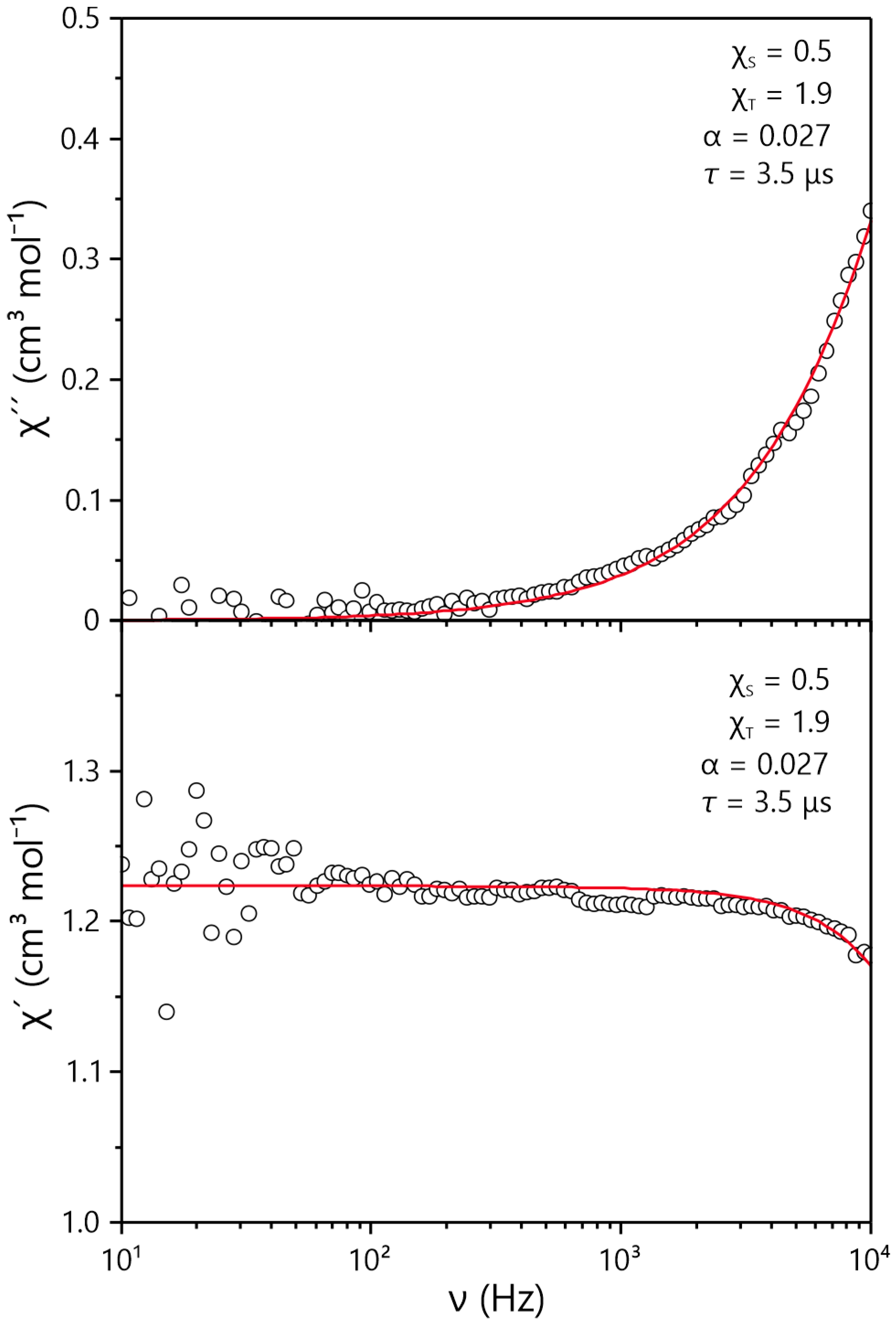
To investigate the dynamics of the magnetic interactions, AC magnetic susceptibility measurements were performed in a zero DC field and an AC field of 5 Oe. In the measured frequency range from 10 to 104 Hz, the resulting out-of-phase susceptibility (χ″) shows a strong dependence on the frequency (Figure 9), which is the signature of slow magnetic relaxation. The absence of the maximum in the χ″ vs. ν plot within the measurement range, however, prevents good approximations of the relaxation times at different temperatures. To evaluate this relaxation behavior, the AC susceptibility data were fitted using the generalized Debye model [45,46,47] with isothermal (χT) and adiabatic (χS) susceptibilities (see Supporting Information for more details). The phenomenological distribution parameter α describes the distribution of relaxation times (τ), with α = 1 marking a wide distribution of τ and α = 0 indicating an infinitely slim distribution of τ.
The relaxation is observed above and below TC = 8.1 K, and the obtained distribution parameter is close to zero (α = 0.027), indicating a single relaxation process with a narrow distribution of relaxation times. The absence of a significant distribution of relaxation times suggests a rather homogeneous relaxation pathway within the 1D chains, without evidence for multiple competing processes. The characteristic magnetic relaxation time at T = 10 K was determined to be in the order of microseconds (τ = 3.5 µs), reflecting relatively fast relaxation compared to typical single-chain magnets, but still significantly slower than typical paramagnetic spin–lattice relaxation. A similar value can be estimated by the ratio of the out-of-phase to the in-phase susceptibility (τ = (1/2πf) (χ″/χ′)) [48], resulting in a relaxation time of τ = 4.6 µs at T = 10 K, which is in line with the time obtained from the fitting to the Debye model. The observed behavior is consistent with thermally assisted spin dynamics governed by the anisotropy of the Co2+ ions and finite intrachain exchange interactions, as mentioned before. Furthermore, the corresponding Cole−Cole plots for the measurements at 2 and 10 K (Figure S2) show the semicircles, characteristic for a process with a single relaxation time. Figure S3 is an alternative to Figure 9 for a larger (at least thinkable) frequency range, up to 108 Hz, even though data are lacking.
Overall, the AC susceptibility results confirm the presence of slow magnetic relaxation in Co(dca)2(py)2, as a consequence of its low-dimensional chain structure of dca ligands and anisotropic Co2+ cations. The relatively short relaxation time, however, indicates that the system does not fulfill the criteria of an ideal single-chain magnet, but rather represents a low-dimensional magnetic system exhibiting a well-defined but fast single process.

3. Conclusions

In summary, Co(dca)2(py)2, whose crystal structure has remained unsolved for over 60 years, was successfully synthesized and structurally characterized as a 1D dca-bridged Co2+ with an almost ideal octahedral coordination environment. The compound exhibits good thermal stability below 200 °C and an optical band gap of 3.6 eV, consistent with insulating behavior typical for dca-based systems. Magnetic studies reveal dominant ferromagnetic intrachain interactions together with a transition into a magnetically ordered state below TC = 8.1 K, accompanied by weak ferromagnetic hysteresis. In addition, Co(dca)2(py)2 exhibits slow magnetic relaxation behavior with a single process and a relaxation time of 3.5 µs. The results highlight the important role of magnetic anisotropy and the dca-mediated exchange pathways in stabilizing long-range order in this low-dimensional Co2+ system. Overall, Co(dca)2(py)2 represents a rare example of a 1D dca-based CP combining slow relaxation behavior and magnetic ordering, whereas the Mn and Fe analogues remain magnetically disordered.

4. Experimental Section

4.1. Synthesis of Co(dca)2(py)2

Co(dca)2(py)2 was synthesized by dissolving stoichiometric amounts of CoCl2 ∙ 6 H2O (594.9 mg, 2.5 mmol) and Na(N(CN)2) (445.2 mg, 5.0 mmol, 2 eq.) in methanol (100 mL). Upon stirring, pyridine (0.4 mL, 5.0 mmol, 2 eq.) was added dropwise. The resulting pink precipitate was filtered off, washed with methanol, and dried at T = 100 °C. The product was obtained as a pink microcrystalline powder. Elemental analysis calculated for C14CoH10N8 (349.22 g mol−1): 48.15% C, 2.89% H, 32.09% N. Found: 47.45% C, 2.69% H, 32.51% N. Crystals suitable for single-crystal X-ray diffraction were obtained by slow solvent evaporation under dilute conditions (CoCl2 ∙ 6 H2O (50.0 mg, 0.21 mmol), Na(N(CN)2) (37.4 mg, 0.42 mmol, 2 eq.) and pyridine (0.034 mL, 0.42 mmol, 2 eq.) in methanol (100 mL) while stored in a refrigerator (T = 4 °C) for 4 weeks.

4.2. Single-Crystal X-Ray Diffraction Analysis

Diffraction data for Co(dca)2(py)2 were collected at 150 K using a Rigaku (Akishima-shi, Tokyo, Japan) XtaLAB Synergy-R diffractometer (Mo-Kα, λ = 0.71073 Å) equipped with a Rigaku Hypix-Arc 100° detector. Observed diffraction spots were processed and reduced using the CrysAlis Pro [49] software (version 1.171.44.100a). Initial structure determination was performed with SHELXT [50] and refined using SHELXL [51] within the Olex2-1.3 suite [52], allowing for anisotropic displacement parameters for all non-hydrogen atoms. The coordinates for the H atoms were refined as riding on the aromatic C atoms, the H atom’s isotropic displacement parameter being 20% larger than the bonded C atom’s Ueq. Crystallographic data for Co(dca)2(py)2 can be obtained free of charge from the Cambridge Crystallographic Data Centre under the deposition number 2557219.

4.3. Infrared Measurements

The infrared spectrum was measured on a Shimadzu (Nakagyo-ku, Kyoto, Japan) IRSpirit FT-IR spectrometer in the range 400–4000 cm−1.

4.4. Optical Measurements

The UV/Vis spectrum of Co(dca)2(py)2 in the solid state was recorded on a Shimadzu UV-2006 spectrophotometer. BaSO4 was used as a white reflectance standard. The Kubelka–Munk function F(R) = (1 − R)2/2R was used to determine the band gap size [34].

4.5. Magnetic Measurements

Magnetic measurements of a powdery sample of Co(dca)2(py)2 were performed on a Quantum Design (San Diego, CA, USA) SQUID MPMS-XL magnetometer in the temperature range 4–300 K in a field of 200 Oe. The magnetic data were corrected with a diamagnetic correction of –1.746 · 10−4 cm3 mol−1. AC magnetic susceptibility measurements were performed on a Quantum Design PPMS-DynaCool system in the vibrating sample magnetometry option with an oscillating field of 5 Oe in the frequency range of 10 Hz to 10 kHz at zero-DC field.

4.6. Heat Capacity Measurement

Heat capacity data were collected on a powdery sample of Co(dca)2(py)2. The measurement was performed in a Quantum Design PPMS-DynaCool system using the heat capacity option in the temperature range 2–100 K under zero applied magnetic field.

4.7. Thermogravimetric Analysis

Thermogravimetric analysis was performed on a Netzsch (Selb, Germany) STA 409 C/CD instrument in an inert atmosphere from 25 to 800 °C with a heating rate of 5 °C min−1.

4.8. Chemicals and Reagents

The following chemicals were used without further purification: CoCl2 ∙ 6 H2O (Riedel-de Haën, Seelze, Germany; 99%), Na(N(CN)2) (Sigma-Aldrich, Schnelldorf, Germany; 96%), pyridine (Sigma-Aldrich, 99.8%), methanol (Fisher Chemical, Dreieich, Germany; 99.9%).

Supplementary Materials

The following supporting information can be downloaded at: https://www.mdpi.com/article/10.3390/inorganics14070181/s1, Figure S1: Thermogravimetric curve of Co(dca)2(py)2. Table S1: IR data with assigned vibrations for Co(dca)2(py)2. Figure S2: Cole−Cole plots obtained for temperatures above (10 K) and below the magnetic transition (2 K) for frequencies from 10 to 104 Hz. Empty circles display the experimental data and solid lines represent the best fitting with Eq. 1 and 2, given the admittedly rather limited experimental data. Figure S3: Frequency dependence of the in-phase (χ′) and out-of-phase (χ″) magnetic susceptibility in zero DC field and AC field of 5 Oe at T = 10 K. Experimental data are given as empty circles, while solid lines show the approximations of the data to the generalized Debye model up to 108 Hz.

Author Contributions

Conceptualization, M.K. and J.M.-J.; methodology, M.K. and J.M.-J.; validation, M.K., J.M.-J. and R.D.; investigation, M.K. and J.M.-J.; resources, R.D.; data curation, M.K.; writing—original draft preparation, M.K.; writing—review and editing, M.K., J.M.-J. and R.D.; visualization, M.K.; supervision, R.D.; project administration, R.D.; funding acquisition, R.D. All authors have read and agreed to the published version of the manuscript.

Funding

This research received no external funding.

Data Availability Statement

Crystallographic data for Co(dca)2(py)2 can be obtained free of charge from the Cambridge Crystallographic Data Centre under the deposition number 2557219.

Acknowledgments

The authors thank Tobias Storp and Daniel Brüx for their assistance with SC-XRD measurements, Christina Houben for performing the SQUID measurement, and Niklas Lothmann for the TGA measurement. J. Medina-Jurado is grateful for the financial support from Deutscher Akademischer Austauschdienst (DAAD).

Conflicts of Interest

The authors declare no conflicts of interest.

Abbreviations

The following abbreviations are used in this manuscript:
1DOne-dimensional
2DTwo-dimensional
3DThree-dimensional
ACAlternating current
CPCoordination polymer
DCDirect current
DCADicyanamide, N(CN)2
IRInfrared
FCField-cooled
PYPyridine, C5H5N
SCMSingle-chain magnet
SC-XRDSingle-crystal X-ray diffraction
SQUIDSuperconducting quantum interference device
TGAThermogravimetric analysis
ZFCZero-field-cooled

References

  1. Köhler, H. Beiträge zur Chemie des Dicyanamid- und des Tricyanmethanidions. I. Die Bildung von Übergangsmetall-Pyridin-Komplexen. Z. Anorg Allg. Chem. 1964, 331, 237–248. [Google Scholar] [CrossRef]
  2. Manson, J.L.; Arif, A.M.; Incarvito, C.D.; Liable-Sands, L.M.; Rheingold, A.L.; Miller, J.S. Structures and Magnetic Properties of Novel 1-D Coordination Polymers Containing Both Dicyanamide and Pyridine-Type Ligands. J. Solid State Chem. 1999, 145, 369–378. [Google Scholar] [CrossRef]
  3. Batten, S.R.; Jensen, P.; Kepert, C.J.; Kurmoo, M.; Moubaraki, B.; Murray, K.S.; Price, D.J. Syntheses, structures and magnetism of α-Mn(dca)2, [Mn(dca)2(H2O)2]·H2O, [Mn(dca)2(C2H5OH)2]·(CH3)2CO, [Fe(dca)2(CH3OH)2] and [Mn(dca)2(L)2], where L = pyridine, CH3OH or DMF and dca = dicyanamide, N(CN)2. J. Chem. Soc. Dalton Trans. 1999, 28, 2987–2997. [Google Scholar] [CrossRef]
  4. Henrich, L.; Müller, P.C.; Hempelmann, J.; Mann, M.; van Leusen, J.; Steinberg, S.; Dronskowski, R. Synthesis and Characterization of Iron Bispyridine Bisdicyanamide, Fe[C5H5N]2[N(CN)2]2. Molecules 2023, 28, 4886. [Google Scholar] [CrossRef] [PubMed]
  5. Luo, J.; Hong, M.; Weng, J.; Zhao, Y.; Cao, R. The complexes with end-to-end dicyanamide bridges: Syntheses, characterization and crystal structures of [Cu(μ1,5-dca)2(phen)]n and [Cd(μ1,5-dca)2(py)2]n (phen=phenanthroline; py=pyridine; dca=dicyanamide, N(CN)2). Inorg. Chim. Acta 2002, 329, 59–65. [Google Scholar] [CrossRef]
  6. Batten, S.R. Coordination polymers. Curr. Opin. Solid State Mat. Sci. 2001, 5, 107–114. [Google Scholar] [CrossRef]
  7. Merabet, L.; Vologzhanina, A.V.; Setifi, Z.; Kaboub, L.; Setifi, F. Topological motifs in dicyanamides of transition metals. CrystEngComm 2022, 24, 4740–4747. [Google Scholar] [CrossRef]
  8. Batten, S.R.; Robson, R.; Jensen, P.; Moubaraki, B.; Murray, K.S. Structure and molecular magnetism of the rutile-related compounds M(dca)2, M = CoII, NiII, CuII, dca = dicyanamide, N(CN)2. Chem. Commun. 1998, 34, 439–440. [Google Scholar] [CrossRef]
  9. Kurmoo, M.; Kepert, C.J. Hard magnets based on transition metal complexes with the dicyanamide anion, {N(CN)2}. New J. Chem. 1998, 22, 1515–1524. [Google Scholar] [CrossRef]
  10. Świtlicka, A.; Machura, B.; Bieńko, A.; Kozieł, S.; Bieńko, D.C.; Rajnák, C.; Boča, R.; Ozarowski, A.; Ozerov, M. Non-traditional thermal behavior of Co(II) coordination networks showing slow magnetic relaxation. Inorg. Chem. Front. 2021, 8, 4356–4366. [Google Scholar] [CrossRef]
  11. Mautner, F.A.; Jantscher, P.; Fischer, R.C.; Torvisco, A.; Vicente, R.; Karsili, T.N.V.; Massoud, S.S. Structure, DFT Calculations, and Magnetic Characterization of Coordination Polymers of Bridged Dicyanamido-Metal(II) Complexes. Magnetochemistry 2019, 5, 41. [Google Scholar] [CrossRef]
  12. Batten, S.R.; Murray, K.S. Structure and magnetism of coordination polymers containing dicyanamide and tricyanomethanide. Coord. Chem. Rev. 2003, 246, 103–130. [Google Scholar] [CrossRef]
  13. Palion-Gazda, J.; Świtlicka, A.; Choroba, K.; Malicka, E.; Machura, B.; Trzęsowska-Kruszyńska, A. Structural Diversity of Heteroleptic Cobalt(II) Dicyanamide Coordination Polymers with Substituted Pyrazines and Pyrimidines as Auxiliary Ligands. Molecules 2025, 30, 3856. [Google Scholar] [CrossRef] [PubMed]
  14. Świtlicka, A. Recent Insights into Magneto-Structural Properties of Co(II) Dicyanamide Coordination Compounds. Magnetochemistry 2024, 10, 90. [Google Scholar] [CrossRef]
  15. Nune, S.V.K.; Basaran, A.T.; Ülker, E.; Mishra, R.; Karadas, F. Metal Dicyanamides as Efficient and Robust Water-Oxidation Catalysts. ChemCatChem 2017, 9, 300–307. [Google Scholar]
  16. Huang, H.; Zhong, Y.; Li, H.; Ge, M.; Yuan, B.; Li, B.; Zhang, J.; Li, Z. Energetic Polymeric Complexes Based on 1-Methyl-5-Aminotetrazole and Dicyanamide for Catalysis on the Thermal Decomposition of Ammonium Perchlorate. Inorg. Chem. 2026, 65, 1477–1486. [Google Scholar] [CrossRef] [PubMed]
  17. Qiao, X.; Cai, G.; Müller, P.C.; Ye, F.; Xu, P.; Hu, Y.; Corkett, A.J.; Zhang, Z.; Li, W.; Sun, P.; et al. Cation-Tuned Reaction Mechanisms in Metal Dicyanamide Anodes for Lithium-Ion Batteries with High Reversible Capacity. ACS Nano 2026, 20, 7093–7104. [Google Scholar] [CrossRef] [PubMed]
  18. Song, B.; Luo, Z.; Liu, X.; Peng, Y.; Wang, J.; Jiang, F.; Cheng, X.-B.; Wu, Y.; He, J. Bridging Donor Ligands Enable an Ultrastable Graphite Anode for Sodium-Ion Batteries. Angew. Chem. Int. Ed. 2025, 64, e202503027. [Google Scholar]
  19. Qiao, X.; Corkett, A.J.; Müller, P.C.; Wu, X.; Zhang, L.; Wu, D.; Wang, Y.; Cai, G.; Wang, C.; Yin, Y.; et al. Zinc Dicyanamide: A Potential High-Capacity Negative Electrode for Li-Ion Batteries. ACS Appl. Mater. Interfaces 2024, 16, 43574–43581. [Google Scholar] [CrossRef] [PubMed]
  20. Xie, H.-H.; Wang, Q.; Weng, J.-L.; Yan, Y.-F.; Bian, H.-Y.; Huang, Y.; Zheng, F.-K.; Qiu, R.-H.; Xu, J.-G. Coordination polymerization of nitrogen-rich linkers and dicyanamide anions toward energetic coordination polymers with low sensitivities. Dalton Trans. 2023, 52, 818–824. [Google Scholar] [CrossRef] [PubMed]
  21. Xu, Y.; Wang, Y.; Zhong, Y.; Lei, G.; Li, Z.; Zhang, J.; Zhang, T. High-Energy Metal-Organic Frameworks with a Dicyanamide Linker for Hypergolic Fuels. Inorg. Chem. 2021, 60, 5100–5106. [Google Scholar] [PubMed]
  22. Yuoh, A.C.B.; Agwara, M.O.; Yufanyi, D.M.; Conde, M.A.; Jagan, R.; Oben Eyong, K. Synthesis, Crystal Structure, and Antimicrobial Properties of a Novel 1-D Cobalt Coordination Polymer with Dicyanamide and 2-Aminopyridine. Int. J. Inorg. Chem. 2015, 2015, 1–8. [Google Scholar] [CrossRef]
  23. Tabrizi, L.; Chiniforoshan, H.; Araújo, J.P.; Lopes, A.M.; Görls, H.; Plass, W.; Mohammadnezhad, G. New 3D dicyanamide bridged coordination polymer of Ni(II): Synthesis, crystal structure, magnetic properties and antibacterial assay. Inorg. Chim. Acta 2015, 426, 195–201. [Google Scholar] [CrossRef]
  24. Hopa, C.; Yavuz, A.B.; Diken, M.E.; Gungor, E. Cu(II) coordination polymers containing dicyanamide and 2,2′-bipyridine: Structural and antibacterial properties. J. Struct. Chem. 2023, 64, 1768–1779. [Google Scholar] [CrossRef]
  25. Kutasi, A.M.; Harris, A.R.; Batten, S.R.; Moubaraki, B.; Murray, K.S. Coordination Polymers of Dicyanamide and Methylpyrazine: Syntheses, Structures, and Magnetic Properties. Cryst. Growth Des. 2004, 4, 605–610. [Google Scholar] [CrossRef]
  26. Escuer, A.; Mautner, F.A.; Sanz, N.; Vicente, R. Syntheses, structures and magnetic properties of the dicyanamide (dca) polynuclear compounds [Mn(ac)(terpy)(μ1,5-dca)]n, [Mn(pdz)21,5-dca)2]n and [{Mn(dca)(terpy)(MeOH)}2(μ-terephthalate)]. Inorg. Chim. Acta 2002, 340, 163–169. [Google Scholar] [CrossRef]
  27. Escuer, A.; Mautner, F.A.; Sanz, N.; Vicente, R. Two new one-dimensional compounds with end-to-end dicyanamide as a bridging ligand: Syntheses and structural characterization of trans-[Mn(4-bzpy)2(N(CN)2)2]n and cis-[Mn(Bpy)(N(CN)2)2]n, (4-bzpy = 4-benzoylpyridine; bpy = 2,2’-bipyridyl). Inorg. Chem. 2000, 39, 1668–1673. [Google Scholar] [CrossRef] [PubMed]
  28. Sun, B.-W.; Gao, S.; Ma, B.-Q.; Wang, Z.-M. Syntheses, structures and magnetic properties of 1-D coordination polymers containing both dicyanamide and 2-pyrrolidone. Inorg. Chem. Commun. 2001, 4, 72–75. [Google Scholar] [CrossRef]
  29. Manson, J.L.; Kmety, C.R.; Huang, Q.; Lynn, J.W.; Bendele, G.M.; Pagola, S.; Stephens, P.W.; Liable-Sands, L.M.; Rheingold, A.L.; Epstein, A.J.; et al. Structure and Magnetic Ordering of MII[N(CN)2]2 (M = Co, Ni). Chem. Mater. 1998, 10, 2552–2560. [Google Scholar] [CrossRef]
  30. Lappas, A.; Wills, A.S.; Green, M.A.; Prassides, K.; Kurmoo, M. Magnetic ordering in the rutile molecular magnets MII[N(CN)2]2 (M = Ni, Co, Fe, Mn, Ni0.5Co0.5, and Ni0.5Fe0.5). Phys. Rev. B 2003, 67, 144406. [Google Scholar] [CrossRef]
  31. Boeckmann, J.; Näther, C. Solid-state transformation of [Co(NCS)2(pyridine)4] into [Co(NCS)2(pyridine)2]n: From Curie-Weiss paramagnetism to single chain magnetic behaviour. Dalton Trans. 2010, 39, 11019–11026. [Google Scholar] [CrossRef] [PubMed]
  32. Boeckmann, J.; Näther, C. A rational route to SCM materials based on a 1-D cobalt selenocyanato coordination polymer. Chem. Commun. 2011, 47, 7104–7106. [Google Scholar] [CrossRef]
  33. Mann, M.; Mroz, D.; Henrich, L.; Houben, A.; van Leusen, J.; Dronskowski, R. Syntheses and Characterization of Diammine-Nickel/Cobalt(II)-Bisdicyanamide M(NH3)2[N(CN)2]2 with M = Ni and Co. Inorg. Chem. 2019, 58, 7803–7811. [Google Scholar] [CrossRef] [PubMed]
  34. Makuła, P.; Pacia, M.; Macyk, W. How To Correctly Determine the Band Gap Energy of Modified Semiconductor Photocatalysts Based on UV-Vis Spectra. J. Phys. Chem. Lett. 2018, 9, 6814–6817. [Google Scholar] [CrossRef] [PubMed]
  35. Mączka, M.; Gągor, A.; Stroppa, A.; Gonçalves, J.N.; Zaręba, J.K.; Stefańska, D.; Pikul, A.; Drozd, M.; Sieradzki, A. Two-dimensional metal dicyanamide frameworks of BeTriMe[M(dca)3(H2O)] (BeTriMe = benzyltrimethylammonium; dca = dicyanamide; M = Mn2+, Co2+, Ni2+): Coexistence of polar and magnetic orders and nonlinear optical threshold temperature sensing. J. Mater. Chem. C 2020, 8, 11735–11747. [Google Scholar] [CrossRef]
  36. Mandal, U.; Rizzoli, C.; Chakraborty, B.; Roy, S.; Bandyopadhyay, D.; Mandal, S. Synthesis, crystal structure, Hirshfeld surface analysis, and characterization of a new 1-D dicyanamide-bridged, polymeric Mn(III) complex. Transit. Met. Chem. 2024, 49, 355–364. [Google Scholar] [CrossRef]
  37. Lueken, H. Magnetochemie; B. G. Teubner: Stuttgart/Leipzig, Germany, 1999. [Google Scholar]
  38. Fisher, M.E. Magnetism in One-Dimensional Systems—The Heisenberg Model for Infinite Spin. Am. J. Phys. 1964, 32, 343–346. [Google Scholar] [CrossRef]
  39. Wriedt, M.; Näther, C. Directed synthesis of μ-1,3,5 bridged dicyanamides by thermal decomposition of μ-1,5 bridged precursor compounds. Dalton Trans. 2011, 40, 886–898. [Google Scholar] [CrossRef] [PubMed]
  40. Palion-Gazda, J.; Klemens, T.; Machura, B.; Vallejo, J.; Lloret, F.; Julve, M. Single ion magnet behaviour in a two-dimensional network of dicyanamide-bridged cobalt(II) ions. Dalton Trans. 2015, 44, 2989–2992. [Google Scholar] [CrossRef] [PubMed]
  41. Du, M.; Wang, Q.; Wang, Y.; Zhao, X.-J.; Ribas, J. Metal dicyanamide layered coordination polymers with cyanopyridine co-ligands: Synthesis, crystal structures and magnetism. J. Solid State Chem. 2006, 179, 3926–3936. [Google Scholar] [CrossRef]
  42. Sen, R.; Bhattacharjee, A.; Gütlich, P.; Miyashita, Y.; Okamoto, K.-I.; Koner, S. Structural and magnetic diversity in metal-dicyanamido polymer moieties: Paramagnetic and antiferromagnetic 1D chain compound and weakly ferromagnetic 2D motif. Inorg. Chim. Acta 2009, 362, 4663–4670. [Google Scholar] [CrossRef]
  43. Mautner, F.A.; Jantscher, P.; Fischer, R.C.; Torvisco, A.; Vicente, R.; Karsili, T.N.; Massoud, S.S. Synthesis and characterization of 1D coordination polymers of metal(II)-dicyanamido complexes. Polyhedron 2019, 166, 36–43. [Google Scholar] [CrossRef]
  44. Mautner, F.A.; Traber, M.; Fischer, R.C.; Massoud, S.S.; Vicente, R. Synthesis, crystal structures, spectral and magnetic properties of 1-D polymeric dicyanamido-metal(II) complexes. Polyhedron 2017, 138, 13–20. [Google Scholar] [CrossRef]
  45. Topping, C.V.; Blundell, S.J. AC susceptibility as a probe of low-frequency magnetic dynamics. J. Phys. Condens. Matter 2019, 31, 013001. [Google Scholar] [PubMed]
  46. Bałanda, M. AC Susceptibility Studies of Phase Transitions and Magnetic Relaxation: Conventional, Molecular and Low-Dimensional Magnets. Acta Phys. Pol. A 2013, 124, 964–976. [Google Scholar] [CrossRef]
  47. Pastukh, O.; Konieczny, P.; Laskowska, M.; Laskowski, Ł. AC Susceptibility Studies of Magnetic Relaxation in Mn12-Stearate SMMs on the Spherical Silica Surface. Magnetochemistry 2021, 7, 122. [Google Scholar] [CrossRef]
  48. Li, Z.; Arauzo, A.; Giner Planas, J.; Bartolomé, E. Magnetic properties and magnetocaloric effect of Ln = Dy, Tb carborane-based metal-organic frameworks. Dalton Trans. 2024, 53, 8969–8979. [Google Scholar] [CrossRef] [PubMed]
  49. CrysAlisPRO, version 1.171.44.100a; Rigaku Oxford Diffraction: Tokyo, Japan, 2025.
  50. Sheldrick, G.M. SHELXT—Integrated space-group and crystal-structure determination. Acta Crystallogr. Sect. A Found. Adv. 2015, 71, 3–8. [Google Scholar] [CrossRef]
  51. Sheldrick, G.M. Crystal structure refinement with SHELXL. Acta Crystallogr. Sect. C Struct. Chem. 2015, 71, 3–8. [Google Scholar] [CrossRef]
  52. Dolomanov, O.V.; Bourhis, L.J.; Gildea, R.J.; Howard, J.A.K.; Puschmann, H. OLEX2: A complete structure solution, refinement and analysis program. J. Appl. Crystallogr. 2009, 42, 339–341. [Google Scholar] [CrossRef]
Figure 1. (a) Schematic representation of the 1D chain motif in μ1,5-bridged dca compounds. (b) Possible coordination sites of the dca moiety with up to five potential metal cations in orange. (c) Typical N-donor ligands that coordinate the metal centers in the axial positions.
Inorganics 14 00181 g001
Figure 2. (a) Coordination environment with atom-numbering scheme and (b) unit cell of Co(dca)2(py)2 highlighting the octahedral coordination environment of Co2+. Thermal displacement ellipsoids are drawn at 50% probability and hydrogen atoms are shown as small blue spheres with arbitrary radii. (c) Propagation of the 1D chains parallel to the crystallographic a-axis.
Inorganics 14 00181 g002
Figure 3. (a) Schematic representation of the “wagging” at the central nitrogen atom in μ1,5-bridged dca. (b) Intra- and interchain distances between cobalt atoms in Co(dca)2(py)2. Projection along the c-axis without pyridine rings for reasons of clarity.
Inorganics 14 00181 g003
Figure 4. IR spectrum of Co(dca)2(py)2. Vibrational bands assigned to dca anion are marked in green, pyridine vibrations in red and metal−N vibrations in orange.
Inorganics 14 00181 g004
Figure 5. (a) UV/Vis spectrum of Co(dca)2 (py)2 with assigned electronic transition. (b) Tauc plot for an indirect band gap for Co(dca)2(py)2 using the Kubelka–Munk approximation [34].
Inorganics 14 00181 g005
Figure 6. (a) Field-cooled (FC) and zero-field-cooled (ZFC) susceptibility at Hdc = 200 Oe. (b) Curie–Weiss fit of the reciprocal magnetic susceptibility (FC).
Inorganics 14 00181 g006
Figure 7. (a) Heat capacity at zero-field for cooling and heating in the range of 2–100 K. (b) Enlargement of the hysteresis loop at weak magnetization (H = ±   5 kOe) and complete saturation of the magnetization in the range of ± 90 kOe at T = 4 K, 6 K, 8 K, 10 K and 20 K.
Inorganics 14 00181 g007
Figure 8. (a) Fitting of the magnetic susceptibility data with intrachain (J1) and interchain (zJ′) contributions after the Fisher model for 1D chains [38] together with a visualization of J1 and J2. (b) Cut out of the crystal structure of Co(dca)2(py)2 with a view along the b-axis to highlight the interchain interactions J3 and J4 that are related to the weak π−π interactions between interlocked pyridine rings.
Inorganics 14 00181 g008
Figure 9. Frequency dependence of the in-phase (χ′) and out-of-phase (χ″) magnetic susceptibility in zero DC field and AC field of 5 Oe at T = 10 K. Experimental data are given as empty circles, while red solid lines show the approximations of the data to the generalized Debye model.
Inorganics 14 00181 g009
Table 1. Crystallographic data and processing parameters.
Co(dca)2(py)2
FormulaC14CoH10N8
Formula weight (g mol−1)349.22
Crystal systemmonoclinic
Space groupI2/m
a (Å)7.3829(5)
b (Å)13.2221(7)
c (Å)8.4934(6)
β (°)114.766(9)
V3)752.85(8)
Z2
T (K)150(2)
λ (Mo-Kα) (Å)0.71073
Density (g cm−3)1.541
Absorption coefficient (mm−1)1.151
θ max (°)30.386
Unique reflections3598
Parameters106
GooF on F21.109
ResidualsR1 = 0.0247, wR2 = 0.0641
Residual extrema (e Å−3)0.267/−0.237
Table 2. Selected bond lengths (Å) and angles (°) for Co(dca)2(py)2. Standard deviations are given in parentheses. Asterisks mark the symmetry-equivalent atom.
Bond Length (Å) Bond Angle (°)
Co1−N12.145(6) N1−Co1−N289.86(6)
Co1−N22.130(6) N1−Co1−N2*90.14(6)
N2−C11.149(3) Co1−N2−C1160.13(14)
C1−N31.303(2) N2−C1−N3174.66(19)
C1−N3−C1*120.0(3)
Symmetry operations used to generate equivalent atoms: N2*, −x, 1 − y, 1 − z; C1*, 1 − x, y, 1 − z.
Table 3. Atomic coordinates and anisotropic thermal displacement parameters for Co(dca)2(py)2. Standard deviations are given in parentheses. Hydrogen atoms were not refined freely but were restrained as riding on the aromatic carbon atoms.
AtomWyckoff SymbolxyzUeq (102 × Å2)
Co12b01/201.866(15)
N14i0.1367(3)1/20.2780(2)2.23(4)
N28j0.2051(2)0.61292(11)0.99885(18)2.60(3)
N34h½0.69845(16)04.10(6)
C18j0.3468(2) 0.64918(12)0.9993(2)2.23(3)
C28j0.1838(3)0.58546(15)0.3675(2)4.30(5)
C38j0.2802(4) 0.58830(16)0.5469(3)5.12(6)
C44i0.3293(4) 1/20.6375(3)3.11(5)
H18j0.15000.64760.30591.2 × Ueq(C2)
H28j0.31170.65120.60611.2 × Ueq(C3)
H34i0.39591/20.76051.2 × Ueq(C4)
Table 4. Comparison of the magnetic behavior of selected mononuclear metal(II) compounds similar to Co(dca)2(py)2 in terms of composition and topology. Abbreviations: hyphen = not reported; n.d. = no data; n.o. = no ordering.
Compound aSpace GroupTopologyd(M−dca−M) (Å)θw (K) μ e f f ( μ B )TC (K)Ref.
Co(dca)2(py)2I2/m1D7.383−20.34.158.1this work
Mn(dca)2(py)2P21/n1D7.521−2.45.89n.o.[2]
Fe(dca)2(py)2I2/m1D7.438--n.o.[4]
Cd(dca)2(py)2C2/m1D7.671n.d.n.d.n.d.[5]
Co(dca)2(pydz)2C2/m1D7.341−20.465.26n.o.[39]
Co(dca)2(atz)2C2/c2D8.042-4.71n.o.[40]
Co(dca)2(3-cypy)2C2/c2D8.194--n.o.[41]
Co(dca)2(NH3)2P21/c2D8.362-4.81n.o.[33]
Co(dca)2(im)2P21/c1D7.395−39.8-n.o.[42]
Co(dca)2(py-NH2)2P21/c1D7.293−17.9-n.o.[43]
Co(dca)2(4-OMP)2P21/c1D7.213−15.5-n.o.[44]
Co(NCS)2(py)2P 1 ¯ 1D5.660−2.75.653.8[31]
Co(NCSe)2(py)2P 1 ¯ 1D5.806−4.75.456.1[32]
a Abbreviation for the ligands: atz = 2-amino-1,3,5-triazine; 3-cypy = 3-cyanopyridine; im = imidazole; py = pyridine; pydz = pyridazine; py-NH2 = amino-pyridine; 4-OMP = 4-hydroxymethylpyridine.
Disclaimer/Publisher’s Note: The statements, opinions and data contained in all publications are solely those of the individual author(s) and contributor(s) and not of MDPI and/or the editor(s). MDPI and/or the editor(s) disclaim responsibility for any injury to people or property resulting from any ideas, methods, instructions or products referred to in the content.