1. Introduction
Compounds with structures derived from perovskite have remained the focus of intensive scientific research over recent decades due to the exceptional diversity of physical and physicochemical properties they exhibit [
1,
2,
3,
4]. Among the extensive family of perovskite-like oxides, Ruddlesden–Popper (RP) phases occupy a special position, representing a homologous series with the general formula A
n+1B
nO
3n+1, where
n denotes the number of perovskite layers within a block. The structural organization of these compounds can be described as the regular alternation of perovskite-like blocks (P) and oxide layers of the rock-salt type (RS), forming the sequence (RS) (P)
n. The A site is usually represented by rare-earth and alkaline-earth elements, while the B site is usually occupied by transition metals. Due to the combination of their functional properties, these oxides are widely investigated for various applications in catalysis, electronics, energy storage, and conversion [
5,
6,
7,
8,
9,
10].
Among them, interest in RP phases containing iron in the B-site position, such as Sr
2FeO
4, Sr
3Fe
2O
7, and Sr
4Fe
3O
10 and their derivatives, is driven by several factors. The variability in the oxidation state of iron and the possibility of substitution at both the A- (by rare-earth and alkaline-earth elements) and B-sites open extensive possibilities for the targeted regulation of functional characteristics [
11,
12,
13,
14,
15,
16,
17,
18,
19]. The investigation of RP ferrites has gained particular momentum in the context of the development of electrochemical devices based on solid oxides. Traditional cobalt-based cathode materials, while possessing high electrochemical activity, suffer from significant drawbacks, including cobalt evaporation, thermal expansion incompatibility with electrolyte materials, and poor long-term chemical stability [
20,
21]. Consequently, the rational design of cobalt-free cathode materials based on iron represents an effective strategy for advancing the commercialization of electrochemical devices based on solid oxides.
Previously, we reported a new design strategy for solid oxide cells, based on the idea of identical ionic compositions of electrode and electrolyte materials. This concept was successfully realized using La
0.8Sr
0.2Ga
0.8Mg
0.2O
3–δ (LSGM)-based electrolyte and (La,Sr)FeO
3−δ-based electrodes by doping them with Fe, Ga, and Mg, respectively [
22]. In the current study, we chose La
2SrFe
2O
7 oxide as the basic electrode material, which is a derivative of the well-known Sr
3Fe
2O
7 system, with partial substitution of Sr by La. This substitution can modify the oxygen vacancy concentration and improve structural stability over a wide oxygen pressure range [
23,
24,
25]; however, the functional properties of this oxide are not well studied in the literature. We attempted to modify it by doping with gallium in order to bring the composition of the electrode material closer to that of the LSGM electrolyte. To the best of our knowledge, there are no reported data in the literature on Ga-doped La
2SrFe
2O
7−δ on its structural and functional properties. Therefore, the objective of this study was to investigate the phase composition, thermal and chemical expansion, oxygen surface exchange kinetics, electrical conductivity, and electrochemical performance of La
2SrFe
2O
7–δ and La
2SrFe
1.8Ga
0.2O
7–δ in order to assess their potential as cobalt-free electrode materials for solid oxide cells.
2. Results and Discussion
To determine the quantitative cation composition of the synthesized samples, atomic emission spectroscopy with inductively coupled plasma (ICP-AES) was employed. The nominal compositions of the prepared compounds were derived under the assumption that La and Sr cations exclusively occupy the A site, whereas Ga and Fe cations reside solely at the B site of the lattice. The actual cation contents and the corresponding stoichiometric formulas are summarized in
Table 1. Overall, the experimental compositions are in close agreement with the targeted ones.
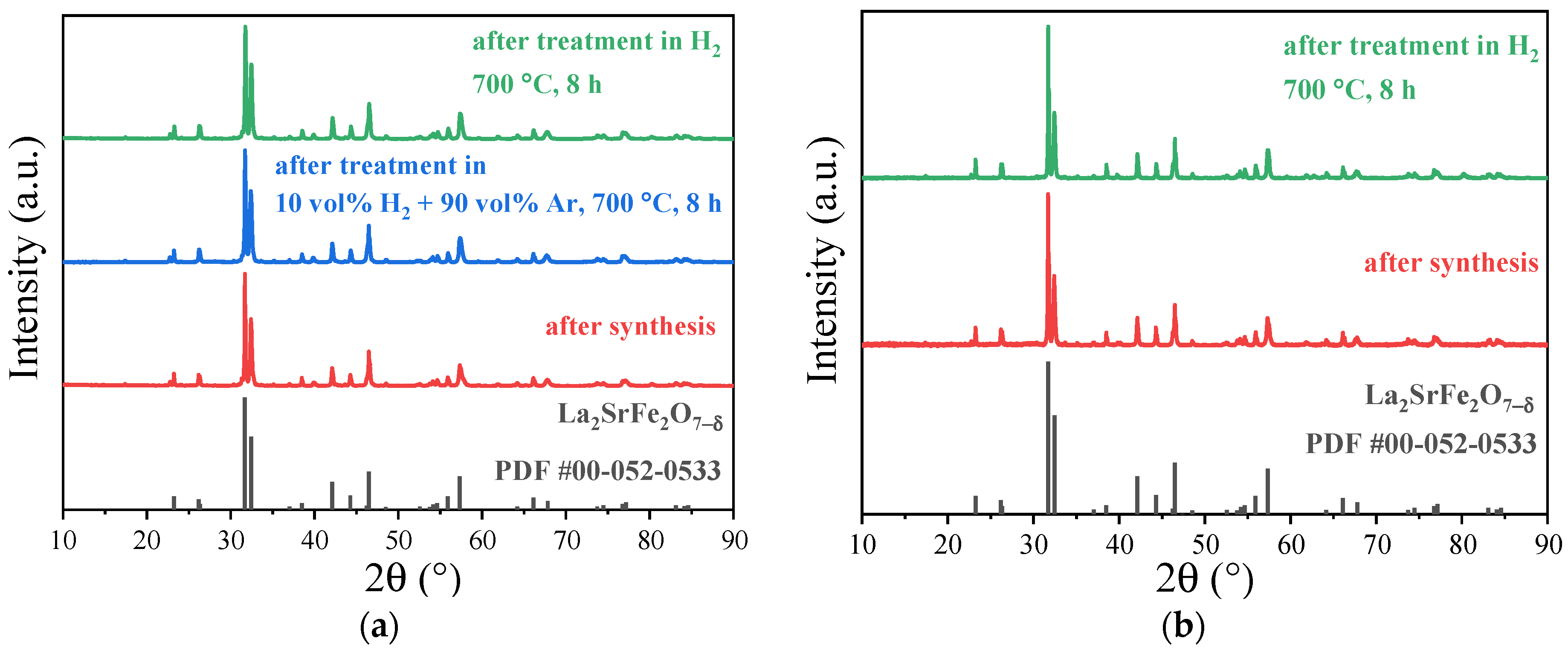
XRD analysis confirmed the formation of the phases with the Ruddlesden–Popper structure for both parent and Ga-doped synthesized oxides (
Figure 1). The crystal structure refinement, using the Whole-Pattern Profile Fitting (WPPF) method, revealed that both La
2SrFe
2O
7−δ and La
2SrFe
1.8Ga
0.2O
7−δ adopt a tetragonal symmetry with the space group
I4/
mmm. The refined lattice parameters and unit cell volume are a = b = 3.91004(8) Å, c = 20.4776(4) Å, V = 313.07(1) Å
3 for La
2SrFe
2O
7−δ, and a = b = 3.91063(12) Å, c = 20.4710(6) Å, V = 313.06(4) Å
3 for La
2SrFe
1.8Ga
0.2O
7−δ. A subtle expansion of the lattice parameter
a and contraction of parameter
c are observed. This structural evolution is the result of a synergistic interplay of factors. Despite the comparable ionic radii of Ga
3+ (0.620 Å) and the radii of Fe
3+/Fe
4+ (0.585–0.645 Å), the partial substitution of Fe
3+/Fe
4+ by Ga
3+ reduces the fraction of high-valence Fe
4+. The local lattice distortions in the ab-plane are diminished by this process, thereby increasing parameter a. Furthermore, the incorporation of 20% Ga into the iron sublattice weakens Fe–O–Fe covalent bonding, leading to a reduced interlayer spacing c upon Ga
3+ substitution.
Since, in this study, some of the results were obtained under reduced oxygen partial pressure, it was necessary to verify the stability of the oxides in a reducing atmosphere. The phase stability of the oxides was investigated by heat treatment in the atmospheres of diluted and pure hydrogen at 700 °C for 8 h. No additional peaks were found on the XRD patterns after the treatment, even after the samples were annealed in pure hydrogen (
Figure 1).
A dilatometric study of compact La
2SrFe
2O
7−δ and La
2SrFe
1.8Ga
0.2O
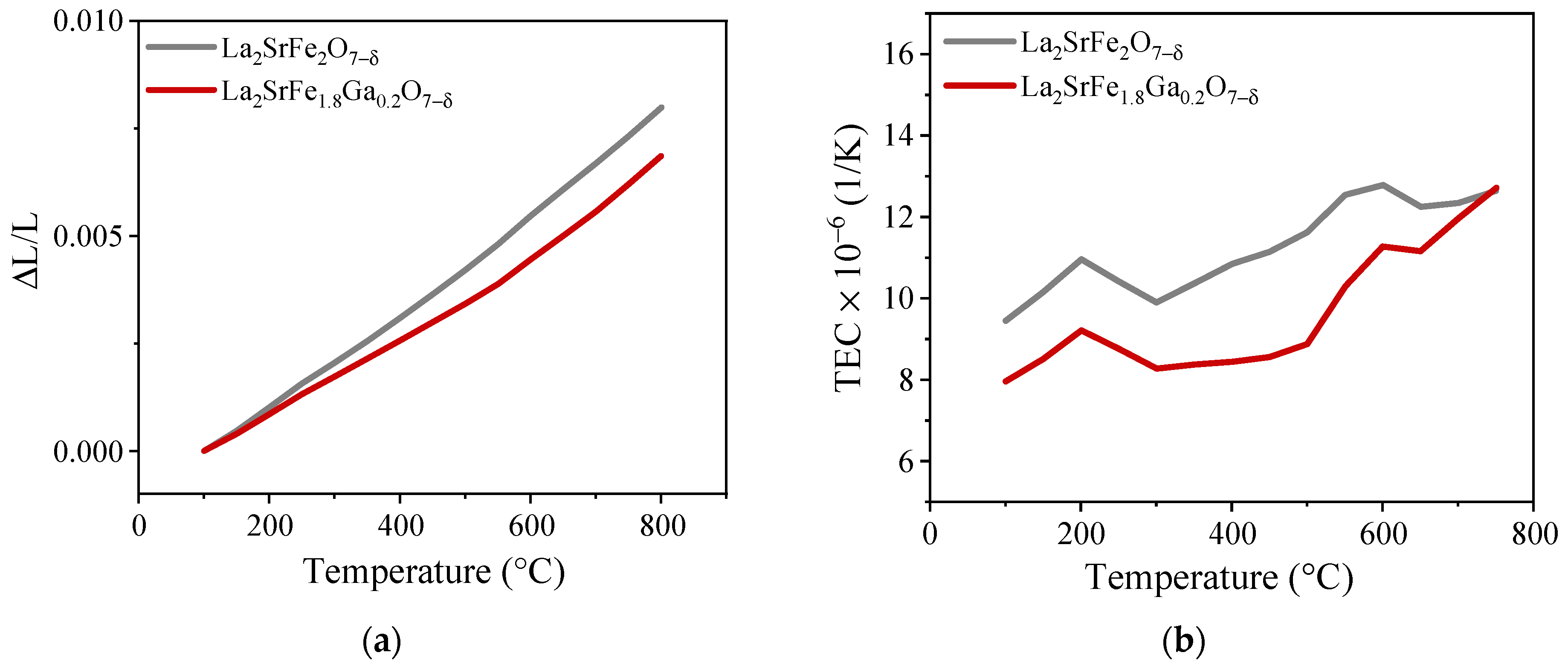
7−δ samples in air revealed that the thermal expansion curves at temperatures up to 800 °C are nearly linear (
Figure 2). The expansion curves are nearly parallel. This indicates similar values of the linear thermal expansion coefficient (TEC). The average TEC values calculated from the dilatometric data are presented in
Table 2.
The thermal expansion values themselves are in good agreement with those for most solid electrolytes. It should be noted that a slight increase in the TEC values was observed in the high-temperature range. This feature is associated with the release of oxygen from the oxide upon heating and the corresponding chemical expansion or chemical deformation. Layered structures (so-called Ruddlesden–Popper phases) are known to exhibit anisotropic chemical expansion; the crystal lattice simultaneously expands along the a-axis and contracts along the c-axis with a decrease in δ. This decrease in unit cell parameter c is due to the weakening of the electrostatic repulsion caused by the release of oxygen, while expansion in the opposite direction occurs due to a decrease in the average oxidation state of iron and a subsequent increase in its effective ionic radius. The tendency toward a decrease in the TEC values with the addition of Ga is the same in both temperature ranges. Overall, the obtained thermal expansion values for both oxides were found to be in good agreement with those for solid electrolytes (
Table 2), which should favorably affect the formation of the electrode/electrolyte interface during electrode fabrication.
A distinct peak is observed in
Figure 2b at approximately 200 °C. This behavior can be explained as follows. Upon heating in air, weakly bound oxygen species begin to leave the crystal lattice, particularly from interstitial positions and SrO layers. This process is especially pronounced in the temperature range of 100–300 °C. The removal of oxygen from the lattice results in lattice expansion due to a reduction in the effective negative charge and weakening of metal–oxygen bonds, leading to a significant increase in the thermal expansion coefficient (TEC). Although oxygen release continues above 300 °C, its rate gradually decreases while the thermal expansion behavior becomes nearly linear. If thermal expansion were governed solely by the anharmonicity of atomic vibrations, the TEC would be expected to increase monotonically with temperature. However, above approximately 200 °C, structural relaxation processes and defect redistribution begin to play an increasingly important role. These processes partially compensate for the expansion associated with oxygen loss, resulting in a slower increase in the lattice parameters compared to the temperature rise.
Studies of the linear expansion dependence on oxygen partial pressure for the La
2SrFe
2O
7−δ and La
2SrFe
1.8Ga
0.2O
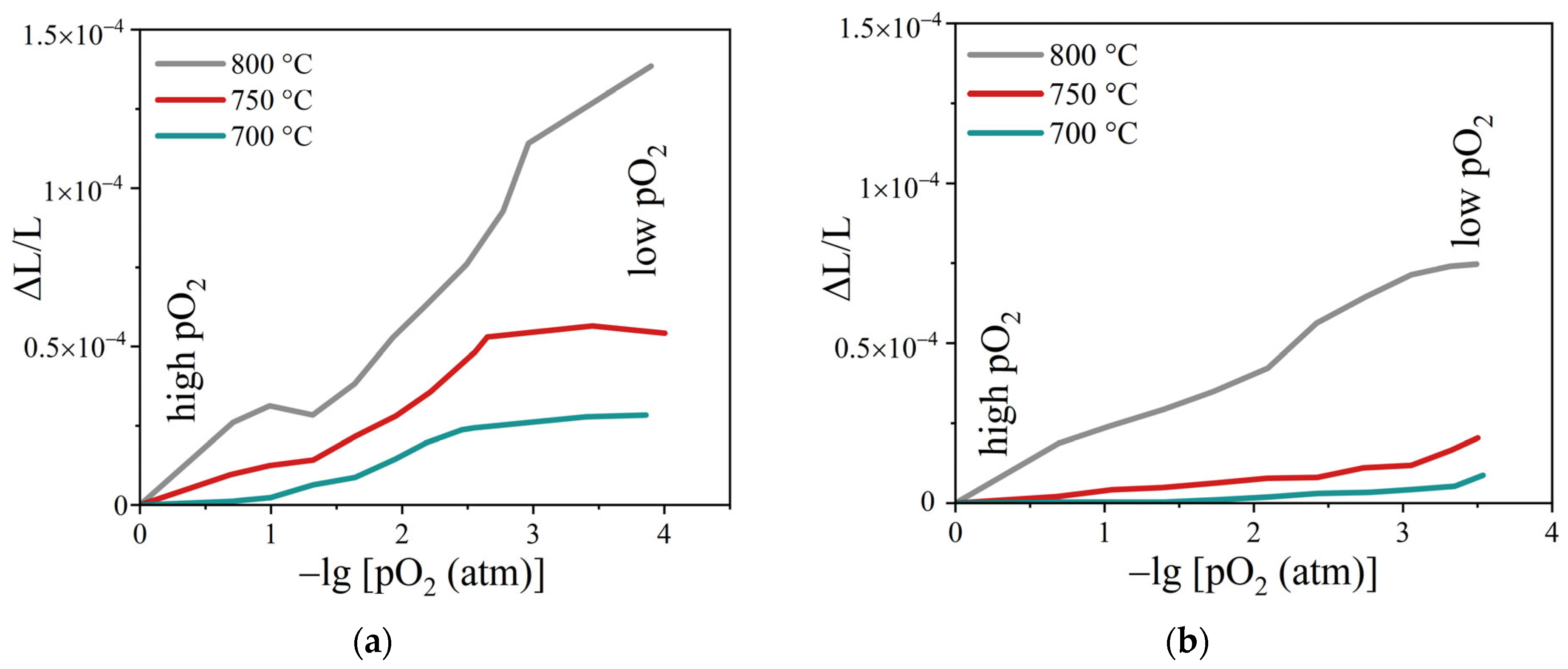
7−δ compositions were carried out at temperatures of 700, 750, and 800 °C. In
Figure 3, it can be seen that a decrease in pO
2 leads to an increase in linear expansion. At 700, 750, and 800 °C, the contribution of the change in pO
2 to the total linear expansion is 0.4%, 0.6%, and 1.4% for La
2SrFe
2O
7−δ and 0.15%, 0.3%, and 0.8% for La
2SrFe
1.8Ga
0.2O
7−δ, respectively, from the overall expansion (see
Figure 2a). It can also be noted that in the studied range of oxygen partial pressure, the expansion of the undoped composition is higher than that of the composition containing Ga. This may be due to the fact that Ga doping reduces the δ dependence on temperature and oxygen pressure [
30]. This suggests that the significant difference in TEC values for these compositions, especially at low oxygen pressures, may partly be due to the large difference in oxygen deficiency and, consequently, the greater chemical expansion contribution to the La
2SrFe
2O
7−δ thermal expansion. Taking into account the correlations between oxygen vacancy concentrations and thermal expansion, which are well known in the literature for materials with temperature-independent oxygen deficiency [
31,
32], it can be expected that at a fixed oxygen content, the expansion of the crystal lattice of derivatives containing Ga may be higher or at least comparable to La
2SrFe
2O
7−δ.
The process of interphase exchange of gaseous oxygen with the surfaces of the La
2SrFe
2O
7−δ and La
2SrFe
1.8Ga
0.2O
7−δ samples was studied by means of the oxygen pressure relaxation method. The use of this method enabled the determination of the values of the chemical coefficient of oxygen surface exchange, depending on the oxygen pressure and temperature.
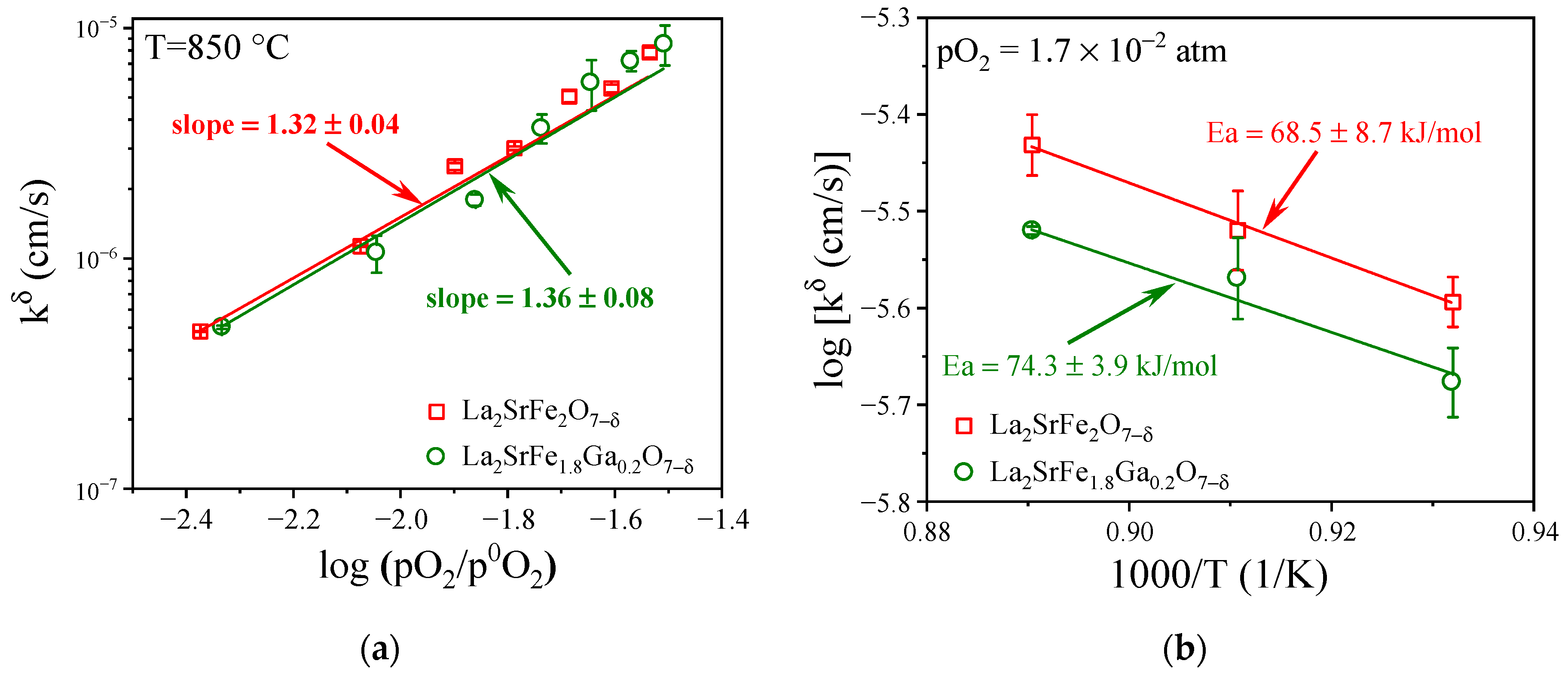
Figure 4 illustrates the calculated values of the chemical coefficients of oxygen exchange with the surfaces of the La
2SrFe
2O
7−δ and La
2SrFe
1.8Ga
0.2O
7−δ oxides. It is demonstrated that for the studied compositions, the surface oxygen exchange coefficients increase with a rise in both the partial pressure of oxygen and the temperature. It is interesting to note that comparable values of the chemical coefficients of surface oxygen exchange were obtained by our group earlier for the oxide La
0.6Sr
0.4FeO
3−δ with a perovskite structure in [
22]. As illustrated in
Figure 4a, the dependence of the chemical oxygen exchange coefficient on oxygen pressure can be described by a power function of the
form. The exponents were determined from the slope of the linearized dependencies
kδ on pO
2 in logarithmic coordinates, with values of 1.32 ± 0.04 for La
2SrFe
2O
7−δ and 1.36 ± 0.08 for La
2SrFe
1.8Ga
0.2O
7−δ. Within the established error limits, it can be hypothesized that the exponents for the studied oxides are equal, indicating that the addition of 10% gallium into the La
2SrFe
2O
7−δ structure does not result in changes in the mechanism of the oxygen exchange process with the gas phase. An analogous mechanism of interaction between gaseous oxygen and the surface of La
2SrFe
2O
7−δ and SrLa
2Fe
1.8Ga
0.2O
7−δ ceramics is also indicated by similar values of the effective activation energies of the oxygen exchange process at the gas/oxide interface (see
Figure 4b). However, analysis of pressure and temperature dependencies of the chemical surface exchange coefficients suggested that partial substitution of iron by gallium in La
2SrFe
2O
7−δ resulted in a slight decrease in the ability of the La
2SrFe
1.8Ga
0.2O
7−δ oxide to exchange oxygen with the gas phase. As established by previous studies [
23,
24,
33], oxygen transfer in layered lanthanum-strontium ferrites transpires principally via the vacancy mechanism. The formation of oxygen vacancies in Sr
2–xLa
xFe
2O
7−δ oxides is attributable to the thermally activated reduction of iron ions from Fe
3+ to Fe
2+ [
23,
24]. This process can be expressed within the Kroeger–Vink notation by the following defects equation:
where
is the Fe
3+ ion at a lattice site in a neutral charge state;
is the regular oxygen ion at a lattice site;
is the Fe
2+ ion (effective negative charge relative to the lattice);
is the doubly positively charged oxygen vacancy.
Since gallium does not exhibit variable valence, partial substitution of the Fe3+ ion by Ga3+ with a constant oxidation state can suppress the formation of additional oxygen vacancies caused by the Fe3+ → Fe2+ transition. Therefore, it can be concluded that the introduction of gallium into the crystal lattice of La2SrFe2O7−δ, as our hypothesis suggests, may be associated with a lower concentration of oxygen vacancies in La2SrFe1.8Ga0.2O7−δ. Consequently, this may result in a slight decrease in the rate of the reduction reaction on the surface of the La2SrFe1.8Ga0.2O7−δ oxide in comparison with the undoped composition. However, direct oxygen-content measurements are required to confirm this interpretation.
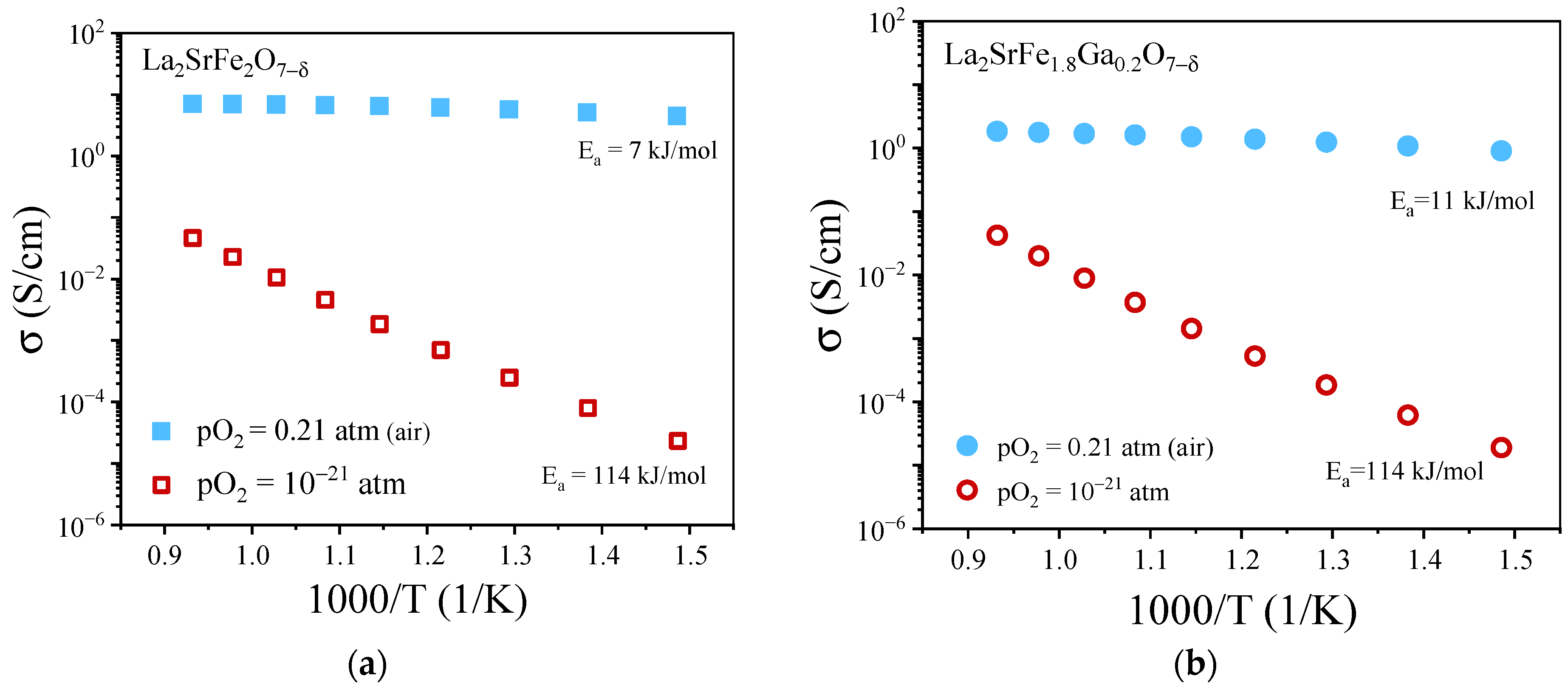
During the investigation of electrical conductivity behavior, it was found that both samples show similar dependencies: in the air, the conductivity of the samples is almost independent of temperature, and in an atmosphere with a low partial pressure of oxygen, the conductivity increases with increasing temperature (
Figure 5). The conductivity of La
2SrFe
2O
7−δ and La
2SrFe
1.8Ga
0.2O
7−δ in air at 800 °C was 7.09 and 1.83 S/cm, respectively, while in an atmosphere with pO
2 = 10
−21 atm at 800 °C, it was only 0.047 and 0.043 S/cm, respectively. Doping the iron sublattice with gallium cations led to a decrease in the overall conductivity of the sample, which is consistent with the behavior of the electrochemical characteristics of conventional perovskites of the general composition (La,Sr)FeO
3−δ [
22]. This behavior can be explained primarily by the electronic nature of conductivity in an oxidizing atmosphere, and the replacement of a cation with a variable oxidation state (iron) with a cation with a constant oxidation state (gallium) leads to a decrease in the electron concentration.
To determine the polarization resistance of the electrodes, electrochemical impedance spectra were measured.
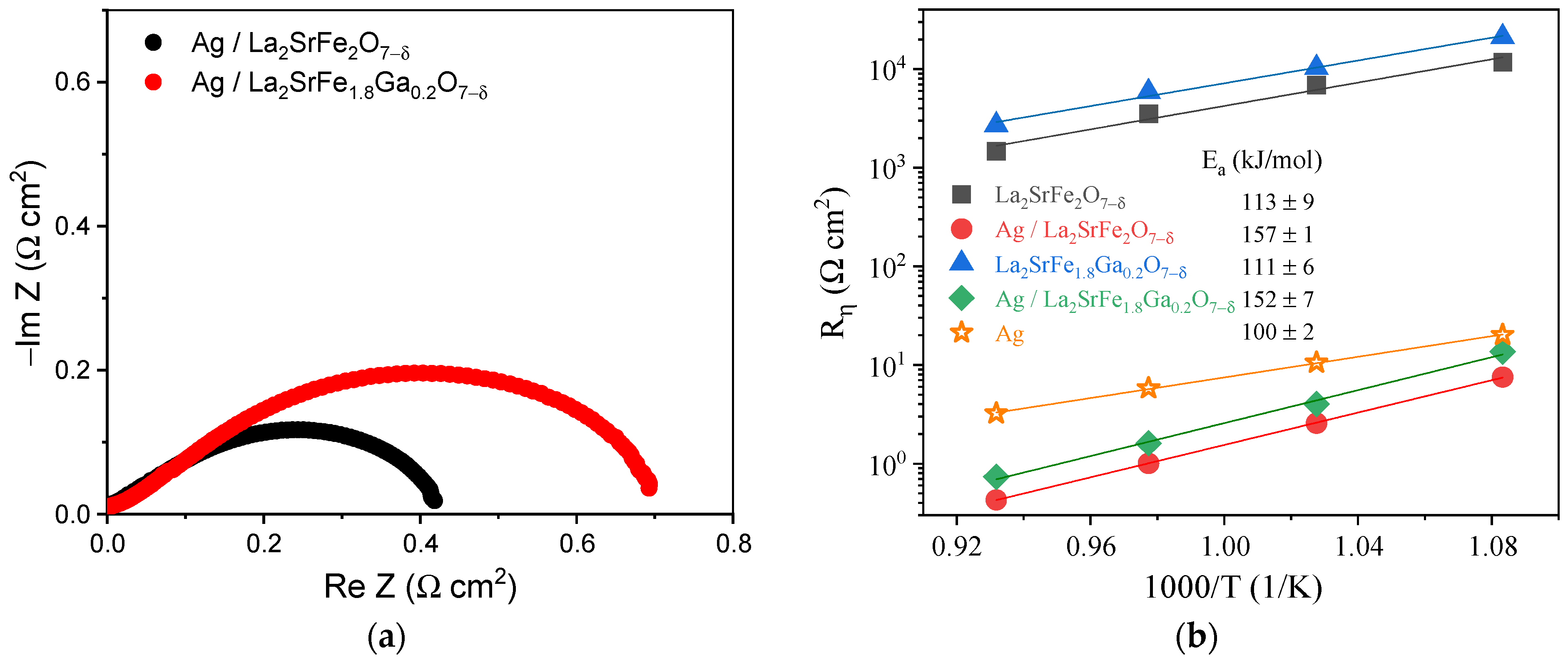
Figure 6a shows the spectra at 800 °C for both investigated electrodes. It can be seen that the spectra have a relatively simple form and consist of a single asymmetric semicircle. Polarization resistance values were obtained from the impedance spectra.
Figure 6b depicts temperature dependencies of the polarization resistance for the investigated electrodes. First, symmetrical cells with La
2SrFe
2O
7−δ and La
2SrFe
1.8Ga
0.2O
7−δ electrodes were measured. It was found that the electrode performance is not satisfactory, with very high values of polarization resistance of about 1.46 and 2.71 kΩ cm
2 at 800 °C for La
2SrFe
2O
7−δ and La
2SrFe
1.8Ga
0.2O
7−δ, respectively. Taking into account the low electrical conductivity of the electrode materials, it can be assumed that poor current distribution at the electrode/current collector interface has a highly negative effect on the characteristics of the electrodes. In this study, a platinum grid with a mesh opening of approximately 0.5 × 0.5 mm and a total of 5 × 5 mesh cells was used as the current collector (a schematic representation is provided in [
34]). Given that each contact between the grid and the electrode is essentially point-like, this configuration appears insufficient to ensure uniform current distribution across the electrode surface. To improve electrical contact with the current collector, a thin layer of silver paste was applied onto the electrode surface for a uniform current distribution over the electrode. After this, the cells were measured again. The application of the current collector was found to lead to a drastic decrease in polarization resistance: the obtained polarization resistance values were 0.43 and 0.73 Ω cm
2 at 800 °C for La
2SrFe
2O
7−δ and La
2SrFe
1.8Ga
0.2O
7−δ, respectively. It should be noted that in both cases, the electrochemical activity of the electrodes with a Ga-doped composition is lower, which is in accordance with the results reported in previous sections; namely, lower electrical conductivity and the oxygen surface exchange coefficient. Additionally, the polarization resistance of the silver electrodes formed on the surface of the supporting electrolyte was measured for comparison (
Figure 6b). It can be seen that polarization resistance is significantly higher than that for the La
2SrFe
2O
7−δ and La
2SrFe
1.8Ga
0.2O
7−δ electrodes with a silver current collector.
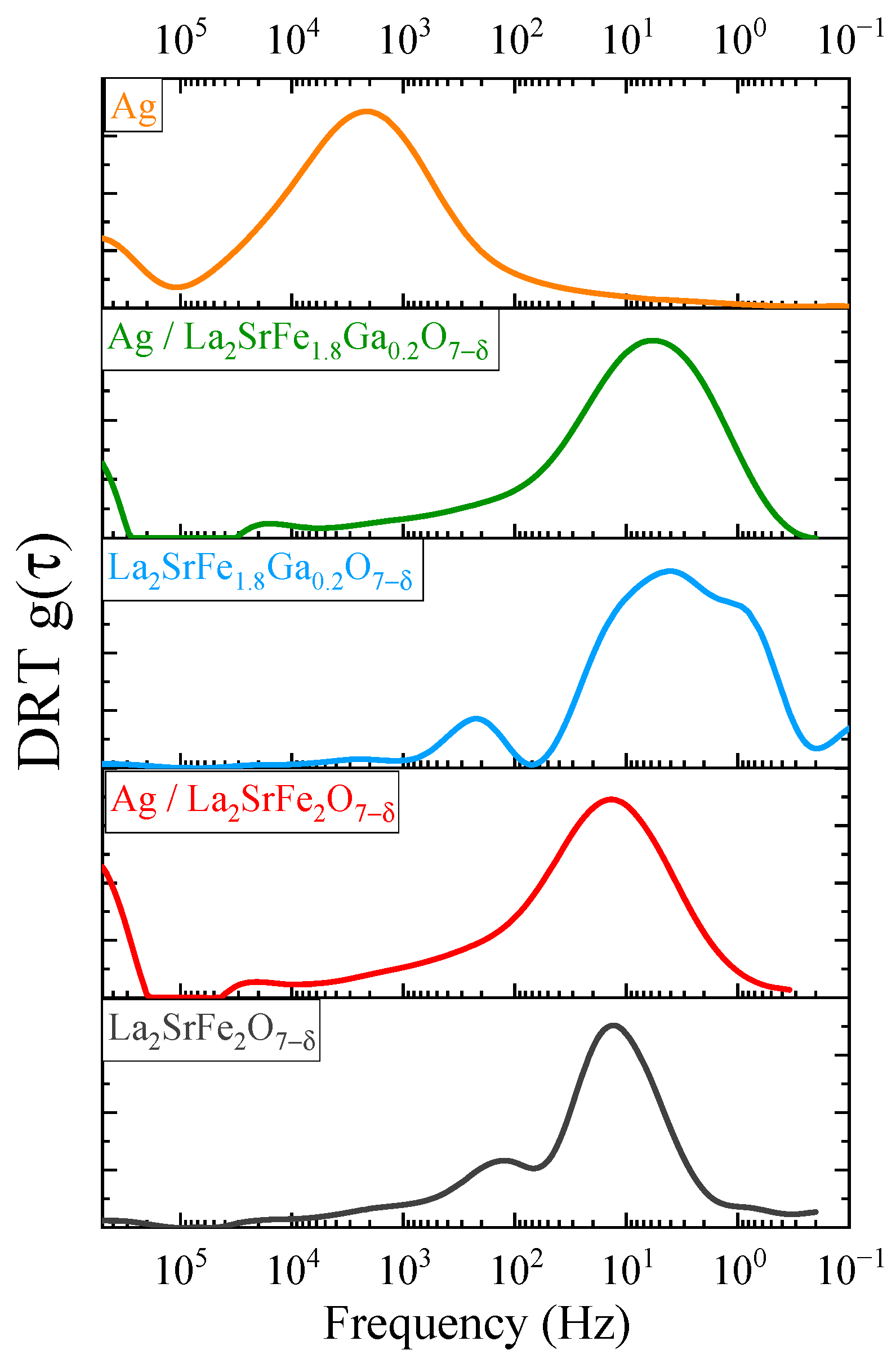
However, the polarization resistance values provide only indirect confirmation that silver acts as a current collector. To demonstrate this more clearly, the distribution of relaxation time (DRT) functions was calculated from the electrochemical impedance spectra (
Figure 7). As can be seen in the figure, the shape of the DRT functions for the La
2SrFe
2O
7−δ and La
2SrFe
1.8Ga
0.2O
7−δ electrodes differs slightly. This difference is associated with the appearance of a low-frequency peak with a relaxation frequency of about 1 Hz for the La
2SrFe
1.8Ga
0.2O
7−δ electrode. Given that both the shape of the DRT functions and the relaxation frequencies (about 10 Hz) for the La
2SrFe
2O
7−δ and La
2SrFe
1.8Ga
0.2O
7−δ electrodes indicate a dominant contribution from a slow gas-phase interfacial exchange step, the appearance of an additional low-frequency peak may be the reason for slower or more complex interfacial exchange kinetics for the La
2SrFe
1.8Ga
0.2O
7−δ electrode, as previously noted in the discussion of the results obtained by the pressure relaxation method. It is worth noting separately that after applying a silver current collector, the shape of the DRT function remained almost unchanged and, more importantly, the relaxation frequencies did not change (
Figure 7).
Figure 7 also shows the DRT function for a silver electrode formed on the surface of an LSGM electrolyte. This curve exhibits only a single peak with a relaxation frequency at a peak maximum of about 2 kHz, which is not observed for the cells with oxide electrodes. This may indicate that the dominant contribution to the electrode polarization resistance in the case of cells with a silver current collector layer is still the response from the electrode material itself. However, further research is needed to exclude the contribution associated with Ag. It should be mentioned that potentially alternative Ag-assisted routes of the electrode reaction cannot be excluded from consideration as possible parallel ways. However, since the shape of the DRT function does not change significantly when using silver current, it can be assumed that their contribution is insignificant. Moreover, the activation energy values of polarization resistance can be considered (
Figure 6). Thus, they are almost the same for both electrodes, significantly increasing when the current collector is applied. Probably, when the current collector layer is applied, the accessibility of the electrode surface for oxygen decreases, which apparently affects the rate of some stages, increasing the activation energy but leaving the electrode reaction mechanism the same. In contrast, the activation energy value of polarization resistance for the silver electrode is significantly lower compared to all other samples, probably due to the fact that, in the case of the silver electrodes, the electrode reaction may be determined with different processes.
3. Materials and Methods
La2SrFe2O7−δ and La2SrFe1.8Ga0.2O7−δ were synthesized using a conventional solid-state method. Precursors La2O3, SrCO3, Fe2O3, and Ga2O3 were mixed and crushed in a zirconia-lined jar using a Retsch PM 100 laboratory ball mill (Retsch, Haan, Germany) in an isopropyl alcohol medium. The powder mixture was subjected to two-stage calcination at temperatures of 1000 °C and 1450 °C with an isothermal holding time of 5 h in SNOL 6.7/1300 (SNOL, Utena, Lithuania) and LHT 02/18 (Nabertherm, Lilienthal, Germany) muffle furnaces, respectively. It should be noted that after each high-temperature treatment, the powder was re-crushed.
In order to conduct studies using the pressure relaxation method and determine the thermomechanical properties of the electrode materials, the powder was formed into pellets and rectangular bars after the initial firing stage. This was accomplished through the implementation of cold uniaxial pressing at a pressure of 100 MPa, followed by isostatic pressing at a pressure of 300 MPa and sintering at 1450 °C for a duration of 10 h. Following sintering, the surfaces of the sintered samples were ground using a diamond wheel (Almaznyi Instrument, Belgorod, Russia) and subsequently polished with diamond polishes (Real-Dzerzhinsk, Dzerzhinsk, Russia).
Symmetrical electrochemical cells on a La0.8Sr0.2Ga0.8Mg0.2O3−δ (LSGM)-supporting electrolyte were fabricated by screen-printing electrodes onto both sides of a ceramic tablet, followed by co-sintering at 1100 °C for 2 h. The supporting electrolyte was synthesized by means of solid-state synthesis, followed by firing at 1000 °C for 6 h, cold uniaxial pressing, sintering at 1450 °C for 6 h, and surface treatment with a diamond wheel to a tablet thickness of ~700 μm. The electrode ink for screen printing was prepared from the electrode powders by mixing them in a mortar with an organic binder. For some samples, silver was used as a current collector. For this, silver paste was painted on the electrode surfaces and sintered at 815 °C for an hour.
The X-ray powder diffraction analysis was conducted at room temperature under ambient atmospheric conditions on a D/MAX-2200 diffractometer (Rigaku, Tokyo, Japan) utilizing CuKα radiation, with the following operational parameters: λ(Kα) = 1.5406 Å, accelerating voltage of 40 kV, and a current of 30 mA. To determine the chemical composition of the synthesized electrolytes, inductively coupled plasma atomic emission OPTIMA 4300 DV spectroscopy was applied (Perkin Elmer, Shelton, CT, USA).
The thermal and chemical expansion measurements of ceramics were studied on an automatic quartz dilatometer based on a Tesatronic TT-80 appliance with a GT-21HP probe (TESA, Renens, Switzerland). The thermal expansion measurements were carried out in air at a heating rate of 2 °/min, up to 900 °C. Chemical expansion was measured at the temperatures of 700, 750, and 800 °C in the partial pressure range of 10−4 ≤ pO2 ≤ 0.21 atm. Oxygen partial pressure was regulated and controlled using a Zirconia-M controller (Research Technologies, Ekaterinburg, Russia).
In order to analyze the exchange kinetics of the gas-phase oxygen with the surface of La
2SrFe
2O
7−δ and La
2SrFe
1.8Ga
0.2O
7−δ oxides under non-equilibrium conditions, the oxygen pressure relaxation (OPR) method was employed. The experiments were performed within the temperature range of 800–850 °C, with an oxygen pressure varying from 10
−3 to 3 × 10
−2 atm. Initially, the equilibrium state of the ceramic with the gas phase was observed at a given temperature and partial pressure of oxygen. Then, the oxygen pressure above the sample was subjected to a rapid alteration with respect to the initial equilibrium value. Consequently, a sharp change in the oxygen pressure was initiated, owing to the gradient of chemical potential arising between the gas phase and the oxide. This process gives rise to either the uptake of oxygen from the gas phase or, in contrast, its release into the gas phase. In the course of the experiment, the variation in oxygen pressure over time in a closed gas circuit of constant volume was monitored, and the resulting relaxation curves were obtained. A detailed description of the OPR method and the model used for data processing was provided in [
22,
35].
The electrical conductivity of the samples was investigated as a function of temperature (400–800 °C) using a four-probe direct current configuration. The experiments were carried out under air conditions and in the atmosphere with low oxygen partial pressure (pO2 = 10−21 atm). The oxygen partial pressure in the experimental setup was regulated and controlled by a Zirconia-M controller (Research Technologies, Ekaterinburg, Russia) with the simultaneous electrical conductivity measurements.
Electrochemical performance of the electrodes was characterized by impedance spectroscopy using a P-20 potentiostat-galvanostat (SmartStat, Chernogolovka, Russia). Impedance spectra were collected in the temperature range of 600–800 °C in an air atmosphere in the frequency range of 50 kHz—0.1 Hz. The resulting impedance spectra were subjected to distribution of relaxation time (DRT) analysis by utilizing custom software (v. 1) based on Tikhonov regularization (the regularization parameter λ was set to 0.01) [
36,
37]. The DRT functions were calculated only within this frequency range, and no extrapolation was performed.




 ,
,