
Article

Enhanced High-Voltage and Li Metal Interfacial Stability of Al-Doped LLZO Solid Electrolytes via PE-ALD Al2O3 Nanocoating

Department of Advanced Materials Engineering, Tech University of Korea, Siheung-si 15073, Gyeonggi-do, Republic of Korea
*
Author to whom correspondence should be addressed.
Inorganics 2026, 14(7), 170; https://doi.org/10.3390/inorganics14070170 (registering DOI)
Submission received: 3 June 2026 / Revised: 16 June 2026 / Accepted: 22 June 2026 / Published: 24 June 2026
(This article belongs to the Topic Advanced Battery Materials and Technologies)

Abstract

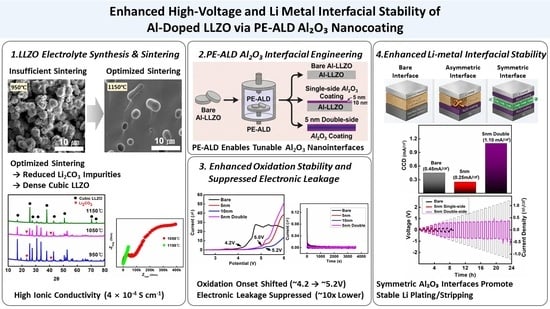
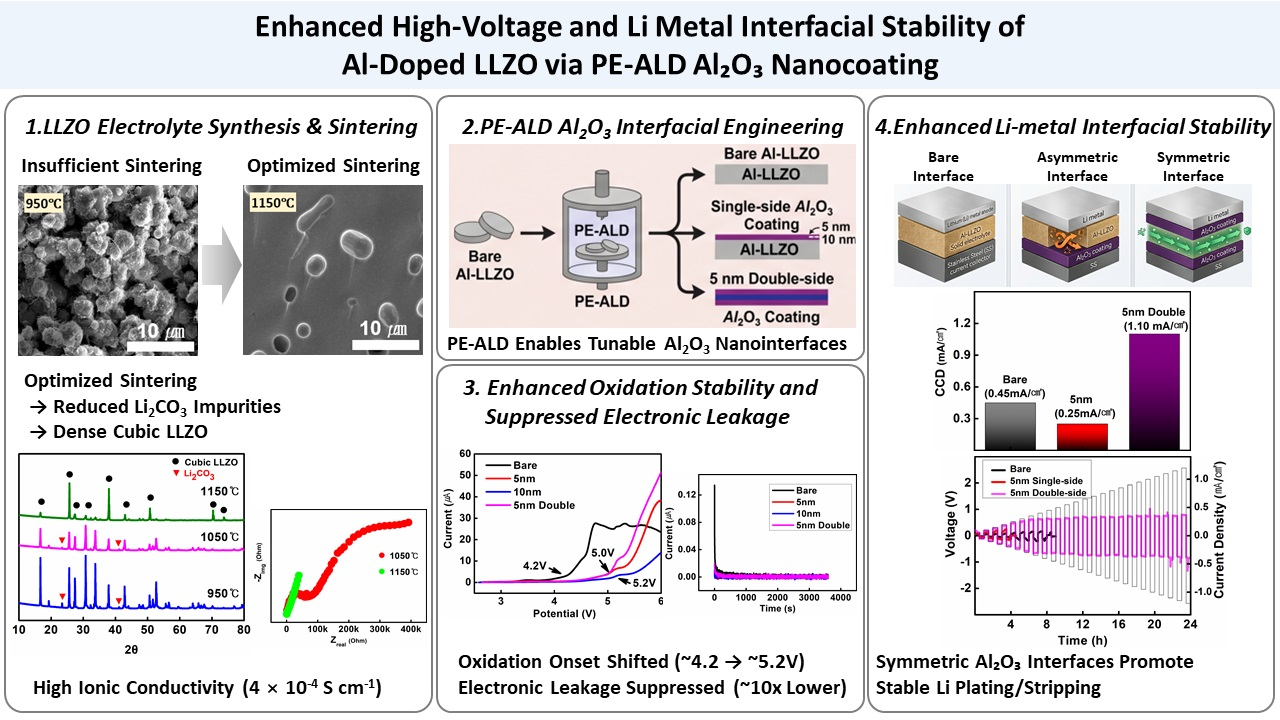
Although garnet-type Li7La3Zr2O12 (LLZO) solid electrolytes are promising candidates for high-energy-density all-solid-state batteries, their practical applications are limited by high-voltage oxidation instability and interfacial degradation. To address these limitations, Al-doped LLZO (Al-LLZO) solid electrolytes were synthesized via a conventional solid-state reaction method, and the effects of PE-ALD-derived Al2O3 nanocoatings on electrochemical properties and interfacial stability were investigated. Al2O3 nanocoatings with different structures (5 and 10 nm single-side, and 5 nm double-side) were deposited on Al-LLZO pellets using plasma-enhanced atomic layer deposition. The Al2O3 coating reduced electronic conductivity by approximately one order of magnitude while maintaining similar ionic conductivity. Linear sweep voltammetry revealed that initial oxidation onset voltage increased from ~4.2 V (bare Al-LLZO) to ~5.0 V (5 nm-coated samples), while the 10 nm-coated sample exhibited the most delayed anodic current response (~5.2 V). The 5 nm double-side coated sample showed the best Li plating/stripping stability with a critical current density of 1.10 mA/cm2 and stable long-term galvanostatic cycling behavior over 200 h at 0.05 mA/cm2. Thus, ALD-based Al2O3 interfacial engineering can simultaneously improve the high-voltage oxidation and Li metal interfacial stabilities of garnet-type Al-LLZO solid electrolytes for practical all-solid-state batteries.

Graphical Abstract

1. Introduction

Lithium-ion batteries (LIBs) have become essential energy storage systems for a wide range of applications, including portable electronic devices, electric vehicles (EVs), energy storage systems (ESSs), urban air mobility, drones, and humanoid robots [1,2,3]. The rapid proliferation of the EV market and AI-based data centers has led to a continuous increase in the demand for high-energy-density, high-power-density, and fast-charging battery systems [3,4]. However, conventional LIBs based on flammable liquid electrolytes and polymer separators suffer from severe safety issues when operated under abusive operating conditions such as overcharging, external impact, and internal short circuits [5,6,7,8]. Operation under such conditions can induce electrolyte decomposition, cathode collapse, thermal runaway, and eventually fire or explosion, which remain critical challenges for large-scale EV and ESS applications [5,6,7,8,9].
All-solid-state batteries (ASSBs) have been proposed as an alternative to fundamentally address these safety concerns. ASSBs replace flammable liquid electrolytes with nonflammable solid electrolytes and have gained considerable attention as next-generation battery systems [10,11]. These batteries offer improved thermal stability and enhanced safety while enabling compact bipolar stacking architectures with high volumetric energy density [10,11,12].
Solid electrolytes are typically classified into sulfide-, polymer-, and oxide-based systems [13,14]. Although sulfide electrolytes exhibit very high ionic conductivity (~10−3–10−2 S/cm), their poor air stability and toxic H2S emissions remain critical drawbacks [15,16]. Polymer electrolytes provide excellent mechanical flexibility and processability; however, their room-temperature ionic conductivity (~10−7–10−5 S/cm) is insufficient for practical high-power applications [17,18]. Among oxide-based electrolytes, garnet-type Li7La3Zr2O12 (LLZO) has emerged as one of the most promising candidates because of its high ionic conductivity, excellent thermal stability, and chemical compatibility with lithium metal [19,20,21,22]. Additionally, various oxide thin-films and bulk ceramics, such as LiPON and NASICON-type electrolytes, have been widely explored to develop robust architectures, though NASICON materials often suffer from interfacial degradation when in direct contact with lithium metal [23,24,25,26,27].
Despite these advantages, the practical application of LLZO electrolytes remains limited because of several challenges [28]. For example, although tetragonal LLZO is thermodynamically stable at room temperature, it exhibits poor ionic conductivity (~10−6 S/cm) because of the ordered Li-ion arrangement [29,30,31]. In contrast, cubic LLZO features a substantially higher ionic conductivity (~10−4–10−3 S/cm) owing to the enhanced Li-ion mobility within the cubic framework and the stabilization of the cubic phase through appropriate dopant incorporation [32,33]. Among various dopants investigated for LLZO, Al has been widely employed because it effectively stabilizes the highly conductive cubic phase by partially substituting Li+ sites and generating lithium vacancies [33,34,35,36,37]. The resulting cubic structure exhibits significantly higher ionic conductivity than the tetragonal phase because of enhanced Li-ion mobility [33,36]. In addition, Al doping can facilitate densification during sintering, thereby reducing grain-boundary resistance and improving ionic transport properties [33,37]. Owing to these advantages, Al-doped LLZO has been extensively studied as a promising solid electrolyte for all-solid-state lithium batteries [33,35,38]. Recent review studies have further highlighted that interface engineering, surface modification, buffer-layer integration, and dopant optimization remain essential strategies for overcoming the remaining challenges of LLZO electrolytes and accelerating their practical implementation in solid-state batteries [39]. Recent studies have also demonstrated that advanced sintering strategies based on multifunctional Li–Al–O compounds can simultaneously improve densification, suppress lithium volatilization, and enhance the electrochemical performance of garnet-type solid electrolytes, highlighting the continuing importance of processing optimization for practical LLZO applications [40]. Therefore, Al-doped LLZO was selected as the model solid electrolyte in this study to investigate the effects of PE-ALD Al2O3 nanocoatings on electrochemical stability and Li-metal interfacial behavior.
However, even cubic Al-doped LLZO suffers from interfacial degradation during electrochemical operation [28].
Poor solid–solid contact between the ceramic electrolyte and electrodes results in large interfacial impedance attributed to limited point-contact interfaces [28,41]. In addition, localized current concentration at grain boundaries can induce Li dendrite penetration through the solid electrolyte, resulting in internal short circuits [42,43,44]. Another critical issue is the limited electrochemical stability window of LLZO. Although theoretical studies predict high oxidation stability, practical oxidation degradation occurs around 4.0–4.5 V because of lithium carbonate surface impurities and parasitic interfacial reactions with high-voltage cathodes [45,46,47,48,49,50,51]. Recent reviews have further emphasized that Li2CO3 contamination on LLZO surfaces can significantly deteriorate ionic transport, interfacial compatibility, and dendrite resistance, underscoring the necessity of effective surface modification and contamination mitigation strategies for practical solid-state battery applications [52]. Electronic leakage pathways and nonuniform Li-ion transport behavior at the Li/LLZO interface have been considered important factors affecting interfacial degradation and dendrite propagation in garnet-type solid electrolytes [42]. Previous studies have reported that localized current concentration, contact loss, and void formation during repeated Li plating/stripping processes can accelerate interfacial degradation, though novel composite anodes have been developed to regulate lithium deposition [44,53,54,55]. Recent reviews have emphasized that the practical implementation of LLZO electrolytes remains hindered by interfacial degradation, lithium dendrite growth, surface contamination, and manufacturing challenges despite their high ionic conductivity and compatibility with lithium metal. These studies further highlight the need for advanced interfacial engineering and surface stabilization strategies to overcome these limitations in garnet-based solid electrolytes [56,57].
Recent studies have focused on nanoscale interfacial engineering using atomic layer deposition (ALD) and sputtering techniques to mitigate these interfacial problems [58,59,60,61,62,63,64,65]. Among the various surface modification techniques, ALD-based oxide coatings have attracted considerable attention because they enable conformal and thickness-controlled nanoscale protective layers on complex ceramic surfaces. For example, Al2O3 coatings have been widely investigated because of their chemical stability and ability to suppress parasitic interfacial reactions. However, excessively thick coating layers can simultaneously increase interfacial resistance and hinder Li-ion transport kinetics. Moreover, most previous studies focused on oxidation protection or cathode-side interface stabilization, while the effect of coating symmetry and coating configuration on Li plating/stripping behavior was comparatively poorly investigated.
In this study, cubic Al-doped LLZO solid electrolytes were synthesized via a conventional solid-state reaction method, and the densification behavior was optimized through controlled sintering conditions. Further, plasma-enhanced atomic layer deposition (PE-ALD) was employed to form ultrathin Al2O3 protective layers with different coating structures, including 5 nm single-side, 10 nm single-side, and 5 nm double-side coatings. The electrochemical properties and interfacial stability were investigated through X-ray diffraction (XRD), scanning electron microscopy (SEM), electrochemical impedance spectroscopy (EIS), linear sweep voltammetry (LSV), and critical current density (CCD) analyses. The optimized sintering condition of 1150 °C for 7 h achieved a dense cubic LLZO structure with an ionic conductivity of 4.00 × 10⁻⁴ S/cm. Further, the Al2O3 nanocoating effectively delayed the initial oxidation onset behavior of Al-LLZO from ~4.2 V to ~5.0–5.2 V while suppressing electronic leakage current. The 5 nm double-side coating structure exhibited the most stable Li plating/stripping behavior with a CCD of 1.10 mA/cm2. This study comparatively investigated single-side and double-side coating structures, providing further insight into the role of interfacial symmetry on Li-ion transport behavior and long-term interfacial stability in garnet-type solid electrolytes. These findings indicate that PE-ALD-based Al2O3 interfacial engineering can effectively enhance both high-voltage oxidation stability and Li metal interfacial stability in garnet-type LLZO solid electrolytes for practical high-voltage ASSBs.

2. Results and Discussion

2.1. Structural and Microstructural Evolution of Al-LLZO Pellets

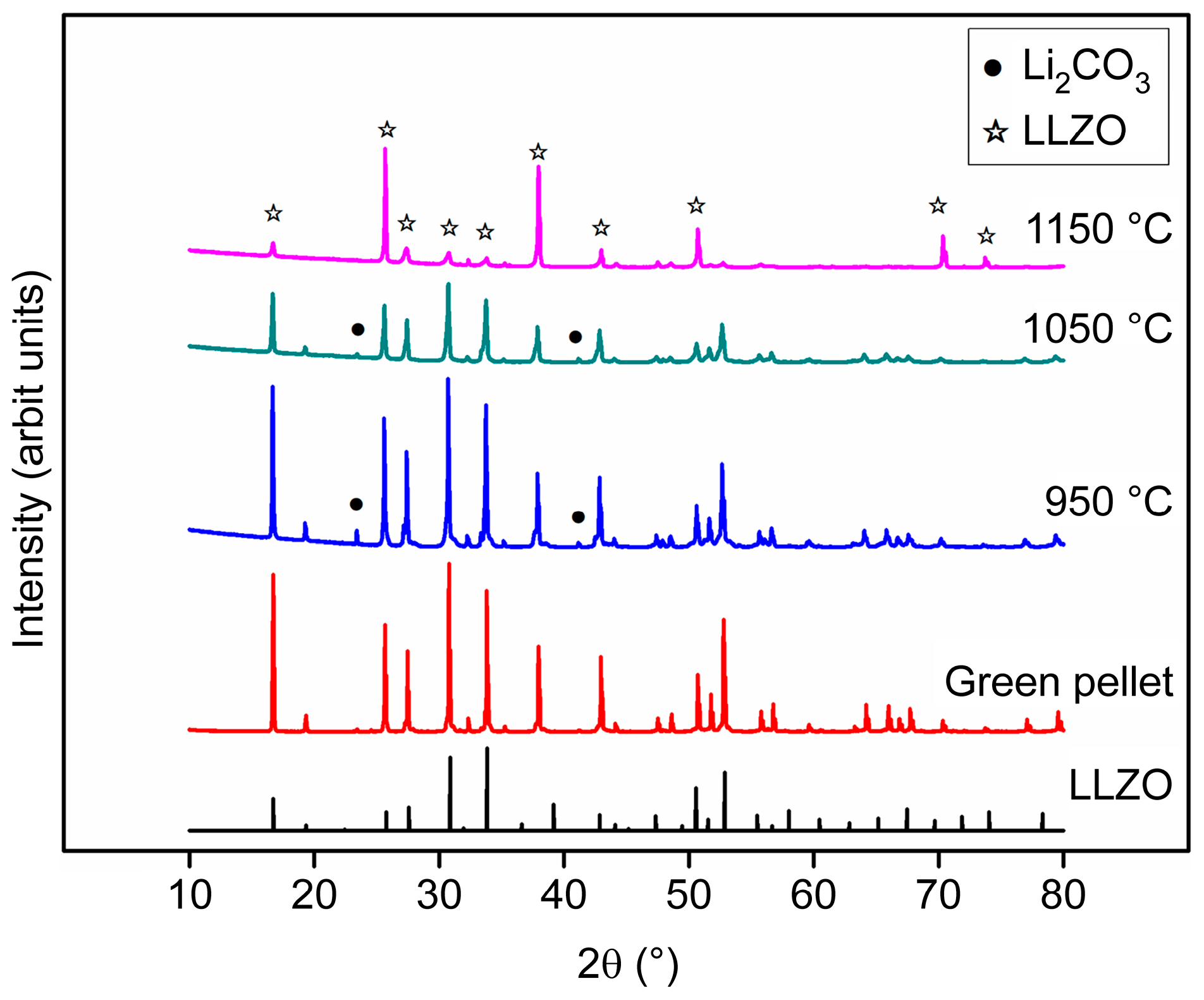
XRD and cross-sectional SEM analyses were performed to investigate the effects of sintering temperature on the crystal structure and microstructure of Al-LLZO pellets. The XRD patterns shown in Figure 1 indicate that all samples predominantly exhibit the cubic LLZO phase, while crystallinity and phase stability improve with increasing sintering temperature. Samples sintered at 950 and 1050 °C showed diffraction patterns similar to those of the green pellet, and several Li2CO3-related peaks were observed. This indicated incomplete phase formation and the presence of residual lithium carbonate under relatively low-temperature sintering conditions. In contrast, the sample sintered at 1150 °C for 7 h exhibited sharper and more distinct LLZO characteristic peaks, while most Li2CO3 peaks disappeared, suggesting improved cubic phase formation and enhanced phase stability at elevated sintering temperatures. The variation in the relative intensity of diffraction peaks in the 30–35° range is attributed to grain growth, densification, and preferential orientation developed during sintering rather than a decrease in crystallinity.
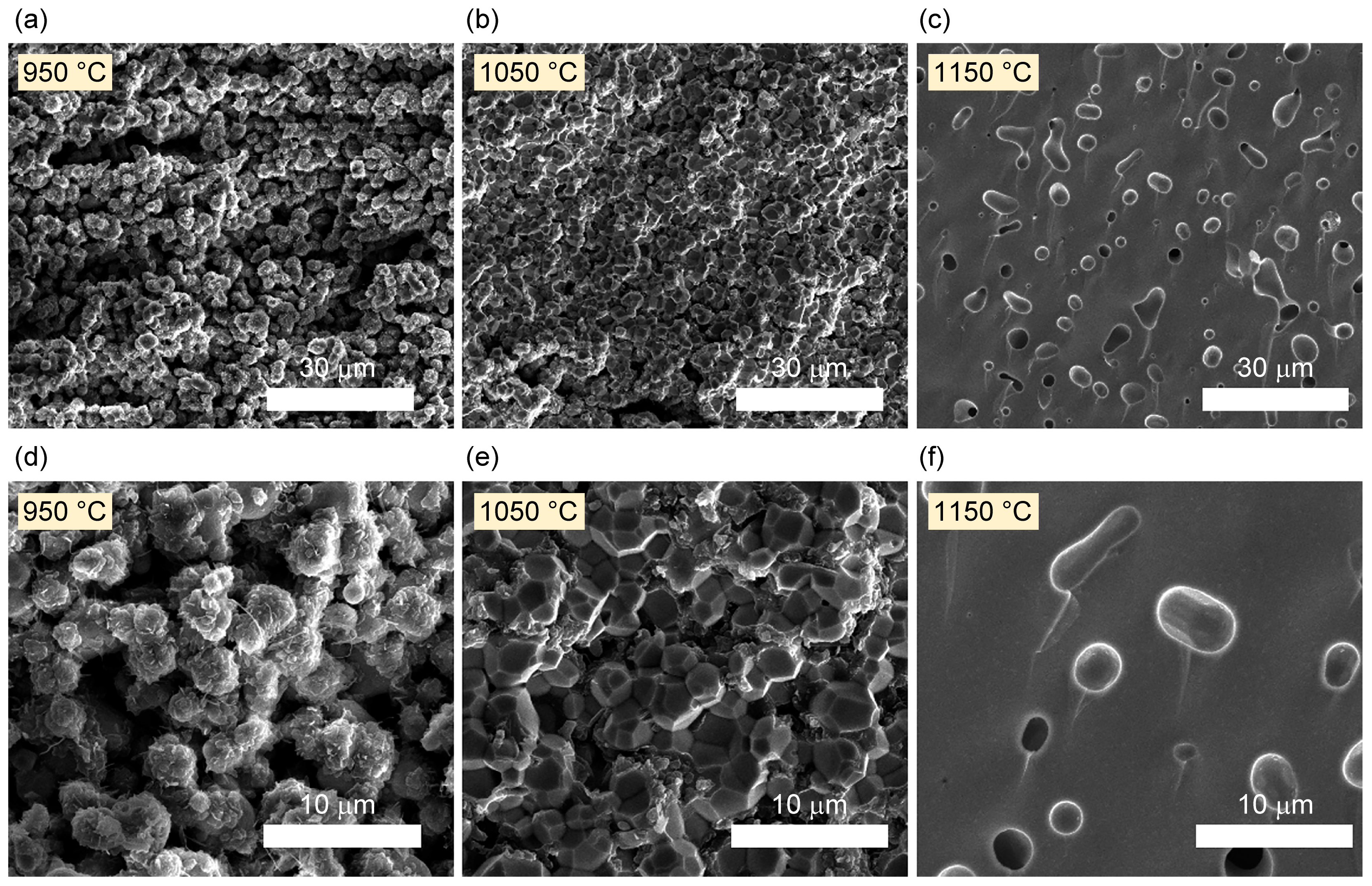
Cross-sectional SEM images in Figure 2 reveal significant microstructural evolution based on the sintering conditions. The pellet sintered at 950 °C exhibited a porous structure with insufficient necking between particles and numerous residual pores. In the sample sintered at 1050 °C, grain growth and particle necking progressed partially; however, distinct grain boundaries and pores were still observed. In contrast, the pellet sintered at 1150 °C for 7 h showed a dense microstructure with significantly improved particle bonding and reduced pore fraction. The grain boundaries became relatively indistinct, and particle fusion behavior was clearly observed, indicating effective densification during high-temperature sintering.
These results indicate that increasing the sintering temperature strongly influences the crystallization and densification behavior of Al-LLZO pellets. The sintering condition of 1150 °C for 7 h was considered most effective for reducing residual Li2CO3 impurities and achieving a dense cubic LLZO structure, which positively contributes to ionic conductivity enhancement and interfacial stabilization. A holding time of 7 h was selected at 1150 °C to achieve sufficient densification while minimizing lithium volatilization and over-sintering effects. Prolonged high-temperature sintering may induce lithium loss, abnormal grain growth, and pore formation, which can adversely affect the microstructure and phase stability of LLZO.
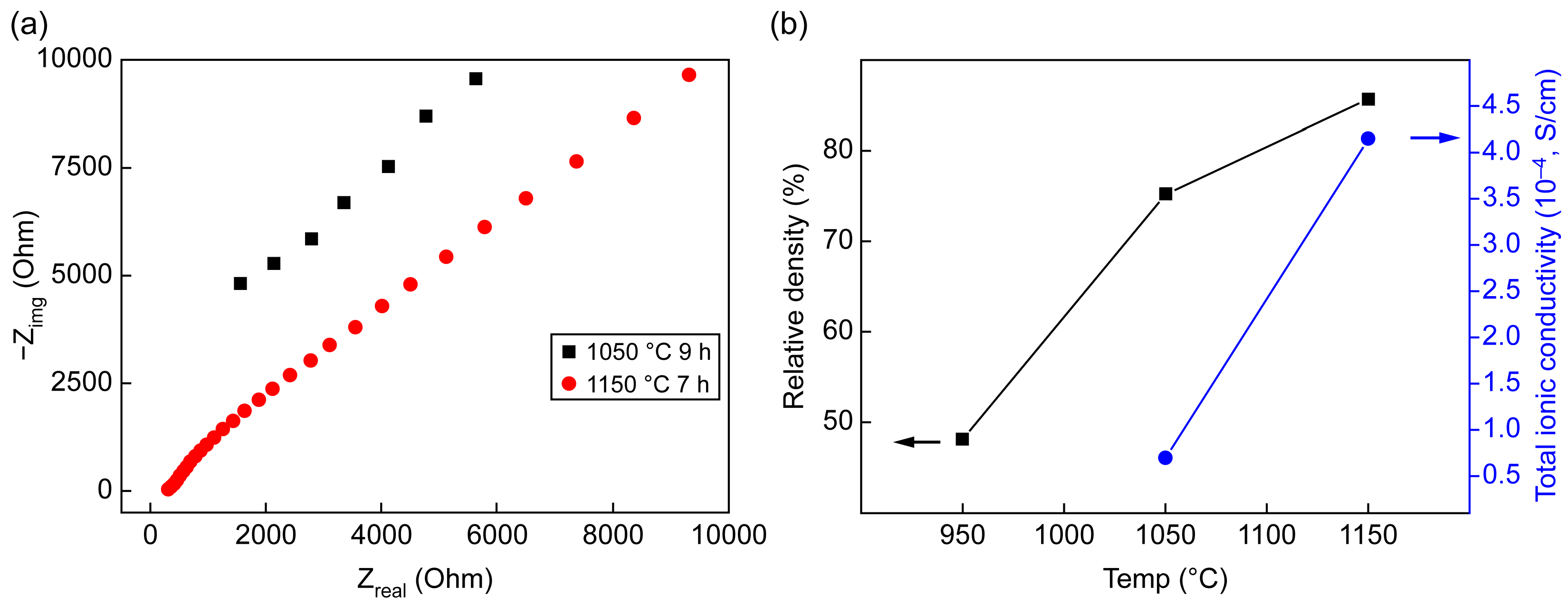
The relative density and ionic conductivity of Al-LLZO pellets were comparatively evaluated as a function of sintering temperature, as shown in Figure 3 and Table 1. Pellet densification improved significantly with increasing sintering temperature, which resulted in a corresponding enhancement in ionic conductivity. The relative density increased from 48.2 ± 7.0% for the sample sintered at 950 °C for 9 h to 75.2 ± 6.0% for the sample sintered at 1050 °C for 9 h, and further to 85.6 ± 2.5% for the sample sintered at 1150 °C for 7 h (Figure 3b and Table 1). The 1150 °C sintering condition promoted effective grain growth and particle bonding, which resulted in the highest densification consistent with SEM observations shown in Figure 2.
As shown in the Nyquist plots in Figure 3a, the sample sintered at 950 °C exhibits unstable impedance behavior because of its low densification and high porosity, which makes accurate ionic conductivity analysis difficult. In contrast, the samples sintered at 1050 and 1150 °C exhibit clearer impedance responses. The ionic conductivity increases from 6.95 × 10⁻⁵ S/cm for the 1050 °C sample to 4.00 × 10⁻⁴ S/cm for the 1150 °C sample (Table 1). This improvement is attributed to the reduction in grain-boundary resistance and enhancement of Li-ion transport pathways with increasing densification. Therefore, the 1150 °C for 7 h condition is determined to be the optimized sintering condition for Al-LLZO solid electrolytes.

2.2. Electrochemical Properties of Al2O3-Coated Al-LLZO

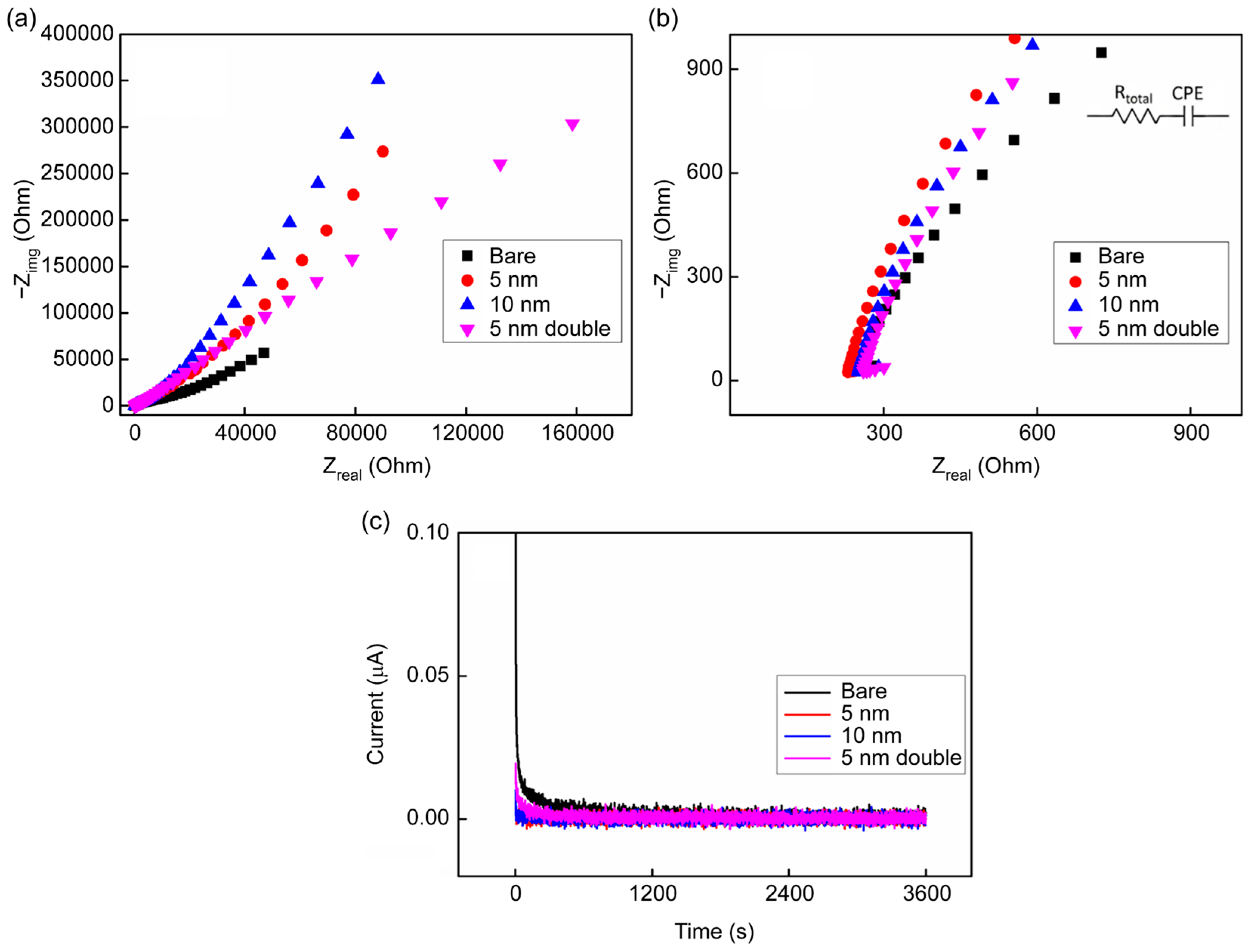
The effects of the ALD Al2O3 coating on the electrochemical properties of Al-LLZO pellets were investigated using Au symmetric cells. Figure 4a,b show the EIS results of bare and Al2O3-coated samples, while Figure 4c presents the DC polarization behavior. As summarized in Table 2, all samples exhibited similar ionic conductivity values in the range of 4.46 × 10⁻⁴ to 4.65 × 10⁻⁴ S/cm. This indicates that the ultrathin Al2O3 coating layer did not significantly hinder Li-ion transport within the Al-LLZO electrolyte. Figure 4b shows only minor differences in the high-frequency impedance response among the samples. The total resistances, determined from the minimum high-frequency intercepts on the Zreal axis, were 248.4, 230.5, 250.3, and 260.8 Ω for the bare, 5 nm single-side, 10 nm single-side, and 5 nm double-side coated samples, respectively. The relatively small variation in resistance is consistent with the similar ionic conductivity values listed in Table 2 and indicates that the ultrathin Al2O3 coating had a negligible influence on the bulk ionic transport properties of Al-LLZO. Furthermore, no additional impedance features associated with the coating layer were observed, suggesting that the Al2O3 coating did not introduce a significant barrier to Li-ion conduction. Because no distinct semicircle was observed in the Nyquist plots, the bulk and grain-boundary resistances could not be individually resolved, and a charge-transfer resistance (Rct) could not be reliably determined. Therefore, the ionic conductivity was calculated using the total resistance obtained from the minimum high-frequency intercept on the Zreal axis. A simplified equivalent circuit consisting of a total resistance (Rtotal) in series with a constant phase element (CPE) was employed to represent the electrolyte response. These results demonstrate that the ALD Al2O3 coating effectively preserves the intrinsic ionic conductivity of Al-LLZO while modifying the surface characteristics of the electrolyte.
In contrast, electronic conductivity decreased substantially after Al2O3 deposition. The bare Al-LLZO pellet exhibited an electronic conductivity of 4.58 × 10⁻⁸ S/cm, whereas the 5 nm single-side, 10 nm single-side, and 5 nm double-side coated samples showed reduced electronic conductivity values of 4.23 × 10⁻⁹, 5.77 × 10⁻⁹, and 1.01 × 10⁻⁹ S/cm, respectively (Table 2). The 5 nm double-side coated sample exhibited the lowest electronic conductivity among the investigated samples, which indicates that symmetric Al2O3 coverage can more effectively suppress electronic leakage pathways. However, the result should be interpreted as a relative tendency rather than an absolute intrinsic value because electronic conductivity at the 10−9 S/cm level is highly sensitive to interfacial contact and measurement noise.
The Li-ion transference number (tLi+) is calculated using
t L i + = σ i o n σ i o n + σ e
where σion and σe represent the ionic conductivity and electronic conductivity, respectively. As summarized in Table 2, all samples exhibit Li-ion transference numbers close to unity (~0.9999), indicating dominant Li-ion conduction behavior regardless of the coating condition.

2.3. High-Voltage Oxidation Stability and Interfacial Characteristics

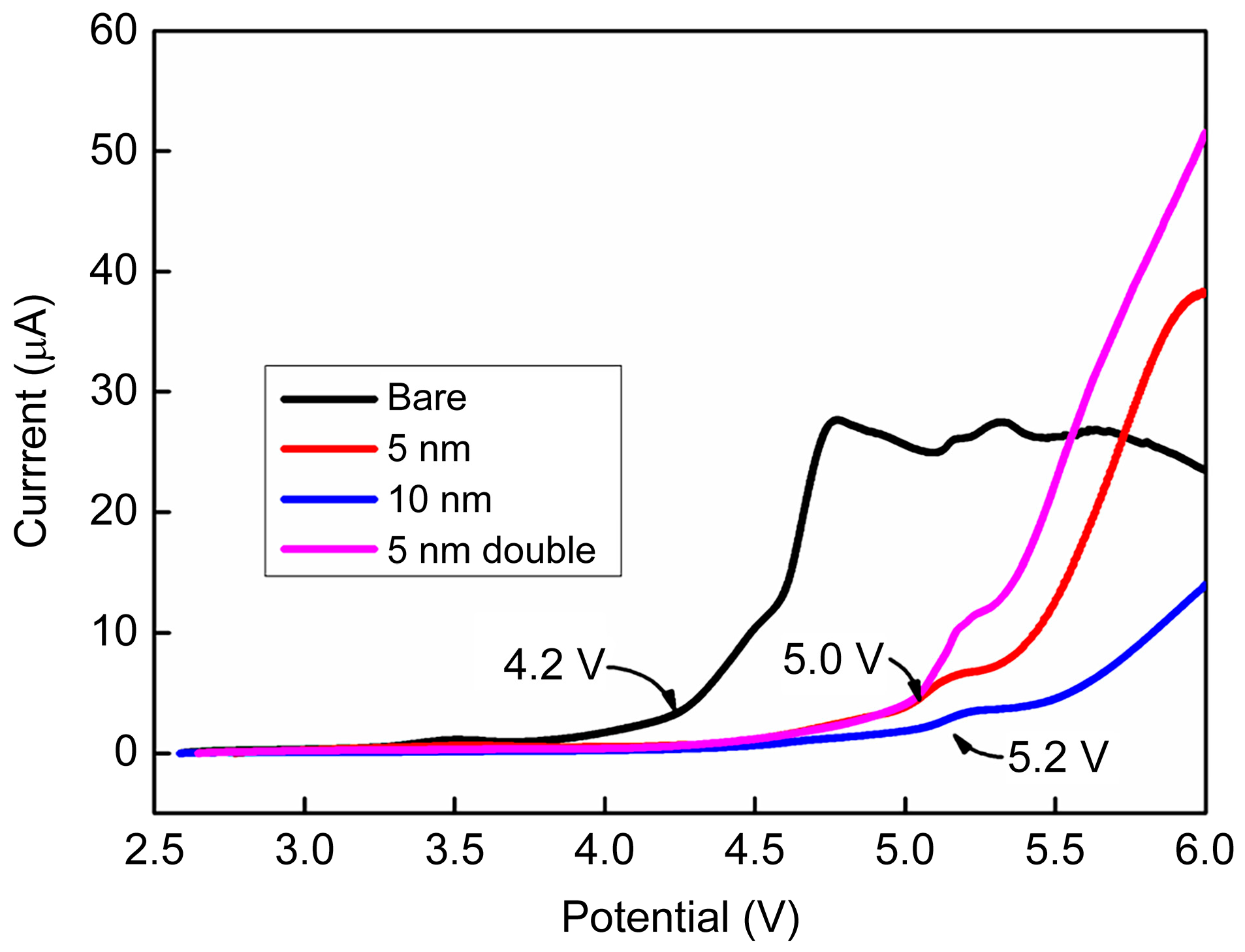
The oxidation stability of bare and Al2O3-coated Al-LLZO pellets was comparatively evaluated using LSV, as shown in Figure 5. The oxidation onset voltage was determined based on the potential at which the anodic current began to deviate from the baseline current region. The bare Al-LLZO sample exhibited an initial anodic current increase at ~4.2 V, followed by a more pronounced oxidation response near 4.5 V, suggesting relatively poor high-voltage stability. In contrast, all Al2O3-coated samples exhibited delayed anodic current responses in the high-voltage region.
The 5 nm single-side and 5 nm double-side coated samples exhibited similar initial oxidation onset behavior at ~5.0 V, whereas the 10 nm coated sample showed the most delayed anodic current response near 5.2 V (Figure 5). In addition, the 10 nm coated sample exhibited a relatively gradual anodic current increase even after the initial onset region, indicating the enhanced suppression of oxidation reaction kinetics under high-voltage conditions. These results confirm that the ALD-deposited Al2O3 layer effectively improves the high-voltage oxidation stability of Al-LLZO surfaces, while thicker coating layers provide enhanced oxidation suppression.
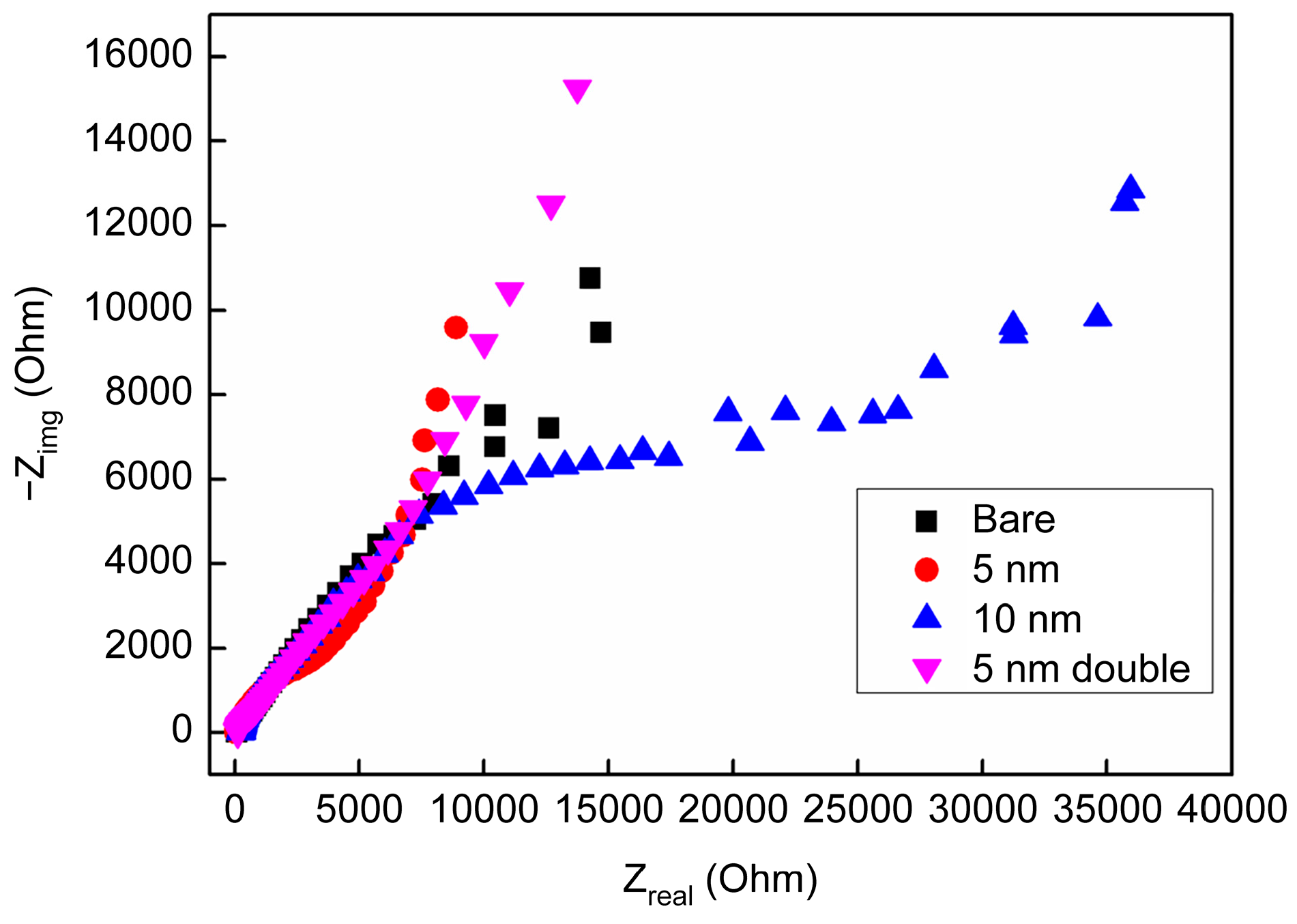
After LSV measurements, the EIS analysis was conducted using the same cells to investigate interfacial changes induced by high-voltage polarization (Figure 6). Although all samples exhibited similar bulk resistance behaviors in the high-frequency region, significant differences in the low-frequency impedance behaviors were observed based on the coating condition. The 10 nm coated sample exhibited the most pronounced low-frequency impedance increase and a strongly expanded tail region in the Nyquist plot, indicating increased interfacial impedance after high-voltage polarization.
In contrast, the 5 nm single-side coated sample exhibited a relatively small impedance increase, while the 5 nm double-side coated sample showed an intermediate impedance behavior. Although the bare sample exhibited increased impedance after LSV testing, the increase was less pronounced than that of the 10 nm coated sample. These results indicate that thicker Al2O3 coatings are highly effective for oxidation suppression; however, they may simultaneously increase interfacial impedance, indicating a trade-off relationship between oxidation stability and interfacial kinetics.

2.4. Li Plating/Stripping Stability and Long-Term Cycling Behavior

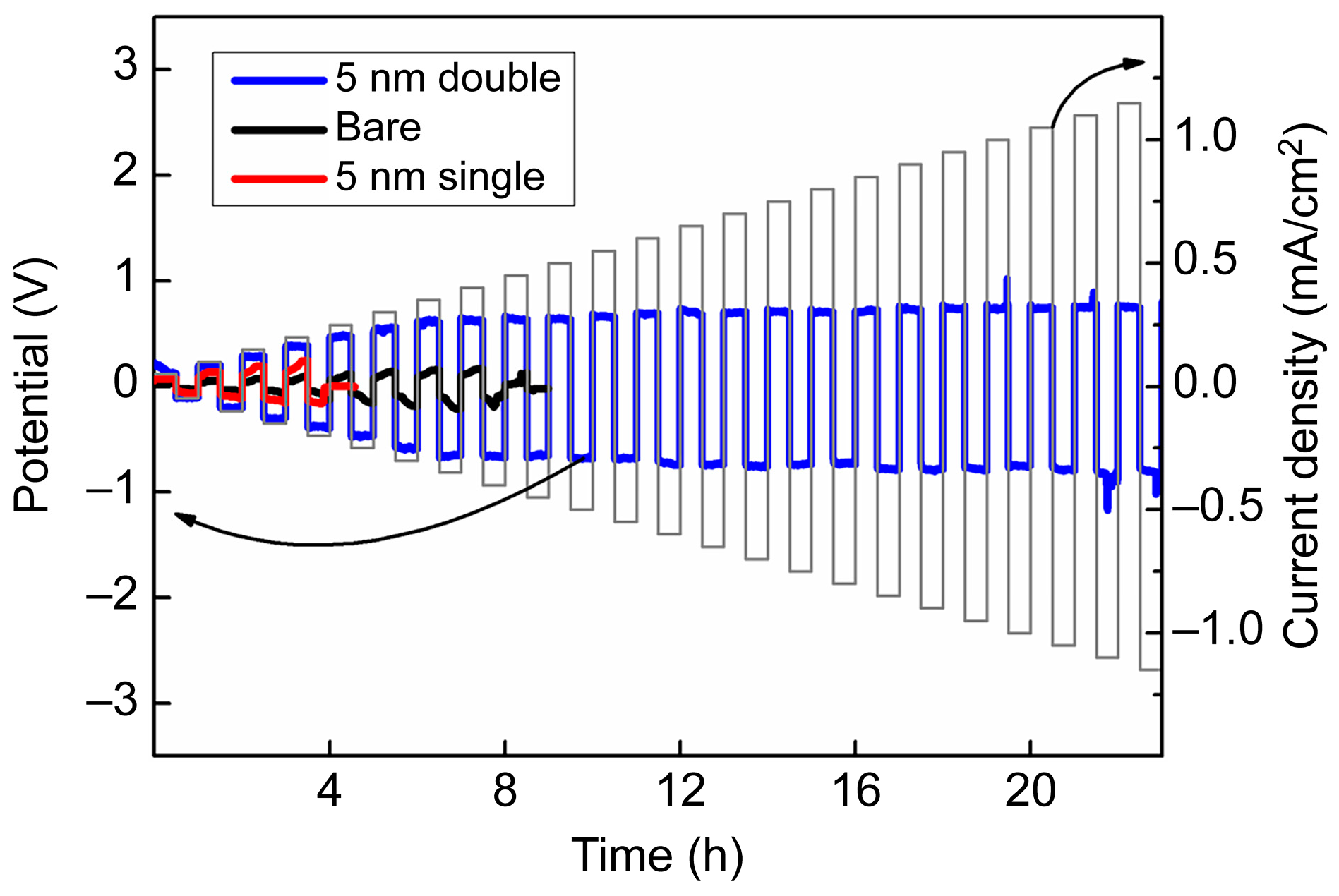
The Li plating/stripping stability of bare and Al2O3-coated Al-LLZO electrolytes is comparatively evaluated using CCD measurements (Figure 7). The current density was sequentially increased from 0.05 to 1.10 mA/cm2 with a step increment of 0.05 mA/cm2. Among the investigated conditions, the 5 nm double-side coated sample exhibited the most stable cycling behavior, achieving stable Li plating/stripping behavior up to 1.10 mA/cm2. In contrast, the bare and 5 nm single-side coated samples exhibited lower CCD values of 0.45 and 0.25 mA/cm2, respectively. Figure 7 shows that the 5 nm single-side coated sample exhibits unstable polarization behavior and short-circuit failure at relatively low current densities, whereas the bare sample exhibits intermediate CCD performance between the 5 nm single-side and 5 nm double-side coated samples.
The 5 nm double-side coated sample showed only a limited increase in polarization voltage despite the stepwise increase in current density, suggesting stable interfacial behavior during repeated Li plating/stripping processes. Similar polarization behavior associated with interfacial contact dynamics and void formation has been reported in Li/LLZO symmetric cells [54,56]. The symmetric Al2O3 interfacial layer is expected to promote more stable Li/solid electrolyte contact during cycling. In contrast, the relatively poor CCD performance of the 5 nm single-side coated sample may originate from the asymmetric interfacial structure introduced by the single-side Al2O3 coating layer, which promotes nonuniform Li-ion transport and localized current concentration, thereby resulting in unstable Li deposition behavior and earlier short-circuit failure. Previous studies suggested that contact loss and void formation during Li stripping reduced the effective interfacial contact area and promoted localized current concentration during subsequent Li plating processes [54,56,57].
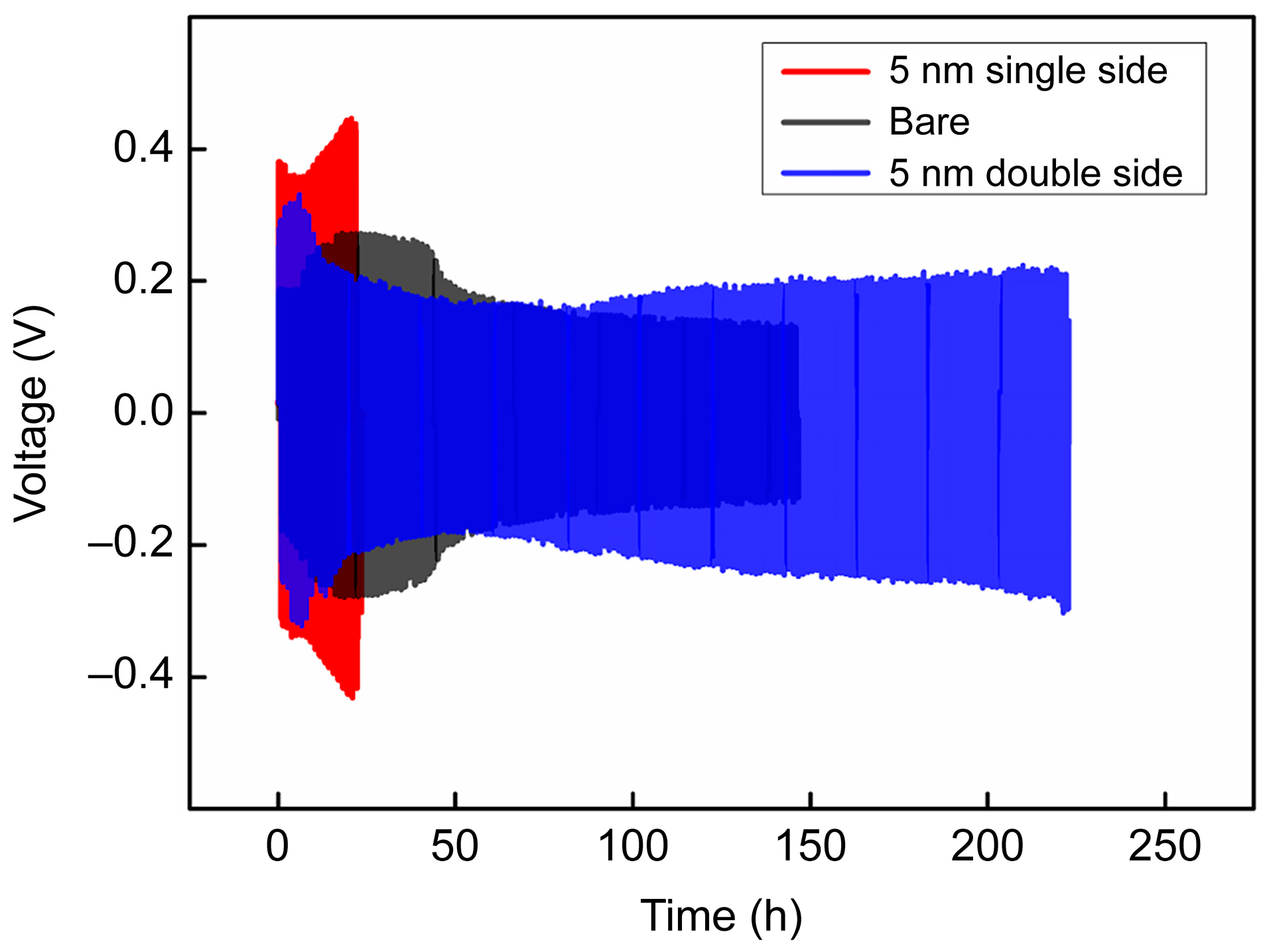
Long-term galvanostatic cycling tests were conducted using Li symmetric cells at a fixed current density of 0.05 mA/cm2, and the results are shown in Figure 8. At this relatively low current-density condition, the bare and 5 nm double-side coated cells maintained stable cycling behavior without short-circuit failure throughout the measurement period; the 5 nm single-side coated cell failed after ~24 h of cycling. The bare sample exhibited intermediate polarization behavior between that of the 5 nm single-side coated and 5 nm double-side coated samples during the current measurement period. In addition, the polarization voltage of the bare cell gradually decreased during prolonged cycling, which could be associated with progressive interfacial contact stabilization during the repeated Li plating/stripping processes.
These results indicate that stable and symmetric interfacial contact is important for long-term Li plating/stripping stability under mild current-density conditions. Although the bare cell exhibited stable cycling behavior at 0.05 mA/cm2, the 5 nm double-side coated sample demonstrated a significantly higher CCD value, indicating improved tolerance to increased current density. In contrast, the relatively poor cycling stability of the 5 nm single-side coated sample could be associated with the asymmetric interfacial structure introduced by the single-side coating layer. This could induce nonuniform Li-ion transport and localized current concentration during repeated cycling. Overall, the symmetric Al2O3 coating layer can contribute to maintaining stable interfacial contact and Li-ion flux under prolonged Li plating/stripping conditions.

2.5. Cross-Sectional FIB and TOF-SIMS Analysis After CCD Testing

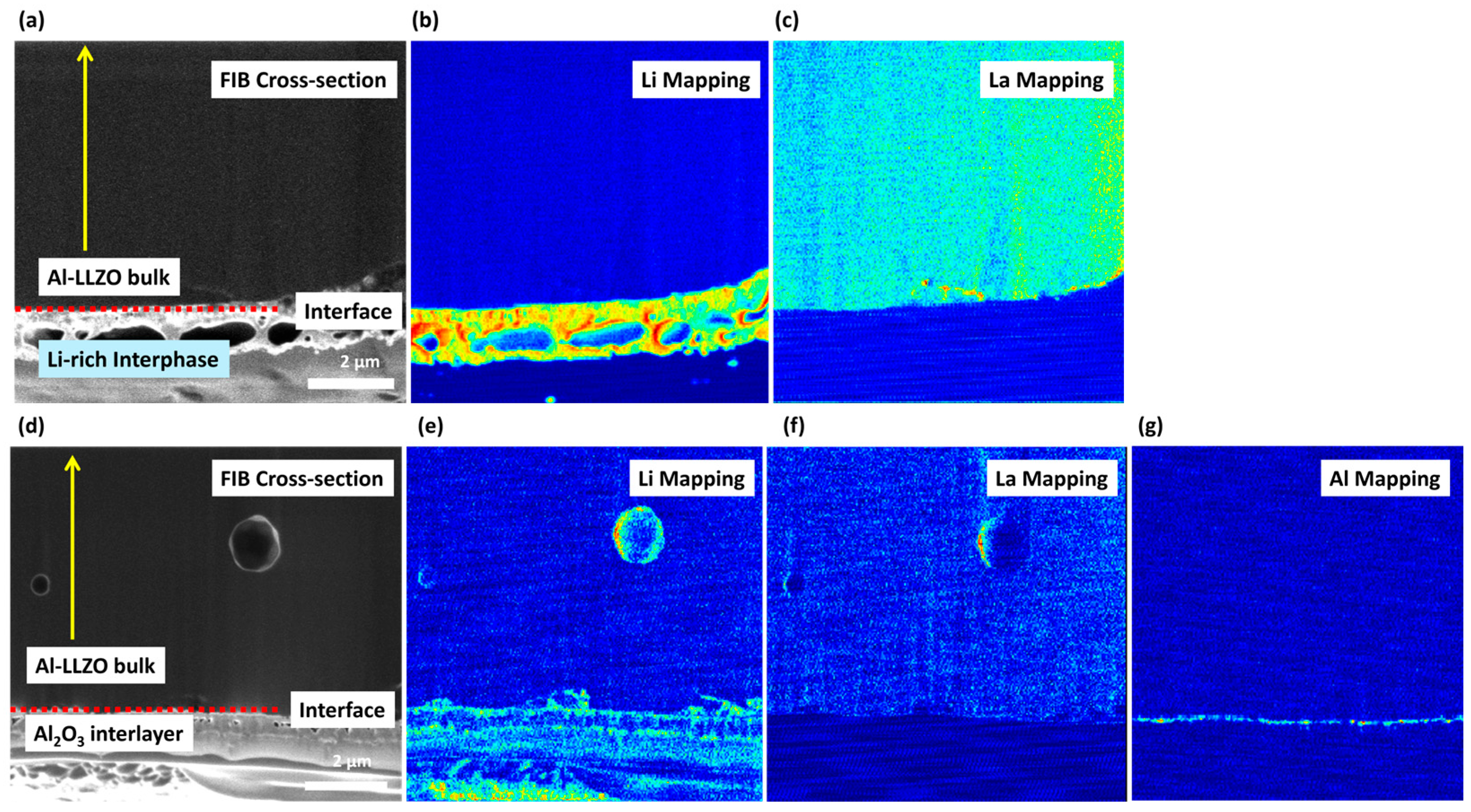
Figure 9 presents the cross-sectional FIB images and TOF-SIMS elemental mapping results of the bare and 5 nm Al2O3 double-side coated Al-LLZO pellets after CCD testing.
For the bare Al-LLZO pellet (Figure 9a–c), a distinct interfacial layer exhibiting a strong Li signal was observed between the Al-LLZO bulk and the Li electrode side. The corresponding La mapping revealed negligible La signal within this interfacial region, indicating that the layer was chemically distinct from the Al-LLZO bulk phase. In addition, the FIB image showed a porous morphology within the Li-rich interphase.
In contrast, the 5 nm Al2O3-coated sample (Figure 9d–g) exhibited a relatively uniform interfacial morphology. No pronounced Li-rich interphase was observed in the analyzed region, and the Al mapping revealed a continuous Al-containing layer localized near the interface. The La signal remained confined to the Al-LLZO bulk region.
Although TOF-SIMS analysis provides localized information from the analyzed cross-section, several notable differences were observed between the bare and Al2O3-coated samples. The Al mapping confirmed the presence of a continuous Al-containing layer near the interface of the coated sample after CCD testing, indicating the retention of the ultrathin Al2O3-derived interfacial layer. In the analyzed region of the bare sample, a Li-rich interphase accompanied by a porous morphology was observed, whereas the coated sample exhibited a relatively uniform interface without the formation of a comparable interphase. While these observations cannot be generalized to the entire interface due to the localized nature of the analysis, the observed interfacial characteristics are qualitatively consistent with the improved CCD performance of the Al2O3-coated samples. These results suggest that the Al2O3 coating may contribute to maintaining a more stable interfacial structure during repeated Li plating/stripping processes. In addition to the geometric effect of the symmetric coating configuration, previous studies have reported that Al2O3 can react with lithium species to form Li–Al–O interfacial phases that are Li-ion conductive and electronically insulating. Such Li–Al–O interphases have been shown to facilitate Li-ion transport while improving interfacial stability and suppressing lithium dendrite growth at LLZO-based interfaces [62,63,64,65]. Although the exact composition of the interfacial reaction products remains to be further clarified, the retained Al-containing interfacial layer observed by TOF-SIMS together with the enhanced electrochemical performance of the 5 nm double-side coated sample suggests a possible contribution of Li–Al–O-derived interfacial stabilization, consistent with previous reports. A comparison of representative solid electrolytes and ALD-coated LLZO-based electrolytes for all-solid-state batteries is summarized in Table 3.
Table 3. Comparison of representative solid electrolytes and ALD-coated LLZO-based electrolytes for all-solid-state batteries.
Electrolyte TypeStructureSintering Temperature (°C)Ionic Conductivity (S/cm)Oxidation StabilityCharacteristicReferences
LLZO
(undoped)
Garnet-type1100–1200~10−6~4.0–4.5 VHigh ionic conductivity; poor Li wettability; interfacial degradation[29,30,31]
Al-doped LLZOCubic garnet1100–120010−4–10−3~4.0–4.5 VImproved cubic phase stability via Al doping; Li2CO3 surface instability[32,33,34,35,36,37,39,40,41,66,67]
ALD-coated LLZOGarnet-type1100–1200~10−4ImprovedImproved interfacial stability through nanoscale coating and interlayer engineering[58,59,60,61]
[This work] Al2O3-coated Al-LLZOPE-ALD engineered garnet1150 °C
7 h
4.00 × 10⁻⁴ S/cm~5.0–5.2 VReduced electronic conductivity; improved oxidation stability and Li plating/stripping stability; stable CCD up to 1.10 mA/cm2This work

3. Materials and Methods

3.1. Synthesis of Al-Doped LLZO (Al-LLZO) and Fabrication of Pellets

Al-doped garnet-type solid electrolytes with a nominal composition of Li6.25Al0.25La3Zr2O12 (Al-LLZO) were synthesized using a conventional solid-state reaction method. Lithium carbonate (Li2CO3, 99%, Sigma-Aldrich Korea, Seoul, Republic of Korea), lanthanum oxide (La2O3, 99.9%, Sigma-Aldrich Korea), zirconium oxide (99%, Sigma-Aldrich Korea), and aluminum oxide (Al2O3, 99%, Sigma-Aldrich Korea) were used as starting materials and weighed according to the designed stoichiometric ratio. Prior to synthesis, the La2O3 powder was pre-heated at 900 °C for 3 h in a box furnace (PT-17EF033, PyroTech, Gyeonggi-do, Republic of Korea) to remove any absorbed moisture and carbonate species.
The precursor powders were mixed and pulverized by ball milling with zirconia balls at 100 rpm for 4 h, followed by drying and sieving through a 150-mesh. The mixed powders were calcined at 1050 °C for 7 h in an alumina crucible under ambient atmosphere. Subsequently, the calcined powders were subjected to secondary wet ball milling using isopropyl alcohol as the solvent at 200 rpm for 5 h. After drying for 24 h followed by sieving, the obtained fine powders were uniaxially pressed using a hydraulic press under a load of 1.5 ton for 3 min to fabricate green pellets with a diameter of 12 mm. These green pellets were buried in the mother powder with the same composition to suppress lithium volatilization during sintering and placed in alumina crucibles. The pellets were sintered at 1150 °C for 7 h under ambient atmosphere at a heating rate of 2 °C/min.
After sintering, the Al-LLZO pellets were polished to remove surface contamination layers and residual impurities. Al2O3 nanoprotective layers were subsequently deposited via PE-ALD (iOV-dx2, iSAC Research, Daejeon, Republic of Korea). Trimethylaluminum (iChems, Gyeonggi-do, Republic of Korea) was used as the metal–organic precursor, while O2 plasma was employed as the oxidant source. The deposition temperature was maintained at 250 °C. During plasma processing, the chamber pressure was controlled in the range of 1.1–1.4 Torr with a radiofrequency plasma power of 200 W. The coating thickness was controlled by adjusting the number of ALD cycles based on a calibrated growth-per-cycle (GPC) value of approximately 1.1 Å/cycle. The thickness of the PE-ALD Al2O3 coating was verified by spectroscopic ellipsometry (Elli-SE-U, Ellipso Technology, Suwon-si, Republic of Korea) using a Si witness wafer deposited simultaneously under identical deposition conditions. The measured thickness of the nominal 5 nm coating was approximately 5.23 nm, confirming good agreement with the thickness estimated from the GPC value. Three coating configurations were prepared: 5 nm single-side, 10 nm single-side, and 5 nm double-side. The electrochemical properties and interfacial stability of the coated samples were systematically compared with those of an uncoated bare Al-LLZO pellet.

3.2. Material Characterization and Electrochemical Measurements

The crystal structures of the synthesized Al-LLZO solid electrolytes were characterized using XRD (D2 PHASER, Bruker, Billerica, MA, USA) using Cu-Kα radiation with a wavelength of 1.5418 Å. The cross-sectional microstructures were characterized through SEM (Nova NanoSEM 450, FEI, Hillsboro, OR, USA). Cross-sectional elemental mapping was performed using an integrated FIB-TOF-SIMS system (Helios 5 UX, Thermo Fisher Scientific, Waltham, MA, USA, equipped with a TOFWERK TOF-SIMS module, Thun, Switzerland). The cross-sections were prepared by FIB milling, followed by TOF-SIMS analysis in positive ion mode at an accelerating voltage of 30 kV, a beam current of 90 pA, and a horizontal field width (HFW) of 10 μm. EIS, DC polarization, LSV, and CCD measurements were performed using an electrochemical workstation (VersaSTAT 3, Princeton Applied Research, Oak Ridge, TN, USA) operated with VersaStudio software (version 2.67.3, AMETEK, Berwyn, PA, USA). All electrochemical measurements were conducted at room temperature.
Ionic and electronic conductivity measurements were performed using Au symmetric cells fabricated by depositing Au thin-film electrodes on both sides of the pellets via a DC magnetron sputtering system (DC-Sputter, BLS, Pyeongtaek-si, Republic of Korea). Prior to sputtering, the chamber pressure was evacuated to ~1 × 10⁻⁵ Torr. Argon gas was introduced at 10 sccm under a pressure of 0.15 Torr. Au thin films with a thickness of ~50 nm were deposited at 40 W for 15 s.
The EIS measurements for ionic conductivity evaluation were conducted over a frequency range of 0.1 Hz to 1 MHz with an AC amplitude of 30 mV. The ionic conductivity was calculated using
σ = L R A
where σ, L, R, and A represent the ionic conductivity (S/cm), pellet thickness (cm), total resistance obtained from the Nyquist plot (Ω), and electrode area (cm2), respectively.
Electronic conductivity was evaluated through DC polarization measurements using Au/solid electrolyte/Au symmetric cells, where the Au electrodes served as ion-blocking electrodes. A constant voltage of 0.2 V was applied for 3600 s, and the steady-state current was used to calculate electronic conductivity according to Ohm’s law.
σ e = I t A U
where σe, I, t, A, and U represent the electronic conductivity (S/cm), steady-state current (A), pellet thickness (cm), electrode area (cm2), and applied voltage (V), respectively.
High-voltage oxidation stability and Li metal interfacial behavior were evaluated by assembling CR2032-type coin cells using Li metal electrodes. For the LSV measurements, Li/Al-LLZO/Au cells were fabricated for the bare sample, while Al2O3-coated samples employed Li/Al2O3-coated Al-LLZO/Au structures. The LSV measurements were conducted in the voltage range of 2.5–6.0 V at a scan rate of 0.5 mV/s. Au was used as a current-collecting electrode to ensure stable electrical contact during oxidation stability measurements. The oxidation onset voltage was defined as the potential at which the anodic current began to deviate from the baseline current region.
Li plating/stripping stability was investigated through CCD measurements using Li symmetric cells. The initial current density was set to 0.05 mA/cm2, and it was sequentially increased by 0.05 mA/cm2 until cell failure or short-circuit behavior was observed. One CCD cycle consisted of lithium plating (30 min), resting period (10 min), lithium stripping (30 min), and an additional resting period (10 min).
Long-term galvanostatic cycling tests were performed using a battery testing system (WBCS3000S, WonATech, Seoul, Republic of Korea) operated with Smart Interface software (version 1.8.9.0, WonATech Co., Ltd., Seoul, Republic of Korea). The cycling tests were conducted at a fixed current density of 0.05 mA/cm2 using direct Li symmetric cells with bare and Al2O3-coated Al-LLZO pellets, without Au interlayers, to evaluate the practical interfacial stability under realistic operating conditions.

4. Conclusions

In this study, Al-LLZO solid electrolytes were synthesized via a solid-state reaction method, and the effects of PE-ALD-based Al2O3 nanocoatings on electrochemical properties and interfacial stability were systematically investigated. The optimized sintering condition of 1150 °C for 7 h produced a dense cubic Al-LLZO structure with a relative density of 85.6 ± 2.5% and an ionic conductivity of 4.00 × 10⁻⁴ S/cm because of the enhanced densification and reduced grain-boundary resistance.
The ALD-based Al2O3 coating effectively reduced electronic conductivity without significantly affecting the bulk ionic conductivity of Al-LLZO. The 5 nm double-side coated sample showed lower electronic conductivity compared to those of the other samples. The LSV analysis demonstrated that the 10 nm coated sample exhibited the most delayed anodic current response and oxidation behavior. However, post-LSV EIS analysis revealed increased low-frequency impedance for the 10 nm coating, suggesting a trade-off relationship between oxidation stability and interfacial impedance. CCD and long-term galvanostatic cycling results demonstrated that Li plating/stripping stability strongly depended on the coating configuration and interfacial symmetry. The 5 nm double-side coated sample exhibited the best CCD performance of 1.10 mA/cm2 and maintained stable cycling behavior for over 200 h, indicating superior interfacial stability during repeated Li plating/stripping processes. Post-mortem cross-sectional FIB and TOF-SIMS analyses revealed the presence of an Al-containing interfacial layer in the Al2O3-coated sample and distinct interfacial characteristics compared with the bare sample after CCD testing. These observations provide additional insight into interfacial evolution during repeated Li plating/stripping processes.
Overall, the PE-ALD Al2O3 nanoprotective layer effectively improved the high-voltage oxidation stability and Li metal interfacial stability of Al-LLZO solid electrolytes. These results suggest that symmetric nanoscale interfacial engineering using ALD-based coatings is a promising strategy for practical high-voltage garnet-type all-solid-state batteries.

Author Contributions

Conceptualization, J.A. and W.L.; Methodology, B.K. (Bojoong Kim) and D.O.; Validation, C.Y. and Y.S.; Investigation, J.A., J.C. and B.K. (Byungwook Kim); Writing—Original draft preparation, J.A. and C.Y.; Writing—Review and editing, Y.S. and C.Y. All authors have read and agreed to the published version of the manuscript.

Funding

This work was supported by the Technology Innovation Program funded by the Ministry of Trade, Industry & Energy (MOTIE, Republic of Korea) through the projects “Development of all-solid-state polymer battery for wearable devices that fit closely to the human body” (RS-2025-02315159, Development of 0.1 Ah-class polymer all-solid-state battery with over 250 Wh/kg) and “Materials & Components Technology Development (R&D)–Package-type” (RS-2025-02220734, Development of Manufacturing Technology for High-Purity Iron Chloride (>99.5%) and Sodium Silicate (>97.0%) via Utilization of Bayer Process Byproducts).

Institutional Review Board Statement

Not applicable.

Informed Consent Statement

Not applicable.

Data Availability Statement

The original contributions presented in the study are included in the article; further inquiries can be directed to the corresponding author.

Conflicts of Interest

The authors declare no conflicts of interest.

Abbreviations

The following abbreviations are used in this manuscript:
LIBsLithium-ion batteries
ASSBsAll-solid-state batteries
Al-LLZOAl-doped Li6.25Al0.25La3Zr2O12
PE-ALDPlasma-enhanced atomic layer deposition
EISElectrochemical impedance spectroscopy
LSVLinear sweep voltammetry
CCDCritical current density

References

  1. Armand, M.; Tarascon, J.M. Building better batteries. Nature 2008, 451, 652–657. [Google Scholar] [CrossRef] [PubMed]
  2. Goodenough, J.B.; Park, K.S. The Li-ion rechargeable battery: A perspective. J. Am. Chem. Soc. 2013, 135, 1167–1176. [Google Scholar] [CrossRef] [PubMed]
  3. Turcheniuk, K.; Bondarev, D.; Amatucci, G.G.; Yushin, G. Battery materials for low-cost electric transportation. Mater. Today 2021, 42, 57–72. [Google Scholar] [CrossRef]
  4. Schmuch, R.; Wagner, R.; Hörpel, G.; Placke, T.; Winter, M. Performance and cost of materials for lithium-based rechargeable automotive batteries. Nat. Energy 2018, 3, 267–278. [Google Scholar] [CrossRef]
  5. Henriksen, M.; Vaagsaether, K.; Lundberg, J.; Forseth, S.; Bjerketvedt, D. Laminar burning velocity of gases vented from failed Li-ion batteries. J. Power Sources 2021, 506, 230141. [Google Scholar] [CrossRef]
  6. Xu, B.; Lee, J.; Kwon, D.; Kong, L.; Pecht, M. Mitigation strategies for Li-ion battery thermal runaway: A review. Renew. Sustain. Energy Rev. 2021, 150, 111437. [Google Scholar] [CrossRef]
  7. Wang, Q.; Ping, P.; Zhao, X.; Chu, G.; Sun, J.; Chen, C. Thermal runaway caused fire and explosion of lithium ion battery. J. Power Sources 2012, 208, 210–224. [Google Scholar] [CrossRef]
  8. Roth, E.P.; Orendorff, C.J. How electrolytes influence battery safety. Electrochem. Soc. Interface 2012, 21, 45–49. [Google Scholar] [CrossRef]
  9. Hausbrand, R.; Cherkashinin, G.; Ehrenberg, H.; Gröting, K.; Albe, C.; Hess, C.; Jaegermann, W. Fundamental degradation mechanisms of layered oxide Li-ion battery cathode materials: Methodology, insights and novel approaches. Mater. Sci. Eng. B 2015, 192, 3–25. [Google Scholar] [CrossRef]
  10. Janek, J.; Zeier, W.G. A solid future for battery development. Nat. Energy 2016, 1, 16141. [Google Scholar] [CrossRef]
  11. Chen, Y.; Wen, K.; Chen, T.; Zhang, X.; Armand, M.; Chen, S. Recent progress in all-solid-state lithium batteries: The emerging strategies for advanced electrolytes and their interfaces. Energy Storage Mater. 2020, 31, 401–433. [Google Scholar] [CrossRef]
  12. Zhu, J.; Li, X.; Wu, C.; Gao, J.; Xu, H.; Li, Y.; Guo, X.; Li, H.; Zhou, W. A multilayer ceramic electrolyte for all-solid-state Li batteries. Angew. Chem. Int. Ed. 2021, 60, 3781–3790. [Google Scholar] [CrossRef] [PubMed]
  13. Chen, X.; Guan, Z.; Chu, F.; Xue, Z.; Wu, F.; Yu, Y. Air-stable inorganic solid-state electrolytes for high energy density lithium batteries: Challenges, strategies, and prospects. InfoMat 2022, 4, e12248. [Google Scholar] [CrossRef]
  14. Wang, Y.; Richards, W.D.; Ong, S.P.; Miara, L.J.; Kim, J.C.; Mo, Y.; Ceder, G. Design principles for solid-state lithium superionic conductors. Nat. Mater. 2015, 14, 1026–1031. [Google Scholar] [CrossRef] [PubMed]
  15. Lee, J.; Lee, T.; Char, K.; Kim, K.J.; Choi, J.W. Issues and advances in scaling up sulfide-based all-solid-state batteries. Acc. Chem. Res. 2021, 54, 3390–3402. [Google Scholar] [CrossRef] [PubMed]
  16. Park, J.-S.; Jo, C.-H.; Myung, S.-T. Comprehensive understanding on lithium argyrodite electrolytes for stable and safe all-solid-state lithium batteries. Energy Storage Mater. 2023, 61, 102869. [Google Scholar] [CrossRef]
  17. Zhao, X.; Wang, Y.; Zhang, H. A review of polymer-based solid-state electrolytes for lithium batteries. Batter. Supercaps 2023, 6, e202200502. [Google Scholar] [CrossRef]
  18. Song, Z.; Wang, H.; Angell, C.A. A reflection on polymer electrolytes for solid-state lithium metal batteries. Nat. Commun. 2023, 14, 5221. [Google Scholar] [CrossRef] [PubMed]
  19. Murugan, R.; Thangadurai, V.; Weppner, W. Fast lithium ion conduction in garnet-type Li7La3Zr2O12. Angew. Chem. Int. Ed. 2007, 46, 7778–7781. [Google Scholar] [CrossRef] [PubMed]
  20. Thangadurai, V.; Weppner, W. Li6ALa2Ta2O12 (A = Sr, Ba): Novel garnet-like oxides for fast lithium ion conduction. Adv. Funct. Mater. 2005, 15, 107–112. [Google Scholar] [CrossRef]
  21. Thangadurai, V.; Narayanan, S.; Pinzaru, D. Garnet-type solid-state fast lithium ion conductors for Li batteries. Chem. Soc. Rev. 2014, 43, 4714–4727. [Google Scholar] [CrossRef] [PubMed]
  22. Sun, H.; Kang, S.; Cui, L. Prospects of LLZO type solid electrolyte: From material design to battery application. Chem. Eng. J. 2023, 452, 140375. [Google Scholar] [CrossRef]
  23. López-Aranguren, P.; Reynaud, M.; Głuchowski, P.; Bustinza, A.; Galceran, M.; López del Amo, J.M.; Armand, M.; Casas-Cabanas, M. Crystalline LiPON as a bulk-type solid electrolyte. ACS Energy Lett. 2021, 6, 445–450. [Google Scholar] [CrossRef]
  24. Hartmann, P.; Leichtweiss, T.; Busche, M.R.; Schneider, M.; Reich, M.; Sann, J.; Adelhelm, P.; Janek, J. Degradation of NASICON-type materials in contact with lithium metal: Formation of mixed conducting interphases (MCI) on solid electrolytes. J. Phys. Chem. C 2013, 117, 21064–21074. [Google Scholar] [CrossRef]
  25. Bucharsky, E.C.; Schell, K.G.; Hupfer, T.; Hoffmann, M.J.; Rohde, M.; Seifert, H.J. Thermal properties and ionic conductivity of Li1.3Ti1.7Al0.3(PO4)3 solid electrolytes sintered by field-assisted sintering. Ionics 2016, 22, 1043–1049. [Google Scholar] [CrossRef]
  26. Lu, W.; Xue, M.; Zhang, C. Modified Li7La3Zr2O12 (LLZO) and LLZO-polymer composites for solid-state lithium batteries. Energy Storage Mater. 2021, 39, 108–129. [Google Scholar] [CrossRef]
  27. Sakakura, M.; Mitsuishi, K.; Okumura, T.; Ishigaki, N.; Iriyama, Y. Fabrication of oxide-based all-solid-state batteries by a sintering process based on function sharing of solid electrolytes. ACS Appl. Mater. Interfaces 2022, 14, 48547–48557. [Google Scholar] [CrossRef] [PubMed]
  28. Wang, C.; Fu, K.; Kammampata, S.P.; McOwen, D.W.; Samson, A.J.; Zhang, L.; Hitz, G.T.; Nolan, A.M.; Wachsman, E.D.; Mo, Y.; et al. Garnet-type solid-state electrolytes: Materials, interfaces, and batteries. Chem. Rev. 2020, 120, 4257–4300. [Google Scholar] [CrossRef] [PubMed]
  29. Awaka, J.; Kijima, N.; Hayakawa, H.; Akiba, E. Synthesis and structure analysis of tetragonal Li7La3Zr2O12 with the garnet-related type structure. J. Solid State Chem. 2009, 182, 2046–2052. [Google Scholar] [CrossRef]
  30. Larraz, G.; Orera, A.; Sanjuán, M.L. Cubic phases of garnet-type Li7La3Zr2O12: The role of hydration. J. Mater. Chem. A 2013, 1, 11419–11428. [Google Scholar] [CrossRef]
  31. Raju, M.M.; Altayran, F.; Johnson, M.; Wang, D.; Zhang, Q. Crystal structure and preparation of Li7La3Zr2O12 (LLZO) solid-state electrolyte and doping impacts on the conductivity: An overview. Electrochem 2021, 2, 390–414. [Google Scholar] [CrossRef]
  32. Ishigaki, K.; Okumura, T.; Mitsuishi, K.; Sakakura, M.; Iriyama, Y. Preparation of garnet-type Li7-3xAlxLa3Zr2O12 at lower temperature by using powders of mixed pre-treatment conditions. J. Inorg. Organomet. Polym. Mater. 2018, 28, 2023–2027. [Google Scholar] [CrossRef]
  33. Zhuang, L.; Huang, X.; Lu, Y.; Tang, J.; Zhou, Y.; Ao, X.; Yang, Y.; Tian, B. Phase transformation and grain-boundary segregation in Al-doped Li7La3Zr2O12 ceramics. Ceram. Int. 2021, 47, 22768–22775. [Google Scholar] [CrossRef]
  34. Huang, X.; Lu, Y.; Song, Z.; Rui, K.; Wang, Q.; Xiu, T.; Badding, M.E.; Wen, Z. Manipulating Li2O atmosphere for sintering dense Li7La3Zr2O12 solid electrolyte. Energy Storage Mater. 2019, 22, 207–217. [Google Scholar] [CrossRef]
  35. Düvel, A.; Kuhn, A.; Robben, L.; Wilkening, M.; Heitjans, P. Mechanosynthesis of solid electrolytes: Preparation, characterization, and Li ion transport properties of garnet-type Al-doped Li7La3Zr2O12 crystallizing with cubic symmetry. J. Phys. Chem. C 2012, 116, 15192–15202. [Google Scholar] [CrossRef]
  36. Chen, Y.; Rangasamy, E.; Liang, C.; An, K. Origin of high Li+ conduction in doped Li7La3Zr2O12 garnets. Chem. Mater. 2015, 27, 5491–5494. [Google Scholar] [CrossRef]
  37. Yang, T.; Li, Y.; Wu, W.; Cao, Z.; He, W.; Gao, Y.; Liu, J.; Li, G. The synergistic effect of dual substitution of Al and Sb on structure and ionic conductivity of Li7La3Zr2O12 ceramic. Ceram. Int. 2018, 44, 1538–1544. [Google Scholar] [CrossRef]
  38. Mann, M.; Küpers, M.; Häuschen, G.; Finsterbusch, M.; Fattakhova-Rohlfing, D.; Guillon, O. Evaluation of scalable synthesis methods for aluminum-substituted Li7La3Zr2O12 solid electrolytes. Materials 2021, 14, 6809. [Google Scholar] [CrossRef] [PubMed]
  39. Ayalew, K.H.; Palaniyandy, N.; Mathe, M.K.; Msomi, P.F. Garnet-type LLZO electrolytes for solid-state lithium batteries: Interfaces, conductivity, in-situ processing, and industrial prospects. Chem. Eng. J. 2025, 524, 168098. [Google Scholar] [CrossRef]
  40. Kim, H.-J.; Kim, J.H.; Choi, M.; Kim, J.H.; Shin, H.; Kwon, K.C.; Park, S.H.; Park, H.M.; Lee, S.; Kim, Y.H.; et al. Revitalizing multifunctionality of Li–Al–O system enabling mother-powder-free sintering of garnet-type solid electrolytes. Mater. Today 2026, 92, 151–159. [Google Scholar] [CrossRef]
  41. Yang, L.; Dai, Q.; Liu, L.; Shao, D.; Luo, K.; Jamil, S.; Liu, H.; Luo, Z.; Chang, B.; Wang, X. Rapid sintering method for highly conductive Li7La3Zr2O12 ceramic electrolyte. Ceram. Int. 2020, 46, 10917–10924. [Google Scholar] [CrossRef]
  42. Wang, M.J.; Choudhury, R.; Sakamoto, J. Characterizing the Li-solid-electrolyte interface dynamics as a function of stack pressure and current density. Joule 2019, 3, 2165–2178. [Google Scholar] [CrossRef]
  43. Han, X.; Gong, Y.; Fu, K.K.; He, X.; Hitz, G.T.; Xiang, J.; Liu, B.; Wachsman, E.D.; Mo, Y.; Hu, L. Negating interfacial impedance in garnet-based solid-state Li metal batteries. Nat. Mater. 2017, 16, 572–579. [Google Scholar] [CrossRef] [PubMed]
  44. Han, F.; Westover, A.S.; Yue, J.; Fan, X.; Wang, F.; Chi, M.; Leonard, D.N.; Dudney, N.J.; Wang, H.; Wang, C. High electronic conductivity as the origin of lithium dendrite formation within solid electrolytes. Nat. Energy 2019, 4, 187–196. [Google Scholar] [CrossRef]
  45. Zhu, F.; Deng, W.; Zhang, B.; Wang, H.; Xu, L.; Liu, H.; Luo, Z.; Zou, G.; Hou, H.; Ji, X. In-situ construction of multifunctional interlayer enabled dendrite-free garnet-based solid-state batteries. Nano Energy 2023, 111, 108416. [Google Scholar] [CrossRef]
  46. Kasemchainan, J.; Zekoll, S.; Jolly, D.S.; Ning, Z.; Hartley, G.O.; Marrow, J.; Bruce, P.G. Critical stripping current leads to dendrite formation on plating in lithium anode solid electrolyte cells. Nat. Mater. 2019, 18, 1105–1111. [Google Scholar] [CrossRef] [PubMed]
  47. Benabed, Y.; Vanacker, A.; Foran, G.; Rousselot, S.; Hautier, G.; Dollé, M. Solving the Li7La3Zr2O12 electrochemical stability window puzzle. Mater. Today Energy 2023, 35, 101320. [Google Scholar] [CrossRef]
  48. Zhu, Y.; He, X.; Mo, Y. Origin of outstanding stability in the lithium solid electrolyte materials: Insights from thermodynamic analyses based on first-principles calculations. ACS Appl. Mater. Interfaces 2015, 7, 23685–23693. [Google Scholar] [CrossRef] [PubMed]
  49. Sharafi, A.; Meyer, H.M.; Nanda, J.; Wolfenstine, J.; Sakamoto, J. Characterizing the Li– Li7La3Zr2O12 interface stability and kinetics as a function of temperature and current density. J. Power Sources 2016, 302, 135–139. [Google Scholar] [CrossRef]
  50. Kim, K.J.; Rupp, J.L.M. All ceramic cathode composite design and manufacturing towards low interfacial resistance for garnet-based solid-state lithium batteries. Energy Environ. Sci. 2020, 13, 4930–4945. [Google Scholar] [CrossRef]
  51. Schwietert, T.K.; Arseneault, V.A.; Bavniak, N.J.; Mo, Y. Clarifying the relationship between redox activity and electrochemical stability in solid electrolytes. Nat. Mater. 2020, 19, 428–435. [Google Scholar] [CrossRef] [PubMed]
  52. Shi, N.; Yang, B.; Chen, N.; Chen, R. Li2CO3 contamination in garnet solid electrolyte: Origins, impacts, and mitigation strategies. Energy Storage Mater. 2025, 77, 104173. [Google Scholar] [CrossRef]
  53. Chang, W.; May, R.; Wang, M.; Thorsteinsson, G.; Sakamoto, J.; Marbella, L.; Steingart, D. Evolving contact mechanics and microstructure formation dynamics of the lithium metal–Li7La3Zr2O12 interface. Nat. Commun. 2021, 12, 6369. [Google Scholar] [CrossRef] [PubMed]
  54. Lu, Y.; Zhao, C.-Z.; Hu, J.-K.; Sun, S.; Yuan, H.; Fu, Z.-H.; Chen, X.; Huang, J.-Q.; Ouyang, M.; Zhang, Q. The void formation behaviors in working solid-state Li metal batteries. Sci. Adv. 2022, 8, eadd0510. [Google Scholar] [CrossRef] [PubMed]
  55. Lee, Y.G.; Fujiki, S.; Jung, C.; Suzuki, N.; Yashiro, N.; Omoda, R.; Ko, D.S.; Shiratsuchi, T.; Sugimoto, T.; Ryu, S.; et al. High-energy long-cycling all-solid-state lithium metal batteries enabled by silver-carbon composite anodes. Nat. Energy 2020, 5, 299–308. [Google Scholar] [CrossRef]
  56. Cheng, E.J.; Duan, H.; Wang, M.J.; Kazyak, E.; Munakata, H.; Garcia-Mendez, R.; Gao, B.; Huo, H.; Zhang, T.; Chen, F.; et al. Li-stuffed garnet solid electrolytes: Current status, challenges, and perspectives for practical Li-metal batteries. Energy Storage Mater. 2025, 75, 103970. [Google Scholar] [CrossRef]
  57. Zhao, Y.; Chen, L.; Su, Y.; Jin, H.; Wang, C. Review of garnet-type Li7La3Zr2O12 solid electrolyte: Materials and interface issues. J. Mater. Sci. 2025, 60, 629–661. [Google Scholar] [CrossRef]
  58. Zhao, Y.; Zheng, K.; Sun, X. Addressing interfacial issues in liquid-based and solid-state batteries by atomic and molecular layer deposition. Joule 2018, 2, 2583–2604. [Google Scholar] [CrossRef]
  59. Meng, X.; Yang, X.Q.; Sun, X. Emerging applications of atomic layer deposition for lithium-ion battery studies. Adv. Mater. 2012, 24, 3589–3615. [Google Scholar] [CrossRef] [PubMed]
  60. Liu, J.; Sun, X. Elegant design of electrode and electrode/electrolyte interface in lithium-ion batteries by atomic layer deposition. Nanotechnology 2015, 26, 024001. [Google Scholar] [CrossRef] [PubMed]
  61. Kozen, A.C.; Lin, C.-F.; Pearse, A.J.; Schroeder, M.A.; Han, X.; Hu, L.; Lee, S.-B.; Rubloff, G.W.; Noked, M. Next-generation lithium metal anode engineering via atomic layer deposition. ACS Nano 2015, 9, 5884–5892. [Google Scholar] [CrossRef] [PubMed]
  62. Pei, D.; Liu, Z.; Ma, R.; Huang, S.; Hou, S.; Liu, M.; Cao, G.; Jin, H. In-situ constructing slow-release Li–Al–O interface layer for lithium metal batteries to enhance interface stability and suppress lithium dendrite growth. Chem. Eng. J. 2022, 446, 136827. [Google Scholar] [CrossRef]
  63. Zhang, Y.; Gao, X.; Tang, Z.; Mei, Y.; Xiang, X.; Deng, J. Study on the suppression of lithium dendrites based on solid electrolyte Li7La3Zr2O12 with annealing treatment of Al interlayer. J. Alloys Compd. 2022, 904, 163908. [Google Scholar] [CrossRef]
  64. Steinhoff, M.K.; Domgans, A.; Ahmed, J.; Schierholz, R.; Daniel, D.T.; Aghdassi, N.; Yu, S.; Tempel, H.; Eichel, R.-A. Tailoring Li–Al–O interphases in garnet-type solid-state electrolytes via powder atomic layer deposition. ACS Appl. Mater. Interfaces 2026, 18, 18955–18968. [Google Scholar] [CrossRef] [PubMed]
  65. Cheng, J.; Zhou, X.; Zhang, H.; Zeng, Z.; Li, Y.; Zhu, Y.; Liao, Y.; Ci, L.; Li, D. From blocker to booster: Harnessing garnet surface chemistry for advanced solid-state electrolytes. Nano Res. 2025, 18, 94906992. [Google Scholar] [CrossRef]
  66. Li, Y.; Cao, Z.; Jiang, Z.; Cao, Y.; Liu, J.; Wang, L.; Li, G. Synergistic effect of Ga and Yb co-doping on the structure and ionic conductivity of Li7La3Zr2O12 Ceramics. Ionics 2022, 28, 5321–5331. [Google Scholar] [CrossRef]
  67. Jiang, J.; Wang, Q.; Cui, J.; Guo, H.; Zhang, H.; Zhang, G.; Chen, X.; Jiang, Y.; Li, Y.; Liu, C. Improved electrical transport properties in Ga/Ta co-doped LLZO under high temperature and pressure. Appl. Phys. Lett. 2025, 126, 213902. [Google Scholar] [CrossRef]
Figure 1. X-ray diffraction (XRD) patterns of Al-LLZO pellets sintered at different temperatures (950, 1050, and 1150 °C) compared with the green pellet and reference cubic LLZO phase.
Inorganics 14 00170 g001
Figure 2. Cross-sectional SEM images of Al-LLZO pellets sintered at different temperatures: (a,d) 950 °C for 9 h, (b,e) 1050 °C for 9 h, and (c,f) 1150 °C for 7 h. (ac) show low-magnification images (3K), whereas (df) show high-magnification images (10K).
Inorganics 14 00170 g002
Figure 3. (a) Nyquist plots of Al-LLZO pellets sintered at different temperatures (1050 and 1150 °C), (b) Relative density and total ionic conductivity of Al-LLZO pellets (950, 1050, and 1150 °C).
Inorganics 14 00170 g003
Figure 4. Electrochemical characterization of bare and Al2O3-coated Al-LLZO pellets using Au symmetric cells. (a,b) EIS curves of bare, 5 nm single-side coated, 10 nm single-side coated, and 5 nm double-side coated samples. (c) DC polarization curves measured under an applied voltage of 0.2 V. The inset in (b) presents the simplified equivalent circuit (Rtotal–CPE) used for impedance analysis.
Inorganics 14 00170 g004
Figure 5. Linear sweep voltammetry (LSV) curves of bare and Al2O3-coated Al-LLZO pellets measured in the voltage range of 2.5–6.0 V at a scan rate of 0.5 mV/s.
Inorganics 14 00170 g005
Figure 6. EIS Nyquist plots of Li/Al-LLZO/Au and Li/Al2O3-coated Al-LLZO/Au coin cells measured after LSV evaluation.
Inorganics 14 00170 g006
Figure 7. Critical current density performance of Li/Al-LLZO/Li symmetric cells with bare and Al2O3-coated Al-LLZO pellets, measured by stepwise current density increase from 0.05 to 1.10 mA/cm2.
Inorganics 14 00170 g007
Figure 8. Long-term galvanostatic cycling performance of direct Li/Al-LLZO/Li symmetric cells with bare and Al2O3-coated Al-LLZO electrolytes measured at a fixed current density of 0.05 mA/cm2.
Inorganics 14 00170 g008
Figure 9. Cross-sectional FIB images and TOF-SIMS elemental mapping of Al-LLZO pellets after CCD testing. (a) FIB cross-section, (b) Li mapping, and (c) La mapping of the bare Al-LLZO pellet. (d) FIB cross-section, (e) Li mapping, (f) La mapping, and (g) Al mapping of the 5 nm Al2O3 double-side coated Al-LLZO pellet. The elemental distributions were obtained using cross-sectional TOF-SIMS analysis following FIB milling.
Inorganics 14 00170 g009
Table 1. Ionic conductivity and relative density of Al-LLZO pellets sintered under different temperature conditions.
TemperatureIonic Conductivity (S/cm)Relative Density (%)
950 °C, 9 h-48.2 ± 7.0
1050 °C, 9 h6.95 × 10−575.2 ± 6.0
1150 °C, 7 h4.00 × 10−485.6 ± 2.5
Table 2. Ionic conductivity, electronic conductivity, and Li-ion transference number (tLi+) of bare and Al2O3-coated Al-LLZO pellets with different coating structures and thicknesses.
TypeIonic Conductivity (S/cm)Electronic Conductivity (S/cm)tLi+
Bare4.46 × 10−44.58 × 10−80.9999
Al2O3 5 nm4.63 × 10−44.23 × 10−90.9999
Al2O3 10 nm4.64 × 10−45.77 × 10−90.9999
Al2O3 5 nm double-side4.65 × 10−41.01 × 10−90.9999
Disclaimer/Publisher’s Note: The statements, opinions and data contained in all publications are solely those of the individual author(s) and contributor(s) and not of MDPI and/or the editor(s). MDPI and/or the editor(s) disclaim responsibility for any injury to people or property resulting from any ideas, methods, instructions or products referred to in the content.