Article

Luminescence Intensity Ratio and Principal Component Analysis-Assisted Thermometry in Pr3+-Activated Inorganic Hosts


by
Vesna Đorđević
1,*,
Zoran Ristić
1,*,
Anđela Rajčić
1,
Ljubica Đačanin Far
1,
Mina Medić
1,
Željka Antić
1,2 and
Miroslav D. Dramićanin
1,2
1
Center of Excellence for Photoconversion, Vinča Institute of Nuclear Sciences–National Institute of the Republic of Serbia, University of Belgrade, P.O. Box 522, 11001 Belgrade, Serbia
2
National Institute of Research and Development for Electrochemistry and Condensed Matter, INCEMC, 300569 Timisoara, Romania
*
Authors to whom correspondence should be addressed.
Inorganics 2026, 14(6), 167; https://doi.org/10.3390/inorganics14060167
Submission received: 28 May 2026 / Revised: 16 June 2026 / Accepted: 16 June 2026 / Published: 19 June 2026
(This article belongs to the Special Issue Phosphors: Synthesis, Properties, and Structures)

Abstract

Temperature-dependent luminescence of Pr3+-doped materials was investigated using both conventional luminescence intensity ratio (LIR) and principal component analysis (PCA)-based thermometry. Three host matrices with distinct structural properties, LiLaP4O12, YNbO4, and Y2O3, were selected to evaluate the influence of crystal structure on thermometric performance. Temperature-resolved emission spectra recorded over the 103–523 K (−170 to 250 °C) range were analyzed using both approaches, with the first principal component (PC1) serving as a thermometric parameter in the PCA. The results show that crystal symmetry and site multiplicity strongly influence the temperature-dependent spectral evolution and, consequently, the thermometric response. LiLaP4O12 exhibits stable and well-defined spectral evolution, resulting in balanced thermometric accuracy and resolution. YNbO4 shows enhanced sensitivity to temperature variations due to increased spectral complexity and stronger crystal-field effects, leading to improved resolution but increased calibration uncertainty. In contrast, Y2O3 exhibits reduced thermometric performance due to overlapping emissions from multiple crystallographically inequivalent sites with distinct thermal responses. Compared to LIR, PCA provides improved thermometric figures of merit, particularly in systems with complex and strongly overlapping emission bands, demonstrating the potential of full-spectrum analysis in luminescence thermometry.

1. Introduction

Rare-earth-doped oxides are widely used in photonic materials due to their chemical stability and characteristic optical properties arising from 4f electronic states [1,2]. Among lanthanide ions, praseodymium (Pr3+) is particularly interesting due to its complex electronic structure, which enables both interconfigurational (4f15d1 → 4f2) and intraconfigurational (4f2 → 4f2) transitions. As a result, Pr3+-activated materials exhibit emission spanning the ultraviolet, visible, and near-infrared spectral regions, making them suitable for applications in lighting, scintillation, sensing, and bioimaging [1,3,4,5,6]. The luminescence properties of Pr3+ ions strongly depend on the host lattice. When incorporated into a solid, the energy separation between the 4f15d1 and 4f2 configurations is modified by crystal-field effects, covalency, and the local coordination environment [7]. Parameters such as site symmetry, phonon energy, ligand polarizability, and metal–ligand distances determine whether broad 4f–5d emission or narrow 4f–4f transitions dominate. These host-dependent effects have been observed in a wide range of materials, including phosphates, oxides, and fluorides [8,9,10,11]. In addition to radiative transitions, the emission efficiency and spectral shape of Pr3+-doped materials are accompanied by several nonradiative processes. Multiphonon relaxation plays a critical role, particularly in hosts with high phonon energies, where excited states such as the higher-lying 5d levels can be efficiently depopulated before radiative emission [7,12]. This behavior follows the energy gap law, according to which nonradiative decay rates increase with decreasing energy separation between electronic states and increasing lattice vibrational energy [13]. Furthermore, energy transfer between neighboring Pr3+ ions becomes more significant at higher dopant concentrations, leading to concentration quenching via dipole–dipole interactions [8,12]. Cross-relaxation processes involving intermediate excited states, such as 3P0 and 1D2, can also enhance nonradiative decay channels, thereby further modifying the observed emission spectra [13].
The complexity of Pr3+ emission, arising from multiple overlapping transitions originating from different excited states (e.g., 3P0, 1D2, and 4f15d1 levels), presents a challenge for quantitative spectral analysis. Conventional approaches based on selected spectral features, such as intensity ratios or peak positions, are widely used in luminescence thermometry for their simplicity and ease of implementation. However, in spectrally complex systems containing multiple overlapping emission bands, these approaches may not fully utilize the temperature-dependent information distributed across the entire emission profile. Temperature-dependent luminescence forms the basis of optical thermometry, a remote sensing approach that offers high spatial resolution, rapid response, and applicability in environments where conventional non-remote methods are impractical [14,15,16]. In such systems, temperature-induced changes in emission spectra arise from thermally activated population redistribution, nonradiative quenching, and modifications of electron–phonon coupling. These effects are typically manifested across the full emission spectrum rather than in isolated spectral features.
As noted above, the presence of multiple overlapping emission bands complicates the extraction of reliable temperature information and limits the applicability of approaches that rely on isolated spectral features [4,6,13]. This limitation becomes particularly important in oxide hosts, where broad emission bands and pronounced spectral overlap frequently complicate conventional spectral analysis. Therefore, a significant portion of temperature-dependent information contained in the emission spectrum may remain underutilized when only selected spectral features are considered. This is particularly critical for Pr3+-activated systems, where the spectral complexity intrinsically favors full-spectrum analysis approaches. Because of these limitations, methods based on analysis of the full emission spectrum have attracted considerable interest. Among them, principal component analysis (PCA) is a powerful multivariate technique that extracts temperature-dependent information from high-dimensional spectral datasets without requiring prior assumptions about specific transitions. By decomposing emission spectra into orthogonal components ranked by explained variance, PCA reduces the dimensionality of the spectral dataset while preserving the dominant temperature-dependent variations [14,15]. This makes PCA particularly suitable for Pr3+-activated systems, where multiple overlapping emission bands hinder conventional spectral analysis. In experimental conditions where temperature is the only changing parameter, it is typically the first principal component, defined by its loading vector, that encodes the temperature-dependent spectral evolution. Consequently, the corresponding PC1 score can be used directly as a thermometric parameter [16,17].
Owing to these methodological advantages, the application of PCA has rapidly expanded beyond basic dimensionality reduction to encompass full-spectrum profiling of complex datasets characterized by significant optical band overlap. Outside the domain of thermal sensing, multivariate full-spectrum analysis is well established as a standard methodology in analytical chemistry, chemometrics, and various optical spectroscopies, including Raman, near-infrared (NIR), and UV-Vis absorption, to resolve overlapping electronic transitions, deconvolve spectral shapes, and suppress baseline fluctuations while preserving spectroscopic information [18,19]. The mathematical rigor of decomposing high-dimensional spectral matrices into orthogonal loading vectors renders PCA broadly applicable for extracting subtle variations from complex fluorescent and luminescent systems [20]. This analytical trend has accelerated across modern optical sciences, where researchers extensively employ PCA-driven chemometrics and advanced peak-feature selection to handle complex, highly congested spectroscopic profiles [21,22,23].
The present study focuses on evaluating the advantages of PCA-based thermometry in Pr3+-activated materials with complex temperature-dependent spectral evolution, where conventional approaches based on selected spectral features may become limited. Despite these advantages, systematic studies of PCA-based thermometry across different host materials remain limited. Since host-dependent structural and vibrational properties strongly govern the emission behavior of Pr3+ ions, it is essential to understand how these factors influence the performance of multivariate thermometric approaches [24,25].
In this work, we investigate temperature-dependent luminescence of Pr3+-doped LiLaP4O12, YNbO4, and Y2O3, three oxide hosts with distinct crystal symmetries and local coordination environments. LiLaP4O12 is a phosphate-based host characterized by well-defined Pr3+ emission features and a high phonon energy (1000–1300 cm−1) due to the phosphate framework, which influences the radiative and non-radiative relaxation processes [25,26]. In contrast, YNbO4 exhibits lower crystal symmetry and a distinct local coordination environment, leading to pronounced crystal-field splitting and complex emission behavior [27]. Finally, Y2O3 is a well-established cubic oxide with moderate-to-low phonon energy and high structural symmetry, commonly used as a reference system in rare-earth luminescence studies [9,28]. By combining these systems, we provide a comparative analysis of how host lattice properties influence both emission characteristics and PCA-based thermometric performance. Temperature-dependent emission spectra are analyzed using both conventional luminescence intensity ratio (LIR) and principal component analysis (PCA) approaches to compare their thermometric performance and evaluate the influence of the host structure on temperature-dependent spectral behavior in Pr3+-activated materials.

2. Results and Discussion

2.1. Structural Characterization and Crystal Structure

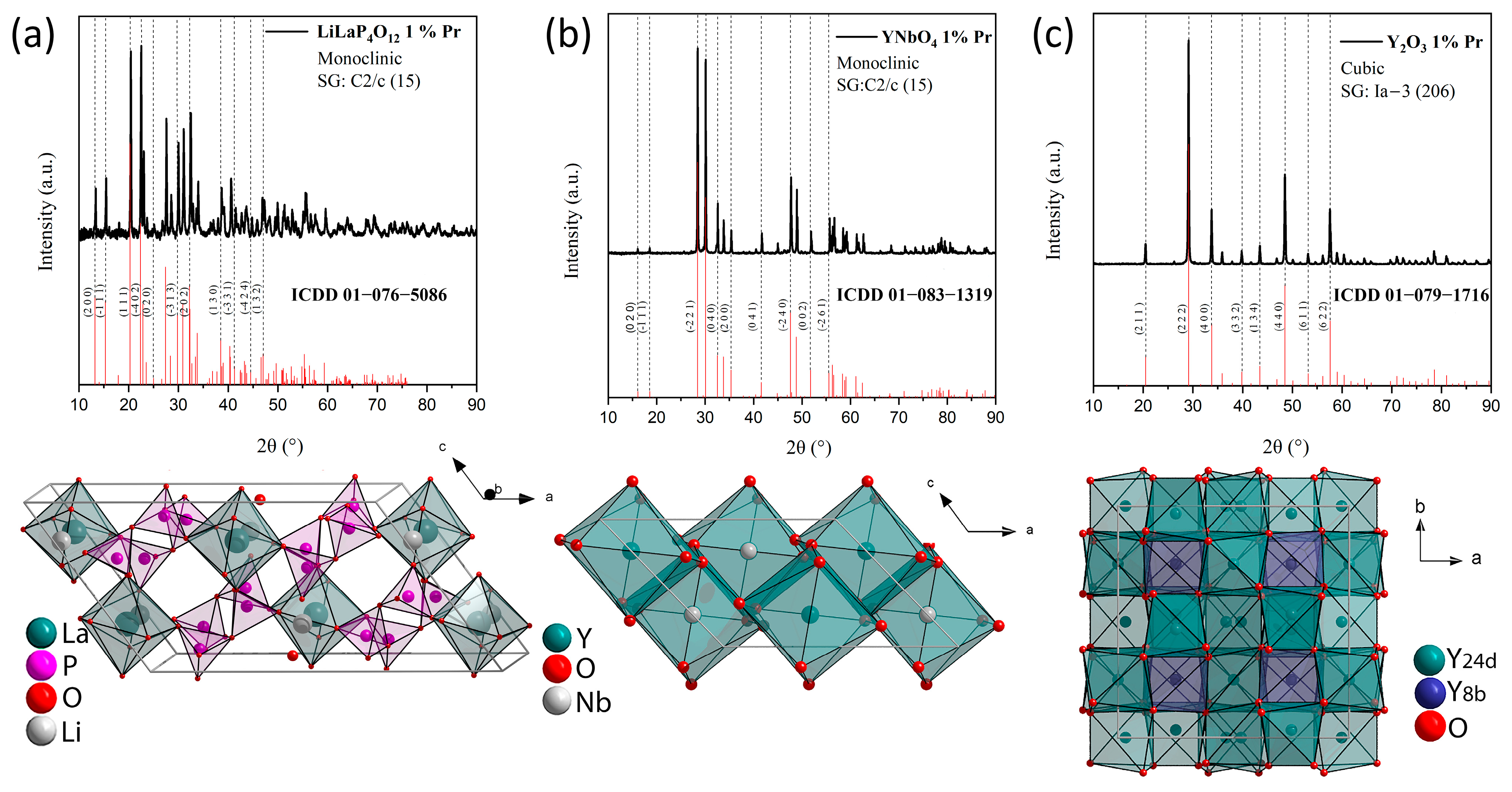
The phase composition of the synthesized Pr3+-doped LiLaP4O12, YNbO4, and Y2O3 powders was examined by X-ray diffraction, and the corresponding patterns are shown in Figure 1a–c. All diffraction peaks can be indexed to the expected crystal structures of the respective host materials, with no detectable impurity phases within the limits of the XRD technique, confirming the successful formation of single-phase materials. The diffraction pattern of LiLaP4O12 (Figure 1a) corresponds to a monoclinic structure (space group C2/c) and agrees well with reported data for tetraphosphate compounds. YNbO4 (Figure 1b) crystallizes in a monoclinic fergusonite-type structure (space group C2/c), with all reflections matching the reference pattern, indicating high phase purity. In contrast, Y2O3 (Figure 1c) adopts a cubic bixbyite structure (space group Ia-3), with no evidence of secondary phases. Due to the low dopant concentration (1 mol%), no measurable peak shifts are observed, indicating that incorporation of Pr3+ ions does not significantly perturb the host lattice within the resolution of XRD. These structural differences, particularly in symmetry and site multiplicity, are expected to play a key role in determining the luminescence behavior and thermometric performance of the investigated systems. To interpret the differences in luminescence behavior, the crystal structures and local coordination environments of the host materials are taken into account. LiLaP4O12 consists of interconnected PO4 tetrahedra and LaO8 polyhedra, with Li+ ions occupying interstitial sites. In this lattice, the La3+ ions occupy the special 4e Wyckoff position, which is characterized by a C2 (2) local site symmetry. The La3+ ions are eightfold coordinated (CN = 8), forming distorted oxygen polyhedra. YNbO4 is composed of NbO4 tetrahedra and YO8 polyhedra forming a three-dimensional framework. Similar to the phosphate host, the Y3+ ions in YNbO4 occupy the 4e Wyckoff position with C2 (2) site symmetry, where they are coordinated by eight oxygen atoms (CN = 8) in a distorted environment characteristic of low-symmetry crystal fields. In contrast, Y2O3 has two crystallographically distinct cation sites. In this lattice, all Y3+ ions are sixfold coordinated (CN = 6), being distributed between the centrosymmetric 8b position with C3i ( 3 ¯ ) local symmetry and the non-centrosymmetric 24d position with C2 (2) local symmetry, present in a 1:3 abundance ratio. These sites correspond to distinct configurations of distorted octahedral environments resulting from different body-diagonal oxygen-vacancy arrangements. These differences in coordination number, site symmetry, and lattice connectivity are expected to influence the crystal field splitting significantly and, consequently, the temperature-dependent luminescence behavior of Pr3+ ions.

2.2. LIR-Based Thermometric Analysis

For both LIR and PCA thermometric analyses, measurements were performed over the temperature range 103–523 K in 10 K intervals, with 100 emission spectra recorded at each temperature. All spectra were corrected for detector background and subsequently area-normalized to minimize the effects of intensity fluctuations due to instrumental or geometric variations. For each temperature point, the dataset was randomly divided into two equal subsets. One subset (50 spectra per temperature) was used as the training dataset to determine both the LIR values and the PCA principal component loading vectors and values, which were used to construct the temperature-dependent calibration points. The second subset (the remaining 50 spectra) was used as the testing dataset to evaluate the predictive performance of both methods. This approach ensures a statistically robust determination of each method’s figures of merit: accuracy and precision.
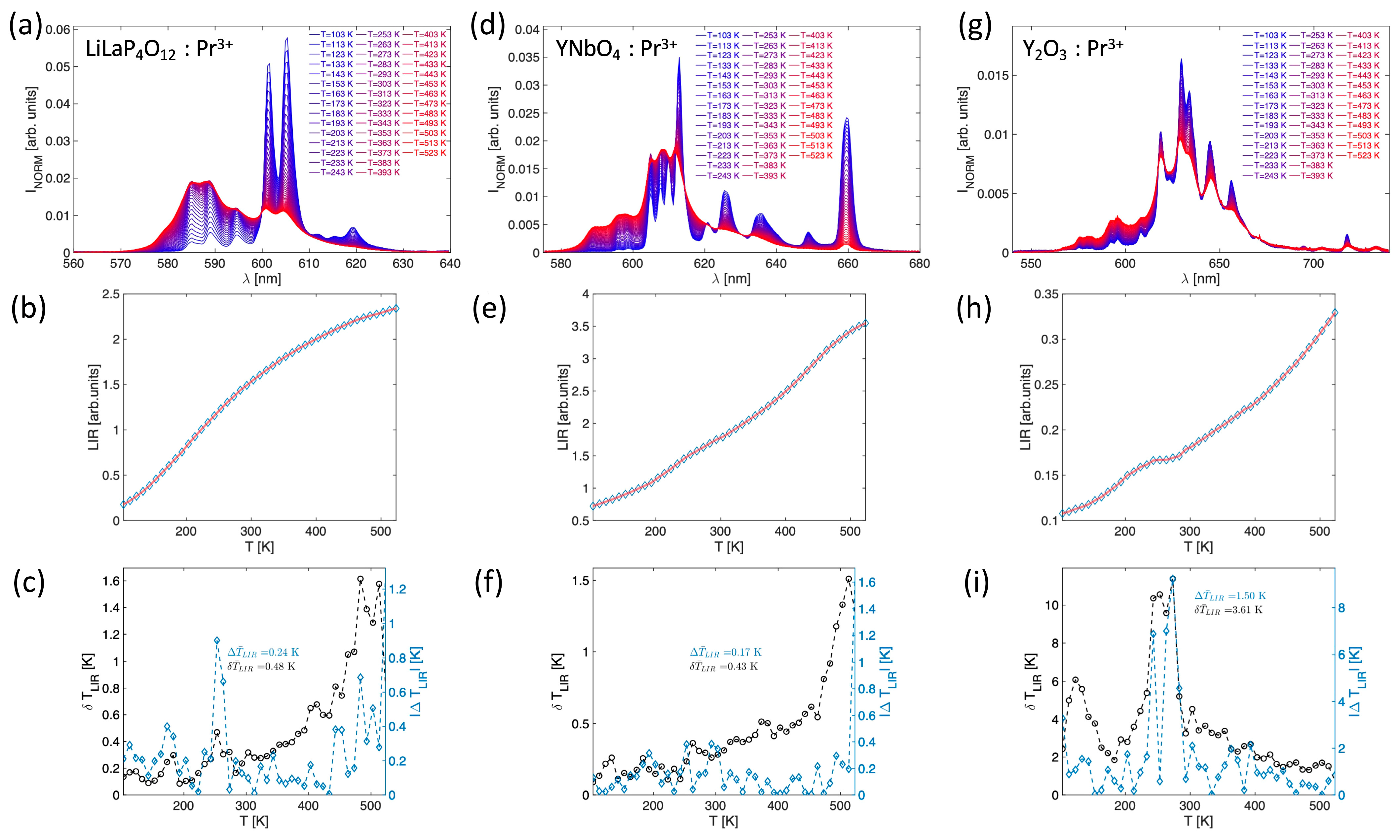
The per-temperature averaged emission spectra of all investigated Pr3+-doped materials are shown in Figure 2a,d,g. In all systems, increasing temperature leads to a gradual redistribution of spectral intensity from lower-energy to higher-energy spectral regions. Due to the complex nature of the Pr3+ emission spectrum, a conventional Boltzmann-type LIR approach based on selected individual transitions was not possible; the LIR analysis was performed using integrated spectral regions. The LIR parameter was defined as the ratio of the integrated intensity at higher energies (IHI) to that at lower energies (ILOW), where the threshold wavelength (λtr) separating the two spectral regions was determined from the intensity inversion point of the area-normalized, temperature-dependent spectra (Equation (1)). The obtained λtr values were 600 nm for LiLaP4O12:Pr3+, 620 nm for YNbO4:Pr3+, and 616 nm for Y2O3:Pr3+.
Figure 2. Temperature-dependent luminescence and LIR-based thermometric analysis of Pr3+-doped (ac) LiLaP4O12, (df) YNbO4, and (gi) Y2O3 in the 103–523 K temperature range. (a,d,g) Area-normalized emission spectra showing temperature-induced spectral redistribution. (b,e,h) Temperature dependence of the luminescence intensity ratio (LIR) calibration points. (c,f,i) Thermometric performance expressed as absolute temperature uncertainty (ΔTLIR) and temperature resolution (δTLIR).
Inorganics 14 00167 g002
L I R T = I H I ( T ) I L O W ( T ) = λ < λ t r I ( λ , T ) λ λ t r I ( λ , T )
The temperature dependences of the averaged LIR values obtained from the training dataset at each stabilized temperature are presented in Figure 2b,e,h. Thermometric accuracy and resolution were evaluated using testing spectra that were not included in the calibration procedure. At each stabilized temperature, the thermometric accuracy was defined as the absolute difference between the mean of the predicted temperature distribution and the stabilized temperature, ΔT(T) = |Tav(T) − T|, while the thermometric resolution (precision) was determined from the standard deviation of the predicted temperature distribution, δT(T) = σ(T). The corresponding temperature-dependent accuracy and resolution plots are shown in Figure 2c,f,i.
LiLaP4O12:Pr3+ exhibits a broad emission band centered around 590 nm arising from overlapping 3P0,13H6 and 1D23H4 transitions. With increasing temperature, gradual redistribution of spectral intensity towards higher-energy components is observed, consistent with thermal population redistribution between the 3P0 and 3P1 excited states. No detectable spectral shift in the peak maximum is observed, indicating stable crystal-field splitting in this phosphate host. The corresponding LIR analysis (Figure 2b,c) demonstrates high thermometric accuracy and resolution over the investigated temperature range. Compared to LiLaP4O12:Pr3+, YNbO4:Pr3+ exhibits a significantly more structured emission spectrum with multiple resolved Stark components in the 580–670 nm region, originating from transitions involving the 3P0, 3P1, and 1D2 excited states. The stronger crystal-field splitting characteristic of the low-symmetry fergusonite lattice results in pronounced temperature-dependent spectral variations and progressive redistribution of emission intensity with increasing temperature. The corresponding LIR analysis (Figure 2e,f) shows improved temperature resolution compared with LiLaP4O12, reflecting the enhanced sensitivity of the spectral profile to temperature-induced changes. Among the investigated systems, Y2O3:Pr3+ exhibits the most complex emission behavior, characterized by broad, strongly overlapping bands extending from approximately 550 to 710 nm. This complexity originates from the coexistence of two crystallographically inequivalent cation sites (C2 and S6 symmetry), each contributing distinct emission transitions with different thermal responses. Increasing temperature leads not only to emission quenching but also to changes in the relative contributions of the two emitting sites. As a result, the corresponding LIR analysis (Figure 2h,i) exhibits significantly reduced thermometric performance compared to the other investigated systems.

2.3. PCA-Based Thermometric Framework

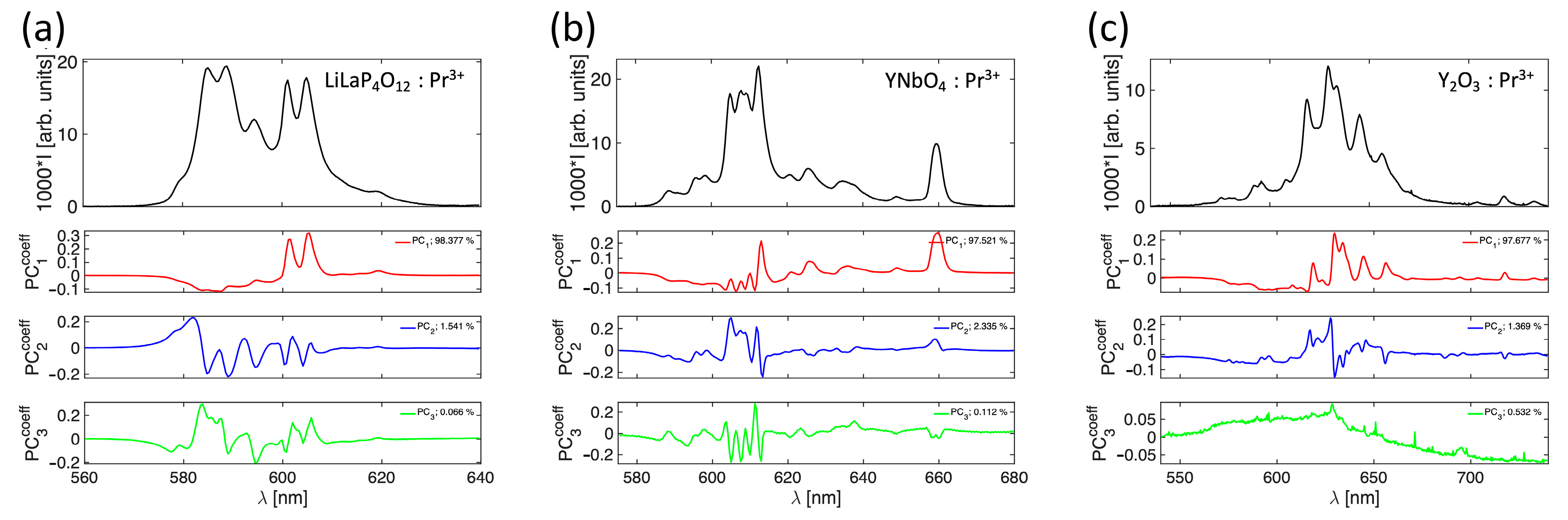
To better extract thermometric information from the full spectral profile, temperature-dependent emission spectra were analyzed using principal component analysis (PCA). PCA is an unsupervised multivariate method that transforms a set of correlated spectral variables into a new set of orthogonal components (principal components, PCs) ranked in descending order according to the amount of explained variance. In this approach, the normalized training spectra were organized into a data matrix M of size n × p. In this matrix, each row represents a single normalized spectrum, and each column corresponds to a specific wavelength channel. The covariance matrix C = MᵀM/(n − 1) is computed and analyzed via eigendecomposition, yielding p orthogonal eigenvectors and their associated eigenvalues. These eigenvectors, called loading vectors (indicated as P C i c o e f f on Figure 3), define directions in p-dimensional hyperspace. Their corresponding eigenvalue ε i represents the variance of the training set in this direction. The eigenvectors are sorted by descending eigenvalues so that the first component captures the greatest variance. The relative variance in the i-th direction is measured using ε i / i ε i (expressed as a percentage in Figure 3), where i ε i represents the total explained variance. A scalar vector product of any normalized spectrum and the corresponding P C i c o e f f yields the principal component value P C i for that spectrum, where i = 1 is the most significant one [29].
In all cases presented here, temperature was the sole variable during spectra acquisition. Consequently, temperature-induced spectral changes represent the dominant source of variance in the training dataset. For all investigated phosphors, the first principal component (PC1) accounts for more than 97.5% of the total spectral variance. This reflects the primary temperature-dependent spectral variations. Because this value exceeds the typical 95% threshold, it indicates that temperature-induced spectral evolution can be effectively described by a single parameter: the value of PC1 (Figure 3). Conversely, higher-order components (PC2, PC3, etc.) account for minor spectral variations caused by alternative influences. These include noise, environmental fluctuations, and other secondary effects beyond temperature changes. While these components can be incorporated through multiparameter analysis, this introduces additional non-temperature sources of variance which may not necessarily improve thermometric performance.
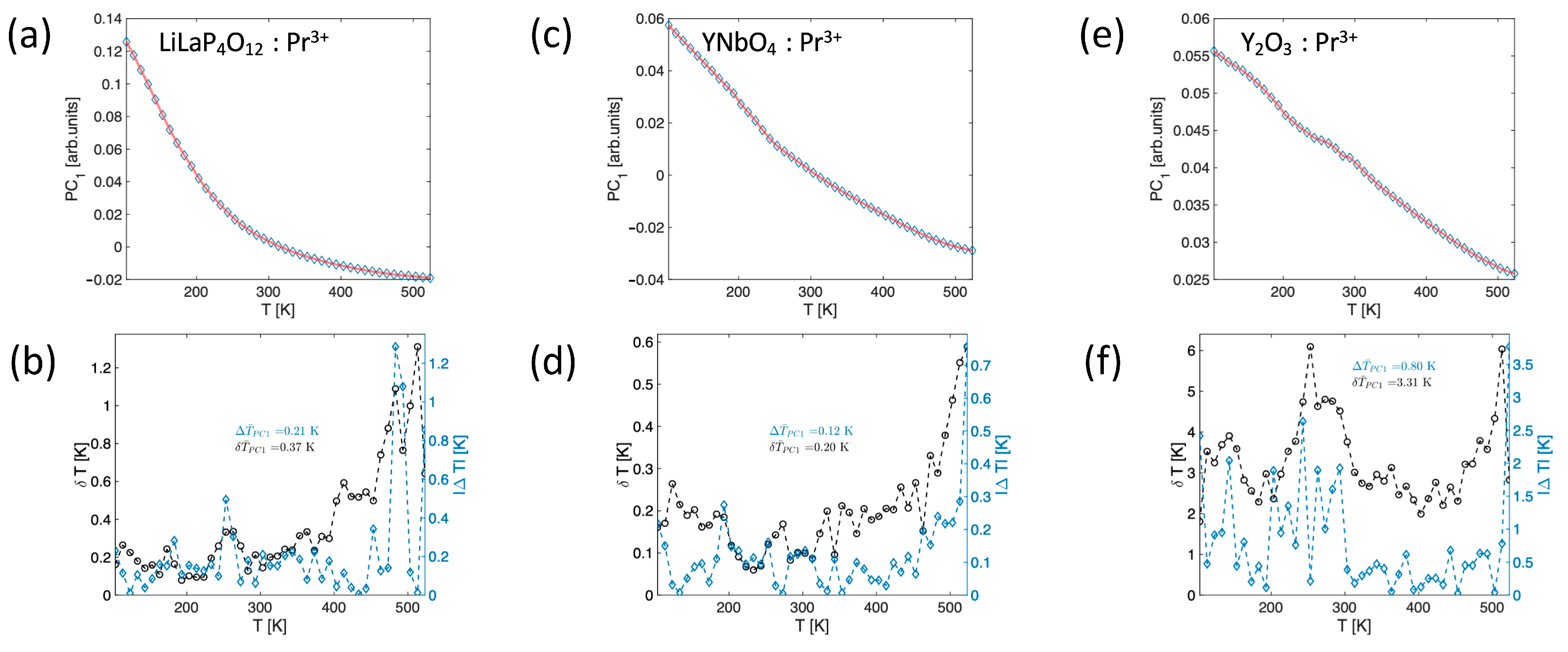
Therefore, each training spectrum was projected onto PC1, and the corresponding score values were used as a thermometric variable to form the calibration values PC1(T) (Figure 4a,c,e). Subsequently, a test set was used to reproduce the stabilized temperatures (50 spectra at each stabilized temperature) by linear interpolation between the nearest calibration values. Using the testing dataset, thermometric performance was evaluated based on the accuracy (ΔTPC1) and resolution (δTPC1) criteria, defined in the same way as for the LIR analysis. The corresponding temperature-dependent thermometric parameters obtained from the PCA-based prediction are shown in Figure 4b,d,f.
The temperature-dependent spectral changes discussed above are directly reflected in the corresponding PC1(T) dependences obtained by principal component analysis (Figure 4). In all investigated systems, the first principal component captures the dominant temperature-dependent spectral variance and enables thermometric readout from the full emission spectrum. For LiLaP4O12:Pr3+, the gradual redistribution of spectral intensity with increasing temperature results in a smooth and monotonic PC1(T) dependence (Figure 4a), enabling reliable temperature calibration. The extracted thermometric parameters are ΔTPC1 = 0.21 K and δTPC1 = 0.37 K (Figure 4b), demonstrating high accuracy and resolution over a wide temperature range. This performance can be attributed to the relatively simple emission profile and stable temperature-dependent spectral evolution observed in this phosphate host. YNbO4:Pr3+ exhibits a more structured emission profile and more pronounced temperature-induced spectral variations, which are reflected in the corresponding PC1(T) dependence (Figure 4c). The obtained dependence is monotonic but slightly non-linear, including a sign change at intermediate temperatures. This effect arises from the mathematical definition of principal components and does not correspond to a physical inversion of emission intensity. Based on the predicted temperatures from the testing dataset, the average values of statistically obtained accuracy and resolution are ΔTPC1 = 0.12 K and δTPC1 = 0.20 K, respectively (Figure 4d). The improved temperature accuracy and resolution compared to LiLaP4O12 reflect the enhanced sensitivity of the emission spectrum to temperature-induced changes. Among the investigated systems, Y2O3:Pr3+ exhibits the most complex emission behavior due to the coexistence of two crystallographically inequivalent emitting sites with distinct thermal responses. The corresponding PC1(T) dependence appears quasi-linear across the investigated temperature range (Figure 4e). Despite this apparent simplicity, the thermometric performance is reduced, with ΔTPC1 = 0.80 K and δTPC1 = 3.31 K (Figure 4f). The coexistence of multiple emitting centers introduces additional spectral variability that cannot be fully described by a single principal component, leading to increased uncertainty and reduced resolution. Nevertheless, the results demonstrate that PCA-based thermometry remains applicable even in systems with pronounced spectral overlap and complex multi-site emission behavior.

2.4. Comparative Discussion

The results summarized in Table 1 show that the thermometric performance of both LIR- and PCA-based approaches strongly depends on the complexity of the temperature-dependent spectral changes. For LiLaP4O12:Pr3+, which exhibits relatively simple and well-defined emission behavior, both methods provide high accuracy and resolution over a broad temperature range. The slightly better performance achieved with PCA suggests that analyzing the full emission spectrum enables more efficient extraction of temperature-dependent information than approaches that rely only on selected spectral features. A different behavior is observed for YNbO4:Pr3+. In this system, the stronger crystal-field splitting produces a more structured emission spectrum and increases the sensitivity of the spectral profile to temperature changes. As a result, both approaches achieve higher resolution than LiLaP4O12. However, PCA yields noticeably lower ΔT and δT values than the corresponding LIR analysis, indicating that full-spectrum analysis becomes increasingly advantageous as spectral complexity increases. The slightly nonlinear PC1(T) dependence is consistent with the increased complexity of the temperature-dependent spectral changes. The most challenging case is Y2O3:Pr3+, in which emissions from two crystallographically inequivalent sites strongly overlap and exhibit distinct quenching dynamics. This leads to reduced thermometric performance for both LIR and PCA approaches. Nevertheless, PCA remains applicable even in this highly complex system and provides significantly higher accuracy (47%) and slightly higher precision than the corresponding LIR analysis. The quasi-linear PC1(T) dependence most likely reflects the averaged contribution of multiple emission centers with different thermal responses.
Overall, the comparison between LIR and PCA approaches shows that the advantage of PCA becomes more pronounced in systems with structured or strongly overlapping emission bands, where temperature-dependent information is distributed across the entire emission spectrum rather than localized in a few selected transitions. It is also important to note that the LIR approach used here relies on broad integrated spectral regions rather than isolated emission lines. Even under these conditions, PCA-based analysis provides improved thermometric performance, highlighting the advantage of utilizing more complete spectral information in luminescence thermometry. For all investigated materials, thermometric accuracy and resolution tend to deteriorate at elevated temperatures. This behavior is particularly pronounced for Y2O3:Pr3+ and reflects the increasing influence of thermal quenching and complex temperature-dependent spectral evolution. Consequently, the reliability of temperature read-out progressively decreases as the temperature approaches the upper end of the investigated range.

3. Experimental Part

3.1. Materials and Synthesis

To ensure a direct comparison of host-dependent luminescence behavior and thermometric performance, a fixed Pr3+ concentration of 1 mol% was used for all investigated materials. This concentration was selected to minimize concentration-dependent effects while enabling reliable evaluation of the host lattice’s influence on the performance of both LIR- and PCA-based thermometry.

3.1.1. Pr3+-Doped LiLaP4O12 (LiLaP4O12:1%Pr3+)

Pr3+-doped LiLaP4O12 (Li(La0.99Pr0.01)P4O12) was prepared via a coprecipitation method following previously reported procedures [25,30]. The starting precursors were La(NO3)3·6H2O (Alfa Aesar, Ward Hill, MA, USA, 99.99%), (NH4)2HPO4 (Thermo Scientific, Waltham, MA, USA, 99.8%), and Li2CO3 (Alfa Aesar, 99.99%). Pr6O11 (Alfa Aesar, 99.99%) was used as the dopant precursor following the previously reported synthesis procedure, while ascorbic acid (C6H8O6, Merck, Darmstadt, Germany) was added to stabilize Pr3+ ions during synthesis. All reagents were dissolved in concentrated HNO3 (Zorka, Sabac, Serbia, 65%) under constant stirring. The pH of the solution was adjusted to 8 with NH4OH (Fisher, Polk County, MN, USA, 25%), resulting in a white precipitate. The obtained suspension was dried at 80 °C for several days. The dried precursor was then annealed at 450 °C for 8 h and allowed to cool naturally to room temperature.

3.1.2. Pr3+-Doped YNbO4 (YNbO4:1%Pr3+)

Pr3+-doped YNbO4 (Y0.99Pr0.01NbO4) was synthesized using a two-step mechanical activation-assisted solid-state reaction, as described in the literature [31,32,33]. The starting materials were Y2O3 (Alfa Aesar, Ward Hill, MA, USA, 99.9%), Nb2O5 (Alfa Aesar, Ward Hill, MA, USA, 99.5%), Pr2O3 (Thermo Scientific, Waltham, MA, USA 99.9%), and Na2SO4·10H2O (Alfa Aesar, Ward Hill, MA, USA, 99%), which was used as a flux. Stoichiometric amounts of the precursors corresponding to 1 mol% Pr3+ were mixed with 10 mL of absolute ethanol and a few drops of H2O2 (Roth, Karlsruhe, Germany, 30%) to prevent oxidation of Pr3+. The mixture was mechanically activated in a planetary ball mill (Retsch PM100, Haan, Germany) at 100 rpm for 3 h, then dried at 70 °C. The dried powder was pre-sintered at 800 °C for 2 h, then ball-milled again under the same conditions, dried, and finally annealed at 1200 °C for 2 h. The resulting powder was washed multiple times with deionized water to remove residual flux and dried before further use.

3.1.3. Pr3+-Doped Y2O3 (Y2O3:1%Pr3+)

Pr3+-doped Y2O3 (Y1.98Pr0.02O3) was synthesized by the polymer complex solution (PCS) combustion method [34,35]. Y2O3 (Sigma–Aldrich, Burlington, MA, USA, 99.99%) and Pr2O3 (Thermo Scientific, 99.9%) were dissolved in concentrated HNO3 (Superlab, Belgrade, Serbia, 69–71%) at 180 °C under continuous stirring until complete dissolution and evaporation to dryness. A small amount of H2O2 (Roth, Karlsruhe, Germany, 30%) was added during dissolution to stabilize Pr3+. Polyethylene glycol (PEG 200, Alfa Aesar, Ward Hill, MA, USA) was added as a fuel and complexing agent. The solution was heated at 100–130 °C under stirring until a homogeneous viscous gel formed. The gel was then heated to approximately 800 °C, initiating self-combustion and producing a fine powder. The obtained powder was calcined at 1100 °C for 24 h to improve crystallinity.

3.2. Instruments and Methods

X-ray diffraction (XRD) measurements were carried out using a Rigaku SmartLab diffractometer (Tokyo, Japan) with Cu Kα radiation (λ = 1.5406 Å), operating at 40 kV and 30 mA. Data were collected over a 2θ range of 10–90°. Luminescence measurements were performed using an Ocean FX UV–VIS spectrometer (Ocean Insight, Winter Park, FL, USA) coupled with a 450 nm solid-state laser as the excitation source via a Y-type optical fiber. The spectrometer operates in the 200–1000 nm wavelength range. A 500 nm long-pass filter was used to suppress the excitation signal in the detection branch. Powdered samples were pelletized and placed in a MicroOptik liquid-nitrogen cooling/heating stage equipped with a quartz window, allowing measurements over the temperature range of 80–700 K. After thermal stabilization, 100 spectra were recorded at each temperature.

4. Conclusions

In this work, temperature-dependent luminescence of Pr3+-doped LiLaP4O12, YNbO4, and Y2O3 was analyzed using both luminescence intensity ratio (LIR) and principal component analysis (PCA)-based thermometry. The results show that PCA reliably extracts temperature information from full emission spectra, particularly in systems with complex, strongly overlapping emission bands. LiLaP4O12:Pr3+, characterized by relatively simple and stable spectral evolution, exhibited high thermometric accuracy and resolution for both approaches. In YNbO4:Pr3+, the increased spectral complexity and stronger temperature sensitivity of the emission profile resulted in improved thermometric resolution, with PCA providing noticeably better performance than the corresponding LIR analysis. In contrast, Y2O3:Pr3+ showed significantly reduced thermometric performance due to overlapping emissions from multiple crystallographically inequivalent sites with different quenching dynamics. Nevertheless, PCA remained applicable even in this structurally complex system and continued to produce improved thermometric parameters compared to the LIR approach. The thermometric performance was found to strongly depend on the complexity of the emission behavior and the structural characteristics of the host material. The obtained results show that PCA-based thermometry becomes particularly advantageous in systems with structured or strongly overlapping emission bands, where temperature-dependent information is distributed across the entire emission spectrum rather than concentrated in a few selected transitions. Compared to the corresponding LIR analysis, PCA generally provides improved thermometric performance, highlighting the potential of multivariate full-spectrum analysis for luminescence thermometry of Pr3+-activated materials. Future studies will explore extending the operating temperature range beyond 523 K, assessing thermometric performance under high-temperature conditions where thermal quenching and spectral broadening become increasingly pronounced, and evaluating the long-term thermal stability and temperature-cycling reproducibility of the investigated materials. Further efforts will also focus on quantitative crystal-field analysis and modeling of non-radiative processes to better understand the relationship between host structure and thermometric performance.

Author Contributions

Conceptualization, M.D.D.; methodology, Z.R. and V.Đ.; formal analysis, Z.R. and V.Đ.; investigation, A.R., M.M., L.Đ.F. and V.Đ.; data curation, Z.R. and V.Đ.; writing—original draft preparation, V.Đ. and Z.R.; writing—review and editing, V.Đ., Z.R., Ž.A. and M.D.D.; visualization, Z.R. and A.R.; supervision, Ž.A. and M.D.D. All authors have read and agreed to the published version of the manuscript.

Funding

This work was supported by the Science Fund of the Republic of Serbia (Grant No. 7017, Technology for Remote Temperature Measurements in Microfluidic Devices—REMTES), the Ministry of Science, Technological Development, and Innovation of the Republic of Serbia (Grant No. 451-03-033/2026-03/200017), and the Romania’s National Recovery and Resilience Plan, NRRP, (Grant No. C9-I8-28/FC 760107/2023).

Data Availability Statement

The data presented in this study are publicly available in the Zenodo repository at https://doi.org/10.5281/zenodo.20440908 (accessed on 15 June 2026).

Conflicts of Interest

The authors declare no conflict of interest.

References

  1. Gupta, I.; Singh, S.; Bhagwan, S.; Singh, D. Rare Earth (RE) Doped Phosphors and Their Emerging Applications: A Review. Ceram. Int. 2021, 47, 19282–19303. [Google Scholar] [CrossRef]
  2. Zheng, B.; Fan, J.; Chen, B.; Qin, X.; Wang, J.; Wang, F.; Deng, R.; Liu, X. Rare-Earth Doping in Nanostructured Inorganic Materials. Chem. Rev. 2022, 122, 5519–5603. [Google Scholar] [CrossRef] [PubMed]
  3. Tsang, M.Y.; Fałat, P.; Antoniak, M.A.; Ziniuk, R.; Zelewski, S.J.; Samoć, M.; Nyk, M.; Qu, J.; Ohulchanskyy, T.Y.; Wawrzyńczyk, D. Pr3+ Doped NaYF4 and LiYF4 Nanocrystals Combining Visible-to-UVC Upconversion and NIR-to-NIR-II Downconversion Luminescence Emissions for Biomedical Applications. Nanoscale 2022, 14, 14770–14778. [Google Scholar] [CrossRef] [PubMed]
  4. Srivastava, A.M. Inter- and Intraconfigurational Optical Transitions of the Pr3+ Ion for Application in Lighting and Scintillator Technologies. J. Lumin. 2009, 129, 1419–1421. [Google Scholar] [CrossRef]
  5. Wang, X.; Mao, Y. Recent Advances in Pr3+-Activated Persistent Phosphors. J. Mater. Chem. C Mater. 2022, 10, 3626–3646. [Google Scholar] [CrossRef]
  6. Srivastava, A.M. Aspects of Pr3+ Luminescence in Solids. J. Lumin. 2016, 169, 445–449. [Google Scholar] [CrossRef]
  7. Dorenbos, P. The 5d Level Positions of the Trivalent Lanthanides in Inorganic Compounds. J. Lumin. 2000, 91, 155–176. [Google Scholar] [CrossRef]
  8. Antić, Ž.; Racu, A.V.; Medić, M.; Alodhayb, A.N.; Kuzman, S.; Brik, M.G.; Dramićanin, M.D. Concentration and Temperature Dependence of Pr3+ F-f Emissions in La(PO3)3. Opt. Mater. 2024, 150, 115226. [Google Scholar] [CrossRef]
  9. Guyot, Y.; Moncorgé, R.; Merkle, L.D.; Pinto, A.; McIntosh, B.; Verdun, H. Luminescence Properties of Y2O3 Single Crystals Doped with Pr3+ or Tm3+ and Codoped with Yb3+, Tb3+ or Ho3+ Ions. Opt. Mater. 1996, 5, 127–136. [Google Scholar] [CrossRef]
  10. Sommerdijk, J.L.; Bril, A.; de Jager, A.W. Luminescence of Pr3+-Activated Fluorides. J. Lumin. 1974, 9, 288–296. [Google Scholar] [CrossRef]
  11. Srivastava, A.M.; Jennings, M.; Collins, J. The Interconfigurational (4f15d1 → 4f2) Luminescence of Pr3+ in LuPO4, K3Lu(PO4)2 and LiLuSiO4. Opt. Mater. 2012, 34, 1347–1352. [Google Scholar] [CrossRef]
  12. Blasse, G.; Grabmaier, B.C. Luminescent Materials; Springer: Berlin, Germany, 1994. [Google Scholar] [CrossRef]
  13. Förster, T.; Reifenberger, J.; Moumin, T.; Helmbold, J.; Antić, Ž.; Dramićanin, M.D.; Suta, M. Design Principles for (Efficient) Excited-State Absorption-Based Blue-to-UV Upconversion Phosphors with Pr3+. Chem. Sci. 2025, 16, 12309–12323. [Google Scholar] [CrossRef] [PubMed]
  14. Stefanska, J.; Marciniak, L. Single-Band Ratiometric Luminescent Thermometry Using Pr3+ Ions Emitting in Yellow and Red Spectral Ranges. Adv. Photonics Res. 2021, 2, 2100070. [Google Scholar] [CrossRef]
  15. Zhou, H.; Gao, W.; Cai, P.; Zhang, B.; Li, S. Investigation on Luminescence and Temperature Sensing Properties of Pr3+-Doped YVO4 Phosphors. Solid State Sci. 2020, 104, 106283. [Google Scholar] [CrossRef]
  16. Rajčić, A.; Ristić, Z.; Periša, J.; Milićević, B.; Aldawood, S.; Alodhayb, A.N.; Antić, Ž.; Dramićanin, M.D. Using Principal Component Analysis for Temperature Readings from YF3:Pr3+ Luminescence. Technologies 2024, 12, 131. [Google Scholar] [CrossRef]
  17. Ximendes, E.; Marin, R.; Carlos, L.D.; Jaque, D. Less Is More: Dimensionality Reduction as a General Strategy for More Precise Luminescence Thermometry. Light Sci. Appl. 2022, 11, 237. [Google Scholar] [CrossRef] [PubMed]
  18. Rinnan, Å.; van den Berg, F.; Engelsen, S.B. Review of the Most Common Pre-Processing Techniques for near-Infrared Spectra. TrAC Trends Anal. Chem. 2009, 28, 1201–1222. [Google Scholar] [CrossRef]
  19. Wold, S.; Esbensen, K.; Geladi, P. Principal Component Analysis. Chemom. Intell. Lab. Syst. 1987, 2, 37–52. [Google Scholar] [CrossRef]
  20. Murphy, K.R.; Stedmon, C.A.; Graeber, D.; Bro, R. Fluorescence Spectroscopy and Multi-Way Techniques. PARAFAC. Anal. Methods 2013, 5, 6557–6566. [Google Scholar] [CrossRef]
  21. Jollife, I.T.; Cadima, J. Principal Component Analysis: A Review and Recent Developments. Philos. Trans. R. Soc. A Math. Phys. Eng. Sci. 2016, 374, 20150202. [Google Scholar] [CrossRef] [PubMed]
  22. Abdi, H.; Williams, L.J. Principal Component Analysis. Wiley Interdiscip. Rev. Comput. Stat. 2010, 2, 433–459. [Google Scholar] [CrossRef]
  23. Bro, R.; Smilde, A.K. Principal Component Analysis. Anal. Methods 2014, 6, 2812–2831. [Google Scholar] [CrossRef]
  24. Jaque, D.; Vetrone, F. Luminescence Nanothermometry. Nanoscale 2012, 4, 4301–4326. [Google Scholar] [CrossRef] [PubMed]
  25. Marciniak, L.; Strek, W.; Guyot, Y.; Hreniak, D.; Boulon, G. Synthesis and Nd3+ Luminescence Properties of ALa1–XNdxP4O12 (A = Li, Na, K, Rb) Tetraphosphate Nanocrystals. J. Phys. Chem. C 2015, 119, 5160–5167. [Google Scholar] [CrossRef]
  26. Ferhi, M.; Horchani-Naifer, K.; Ferid, M. Efficient NIR Quantum Cutting of Eu3+/Yb3+ Co-Doped LiLa(PO3)4 for Luminescent Solar Concentrators. Opt. Mater. 2023, 135, 113365. [Google Scholar] [CrossRef]
  27. Sekulić, M.; Dramićanin, T.; Ćirić, A.; Far, L.Ð.; Dramićanin, M.D.; Ðordević, V. Photoluminescence of the Eu3+-Activated YxLu1−xNbO4 (x = 0, 0.25, 0.5, 0.75, 1) Solid-Solution Phosphors. Crystals 2022, 12, 427. [Google Scholar] [CrossRef]
  28. Bai, X.; Song, H.; Yu, L.; Yang, L.; Liu, Z.; Pan, G.; Lu, S.; Ren, X.; Lei, Y.; Fan, L. Luminescent Properties of Pure Cubic Phase Y2O3/Eu3+ Nanotubes/Nanowires Prepared by a Hydrothermal Method. J. Phys. Chem. B 2005, 109, 15236–15242. [Google Scholar] [CrossRef] [PubMed]
  29. Kuzman, S.; Dramićanin, M.D.; Ćirić, A.; Periša, J.; Milićević, B.; Antić, Ž.; Ristić, Z. Machine Learning-Assisted Luminescence Thermometry Using Mn5+ -Doped near-Infrared Phosphor with Improved Accuracy and Precision. Sens. Actuators A Phys. 2026, 397, 117292. [Google Scholar] [CrossRef]
  30. Strek, W.; Marciniak, L.; Lukowiak, A.; Bednarkiewicz, A.; Hreniak, D.; Wiglusz, R. Synthesis and Luminescence Properties of LiLa1−xNdxP4O12 Nanocrystals. Opt. Mater. 2010, 33, 131–135. [Google Scholar] [CrossRef]
  31. Đačanin, L.R.; Dramićanin, M.D.; Lukić-Petrović, S.R.; Petrović, D.M.; Nikolić, M.G.; Ivetić, T.B.; Gúth, I.O. Mechanochemical Synthesis of YNbO4:Eu Nanocrystalline Powder and Its Structural, Microstructural and Photoluminescence Properties. Ceram. Int. 2014, 40, 8281–8286. [Google Scholar] [CrossRef]
  32. Karsu, E.C.; Popovici, E.J.; Ege, A.; Morar, M.; Indrea, E.; Karali, T.; Can, N. Luminescence Study of Some Yttrium Tantalate-Based Phosphors. J. Lumin. 2011, 131, 1052–1057. [Google Scholar] [CrossRef]
  33. Nazarov, M.; Kim, Y.J.; Lee, E.Y.; Min, K.I.; Jeong, M.S.; Lee, S.W.; Noh, D.Y. Luminescence and Raman Studies of YNbO4 Phosphors Doped by Eu3+, Ga3+, and Al3+. J. Appl. Phys. 2010, 107, 103104. [Google Scholar] [CrossRef]
  34. Dordević, V.; Antić, Ž.; Lojpur, V.; Dramićanin, M.D. Europium-Doped Nanocrystalline Y2O3−La2O3 Solid Solutions with Bixbyite Structure. J. Phys. Chem. Solids 2014, 75, 1152–1159. [Google Scholar] [CrossRef]
  35. Diego-Rucabado, A.; Candela, M.T.; Aguado, F.; González, J.; Rodríguez, F.; Valiente, R.; Martín-Rodríguez, R.; Cano, I. A Comparative Study on Luminescence Properties of Y2O3: Pr3+ Nanocrystals Prepared by Different Synthesis Methods. Nanomaterials 2020, 10, 1574. [Google Scholar] [CrossRef] [PubMed]
Figure 1. X-ray diffraction patterns of Pr3+-doped (a) LiLaP4O12, (b) YNbO4, and (c) Y2O3 powders. The diffraction peaks correspond to the expected crystal structures of the host materials, indicating phase purity within the detection limits of XRD.
Inorganics 14 00167 g001
Figure 3. Temperature-dependent emission spectra and corresponding PCA loadings for Pr3+-doped (a) LiLaP4O12, (b) YNbO4, and (c) Y2O3 in the 103–523 K range. The upper panels show area-normalized emission spectra, while the lower panels display the first three principal component loadings (PC1–PC3). The loading profiles indicate the spectral regions contributing to the total variance, with PC1 capturing the dominant temperature-dependent spectral changes. The indicated percentages represent the variance explained by each component.
Inorganics 14 00167 g003
Figure 4. Temperature-dependent PCA-based thermometric analysis of Pr3+-doped LiLaP4O12, YNbO4, and Y2O3 in the 103–523 K range. (a,c,e) Temperature dependence of the first principal component (PC1) calibration points, used as a thermometric parameter. (b,d,f) Thermometric performance expressed as absolute temperature uncertainty (ΔTPC1), defined as the deviation between predicted and set temperature, and temperature resolution (δTPC1), defined as the standard deviation of the predicted temperature distribution.
Inorganics 14 00167 g004
Table 1. Summary of thermometric parameters obtained from LIR and PC1 analysis for Pr3+-doped host materials.
LIR-Based ThermometryPCA-Based Thermometry
Host MatrixΔTLIR (K)δTLIR (K)ΔTPC1 (K)δTPC1 (K)PC1(T) Behavior
LiLaP4O12:Pr3+0.240.480.210.37Non-linear
YNbO4:Pr3+0.170.430.120.20Non-linear
Y2O3:Pr3+1.503.610.803.31Quasi-linear
Disclaimer/Publisher’s Note: The statements, opinions and data contained in all publications are solely those of the individual author(s) and contributor(s) and not of MDPI and/or the editor(s). MDPI and/or the editor(s) disclaim responsibility for any injury to people or property resulting from any ideas, methods, instructions or products referred to in the content.