
Structural Aspects of Cu(I)(κ2-X1,X2)(Y3) and Cu(I)(η2-X1,X2)(Y3) Complexes



Abstract
1. Introduction
2. Results and Discussion
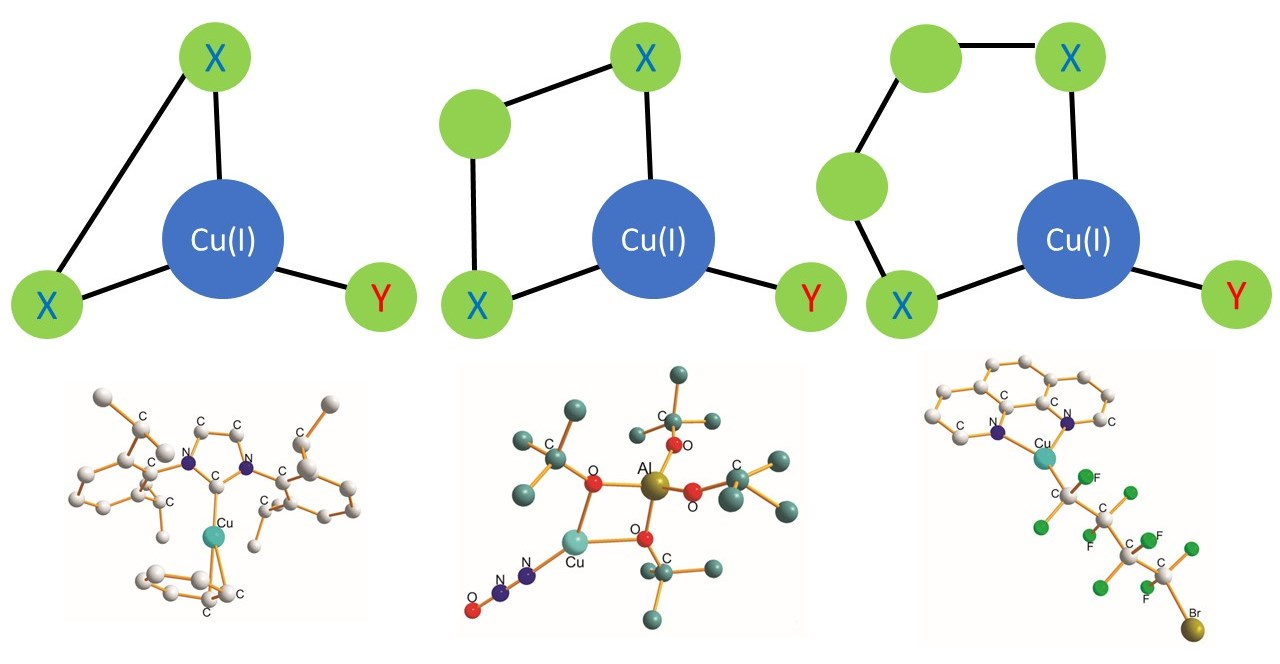
2.1. Three-Membered Metallocycles in Cu(η2-X1X2)(Y3) and Cu(κ2-X1X2)(Y3) Derivatives
- -
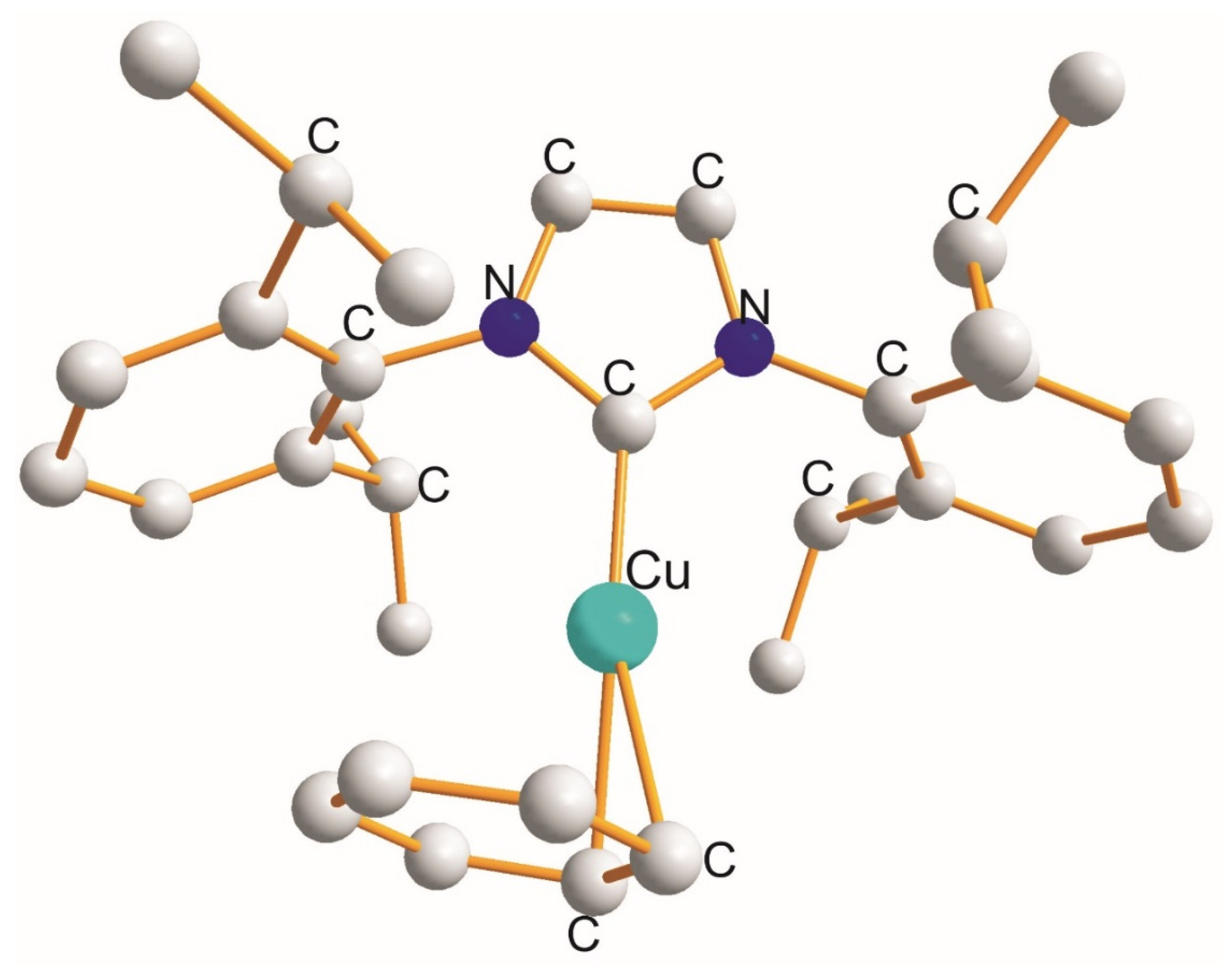
- C1-C2-Cu-C3 [24], Cu-L(Å): 2.217 (C1), 2.129 (C2), 1.886 Å (C3); 37.4°(C1-Cu-C2), 156.3°(C1-Cu-C3), 164.3°(C2-Cu-C3);
- -
- B1=B2-Cu-Cl3 [25], Cu-L(Å): 2.143 (B1), 2.133 (B2), 2.176 Å (Cl3), 44.6°(B1-Cu-B2) 145.6° (B1-Cu-Cl3), 164.9°(B2-Cu-Cl3);
- -
- P1≡C2-Cu-C3 [26], Cu-L(Å): 2.224 Å (P1), 1.915 Å (C2), 1.911 Å (C3), 39.9°(P1-Cu-C2), 173.4°(P1-Cu-C3), 173.4°(C2-Cu-C3).
- -
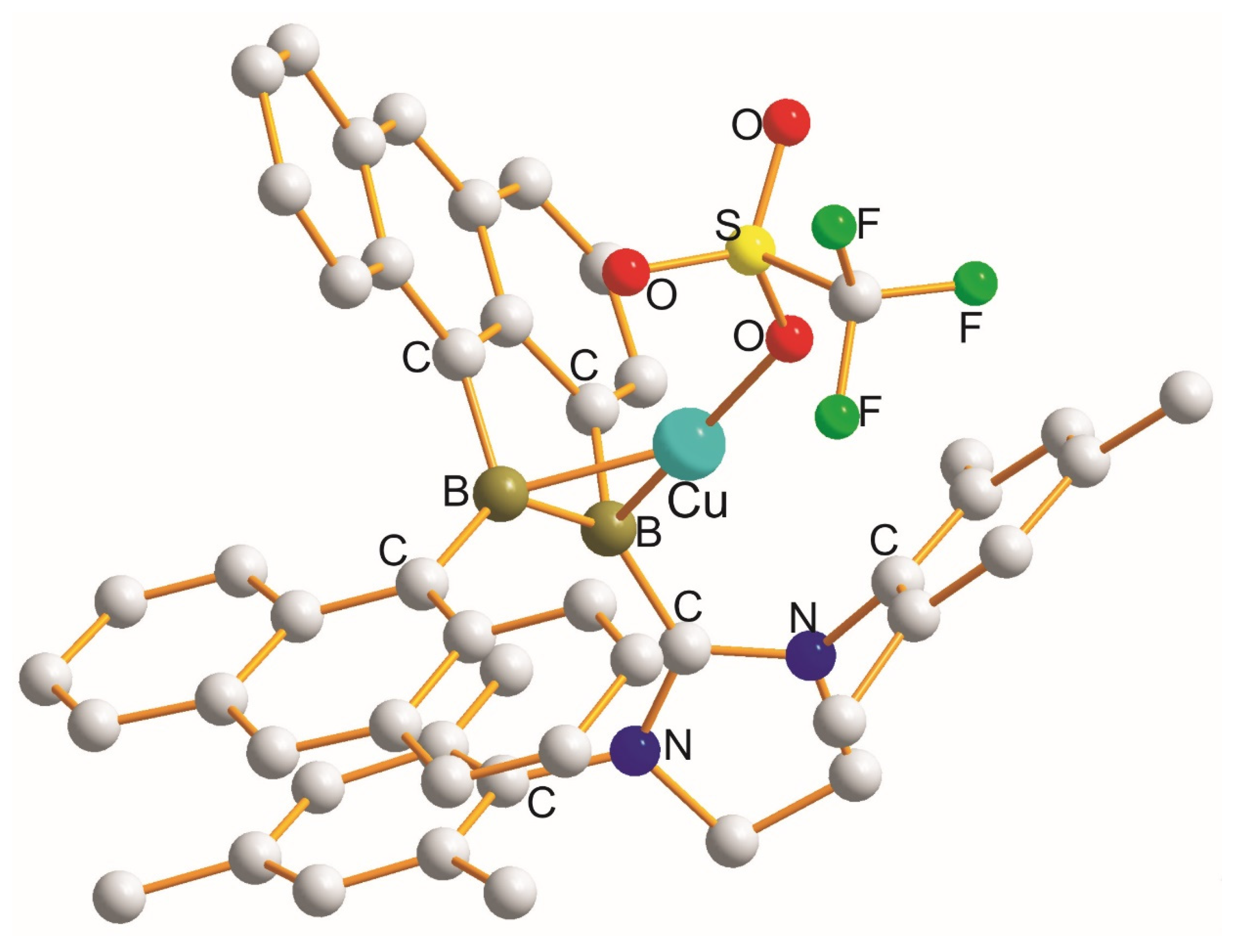
- B1-B2-Cu-X3 (X = OTf) [27], Cu-L(Å): 2.086 (B1), 2.068 (B2), 1.920 (O3), 51.2° (B1-Cu-B2), 140.1° (B1-Cu-O3), 163.3° (B2-Cu-O3).
- -
- B1-B2-Cu-C3 [28], Cu-L(Å): 2.177 (B1), 2.177 (B2), 1.949 (C3), 47.7° (B1-Cu-B2), 156.1° (B1-Cu-C3), 156.1° (B2-Cu-C3).
- -
- B1-B2-Cu-C3 [30], Cu-L(Å): 2.171 (B1), 2.135 (B2), 1.896 (C3), 47.2° (B1-Cu-B2), 154.5° (B1-Cu-C3), 157.8° (B2-Cu-C3).
- -
- B1=B2-Cu-Cl3 (Cl3-(C4H8O)3Li) [29], Cu-L(Å): 2.093 (B1), 2.071 (B2), 2.140 (Cl3), 49.0° (B1-Cu-B2), 158.7° (B1-Cu-Cl3), 152.0° (B2-Cu-Cl3).
- -
- B1-C2-Cu-C3 [31], Cu-L(Å): 2.121 (B1), 2.411 (C2), 1.943 (C3), 37.1°(B1-Cu-C2), 156.3° (B1-Cu-C3), 163.4° (C1-Cu-C3).
2.2. Four-Membered Metallocycles in Cu(κ2-X1×2)(Y3) Derivates
- -
- H1-B(H2)-H2,C3 [32]: Cu-L (Å): 1.693 (H1), 1.696 (H2), 1.891 (C3), 69.0° (H1-Cu-H2); 139.2° (H1-Cu-C3); 151.3° (H2-Cu-C3);
- -
- H1-B(Ph2)-C2,C3 [8]: Cu-L (Å): 1.584 (H1), 2.188 (C2), 2.165 (C3); 72.0° (H1-Cu-C2), 136.0° (H1-Cu-C3), 143.0° (C2-Cu-C3);
- -
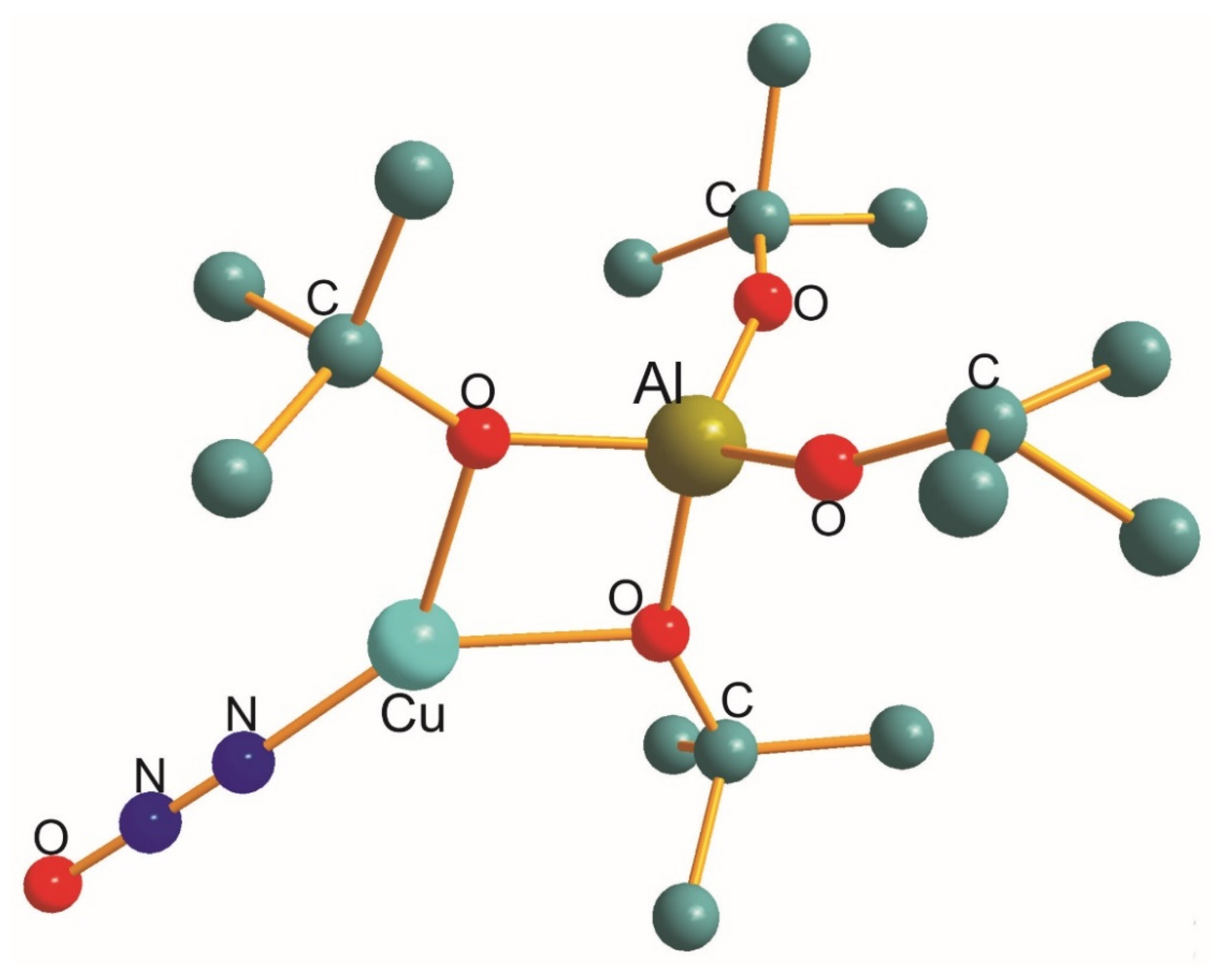
- O1-Al-O2, N3 [14]: Cu-L (Å): 2.099 (O1), 2.099 (O2), 1.885 (N3); 73.6° (O1-Cu-O2), 143.6° (O1-Cu-N3), 143.6° (O2-Cu-N3);
- -
- O1-Ce-O2, N3 [33]: Cu-L (Å): 2.090 (O1), 2.095 (O2), 1.927 (N3); 76.0° (O1-Cu-O2), 141.5° (O1-Cu-N3), 142.4° (O2-Cu-N3);
- -
- O1-Ce-O2, N3 [33]: Cu-L (Å): 2.025 (O1), 2.210 (O2), 1.919 (N3); 75.4° (O1-Cu-O2), 136.9° (O1-Cu-N3), 147.3° (O2-Cu-N3);
- -
- S1-C-P2, C3 [7]: Cu-L (Å): 2.369 (S1), 2.312 (P2), 1.927 (C3); 74.0° (S1-Cu-P2), 141.2° (S1-Cu-C3), 144.7° (P2-Cu-C3);
- -
- S1-C-P2, C3 [7]: Cu-L (Å): 2.311 (S1), 2.329 (P2), 1.929 (C3); 74.9° (S1-Cu-P2), 135.0° (S1-Cu-C3), 150.3° (P2-Cu-C3);
- -
- N1-P-N2, C3 [34]: Cu-L (Å): 2.002 (N1), 2.002 (N2), 1.824 (C3); 77.7° (N1-Cu-N2), 139.7° (N1-Cu-C3), 142.4° (N2-Cu-C3);
- -
- N1-P-N2, C3 [35]: Cu-L (Å): 1.971 (N1), 1.966 (N2), 1.832 (C3); 78.4° (N1-Cu-N2), 136.9° (N1-Cu-C3), 144.5° (N2-Cu-C3);
- -
- N1-N-N2, C3 [36]: Cu-L (Å): 2.562 and 2.701 (N1), 1.899 and 1.895 (N2), 1.834 and 1.833 (C3); 54.8° and 52.3° (N1-Cu-N2), 123.9° and 123.6° (N1-Cu-C3), 176.0° and 173.7° (N2-Cu-C3);
- -
- N1-C-N2, C3 [37]: Cu-L (Å): 1.891 (N1), 2.672 (N2), 1.876 (C3); 56.8° (N1-Cu-N2), 171.5° (N1-Cu-C3), 120.9° (N2-Cu-C3);
- -
- S1-C-S2, C3 [37]: Cu-L (Å): 2.310 (S1), 2.316 (S2), 1.878 (C3); 76.5° (S1-Cu-S2), 140.3° (S1-Cu-C3), 139.1° (S2-Cu-C3);
- -
- N1-P-S2, P3 [38]: Cu-L (Å): 1.960 (N1), 2.390 (S1), 2.154 (P3); 80.6° (N1-Cu-S1), 149.2°(N1-Cu-P3), 129.6° (S1-Cu-P3);
- -
- H1-B-H2, C3 [39]: Cu-L (Å): 1.716 (H1), 1.678 (H2), 1.887 (C3); 69.3° (H1-Cu-H2), 137.2° (H1-Cu-C3), 153.2° (H2-Cu-C3);
- -
- N1-Si-O1, Cl3 [40]: Cu-L (Å): 1.909 (N1), 2.596 (O2), 2.160 (Cl3); 69.0° (N1-Cu-O2), 173.1° (N1-Cu-Cl3), 112.5° (O2-Cu-Cl3);
- -
- Si1-N-Si2, C3 [41]: Cu-L (Å): 2.335 (Si1), 2.280 (Si2), 1.961 (C3); 69.0° (Si1-Cu-Si2), 139.6° (Si1-Cu-C3), 151.2° (Si2-Cu-C3);
- -
- Si1-N-Si2, I3 [41]: Cu-L (Å): 2.288 (Si1), 2.288 (Si2), 2.474 (I3); 70.5° (Si1-Cu-Si2), 144.7° (Si1-Cu-I3), 144.7° (Si2-Cu-I3);
- -
- N1-C-S2, C3 [42]: Cu-L (Å): 2.745 (N1), 2.146 (S2), 1.915 (C3); 63.9° (N1-Cu-S1), 122.1° (N1-Cu-C3), 173.7° (S1-Cu-C3);
- -
- O1-C-O2, C3 [43]: Cu-L (Å): 1.849 (O1), 2.811 (O2), 1.851 (C3); 86.6° (O1-Cu-O2), 133.0° (O1-Cu-C3), 174.6° (O2-Cu-C3).
- -
- 49.1 (37.1–79.2)° vs. 71.0 (range 52.3–86.6)° (X1-Cu-X2);
- -
- 155.1 (140.1–173.4)° vs. 140.4 (range 122.1–173.1)° (X1-Cu-Y3);
- -
- 161.9 (152.0–173.4)° vs. 147.9 (range 112.5–174.6)° (X2-Cu-Y3).
2.3. Five-Membered Metallocycles in Cu(κ2-X1×2)(Y3) and Cu(η2-X1×2)(Y3) Derivatives
2.3.1. Five-Membered Metallocycles Formed by Unsaturated (κ2-N1N2) Donor Ligands
- -
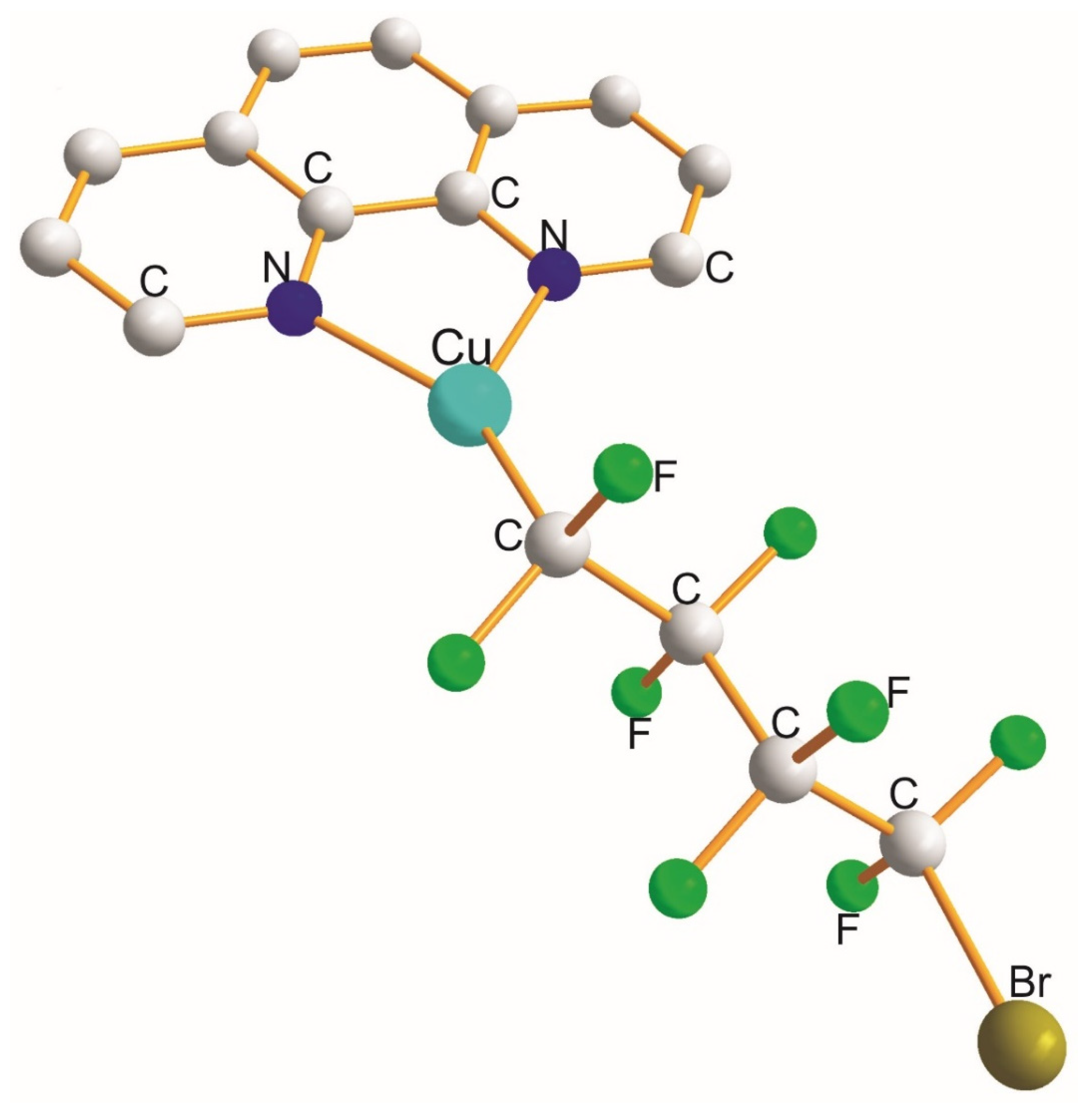
- N1-C2H4-N2, Cl3 [44]: Cu-L (Å): 1.906 (N1), 2.639 (N2), 2.129 (Cl3); 79.1° (N1-Cu-N2), 164.9° (N1-Cu-Cl3), 115.8° (N2-Cu-Cl3);
- -
- N1-C2H4-N2, X3 (X3 = I, Br, Cl) [44]: Cu-L (Å): 1.937 (N1, Cl3), 1.950 (N1, Br3), 1.982 (N1, I3); 2.311 (N2, Cl3), 2.267 (N2, Br3), 2.233 (N2, I3); 2.145 (Cl3), 2.275 (Br3), 2.459 (I3); 84.5° (N1-Cu-N2, Cl3), 85.2° (N1-Cu-N2, Br3), 85.6° (N1-Cu-N2, I3); 158.9° (N1-Cu-Cl3), 155.8° (N1-Cu-Br3), 143.0° (N1-Cu-I3); 116.3° (N2-Cu-Cl3), 118.7° (N2-Cu-Br3), 130.8° (N2-Cu-I3);
- -
- N1-C2H4-N2, Cl3 [45]: Cu-L (Å): 1.971 (N1), 2.159 (N2), 2.150 (Cl3); 85.0° (N1-Cu-N2), 150.2° (N1-Cu-Cl3), 123.9° (N2-Cu-Cl3);
- -
- N1-C2H4-N2, I3 [46]: Cu-L (Å): 1.969 (N1), 2.171 (N2), 2.435 (I3); 86.4° (N1-Cu-N2), 159.1° (N1-Cu-I3), 114.4° (N2-Cu-I3);
- -
- N1-C2H4-N2, N3 [47]: Cu-L (Å): 1.987 (N1), 2.033 (N2), 1.858 (N3); 83.3° (N1-Cu-N2), 142.6° (N1-Cu-N3), 133.5° (N2-Cu-N3).
2.3.2. Five-Membered Metallocycles “Interlocked” in Macrocycles
3. Materials and Methods
4. Conclusions

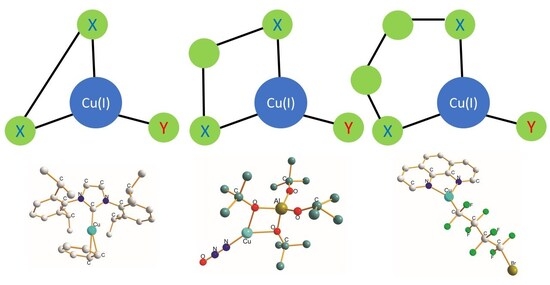
| A | 44.2 (37.1–51.2)° (X1-Cu-X2), 155.1 (140.1–173.4)° (X1-Cu-Y3), 161.9 (152–173.4)° (X2-Cu-Y3) |
| B | 71.0 (52.3–86.6)° (X1-Cu-X2), 140.4 (122.1–173.1)° (X1-Cu-Y3), 147.9 (112.5–174.6)° (X2-Cu-Y3) |
| C | 82.9 (79.1–86.4)° (X1-Cu-X2), 148.0 (140.0–164.9)° (X1-Cu-Y3), 121.9(114.4–139.2)° (X2-Cu-Y3) |
Author Contributions
Funding
Data Availability Statement
Acknowledgments
Conflicts of Interest
Abbreviations
| C8H10N2 | (4-dimethyllamino)pyridine |
| C8H4NO5 | (4-nitrophenyl)oxoacetate |
| C8H5O3 | benzoylformate |
| C9H5O6 | 2,5-dicarboxybenzenecarboxylate |
| C10H8N2 | 4,4′-bipyridine |
| C12H8N2 | 1,10-phenanthroline |
| C15H28N2 | bis(di-isopropylamino)cyclophenylidene |
| C22H35NO | (1-(2,6-diisopropylphenyl)-3,3-diethyl-5,5-dimethyl-pyrrolidin-2-ylidene) |
| C22H35NP | cyclic (alkyl)(amino)carbene |
| C24H37N | (2-(2,6-di-isopropylphenyl)-1,5-dimethyl-4-isopropyl-2-azabicyclo [2.2.2]octan-3-ylidene) |
| C27H36N2 | (1,3-bis(2,6-diisopropylphenyl)imidazole-2-ylidene) |
| C30H32N2 | (1,3-bis[2,6-bis(propan-2-yl)phenyl]imidazol-2-ylidene) C6F5 pentafluorophenyl substituent |
| P(But)2(Ph2) | (1,1′-biphenyl(-2-yl)(di-t-butyl)phosphine) |
| P(o-tol)3 | [tris(2-methylphenyl)phosphine] |
| η2-C6H6 | Benzene |
| η2-C11H18N4 | (1,1,3,3-tetramethyl-2-((pyridine-2-yl)methyl)quanidine) |
| η2-C11H24O2 | (2,5-di-t-butyl-1-oxido-6-oxocyclohexa-2,4-diene-1-yl) |
| κ2-C12H28N2 | (N,N′-di-t-butyl-N,N′-dimethylethane-1,2-diamine) |
| η2-C12H8N3 | (2-(2-pyridyl)benzimidazolate) |
| η2-C13H12N2 | (1-phenyl-N-((pyridine-2-yl)methyl)methenimine) |
| η2-C14H10Br2N2 | 2,9-bis(bromomethyl)-1,10-phenanthroline |
| η2-C14H17BrN4 | N″-(6-bromoquinolin-8-yl)(N,N,N′,N′-tetramethylquanidine) |
| η2-C14H17N5O2 | (N,N,N′,N′-tetramethyl-N″-(6-nitroquinolin-8-yl)quinidine) |
| κ2-C16AlF36O4 | bis(1,1,1,3,3,3-hexafluoro-2-(trifluoromethyl)propan-2-olato)-nitrosyliminoaluminium |
| η2-C16H14N2 | (2,7-dimethyl-1,10-phenanthrolidine) |
| η2-C16H22N2 | (1,7,7-trimethyl-N-((pyridine-2-yl)methyl)bicyclo [2.2.1]heptan-2-imine) |
| η2-C25H32N2 | (N-(1-(6-phenyl-2-pyridyl)ethylidene)-N-(2,6-diisopropylphenyl)amini) |
| η2-C26H30N2O | (N-(1-(6-(3-methoxyphenyl)-2-pyridyl)ethylilidene)-N-(2,6-diisopropylphenyl)amine) |
| η2-C26H38N2O | (17-((4-methylpyridin-2yl)methyl)iminoandrostane-3-ol) |
| η2C26H38N2O | (1H-(((4-methylpyridin-2-yl)methyl)imino)androstan-3-ol) |
| η2-C27H31O3N3 | (1,3-bis(3′,5′-di-t-butyl [1,1′-biphenyl])-4-yl,imidazole-2-ylidene) |
| η2-C28H32N2 | (N-(1-(6-2,6-dimethylphenyl)-2-pyridyl)ethylidene)-N-(2,6-diisopropylphenyl)amine |
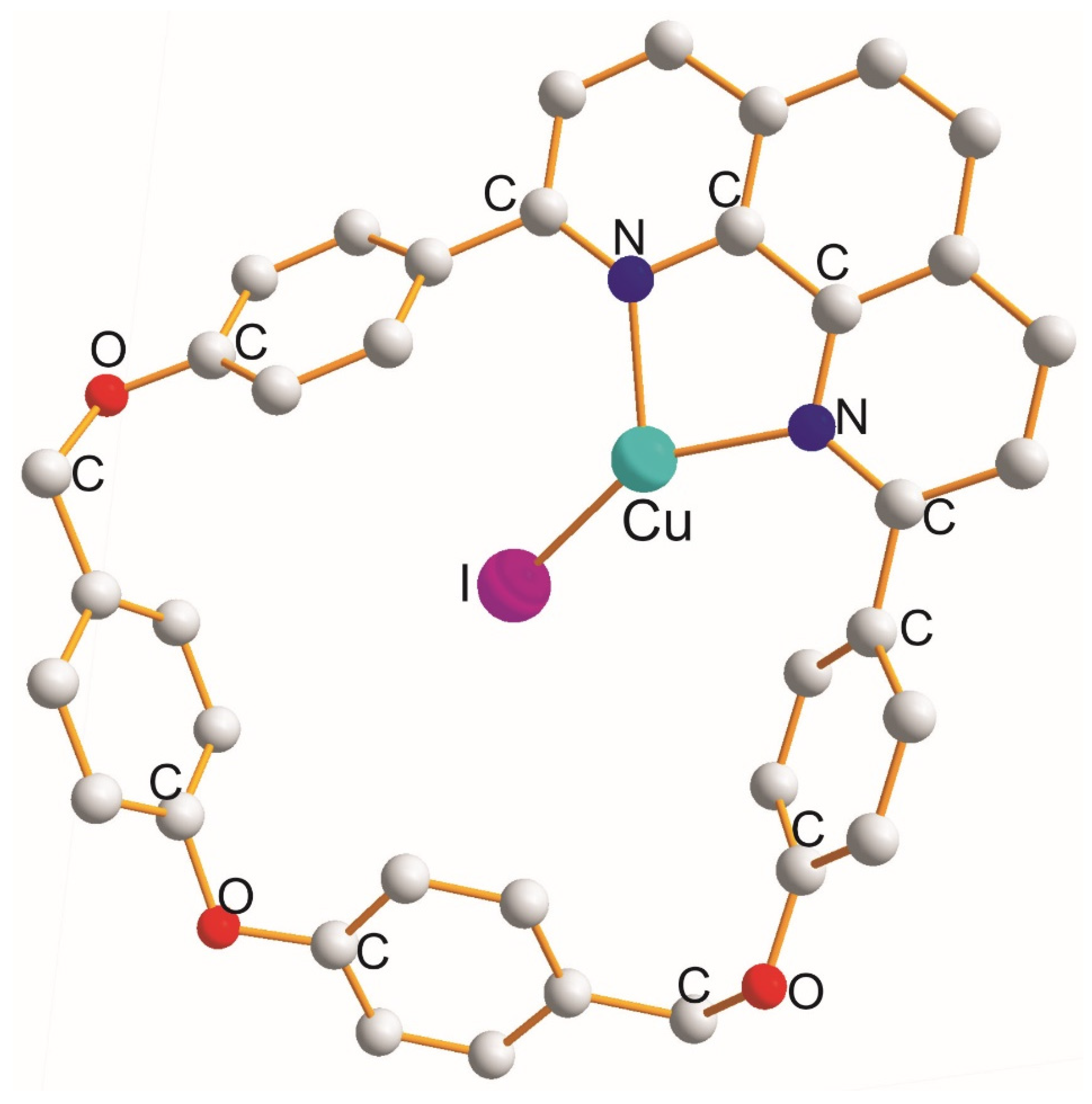
| η2-C30H30N2O4 | (4,15,22,27-tetraoxa-35,36-diazapentacyclo [26.2.2.210,6.21.15.9110,14]hexatriaconta-1(30)6.8.10(35),11.13.18.20.28.31.33-dodecaene) |
| η2-C34H36B2 | 1,2-bis(anthracen-9-yl)diborene |
| κ2-C36H81Ce2O9 | tris(μ-t-butoxo-hexakis(t-butoxy)di-cerium) |
| η2-C38H26O3N2 | [6,12,18-trioxa-32,35-diazaoctacylo [21.8.4.22,5,28,11,213,16,219,22,O26,34,O29,33]] tritetraconta-1(32),2,4.8,10,13,15,19,21,23(35)24,26,28,30,33,36,38,40,42–nonadecaene |
| η2-C42H42O4N2 | (6,13,19,26-tetraoxa-40.43—diazaheptacyclo [29.8.4.22,5.217,30114,18,O34,42O37,41] octatetraconta-1(39),2,4,14(46),15,17,27,29,31,33,35,37,40,42,44,47-hexadecaene) |
| κ1-C45H58N2O3 | (3,11-dimethyl-18,21,24-trioxa-3,11,33-triazatetra-cyclo [24.2.2.213,16,15,9]tritriaconta-1(28),5(33),6,8,13,15,26,29,31-nonaene) |
| κ2-HB(H2)H | tetrahydridoborate |
| κ2-B(ph)2C6H6 | hydrido(triphenyl)borate |
| η2-P≡C-O | Phosphaethynolate C6F5 pentafluorophenyl substituent κ2-S1C(=S)P2(Ph2) (diphenylphosphanyl)carbonodithioate |
References
- Zhong, M.; Pannecoucke, X.; Jubault, P.; Poisson, T. Recent Advances in Photocatalyzed Reactions Using Well-Defined Copper(I) Complexes. Beilstein J. Org. Chem. 2020, 16, 451–481. [Google Scholar] [CrossRef] [PubMed]
- Seidler, B.; Tran, J.H.; Hniopek, J.; Traber, P.; Gorls, H.; Grafe, S.; Schmitt, M.; Popp, J.; Schulz, M.; Dietzek-Ivansic, B. Photophysics of Anionic Bis(4H-imidazolato)CuI Complexes. Chem. Eur. J. 2022, 28, e202202697. [Google Scholar] [CrossRef]
- Bruschi, C.; Gui, X.; Rauthe, P.; Fuhr, O.; Unterreiner, A.N.; Klopper, W.; Bizzari, C. Dual Role of a Novel Heteroleptic Cu(I) Complex in Visible-Light-Driven CO2 Reduction. Chem. Eur. J. 2024, 30, e202400765. [Google Scholar] [CrossRef]
- Gupta, D.; Gaur, A.K.; Chauhan, D.; Thakur, S.K.; Ashish; Singh, S.; Rajaraman, G.; Venkataramani, S. Photocontrol of Catalysis in CuAAC Reactions by Air-Stable Cu(I) Complexes of Phenylazopyrazole-Incorporated Ligands. Inorg. Chem. Front. 2024, 11, 3555–3565. [Google Scholar] [CrossRef]
- Melník, M.; Mikušová, V.; Mikuš, P. Homo-Chromophores in Cu(I)(XXX), (X3 = N3, C3, Cl3, S3, P3, Br3, or I3) Derivatives—Structural Aspects. Inorganics 2025, 13, 36. [Google Scholar] [CrossRef]
- Melník, M.; Mikušová, V.; Mikuš, P. Variable Unidentate Ligands in Cu(I)(XXY) and Cu(I)(XYZ) Complexes—Structural Aspects. Inorganics 2025, 13, 182. [Google Scholar] [CrossRef]
- Downie, T.M.H.; Hall, J.W.; Finn, T.P.C.; Liptrot, D.J.; Lowe, J.P.; Mahon, M.F.; McMullin, C.L.; Whittlesey, M.K. The first ring-expanded NHC–copper(i) phosphides as catalysts in the highly selective hydrophosphination of isocyanates. Chem. Commun. 2020, 56, 13359–13362. [Google Scholar] [CrossRef]
- Ritter, F.; Mukherjee, D.; Spaniol, T.P.; Hoffmann, A.; Okuda, J. A Masked Cuprous Hydride as a Catalyst for Carbonyl Hydrosilylation in Aqueous Solutions. Angew. Chem. Int. Ed. 2019, 58, 1818–1822. [Google Scholar] [CrossRef]
- Shi, S.; Djurovich, P.I.; Thompson, M.E. Synthesis and characterization of phosphorescent three-coordinate copper(I) complexes bearing bis(amino)cyclopropenylidene carbene (BAC). Inorg. Chim. Acta 2018, 482, 246–251. [Google Scholar] [CrossRef]
- Kakizoe, D.; Nishikawa, M.; Fujii, Y.; Tsubomura, T. Photophysical properties of three coordinated copper(i) complexes bearing 1,10-phenanthroline and a monodentate phosphine ligand. Dalton Trans. 2017, 46, 14804–14811. [Google Scholar] [CrossRef]
- Baranova, Z.; Amini, H.; Neupane, M.; Garrett, S.C.; Ehnbom, A.; Bhuvanesh, N.; Reibenspies, J.H.; Gladysz, J.A. Syntheses, Structural Studies, and Copper Iodide Complexes of Macrocycles Derived from Williamson Ether Syntheses Involving 2,9-Bis(4-hydroxyphenyl)-1,10-phenanthroline, α,ω-Dibromides, and Resorcinol or 2,7-Dihydroxynaphthalene. Aust. J. Chem. 2017, 70, 373–386. [Google Scholar] [CrossRef]
- Trammell, R.; See, Y.Y.; Herrmann, A.T.; Xie, N.; Diaz, D.E.; Siegler, M.A.; Baran, P.S.; Garcia-Bosch, I. Decoding the Mechanism of Intramolecular Cu-Directed Hydroxylation of sp3 C–H Bonds. J. Org. Chem. 2017, 82, 7887–7904. [Google Scholar] [CrossRef] [PubMed]
- Trammell, R.; D’Amore, L.; Cordova, A.; Polunin, P.; Xia, N.; Siegler, M.A.; Belanzoni, P.; Swart, M.; Garcia-Bosch, I. Directed Hydroxylation of sp2 and sp3 C–H Bonds Using Stoichiometric Amounts of Cu and H2O2. Inorg. Chem. 2019, 58, 7584–7592. [Google Scholar] [CrossRef]
- Zhuravlev, V.; Malinowski, P.J. A Stable Crystalline Copper(I)–N2O Complex Stabilized as the Salt of a Weakly Coordinating Anion. Angew. Chem. Int. Ed. 2018, 57, 11697–11700. [Google Scholar] [CrossRef]
- Healy, P.C.; Pakawatchai, C.; White, A.H.J. Lewis-base adducts of Group 1B metal(I) compounds. Part 18. Stereo-chemistries and structures of the 1:1 neutral complexes of CuIX with 1,10-phenanthroline (X = I) or 2,9-dimethyl-1,10-phenanthroline (X = I, Br, or Cl). J. Chem. Soc. Dalton Trans. 1985, 2531–2539. [Google Scholar] [CrossRef]
- Zhang, S.; Wang, Z.; Zhang, H.; Cao, Y.; Sun, Y.; Chen, Y.; Huang, C.; Yu, X. Self-assembly of two fluorescent supramolecular frameworks constructed from unsymmetrical benzene tricarboxylate and bipyridine. Inorg. Chim. Acta 2007, 360, 2704–2710. [Google Scholar] [CrossRef]
- Lewis, J.E.M.; Bordoli, R.J.; Denis, M.; Fletcher, C.J.; Galli, M.; Neal, E.A.; Rochette, E.M.; Goldup, S.M. High yielding synthesis of 2,2′-bipyridine macrocycles, versatile intermediates in the synthesis of rotaxanes. Chem. Sci. 2016, 7, 3154–3161. [Google Scholar] [CrossRef]
- Meshcheryakova, I.N.; Arsenyeva, K.V.; Fukin, G.K.; Cherkasov, V.K.; Piskunov, A.V. Stable N-heterocyclic carbene derivatives of copper(I) and silver(I) containing radical anion redox active ligands. Mendeleev Commun. 2020, 30, 592–595. [Google Scholar] [CrossRef]
- Holloway, C.E.; Melnik, M. Copper(I) compounds: Classification and analysis of crystallographic and structural data. Rev. Inorg. Chem. 1995, 15, 147–386. [Google Scholar] [CrossRef]
- Ohashi, M.; Adachi, T.; Ishida, N.; Kikushima, K.; Ogoshi, S. Synthesis and Reactivity of Fluoroalkyl Copper Complexes by the Oxycupration of Tetrafluoroethylene. Angew. Chem. Int. Ed. 2017, 56, 11911–11915. [Google Scholar] [CrossRef]
- Ohashi, M.; Ishida, N.; Ando, K.; Hashimoto, Y.; Shigaki, A.; Kikushima, K.; Ogoshi, S. CuI-Catalyzed Pentafluoroethylation of Aryl Iodides in the Presence of Tetrafluoroethylene and Cesium Fluoride: Determining the Route to the Key Pentafluoroethyl CuI Intermediate. Chem.–Eur. J. 2018, 24, 9794–9798. [Google Scholar] [CrossRef] [PubMed]
- Kaplan, P.T.; Vicic, D.A. Versatile Route to Arylated Fluoroalkyl Bromide Building Blocks. Org. Lett. 2016, 18, 884–886. [Google Scholar] [CrossRef]
- Hartshorn, R.M.; Hellwich, K.H.; Yerin, A.; Ture, D.; Hutton, A.T. Brief guide to the nomenclature of inorganic chemistry. Pure Appl. Chem. 2015, 87, 1039–1049. [Google Scholar] [CrossRef]
- Parvin, N.; Pal, S.; Echeverría, J.; Alvarez, S.; Khan, S. Taming a monomeric [Cu(η6-C6H6)]+ complex with silylene. Chem. Sci. 2018, 9, 4333–4337. [Google Scholar] [CrossRef]
- Wang, S.R.; Arrowsmith, M.; Braunschweig, H.; Dewhurst, R.D.; Paprocki, V.; Winner, L. CuOTf-mediated intramolecular diborene hydroarylation. Chem. Commun. 2017, 53, 11945–11947. [Google Scholar] [CrossRef]
- Liu, L.L.; Ruiz, D.A.; Dahcheh, F.; Bertrand, G.; Suter, R.; Tondreau, A.M.; Grützmacher, H. Isolation of Au-, Co-η1PCO and Cu-η2PCO complexes, conversion of an Ir–η1PCO complex into a dimetalladiphosphene, and an interaction-free PCO anion. Chem. Sci. 2016, 7, 2335–2341. [Google Scholar] [CrossRef]
- Wang, R.S.; Prieschl, D.; Mattock, J.D.; Arrowsmith, M.; Pranckevicius, C.; Stennett, T.E.; Dewhurst, R.D.; Vargas, A.; Braunschweig, H. Bottleable Neutral Analogues of [B2H5]− as Versatile and Strongly Binding η2 Donor Ligands. Angew. Chem. Int. Ed. 2018, 57, 6347. [Google Scholar] [CrossRef]
- Mao, X.; Zhang, J.; Lu, Z.; Xie, Z. A (μ-hydrido)diborane(4) anion and its coordination chemistry with coinage metals. Chem. Sci. 2022, 13, 3009–3013. [Google Scholar] [CrossRef]
- Grewelinger, P.; Wiesmeier, T.; Präsang, C.; Morgenstern, B.; Scheschkewitz, D. Diboriranide σ-Complexes of d- and p-Block Metals. Angew. Chem. Int. Ed. 2023, 62, e202308678. [Google Scholar] [CrossRef]
- Akiyama, S.; Ikemoto, S.; Muratsugu, S.; Tada, M.; Yamashita, M. Copper Complexes Bearing a Dianionic Diborane(4) Ligand: Synthesis and Evaluation of the Donor Property. Organometallics 2020, 39, 500. [Google Scholar] [CrossRef]
- Phillips, N.A.; Kong, R.Y.; White, A.J.P.; Crimmin, M.R. Group 11 Borataalkene Complexes: Models for Alkene Activation. Angew. Chem. Int. Ed. 2021, 60, 12013. [Google Scholar] [CrossRef] [PubMed]
- Romero, E.; Zhao, T.; Nakano, R.; Hu, X.; Wu, Y.; Jazzar, R.; Bertrand, G. Tandem copper hydride–Lewis pair catalysed reduction of carbon dioxide into formate with dihydrogen. Nat. Catal. 2018, 1, 743–747. [Google Scholar] [CrossRef]
- Tsurugi, H.; Ikeda, Y.; Shinohara, K.; Shirase, S.; Toya, N.; Tanaka, S.; Mashima, K. Synthesis and Characterization of Alkoxide-Bridged Heterometallic Clusters of Cerium and Copper. Inorg. Chem. 2019, 58, 12565–12572. [Google Scholar] [CrossRef]
- Shishkov, I.V.; Rominger, F.; Hofmann, P. Remarkably Stable Copper(I) α-Carbonyl Carbenes: Synthesis, Structure, and Mechanistic Studies of Alkene Cyclopropanation Reactions. Organometallics 2009, 28, 1049–1059. [Google Scholar] [CrossRef]
- Hofmann, P.; Shishkov, I.V.; Rominger, F. Synthesis, Molecular Structures, and Reactivity of Mono- and Binuclear Neutral Copper(I) Carbenes. Inorg. Chem. 2008, 47, 11755–11762. [Google Scholar] [CrossRef]
- Lee, H.S.; Niemeyer, M. Sterically crowded triazenides as novel ancillary ligands in copper chemistry. Inorg. Chim. Acta 2011, 374, 163–170. [Google Scholar] [CrossRef]
- Romanov, A.S.; Chotard, F.; Rashid, J.; Bochmann, M. Synthesis of copper(i) cyclic (alkyl)(amino)carbene complexes with potentially bidentate N^N, N^S and S^S ligands for efficient white photoluminescence. Dalton Trans. 2019, 48, 15445–15454. [Google Scholar] [CrossRef]
- Chivers, T.; Fedorchuk, C.; Krahn, M.; Parvez, M.; Schatte, G. Preparation and X-ray Structures of Cu(I), Ni(II), and Pd(II) (N,S) Complexes of the Monoanion [(tBuN)(S)P(μ-NtBu)2P(S)(NHtBu)]− and a Pt(II) (S,S’) Complex of the Dianion [(tBuN)(S)P(μ-NtBu)2P(S)(NtBu)]2−. Inorg. Chem. 2001, 40, 1936–1942. [Google Scholar] [CrossRef] [PubMed]
- Hu, X.; Soleilhavoup, M.; Melaimi, M.; Chu, J.; Bertrand, G. Air-Stable (CAAC)CuCl and (CAAC)CuBH4 Complexes as Catalysts for the Hydrolytic Dehydrogenation of BH3NH3. Angew. Chem. Int. Ed. 2015, 54, 6008–6011. [Google Scholar] [CrossRef]
- Gompa, T.P.; Jiang, N.; Bacsa, J.; La Pierre, H.S. Synthesis of homoleptic, divalent lanthanide (Sm, Eu) complexes via oxidative transmetallation. Dalton Trans. 2019, 48, 16869–16872. [Google Scholar] [CrossRef] [PubMed]
- Yadav, R.; Sun, X.; Köppe, R.; Gamer, M.T.; Weigend, F.; Roesky, P.W. Stimuli Responsive Silylene: Electromerism Induced Reversible Switching Between Mono- and Bis-Silylene. Angew. Chem. Int. Ed. 2022, 61, e202211115. [Google Scholar] [CrossRef]
- Varna, D.; Geromichalos, G.; Gioftsidou, D.K.; Tzimopoulos, D.; Hatzidimitriou, A.G.; Dalezis, P.; Papi, R.; Trafalis, D.; Angaridis, P.A. N-heterocyclic-carbene vs diphosphine auxiliary ligands in thioamidato Cu(I) and Ag(I) complexes towards the development of potent and dual-activity antibacterial and apoptosis-inducing anticancer agents. J. Inorg. Biochem. 2024, 252, 112472. [Google Scholar] [CrossRef]
- Lakliang, Y.; Mankad, N.P. Heterometallic Cu2Fe and Zn2Fe2 Complexes Derived from [Fe(CO)4]2– and Cu/Fe Bifunctional N2O Activation Reactivity. Organometallics 2020, 39, 2043–2046. [Google Scholar] [CrossRef]
- Bienemann, O.; Haase, R.; Jesser, A.; Beschnitt, T.; Doring, A.; Kuckling, D.; Vieira, I.S.; Florke, U.; Herres-Pawlis, S. Synthesis and Application of New Guanidine Copper Complexes in Atom Transfer Radical Polymerisation. Eur. J. Inorg. Chem. 2011, 2011, 2367–2379. [Google Scholar] [CrossRef]
- Flörke, U. CCDC 1416655: Experimental Crystal Structure Determination; CSD Communication: Cambridge, UK, 2015. [Google Scholar] [CrossRef]
- Flörke, U.; Hasse, R.; Henkel, G. CCDC 1409043: Experimental Crystal Structure Determination; CSD Communication: Cambridge, UK, 2016. [Google Scholar] [CrossRef]
- Flörke, U. CCDC 1047090: Experimental Crystal Structure Determination; CSD Communication: Cambridge, UK, 2015. [Google Scholar] [CrossRef]
- Zhang, C.Z.; Su, Y.X.; Niu, M.X. A selective chemosensor for detection of Ag(I) and Cu(I) based on an acenaphthoquinone derivative and its complexes. J. Coord. Chem. 2016, 69, 3158–3171. [Google Scholar] [CrossRef]
- Becker, B.; Wojnowski, W.; Peters, K.; Peters, E.M.; Von Schnering, H.G. Contributions to the chemistry of silicon-sulphur compounds—LXI. The first neutral monomeric copper(I) thiolate complex. Crystal and molecular structure of (1,10-phenanthroline)(tri-tert-butoxysilanethiolato) copper(I), [Cu{SSi(OC4H9-t)3}(phen)]. Polyhedron 1992, 11, 613–616. [Google Scholar] [CrossRef]
- Flörke, U.; Stührenberg, K.; Bauer, M. CCDC 1861528: Experimental Crystal Structure Determination; CSD Communication: Cambridge, UK, 2018. [Google Scholar] [CrossRef]
- Hong, S.; Huber, S.M.; Gagliardi, L.; Cramer, C.C.; Tolman, W.B. Copper(I)−α-Ketocarboxylate Complexes: Characterization and O2 Reactions That Yield Copper−Oxygen Intermediates Capable of Hydroxylating Arenes. J. Am. Chem. Soc. 2007, 129, 14190–14192. [Google Scholar] [CrossRef]
- Gupta, A.K.; Tolman, W.B. Copper/α-Ketocarboxylate Chemistry with Supporting Peralkylated Diamines: Reactivity of Copper(I) Complexes and Dicopper−Oxygen Intermediates. Inorg. Chem. 2010, 49, 3531–3539. [Google Scholar] [CrossRef] [PubMed]
- Krockert, K.W.; Mannsperger, J.S.; Rosener, T.; Hoffmann, A.; Herres-Pawlis, S. Increasing the Activity of Copper Guanidine Quinoline Catalysts: Substitution at the Quinoline Backbone Leads to Highly Active Complexes for ATRP. Z. Anorg. Allg. Chem. 2021, 647, 832–842. [Google Scholar] [CrossRef]
- Flörke, U.; Hasse, R.; Henkel, G. CCDC 1407091: Experimental Crystal Structure Determination; CSD Communication: Cambridge, UK, 2016. [Google Scholar] [CrossRef]
- Flörke, U. CCDC 1480701: Experimental Crystal Structure Determination; CSD Communication: Cambridge, UK, 2016. [Google Scholar] [CrossRef]
- Gawel, P.; Woltering, S.L.; Xiong, Y.; Christensen, K.E.; Anderson, H.L. Masked Alkyne Equivalents for the Synthesis of Mechanically Interlocked Polyynes. Angew. Chem. Int. Ed. 2021, 60, 5941–5947. [Google Scholar] [CrossRef]
- Hsueh, F.C.; Tsai, C.Y.; Lai, C.C.; Liu, Y.H.; Peng, S.M.; Chiu, S.H. N-Heterocyclic Carbene Copper(I) Rotaxanes Mediate Sequential Click Ligations with All Reagents Premixed. Angew. Chem. Int. Ed. 2020, 59, 11278–11282. [Google Scholar] [CrossRef] [PubMed]


Disclaimer/Publisher’s Note: The statements, opinions and data contained in all publications are solely those of the individual author(s) and contributor(s) and not of MDPI and/or the editor(s). MDPI and/or the editor(s) disclaim responsibility for any injury to people or property resulting from any ideas, methods, instructions or products referred to in the content. |
© 2026 by the authors. Licensee MDPI, Basel, Switzerland. This article is an open access article distributed under the terms and conditions of the Creative Commons Attribution (CC BY) license.
Share and Cite
Melník, M.; Miklášová, N.; Mikušová, V.; Mikuš, P. Structural Aspects of Cu(I)(κ2-X1,X2)(Y3) and Cu(I)(η2-X1,X2)(Y3) Complexes. Inorganics 2026, 14, 142. https://doi.org/10.3390/inorganics14050142
Melník M, Miklášová N, Mikušová V, Mikuš P. Structural Aspects of Cu(I)(κ2-X1,X2)(Y3) and Cu(I)(η2-X1,X2)(Y3) Complexes. Inorganics. 2026; 14(5):142. https://doi.org/10.3390/inorganics14050142
Chicago/Turabian StyleMelník, Milan, Natalia Miklášová, Veronika Mikušová, and Peter Mikuš. 2026. "Structural Aspects of Cu(I)(κ2-X1,X2)(Y3) and Cu(I)(η2-X1,X2)(Y3) Complexes" Inorganics 14, no. 5: 142. https://doi.org/10.3390/inorganics14050142
APA StyleMelník, M., Miklášová, N., Mikušová, V., & Mikuš, P. (2026). Structural Aspects of Cu(I)(κ2-X1,X2)(Y3) and Cu(I)(η2-X1,X2)(Y3) Complexes. Inorganics, 14(5), 142. https://doi.org/10.3390/inorganics14050142