Article

Low-Temperature Synthesis of TaxHf1−xC Solid Solutions via Pectin Gelation: Phase and Morphological Evolution


by
Aimé L. Acosta-Soto
1,
Laura G. Ceballos-Mendívil
1,*,
Jonathan C. Luque-Ceballos
2,
Rody Soto-Rojo
1,
Francisco Baldenebro-López
1,
Adriana Cruz-Enríquez
1,
José J. Campos-Gaxiola
1,
Carlos A. Pérez-Rábago
3 and
Jesús Baldenebro-López
1,*
1
Facultad de Ingeniería Mochis, Universidad Autónoma de Sinaloa, Prol. Ángel Flores y Fuente de Poseidón, S/N, Los Mochis 81223, Mexico
2
Departamento de Investigación en Física, Universidad de Sonora, Blvd. Luis Encinas y Rosales, Hermosillo 83000, Mexico
3
Instituto de Energías Renovables, Universidad Nacional Autónoma de México, Priv. Xochicalco S/N, Temixco 62580, Mexico
*
Authors to whom correspondence should be addressed.
Inorganics 2026, 14(5), 139; https://doi.org/10.3390/inorganics14050139
Submission received: 12 April 2026 / Revised: 9 May 2026 / Accepted: 15 May 2026 / Published: 16 May 2026
(This article belongs to the Special Issue Novel Ceramics and Refractory Composites)

Abstract

Ultra-high-temperature ceramics (UHTCs) in the Ta–Hf–C ternary system are of significant interest for extreme aerospace and energy applications due to their melting points near 4000 °C. However, their synthesis typically requires extreme temperatures and pressures. This study reports a pectin-assisted low-temperature route for Ta-rich TaxHf1−xC powder synthesis via carbothermal reduction at 1500 °C. The effect of Ta/Hf molar ratios (2.7/1, 0.9/1, and 0.3/1) on phase evolution, crystallinity, and morphology was systematically investigated. FTIR confirmed the successful formation of homogeneous hybrid organic–inorganic precursors through the chelation of metal ions with pectin functional groups. XRD results demonstrated that the Ta-rich composition (Ta/Hf = 2.7/1) promotes the formation of a high-purity (95.87%) cubic solid solution (lattice parameter a = 4.453 Å) with sharp reflections and improved crystallinity. In contrast, Hf-rich samples exhibited incomplete conversion, leaving unreacted HfO2 and Ta2Hf6O17 oxide phases due to the high thermodynamic stability of hafnia. Microstructural analysis revealed quasi-spherical TaxHf1−xC particles with an average size of approximately 123 nm, together with finer residual oxide particles of about 50 nm. Overall, these results demonstrate that pectin-assisted precursor chemistry is an effective strategy for promoting low-temperature carbide formation in Ta-rich TaxHf1−xC compositions.

1. Introduction

Ultra-high-temperature ceramics are a class of materials characterized by melting points exceeding 3000 °C, exceptional hardness, and superior thermochemical stability. These properties make them highly attractive for structural applications in extreme environments, such as hypersonic flight and atmospheric re-entry, where conventional ceramics fail [1]. Within this family, transition metal carbides, specifically tantalum carbide (TaC) and hafnium carbide (HfC), have attracted considerable attention due to their melting points approaching 4000 °C [2]. Tantalum (Ta) and hafnium (Hf), located in groups 5 and 4, possess similar atomic radii owing to the lanthanide contraction; this facilitates the formation of stable, continuous solid solutions across the Ta–Hf–C ternary system [3,4]. Specific compositions within this system exhibit one of the highest reported melting points, while combining the oxidation resistance and mechanical robustness associated with the parent carbides [5]. The versatility of the TaxHf1−xC system also extends to functional and protective applications. Beyond structural use, Valencia et al. [6] identified that Ta0.7Hf0.3C films exhibit peak electrocatalytic activity for the hydrogen evolution reaction, while in ablation environments, polymer-derived composites form stable Ta2Hf6O17 protective oxide scales that significantly reduce mass loss at 2300 °C [7,8].
Despite their potential, the processing of Ta–Hf–C ceramics remains a significant challenge. The combination of strong covalent bonding and low self-diffusion coefficients hinders densification, typically necessitating extreme temperatures and pressures [9,10,11]. To overcome these limitations, various synthesis strategies have been explored, including mechanical alloying [12,13] and high-energy milling [14], as well as advanced sintering techniques such as spark plasma sintering (SPS) [15,16,17] and reactive hot pressing [18,19,20]. Although these methods can achieve high relative densities, they rely on solid-state processing and diffusion between discrete phases. While solid-state routes involving high-energy milling have successfully produced TaxHf1−xC at reduced temperatures, achieving fully homogeneous cation distribution may be limited by diffusion constraints in ultra-refractory systems. In this context, chemical routes such as the pectin-gelation method provide improved precursor mixing at the molecular level through solution processing, offering a strategy to enhance compositional uniformity during carbothermal reduction [21]. Zhang et al. reported that the additional energy associated with solid-solution formation can suppress grain growth during sintering [22]. As a result, a significant grain refinement (up to ~50%) is achieved relative to pure carbides, thereby enhancing mechanical performance. The microstructure and mechanical behavior of the TaxHf1−xC are dependent on the Ta:Hf ratio [23].
In recent years, chemical synthesis routes, particularly the preceramic polymer process and precursor impregnation and pyrolysis (PIP), have emerged as superior alternatives for producing high-purity, nanostructured binary carbides [4,24]. A critical factor across these liquid-phase and organometallic routes is the pyrolysis temperature, which governs the transition from amorphous precursors to crystalline solid solutions. For instance, Cheng et al. [25] demonstrated a facile one-pot organometallic synthesis in which the system evolves from an amorphous state at 1200 °C to a high-purity Ta4HfC5 phase at 1800 °C. Similarly, Gong et al. [26] utilized a gel-casting approach to produce porous Ta4HfC5, noting that while carbothermal reduction begins at 1400 °C, temperatures of at least 1600 °C are required to eliminate HfO2 and ensure Hf diffusion into the TaC lattice. Increasing this threshold to 1800–2000 °C further refines crystallinity and enhances mechanical integrity, increasing compressive strength from 0.25 to 1.12 MPa, without compromising the hierarchical pore structure. Although the influence of the Ta/Hf molar ratio on the synthesis and properties of TaxHf1−xC has been investigated, these approaches generally rely on processing temperatures above 1600 °C and tend to produce powders or microstructures with characteristic sizes in the micrometer range [23,27]. This temperature constraint not only increases energy consumption and processing costs but also promotes grain coarsening and limits the scalability of nanostructured carbides. Therefore, developing synthesis strategies that reduce processing temperature while maintaining phase purity and compositional homogeneity remains a critical challenge.
Here, ‘pectin gelation’ refers to the formation of a homogeneous organic–inorganic precursor by coordinating metal ions to pectin functional groups, followed by gel formation and subsequent carbothermal conversion. This approach uses pectin as a renewable carbon precursor and offers a promising pathway to enhance reactivity and compositional control. In the present work, TaxHf1−xC ceramics were synthesized via a sol–gel route using pectin as a renewable carbon precursor, followed by thermal treatment at 1500 °C under an inert atmosphere. Notably, this study demonstrates that homogeneous TaxHf1−xC solid solutions can be obtained at 1500 °C, a temperature significantly lower than those typically reported (>1600 °C), highlighting the effectiveness of the pectin-assisted route in enhancing precursor reactivity and enabling reduced-temperature processing. The influence of different Ta/Hf molar ratios on the formation of the TaxHf1−xC phase, the possible persistence of secondary phases (e.g., HfO2), and the resulting microstructural features were systematically investigated by Fourier transform infrared spectroscopy (FTIR), X-ray diffraction (XRD), scanning electron microscopy (SEM), and energy-dispersive spectroscopy (EDS).

2. Results and Discussion

2.1. FTIR

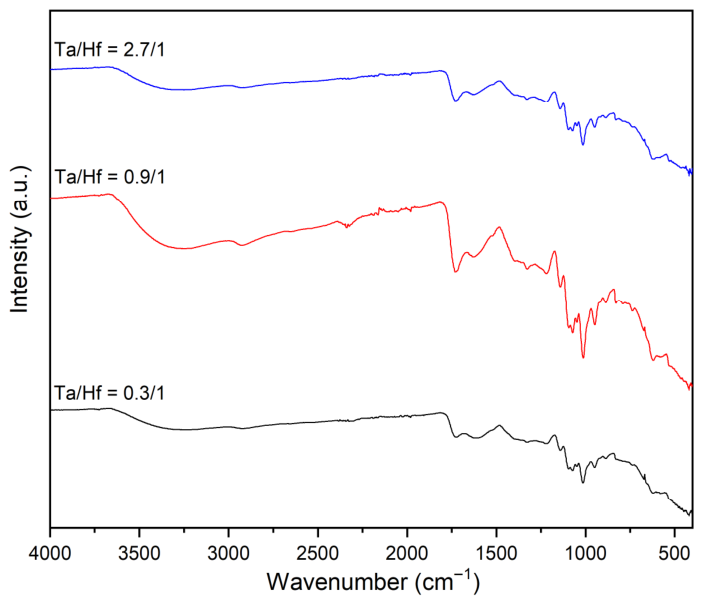
FTIR spectroscopy was employed to elucidate the chemical structure of the Ta/Hf/O/C precursor and the resulting TaxHf1−xC phase. Figure 1 shows the vibrational spectra of the hybrid organic–inorganic precursor powders dried at 110 °C with Ta/Hf molar ratios of 2.7/1, 0.9/1, and 0.3/1 (corresponding to nominal x = 0.73, 0.47, 0.23). All samples exhibit consistent characteristic bands, indicating that variations in molar ratios do not significantly alter the organic–inorganic bonding environment. A broad absorption band between 2800–3600 cm−1 is attributed to O–H stretching from adsorbed moisture and the hydroxyl groups of the pectin. Aliphatic C–H stretching from the pectin methine groups is observed at 2875 cm−1, while the bands at 1729, 1614, and 1330 cm−1 are assigned to carbonyl (C=O) stretching, asymmetric carboxylate ion (COO) stretching, and symmetric –CH3 vibrations, respectively [28]. These signals suggest the formation of Hf- and Ta-chelate structures within the precursor [25,29]. The vibrations at 1210, 1140, 1078, and 1012 cm−1 correspond to skeletal C–O and C–C stretching associated with the glycosidic linkages in pectin [24,29]. The peaks in the 1000–1150 cm−1 region further confirm a high homogalacturonan content in the pectin matrix [28]. Finally, the band at 945 cm−1 is attributed to C–O–C stretching [30], while the low-wavenumber peaks at 873 and 623 cm−1 are assigned to the metal-oxygen (Ta–O and Hf–O) vibrational modes [25,26]. These results confirm the successful formation of a homogeneous hybrid organic–inorganic precursor. The invariance of the bands under stoichiometric variations demonstrates the stability of the coordination environment. Specifically, the attenuation of the carbonyl stretching at 1729 cm−1 indicates a change in the electron density of the C=O bond due to its coordination with the metallic centers. Furthermore, the asymmetric carboxylate vibration at 1614 cm−1 and the metal-oxygen modes (873 and 623 cm−1) suggest that the chlorine atoms from the starting halides were substituted by oxygen-based ligands from the polymer, forming a stable cyclic metal-pectin complex. Pectin serves as an effective low-temperature, non-toxic precursor due to its superior metal-ion chelating capacity and morphological control, which are instrumental for the carbothermal reduction process [29]. These findings confirm that the precursors consist of a polymeric network incorporating Ta and Hf, formed via simultaneous chelation and self-polycondensation reactions.
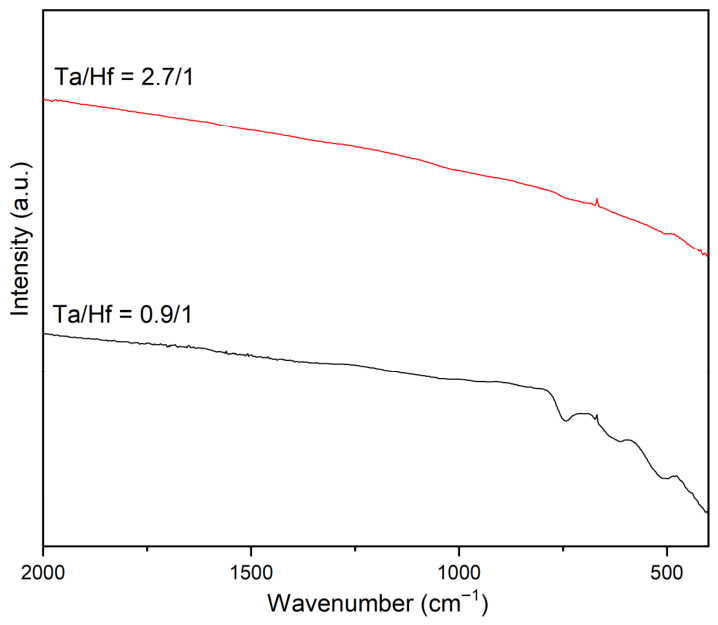
Figure 2 shows the FTIR spectra of the TaxHf1−xC solid solution powders synthesized at 1500 °C under an argon atmosphere for two representative Ta/Hf molar ratios: 2.7/1 and 0.9/1. The Hf-rich sample is not shown because no additional FTIR bands were observed relative to the intermediate composition, although its phase composition differs according to XRD/EDS. The spectra exhibit a largely featureless response in the 2000–1000 cm−1 region, indicating the effective removal of organic functional groups from the precursor. The absence of characteristic bands associated with C–H and C=O vibrations suggests that the pectin-derived polymeric network was completely decomposed during thermal treatment, yielding an inorganic material. Differences between compositions are more evident in the low wavenumber region (1000–450 cm−1). The Ta/Hf = 0.9/1 sample exhibits more pronounced absorption features at ~700–800 cm−1 and ~500–600 cm−1, attributed to metal–oxygen (M–O) vibrational modes. These features indicate the presence of oxygen-containing species, likely associated with residual oxides or slight surface oxidation. In contrast, the Ta-rich sample (Ta/Hf = 2.7/1) shows a smoother spectral profile with less pronounced bands, suggesting a lower contribution of such species. Metal–carbon (M–C) bonds are weakly infrared-active. Thus, FTIR analysis primarily serves to confirm the elimination of organic components and the presence of minor oxygen-related phase residues. Overall, the higher intensity of the M–O bands in the sample with Ta/Hf = 0.9/1 suggests that this composition is more prone to retaining oxygen under the investigated synthesis conditions.

2.2. XRD

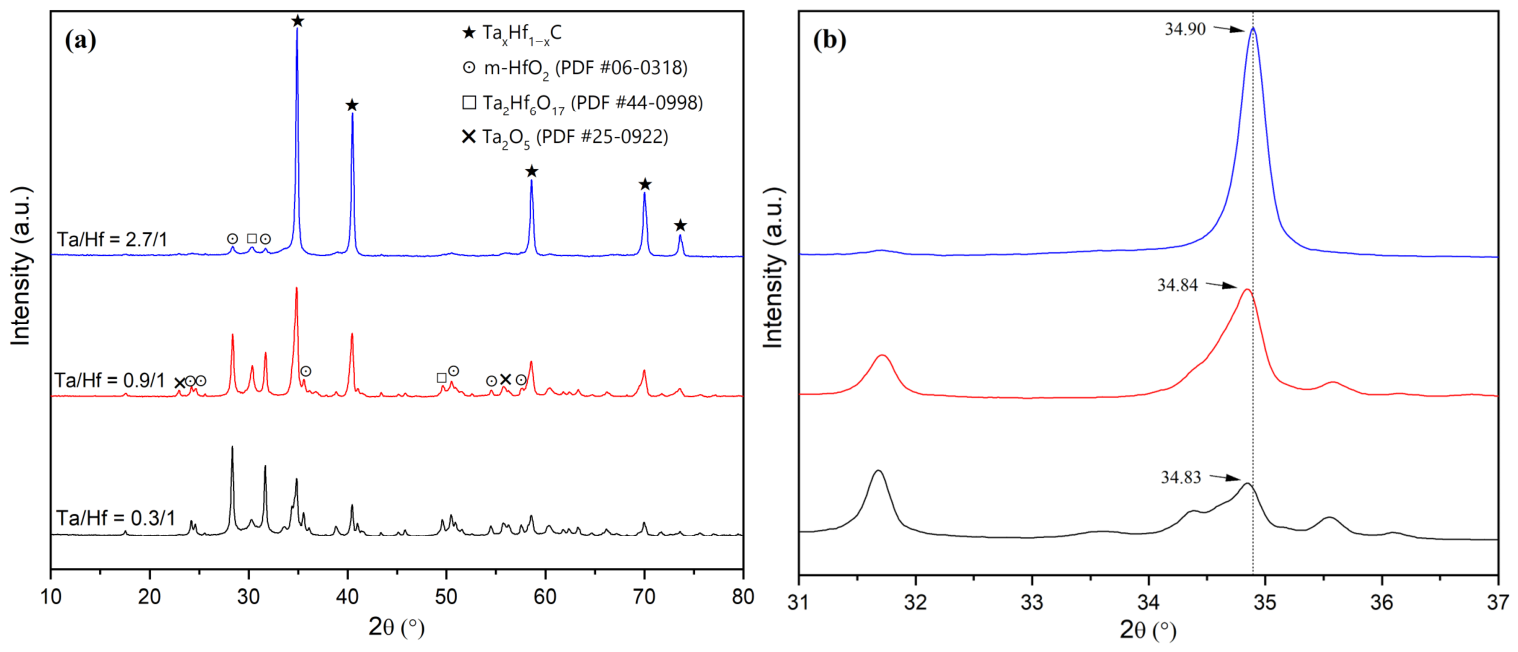
The XRD patterns in Figure 3a illustrate the phase evolution during the synthesis of TaxHf1−xC at 1500 °C as a function of the Ta/Hf molar ratio. The results clearly demonstrate that composition strongly influences phase formation, crystallinity, and the extent of carbothermal reduction. For the Ta-rich composition (Ta/Hf = 2.7/1), the diffraction pattern is dominated by sharp and intense peaks that can be indexed to a cubic TaxHf1−xC solid solution (space group Fm 3 ¯ m) with x ≈ 0.73. The five most prominent diffraction peaks of the Ta-rich sample can be indexed to the (111), (200), (220), (311), and (222) crystallographic planes of the face-centered cubic TaxHf1−xC phase, in good agreement with previous reports on TaxHf1−xC solid solutions [26,31]. This correspondence confirms the formation of a well-crystallized substitutional solid solution. However, minor residual oxides indicate that the reaction was not fully completed. The high crystallinity suggests that the homogeneous mixing achieved via the chloride–pectin route promotes uniform nucleation and growth of the carbide phase. A more detailed phase analysis of the Ta-rich composition confirms the predominance of the cubic Ta0.73Hf0.27C solid solution, with minor residual phases identified as monoclinic hafnia (m-HfO2, PDF No. 34-0104) and orthorhombic Ta2Hf6O17 (PDF No. 44-0998). Based on semi-quantitative analysis of integrated XRD peak areas, rather than full Rietveld refinement, the Ta0.73Hf0.27C solid solution was estimated to be the major phase, accounting for approximately 96% of the crystalline content. The remaining percentage corresponds to minor residual oxide phases (HfO2 and Ta2Hf6O17), whose weak reflections indicate their presence in trace amounts. This estimation is semi-quantitative and intended to demonstrate the high yield of the carbide phase under the reported synthesis conditions. Notably, the presence of these minor oxide phases at 1500 °C is consistent with the findings of Gong et al. [26], who reported similar HfO2 residues despite employing a more complex experimental assembly. The high yield of the carbide phase, with only ~4% residual oxides, indicates that a Ta/Hf molar ratio of 2.7/1 is optimal for promoting carbothermal reduction and solid-solution formation under the present conditions. The choice of 1500 °C for 2 h as the synthesis condition was intended to evaluate the effectiveness of the pectin-assisted route at temperatures below the conventional range typically reported for TaxHf1−xC synthesis (>1600 °C). This temperature was selected based on the research group’s previous successful synthesis of monocarbide powders (e.g., HfC) using related polymer-derived precursor approaches [32]. Although temperatures ≥ 1600 °C are generally required for complete HfO2 reduction and enhanced Hf diffusion, the XRD results obtained at 1500 °C demonstrate that the pectin-gelation route promotes an early onset of carbothermal reduction and solid-solution formation, particularly in the Ta-rich composition. The persistence of residual oxide phases in Hf-rich samples indicates that further optimization through higher temperatures or longer dwell times may be necessary to achieve complete conversion. The diffraction peaks of the TaxHf1−xC phase are located close to those of pure TaC [23], suggesting that the solid solution forms through substitutional incorporation of Hf into the TaC lattice. In contrast, the intermediate composition (Ta/Hf = 0.9/1) exhibits a multiphase assemblage where carbide peaks coexist with HfO2, Ta2O5, and the Ta2Hf6O17 phase. This incomplete conversion can be attributed to the high thermodynamic stability of HfO2, which requires more severe conditions (higher temperatures or longer dwell times) for complete conversion than those required for tantalum oxides. The persistence of oxide phases indicates that, in this composition, carbon availability and/or diffusion kinetics are insufficient to convert the oxide intermediates fully. For the Hf-rich sample (Ta/Hf = 0.3/1), carbide formation is significantly hindered, resulting in broad, low-intensity reflections and predominantly oxide phases, indicative of poor crystallinity and incomplete reaction. These structural findings are consistent with the FTIR results (Figure 2), which provide complementary information on the chemical evolution during synthesis. The reduced intensity of M–O vibrations observed in the Ta-rich sample indicates a more complete oxide-to-carbide conversion, in agreement with the formation of a highly crystalline TaxHf1−xC phase in XRD. In contrast, the persistence of M–O features at lower Ta/Hf ratios correlates with the presence of residual oxide phases and lower crystallinity, confirming that incomplete carbothermal reduction directly affects phase composition and structural order. Figure 3b provides a magnified view of the main diffraction peak in the 2θ range of 31–37°. A systematic shift of the principal peak from 34.83° (Ta/Hf = 0.3/1) to 34.90° (Ta/Hf = 2.7/1) is observed with increasing Ta content. The continuous peak displacement, without peak splitting, strongly suggests the formation of a single cubic carbide solid-solution phase, rather than separate TaC and HfC phases, although minor oxide phases remain.
The structural parameters presented in Table 1 were derived from the XRD data. The lattice parameters were calculated using Bragg’s Law for the cubic symmetry of the TaxHf1−xC solid solution. The average crystallite size was determined using the Scherrer equation, adopting a shape factor (K) of 0.84. The microstrain was estimated from the peak broadening related to the Bragg angle (θ). These calculations were performed using the most intense reflections (111, 200, and 220) to ensure statistical reliability across the different compositions. The lattice parameter increases from 4.453 to 4.462 Å as the Ta/Hf ratio decreases, confirming the substitutional incorporation of the larger Hf atoms into the cubic lattice. Furthermore, a clear inverse relationship between microstrain (ε) and crystallite size is observed. The highest microstrain is observed for the near-equimolar sample (Ta/Hf ≈ 1), which also shows the smallest crystallite size (~18 nm). This localized increase in lattice strain at intermediate compositions is consistent with previous reports [23,33], which attribute this phenomenon to maximum compositional disorder and to the significant atomic-size mismatch between Ta and Hf when neither species dominates the host lattice. This effect effectively hinders the growth of well-ordered crystalline domains. However, Ta-rich and Hf-rich samples exhibit lower strain and larger crystallite sizes, indicating improved structural relaxation when one cation dominates the lattice.
The observed increase in microstrain (ε = 58.1 × 10⁻⁴) for the near-equimolar sample (Ta/Hf = 0.9/1) can be attributed to enhanced configurational disorder and local lattice distortion arising from the atomic-size mismatch between Ta and Hf in the solid solution. This distortion increases elastic strain within the crystal lattice and hinders the growth of well-ordered crystallites, explaining the reduced crystallite size (approximately 18 nm) observed for the near-equimolar composition. These findings indicate that compositional disorder plays a key role in controlling microstructural refinement in TaxHf1−xC.
The observed shift toward higher 2θ values with increasing Ta content (Figure 3b) indicates a decrease in interplanar spacing, consistent with lattice contraction. According to Bragg’s law, this reflects a reduction in the lattice parameter as Ta progressively substitutes Hf in the carbide structure, a trend consistent with the slightly smaller atomic radius of Ta compared to Hf [25,31,34]. This compositional dependence follows Vegard’s law, supporting the formation of a continuous TaxHf1−xC solid solution. Unlike temperature-driven studies [25,31], in which peak shifts are primarily associated with enhanced diffusion, these results demonstrate that, at a fixed processing temperature (1500 °C), the crystallographic parameters are predominantly governed by the initial molar ratios. Furthermore, the progressive sharpening of diffraction peaks with increasing Ta content suggests improved crystallinity. In contrast, the peak broadening observed at intermediate compositions indicates smaller crystallite sizes and higher microstrain, likely associated with maximum configurational disorder.
Compared with previous studies based on organic/polymeric precursors, such as those reported by Liu et al. [8] and Pan et al. [15], the pectin-gelation route enabled the formation of TaxHf1−xC solid solutions at a lower temperature (1500 °C). In contrast, similar precursor-assisted approaches generally required temperatures of 1800–2100 °C. The enhanced chelation capability of pectin promotes a homogeneous molecular-level distribution of Ta, Hf, and carbon species, facilitating carbothermal reduction and solid-state diffusion. Consequently, the proposed method reduces energy consumption, limits grain coarsening, and improves synthesis efficiency.

2.3. SEM

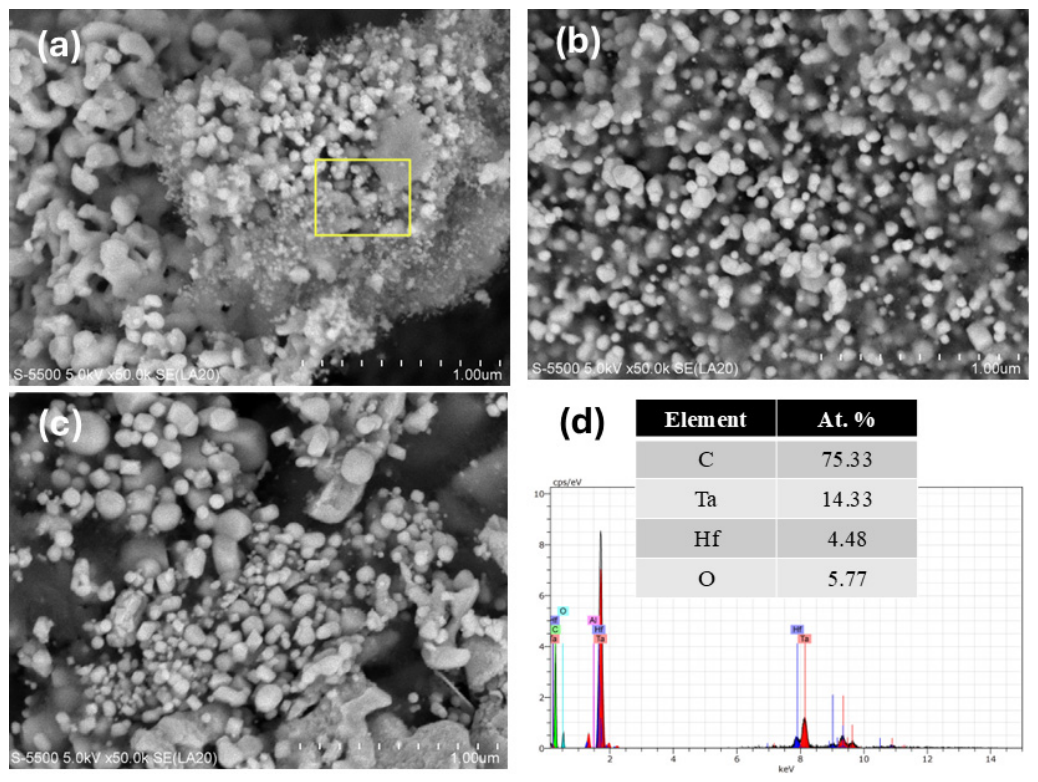
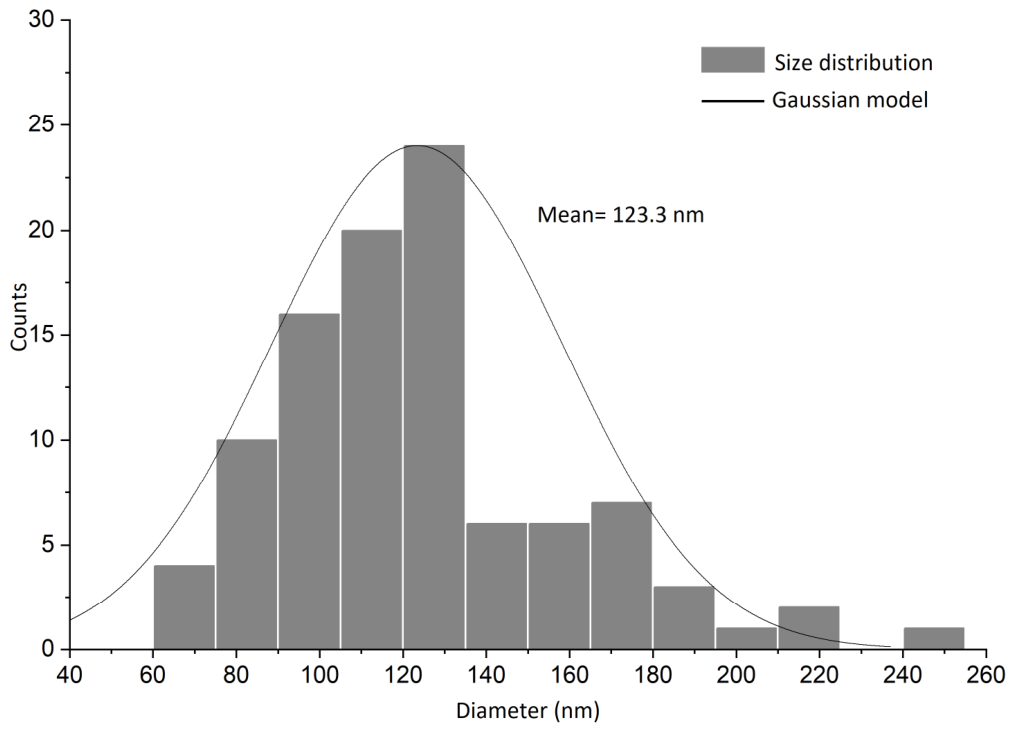
Figure 4 presents SEM micrographs of the TaxHf1−xC synthesized powders at 1500 °C with different Ta/Hf molar ratios, together with the corresponding EDS analysis for the Ta-rich composition. SEM analysis reveals that the chloride–pectin route produces predominantly submicron particles with spherical or polyhedral shapes. Notably, the particle morphology, size distribution, and degree of agglomeration vary significantly with the Ta/Hf ratio. The Ta-rich sample (Figure 4a) consists of relatively fine, quasi-spherical particles that form dense and homogeneous agglomerates. The morphology and particle size distribution were analyzed from SEM images acquired at 5000× magnification. The particle size statistics were determined by measuring the diameter of 100 randomly selected particles from different regions of the samples. As shown in the histogram in Figure 5, the particle sizes determined by image analysis using ImageJ software (version 1.54g) ranged from 66 nm to 247 nm, with a calculated average size of 123.3 ± 34.1 nm for the Ta0.73Hf0.27C nanoparticles synthesized at 1500 °C, while the accompanying oxide particles exhibit significantly smaller sizes of around 50 nm. This size distinction is consistent with the coexistence of carbide and residual oxide phases, although compositional mapping would be needed to confirm phase-specific assignment. Furthermore, the powders show partial interparticle necking and agglomeration, as evidenced by the presence of particle agglomeration and partial interparticle contact between adjacent grains. This observation is consistent with the sharp XRD reflections observed for this composition, indicating high crystallinity and enhanced carbothermal reduction kinetics at 1500 °C. At the intermediate ratio (Figure 4b), the powders exhibit a more heterogeneous morphology, characterized by a broader particle size distribution and irregular clusters with poorly defined boundaries. This microstructure, showing increased agglomeration and partial interparticle sintering, suggests local reaction heterogeneity and reduced structural organization during carbothermal conversion. These microstructural features correlate well with the multiphase nature identified by XRD, where residual oxides coexist with carbide phases, indicating competing oxide–carbide reactions at this composition. The Hf-rich sample (Figure 4c) is characterized by a microstructure dominated by coarse, irregularly shaped particles and dense, poorly defined agglomerates. These larger and less uniform grains suggest limited nucleation control and restricted growth of well-defined carbide domains. Such morphological features are consistent with hindered carbothermal reduction, and the predominance of oxide phases detected by XRD reflects the higher thermodynamic stability of HfO2 at 1500 °C compared to that of tantalum-based oxides. The elemental composition of the Ta-rich sample was further analyzed by EDS (Figure 4d) using point analysis mode on a representative region of the agglomerated particles shown in Figure 4a. The analysis confirms Ta, Hf, and C as the primary constituents. The measured Ta/Hf atomic ratio agrees well with the nominal stoichiometry, supporting reasonable compositional control of the chloride–pectin route for achieving precise compositional control in complex ternary carbides. The high carbon content reported by EDS (75.33 at.%) is attributed to residual carbon from the pectin precursor and to the intrinsic limitations of EDS for quantifying light elements. The organic-to-inorganic ratio was maintained constant for all TaxHf1−xC compositions; therefore, significant variations in the nominal carbon input among the three compositions are not expected. The presence of excess carbon is characteristic of polymer-derived ceramic routes, in which the organic matrix serves as a carbon source, reducing agent, and structural template during carbothermal reduction. In contrast, the oxygen content (5.77 at.%) indicates that carbothermal reduction at 1500 °C was substantial, although not complete. This result suggests that intimate molecular-level mixing of the precursor components may facilitate oxygen removal, while still leaving minor residual oxide species. EDS provides only semi-quantitative results for low-atomic-number elements due to significant X-ray absorption and the low energy of their characteristic signals. The qualitative elemental distribution is consistent with previous reports [25,26,35], confirming a similar elemental distribution in Ta–Hf–C systems. The EDS findings are consistent with the XRD results, which showed only minor residual oxide phases (e.g., HfO2 and Ta2Hf6O17). Overall, the combined SEM and EDS analyses demonstrate that higher Ta content promotes a more homogeneous microstructure, improved precursor organization, and enhanced phase purity, whereas increasing Hf content leads to greater morphological heterogeneity and incomplete reaction. These results highlight the critical role of the Ta/Hf ratio in governing both phase evolution and microstructural development in TaxHf1−xC ultra-high-temperature ceramics. Additional EDS spectra for the intermediate (Ta/Hf = 0.9/1) and Hf-rich (Ta/Hf = 0.3/1) samples are provided in the Supplementary Materials as Figures S1 and S2, respectively. The intermediate composition exhibits a moderate oxygen content (~5.91 at.%), indicating partial carbothermal reduction. In contrast, the Hf-rich sample shows a significantly higher oxygen content (~25.15 at.%) and lower Ta fraction, consistent with incomplete conversion and the persistence of oxide phases. These results agree with the XRD and SEM analyses.

3. Materials and Methods

3.1. Materials

High-purity tantalum pentachloride (TaCl5, 99%) and hafnium chloride (HfCl4, 98%) were dissolved in ethanol to serve as the metal-ion precursors for the synthesis of TaxHf1−xC. Citrus pectin (74% galacturonic acid) was utilized as an organic carbon source. All chemicals were purchased from Sigma-Aldrich® (St. Louis, MO, USA) and used as received.

3.2. Preparation of Ta–Hf–O–C Hybrid Precursors

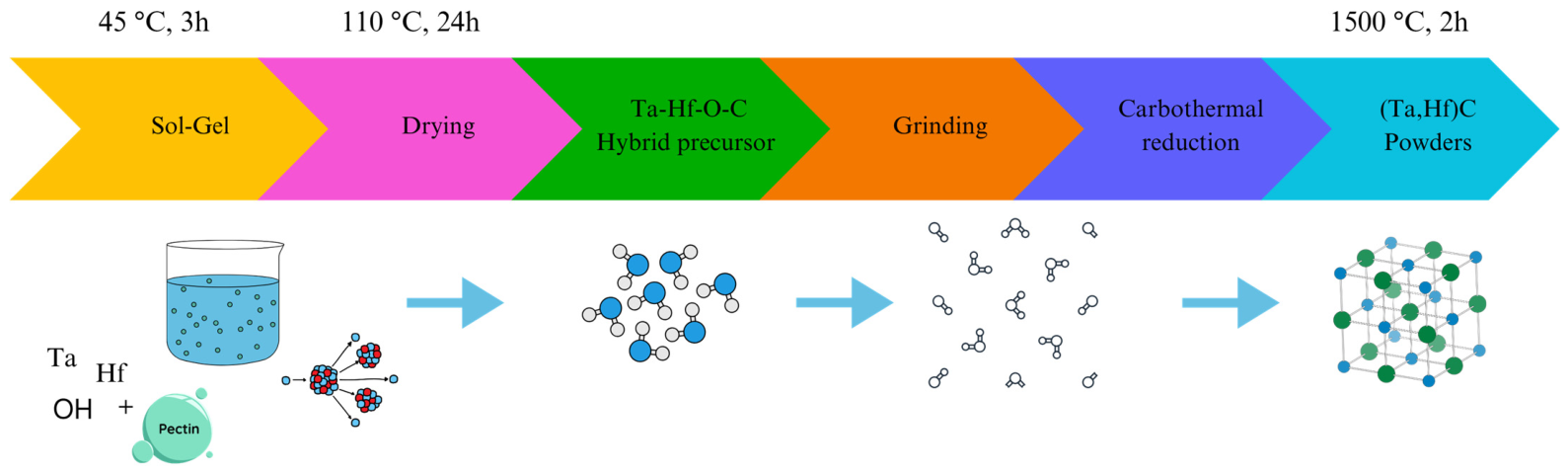
The synthesis route for TaxHf1−xC is illustrated in Figure 6. The preparation of the Ta–Hf–O–C hybrid precursors was carried out as follows: TaCl5, HfCl4, and pectin were mixed in distilled water at Ta/Hf molar ratios of 2.7/1, 0.9/1, and 0.3/1 (corresponding to nominal x values of 0.73, 0.47, and 0.23 in the TaxHf1−xC system, respectively). The solutions were stirred magnetically at 45 °C for 3 h to ensure complete homogenization and promote the chelation of metal ions by the pectin polymer chains. Subsequently, the resulting mixtures were dried at 110 °C for 24 h to obtain the solid Ta–Hf–O–C hybrid precursors. The dried products were finely ground in an agate mortar to obtain a homogeneous powder, which served as the starting material for the subsequent carbothermal reduction process.

3.3. Synthesis of TaxHf1−xC via Carbothermal Reduction

The carbothermal reduction in the ground hybrid precursors was performed in alumina crucibles using a tube furnace. The thermal treatment was carried out at 1500 °C for 2 h with a heating rate of 5 °C min−1 under a flow of high-purity argon (99.99%). After the holding time, the system was cooled to room temperature while maintaining the inert atmosphere to prevent any undesired oxidation of the synthesized carbides.

3.4. Characterization

The chemical structures and functional groups of both the precursor and the synthesized powders were analyzed by Fourier transform infrared spectroscopy using a PerkinElmer spectrophotometer (Waltham, MA, USA) over 4000–400 cm−1. Crystalline phase evolution was investigated via X-ray diffraction using a Rigaku ULTIMA IV diffractometer (Tokyo, Japan) with Cu-Kα radiation (λ = 0.15418 nm). Furthermore, the morphology and particle size distribution were examined by scanning electron microscopy (SEM) using a Hitachi S-5500 microscope (Tokyo, Japan).

4. Conclusions

In this work, a pectin-assisted synthesis route was demonstrated as an effective approach for the low-temperature preparation of TaxHf1−xC solid-solution powders. The use of pectin as a biopolymer-derived carbon source enables molecular-level mixing of tantalum and hafnium species, promoting homogeneous precursor formation and facilitating carbothermal reduction at 1500 °C.
The phase evolution and microstructural development were found to be strongly dependent on the Ta/Hf molar ratio. The Ta-rich composition (Ta0.73Hf0.27C) exhibited the most favorable results, achieving a high phase fraction (~95.87%) of the cubic solid solution with well-defined crystallinity and relatively homogeneous submicron particles. These findings indicate that, under the selected processing conditions, the pectin-assisted route is particularly effective for Ta-rich systems.
In contrast, intermediate and Hf-rich compositions showed incomplete carbothermal reduction, with the presence of residual oxide phases (e.g., HfO2 and Ta2Hf6O17) and increased microstructural heterogeneity. These results are consistent with the higher thermodynamic stability of HfO2, which limits complete conversion at 1500 °C.
Overall, the present study demonstrates that the pectin-assisted route enables the formation of TaxHf1−xC solid solutions at reduced temperature, particularly for Ta-rich compositions. However, further optimization of processing parameters, such as temperature and dwell time, is required to achieve comparable phase purity and compositional uniformity in Hf-rich systems.

Supplementary Materials

The following supporting information can be downloaded at: https://www.mdpi.com/article/10.3390/inorganics14050139/s1, Figure S1: EDS spectrum of molar ratios Ta/Hf = 0.9/1; Figure S2: EDS spectrum of molar ratios Ta/Hf = 0.3/1.

Author Contributions

Conceptualization, A.L.A.-S., L.G.C.-M. and J.B.-L.; methodology, A.L.A.-S., L.G.C.-M., J.C.L.-C., F.B.-L. and A.C.-E.; software, J.C.L.-C., R.S.-R., J.J.C.-G., C.A.P.-R. and J.B.-L.; validation, L.G.C.-M., J.J.C.-G., F.B.-L. and J.B.-L.; formal analysis, A.L.A.-S., L.G.C.-M., J.C.L.-C., C.A.P.-R., R.S.-R., F.B.-L., A.C.-E., J.J.C.-G. and J.B.-L.; investigation, A.L.A.-S., L.G.C.-M. and J.B.-L.; resources, L.G.C.-M. and J.B.-L.; data curation, J.C.L.-C., C.A.P.-R., R.S.-R., F.B.-L. and A.C.-E.; writing—original draft preparation, A.L.A.-S., L.G.C.-M. and J.B.-L.; writing—review and editing, L.G.C.-M. and J.B.-L.; visualization, J.C.L.-C., R.S.-R., F.B.-L., A.C.-E. and J.J.C.-G.; supervision, L.G.C.-M. and J.B.-L. All authors have read and agreed to the published version of the manuscript.

Funding

This research received no external funding.

Institutional Review Board Statement

Not applicable.

Informed Consent Statement

Not applicable.

Data Availability Statement

The original contributions presented in this study are included in the article. Further inquiries can be directed to the corresponding authors.

Acknowledgments

The authors gratefully acknowledge the technical assistance provided by M.L. Ramón García for the XRD analysis and by R. Morán Elvira for the SEM analysis, both from IER-UNAM.

Conflicts of Interest

The authors declare no conflicts of interest.

Abbreviations

The following abbreviations are used in this manuscript:
UHTCsultra-high-temperature ceramics
TaCtantalum carbide
HfChafnium carbide
Tatantalum
Hfhafnium
PIPprecursor impregnation and pyrolysis
FTIRFourier transform infrared
XRDX-ray diffraction
SEMscanning electron microscopy
EDSenergy-dispersive spectroscopy
M–Ometal–oxygen
Ta2Hf6O17tantalum hafnium oxide
εmicrostrain
TaCl5tantalum pentachloride
HfCl4hafnium tetrachloride
Åangstrom
a.u.arbitrary units
PDFpowder diffraction file
m-HfO2monoclinic hafnia

References

  1. Cui, K.; Mao, H.; Zhang, Y.; Wang, J.; Wang, H.; Tan, T.; Fu, T. Microstructure, mechanical properties, and reinforcement mechanism of carbide toughened ZrC-based ultra-high temperature ceramics: A review. Compos. Interfaces 2022, 29, 729–748. [Google Scholar] [CrossRef]
  2. Liu, H.; Tong, K.; Feng, X.; Liu, S.; Wen, B. Temperature-dependent mechanical properties of TaC and HfC. J. Mater. Sci. 2023, 58, 157–169. [Google Scholar] [CrossRef]
  3. Yang, M.; Sun, H. Early melting of tantalum carbide under anisotropic stresses: An ab initio molecular dynamics study. Phys. Rev. B 2023, 107, 104101. [Google Scholar] [CrossRef]
  4. Zhang, Y.; Ma, H.; He, M.; Zhang, L.; Song, C.; Li, J.; Wan, F. Preparation and performance of C/Ta4HfC5-SiC composite fabricated by PIP combined with RMI process. Ceram. Int. 2025, 51, 787–797. [Google Scholar] [CrossRef]
  5. Cedillos-Barraza, O.; Manara, D.; Boboridis, K.; Watkins, T.; Grasso, S.; Jayaseelan, D.D.; Konings, J.M.; Reece, M.J.; Lee, W.E. Investigating the highest melting temperature materials: A laser melting study of the TaC-HfC system. Sci. Rep. 2016, 6, 37962. [Google Scholar] [CrossRef]
  6. Valencia, D.P.; Yate, L.; Aperador, W.; Li, Y.; Coy, E. High electrocatalytic response of ultra-refractory ternary alloys of Ta-Hf-C carbide toward hydrogen evolution reaction in acidic media. J. Phys. Chem. C 2018, 122, 25433–25440. [Google Scholar] [CrossRef]
  7. Qing, M.; He, Q.; Wang, Y.; Fan, C.; Yin, X. Strong associations between composition and plasma ablation behavior in C/C-Hf1-xTaxC composites. J. Eur. Ceram. Soc. 2026, 46, 117899. [Google Scholar] [CrossRef]
  8. Liu, Z.; Li, B.; Tian, Y.; Zhu, H.; Li, Y.; Cong, Y.; Guo, J.; Zhang, J.; Dong, Z.; Li, X. Effect of Hf/Ta atomic ratio on formation, structure and ablation resistance of TaxHf1-xC solid solutions derived from single-source precursors. Ceram. Int. 2025, 51, 59320–59334. [Google Scholar] [CrossRef]
  9. Simonenko, E.P.; Simonenko, N.P.; Papynov, E.K.; Shichalin, O.O.; Belov, A.A.; Nagornov, I.A.; Gorobtsov, P.Y.; Kuznetsov, N.T. Effect of nanocrystalline SiC addition on reactive SPS and oxidation resistance of Ta4HfC5 ceramics. Ceram. Int. 2023, 49, 9691–9701. [Google Scholar] [CrossRef]
  10. Liu, S.; Ma, Z.; Liu, Y.; Tian, X.; Zhu, S.; Liu, L.; He, S.; Guangyi, M. Ablation performance of Ta0.8Hf0.2C-SiC coating fabricated via pack cementation for carbon/carbon composites. J. Eur. Ceram. Soc. 2025, 45, 117064. [Google Scholar] [CrossRef]
  11. Mu, G.; Liu, Y.; Tian, X.; Ma, Z.; Zhu, S.; Liu, L.; He, S.; Chi, H. First-principles calculation, synthesis, and oxidation mechanism of Ta1−xHfxC ultra-high temperature ceramics. Int. J. Refract. Met. Hard Mater. 2024, 123, 106744. [Google Scholar] [CrossRef]
  12. Wang, B.; Li, D.; Yang, Z.; Ye, S.; Jia, D.; Guan, J.; Zhou, Y. Mechanical alloying derived SiBCN-Ta4HfC5 composite ceramics: Study on amorphous transformation mechanism. J. Non-Cryst. Solids 2022, 585, 121543. [Google Scholar] [CrossRef]
  13. Wang, B.; Li, D.; Yang, Z.; Jia, D.; Guan, J.; Peng, H.; Cai, D.; He, P.; Duan, X.; Zhou, Y.; et al. Microstructural evolution and mechanical properties of in situ nano Ta4HfC5 reinforced SiBCN composite ceramics. J. Adv. Ceram. 2020, 9, 739–748. [Google Scholar] [CrossRef]
  14. Shcherbakov, V.A.; Gryadunov, A.N.; Semenchuk, I.E.; Alymov, M.I. Ta4HfC5 ceramic by electro-thermal explosion under pressure: Thermal and electrical parameters of the process. Int. J. Self-Propag. High-Temp. Synth. 2022, 31, 1–5. [Google Scholar] [CrossRef]
  15. Pan, R.; Chen, G.; Xu, H.; Hou, C.; Liu, D.; Wang, Y.; Han, W. Sintering behavior and mechanical properties of Ta4HfC5-based composites with ZrB2 additive. J. Eur. Ceram. Soc. 2022, 42, 3720–3729. [Google Scholar] [CrossRef]
  16. Lu, Y.; Sun, Y.; Zhang, T.; Chen, F.; Ye, L.; Zhao, T. Polymer-derived Ta4HfC5 nanoscale ultrahigh-temperature ceramics: Synthesis, microstructure and properties. J. Eur. Ceram. Soc. 2019, 39, 205–211. [Google Scholar] [CrossRef]
  17. Pan, R.; Chen, G.; Yu, X.; Yang, Y.; Han, W. Densification, microstructure and mechanical properties of Ta4HfC5-based ceramics obtained from synthesized nanoscale powder. J. Eur. Ceram. Soc. 2021, 41, 2247–2254. [Google Scholar] [CrossRef]
  18. Lu, Y.; Zhu, S.; Wang, X.; Sui, X.; Zhang, S.; Hao, J.; Zhao, T. High temperature tribological behavior of polymer-derived Ta4HfC5 nanoceramics. Tribol. Int. 2021, 156, 106859. [Google Scholar] [CrossRef]
  19. Guan, J.; Li, D.; Wang, B.; Yang, Z.; Cao, N.; Li, L.; Wang, Y.; Jia, D.; Zhou, Y. Atomic migration behavior of Ta4HfC5-SiBCN ceramics sintered by hot-pressing. J. Eur. Ceram. Soc. 2025, 45, 117510. [Google Scholar] [CrossRef]
  20. Guan, J.; Li, D.; Zhou, G.; Duan, W.; Yang, Z.; Jia, D.; Riedel, R.; Qin, S.; Zhou, Y. Interface structure and grain growth behavior of Ta4HfC5-Si2BC3N complex ceramic. Sci. China Mater. 2023, 66, 4306–4316. [Google Scholar] [CrossRef]
  21. Gaballa, O.; Cook, B.A.; Russell, A.M. Reduced-temperature processing and consolidation of ultra-refractory Ta4HfC5. Int. J. Refract. Met. Hard Mater. 2013, 41, 293–299. [Google Scholar] [CrossRef]
  22. Zhang, C.; Gupta, A.; Seal, S.; Boesl, B.; Agarwal, A. Solid solution synthesis of tantalum carbide-hafnium carbide by spark plasma sintering. J. Am. Ceram. Soc. 2017, 100, 1853–1862. [Google Scholar] [CrossRef]
  23. Ni, D.; Qin, Y.; Dong, S. Microstructure and mechanical behavior of TaxHf1−xC–SiC fabricated by reactive hot-pressing: Effect of Ta: Hf ratio. J. Am. Ceram. Soc. 2024, 107, 6974–6984. [Google Scholar] [CrossRef]
  24. Wan, F.; Ma, H.; Zhang, L.; He, M.; Chen, Y.; Li, X.; Song, C.; Li, J. Preparation, microstructure and properties of C/Ta4HfC5-SiC composite fabricated by PIP method based on a new liquid precursor. J. Eur. Ceram. Soc. 2025, 45, 117281. [Google Scholar] [CrossRef]
  25. Cheng, J.; Dong, Z.; Zhu, H.; Yuan, G.; Westwood, A.; Cong, Y.; Li, B.; Guo, J.; Li, X. Synthesis and ceramisation of organometallic precursors for Ta4HfC5 and TaHfC2 ultra-fine powders through a facile one-pot reaction. J. Alloys Compd. 2022, 898, 162989. [Google Scholar] [CrossRef]
  26. Gong, Z.; Li, Y.; Chang, J.; Zhang, Y.; Chen, S.; Xu, Q.; Yan, L. Ultra-high temperature thermal insulated Ta4HfC5 porous ceramics with thermal stability and temperature resistance up to 2000 °C. Ceram. Int. 2025, 51, 34716–34723. [Google Scholar] [CrossRef]
  27. Wolfe, D.E.; Albert, P.E.; Ryan, C.J.; Reiss, J.A.; Stepanoff, S.P.; Kolonin, P.A. Optimized processing of high density ternary hafnium-tantalum carbides via field assisted sintering technology for transition into hypersonic applications. J. Eur. Ceram. Soc. 2022, 42, 327–335. [Google Scholar] [CrossRef]
  28. Santos, E.E.; Amaro, R.C.; Bustamante, C.C.C.; Guerra, M.H.A.; Soares, L.C.; Froes, R.E.S. Extraction of pectin from agroindustrial residue with an ecofriendly solvent: Use of FTIR and chemometrics to differentiate pectins according to degree of methyl esterification. Food Hydrocoll. 2020, 107, 105921. [Google Scholar] [CrossRef]
  29. Patra, N.; Al Nasiri, N.; Jayaseelan, D.D.; Lee, W.E. Low-temperature solution synthesis of nanosized hafnium carbide using pectin. Ceram. Int. 2016, 42, 1959–1963. [Google Scholar] [CrossRef]
  30. Jiang, Y.; Ni, D.; Ding, Q.; Chen, B.; Chen, X.; Kan, Y.; Dong, S. Synthesis and characterization of nano-crystalized HfC based on an aqueous solution-derived precursor. RSC Adv. 2018, 8, 39284–39290. [Google Scholar] [CrossRef] [PubMed]
  31. Jiang, J.; Wang, S.; Li, W. Preparation and characterization of ultrahigh-temperature ternary ceramics Ta4HfC5. J. Am. Ceram. Soc. 2016, 99, 3198–3201. [Google Scholar] [CrossRef]
  32. Ceballos-Mendívil, L.G.; Manzanarez-Salazar, E.; Luque-Ceballos, J.C.; Soto-Rojo, R.; Baldenebro-López, F.; Cruz-Enríquez, A.; Baldenebro-López, J. Facile synthesis of high-purity nanostructured hafnium carbide via pectin-assisted carbothermal reduction: Structural evolution and morphological insight. Inorganics 2026, 14, 92. [Google Scholar] [CrossRef]
  33. Thomas, T.; Nisar, A.; Zhang, C.; Joglekar, S.; Pankow, M.; Boesl, B.; Agarwal, A. High strain rate response and mechanical performance of tantalum carbide–hafnium carbide solid solution. Ceram. Int. 2023, 49, 39099–39106. [Google Scholar] [CrossRef]
  34. Tan, Z.Y.; Zhu, W.; Yang, L.; Zhou, Y.C.; Wu, Q.; Gong, L.J. Microstructure, mechanical properties and ablation behavior of ultra-high-temperature Ta-Hf-C solid solution coating prepared by a step-by-step plasma solid solution method. Surf. Coat. Technol. 2020, 403, 126405. [Google Scholar] [CrossRef]
  35. Zou, X.; Ni, D.; Chen, B.; Ye, L.; Sun, Y.; Lu, J.; Cai, F.; Gao, L.; Zhao, T.; Dong, S. Fabrication and properties of Cf/Ta4HfC5-SiC composite via precursor infiltration and pyrolysis. J. Am. Ceram. Soc. 2021, 104, 6601–6610. [Google Scholar] [CrossRef]
Figure 1. FTIR spectra of the Ta–Hf–O–C hybrid precursors synthesized at 110 °C with varying Ta/Hf molar ratios: 2.7/1, 0.9/1, 0.3/1.
Inorganics 14 00139 g001
Figure 2. FTIR spectra of TaxHf1−xC synthesized at 1500 °C under an argon atmosphere with varying Ta/Hf molar ratios: 2.7/1 and 0.9/1.
Inorganics 14 00139 g002
Figure 3. (a) XRD patterns of TaxHf1−xC synthesized at 1500 °C for 2 h under an argon atmosphere at various Ta/Hf molar ratios; (b) magnified view of the TaxHf1−xC diffraction peaks in the 2θ range of 31–37°.
Inorganics 14 00139 g003
Figure 4. SEM micrographs of TaxHf1−xC synthesized powders at 1500 °C for 2 h with different Ta/Hf molar ratios: (a) 2.7/1, (b) 0.9/1, and (c) 0.3/1. (d) EDS spectrum of the sample with Ta/Hf molar ratio.
Inorganics 14 00139 g004
Figure 5. Particle size distribution histogram of Ta0.73Hf0.27C powders obtained from SEM image analysis with Gaussian model.
Inorganics 14 00139 g005
Figure 6. Schematic representation of the synthesis route for TaxHf1−xC powders via carbothermal reduction.
Inorganics 14 00139 g006
Table 1. Lattice parameter, crystallite size, and microstrain (ε) for TaxHf1−xC samples synthesized at 1500 °C.
Molar RatioLattice Parameter (Å)Crystallite Size (nm)Microstrain ε (10−4)
Ta/Hf = 2.7/14.45321.5139.1
Ta/Hf = 0.9/14.46018.0258.1
Ta/Hf = 0.3/14.46224.9938.7
Disclaimer/Publisher’s Note: The statements, opinions and data contained in all publications are solely those of the individual author(s) and contributor(s) and not of MDPI and/or the editor(s). MDPI and/or the editor(s) disclaim responsibility for any injury to people or property resulting from any ideas, methods, instructions or products referred to in the content.