Article

Study on the Construction and Performance Measurement of Tm2FeSbO7/BiYO3 Heterojunction Photocatalyst and the Photocatalytic Degradation of Sulfamethoxazole in Pharmaceutical Wastewater Under Visible Light Irradiation


1
School of Physics, Changchun Normal University, Changchun 130032, China
2
State Key Laboratory of Pollution Control and Resource Reuse, School of the Environment, Nanjing University, Nanjing 210093, China
3
School of Physics, Jilin University, Changchun 130012, China
*
Author to whom correspondence should be addressed.
Inorganics 2026, 14(3), 82; https://doi.org/10.3390/inorganics14030082
Submission received: 22 December 2025 / Revised: 6 March 2026 / Accepted: 10 March 2026 / Published: 13 March 2026
(This article belongs to the Special Issue Metal-Based Photocatalysts: From Synthesis to Applications)

Abstract

A novel catalyst, Tm2FeSbO7, was synthesized by employing the solid-phase high-temperature sintering method, and, for the first time, it was utilized to create a Z-type heterojunction with BiYO3. A direct Z-scheme Tm2FeSbO7/BiYO3 heterojunction photocatalyst (TBHP) was successfully produced by employing the ball-milling technique. X-ray diffraction analysis results indicated that Tm2FeSbO7 crystallized in a cubic pyrochlorestructure which owned the Fd-3m space group, with a unit cell parameter of 10.1769 Å, whereas BiYO3 displayed a fluorite structure in the Fm-3m space group, with a unit cell parameter of 5.4222 Å. The Mossbauer spectrum of Tm2FeSbO7 showed that Fe3+ ions might locate at octahedral sites. The measured bandgap widths for the TBHP, Tm2FeSbO7, and BiYO3 were 2.14 eV, 2.21 eV, and 2.30 eV, respectively. Multiple experimental results demonstrated that the TBHP exhibited a higher valence band ionization potential, a narrower band gap width, and a higher removal efficiency of the sulfamethoxazole (SMX) compared with the Dy2TmSbO7/BiHoO3 heterojunction photocatalyst. Under visible-light irradiation (VISLI) of 115 min, the TBHP showcased exceptional photocatalytic elimination performance; therefore, the elimination rate of the SMX and the total organic carbon (TOC) mineralization rate reached 99.51% and 98.10%, respectively. In contrast to single-component Tm2FeSbO7, BiYO3, or conventional nitrogen-doped titanium dioxide (N-TiO2) catalyst, the TBHP exhibited removal efficiency enhancement for degrading the SMX by 1.17 times, 1.31 times, or 4.06 times. Simultaneously, the matching mineralization rate for removing the TOC density by employing the TBHP was 1.20 times, 1.34 times, or 4.73 times higher than that by employing Tm2FeSbO7, BiYO3, or conventional N-TiO2. Above experimental results indicated that the mineralization efficiency for removing TOC density by employing the TBHP was higher than that by employing Tm2FeSbO7, BiYO3, or N-TiO2. Radicals trapping experiments and the electron paramagnetic resonance spectroscopy results revealed that hydroxyl radicals, superoxide anions, and photoinduced holes were the primary active species during the catalytic elimination course of the SMX by employing the TBHP under VISLI. The results demonstrated that the direct Z-scheme TBHP, which was developed in this study, exhibited the maximal removal efficiency for degrading the SMX in contrast to Tm2FeSbO7, BiYO3, or N-TiO2. Additionally, the possible elimination routes and elimination mechanisms of the SMX were proposed. Therefore, an important scientific foundation for developing high-performance heterojunction catalysts was established.

1. Introduction

Since the 21st century, the pharmaceutical industry has developed vigorously. The rapid accumulation of pharmaceutical wastewater has become a severe and unavoidable problem in environmental pollution control. Antibiotics have been detected in sewage and groundwater worldwide [1,2]. Nevertheless, antibiotics that enter the water environment not only disrupt ecological balance and reduce biodiversity, but also pose potential threats to human health [3]. Sulfamethoxazole (SMX) is a typical sulfonamide antibiotic. SMX is widely present in pharmaceutical wastewater and is difficult to degrade. The reason is that SMX contains sulfonamide bonds and isoxazole rings, which are stable chemical structures [4,5]. The key resolution procedure for decomposing the stable organic structures was the cleavage of the C-C bond and the C-H bond. Fukui index and liquid chromatograph mass spectrometer (LC-MS) analysis results revealed that the sulphonamide bond cleavage and isoxazole ring opening are the main detoxification pathways [6]. Therefore, these compounds require strong oxidative species such as •OH and h+ for degradation.
The emergence of high-level semiconductor photocatalytic technology provided a sustainable solution for water purification. This photocatalytic technology employed light energy for driving chemical reactions, with its principle, which was primarily based on solid-state band theory [7]. When semiconductor photocatalysts (SPC) such as titanium dioxide were exposed to incident light energy that exceeded the bandgap width of the SPC, electrons transferred from the valence band (VB) of the SPC to the conduction band (CB) of the SPC. Accordingly, the photo-induced electron remained in the CB of the SPC; meanwhile, the holes remained in the VB of the SPC [8]. These photo-induced electrons and holes were subsequently separated and migrated on or between the surfaces of the SPC [9]. The electrons, which were employed as a reducing agent, might reduce soluble oxygen into superoxide radicals [10]. On the contrary, the holes which possessed oxydic performance might respond with aquafer or hydroxyl groups for generating altus active hydroxyl radicals. Ultimately, the generated radicals reacted with the pollutants, decomposing the pollutants into harmless compounds such as carbon dioxide (CO2) and water (H2O) [11].
The advanced oxidation technology has been widely applied due to its more direct degradation mechanism. For example, the market-applied photocatalyst TiO2 (e.g., Degussa P25) is currently used to treat aqueous contaminants under ultraviolet light irradiation [12]. In addition, Tatiana Makropoulou’s team had confirmed that ZnO could degrade SMX almost completely under ultraviolet light irradiation [13]. However, the conventional photocatalytic nanomaterials such as TiO2 and ZnO have limitations such as weak response to visible light and low photogenerated electron mobility, which immensely restrict the enhancement of their catalytic property [14,15]. The semiconductor photocatalysis technologies, specifically those photocatalytic technologies that were represented by novel pyrochlore-type A2BCO7 (A3+, B3+, C5+, O2-) metal oxide semiconductors, have provided new approaches for water pollution control. A loftier specific surficial area and stronger metal oxide interaction were achieved for promoting particle diffusion; accordingly, the photocatalytic activity and thermal stability were enhanced. These oxides belong to a class of semiconductor materials with layered structures and have gained significant attention owing to their unique crystal structures and photocatalytic activity [16]. Based on previous research outcomes, we aimed to further choose favorable elements for synthesizing the A2BCO7 compound.
Zhang Bowen’s team employed rare earth element-doped TiO2; as a result, in the activity test, the Tm-doped TiO2 sample exhibited the highest photocatalytic activity for decomposing nicotinic insecticides, in contrast to pure TiO2 [17]. Prof. Dr. Greta Patzke’s team pointed out that the Ni-based catalysts exhibited higher catalytic activity when they were doped with Fe3+ [18]. Moreover, Dr. Eleonora Aneggi et al. demonstrated that the Cu/Fe coupling effect not only exhibited extremely high elimination efficiency, but also maintained its reactivity over a wider pH range [19]. V. Ganesh et al. reported that Sb-doped ZnO achieved an 86% elimination efficiency for methylene blue dye [20]. Based on these findings, this study proposed to replace A3+ with Tm3+, replace B3+ with Fe3+, and replace C5+ with Sb5+ in the pyrochlore-type A2BCO7; as a result, novel Tm2FeSbO7 was designed with the expectation of increasing carrier concentration.
However, single-component Bi-based catalysts suffered from severe carrier recombination and limited active sites, prompting the development of heterojunction systems. Among these Bi-based catalysts, Z-scheme heterojunctions have emerged as a promising strategy for enhancing charge separation efficiency. In order to address the issue, binary heterojunction photocatalysts have gained popularity due to their interfacial electric fields that promote carrier separation. For instance, Yu et al. constructed an immediate Z-type ZnMoO4/Cu2O heterogeneous junction, which significantly improved the photodegradation efficiency of antibiotic pollutants under VISLI conditions [21]. Chen et al. developed an immediate Z-type BiVO4/CdS heterogeneous junction, which demonstrated excellent photodegradation performance for quinolone antibiotics [22]. These results indicated that constructing Z-scheme heterojunctions was an effective strategy for enhancing the photocatalytic activity of the Z-type heterojunction catalysts.
Meanwhile, worldwide researchers have conducted extensive studies on Bi-based photocatalysts for the elimination of organic pollutants. Bi-based photocatalyzers typically exhibited a bandgap (Eg) which was lower than 3.0 eV; concurrently, due to the hybridization of Bi 6s orbit and O 2p orbit, these Bi-based photocatalyzers extended their light absorption waveband to the visible-light waveband region (400–700 nm) [23,24]. This hybridization effectively reduced the mass of photogenerated carriers and enhanced charge-separative efficiency and transport efficiency in Bi-based photocatalyzers. Consequently, Bi-based photocatalyzers were regarded as highly efficient catalysts. For example, BiYO3, which was proposed by Zuzeng Qin, has also been confirmed to exhibit excellent photocatalytic activity [23].
Based on the above research, we creatively proposed to combine Tm2FeSbO7 with BiYO3 for forming a heterostructure; accordingly, our objective was to increase carrier concentration and improve the degradation efficiency of the SMX for the sake of enhancing the separation efficiency of photo-induced electrons and photogenerated holes. The ball-milling technique was successfully employed for producing Tm2FeSbO7/BiYO3 heterojunction photocatalyst (TBHP). In addition, we employed SMX as the degradation target for evaluating the photocatalytic activity of the Z-scheme TBHP. Meanwhile, we conducted photoelectrochemical experiments to analyze the degradation mechanism and potential degradation pathways of the SMX.

2. Results and Discussion

2.1. Structural and Photochemical Properties of Composition Photocatalysts

2.1.1. X-Ray Diffraction Patterns and Mössbauer Spectrum Analysis

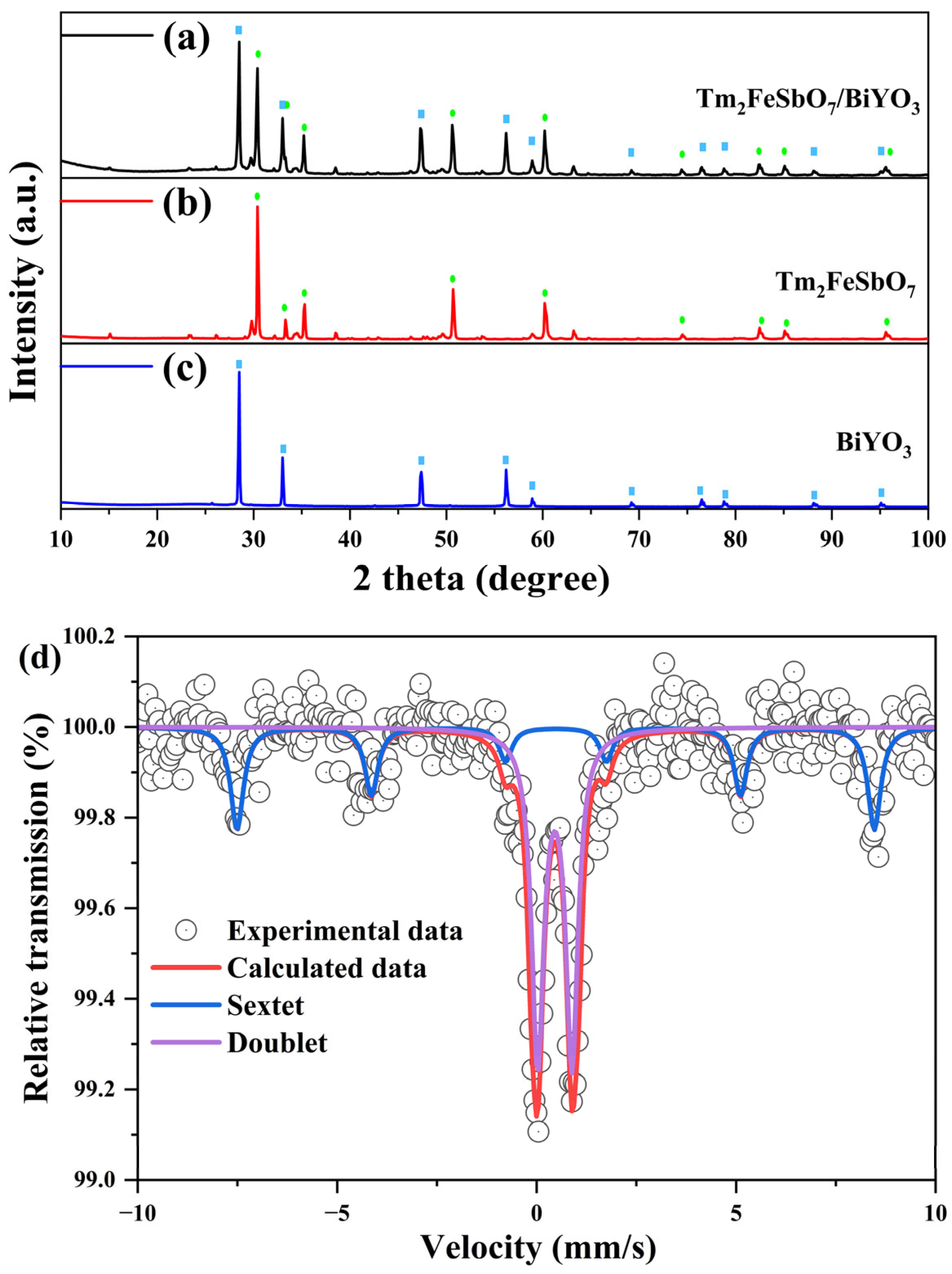
Figure 1a–c displays the X-ray diffraction (XRD) patterns of the TBHP, Tm2FeSbO7, and BiYO3. The prominent peaks that were perceived in the XRD pattern of TBHP (Figure 1a) matched those peaks that stemmed from Tm2FeSbO7 (Figure 1b) and BiYO3 (Figure 1c), indicating that the successful synthesis of TBHP was realized. In order to further confirm the crystal structure, the XRD data of Tm2FeSbO7 and BiYO3 were processed by employing the Pawley refinement method and Materials Studio software (version 2023) for improving data quality and obtaining more accurate crystal structure information. The refinement model included oxygen atoms, showing excellent agreement between the experimental diffraction peak intensities and calculated diffraction peak intensities (EDPI-CDPI) for Tm2FeSbO7 or BiYO3. The refinement result for Tm2FeSbO7 is shown in Figure S1a. By comparing Figure S1 with the standard XRD card of γ-Fe2O3, it could be seen that Tm2FeSbO7 might contain a small amount of γ-Fe2O3 because the maximal diffraction peak of γ-Fe2O3 occurs at 2θ = 30.272 degrees [25]. However, the Pawley refinement results of Tm2FeSbO7 (RP = 11.67%) confirmed a high consistency between EDPI-CDPI, demonstrating that Tm2FeSbO7 possessed a high precision in terms of the pyrochlore-type structure. Additionally, the results showed that Tm2FeSbO7 was a single-component cubic lattice with a space group of Fd-3m (No. 227). By analyzing the interplanar distance d, diffraction angle, and the wavelength (1.5406 Å) of the copper target in the X-ray diffractometer, the lattice parameter a of Tm2FeSbO7 was determined to be 10.1769 Å. Figure S1b shows the atomic structure of Tm2FeSbO7. The atomic positions and geometric factors of Tm2FeSbO7 are listed in Table S2. The refinement result for BiYO3 compounds is shown in Figure S2a. The Pawley refinement results of BiYO3 (RP = 3.93%) confirmed a high consistency between EDPI-CDPI, indicating high precision in terms of the fluorite structure. The space group of BiYO3 was Fm-3m (No. 225). Similarly, the lattice parameter a of BiYO3 was determined to be 5.4222 Å. Figure S2b reveals the atomic structure of BiYO3. The atomic positions and geometric factors of BiYO3 are listed in Table S3. These observation results indicated that the synthesized Tm2FeSbO7 or BiYO3 exhibited excellent structural stability and might serve as efficient photocatalysts in various scientific fields.
Pyrochlore-type A2BCO7 compounds are well known for their outstanding structural stability. The x-coordinate of the O (1) atom played a crucial role in crystal structure analysis and was widely regarded as a fundamental parameter for characterizing structural properties of Tm2FeSbO7, highlighting its importance in compound characterization. An x-value of 0.375 indicated the equivalence of six A-O (1) connectivity dimensions and two A-O (2) connectivity dimensions [26]. Tm2FeSbO7 featured a three-dimensional interconnected framework which was composed of corner-sharing MO6 (M = Fe3+ and Sb5+) octahedra, which were linked by Tm3+ ions to form a chain-like structure. When the x-value deviated from 0.375, it suggested distortion in the MO6 (M = Fe3+ and Sb5+) octahedra, implying that a distortion in the crystal structure of Tm2FeSbO7 was realized. Carrier separation played a key role in the photocatalytic elimination of SMX under VISLI by effectively preventing the recombination of photo-induced electrons and photo-induced holes. Studies about certain photocatalytic compounds have found that local distortion of MO6 octahedra could inhibit charge recombination; therefore, the photocatalytic performance of the catalysts could be enhanced [27,28]. Therefore, the distortion of MO6 (M = Fe3+ and Sb5+) octahedra in Tm2FeSbO7 might contribute to the enhanced photocatalytic performance of Tm2FeSbO7.
In the crystal structure of Tm2FeSbO7, there were two Tm-O connectivity dimensions: six Tm-O (1) bond lengths (2.545 Å) were longer than two Tm-O (2) bond lengths (2.203 Å). The six M-O (1) (M = Fe3+ and Sb5+) bond lengths were 1.947 Å, and the M-Tm (M = Fe3+ and Sb5+) bond lengths were 3.598 Å. In the crystal structure of Tm2FeSbO7, the M-O-M (M = Fe3+ and Sb5+) interatomic angle was 135.080°, and the Tm-M-O (M = Fe3+ and Sb5+) interatomic angle was 137.072°. The angle of M-O-M caused the delocalization of the excited states. When the angle of M-O-M approached 180°, luminescence performance was enhanced [29]. The angle of M-O-M in Tm2FeSbO7 affected the transference of photoactivated electron-hole pairs; therefore, their moving ability for reaching the active centers on the photocatalyst surface was influenced; consequently, the photocatalytic performance of Tm2FeSbO7 was enhanced. Moreover, the larger interatomic angle of Tm-Fe-O or Tm-Sb-O, which originated from Tm2FeSbO7, also enhanced the photocatalytic activity of Tm2FeSbO7.
BiYO3 exhibits the fluorite structure and the cubic crystal system with the space group Fm-3m. Doping with Bi2O3 for forming BiYO3 could improve the photocatalytic performance of BiYO3 by narrowing the bandgap width and introducing electronic crystal defects (e.g., oxygen vacancies). The electronic crystal defects could act as promoters for improving charge carriers’ locomotivity, extending the lifetime of charge carriers, and increasing the potential for reaching the crystal surface of BiYO3. The above conclusion had been demonstrated by doping with metal elements such as Cu and other transition metal elements [29]. The structure of BiYO3 consisted of a face-centered cubic close packing of A (Bi3+ and Y3+) ions, with B (O2−) ions occupying all tetrahedral voids. As to BiYO3, this highly regular and symmetrical three-dimensional cubic lattice ensured the ordered arrangement of atoms and structural robustness; as a result, the fundamental geometric stability was provided. This structure of BiYO3 made the crystal resistant to deformation or collapse under external forces (e.g., slight compression or vibration); accordingly, BiYO3 was allowed to maintain its crystalline form stably under ambient foul environmental conditions.
In order to clarify the phase composition, iron ion valence, and coordination geometry of the prepared Tm2FeSbO7 samples, we used room-temperature 57Fe Mössbauer spectroscopy for characterization. Figure 1d displays the Mössbauer spectrum of Tm2FeSbO7. The Mössbauer parameters of Tm2FeSbO7 are exhibited in Table S4. The spectral fitting results and the related parameters were obtained in accordance with Figure 1d and Table S4. In the Figure 1d the blue line (Sextet) represents the sextet from secondary hyperfine interaction, while the red line (Doublet) represents the doublet from quadrupole interaction. During the fitting process, the experimental data points were in high agreement with the calculated fitting curve, indicating that the fitting model was reliable.
In combination with the characteristics for Mössbauer parameters and the pyrochlore structure of Tm2FeSbO7, each fitting component was assigned. The hyperfine field (H) of 49.65 T and the isomer shift (IS) of 0.48 mm/s for the Sextet were consistent with the characteristics of high-spin Fe3+ in a magnetic order environment; therefore, it was speculated that the prepared Tm2FeSbO7 sample contained γ-Fe2O3, which occupied a relative content of 18.60%. The Doublet was the dominant component of Tm2FeSbO7 with a relative content of 81.40%. The IS of 0.46 mm/s and the quadrupole splitting (QS) of 0.86 mm/s were consistent with the characteristic parameters of Fe3+ in the Tm2FeSbO7 pyrochlore lattice; consequently, Fe3+ ions might be located at octahedral sites. Usually, the Mössbauer spectrum of pure single-phase Tm2FeSbO7 pyrochlore could only exhibit one set of doublets, which corresponded to lattice Fe3+. However, the sextet impurity phase represented the γ-Fe2O3 in this sample. This indicates that the prepared sample was not pure single-phase Tm2FeSbO7 but a multi-phase coexistence sample.
The iron ion valence, coordination geometry, and distribution of Fe3+ had a significant impact on the photocatalytic activity of Tm2FeSbO7. At the same time, the magnetic iron oxide impurity phase was endowed with certain magnetic separation properties, which facilitated the efficient recovery and reuse of the TBHP.

2.1.2. Fourier Transform Infrared Spectra and Raman Analysis

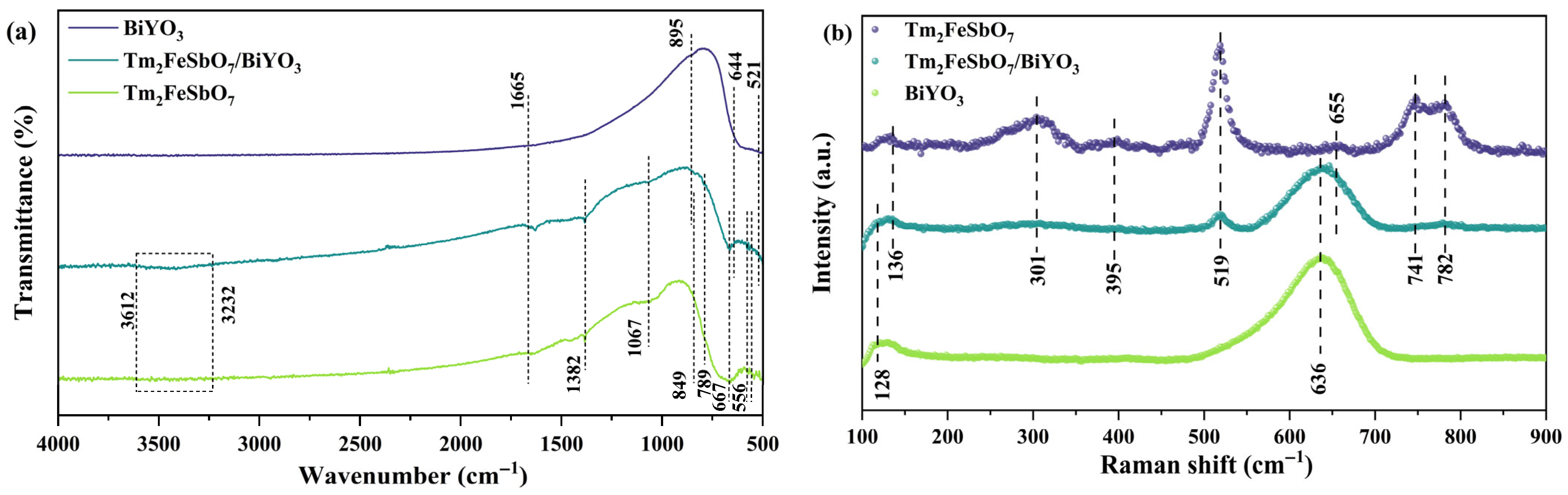
Through Fourier transform infrared (FTIR) spectra, we conducted an in-depth analysis of the chemical bond type and constitution characteristics of TBHP, Tm2FeSbO7, and BiYO3. As shown in Figure 2a, in contrast to Tm2FeSbO7, BiYO3 or TBHP exhibited a slight shift in the Fe-O vibration peak and Bi-O vibration peak, indicating that strong interfacial interactions between Tm2FeSbO7 and BiYO3 were realized. According to the FTIR spectra analysis, the characteristic peak of BiYO3 at 521 cm−1 could match the stretching vibration about the Bi-O bond, while the characteristic peak at 895 cm−1 was assigned to the in-plane flexural vibration about the Y-O bond, and the peak at 644 cm−1 could match the out-of-plane flexural vibration [30]. The characteristic stretching vibration of Tm2FeSbO7 about the Fe-O bond was perceived at 556 cm−1 [31]. The peak at 849 cm−1 could be ascribed to the characteristic stretching vibration about the Tm-O bond [32,33]. The absorption peaks at 667 cm−1 and 789 cm−1 were thought to originate from the antisymmetric stretching vibration about the Sb-O-Sb bond in the SbO6 octahedra, reflecting that the distortion of the pyrochlore structure was realized [20,34].
Notably, TBHP and Tm2FeSbO7 exhibited a common broad band in the range of 3232 cm−1–3612 cm−1, which arose from hydrogen-bonded O-H stretching vibration about adsorbed water molecules and surface hydroxyl groups, which were crucial for generating •OH radicals during the photocatalytic degradation course of the SMX. The characteristic absorption peaks at 1067 cm−1, 1382 cm−1 and 1665 cm−1 could match the flexural vibration mode about H-O-H bond [35,36,37,38,39].
Figure 2b displays the Raman spectra of Tm2FeSbO7, BiYO3, and TBHP. In the spectrum of Tm2FeSbO7, the strong peak which was perceived at 136 cm−1 could be attributed to the translational vibrations about Tm and Fe, while the characteristic peak which was located at 301 cm−1 was assigned to the flexural vibration mode about the Fe-O bond. The peak, which is located at 395 cm−1, could match the stretching vibration mode of the Sb-O bond. Notably, the strongest peak, which was perceived at 519 cm−1, was primarily ascribed to the stretching vibration mode about the Fe-O bond, reflecting the distortion phenomenon about the oxygen coordination structure around Fe3+ ions [40]. The peak, which is located at 655 cm−1, originated from the antisymmetric stretching vibration about the Sb-O-Sb bond in the (SbO6) octahedron, while the double peaks, which appeared at 741 cm−1 and 782 cm−1, were attributed to different vibrational modes about the Sb-O bond [41,42]. In the BiYO3 spectrum, the peak located at 128 cm−1 was assigned to the lattice vibration mode about the Bi-O bond, while the peak located at 636 cm−1 could match the symmetric stretching vibration about the O-Y-O functional group [20].

2.1.3. Transmission Electron Microscopy and Energy Dispersive X-Ray Spectra Analysis

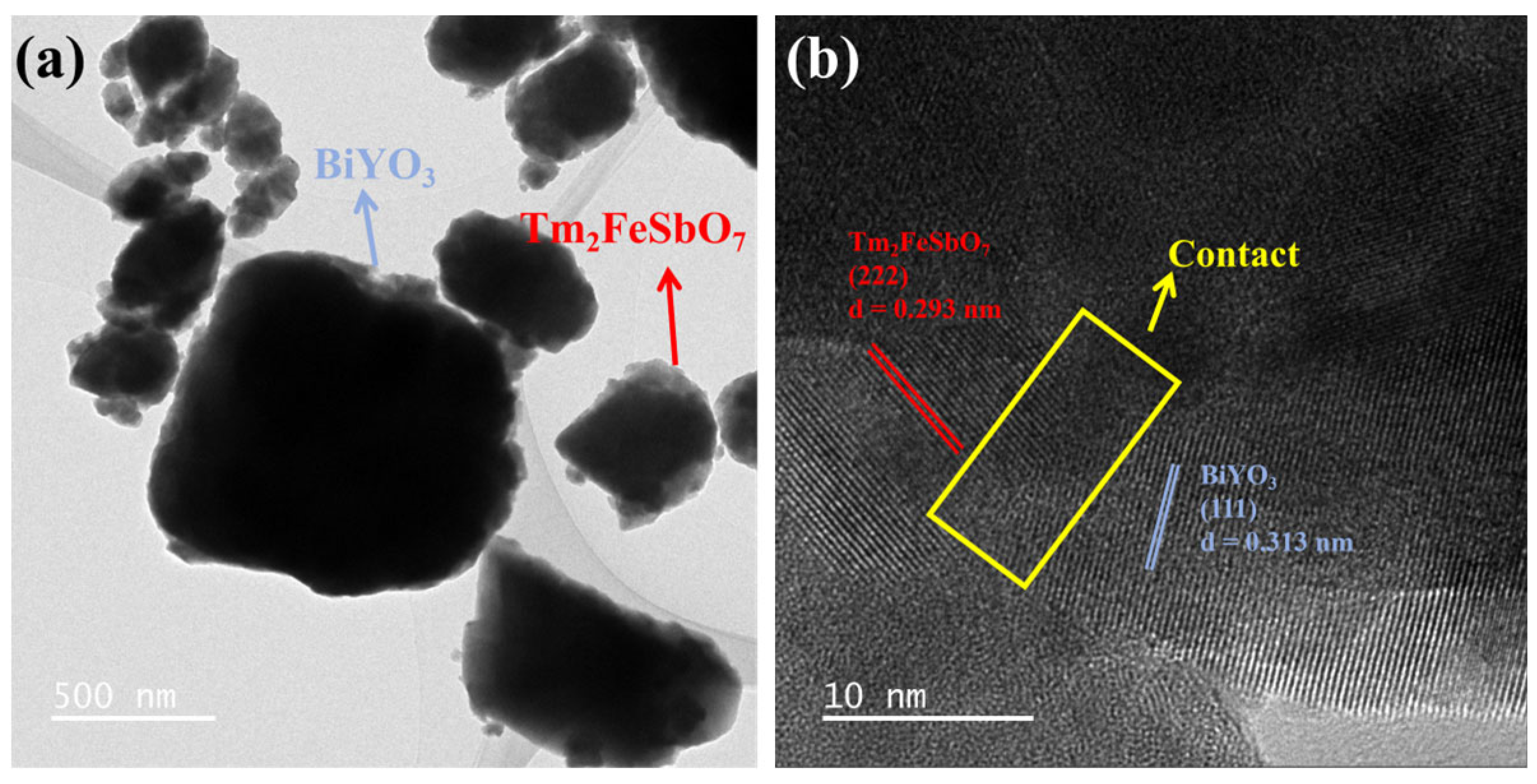
The microstructure and elemental composition of the TBHP were systematically characterized by employing transmission electron microscopy (TEM) and energy-dispersive X-ray (EDX) spectra. Figure 3 presents the TEM image and high-resolution TEM (HRTEM) image of the TBHP. The TEM image in Figure 3a clearly shows the coexistence of Tm2FeSbO7 nanoparticles and BiYO3 nanoparticles in the TBHP. Figure 3b shows the HRTEM image of the marked region, which is shown in Figure 3a. As indicated in Figure 3a, the interfacial structure between Tm2FeSbO7 and BiYO3, and the lattice fringes of Tm2FeSbO7 and BiYO3 could be distinctly identified. The calculated interplanar distance of Tm2FeSbO7 was 0.293 nm, while the interplanar distance of BiYO3 was 0.313 nm. Figure S3a reveals the EDX elemental scanning mapping of the TBHP. Figure S3a demonstrates the uniform distribution of Tm, Fe, Sb, Bi, Y, and O elements in the TBHP, directly confirming that the Tm2FeSbO7 phase and BiYO3 phase coexisted. By comparing the intensity differences in the luminescent regions of Tm, Fe, Sb, Bi, and Y elements, it could be inferred that BiYO3 primarily might match the larger-size particles, whereas Tm2FeSbO7 existed as smaller-size particles. Figure S3b displays the EDX composition content distribution image of the TBHP. As shown in Figure S3b, the EDX plot analysis revealed that the atomic ratio of the elements for TBHP was approximately Tm:Fe:Sb:Bi:Y:O = 175:53:61:54:48:609. Figure S4a exhibits the second EDX elemental scanning mapping of the TBHP. Figure S4b represents the second EDX composition content distribution image of the TBHP. Similarly, Figure S4a,b reveal that the atomic ratio of the elements for TBHP was approximately Tm:Fe:Sb:Bi:Y:O = 186:148:125:104:97:251.
Figure S4a confirmed that the particles that were rich in Tm, Fe, and Sb elements did not contain Bi and Y elements; correspondingly, the particles that were rich in Bi and Y elements did not include Tm, Fe, and Sb elements. Meanwhile, it could be found from Figure S4b that the particles that were rich in Tm, Fe, and Sb elements were observed to be in contact with the particles that were rich in Bi and Y elements, indicating that the TBHP was obtained successfully. Based on the above characterization results, it was confirmed that the TBHP could be prepared successfully by employing the ball milling method [43].

2.1.4. X-Ray Photoelectron Spectra Analysis

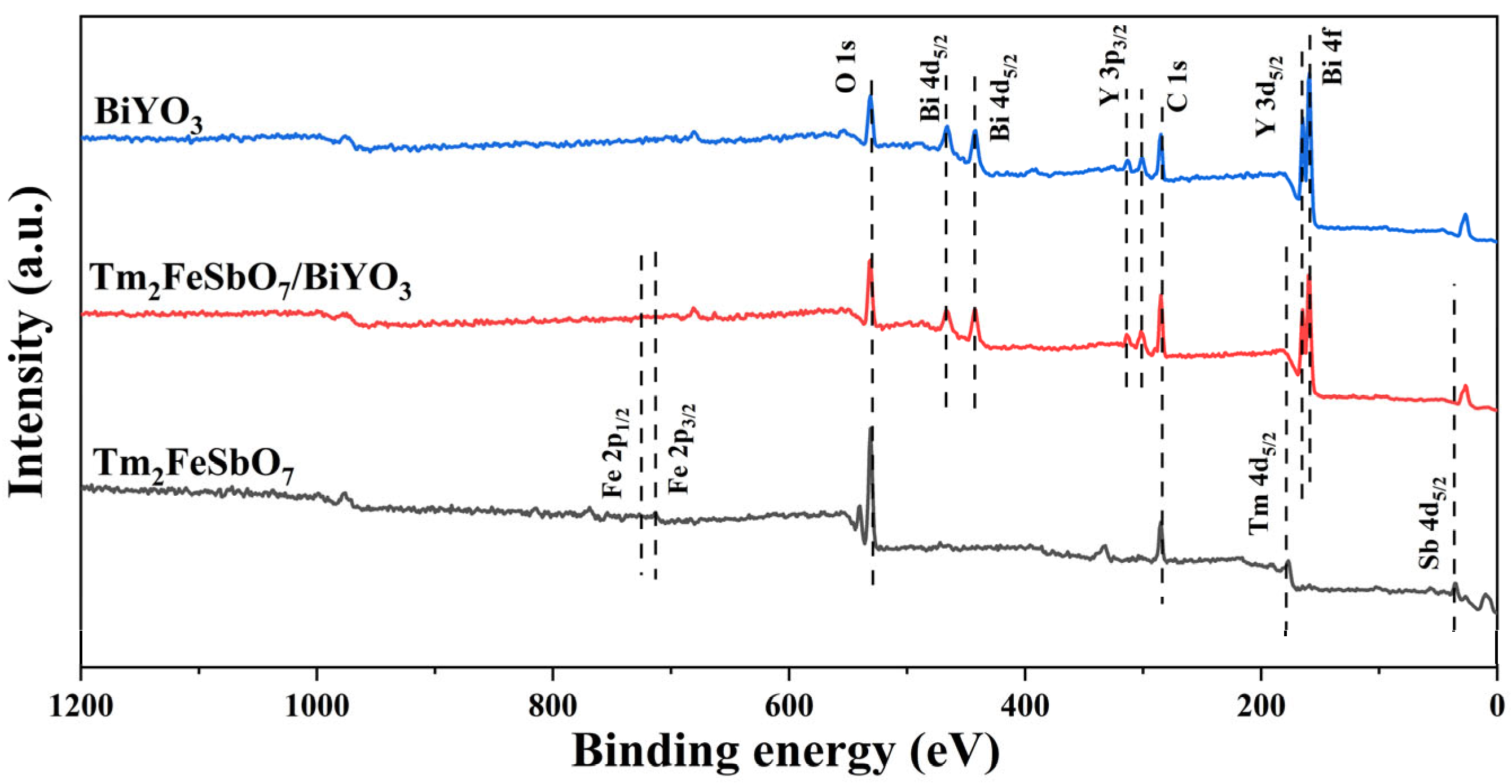
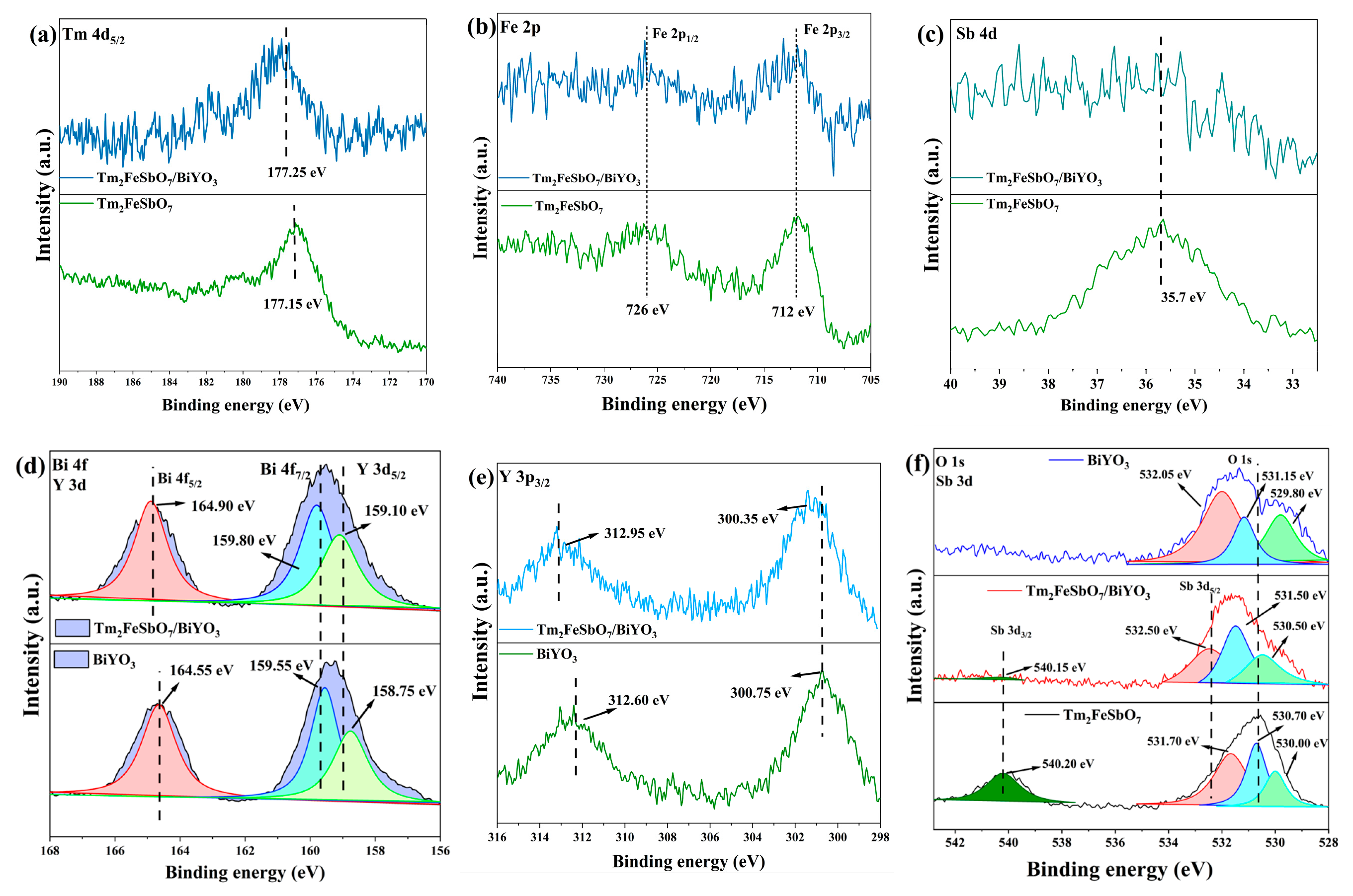
This study systematically characterized the surface chemical composition and valence states of Tm2FeSbO7, BiYO3, and TBHP by employing X-ray photoelectron spectra (XPS), with specific analytical results shown in Figure 4. The full-spectrum scan revealed the presence of Tm, Fe, Sb, Bi, Y, and O elements in TBHP; concurrently, the carbon peak might serve as a calibration reference. Comparative analysis results stemming from BiYO3 demonstrated significant enhancement of the characteristic peaks of Bi3+ and Y3+ in TBHP, confirming that the Bi element and Y element were present. Comparative analysis results, which originated from Tm2FeSbO7, demonstrated significant enhancement of the characteristic peaks of Tm3+, Fe3+, and Sb5+ in TBHP, confirming that the Tm element, Fe element, and Sb element were present. Figure 5a–f displays the XPS of Tm 4d, Fe 2p, Sb 4d, Bi 4f, Y 3p, Y 3d, and O 1s, which stem from Tm2FeSbO7, BiYO3, and TBHP.
As shown in Figure 5a, the binding energy of the Tm 4d5/2 peak in TBHP was 177.25 eV, which exhibited a distinct high binding energy shift compared with Tm2FeSbO7. In Figure 5b, the Fe 2p spectrum of TBHP showed peaks at 726 eV and 711 eV, which could match the 2p1/2 orbit and 2p3/2 orbit of Fe3+, respectively. Figure 5c revealed the Sb 4d spectrum of TBHP at 35.7 eV. In Figure 5d, the characteristic peaks of Bi 4f in TBHP appeared at 159.80 eV and 164.90 eV, which could match the 4f7/2 and 4f5/2 orbits of Bi3+, respectively, with a spin–orbit splitting energy of 5.1 eV, which was consistent with the characteristics of Bi3+. Notably, the matching peaks in BiYO3 shifted toward higher binding energies at 164.55 eV and 159.55 eV.
For the Y 3d5/2 spectrum shown in Figure 5d and the Y 3p spectrum shown in Figure 5e, peaks located at 158.75 eV, 312.60 eV, and 300.75 eV indicate the presence of Y in the form of Y3+ within BiYO3. After the combination of Tm2FeSbO7 with BiYO3, the binding energy of Y 3d5/2 turned into 159.10 eV, and the binding energies of Y 3p3/2 turned into 312.95 eV and 300.35 eV compared with standalone BiYO3. These binding energy shifts suggested possible electron transfer and delocalization phenomena between Tm2FeSbO7 and BiYO3. Such interfacial interactions enhanced the overall efficiency and performance of the photocatalyzers [44].
Figure 5f presents the peak fitting results of the O 1s spectrum for TBHP, Tm2FeSbO7, and BiYO3. Peaks located at 529.8 eV, 530 eV, and 530.7 eV could match lattice oxygen, while peaks located at 531.15 eV and 531.7 eV were attributed to surface adsorbed oxygen. The characteristic peak, located at 532.05 eV, indicated the presence of surface hydroxyl groups. Notably, in Figure 5f, the binding energy of Sb 3d3/2 in TBHP (540.61 eV) was significantly higher than that in Tm2FeSbO7. The result confirmed the presence of Sb5+.

2.1.5. Ultraviolet-Visible Diffuse Reflectance Spectra and Analysis

In order to thoroughly investigate the energy band structure characteristics of the samples, this study thoughtfully analyzes the ultraviolet visible diffuse reflectance (UV-Vis DR) spectra of Tm2FeSbO7, BiYO3, and TBHP; accordingly, the above results are revealed in Figure S5a. As illustrated in Figure S5a, the absorption edges of Tm2FeSbO7 and BiYO3 appeared at 560 nm and 565 nm, respectively, while the absorption edge of TBHP was perceived at 590 nm. TBHP exhibited a significant red shift in contrast to Tm2FeSbO7 or BiYO3, indicating that TBHP possessed broader spectral response characteristics. This suggested that TBHP exhibits superior visible-light absorption capability in contrast to Tm2FeSbO7 and BiYO3.
The Kubelka–Munk function is exhibited in Formula (1). Simultaneously, the Eg value of semiconductor catalysts can be accurately determined by counting the tangential line within the rectilineal range of the diffused reflective spectra absorption edge and extending it to the crosspoint with the horizontal axis [45,46].
[ 1 R d h v ] 2 2 R d ( h v ) = α ( h v ) S
In this function, S, Rd, and α represent the scattering coefficient, diffuse reflectance, and radiation absorption coefficient, respectively. Moreover, the photoabsorption character near the band brink of the compound conforms to the arithmetical relation of Formula (2) [47,48]:
( α h v ) 1 n = A ( h v E g )
In the equation, A is the proportionality constant, α is the absorption coefficient, Eg is the band gap, and ν is the photon frequency. The parameter n characterizes the type of electronic transition after photoexcitation, where the n value of 1/2 can match a direct transition, and the n value of two indicates an indirect transition. By analyzing the data shown in Figure S5b, the bandgap widths of Tm2FeSbO7 and BiYO3 were measured to be 2.21 eV and 2.30 eV, respectively, with both n values pressing towards two, indicating that their interband transitions were mediated. The calculated band gap width for TBHP was 2.14 eV, exhibiting characteristics of an indirect transition. The significant reduction in the bandgap width of TBHP was consistent with the enhanced light absorption performance, which certified the research trend of heterojunctions for improving photoelectric conversion efficiency.

2.2. Optical Characterization of TBHP, Tm2FeSbO7, and BiYO3

2.2.1. Photoelectrochemical Analysis

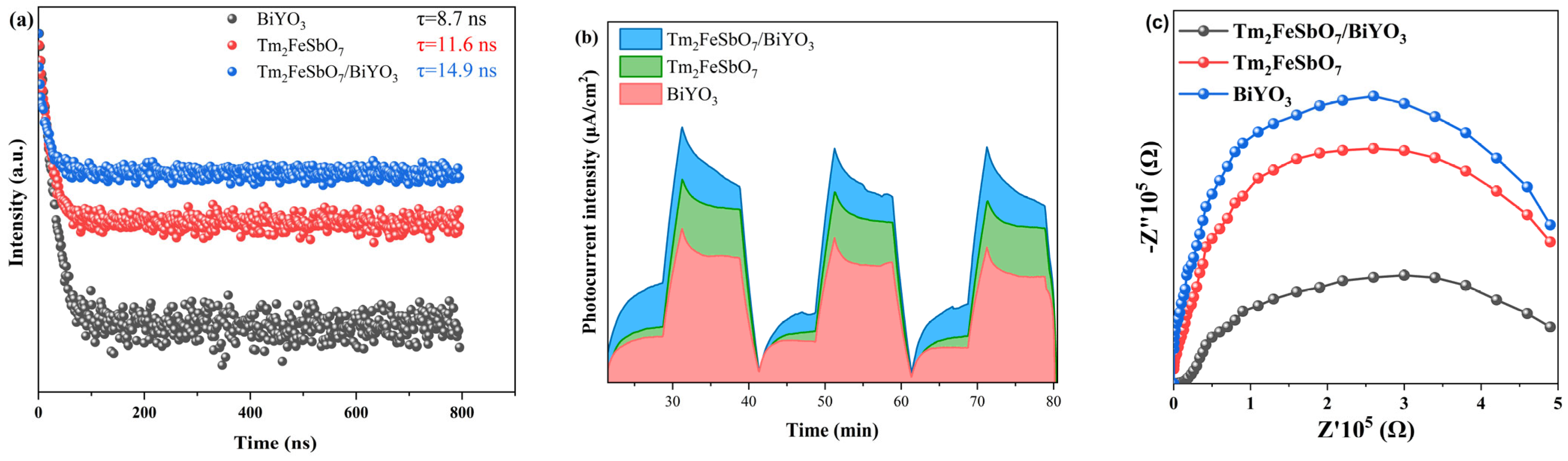
Using short wavelength excitation for TBHP, Tm2FeSbO7, and BiYO3 were detailed in the supporting information (Section S9 and Figure S6). Figure 6a presents the time-resolved photoluminescence (TRPL) spectra of Tm2FeSbO7, BiYO3, and TBHP. Further confirmation was achieved by verifying that TBHP exhibited stronger photocatalytic efficacy compared with Tm2FeSbO7 and BiYO3. A double exponential decay Formula (3) was employed for obtaining the fitting results of the TRPL spectra, as shown in Figure 6a [49]:
t = I 0 + A 1 exp t τ 1 + A 2 e x p ( t τ 2 )
According to the given equation, A 1 and A 2 represent the matching weighting coefficients of the first-order and second-order decay times for each decay channel, respectively. The average photogenerated carrier lifetime ( τ a v e ) was calculated by employing Equation (4) [50]:
τ a v e = ( A 1 τ 1 2 + A 2 τ 2 2 ) / ( A 1 τ 1 + A 2 τ 2 )
The construction of heterojunctions facilitated the separation velocity of photogenerated charge carriers; as a result, TBHP attained a significantly prolonged lifetime of 14.9 ns for τ a v e compared with the lifetime τ a v e of 11.6 ns for Tm2FeSbO7 or the lifetime τ a v e of 8.7 ns for BiYO3. Relevant studies demonstrated that forming heterojunction structures, such as combining Bi2O3 with other semiconductor catalysts, could effectively enhance the separative efficiency of photo-induced electrons and photo-induced holes; therefore, the photocatalytic performance of the heterostructure catalysts might be enhanced [46]. For instance, the research about the preparation of WS2/ZnIn2S4 heterojunction and its photocatalytic properties revealed that heterostructure catalysts could promptly and efficiently promote the separative efficiency of photogenerated electron-hole pairs; accordingly, the catalytic activity of the heterostructure catalysts was enhanced [51].
Figure 6b shows the transient photocurrent intensity variation spectra of TBHP, Tm2FeSbO7, and BiYO3. In the light of Figure 6b, the photocurrent density of TBHP was significantly higher than that of Tm2FeSbO7 or BiYO3; therefore, the reason that TBHP had a higher photocurrent density could be attributed to the efficient separation and rapid transport velocity of photogenerated electron-hole pairs, which stemmed from the heterojunction structure of TBHP. This phenomenon indicated that the composite structure of Tm2FeSbO7 and BiYO3 effectively promoted the separative efficiency of photogenerated carriers [52,53,54]. To further validate this conclusion, Figure 6c presents the electrochemical impedance spectra (EIS) of the TBHP, Tm2FeSbO7, and BiYO3. It can be found from Figure 6c that a smaller arc semidiameter could typically match the reduced charge transfer resistance [55,56]. The arc semidiameter about TBHP was significantly smaller than that of single-component compounds such as Tm2FeSbO7 or BiYO3, confirming that TBHP possessed more efficient charge disassociation competency. This result was highly consistent with the conclusions drawn from the PL spectra, the transient photocurrent response test spectra, and the TRPL spectra. The observation results suggested that TBHP obtained enhanced photocatalytic activity by more efficiently separating photogenerated carriers and improving interfacial charge mobility.

2.2.2. Photocatalytic Elimination Analysis of the SMX

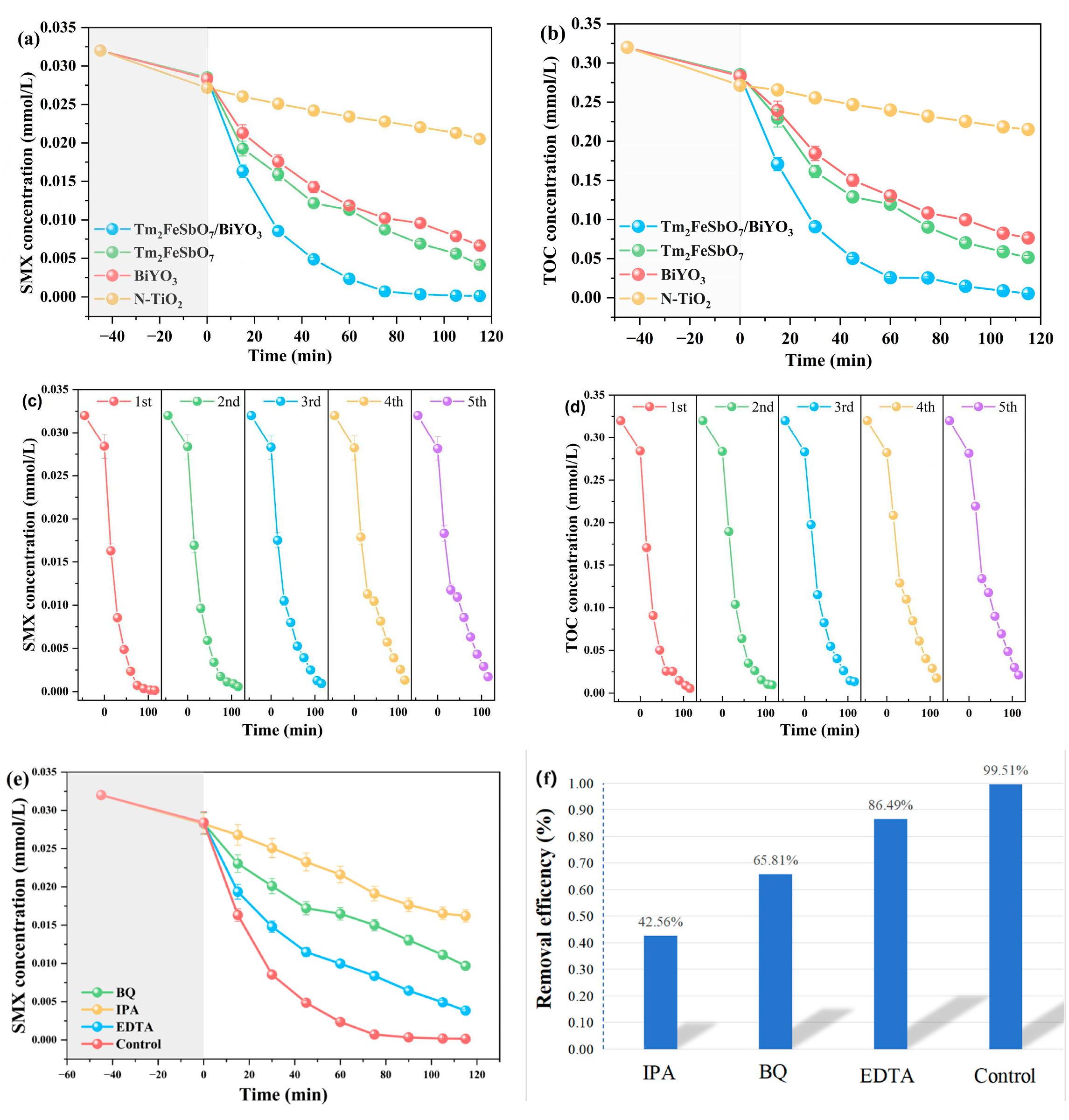
This study systematically evaluated the degradation elimination efficiency of SMX by employing TBHP, Tm2FeSbO7, BiYO3, and N-TiO2 in SMX solution under VISLI. As shown in Figure 7a, the experimental groups that contained catalysts exhibited prominent decreases in SMX concentration, whereas the blank control group, which was utilized for the photolysis experiment without a catalyst, did not display a notable change in SMX concentration, confirming that the photocatalysts play a dominant role in the photocatalytic elimination of SMX. The elimination efficiency of SMX was calculated by employing the formula of ( 1 C t / C 0 ) × 100%, where C t and C 0 represented the instantaneous concentration of SMX and the initial concentration of SMX, respectively. The experimental result demonstrated that after VISLI of 115 min, the removal rate of SMX reached as high as 99.51% by employing TBHP, significantly surpassing the removal rates achieved by employing Tm2FeSbO7 (85.41%) and BiYO3 (75.63%) alone. Comparative analysis results revealed that the removal rate of SMX by employing TBHP was 1.17 times, 1.31 times, and 4.06 times higher than that by employing Tm2FeSbO7, BiYO3, and N-TiO2, respectively, underscoring that TBHP possesses superior catalytic performance compared with Tm2FeSbO7, BiYO3, or N-TiO2. Additionally, by comparison, the removal rate for degrading the SMX reached 89.86% or 94.30% [57] by employing Dy2TmSbO7/BiHoO3 or molecular imprinted (MI) TiO2@Fe2O3@g-C3N4 [57] after VISLI of 115 min; obviously, TBHP exhibited a superior photocatalytic activity for degrading the SMX compared with Dy2TmSbO7/BiHoO3 or MI TiO2@Fe2O3@g-C3N4. Similarly, by comparison, the removal rate for degrading the SMX reached 63.1% [57] or 48.9% [57] by employing MI-polymers TiO2@g-C3N4 [57] or MI-polymers TiO2@Fe2O3 [57] after 120 min of VISLI. Obviously, TBHP exhibited a superior photocatalytic activity for degrading the SMX compared with MI-polymers TiO2@g-C3N4 or MI-polymers TiO2@Fe2O3 [57].
Figure 7b further demonstrates the mineralization efficiency for removing the total organic carbon (TOC) concentration by employing TBHP, Tm2FeSbO7, BiYO3, and N-TiO2 in SMX solution under VISLI. The mineralization rate for removing TOC concentration (MRRTC) was calculated by employing the formula ( 1 T O C t / T O C 0 ) × 100%, where T O C t and T O C 0 represented the instantaneous concentration of TOC and the initial concentration of TOC, respectively. The results revealed that after VISLI of 115 min, the MRRTC was 98.10%, achieved by employing TBHP. The MRRTC by employing TBHP was significantly higher than that by employing Tm2FeSbO7 (81.97%), BiYO3 (73.03%), or N-TiO2 (20.75%). Comparative analysis results revealed that the MRRTC by employing TBHP was 1.20 times, 1.34 times, or 4.73 times higher than that by employing Tm2FeSbO7, BiYO3, or N-TiO2, respectively, further confirming that TBHP possesses superior capability for the deep mineralization of organic pollutant SMX.
In order to evaluate the actual durability and actual reusability of TBHP, this study conducted five cyclic experiments for degrading SMX by employing TBHP under VISLI, with the results shown in Figure 7c,d. The experimental data indicated that after five consecutive photocatalytic reactions for degrading SMX, the removal rates of SMX by employing TBHP in the five cyclic experiments were 99.51%, 97.99%, 96.68%, 95.32%, and 93.92%, which could match the MRRTC of 98.1%, 96.56%, 95.28%, 93.77%, and 92.48%. After five cyclic experiments, the TBHP demonstrated outstanding stability, with only a slight decrease of 5.59% in the removal rate of SMX and a 5.62% reduction in MRRTC under VISLI. The results fully confirmed the application potential of TBHP as a photocatalyst in wastewater remediation.
The first-order kinetic curve for degrading the SMX (Figure S7a), removing the TOC concentration (Figure S7b), degrading the SMX concentration by employing TBHP over five cyclic experiments (Figure S8a), and removing the TOC concentration by employing TBHP over five cyclic experiments (Figure S8b) are detailed in the Supplementary Materials (Section S10).

2.2.3. Radicals Assay Experiment

Figure 7e illustrates the influence of radical inhibitors benzoquinone (BQ), isopropanol (IPA), and ethylenediaminetetraacetic acid (EDTA) on the catalytic degradation efficiency of SMX in SMX solution by employing TBHP under VISLI. The experimental results determined the directed scavenging effectiveness of •OH, •O2, and h+ active radicals by separately adding IPA, BQ, and EDTA. In Figure 7f, comparative analysis results revealed that the introduction of IPA reduced the degradation efficiency of the SMX by an average of 56.95%; accordingly, the single effect of •OH could cause a removal rate of 56.95% for degrading SMX by employing TBHP after VISLI of 115 min. Correspondingly, the introduction of BQ reduced the degradation efficiency of the SMX by an average of 33.70%; resultingly, the single effect of •O2 could cause a removal rate of 33.70% for degrading SMX by employing TBHP after VISLI of 115 min. Analogically, the introduction of EDTA diminished the degradation efficiency of the SMX by an average of 13.02%; consequently, the single effect of h+ could cause a removal rate of 13.02% for degrading SMX by employing TBHP after VISLI of 115 min. It was thus inferred that •OH played a dominant role for the photocatalytic degradation of SMX by employing TBHP; as a result, the descending order of contribution importance might be •OH > •O2 > h+.
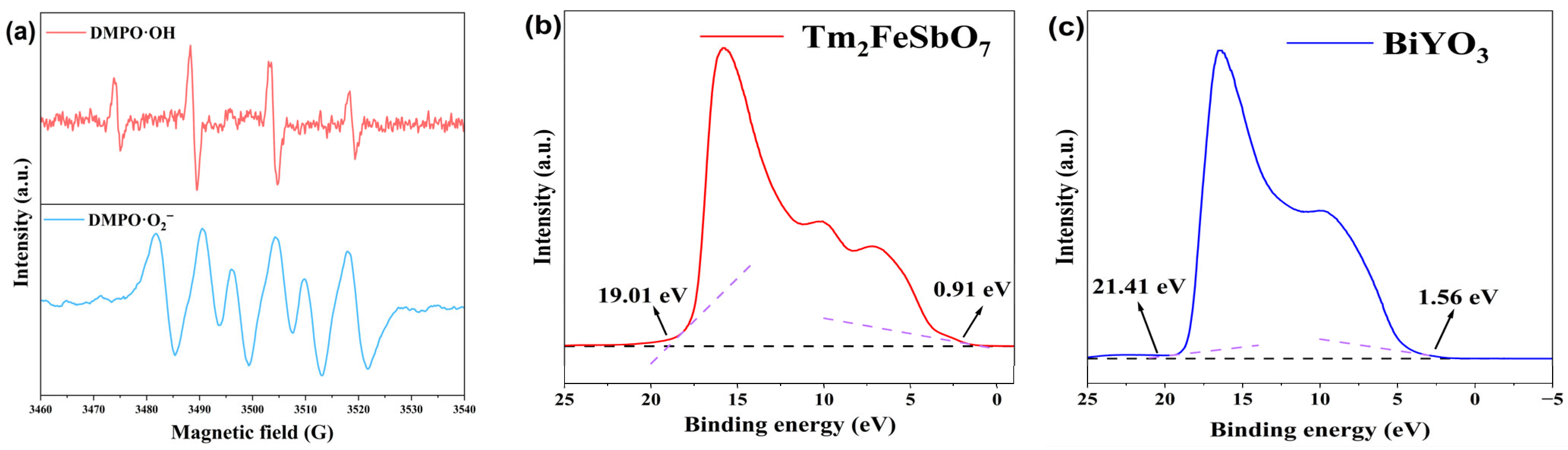
In order to further verify the generation characteristics of active radicals during the photocatalytic degradation of SMX by employing TBHP, electron paramagnetic resonance (EPR) technology was employed to detect the •O2 and •OH, which were produced during the photocatalytic elimination process. Figure 8a displays the EPR signal characteristics of DMPO•O2 and DMPO•OH adducts by employing TBHP. Figure 8a was related to the EPR spectral analysis of the spin adducts of DMPO with •O2 and •OH during EPR detection. After VISLI of 10 min, a quartet of equal intensity peaks (intensity ratio 1:1:1:1), which were consistent with the characteristic signal of DMPO•O2 [46] appeared in the EPR spectrum, confirming the existence of •O2 radicals. Simultaneously, a quartet of peaks with an intensity ratio of 1:2:2:1 was detected, matching the characteristic signal of DMPO•OH adducts [58], indicating that the generation of •OH radicals was realized under VISLI conditions. Notably, the relative intensity analysis of the EPR signals revealed that the production amount of •OH was significantly higher than that of •O2. This result was highly consistent with the conclusions drawn from the radicals trapping experiments, providing direct evidence for the synergistic participation of •O2 and •OH in the degradation reaction.

2.2.4. Ultraviolet Photoelectron Spectrogram and Degradation Mechanism Analysis

Figure 8b,c show the ultraviolet photoelectron spectrogram test results of Tm2FeSbO7 and BiYO3, providing crucial data support for determining the ionization potentials of the compounds. The initial binding energy (Ei) and cutoff binding energy (Ecutoff) of Tm2FeSbO7 were 0.91 eV and 19.01 eV, and the matching values for BiYO3 were 1.56 eV and 21.41 eV [59]. By combining the excitation light source energy 21.20 eV, the ionization potentials of Tm2FeSbO7 and BiYO3 could be calculated as 3.10 eV and 1.35 eV, respectively [60]. Both Tm2FeSbO7 and BiYO3 exhibited light absorption characteristics in the visible-light waveband region, thereby generating the photoexcited charge carriers.
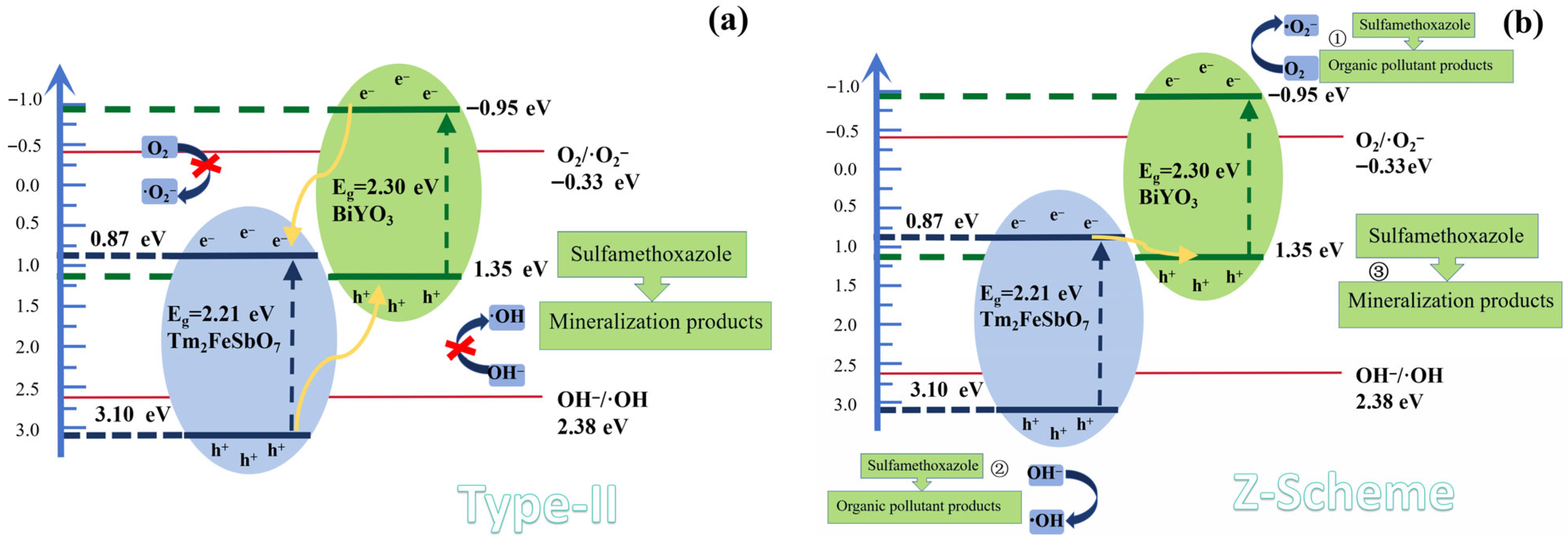
Based on the energy band structure characteristics of Tm2FeSbO7 and BiYO3, this study thoroughly investigated the photocatalytic reaction mechanism of the TBHP. As illustrated in Figure 9a,b, two possible charge transfer modes are proposed: the conventional Type-II heterojunction and the direct Z-scheme heterojunction. The conventional Type-II structure heterojunction mechanism is depicted in Figure 9a. The conventional Type-II structure is detailed in the supporting information (Section S11). In this paper, the heterojunction is synthesized as a Z-scheme in Figure 9b. In the Z-scheme TBHP, the photoinduced electrons migrated from the CB of Tm2FeSbO7 (ECB = 0.87 eV) to the VB of BiYO3 (EVB = 1.35 eV); as a result, the separation efficiency of the photogenerated charge carriers was significantly improved. Due to the structural nature of the Z-scheme heterojunction, the recombination of charge carriers with lower redox potentials is facilitated. Consequently, highly reactive charge carriers are preserved, which is crucial for enhancing the photocatalytic performance of the catalysts. During the photocatalytic reaction of the SMX, the photo-induced electrons which existed in the CB of BiYO3 (ECB = −0.95 eV) could react with O2 for generating •O2 because the electrochemic potential of the CB for BiYO3 (ECB = −0.95 eV) was more negative than the reductive potential of O2/•O2 (−0.33 eV vs. NHE); meanwhile, the photogenerated holes which existed in the VB of Tm2FeSbO7 (EVB = 3.10 eV) could oxidize OH for producing •OH because the ionizing potential of the VB for Tm2FeSbO7 (EVB = 3.10 eV) was more positive than the oxidative potential of OH/•OH (2.38 eV vs. NHE). TBHP possessed a higher valence band ionization potential compared with the Dy2TmSbO7/BiHoO3 heterojunction photocatalyst. TBHP was endowed with a stronger capability for efficiently generating •OH, which was presumably the primary reason that TBHP had higher photocatalytic activity during the efficient degradation process of the SMX compared with the Dy2TmSbO7/BiHoO3 heterojunction photocatalyst. A portion of photogenerated holes that existed in the VB of Tm2FeSbO7 could serve as excellent oxidants for degrading the SMX, indicating that Tm2FeSbO7 might exhibit significant photocatalytic reactivity. Therefore, the photogenerated holes derived from the VB of Tm2FeSbO7 had strong oxidative capacity and could directly participate in the oxidative degradation of the SMX. The synergistic effects of •OH, •O2, and h+ active radicals contributed to pollutant degradation, indicating that the above results were consistent with the results derived from the radicals trapping experiment and the EPR detection. The aforementioned mechanistic analysis results not only elucidated the photocatalytic degradation pathway of the SMX but also highlighted the notable advantages of the TBHP for environmental remediation. As a result, the theoretical innovation for the efficient photocatalytic degradation of SMX was provided.

2.2.5. Degradation Pathway Analysis

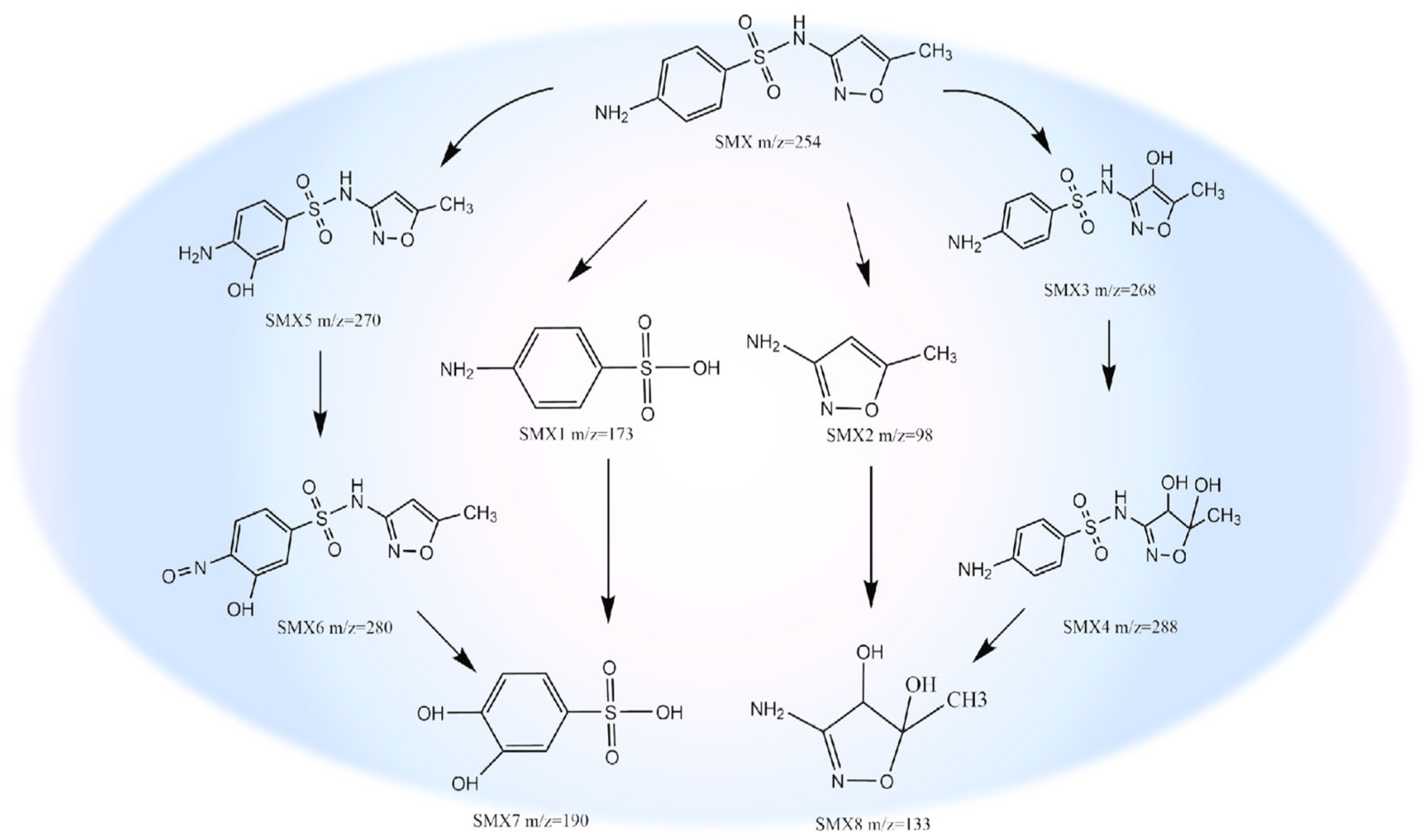
In order to investigate the degradation pathways of the SMX, this study systematically analyzed the intermediate products during the photocatalytic elimination process of the SMX by employing a literature review and LC-MS detection. Figure 10 represents the possible elimination pathways of the SMX by employing TBHP. Based on above findings, we proposed the possible photocatalytic elimination mechanisms of the SMX: (1) the sulfonamide group -SO2-NH- which was contained in the SMX molecules underwent the S-N bond cleavage under the synergistic attack of the •OH and the •O2, yielding the intermediate products SMX1 (m/z = 173) and SMX2 (m/z = 99); (2) the double bond contained in the SMX isoxazole ring was oxidized and underwent the substitution by hydroxyl radicals, forming intermediate products such as SMX3 (m/z = 268), SMX4 (m/z = 288) and SMX7 (m/z = 190); (3) the •OH abstracted the hydrogen atoms from the amino group -NH2, which was contained on the aromatic ring, followed by hydroxylation for generating the intermediate products such as SMX5 (m/z = 270), SMX6 (m/z = 280) and SMX8 (m/z = 133). During the photocatalytic elimination course of the SMX, the •O2 and the •OH worked cooperatively for driving the ring-opening reactions; meanwhile, the •O2 continuously generated H2O2 through disproportionation reactions; therefore, the radical chain reaction was sustained for ensuring a continuous •OH supply. Ultimately, pollutants were mineralized into water and carbon dioxide [61,62,63,64,65,66].

3. Materials and Methods

3.1. Preparation of Photocatalysts

The experimental instruments were detailed in the supporting information (Table S1). The complete raw chemical reagents were detailed in the supporting information (Section S1); the complete preparation course of Tm2FeSbO7 was detailed in the supporting information (Section S2); the complete preparation course of BiYO3 was detailed in the supporting information (Section S3); the complete preparation course of TBHP was detailed in the supporting information (Section S4); the complete preparation course of nitrogen-doped titanium dioxide (N-TiO2) was detailed in the supporting information (Section S5).

3.2. Degradation Elimination Experiment of SMX

The complete preparation course of the SMX solution was detailed in the supporting information (Section S6); the complete course of the photoelectrochemical experiment was detailed in the supporting information (Section S7); the complete course for the degradation elimination experiment of SMX was detailed in the supporting information (Section S8).

4. Conclusions

This study pioneered the successful preparation of a direct Z-type TBHP by employing the ball milling method, and single-component Tm2FeSbO7 and BiYO3 were prepared by employing a solid-state synthesis and high-temperature sintering method. The first comprehensive property characterization spectrograms for TBHP, Tm2FeSbO7, and BiYO3 encompassed the XRD patterns, the Mössbauer spectrum, the FTIR spectra, the Raman spectra, the UV-Vis DR spectra, the XPS, the TEM images, the EDX spectra, the photoluminescence spectra, the transient photocurrent intensity variation spectra, the EIS, the ultraviolet photoelectron spectrograms, and the EPR testing spectra. As a result, the precise crystal structures, microstructures, chemical compositions, and electrochemical properties for TBHP, Tm2FeSbO7, and BiYO3 were revealed. The experimental results indicated that Tm2FeSbO7 crystallized in a cubic pyrochlore-type structure; BiYO3 displayed a fluorite structure. TBHP exhibited remarkable separative efficiency of photo-induced electrons and photogenerated holes, absorption performance, and higher degradation efficiency of the SMX with a narrower bandgap. After VISLI of 115 min, TBHP showcased exceptional photocatalytic degradation performance; therefore, the elimination rate of the SMX with the TBHP was 99.51%. Simultaneously, the mineralization rate for eliminating the TOC density during the photocatalytic elimination course of the SMX with the TBHP reached 98.10%. In contrast to Tm2FeSbO7, BiYO3, or N-TiO2, TBHP exhibited enhanced degradation efficiency for SMX and a higher mineralization rate for TOC removal. Cyclic stability tests confirmed the promising practical applications of the TBHP. These enhancements were attributed to the Z-scheme electron transport mechanism, which effectively preserved the redox capacities of both Tm2FeSbO7 and BiYO3. The trapping radicals experiments and the EPR testing results revealed that hydroxyl radicals, superoxide radicals, and photoinduced holes were the primary active species (•OH > •O2 > h+) during the catalytic elimination course of the SMX by employing the TBHP under VISLI. Moreover, the possible elimination pathways and the elimination mechanism of SMX were proposed. Notably, this research not only advanced the development of high-efficiency Z-type heterostructure photocatalysts but also demonstrated the practical applicability of the prepared heterojunction photocatalyst for effectively decomposing SMX. The results held significant theoretical value and practical value for environmental rehabilitation applications.

Supplementary Materials

The following supporting information can be downloaded at: https://www.mdpi.com/article/10.3390/inorganics14030082/s1, References [67,68,69,70,71] are cited in the supplementary materials.

Author Contributions

Conceptualization, J.L. and Y.C.; methodology, Y.C. and J.L.; software, Y.C., A.L. and L.H.; validation, J.L., Y.C., H.Z. and J.W.; formal analysis, J.L., Y.C. and J.W.; investigation, J.L., Y.C. and J.W.; resources, J.L.; data curation, J.L., Y.C. and J.W.; writing—original draft preparation, J.L. and Y.C.; writing—review and editing, J.L., Y.C. and J.W.; visualization, J.L., Y.C. and J.W.; supervision, J.L. and Y.C.; project administration, J.L.; funding acquisition, J.L. All authors have read and agreed to the published version of the manuscript.

Funding

This research was funded by the Scientific Research Industrialization Project of the Education Department of Jilin Province of China (Grant No. JJKH20262399CY), and by the Steeple-Crowned Talent Development Fund of Department of Human Resource and Social Security of Jilin Province of China (Grant No. JiCaiSheZhi [2024] 0451).

Institutional Review Board Statement

Not applicable.

Informed Consent Statement

Not applicable.

Data Availability Statement

The original contributions presented in this study are included in the article/Supplementary Material. Further inquiries can be directed to the corresponding author.

Conflicts of Interest

The authors declare no conflicts of interest.

References

  1. Zainab, S.M.; Junaid, M.; Xu, N.; Malik, R.N. Antibiotics and antibiotic resistant genes (ARGs) in groundwater: A global review on dissemination, sources, interactions, environmental and human health risks. Water Res. 2020, 187, 116455. [Google Scholar] [CrossRef]
  2. Andrade, L.; Kelly, M.; Hynds, P.; Weatherill, J.; Majury, A.; O’Dwyer, J. Groundwater resources as a global reservoir for antimicrobial-resistant bacteria. Water Res. 2020, 170, 115360. [Google Scholar] [CrossRef]
  3. Han, Y.; Yu, X.; Liu, Y.; Zhang, M.; Huang, X.; Zhang, Y.; Zhang, H. Toxicological effects of sulfamethoxazole (SMX) and tire micro-particles (TMPs), alone or in combination, on the hepatopancreas of Litopenaeus vannamei. Environ. Pollut. 2025, 384, 126976. [Google Scholar] [CrossRef]
  4. Chen, Y.; Liu, Y.; Jin, H.; Wang, X.; Wang, G.; Ma, H.; Subramaniam, V.; Ramachandran, K.; Liu, X. Photoelectrocatalytic degradation of sulfamethoxazole with contrivable MnOx@Co/NC core-shell heterostructures derived from ZIF-67. Environ. Res. 2025, 292, 123666. [Google Scholar] [CrossRef] [PubMed]
  5. Wang, Y.; Zhuang, L.; Su, Y.; Liu, S.; Hu, Z.; Zhang, J.; Wang, X.; Cui, S.; Peng, G.; Xie, S. Effects of sulfamethoxazole stress on pollutant removal performance of unsaturated constructed wetlands. J. Environ. Sci. 2026, 161, 330–340. [Google Scholar] [CrossRef] [PubMed]
  6. Zeng, C.; Ding, A.; Chen, X.; Ma, Y.; Lin, H.; Ding, H.; Xie, F.; Zang, L.; Cui, S.; Li, P.; et al. Biochar loaded with Cu(I) to activate peroxyacetic acid for sulfamethoxazole removal: Effect of electron transfer and free radicals. Sep. Purif. Technol. 2026, 386, 136538. [Google Scholar] [CrossRef]
  7. Li, J.; Zhao, W.; Guo, Y.; Wei, Z.; Han, M.; He, H.; Yang, S.; Sun, C. Facile synthesis and high activity of novel BiVO4/FeVO4 heterojunction photocatalyst for degradation of metronidazole. Appl. Surf. Sci. 2015, 351, 270–279. [Google Scholar] [CrossRef]
  8. Chatterjee, D.; Dasgupta, S. Visible light induced photocatalytic degradation of organic pollutants. J. Photochem. Photobiol. C Photochem. Rev. 2005, 6, 186–205. [Google Scholar] [CrossRef]
  9. Hu, X.; Hu, X.; Peng, Q.; Zhou, L.; Tan, X.; Jiang, L.; Tang, C.; Wang, H.; Liu, S.; Wang, Y.; et al. Mechanisms underlying the photocatalytic degradation pathway of ciprofloxacin with heterogeneous TiO2. Chem. Eng. J. 2020, 380, 122366. [Google Scholar] [CrossRef]
  10. Li, W.; Xu, X.; Lyu, B.; Tang, Y.; Zhang, Y.; Chen, F.; Korshin, G. Degradation of typical macrolide antibiotic roxithromycin by hydroxyl radical: Kinetics, products, and toxicity assessment. Environ. Sci. Pollut. Res. 2019, 26, 14570–14582. [Google Scholar] [CrossRef]
  11. Rameel, M.I.; Wali, M.; Al-Humaidi, J.Y.; Liaqat, F.; Khan, M.A. Enhanced photocatalytic degradation of levofloxacin over heterostructured C3N4/Nb2O5 system under visible light. Heliyon 2023, 9, e20479. [Google Scholar] [CrossRef] [PubMed]
  12. Kim, J.R.; Kan, E. Heterogeneous photocatalytic degradation of sulfamethoxazole in water using a biochar-supported TiO2 photocatalyst. J. Environ. Manag. 2016, 180, 94–101. [Google Scholar] [CrossRef]
  13. Makropoulou, T.; Kortidis, I.; Davididou, K.; Motaung, D.E.; Chatzisymeon, E. Photocatalytic facile ZnO nanostructures for the elimination of the antibiotic sulfamethoxazole in water. J. Water Process Eng. 2020, 36, 101299. [Google Scholar] [CrossRef]
  14. Abdelfattah, I.; El-Shamy, A.M. A comparative study for optimizing photocatalytic activity of TiO2-based composites with ZrO2, ZnO, Ta2O5, SnO, Fe2O3, and CuO additives. Sci. Rep. 2024, 14, 27175. [Google Scholar] [CrossRef]
  15. Endeshaw, S.B.; Goddati, M.; Lee, J.; Aga, F.G.; Tufa, L.T.; Sabir, F.K. ZnO/CuO nanocomposites for enhanced photocatalytic and antibacterial applications: A comparative study of synthesis methods. J. Sci. Adv. Mater. Devices 2025, 10, 100898. [Google Scholar] [CrossRef]
  16. Zhigang, Z.; Wensi, C.; Yong, Z. Metal Oxide Semiconductors: State of the Art and New Challenges. In Metal Oxide Semiconductors: Synthesis, Properties, and Devices; Wiley: Hoboken, NJ, USA, 2024; pp. 1–13. [Google Scholar]
  17. Bowen, Z.; Danyang, L.; Wei, X.; Mingkun, W.; Bingxian, C.; Hao, L.; Meina, H.; Minguang, F.; Bin, L.; Lihui, D. Fabrication of three-dimensional hollow nanocassette photocatalysts RE-TiO2 (RE = La, Ce, Sm, Yb, and Tm) with enhanced pesticide degradation activity and highly exposed (1 0 1) crystal planes. Appl. Surf. Sci. 2023, 626, 157239. [Google Scholar] [CrossRef]
  18. Mavrokefalos, C.K.; Patzke, G.R. Water Oxidation Catalysts: The Quest for New Oxide-Based Materials. Inorganics 2019, 7, 29. [Google Scholar] [CrossRef]
  19. Hussain, S.; Aneggi, E.; Goi, D.; Trovarelli, A. Bimetallic Cu/Fe Catalysts for Ibuprofen Mineralization. Catalysts 2021, 11, 1383. [Google Scholar] [CrossRef]
  20. Ganesh, V.; Yahia, I.S.; Chidhambaram, N. Facile Synthesis of ZnO:Sb/g-C3N4 Composite Materials for Photocatalysis Applications. J. Clust. Sci. 2023, 34, 1659–1668. [Google Scholar] [CrossRef]
  21. Yu, X.; Wang, R.; Liu, Z.; Wei, Y.; Wang, K.; Zhang, J.; Niu, J. Construction of ZnMoO4/Cu2O with Z-type heterojunction and its photocatalytic degradation performance. Ceram. Int. 2025, 51, 7883–7896. [Google Scholar] [CrossRef]
  22. Chen, W.-W.; Huang, F.-F.; Qu, Q.-Y.; Li, L.; Jia, J.-F.; Wang, D.-S.; Li, Y.-D. Construction of BiVO4/CdS Z-type heterojunction for sunlight-driven degradation of quinolone antibiotics. Rare Met. 2025, 44, 3970–3980. [Google Scholar] [CrossRef]
  23. Qin, Z.; Chen, L.; Ma, R.; Tomovska, R.; Luo, X.; Xie, X.; Su, T.; Ji, H. TiO2/BiYO3 composites for enhanced photocatalytic hydrogen production. J. Alloys Compd. 2020, 836, 155428. [Google Scholar] [CrossRef]
  24. Kaur, G.; Sharma, S.; Bansal, P. Visible light responsive heterostructured α-Bi2O3/ZnO doped β- Bi2O3 photocatalyst for remediation of organic pollutants. Desalin. Water Treat. 2020, 201, 349–355. [Google Scholar] [CrossRef]
  25. Guo, S.-Z.; Li, Y.; Jiang, J.-S.; Xie, H.-Q. Nanofluids Containing γ-Fe2O3 Nanoparticles and Their Heat Transfer Enhancements. Nanoscale Res. Lett. 2010, 5, 1222–1227. [Google Scholar] [CrossRef]
  26. Zou, Z.; Ye, J.; Abe, R.; Arakawa, H. Photocatalytic decomposition of water with Bi2InNbO7. Catal. Lett. 2000, 68, 235–239. [Google Scholar] [CrossRef]
  27. Kohno, M.; Ogura, S.; Sato, K.; Inoue, Y. Properties of photocatalysts with tunnel structures: Formation of a surface lattice O− radical by the UV irradiation of BaTi4O9 with a pentagonal-prism tunnel structure. Chem. Phys. Lett. 1997, 267, 72–76. [Google Scholar] [CrossRef]
  28. Kudo, A.; Kato, H.; Nakagawa, S. Water Splitting into H2 and O2 on New Sr2M2O7 (M = Nb and Ta) Photocatalysts with Layered Perovskite Structures:  Factors Affecting the Photocatalytic Activity. J. Phys. Chem. B 2000, 104, 571–575. [Google Scholar] [CrossRef]
  29. Zou, Z.; Ye, J.; Arakawa, H. Growth, photophysical and structural properties of Bi2InNbO7. J. Cryst. Growth 2001, 229, 462–466. [Google Scholar] [CrossRef]
  30. Hernández-Arellano, D.L.; Durán-Álvarez, J.C.; Cortés-Lagunes, S.; Zanella, R.; Soto, T.E.; López-Juárez, R. Cr-doped BiYO3 photocatalyst for degradation of oxytetracycline under visible light irradiation. J. Korean Ceram. Soc. 2023, 60, 113–126. [Google Scholar] [CrossRef]
  31. Singh, A.; Mishra, B.K. Solar light–driven photocatalysis using BaFe2O4/rGO for chlorhexidine digluconate–contaminated water: Comparison with artificial UV and visible light–mediated photocatalysis. Environ. Sci. Pollut. Res. 2022, 29, 30739–30753. [Google Scholar] [CrossRef]
  32. Dogru, K.; Aktas, B.; Acikgoz, A.; Yilmaz, D.; Pathman, A.F.; Yalcin, S.; Demircan, G. Structural, thermal, and radiation shielding properties of B2O3-TeO2-Bi2O3-CdO-Tm2O3 glasses: The role of Tm2O3. Ceram. Int. 2024, 50, 47384–47394. [Google Scholar] [CrossRef]
  33. Yong, W.; Tang, P.; Chen, R.; Wen, S.; Zhang, J.; Xu, H.; Li, Q.; Tu, W.; Ding, Y. Preparation of Tm2Ti2O7 by Sol-Gel Method and Its Photocatalytic Activity. Integr. Ferroelectr. 2024, 240, 850–857. [Google Scholar] [CrossRef]
  34. Kaviyarasu, K.; Sajan, D.; Devarajan, P.A. A rapid and versatile method for solvothermal synthesis of Sb2O3 nanocrystals under mild conditions. Appl. Nanosci. 2013, 3, 529–533. [Google Scholar] [CrossRef]
  35. Deng, Y.; Tu, L.; Wang, P.; Chen, S.; Zhang, M.; Xu, Y.; Dai, W. Improving Separation Efficiency of Photogenerated Charges through Combination of Conductive Polythiophene for Selective Production of CH4. Catalysts 2023, 13, 1142. [Google Scholar] [CrossRef]
  36. Isari, A.A.; Hayati, F.; Kakavandi, B.; Rostami, M.; Motevassel, M.; Dehghanifard, E. N, Cu co-doped TiO2@functionalized SWCNT photocatalyst coupled with ultrasound and visible-light: An effective sono-photocatalysis process for pharmaceutical wastewaters treatment. Chem. Eng. J. 2020, 392, 123685. [Google Scholar] [CrossRef]
  37. Cheng, T.; Gao, H.; Liu, G.; Pu, Z.; Wang, S.; Yi, Z.; Wu, X.; Yang, H. Preparation of core-shell heterojunction photocatalysts by coating CdS nanoparticles onto Bi4Ti3O12 hierarchical microspheres and their photocatalytic removal of organic pollutants and Cr(VI) ions. Colloids Surf. A Physicochem. Eng. Asp. 2022, 633, 127918. [Google Scholar] [CrossRef]
  38. Janani, B.; Okla, M.K.; Abdel-Maksoud, M.A.; AbdElgawad, H.; Thomas, A.M.; Raju, L.L.; Al-Qahtani, W.H.; Khan, S.S. CuO loaded ZnS nanoflower entrapped on PVA-chitosan matrix for boosted visible light photocatalysis for tetracycline degradation and anti-bacterial application. J. Environ. Manag. 2022, 306, 114396. [Google Scholar] [CrossRef]
  39. Luan, J.; Hao, L.; Yao, Y.; Wang, Y.; Yang, G.; Li, J. Preparation and Property Characterization of Sm2EuSbO7/ZnBiSbO5 Heterojunction Photocatalyst for Photodegradation of Parathion Methyl under Visible Light Irradiation. Molecules 2023, 28, 7722. [Google Scholar] [CrossRef] [PubMed]
  40. Jana, Y.M.; Halder, P.; Biswas, A.A.; Roychowdhury, A.; Das, D.; Dey, S.; Kumar, S. Synthesis, X-ray Rietveld analysis, infrared and Mössbauer spectroscopy of R2FeSbO7 (R3+ = Y, Dy, Gd, Bi) pyrochlore solid solution. J. Alloys Compd. 2016, 656, 226–236. [Google Scholar] [CrossRef]
  41. Kumar, S.; Gupta, H.C. First principles study of zone centre phonons in rare-earth pyrochlore titanates, RE2Ti2O7 (RE = Gd, Dy, Ho, Er, Lu; Y). Vib. Spectrosc. 2012, 62, 180–187. [Google Scholar] [CrossRef]
  42. Yadav, P.K.; Upadhyay, C. Quantum criticality in geometrically frustrated Ho2Ti2O7 and Dy2Ti2O7 spin ices. J. Magn. Magn. Mater. 2019, 482, 44–49. [Google Scholar] [CrossRef]
  43. Balapure, A.; Ray Dutta, J.; Ganesan, R. Recent advances in semiconductor heterojunction: A detailed review of fundamentals of the photocatalysis, charge transfer mechanism, and materials. RSC Appl. Interfaces 2023, 1, 43–69. [Google Scholar] [CrossRef]
  44. Luan, J.; Ma, B.; Yao, Y.; Liu, W.; Niu, B.; Yang, G.; Wei, Z. Synthesis, Performance Measurement of Bi2SmSbO7/ZnBiYO4 Heterojunction Photocatalyst and Photocatalytic Degradation of Direct Orange within Dye Wastewater under Visible Light Irradiation. Materials 2022, 15, 3986. [Google Scholar] [CrossRef] [PubMed]
  45. Zhou, F.; Kang, K.; Maxisch, T.; Ceder, G.; Morgan, D. The electronic structure and band gap of LiFePO4 and LiMnPO4. Solid State Commun. 2004, 132, 181–186. [Google Scholar] [CrossRef]
  46. Nowak, M.; Kauch, B.; Szperlich, P. Determination of energy band gap of nanocrystalline SbSI using diffuse reflectance spectroscopy. Rev. Sci. Instrum. 2009, 80, 046107. [Google Scholar] [CrossRef]
  47. Tauc, J.; Grigorovici, R.; Vancu, A. Optical Properties and Electronic Structure of Amorphous Germanium. Phys. Status Solidi 1966, 15, 627–637. [Google Scholar] [CrossRef]
  48. Butler, M.A.; Ginley, D.S.; Eibschutz, M. Photoelectrolysis with YFeO3 electrodes. J. Appl. Phys. 1977, 48, 3070–3072. [Google Scholar] [CrossRef]
  49. Liu, J. Origin of High Photocatalytic Efficiency in Monolayer g-C3N4/CdS Heterostructure: A Hybrid DFT Study. J. Phys. Chem. C 2015, 119, 28417–28423. [Google Scholar] [CrossRef]
  50. Opoku, F.; Govender, K.K.; van Sittert, C.G.C.E.; Govender, P.P. Insights into the photocatalytic mechanism of mediator-free direct Z-scheme g-C3N4/Bi2MoO6(010) and g-C3N4/Bi2WO6(010) heterostructures: A hybrid density functional theory study. Appl. Surf. Sci. 2018, 427, 487–498. [Google Scholar] [CrossRef]
  51. Ashraf, W.; Parvez, S.H.; Khanuja, M. Synthesis of highly efficient novel two-step spatial 2D photocatalyst material WS2/ZnIn2S4 for degradation/reduction of various toxic pollutants. Environ. Res. 2023, 236, 116715. [Google Scholar] [CrossRef]
  52. Chen, H.; Li, J.; Meng, L.; Bae, S.; Erni, R.; Abbott, D.F.; Li, S.; Triana, C.A.; Mougel, V.; Patzke, G.R. Modulating Carrier Kinetics in BiVO4 Photoanodes through Molecular Co4O4 Cubane Layers. Adv. Funct. Mater. 2023, 33, 2307862. [Google Scholar] [CrossRef]
  53. Cheng, Y.; Ye, J.; Lai, L.; Fang, S.; Guo, D. Ambipolarity Regulation of Deep-UV Photocurrent by Controlling Crystalline Phases in Ga2O3 Nanostructure for Switchable Logic Applications. Adv. Electron. Mater. 2023, 9, 2201216. [Google Scholar] [CrossRef]
  54. Ma, Q.; Krishna Kumar, R.; Xu, S.-Y.; Koppens, F.H.L.; Song, J.C.W. Photocurrent as a multiphysics diagnostic of quantum materials. Nat. Rev. Phys. 2023, 5, 170–184. [Google Scholar] [CrossRef]
  55. Behera, A.; Mansingh, S.; Das, K.K.; Parida, K. Synergistic ZnFe2O4-carbon allotropes nanocomposite photocatalyst for norfloxacin degradation and Cr (VI) reduction. J. Colloid Interface Sci. 2019, 544, 96–111. [Google Scholar] [CrossRef]
  56. Bredar, A.; Chown, A.; Burton, A.; Farnum, B. Electrochemical Impedance Spectroscopy of Metal Oxide Electrodes for Energy Applications. ACS Appl. Energy Mater. 2020, 3, 66–98. [Google Scholar] [CrossRef]
  57. Zhang, J.-Y.; Ding, J.; Liu, L.-M.; Wu, R.; Ding, L.; Jiang, J.-Q.; Pang, J.; Li, Y.; Ren, N.-Q.; Yang, S. Selective removal of sulfamethoxazole by a novel double Z-scheme photocatalyst: Preferential recognition and degradation mechanism. Environ. Sci. Ecotechnology 2023, 17, 100308. [Google Scholar] [CrossRef]
  58. Zhuang, Y.; Luan, J. Improved photocatalytic property of peony-like InOOH for degrading norfloxacin. Chem. Eng. J. 2020, 382, 122770. [Google Scholar] [CrossRef]
  59. Annadi, A.; Gong, H. Success in both p-type and n-type of a novel transparent AgCuI alloy semiconductor system for homojunction devices. Appl. Mater. Today 2020, 20, 100703. [Google Scholar] [CrossRef]
  60. Cheng, T.; Gao, H.; Sun, X.; Xian, T.; Wang, S.; Yi, Z.; Liu, G.; Wang, X.; Yang, H. An excellent Z-scheme Ag2MoO4/Bi4Ti3O12 heterojunction photocatalyst: Construction strategy and application in environmental purification. Adv. Powder Technol. 2021, 32, 951–962. [Google Scholar] [CrossRef]
  61. Guo, H.; Li, D.; Li, Z.; Lin, S.; Wang, Y.; Pan, S.; Han, J. Promoted elimination of antibiotic sulfamethoxazole in water using sodium percarbonate activated by ozone: Mechanism, degradation pathway and toxicity assessment. Sep. Purif. Technol. 2021, 266, 118543. [Google Scholar] [CrossRef]
  62. Martini, J.; Orge, C.A.; Faria, J.L.; Pereira, M.F.R.; Soares, O.S.G.P. Sulfamethoxazole degradation by combination of advanced oxidation processes. J. Environ. Chem. Eng. 2018, 6, 4054–4060. [Google Scholar] [CrossRef]
  63. Liu, S.; Fu, Y.; Wang, G.; Liu, Y. Degradation of sulfamethoxazole by UV/sulfite in presence of oxygen: Efficiency, influence factors and mechanism. Sep. Purif. Technol. 2021, 268, 118709. [Google Scholar] [CrossRef]
  64. Xiang, L.; Xie, Z.; Guo, H.; Song, J.; Li, D.; Wang, Y.; Pan, S.; Lin, S.; Li, Z.; Han, J.; et al. Efficient removal of emerging contaminant sulfamethoxazole in water by ozone coupled with calcium peroxide: Mechanism and toxicity assessment. Chemosphere 2021, 283, 131156. [Google Scholar] [CrossRef] [PubMed]
  65. Yan, H. Research on Oxidation of Sulfamethoxazole in Aqueous Solution by Peroxymonosulfate Activated with Ferrous/Hydroxylamine. Master’s Thesis, Harbin Engineering University, Harbin, China, 2016. [Google Scholar]
  66. Ji, Z. Research on the Degradation Performance of Sulfamethoxazole in Wastewater by Electro-Fenton Membrane. Master’s Thesis, Dalian University of Technology, Dalian, China, 2024. [Google Scholar]
  67. Ali, T.; Tripathi, P.; Raza, W.; Shareef Ahmed, A.; Ahmed, A.; Muneer, M. Photocatalytic performance of Fe-doped TiO2 nanoparticles under visible-light irradiation. Mater. Res. Express 2017, 4, 015022. [Google Scholar] [CrossRef]
  68. Balakrishnan, G.; Velavan, R.; Mujasam Batoo, K.; Raslan, E.H. Microstructure, optical and photocatalytic properties of MgO nanoparticles. Results Phys. 2020, 16, 103013. [Google Scholar] [CrossRef]
  69. Huang, W.; Li, Y.; Fu, Q.; Chen, M. Fabrication of a novel biochar decorated nano-flower-like MoS2 nanomaterial for the enhanced photodegradation activity of ciprofloxacin: Performance and mechanism. Mater. Res. Bull. 2022, 147, 111650. [Google Scholar] [CrossRef]
  70. Zhang, J.; Hu, Y.; Jiang, X.; Chen, S.; Meng, S.; Fu, X. Design of a direct Z-scheme photocatalyst: Preparation and characterization of Bi2O3/g-C3N4 with high visible light activity. J. Hazard. Mater. 2014, 280, 713–722. [Google Scholar] [CrossRef]
  71. Yan, S.; Yang, J.; Li, Y.; Jia, X.; Song, H. One-step synthesis of ZnS/BiOBr photocatalyst to enhance photodegradation of tetracycline under full spectral irradiation. Mater. Lett. 2020, 276, 128232. [Google Scholar] [CrossRef]
Figure 1. The XRD patterns of the prepared (a) TBHP sample, (b) Tm2FeSbO7 sample, and (c) BiYO3 sample; (d) Mössbauer spectrum of Tm2FeSbO7.
Inorganics 14 00082 g001
Figure 2. (a) The FTIR spectra of Tm2FeSbO7, BiYO3, and TBHP; (b) the Raman spectra of Tm2FeSbO7, BiYO3, and TBHP.
Inorganics 14 00082 g002
Figure 3. (a) The TEM image and (b) the HRTEM image of the TBHP.
Inorganics 14 00082 g003
Figure 4. The full XPS of the TBHP, Tm2FeSbO7, and BiYO3.
Inorganics 14 00082 g004
Figure 5. The XPS of matching elements in TBHP, Tm2FeSbO7, and BiYO3: (a) Tm 4d; (b) Fe 2p; (c) Sb 4d; (d) Bi 4f and Y 3d; (e) Y 3p; (f) O 1s and Sb 3d.
Inorganics 14 00082 g005
Figure 6. (a) The TRPL spectra of TBHP, Tm2FeSbO7, and BiYO3; (b) the transient photocurrent intensity variation spectra of TBHP, Tm2FeSbO7, and BiYO3; (c) the electrochemical impedance spectra of TBHP, Tm2FeSbO7, and BiYO3.
Inorganics 14 00082 g006
Figure 7. (a) The concentration variation curve of the SMX over time during the elimination course of the SMX by employing TBHP, Tm2FeSbO7, BiYO3, or N-TiO2. (b) The concentration variation curve of the TOC concentration by employing TBHP, Tm2FeSbO7, BiYO3, or N-TiO2. (c) The concentration variation curves for degrading the SMX over five cycles by employing the TBHP. (d) The TOC concentration variation curves over five cycles by employing the TBHP. (e) The effect of different radicals scavengers on the concentration variation for degrading the SMX by employing the TBHP. (f) The effect of different radicals scavengers on the removal rates of the SMX by employing the TBHP.
Inorganics 14 00082 g007
Figure 8. (a) The EPR spectra of DMPO•O2 and DMPO•OH during the photocatalytic degradation of the SMX by using TBHP under VISLI; (b) the ultraviolet photoelectron spectrum of Tm2FeSbO7; (c) the ultraviolet photoelectron spectrum of BiYO3.
Inorganics 14 00082 g008
Figure 9. Possible photodegradation mechanism of the SMX by employing the TBHP: (a) Type-II heterojunction; (b) direct Z-scheme heterojunction.
Inorganics 14 00082 g009
Figure 10. The possible elimination pathways of the SMX by employing the TBHP.
Inorganics 14 00082 g010
Disclaimer/Publisher’s Note: The statements, opinions and data contained in all publications are solely those of the individual author(s) and contributor(s) and not of MDPI and/or the editor(s). MDPI and/or the editor(s) disclaim responsibility for any injury to people or property resulting from any ideas, methods, instructions or products referred to in the content.