Article

Oxidation Path and Protonation of [Fe2(CO)4(µ-edt){κ2-(R2PCH2)2NCH2Fc}] (R = Ph, Cy) Biomimetics of [FeFe]-hydrogenases Incorporating a Proton Relay and a Second Redox Center


1
Department of Chemistry, King’s College London, 7 Trinity Street, London SE1 1DB, UK
2
Department of Inorganic Chemistry, University of Chemistry and Technology Prague, Technická 5, 166 28 Prague 6, Czech Republic
3
Department of Chemistry, Loughborough University, Loughborough LE11 3TU, UK
4
Department of Chemistry, University College London, 20 Gordon Street, London WC1H 0AJ, UK
5
Department of Chemistry, University of Reading, Whiteknights, Reading RG6 6DX, UK
*
Authors to whom correspondence should be addressed.
Inorganics 2026, 14(3), 83; https://doi.org/10.3390/inorganics14030083
Submission received: 10 February 2026 / Revised: 2 March 2026 / Accepted: 4 March 2026 / Published: 16 March 2026

Abstract

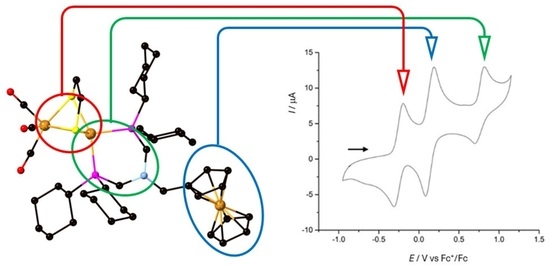
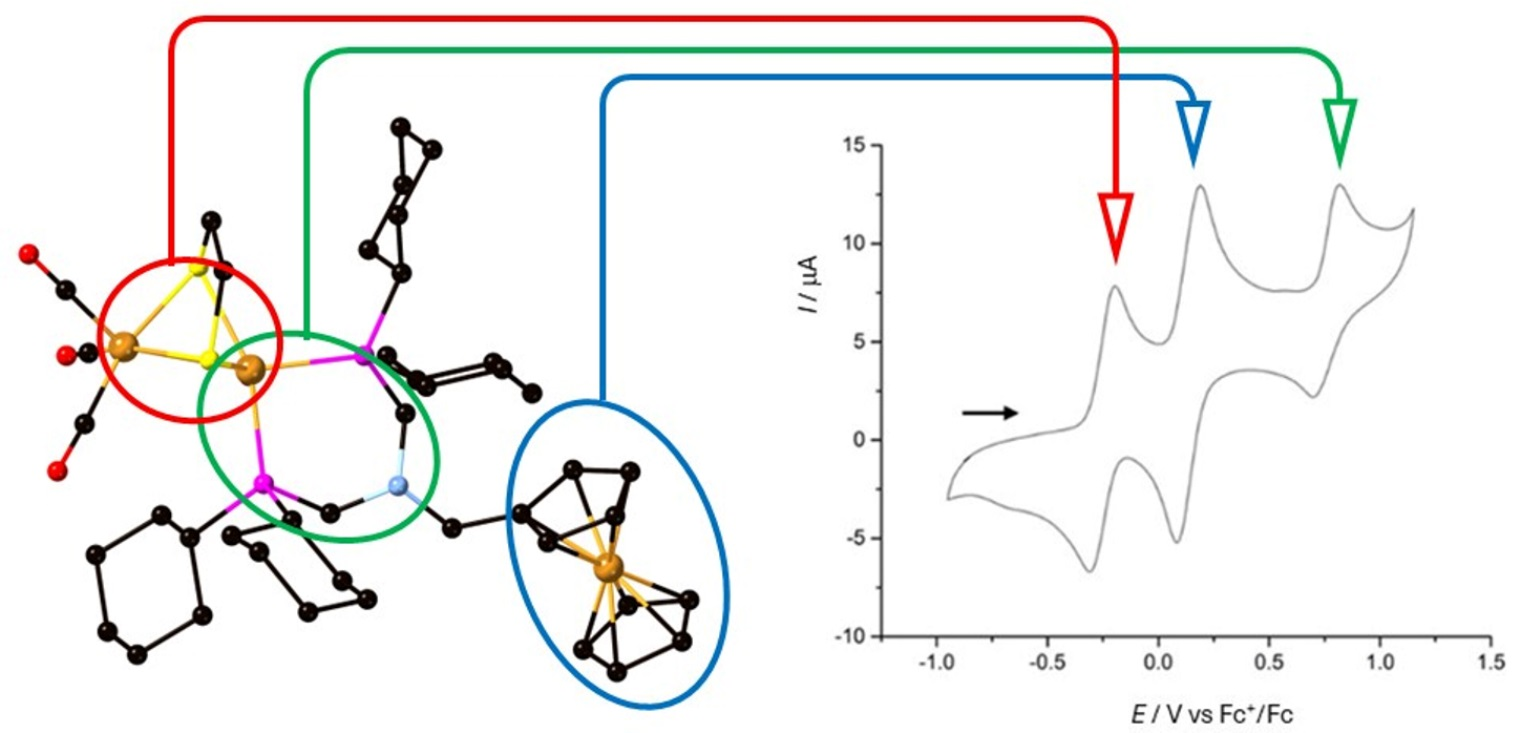
While many [FeFe]-hydrogenase biomimetics are effective proton-reduction catalysts, few are active for H2 oxidation, and examples containing both a pendant amine group, able to act as a proton relay, and a second redox center, both essential features of the enzymes, are rare. Here we report the preparation and oxidation chemistry of two ferrocene-functionalized amino-diphosphines (PCNCP), (CH2PR2)2NCH2Fc (R = Ph (1), Cy (2)), and their ethylenedithiolate (edt) diiron complexes, [Fe2(CO)4(μ-edt){κ2-(R2PCH2)2NCH2Fc}] (R = Ph (3), Cy (4)). Their crystallographic characterization shows that PCNCP occupies an apical–basal position. CV responses are slightly R-dependent, showing for 3 and 4 in three separate oxidative processes assigned to successive one-electron oxidation of the diiron core (quasireversible), appended Fc (reversible), and the amine–diiron moiety (irreversible), as confirmed by IR and UV–Vis spectroelectrochemical studies supported by Density Functional Theory (DFT) and Time-dependent Density Functional Theory (TDDFT) calculations. The first oxidation results in a structural rearrangement of the Fe(PNP)(CO) unit and the formation of a semi-bridging carbonyl. Slow protonation of 3 with HBF4∙Et2O affords the corresponding N-protonated cation in acetone, whilst μ-hydride products dominate for both 3 and 4 in CD2Cl2. A preliminary H2 oxidation study was carried out with 3, and while there was some evidence of activity, it was much lower than reported for alkyl-functionalized PCNPC diiron derivatives.

Graphical Abstract

1. Introduction

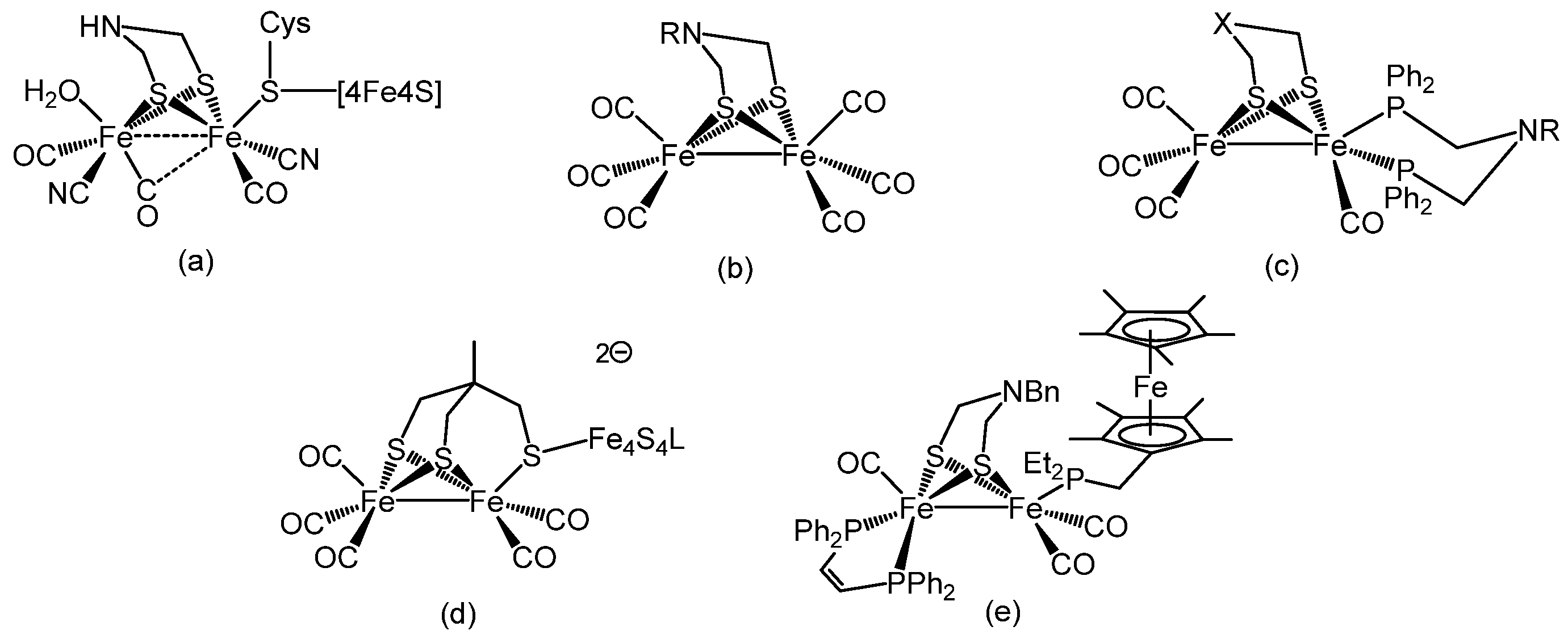
Hydrogenases efficiently catalyze the reduction of protons and oxidation of dihydrogen [1,2,3,4,5]. Over the past two decades, [FeFe]-H2ase biomimetics have received significant attention with the aim of both better understanding the mechanism of the action of the enzymes and preparing cheap, robust, and efficient earth-abundant catalysts capable of reversible splitting or formation of H2 [6,7,8,9,10,11,12,13,14,15]. The active site of [FeFe]-H2ases (Chart 1a) contains a diiron center, [2Fe–2S] (responsible for H+ reduction or H2 oxidation), spanned by a dithiolate and supported by carbonyl and cyanide ligands. The diiron center is further linked to a [4Fe–4S] cubane subcluster (responsible for H2 splitting) via one of the thiolate groups of a cysteine residue [16,17,18,19]. Two important features of this Fe6 (H-cluster) site are (i) the proximity of the [2Fe–2S] and [4Fe–4S] redox centers, which secures strong electronic communication between them via redox potential leveling [20], and (ii) the presence of a central NH group that can act as a proton relay, transporting the protons to/from the Fe2 center [19,21]. While many [FeFe]-H2ase biomimetics have been prepared and studied, the vast majority of these contain neither of these features, and very few contain both (Chart 1) [6,7,8,9,10,11,12,13,14,15].
Implementation of a proton-relay site is usually achieved in a fashion like that adopted in the enzyme, namely by incorporating an amine group into the dithiolate backbone (Chart 1b) [22]. A second strategy for proton-relay inclusion uses diphosphine ligands with an incorporated amine site, as in so-called PCNCP ligands such as Ph2PCH2N(R)CH2PPh2 [23,24,25,26,27,28,29,30,31,32] (Chart 1c). This approach also serves both to increase electron density at the Fe2 center, thereby facilitating proton addition, and to render the Fe2 center unsymmetrical, the latter being identified as a key feature for the successful preparation of a functional model [33]. Synthetically, this is a useful strategy, as the native NH can be exchanged for a range of substituents, allowing steric and electronic tuning of the basic site [34,35,36,37,38,39,40,41,42,43]. Several strategies have been adopted for incorporating a second redox center [44,45,46,47,48,49,50,51,52,53,54,55,56,57,58,59,60]. The first of these was from Pickett and co-workers, who prepared a [FeFe]-H2ase biomimetic (Chart 1d, L = 1,3,5-tris(4,6-dimethyl-3-mercaptophenylthio)-2,4,6-tris(p-tolyl-thio)benzene) containing both Fe2 and Fe4 centers and showed that it functioned as an electrocatalyst for proton reduction [45]. A second notable example comes from Camara, Rauchfuss, and co-workers, who prepared a biomimetic (Chart 1e) containing both phosphine-appended permethylated ferrocenyl as a second redox center and an azo-dithiolate bridge capable of acting as a proton relay [46,47], being a rare example of [FeFe]-H2ase biomimetics with both features [14].
In developing routes toward new [FeFe]-H2ase biomimetics, especially those capable of acting as catalysts for H2 oxidation, our strategy is to incorporate both the proton relay and the second redox-active center into a single ligand that can be tuned in a modular way and attached to a range of suitable diiron-dithiolate centers. Amino-diphosphines with a PCNCP backbone have been targeted since they are easily prepared upon addition of R2PCH2OH to primary amines [61,62,63], and several primary ferrocene-functionalized amines have been reported [64,65,66]. Further, diiron PCNCP complexes have been shown to be rare examples of [FeFe]-H2ase biomimetics that are able to oxidize H2 [29,32], a target of our current research program in this area. Herein, we describe the syntheses of Fc-functionalized PCNCP ligands, (CH2PR2)2NCH2Fc (12; R = Ph, Cy), and corresponding ethylene dithiolate (edt) diiron (1:1) complexes (34). The sequential electrochemical oxidation (oxidative path) of the complexes was investigated by cyclic voltammetry (CV) and IR spectroelectrochemistry (IR SEC) supported by DFT and TDDFT calculations. Their protonation was also probed to gain information about the prospects for catalytic H2 oxidation.

2. Results and Discussion

2.1. Synthesis and Characterization of FcCH2N(CH2PR2)2 (12)

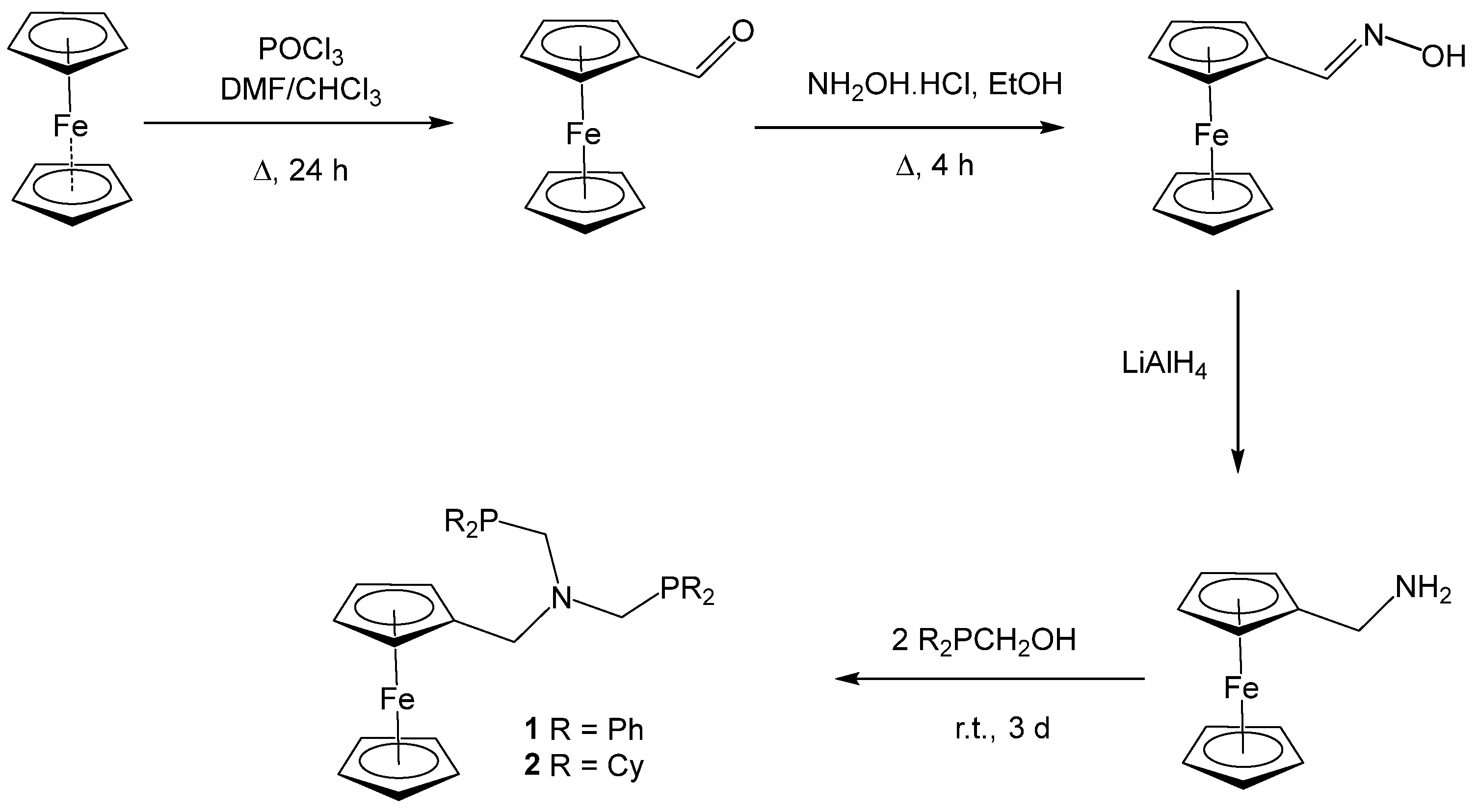
Aminomethylferrocene (FcCH2NH2) was chosen as the amine precursor due to its well-documented synthesis shown in Scheme 1 [67] and the presence of an insulating methylene group, which should reduce the inductive effects of ferrocene-localized oxidation on the basicity of the amine. The ultimate key step is the addition of R2PCH2OH (R = Ph, Cy) to FcCH2NH2, which was carried out in MeOH for 3 d, giving (CH2PR2)2NCH2Fc (12) as yellow precipitates [67]. Recrystallization from CH2Cl2–MeOH mixtures gave orange crystalline solids in moderate yields. The formation of 12 was confirmed by 31P{1H} NMR spectra showing a singlet at δ −28.2 for 1 and δ −18.3 for 2. In the 1H NMR spectrum of 1, two sets of methylene protons were observed as a singlet at δ 4.14 (2H) and a doublet at δ 3.42 (4H, JPH = 3.6 Hz). Štĕpnička and co-workers reported a similar synthesis of the methylene-lacking derivative Fc–N(CH2PPh2)2 isolated in 87% yield from the reaction of FcNH2 with Ph2PCH2OH in CH2Cl2 [66]; the product 31P{1H} NMR spectrum features a singlet at δ −23.5. Thus, the methylene linker in 1 has little effect on the electronic nature of the phosphorus centers.
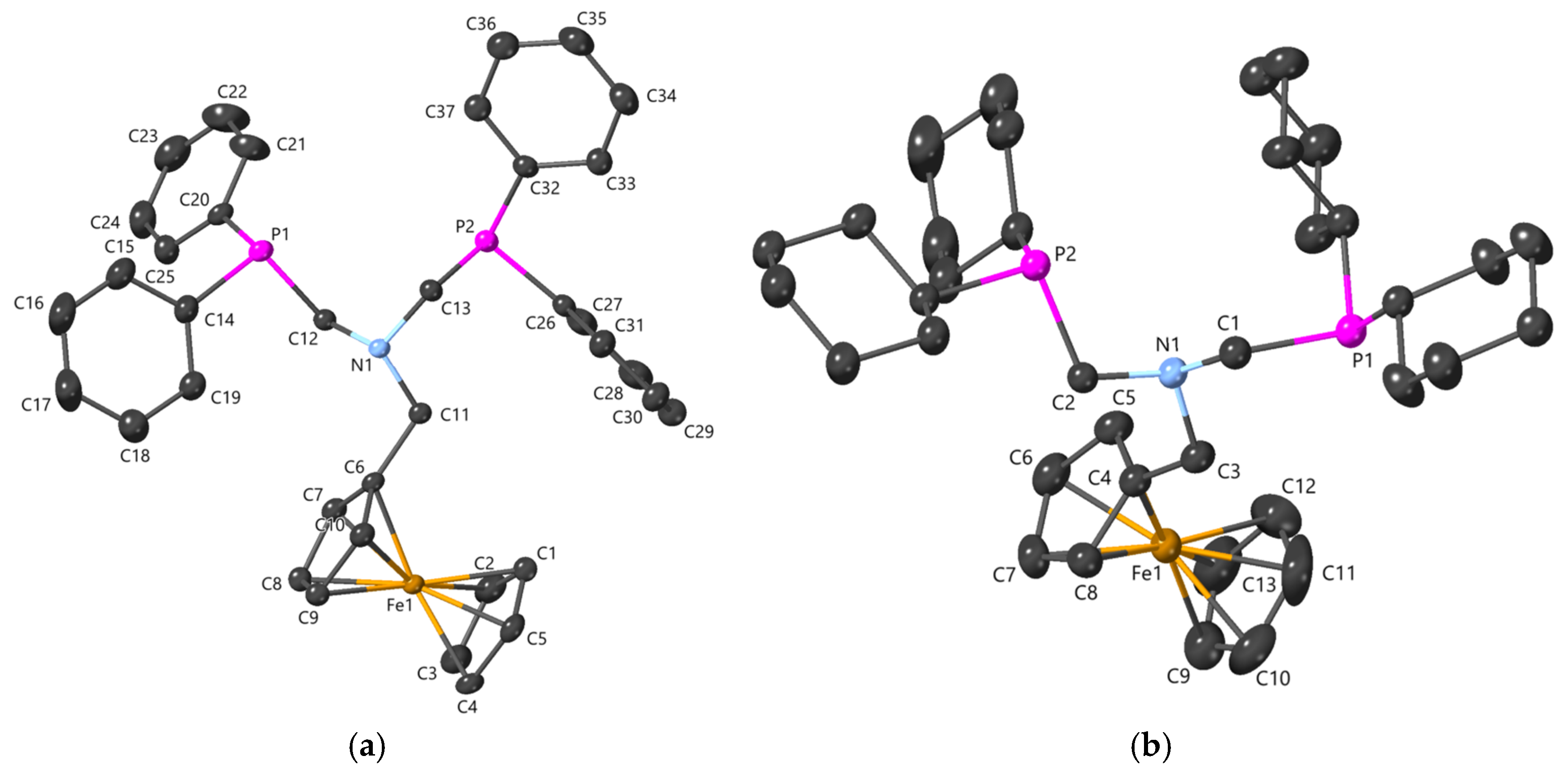
Molecular structures of 1 and 2 have been elucidated by X-ray crystallography (Figure 1, Tables S1–S3, ESI) and are very similar to those of Fc–N(CH2PPh2)2 and Fc–N(CH2P(Se)Ph2)2 reported by Štěpnička and co-workers [66].

2.2. Synthesis and Characterization of [Fe2(CO)4}(μ-dithiolate){κ2-(R2PCH2)2NCH2Fc}] (34)

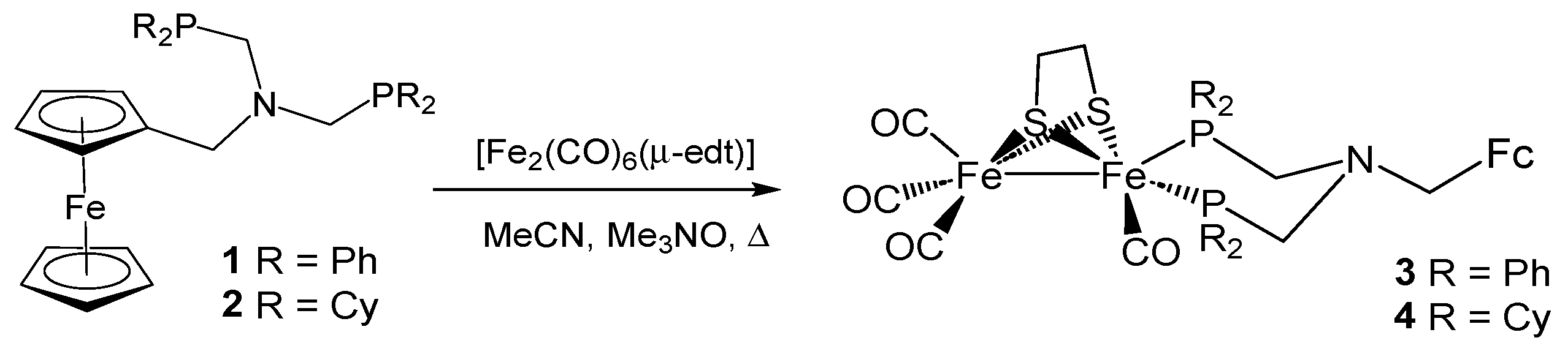
Following the successful preparations of 1 and 2, their coordination to an [FeFe]-H2ase biomimetic [Fe2(CO)6(µ-edt)] was attempted. The reaction with 1 was slow in refluxing MeCN (82 °C, 3 h) in the presence of Me3NO and afforded the targeted chelate complex [Fe2(CO)4(µ-edt){κ2-(Ph2PCH2)2NCH2Fc}] (3) (Scheme 2). Under similar conditions, diphosphine 2 reacted with [Fe2(CO)6(µ-edt)] even more slowly (ca. 7 h), but the targeted complex [Fe2(CO)4(µ-edt){κ2-(PCy2CH2)2NCH2Fc} (4) was formed ultimately. Work-up of these new complexes is non-trivial due to their instability on chromatographic supports (often seen with amines), and we were only able to obtain pure samples by repeated recrystallization, thus giving moderate isolated yields. The dark brown microcrystalline solids 3 and 4 are slightly sensitive to oxygen, oxidizing in air over several weeks.
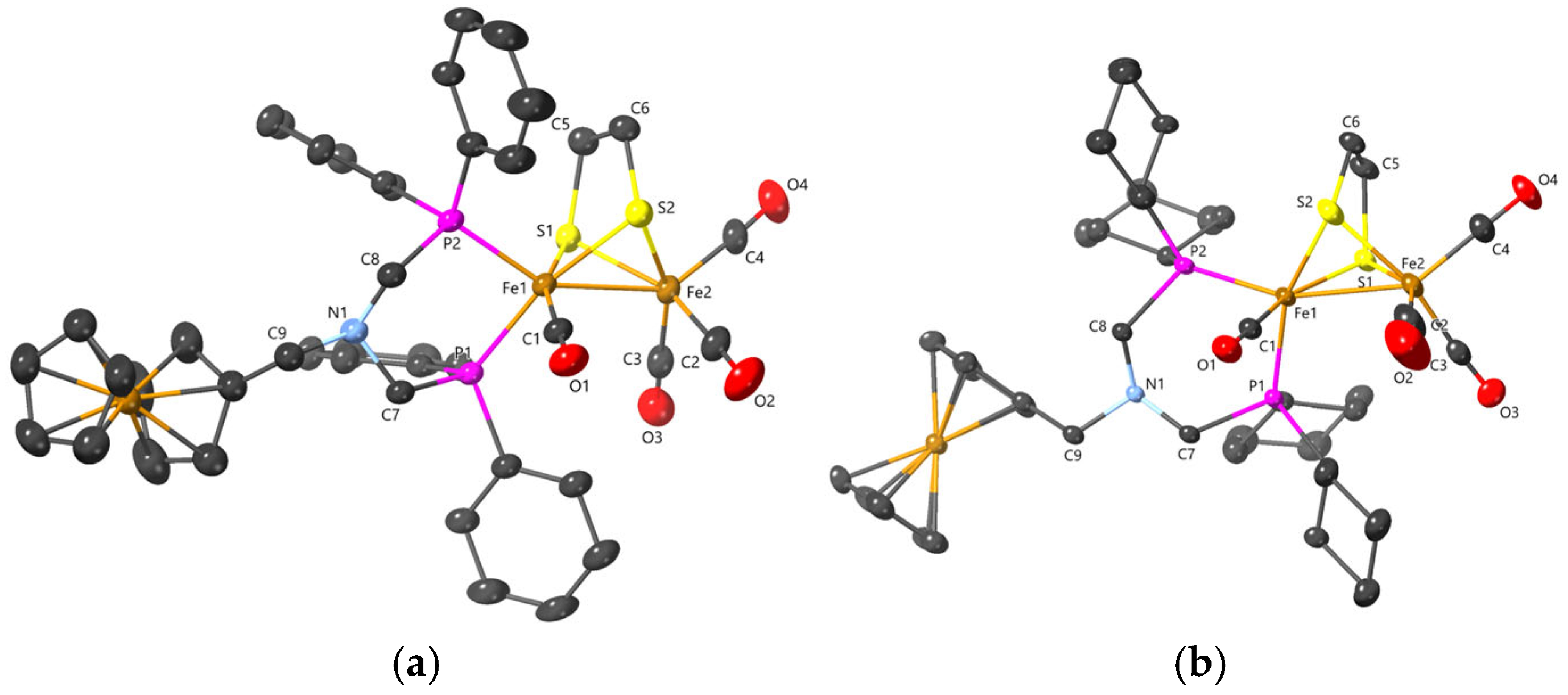
Determination of molecular structures was carried out on both 3 and 4 (Figure 2). They confirm that the diphosphine adopts an apical–basal geometry, in accord with related PCNCP complexes. The Fe–Fe bond lengths [2.5678(4) in 3 and 2.5842(3) Å in 4] and P–Fe–P bite angles [3 - 90.1341(7)°, 4 - 90.295(17)°] are within the expected ranges. In the solid-state structures, the ferrocenyl iron center is located at ca. 8.109 Å (3) and 8.076 Å (4) from the nearest iron atom of the Fe2 unit.
Characterization of 3 and 4 was relatively straightforward. Spectroscopic data comply with related diiron PCNCP complexes [23,24,25,26,27,28,29,30,31,32]. Thus, IR spectra confirm the chelating mode of the diphosphine ligand, revealing a characteristic ν(CO) pattern of three absorption bands, whereof the asymmetric middle one represents two close-lying stretching modes (Figures 4 and 5, Figure S1, and Table 2). DFT calculations (Table 2 and Table S12) indicate that the terminal carbonyls in the connected Fe(CO)3 and Fe(CO) units do not vibrate independently; the in-plane Fe1–C1–O1 and Fe2–C2–O2 carbonyl ligands (Figure 2) combine in two IR-active, symmetric and asymmetric, stretching modes. This analysis is crucial for identifying structural changes accompanying oxidation of 3 and 4, as described hereinafter. The increased electron density on the diiron center in 4 is evident from the red shift in the ν(CO) bands (Table 2). The 31P{1H} NMR spectra (Figures S29 and S31) each show a singlet resonance (3 at δ 52.9; 4 at δ 51.5) attributed to rapid interconversion of the diphosphine basal and apical sites; two methylene resonances in a 1:2 ratio in the 1H NMR spectra (Figures S28 and S30) are consistent with this interconversion.

2.3. Cyclic Voltammetry (CV) of 14 and DFT Calculations

Cyclic voltammograms of 1 and 2 in dry CH2Cl2/10−1 M [NBu4][PF6] reveal reversible oxidation to corresponding cations at E1/2 = 0.005 V and −0.02 V vs Fc+/Fc, respectively, localized on the ferrocenyl center with negligible amine participation [67]. The limited impact of the Cp-bound donor methylene group on the Fe(II) oxidation complies with the oxidation potential of methyl ferrocene, E1/2 = −0.096 V vs Fc+/Fc. On the other hand, reference FcN(CH2PPh2)2 oxidizes significantly more negatively, at E1/2 = −0.37 V [66], on the electron-rich N-amino-diphosphine substituent [67].
Previous work has established that complexes [Fe2(CO)4(μ-dithiolate){κ2-(Ph2PCH2)2N(R)}] undergo a quasi-reversible Fe2-based one-electron oxidation at low potentials (ca. −0.14 V to −0.16 V), resulting in the formation of stable [Fe2(CO)4(μ-dithiolate){κ2-(Ph2PCH2)2NR’}]+ (R’ = H, alkyl, aryl) [33,34,35,36,37,38,39,40,41,42]. The crystal structure of one of these cations, viz. [Fe2(CO)4(μ-pdt){κ2-(Ph2PCH2)2N(Pr)}][BArF4] (Pr = propyl) [38], reveals two major structural changes occurring upon the oxidation (Scheme 3). Thus, the chelating diphosphine rotates into a (pseudo)dibasal position whilst the single carbonyl ligand at this chelated Fe center moves from the terminal to a semi-bridging position. DFT calculations have determined a Gibbs free energy barrier of 14.6 kcal mol−1 for these rearrangements [38]. Accordingly, the Fe2 center in 3 and 4 was anticipated to oxidize first, followed closely by the oxidation of the aminomethylene-appended ferrocenyl moiety [66]. This hypothesis was probed by cyclic voltammetry and IR/UV–Vis spectroelectrochemistry, as described in the following sections, and strongly supported by DFT and TDDFT calculations.
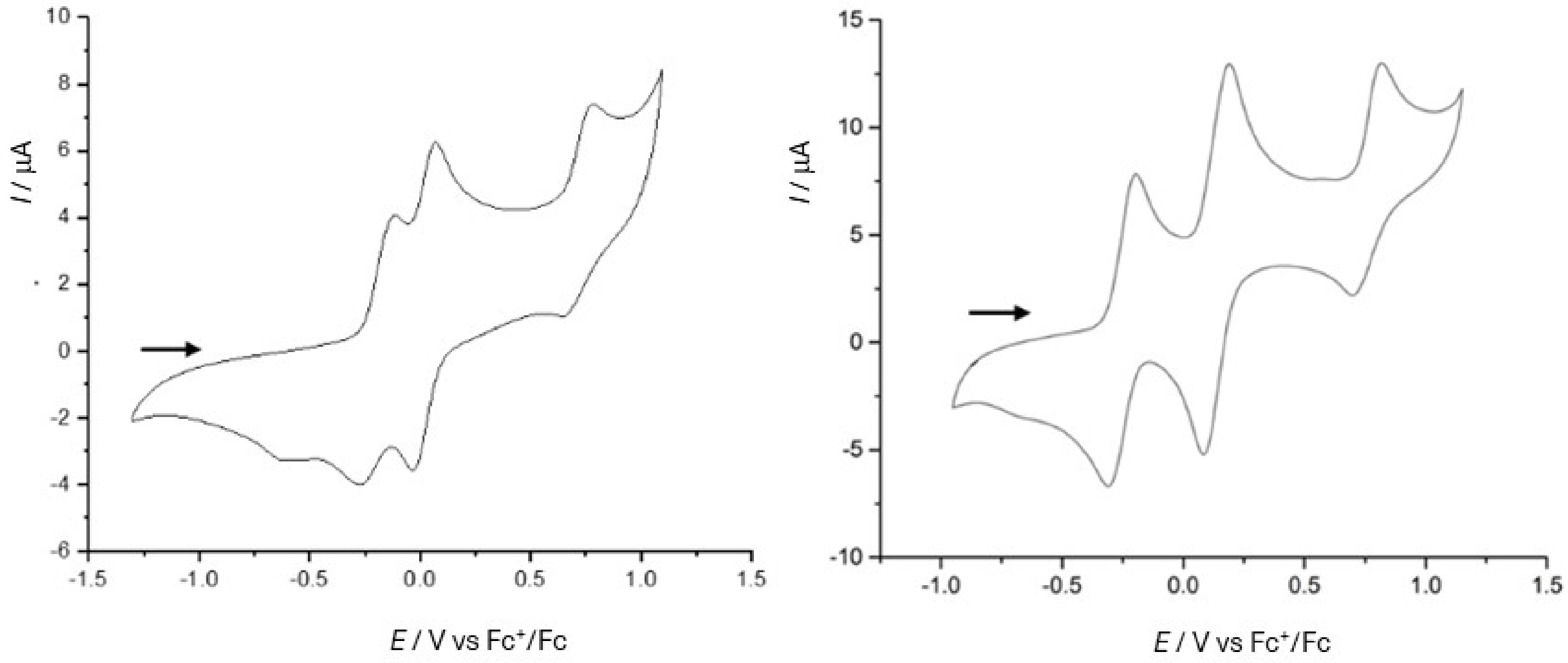
For 3, two closely spaced oxidation waves were observed (Figure 3, left) at E1/2 = −0.16 V (electrochemically quasi-reversible, ΔEp = 130 mV) and E1/2 = 0.04 V (reversible, ΔEp = 90 mV), while scanning to more positive potentials revealed a third, irreversible oxidation (E1/2 = 0.78 V, ΔEp = 130 mV, Ip,c/Ip,a < 1). As expected, more electron-rich 4 oxidizes at a lower electrode potential than 3. The CV again shows three clear oxidation events at E1/2 = −0.25 V (ΔEp = 120 mV, quasi-reversible), E1/2 = 0.15 V (ΔEp = 90 mV, reversible), and E1/2 = 0.80 V (ΔEp = 120 mV, Ip,c/Ip,a < 1, irreversible). As expected, the initial oxidation of both complexes localized at the Fe2 center (see the HOMO in Figures S10 and S16 and the spin density distribution in Figures S4 and S5, left), in line with the larger ΔEp values reflecting slower electron transfer due to the concomitant structural changes in the monocation visualized in Scheme 3 and confirmed by DFT calculations (see the rearranged molecular structures in Figures S2 and S3). The following oxidation is faster and resides at the remote ferrocenyl center to give stable state-triplet dications. This assignment is again strongly supported by DFT calculations, which afforded the Fc-based β-HOSO in [3′]+ and [4′]+ (see Figures S12 and S18) and the corresponding separate distribution of spin density in [3′]2+ and [4′]2+ at the Fe2 and Fc centers (see Figures S4 and S5, right).
The third, irreversible oxidation wave in the CVs of 3 and 4 can be assigned with confidence with the aid of DFT calculations. The frontier β-HOSO of biradicals [3′]2+ and [4′]2+ is delocalized over the diphosphinoamine–Fe2+ backbone (see Figures S14 and S20). The ca. 700 mV separation of the second and third oxidation waves for 3 and 4 (Table 1) complies with the two-step oxidation of reference 4-(diphenylamino)phenylferrocene (Fc–TPA) at the FeII–TPA and FeIIITPA centers, where the corresponding oxidation waves were separated by 660 mV [67].

2.4. IR Spectroelectrochemistry (IR SEC) of 34 and DFT Calculations

To gain further insight into the precise nature of the three separate oxidation processes observed with conventional CV for edt-bridged 3 and 4 (Table 1), we turned to in situ IR spectroelectrochemistry (IR SEC) combined with DFT calculations.
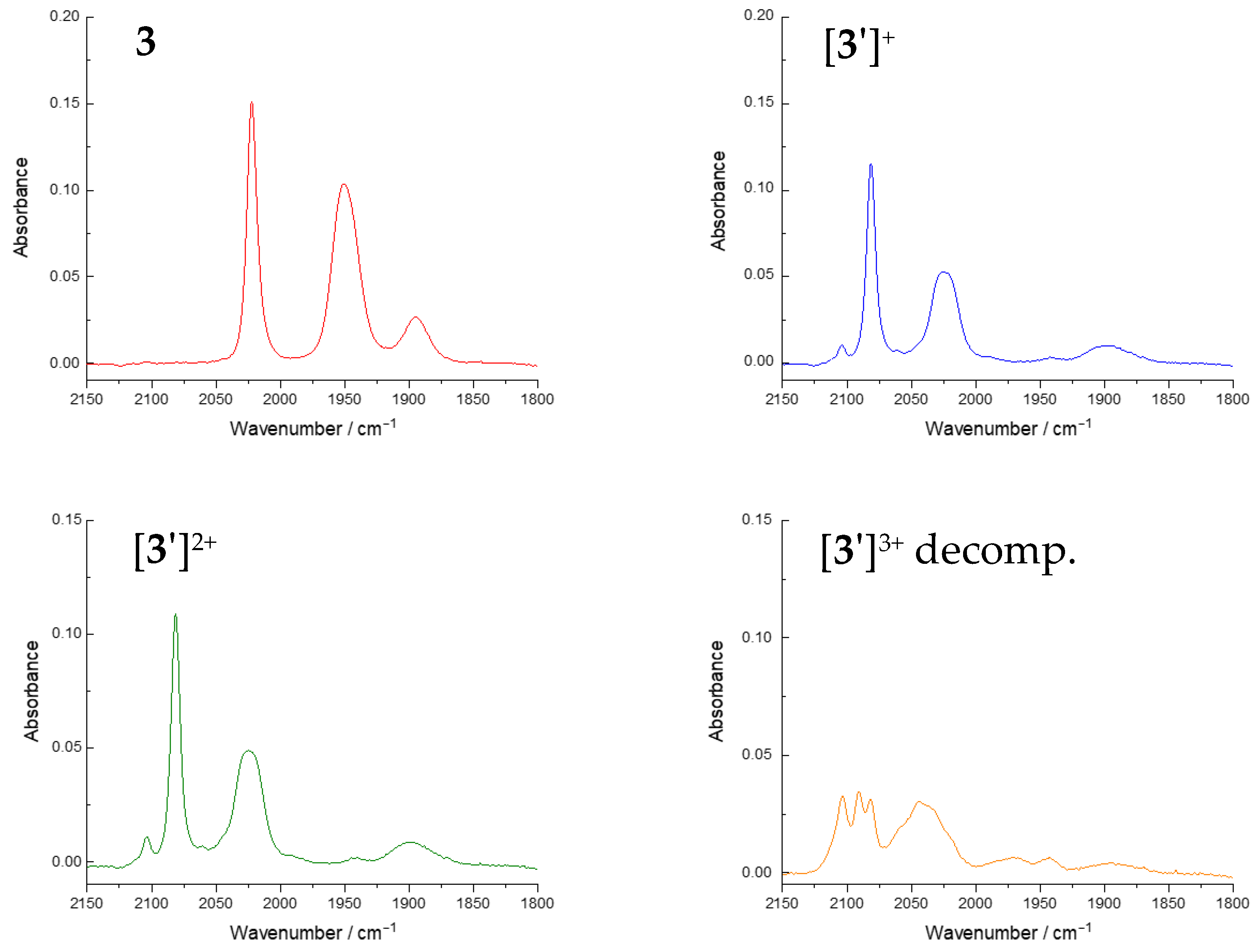
For 3, all three oxidative processes (Table 1) were observed in the thin-layer cyclic voltammogram (TL-CV) recorded with than OTTLE cell along with the in situ IR spectroscopic monitoring, despite the closely spaced first and second oxidation steps (Figure 4). The first oxidation results in a large blue shift in the two highest-energy IR ν(CO) bands of 3 corresponding to the stretching modes of the Fe(CO)3 unit (Table 2). This behavior can be attributed with confidence to the selective oxidation at the diiron core. The product [3′]+ features a semi-bridging carbonyl (vibrationally decoupled from Fe(CO)3), as evidenced by the IR ν(CO) absorption at 1897 cm−1. The weakening of the CO bond in the semi-bridging position explains the negligible blue shift in this band upon the oxidation of the diiron core, similar to the wavenumbers of the ν(CO) modes of the terminal carbonyls in Fe(CO)3.
The second oxidation producing [3′]2+ does not result in any significant change to the IR spectrum (Figure 4) and can therefore be attributed to the distant Fc center, as indicated by cyclic voltammetry and the corresponding DFT data.
The third oxidation to [3′]3+ results in significant changes in the IR spectrum, indicative of the formation of more than one, probably poorly soluble, new species. The small, but apparent, additional blue shift in the low-intensity ν(CO) bands attributed to the persistent Fe(CO)3 group is consistent with the dominant oxidation of the amine functionality in [3′]2+ with some participation of the cationic diiron center, as discussed in the CV Section.
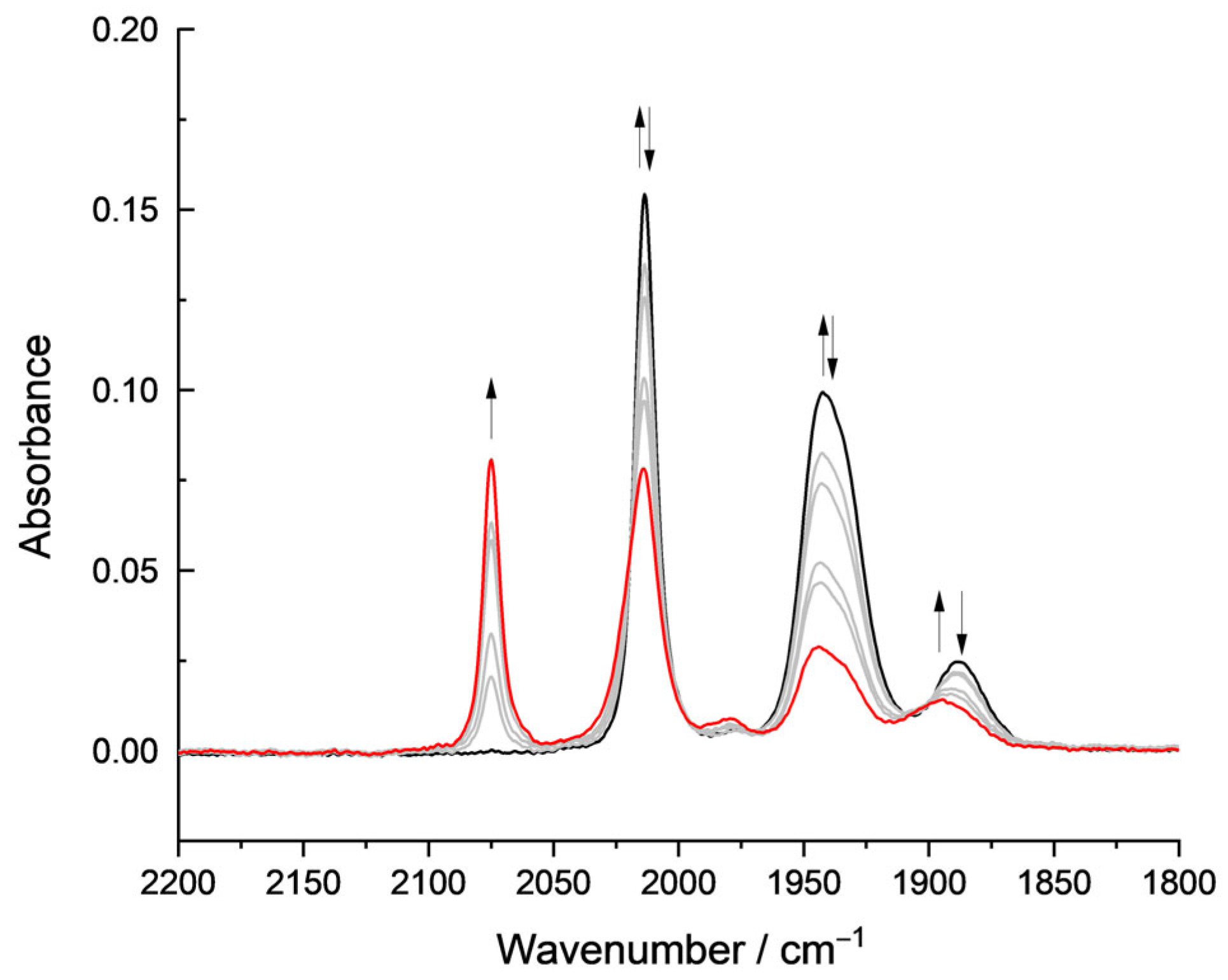
The initial one-electron oxidation of 4 (Figure 5) results in a significant blue shift in the highest-frequency ν(CO) band by 63 cm−1, confirming the involvement at the diiron center, comparable with 3. Further, there is a clear isosbestic point observed at 2020 cm−1 as a strong indication that the anodic electron transfer smoothly generates cation [4′]+ with a semi-bridging CO ligand absorbing at 1900 cm−1. Unfortunately, the complete oxidation path of 4, in contrast to 3, could not be probed by IR SEC due to significant deposition of [4′]+ on the minigrid electrode in the thin solution layer, causing passivation of the active Pt surface. Any decomposition of [4′]+ at this stage was excluded, as the slow back reduction, triggered by the potential scan reversal, led to full recovery of parent 4.

2.5. UV–Vis Spectroelectrochemistry (UV–Vis SEC) of 3 and TDDFT Calculations

Based on the outcomes of the IR SEC investigations, the stepwise smooth electrochemical oxidation of 3 to [3′]+ and [3′]2+ within the OTTLE cell was also monitored by rapid UV–Vis absorption spectroscopy. The recorded spectral changes were compared with data gained from TDDFT calculations based on plausible models of the parent complex and the reorganized oxidized species featuring the semi-bridging carbonyl ligand.
Parent 3 exhibits strong electronic absorption at 485 nm (Figures S6, S7, and S9), which is attributed to the dominant HOMO→LUMO transition having a combined (edt–Fe2)-to-P(Ph) (mixed L’LCT/MLCT) and σ(Fe2)-to-σ*(Fe2) character (Figure S10, Table S6). As expected, this absorption band disappears upon the initial oxidation, dominantly localized on the Fe2 core. The CO-bridged cationic species, [3′]+, shows characteristic new absorption around 600 nm (Figures S6, S7, and S11), which has a strongly mixed character roughly corresponding to a PhP-to-Fe(CO)3+ (LMCT) excitation (Figure S12, Table S7). As anticipated, this electronic transition hardly changes when generating the Fc-oxidized dicationic species, [3′]2+ (Figures S6, S7, and S13, Table S8). The characteristic new absorption of [3′]2+ arose at 250 nm, corresponding to several charge-transfer transitions directed from occupied edt- and PhP-based α-HOSO − 3/4/5 to α-LUSO and α-LUSO + 1 localized on oxidized Fc+ (Figure S14, Table S8). Summarizing, the outcomes of the detailed analysis of electronic transitions characterizing the oxidation path of 3 are consistent with the initial oxidation involving the Fe2 core and the following step being localized on the ferrocenyl redox center (Figure S4).

2.6. Protonation of 34

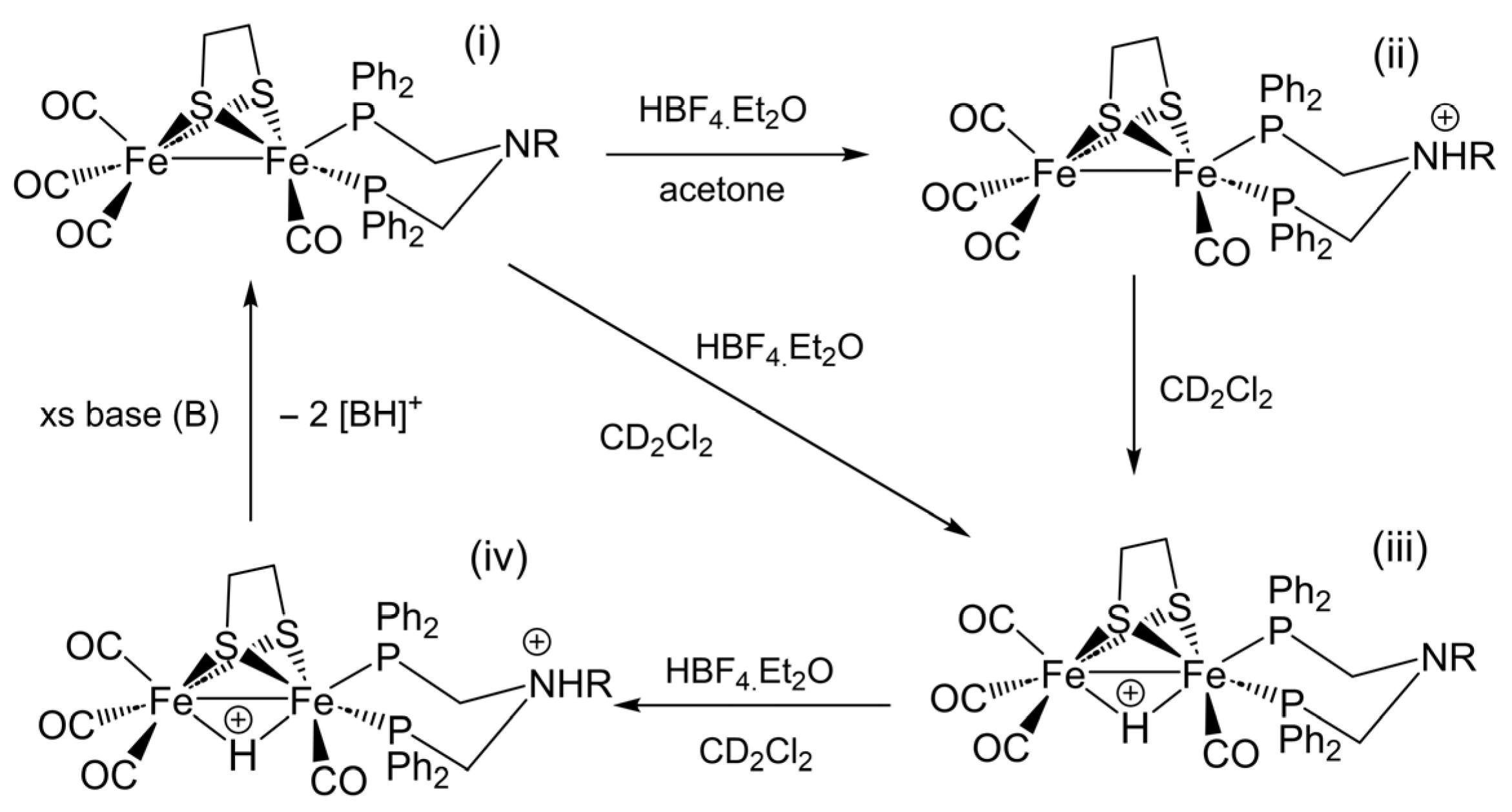
As presented in the Introduction, the incorporation of a proton-relay center is a key feature of [FeFe]-H2ases. Previous studies of diiron–PCNCP complexes have shown that their protonation chemistry (with HBF4∙Et2O) is dependent upon both the nature of the dithiolate backbone and the substituent on the amine nitrogen [34,35,36,37,38,39,40,41,42]. Some key general features are summarized in Scheme 4. These are (i) favored N-protonation in acetone, with the N-to-Fe2 proton transfer being slow or disfavored, (ii) a facile N-to-Fe2 proton transfer in dichloromethane, resulting in the formation of a bridged hydride complex, (iii) formation of complexes with both N and Fe2 protonated upon addition of a slight excess of acid in dichloromethane, and (iv) deprotonation and reformation of the neutral diiron complex upon addition of a base, the latter process being of key importance for the development of an H2 oxidation catalyst.
We studied the protonation chemistry of 3 and 4, having used HBF4∙Et2O as the proton source. In acetone-d6, addition of HBF4∙Et2O to 3 affords the N-protonated complex (Scheme 4ii), which can be followed by 31P{1H} NMR spectroscopy (Figure S21). The singlet at δ 53.2 for 3 is replaced by two new signals at δ 57.6 and 67.5, assigned to endo and exo isomers of [3NH][BF4]. In CD2Cl2, however, a more complex behavior was noted (Figure S22). Addition of one equivalent of HBF4∙Et2O resulted in a very slow formation of [3NH][BF4] but also [3(µ-H)][BF4] (Scheme 4iii), the latter being identified by the growth of an unresolved hydride peak at δ −15.5 in the 1H NMR spectrum and a singlet at δ 38.2 in the 31P{1H} NMR spectrum. Addition of the second acid equiv. gave a new (weak and broad) signal in the 31P{1H} NMR spectrum at δ 40.5, a range associated with the formation of a dication upon proton addition to both amine N and the diiron center (Scheme 4iv); however, the 1H NMR spectrum was too broad to unequivocally confirm this. Importantly, a significant amount of 3 remained intact even after the addition of excess acid, suggesting that the protonation under these conditions was slow and unfavorable.
The limited yield of the protonated species derived from 3 CD2Cl2 complicated their investigation by cyclic voltammetry at the GC electrode and subsequently by spectroelectrochemistry. The only observable change in the CV of 3 in CH2Cl2/10−1 M [NBu4][PF6] upon the addition of 1 and 2 proton equivalents was the gradual disappearance of the first, Fe2-based oxidation wave at −0.16 V (Figure 3, left), which corresponds with the protonation of the diiron center (Scheme 4iii). At the same time, the third, largely amine-based oxidation wave at +0.78 V became slightly diminished, and the only intact oxidation wave remained the second one at 0.15 V, which is based on the remote ferrocenyl center. Qualitatively, these observations correspond with the co-existence of [3NH][BF4] and [3(µ-H)][BF4] indicated by the 31P{1H} NMR spectra in Figure S22.
Next, we studied the protonating behavior of electron-rich 4 in CD2Cl2 (Figure S23). The addition of one equiv. HBF4∙Et2O directly resulted in the formation of a dominant species with a bridging hydride, [4(µ-H)][BF4], as evidenced by the high-field triplet in the 1H NMR spectrum at δ −15.7 (JPH = 16.9 Hz) and the appearance of a new signal at δ 39.8 in the 31P{1H} NMR spectrum. Additional small peaks were observed at δ 47.1 and 44.0, which were first considered to reflect the formation of a doubly protonated complex; however, upon addition of a second equivalent of acid, both minor signals disappeared, suggesting that this was not the case.

2.7. Attempted Hydrogen Oxidation

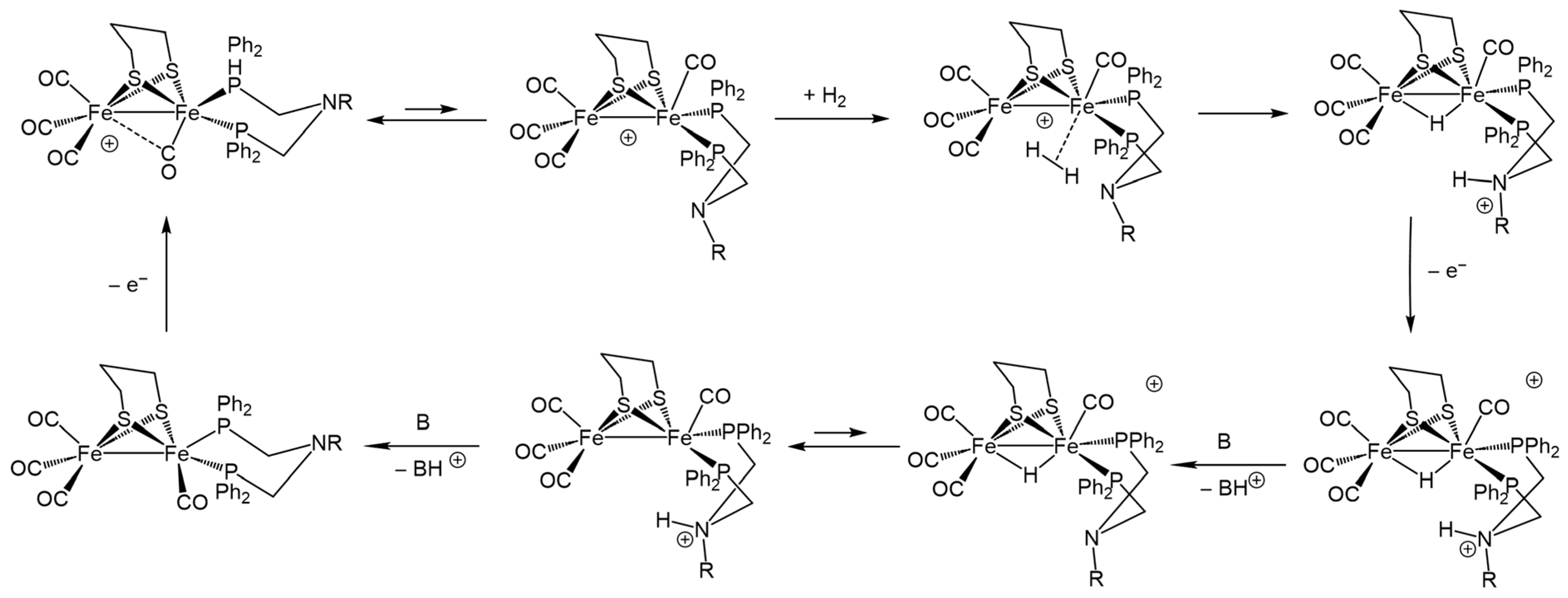
The protonation studies in dichloromethane have revealed the partial conversion of 3 to [3(µ-H)][BF4], the latter being the redox equivalent of singly oxidized [3′]+ (= [3(µ-CO)][BF4]). The conversion of [3′]+ to [3(µ-H)]+ upon coordination of H2 is a key step in the catalytic mechanism of hydrogen oxidation for this family of Fe2–PCNCP complexes (Scheme 5) proposed by Ahlquist and co-workers [29,30,31]. This process appears to be more efficient for 4, but the low solubility of precursor [4′]+, demonstrated by electrode passivation in the IR SEC Section, is the limiting factor for practical testing.
In order to assess the catalytic potential of 3 to oxidize H2, a small amount was dissolved in CD2Cl2, degassed, and flushed with H2, followed by the addition of ca. 9 equivalents of the oxidant Fc[BF4] to generate [3′]+ (Scheme 3 and Table 1). Then, 9 equivalents of P(o-tolyl)3 as a proton-abstraction agent were added, and the sample was transferred to an NMR tube, the headspace of which was filled with H2 (1 atm), and the conversion of P(o-tolyl)3 to [HP(o-tolyl)3]+ was monitored by 31P{1H} NMR spectroscopy. Over 3 h, a doublet resonance attributed to [HP(o-tolyl)3][BF4] (B and BH+, respectively, in Scheme 5) slowly appeared, indicating that [3′]+ can trigger oxidation of H2. However, even after 8 h, the ratio of P(o-tolyl)3 to [HP(o-tolyl)3]+ suggested that only ca. two equivalents of phosphine had been protonated, being significantly less than reported [32] for the derivatives of 3 with the pendant –CH2Fc group on amine replaced by methyl or benzyl. The exact reasons for the lower activity of 3 are not precisely known, but likely the sterically demanding nature of the Fc group may hinder proton transfer. Electronically, the electron-withdrawing nature of Fc+ in the dicationic complex might also reduce the basicity of the proton relay nitrogen center.

3. Materials and Methods

3.1. General Procedures

All reactions were carried out in anhydrous solvents, using standard Schlenk-line techniques under an atmosphere of dry N2. Work-up was carried out in air, using standard bench reagents, unless otherwise stated. FcCH2NH2 [69] and [Fe2(CO)6(μ-edt)] [70] were prepared by standard procedures. NMR spectra (Figures S24–S31) were recorded on a Bruker Avance 400 MHz Ultrashield NMR spectrometer (Bruker, Coventry, UK) and referenced internally to residual solvent peaks or externally to P(OMe)3 (31P{1H} NMR). Chemical shifts are expressed relative to TMS. High-resolution electrospray ionization (HR ESI) mass spectra were recorded on a Bruker Daltonics Esquire 3000 spectrometer (Bruker, Coventry, UK) by Dr. Lisa Haigh (Imperial College). IR spectra (characterization) were obtained with a Shimadzu IRAffinity-1S spectrometer (Bruker, Milton Keynes, UK) in a solution cell fitted with calcium fluoride plates. HBF4.Et2O for protonation studies was used as supplied.

3.2. Syntheses and Characterization

FcCH2N(CH2PPh2)2 (1) — FcCH2NH2 (400 mg, 1.86 mmol) was dissolved in dry, degassed MeOH (10 mL) to form an orange solution, and Ph2PCH2OH (820 mg, 3.79 mmol) was added with vigorous stirring. After 3 d, the pale-yellow solution was filtered to give a pale-yellow precipitate. The latter was dissolved in CH2Cl2–MeOH (1:1, v/v), and CH2Cl2 was allowed to slowly evaporate to produce 1 (819 mg, 72%) as bright orange crystals. 1H NMR (CDCl3) δ 7.38–7.22 (m, 20H, Ar), 4.14 (s, 2H), 4.09 (s, 7H), 3.93 (s, 2H), 3.42 (d, J 3.6 Hz, 4H, CH2P). 31P{1H} NMR (CDCl3) δ −28.2. FAB MS: m/z calc. for (C37H35NP2Fe): 611.159414; found 611 [M − H]+.
FcCH2N(CH2PCy2)2 (2) — As for 1, except using Cy2PCH2OH and stirring for 1.5 d. Yield: 68%. 1H NMR (CDCl3) δ 4.11 (t, 2H, JHH 1.6, Cp), 4.06 (s, 5H, Cp), 4.01 (t, 2H, JHH 1.6, Cp), 3.64 (s, 2H, CH2C5H4), 2.57 (s, 4H, CH2P), 1.67–1.13 (m, 44H, Cy); 31P{1H} NMR (CDCl3) δ −18.3. ESI(+) MS: m/z calc. for (C37H59FeNP2): 635.347214; found 636.3567 [M+H]+.
[Fe2(CO)4(μ-edt){κ2-(Ph2PCH2)2NCH2Fc}] (3) — [Fe2(CO)6(µ-edt)] (70 mg, 0.19 mmol), 1 (110 mg, 0.18 mmol), and Me3NO (15.5 mg, 0.21 mmol, 1.1 equiv.) were combined in MeCN (20 mL) and refluxed for 3 h until the solution became dark red–brown. The reaction solution was filtered through celite, washed with CH2Cl2 (2 × 10 mL), and the solvent was removed under reduced pressure. The product was crystallized from warm CH2Cl2–hexane (1:2, v/v) and then recrystallized from a hexane-layered CH2Cl2 solution to give 3 (115 mg, 69%) as dark brown crystals. 1H NMR (CD2Cl2) δ 7.58–7.18 (20H, Ar), 4.05 (5H, Cp and 2H, FcCH2N), 3.91 (s, 2H, Cp), 3.77 (m, 2H, CH2PPh2), 3.46 (s, 2H, Cp), 3.00 (m, 2H, CH2PPh2), 1.79 (m, 2H, SCH2), 1.63 (m, 2H, SCH2). 31P{1H} NMR (CD2Cl2) δ 52.9. IR (CH2Cl2) ν(CO): 2022 vs, 1951 s, 1895 w cm−1. ESI(+) MS: m/z calc. for (C43H39Fe3NO4P2S2): 926.984396; found 927.9904 [M + H]+.
[Fe2(CO)4(μ-edt){κ2-(Cy2PCH2)2NCH2Fc}] (4) — [Fe2(CO)6(µ-edt)] (70 mg, 0.19 mmol), 2 (120 mg, 0.19 mmol), and Me3NO (15.5 mg, 0.21 mmol) were combined in MeCN (20 mL) and refluxed for 7 h, the solution becoming darker. The reaction solution was filtered through celite, washed with CH2Cl2 (2 × 10 mL), and solvents removed under reduced pressure. The product was crystallized from warm CH2Cl2–hexane (1:2, v/v) and then recrystallized from a hexane-layered CH2Cl2 solution. Yield: 101 mg (56%). 1H NMR (CDCl3) δ 4.15 (s, 4H, Cp), 4.13 (5H, s, Cp), 3.38 (s, 2H, CH2Fc), 3.29 (m, 2H, CH2P), 2.37 (m, 2H, CH2P), 2.14–0.98 (m, 48H, Cy + edt). 31P{1H} NMR (CDCl3) δ 51.5. IR (CH2Cl2) ν(CO): 2013 vs, 1940 s, 1886 br cm−1. ESI(+) MS: m/z calc. for (C43H63Fe3NO4P2S2): 951.172196; found 951.1746 (M+), 952.1772 [M + H+].

3.3. Cyclic Voltammetry and Spectroelectrochemistry

All spectroelectrochemical studies were conducted under an atmosphere of dry Ar. Cyclic voltametric scans were carried out in degassed anhydrous dichloromethane, using 10−1 M [NBu4][PF6] as the supporting electrolyte. [NBu4][PF6] was recrystallized twice from absolute ethanol and pre-dried overnight under vacuum at 80 °C. The working electrode was a 3-μm diameter glassy carbon disk that was polished with a 0.25-μm diamond slurry, washed, and cleaned for 10 min in an ultrasonic bath. The counter electrode was a coiled Pt wire, and the pseudo-reference electrode was a coiled silver wire. All electrode potentials are referenced against the internal standard ferrocenium/ferrocene (Fc+/Fc) or auxiliary Fc*+/Fc* (Fc* = permethylated ferrocene) redox couples. A Metrohm Autolab Interface 6 (Utrecht, The Netherlands) potentiostat was used for cyclovoltammetric measurements. IR SEC was performed with a Bruker Optics Vertex 70v (Ettlingen, Germany) FT-IR spectrometer equipped with a DTLaGS detector, and UV–Vis SEC with a Scinco S3100 (Seoul, the Republic of Korea) diode-array spectrophotometer (200–1100 nm). The SEC electrolyzes, and parallel thin-layer cyclic voltammetry (TL-CV) was carried out with an OTTLE cell (Reading, UK) [71] and a PalmSens EmStat4S (Houten, The Netherlands) potentiostat operated with the PSTrace 5.9 software. The OTTLE cell was equipped with a Pt minigrid working electrode, a Pt minigrid counter electrode, an Ag-wire pseudo-reference electrode, and CaF2 windows. SEC samples contained 3 × 10⁻¹ M [NBu4][PF6] and 1 mM analyte.

3.4. Protonation Studies

All protonation reactions were carried out in a standard NMR tube. Following dissolution of an appropriate amount of complex in the deuterated solvent, 1H and 31P{1H} NMR spectra were recorded. In the next step, 1 and 2 equivalents of HBF4.Et2O was added using a microsyringe. After shaking and allowing the sample to equilibrate for ca. 5 min, both spectra were re-recorded. No attempts were made to isolate products.

3.5. H2 Oxidation

To one equivalent of 3 (5 mg, 0.006 mmol) in degassed CD2Cl2 in an NMR tube, 9 equivalents of Fc[BF4] (15 mg, 0.055 mmol) and 9 equivalents of P(o-tolyl)3 (16.7 mg, 0.055 mmol) were added. The solution was sparged for 1 min with H2 before the headspace of the NMR tube was filled with H2 and sealed, followed by recording 31P{1H} NMR spectra.

3.6. X-Ray Diffraction

X-ray diffraction data for 1, 3, and 4 were collected at 150(1) K using an Agilent Diffraction SuperNova(Oxford, UK) equipped with a microfocus Cu-Kα X-ray source, a Cryojet5®, and an Atlas CCD detector using the CrysAlis PRO171.39.46 software at the University College London. The crystal structures were solved using SHELXT [72] and refined using SHELXL2018/3 [73], both of which were operated within either the Oscail [72] or OLEX2 [74] software packages. X-ray diffraction data for 2 were collected at 150(2) K on a Bruker APEX 2 CCD diffractometer (Bruker, Coventry, UK) equipped with a sealed-tube Mo-Kα X-ray source and Cryostream crystal cooler. The structure was solved with direct methods [75] and refined as above. Important crystallographic data are given in Table S1. A full list of all bond lengths and angles can be found in Tables S2–S7. Crystallographic data have been deposited with the Cambridge Data Center. For the deposition numbers, please refer to Table S1.

3.7. Quantum Mechanical Calculations

DFT calculations were performed on 3 and 4 in Gaussian 16, Revision C01 (G16) [76], together with the three-parameterized Becke, Lee, Yang, and Park (B3LYP) functional [77,78]. For the Fe atom, a LanL2TZ basis set [79,80,81] was used, and for the H, C, N, O, S, and P atoms, the 6-311+G and 6-311+G(3d) basis sets were used, respectively [82,83]. Solvent effects (DCM) were described by the conductor-like polarizable continuum model (CPCM) [84]. Open-shell systems were calculated using the unrestricted Kohn-Sham (UKS) approach, and time-dependent DFT (TDDFT) was used to calculate electronic transitions and analyze them in terms of contributing one-electron excitations [85]. All geometry optimizations were followed by vibrational frequency calculations, and no imaginary frequencies were detected. The GaussView 6 [86] software was used to plot the molecular orbitals (isovalue 0.03 e1/2 bohr−3/2), spin densities (isovalue 0.003 e bohr−3), IR spectra (Lorentzian shape with FWHM = 6 cm−1), and UV–Vis spectra (Gaussian shape with FWHM = 0.3 eV). For 3+, 4+, the spin state is 2, and for 32+, the spin state is 3.

4. Conclusions

In this contribution, we have prepared two new [FeFe]-H2ase biomimetics, [Fe2(CO)4(μ-edt){κ2-(R2PCH2)2NCH2Fc}] (R = Ph, Cy), being rare examples of [FeFe]-H2ase biomimetics containing the three essential elements of the active H-cluster (Fe6} system, namely, (i) a redox active [2S–2Fe] (Fe2) center, (ii) an appended second redox center (ferrocenyl) replacing the [4S–4Fe] subcluster, and (iii) an appended amine site able to act as a proton relay. Crystallographic characterization of the two Fe2–PCN(Fc)CP complexes shows that the diphosphine occupies an apical–basal position in the solid state, and the two redox centers are in (relatively) close proximity (ca. 8 Å). The electrochemical oxidation chemistry of these relatively electron-rich complexes was investigated by cyclic voltammetry. The oxidation path consists of three separate one-electron steps, starting with the oxidation of Fe2, followed by the oxidation of Fc, and the third step mainly resides on the amine center but also involves the diiron core. These assignments have been confirmed by IR, SEC, and UV–Vis SEC studies supported by calculated DFT and TDDFT data. A significant structural rearrangement of the Fe(PCNCP)(CO) subunit of Fe2 has been evidenced to take place during the first oxidation, resulting in the formation of a semi-bridging carbonyl. The role of the proton-relay model was assessed by protonation studies. The results were complicated by the solvent dependence of the protonation process, but suggested that under judicious experimental conditions, it is possible to protonate both the amine and diiron sites. While these studies give further insight into the coordination and redox chemistry of [FeFe]-H2ase biomimetics, the complexes themselves are much less effective H2 oxidation catalysts than related complexes without the Fc redox center. These observations highlight the challenges faced in trying to design functional mimics of the [FeFe]-H2ase enzyme center.

Supplementary Materials

The following supporting information can be downloaded at https://www.mdpi.com/article/10.3390/inorganics14030083/s1. Table S1. Crystallographic data and structural refinement details for 14. Table S2. Bond lengths and angles for 1. Table S3. Bond lengths and angles for 2. Table S4. Bond lengths and angles for 3. Table S5. Bond lengths and angles for 4. Table S6. Major electronic excitations in 3 are determined by TDDFT calculations. Table S7. Major electronic excitations in [3′]+ determined by TDDFT calculations. Table S8. Major electronic excitations in [3′]2+ determined by TDDFT calculations. Table S9. Major electronic excitations in 4 are determined by TDDFT calculations. Table S10. Major electronic excitations in [4′]+ determined by TDDFT calculations. Table S11. Major electronic excitations in [4’]2+ determined by TDDFT calculations. Table S12. DFT-calculated IR ν(CO) wavenumbers [cm−1] and intensities [km · mol−1] of 3 and 4 and their oxidized forms. Figure S1. DFT-calculated IR spectra of 3 and 4. Figure S2. DFT-calculated structure of [3’]+ with semi-bridging CO. Figure S3. 1H NMR spectrum of 2 in CDCl3. Figure S4. Spin density distribution in stable 2[3’]+ and 3[3’]2+. Figure S5. Spin density distribution in stable 2[4’]+ and 3[4’]2+. Figure S6. UV–Vis absorption spectra of 10−3 M 3 and stable products of its two successive one-electron oxidations. Figure S7. DFT-calculated UV–Vis absorption and IR spectra of 3, [3’]+ and [3’]2+. Figure S8. DFT-calculated UV–Vis absorption and IR spectra of 4, [4’]+ and [4’]2+. Figure S9. TDDFT-calculated UV–Vis absorption spectrum of 3. Figure S10. Molecular orbitals involved in electronic transitions in 3. Figure S11. TDDFT-calculated UV–Vis absorption spectrum of [3’]+. Figure S12. Molecular orbitals involved in electronic transitions in [3’]+. Figure S13. TDDFT-calculated UV–Vis absorption spectrum of [3’]2+. Figure S14. Molecular orbitals involved in electronic transitions in [3′]2+. Figure S15. TDDFT-calculated UV–Vis absorption spectrum of 4. Figure S16. Molecular orbitals involved in electronic transitions in 4. Figure S17. TDDFT-calculated UV–Vis absorption spectrum of [4′]+. Figure S18. Molecular orbitals involved in transitions of [4′]+. Figure S19. TDDFT-calculated UV–Vis absorption spectrum of [4′]2+. Figure S20. Molecular orbitals involved in electronic transitions in [4′]2+. Figure S21. 31P{1H} NMR spectra of 3–protonation with HBF4∙Et2O in acetone-d6. Figure S22. 1H and 31P{1H} NMR spectra of 3–protonation with HBF4∙Et2O in CD2Cl2. Figure S23. 1H and 31P{1H} NMR spectra of 4–protonation with HBF4∙Et2O in CD2Cl2. Figure S24. 1H NMR spectrum of 1 in CDCl3. Figure S25. 31P NMR spectrum of 1 in CDCl3. Figure S26. 1H NMR spectrum of 2 in CDCl3. Figure S27. 31P NMR spectrum of 2 in CDCl3. Figure S28. 1H NMR spectrum of 3 in CD2Cl2. Figure S29. 31P NMR spectrum of 3 in CD2Cl2. Figure S30. 1H NMR spectrum of 4 in CDCl3. Figure S31. 31P NMR spectrum of 4 in CDCl3. Figure S32. IR spectra (in CH2Cl2) of 3 and 4.

Author Contributions

Conceptualization, G.H.; methodology, G.H., M.B.S. and F.H.; formal analysis, G.H., F.H., G.R.F.O. and M.R.J.E.; investigation, G.R.F.O., S.B. and A.J.L.; DFT calculations, M.P.; data curation, F.H., M.P., M.R.J.E. and J.K.C.; writing—F.H., G.H. and G.R.F.O.; editing, F.H., G.H., M.P., M.B.S. and G.R.F.O.; supervision, G.H., M.B.S., M.R.J.E. and F.H.; funding acquisition, G.H., F.H., M.P. All authors have read and agreed to the published version of the manuscript.

Funding

We thank King’s College London for PhD funding (G.R.F.O.) and the Royal Society of Chemistry for an Undergraduate Bursary (S.B.). The SEC studies were financially supported by Spectroelectrochemistry Reading (a spinout project at SCFP, led by F.H.). M.P. is grateful for the support obtained from the Czech Science Foundation (GAČR grant No. 23-05760O). Computational resources were provided by the e-INFRA CZ project (ID: 90140), supported by the Ministry of Education, Youth and Sports of the Czech Republic (MP).

Institutional Review Board Statement

Not applicable.

Informed Consent Statement

Not applicable.

Data Availability Statement

The original contributions presented in this study are included in the article/Supplementary Material. Further inquiries can be directed to the corresponding authors.

Conflicts of Interest

The authors declare no competing interests.

References

  1. Schilter, D.; Camara, J.M.; Huynh, M.T.; Hammes-Schiffer, S.; Rauchfuss, T.B. Hydrogenase Enzymes and Their Synthetic Models: The Role of Metal Hydrides. Chem. Rev. 2016, 116, 8693–8749. [Google Scholar] [CrossRef]
  2. Lubitz, W.; Ogata, H.; Rüdiger, O.; Reijerse, E. Hydrogenases. Chem. Rev. 2014, 114, 4081–4148. [Google Scholar] [CrossRef]
  3. Simmons, T.R.; Berggren, G.; Bacchi, M.; Fontecave, M.V.; Artero, V. Mimicking hydrogenases: From biomimetics to artificial enzymes. Coord. Chem. Rev. 2014, 270–271, 127–150. [Google Scholar] [CrossRef]
  4. Evans, D.J.; Pickett, C.J. Chemistry and the hydrogenases. Chem. Soc. Rev. 2003, 32, 268–287. [Google Scholar] [CrossRef]
  5. Wittkamp, F.; Senger, M.; Stripp, S.T.; Apfel, U.-P. [FeFe]-Hydrogenases: Recent developments and future perspectives. Chem. Commun. 2018, 54, 5934–5942. [Google Scholar] [CrossRef]
  6. Georgakaki, I.P.; Thomson, L.M.; Lyon, E.J.; Hall, M.B.; Darensbourg, M.Y. Fundamental properties of small molecule models of Fe-only hydrogenase: Computations relative to the definition of an entatic state in the active site. Coord. Chem. Rev. 2003, 238–239, 255–266. [Google Scholar] [CrossRef]
  7. Sun, L.; Åkermark, B.; Ott, S. Iron hydrogenase active site mimics in supramolecular systems aiming for light-driven hydrogen production. Coord. Chem. Rev. 2005, 249, 1653–1663. [Google Scholar] [CrossRef]
  8. Liu, X.; Ibrahim, S.K.; Tard, C.; Pickett, C.J. Iron-only hydrogenase: Synthetic, structural and reactivity studies of model compounds. Coord. Chem. Rev. 2005, 249, 1641–1652. [Google Scholar] [CrossRef]
  9. Capon, J.-F.; Gloaguen, F.; Pétillon, F.Y.; Schollhammer, P.; Talarmin, J. Catalysis of the electrochemical H2 evolution by di-iron sub-site models. Coord. Chem. Rev. 2005, 249, 1664–1676. [Google Scholar] [CrossRef]
  10. Tard, C.; Pickett, C.J. Structural and Functional Analogues of the Active Sites of the [Fe]-, [NiFe] and [FeFe]-Hydrogenases. Chem. Rev. 2009, 109, 2245–2274. [Google Scholar] [CrossRef] [PubMed]
  11. Capon, J.-F.; Gloaguen, F.; Pétillon, F.Y.; Schollhammer, P.; Talarmin, J. Electron and proton transfers at diiron dithiolate sites relevant to the catalysis of proton reduction by the [FeFe]-hydrogenases. Coord. Chem. Rev. 2009, 253, 1476–1494. [Google Scholar] [CrossRef]
  12. Wang, N.; Wang, M.; Chen, L.; Sun, L. Reactions of [FeFe]-hydrogenase models involving the formation of hydrides related to proton reduction and hydrogen oxidation. Dalton Trans. 2013, 42, 12059–12071. [Google Scholar] [CrossRef]
  13. Tschierlei, S.; Ott, S.; Lomoth, R. Spectroscopically characterized intermediates of catalytic H2 formation by [FeFe] hydrogenase models. Energy Environ. Sci. 2011, 4, 2340–2352. [Google Scholar] [CrossRef]
  14. Kleinhaus, J.T.; Wittkamp, F.; Yadav, S.; Siegmund, D.; Apfel, U.-P. [FeFe]-Hydrogenases: Maturation and reactivity of enzymatic systems and overview of biomimetic models. Chem. Soc. Rev. 2021, 50, 1668–1784. [Google Scholar] [CrossRef] [PubMed]
  15. Hogarth, G. Unexpected leading roles for [Fe2(CO)6(m-pdt)] in our understanding of [FeFe]-H2ases and the search for clean hydrogen production. Coord. Chem. Rev. 2023, 490, 215174. [Google Scholar] [CrossRef]
  16. Nicolet, Y.; Piras, C.; Legrand, P.; Hatchikian, C.E.; Fontecilla-Camps, J.C. Desulfovibrio desulfuricans iron hydrogenase: The structure shows unusual coordination to an active site Fe binuclear center. Structure 1999, 7, 13–23. [Google Scholar] [CrossRef]
  17. Peters, J.W.; Lanzilotta, W.N.; Lemon, B.; Seefeldt, L.C. X-ray crystal structure of the Fe-only hydrogenase (CpI) from Clostridium pasteurianum to 1.8 angstrom resolution. Science 1998, 282, 1853–1858. [Google Scholar] [CrossRef]
  18. Lemon, B.J.; Peters, J.W. Binding of Exogenously Added Carbon Monoxide at the Active Site of the Iron-Only Hydrogenase (CpI) from Clostridium pasteurianum. Biochemistry 1999, 38, 12969–12973. [Google Scholar] [CrossRef] [PubMed]
  19. Nicolet, Y.; De Lacy, A.L.; Vernéde, X.; Fernandez, V.M.; Hatchikian, E.C.; Fontecilla-Camps, J.C. Crystallographic and FTIR Spectroscopic Evidence of Changes in Fe Coordination Upon Reduction of the Active Site of the Fe-Only Hydrogenase from Desulfovibrio desulfuricans. J. Am. Chem. Soc. 2001, 123, 1596–1601. [Google Scholar] [CrossRef]
  20. Sommer, C.; Adamska-Venkatesh, A.; Pawlak, K.; Birrell, J.A.; Rűdiger, O.; Reijerse, E.J.; Lubitz, W. Proton Coupled Electronic Rearrangement within the H-Cluster as an Essential Step in the Catalytic Cycle of [FeFe] Hydrogenases. J. Am. Chem. Soc. 2017, 129, 1440–1443. [Google Scholar] [CrossRef]
  21. Silakov, A.; Wenk, B.; Reijerse, E.; Lubitz, W. 14N HYSCORE investigation of the H-cluster of [FeFe] hydrogenase: Evidence for a nitrogen in the dithiol bridge. Phys. Chem. Chem. Phys. 2009, 11, 6592–6599. [Google Scholar] [CrossRef]
  22. Rauchfuss, T.B. Diiron Azothiolates as Models for the [FeFe]-Hydrogenase Active Site and Paradigm for the Role of the Second Coordination Sphere. Acc. Chem. Res. 2015, 48, 2107–2116. [Google Scholar] [CrossRef]
  23. Wang, N.; Wang, M.; Zhang, T.; Li, P.; Liu, J.; Sun, L. A proton–hydride diiron complex with a base-containing diphosphine ligand relevant to the [FeFe]-hydrogenase active site. Chem. Commun. 2008, 5800–5802. [Google Scholar] [CrossRef]
  24. Ezzaher, S.; Capon, J.-F.; Gloaguen, F.; Pétillon, F.Y.; Schollhammer, P.; Talarmin, J.; Kervarec, N. Influence of a Pendant Amine in the Second Coordination Sphere on Proton Transfer at a Dissymmetrically Disubstituted Diiron System Related to the [2Fe]H Subsite of [FeFe]H2ase. Inorg. Chem. 2009, 48, 2–4. [Google Scholar] [CrossRef]
  25. Wang, N.; Wang, M.; Liu, J.; Jin, K.; Chen, L.; Sun, L. Preparation, Facile Deprotonation, and Rapid H/D Exchange of the μ-Hydride Diiron Model Complexes of the [FeFe]-Hydrogenase Containing a Pendant Amine in a Chelating Diphosphine Ligand. Inorg. Chem. 2009, 48, 11551–11558. [Google Scholar] [CrossRef] [PubMed]
  26. Lounissi, S.; Zampella, G.; Capon, J.-F.; De Gioia, L.; Matoussi, F.; Mahfoudhi, S.; Pétillon, F.Y.; Schollhammer, P.; Talarmin, J. Electrochemical and Theoretical Investigations of the Role of the Appended Base on the Reduction of Protons by [Fe2(CO)4(κ2-PNPR)(μ-S(CH2)3S] (PNPR = {Ph2PCH2}2NR, R = Me, Ph). Chem. Eur. J. 2012, 18, 11123–11138. [Google Scholar] [CrossRef] [PubMed]
  27. Zhao, P.-H.; Li, J.-R.; Gu, X.-L.; Jing, X.-B.; Liu, X.-F. Diiron and trinuclear NiFe2 dithiolate complexes chelating by PCNCP ligands: Synthetic models of [FeFe]- and [NiFe]-hydrogenases. J. Inorg. Biochem. 2020, 210, 111126. [Google Scholar] [CrossRef]
  28. Cheng, M.; Wang, M.; Zheng, D.; Sun, L. Effect of the S-to-S bridge on the redox properties and H2 activation performance of diiron complexes related to the [FeFe]-hydrogenase active site. Dalton Trans. 2016, 45, 17687–17696. [Google Scholar] [CrossRef]
  29. Wang, N.; Wang, M.; Wang, Y.; Zheng, D.; Han, H.; Ahlquist, M.S.G.; Sun, L. Catalytic Activation of H2 under Mild Conditions by an [FeFe]-Hydrogenase Model via an Active μ-Hydride Species. J. Am. Chem. Soc. 2013, 135, 13688–13691. [Google Scholar] [CrossRef] [PubMed]
  30. Wang, Y.; Wang, M.; Sun, L.; Ahlquist, M.S.G. Pendant amine bases speed up proton transfers to metals by splitting the barriers. Chem. Commun. 2012, 48, 4450–4452. [Google Scholar] [CrossRef]
  31. Wang, Y.; Ahlquist, M.S.G. Mechanistic studies on proton transfer in a [FeFe] hydrogenase mimic complex. Dalton Trans. 2013, 42, 7816–7822. [Google Scholar] [CrossRef]
  32. Orton, G.R.F.; Belazregue, S.; Cockcroft, J.K.; Hartl, F.; Hogarth, G. Biomimics of [FeFe]-hydrogenases with a pendant amine: Diphosphine complexes [Fe2(CO)4{µ-S(CH2)nS}{κ2-(Ph2PCH2)2NR}] (n = 2, 3; R = Me, Bn) towards H2 oxidation catalysts. J. Organomet. Chem. 2023, 991, 122673. [Google Scholar] [CrossRef]
  33. Tye, J.W.; Darensbourg, M.Y.; Hall, M.B. De Novo Design of Synthetic Di-Iron(I) Complexes as Structural Models of the Reduced Form of Iron−Iron Hydrogenase. Inorg. Chem. 2006, 45, 1552–1559. [Google Scholar] [PubMed]
  34. Li, H.; Rauchfuss, T.B. Iron Carbonyl Sulfides, Formaldehyde, and Amines Condense To Give the Proposed Azadithiolate Cofactor of the Fe-Only Hydrogenases. J. Am. Chem. Soc. 2002, 124, 726–727. [Google Scholar] [CrossRef]
  35. Lawrence, J.D.; Li, H.; Rauchfuss, T.B.; Benard, M.; Rohmer, M.-M. Diiron Azadithiolates as Models for the Iron-Only Hydrogenase Active Site: Synthesis, Structure, and Stereoelectronics. Angew. Chem. Int. Ed. 2001, 40, 1768–1771. [Google Scholar] [CrossRef]
  36. Eilers, G.; Schwartz, L.; Stein, M.; Zampella, G.; de Gioia, L.; Ott, S.; Lomoth, R. Ligand versus Metal Protonation of an Iron Hydrogenase Active Site Mimic. Chem. Eur. J. 2007, 13, 7075–7084. [Google Scholar] [CrossRef]
  37. Unwin, D.G.; Ghosh, S.; Ridley, F.; Richmond, M.G.; Holt, K.B.; Hogarth, G. Models of the iron-only hydrogenase enzyme: Structure, electrochemistry and catalytic activity of Fe2(CO)3(μ-dithiolate)(μ,κ1,κ2-triphos). Dalton Trans. 2019, 48, 6174–6190. [Google Scholar] [CrossRef] [PubMed]
  38. Capon, J.-F.; Ezzaher, S.; Gloaguen, F.; Petillon, F.Y.; Schollhammer, P.; Talarmin, J.; Davin, T.J.; McGrady, J.E.; Muir, K.W. Electrochemical and theoretical investigations of the reduction of [Fe2(CO)5L{μ-SCH2XCH2S}] complexes related to [FeFe] hydrogenase. New J. Chem. 2007, 31, 2052–2064. [Google Scholar]
  39. Chen, F.-Y.; Hu, M.-Y.; Gu, X.-L.; Liu, X.-F.; Zhao, P.-H. ADT-Type [FeFe]-hydrogenase biomimics featuring monodentate phosphines: Formation, structures, and electrocatalysis. Trans. Met. Chem. 2021, 46, 645–653. [Google Scholar] [CrossRef]
  40. Li, A.; Yang, J.; Lü, S.; Gui, M.S.; Yan, P.; Gao, F.; Du, L.B.; Yang, Q.; Li, Y.L. Synthesis, characterization and electrochemical properties of diiron azadithiolate complexes Fe2[(μ-SCH2)2NCH2CCH](CO)5L (L = CO or monophosphines). Polyhedron 2021, 196, 115007. [Google Scholar] [CrossRef]
  41. Merinero, A.D.; Collado, A.; Casarrubios, L.; Gómez-Gallego, M.; de Arellano, C.R.; Caballero, A.; Zapata, F.; Sierra, M.A. Triazole-Containing [FeFe] Hydrogenase Mimics: Synthesis and Electrocatalytic Behavior. Inorg. Chem. 2019, 58, 16267–16278. [Google Scholar] [CrossRef]
  42. Rana, A.; Das, P.K.; Mondal, B.; Dey, S.; Crouthers, D.; Dey, A. Investigation of Bridgehead Effects on Reduction Potential in Alkyl and Aryl Azadithiolate-Bridged (µ-SCH2XCH2S) [Fe(CO)3]2 Synthetic Analogues of [FeFe]-H2ase Active Site. Eur. J. Inorg. Chem. 2018, 2018, 3633–3643. [Google Scholar] [CrossRef]
  43. Esmieu, C.; Berggren, G. Characterization of a monocyanide model of FeFe hydrogenases—Highlighting the importance of the bridgehead nitrogen for catalysis. Dalton Trans. 2016, 45, 19242–19248. [Google Scholar] [CrossRef]
  44. Liu, Y.-C.; Yen, T.-H.; Chu, K.-T.; Chiang, M.-H. Utilization of Non-Innocent Redox Ligands in [FeFe] Hydrogenase Modeling for Hydrogen Production. Comments Inorg. Chem. 2016, 36, 141–181. [Google Scholar] [CrossRef]
  45. Tard, C.; Liu, X.; Ibrahim, S.K.; Bruschi, M.; De Gioia, L.; Davies, S.C.; Yang, X.; Wang, L.-S.; Sawers, G.; Pickett, C.J. Synthesis of the H-cluster framework of iron-only hydrogenase. Nature 2005, 433, 610–613. [Google Scholar] [CrossRef]
  46. Camara, J.M.; Rauchfuss, T.B. Combining acid-base, redox and substrate binding functionalities to give a complete model for the [FeFe]-hydrogenase. Nat. Chem. 2012, 4, 26–30. [Google Scholar] [CrossRef] [PubMed]
  47. Lansing, J.C.; Camara, J.M.; Gray, D.E.; Rauchfuss, T.B. Hydrogen Production Catalyzed by Bidirectional, Biomimetic Models of the [FeFe]-Hydrogenase Active Site. Organometallics 2014, 33, 5897–5906. [Google Scholar] [CrossRef] [PubMed]
  48. Ghosh, S.; Hogarth, G.; Hollingsworth, N.; Holt, K.B.; Kabir, S.E.; Sanchez, B.E. Hydrogenase biomimetics: Fe2(CO)4(μ-dppf)(μ-pdt) (dppf = 1,1′-bis(diphenylphosphino) ferrocene) both a proton-reduction and hydrogen oxidation catalyst. Chem. Commun. 2014, 50, 945–947. [Google Scholar] [CrossRef] [PubMed]
  49. Ghosh, S.; Hollingsworth, N.; Warren, M.; Hrovat, D.A.; Richmond, M.G.; Hogarth, G. Hydrogenase biomimics containing redox-active ligands: Fe2(CO)4(μ-edt)(κ2-bpcd) with electron-acceptor 4,5-bis(diphenylphosphino)-4-cyclopenten-1,3-dione (bpcd) as a potential [Fe4–S4]H surrogate. Dalton Trans. 2019, 48, 6051–6060. [Google Scholar] [CrossRef]
  50. Orton, G.R.F.; Ghosh, S.; Alker, L.; Sarker, J.C.; Pugh, D.; Richmond, M.G.; Hartl, F.; Hogarth, G. Biomimetics of [FeFe]-hydrogenases incorporating redox-active ligands: Synthesis, redox and spectroelectrochemistry of diiron-dithiolate complexes with ferrocenyl-diphosphines as Fe4S4 surrogates. Dalton Trans. 2022, 51, 9748–9769. [Google Scholar] [CrossRef]
  51. Si, Y.; Charreteur, K.; Capon, J.-F.; Gloaguen, F.; Pétillon, F.Y.; Schollhammer, P.; Talarmin, J. Non-innocent bma ligand in a dissymetrically disubstituted diiron dithiolate related to the active site of the [FeFe] hydrogenases. J. Inorg. Biochem. 2010, 104, 1038–1042. [Google Scholar] [CrossRef]
  52. Ghosh, S.; Rana, S.; Hollingsworth, N.; Richmond, M.G.; Kabir, S.E.; Hogarth, G. Synthesis, structure and electrocatalytic studies on Fe2(CO)4(κ2-dppn)(µ-edt) (edt = ethanedithiolate; dppn = 1,8-bis(diphenylphosphino)naphthalene). Inorganics 2018, 6, 122. [Google Scholar] [CrossRef]
  53. Becker, R.; Amirjalayer, S.; Li, P.; Wouterse, S.; Reek, J.N.H. An iron-iron hydrogenase mimic with appended electron reservoir for efficient proton reduction in aqueous media. Sci. Adv. 2016, 2, e1501014. [Google Scholar] [CrossRef]
  54. Liu, Y.-C.; Lee, C.-H.; Lee, G.-H.; Chiang, M.-H. Influence of a Redox-Active Phosphane Ligand on the Oxidations of a Diiron Core Related to the Active Site of Fe-Only Hydrogenase. Eur. J. Inorg. Chem. 2011, 2011, 1155–1162. [Google Scholar] [CrossRef]
  55. Ghosh, S.; Rahaman, A.; Holt, K.B.; Nordlander, E.; Richmond, M.G.; Kabir, S.E.; Hogarth, G. Hydrogenase biomimetics with redox-active ligands: Electrocatalytic proton reduction by [Fe2(CO)4(κ2-diamine)(μ-edt)] (diamine = 2,2′-bipy, 1,10-phen). Polyhedron 2016, 116, 127–135. [Google Scholar] [CrossRef]
  56. Roy, S.; Groy, T.L.; Jones, A.K. Biomimetic model for [FeFe]-hydrogenase: Asymmetrically disubstituted diiron complex with a redox-active 2,2′-bipyridyl ligand. Dalton Trans. 2013, 42, 3843–3853. [Google Scholar] [CrossRef] [PubMed]
  57. Roy, S.; Laureanti, J.A.; Groy, T.L.; Jones, A.K. Synthesis and Electrocatalytic Activity of [FeFe]-Hydrogenase Model Complexes with Non-Innocent Chelating Nitrogen-Donor Ligands. Eur. J. Inorg. Chem. 2017, 2017, 2942–2950. [Google Scholar] [CrossRef]
  58. Orain, P.-Y.; Capon, J.-F.; Kervarec, N.; Gloaguen, F.; Pétillon, F.; Pichon, R.; Schollhammer, P.; Talarmin, J. Use of 1,10-phenanthroline in diiron dithiolate derivatives related to the [Fe-Fe] hydrogenase active site. Dalton Trans. 2007, 3754–3756. [Google Scholar] [CrossRef]
  59. Zhao, J.; Wei, Z.; Zeng, X.; Liu, X. Three diiron complexes bearing an aromatic ring as mimics of the diiron subunit of [FeFe]-hydrogenase: Synthesis, electron transfer and coupled chemical reactions. Dalton Trans. 2012, 41, 11125–11133. [Google Scholar] [CrossRef] [PubMed]
  60. Liu, Y.-C.; Yen, T.-H.; Tseng, Y.-J.; Hu, C.-H.; Lee, G.-H.; Chiang, M.-H. Electron Delocalization from the Fullerene Attachment to the Diiron Core within the Active-Site Mimics of [FeFe]-Hydrogenase. Inorg. Chem. 2012, 51, 5997–5999. [Google Scholar] [CrossRef]
  61. Brown, G.M.; Elsegood, M.R.J.; Lake, A.J.; Sanchez-Ballester, N.M.; Smith, M.B.; Varley, T.S.; Blann, K. Mononuclear and heterodinuclear metal complexes of nonsymmetric ditertiary phosphanes derived from R2PCH2OH. Eur. J. Inorg. Chem. 2007, 2007, 1405–1414. [Google Scholar] [CrossRef]
  62. De’Ath, P.; Elsegood, M.R.J.; Halliwell, C.A.G.; Smith, M.B. Mild intramolecular P-C(sp3) bond cleavage in bridging diphosphine complexes of RuII, RhIII, and IrIII. J. Organomet. Chem. 2021, 937, 121704. [Google Scholar] [CrossRef]
  63. De’Ath, P.; Elsegood, M.R.J.; Sanchez-Ballester, N.M.; Smith, M.B. Low-dimensional architectures in isomeric cis-PtCl2{Ph2PCH2N(Ar)CH2PPh2} complexes using regioselective-N(Aryl)- group manipulation. Molecules 2021, 26, 6809. [Google Scholar] [CrossRef]
  64. Elsegood, M.R.J.; Lake, A.J.; Mortimer, R.J.; Smith, M.B.; Weaver, G.W. A new tris(ferrocenylamine) ditertiary phosphine: Synthesis and co-ordination studies. J. Organomet. Chem. 2010, 695, 1838–1842. [Google Scholar] [CrossRef]
  65. Elsegood, M.R.J.; Lake, A.J.; Mortimer, R.J.; Smith, M.B.; Weaver, G.W. Synthesis, co-ordination studies and redox properties of a novel ditertiary phosphine bearing two ferrocenyl groups. J. Organomet. Chem. 2008, 693, 2317–2326. [Google Scholar] [CrossRef]
  66. Navrátil, M.; Císařová, I.; Štěpnička, P. Synthesis, Coordination and Electrochemistry of a Ferrocenyl-Tagged Amino-bis-phosphane Ligand. Eur. J. Inorg. Chem. 2021, 2021, 3781–3792. [Google Scholar] [CrossRef]
  67. Zhang, M.-X.; Zhang, J.; Yin, J.; Hartl, F.; Liu, S.H. Anodic electrochemistry of mono- and dinuclear aminophenylferrocene and diphenylaminoferrocene complexes. Dalton Trans. 2018, 47, 6112–6123. [Google Scholar] [CrossRef]
  68. Alecu, I.M.; Zheng, J.; Zhao, Y.; Truhlar, D.G. Computational Thermochemistry: Scale Factor Databases and Scale Factors for Vibrational Frequencies Obtained from Electronic Model Chemistries. J. Chem. Theory Comput. 2010, 6, 2872–2887. [Google Scholar]
  69. Lake, A.J. Advances in Polyaromatic and Ferrocenyl Phosphine Chemistry. Ph.D. Thesis, Loughborough University, Loughborough, UK, 2010. [Google Scholar]
  70. Winter, A.; Zsolnai, L.; Huttner, G. Dinuclear and trinuclear carbonyliron complexes containing 1,2- and 1,3-dithiolato bridging ligands. Z. Naturforsch. B 1982, 37, 1430–1436. [Google Scholar] [CrossRef]
  71. Krejčík, M.; Daněk, M.; Hartl, F. Simple construction of an infrared optically transparent thin-layer electrochemical cell. Applications to the redox reactions of ferrocene, decacarbonyldimanganese and (3,5-di-tert-butylcatecholato)tricarbonylmanganese(1–). J. Electroanal. Chem. Interfacial Electrochem. 1991, 317, 179–187. [Google Scholar] [CrossRef]
  72. McArdle, P. Oscail, a program package for small-molecule single-crystal crystallography with crystal morphology prediction and molecular modelling. J. Appl. Crystallogr. 2017, 50, 320–326. [Google Scholar] [CrossRef]
  73. Sheldrick, G.M. Crystal structure refinement with SHELXL. Acta Crystallogr. C Struct. Chem. 2015, 71, 3–8. [Google Scholar] [CrossRef]
  74. Dolomanov, O.V.; Bourhis, L.J.; Gildea, R.J.; Howard, J.A.K.; Puschmann, H. OLEX2: A complete structure solution, refinement and analysis program. J. Appl. Crystallogr. 2009, 42, 339–341. [Google Scholar] [CrossRef]
  75. Sheldrick, G.M. A short history of SHELX. Acta Crystallogr. Sect. A 2008, 64, 112–122. [Google Scholar] [CrossRef]
  76. Frisch, M.J.; Trucks, G.W.; Schlegel, H.B.; Scuseria, G.E.; Robb, M.A.; Cheeseman, J.R.; Scalmani, G.; Barone, V.; Petersson, G.A.; Nakatsuji, H.; et al. Gaussian 16; Revision C.01; Gaussian, Inc.: Wallingford, CT, USA, 2016. [Google Scholar]
  77. Becke, A.D. Density-functional thermochemistry. III. The role of exact exchange. J. Chem. Phys. 1993, 98, 5648–5652. [Google Scholar] [CrossRef]
  78. Lee, C.T.; Yang, W.T.; Parr, R.G. Development of the Colle-Salvetti correlation-energy formula into a functional of the electron-density. Phys. Rev. B 1988, 37, 785–789. [Google Scholar] [CrossRef]
  79. Hay, P.J.; Wadt, W.R. Ab initio effective core potentials for molecular calculations. Potentials for K to Au including the outermost core orbitals. J. Chem. Phys. 1985, 82, 299–310. [Google Scholar] [CrossRef]
  80. Pritchard, B.P.; Altarawy, D.; Didier, B.; Gibson, T.D.; Windus, T.L. New Basis Set Exchange: An Open, Up-to-Date Resource for the Molecular Sciences Community. J. Chem. Inf. Model. 2019, 59, 4814–4820. [Google Scholar] [CrossRef] [PubMed]
  81. Roy, L.E.; Hay, P.J.; Martin, R.L. Revised Basis Sets for the LANL Effective Core Potentials. J. Chem. Theory Comput. 2008, 4, 1029–1031. [Google Scholar] [CrossRef] [PubMed]
  82. Krishnan, R.; Binkley, J.S.; Seeger, R.; Pople, J.A. Self-consistent molecular orbital methods. XX. A basis set for correlated wave functions. J. Chem. Phys. 1980, 72, 650–654. [Google Scholar] [CrossRef]
  83. McLean, A.D.; Chandler, G.S. Contracted Gaussian basis sets for molecular calculations. I. Second row atoms, Z = 11–18. J. Chem. Phys. 1980, 72, 5639–5648. [Google Scholar] [CrossRef]
  84. Cossi, M.; Rega, N.; Scalmani, G.; Barone, V. Energies, Structures, and Electronic Properties of Molecules in Solution with the C-PCM Solvation Model. J. Comput. Chem. 2003, 24, 669–681. [Google Scholar] [CrossRef] [PubMed]
  85. Vlček, A., Jr.; Záliš, S. Modeling of charge-transfer transitions and excited states in d6 transition metal complexes by DFT techniques. Coord. Chem. Rev. 2007, 251, 258–287. [Google Scholar] [CrossRef]
  86. Dennington, R.; Keith, T.A.; Millam, J.M. GaussView; Version 6; Semichem Inc.: Shawnee Mission, KS, USA, 2016. [Google Scholar]
Figure 1. Molecular structures of (a) 1 (CCDC No. 2420219) and (b) 2 (CCDC No. 2405526) with thermal ellipsoids shown at 35% probability.
Inorganics 14 00083 g001
Figure 2. Molecular structures of (a) 3 (CCDC No. 2420222) and (b) 4 (CCDC No. 2420221), with thermal ellipsoids shown at 35% probability.
Inorganics 14 00083 g002
Figure 3. Cyclic voltammograms showing oxidation waves of 10−3 M 3 (left) and 4 (right) in dry CH2Cl2/10−1 M [NBu4][PF6]; v = 100 mV s−1, a Pt microdisk working electrode. The arrows indicate the starting point and the direction of the potential scan.
Inorganics 14 00083 g003
Figure 4. IR spectra recorded after each of the three successive one-electron oxidations of 10−3 M 3 in CH2Cl2/10−1 M [NBu4][PF6] within an OTTLE cell.
Inorganics 14 00083 g004
Figure 5. IR SEC of 1 mM 4 in CH2Cl2/10−1 M [NBu4][PF6], showing the incomplete oxidation of 4 (black trace) to [4′]+ (red trace) within an OTTLE cell.
Inorganics 14 00083 g005
Scheme 1. Synthesis of FcCH2N(CH2PR2)2 (12) via the aminomethylferrocene intermediate [67].
Inorganics 14 00083 sch001
Scheme 2. Synthesis of [Fe2(CO)4(μ-edt){κ2-(R2PCH2)2NCH2Fc}] (34).
Inorganics 14 00083 sch002
Scheme 3. Oxidation of [Fe2(CO)4(μ-dithiolate){κ2-(Ph2PCH2)2N(R)}] to afford the kinetically favored all-terminal CO cation concomitantly isomerizes to the thermodynamically favored structure with a semi-bridging carbonyl ligand.
Inorganics 14 00083 sch003
Scheme 4. Summary of general features observed upon protonation of diiron–PCNCP complexes with HBF4∙Et2O [34,35,36,37,38,39,40,41,42].
Inorganics 14 00083 sch004
Scheme 5. Simplified version of the H2 oxidation mechanism (R = n-propyl) [29,30,31].
Inorganics 14 00083 sch005
Chart 1. Line drawings of (a) the active site of [FeFe]-H2ases, (b,c) examples of biomimetics containing a proton-relay site, viz. (b) aza-dithiolate (adt) complexes, (c) PCNCP chelate complexes (X = CH2, NR), (d) Pickett’s Fe6 complex, (e) Rauchfuss’ complex containing both a second redox-active center (appended ferrocenyl) and a proton-relay site incorporated into the dithiolate bridge.
Inorganics 14 00083 ch001
Table 1. Oxidation potentials of 14 (vs Fc+/Fc) determined from cyclic voltammograms recorded in dry CH2Cl2/[NBu4][PF6] at ambient temperature.
CompoundE1/2 (1)/VE1/2 (2)/VE1/2 (3)/V
10.005  
2−0.02  
3−0.160.040.78
4−0.250.150.80
Table 2. Experimental and DFT-calculated IR ν(CO) wavenumbers [cm−1] of 3 and 4 and their oxidized forms determined from IR spectroelectrochemistry in dry CH2Cl2/[NBu4][PF6] at ambient temperature.
Compoundν(CO)expν(CO)calc a
32022vs, 1949s, 1895w2006, 1937, 1930, 1897
[3′]+2081s, 2024m, 1899w2087, 2044, 2037, 1893
[3′]2+2082s, 2025m, 1902w2090, 2047, 2041, 1893
42010vs, 1939s, 1888w1996, 1923, 1918, 1891
[4′]+2073s, 2015m, 1900w2078, 2031, 2029, 1880
[4′]2+2081, 2035, 2034, 1880
a The calculated wavenumber values were multiplied by the proportionality factor 0.975 [68].
Disclaimer/Publisher’s Note: The statements, opinions and data contained in all publications are solely those of the individual author(s) and contributor(s) and not of MDPI and/or the editor(s). MDPI and/or the editor(s) disclaim responsibility for any injury to people or property resulting from any ideas, methods, instructions or products referred to in the content.