
Article

AgBr and Ag3PO4 Coupled with TiO2 as Active Powder Photocatalysts and Glass Coatings
1
Grupo de Catálisis, Universidad Pedagógica y Tecnológica de Colombia UPTC, Avenida Central del Norte, Tunja 150002, Boyacá, Colombia
2
Grupo de Investigación Agroalimentaria GIA, Escuela de Ciencias Básicas Tecnología e Ingeniería, Universidad Nacional Abierta y a Distancia UNAD, Sogamoso 152217, Boyacá, Colombia
3
Instituto de Ciencias Agro-alimentarias, Animales y Ambientales (ICA3), Campus Colchagua, Universidad de O’Higgins, San Fernando 2840440, Chile
4
Instituto de Ciencia de Materiales de Sevilla (ICMS), Centro Mixto CSIC–Universidad de Sevilla, Américo Vespucio 49, 41092 Seville, Spain
5
Grupo de Investigación de Farmacia y Medio Ambiente (FARQUIMA), Universidad Pedagógica y Tecnológica de Colombia UPTC, Avenida Central del Norte, Tunja 150003, Boyacá, Colombia
*
Authors to whom correspondence should be addressed.
Inorganics 2025, 13(12), 381; https://doi.org/10.3390/inorganics13120381
Submission received: 27 October 2025 / Revised: 18 November 2025 / Accepted: 21 November 2025 / Published: 23 November 2025
(This article belongs to the Special Issue Metal-Based Photocatalysts: From Synthesis to Applications)

Abstract

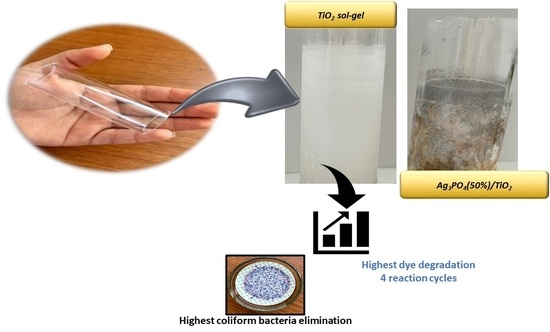
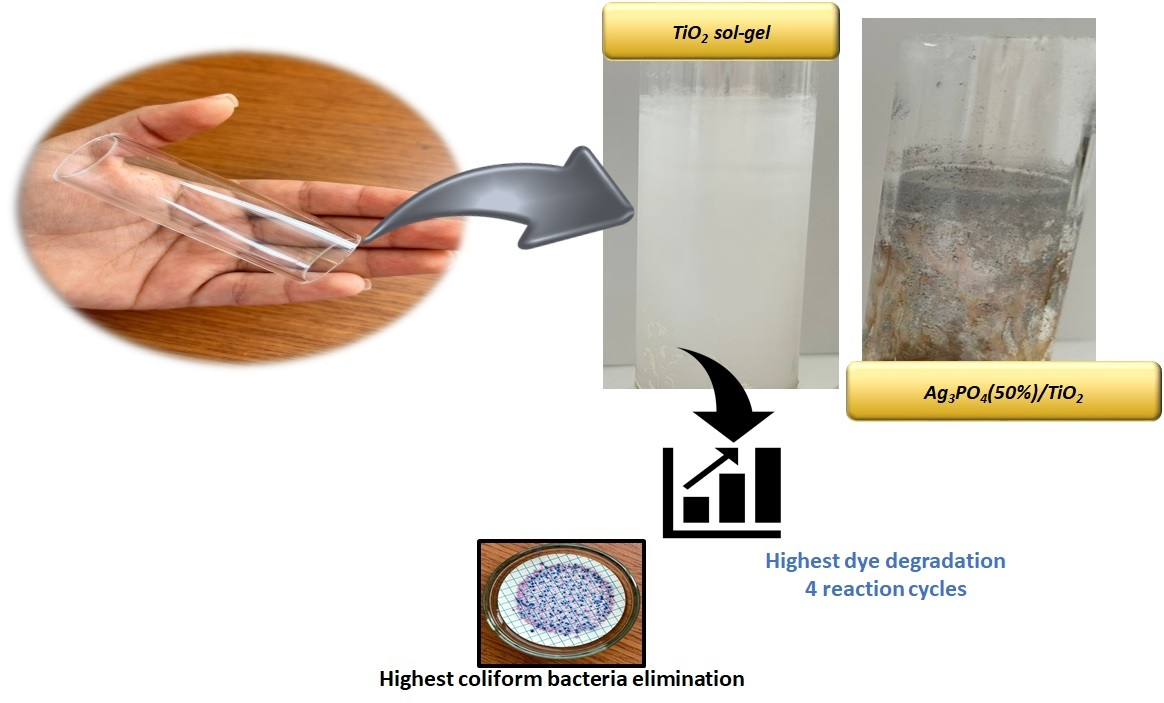
In this work, different materials based on TiO2 coupled with either AgBr or Ag3PO4 were synthesized. The Ag3PO4(50%)/TiO2 powder photocatalyst prepared by deposition–precipitation method showed higher antimicrobial activity than the bare TiO2 and also than the same coupled powder obtained by sol–gel method. This material achieved 100% E. coli, coliforms, and other enterobacteria elimination. The high bactericidal efficiency of this material could be attributed to the improved properties obtained by coupling Ag3PO4 and TiO2, such as high absorption in the visible region, low band-gap value, and high surface hydroxylation. The sol–gel method was chosen for the production of photocatalytic coatings on borosilicate glass tubes based on TiO2 and Ag3PO4/TiO2 materials due to the ease of its preparation procedure and its suitability for dip coating. In this series, the most effective elimination of E. coli, coliforms, and other enterobacteria was achieved with the glass tubes coated with the laboratory–prepared TiO2 sol. Interestingly, this material presented superior antimicrobial performance as coating (100% of E. coli elimination) compared to its powder form. The titania coating also showed the best efficiency in the degradation of methylene blue (i.e., 95.2%), though this material lost 30% of its photoactivity after four reaction cycles.

Graphical Abstract

1. Introduction

Photocatalysis has been extensively studied worldwide for many years, particularly environmental applications for air and water treatment, and the results obtained to date are interesting and relevant; however, the application of this advanced oxidation technology (AOT) at the industrial level faces challenges such as high operational costs, limited photocatalyst stability, and complex reactor design [1].
Several authors have pointed out that the main drawbacks and/or challenges of TiO2 photocatalysis at a large-scale application are the recombination of photogenerated charges [2], low surface contact [3], difficulty in achieving UV–Vis absorption [3], pollutant competition in the water matrix to be treated [4], long residence times, recovery and recycling of the photocatalyst [5], and nanoparticle toxicity [6], among others. In response to these findings, many researchers worldwide have studied alternatives and strategies to improve the effectiveness and applicability of heterogeneous photocatalysis. From these efforts, TiO2 doping with fluorine and/or coupling with other materials have been adopted as potential methods to avoid the electron–hole recombination, to improve the absorption in the visible region of the electromagnetic spectrum, and to increase the surface activity for organic pollutants degradation [7,8]. It has also been reported that surface fluorination improves the generation of unbound OH radicals, usually considered as stronger oxidants than their counterpart, the surface–adsorbed OH radicals; as a consequence, a high number of available free •OH can be produced in the presence of fluorinated TiO2, thus leading to an increase in photocatalytic activity [9]. Likewise, the immobilization of semiconductor powders has been effectively applied to reduce the cost of the process and the potential toxicity of the semiconductor nano–powders [10].
In this context, AgBr and Ag3PO4 were used in the present work as coupling materials with TiO2. Both silver ions and silver salts have been recognized for their antibacterial properties and for showing visible light absorption at wavelengths above 400 nm, thus leading to the sensitization of TiO2 by broadening its absorption spectrum towards the visible region. These ions and salts also generated a decrease in the recombination rate of electron–hole pairs [11,12].
In this study, heterostructured systems based on AgBr/TiO2 and Ag3PO4/TiO2 were evaluated as photocatalytic powders. In addition, those materials showing the best photo-catalytic performance were immobilized on borosilicate glass tubes and then tested in the elimination of enterobacteria and in the removal of a commercial dye. Glass tubes were chosen for this work because this material is commonly used in compound parabolic concentrator (CPC) reactors for AOT applications [13].
In a previous study, our research group evaluated the photocatalytic activities of fluorinated TiO2 (F) prepared by hydrothermal synthesis. This material was sensitized by coupling it with AgBr or Ag3PO4. The results obtained indicated that the combination of the silver salts with TiO2 (F) not only increases (or at least maintains) the high photocatalytic activity of TiO2 (F) in the UV region but also greatly increases the pollutants’ degradation activity under visible illumination [12]. In that work, we studied three different AgBr molar percentages (10, 20, and 50%), and on the basis of a comprehensive study, it was concluded that the AgBr(50%)/TiO2 sample gave better results in terms of successive recycling cycles and percentages of Rhodamine B dye mineralization. For this reason, in the present work, we explore the combination of TiO2 (F) samples with AgBr or Ag3PO4 in a 50% molar ratio.
In the present research, these coupled and heterostructured materials were evaluated in disinfection and dye degradation; then, the powder sample with the best performance was used for glass tube coating. Finally, its photocatalytic behavior for disinfection and contaminant removal was studied in a closer approximation to a further real potential application.
TiO2 materials in conjunction with silver have been extensively reported and evaluated as antibacterial surfaces for medical implants [14]; the antifungal capacity of silver titania composites has also been demonstrated [15]. Titania has also been modified with different oxides to improve its biocompatibility [16] and its antibacterial properties [17]. The organic dye degradation has been evaluated on the surfaces of Ag/TiO2 glass coatings, demonstrating the potential of these films for the obtention of self–cleaning surfaces [18]. By a comprehensive literature review, it was possible to determine that those materials reported in the existing literature are obtained by complex, expensive, and lengthy synthesis processes, where silver particles are incorporated into TiO2, producing wastes from the metal precursors. The advantages that we present in this work emphasize the simple method of synthesis where the silver salts are totally incorporated to TiO2, and the obtained materials have demonstrated to be effective not only in dye degradation but also in bacteria elimination, both as powders and as glass coatings.
Ag3PO4- or AgBr-based heterojunctions with TiO2 have been obtained by different methods, and it has been reported that these systems can increase the visible-light response and the photocatalytic and antibacterial properties as compared with the individual semiconductors [19]. The main results reported in recent studies were obtained under realistic conditions to evaluate the antibacterial activity and the degradation of different pollutants using photocatalytic powders [20,21,22,23,24,25,26,27]; thus, the novelty of our work implies the evaluation of Ag3PO4/TiO2 and AgBr/TiO2 composites not only as powders but also as coatings for borosilicate tubes to be employed in CPC reactors for environmental remediation.

2. Results and Discussion

2.1. Characterization of the Photocatalytic Powders

2.1.1. SBET

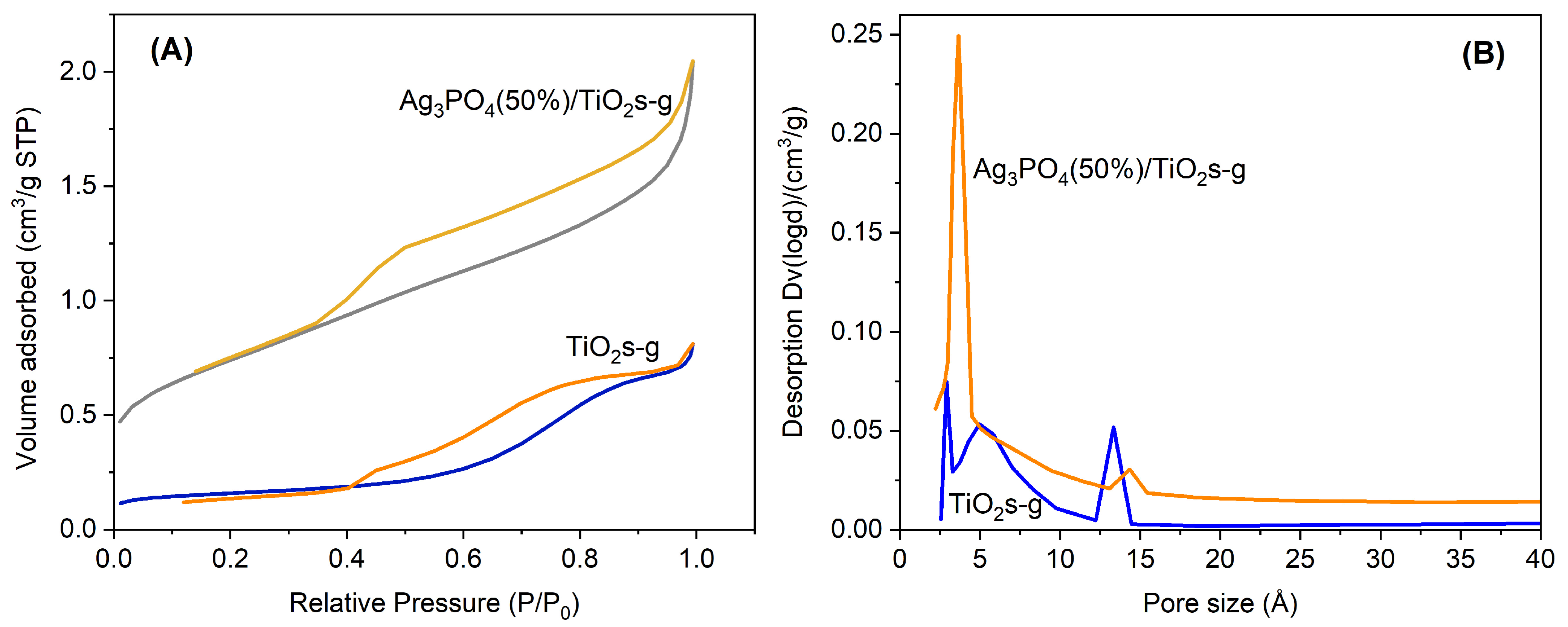
The specific surface area, the absorption and desorption graphs, and the pore/volume diameter of the TiO2 (F) materials were reported in some of our previous works [12,28]. For brevity, this manuscript includes the SBET values measured for all photocatalysts in Table 1, and Figure 1 shows the adsorption–desorption isotherms and pore size distribution of the sol–gel synthesized materials only.
As reported in our previous work [12], the TiO2 (F) sample shows a pore size distribution with pore diameters between 2 and 100 nm. The SBET value for this material significantly decreased after coupling this oxide with the silver salts, mainly due to the low area of these salts (Table 1), thus indicating that there is a good interaction between the components of the coupled materials. This decrease in surface area could also be accentuated by the blocking of the original porosity of TiO2 (F) by the silver salts [12].
On the other hand, the TiO2 s-g presented lower surface area than TiO2 (F), which suggests the formation of a dense TiO2 network due to the use of PEG as a template material, similar to that reported by Tiwari et al. [29]. However, the SBET value increased after coupling it with Ag3PO4. It was also observed that the coupled material prepared by sol–gel (Ag3PO4(50%)/TiO2 s-g) had a higher surface area than the coupled materials synthesized by deposition–precipitation. This result could be relevant, considering that the surface area is an important parameter influencing the bacteria elimination of heterogeneous photocatalysis.
As can be seen in Figure 1, the pore size of the titania prepared by sol–gel (TiO2 s-g) exhibits a bimodal distribution with isotherm type IV and hysteresis type H4 loops, which are associated with narrow, slit-like pores [30].

2.1.2. XRD

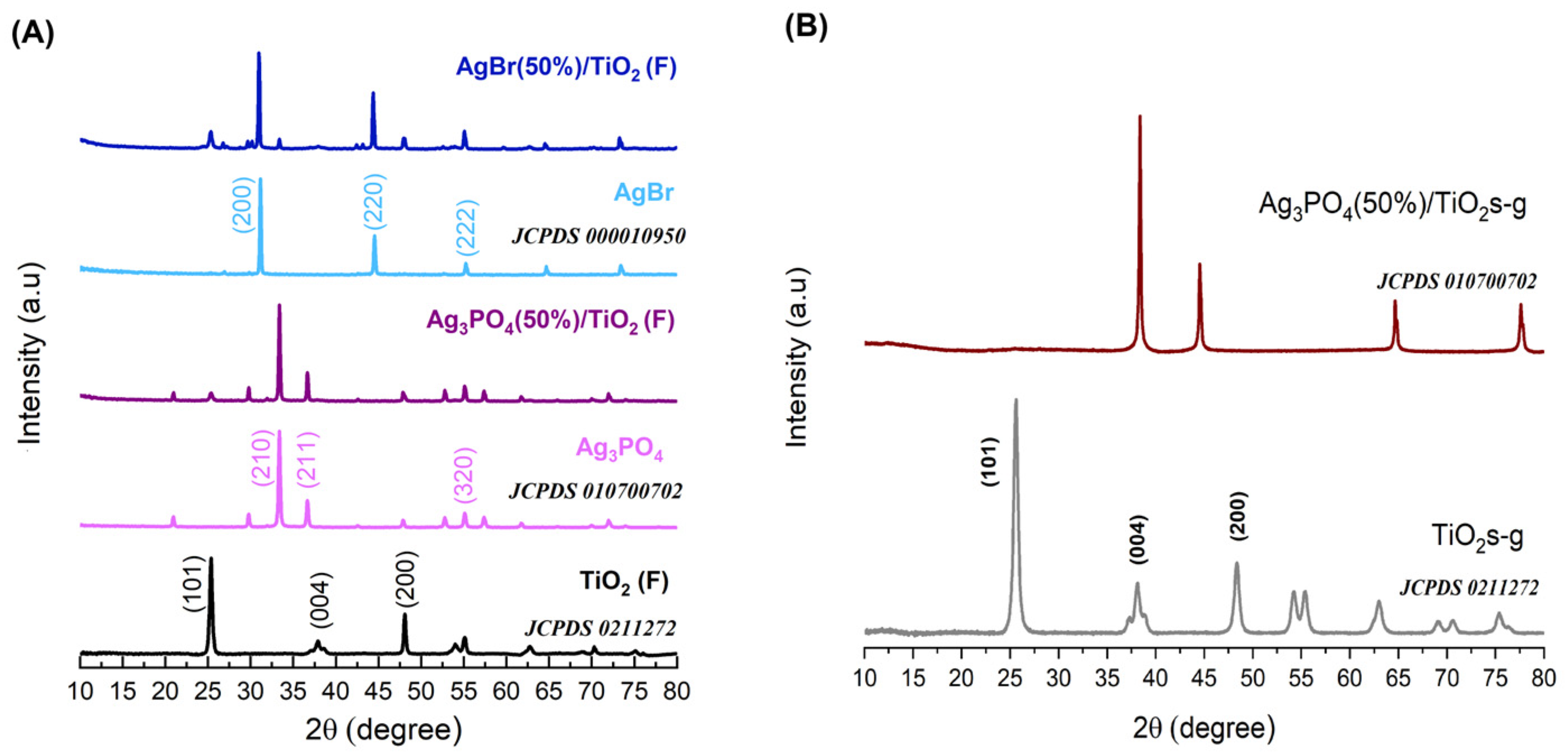
Figure 2A shows the XRD patterns of the photocatalytic powders synthesized by deposition–precipitation and sol–gel methods, respectively. For TiO2 (F), the anatase phase can be identified by the presence of (101), (004), and (200) peaks, located at 2θ values of 25.3°, 38.0°, and 48.0° (JCPDS No 021-1272) [29,31].
In the case of the silver salts Ag3PO4 and AgBr, the corresponding diffractograms can be identified with JCPDS file No. 01-070-0702 and JCPDS file No. 00-001-0950, respectively, presenting BCC and cubic structures [12]. On the other hand, in the coupled materials, it is possible to identify the characteristic peaks of the anatase TiO2 and of the silver salts. Thus, for Ag3PO4(50%)/TiO2 (F), peaks indexed to (210), (211), and (320) of Ag3PO4 are observed, and in the case of AgBr(50%)/TiO2 (F), (200), (220), and (222) AgBr peaks are evident. It was also observed that the intensity of the (101) main peak of TiO2 (F) decreased after coupling it with the silver salts due to the presence of the characteristic peaks of the salts.
On the other hand, Figure 2B shows the XRD patterns of the sol–gel materials. As for the materials synthesized by deposition–precipitation, these diffractograms also show peaks corresponding to the anatase phase, located at 25.53°, 38.12°, and 48.25°, associated with the (101), (004), and (200) planes, respectively (JCPDS No. 02-1272).
In the diffractogram of the Ag3PO4(50%)/TiO2 s-g powder (Figure 2B), there is a high-intensity peak located at 38.26°, which corresponds to the Ag monomer (111) plane; another two low–intensity peaks located at 44.5° and 64.72° are assigned to (200) and (220) planes, respectively (PDF# 04–0783). These planes are formed by silver reduction from Ag3PO4 when TiO2 gel containing organic groups was calcined at 450 °C for 2 h [32,33].
It is interesting to note that the XRD patterns of TiO2 were more clearly affected in the sol–gel material compared with the materials obtained by DP; after the careful revision of the diffractograms obtained, we found that the anatase phase did not disappear but instead remained in the compositional analysis, thus indicating the better affinity achieved by the sol–gel method between TiO2 and Ag3PO4.
In addition, as previously indicated in Section 2.3, the crystallite sizes were also determined, and the values obtained for each photocatalytic material are included in Table 2. As observed in this table, the crystallite size of the silver salts increased after coupling them with TiO2 (F), which could be due to some deformations in the materials induced by possible contact stress and stacking failures, as has been reported by different authors [34].

2.1.3. FTIR

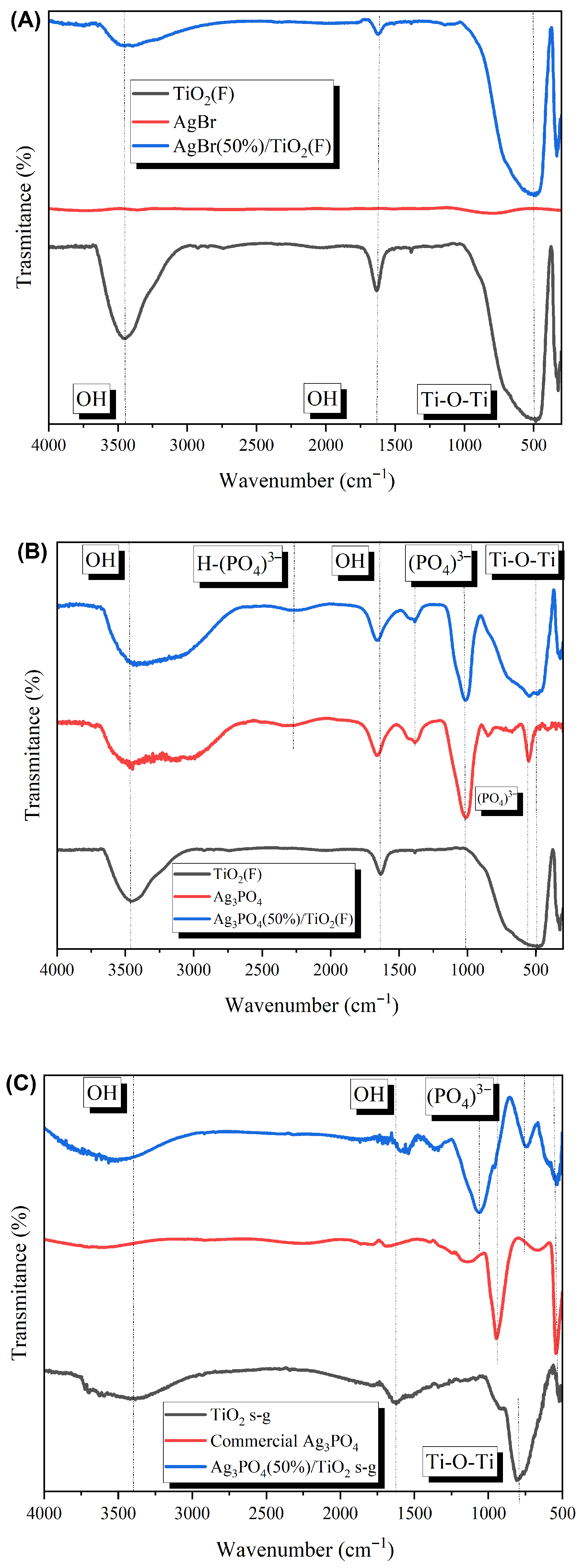
Figure 3A,B show the FTIR spectra of bare and coupled TiO2 (F), AgBr, and Ag3PO4 materials, respectively, which were prepared by deposition–precipitation method. Figure 3C presents the FTIR spectra of TiO2, Ag3PO4, and Ag3PO4(50%)/TiO2 prepared by sol–gel method. In these figures, for the TiO2 samples and all the coupled materials, it is possible to identify a band located between 400 and 700 cm−1, which is associated with Ti-O-Ti bending–tension vibrations [12]. The bands located at 1630 cm−1 and those observed between 3400 and 3500 cm−1 in all the spectra correspond to O-H bending–tension vibrations in the water adsorbed on the surface of the photocatalysts analyzed [24].
For the Ag3PO4(50%)/TiO2 (F) and Ag3PO4(50%)/TiO2 s-g samples, it is also possible to identify bands associated with Ag3PO4, which are located between 490 and 1700 cm−1 and are assigned to vibrational modes of PO43− species [35,36].
On the other hand, it is well–known that the synthesis method can influence the surface features of the materials obtained. This was proven by FTIR; thus, in all the spectra presented in Figure 3, is possible to observe broad bands centered between 3400 and 3500 cm−1, which exhibit different intensities. These bands indicate the presence of isolated OH groups, which are important species for the generation of hydroxyl radicals during the photocatalytic process [36].
It has been reported that a high density of surface hydroxyl groups leads to enhanced photoactivity [37] and therefore also leads to improved organic compounds degradation and bacteria elimination. Qualitatively, in the FTIR spectra, it is possible to observe that the width trend of the OH groups band in the materials analyzed was AgBr > TiO2 s-g > TiO2 (F) > Ag3PO4 > AgBr(50%)/TiO2 (F) > Ag3PO4(50%)/TiO2 s-g, which indicates that it is possible to obtain a more hydroxylated surface in the materials prepared by the deposition–precipitation method (Figure 3B). This fact can positively influence the efficiency of these materials in the elimination of bacteria through an improved generation of oxidizing radicals. It is also interesting to note the shift of the OH band towards a higher wavenumber in the Ag3PO4(50%)/TiO2 (F) material prepared by the deposition–precipitation method; this shift can indicate that this material mainly presents OH bending groups [38].

2.1.4. UV–Vis DRS

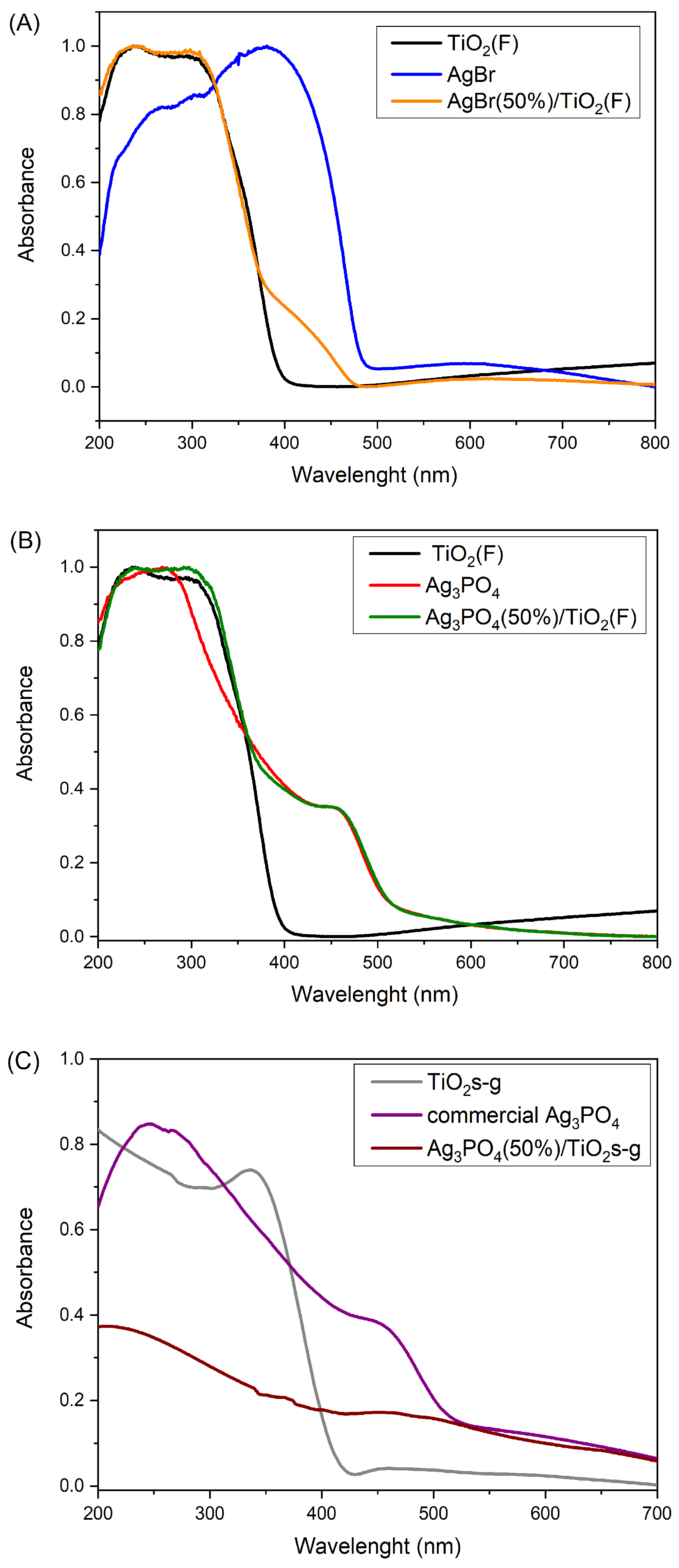
Figure 4 includes the UV–Vis DR spectra of the analyzed materials. As can be seen in this figure, the coupling significantly modifies the optical properties of TiO2. Thus, in contrast to the absorption of the bare TiO2 samples, the coupled materials show a significant absorption in the visible region of the electromagnetic spectrum, which would mean an improvement in the optical properties for photocatalytic processes.
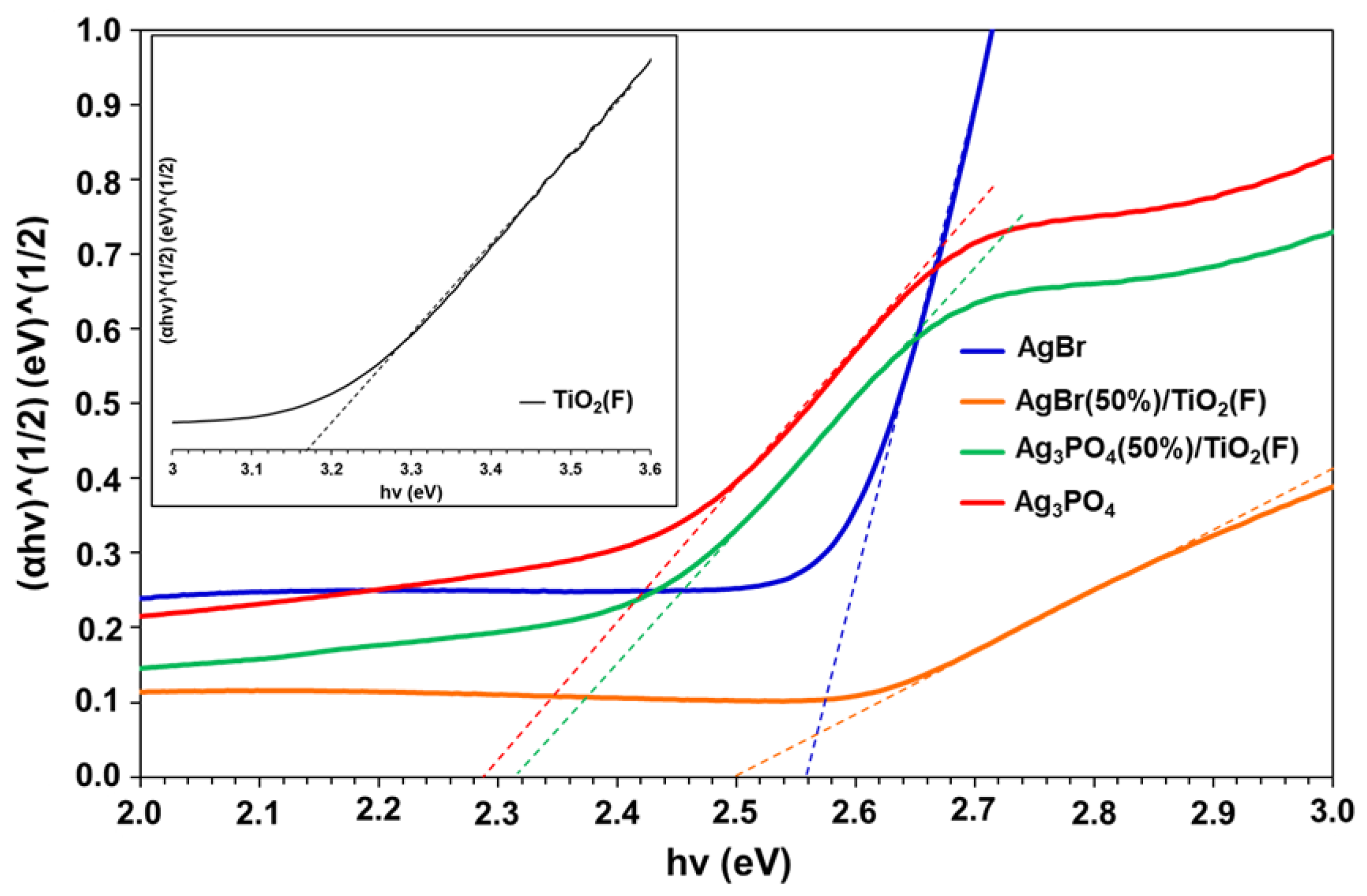
The band-gap values were calculated from the absorption spectra using the Kubelka–Munk function for indirect semiconductors, and the results are shown in Figure 5 and also included in Table 3. As observed in Figure 5, the band-gap value of the TiO2 decreased after coupling it with the silver salts, which is due to the low band-gap energy value of the pristine AgBr (2.56 eV) and Ag3PO4 (2.29 eV) (Table 3).
The behavior observed in the optical properties of the coupled materials can be a determinant factor of the photocatalytic activity; thus, it is well-known that the absorption of a wider range of wavelengths could improve the efficiency of the materials in photocatalytic processes when solar or simulated solar illumination is used. Thus, the coupling of the materials can improve the mobility and separation of the photogenerated charges during the photocatalytic process [39], which is probably due to two reasons: (i) the plasmonic effect generates a strong electromagnetic field [40,41], as evidenced in the spectra included in Figure 5, where the plasmon corresponding to Ag is observed in both the bare salts and coupled materials in the visible region; and (ii) the heterojunction increases the interface contact between the salts and titania, and this interaction favors the rapid migration and separation of photogenerated charges, thus reducing the recombination rate [42].
It is important to note that it was difficult to characterize the borosilicate glass tubes using the techniques usually employed for photocatalytic powders due to their morphology. However, given their potential application in CPC reactors, this study focused mainly on determining their durability and efficiency rather than on their physicochemical properties.

2.2. Assessment of the Photocatalytic Activity

2.2.1. Photocatalytic Powders

The bactericidal activity of the photocatalytic powders synthesized by deposition–precipitation and by sol–gel methods was evaluated in the treatment of water samples taken from a polluted river. Firstly, the results obtained for pH and real color after the treatment with the materials analyzed are shown in Table 4. From these results, it can be seen that the pH value of the water sample slightly increased after the blank reaction and after the treatment with all the analyzed materials. This behavior may be due to the formation of by-products coming from protein oxidation during the bacteria inactivation, which has been observed in previous studies [43]. The real color measured spectroscopically at 436 nm decreased significantly after the treatment; the highest color decrease was observed when Ag3PO4 (50%)/TiO2 (F) was used as photocatalyst, suggesting the superior performance of this material in the photocatalytic degradation of colored organic compounds.
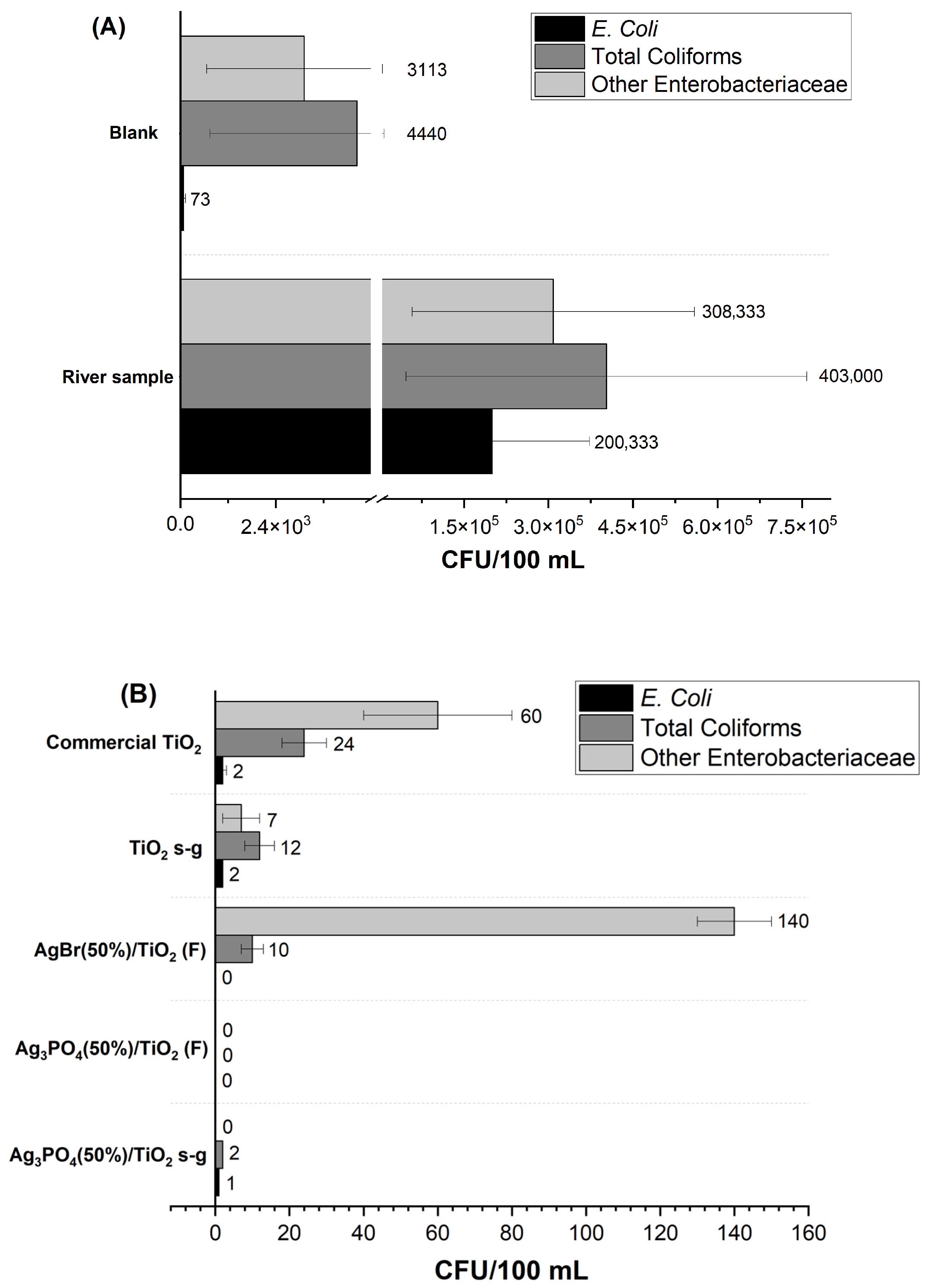
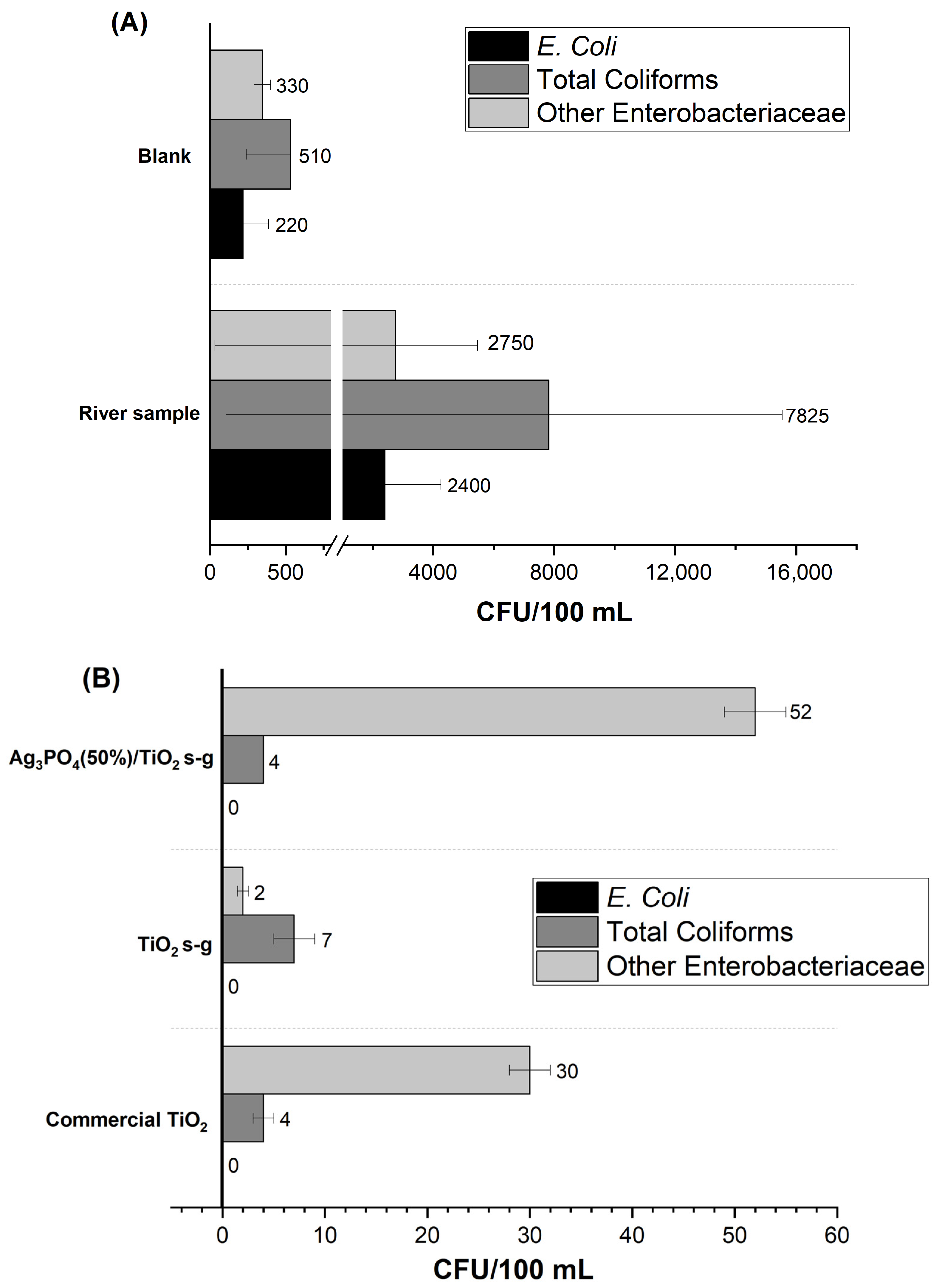
On the other hand, the results obtained in the elimination of bacteria are shown in Figure 6. As it can be seen in Figure 6A, the river water presents a high content of enterobacteria. The content of these microorganisms decreased after UV–Vis irradiation (blank test), which is due to the bactericidal effect of UV radiation; however, as expected, the results obtained are not satisfactory enough in terms of wastewater treatment, showing the need for complementary treatments.
Then, when the photocatalytic treatments were applied, the bacteria elimination significantly increased. Thus, as observed in Figure 6B, the effectiveness in the bacteria removal under UV–Vis light significantly increased with the use of TiO2. It is interesting to note that the sol–gel lab-prepared titania (TiO2 s-g) showed better performance in the bacteria elimination than the commercial oxide. Similar behavior has been previously reported for lab–prepared fluorinated TiO2 (TiO2 (F)) [44]; nevertheless, no total bacteria removal was achieved with the single TiO2.
On the other hand, when the lab-prepared TiO2 (F) was coupled with 50% of AgBr or Ag3PO4 by deposition–precipitation, it was possible to achieve the total elimination of E. coli, thus showing that coupling with silver salts is a good alternative to improve the TiO2 photocatalytic activity. However, it is important to note that, as observed in Figure 6B, the AgBr (50%)/TiO2 (F) photocatalyst presented low bacterial elimination activity, which may be due to the release of Br into the reaction medium, as we also previously reported [12]. This result demonstrates that Ag3PO4 is a better choice for coupling with titania.
As indicated in the experimental section, the effect of the preparation method on the physicochemical and photocatalytic properties of the coupled materials was analyzed by carrying out the coupling between Ag3PO4 and TiO2 using deposition–precipitation and sol–gel methods. As observed in Figure 6B, the remaining UCF of the analyzed bacteria was detected after treatment with the Ag3PO4 (50%)/TiO2 s-g powder. On the contrary, the material prepared by deposition–precipitation (Ag3PO4 (50%)/TiO2 (F)) achieved the total elimination of E. coli, total coliforms, and other Enterobacteriaceae (Figure 6B). Is important to note that no regrowth of the bacteria analyzed was observed even after 48 h of storing the treated water at room temperature, thus proving the broad antimicrobial spectrum of this treatment.
The better antibacterial activity observed with the Ag3PO4 (50%)/TiO2 (F) photocatalyst may be related with its physicochemical properties, as detailed below:
(i).
As observed by the FTIR analyzes described previously in Section 3.1, this material presented a more hydroxylated surface, with the presence of isolated OH groups. The higher hydroxylation may enhance the generation of •OH radicals by interaction of the OH- with the photogenerated positive vacancies; these radicals are reported to be important reactive oxygen species (ROS) that influence the photocatalytic elimination of bacteria. In the photocatalytic removal of bacteria, ROS have been reported to induce oxidative stress that damages membranes and cellular components, resulting in bacteria inactivation [45];
(ii).
The Ag3PO4 (50%)/TiO2 (F) sample also has higher UV and visible absorption than the other coupled materials analyzed (Figure 6). The high absorption in a wider range of the electromagnetic spectrum towards the visible region could favor the photoactivity, resulting in this material’s improved bactericidal effect, as observed in Figure 6B;
(iii).
It is also important to note that the Ag+ species itself exhibits bactericidal activity. Previous studies have shown that Ag3PO4/TiO2 (F) materials are more unstable and release higher quantities of silver into the reaction medium than AgBr/TiO2 (F) [12,46,47,48]. The increase in the silver content can also enhance the photoactivity of the coupled materials in bacteria elimination.
Once this experimental stage was completed, it can be concluded that the Ag3PO4(50%)/TiO2 (F) powder is the best material for river water treatment focusing on the elimination of enterobacteria, thus demonstrating the benefits of using coupled materials in environmental remediation. However, it is very important to consider that fluorine can be toxic for human and animal health [49,50], and for this reason, further studies on the chemical stability and potential leaching of F should be carried out before these materials can be used under realistic conditions, particularly for applications involving contact with water, humans, or food surfaces.
Although the effectiveness of this Ag3PO4(50%)/TiO2 (F) is undeniable, the deposition–precipitation method (DP) employed to prepare this photocatalytic powder is not suitable enough for producing coatings on borosilicate glass tubes, which is the main objective of this research. For this reason, and considering that the results obtained with the material prepared by sol–gel are very close to those obtained with the material obtained by DP (Figure 6B), the sol–gel was chosen to apply the Ag3PO4(50%)/TiO2 as a coating, and the results obtained in a second experimental stage are described below.

2.2.2. Photocatalytic Coatings

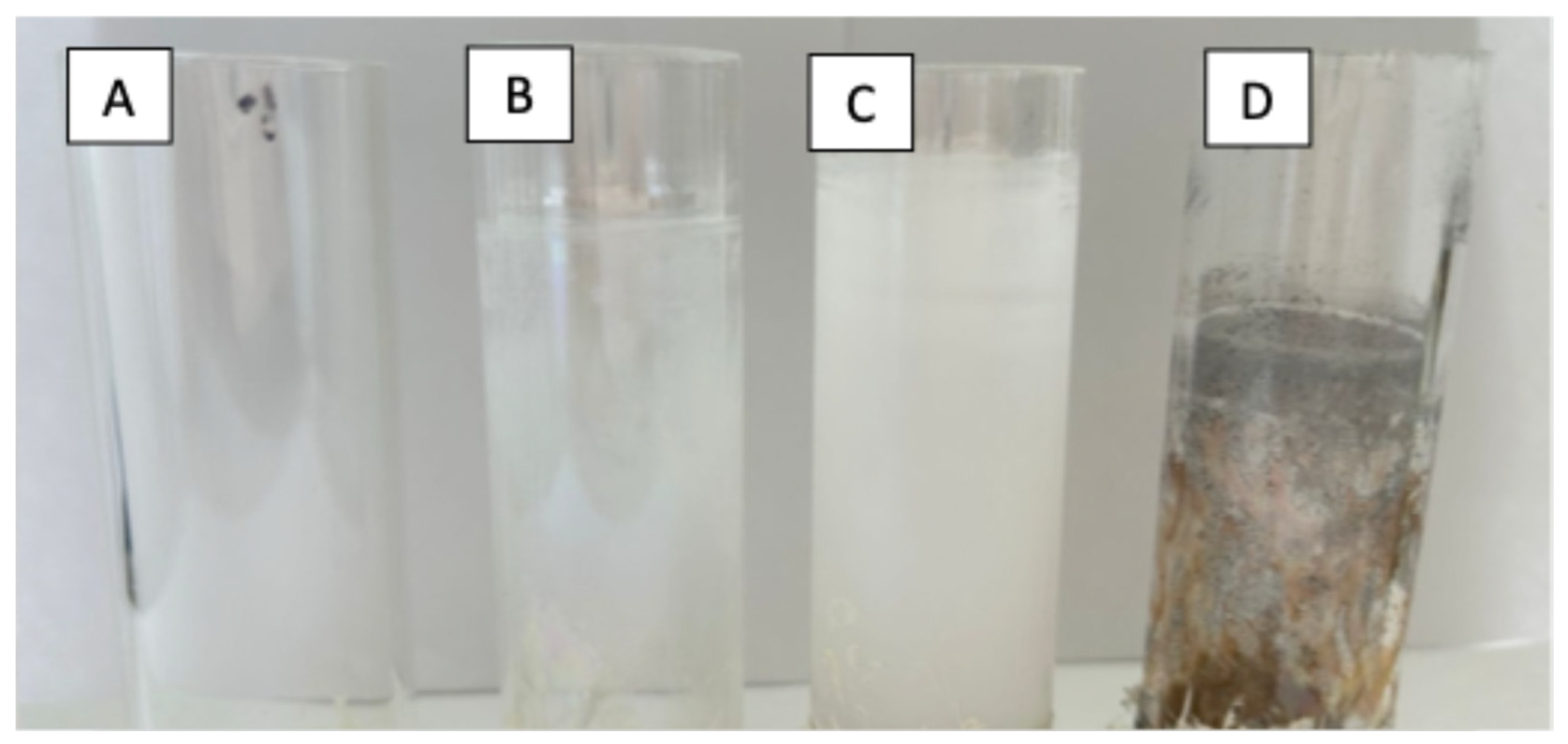
The photocatalytic coatings were prepared by dip-coating method following the procedure described in Section 3.2; thus, commercial TiO2, TiO2 s-g, and Ag3PO4 (50%)/TiO2 obtained by sol–gel were employed to produce coatings for borosilicate glass tubes. Figure 7 shows some images of these tubes before and after the dip–coating process.
The loading of each coating effectively deposited on the glass tubes is presented in Table 5. As observed in Figure 7 and reported in Table 5, very thin coatings were achieved on the tubes. The most homogeneous layer was obtained applying TiO2 s-g (Figure 7C) with 0.05 mm thickness. On the other hand, the highest coating load was obtained with the Ag3PO4 (50%)/TiO2 sol; this material was more effectively deposited on the glass; however, the coated tubes present heterogeneous distribution, with relatively empty areas in the glass (Figure 7D).
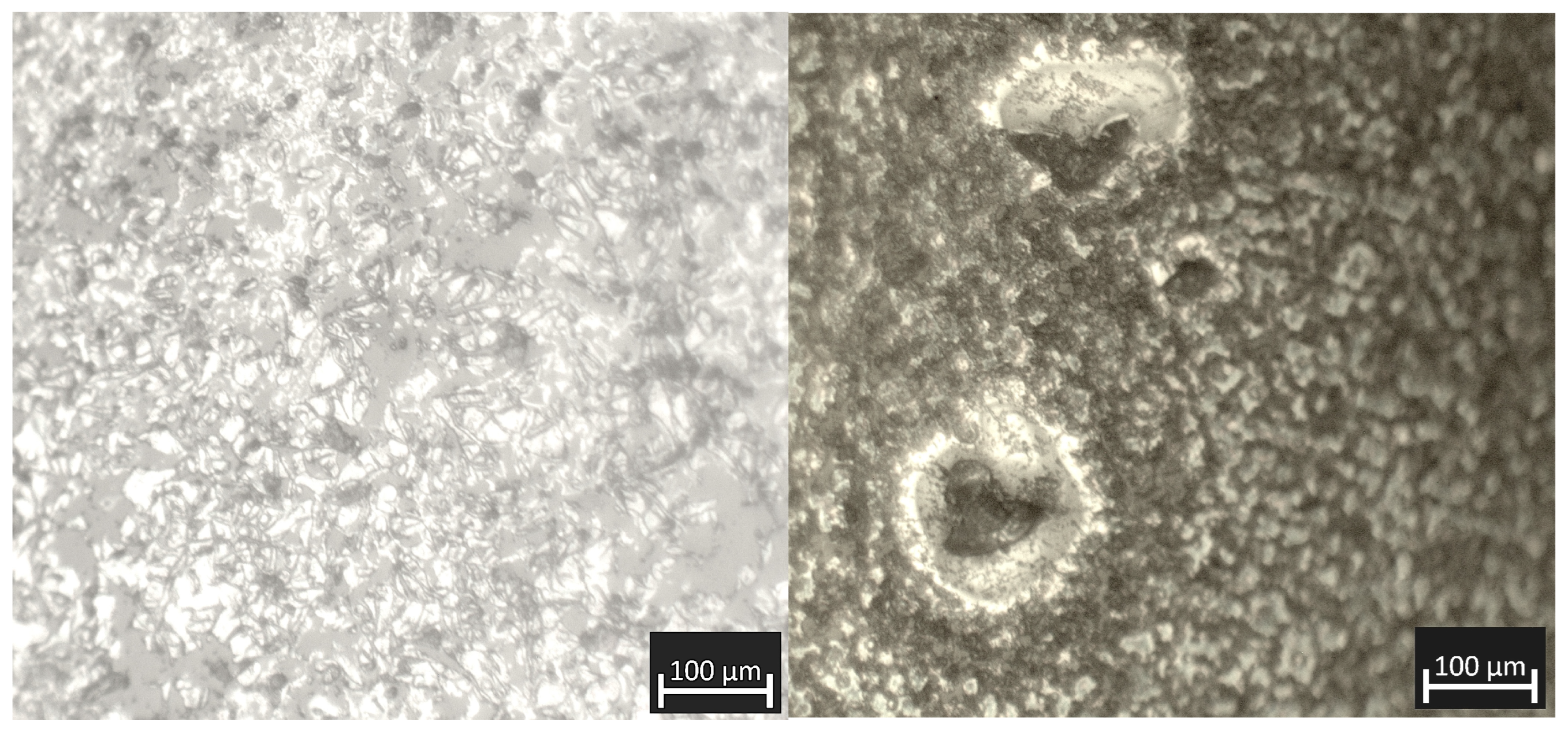
Figure 8 shows some images of the tubes coated with TiO2 s-g, which were obtained by optical microscopy in a Carl Zeiss I Axiotech Vario microscope. Despite the imperfections evidenced in the coating, such as the two cavities visible in the image on the right, the depth of the coating is clear, which was achieved through successive layers applied during the dip–coating process. The increase in the number of coating layers on the tube could ensure some remaining coating on the glass, thus increasing the surface wear resistance during the photocatalytic tests.
It is important to consider that it was not possible to ensure the same material distribution and morphology across the entire tube using the dip–coating method. However, the results obtained in this work represent an interesting starting point for further studies focused on the standardization of the coatings’ production process.

2.3. Bactericidal Effect of the Photocatalytic Coatings

The coatings were evaluated for their ability to remove bacteria from river water samples, and similarly to the results obtained for the sol–gel powder series, the pH value increased, and the turbidity of the water sample decreased after UV–Vis and photocatalytic treatments (Table 6). The lowest color value of the treated water sample was obtained after treatment with the TiO2 s-g coating, demonstrating the effectiveness of this coating in photodegrading organic compounds.
As seen in Figure 9, all of the tested coatings completely eliminated E. coli bacteria. The TiO2 s-g coating achieved the highest bacteria removal for total coliforms and other enterobacteria, with 7 and 2 CFU, respectively, remaining after treatment.
Two interesting outcomes are noted from the results obtained:
(i).
TiO2 s-g is a more efficient photocatalyst as a coating than as a powder (Figure 6);
(ii).
A low amount of TiO2 s-g coating (i.e., 0.040 g, with an internal loading of 0.018 g) was necessary to achieve good efficiency in the bacteria elimination.
These results can be explained by taking into account that, as observed in Figure 7, this coating shows homogeneous distribution on the glass tube. The observed results show the advantages of using supported photocatalytic materials as bactericidal surfaces.
Conversely, it should be noted that coupling Ag3PO4 with TiO2 improved the photocatalytic properties of both materials in powder form, resulting in an enhanced bacterial elimination performance (Figure 6). This positive effect was evident regardless of the synthesis method (i.e., deposition–precipitation or sol–gel). However, as Figure 9 shows, the bactericidal effect of the Ag3PO4 (50%)/TiO2 coating was significantly reduced. This may be due to the inability to achieve homogeneous distribution of the coating on the glass tube for the coupled material despite the highest coating loading obtained (i.e., 0.095 g).
It is also important to bear in mind that, in the setup used for the photocatalytic tests on the coated tubes, oxygen flux is avoided, as this can significantly reduce the overall effectiveness of the treatment.
It can be concluded that the effectiveness of photocatalytic coatings depends on both the quantity and homogeneity of the coating applied. This is an important consideration when developing further photocatalysis applications for bacterial elimination in CPC reactors that use coated borosilicate glass tubes.

2.4. Photocatalytic Coatings for Dye Degradation

Currently, the ISO 10678-2010 [51] is the most widely accepted method for the determination of the photocatalytic activity of surfaces in an aqueous medium. Therefore, this standardized method was used in this work to analyze the effectiveness of TiO2 s-g coating in the degradation of methylene blue.
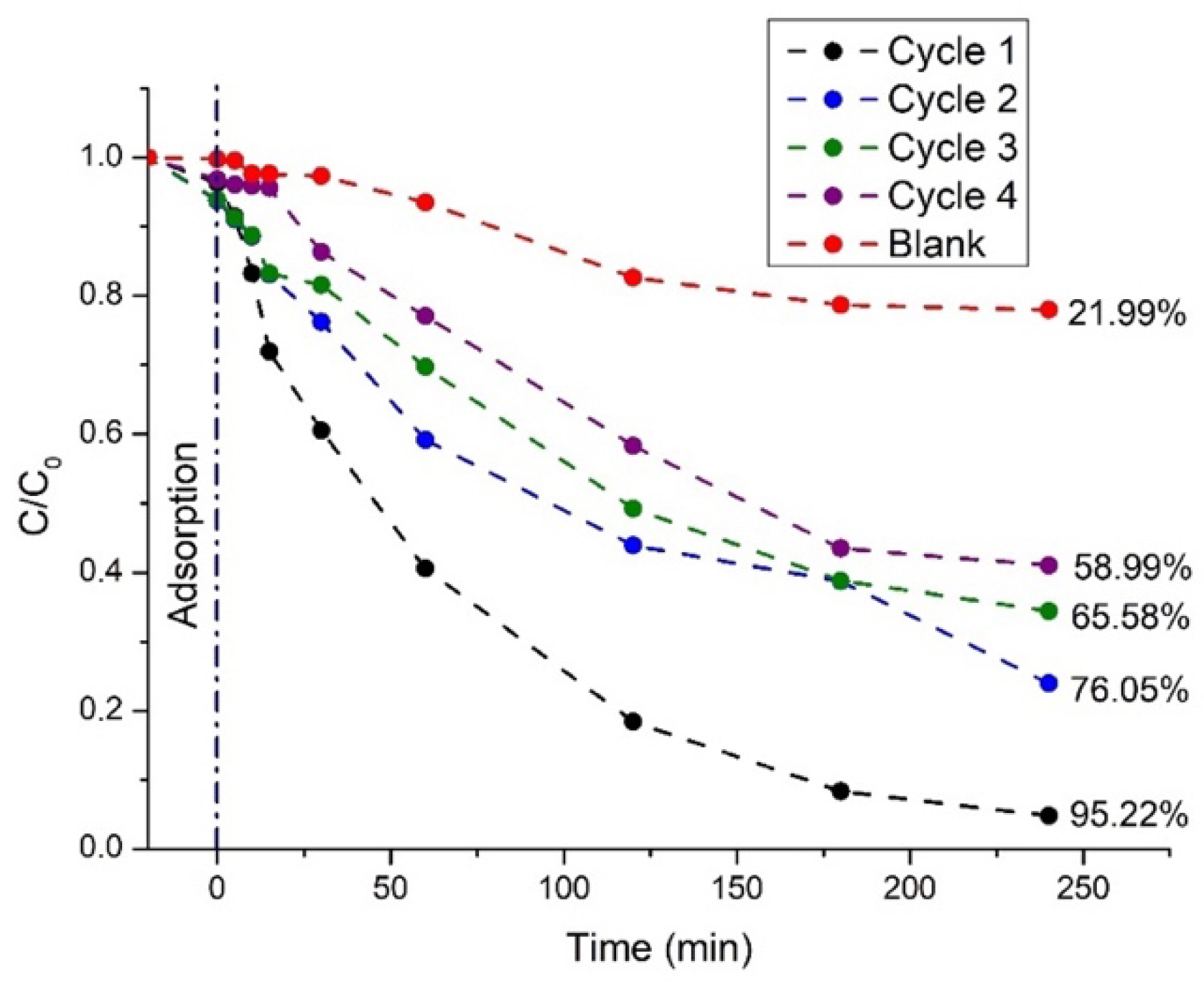
Figure 10 shows the results obtained in the dye degradation reaction, where it is observed that during the blank test, 21.99% dye degradation was achieved after 240 min of illumination, mainly due to the dye sensitization under UV–Vis radiation. Then, when the photocatalytic coating was used, a slight adsorption of the dye was observed, which was evident by the change in color inside and outside of the glass as well as by the decrease in the dye concentration after 15 min of stirring in the dark.
In order to analyze the stability and durability of the TiO2 s-g coating, the coated tube was tested sequentially after drying and through different reaction cycles. As can be seen in Figure 10, this coating remained active during four reaction cycles, though it lost effectiveness in dye degradation with each cycle. The apparent kinetic rate constant (k) was calculated, revealing that the fastest dye degradation was achieved with the TiO2 s-g coating during cycle 1, with a value of k = 16.538 × 10⁻³ M/min. Likewise, the k value decreased after successive usage cycles of the coating, reaching 4.638 × 10⁻³ M/min in cycle 4. This behavior may be due to the poisoning of the coating by successive reactions, which may be related to the adsorption of the dye and intermediates on the surface, leading to the obstruction of the active sites on the coating surface. These phenomena can further deactivate the photocatalytic coating. To avoid or reduce this deactivation, it could be recommended in further works to wash the tubes successively with clean water and heat them before recycling.
In the first reaction cycle of the TiO2 s-g coating, 95.22% dye degradation and 63.31% dye mineralization were achieved, with the lowest TOC value (Table 7). These values are significantly better than those obtained in the blank test. These results show the high efficacy of this coating not only for the elimination of bacteria, as observed in the previous section (Figure 9), but also for the degradation of organic compounds by heterogeneous photocatalysis.
Despite the loss of photocatalytic efficiency, no release of the coating into the liquid phase was detected after each reaction cycle, and this was confirmed by mass control in the tubes before and after the reaction, which demonstrates the stability of the coating during the period of use. This is a highly desirable property for photocatalytic coatings. To obtain good and efficient photocatalytic coating surfaces, it is important to evaluate the mechanical and wear resistance [52] as a determinant factor for further applications of coated surfaces in food or other industries. For that reason, is recommended to conduct wear analysis in further research, which was difficult to achieve in the present work due to the morphology of the glass tubes.
The results reported in this work represent an interesting contribution as a starting point for further applications; however, a detailed analysis of the interaction between contaminants and ROS is critical and desirable for the development of effective degradation strategies, and therefore, this approach should be adopted in further studies. Hydroxyl radicals, electrons, positive holes, and superoxide are recognized ROS, reported as the main species involved in photocatalytic process; thus, the general mechanism for MB and bacteria degradation includes the widely reported formation of charges carriers. Then, the positive vacancies that are photogenerated lead to the formation of OH radicals, recognized as the main responsible for the oxidation of organic compounds molecules [53]. The •OH and other radicals generated during the redox reactions in the photocatalytic process are the main ROS that affect the bacterial cell, leading to the bacteria death [54].

3. Materials and Methods

3.1. Synthesis of Photocatalytic Powders

Commercial TiO2 Sigma Aldrich (Darmstadt, Germany) Was Used as Received

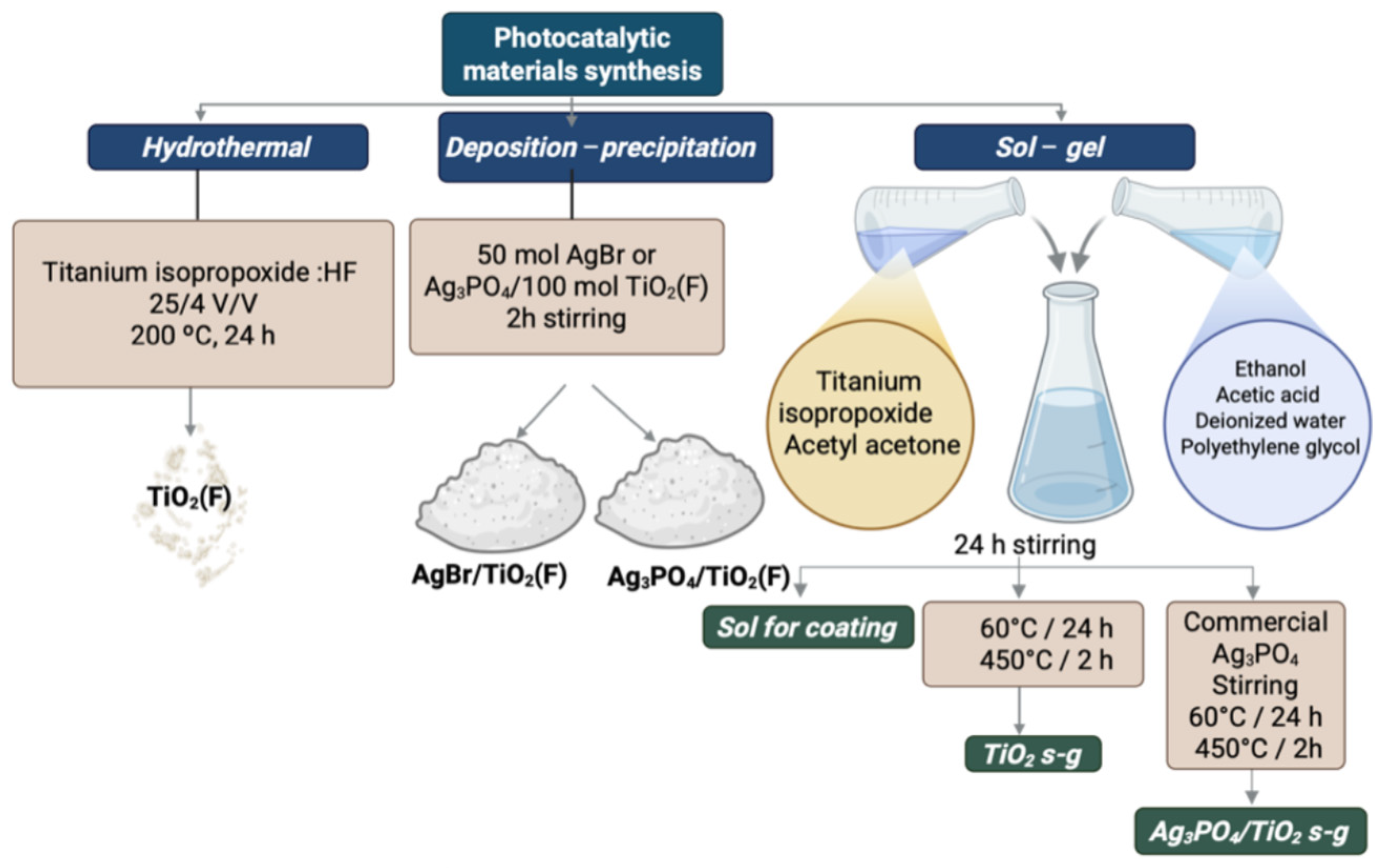
Fluorinated TiO2: This powder was obtained by hydrothermal method involving the preparation of a mixture of titanium isopropoxide (Sigma Aldrich 97%, Darmstadt, Germany) with an aqueous solution of HF (AnalaR NORMAPUR, VWR Chemicals 40% v/v, Manchester, UK). The titanium/acid ratio was 25/4 v/v. This mixture was kept into a hydrothermal reactor at 200 °C for 24 h. The precipitate was then recovered by filtration, washed with deionized water, and dried at 100 °C overnight. This one-pot synthesis produces nanoplatelets of anatase TiO2 with a high {001} facet exposure and a total content of around 4% of F. The detailed procedure of this synthesis, as well as some features of its physicochemical characterization and photocatalytic reactivity, can be found in [28]. To simplify the nomenclature of this material, we refer to it as TiO2 (F), indicating the fluorination in the synthesis process as well as its characteristics as a high {001} faceted material.
AgBr (50%)/TiO2 (F) and Ag3PO4 (50%)/TiO2 (F): These coupled powders were prepared by deposition–precipitation of AgBr or Ag3PO4 over an aqueous suspension of the TiO2 (F). KBr and Na3PO4 were used as AgBr and Ag3PO4 precursors, respectively. Aqueous solutions of these precursors were dropped onto the TiO2 (F) suspension with AgNO3 and then stirred in the dark for 2 h. The powders were then recovered by filtration, washed with deionized water, and finally dried at 100 °C for 24 h. The amount of the silver salts in the coupled materials was 50% molar (i.e., 50 mol AgBr or Ag3PO4/100 mol TiO2 (F)). A more detailed description of the synthesis of these materials, as well as some aspects of their physicochemical characterization and photocatalytic reactivity, can be found in [12].
TiO2 s-g and Ag3PO4 (50%)/TiO2 s-g: These materials were synthesized by sol–gel method (s-g). Firstly, to obtain the TiO2 s-g, two solutions were prepared. Solution 1 was obtained by adding of 10 mL g of titanium isopropoxide (97% Sigma Aldrich) to 4.5 mL of acetyl acetone and stirring until a homogeneous mixture was formed. Solution 2 was prepared under stirring by sequential addition of 78.8 mL of ethanol, 1.7 mL of acetic acid (99%), 12.17 mL of deionized water, and 4 g of polyethylene glycol (PEG Sigma Aldrich). The PEG was employed as a pore-forming chemical for TiO2 [55].
Then, solution 2 was added to solution 1, and the mixture was kept under constant stirring for 2 h. The resulting suspension was sonicated for 30 min and left in the dark under continuous stirring for 24 h until a sol was obtained (TiO2 s-g suspension) [56,57]. When this material was used as coating, it was applied as sol before the drying step.
The final powder was obtained after drying at 60 °C for 24 h, followed by calcination at 450 °C for 2 h; this material was labeled as TiO2 s-g. As previously reported, this synthesis method yields mainly TiO2 anatase powders, which was confirmed by XRD analysis [57].
Finally, in order to visualize a further application of the coatings, by using easily obtained precursors, in this case, we employed commercial Ag3PO4 (Sigma Aldrich 98%); thus, 6.9 g of this compound was added to the previously obtained TiO2 s-g suspension (before drying) and stirred for 20 min in the dark until the solid in the suspension was homogeneous; this material was dried at 60 °C for 24 h, calcined at 450 °C for 2 h, and labeled as Ag3PO4 (50%)/TiO2 s-g.
A summary of the photocatalytic materials synthesis procedures is represented in Figure 11.

3.2. Photocatalytic Coatings

Borosilicate glass tubes (diameter: 26 mm, thickness: 2 mm, and length: 8 cm) were used as supports for the photocatalytic materials. To obtain a higher surface area and better adhesion of the coatings and in order to remove impurities from the glass, these tubes were previously treated by immersion in a solution of H2SO4:H2O (1:1) at 60 °C for 5 min; then, the tubes were washed three times with distilled water and dried at 100 °C overnight.
The glass tubes were coated with different materials, such as: (a) an aqueous suspension of 5% commercial TiO2 (Sigma Aldrich) used as a reference coating and (b) TiO2 s-g and (c) Ag3PO4 (50%)/TiO2 s-g coatings, where the sols obtained as described in Section 2.1 were used before drying.
The dip-coating method was used to prepare the photocatalytic coatings, whereby the pre–treated tubes were immersed in the precursor solutions using a PTL-NMB01 Shenyang Instruments dip coater (Shenyang, China) at an extraction rate of 70 mm/s. Then, the coated tubes were dried at 100 °C for 10 min [57,58]. The dip–coating process was performed eight times to obtain the same number of coating layers. Finally, the coated tubes were calcined at 450 °C for 2 h, with a heating ramp of 20 °C/min.
In order to determine the actual photocatalyst loading effectively deposited on the glass tubes, Equations (1)–(5) were employed.
A = 2πrh
A t o t a l = A i n t + A e x t
C o a t i n g   p e r c e n t a g e % = A i n t A t o t a l · 100
w i m m o b i l i z e d   p h o t o c a t a l y s t = w f i n a l w i n i t i a l
w i m m o b i l i z e d   p h o t o c a t a l y s t   i n s i d e   t h e   t u b e = w i m m o b i l i z e d   p h o t o c a t a l y s t · % c o a t i n g 100
where:
A = Glass tube area (cm2).
Aext = External tube area (cm2).
Aint = Internal tube area (cm2).
W = Tube weight (g).
r = Tube radius (external radius 1.25 cm and internal radius 1.05 cm).
h = Tube length (8 cm).

3.3. Characterization of Photocatalytic Powders

N2 physisorption (SBET): The specific surface area (SBET) was determined by N2 adsorption/desorption at 77 K, using a Micromeritics ASAP 2420 instrument (Norcross, GA, USA). Prior to analysis, the materials were degassed under vacuum at 150 °C for 30 min under He flow. Silica–alumina Micromeritics, with a standard value of 200 m2/g, was employed as the reference material for calibration purposes. The Brunauer–Emmett–Teller (BET) method was employed to calculate the SBET, using the Equation (6) [59].
S B E T = V 0 N a s M v
where
V0 = Volume of a monolayer of adsorbed gas (cm3).
Na = Avogadro number (molecules/g. mol).
Mv = Molar volume of the adsorbate (cm3/g. mol).
s = Surface area of a gas molecule adsorbed in the solid (m2).
X-ray diffraction (XRD): Crystalline phases were identified from the XRD patterns obtained with a Siemens D-501 diffractometer (Burladingen, Germany) equipped with an X-ray source radiation Cu Kα (λ = 1.5406 Å), with a Ni filter and graphite monochromator with diffracted beam and a scintillation detector. The X-ray patterns were obtained in the 2θ range between 10 and 80°, with a pass size of 0.05° and 300 s. The crystallite sizes of AgBr, Ag3PO4, and TiO2 were calculated using the Scherrer equation and the width of the main XRD pattern (Equation (7)).
D = K λ B c o s   θ
where
K = Scherrer constant.
λ = Wavelength of the incident radiation.
B = Width of the pattern at half height.
θ = Position of the main pattern.
FTIR spectroscopy (FTIR): FTIR spectra were collected using an ATR cell with a Thermo Scientific Nicolet TM iS50 instrument (Waltham, MA, USA). The samples were evaluated between 4000 and 450 cm−1, with a resolution of 2 cm−1. The spectra obtained allowed us to obtain information about the functional groups in the photocatalytic powders.
UV–Vis DR Spectrophotometry (UV–Vis DRS): The optical properties of the materials analyzed were studied using this technique. The UV–Vis DR spectra were obtained with an Agilent Instruments Cary 3000 instrument (Santa Clara, CA, USA), using BaSO4 as reference. The band-gap value was calculated by the Kubelka–Munk model for indirect semiconductors (Equation (8)) [60], and the Tauc plot method was used for the calculation of the final value [61].
K S = ( 1 R ) 2 2 R
where
R = Diffuse reflectance.
K = Absorbance coefficient.
S = Dispersion coefficient.

3.4. Photocatalytic Activity Tests

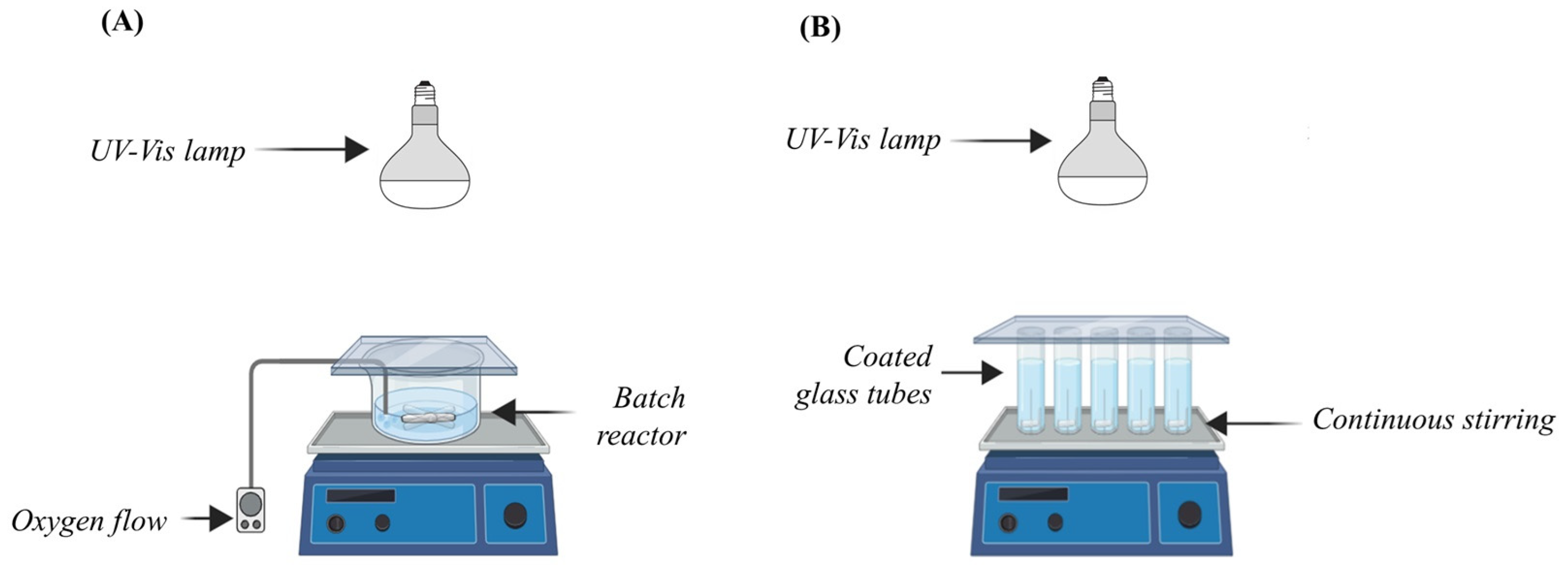
In order to determine the effectiveness of the photocatalytic powders and coatings in bacteria inactivation, water samples taken from a river with a high load of enteropathogenic bacteria were selected for this work. The water samples were taken at the local coordinates (latitude: 5.553981 and longitude: −73.350224) according to the Standard Methods for the Examination of Water and Wastewater [62]. Figure 12 shows the set-up employed for the photocatalytic activity tests for powders (Figure 12A) and for the coated glass tubes (Figure 12B), and the procedure used is described in detail below.

3.4.1. Photocatalytic Powders

Powder samples were evaluated in a Pyrex batch reactor with 250 mL of the river water sample and 1 g/L of photocatalyst (Figure 12A). This reactor was irradiated through a UV-transparent plexiglass window by an Osram Ultra-Vitalux 300 W lamp with solar-like emission spectrum. The distance between the lamp and the reactor was enough to create a light intensity of 30 W/m2 as measured with a Delta OHM, HD 2102.2 photoradiometer, which was equipped with an LP 471 UVA accessory (spectral range between 315 and 400 nm).
In the photocatalytic runs before switching on the lamp and in order to achieve the adsorption/desorption equilibrium, the suspension was kept in the dark for 20 min under stirring and a continuous flow of oxygen of 0.84 L/h. The lamp was then turned on for a total reaction time of 4 h. Finally, the photocatalytic powders were recovered by filtration and dried at room temperature overnight. A blank reaction was also carried out under UV–Vis light and without a photocatalyst.
Water samples were analyzed before and after the photocatalytic treatment using a Spectroquant Move 100 colorimeter (Merck Millipore, Sigma, Hub Carlsbad, CA, USA) to determine the pH and the true color at 436 nm. The colony-forming units (CFU/100 mL) of Escherichia coli, total coliforms, and other enteropathogenic bacteria were also quantified using the membrane filtration method according to the instructions given in the ISO 9308 method Part 1 [63].
Bacterial regrowth assays were also carried out to test the true long-term effectiveness of the photocatalytic treatment. These assays were performed in those treatments where the total bacteria elimination was obtained. Thus, the treated water was stored at room temperature for 48 h, after which the bacteria content was measured again.
Each photocatalytic test, the regrowth bacteria tests, and the physicochemical analyses were carried out twice, and the results are reported in this manuscript as average values.

3.4.2. Photocatalytic Coatings

To determine the antibacterial properties of the borosilicate glass tubes coated with the photocatalytic materials, a set of six tubes was employed (Figure 12B). Each tube was filled with 40 mL of the water sample to obtain a total volume of 240 mL. These tests were carried out using the same reaction parameters and the water quality analyses described in Section 3.4, but in this case, the oxygen flow was avoided.
The loadings of the photocatalytic coatings used in these assays were 0.023 g for commercial TiO2, 0.018 g for TiO2 s-g, and 0.043 g for Ag3PO4 (50%)/TiO2 s-g; these values were calculated as previously described in Section 2.2.
On the other hand, the coating showing the best photocatalytic performance in the bacteria removal was selected for testing in methylene blue (MB) degradation; this molecule was chosen as the model pollutant following the instructions given in the ISO 10678:2010 method, which describes the guidelines for the determination of the photocatalytic activity of surfaces in an aqueous medium [51]. For this test, the same set–up as for the bacterial elimination tests was used with a 3.7 ppm MB solution. The dye concentration was determined using a Thermo Scientific Evolution 300 spectrophotometer. The absorbance of the dye solution was determined scanning between 200 and 900 nm, where the maximum absorption length was observed at 664 nm.
MB mineralization percentage was also determined by total organic carbon (TOC) analysis using multi N/C 2100S Analytikjena equipment (Langewiesen, Germany); Equation (9) was employed for the calculation of this parameter, which considers the starting (0) and final (f) TOC content.
M i n e r a l i z a t i o n % = T O C 0 T O C f T O C 0 · 100
Finally, the stability of the coatings was also analyzed; for these tests, the coated glass tubes were air–dried overnight after each photocatalytic run and then sequentially tested four times for dye degradation.

4. Conclusions

The successful coupling of AgBr or Ag3PO4 with TiO2 yields improved properties such as absorption to the visible region of the electromagnetic spectrum and surface hydroxylation. The method employed to synthesize the photocatalytic powders, i.e., deposition–precipitation or sol–gel, significantly influenced these physicochemical properties and, consequently, the antibacterial activity of the powders prepared.
The best photocatalytic performance was obtained with Ag3PO4 (50%)/TiO2 (F) synthesized by deposition–precipitation method. This material led to the total elimination of E. coli, total coliforms, and other Enterobacteriaceae present in a polluted river. These results were achieved after 4 h of UV–Vis irradiation at 30 W/m2.
The TiO2 powder prepared by sol–gel method presented lower effectiveness for the treatment of water from a highly polluted river than its counterpart, the TiO2 coating on the glass tubes. It can be explained by the homogeneous distribution of TiO2 on the glass surface, which led to better contact between the bacteria and the surface, thus improving the photocatalytic activity.
The Ag3PO4 (50%)/TiO2 (F) photocatalyst was less effective in bacteria elimination when it was used as a coating due to the poor distribution of this material on the glass tube surface.
Borosilicate glass tubes dip–coated with TiO2 prepared by sol–gel method represent a promising alternative for obtaining bactericidal and self–cleaning surfaces. These surfaces yielded total elimination of E. coli and 99% elimination of total coliforms and other Enterobacteriaceae, without regrowth for E. coli.
Furthermore, 95.22% of methylene blue degradation was achieved on the TiO2 sol–gel surface during its first use, and the coating was active even after four reaction cycles. However, taking into account that the coating loses effectiveness through successive recycling, the regeneration of the surface should be considered for future applications in order to preserve the stability of the photocatalytic material.

Author Contributions

Conceptualization, J.A.N., M.C.H., F.P. and J.J.M.; methodology, P.M.-P., M.H.-L. and F.P.; formal analysis, J.A.N., M.C.H., F.P. and J.J.M.; writing—original draft preparation, J.A.N., M.C.H., F.P., J.J.M., P.M.-P., M.H.-L. and M.B.; writing—review and editing, J.A.N., M.C.H., F.P., J.J.M., P.M.-P., M.H.-L. and M.B.; research, J.A.N., M.C.H., F.P., J.J.M., P.M.-P., M.H.-L. and M.B.; funding acquisition, J.A.N., M.C.H., J.J.M., M.H.-L. and M.B.; supervision, J.A.N., M.C.H. and J.J.M. All authors have read and agreed to the published version of the manuscript.

Funding

This work was funded by the Ministerio de Ciencia, Tecnología e Innovación—Minciencias and Ministerio de Salud y Protección Social, Project 110991891727, and Universidad Pedagógica y Tecnológica de Colombia (UPTC) Projects SGI 3393 and SGI 3502. The APC was funded by the Project SGI 3946.

Institutional Review Board Statement

Not applicable.

Informed Consent Statement

Not applicable.

Data Availability Statement

The original contributions presented in this study are included in the article. Further inquiries can be directed to the corresponding authors.

Acknowledgments

M. Hernández-Laverde would like to thank Ministerio de Ciencia Tecnología e Innovación de Colombia (Minciencias) and Gobernación de Boyacá for the concession of a researcher grant (OCAD-Fondo Nacional de Financiamiento para la Ciencia, la Tecnología e Innovación (FCTel) del Sistema general de regalías, Becas de Excelencia Doctoral del Bicentenario).

Conflicts of Interest

The authors declare no conflicts of interest.

Abbreviations

The following abbreviations are used in this manuscript:
AOTAdvanced oxidation technology
CPCCompound parabolic concentrator
PEGPolyethylene glycol
SBETSpecific surface area
BETBrunauer–Emmett–Teller
XRDX-ray diffraction

References

  1. Rengifo-Herrera, J.A.; Pulgarin, C. Why five decades of massive research on heterogeneous photocatalysis, especially on TiO2, has not yet driven to water disinfection and detoxification applications? Critical review of drawbacks and challenges. Chem. Eng. J. 2023, 477, 146875. [Google Scholar] [CrossRef]
  2. Bloh, J.Z. Intensification of Heterogeneous Photocatalytic Reactions Without Efficiency Losses: The Importance of Surface Catalysis. Catal. Lett. 2021, 151, 3105–3113. [Google Scholar] [CrossRef]
  3. Iervolino, G.; Zammit, I.; Vaiano, V.; Rizzo, L. Limitations and Prospects for Wastewater Treatment by UV and Visible-Light-Active Heterogeneous Photocatalysis: A Critical Review. Top. Curr. Chem. 2019, 378, 7. [Google Scholar] [CrossRef]
  4. Long, Z.; Li, Q.; Wei, T.; Zhang, G.; Ren, Z. Historical development and prospects of photocatalysts for pollutant removal in water. J. Hazard. Mater. 2020, 395, 22599. [Google Scholar] [CrossRef]
  5. Ateia, M.; Alalm, M.G.; Awfa, D.; Johnson, M.S.; Yoshimura, C. Modeling the degradation and disinfection of water pollutants by photocatalysts and composites: A critical review. Sci. Total Environ. 2020, 698, 134197. [Google Scholar] [CrossRef]
  6. Gatou, M.A.; Syrrakou, A.; Lagopati, N.; Pavlatou, E.A. Photocatalytic TiO2-Based Nanostructures as a Promising Material for Diverse Environmental Applications: A Review. Reactions 2024, 5, 135–194. [Google Scholar] [CrossRef]
  7. Pedanekar, R.S.; Shaikh, S.K.; Rajpure, K.Y. Thin film photocatalysis for environmental remediation: A status review. Curr. Appl. Phys. 2020, 20, 931–952. [Google Scholar] [CrossRef]
  8. Vembuli, T.; Thiripuranthagan, S.; Kumaravel, S. Enhanced removal of hazardous organic contaminants with advanced visible light-active F-doped TiO2/rGO/PVDF photocatalytic membranes. J. Alloys Compd. 2024, 1005, 175997. [Google Scholar] [CrossRef]
  9. Liu, S.; Yu, J.; Cheng, B.; Jaroniec, M. Fluorinated semiconductor photocatalysts: Tunable synthesis and unique properties. Adv. Colloid Interface Sci. 2012, 173, 35–53. [Google Scholar] [CrossRef]
  10. Sakai, N.; Fujishima, A.; Watanabe, T.; Hashimoto, K. Quantitative Evaluation of the Photoinduced Hydrophilic Conversion Properties of TiO2 Thin Film Surfaces by the Reciprocal of Contact Angle. J. Phys. Chem. B 2003, 107, 1028–1035. [Google Scholar] [CrossRef]
  11. Morovati, R.; Rajabi, S.; Ghaneian, M.T.; Dehghani, M. Efficiency of Ag3PO4/TiO2 as a heterogeneous catalyst under solar and visible light for humic acid removal from aqueous solution. Heliyon 2023, 9, 15678. [Google Scholar] [CrossRef]
  12. Puga, F.; Navío, J.A.; Paulete-Romero, M.A.; Córdoba, J.M.; Hidalgo, M.C. Exploring the photocatalytic activities of a highly {001} faceted TiO2 sensitized by coupling with AgBr or Ag3PO4. Mater. Sci. Eng. B 2022, 276, 115555. [Google Scholar] [CrossRef]
  13. Murcia, J.J.; González, W.; Rojas, H.; Cubillos, J.A. Planta Para el Tratamiento de Aguas Residuales con Función dual Floculación/Fotocatálisis Impulsada por Energía Solar y un Reactor de Tubos Soportado Sobre una Lámina Inclinada. Colombian Patent No. NC2018/0013099, 14 March 2018. [Google Scholar]
  14. He, X.; Zhang, X.; Wang, X.; Qi, L. Review of Antibacterial Activity of Titanium-Based Implants’ Surfaces Fabricated by Micro-Arc Oxidation. Coatings 2017, 7, 45. [Google Scholar] [CrossRef]
  15. Cabrera-Rodríguez, O.; Trejo-Valdez, M.D.; Torres-SanMiguel, C.R.; Pérez-Hernández, N.; Bañuelos-Hernández, Á.; Manríquez-Ramírez, M.E.; Hernández-Benítez, J.A.; Rodríguez-Tovar, A.V. Evaluation of the performance of TiO2 thin films doped with silver nanoparticles as a protective coating for metal prostheses. Surf. Coat. Technol. 2023, 458, 129349. [Google Scholar] [CrossRef]
  16. Ahmadi, R.; Afshar, A. In vitro study: Bond strength, electrochemical and biocompatibility evaluations of TiO2/Al2O3 reinforced hydroxyapatite sol–gel coatings on 316L SS. Surf. Coat. Technol. 2021, 405, 126594. [Google Scholar] [CrossRef]
  17. Trung Kien, K.D.; Quang Minh, D.; Minh, H.N.; Nhi, N.V.U. Study on Photocatalytic Antibacterial Ability of TiO2, TiO2-SiO2 Coatings. J. Appl. Sci. Eng. 2025, 28, 459–467. [Google Scholar] [CrossRef]
  18. Stefanov, B.I. Laser-Patterned and Photodeposition Ag-Functionalized TiO2 Grids on ITO Glass for Enhanced Photocatalytic Degradation. Coatings 2025, 15, 709. [Google Scholar] [CrossRef]
  19. Tugelbaya, S.; Yergaliuly, G.; Abilkhan, A.; Khan, N.; Tatykayev, B. Ag3PO4-based composites as next-generation antibacterial nanomaterials: A review of light induced synergistic effects. Chem. Eng. J. 2025, 522, 167818. [Google Scholar] [CrossRef]
  20. Guan, Q.; Khan, S.; Wang, Z.; Liu, Q.; Zhang, L.; Zhao, Y.; Wang, X.; Yang, X.; Geng, Z. The preparation, characterization of TiO2-X/Ag3PO4 heterojunctions with enhanced photocatalytic visible-light performance. J. Alloys Compd. 2021, 852, 156947. [Google Scholar] [CrossRef]
  21. Lyu, Y.H.; Wei, F.; Zhang, T.; Luo, L.; Pan, Y.; Yang, X.; Yu, H.; Zhou, S. Different antibacterial effect of Ag3PO4/TiO2 heterojunctions and the TiO2 polymorphs. J. Alloys Compd. 2021, 876, 160016. [Google Scholar] [CrossRef]
  22. Du, J.; Ma, S.; Yan, Y.; Li, K.; Zhao, F.; Zhou, J. Corn-silk-templated synthesis of TiO2 nanotube arrays with Ag3PO4 nanoparticles for efficient oxidation of organic pollutants and pathogenic bacteria under solar light. Colloids Surf. A Physicochem. Eng. Asp. 2019, 572, 237–249. [Google Scholar] [CrossRef]
  23. Baďurov, K.; Motola, M.; Janczura, A.; Roch, T.; Satrapinskyy, L.; Gregus, J.; Dworniczek, E.; Plesch, G. Structural transformation of Ag3PO4 and Ag3PO4/TiO2 induced by visible light and Cl−ions: Its impact on their photocatalytic, antimicrobial, and antifungal performance. Chem. Pap. 2020, 74, 2785–2797. [Google Scholar] [CrossRef]
  24. Liu, H.; Li, D.; Yang, X.; Li, H. Fabrication and characterization of Ag3PO4/TiO2 heterostructure with improved visible-light photocatalytic activity for the degradation of methyl orange and sterilization of E. coli. Mater. Technol. 2018, 34, 192–203. [Google Scholar] [CrossRef]
  25. Xu, Y.; Liu, X.; Zheng, Y.; Li, C.; Kwok Yeung, K.W.; Cui, Z.; Liang, Y.; Li, Z.; Zhu, S.; Wu, S. Ag3PO4 decorated black urchin-like defective TiO2 for rapid and long-term bacteria-killing under visible light. Bioact. Mater. 2021, 6, 1575–1587. [Google Scholar] [CrossRef]
  26. Pal, R.; Billah, M.; Rangarajan, G.; Farnood, R. Crystal strain engineering of AgBr/TiO2 for visible-light photocatalysis: Balancing light absorption and charge carrier kinetics. J. Photochem. Photobiol. A 2023, 441, 114688. [Google Scholar] [CrossRef]
  27. Xiong, Q.i.; Shi, Q.; Wang, B.; Baiker, A.; Li, G. Facet-induced reduction directed AgBr/Ag0/TiO2{100} Z-scheme heterojunction for tetracycline removal. Chin. J. Catal. 2025, 75, 164–179. [Google Scholar] [CrossRef]
  28. Lara, M.A.; Sayagués, M.J.; Navío, J.A.; Hidalgo, M.C. A facile shape- controlled synthesis of highly photoactive fluorine containing TiO2 nanosheets with high {001} facet exposure. J. Mater. Sci. 2018, 53, 435–446. [Google Scholar] [CrossRef]
  29. Tiwari, A.; Shukla, A.; Tiwari, D.; Lee, S.M. Nanocomposite thin films Ag0 (NP)/TiO2 in the efficient removal of micro-pollutants from aqueous solutions: A case study of tetracycline and sulfamethoxazole removal. J. Environ. Manag. 2018, 220, 96–108. [Google Scholar] [CrossRef]
  30. Sing, K.S.W. Reporting physisorption data for gas/solid systems with Special Reference to the Determination of Surface Area and Porosity. Pure Appl. Chem. 1982, 54, 2201–2222l8. [Google Scholar] [CrossRef]
  31. Feizpoor, S.; Habibi-Yangjeh, A. Integration of Ag2WO4 and AgBr with TiO2 to fabricate ternary nanocomposites: Novel plasmonic photocatalysts with remarkable activity under visible light. Mater. Res. Bull. 2018, 99, 93–102. [Google Scholar] [CrossRef]
  32. Du, T.; Hu, C.; Li, Y.; Pang, Y.; Li, M.; Liu, B.; Li, L.; Liu, Y.; Lu, H.; Huang, B. High-efficiency photocatalytic degradation of Rhodamine B and tetracycline by Z-scheme nanostructured Ag/Ag3PO4/Ti3+-TiO2 mesocrystals heterojunctions under visible light. Mater. Sci. Semicond. Process. 2024, 172, 108081. [Google Scholar] [CrossRef]
  33. Wang, D.; Li, L.; Luo, Q.; An, J.; Li, X.; Yin, R.; Zhao, M. Enhanced visible-light photocatalytic performances of Ag3PO4 surface-modified with small amounts of TiO2 and Ag. Appl. Surf. Sci. 2014, 321, 439–446. [Google Scholar] [CrossRef]
  34. Mirsalari, S.A.; Nezamzadeh-Ejhieh, A. A ternary CdS/AgBr/Ag3PO4 nanocomposite: Characterization and the kinetics of its photocatalytic activity. Environ. Sci. Pollut. Res. Int. 2021, 28, 41651–41662. [Google Scholar] [CrossRef]
  35. Batvandi, M.; Haghighatzadeh, A.; Mazinani, B. Synthesis of Ag3PO4 microstructures with morphology-dependent optical and photocatalytic behaviors. Appl. Phys. A 2020, 126, 571. [Google Scholar] [CrossRef]
  36. Nyankson, E.; Efavi, J.K.; Agyei-Tuffour, B.; Manu, G. Synthesis of TiO2–Ag3PO4 photocatalyst material with high adsorption capacity and photocatalytic activity: Application in the removal of dyes and pesticides. RSC Adv. 2021, 11, 17032–17045. [Google Scholar] [CrossRef] [PubMed]
  37. Liu, B.; Zhang, B.; Ji, J.; Li, K.; Cao, J.; Feng, Q.; Huang, H. Effective regulation of surface bridging hydroxyls on TiO2 for superior photocatalytic activity via ozone treatment. Appl. Catal. B 2022, 304, 120952. [Google Scholar] [CrossRef]
  38. Murcia, J.J.; Hidalgo, M.C.; Navío, J.A.; Araña, J.; Doña-Rodríguez, J.M. Correlation study between photo-degradation and surface adsorption properties of phenol and methyl orange on TiO2 Vs platinum-supported TiO2. Appl. Catal. B 2014, 151, 107–115. [Google Scholar] [CrossRef]
  39. Kaur, K.; Badru, R.; Singh, P.; Kaushal, S. Photodegradation of organic pollutants using heterojunctions: A review. J. Environ. Chem. Eng. 2020, 8, 103666. [Google Scholar] [CrossRef]
  40. Tayebeh, S.; Yousef, G.; Tecush, M.; Momeni, M.M. Enhanced photoelectrochemical water splitting of CrTiO2 nanotube photoanodes by the decoration of their surface via the photodeposition of Ag and Au. Dalton Trans. 2018, 47, 11593–11604. [Google Scholar] [CrossRef]
  41. Belessiotisa, G.V.; Kontos, A.G. Plasmonic silver (Ag)-based photocatalysts for H2 production and CO2 conversion: Review, analysis and perspectives. Renew. Energy 2022, 195, 497–515. [Google Scholar] [CrossRef]
  42. Li, X.; Qu, Y.; Xu, J.; Liang, J.; Chen, H.; Chen, D.A.; Bai, L. 2D/2D Biochar/Bi2WO6 Hybrid Nanosheets with Enhanced Visible-Light-Driven Photocatalytic Activities for Organic Pollutants Degradation. ACS Omega 2023, 8, 26882–26894. [Google Scholar] [CrossRef] [PubMed]
  43. Murcia, J.J.; Ávila-Martínez, E.G.; Rojas, H.; Navío, J.A.; Hidalgo, M.C. Study of the E. coli elimination from urban wastewater over photocatalysts based on metallized TiO2. Appl. Catal. B 2017, 200, 469–476. [Google Scholar] [CrossRef]
  44. Murcia, J.J.; Hernández, J.S.; Rojas, H.; Moreno-Cascante, J.; Sánchez-Cid, P.; Hidalgo, M.C.; Navío, J.A.; Jaramillo-Páez, C. Evaluation of Au–ZnO, ZnO/Ag2CO3 and Ag–TiO2 as Photocatalyst for Wastewater Treatment. Top. Catal. 2020, 63, 1286–1301. [Google Scholar] [CrossRef]
  45. Costa, A.; Lepretti, M.; Rizzo, L.; Caputo, I.; Vaiano, V.; Sacco, O.; Silva Lopes, W.; Sannino, D. Surface water disinfection by chlorination and advanced oxidation processes: Inactivation of an antibiotic resistant E. coli strain and cytotoxicity evaluation. Sci. Total Environ. 2016, 554, 1–6. [Google Scholar]
  46. Lin, L.; Xie, Q.; Zhang, M.; Liu, C.; Zhang, Y.; Wang, G.; Zou, P.; Zeng, J.; Chen, H.; Zhao, M. Construction of Z-scheme Ag-AgBr/BiVO4/graphene aerogel with enhanced photocatalytic degradation and antibacterial activities. Colloids Surf. A Physicochem. Eng. Asp. 2020, 601, 124978. [Google Scholar] [CrossRef]
  47. Warshagha, M.Z.; Muneer, M. Direct Z-scheme AgBr/β-MnO2 photocatalysts for highly efficient photocatalytic and anticancer activity. ACS Omega 2022, 7, 30171–30183. [Google Scholar] [CrossRef]
  48. Wang, D.; Li, Y.; Huang, H.; Ke, Y. Flower-like AgBr/CeO2 Z-scheme heterojunction photocatalyst with enhanced visible light photocatalytic and antibacterial activities. Appl. Surf. Sci. 2021, 565, 150534. [Google Scholar] [CrossRef]
  49. Dec, K.; Łukomska, A.; Maciejewska, D.; Jakubczyk, K.; Baranowska-Bosiacka, I.; Chlubek, D.; Wąsik, A.; Gutowska, I. The Influence of Fluorine on the Disturbances of Homeostasis in the Central Nervous System. Biol. Trace Elem. Res. 2017, 177, 224–234. [Google Scholar] [CrossRef]
  50. Kowalkinska, M.; Sikora, K.; Łapinski, M.; Karczewski, J.; Zielinska-Jurek, A. Non-toxic fluorine-doped TiO2 nanocrystals from TiOF2 for facet-dependent naproxen degradation. Catal. Tod. 2023, 413, 113959. [Google Scholar] [CrossRef]
  51. ISO 10678; Fine Ceramics (Advanced Ceramics, Advanced Technical Ceramics)—Determination of Photocatalytic Activity of Surfaces in an Aqueous Medium by Degradation of Methylene Blue. ISO: Geneva, Switzerland, 2010.
  52. Randall, N.X. The current state-of-the-art in scratch testing of coated systems. Surf. Coat. Technol. 2019, 380, 125092. [Google Scholar] [CrossRef]
  53. Dong, C.; Fang, W.; Yi, Q.; Zhang, J. A comprehensive review on reactive oxygen species (ROS) in advanced oxidation processes (AOPs). Chemosphere 2022, 308, 136205. [Google Scholar] [CrossRef]
  54. Pasquale, I.D.; Porto, C.L.; Dell’Edera, M.; Petronella, F.; Agostiano, A.; Curri, M.L.; Comparelli, R. Photocatalytic TiO2-based nanostructured materials for microbial inactivation. Catalysts 2020, 12, 1382. [Google Scholar] [CrossRef]
  55. Gayatri, R.; Zulkifli, M.; Fizal, A.N.S.; Yuliwati, E.; Hossain, M.S.; Taweepreda, W.; Yahaya, A.N.A. Preparation and Characterization of PVDF–TiO2 Mixed-Matrix Membrane with PVP and PEG as Pore-Forming Agents for BSA Rejection. Nanomaterials 2023, 13, 1023. [Google Scholar] [CrossRef] [PubMed]
  56. Vaiano, V.; Sarno, G.; Ciambelli, P.; Sannino, D. Functionalization of Ceramic Tiles with N-doped TiO2 and Their Photocatalytic Function Under UV or Visible Light Irradiation. J. Adv. Oxid. Technol. 2014, 17, 193–201. [Google Scholar] [CrossRef]
  57. Vaiano, V.; Sarno, G.; Sannino, D.; Ciambelli, P. Photocatalytic Applications with TiO2-Zeolites Composites Anchored on Ceramic Tiles. Chem. Eng. Trans. 2015, 43, 985–990. [Google Scholar] [CrossRef]
  58. Hidalgo, M.C.; Sakthivel, S.; Bahnemann, D. Highly photoactive and stable TiO2 coatings on sintered glass. Appl. Catal. A Gen. 2004, 277, 183–189. [Google Scholar] [CrossRef]
  59. Palchoudhury, S.; Baalousha, M.; Lead, J. “Chapter 5—Methods for measuring concentration (mass, surface area and number) of nanomaterials’’, in Characterization of Nanomaterials in Complex Environmental and Biological Media. Front. Nano 2015, 8, 153–181. [Google Scholar] [CrossRef]
  60. Shi, T.; Duan, Y.; Lv, K.; Hu, Z.; Li, Q.; Li, M.; Li, X. Photocatalytic Oxidation of Acetone Over High Thermally Stable TiO2 Nanosheets with Exposed (001) Facets. Front. Chem. 2018, 6, 175. [Google Scholar] [CrossRef]
  61. Makuła, P.; Pacia, M.; Macyk, W. How to Correctly Determine the Band Gap Energy of Modified Semiconductor Photocatalysts Based on UV–Vis Spectra. J. Phys. Chem. Lett. 2018, 9, 6814–6817. [Google Scholar] [CrossRef]
  62. Baird, R.B.; Eaton, A.D.; Rice, E.W.; American Public Health Association; American Water Works Association; Environment Water Federation. Standard Methods for the Examination of Water and Wastewater, 23rd ed.; American Public Health Association: Washington, DC, USA, 2017. [Google Scholar]
  63. ISO 9308-1:2014; Water Quality-Enumeration of Escherichia coli and Coliform Bacteria. ISO: Geneva, Switzerland, 2014.
Figure 1. N2 adsorption–desorption isotherms (A) and pore size distribution (B) of sol–gel synthesized materials.
Inorganics 13 00381 g001
Figure 2. XRD patterns for the individual and coupled photocatalytic materials prepared by (A) deposition–precipitation and (B) sol–gel method.
Inorganics 13 00381 g002
Figure 3. FTIR spectra of the photocatalytic powders: (A) Photocatalyst based on TiO2 and AgBr and (B) photocatalyst based on TiO2 and Ag3PO4 synthesized by deposition–precipitation method. (C) FTIR spectra of the photocatalytic powders synthesized by sol–gel.
Inorganics 13 00381 g003
Figure 4. UV–Vis DR spectra of the photocatalytic powders synthesized. Materials coupling TiO2 and AgBr (A) and coupling TiO2 and Ag3PO4 (B) as prepared by deposition–precipitation method and (C) bare materials prepared by sol–gel method.
Inorganics 13 00381 g004
Figure 5. Tauc plots for band-gap calculations of the photocatalytic powders.
Inorganics 13 00381 g005
Figure 6. Content of enteropathogenic bacteria in the river water sample. (A) Before and after blank reaction under UV–Vis radiation without photocatalyst and (B) after the photocatalytic treatments with different photocatalytic powders.
Inorganics 13 00381 g006
Figure 7. Borosilicate glass tubes before (A) and after coating with commercial TiO2 (B), after coating with TiO2 s-g (C), and after coating with commercial Ag3PO4 (50%)/TiO2 s-g (D).
Inorganics 13 00381 g007
Figure 8. Microscopic images of different zones of a glass tube coated with TiO2 s-g, obtained applying less (left) and more contrast (right).
Inorganics 13 00381 g008
Figure 9. (A) Content of enteropathogenic bacteria in the river water sample before and after the blank treatment and (B) after the treatment with the photocatalytic coatings.
Inorganics 13 00381 g009
Figure 10. Photocatalytic degradation of methylene blue by TiO2 s-g coated on borosilicate glass tubes, tested in different reaction cycles.
Inorganics 13 00381 g010
Figure 11. Flowchart of the photocatalytic materials synthesis procedures.
Inorganics 13 00381 g011
Figure 12. Set-up for the photocatalytic tests using (A) photocatalytic powders and (B) the coated glass tubes.
Inorganics 13 00381 g012
Table 1. Specific surface area of the bare and coupled photocatalysts.
Photocatalytic PowderSBET (m2/g)
TiO2 (F)91.00
TiO2 s-g11.83
AgBr2.68
Ag3PO42.73
AgBr(50%)/TiO2 (F)23.40
Ag3PO4(50%)/TiO2 (F)16.70
Ag3PO4(50%)/TiO2 s-g58.23
Table 2. Crystallite size of the photocatalytic materials analyzed.
PhotocatalystsCrystallite Size D (nm)
AgBr175.50 (*)
Ag3PO488.22 (¤)
TiO2 (F)34.2 (**)
TiO2 s-g15.36 (**)
AgBr(50%)/TiO2 (F)242.40 (*)
36.08 (**)
Ag3PO4(50%)/TiO2 (F)153.6(¤)
27.1 (**)
Ag3PO4(50%)/TiO2 s-g35.12 (¤)
15.36 (**)
(*) Crystallite size of AgBr on 200 crystal plane. (¤) Crystallite size of Ag3PO4 on 210 crystal plane. (**) Crystallite size of TiO2 on 101 crystal plane.
Table 3. Band-gap values of the photocatalytic powders analyzed.
PhotocatalystsBand Gap (eV)
TiO2 (F)3.16
TiO2 s-g3.03
AgBr2.56
Ag3PO42.29
Commercial Ag3PO42.23
AgBr(50%)/TiO2 (F)2.50
Ag3PO4(50%)/TiO2 (F)2.31
Ag3PO4(50%)/TiO2 s-g2.97
Table 4. Selected water quality control parameters for the river water sample before and after treatment with different photocatalytic powders.
Water Quality Control ParameterStarting Water SampleBlankCommercial TiO2TiO2 s-gAg3PO4
(50%)
/TiO2 s-g)
Ag3PO4
(50%)
/TiO2 (F)
AgBr (50%)
/TiO2 (F)
pH5.71 ± 0.536.416.406.21 ± 0.026.56 ± 0.036.35 ± 0.056.30
Real color at 436 nm650.02 ± 4.70166.3 ± 1.98221.3 ± 2.00194.5 ± 0.56156.0 ± 3.4332.33 ± 1.0651.57 ± 4.22
Table 5. Loading of photocatalytic coating deposited on the borosilicate glass tubes.
CoatingTotal Loading of Coating (g)Loading of Coating Inside of the Tubes (Aint) (g)
Commercial TiO20.0500.023
TiO2 s-g0.0400.018
Ag3PO4(50%)/TiO2 s-g0.0950.043
Table 6. Water quality control parameters analyzed before and after photocatalytic treatments in the glass tube coatings.
Quality Control ParametersStarting Water SampleBlankCommercial TiO2TiO2 s-gAg3PO4(50%)
/TiO2 s-g
pH5.43 ± 0.766.47 ± 0.026.80 ± 0.016.47 ± 0.206.32 ± 0.02
Real color at 436 nm300.4 ± 2.90161.3 ± 1.24124.0 ± 0.53118.5 ± 0.24145.0 ± 4.95
Table 7. TOC concentration and mineralization percentage for methylene blue degradation on borosilicate glass tubes coated with TiO2 s-g.
TOC (mg/L)Mineralization (%)
T O C 0 T O C f
Blank26.321.5618.02
TiO2 s-g26.39.6563.31
Disclaimer/Publisher’s Note: The statements, opinions and data contained in all publications are solely those of the individual author(s) and contributor(s) and not of MDPI and/or the editor(s). MDPI and/or the editor(s) disclaim responsibility for any injury to people or property resulting from any ideas, methods, instructions or products referred to in the content.