Article

Synergistic Enhancement of Structural and Thermal Properties in Samaria-Doped Zirconia (ZrO2-Sm2O3)


by
Cristina Florentina Ciobota
1,
Florentina-Gabriela Ioniță
1,2,*,
Năstase-Dan Ciobota
1,
Dumitru-Valentin Drăguț
1,
Miruna-Adriana Ioța
1,
Ioan-Albert Tudor
1,
Ștefania Caramarin
1,*,
Bogdan Florea
3 and
Dragos-Florin Marcu
3
1
National R&D Institute for Non-Ferrous and Rare Metals, 178-184 Biruintei Blvd, 077145 Pantelimon, Romania
2
Faculty of Chemical Engineering and Biotechnology, National University of Science and Technology Politehnica Bucharest, 1-7 Gh. Polizu Street, 011061 Bucharest, Romania
3
Engineering and Management of Obtaining Metallic Materials Department, Faculty of Material Science and Engineering, National University of Science and Technology Politehnica Bucharest, 313 Splaiul Independentei Street, 060042 Bucharest, Romania
*
Authors to whom correspondence should be addressed.
Inorganics 2026, 14(3), 76; https://doi.org/10.3390/inorganics14030076
Submission received: 13 February 2026 / Revised: 2 March 2026 / Accepted: 4 March 2026 / Published: 6 March 2026
(This article belongs to the Section Inorganic Materials)

Abstract

The study investigates the structural and thermal properties of zirconia ceramics doped with Sm2O3. The powders were prepared via a mild hydrothermal synthesis route at a temperature of 200 °C, for 2 h with a pressure of 60–100 atm, starting from ZrO2-Sm2O3 compositions. Structural and physicochemical characterization was performed using XRD, SEM-EDAX, BET and FT-IR analyses after synthesis and subsequent heat treatments up to 1500 °C. The results indicate good thermal stability of the materials, while a single cubic phase is achieved after calcination at 1500 °C. The ceramics show low thermal conductivity (0.41 W·m−1·K−1), reduced heat capacity (0.26 J·g−1·K−1), and low thermal diffusivity (0.34 mm2·s−1), with all measured parameters lower than those commonly reported for conventional rare-earth-stabilized zirconia.

1. Introduction

The relentless degradation of metallic components in industrial environments—from chemical processing plants to marine infrastructures and energy generation systems—imposes monumental economic and safety burdens annually [1,2]. The quest for advanced protective coatings that can withstand extreme conditions of temperature, pressure, and corrosive atmospheres remains a paramount challenge in materials science. Among the front-runners in this domain are ceramics based on zirconia (ZrO2), renowned for their exceptional chemical inertness, high mechanical strength, and low thermal conductivity [3,4]. However, the practical application of pure zirconia is hindered by its polymorphic phase transitions (monoclinic ↔ tetragonal ↔ cubic) upon thermal cycling [5], which induce deleterious volume changes and catastrophic cracking [6].
The strategic incorporation of rare-earth oxide stabilizers, such as yttria (Y2O3) or ceria (CeO2), to form partially or fully stabilized zirconia (PSZ/FSZ) has been a cornerstone of zirconia technology for decades [7,8,9]. In recent years, samaria (Sm2O3) has emerged as a highly promising alternative dopant. Samaria-doped zirconia (SDZ) exhibits superior ionic conductivity, excellent phase stability at high temperatures, and a closer match in cationic radius between Sm3+ and Zr4+, which promotes the formation of a more stable defect-fluorite or cubic structure with enhanced longevity [10].
The efficacy of an SDZ coating as an anticorrosion barrier is not a function of a single property but a complex interplay of its microstructure, phase composition, thermal stability, and electrochemical response. Therefore, a multi-faceted analytical approach is indispensable for elucidating the structure–property relationships that underpin its performance.
The zirconia–samaria (ZrO2–Sm2O3) system exhibits complex phase behavior due to the polymorphic nature of zirconia and the stabilizing effect of trivalent rare-earth cations. Pure zirconia (ZrO2) undergoes a series of temperature-dependent phase transformations: monoclinic (m-ZrO2) up to 1170 °C, tetragonal (t-ZrO2) between 1170 and 2370 °C, and cubic (c-ZrO2) after 2370 °C [11].
The incorporation of aliovalent oxides such as Sm2O3, Y2O3, or Gd2O3 into ZrO2 results in the replacement of Zr4+ by trivalent cations (Sm3+, Y3+, and Gd3+) within the crystal lattice. To preserve electroneutrality, this substitution leads to the formation of oxygen vacancies, as each dopant ion carries a lower positive charge than the zirconium ion it replaces.
The corresponding defect reaction (in Kröger–Vink notation) is as follows:
S m 2 O 3 2 S m Z r + 3 O o x + V O ¨
Every Sm3+ ion introduced into the lattice generates oxygen vacancies ( V O ¨ ) to compensate for the charge imbalance. These vacancies disrupt the long-range ordering of the oxygen sublattice and favor the high-symmetry fluorite (cubic) structure over the monoclinic or tetragonal phases. Consequently, samarium acts as a phase stabilizer, promoting the retention of the cubic phase to room temperature [12].
In the present study, a composition of 0.8 ZrO2-0.2 Sm2O3 (20 mol% Sm2O3) was selected to ensure effective stabilization of the cubic fluorite structure while maintaining a zirconia-based solid solution rather than forming a fully ordered zirconate compound such as Sm2Zr2O7. This compositional range is reported to promote high defect concentration and structural stability, while preserving the thermophysical characteristics desirable for thermal barrier and anticorrosion applications [12]. The chosen ratio therefore represents a compromise between phase stability, defect engineering and functional performance.

2. Results and Discussion

Comprehensive chemical, morphological, structural, and thermal conductivity investigations were carried out to elucidate the properties of the nanostructured powder of 0.8 ZrO2-0.2 Sm2O3 (ZrO2-Sm2O3).

2.1. Chemical Composition of 0.8 ZrO2-0.2 Sm2O3

The 0.8 ZrO2-0.2 Sm2O3 powder obtained via the hydrothermal route was examined in terms of its chemical composition, particularly regarding the presence of Zr and Sm, using ICP-OES measurements. Theoretical molar formula of the sample was as follows: 0.8 ZrO2-0.2 Sm2O3. Elemental analysis was not repeated after heat treatment, as no variation in composition was expected with increasing temperature. The ICP-OES measurements were conducted in accordance with ASTM E1479-24 [13]. The results of the elemental analysis are presented in Table 1.

2.2. X-Ray Analysis of ZrO2-Sm2O3 Powders

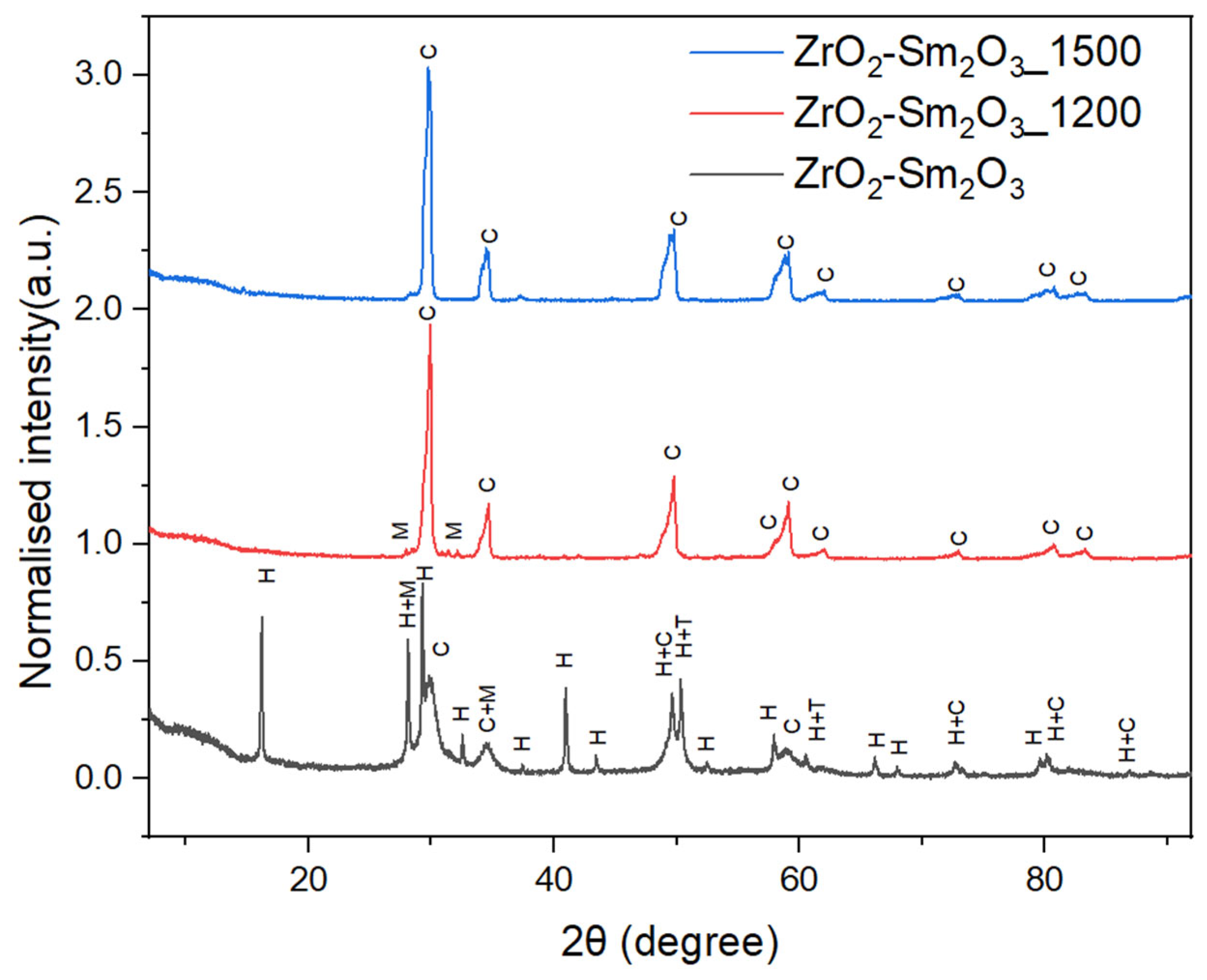
For a better understanding of the structural characteristics behavior of the elaborated samples, Figure 1 presents the XRD analysis results. It is clearly noticed that as the temperature increases, the hexagonal and tetragonal structures identified within the untreated samples are eliminated. Also, as the temperature reaches 1500 °C, the analysis points out the formation of cubic crystalline structures.
The analysis of the thermally untreated sample points out the formation of the following structures: a fluorite-type cubic structure (Fm 3 ¯ m (225)) (ICDD 04-028-0043); a hexagonal A3B3C-type structure (P63/m (176)) (ICDD 04-023-7771); a baddeleyite-type monoclinic structure P21/c(14) (ICDD 04-004-4339) and a tetragonal structure (P42/nmc (137)) (ICDD 01-091-0757).
To estimate the degree of crystallinity of the sample, the Crystallinity Index was calculated as the ratio of the integrated area of the diffraction peaks corresponding to crystalline phases to the overall diffracted area of the sample after background subtraction. Accordingly, the as-prepared (non-heat-treated) sample exhibited crystallinity of approximately 67.5%.
The pronounced peak broadening observed for the as-synthesized powder suggests the presence of ultrafine nanoparticles. With increasing treatment temperature [14], the diffraction peaks progressively sharpen, reflecting an increase in crystallinity.
Zirconia doped with Sm exhibits improved structural stability, which is consistent with the defect chemistry of aliovalent rare-earth substitution. The replacement of Zr4+ by Sm3+ is expected to induce oxygen vacancies for charge compensation, thereby promoting stabilization of the cubic phase, as widely reported in the literature [15].
When the sintering temperature was raised to 1200 °C, the crystallinity increased to approximately 82.5%. At this stage, the material exhibited a mixed-phase composition consisting of a monoclinic structure P21/c(14) (ICDD 04-004-4339), together with two cubic structures: a fluorite-type cubic structure Fm 3 ¯ m (225) (ICDD 04-008-5028) and a pyrochlore-type cubic structure Fd 3 ¯ m (227) (ICDD 00-024-1012).
Upon raising the sintering temperatures to 1500 °C, the XRD analysis showed the formation of cubic phases, while the degree of crystallinity increased even higher, exceeding 86.2%. The characteristic diffraction peaks were attributed to the existence of three pyrochlore-type cubic structures Fd 3 ¯ m (227). No diffraction peaks corresponding to crystalline Sm2O3 were detected in any of the investigated samples, confirming the formation of a Sm-stabilized zirconia within the detection limits of the XRD technique.
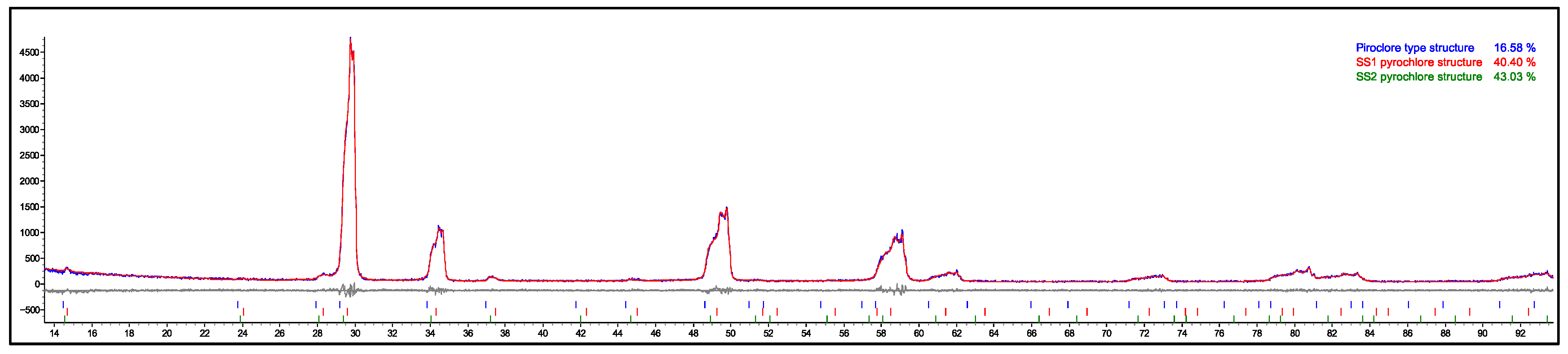
To better quantify the XRD data, a Rietveld refinement (Figure 2) was conducted upon the three samples. The analysis was performed using a Chebyshev fifth-order polynomial for the background calculation and a Pearson PVII peak type.
The X-ray diffraction patterns for ZrO2-Sm2O3 samples recorded at room temperature are presented in Figure 1 and the unit cell parameters obtained after Rietveld refinement of the experimental data can be seen in Table 2.

2.3. BET Surface Analysis of ZrO2-Sm2O3 Powders

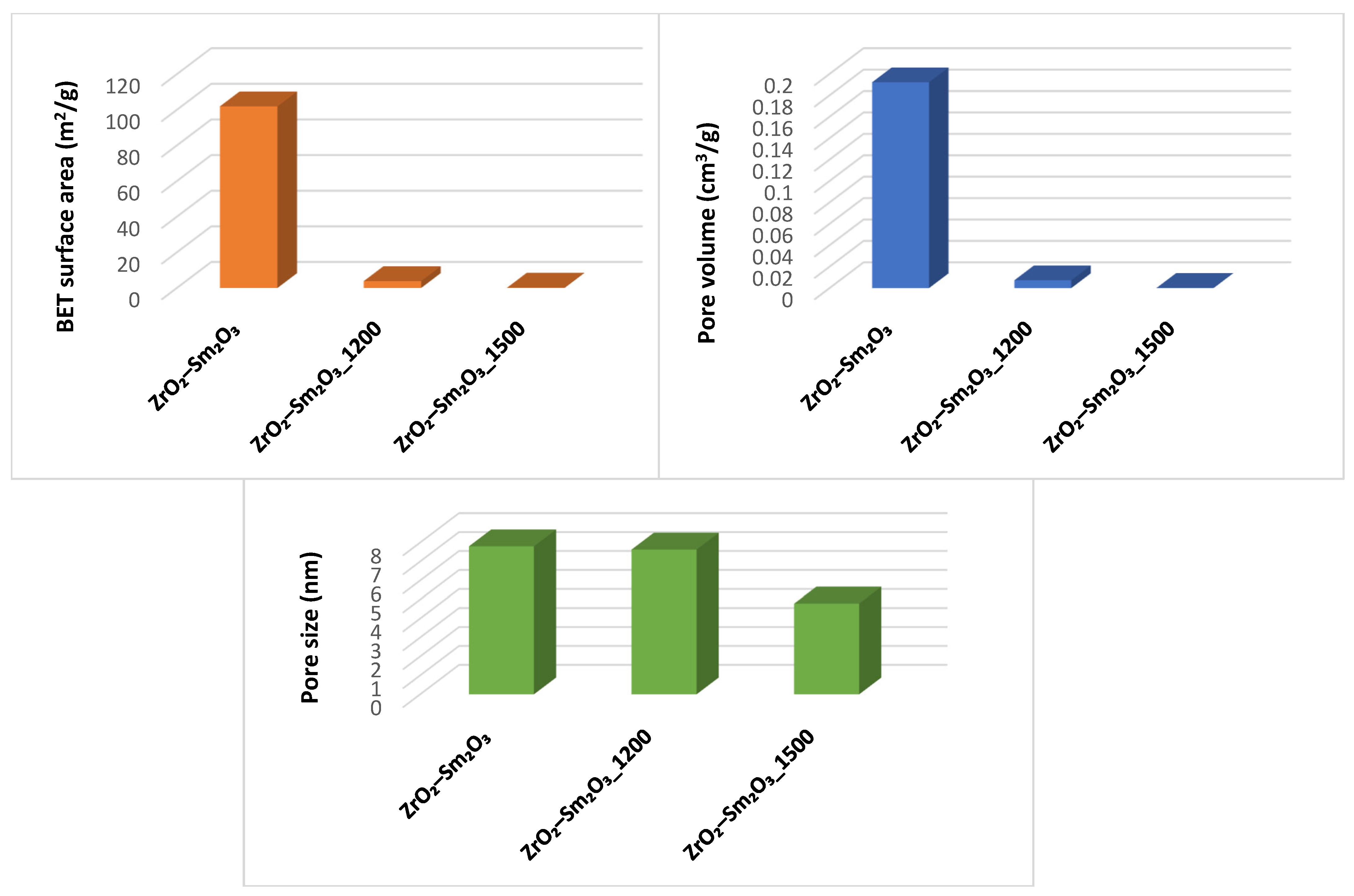
For all samples, the specific surface area and pore characteristics were determined using Brunauer–Emmett–Teller (BET) analysis and presented in Figure 3.
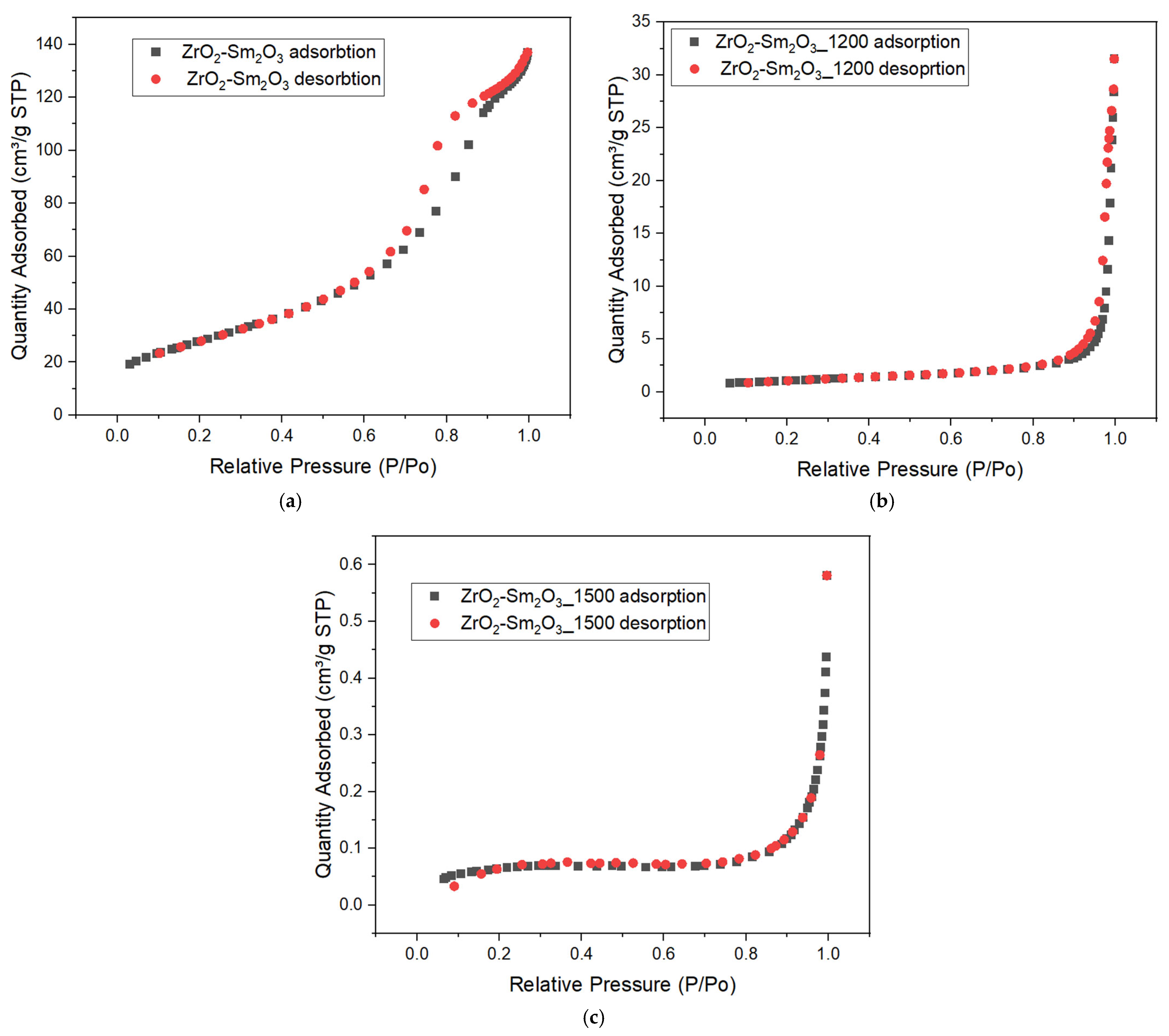
The surface area was calculated to be 101.96, 3.84 and 0.22 m2/g for ZrO2-Sm2O3, ZrO2-Sm2O3_1200 and ZrO2-Sm2O3_1500, respectively. According to the Barrett–Joyner–Halenda (BJH) method, the average pore size diameters are approximately 7.8 nm for ZrO2-Sm2O3, 7.62 nm for ZrO2-Sm2O3_1200 and 4.78 nm for ZrO2-Sm2O3_1500. The average pore size range indicates that the material is mesoporous, which matches the SEM analysis. The N2 adsorption−desorption isotherms correspond to type IV (IUPAC classification) for ZrO2-Sm2O3, characteristic of mesoporous materials with capillary condensation, whereas the ZrO2-Sm2O3_1200 and ZrO2-Sm2O3_1500 samples exhibit type III isotherm behavior [16,17].
The ZrO2-Sm2O3 sample calcined at 1500 °C exhibits lower adsorption across the entire pressure range compared with the ZrO2-Sm2O3 and ZrO2-Sm2O3_1200 samples (Figure 4). This trend correlates with the decrease in pore volume measured for the heat-treated samples at 1200 °C and 1500 °C. Particle size evaluation confirms the development of nanostructured powders: 10.35 nm for ZrO2-Sm2O3, 217.97 nm for ZrO2-Sm2O3_1200, and 4072.76 nm for ZrO2-Sm2O3_1500. Sintering at elevated temperatures enhances atomic diffusion, facilitating particle coalescence and leading to a reduction in pore volume as well as the collapse of pre-existing pores—an effect that is more pronounced in nanostructured materials. The densification process is particularly significant in doped zirconia, where dopant incorporation reduces the effective melting temperature and introduces ionic size mismatch within the lattice. Compared to pure ZrO2, dopant cations such as La, Sm, Gd, Yb and Nd possess larger ionic radius, generating lattice distortions and oxygen vacancies that enhance atomic diffusion and accelerate the sintering process [18,19].

2.4. Scanning Electron Microscopy Analysis of ZrO2-Sm2O3 Powders

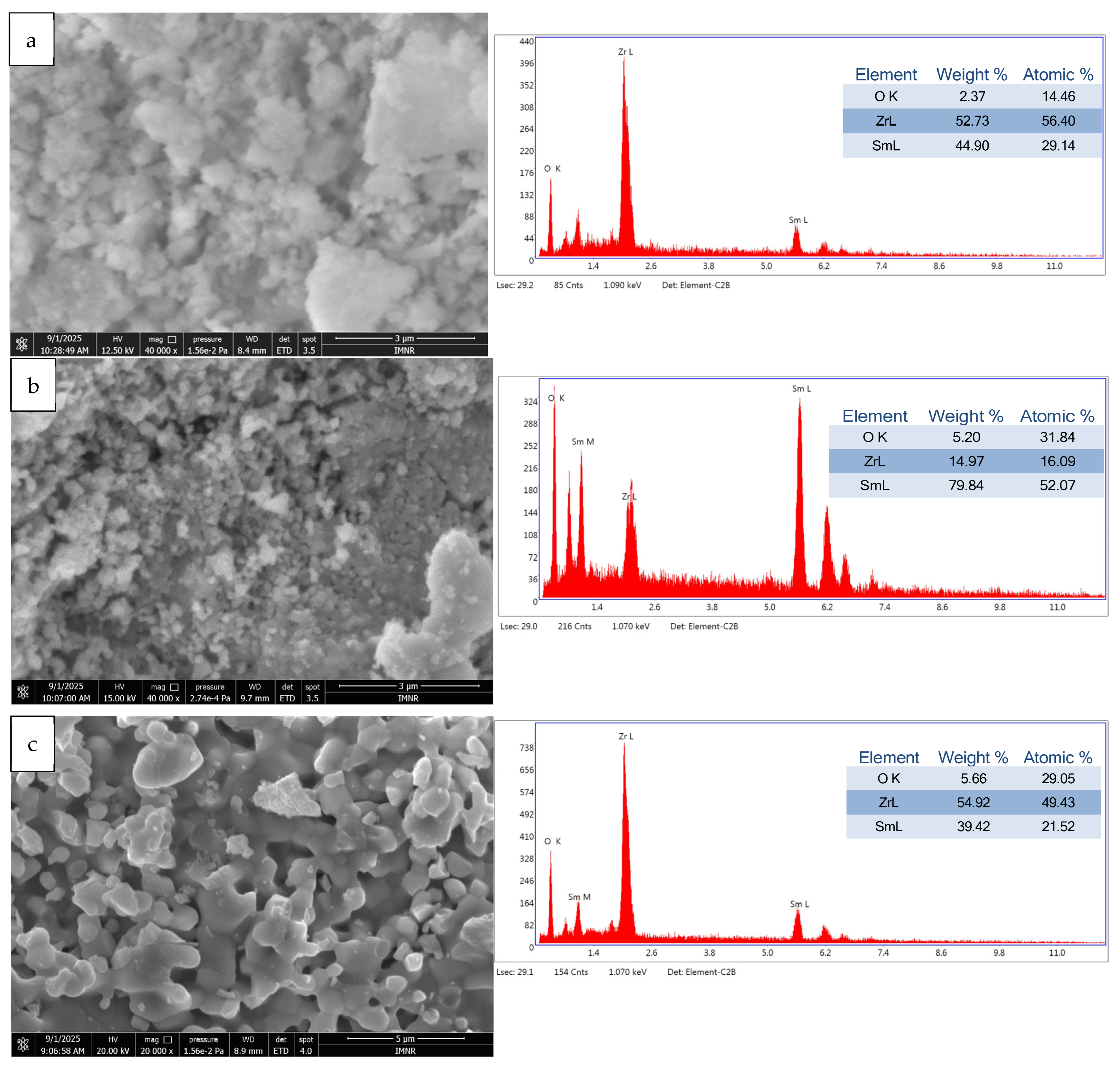
The morphological features of the Sm2O3-ZrO2 powder, together with those of the samples subjected to heat treatment at 1200 °C and 1500 °C, are presented in Figure 5. The particles in the synthesized sample appear to be fine and agglomerated, resembling irregularly shaped formations. After treatment at 1200 °C, the particles exhibit a tendency toward a more rounded morphology, whereas at 1500 °C, the powder develops larger aggregates (3 μm) characterized by intergranular porosity.

2.5. FT-IR Analysis of ZrO2-Sm2O3 Powders

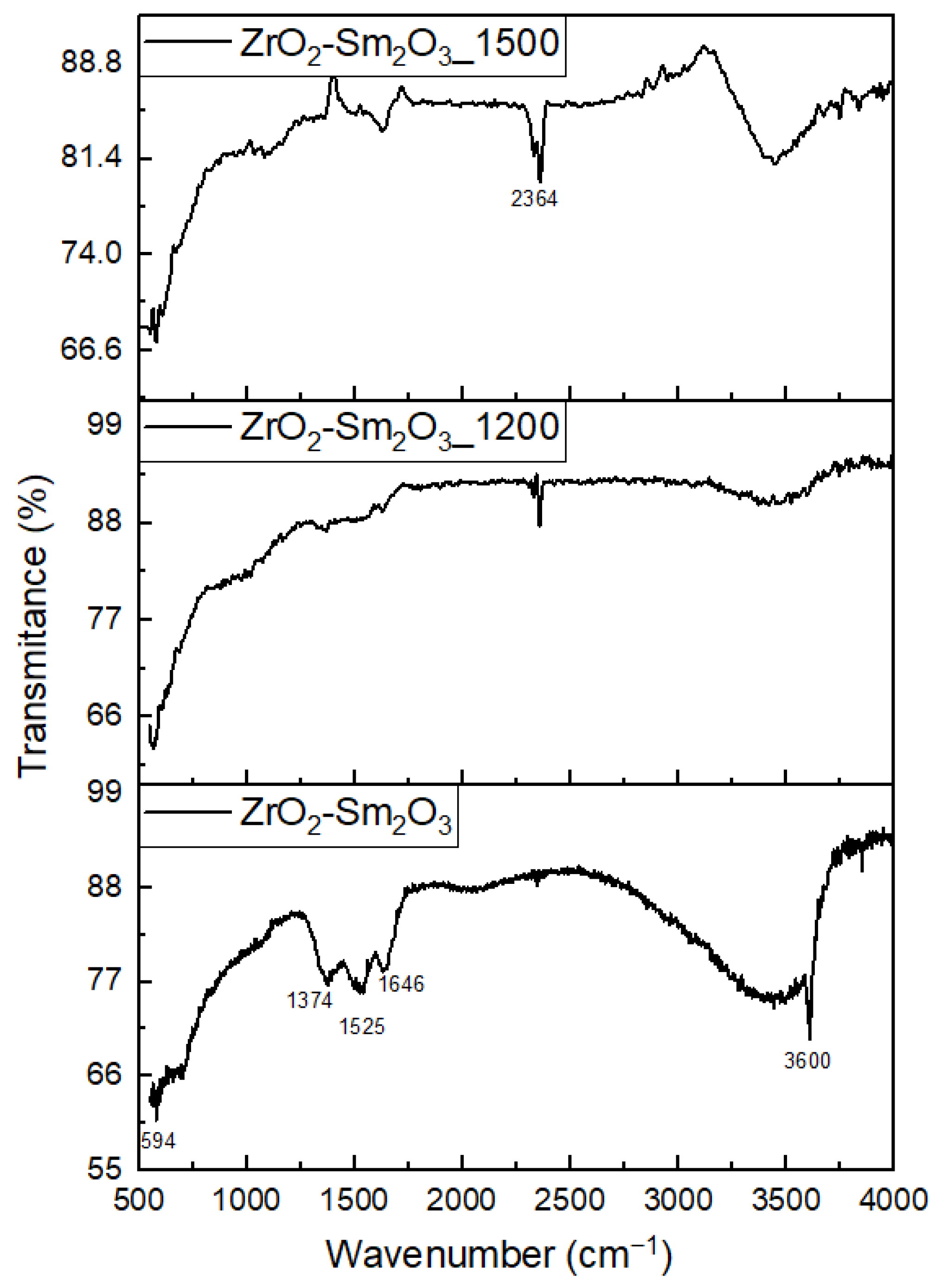
Fourier Transform Infrared (FTIR) spectroscopy was used to evaluate the structural features of the synthesized powders, and the corresponding spectra are shown in Figure 6. The intense absorption band centered near 3600 cm−1 is assigned to the stretching vibrations of –OH groups associated with water molecules adsorbed on the surface of ZrO2 nanoparticles. The peak at 1646 cm−1 corresponds to the bending mode of hydroxyl groups from physically adsorbed water [20,21].
The band at approximately 1374 cm−1 is attributed to surface carbonate species formed through atmospheric CO2 adsorption, a common phenomenon in nanostructured oxide materials synthesized in aqueous environments. The absorption feature near 594 cm−1 is assigned to metal–oxygen (M–O) vibrations, primarily corresponding to Zr–O and Sm–O bending modes. This band becomes more distinct after calcination, consistent with previous studies reporting Sm–O bending vibrations in the 593–475 cm−1 range [22].
As the calcination temperature increases, the intensity of the higher-wavenumber absorption bands decreases, indicating the progressive removal of adsorbed water molecules [23]. Simultaneously, the attenuation of carbonate-related bands and the enhancement of M–O vibrations suggest an increase in crystallinity. At 1500 °C, the spectra are dominated by features characteristic of a well-defined oxide structure, confirming the formation of a stable crystalline oxide phase.

2.6. DSC/TG Analysis of ZrO2-Sm2O3 Powders

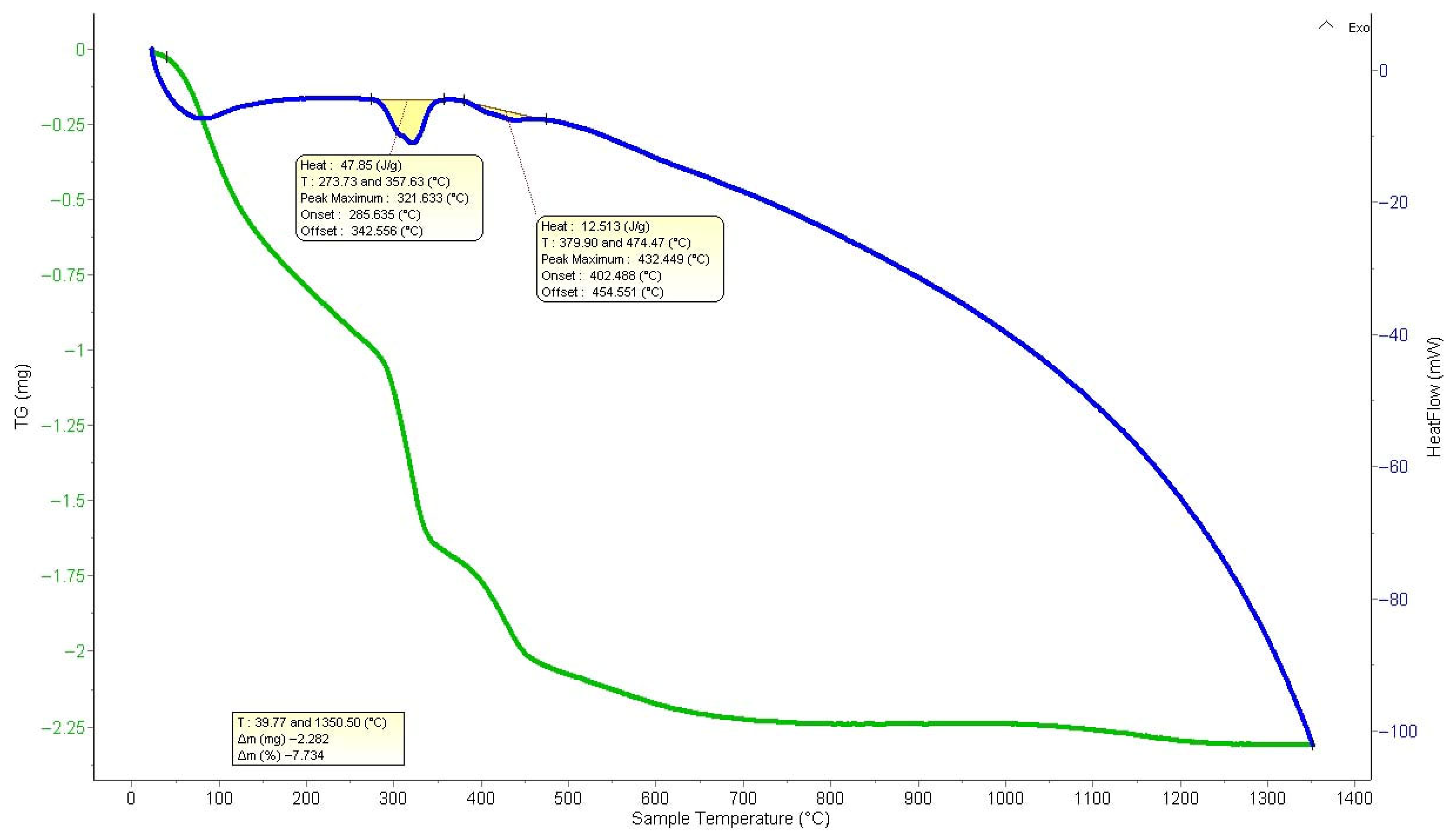
Figure 7 presents the DSC–TG curve of the Sm2O3-ZrO2 sample, showing a total mass loss of approximately 7.3%. The first endothermic event, observed between 285 and 342 °C, may be associated with the removal of residual chloride species originating from the ZrCl4 precursor and adsorbed water. The second peak, centered at approximately 462 °C, can be attributed to the process of crystallization of Sm-doped ZrO2 and to the monoclinic phase transformation. Above 500 °C, the TG curve becomes stable, suggesting that the predominant phases are oxides. The absence of additional mass loss or thermal events beyond 600 °C supports the XRD results, which confirm that, at 1200 °C, the material contains both cubic and monoclinic ZrO2 phases, while the tetragonal phase disappears [24]. This observation is also consistent with the FT-IR data, indicating that carbonate species decompose above 1200 °C.

2.7. Thermal Conductivity of ZrO2-Sm2O3

For this kind of measurement, the pellets were heated to 1500 °C. This indicates that the cubic phase is present at this temperature based on XRD analysis [25]. The relative density of the Hot Disk test samples was calculated based on the geometric density and a theoretical density of 6.5 g/cm3 for 20 mol% Sm2O3-stabilized ZrO2. The samples exhibited a relative density of approximately 73%, indicating significant residual porosity, which may influence thermal conductivity values.
Chemical composition can also affect the density, specific heat capacity, lattice parameters, and concentration of oxygen vacancies, all of which play decisive roles in determining thermal conductivity. Modification of the composition through the incorporation of Sm3+ ions reduces the thermal conductivity of ZrO2 because of the mass disparity and ionic radius mismatch between the dopant cations and Zr4+, as well as the associated formation of oxygen vacancies.
Doping ZrO2 with trivalent Sm3+ ions has a pronounced effect on its thermal transport properties by altering the lattice structure and defect landscape. The substitution of Zr4+ by larger, heavier Sm3+ cations is expected to generate oxygen vacancies for charge compensation, leading to increased mass and strain field disorder within the lattice. These defect-related mechanisms contribute to enhanced phonon scattering, which is consistent with the observed reduction in thermal conductivity. In a recent study on equimolar rare-earth co-doped ZrO2, the presence of Sm alongside other RE ions produced thermal conductivity as low as ~0.61 W·m−1·K−1 [15], with concomitantly reduced thermal diffusivity and specific heat capacity compared to typical RE-doped systems. The reduction in thermal diffusivity arises primarily from the diminished thermal conductivity, as the phonon mean free path is curtailed by both mass disorder and vacancy scattering, while changes in density and heat capacity are comparatively modest. Additionally, studies of related Sm-containing zirconate solid solutions illustrate that point defect phonon scattering is a dominant mechanism for lowering thermal diffusivity over broad temperature ranges, reinforcing the role of aliovalent dopants in tailoring thermophysical behavior [26].
The thermal parameters determined in this study for Sm2O3-doped ZrO2 are comparable in magnitude to those reported in our previous work [27], which examined the effect of individual rare-earth dopants (La, Nd, Sm, and Gd) on the room-temperature thermal conductivity of YSZ using the Hot Disk method. The thermal conductivity measured for YSZ-6% Sm was 0.39 W/mK.
Rare-earth doping lowers the thermal diffusivity of ZrO2 by introducing lattice disorder, mass and strain field fluctuations, and vacancy-type defects inherent to aliovalent substitution, all of which act as phonon scattering centers and hinder heat transport [28].
The measured thermal conductivity of the Sm-doped zirconia obtained in this work is significantly lower than the values commonly reported in the literature, as summarized in Table 3.
From a temperature-dependent perspective, the thermal transport in stabilized zirconia systems is primarily governed by phonon conduction. In rare-earth-doped ZrO2, the dominant phonon scattering mechanisms include mass fluctuation scattering, strain field distortion induced by ionic radius mismatch, and vacancy scattering associated with aliovalent substitution. As the temperature increases, Umklapp phonon–phonon scattering becomes progressively dominant, leading to a typical decrease in thermal conductivity in crystalline oxides.
However, in highly defected fluorite-type structures such as Sm-stabilized ZrO2, the phonon mean free path is already significantly reduced at room temperature due to a high concentration of oxygen vacancies and lattice disorder. Consequently, the temperature dependence of thermal conductivity is expected to be less pronounced compared to undoped zirconia, as reported for other rare-earth-stabilized systems.
Although the present study reports room-temperature thermal conductivity values, the literature data indicate that rare-earth-stabilized zirconia compositions generally maintain relatively low thermal conductivity at elevated temperatures due to persistent defect-induced phonon scattering. Therefore, the remarkably low value obtained in this work (0.41 W/mK) suggests that Sm3+ incorporation effectively enhances lattice disorder and may contribute to reduced thermal transport even under high-temperature service conditions.

3. Materials and Methods

3.1. Samarium-Doped ZrO2 via Hydrothermal Synthesis

Nanostructured 0.8ZrO2-0.2 Sm2O3 powders were synthesized through a single-step hydrothermal process using aqueous soluble zirconium salts and rare-earth oxides. Zirconium (IV) chloride (Merck, Rahway, NJ, USA, p.a. 98%) and Sm2O3 (Alfa Aesar, Stoughton, MA, USA, p.a. >99.9%), together with NH3 (25%) as a mineralizer, served as starting materials. The amounts of ZrCl4 and samarium oxide were calculated according to the targeted 0.8ZrO2-0.2Sm2O3 stoichiometry. During precipitation, the pH was maintained within the range of 9.5 to 11.
The resulting suspension was subjected to hydrothermal treatment at 200 °C under 100 atm for two hours. The synthesis was carried out in a Teflon-coated container housed within a 5 L sealed hydrothermal autoclave (Berghof Products + Instruments GmbH, Eningen unter Achalm, Germany), fitted with a cooling system. Argon gas was introduced into the autoclave to control the internal pressure. All the processes are described in [15].

3.2. Characterization Methods

The resulting powders were chemically analyzed by Inductively Coupled Plasma Atomic Emission Spectroscopy (ICP-OES) with the ICP-OES 725 system (AGILENT, Santa Clara, CA, USA), following the ASTME E 1479-24 standard [13].
Phase composition was determined using a BRUKER D8 ADVANCE X-ray Diffractometer (Bruker AXS GmbH, Karlsruhe, Germany), equipped with monochromatic Cu Ka radiation, using the Bragg–Brentano diffraction method. Scans were obtained in an angular range of 4–94°, with a step increment of 0.02°, 7.5 s/step. For phase identification, data processing was performed using the software package DIFFRAC.SUITE.EVA, version 5.2019 by Bruker AXS Company, Karlsruhe, Germany; SLEVE + 2025 and ICDD PDF 5 + 2025 databases were edited by the International Centre for Diffraction Data (ICDD).
An energy-dispersive X-Ray spectrometer (EDS) from EDAX Ametek (Mahwah, NJ, USA) was used in conjunction with an FEI Quanta 250 (FEI, Eindhoven, The Netherlands) high-resolution microscope to conduct scanning electron microscopy (SEM). The EDS system included a Team 4.5 EDS analysis system and an Element Silicon Drift Detector. Before the analysis, a small film of gold was added to improve sample conductivity.
The Micromeritics ® TriStar II Plus (Norcross-Atlanta, GA, USA), an entirely automated analyzer that produces quick, accurate results, was used to perform surface area and porosity studies. This three-station apparatus provides the accuracy and data processing capabilities required for research applications while increasing the speed and efficacy of typical quality control analyses.
An ABB MB 3000 FT-IR Spectrometer (ABB Inc., Québec, QC, Canada) and the EasiDiff device (PIKE Technologies, Inc., Madison, WI, USA) were used for the Fourier Transform Infrared Spectroscopy (FT-IR) analysis measurements. Data were gathered using 64 scans at a resolution of 4 cm−1, covering the mid-infrared range from 550 to 4000 cm−1, or wavelengths between roughly 18.18 and 2.5 μm, all measured in transmittance mode, using a solid composite sample (1% by weight) combined with KBr. Version 3.4.0.3 of the Horizon MBTM FTIR Software (ABB Inc., Québec, Canada) was used to process the experimental data.
Differential scanning calorimetry (DSC) and thermogravimetry (TG) utilizing SETSYS Evolution 17 (Setaram, Caluire-et-Cuire, France) were used to analyze the samples’ thermal behavior under non-isothermal conditions. Heat flow calibration of the DSC sensor was performed using certified reference materials at three distinct heating rates, following standard instrument calibration procedures. The thermal behavior of the investigated sample of ZrO2-Sm2O3 was subsequently recorded at a heating rate of 10 K/min from 25 to 1400 °C while argon flowed continuously at a rate of 16 mL/min.
Using the Hot Disk method (TPS 2200, Hot Disk, Göteborg, Sweden), thermal conductivity, thermal diffusivity, and volumetric specific heat were measured at room temperature on pairs of cylindrical samples (14 mm in diameter and 3,56 mm in height) that had been heat-treated for three hours at 1500 °C. The pellets were fabricated by uniaxial hydraulic pressing in a stainless-steel die with a diameter of 14 mm, applying a pressure of 400 MPa. To detect the temperature variations, a hot disk Kapton sensor (code 7577) with a 2 mm radius was positioned between the two cylindrical samples to produce heat concurrently. Using a calculating algorithm built into the manufacturer’s data processing software, the approach measured thermal conductivity directly (HotDiskTPS7.4).

4. Conclusions

Sm2O3-doped ZrO2 is a promising option for creating extremely effective anticorrosion coatings because it stabilizes the cubic phase and produces extremely low thermal conductivity, heat capacity, and diffusivity.
Sm2O3-doped ZrO2 maintains a stable cubic structure at high temperatures, a feature that plays a central role in its thermal and chemical durability. The cubic phase suppresses the detrimental tetragonal–monoclinic phase transformations that typically induce volume changes and microcracking in zirconia-based coatings. Its defect-rich lattice, associated with oxygen vacancies inherently generated by aliovalent Sm3+ substitution, contributes to modified diffusion behavior and enhanced thermal stability. In addition, the intrinsic lattice disorder of the cubic structure reduces thermal conductivity, thereby minimizing heat transfer to the underlying substrate during high-temperature exposure. Because this phase is isotropic, it expands uniformly under thermal cycling, reducing stress accumulation and improving coating integrity. Together, these attributes make cubic Sm2O3-doped ZrO2 a robust candidate for high-temperature corrosion-resistant coatings.
Sm2O3-doped ZrO2 exhibits low diffusivity, which is essential because it acts as an effective barrier, reducing the penetration of corrosive species through the coating and protecting the underlying substrate. In addition, the low heat capacity of helps limit heat absorption, minimizing sudden temperature changes and the thermal stresses they generate. This novel material offers a unique set of characteristics that immediately address the main issues with high-temperature corrosion that are present in many different industries. Ongoing research focuses on enabling the use of synthesized Sm2O3-doped ZrO2 powders for the development and characterization of advanced ceramic coatings.

Author Contributions

Conceptualization: C.F.C. and Ș.C.; methodology: C.F.C. and N.-D.C.; validation: Ș.C. and F.-G.I.; investigation: I.-A.T., M.-A.I., D.-V.D. and Ș.C., data curation: C.F.C., N.-D.C., F.-G.I., B.F. and D.-F.M.; writing—original draft preparation: C.F.C., Ș.C. and F.-G.I.; writing—review and editing: C.F.C. and F.-G.I.; project administration: C.F.C.; funding acquisition: C.F.C. and N.-D.C. All authors have read and agreed to the published version of the manuscript.

Funding

This work was supported by the Nucleu Program within the National Research Development and Innovation Plan 2022–2027, financed by Ministry of Research, Innovation and Digitization in the frame of contract no. 5N/2023 (Project: PN 23 25 01 01).

Institutional Review Board Statement

Not applicable.

Informed Consent Statement

Not applicable.

Data Availability Statement

The original contributions presented in the study are included in the article, further inquiries can be directed at the corresponding author.

Conflicts of Interest

The authors declare no conflicts of interest.

References

  1. Bowman, E.; Thompson, N.; Gl, D.; Moghissi, O.; Gould, M.; Payer, J. International Measures of Prevention, Application, and Economics of Corrosion Technologies Study; NACE International: Houston, TX, USA, 2016. [Google Scholar]
  2. Dalbouha, A.; Rais, Z. Metal Corrosion: In-depth Analysis, Economic Impacts and Inhibition Strategies for Enhanced Infrastructure Durability. J. Appl. Sci. Environ. Stud. 2022, 5, 13–21. [Google Scholar] [CrossRef]
  3. Clarke, D.R.; Levi, C.G. Materials Design for the next Generation Thermal Barrier Coatings. Annu. Rev. Mater. Res. 2003, 33, 383–417. [Google Scholar] [CrossRef]
  4. Mirbagheri, M.; Shahgholi, M.; Farahnakian, M. Progress and Perspective on the Zirconia Ceramics and Applications: A Review on Processing Methods and Mechanical Characteristics Improvements. Preprints 2024. [Google Scholar] [CrossRef]
  5. Gionea, A.; Andronescu, E.; Voicu, G.; Surdu, V.-A.; Ilie, A. ZrO2-CaO Ceramics-A Comparative Study. UPB Sci. Bull. Series B 2016, 78. [Google Scholar]
  6. Luo, X.; Zhou, W.; Ushakov, S.V.; Navrotsky, A.; Demkov, A.A. Monoclinic to Tetragonal Transformations in Hafnia and Zirconia: A Combined Calorimetric and Density Functional Study. Phys. Rev. B Condens. Matter Mater. Phys. 2009, 80, 134119. [Google Scholar] [CrossRef]
  7. Grabis, J.; Jankoviča, D.; Šteins, I.; Lubāne, M.; Sīpola, I. Characteristics and Sinterability of Ceria Stabilized Zirconia Nanoparticles Prepared by Chemical Methods. Medziagotyra 2018, 24, 243–246. [Google Scholar] [CrossRef]
  8. Kelly, J.R.; Denry, I. Stabilized Zirconia as a Structural Ceramic: An Overview. Dent. Mater. 2008, 24, 289–298. [Google Scholar] [CrossRef]
  9. Slobozeanu, A.E.; Piticescu, R.R.; Predescu, C.; Tudor, I.A.; Matei, A.C. Efficient use of rare earths as dopants in the development of ZrO2 based materials. UPB Sci. Bull. Ser. B Chem. Mater. Sci. 2023, 85, 225–234. [Google Scholar]
  10. Steele, B.C.H.; Heinzel, A. Materials for Fuel-Cell Technologies. Nature 2001, 414, 345–352. [Google Scholar] [CrossRef]
  11. Gutierrez-Sanchez, C.D.; Dorantes-Rosales, H.; Balmori-Ramírez, H.; Téllez-Jurado, L. Phase Transformation Kinetics of Zirconia Nanoparticles: Comparative Study of Acidic or Basic Medium in Sol-Gel Synthesis. Ceram. Int. 2025, 51, 36426–36437. [Google Scholar] [CrossRef]
  12. Tsipas, S.A. Effect of Dopants on the Phase Stability of Zirconia-Based Plasma Sprayed Thermal Barrier Coatings. J. Eur. Ceram. Soc. 2010, 30, 61–72. [Google Scholar] [CrossRef]
  13. ASTM E1479-24; Standard Practice for Describing and Specifying Inductively Coupled Plasma Atomic Emission Spectrometers. ASTM International: West Conshohocken, PA, USA, 2024. Available online: https://webstore.ansi.org/standards/astm/astme147924?srsltid=AfmBOop5Q_mMOb-yka6aj9_TRScl8wMUX3l7_vYB9R4GuY-hkbeRcpp5 (accessed on 28 August 2025).
  14. Holder, C.F.; Schaak, R.E. Tutorial on Powder X-Ray Diffraction for Characterizing Nanoscale Materials. ACS Nano 2019, 13, 7359–7365. [Google Scholar] [CrossRef]
  15. Petriceanu, M.; Ioniță, F.G.; Piticescu, R.R.; Nicoară, A.I.; Matei, A.C.; Ioța, M.A.; Tudor, I.A.; Caramarin, Ș.; Ciobota, C.F. Effect of Doping ZrO2 on Structural and Thermal Properties. Inorganics 2024, 12, 290. [Google Scholar] [CrossRef]
  16. Sing, K.S.W.; Everett, D.H.; Haul, R.A.W.; Moscou, L.; Pierotti, R.A.; Rouquerol, J.; Siemieniewska, T. Reporting Physisorption Data for Gas/Solid Systems with Special Reference to the Determination of Surface Area and Porosity (Recommendations 1984). Pure Appl. Chem. 1985, 57, 603–619. [Google Scholar] [CrossRef]
  17. Pandey, M.; Singh, M.; Wasnik, K.; Gupta, S.; Patra, S.; Gupta, P.S.; Pareek, D.; Chaitanya, N.S.N.; Maity, S.; Reddy, A.B.M.; et al. Targeted and Enhanced Antimicrobial Inhibition of Mesoporous ZnO-Ag2O/Ag, ZnO-CuO, and ZnO-SnO2 Composite Nanoparticles. ACS Omega 2021, 6, 31615–31631. [Google Scholar] [CrossRef]
  18. Chevalier, J.; Gremillard, L.; Virkar, A.V.; Clarke, D.R. The Tetragonal-Monoclinic Transformation in Zirconia: Lessons Learned and Future Trends. J. Am. Ceram. Soc. 2009, 92, 1901–1920. [Google Scholar] [CrossRef]
  19. Gupta, T.K.; Bechtold, J.H.; Cadoff, L.H.; Rossing, B.R. Stabilization of Tetragonal Phase in Polycrystalline Zirconia. J. Mater. Sci. 1977, 12, 2421–2426. [Google Scholar] [CrossRef]
  20. Pérez-Maqueda, L.A.; Matijevi’c, E.M. Preparation and Characterization of Nanosized Zirconium (Hydrous) Oxide Particles. J. Mater. Res. 1997, 12, 3286–3292. [Google Scholar] [CrossRef]
  21. Guo, G.Y.; Chen, Y.L.; Ying, W.J. Thermal, Spectroscopic and X-Ray Diffractional Analyses of Zirconium Hydroxides Precipitated at Low pH Values. Mater. Chem. Phys. 2004, 84, 308–314. [Google Scholar] [CrossRef]
  22. Putri, N.; Yulizar, Y.; Umar, A.; Apriandanu, D.O.B. Sm2O3 nanoparticles Preparation Using Caesalpinia Pulcherrima Leaf Extract, Characterization and Photocatalytic Activity. In Proceedings of the IOP Conference Series: Materials Science and Engineering, Bali, Indonesia, 6–7 November 2019; IOP Publishing Ltd.: Bristol, UK, 2020; Volume 902. [Google Scholar]
  23. Horti, N.C.; Kamatagi, M.D.; Nataraj, S.K.; Wari, M.N.; Inamdar, S.R. Structural and Optical Properties of Zirconium Oxide (ZrO2) Nanoparticles: Effect of Calcination Temperature. Nano Express 2020, 1, 010022. [Google Scholar] [CrossRef]
  24. Borik, M.; Chislov, A.; Kulebyakin, A.; Lomonova, E.; Milovich, F.; Myzina, V.; Ryabochkina, P.; Sidorova, N.; Tabachkova, N. Phase Composition and Mechanical Properties of Sm2O3 Partially Stabilized Zirconia Crystals. Crystals 2022, 12, 1630. [Google Scholar] [CrossRef]
  25. Qu, L.; Choy, K.L.; Wheatley, R. Theoretical and Experimental Studies of Doping Effects on Thermodynamic Properties of (Dy, Y)-ZrO2. Acta Mater. 2016, 114, 7–14. [Google Scholar] [CrossRef]
  26. Pan, W.; Wan, C.L.; Xu, Q.; Wang, J.D.; Qu, Z.X. Thermal Diffusivity of Samarium-Gadolinium Zirconate Solid Solutions. Thermochim. Acta 2007, 455, 16–20. [Google Scholar] [CrossRef]
  27. Piticescu, R.R.; Slobozeanu, A.E.; Valsan, S.N.; Ciobota, C.F.; Ghita, A.N.; Motoc, A.M.; Chiriac, S.; Prakasam, M. Hydrothermal Synthesis of Nanocrystalline ZrO2-8Y2O3-XLn2O3 Powders (Ln = La, Gd, Nd, Sm): Crystalline Structure, Thermal and Dielectric Properties. Materials 2021, 14, 7432. [Google Scholar] [CrossRef]
  28. Liu, D.; Shi, B.; Geng, L.; Wang, Y.; Xu, B.; Chen, Y. High-Entropy Rare-Earth Zirconate Ceramics with Low Thermal Conductivity for Advanced Thermal-Barrier Coatings. J. Adv. Ceram. 2022, 11, 961–973. [Google Scholar] [CrossRef]
  29. Liu, W.; Ren, X. Large Piezoelectric Effect in Pb-Free Ceramics. Phys. Rev. Lett. 2009, 103, 257602. [Google Scholar] [CrossRef]
Figure 1. X-ray diffractograms of ZrO2-Sm2O3.
Inorganics 14 00076 g001
Figure 2. Rietveld refinement for ZrO2-Sm2O3_1500 (relevant for another sample as well). The black lines means the difference between the fitted and experimental profiles.
Inorganics 14 00076 g002
Figure 3. Results of the BET surface area analysis: BET surface area, pore volume, and pore size plots.
Inorganics 14 00076 g003
Figure 4. Results of BET surface area measurements and corresponding N2 adsorption–desorption isotherms. (a) ZrO2-Sm2O3 as synthetized; (b) ZrO2-Sm2O3 heat-treated at 1200 °C; (c) ZrO2-Sm2O3 heat-treated at 1500 °C.
Inorganics 14 00076 g004
Figure 5. SEM/EDAX images of (a) ZrO2-Sm2O3, (b) ZrO2-Sm2O3 heat-treated at 1200 °C, (c) ZrO2-Sm2O3 heat-treated at 1500 °C.
Inorganics 14 00076 g005
Figure 6. FT-IR spectra of ZrO2-Sm2O3 as synthetized, heat-treated at 1200 °C and at 1500 °C.
Inorganics 14 00076 g006
Figure 7. DSC/TG spectra of ZrO2-Sm2O3. Green curve—TG curve; blue curve—DSC curve.
Inorganics 14 00076 g007
Table 1. Elemental composition determined by ICP-OES analysis.
ElementWt.%
Zr52.38
Sm28.61
Table 2. Cell parameters acquired through Rietveld refinement.
ZrO2-Sm2O3ZrO2-Sm2O3__1200ZrO2-Sm2O3__1500
ICDD PDF4+04-023-777104-028-004304-004-433901-091-075704-008-502800-024-101204-004-279501-083-438001-075-826604-021-6443
SymmetryP63/mFm 3 ¯ mP21/cP42/nmcFm 3 ¯ mFd 3 ¯ mC2/mFd 3 ¯ mFd 3 ¯ mFd 3 ¯ m
a [Å]6.37705.21535.15763.65625.197010.482014.191510.590010.453710.5285
b [Å] 5.2246 3.6254
c [Å]3.6821 5.34025.1523 8.8477
Volume [A3]129.67142.47141.4669.82140.271151.64448.171187.671142.381167.13
Crystal SystemHexagonalCubicMonoclinicTetragonalCubicCubicMonoclinicCubicCubicCubic
Rwp9.7616.0212.54
Table 3. Comparative analysis of thermal conductivity (k), diffusivity (α) and heat capacity (Cp) of rare-earth-modified zirconia.
Materialk (W/mK)α (mm2/s)Volumetric Cp (106 J/m3K)Cp (J/gK)Ref.
ZrO2-Sm2O30.41 ± 0.00070.34 ± 0.0091.224 ± 0.030.26This work
SmxZr1_xO2_x/2
(0.2_x_0.5)
1.41–1.860.59–0.70-0.39–0.45[29]
ZrO2-LSGYN0.61 ± 0.0060.34 ± 0.021.82 ± 0.110.42[15]
Sm2Zr2O71.2---[26]
(Sm1−xGdx)2Zr2O7-0.8--[26]
Dy0.06Y0.072Zr0.868O1.9342.18 ± 0.33--0.33[25]
Disclaimer/Publisher’s Note: The statements, opinions and data contained in all publications are solely those of the individual author(s) and contributor(s) and not of MDPI and/or the editor(s). MDPI and/or the editor(s) disclaim responsibility for any injury to people or property resulting from any ideas, methods, instructions or products referred to in the content.