Article

Triple Modification by g-C3N4 Induces Enhanced Photocatalytic Performance of Bi2MoO6 for Efficient Visible-Light Water Treatment


1
School of Materials and Chemical Engineering, Functional Powder Materials Laboratory of Bengbu City, Anhui Provincial Engineering Laboratory of Silicon Based Materials, Engineering Technology Research Center of Silicon-Based Materials (Anhui), Bengbu University, Bengbu 233030, China
2
State Key Laboratory of Advanced Glass Materials, CNBM Research Institute for Advanced Glass Materials Group Co., Ltd., Bengbu 233010, China
*
Authors to whom correspondence should be addressed.
Inorganics 2026, 14(3), 70; https://doi.org/10.3390/inorganics14030070
Submission received: 7 February 2026 / Revised: 25 February 2026 / Accepted: 25 February 2026 / Published: 27 February 2026

Abstract

The degradation of aquatic pollutants using eco-friendly and non-toxic photocatalytic materials is a pivotal strategy for water pollution remediation. However, single-component photocatalysts typically suffer from low photocatalytic efficiency due to limited light absorption spectra and rapid recombination of photogenerated charge carriers. This study reports a novel and facile one-step mixing strategy for realizing triple synergistic modifications: heterostructured composite construction, specific surface area regulation, and efficient photogenerated electron–hole pair separation of Bi2MoO6 (BMO) via composite enhancement with low-cost and intrinsically green g-C3N4 (CN), which avoids the high cost, complex processes, and potential pollution risks of precious metal/heavy metal modification for BMO. Under visible-light irradiation, the BMO composite modified with 15 wt% CN achieved a dye removal rate of 85.1% within 60 min, representing a 1.6-fold enhancement in photocatalytic performance compared with that achieved using pristine BMO. We further clarify the unique photocatalytic mechanism of the CN/BMO heterojunction via radical quenching experiments, identifying photogenerated holes (h+) and superoxide radicals (·O2) as the dominant active species for Rhodamine B (RhB) degradation. This study systematically demonstrates a scalable photocatalyst preparation method that integrates controllable specific surface area, rational heterostructure construction, and simple operation, and we provide an in-depth investigation into the photocatalytic reaction process and underlying synergistic enhancement mechanism. The proposed non-metallic modification route provides a new theoretical and experimental basis for the design of high-efficiency BMO-based photocatalysts, and the as-prepared CN/BMO composite holds great potential for practical application in sustainable solar-driven water purification.

1. Introduction

As global industrialization continues to accelerate, energy crises and environmental pollution have emerged as major challenges constraining the sustainable development of human society [1,2]. In this context, visible-light-driven, highly efficient semiconductor photocatalytic technology continues to demonstrate significant potential in addressing energy demands and environmental governance [3,4,5]. Among numerous photocatalytic materials, bismuth-based materials exhibit particularly remarkable performance. Specifically, bismuth molybdate materials are non-toxic and harmless, with a bandgap of approximately 2.7 eV [6,7]. They efficiently absorb light in the visible spectrum, reducing dependence on ultraviolet light and achieving higher solar energy conversion efficiency than traditional broadband semiconductors. It features a characteristic Aurivillius-type layered framework, which is assembled by the alternating stacking of (Bi2O2)2+ cation layers and (MoO4)2− anion layers. This layered architecture generates a built-in electric field that facilitates photocatalytic reactions. The interlayer spaces also serve as active sites for adsorbing and reacting with reactants, shortening charge migration distances and significantly enhancing catalytic efficiency. However, interlayer electrostatic interactions and van der Waals forces readily cause flake stacking agglomeration, resulting in poor dispersion. This reduces the contact area between the dye and the active sites of the sample, thereby affecting the performance of the photocatalytic sample [8,9,10,11,12]. Furthermore, single-component photocatalysts commonly face the limitations of low quantum yield and rapid recombination of photogenerated carriers, limiting their practical application efficiency [13,14]. In recent years, researchers have focused on synergistically optimizing light absorption and charge separation through doping or heterojunction construction. For instance, according to reports in the literature, X. Cui et al. [15,16,17] enhanced charge separation efficiency by doping Bi2MoO6 with metal particles such as Pd, Ag, and Cu, thereby improving the photocatalytic performance of Bi2MoO6. The unique localized surface plasmon resonance effect of gold nanoparticles significantly boosts light absorption capacity [18], promoting electron–hole pair separation by constructing Z-type heterojunctions of Bi2MoO6/Co0.08Cd0.92S, S-type Bi2MoO6/CdS heterojunctions, and multi-component composites [19,20,21,22,23]. These studies have provided numerous improvement strategies for photocatalytic applications of Bi2MoO6. However, precious metal modification is costly, multi-component composite processes are complex, and heavy metal modifications may introduce potential pollution risks. Developing a low-cost, simple-process Bi2MoO6 modification strategy that does not introduce potential pollution sources holds significant practical value.
Graphitic carbon nitride (g-C3N4), a class of graphite-mimicking polymer-based semiconducting material, possesses a distinctive electronic structure with a bandgap of approximately 2.7 eV [24,25,26,27]. It can be synthesized from low-cost precursors via straightforward and environmentally benign routes [28,29,30,31]. The incorporation of g-C3N4 (CN) with Bi2MoO6 (BMO) offers a composite photocatalytic system [32] without substantially increasing cost or process complexity. This study puts forward a rational optimized regulation strategy to strengthen the photocatalytic performance of BMO through compounding with the metal-free polymeric semiconductor g-C3N4.
This study employs a rapid solution combustion synthesis method [33] where the precursors are uniformly dispersed in solution, enabling precise control over the heterojunction composition, interfacial contact area, and surface chemistry. This approach promotes intimate interfacial coupling between CN and BMO while ensuring high reproducibility of the material properties. By systematically adjusting the composite conditions, this research explores their impacts on the heterojunction’s microstructure, with a particular focus on the interfaces, as well as its optical properties. Comprehensive characterization via X-ray diffraction (XRD), high-resolution transmission electron microscopy (HRTEM), X-ray photoelectron spectroscopy (XPS), ultraviolet–visible diffuse reflectance spectroscopy (UV-Vis DRS), and photoluminescence (PL) spectroscopy was conducted to analyze the crystal phase, morphology, elemental chemical states, and separation efficiency of photogenerated charge carriers. Furthermore, the underlying photocatalytic mechanisms were elucidated through quenching experiments. This study provides a controllable synthesis pathway and a solid theoretical foundation for constructing highly efficient CN/BMO heterojunctions.

2. Results and Discussion

2.1. Characterizations of CN/BMO

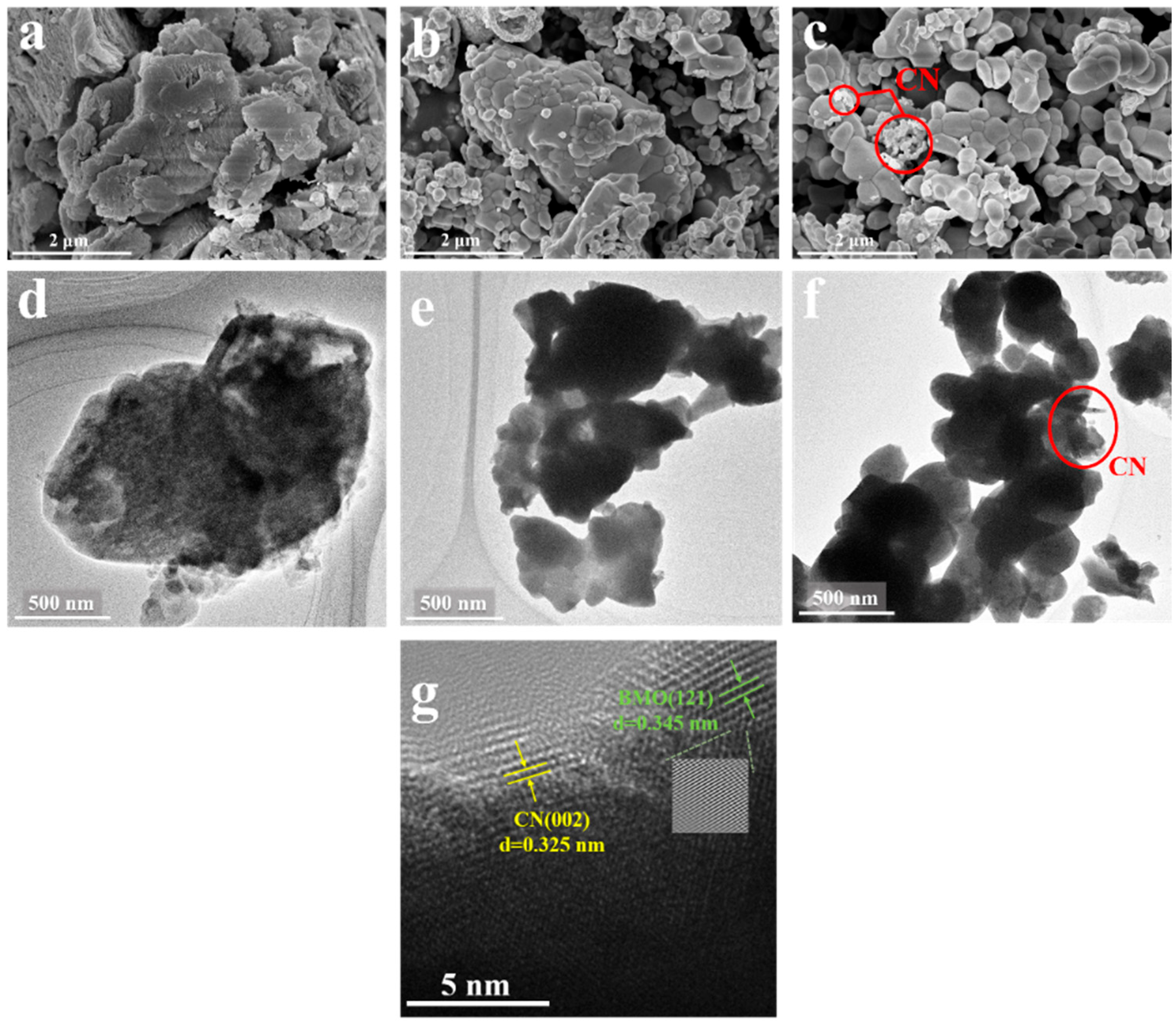
Scanning electron microscopy (SEM) characterized the sample morphology, transmission electron microscopy (TEM) resolved its internal structure, and high-resolution TEM (HRTEM) revealed the interfacial details. As shown in Figure 1a, the pristine CN displays a typical morphology of irregular, two-dimensional layered stacking, featuring a smooth surface yet notable agglomeration. However, analysis of the TEM image (Figure 1d) clearly indicates that CN consists of thin two-dimensional nanosheets. Figure 1b shows BMO composed of irregular polyhedra of varying sizes extensively aggregated with poor dispersion. For the 15% CN/BMO composite (Figure 1c), CN nanosheets tightly adhere to BMO polyhedra or interstitial voids, reducing polyhedral bonding between BMO particles and increasing porosity. The results indicate that incorporating 15% CN improves BMO stacking and enhances particle dispersion. The relatively dispersed structure promotes photocatalytic reactions by enabling efficient separation of photo-generated electron–hole pairs at the interface, which is achieved through the construction of a tightly attached CN-BMO heterojunction [34]. Abundant cavities enable multiple reflections and absorption of incident light, significantly boosting light absorption and scattering efficiency [35].
As shown in the HRTEM image (Figure 1g), well-resolved lattice fringes are visible. The fringe spacing is quantified as 0.345 nm for the BMO (121) plane and 0.325 nm for the CN (002) plane. The appearance of blurred spots within these fringes is ascribed to point defects induced by oxygen vacancies (OVs) within the BMO structure, a conclusion that is in agreement with the XPS analysis [36].
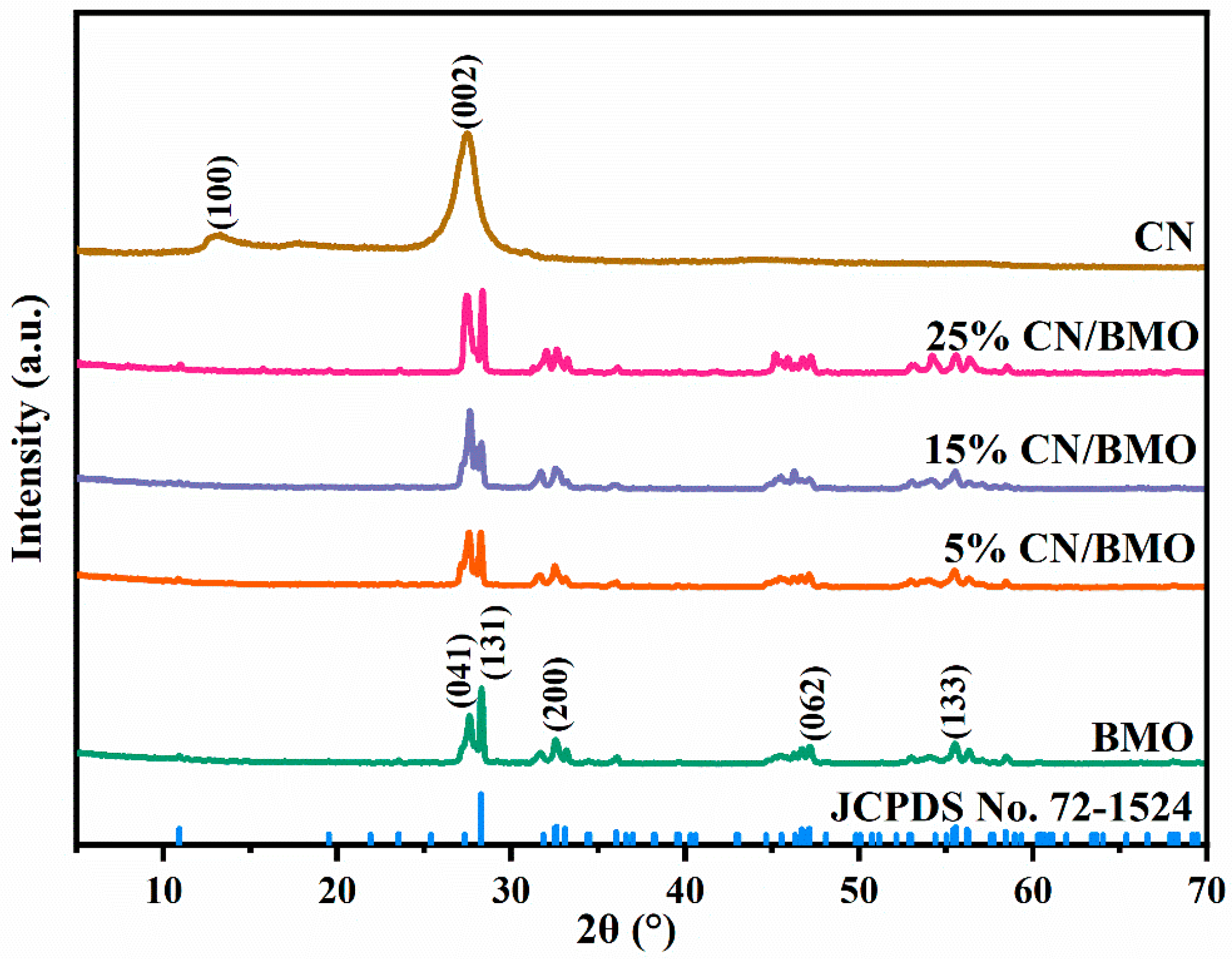
Figure 2 delineates the phase evolution of BMO and its CN-based composite via XRD analysis. The pattern for pure CN is in good agreement with JCPDS No. 87-1526, with its (100) and (002) planes identified at 13.2° and 27.5°. Meanwhile, pure BMO exhibits a pattern perfectly matching orthorhombic JCPDS No. 72-1524: the peaks at 27.5°, 28.3°, 32.6°, 47.2°, and 55.6° ascribed to its (041), (131), (200), (062), and (133) planes. This BMO structure corresponds to γ-BMO, with sharp peak shapes indicating excellent crystallinity [37]. γ-BMO possesses a unique Aurivillius-type layered structure, formed by alternating stacks of (Bi2O2)2+ cation layers and (MoO4)2− anion layers. This layered structure generates an intrinsic electric field, facilitating photocatalytic reactions. The interlayer spaces also serve as active sites for adsorbing and reacting with reactants, shortening charge migration distances and significantly enhancing catalytic efficiency [38]. Notably, after BMO was combined with CN, the XRD pattern exhibited nearly identical diffraction characteristics with no detectable impurity peaks, indicating excellent control over synthesis and purification. Within the CN/BMO composite, the CN (100) peak at 13.0° is masked by the strong diffraction from highly crystalline BMO, which overshadows the weak signal from the CN component [39,40]. Furthermore, the diffraction peaks corresponding to the CN (002) and BMO (041) planes overlap, resulting in a pronounced enhancement of the BMO peak intensity. Consequently, the overlap between the (002) crystal plane of CN and the (041) crystal plane of BMO leads to a significant increase in the intensity of the BMO peak. Consequently, the incorporation of CN not only addresses the poor dispersion of BMO caused by interlayer electrostatic and van der Waals forces that promote stacking aggregation but also preserves the crystalline structure of BMO.
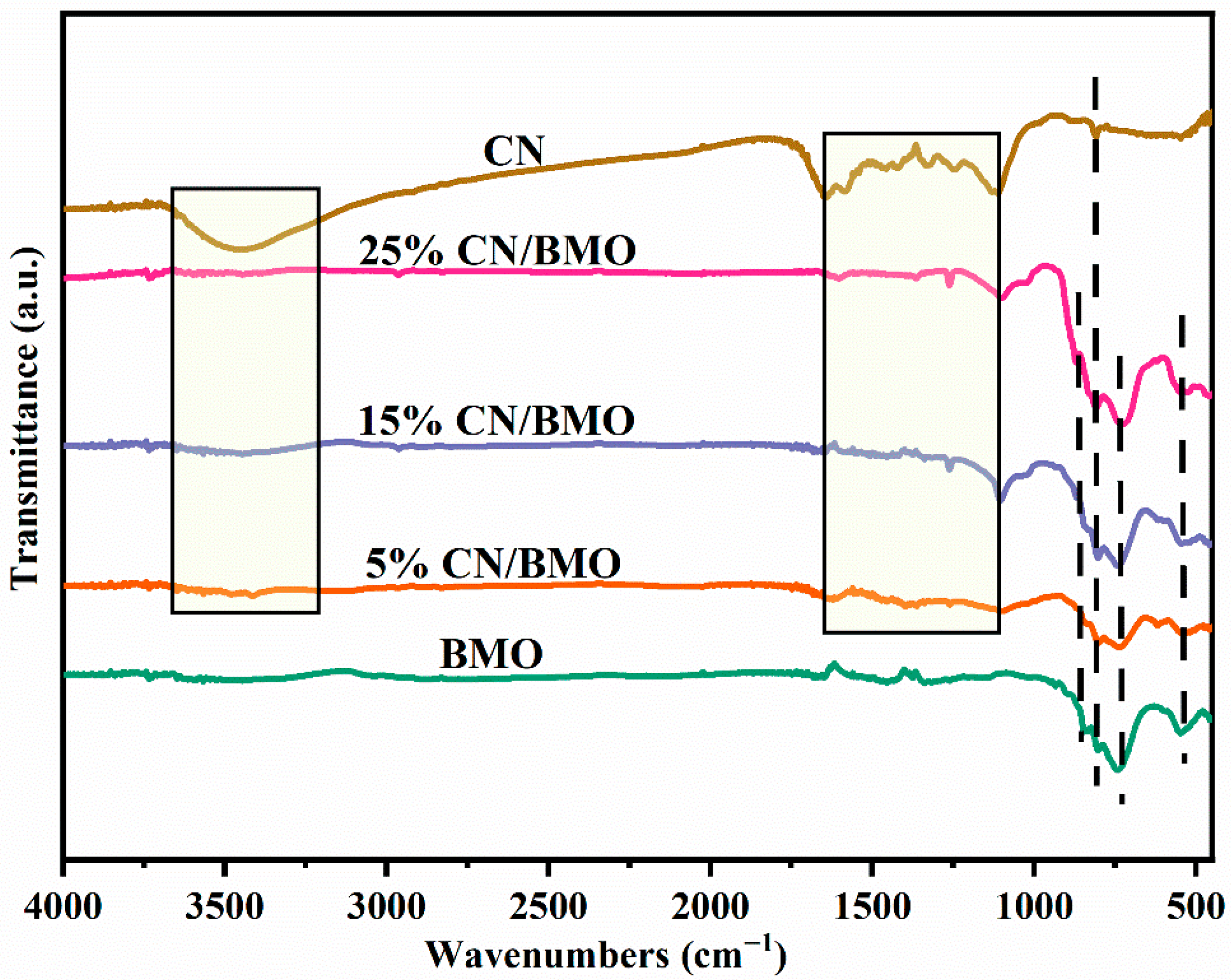
The infrared spectrum clearly displays the functional group characteristics of CN, BMO, and their composite materials. In Figure 3, the characteristic spectral lines of CN are clearly discernible. The broad peak between 3200 and 3600 cm−1 represents the stretching vibrations of the terminal -NH2 or N-H groups on CN [41]. The chemical structure of the materials was probed by FT-IR spectroscopy. Pristine CN exhibits its fingerprint peaks: a band at 807 cm−1 for the triazine unit, multiple bands in the 1200–1650 cm−1 region for C-N/C=N rings. Pristine BMO shows distinct bands at 560, 740, and 847 cm−1 corresponding to Bi-O, Mo-O, and Mo-O-Mo stretching vibrations [42]. The coexistence of these characteristic bands in the composite spectra unambiguously demonstrates the successful formation of an intimate composite structure, distinct from a simple physical mixture.
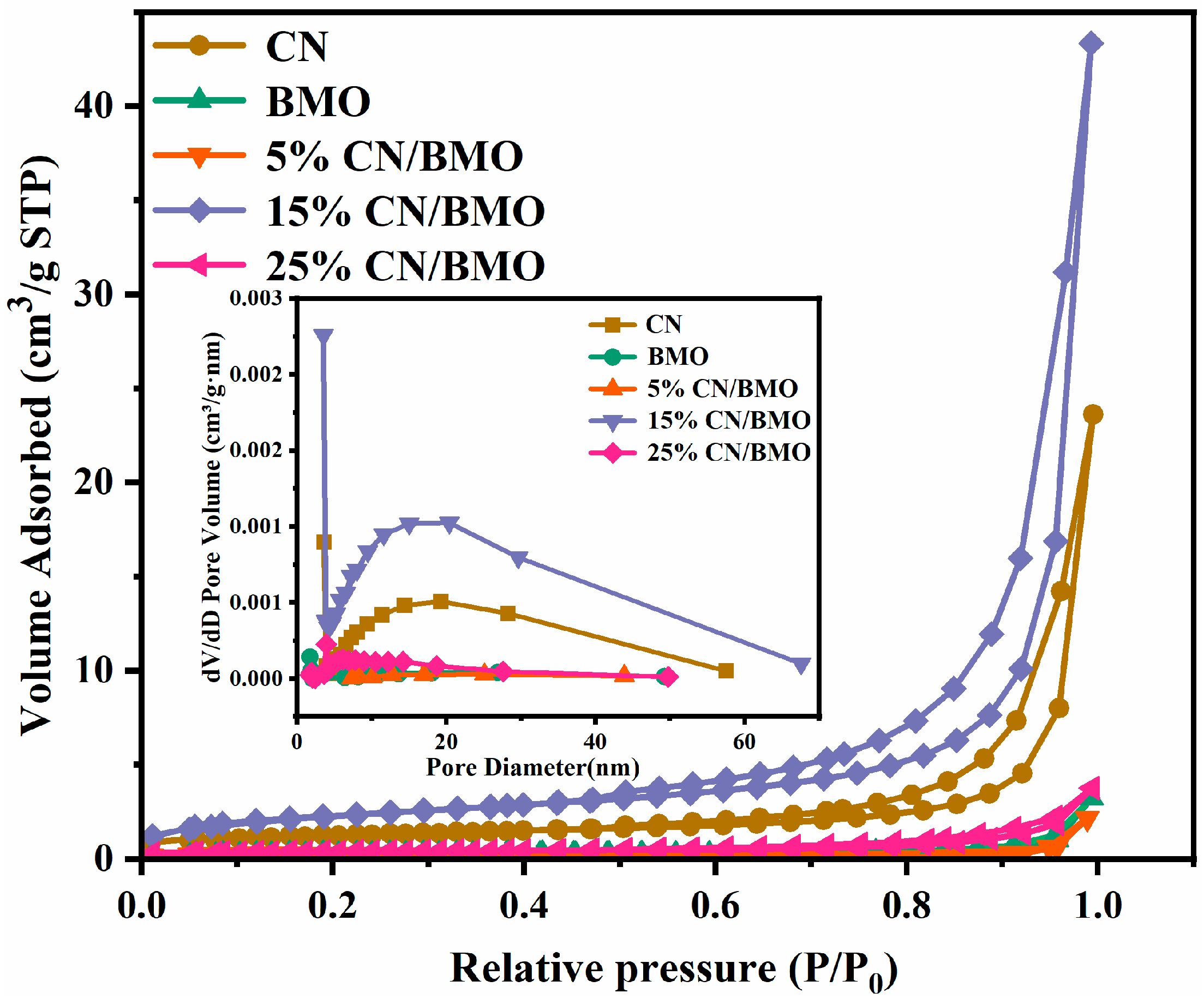
The surface area characteristics of CN/BMO materials were determined by nitrogen adsorption–desorption techniques. As evidenced by Figure 4, all samples display Type IV isotherms accompanied by H3-type hysteresis loops [43]. This confirms the existence of diverse pore architectures within the composite, such as flat plate slits, fissures, and wedge-shaped pores, which were more pronounced in the 5% CN/BMO and CN samples. The test data revealed specific surface areas of 4.26, 0.93, 0.71, 8.12, and 1.30 m2/g for CN, BMO, 5% CN/BMO, 15% CN/BMO, and 25% CN/BMO, respectively. It is noteworthy that after adding BMO, the specific surface area decreased in all samples except the 15% CN/BMO composite. This indicates that factors other than specific surface area dominate the enhanced photocatalytic activity exhibited by the 15% CN/BMO composite. The pore size distribution curve shown in Figure 4 indicates that the 15% CN/BMO composite exhibits a peaked distribution centered at 23.12 nm. Adsorption capacity serves as a crucial prerequisite for photocatalytic performance, primarily by providing abundant surface reaction sites to facilitate photocatalytic reactions [44]. An enlarged specific surface area and optimized pore structure facilitate the enrichment and adsorption of reactant molecules (e.g., pollutants, water molecules) on the catalyst surface. This provides more reaction targets for subsequent photogenerated carriers (electron–hole pairs), effectively shortening the transport distance between active species and targets, which typically enhances reaction rates [45,46,47].
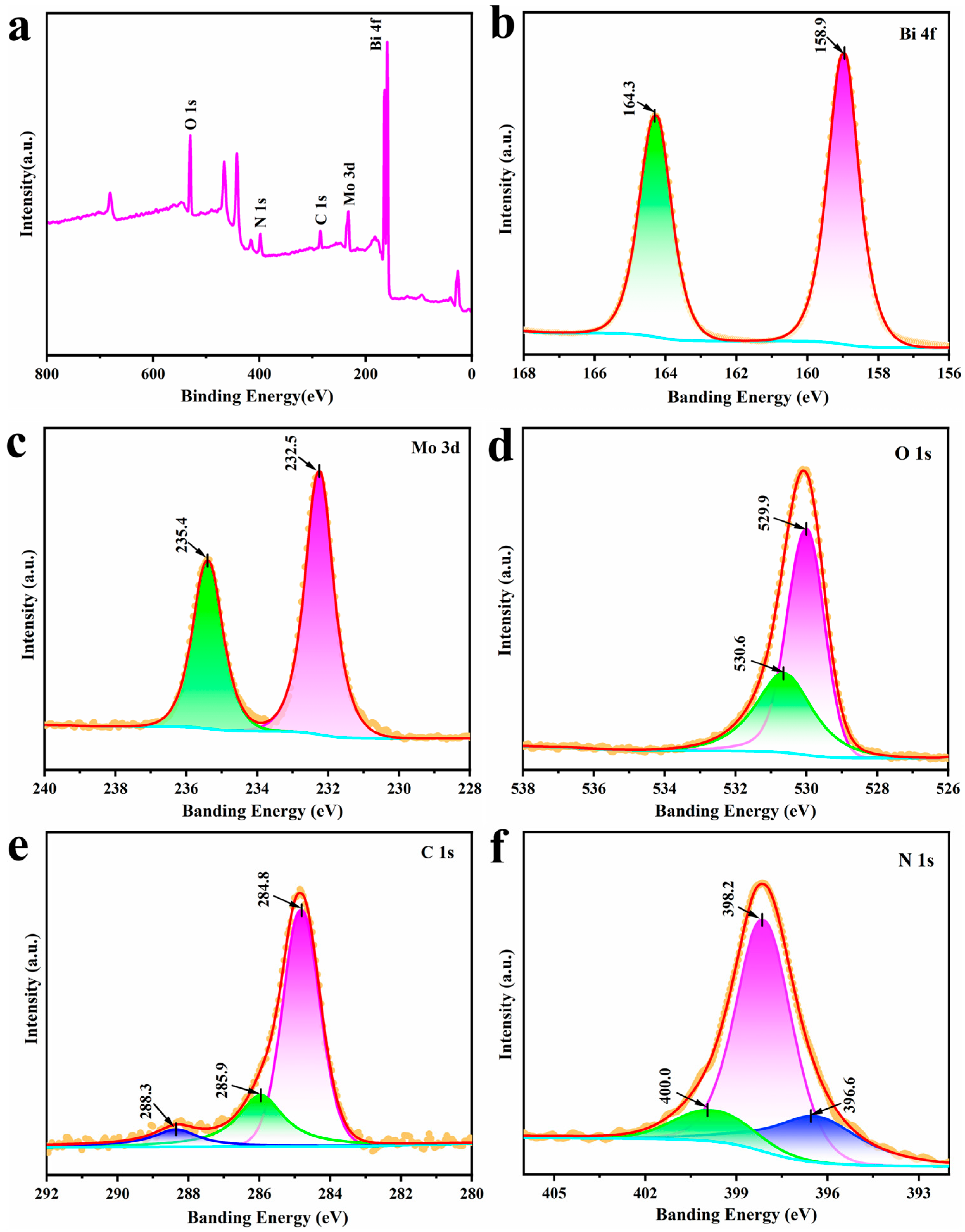
XPS analysis was employed to systematically investigate the elemental bonding characteristics and electronic configurations of CN, BMO and their composite. As shown in the full survey XPS spectrum of the 15% CN/BMO sample (Figure 5a), characteristic signals of Bi, Mo, O, C and N elements are clearly detected on the sample surface, providing direct evidence for the successful fabrication of the CN/BMO composite. For the high-resolution Bi 4f spectrum (Figure 5b), two well-resolved peaks appear at binding energies of 158.9 eV and 164.3 eV, which are respectively attributed to the spin–orbit splitting of Bi 4f7/2 and Bi 4f5/2 orbitals from the [Bi2O2]2+ structural unit [48]. As for the Mo 3d spectrum displayed in Figure 5c, two prominent peaks centered at 232.5 eV and 235.4 eV are observed, corresponding to the Mo 3d5/2 and Mo 3d3/2 orbitals of Mo6+ species, respectively, which confirms the presence of hexavalent molybdenum in the composite [49]. The high-resolution O 1s spectrum (Figure 5d) is deconvoluted into two characteristic peaks at 529.6 eV and 531.1 eV, which are assigned to the lattice oxygen species in Bi-O bonds and Mo-O bonds, respectively [50].
Furthermore, the chemical states of carbon and nitrogen elements in the composite were also analyzed via high-resolution XPS. The C 1s spectrum (Figure 5e) can be fitted into three distinct characteristic peaks located at 284.8 eV, 285.9 eV and 288.3 eV, which are respectively ascribed to the sp2-hybridized C-C bonds of graphitic carbon, the C-N bonds in nitrogen-containing heterocyclic structures, and the N-C=N bonds in the triazine repeating units of CN [51]. For the high-resolution N 1s spectrum (Figure 5f), two deconvoluted main peaks at 398.2 eV and 400.0 eV are observed, which correspond to the C-N=C coordination and the tertiary nitrogen N-(C)3 groups in the CN framework, respectively. In addition, a characteristic peak at 396.6 eV is detected in this spectrum, which is attributed to the Mo 3p3/2 orbital of Mo species in the composite [52].

2.2. Photocatalytic Activity

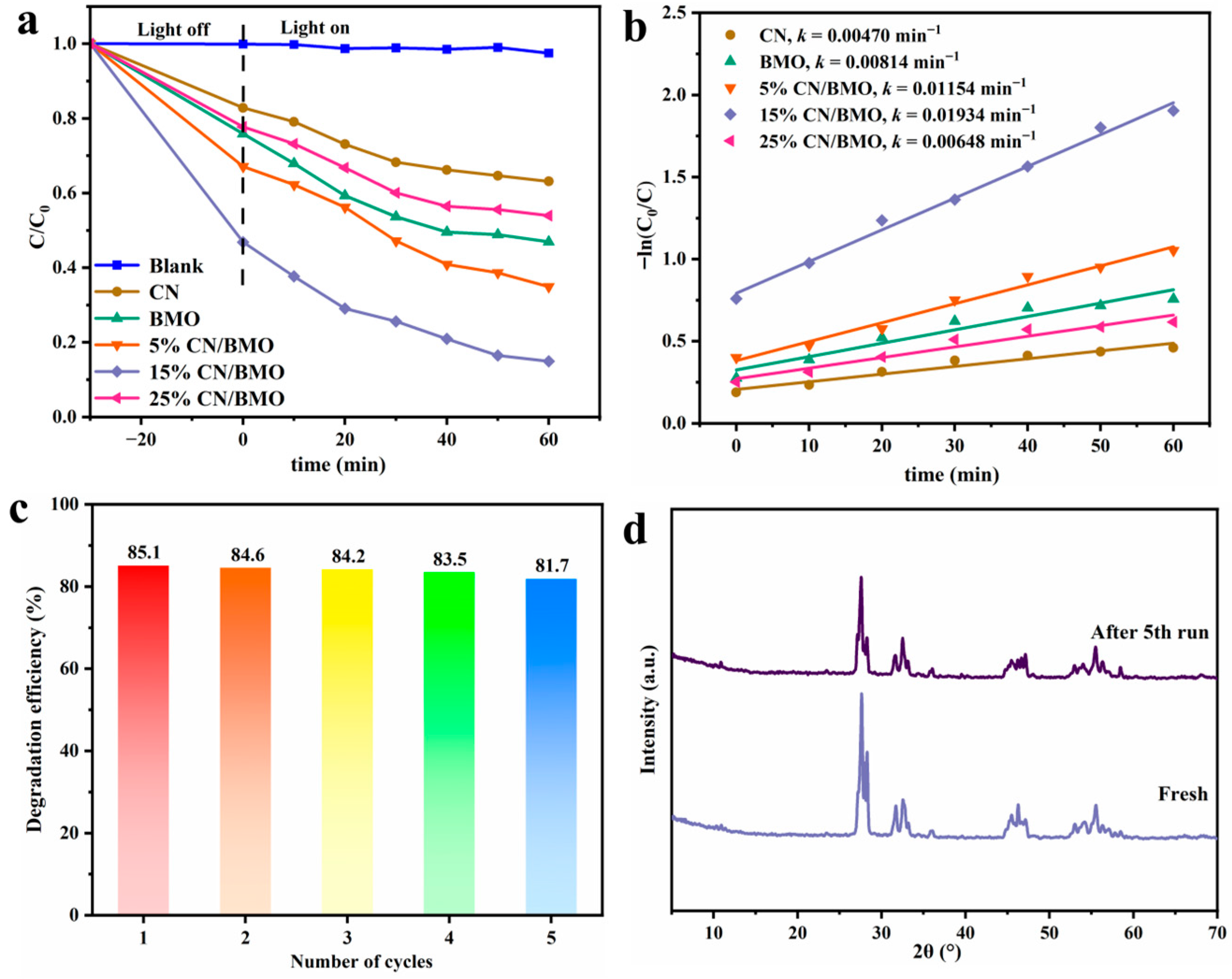
To assess the photocatalytic activity of CN/BMO, RhB degradation experiments were carried out under visible light irradiation. Adsorption experiments in the dark are presented in the Supplementary Materials [53,54,55]. The blank experiment showed that the RhB concentration remained essentially unchanged before and after illumination (Figure 6a), indicating that xenon lamp irradiation has a negligible effect on RhB photolysis in the absence of photocatalysts. Under identical conditions, the BMO catalyst achieved a RhB removal rate of 52.9%. When BMO was combined with CN, the degradation efficiency of the catalyst significantly improved. The removal rates for 5% CN/BMO and 15% CN/BMO reached 65.1% and 85.1%, respectively. Notably, the degradation efficiency of the composite decreased when the CN content reached 25%, falling below that of pure BMO. Among all samples, 15% CN/BMO exhibited the most outstanding RhB degradation performance. The photocatalytic performance is enhanced when CN is loaded in moderation, but excessive amounts lead to a drop in degradation efficiency. For the 25% CN/BMO composite, this drop can be partially explained by its diminished specific surface area.
Figure 6b presents the photodegradation kinetics of CN, BMO, and X% BM/CN composites (X = 5, 15, 25). The degradation profiles are well described by the pseudo-first-order model: −ln(C/C0) = kt, where k represents the apparent rate constant, and C0 and C denote the RhB concentrations at the start and after time t, respectively [56]. Among all samples, the 15% CN/BMO composite achieved a rate constant of 0.01934 min−1, which is substantially higher than those of CN (0.00470 min−1), BMO (0.00814 min−1), 5% CN/BMO (0.01154 min−1), and 25% CN/BMO (0.00648 min−1). This corresponds to enhancement factors of approximately 4.1, 2.4, 1.7, and 3.0 times, respectively. Undoubtedly, the 15% CN/BMO composite exhibited the highest RhB photodegradation activity among all samples.
The reusability and recovery capability of 15% CN/BMO were investigated through five cyclic experiments using the same catalyst (Figure 6c). Even after five cycles, the catalytic activity of 15% CN/BMO showed no significant decline, demonstrating its potential for reuse and practical application. The minor decline in performance likely results from the gradual loss of surface active sites during repeated cycling [57,58]. Furthermore, XRD patterns were employed to investigate the stability of the 15% CN/BMO photocatalyst before and after continuous cycling. As shown in Figure 6d, the diffraction characteristic peaks remained intact after use, with no slight shifts or emergence of new peaks, indicating no alteration in the crystalline phase of 15% CN/BMO. Thus, the aforementioned results validate the excellent structural stability of 15% CN/BMO [59]. To quantitatively evaluate the photocatalytic activity competitiveness and practical application value of the 15% CN/BMO composite material prepared in this study, we conducted a systematic benchmark analysis targeting representative CN/BMO-based photocatalysts for organic pollutant degradation reported in the recent literature. Detailed comparative results are summarized in Table 1. Visible-light-driven RhB photodegradation tests demonstrate that the 15% CN/BMO material, synthesized via a simplified method, exhibits competitive or even superior photocatalytic kinetic performance at an optimal CN loading ratio. Its performance rivals or surpasses that of most previously reported high-efficiency CN/BMO photocatalytic systems under equivalent reaction conditions.
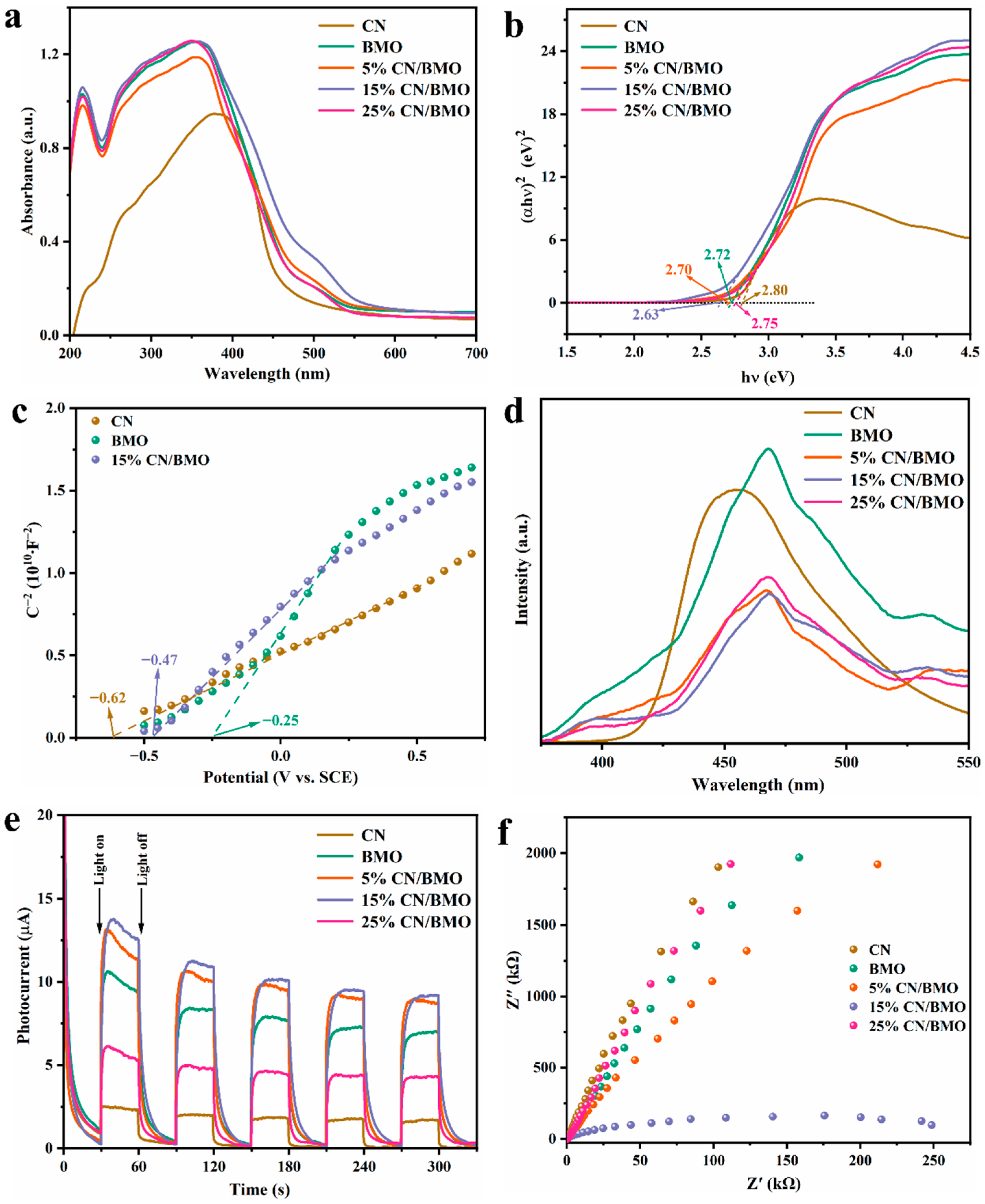
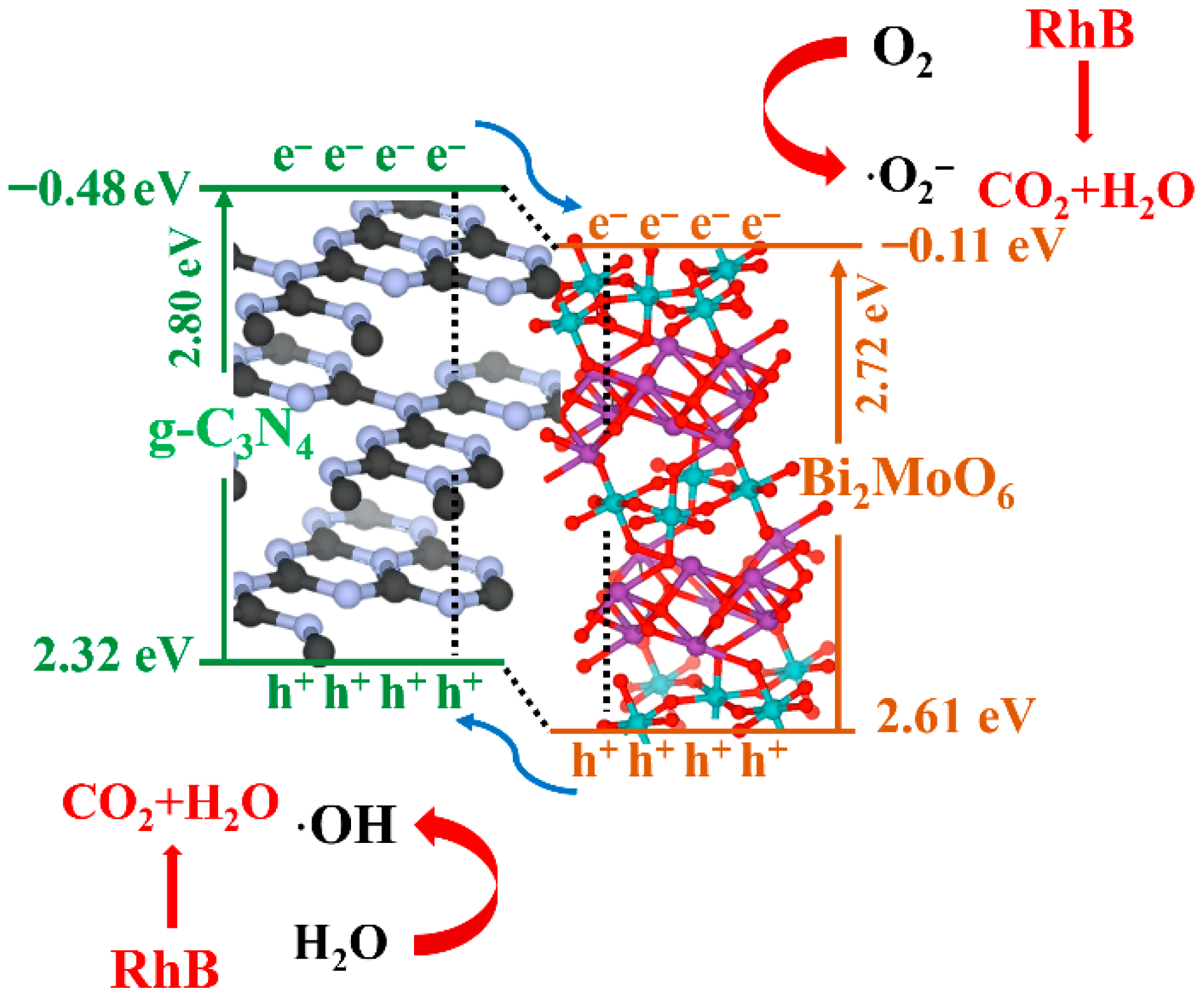
Visible-light harvesting and charge carrier dynamics in the photocatalyst are strongly influenced by its composite structure. UV-vis diffuse reflectance spectroscopy was therefore conducted to assess the optical characteristics and bandgap of the as-prepared samples (Figure 7a,b), as these factors fundamentally influence catalytic efficiency. The figures provide an intuitive explanation for the enhanced performance of 15% CN/BMO in the photocatalytic degradation of RhB. As clearly observed in Figure 7a, CN exhibits a relatively narrow light absorption range. The absorption edge of CN/BMO overlaps with the ranges of both CN and BMO, with the absorption edge of 15% CN/BMO exhibiting a significant red shift into the visible region. This confirms the successful heterojunction formation between CN and BMO, which contributes to the improved photocatalytic performance of the composite. From the Kubelka–Munk function curves, the bandgap energies of CN and BMO were determined to be 2.80 eV and 2.72 eV, respectively. The bandgap values of the catalyst changed after the formation of the CN/BMO composite [62]. The bandgaps for 5% CN/BMO, 15% CN/BMO, and 25% CN/BMO were 2.70 eV, 2.63 eV, and 2.75 eV, respectively [63]. The bandgaps of CN/BMO composites with appropriate CN content were smaller than those of pure BMO samples, with the 15% CN/BMO composite exhibiting the narrowest bandgap. This indicates that CN incorporation modulates the energy band structure of the catalyst, reducing the bandgap width and thereby enhancing its photocatalytic degradation capability toward RhB [64]. To evaluate the flat-band potentials, Mott–Schottky measurements were performed at 1 kHz [65]. The linear segments of the C−2 versus potential curves show positive slopes (Figure 7c), revealing the n-type nature of both CN and BMO semiconductors [66]. Based on the x-intercept of the line, the flat-band potentials (vs. SCE) of CN and BMO were calculated as −0.62 V and −0.25 V, respectively, corresponding to standard electrode potentials (vs. NHF) of −0.38 V and −0.01 V. According to a report in the literature [67], the conduction band position in n-type semiconductors is approximately 0.10 V lower than the flat-band potential. Therefore, the conduction band potentials for CN and BMO are −0.48 eV and −0.41 eV, respectively. Using the formula EVB = Eg + ECB [68], the valence band potentials of CN and BMO were calculated to be 2.32 eV and 2.61 eV, corresponding to the valence band and conduction band, respectively. This indicates that BMO possesses a valence band with a more positive potential, while g-C3N4 exhibits a conduction band with a more negative potential. This distinct band structure effectively promotes the separation of photogenerated electrons and holes, thereby enhancing the photocatalytic reaction efficiency [69].
Photoluminescence measurements were employed to evaluate the electron–hole pair recombination rate. Figure 7d presents the PL spectra of all samples. The PL emission of pure CN peaks at 454 nm, whereas both BMO and the CN/BMO composites show peaks near 468 nm. The strongest PL intensity observed for BMO points to a high rate of photogenerated charge carrier recombination. Notably, the composites display a much lower PL intensity than BMO, demonstrating that the integration with CN facilitates interfacial charge transfer and suppresses radiative recombination. The 15% CN/BMO composite exhibits weaker fluorescence intensity, indicating efficient charge separation and strong interface contact, consistent with its superior photocatalytic performance. This conclusion is further corroborated by transient photocurrent response analysis [70]. Understanding the behavior of photogenerated carriers is crucial, prompting a series of photoelectrochemical measurements to evaluate their transport and migration efficiency. The photocurrent fluctuations in different samples exposed to alternating light are illustrated in Figure 7e. The 15% CN/BMO sample exhibited the highest photocurrent intensity, indicating superior charge separation efficiency. Stronger interfacial bonding enhances photocatalytic activity [71]. Additionally, the samples’ conductivity was evaluated using electrochemical impedance spectroscopy (EIS) (Figure 7f). The arc radii were arranged in ascending order as follows: 15%CN/BMO < 5%CN/BMO < BMO < 25%CN/BMO < CN. The 15%CN/BMO sample exhibited the smallest arc radius, indicating lower electron transfer resistance compared with other samples. The introduction of CN reduced charge transfer barriers within CN/BMO, amplifying the mobility and effective separation of photogenerated carriers [72].
Notably, beyond fluorescence performance, the 25% CN/BMO sample exhibited an inferior bandgap, photoelectrochemical properties, and EIS characteristics compared with pure BMO. This may be attributed to excess CN potentially shielding incident light and covering active sites on the BMO surface, thereby reducing light absorption efficiency and impeding interfacial reaction kinetics. The excess CN layer severely hinders the efficient transport of photogenerated carriers at the interface. This finding aligns with the photodegradation performance observed in the samples.

2.3. Photocatalytic Mechanism

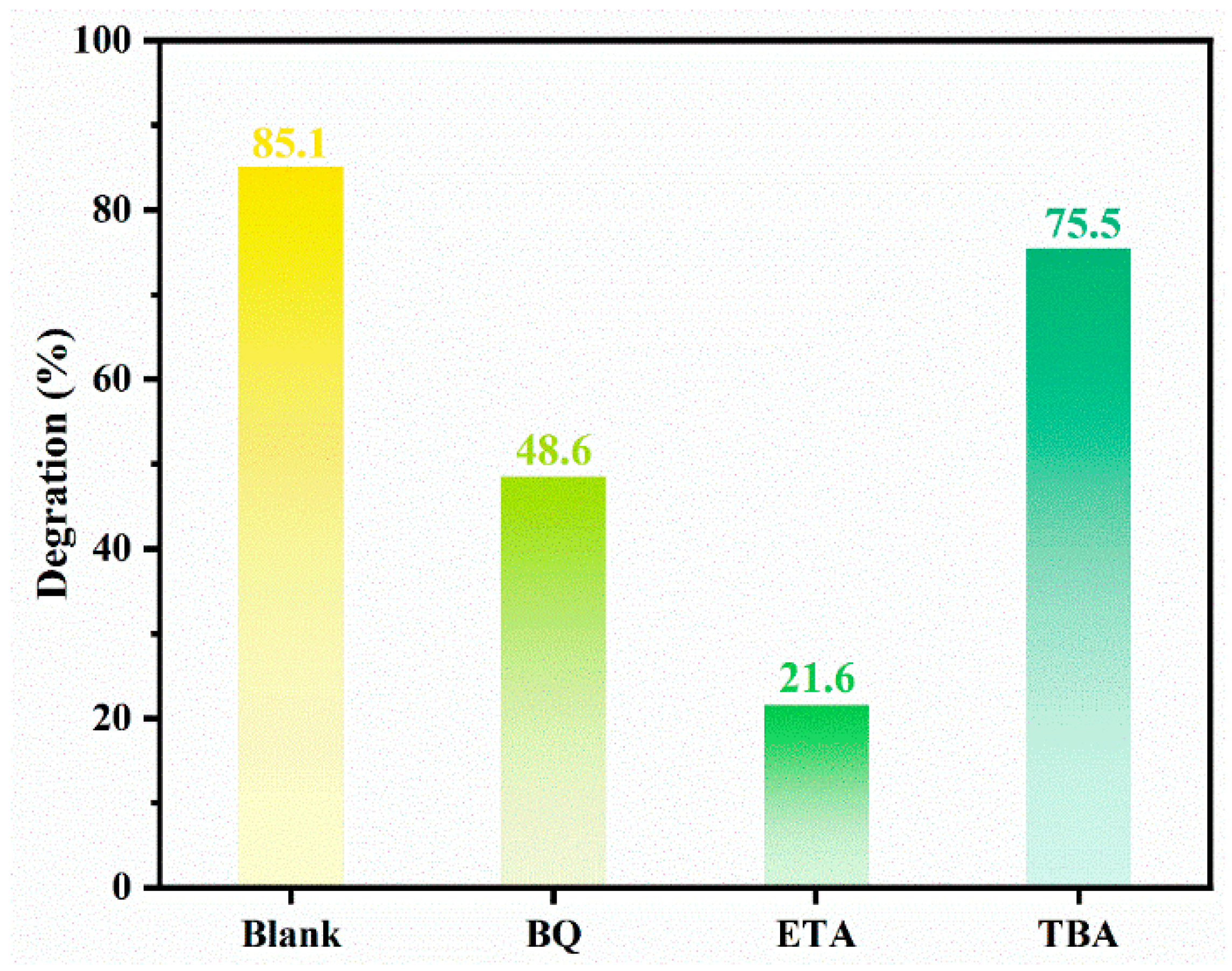
The roles of different reactive species in RhB photodegradation over BMO were investigated through radical trapping experiments. Using benzoquinone, triethanolamine, and tributyrin as quenchers, the superoxide radical ·O2, photogenerated hole h+, and hydroxyl radical ·OH generated during the photocatalytic degradation of RhB using 15% CN/BMO were sequentially captured [73,74]. As depicted in Figure 8, when phenanthrenequinone and triethanolamine were added to the reaction solution, the degradation rate of RhB using 15% CN/BMO decreased from the original 85.1% to 48.6% and 21.6%, respectively. Upon addition of butanol, the degradation rate of RhB using 15% CN/BMO only decreased to 75.5%. This indicates that superoxide radicals ·O2 and photogenerated holes h+ jointly play crucial roles in the photodegradation of RhB using 15% CN/BMO, with photogenerated holes h+ being particularly significant. In contrast, the hydroxyl radical exhibits negligible activity, suggesting that its radical does not participate in this photodegradation process.
Based on the experimental results described above, we propose the CN/BMO photocatalytic mechanism to elucidate the charge transfer mechanism during the catalytic degradation of RhB via the CN/BMO heterojunction. As illustrated in Figure 9, given the excellent band structure compatibility between CN and BMO, both materials generate photogenerated electrons and holes upon sunlight irradiation, located in their respective conduction and valence bands. Due to the more negative conduction band of CN and the more positive valence band of BMO, an interfacial electric field develops at the heterojunction [75]. This field directs electron flow from CN to BMO, where electrons reduce O2 to superoxide radicals (·O2). Concurrently, holes migrate from BMO to CN, facilitating direct oxidation or hydroxyl radical (·OH) generation. This synergistic charge separation effectively suppresses recombination while preserving redox capacity, enabling reactive species (·O2, h+, and ·OH) to work in concert for efficient RhB degradation and mineralization.

3. Experimental Section

3.1. Chemical Reagents

Bismuth (III) nitrate pentahydrate (Bi(NO3)3·5H2O, 99.0%) was sourced from Tianjin Damiao Chemical Reagent Factory. Ammonium molybdate ((NH4)2MoO4, analytical grade) was purchased from Tianjin Yongda Chemical Reagent Co., Ltd, Tianjin, China. Sinopharm Chemical Reagent Co., Ltd. (Shanghai, China) supplied nitric acid (HNO3, analytical grade), ethylene glycol (C2H6O2, analytical grade), and melamine (C3H6N6, analytical grade). Anhydrous ethanol (C2H6O, analytical grade) was sourced from Shanghai Wokai Biotechnology Co., Ltd, Shanghai, China.

3.2. Synthesis of CN/BMO Composite Materials

Solvothermal g-C3N4 was first prepared via a thermal polymerization method. Specifically, a suitable amount of melamine precursor was placed in a quartz boat and calcined in a muffle furnace at 550 °C for 2 h. The resulting product was ground into a fine powder, repeatedly washed with deionized water and anhydrous ethanol, and then dried at 80 °C to obtain a yellow CN powder.
For the synthesis of CN/BMO composites, 9.70 g of bismuth nitrate and 1.96 g of ammonium molybdate were dissolved in 60 mL of ethylene glycol under stirring. Subsequently, the as-prepared CN powder was added to the solution at different mass ratios relative to BMO, corresponding to nominal CN loadings of 5 wt%, 15 wt%, and 25 wt%. The mixture was continuously stirred and then transferred to a tube furnace, where it was reacted at 550 °C for 20 min. Finally, a series of CN/BMO composite samples with CN mass ratios of 0%, 5%, 15%, and 25% were obtained.

3.3. Characterizations

The crystalline phases of the samples were investigated by X-ray diffraction (XRD) on a Rigaku SmartLab SE instrument (Cu target, Tokyo, Japan) at a scanning speed of 20° min−1 and a step increment of 0.02°. Morphological characterization was performed using a Japanese Hitachi Novanano 450 scanning electron microscope (operating voltage 4.0 kV; Hitachi, Tokyo, Japan) and an American Thermo Fisher Talos F200X transmission electron microscope (Thermo Fisher Scientific, Waltham, MA, USA). Surface element chemical states were determined using a Thermo Fisher ESCALAB 250Xi X-ray photoelectron spectrometer (Thermo Fisher Scientific, Waltham, MA, USA). Particle size distribution data were obtained from a PSS Nicomp380Z3000 laser particle size analyzer (China Center of Excellence, Los Angeles, CA, USA). Optical properties were tested using a Hitachi U3900-UV-Vis spectrophotometer (Hitachi, Tokyo, Japan): solid samples were scanned for diffuse reflectance over 300–700 nm at 300 nm/min. In the photocatalytic experiments, Rhodamine B was used as the degradation target; it was monitored at 450–650 nm with consistent scanning rates. Infrared spectral data were acquired using a Thermo Fisher IS10 Fourier Transform Infrared Spectrometer (Thermo Fisher Scientific, Waltham, MA, USA). To investigate the separation behavior of photogenerated charge carriers, fluorescence spectra were collected from 300 to 600 nm under 300 nm excitation to evaluate photogenerated electron–hole pair separation. Additionally, functional groups were identified by FTIR spectroscopy using the KBr pellet method in the 400–4000 cm−1 region.

3.4. Evaluation of Photocatalytic Oxidation Activity Toward RhB

Visible-light-driven photocatalytic experiments were conducted on both bare BMO and the CN/BMO composite using a 500 W xenon lamp (λ ≥ 420 nm, Guangzhou Yuye Light Source Manufacturing, Guangzhou, China) with a light intensity of 520 mW/cm2. Experiments were conducted at ambient temperature to eliminate thermal interference. The procedure was as follows: A total of 0.2 g of catalyst was placed in a reaction vessel with 50 mL of 10 mg/L RhB solution. Prior to irradiation, the suspension was stirred in the dark for 30 min to attain adsorption equilibrium, and a 5 mL portion was then taken as the reference sample. After activating the xenon lamp, samples were collected at 10 min intervals until a total of five measurements had been taken. Each sample underwent 5 min of high-speed centrifugation, followed by analysis of the supernatant using a U-3900 UV-visible spectrophotometer.

3.5. Photoelectrochemical Properties

Using a CHI760E electrochemical workstation (Shanghai Chenhua Instrument, Shanghai, China), the samples were characterized by EIS, photocurrent, and Mott–Schottky measurements in a three-electrode cell (Pt wire counter electrode, Ag/AgCl reference, 0.5 M Na2SO4 electrolyte). Working electrodes were fabricated by coating an ultrasonically dispersed slurry of 10 mg sample in 2 mL H2O onto ITO glass (1 × 2 cm2), followed by drying at 60 °C for 6 h. Photocurrent tests employed chopped illumination with 30 s intervals. During photocurrent testing, an intermittent illumination mode was employed, controlling the light source on/off cycle at 30 s intervals.

4. Conclusions

In this study, we employed low-cost, environmentally friendly CN as a modifier to prepare CN/BMO heterojunction photocatalysts using a simple method. With this approach, triple modification effects were achieved: heterostructure construction, specific surface area regulation, and enhanced photogenerated charge separation efficiency. The incorporation of CN effectively mitigated BMO agglomeration. The specific surface area of 15% CN/BMO increased by 7.73-fold compared with that of pure BMO, exhibiting a significant red shift in the visible absorption edge and a narrowed bandgap. The bandgap matching effect of the heterojunction substantially suppressed photogenerated carrier recombination. Under visible light, the 15% CN/BMO composite achieved an 85.1% degradation rate of RhB within 60 min, representing a 1.6-fold improvement over pure BMO (52.9%). Crucially, its catalytic performance and crystal structure remained stable after five cycles. Quenching experiments confirmed that the core active species for Rhodamine B degradation in this composite are photogenerated holes, h+, and superoxide radicals, ·O2, which synergistically achieve the efficient decomposition of organic pollutants. The developed modification strategy features a simple process and low cost, offering a novel approach for preparing highly efficient and stable visible-light-driven photocatalysts. The resulting material shows promising applications in solar-driven water purification.

Supplementary Materials

The following supporting information can be downloaded at: https://www.mdpi.com/article/10.3390/inorganics14030070/s1, Figure S1: Adsorption of RhB by the sample under dark conditions.

Author Contributions

Conceptualization, Q.W. and J.W.; methodology and validation Q.W., D.W. (Dazhang Wang) and C.X.; formal analysis, Q.W., J.G. and D.W. (Dong Wang); data curation, Q.W. and J.W.; writing—original draft preparation, Q.W.; writing—review and editing, J.W., C.F. and D.W. (Dong Wang); funding acquisition, J.G. All authors have read and agreed to the published version of the manuscript.

Funding

This work was supported by the Excellent Innovative Scientific Research Team of Silicon-Based Materials (2022AH010101), the Scientific Research Team for Controllable Design and Application of Functional Powder Materials (2025XKJCTD02), and the Key Scientific Research Project of Bengbu University (2022ZR01zd).

Data Availability Statement

The original contributions presented in this study are included in the article/Supplementary Material. Further inquiries can be directed to the corresponding authors.

Conflicts of Interest

Author Jinlei Wang and Dong Wang were employed by the company of CNBM Research Institute for Advanced Glass Materials Group Co., Ltd.. The remaining authors declare that the research was conducted in the absence of any commercial or financial relationships that could be construed as a potential conflict of interest.

References

  1. Feng, F.X.; Zhu, Z.M.; Li, J.L.; Su, S.; Dong, G.L.; Wang, G.H.; Liu, X.B.; Han, R.L. In-situ grown electrospun PI/BiOCl nanofiber membranes for efficient photocatalytic degradation of antibiotics. J. Photochem. Photobiol. A Chem. 2026, 474, 117014. [Google Scholar] [CrossRef]
  2. Yang, P.Y.; Chen, J.Q.; Guo, Y.Q.; Yan, Y.P.; Jiang, G.J.; Zhang, Q.; Li, Y. La-loaded BiOBr enhances photocatalytic nitrogen fixation activity by reducing energy barriers for ammonia release. J. Environ. Chem. Eng. 2026, 14, 121317. [Google Scholar] [CrossRef]
  3. Liu, Y.F.; Guo, R.T.; Guo, S.H.; Yu, L.Q.; Yan, J.S.; Pan, W.G. Recent progress of piezoelectric materials applied in photocatalytic CO2 reduction: A review. J. Environ. Chem. Eng. 2024, 12, 114782. [Google Scholar] [CrossRef]
  4. Zhan, N.; Geng, J.; Jiang, P.; Wang, A.; Yu, Y.; Yu, F.K.; Yang, Z. Enhanced Photocatalytic Antibacterial Property by Regulating the Built-In Electric Field of BiV4 with the Piezoelectric Mineral Tourmaline. Inorganics 2025, 13, 408. [Google Scholar] [CrossRef]
  5. Liu, Q.H.; Zhang, R.Q.; Zhao, X.J.; Zhao, X.Y.; Li, H.S.; Zhang, D.F.; Liu, J.C.; Chen, Z.; Pu, X.P. Boosting the photocatalytic hydrogen evolution of snowflake Cu2S/ZnWO4 through morphology control and construction of p-n heterojunction. J. Colloid Interface Sci. 2026, 708, 139859. [Google Scholar] [CrossRef]
  6. Cao, C.S.; Dong, H.L.; Chen, R.; Wang, D.; Liu, D.; Kuvarega, A.T.; Mamba, B.B.; Gui, J.Z. Embedding Z-scheme heterojunction for enhancing charge transfer in PCN-224/Bi2MoO6 composites as efficient visible-light-driven catalysts. J. Environ. Chem. Eng. 2025, 13, 120222. [Google Scholar] [CrossRef]
  7. Zhang, Y.L.; Zhang, H.L.; Shu, Y.X.; Zhao, Y.C.; Wang, X.B.; Xiao, R.H.; Zhang, J.Y. Synthesis and testing of carbon quantum dots loaded 2D Bi2MoO6 for efficient Hg0 photocatalytic removal. Appl. Surf. Sci. 2023, 633, 157587. [Google Scholar] [CrossRef]
  8. Li, N.B.; Yang, P.X.; Xiao, Y.Y.; Liu, J.Y.; Zhao, R. Photoelectrocatalytic ammonia synthesis through a Bi2MoO6@CuO/CF composite photocatalyst. J. Alloys Compd. 2024, 1006, 176343. [Google Scholar] [CrossRef]
  9. Zhao, B.X.; Xing, Y.L.; Xue, Y.R.; Chen, N.; Sun, C.J.; Li, M.F.; Shi, H.X.; Ma, B.R.; Wang, S.X.; Tang, Y.Z.; et al. Efficient degradation of dye wastewater with a novel tribocatalytic process initiated by CQDs-Bi2MoO6 catalyst: Preparation, degradation, kinetics, DFT calculations and mechanism. Chem. Eng. J. 2025, 511, 161852. [Google Scholar] [CrossRef]
  10. Chankhanittha, T.; Johnson, B.; Bushby, R.J.; Butburee, T.; Khemthong, P.; Nanan, S. One-pot hydrothermal synthesis of g-C3N4/BiOBr/Bi2MoO6 as a Z-scheme heterojunction for efficient photocatalytic degradation of ciprofloxacin (CIP) antibiotic and Rhodamine B (RhB) dye. J. Alloys Compd. 2024, 1008, 176764. [Google Scholar] [CrossRef]
  11. Wang, D.Y.; Li, K.; Zhou, C.; Lei, L.; de Rancourt de Mimerand, Y.; Jin, X.Y.; Guo, J. Bi2MoO6 and Ag nanoparticles immobilized on textile by plasma-derived innovative techniques to generate antimicrobial activity. Appl. Surf. Sci. 2022, 585, 152591. [Google Scholar] [CrossRef]
  12. Li, J.M.; Chen, C.H.; Bai, J.W.; Jin, Y.H.; Guo, C.F. Boosting of the piezoelectric photocatalytic performance of Bi2MoO6 by Fe3+ doping and construction S-scheme heterojunction using WO3. J. Colloid Interface Sci. 2025, 683, 574–584. [Google Scholar] [PubMed]
  13. Lyu, M.J.; Wang, C.M.; Rong, Y.Z.; Wei, J.W.; Yang, Y.K.; Liu, Y.Y.; Wei, G.X.; Zhang, Q.; Wang, C.; Xiu, J.S. Advances in modification of Bi2MoO6 and its photocatalysis: A review. J. Alloys Compd. 2024, 982, 173759. [Google Scholar] [CrossRef]
  14. Lin, Z.X.; Xu, J.; Gu, H.J.; Huang, J.Y.; Lin, J.H.; Shao, J.; Wang, D.D.; Li, H.J. A review on research progress in photocatalytic degradation of organic pollutants by Bi2MoO6. J. Environ. Chem. Eng. 2023, 11, 110911. [Google Scholar] [CrossRef]
  15. Cui, X.W.; Huang, C.; Sun, S.Z.; Guo, J.Y.; Zhang, W.D.; Wang, Z.W.; Song, Y.J. Cooperative surface multifunctional sites of Pd/Bi2MoO6 nanosheets for precise synthesis of Schiff bases via one-pot photocatalytic coupling of benzyl alcohol and nitrobenzene. Mol. Catal. 2024, 564, 114329. [Google Scholar]
  16. Wang, J.F.; Zhao, C.R.; Yuan, S.D.; Li, X.J.; Zhang, J.Y.; Hu, X.; Lin, H.J.; Wu, Y.; He, Y.M. One-step fabrication of Cu-doped Bi2MoO6 microflower for enhancing performance in photocatalytic nitrogen fixation. J. Colloid Interface Sci. 2023, 638, 427–438. [Google Scholar] [CrossRef]
  17. Suebsom, P.; Phuruangrat, A.; Suwanboon, S.; Thongtem, S.; Thongtem, T. Enhanced visible-light-driven photocatalytic activity of heterostructure Ag/Bi2MoO6 nanocomposites synthesized by photoreduction method. Inorg. Chem. Commun. 2020, 119, 108120. [Google Scholar]
  18. Li, B.L.; Pan, T.; Yu, S.N.; Wang, X.Y.; Li, B.S.; Chen, C.; Shen, L.G.; Teng, J.H.; Zhou, M.Z.; Lin, H.J. Synergistic enhancement of singlet oxygen generation in Au and oxygen vacancy co-modified Bi2MoO6 ultrathin nanosheets for efficient ciprofloxacin degradation. Sep. Purif. Technol. 2025, 354, 129321. [Google Scholar] [CrossRef]
  19. Pradhan, S.K.; Bariki, R.; Kumar, A.; Nayak, S.K.; Panda, S.; Das, N.K.; Mishra, B.G. In situ fabrication of oxygen deficient Bi2MoO6/InVO4/CeVO4 dual S-scheme ternary heterostructure for robust photocatalytic H2 and H2O2 production. Surf. Interfaces 2024, 52, 104824. [Google Scholar]
  20. Wang, R.X.; Zhu, P.F.; Duan, M.; Xu, J.; Liu, M.; Luo, D. Synthesis and characterization of successive Z-scheme CdS/Bi2MoO6/BiOBr heterojunction photocatalyst with efficient performance for antibiotic degradation. J. Alloys Compd. 2021, 870, 159385. [Google Scholar] [CrossRef]
  21. Qi, S.Y.; Wu, S.Q.; Zhang, K.Y.; Guan, L.; Hu, X.; Li, H.Y. Design, preparation and mechanism of Bi2MoO6-modified cobalt-doped CdS solid solution photocatalysts. J. Alloys Compd. 2024, 1003, 175565. [Google Scholar] [CrossRef]
  22. Wu, Y.H.; He, J.P.; Liu, Y.; Ma, X.H.; Li, S.B.; Guo, G.B.; Su, Y.G.; Song, M.T. Construction of Bi2MoO6/CdS S-scheme heterojunction for highly efficiency photocatalytic reduction of Cr(VI) under visible light. J. Water Process Eng. 2025, 69, 106693. [Google Scholar] [CrossRef]
  23. Wang, Z.S.; Li, J.L.; Fu, S.S.; Guo, D.X.; Tang, J.; Yang, X.; Xu, R.P.; Sui, G.Z.; Chen, S.J. Construction of MoS2/CdS/Bi2MoO6 Z-scheme photocatalyst for efficient photocatalytic degradation under visible-light. J. Solid State Chem. 2023, 322, 123957. [Google Scholar] [CrossRef]
  24. Banerjee, B.; Chakrabortty, P.; Haque, N.; Ghosh, S.; Sarkar, M.; Khan, A.; Islam, S.M. AgNPs Embedded in Porous Polymeric Framework: A Reusable Catalytic System for the Synthesis of α-Alkylidene Cyclic Carbonates and Oxazolidinones via Chemical Fixation of CO2. Catalysts 2023, 13, 1467. [Google Scholar] [CrossRef]
  25. Chen, R.S.; Hu, R.R.; Gao, L.S.; Wei, H.Z.; Zhao, S.Q.; Liu, X.Y.; Li, X.X.; Xu, A.H. Synergistic photocatalytic activation of permanganate by carbon quantum dots-doped g-C3N4 under visible light irradiation. J. Environ. Chem. Eng. 2025, 13, 117162. [Google Scholar] [CrossRef]
  26. Farid, J.; Kadhimi, H.; Al-Jubouri, A. The role of two-dimensional materials (graphene, g-C3N4, and MXene) in enhancing photocatalytic performance: A review. Inorg. Chem. Commun. 2026, 184, 115981. [Google Scholar] [CrossRef]
  27. Ayodhya, D. g-C3N4 based mixed metal/semiconductor heterojunction nanocomposites towards photocatalytic water splitting for hydrogen production: A review. Rev. Mater. Res. 2025, 1, 100116. [Google Scholar] [CrossRef]
  28. Girma, S.; Taddesse, A.M.; Bogale, Y.; Bezu, Z. Zeolite-supported g-C3N4/ZnO/CeO2 nanocomposite: Synthesis, characterization and photocatalytic activity study for methylene blue dye degradation. J. Photochem. Photobiol. A Chem. 2023, 444, 114963. [Google Scholar] [CrossRef]
  29. Shenoy, S.; Chuaiacham, C.; Sekar, K.; Sasaki, K. Seamless carbon nitride growth on bimetallic oxide for antibiotic residue degradation. Environ. Chem. Lett. 2025, 23, 33–39. [Google Scholar] [CrossRef]
  30. Gandamalla, A.; Manchala, S.; Verma, A.; Fu, Y.P.; Shanker, V. Development of highly efficient Ce(MoO4)2/g-C3N4 composite for the photocatalytic degradation of methylene blue and ciprofloxacin under visible light. J. Mol. Struct. 2024, 1297, 136896. [Google Scholar] [CrossRef]
  31. Shenoy, S.; Farahat, M.M.; Chuaicham, C.; Sekar, K.; Ramasamy, B.; Sasaki, K. Mixed-phase Fe2O3 derived from natural hematite Ores/C3N4 Z-scheme photocatalyst for ofloxacin removal. Catalyst 2023, 13, 792. [Google Scholar] [CrossRef]
  32. Shanmugam, V.; Muppudathi, A.L.; Jayavel, S.; Jeyaperumal, K.S. Construction of high efficient g-C3N4 nanosheets combined with Bi2MoO6-Ag photocatalysts for visible-light-driven photocatalytic activity and inactivation of bacterias. Arab. J. Chem. 2020, 13, 2439–2455. [Google Scholar] [CrossRef]
  33. Wang, Q.Q.; Ge, J.L.; Liu, W.; Zhang, H.Y.; Li, R.C. Influence of Preparation Method on Structure and Photocatalytic Performance of Bi2MoO6. Catalysts 2025, 15, 198. [Google Scholar] [CrossRef]
  34. He, W.J.; Wei, Y.C.; Xiong, J.; Tang, Z.L.; Wang, Y.L.; Wang, X.; Xu, H.; Zhang, X.; Yu, X.L.; Zhao, Z.; et al. Variable valence Mo5+/Mo6+ ionic bridge in hollow spherical g-C3N4/Bi2MoO6 catalysts for promoting selective visible light-driven CO2 photoreduction into CO. J. Energy Chem. 2023, 80, 361–372. [Google Scholar] [CrossRef]
  35. Dong, S.Y.; Liu, X.D.; Tian, G.G.; Wang, Y.; Jin, G.G.; Zhao, Y.L.; Sun, J.H.; Fan, M.H. Surface oxygen vacancies modified Bi2MoO6 double-layer spheres: Enhanced visible LED light photocatalytic activity for ciprofloxacin degradation. J. Alloys Compd. 2022, 892, 162217. [Google Scholar] [CrossRef]
  36. Qin, Y.M.; Qin, L.L.; Zhu, Z.; Lu, H.R.; Yang, T.; Liu, Y.L.; Zhang, Q.Q.; Liang, W.Y. Binary regulation of photoelectron-heterojunction Sg-CN/BMO using sulfur-doping and oxygen vacancy construction for boosting chloroquine degradation. Sep. Purif. Technol. 2023, 325, 124602. [Google Scholar]
  37. Liang, X.Y.; Zhao, D.; Dong, Y.M.; Fan, S.Q.; Yue, X.H.; Qin, J.M. Activation of MnOOH/γ-Bi2MoO6 composites for RhB degradation by peroxymonosulfate. J. Water Process Eng. 2025, 79, 109053. [Google Scholar]
  38. Yang, X.W.; Cai, T.X.; Yao, Z.R.; Chao, G.J. Layered borophene maximizes the active sites in in-situ synthesized Bi2MoO6/BiVO4 heterostructures towards high-performance supercapacitors and efficient photocatalysts. Ceram. Int. 2025, 51, 39812–39824. [Google Scholar] [CrossRef]
  39. Lan, Y.L.; Kong, Q.P.; Wang, D.X.; Ren, D.D.; Fang, Z.L.; Zhang, W.Q.; Chang, Q.; Li, B.Y.; Liu, J.; Xiao, L.P. Construction of highly efficient 0D/2D Bi2MoO6/g-C3N4 heterojunctions for visible light driven photodegradation of 1 naphthol. Ceram. Int. 2023, 49, 2149–2156. [Google Scholar]
  40. Di, G.L.; Zhu, Z.L.; Zhang, H.; Qiu, Y.L.; Yin, D.Q.; Crittenden, J. Simultaneous sulfamethazine oxidation and bromate reduction by Pd mediated Z scheme Bi2MoO6/g-C3N4 photocatalysts: Synergetic mechanism and degradative pathway. Chem. Eng. J. 2020, 401, 126061. [Google Scholar] [CrossRef]
  41. Kistan, A.; Narmatha, S.; Chitra, M.; Mayavan, L. A novel mesoporous Bi2MoO6/g-C3N4 nanocomposite as an effective photocatalyst against toxic organic pollutants. Diam. Relat. Mater. 2025, 151, 111841. [Google Scholar] [CrossRef]
  42. Fan, Y.X.; Xiong, J.H.; Cai, Y.X.; Huang, S.Z.; Liang, Y.N.; Jiang, S.F.; Chen, G.N. Bi2MoO6/g-C3N4 S-type heterojunction with oxygen vacancies for enhanced removal of ciprofloxacin: Investigation of degradation efficiency and mechanism. J. Water Process Eng. 2025, 71, 107157. [Google Scholar] [CrossRef]
  43. Ahmad, I.; Danish, M.; Athar, M.S.; Waris; Muneer, M. Design and construction of a double Z-scheme CdS@g-C3N4/Bi2MoO6 ternary nanocomposite: Photocatalytic degradation in visible light, adsorption and electrochemical applications. Mater. Chem. Phys. 2023, 307, 128125. [Google Scholar] [CrossRef]
  44. Kóth, J.; Sinkó, K. Removal of organic contamination by visible light photocatalytic-adsorption effect. J. Mol. Liq. 2026, 446, 129312. [Google Scholar] [CrossRef]
  45. Zhang, H.N.; Zhang, Z.Q.; Tian, L.H.; Han, J.P.; Zhao, Y.; Wei, Z.Q.; Wu, Z.G.; Cao, Y. Preparation of BiVO4/BiOI/ACF photocatalysts and their adsorption-photocatalytic synergistic degradation of phenol. J. Water Process Eng. 2025, 80, 109098. [Google Scholar] [CrossRef]
  46. Koumeir, D.; Yammine, P.; Riachi, N.; Ezzeddine, D.; Elzakhem, H.; Zakhem, M.; Hleis, D.; El-Nakat, H.; Chmayssem, A. Amlodipine besylate photocatalytic degradation using titanium dioxide: Adsorption isotherms and kinetics. Desalin. Water Treat. 2025, 323, 101346. [Google Scholar] [CrossRef]
  47. Zhang, Y.X.; Wang, M.M.; Chen, D.Y.; Li, N.J.; Xu, Q.F.; Li, H.; Lu, J.M. Ternary heterojunction of cross-linked benzene Polymer/Bi2MoO6-Graphene oxide catalysts promote efficient adsorption and photocatalytic removal of oxytetracycline. J. Colloid Interface Sci. 2024, 668, 437–447. [Google Scholar] [CrossRef]
  48. Rohilla, P.; Pal, B.; Das, R.K. Construction of a Bi-doped g-C3N4/Bi2MoO6 ternary nanocomposite for the effective photodegradation of ofloxacin under visible light irradiation. RSC Adv. 2025, 15, 2347. [Google Scholar] [CrossRef]
  49. Yang, R.F.; Li, C.Q.; Yuan, F.; Wu, C.P.; Sun, Z.M.; Ma, R.X. Synergistic effect of diatomite and Bi self-doping Bi2MoO6 on visible light photodegradation of formaldehyde. Microporous Mesoporous Mater. 2022, 339, 112003. [Google Scholar] [CrossRef]
  50. Zhang, L.L.; Wang, Z.Q.; Hu, C.; Shi, B.Y. Enhanced photocatalytic performance by the synergy of Bi vacancies and Bi0 in Bi0-Bi2-δMoO6. Appl. Catal. B Environ. 2019, 257, 117785. [Google Scholar] [CrossRef]
  51. Masoud, A.; Ahmed, M.A.; Kühn, F.; Bassioni, G. Nanosheet g-C3N4 enhanced by Bi2MoO6 for highly efficient photocatalysts toward photodegradation of Rhodamine-B dye. Heliyon 2023, 9, e22342. [Google Scholar] [CrossRef]
  52. Li, Q.Q.; Zhao, W.L.; Zhai, Z.C.; Ren, K.X.; Wang, T.Y.; Guan, H.; Shi, H.F. 2D/2D Bi2MoO6/g-C3N4 S-scheme heterojunction photocatalyst with enhanced visible-light activity by Au loading. J. Mater. Sci. Technol. 2020, 56, 216–226. [Google Scholar]
  53. Duong, T.T.H.; Ding, S.; Sebek, M.; Lund, H.; Bartling, S.; Peppel, T.; Le, T.S.; Steinfeldt, N. Effect of Bi2MoO6 Morphology on Adsorption and Visible–Light–Driven Degradation of 2,4-Dichlorophenoxyacetic Acid. Molecules 2024, 29, 3255. [Google Scholar]
  54. Ortelli, S.; Faccani, L.; Ercolani, E.; Zanoni, I.; Artusi, C.; Blosi, M.; Albonetti, S.; Costa, A.L. Design and Properties of Titanium Dioxide/Graphene Oxide Composites Exploitable in Wastewater Treatments. Water 2025, 17, 1809. [Google Scholar] [CrossRef]
  55. Wang, D.J.; Shen, H.D.; Guo, L.; Wang, C.; Fu, F. Porous BiOBr/ Bi2MoO6 Heterostructures for Highly Selective Adsorption of Methylene Blue. ACS Omega 2016, 1, 566−577. [Google Scholar] [CrossRef]
  56. Nguyen, C.T.H.; Nguyen, K.T.; Nguyen, B.Q.; Pham, C.N.; Ngo, Q.V.; Dao, H.N.; Luu, H.T.V.; Nguyen, M.V.N.; Dao, N.N. Synthesis of monoclinic clinobisvanite BiVO4 for effective visible-light degradation of antibiotics in water: Photocatalytic performance, reaction kinetics, and mechanism. Powder Technol. 2025, 453, 120650. [Google Scholar] [CrossRef]
  57. Liu, Q.L.; Yu, Z.; Liang, D.M.; Xiong, J.; Gan, T.; Hu, H.Y.; Huang, Z.Q.; Zhang, Y.J. Elemental imprinting-induced interfacial growth strategy to bridge g-C3N4 and Bi2MoO6 with engineering rapid electron transfer pathway for efficient visible light-driven photocatalysis. Chem. Eng. J. 2024, 496, 154057. [Google Scholar] [CrossRef]
  58. Wu, S.S.; Yi, B.; Lan, D.H. Fabrication of Bi2MoO6/g-C3N4 visible-light driven photocatalyst for enhanced tetracycline degradation. J. Photochem. Photobiol. A Chem. 2023, 444, 115013. [Google Scholar] [CrossRef]
  59. Chen, R.J.; Wang, L.; Ding, J.; Zhang, J.F.; Wan, H.; Guan, G.F. Microwave-assisted construction of Bi2MoO6/g-C3N4 heterostructure for boosting photocatalytic CO2 conversion. J. Alloys Compd. 2023, 960, 170605. [Google Scholar] [CrossRef]
  60. Yang, M.M.; Jia, T.P.; An, X.H.; Wang, J.; Han, C.X.; Yang, S.; Meng, Q.Q.; Zhang, H.Y.; Wu, A.P. Sulfonic-acid-bridged 2D/2D g-C3N4/Bi2MoO6 heterojunctions for efficient photocatalytic degradation of tetracycline hydrochloride and toxicity assessment. Opt. Mater. 2026, 173, 117869. [Google Scholar] [CrossRef]
  61. Le, P.T.; Nguyen, T.P.; Nguyen, H.N.; Tran, T.H.; Do, T.H.; Phan, T.T.; Dinh, T.M.T.; Tsubota, T.; Nguyen, V.D.; Nguyen, T.D. Z-scheme Bi2MoO6/g-C3N4 heterojunction for efficient antibiotic degradation via persulfate activation under visible light. Water Sci. Eng. 2025, 18, 515–526. [Google Scholar] [CrossRef]
  62. Yin, Y.; Li, F.; Zhan, Q.F.; Jiang, D.M.; Chen, R.Z. Synthesis of δ-Bi2O3/Bi2MoO6 composites with enhanced photocatalytic activity by hydrothermal method. Mater. Res. Bull. 2018, 103, 47–54. [Google Scholar] [CrossRef]
  63. Xing, Y.X.; Cheng, R.Q.; Li, H.P.; Liu, Z.L.; Du, C.F. Mannitol-assisted synthesis of ultrathin Bi2MoO6 architectures: Excellent selective adsorption and photocatalytic performance. J. Nanoparticle Res. 2019, 21, 40. [Google Scholar] [CrossRef]
  64. Sun, H.H.; Zou, C.J.; Tang, W.Y. Designing double Z-scheme heterojunction of g-C3N4/Bi2MoO6/Bi2WO6 for efficient visible-light photocatalysis of organic pollutants. Colloids Surf. A Physicochem. Eng. Asp. 2022, 654, 130105. [Google Scholar] [CrossRef]
  65. Wang, Y.Z.; Xing, Z.P.; Yang, Y.; Kong, W.F.; Wu, C.X.; Peng, H.; Li, Z.Z.; Xie, Y.; Zhou, W. Oxygen-Defective Bi2MoO6/g-C3N4 hollow tubulars S-scheme heterojunctions toward optimized photocatalytic performance. J. Colloid Interface Sci. 2024, 653, 1566–1576. [Google Scholar] [CrossRef] [PubMed]
  66. Bagri, A.; Gopal, V.; Reddy, H.P.; Estili, M.; Selvaraj, A. Photocatalytic treatment of agricultural runoff water using Bi2O3-ZrO2: A novel approach to mitigating persistent organic pollutants and nutrient contaminants. J. Environ. Chem. Eng. 2025, 13, 116620. [Google Scholar] [CrossRef]
  67. Ito, M.; Fukahori, S.; Fujiwara, T. Adsorptive removal and photocatalytic decomposition of sulfamethazine in secondary effluent using TiO2-zeolite composites. Environ. Sci. Pollut. Res. 2014, 21, 834–842. [Google Scholar] [CrossRef] [PubMed]
  68. Nanda, B.; Pradhan, A.C.; Parida, K.M. Fabrication of mesoporous CuO/ZrO2-MCM-41 nanocomposites for photocatalytic reduction of Cr (VI). Chem. Eng. J. 2017, 316, 1122–1135. [Google Scholar] [CrossRef]
  69. Sheik Moideen Thaha, S.K.; Sathishkumar, P.; Mangalaraja, R.V.; Basavegowda, N. Harnessing multi-frequency ultrasound and visible-light for enhanced bisphenol (A/F) mineralization in presence of ultra-small Bi/Bi2MoO6/MXene/g-C3N4 nanocomposites—Energy consumption and toxicity analyses. Chem. Eng. J. 2025, 525, 169837. [Google Scholar] [CrossRef]
  70. Ravankhah, N.; Rezaei, M.R.; Pirsaheb, M.; Asadi, A. Photocatalytic activation of peroxymonosulfate by Bi2WO6/Fe3O4/ZrO2 magnetic composite for degradation of cloxacillin, moxifloxacin, and azithromycin antibiotics under visible LED light irradiation. J. Water Process Eng. 2025, 74, 107791. [Google Scholar] [CrossRef]
  71. Liu, W.; Hu, W.N. Green fabrication of h-BN/g-C3N4 with efficient holes transfer towards highly improved photocatalytic CO2 reduction and RhB degradation. Mater. Charact. 2022, 191, 112165. [Google Scholar] [CrossRef]
  72. Wang, Q.Y.; Zhao, Y.H.; Zhang, Z.F.; Liao, S.W.; Deng, Y.D.; Wang, X.; Ye, Q.L.; Wang, K.S. Facile synthesis of Bi2WO6/Bi2MoO6 Z-scheme heterojunction for dye degradation and Cr (VI) reduction. J. Mol. Liq. 2023, 383, 122164. [Google Scholar] [CrossRef]
  73. Shi, H.X.; Wang, C.J.; Wang, W.; Hu, X.Y.; Fan, J.; Tang, Z.S. The enhanced visible light driven photocatalytic inactivation of Escherichia coli with Z-Scheme Bi2O3/Bi2MoO6 heterojunction and mechanism insight. Ceram. Int. 2021, 47, 7974–7984. [Google Scholar] [CrossRef]
  74. Ju, P.; Zhang, Y.; Hao, L.; Cao, J.Z.; Dou, K.P.; Jiang, F.H.; Sun, C.J. Facile in-situ construction of plate-on-plate structured Bi2MoO6/BiOI Z-scheme heterojunctions enriched with oxygen vacancies for highly efficient photocatalytic performances. Appl. Surf. Sci. 2022, 602, 154319. [Google Scholar] [CrossRef]
  75. Zheng, J.; Liu, J.C.; Feng, X.Y.; Luo, Y.J.; Cai, W.; Liao, Z.W.; Fang, Y.X. One-step fabrication of Bi2MoO6 nanowires-g-C3N4 composites for outstanding photocatalytic performance in cyclohexane oxidation. J. Alloys Compd. 2025, 1010, 177367. [Google Scholar] [CrossRef]
Figure 1. SEM images of (a) CN, (b) BMO, and (c) 15% CN/BMO; TEM images of (d) CN, (e) BMO, and (f) 15% CN/BMO; and HRTEM images of (g) 15% CN/BMO.
Inorganics 14 00070 g001
Figure 2. XRD of CN, BMO, and CN/BMO.
Inorganics 14 00070 g002
Figure 3. FT-IR spectra of photocatalysts with different ratios.
Inorganics 14 00070 g003
Figure 4. N2 adsorption–desorption isotherms of CN/BMO composite samples.
Inorganics 14 00070 g004
Figure 5. XPS spectra of (a) survey, (b) Bi 4f, (c) Mo 3d, (d) O 1s, (e) C 1s, and (f) N 1s of CN/BMO.
Inorganics 14 00070 g005
Figure 6. Photocatalytic evaluation of 15%CN/BMO: (a) RhB degradation under dark and visible light; (b) corresponding kinetic fitting; (c) cyclic stability; (d) XRD patterns before and after cycling.
Inorganics 14 00070 g006
Figure 7. Characterization of the as-synthesized samples: (a) UV-vis DRS; (b) corresponding Tauc plots; (c) Mott–Schottky analysis; (d) photoluminescence spectra; (e) transient photocurrent measurements; (f) electrochemical impedance spectroscopy.
Inorganics 14 00070 g007
Figure 8. Photodegradation of 1-naphthol using 15%CN/BMO in the presence of different radical quenchers, namely BQ (·O2), ETA (h+), and TBA (·OH), under visible light.
Inorganics 14 00070 g008
Figure 9. Possible mechanism of photocatalytic RhB degradation over 15%CN/BMO heterojunction under visible light.
Inorganics 14 00070 g009
Table 1. Comparison of the photocatalytic performance of 15% CN/BMO in this study with that in prior research.
Catalystk (min−1)PollutantDegradation Efficiency @ TimeReference
15%CN/BMO0.01934RhB85.1% @ 60 minThis work
30% SCN-BMO0.082TCH78% @ 40 min[60]
Bi2MoO6/g-C3N4-8%0.0185TC97.5% @ 120 min[58]
BMCN-20*CFX89.4% @ 90 min[61]
* = not listed.
Disclaimer/Publisher’s Note: The statements, opinions and data contained in all publications are solely those of the individual author(s) and contributor(s) and not of MDPI and/or the editor(s). MDPI and/or the editor(s) disclaim responsibility for any injury to people or property resulting from any ideas, methods, instructions or products referred to in the content.