Article

Copper(II) Complexes with 4,4′-Bipyridine: From 1D to 3D Lattices

1
Department of Chemistry, Biochemistry, and Pharmaceutical Sciences, University of Bern, Freiestrasse 3, 3012 Bern, Switzerland
2
Laboratory for Neutron Scattering and Imaging, Paul Scherrer Institute (PSI), Forschungsstrasse 111, 5232 Villigen, Switzerland
*
Author to whom correspondence should be addressed.
Inorganics 2025, 13(12), 400; https://doi.org/10.3390/inorganics13120400

Submission received: 15 November 2025 / Revised: 2 December 2025 / Accepted: 3 December 2025 / Published: 5 December 2025
(This article belongs to the Special Issue Feature Papers in Inorganic Solid-State Chemistry 2025)

Abstract

Three new Cu(II) coordination polymers with 4,4′-bipyridine (bpy) were synthesized by hydrothermal reactions and their structures determined by single crystal X-ray diffraction. [Cu(bpy)3(H2O)2](bpy)(PF6)2(H2O)3 (1) is built from bpy-bridged chains, [Cu(bpy)2(H2O)2](bpy)(PF6)2(H2O)6 (2) from layers, and in [Cu(bpy)2(NO3)](bpy)(PF6)2(H3O)(H2O) (3) the layers are further connected by nitrate to a cuboid lattice. The magnetic properties of 3 are compared to [Cu(bpy)2(H2O)2](SiF6) (4) and [Cu(pyz)(bpy)(H2O)2](PF6)2 (5), where pyz = pyrazine. 35 are weakly coupled two-dimensional S = 1/2 antiferromagnetic Heisenberg lattices with 0.86 K < J < 1.47 K.

Graphical Abstract

1. Introduction

The aim of the present study was the hydrothermal synthesis of new Cu(II) complexes with 4,4′-bipyridine (bpy) linkers. Due to their small S = 1/2 spin and low-dimensional magnetic correlations, Cu(II) compounds serve as model systems in quantum magnetism. The bpy ligand acts as a linear bismonodentate N,N′-linker between Cu(II) ions, or a bpy molecule is intercalated in the coordination polymer. Cu-bpy-Cu units can be contained in a variety of lattices ranging, e.g., from isolated dimers (0D), to chains (1D), layers (2D), and cuboid lattices (3D).
Previously studied is a family of compounds with the general formula [Cu(pyz)2X]X’, where pyz = pyrazine, X = NO3, HF2, Cl, or Br, and X’ = BF4 or PF6 [1,2,3,4,5,6]. These quasi two-dimensional (2D) square lattices of [Cu(pyz)2]2+ exhibit antiferromagnetic exchange in the range of 6.3 K < J < 13.4 K. We were interested in extending the square to a rectangular grid by introducing bridging ligands of different bond lengths. The bpy ligand, analogous to pyz as a linear bismonodentate N,N′-linker, is a useful building block in the construction of polymeric metal–organic coordination frameworks; both ligands have been shown to form non-interpenetrated cuboid networks with SiF6 linkers [7,8]. To our knowledge, only one rectangular lattice of pyz and bpy was reported: [Cu(pyz)(bpy)(H2O)2](PF6)2 (5) [9] forms staggered layers of [Cu(pyz)(bpy)(H2O)2] with terminal water ligands. This compound was synthesized from an ethanol solution.
Transition metal complexes with bpy are often obtained as powdered or microcrystalline materials and are typically insoluble in common solvents, making them difficult to recrystallize [10,11,12]. Hydrothermal synthesis is a well-known method to yield crystalline material or grow crystals, which are often required for further characterizations, e.g., by magnetic measurements or neutron scattering. However, our hydrothermal syntheses aiming for the general formula [Cu(pyz)(bpy)Y]Y’, where Y = NO3, Br, or Cl and Y’ = PF6 or BF4, were unsuccessful to date. All products contained the bpy ligand, only, and pyz was not incorporated in any solid product. Hydrothermal syntheses with ethanol instead of water were not an alternative since the reduction of Cu(II) to Cu(I) occurs at elevated temperatures. After the composition of the product was clarified by single-crystal X-ray diffraction, the syntheses were repeated with the stoichiometric composition to obtain pure material for magnetic characterization. Three new Cu-bpy complexes have been synthesized, and their structures are presented here: [Cu(bpy)3(H2O)2](bpy)(PF6)2(H2O)3 (1), [Cu(bpy)2(H2O)2](bpy)(PF6)2(H2O)6 (2), and [Cu(bpy)2(NO3)](bpy)(H3O)(PF6)2(H2O) (3). The magnetic properties of 3 are compared to the known compounds [Cu(bpy)2(H2O)2](SiF6) (4) [10], CCDC 183303, and [Cu(pyz)(bpy)(H2O)2](PF6)2 (5) [9], CCDC 1237444, which had so far not been magnetically characterized.

2. Results and Discussion

2.1. Synthesis

The initial presence of pyrazine in the syntheses of compounds 13 did not result in mixed-ligand compounds, but in 4,4′-bipyridine-only complexes. The electron pair on the N-atoms of 4,4′-bipyridine ligands is a stronger σ-donor compared to pyrazine. Therefore, pyrazine could not compete with 4,4′-bipyridine in the ligation of Cu2+ ions under the present conditions. The syntheses were repeated then with the stoichiometric compositions, as determined from single crystal X-ray diffraction.
In the Cu2+/bpy/H2O/NO3/PF6 system, three new compounds 13 were obtained. All Cu(II) ions have an equatorial coordination by four bpy molecules. Axial positions are occupied by O ligands from H2O or NO3. The Cu:byp ratio determines the connectivity of the Cu-bpy network. The ratio 1:4 results in chains of 1, whereas Cu-bpy layers of 2 and 3 are formed for a 1:3 ratio. The weekly coordinating NO3 anion further connects the Cu-bpy layers of 3 into a cuboid network. All three compounds contain a non-coordinating, interstitial byp molecule in the voids of the lattice. Structural details of the compounds are discussed below.
Non-coordinating PF6 anions compensate for the charge of the network. Extended hydrothermal reaction times as well as higher temperatures resulted in the partial or full hydrolysis of the hexafluorophosphate ion. In these trials, green powder that had formed in the hydrothermal vessel was identified as Cu2(PO4)(OH) [13]. Reaction time and temperature were limited to reduce hydrolysis.

2.2. Analysis of Crystal Structures

Crystallographic data for 13 are given in Table 1. Selected bond lengths of the copper coordination sphere are provided in Table 2.

2.2.1. X-Ray Structure of [Cu(bpy)3(H2O)2](bpy)(PF6)2(H2O)3 (1)

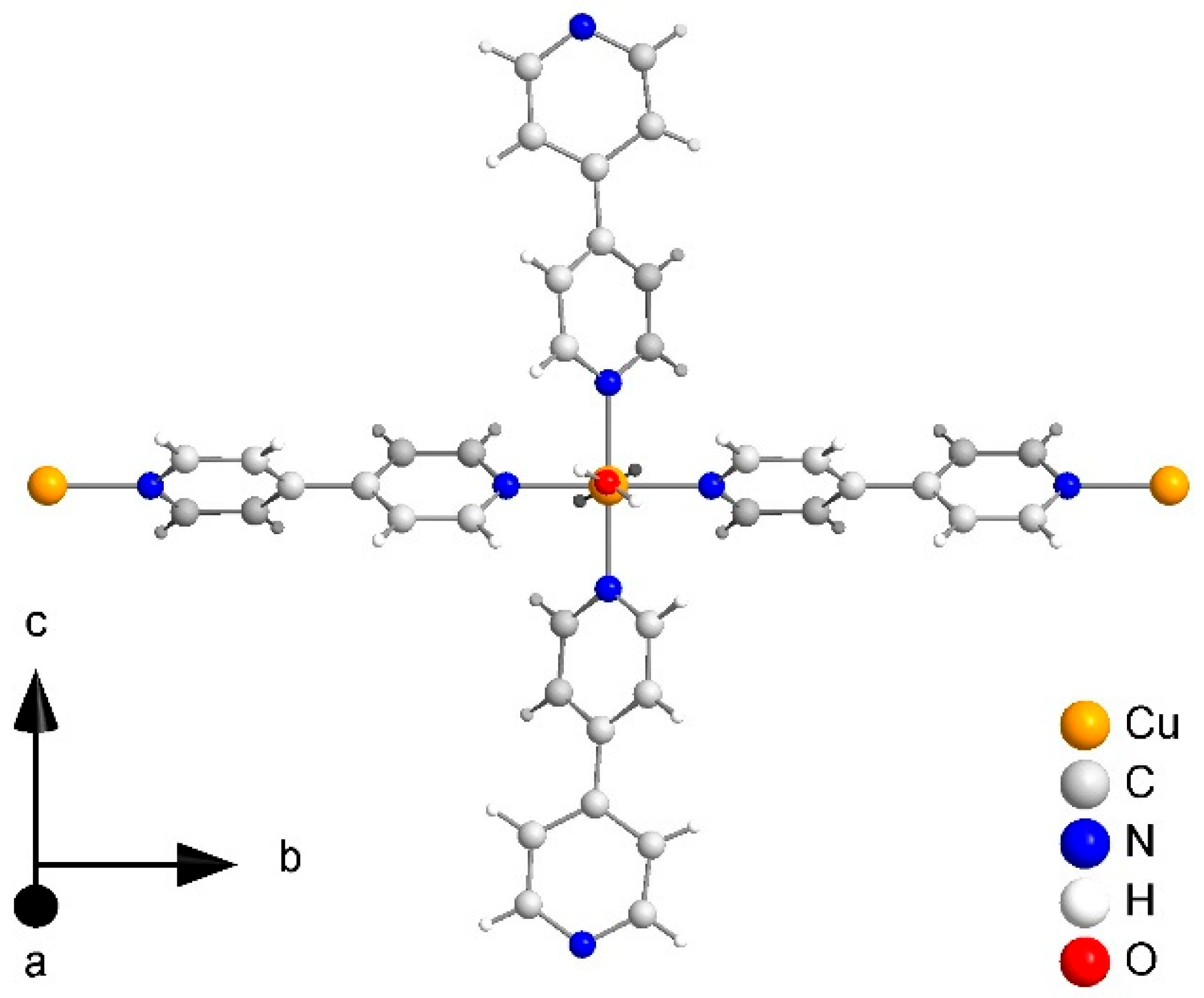
[Cu(bpy)3(H2O)2](bpy)(PF6)2(H2O)3 (1) crystallizes in the monoclinic space group P2/c with Z = 2, see Table 1 for crystallographic parameters. The structure has one Cu(II) site with six-fold coordination and C2 point symmetry, see Figure 1. Four bpy ligands occupy the equatorial positions with bridging Cu-N distances of 2.025 and 2.036 Å and terminal distances of 2.041 Å, see Table 2. Two H2O molecules fill the axial positions. The Cu-O distances are elongated to 2.413 Å due to the Jahn-Teller distortion of the 3d9 Cu2+ ion.
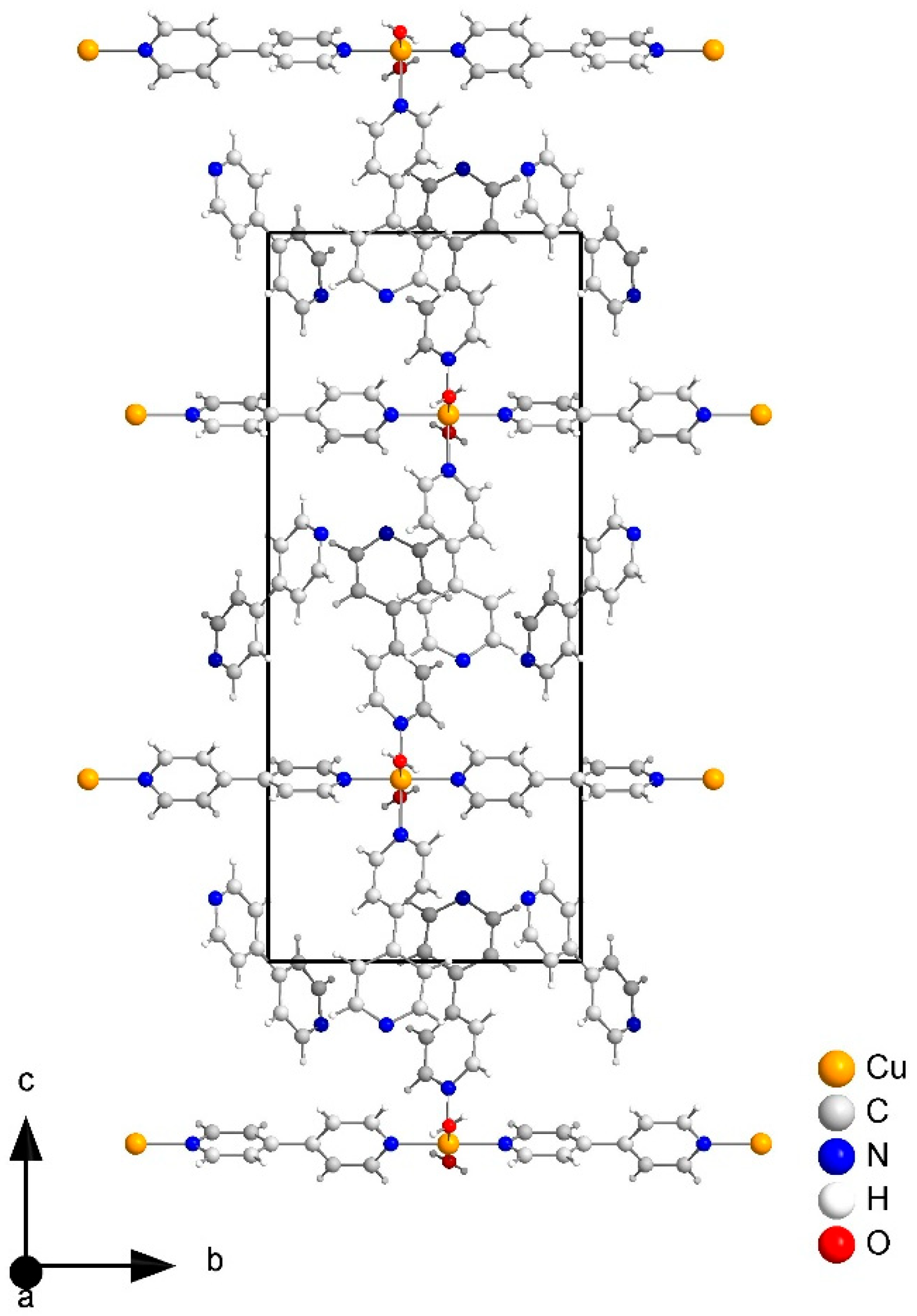
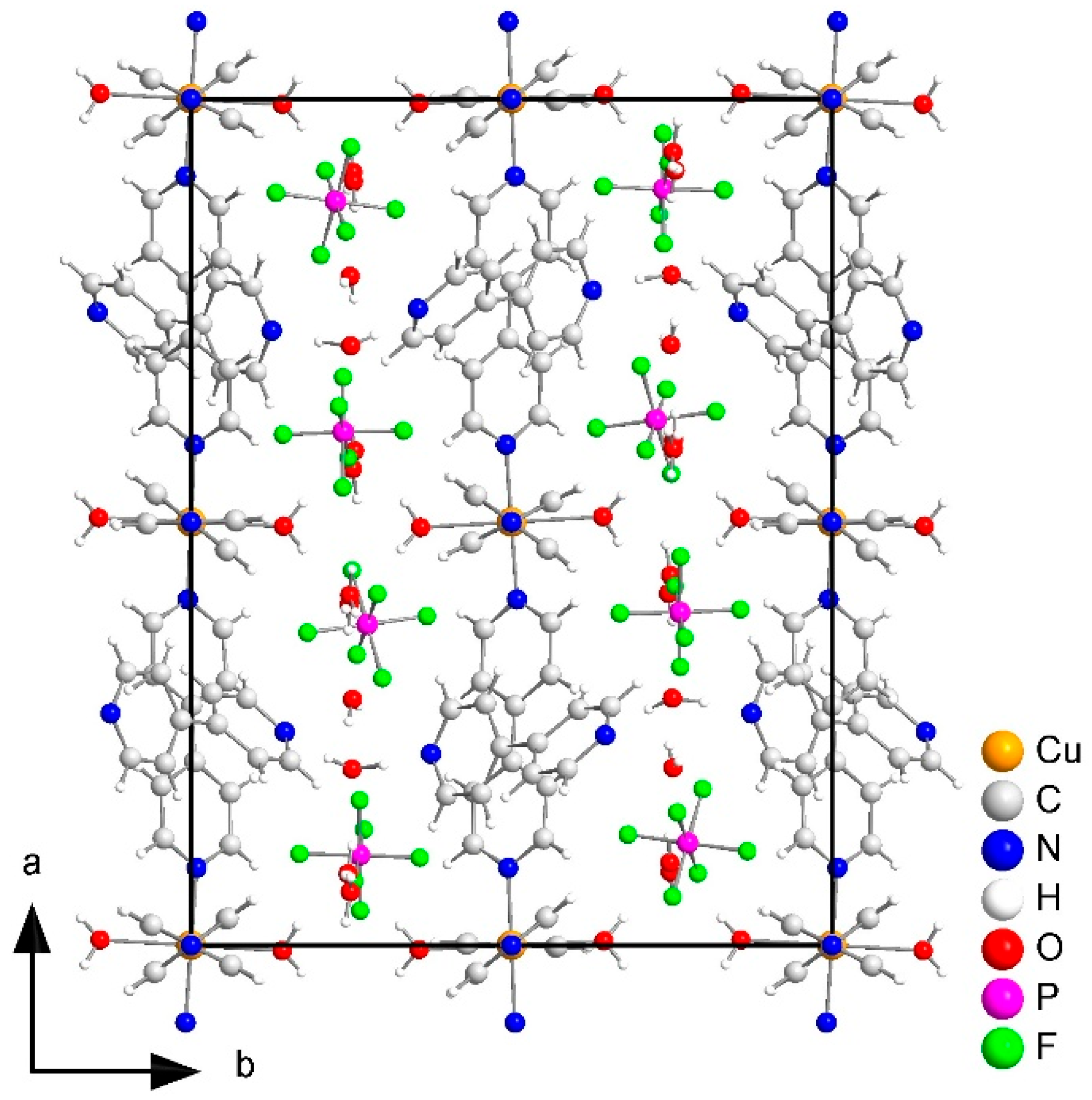
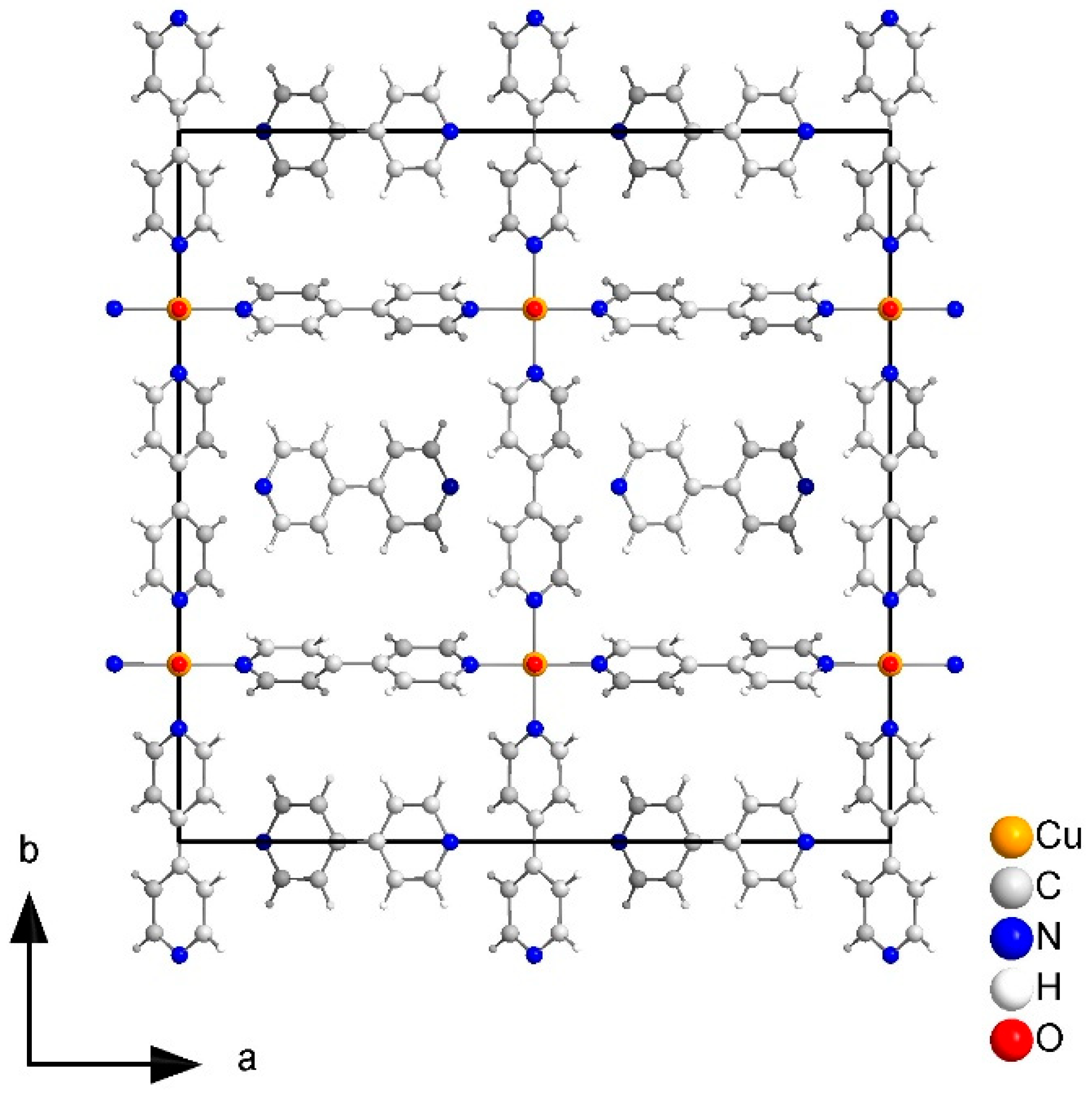
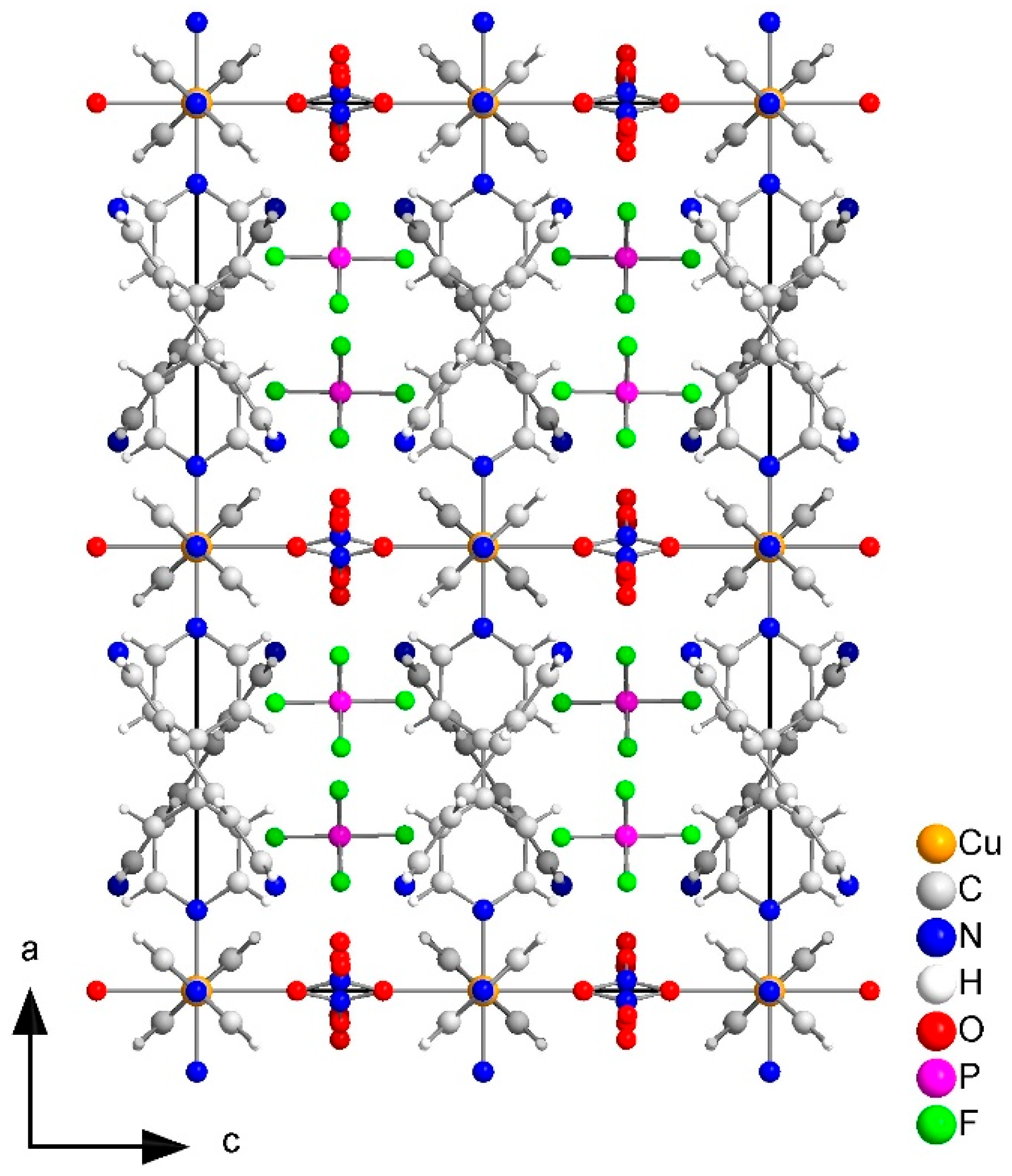
1 is a one-dimensional (1D) coordination polymer with Cu-bpy chains propagating parallel to the b-axis, see Figure 2. The structure contains three distinct bpy molecules: bridging, terminal, and interstitial. The pyridine units of the bpy ligands are rotated around the 1,1′ C-C bond by 59.63° for the bridging and 37.45° for the terminal ligands, respectively. This results in identical chirality of the Cu(II) centers along one chain and alternating Δ and Λ chirality of neighboring chains along the c-axis. Neighboring chains are shifted along the b-axis, and their equatorial Cu-N coordination plane is tilted by 14° from the c-axis to reduce steric crowding of the bpy ligands. The voids between the Cu-bpy chains host a further interstitial bpy molecule, resulting in a [Cu(bpy)3(H2O)2](bpy) layer in the b-c plane. The interstitial bpy molecule is flat. PF6 counter anions and crystal H2O molecules are located between the Cu-bpy layers, see Figure 3. They are linked by H-bonds to the axial H2O ligand (O1) with distances of 2.739 Å (O1-O2) and 2.812 Å (O1-F1), as well among each other (O2-O3 2.638 Å), and the interstitial byp (N5-O3 2.828 Å). The Cu-Cu distances are 11.1058 Å (=b) along the Cu-bpy chains, 13.0563 Å between the chains in the b-c plane, and 7.9786 Å (=a) between the layers.

2.2.2. X-Ray Structure of [Cu(bpy)2(H2O)2](bpy)(PF6)2(H2O)6 (2)

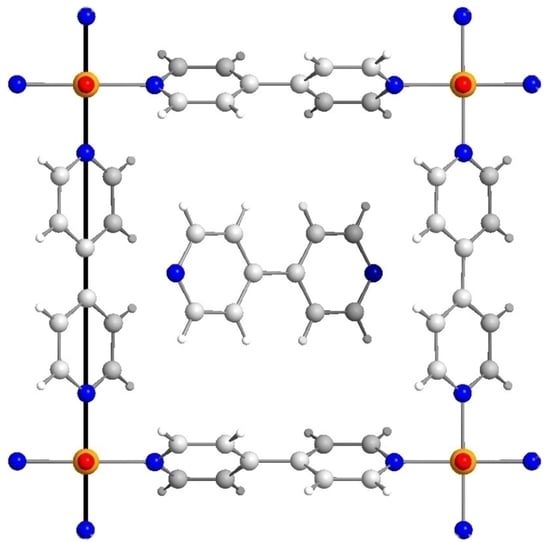
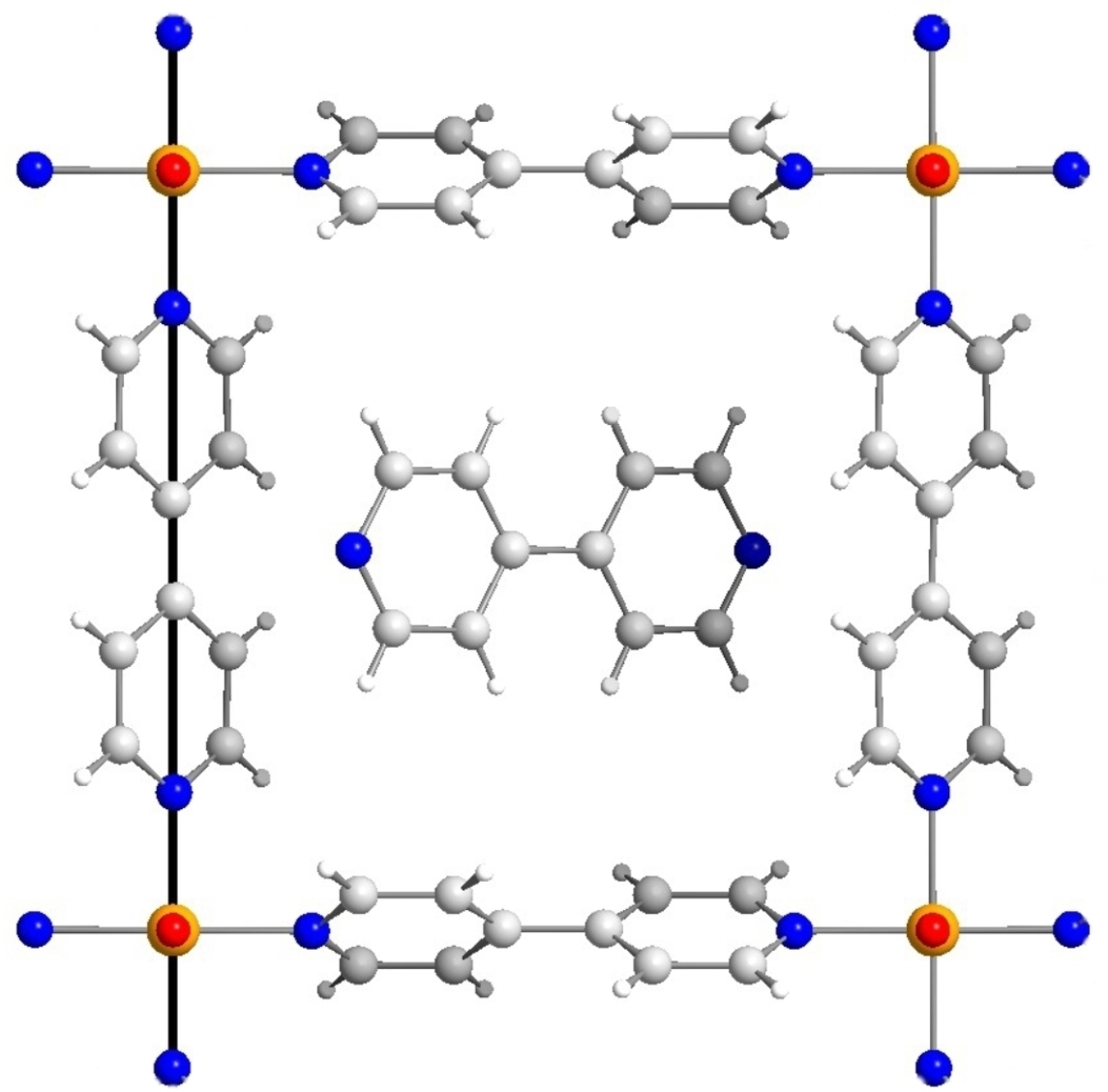
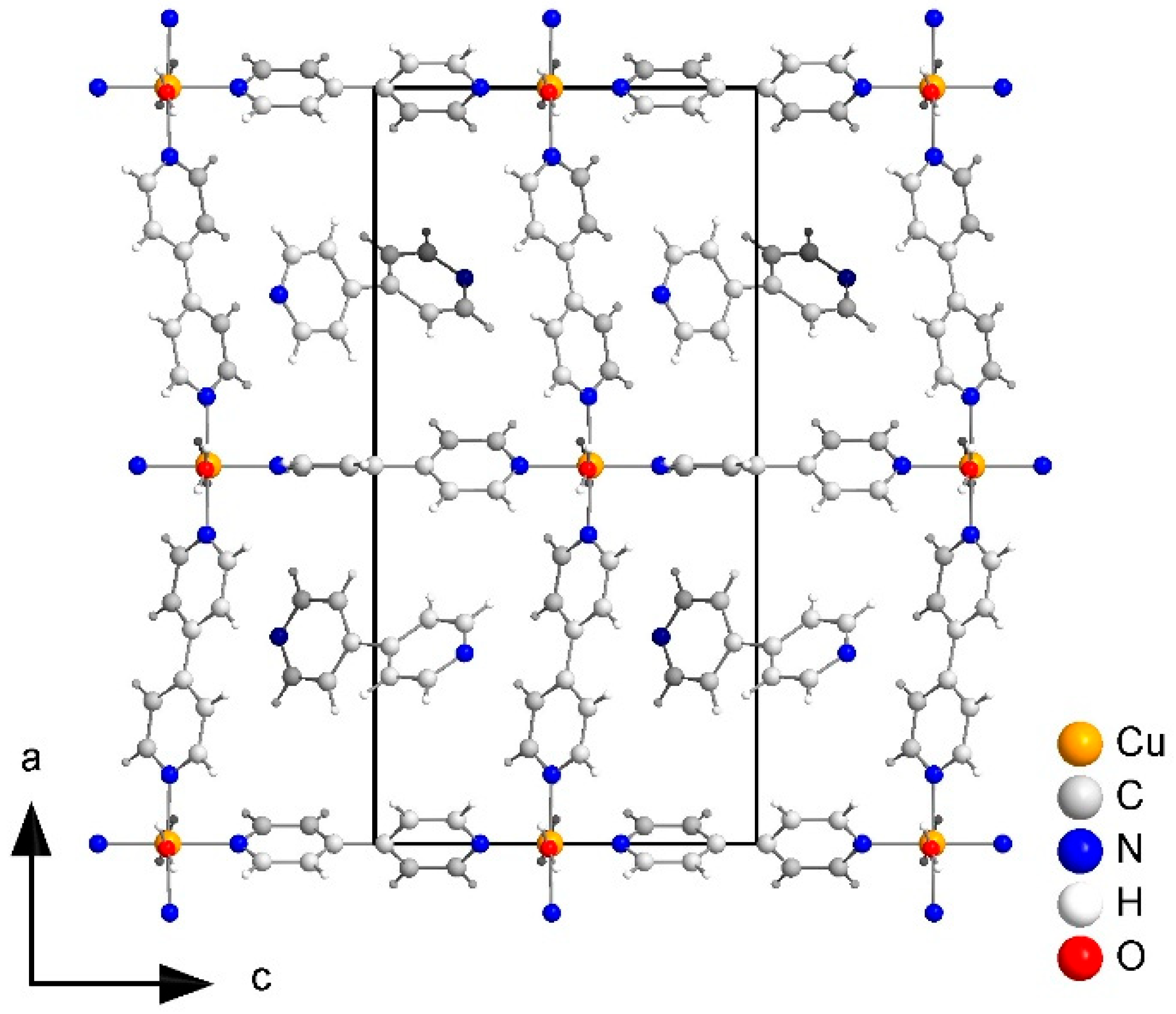
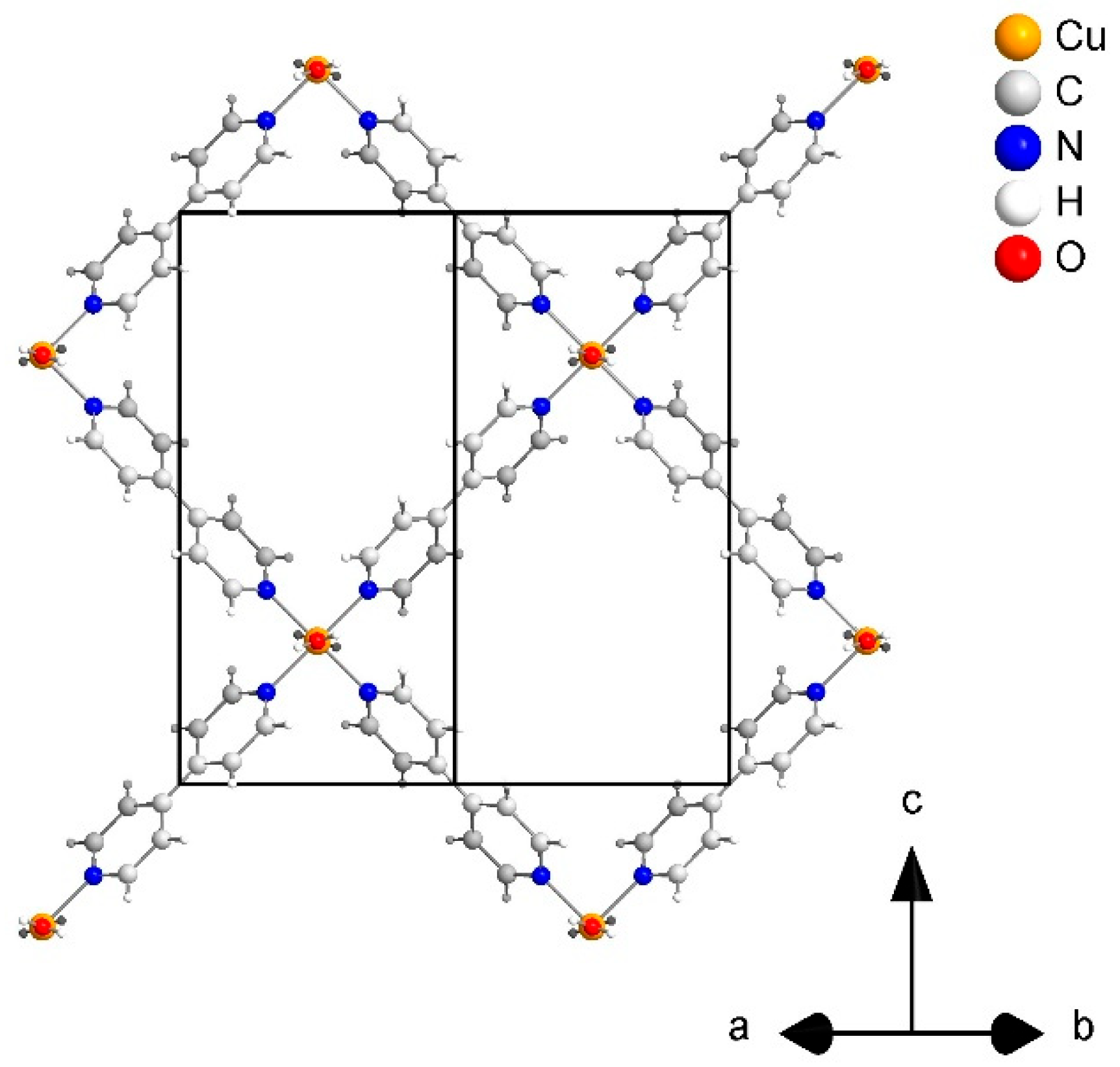
[Cu(bpy)2(H2O)2](bpy)(PF6)2(H2O)6 (2) crystallizes in the orthorhombic space group P21212 with Z = 4, see Table 1. The structure is closely related to 1. Elimination of a terminal bpy ligand from the 1D [Cu(bpy)3(H2O)2] chains of 1 results in the 2D [Cu(bpy)2(H2O)2] layers of 2. The structure has two Cu(II) sites, both with C2 symmetry, four equatorial bpy, and two axial H2O ligands. All equatorial bpy ligands are bridging and form a slightly distorted 2D [Cu(bpy)2] network, see Figure 4. The Cu-N distances range from 2.019 Å to 2.061 Å, see Table 2. The Cu-O distances are elongated to 2.375 Å and 2.408 Å due to Jahn-Teller distortion. The structure has four crystallographically distinct bpy molecules: three bridging and one interstitial. The bpy molecule along the a-axis is almost flat with a rotation angle of 3.7° around the 1,1′ C-C bond. Along the c-axis, the rotation angles are distinctly larger and amount to 43.2° and 63.3° for the bridging and 37.2° for the interstitial bpy, respectively. Accordingly, the Cu(II) ions have alternating Δ and Λ chirality along the a-axis and identical chirality parallel to the c-axis. The [Cu(bpy)2] layers of 2 are modulated in the a-direction with a node angle of 167.85° between Cu centers. As for 1, an interstitial bpy molecule occupies the void in the Cu-bpy layer, which results in the composition [Cu(bpy)2(H2O)2](bpy).
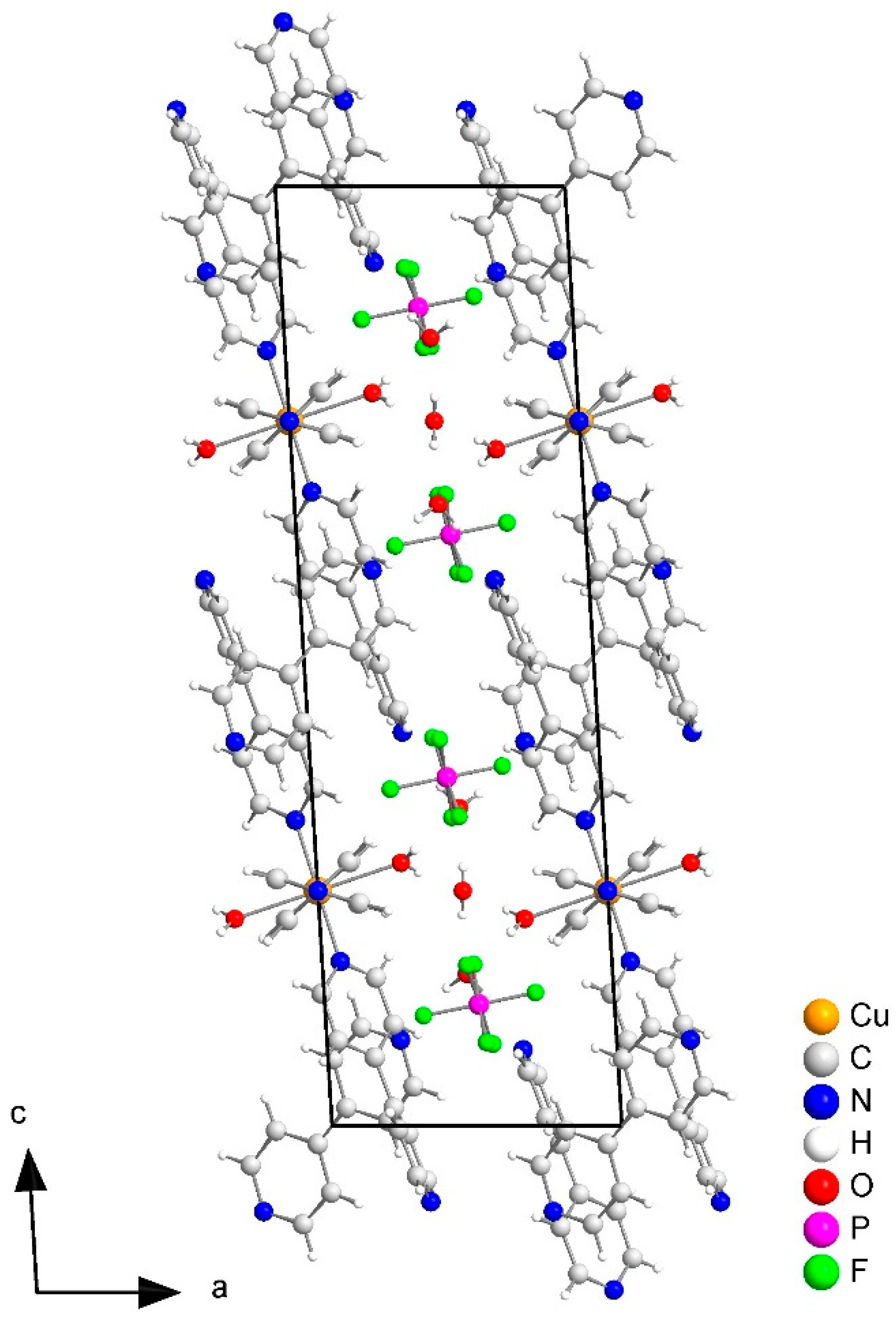
The layers are stacked along the b-axis and accommodate PF6 anions and H2O molecules in between, see Figure 5. A H-bonding network links them among each other, the axial water ligands of the Cu(II) coordination, and the interstitial bpy. O-O and N-O distances fall into a narrow range from 2.73 Å to 2.80 Å, and O-F distances are a bit longer, between 2.82 Å and 3.05 Å. One of the PF6 anions is disordered over two positions in a 1:1 ratio. The Cu-Cu distances are 11.0876 Å and 11.1428 Å (=c) in the layer and 8.3453 Å between the layers.

2.2.3. X-Ray Structure of [Cu(bpy)2(NO3)](bpy)(PF6)2(H3O)(H2O) (3)

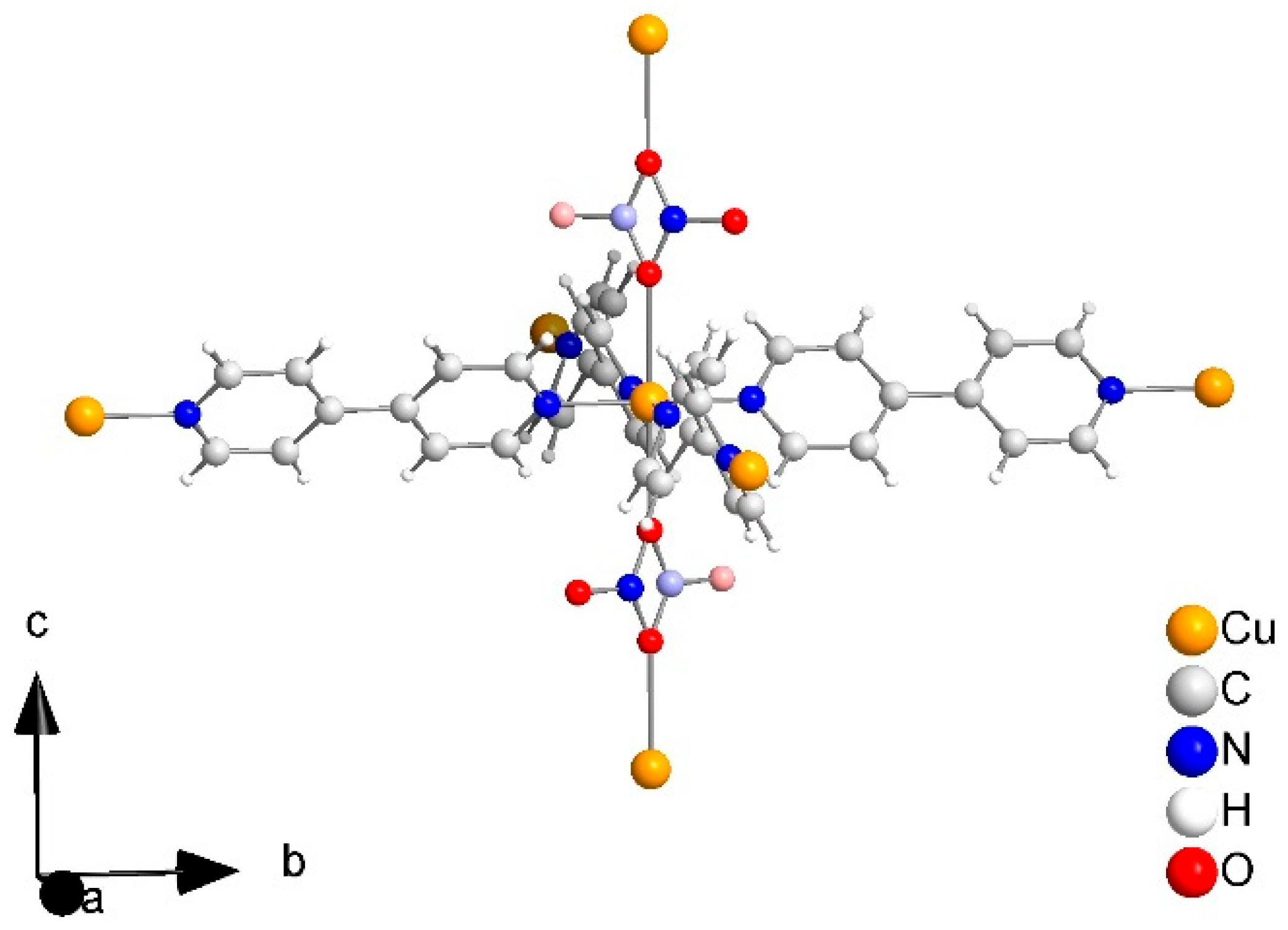
[Cu(bpy)2(NO3)](bpy)(PF6)2(H3O)(H2O) (3) crystallizes in the orthorhombic space group Ibca with Z = 8, see Table 1. The [Cu(bpy)2](bpy) layers of 3 resemble those of 2, but axial water ligands of Cu(II) are replaced by NO3 which connects the layers into a 3D network, see Figure 6. The structure of 3 has one Cu(II) site with C2 symmetry along the c-axis and three crystallographically distinct bpy molecules: two bridging and one interstitial. Equatorial Cu-N distances of bridging bpy ligands are 2.012 Å and 2.022 Å, see Table 2. The axial NO3 ligands have elongated Cu-O distances of 2.501 Å and 2.502 Å as a result of Jahn-Teller distortion. N3 and O3 atoms of the nitrate group are disordered over two positions due to the C2 symmetry.
[Cu(bpy)2] layers of 3 contain a rectangular 2D net with close Cu-Cu distances of 11.0925 Å and 11.0996 Å, see Figure 7. The bridging bpy molecules along the a-axis have a rotation angle of 51.8° around the 1,1′ C-C bond. The other bpys are flat, which bridge parallel to the b-axis or are interstitial. Accordingly, the Cu(II) ions have identical chirality parallel to the a-axis and alternating Δ and Λ chirality along the b-axis. With respect to the plane of the 2D Cu net, the bridging bpy along the b-axis and the interstitial bpy are tilted by 47.5° and 34.2°, respectively, which allows a close-to-parallel stacking of the molecules. The topology and chirality of the [Cu(bpy)2](bpy) layers are identical to those of 2, see Figure 4; the distortions from a regular 2D net are significantly reduced for 3 due to a higher crystal symmetry.
[Cu(bpy)2] layers of 3 are bridged by NO3 anions into a 3D coordination network, see Figure 8. The Cu-Cu distance between layers is 7.1652 Å which is shorter than for 1 and 2. H2O, H3O+, and PF6 are located between the layers. H2O (O4) and H3O+ (O5) are linked by H-bonds to NO3 and disordered over two positions, as is the nitrate ion. The presence of H3O+ is required for charge neutrality. O5 is further linked to the interstitial byp with N-O distances close to 2.6 Å. PF6 ions are disordered over two positions in a 4:1 ratio.

2.2.4. Reference Structures for Comparison

Reference compounds [Cu(bpy)2(H2O)2](SiF6) (4) [10] and [Cu(pyz)(bpy)(H2O)2](PF6)2 (5) [9] were synthesized for magnetic behavior comparison. Compound 4 crystallizes in the tetragonal space group P4/ncc with Z = 4. The structure contains one Cu(II) site with D2 symmetry, see Figure 9. The four equatorial positions are occupied by bridging bpy ligands with a Cu-N distance of 2.044 Å. The bpy ligands are flat. The axial positions are occupied by water ligands with a Cu-O distance elongated to 2.380 Å by the Jahn-Teller effect. The compound contains two sets of 2D square nets, which are not connected to each other and interpenetrate to build a 3D structure with SiF62− anions in channels along the c-axis. The 2D nets are slightly elongated along the c-axis with a node angle of 92.21° between Cu(II) ions.
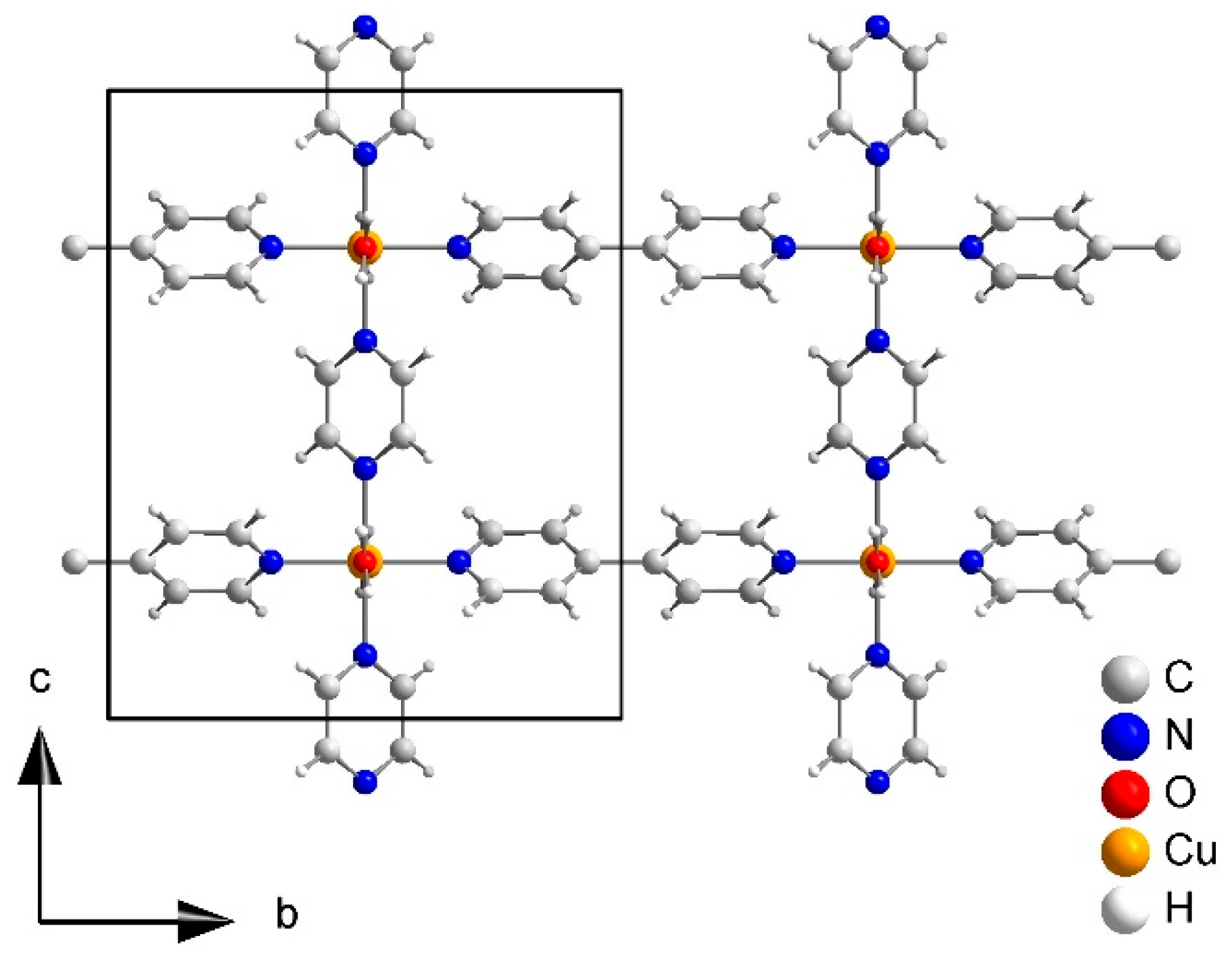
Compound 5 crystallizes in the orthorhombic space group Ibam with Z = 4. It has one Cu(II) site with D2 symmetry, see Figure 10. Pyz and bpy ligands occupy the equatorial positions with Cu-N distances of 2.036 and 2.045 Å, respectively. The bpy ligand has a rotation angle of 66.5° around the 1,1′ C-C bond. The axial water ligands have a long Cu-O distance of 2.445 Å due to the Jahn-Teller distortion. Rectangular [Cu(pyz)(bpy)(H2O)2] layers are stacked along the a-axis and accommodate PF6 anions between the staggered sheets.
The connectivity of the coordination polymers increases from 1D to 2D and 3D along the series 13. Compounds 1, 2, and 4 are built from Cu2+, bpy, H2O, and PF6 or SiF62− anions. Reducing the ligand/Cu ratio results in the elimination of a terminal bpy ligand and connects the [Cu(bpy)3(H2O)2] chains of 1 into [Cu(bpy)2(H2O)2] layers of 2. Enhancing the reaction temperature eliminates interstitial bpy and crystal H2O molecules. While keeping the 2D [Cu(bpy)2(H2O)2] layer, the structure changes from stacked layers of 2 towards interpenetrating layers for 4. The Cu-bpy-Cu distance increases slightly by 1% from 2 to 4, see Table 2, but the density of 4 is distinctly higher than for 2, with 1.90 and 1.56 g/cm3, respectively, see Table 1. It can be assumed that 4 is the thermodynamically more stable compound.
Replacing the non-coordinating PF6 or SiF62− by the weakly coordinating NO3 anion, the nitrate replaces axial water ligands and connects the 2D [Cu(bpy)2(H2O)2] layers of 2 into a cuboid 3D [Cu(bpy)2(NO3)] lattice of 3 with bridging NO3 ligands. The density is enhanced to 1.73 g/cm3 due to the higher connectivity and places 3 in between 2 and 4. Compound 3 is reminiscent of the [Cu(pyz)2X]X’ family of which many compounds with, e.g., X = NO3, FHF, Cl, and Br are known [1,2,3,4,5,6]. Replacing the nitrate ligand in 3 might yield a similar series of [Cu(bpy)2X]X’ compounds. Since pyz is a distinctly shorter bridging ligand than bpy, the 3D [Cu(pyz)2X] lattice hosts only counter anions, whereas the [Cu(bpy)2(NO3)] lattice of 3 has wider voids and accommodates further interstitial bpy molecules.
The Cu(II) centers on these networks are chiral due to the propeller-like configuration of the four pyz or bpy equatorial ligands. [Cu(pyz)2X] lattices show alternating Δ and Λ chirality on a 2D square net since the pyz ligand is flat. The bpy ligand is more flexible, and its aromatic rings can rotate around the 1,1′ C-C bond. For flat bpy ligands, as in 4, the situation is the same as for [Cu(pyz)2X]. But a rotation (of about 60°) around the 1,1′ C-C bond results in homo-chiral neighboring centers, as for the chains of 1. The 2D square lattices of 2 and 3 show both a homo-chiral connection in one direction and an alternating connection in the second direction, as is the case for the rectangular lattice of 5.

2.3. Magnetism

The orbitals with an unpaired electron and the electronic exchange paths between them determine the magnetic properties. For Cu(II) with a distorted octahedral coordination, the unpaired electron is located in the d x 2 y 2 orbital (in local coordinates) in the plane perpendicular to the elongated Jahn-Teller distorted axis; therefore, the Cu-ligand distances provide important information about the location of this magnetic orbital and the direction of magnetic exchange within the samples. In each of the compounds, the Jahn-Teller axis is oriented along Cu-O bonds, see Table 2, which belong to terminal water (1, 2, 4, and 5) or the bridging NO3 group (3). For compounds 24, the magnetic orbital is contained in 2D [Cu(bpy)2] (slightly distorted) square lattices, while compound 5 has a 2D [Cu(pyz)(bpy)] rectangular lattice. Accordingly, 2D magnetic lattices are expected for 25. Compound 2 was not further investigated by magnetic measurements because it decomposes easily due to loss of crystal water. Within the layers, there is a σ-type exchange via the bpy or pyz ligands [1]. Despite much shorter interlayer Cu-Cu distances, the magnetic interaction perpendicular to the layers is very weak due to orthogonal orbitals and missing electronic overlap.

2.3.1. Magnetic Susceptibility

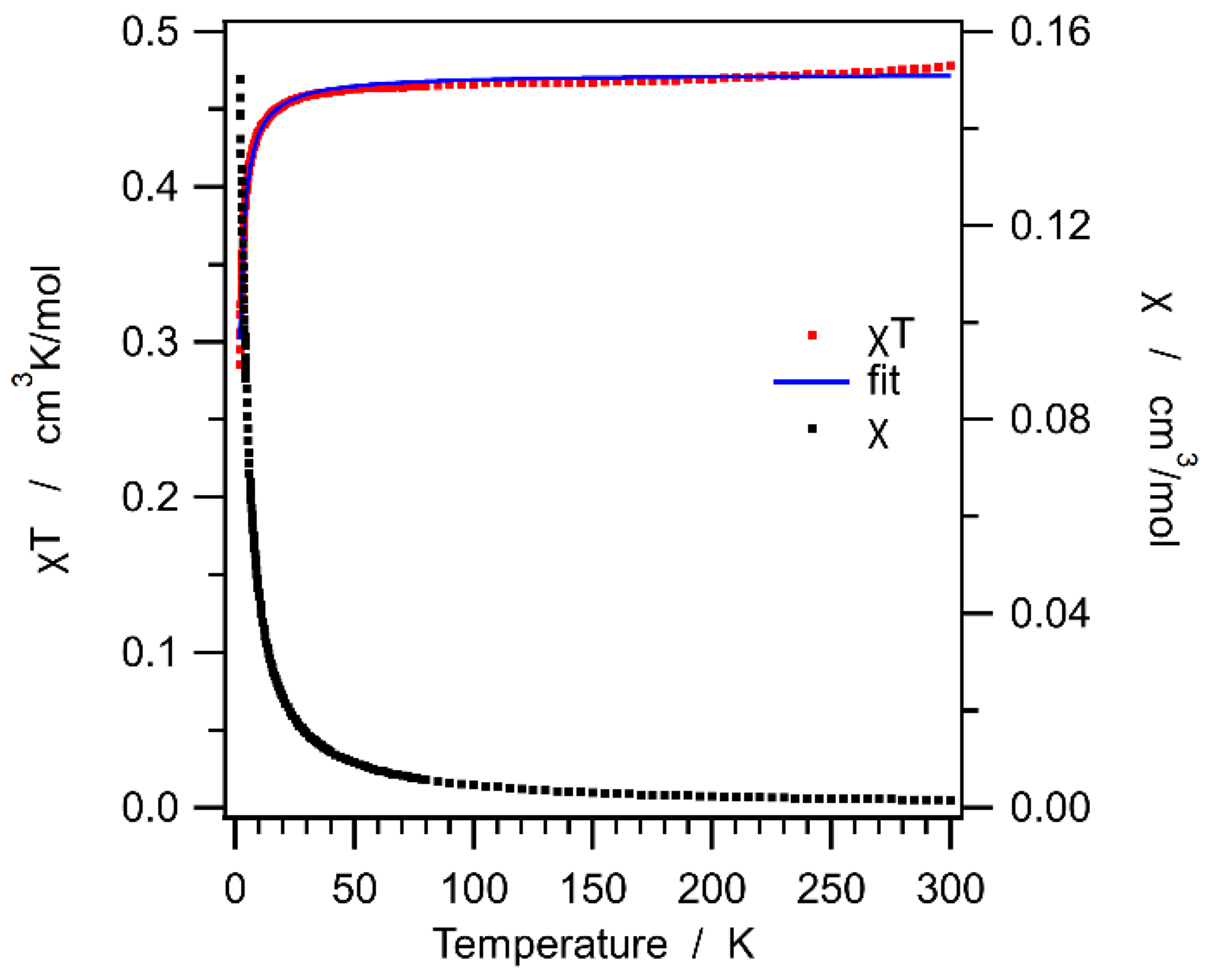
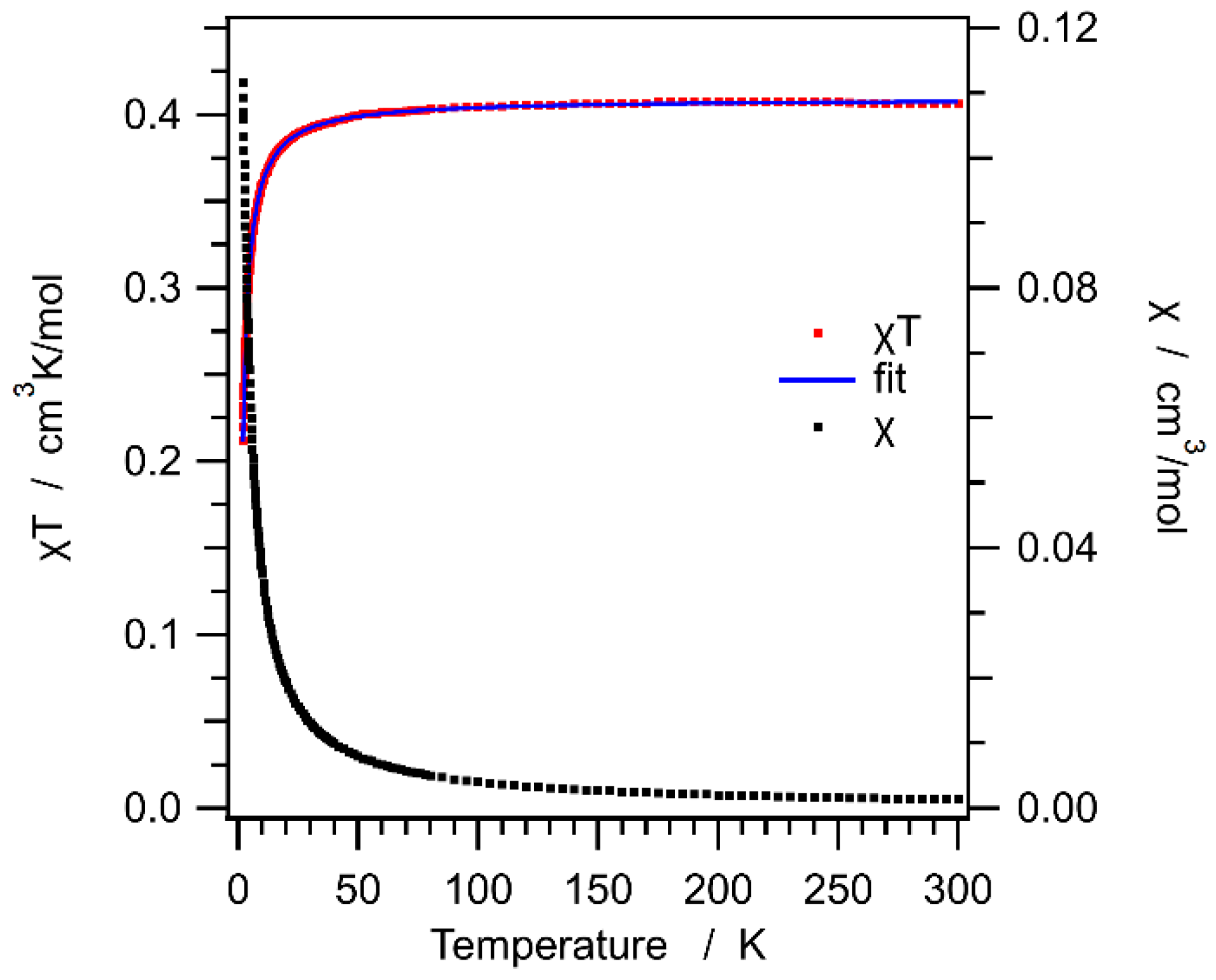
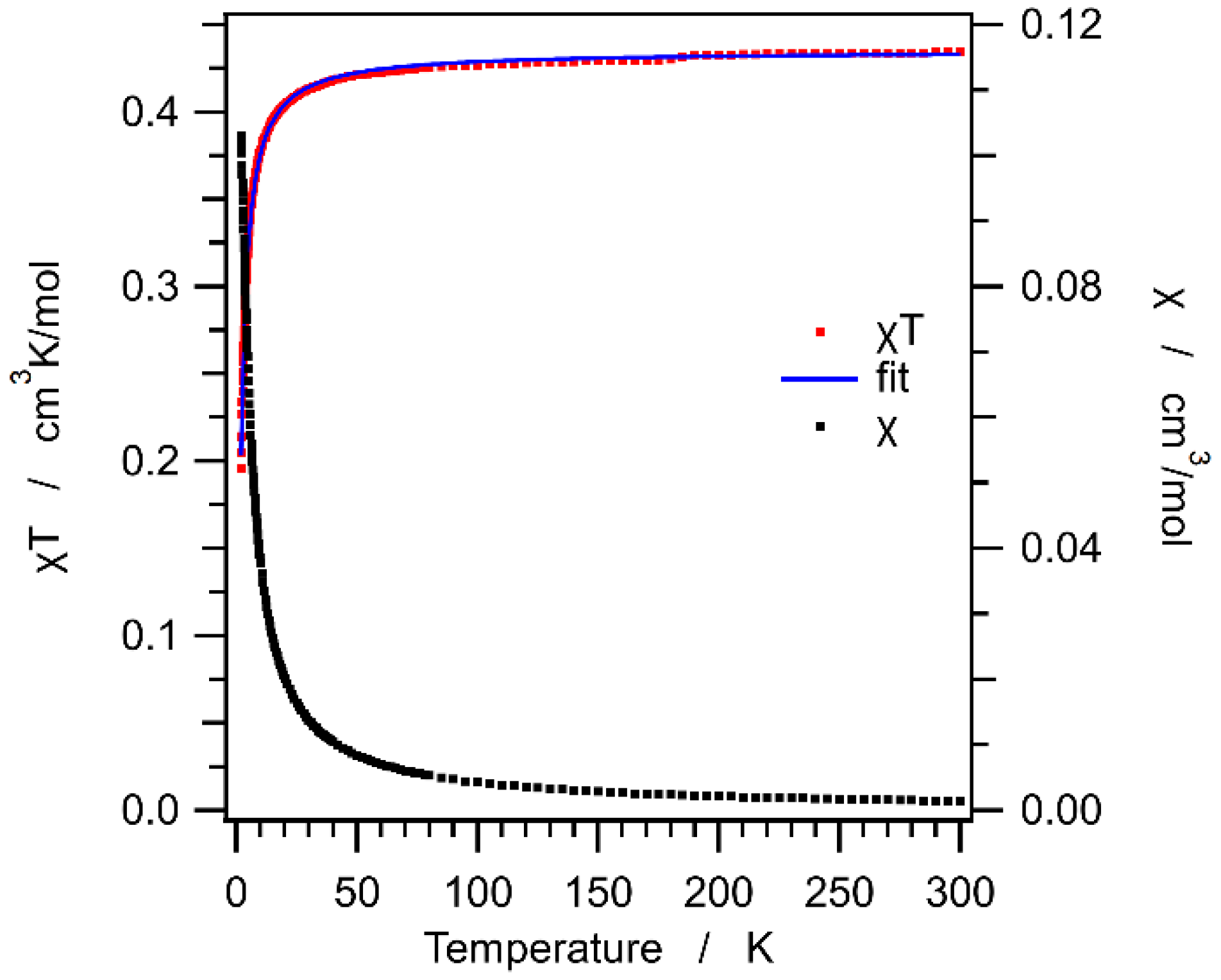
Magnetic susceptibility data for 35 were obtained using a Quantum Design MPMS-XL SQUID magnetometer between 1.9 and 300 K in a 1 kOe applied field. The molar susceptibility χ and χT versus T curves are shown in Figure 11, Figure 12 and Figure 13. All three compounds show very similar behavior. From 300 to 50 K, the χT values decrease very slightly, indicating a close-to-paramagnetic behavior. The χT values at 300 K are 0.478, 0.406, and 0.434 cm3K/mol for 35, respectively, in good agreement with expectation values for Cu(II) with S = 1/2 and g ≈ 2.2. Below 50 K, the χT values become smaller and steeply fall off below 10 K. The curves tend towards zero with low temperature without any bending or kink, which would be an indication of 3D magnetic order. At 1.9 K, the χT values are 0.285, 0.211, and 0.196 cm3K/mol for 35, respectively. The downturn of χT values towards lower temperatures is attributed to antiferromagnetic interactions between the Cu2+ ions in the [Cu(bpy)2] or [Cu(pyz)(bpy)] layers, respectively. The χT curves are fitted to an antiferromagnetic Heisenberg square lattice model with S = 1/2 using a single exchange parameter J. The Hamiltonian in Equation (1) was used and the fitting function of Equation (2) [14,15].
H   =   J   S i S j
χ   T = C   [ 1 + i = 1 5 N i ( J k T ) i 1 + i = 1 5 D i ( J k T ) i ]
J is the exchange parameter, C the Curie constant, and k the Boltzmann constant. Ni and Di parameters are taken from Ref. [15]. The fit results are summarized in Table 3.
The exchange parameter J/k = 0.86 K for 3 is smaller than for 45 despite slightly shorter Cu-Cu distances. This is attributed to the axial nitrate ligand, which slightly reduces the electron density on the Cu(II) center compared to the axial water ligands of 45. The bpy ligands in the [Cu(bpy)2] layer of 3 are not equivalent. Their Cu-Cu distances are very close, see Table 2, but the bpy ligand along the a-axis has a rotation angle of 51.8° around the 1,1′ C-C bond, whereas the bpy along the b-axis is flat, see Figure 7. The magnetic measurements give no indication of different J values along these two directions, and we use a single J parameter in the fit. Since the Cu-bpy-Cu exchange is mainly σ-type, rotations of the ligand around the Cu-Cu axis or the 1-1′ C-C bond are expected to have no significant influence on the exchange strength.
Compound 4 has the highest symmetry within the series and contains just one Cu(II) and one bpy site. A rhombic elongation along the c-axis causes a small deviation by 2.21° from an ideal 2D [Cu(bpy)2] square lattice. Magnetic measurements are very well fitted by a single parameter J/k = 1.27 K. A comparison to [Cu(pyz)2] square layers [1] with 6.3 < J/k < 13.4 K reveals a reduction in the exchange parameter by an order of magnitude between pyz and bpy ligands.
The strongest exchange parameter J/k = 1.47 K was found for 5, which has a 2D [Cu(pyz)(bpy)] rectangular lattice. Accordingly, different exchange parameters J along the Cu-pyz-Cu and Cu-bpy-Cu directions are expected. Jpyz should be about a magnitude stronger than Jbpy ≈ 1.27 K, as stated above for 4. The χ T versus T curve in Figure 13 did not allow a fit of 2 different J parameters. A single J parameter yields a very good fit to the data and should be viewed as an average value between the two directions of the rectangular lattice.
According to Jǀǀ = 1.07·Tmax, a maximum in the χ versus T curve is expected for 2D antiferromagnetic Heisenberg lattices. Since 35 have values of 0.86 K < J/k < 1.47 K, the maximum is expected well below our accessible temperature range. The χ and χ T versus T curves show no turn or any hint of 3D magnetic order down to 1.9 K.

2.3.2. Magnetization

Magnetization data for 35 were obtained using a Quantum Design MPMS-XL SQUID magnetometer at 1.9 K and up to 50 kOe applied field. Measurements are very similar for the three compounds and are shown in Figure S6 of the Supporting Information. For fields up to 20 kOe, a linear dependence is observed. Towards higher fields, the slope decreases. No saturation was achieved up to 50 kOe.

3. Materials and Methods

3.1. Materials

All chemicals were used as purchased without purification. Cu(NO3)2·xH2O (Alfa Aesar, 99.999%) with x ≈ 3; 4,4′-bipyridine (Alfa Aesar, 98%); pyrazine (Acros organics, 99+%); NaPF6 (Fluka, ≥98%), and (NH4)2SiF6 (SAM, 99%).

3.2. Synthesis

3.2.1. Synthesis of [Cu(bpy)3(H2O)2](bpy)(PF6)2(H2O)3 (1)

Cu(NO3)2·3H2O (72.9 mg, 0.302 mmol), bpy (188.5 mg, 1.208 mmol), and NaPF6 (102.1 mg, 0.604 mmol) were placed into distilled water (4 mL) in a 23 mL Teflon-lined Parr acid digestion vessel. The autoclave vessel was sealed and heated at 100 °C for 4 h, whereupon it was cooled at 6 °C/h to 25 °C. Blue crystals and a small amount of green powder were present in the vessel. The blue crystals were separated from the green powder for further analysis. The green powder was determined to be copper phosphate hydroxide, Cu2(PO4)(OH) [13], via powder X-ray diffraction. The hydrolysis of PF6 in aqueous solution increases with temperature and time. It results in the formation of PO43− and the precipitation of insoluble Cu2(PO4)(OH).

3.2.2. Synthesis of [Cu(bpy)2(H2O)2](bpy)(PF6)2(H2O)6 (2)

Cu(NO3)2·3H2O (72.6 mg, 0.300 mmol) was dissolved in distilled water (10 mL) and heated to 50 °C. A warm solution of bpy (140.6 mg, 0.900 mmol) in distilled water (30 mL) was added dropwise over 10 min to the aqueous Cu(NO3)2 solution. NaPF6 (98.2 mg, 0.610 mmol in 10 mL H2O) was added dropwise to the clear blue solution. The cloudy solution was filtered and slowly cooled to room temperature. The beaker was closed (not completely), and after 3 days, blue needle-shaped crystals were visible in the solution. The crystals slowly decompose after removal from solution, likely due to loss of water between the layers.

3.2.3. Synthesis of [Cu(bpy)2(NO3)](bpy)(PF6)2(H3O)(H2O) (3)

Cu(NO3)2·3H2O (74.1 mg, 0.307 mmol), bpy (143.7 mg, 0.921 mmol), and NaPF6 (100.6 mg, 0.614 mmol) were placed into distilled water (5 mL) in a 23 mL Teflon-lined Parr acid digestion vessel. The autoclave vessel was sealed and heated at 110 °C for four hours, whereupon it was cooled at 4 °C/h to 25 °C. Purple crystals, as well as some green powder, were present in the vessel. The purple crystals were separated from the powder.
While there is a 3:1 ratio of bpy to copper in this complex, a small amount of blue crystals of 1 are typically formed in addition to 3. A 2:1 deficiency of bpy in the reaction vessel can prohibit the formation of 1 but reduces the yield. At higher temperatures and longer reaction times, more green powder is present, which was identified by XRD as copper phosphate hydroxide, Cu2(PO4)(OH) [13]. It is assumed that 1 is an intermediate kinetic product which finally transforms into 3, but the in-parallel ongoing hydrolysis of PF6 limits reaction time and temperature.

3.2.4. Synthesis of [Cu(bpy)2(H2O)2](SiF6) (4)

This known compound [10] was also synthesized by hydrothermal synthesis. Cu(NO3)2·3H2O (72.5 mg, 0.300 mmol), bpy (93.9 mg, 0.600 mmol), and (NH4)2SiF6 (53.6 mg, 0.300 mmol) were placed in a 23 mL Teflon-lined Parr acid digestion vessel with distilled water (4 mL). The autoclave vessel was sealed and heated at 150 °C for four hours, whereupon it was cooled at 8 °C/h to 25 °C. A blue powder of 4 (155.1 mg, 93.3%) was present in a clear filtrate.

3.2.5. Synthesis of [Cu(pyz)(bpy)(H2O)2](PF6)2 (5)

The synthesis of 5 followed that from the literature [9].

3.3. Single Crystal X-Ray Diffraction

Single crystals were mounted in air at ambient conditions. All measurements were made on an Oxford Diffraction SuperNova area-detector diffractometer [16] using mirror optics monochromated Mo Kα radiation (λ = 0.71073 Å), which was Al filtered [17]. The unit cell parameters and an orientation matrix for data collection were obtained from a least-squares refinement of the setting angles of reflections in the range 1.8° < θ < 27.8°. A total of 888/705/676 frames (for 13, respectively) were collected using ω scans, with 30 + 30 s exposure time (50 + 50 for 3), a rotation angle of 1.0° per frame, and a crystal-detector distance of 65.0 mm. Data were measured at T = 173 (2) K.
Data reduction was performed using the CrysAlisPro [16] program. The intensities were corrected for Lorentz and polarization effects, and a numerical absorption correction based on Gaussian integration over a multifaceted crystal model was applied. Data collection and refinement parameters for 13 are given in Table 1. Selected bond lengths and angles are provided in Table 2 and throughout the text for comparison. The structures have been deposited with the CCDC (1, 1935198; 2, 1935199; 3, 1935200). Crystallographic data from single-crystal refinements were used for comparison to powder X-ray diffraction data to establish the purity of the samples used for magnetic measurements. Measured and calculated powder X-ray diffraction patterns of 15 are provided in the Supporting Information.
The structures were solved by direct methods using SHELXT [18], which revealed the positions of all non-disordered non-hydrogen atoms. The non-hydrogen atoms were refined anisotropically. All H-atoms, except the water hydrogens of 1 and 2, were placed in geometrically calculated positions and refined using a riding model where each H-atom was assigned a fixed isotropic displacement parameter with a value equal to 1.2 Ueq of its parent atom (1.5 Ueq for water and oxonium in 3). For the water H-atoms of 1, the positions were freely refined, and a fixed isotropic displacement parameter of 1.5 Ueq was used. For 2, each water H-atom was assigned a fixed isotropic displacement parameter with a value equal to 1.5 Ueq of its parent atom. The geometry of the disordered PF6 anion was fixed to standard values. Its ADPs were restrained with the SHELX SIMU and RIGU instructions. The crystal was twinned by inversion with a domain ratio of 0.54:0.46. One of the two PF6 anions is disordered between two sites.
The crystal of 3 was found to be a pseudo-merohedral twin with the twin law b, a, -c and a domain ratio of 0.589:0.411. The PF6 anion is disordered about two sites. Its geometry was constrained to standard values, and its ADPs were restrained with SHELX SIMU and RIGU instructions. The nitrate, water, and oxonium are each disordered about an inversion center. To balance the charge, one of the two water molecules was assumed to be an oxonium cation. The hydrogen atoms could not, however, be located from the difference electron density map.
Refinement of each of the structures was carried out on F2 using full-matrix least-squares procedures, which minimized the function Σw(Fo2 − Fc2)2. The weighting scheme was based on counting statistics and included a factor to down-weight the intense reflections. All calculations were performed using the SHELXL-2014/7 [19] program in OLEX2 [20].

3.4. Powder X-Ray Diffraction

Powder X-ray diffraction patterns were measured on a STOE StadiP transmission X-ray diffractometer with Cu Kα1 radiation (λ = 1.5406 Å) from a curved Ge (111) monochromator and a Dectris Mythen 1K-detector. The measured and calculated powder patterns of 15 are shown in Figures S1–S5 of the Supporting Information.

3.5. Magnetic Measurements

Magnetic data were recorded on a Quantum design MPMS-5XL SQUID magnetometer in the temperature range from 1.9 to 300 K and an applied magnetic field of 1 kOe. Magnetization measurements were collected at 1.9 K in fields up to 50 kOe. Samples for magnetic measurements were placed into gelatin capsules. Susceptibility data were corrected for diamagnetic contributions from the sample (−0.45·10−6 cm3/g·molar weight), the empty sample holder, and the temperature-independent paramagnetic (TIP) contribution of Cu2+.

4. Conclusions

A series of Cu(II)-bpy coordination compounds was obtained by varying the Cu/bpy ratio, the counter-anion, and experimental conditions. The connectivity of the Cu-bpy framework could be modified from chains to layers and a cuboid lattice for 13. The Cu-bpy compounds are closely related to Cu-pyz compounds, e.g., the [Cu(pyz)2X]X’ family. The bpy linker is more flexible than pyz and adds structural variation due to the 1,1′ C-C bond rotation. Also, bpy molecules can enter interstitial positions of the structure.
The longer Cu-Cu distances in bpy bridged frameworks reduce the antiferromagnetic coupling by an order of magnitude compared to pyz lattices. Both bpy and pyz occupy equatorial positions in the Cu(II) coordination and mediate σ-type exchange. The rotation of the ligand around the Cu-Cu axis has no significant influence on the exchange strength. Due to the Jahn-Teller distortion of the six-fold Cu-coordination, the magnetic orbital is located in the equatorial plane and results in 2D magnetic lattices for 35. The 3D crystal lattice of 3 has no influence on the magnetism compared to the 2D lattices of 45. But the axial nitrate ligand of 3 reduces the coupling parameter below the values for axial water ligands in 45.

Supplementary Materials

The following supporting information can be downloaded at: https://www.mdpi.com/article/10.3390/inorganics13120400/s1.

Author Contributions

This study was designed by S.N.H. and K.W.K. The experiments were performed by R.L.W., D.B., and S.N.H. Magnetic data were analyzed by S.N.H. and K.W.K. Single crystal X-ray data were analyzed by J.H. The manuscript was written with contributions from S.N.H., J.H., and K.W.K. All authors have read and agreed to the published version of the manuscript.

Funding

The financial support by the Swiss National Science Foundation under grant no. 200020_172659 is gratefully acknowledged.

Institutional Review Board Statement

Not applicable.

Informed Consent Statement

Not applicable.

Data Availability Statement

The structures have been deposited with the CCDC (1, 1935198; 2, 1935199; 3, 1935200).

Conflicts of Interest

The authors declare no conflicts of interest.

Abbreviations

The following abbreviations are used in this manuscript:
Ddimensional
bpy4,4′-bipyridine
pyzpyrazine

References

  1. Kubus, M.; Lanza, A.; Scatena, R.; Dos Santos, L.H.R.; Wehinger, B.; Casati, N.; Fiolka, C.; Keller, L.; Macchi, P.; Rüegg, C.; et al. Quasi-2D Heisenberg Antiferromagnets [CuX(pyz)2](BF4) with X = Cl or Br. Inorg. Chem. 2018, 57, 4934–4943. [Google Scholar] [CrossRef] [PubMed]
  2. Goddard, P.A.; Singleton, J.; McDonald, R.D.; Lancaster, T.; Blundell, S.J.; Pratt, F.L.; Cox, S.; Harrison, N.; Manson, J.L.; Southerland, H.I.; et al. Experimentally determining the exchange parameters of quasi-two-dimensional Heisenberg magnets. New J. Phys. 2008, 10, 083025. [Google Scholar] [CrossRef]
  3. Woodward, F.M.; Gibson, P.J.; Jameson, G.B.; Landee, C.P.; Turnbull, M.M.; Willett, R.D. Two-dimensional Heisenberg antiferromagnets: Syntheses, X-ray structures, and magnetic behavior of [Cu(pz)2](ClO4)2, [Cu(pz)2](BF4)2, and [Cu(pz)2(NO3)]PF6. Inorg. Chem. 2007, 46, 4256–4266. [Google Scholar] [CrossRef] [PubMed]
  4. Brown, S.; Cao, J.; Musfeldt, J.L.; Conner, M.M.; McConnell, A.C.; Southerland, H.I.; Manson, J.L.; Schlueter, J.A.; Phillips, M.D.; Turnbull, M.M.; et al. Hydrogen bonding and multiphonon structure in copper pyrazine coordination polymers. Inorg. Chem. 2007, 46, 8577–8583. [Google Scholar] [CrossRef] [PubMed]
  5. Manson, J.L.; Schlueter, J.A.; Funk, K.A.; Southerland, H.I.; Twamley, B.; Lancaster, T.; Blundell, S.J.; Baker, P.J.; Pratt, F.L.; Singleton, J.; et al. Strong H···F hydrogen bonds as synthons in polymeric quantum magnets: Structural, magnetic, and theoretical characterization of [Cu(HF2)(pyrazine)2](SbF6), [Cu2F(HF)(HF2)(pyrazine)4](SbF6)2, and [CuAg(H3F4)(pyrazine)5](SbF6)2. J. Am. Chem. Soc. 2009, 131, 6733–6747. [Google Scholar] [CrossRef] [PubMed]
  6. Manson, J.L.; Schlueter, J.A.; McDonald, R.D.; Singleton, J. Crystal structure and antiferromagnetic ordering of quasi-2D [Cu(HF2)(pyz)2]TaF6 (pyz = pyrazine). J. Low Temp. Phys. 2010, 159, 15–19. [Google Scholar] [CrossRef]
  7. Uemura, K.; Maeda, A.; Maji, T.K.; Kanoo, P.; Kita, H. Syntheses, Crystal Structures and Adsorption Properties of Ultramicroporous Coordination Polymers Constructed from Hexafluorosilicate Ions and Pyrazine. Eur. J. Inorg. Chem. 2009, 2009, 2329–2337. [Google Scholar] [CrossRef]
  8. Noro, S.; Kitagawa, S.; Kondo, M.; Seki, K. A new, methane adsorbent, porous coordination polymer [{CuSiF6(4,4′-bipyridine)2}n]. Angew. Chem. Int. Ed. 2000, 39, 2081–2084. [Google Scholar] [CrossRef]
  9. Tong, M.-L.; Chen, X.-M.; Yu, X.-L.; Mak, T.C.W. A novel two-dimensional rectangular network. Synthesis and structure of {[Cu(4,4′-bpy)(pyz)(H2O)2][PF6]2}n (4,4′-bpy = 4,4′-bipyridine, pyz = pyrazine). J. Chem. Soc. Dalton Trans. 1998, 1, 5–6. [Google Scholar] [CrossRef]
  10. Noro, S.-I.; Kitaura, R.; Kondo, M.; Kitagawa, S.; Ishii, T.; Matsuzaka, H.; Yamashita, M. Framework Engineering by Anions and Porous Functionalities of Cu(II)/4,4′-bpy Coordination Polymers. J. Am. Chem. Soc. 2002, 124, 2568–2583. [Google Scholar] [CrossRef] [PubMed]
  11. Musgrave, T.R.; Mattson, C.E. Coordination chemistry of 4,4′-bipyridine. Inorg. Chem. 1968, 7, 1433–1436. [Google Scholar] [CrossRef]
  12. Ferraro, J.R.; Davis, K.C. Low frequency infrared studies of metal halide complexes of 4,4′-bipyridine. Inorganica Chim. Acta 1969, 3, 685–688. [Google Scholar] [CrossRef]
  13. Cordsen, A. A crystal structure refinement of libethenite. Can. Mineral. 1978, 16, 153–157. [Google Scholar]
  14. Woodward, F.M.; Albrecht, A.S.; Wynn, C.M.; Landee, C.P.; Turnbull, M.M. Two-dimensional S= ½ Heisenberg antiferromagnets: Synthesis, structure, and magnetic properties. Phys. Rev. B 2002, 65, 144412. [Google Scholar] [CrossRef]
  15. Landee, C.P.; Turnbull, M.M. Review: A gentle introduction to magnetism: Units fields, theory, and experiment. J. Coord. Chem. 2014, 67, 375–439. [Google Scholar] [CrossRef]
  16. Oxford Diffraction. CrysAlisPro, (Version 1.171.38.41); Oxford Diffraction Ltd.: Oxfordshire, UK, 2010.
  17. Macchi, P.; Bürgi, H.B.; Chimpri, A.S.; Hauser, J.; Gál, Z. Low-energy contamination of Mo microsource X-ray radiation: Analysis and solution of the problem. J. Appl. Crystallogr. 2011, 44, 763–771. [Google Scholar] [CrossRef]
  18. Sheldrick, G.M. SHELXT—Integrated space-group and crystal-structure determination. Acta Cryst. 2015, A71, 3–8. [Google Scholar] [CrossRef] [PubMed]
  19. Sheldrick, G.M. Crystal structure refinement with SHELXL. Acta Cryst. 2015, C71, 3–8. [Google Scholar]
  20. Dolomanov, O.V.; Bourhis, L.J.; Gildea, R.J.; Howard, J.A.K.; Puschmann, H. OLEX2: A complete structure solution, refinement and analysis program. J. Appl. Cryst. 2009, 42, 339–341. [Google Scholar] [CrossRef]
Figure 1. Coordination environment of Cu(II) in 1 with two bridging bpy, two terminal bpy, and two terminal water ligands.
Inorganics 13 00400 g001
Figure 2. View onto the b-c plane of 1 showing 1D [Cu(bpy)3(H2O)2] chains parallel to the b-axis and interstitial bpy molecules.
Inorganics 13 00400 g002
Figure 3. View along the b-axis of 1. PF6 anions and water molecules are located between Cu-bpy sheets in the b-c plane.
Inorganics 13 00400 g003
Figure 4. View onto the a-c plane of 2 showing a 2D [Cu(bpy)2(H2O)2] layer and interstitial bpy molecules.
Inorganics 13 00400 g004
Figure 5. View along the c-axis of 2. PF6 anions and water molecules are located between Cu-bpy layers in the a-c plane.
Inorganics 13 00400 g005
Figure 6. Coordination environment of Cu(II) in 3 with four bridging bpy and two bridging nitrate ligands. The axial NO3 ligands are disordered over two positions.
Inorganics 13 00400 g006
Figure 7. View on the a-b plane of 3 showing a 2D [Cu(bpy)2] layer and interstitial bpy molecules.
Inorganics 13 00400 g007
Figure 8. View along the b-axis of 3 showing the connection of Cu-bpy layers by NO3 ions. PF6, H3O+, and H2O are located between Cu-bpy layers.
Inorganics 13 00400 g008
Figure 9. View along [110] on a [Cu(bpy)2(H2O)2] 2D square net of 4.
Inorganics 13 00400 g009
Figure 10. View along the a-axis on the 2D [Cu(pyz)(bpy)(H2O)2] rectangular net of 5.
Inorganics 13 00400 g010
Figure 11. χT versus temperature (red dots, left axis) and susceptibility (χ) versus temperature (black dots, right axis) plots for 3. The best fit according to Equation (2) is shown as blue line.
Inorganics 13 00400 g011
Figure 12. χT versus temperature (red dots, left axis) and susceptibility (χ) versus temperature (black dots, right axis) plots for 4. The best fit according to Equation (2) is shown as blue line.
Inorganics 13 00400 g012
Figure 13. χT versus temperature (red dots, left axis) and susceptibility (χ) versus temperature (black dots, right axis) plots for 5. The best fit according to Equation (2) is shown as blue line.
Inorganics 13 00400 g013
Table 1. Crystallographic data from single-crystal refinements of 13.
Empirical FormulaC40H42CuF12N8O5P2 1C30H40CuF12N6O8P2 2C30H29CuF12N7O5P2 3
CCDC no.193519819351991935200
Formula weight1068.29966.16921.08
Temperature/K173.0 (1)173.0 (1)173.0 (1)
Crystal systemmonoclinicOrthorhombicorthorhombic
Space groupP2/c (13)P21212 (18)Ibca (73)
a7.97861 (10)22.05085 (16)22.1992 (3)
b11.10581 (10)16.68140 (15)22.1851 (3)
c25.8942 (3)11.14277 (8)14.33047 (19)
α/°909090
β/°93.4742 (11)9090
γ/°909090
Volume/Å32290.24 (4)4098.74 (6)7057.61 (15)
Z248
ρcalc/g cm−31.5491.5661.734
μ/mm−10.6480.7190.825
F(000)109019723720
Crystal size/mm30.222 × 0.126 × 0.0590.314 × 0.198 × 0.0890.337 × 0.107 × 0.102
RadiationMoKα
(λ = 0.71073)
MoKα
(λ = 0.71073)
MoKα
(λ = 0.71073)
2Θ data collect./°3.152 to 56.2823.656 to 56.3623.382 to 56.368
Index ranges−10 ≤ h ≤ 9
−14 ≤ k ≤ 14
−34 ≤ l ≤ 32
−27 ≤ h ≤ 28
−21 ≤ k ≤ 22
−14 ≤ l ≤ 14
−28 ≤ h ≤ 28
−28 ≤ k ≤ 28
−18 ≤ l ≤ 18
Collected reflect.297194403736051
Independ. reflect.5224 [Rint = 0.0336,
Rsigma = 0.0240]
9392 [Rint = 0.0350,
Rsigma = 0.0268]
4157 [Rint = 0.0329,
Rsigma = 0.0163]
Data/restr./param.5224/0/3269392/187/6214157/333/310
Goodness-of-fit F21.0381.0961.134
Final R indexes
[I ≥ 2σ (I)]
R1 = 0.0415
wR2 = 0.1056
R1 = 0.0400
wR2 = 0.0975
R1 = 0.0470
wR2 = 0.1489
Final R indexes
[all data]
R1 = 0.0507
wR2 = 0.1121
R1 = 0.0464
wR2 = 0.1013
R1 = 0.0603
wR2 = 0.1633
Largest difference
peak/hole/e Å−3
0.69/−0.570.53/−0.320.60/−0.68
Flack parameter 0.463 (14)
Table 2. Selected atomic distances in Å of Cu-bpy compounds 14 and Cu-pyz-bpy compound 5.
Compound12345
Cu1-N2.025 (2)b2.019 (3)b (2×)2.012 (4)b (2×)2.044b (4×)2.036b,pyz (2×)
2.036 (2)b2.044 (4)b2.022 (5)b (2×) 2.045b,bpy (2×)
2.0405 (17)t (2×)2.058 (3)b
Cu1-O2.4127 (17)t (2×)2.408 (3)t (2×)2.501 (4)b2.380t (2×)2.445t (2×)
2.503 (4)b
Cu2-N 2.022 (3)b (2×)
2.038 (3)b
2.061 (4)b
Cu2-O 2.375 (3)t (2×)
Cu-Cu11.1058 (1)c11.0876 (1)l11.0925 (2)l11.206l6.828l,pyz
13.0563 (2)l11.1428 (1)l11.0996 (2)l 11.149l,bpy
−7.9786 (1)i8.3453 (1)i7.1652 (1)i7.835i
8.012i
9.247i
b = bridging, t = terminal, c = chain, l = layer, i = interlayer.
Table 3. Magnetic parameters from χT versus T fits according to Equation (2).
CompoundJ/k
[K]
Curie Constant
[cm3K/mol]
χ2
30.860 (8)0.4730 (6)2.13 × 10⁻³
41.270 (2)0.4091 (1)5.16 × 10⁻⁵
51.468 (6)0.4351 (4)6.85 × 10⁻⁴
Disclaimer/Publisher’s Note: The statements, opinions and data contained in all publications are solely those of the individual author(s) and contributor(s) and not of MDPI and/or the editor(s). MDPI and/or the editor(s) disclaim responsibility for any injury to people or property resulting from any ideas, methods, instructions or products referred to in the content.