Article

A Mild Iodide–Triiodide Redox Pathway for Alkali-Metal and Ammonium Ion Intercalation into Layered Tungsten Oxychloride (WO2Cl2)


1
Department of Chemistry, University of Wyoming, Laramie, WY 82071, USA
2
Department of Physics and Astronomy, University of Wyoming, Laramie, WY 82071, USA
3
Department of Chemical and Biological Engineering, University of Wyoming, Laramie, WY 82071, USA
4
Resonant Sciences, Beaver Creek, OH 45430, USA
*
Author to whom correspondence should be addressed.
Inorganics 2025, 13(12), 403; https://doi.org/10.3390/inorganics13120403
Submission received: 14 November 2025 / Revised: 4 December 2025 / Accepted: 5 December 2025 / Published: 11 December 2025
(This article belongs to the Special Issue Feature Papers in Inorganic Solid-State Chemistry 2025)

Abstract

A novel and facile route for intercalating alkali-metal ions and ammonium ions into the layered mixed-ion compound tungsten oxychloride (WO2Cl2) has been developed using the iodide–triiodide redox couple as a mild redox-active reagent. Unlike traditional intercalation techniques employing highly reducing and air-sensitive reagents such as n-butyllithium, alkali triethylborohydride, and naphthalenide, the I/I3 redox system operates at a moderate potential (0.536 V vs. SHE), enabling safer handling under ambient conditions without stringent inert-atmosphere requirements. This redox pair promotes the reduction of W6+ to W5+, thereby facilitating cation insertion into the van der Waal (vdW) gaps of WO2Cl2. This method uniquely enables ammonium ion intercalation into WO2Cl2, a first for this system. Intercalation was confirmed by X-ray diffraction, scanning electron microscopy (SEM/EDS), Raman spectroscopy, and X-ray photoelectron spectroscopy (XPS), with measured lattice expansion correlating well with Shannon ionic radii and coordinating environments. Electrical transport measurements reveal a transition from insulating WO2Cl2 to a semiconducting phase for K0.5WO2Cl2, exhibiting a resistance drop of over four orders of magnitude. This work demonstrates the I/I3 couple as a general, safe, and versatile method for layered mixed-anion materials, broadening the chemical toolkit for low-temperature, solution-based tuning of structures and properties.

1. Introduction

Since the isolation of graphene in 2004, two-dimensional (2D) materials have been a key area of research in materials chemistry and condensed matter physics. As a result of their layered crystal structures with strong in-plane covalent bonds and weak out-of-plane van der Waals (vdW) interactions, 2D materials exhibit properties that can be tuned by changing the thickness, stacking order, and via ion intercalation [1,2,3]. Notable families of 2D materials include transition metal dichalcogenides (TMDs) such as MoS2, WS2, and TaS2 [4,5]; layered metal oxides like LiCoO2, NaxCoO2 [6,7], and CoO2 [8], and layered halides such as FeOCl and BiI3 [9,10].
Two-dimensional materials are particularly interesting because the vdW gaps can host guest species with little or no disruption to the in-plane covalent framework, enabling property modulation by intercalation, ion exchange, or molecular adsorption [11,12]. These modifications can induce superconductivity (e.g., CuxTiSe2) [13], charge density waves (e.g., alkali-metal TaS2) [14], enhanced catalysis [15], or changes in optical and electronic behavior [3,16]. The inherent structural anisotropy in 2D materials also results in high surface areas and unique defect chemistry, making these materials relevant to applications in electrochemical energy storage [17], sensing [18], optoelectronics [4], and electrochromic materials [19].
While research on 2D materials has traditionally focused on single-anion systems (e.g., sulfides, selenides, and oxides), mixed-anion compounds offer an expanded design space. In these materials, the anionic sublattice comprises more than one type of anion, such as O2− with halides, nitrides, or chalcogenides arranged within heteroleptic coordination polyhedra [20,21]. This can drastically change the electronic structure, lattice polarity, and chemical reactivity compared to single-anion analogs [22].
Mixed-anion layered materials, including oxyhalides (e.g., TiOCl, FeOCl, and WO2Cl2) [20,22], oxynitrides, and oxysulfides, combine the directional bonding of oxides with larger, polarizable halide anions. The resulting heteroleptic [MOxXγ] polyhedra (X = halide) enables tuning of ion transport channels, interlayer distances, redox potentials, and electronic density of states [20].
Tungsten oxychloride (WO2Cl2) exemplifies such a mixed-anion system. It can be synthesized from WO3 by replacing one oxygen atom with two chloride ions, converting the structure from a 3D corner-sharing Oh, with symmetry around the metal atom [WO6], to a 2D layered WO4Cl2 octahedra with D4h symmetry. The resulting double chloride layers define wide vdW gaps, offering multiple crystallographically distinct intercalation sites. This geometry inherently supports faster intercalation kinetics than WO3, whose 3D network restricts ion mobility [23,24,25,26].
Intercalation is the reversible insertion of ions or molecules between the layers of a host material without significant disruption of its 2D framework [11,12]. In TMDs and related layered compounds, intercalation proceeds via electron transfer from the guest species to the host lattice, often accompanied by c-axis expansion and changes in electronic behavior. Intercalation not only alters the lattice spacing and coordination environment but also tunes the physical properties: (1) electronic structure: changes from insulating to metallic, semiconducting, or superconducting phases [12,13]. (2) Optical properties: shifts in absorption edge, photoluminescence, or electrochromic behavior [4,13]. (3) Magnetic ordering: emergence or suppression of magnetic phases [27,28].
Chemical intercalation typically employs strong reductants such as n-butyllithium [1,3], alkali-naphthalenide complexes [29,30,31,32], or molten salts [33,34], which rapidly reduce the host and drive ion insertion. While effective, these reagents are air-sensitive, hazardous, and often induce exfoliation, limiting control of stoichiometry and scalability. Electrochemical intercalation offers better tunability, enabling precise control over ion stoichiometry and phase transitions [26,35]. However, it requires conductive substrates and may be limited by electrolyte compatibility with certain guest species. Alternative methods include vapor-phase intercalation, soft chemical exchange, and ammoniation routes [36,37,38]. Ammonium ions (NH4+) and organic cations can be inserted into layered hosts via solution methods, but their reactivity toward strong reductants has hampered integration into mixed-anion hosts [38,39,40].
A mild redox-active reagent is crucial for studying intercalation in 2D materials because it provides just enough driving force to partially reduce the host and lower interlayer insertion barriers without over-reducing the lattice, decomposing labile guest ions, triggering exfoliation or phase collapse, or obscuring transient, mechanistically informative intermediates; this mild redox window preserves the crystallinity and stacking order that can be tracked by XRD/Raman/XPS, and improves safety, reproducibility, and comparability across systems conditions, which are essential when the scientific goal is to resolve site preferences, coordination environments, and structure–property relationships rather than merely force maximal insertion [41,42].
The iodide–triiodide couple (3I ⇌ I3 + 2e), which has a formal reduction potential of 0.536 V vs. the standard hydrogen electrode (SHE) [43,44], is substantially less energetic than common chemical intercalants (e.g., Li-naphthalenide ~–2.5 V vs. SHE). Its key features include solubility in polar organic solvents (e.g., acetonitrile and methanol), stable redox cycling under ambient conditions, and low overpotential for W6+ → W5+ reduction in oxyhalide frameworks. The I/I3 system is extensively used in dye-sensitized solar cells (DSSCs) for dye regeneration due to its favorable redox kinetics [45] and in scanning electrochemical cell microscopy for potential control [42]. Its application to solid-state intercalation chemistry, however, has been rare, with only one report of K+ insertion into FeOCl [9]. This gap suggests unexplored potential for applying the couple to mixed-anion layered materials.
In this study, we present the I/I3 redox couple as a novel chemical route for intercalating Li+, Na+, K+, Rb+, and NH4+ into WO2Cl2. Using simple iodide salts in acetonitrile, the reaction proceeds under ambient or mildly elevated temperatures, with periodic solution replacement to sustain I3 generation. These reactions work on the benchtop in air and eliminate the need for glovebox handling and pyrophoric reagents, avoid exfoliation, preserve crystalline order, and allow for the first-ever insertion of NH4+ into WO2Cl2, enabled by the mild potential, allowing for future work with functional ammonium derivatives.
By comparing the lattice expansions via X-ray diffraction (XRD), ion concentration from scanning electron microscopy–energy dispersive X-ray (SEM-EDS), Raman shifts, and X-ray photoelectron spectroscopy (XPS) signatures of the resulting intercalates, we verified intercalation and correlated ionic radius and coordination with structural and electronic changes. This work positions the I/I3 method as a safe, accessible, and generalizable intercalation route for layered mixed-anion materials, complementing existing chemical and electrochemical methods and presenting novel routes for functionalizing 2D hosts with both inorganic and organic cations.

2. Results and Discussion

2.1. WO2Cl2 Synthesis and Characterization

The synthesized WO2Cl2 crystallized as centimeter-sized transparent plate-like crystals, consistent with the orthorhombic Immm (71) space group previously reported, with a = 3.843 Å, b = 3.888 Å, and c = 13.878 Å [23]. The phase, crystallinity, morphology, and oxidation state of the synthesized WO2Cl2 were confirmed using XRD, SEM, Raman, and XPS, as seen in Figure S1.
The XRD pattern of WO2Cl2 is dominated by the layering (00l) peaks because of the crystal’s layered structure and its preferential orientation on the XRD sample holder. To observe the missing hkls, the crystals were ground and indexed (Figure S2). The SEM image in Figure S1 shows the layered morphology of WO2Cl2 with a distinct sheet-like structure. Raman spectroscopy data displayed the characteristic in-plane W-O stretching at 763 and 841 cm−1, while the stretching and bending vibrations of the terminal W-Cl bond were observed in the 200–400 cm−1 range, matching prior reports on high-purity WO2Cl2. XPS spectra confirmed tungsten in WO2Cl2 is in its fully oxidized state (W6+) with binding energy for W(f7/2) at 36.09 eV and 38.29 eV W(f5/2), in agreement with the literature values for fully oxidized tungsten oxychlorides. Notably, no additional shoulders or sub-peaks associated with lower oxidation states or surface contamination were observed, indicating the purity of the crystals.

2.2. Intercalation Experiment

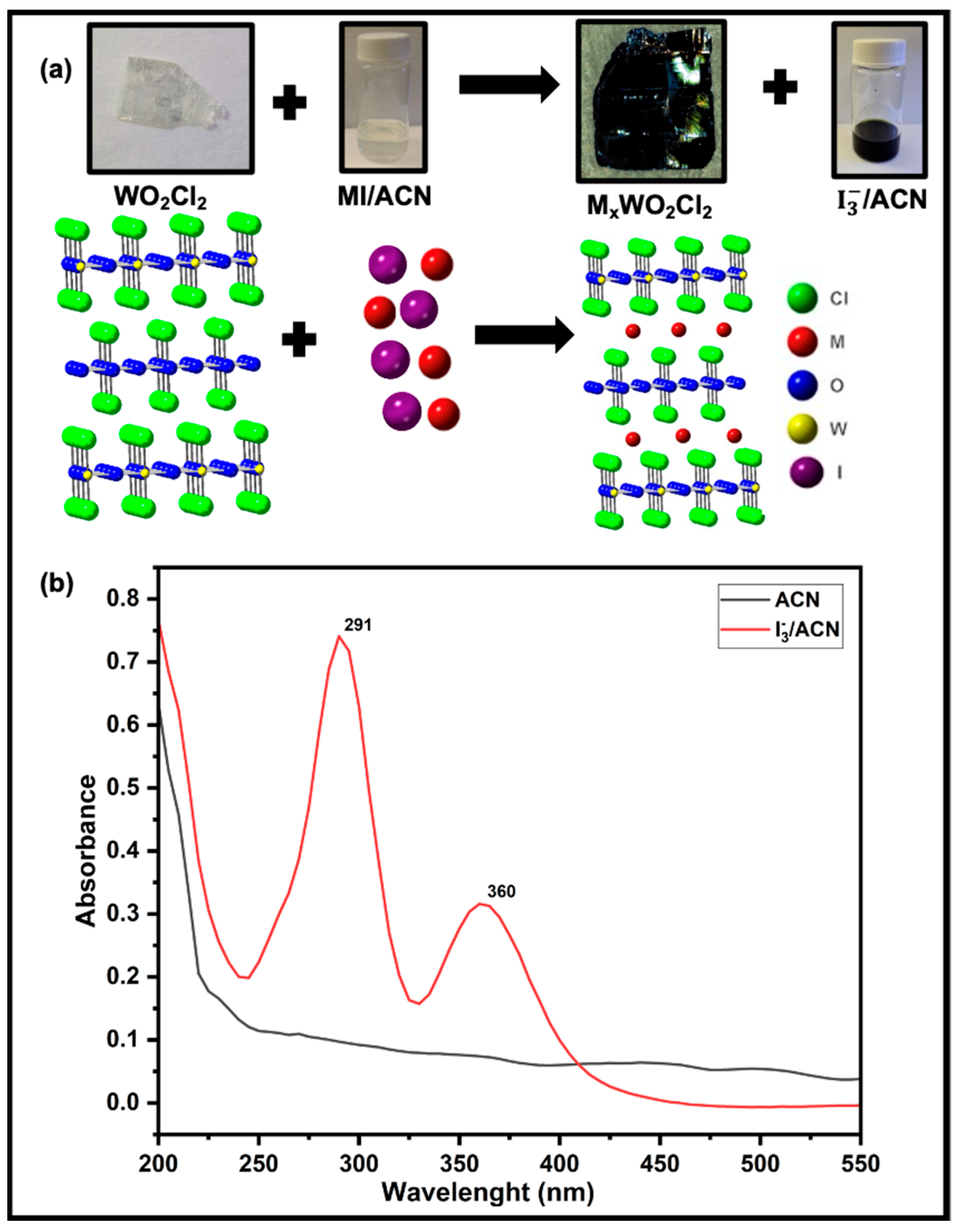
WO2Cl2 crystals and powders were intercalated with alkali-metal or ammonium ions by treating them with the stoichiometric excess acetonitrile (ACN) solutions of the corresponding iodide salts. These intercalation reactions were carried out under Ar but can also be performed on the benchtop in air, as seen in Figure 1a. During the reaction, the initially colorless metal iodide salt solution turned deep green, consistent with the formation of triiodide (I3) (Figure 1a), and the WO2Cl2 crystals changed from a clear, transparent material to a dark-blue crystal upon the reduction of W6+ to W5+ and insertion of the alkali-metal cation (Figure 1a).
3 I I 3 + 2 e
W 6 + e W 5 +
W O 2 C l 2 + M I / A C N I 3 + M x W O 2 C l 2
In acetonitrile, the dark-green triiodide (I3) solution shows two broad, intense UV–vis bands centered at ~291 nm and ~360 nm, diagnostic of I3 formation (Figure 1b). These bands correspond to the lowest electronic transitions of I3 and are routinely used to confirm its presence. Peak positions may shift slightly with concentration/ion pairing, but the 290/360 nm pattern persists in ACN [46,47].
To drive intercalation to completion, the MI/ACN solution (M = alkali-metal or ammonium) was periodically refreshed. The triiodide redox couple (3I → I3) that drives intercalation forms faster than ions can diffuse between the WO2Cl2 layers for complete intercalation. Once most of the iodide is converted to I3, further uptake of the cations stalls. We therefore decanted the dark-green I3 solution and replaced it with fresh MI/ACN solution until the layering peaks indicate full and complete expansion. Intercalation with Li+, Na+, and K+ proceeded at room temperature. For the larger Rb+ and NH4+ ions in crystal WO2Cl2, reactions were run at ACN’s reflux temperature (~85 °C) to accelerate diffusion into the van der Waals layers. All intercalated products of Na+, K+, Rb+, and NH4+ exhibited a blue color, with only minor differences in intensity (Figure S3).

2.3. XRD Analysis

Intercalation of Li+ into WO2Cl2 did not reach completion because Li+ was solvated between the layers. XRD showed a large, initial interlayer expansion of ~3.35 Å, followed by a contraction to ~2.72 Å after gentle heating at 50 °C for 24 h (Figure S4), consistent with partial de-solvation. The expansion was larger than the previously observed results from direct Li intercalation (~0.57 Å), suggesting co-intercalation of solvent molecules [48]. Attempts to force the reaction further by treating with additional Li solution led to exfoliation of the crystals.
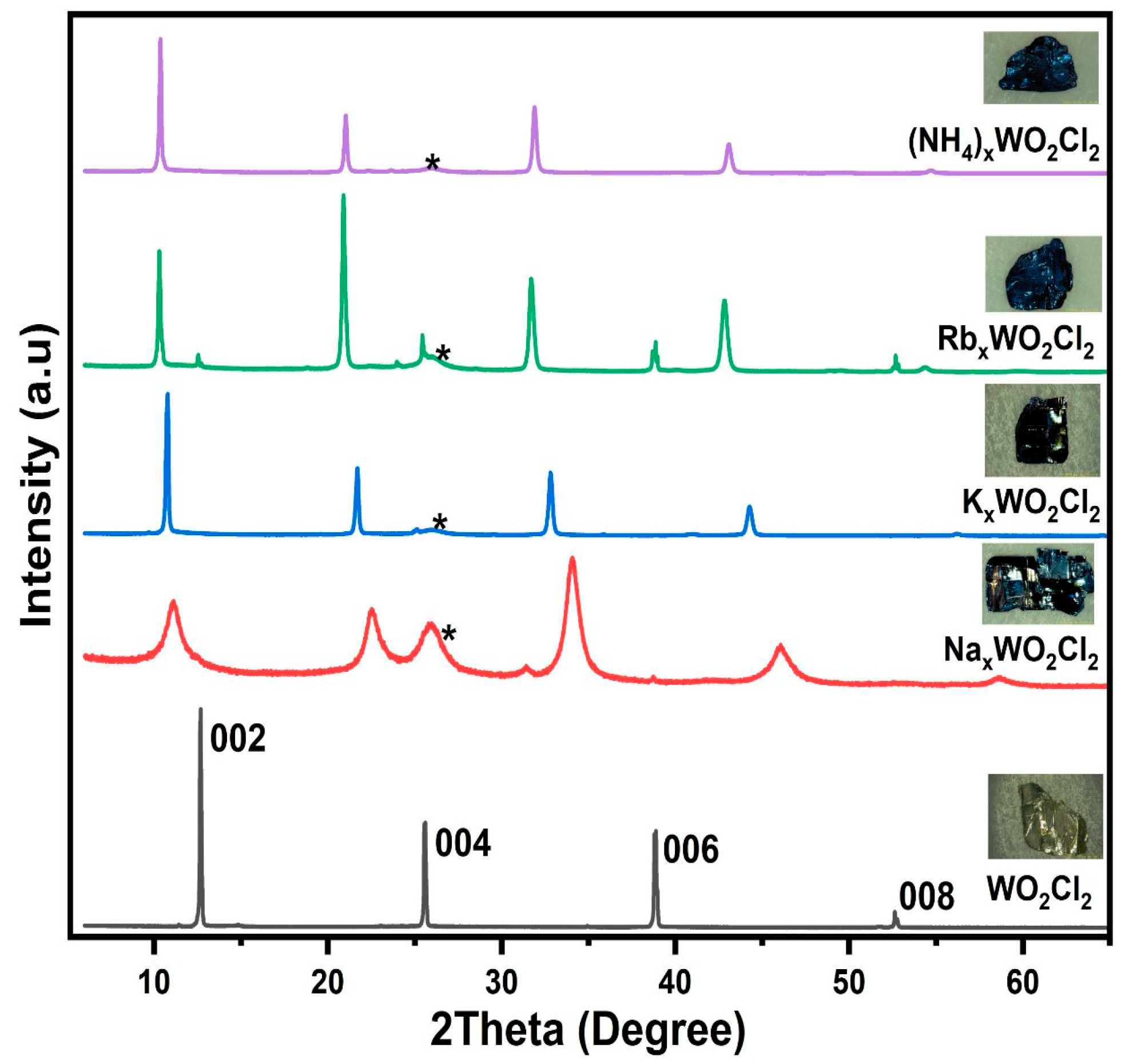
Na+ intercalation showed a similar solvation-then-desolvation behavior. The initial expansion was ~2.097 Å and after drying at 50 °C for 24 h, the d-spacing decreased to 0.98 Å, consistent with the loss of co-intercalated solvent and Na+ intercalation previously reported in this host [25,49]. K+, Rb+, and NH4+ intercalated with WO2Cl2 showed no solvation. XRD (Figure 2) shows that the interlayer spacing increases with cation size. The measured (002) interlayer spacing ∆ for Na+, K+, Rb+, and NH4+ are 0.98, 1.23, 1.51, and 1.25 Å, respectively, in good agreement with the literature values for alkali-metal intercalation into this hosts [25,49]. Similar reactions were conducted using WO2Cl2 powders, which produced interlayer expansions comparable to those in single crystals. After drying, Li+ remained partially solvated, whereas Na+ was fully de-solvated (Figures S5 and S6). Interestingly, K+, Rb+, and NH4+ did not require reflux to complete the reaction, indicating that the higher surface area enhances the reaction rate; corresponding XRD patterns are provided in Figure S7.

2.4. Shannon Radii Analysis

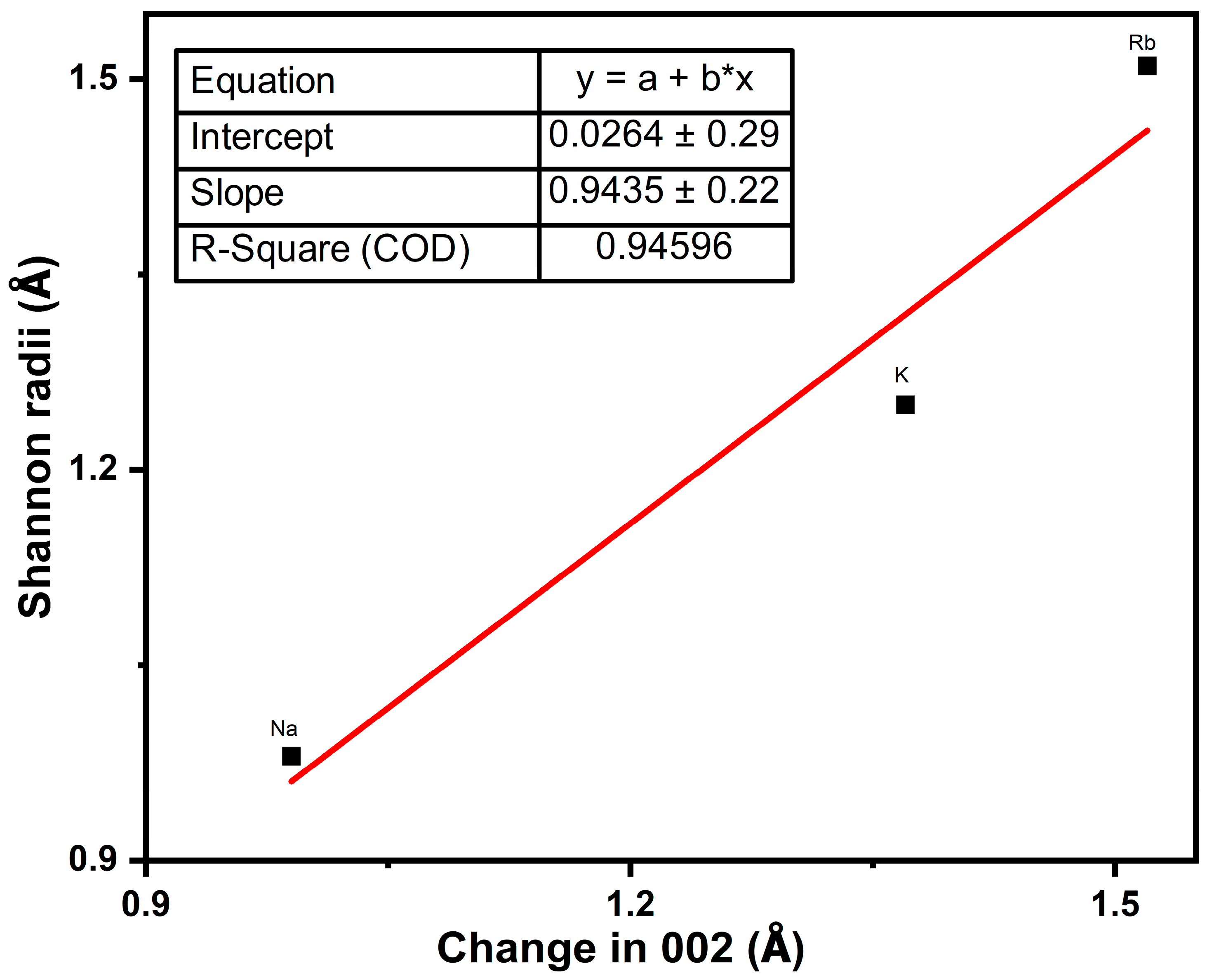
We rationalized the interlayer expansion by comparing changes in the layering peak (002) with the Shannon ionic radii for each cation under different coordination numbers (Table 1). A simple linear fit shows the best agreement when Na+ and K+ are assigned tetrahedral (CN = 4) radii, whereas Rb+ matches an octahedral (CN = 6) radius. The strong correlation between Δ (002) and the selected radius supports successful intercalation of the alkali ions into WO2Cl2 (Figure 3), consistent with the reported literature for alkali-metal intercalation in this system [5].

2.5. Raman and Optical Analysis

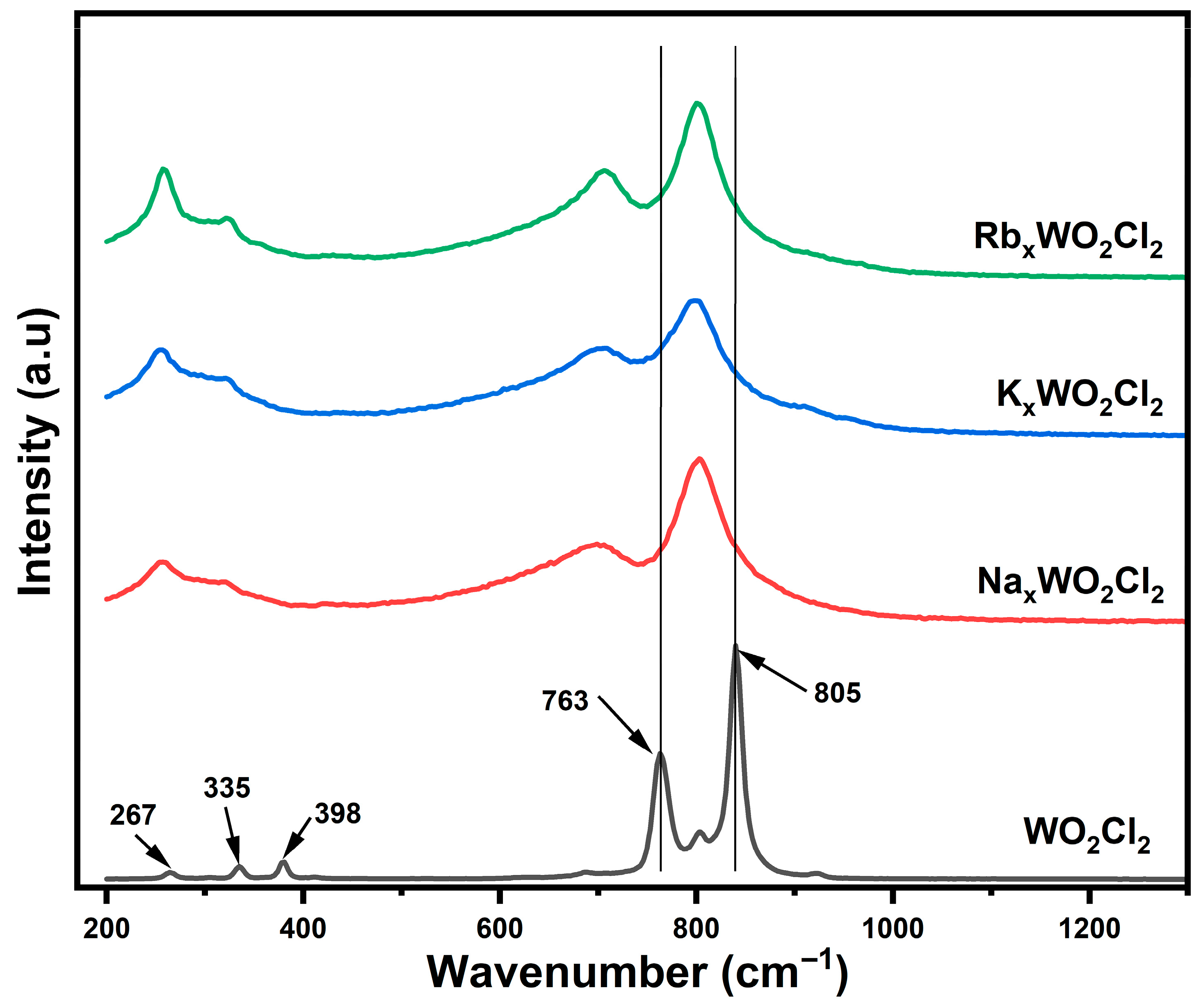
The Raman spectra of M-intercalated WO2Cl2 (M = Na+, K+, Rb+) show clear red-shifts in the W–O and W–Cl modes by about 35 cm−1 relative to pristine WO2Cl2 consistent with partial reduction of W6+ to W5+, which weakens and elongates these bonds and lowers their vibrational frequencies (Figure 4). Together with the uniform blue coloration observed for all intercalated samples, these shifts support the formation of a common blue, semiconducting phase across all cations. In addition, polarized-light microscopy revealed no change in optical anisotropy upon intercalation, indicating that the crystals retain the original orthorhombic symmetry after intercalation (Figure S9).

2.6. SEM Morphology and EDS Analysis

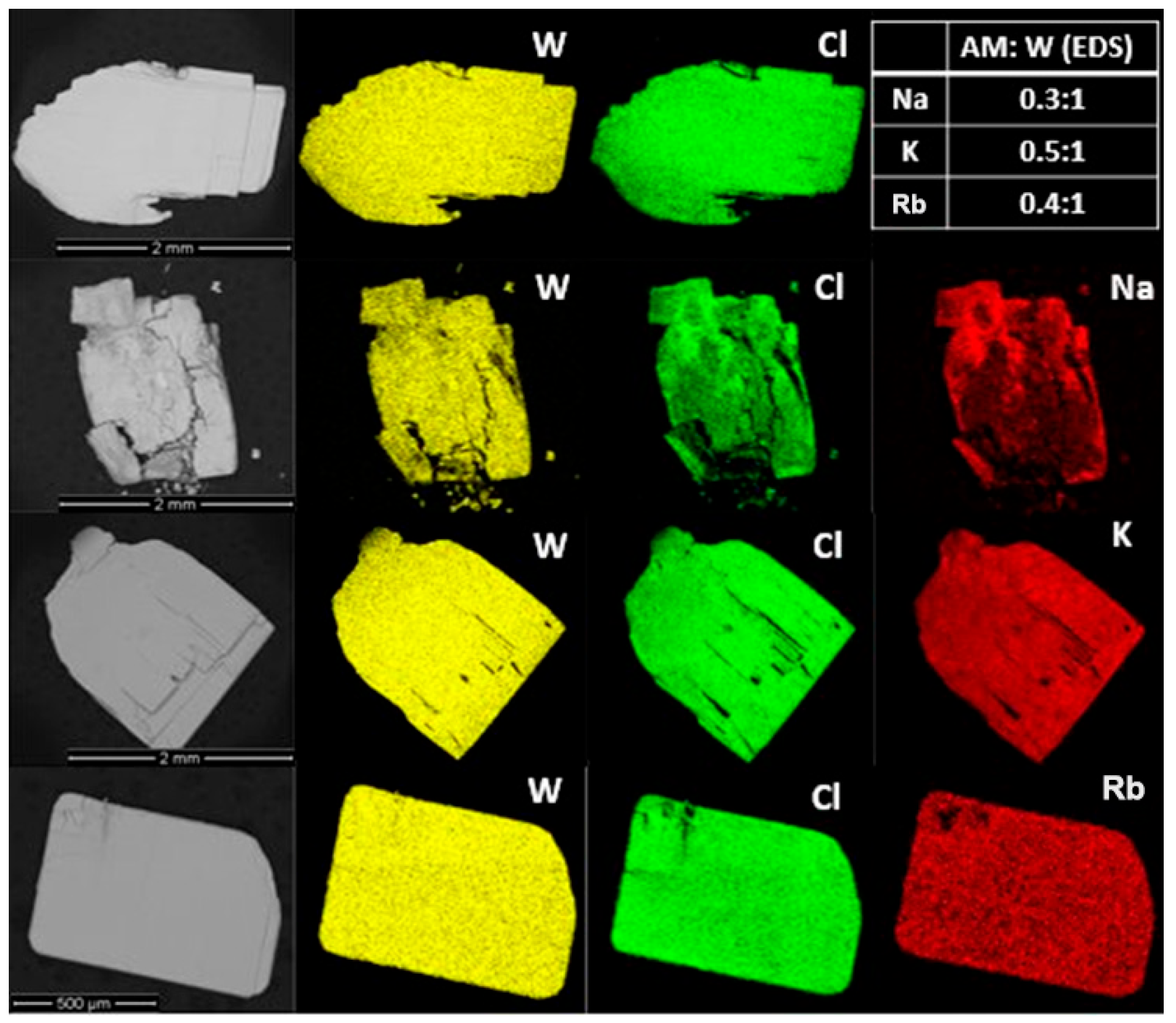
SEM images show that the crystals retain their plate-like morphology after intercalation. Elemental maps (EDS) indicate uniform distributions of Na, K, and Rb within the crystals (Figure 5), with maximum loadings of approximately 0.3 for Na, 0.5 for K, and 0.4 for Rb per W (M/W atomic ratios). There was no iodine detected in any of the samples by EDS, suggesting that all precursor metal iodides and I3 ions were removed by washing.
NH4+ could not be quantified by EDS because nitrogen’s low-Z signal is weak and not reliably detected. The preserved morphology together with the sharp diffraction peaks (Figure 2) confirms that crystallinity is maintained throughout the intercalation process.

2.7. XPS Analysis

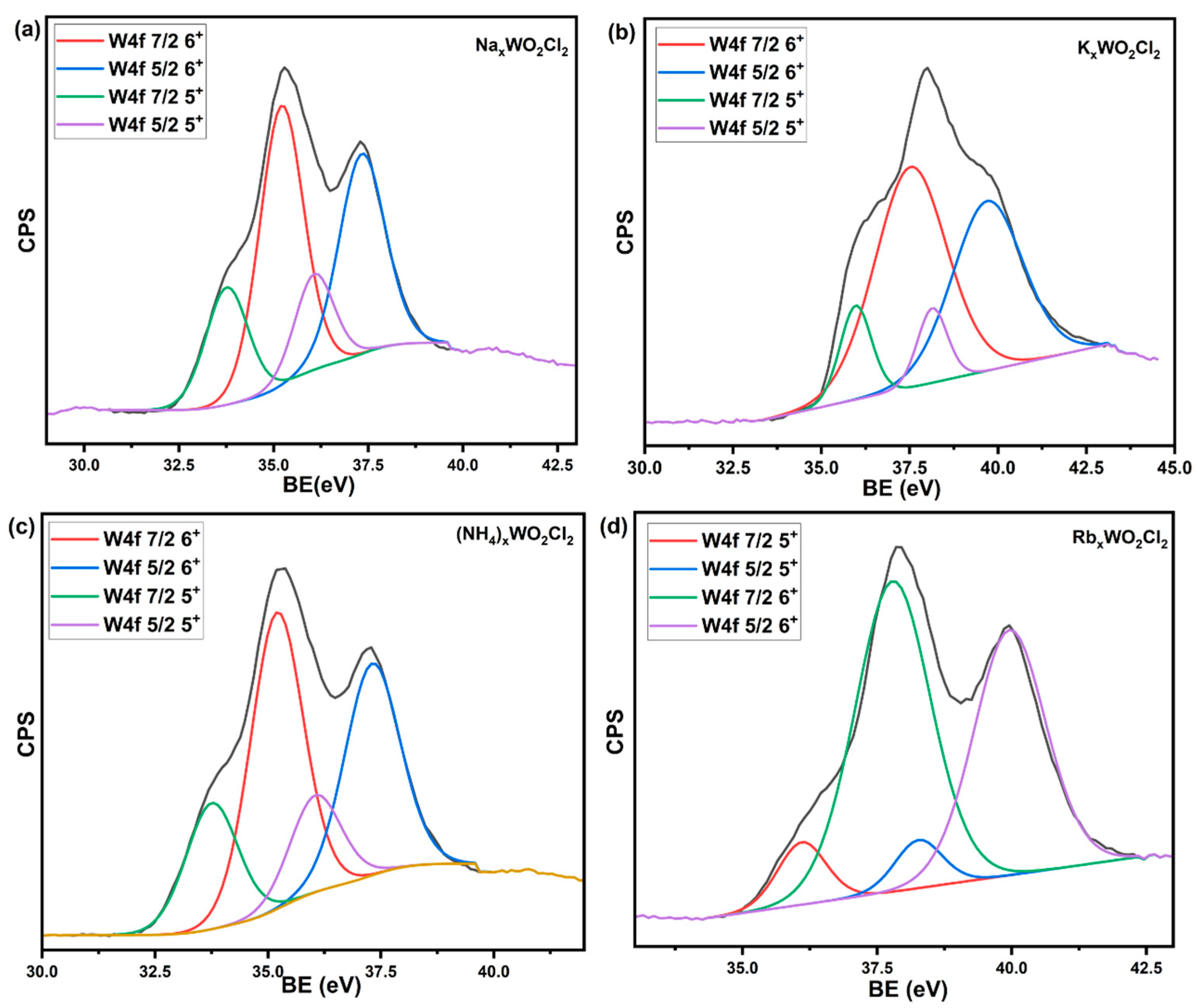
X-ray photoelectron spectroscopy of all intercalated WO2Cl2 samples shows mixed W5+/W6+ components in Table 2 and Figure 6, confirming the partial reduction associated with the observed blue phase.
In addition, core-level signals for the intercalated ions (Na, K, and Rb, and N from NH4+) are present, consistent with their incorporation into the material and, together with the lattice’s expansion, support their location within the van der Waals layers (Figures S10–S13).

2.8. Resistivity Measurement

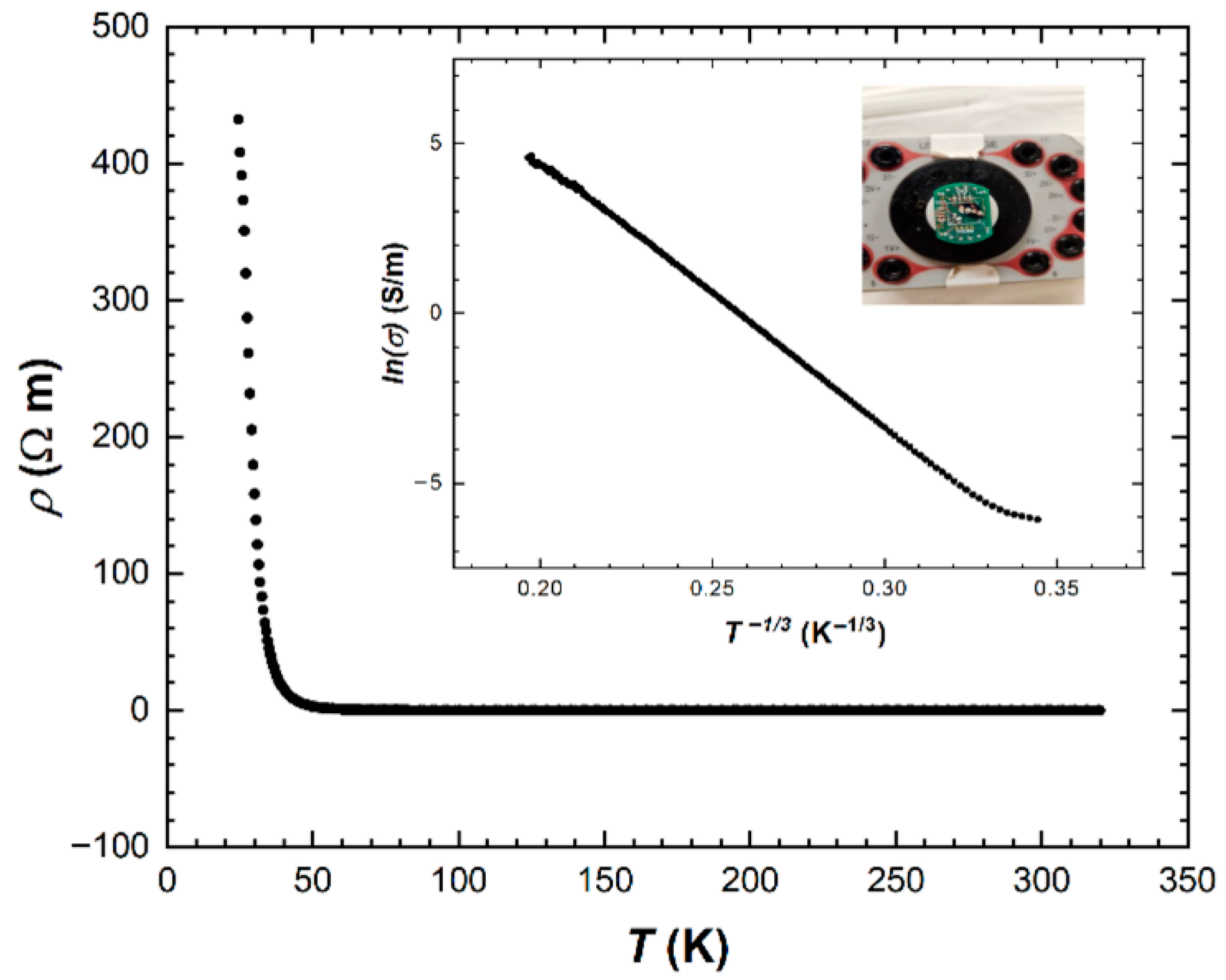
Four-probe, temperature-dependent measurements of K-intercalated WO2Cl2 in a Quantum Design PPMS show clear semiconducting behavior. At 320 K, the resistivity of K0.5WO2Cl2 appears to be relatively low (~1.5 mΩ·m), while at 24.5 K, the resistivity of K0.5O2Cl2 appears to be relatively high (~408 Ω·m). This indicates strong semiconductor-like behavior in the crystal. This is visible in the overall behavior of the temperature-dependent resistivity data (Figure 7). The semiconductor-like behavior of the K0.5O2Cl2 crystal is even more apparent in the conductivity data, where at 24.5 K, σ = 2.45 × 10 3 S/m compared to σ = 27.5 S/m at 100 K. The T 1 / 3 dependence of the log of the conductance (obtained from a least-squares fit and shown in Figure 7’s inset) implies that the Mott variable range hopping is the most likely mechanism for the increase in resistivity seen in Figure 7 and the transport is two-dimensional in nature within the van der Waals lattice planes.

3. Materials and Methods

3.1. Materials and WO2Cl2 Synthesis

Tungsten hexachloride (WCl6, 99.9%), tungsten VI oxide (WO3, 99%), lithium iodide (LiI, 99%), sodium iodide (NaI, 99%), and potassium iodide (KI, 99%), were purchased from Sigma-Aldrich (Burlington, MA USA); rubidium (RbI, 99%) and ammonium iodide (NH4I, 99%) was from Fisher Scientific (Waltham, MA USA), while acetonitrile (ACS reagent 99.5%) was purchased from Millipore Sigma (Burlington, MA, USA). All reagents were used as purchased without further purification. WO2Cl2 was synthesized from a 2:1 ratio of WO3 and WCl6 in an evacuated Pyrex tube and heated in a tube furnace at 275 °C with a 20 °C gradient for 7 days.
Crystal Maker 11 was used to create images of crystal structures.

3.2. Intercalation

Alkali-metals and ammonium salt solutions were prepared in a 100 mL volumetric flask corresponding to 0.74 M for LiI, 0.66M for NaI, 0.072 M for KI, 0.046 M for RbI, and 0.05 M for NH4I in acetonitrile as a solvent in the glove box under argon atmosphere. In a simple reaction, 0.20 g of crystal WO2Cl2 was added to a 20 mL vial containing 5 mL of MI-ACN. These reactions were primarily performed in an Ar-filled glovebox but can also be performed on the benchtop with no inert gas protection. The reaction was allowed to proceed for minutes (Li and Na) to days (K), with periodic replenishing of the metal–salt solution. Lithium and sodium were replenished twice at 10 min intervals, while potassium was refreshed twice at 5-day intervals. Figure S8 shows step-wise changes in the XRD of potassium intercalation in crystal WO2Cl2. Upon completion, the crystals were washed three to five times in ACN to remove remnant MI-ACN and I−3-ACN. The samples were dried at 50 °C for 24 h to remove any residual solvent.
Rubidium and ammonium intercalation were carried out under Ar in a 2-neck round-bottom flask refluxed at ~85 °C to accelerate diffusion into the van der Waals layers. Rubidium and ammonium were refreshed twice at 7 and 2 days, respectively.

3.3. Material Characterization

Phase-pure intercalated samples were confirmed by XRD using a Rigaku Smart Lab X-ray diffractometer (Tokyo, Japan); samples were sealed with mylar and vacuum grease to maintain an oxygen and moisture free environment. The Raman spectrum was obtained with an Snowy Range Instruments (Laramie, WY, USA) IM-52 spectrometer equipped with a 532 nm laser. The SEM images and EDS were with a collected with a FEI (Hillsboro, OR, USA) Quanta 450 with a Schottky Field Emitter gun. Polarized-light images were acquired on a Nikon (Tokyo, Japan) Optiphot polarizing trinocular microscope fitted with a Nikon 10× optical-zoom camera (6.3–63 mm, f/3.5 lens). XPS was carried out using a Kratos (San Diego, CA, USA) Ultra DLD X-ray Photoelectron spectrometer.

3.4. Resistivity Measurement

Resistance measurements were conducted using a Quantum Design (San Diego, CA, USA) PPMS (Physical Properties Measurement System). A four-probe wiring configuration was used to minimize contact resistance; a 0.01 µA current was used to ensure that the high resistance (at low temperatures), in conjunction with the provided current, did not exceed the power limit of the PPMS, thus avoiding any measurement shutdowns. Resistance measurements were taken both while warming and cooling the sample from 25 to 320 K. These resistance measurements were used to obtain the temperature-dependent resistance of K0.5WO2Cl2; then, it was converted to resistivity (ρ) in the standard way:
ρ = R A L
where A is the cross-sectional area of the single crystal and L is the length of the crystal between voltage leads. This temperature-dependent resistivity was used to determine the conductivity:
σ = 1 ρ

4. Conclusions

We have demonstrated that the iodide–triiodide redox couple is an effective, mild, and versatile mediator for the intercalation of alkali-metals and ammonium ions into the layered mixed-anion material WO2Cl2. This approach eliminates the need for highly reactive, air-sensitive reagents, operates at moderate potential, and uniquely enables NH4+ intercalation. Structural, spectroscopic, and electrical measurements confirm successful insertion, retention of crystallinity, and tunable electronic properties. Given its safety, accessibility, and compatibility with a wide range of cations, the I/I3 method holds promise for broader applications to other 2D-layered, single-anion and mixed-anion systems, including transition metal dichalcogenides, metal halides, oxybromides, oxynitrides, and layered halide perovskites.

Supplementary Materials

The following supporting information can be downloaded at: https://www.mdpi.com/article/10.3390/inorganics13120403/s1, Figure S1: (a). XRD of crystal WO2Cl2 showing layering peaks with crystal image as inset (b). SEM image of WO2Cl2 crystal (c). Raman Spectra of WO2Cl2 (d). XPS spectrum of WO2Cl2 showing W4f peaks. Figure S2: Powder XRD of WO2Cl2 fitted to an orthorhombic unit cell with a = 3.84 Å, b = 3.89 Å, and c = 13.88 Å. Table S1: HKL and d-spacing measurement for WO2Cl2. Figure S3: Image of WO2Cl2 before and after intercalating with Na+, K+, Rb+ and NH4+. Figure S4: XRD of Li+ intercalated WO2Cl2 showing large lattice expansion due to solvation. Figure S5: XRD of Li+ intercalated powder WO2Cl2. Figure S6: XRD of Na+ intercalated powder WO2Cl2. Figure S7: XRD of K+, Rb+ and NH+4 intercalated powder WO2Cl2. Figure S8: XRD of K+ intercalated crystal WO2Cl2 showing step wise progression at 5 Days intervals. Figure S9: Polarized images of Na+, K+, Rb+ and NH+4 intercalated WO2Cl2. Figure S10: (a). Survey XPS spectrum of Na+ intercalated WO2Cl2 (b). Highlighted spectra of Na 1s peak. Figure S11: (a). Survey XPS spectrum of K+ intercalated WO2Cl2 (b). Highlighted spectra of K 2p peak. Figure S12: (a). Survey XPS spectrum of Rb+ intercalated WO2Cl2 (b). Highlighted spectra of Rb 3d peak. Figure S13: (a). Survey XPS spectrum of NH+4 intercalated WO2Cl2 (b). Highlighted spectra of N 1s peak.

Author Contributions

Conceptualization, J.S. and B.L.; methodology, J.S. and B.L.; investigation, J.S. and J.C.; writing—original draft preparation, J.S. and B.L.; writing—review and editing, J.S., B.L., J.C., J.A. and J.T.; supervision, J.A., B.L. and J.T.; project administration, B.L.; funding acquisition, B.L. All authors have read and agreed to the published version of the manuscript.

Funding

This research was funded by the National Science Foundation, grant number 1905914.

Institutional Review Board Statement

Not applicable.

Informed Consent Statement

Not applicable.

Data Availability Statement

The raw data supporting the conclusions of this article will be made available by the authors on request.

Conflicts of Interest

John Ackerman was employed by the Resonant Sciences, Beaver Creek. The remaining authors declare that the research was conducted in the absence of any commercial or financial relationships that could be construed as a potential conflict of interest.

References

  1. Novoselov, K.S.; Geim, A.K.; Morozov, S.V.; Jiang, D.; Zhang, Y.; Dubonos, S.V.; Grigorieva, I.V.; Firsov, A.A. Electric Field Effect in Atomically Thin Carbon Films. Science 2004, 306, 666–669. [Google Scholar] [CrossRef] [PubMed]
  2. Geim, A.K.; Grigorieva, I.V. Van der Waals Heterostructures. Nature 2013, 499, 419–425. [Google Scholar] [CrossRef]
  3. Voiry, D.; Mohite, A.; Chhowalla, M. Phase Engineering of Transition Metal Dichalcogenides. Chem. Soc. Rev. 2015, 44, 2702–2712. [Google Scholar] [CrossRef] [PubMed]
  4. Wang, Q.H.; Kalantar-Zadeh, K.; Kis, A.; Coleman, J.N.; Strano, M.S. Electronics and Optoelectronics of Two-Dimensional Transition Metal Dichalcogenides. Nat. Nanotechnol. 2012, 7, 699–712. [Google Scholar] [CrossRef] [PubMed]
  5. Manzeli, S.; Ovchinnikov, D.; Pasquier, D.; Yazyev, O.V.; Kis, A. 2D Transition Metal Dichalcogenides. Nat. Rev. Mater. 2017, 2, 17033. [Google Scholar] [CrossRef]
  6. Mizushima, K.; Jones, P.C.; Wiseman, P.J.; Goodenough, J.B. LixCoO2 (0 < x ≤ 1): A New Cathode Material for Batteries of High Energy Density. Mater. Res. Bull. 1980, 15, 783–789. [Google Scholar] [CrossRef]
  7. Takada, K.; Sakurai, H.; Takayama-Muromachi, E.; Izumi, F.; Dilanian, R.A.; Sasaki, T. Superconductivity in Two-Dimensional CoO2 Layers. Nature 2003, 422, 53–55. [Google Scholar] [CrossRef]
  8. Motohashi, T.; Sugimoto, T.; Masubuchi, S.; Nohara, M.; Ueda, Y.; Takada, K.; Sasaki, T.; Watanabe, T.; Takagi, H. Electronic Phase Diagram of the Layered Cobalt Oxide System, LixCoO22 (0 ≤ x ≤ 1). Phys. Rev. B 2009, 80, 165114. [Google Scholar] [CrossRef]
  9. Wang, J.; Hou, K.P.; Wen, Y.; Liu, H.; Wang, H.; Chakarawet, K.; Gong, M.; Yang, X. Interlayer Structure Manipulation of Iron Oxychloride (FeOCl) by Potassium Cation Intercalation to Steer H2O2 Activation Pathway. J. Am. Chem. Soc. 2022, 144, 4294–4299. [Google Scholar] [CrossRef]
  10. Wei, Q.; Chen, J.; Ding, P.; Shen, B.; Yin, J.; Xu, F.; Xia, Y.D.; Liu, Z.G. Synthesis of Easily Transferred 2D Layered BiI3 Nanoplates for Flexible Visible-Light Photodetectors. ACS Appl. Mater. Interfaces 2018, 10, 21527–21533. [Google Scholar] [CrossRef]
  11. Chhowalla, M.; Shin, H.S.; Eda, G.; Li, L.-J.; Loh, K.P.; Zhang, H. The Chemistry of Two-Dimensional Layered Transition Metal Dichalcogenide Nanosheets. Nat. Chem. 2013, 5, 263–275. [Google Scholar] [CrossRef] [PubMed]
  12. Dresselhaus, M.S.; Dresselhaus, G. Intercalation Compounds of Graphite. Adv. Phys. 2002, 51, 1–186. [Google Scholar] [CrossRef]
  13. Morosan, E.; Zandbergen, H.W.; Dennis, B.S.; Bos, J.W.G.; Onose, Y.; Klimczuk, T.; Ramirez, A.P.; Ong, N.P.; Cava, R.J. Superconductivity in CuxTiSe2. Nat. Phys. 2006, 2, 544–550. [Google Scholar] [CrossRef]
  14. Fang, L.; Wang, Y.; Zou, P.Y.; Tang, L.; Xu, Z.; Chen, H.; Dong, C.; Shan, L.; Wen, H.H. Fabrication and Superconductivity of NaxTaS2 Crystals. Phys. Rev. B 2005, 72, 014534. [Google Scholar] [CrossRef]
  15. Hinnemann, B.; Moses, P.G.; Bonde, J.; Jørgensen, K.P.; Nielsen, J.H.; Horch, S.; Chorkendorff, I.; Nørskov, J.K. Biomimetic Hydrogen Evolution: MoS2 Nanoparticles as Catalyst for Hydrogen Evolution. J. Am. Chem. Soc. 2005, 127, 5308–5309. [Google Scholar] [CrossRef]
  16. Mak, K.F.; Lee, C.; Hone, J.; Shan, J.; Heinz, T.F. Atomically Thin MoS2: A New Direct-Gap Semiconductor. Phys. Rev. Lett. 2010, 105, 136805. [Google Scholar] [CrossRef]
  17. Anasori, B.; Lukatskaya, M.R.; Gogotsi, Y. 2D Metal Carbides and Nitrides (MXenes) for Energy Storage. Nat. Rev. Mater. 2017, 2, 16098. [Google Scholar] [CrossRef]
  18. Schedin, F.; Geim, A.K.; Morozov, S.V.; Hill, E.W.; Blake, P.; Katsnelson, M.I.; Novoselov, K.S. Detection of Individual Gas Molecules Adsorbed on Graphene. Nat. Mater. 2007, 6, 652–655. [Google Scholar] [CrossRef]
  19. Li, R.; Shao, H.; Dong, Y.; Wang, T.; Xia, Y.; Zhang, T.; Yang, J.; Wang, H. Flexible and High-Performance Electrochromic Devices Based on Self-Assembled 2D TiO2/Ti3C2Tx Heterostructures. Microsyst. Nanoeng. 2021, 7, 24. [Google Scholar]
  20. Kageyama, H.; Hayashi, K.; Maeda, K.; Attfield, J.P.; Hiroi, Z.; Rondinelli, J.M.; Poeppelmeier, K.R. Expanding Frontiers in Materials Chemistry and Physics with Multiple Anions. Nat. Commun. 2018, 9, 772. [Google Scholar] [CrossRef]
  21. Harada, J.K.; Charles, N.; Poeppelmeier, K.R.; Rondinelli, J.M. Heteroanionic Materials by Design: Progress Toward Targeted Properties. Adv. Mater. 2019, 31, e1805295. [Google Scholar] [CrossRef] [PubMed]
  22. Charles, N.; Saballos, R.J.; Rondinelli, J.M. Structural Diversity from Anion Order in Heteroanionic Materials. Chem. Mater. 2018, 30, 3528–3537. [Google Scholar] [CrossRef]
  23. Abrahams, I.; Nowinski, J.L.; Bruce, P.G.; Gibson, V.C. The Disordered Structure of WO2Cl2: A Powder Diffraction Study. J. Solid State Chem. 1993, 102, 140–145. [Google Scholar] [CrossRef]
  24. Bortoluzzi, M.; Evangelisti, C.; Marchetti, F.; Pampaloni, G.; Piccinelli, F.; Zacchini, S. Synthesis of a Highly Reactive Form of WO2Cl2, Its Conversion into Nanocrystalline Mono-Hydrated WO3, and Coordination Compounds with Tetramethylurea. Dalton Trans. 2016, 45, 15342–15349. [Google Scholar] [CrossRef]
  25. Bruce, P.G.; Nowinski, J.; Gibson, V.C.; Hauptman, Z.V.; Shaw, A. Sodium Intercalation into WO2Cl2. J. Solid State Chem. 1990, 89, 202–207. [Google Scholar] [CrossRef]
  26. Wu, Y.; Li, D.; Wu, C.-L.; Hwang, H.Y.; Cui, Y. Electrostatic Gating and Intercalation in 2D Materials. Nat. Rev. Mater. 2023, 8, 41–53. [Google Scholar] [CrossRef]
  27. Huang, B.; Clark, G.; Navarro-Moratalla, E.; Klein, D.R.; Cheng, R.; Seyler, K.L.; Zhong, D.; Schmidgall, E.; McGuire, M.A.; Cobden, D.H.; et al. Layer-Dependent Ferromagnetism in a van der Waals Crystal Down to the Monolayer Limit. Nature 2017, 546, 270–273. [Google Scholar] [CrossRef]
  28. Burch, K.S.; Mandrus, D.; Park, J. Magnetism in Two-Dimensional van der Waals Materials. Nature 2018, 563, 47–52. [Google Scholar] [CrossRef]
  29. Dines, M.B. n-Butyllithium in Hexane Solution Serves as an Excellent Reagent to Effect the Intercalation of Lithium into the Group IVb and Vb Layered Dichalcogenides. Mater. Res. Bull. 1975, 10, 287–291. [Google Scholar] [CrossRef]
  30. Ambrosi, A.; Sofer, Z.; Pumera, M. Lithium Intercalation Compounds of MoS2: Influence of n-BuLi vs. t-BuLi on Material Properties. Small 2015, 11, 605–612. [Google Scholar] [CrossRef]
  31. Zheng, J.; Zhang, H.; Dong, S.; Liu, Y.; Nai, C.T.; Shin, H.S.; Jeong, H.Y.; Liu, B.; Loh, K.P. High-Yield Exfoliation of 2D Chalcogenides Using Lithium, Potassium, and Sodium Naphthalenide. Nat. Commun. 2014, 5, 2995. [Google Scholar] [CrossRef] [PubMed]
  32. Luxa, J.; Ondrej, J.; David, S.; Rostislav, M.; Miroslav, M.; Markin, P.; Zdenek, S. Origin of exotic ferromagnetic behavior in exfoliated layered transition metal dichalcogenides MoS2 and WS2. Nanoscale 2016, 8, 1960–1967. [Google Scholar] [CrossRef] [PubMed]
  33. Kruger, D.D.; García, H.; Primo, A. Molten Salt Derived MXenes: Synthesis and Applications (Lewis-acid molten salts as powerful chemical media). Adv. Sci. 2024, 11, 2307106. [Google Scholar] [CrossRef] [PubMed]
  34. Kim, H.; Yunki, J.; Wonhwa, L.; Young-Pyo, J.; Jin-Yong, H.; Jea, U.L. Sustainable MXene Synthesis via Molten Salt Method and Nano-Silicon coating for enhanced lithium-ion Battery performance. Nanomaterials 2025, 30, 812. [Google Scholar] [CrossRef]
  35. Xia, J.; Wang, J.; Chao, D.; Chen, Z.; Liu, Z.; Kuo, J.-L.; Yan, J.; Shen, Z.X. Phase Evolution of Lithium Intercalation Dynamics in 2H-MoS2 (Electrochemical Control of 2H→1T/dT Transitions). Nanoscale 2017, 9, 7533–7540. [Google Scholar] [CrossRef]
  36. Wehenkel, D.J.; Bointon, T.H.; Booth, T.J.; Russo, S.; Craciun, M.F. Unforeseen High Temperature and Humidity Stability of FeCl3-Intercalated Few-Layer Graphene (vapor transport, two-zone furnace). Sci. Rep. 2015, 5, 7609. [Google Scholar] [CrossRef]
  37. Uppuluri, R.; Sen Gupta, A.; Rosas, A.S.; Mallouk, T.E. Soft Chemistry of Ion-Exchangeable Layered Metal Oxides (low-temperature ion exchange/topochemical routes in layered hosts). Chem. Soc. Rev. 2018, 47, 2401–2430. [Google Scholar] [CrossRef]
  38. Jeffery, A.A.; Nethravathi, C.; Rajamathi, M. Two-Dimensional Nanosheets and Layered Hybrids of MoS2 and WS2 through Exfoliation of Ammoniated MS2 (M = Mo, W) (ammonia/NH4+ intercalation leading to expanded layers and dispersible sheets). J. Phys. Chem. C 2014, 118, 1386–1396. [Google Scholar] [CrossRef]
  39. Zhou, J.; Wang, B.; Zhang, Y.; Zhang, H.; Li, Y.; Yang, Q.; Wang, Y.; Zhang, Q. Ammonium-Ion Intercalation–Induced Expansion and Phase Regulation in MoSe2. ACS Appl. Mater. Interfaces 2021, 13, 7890–7898. [Google Scholar]
  40. Xin, H.; Zhang, X.; Li, J.; Liu, Y.; Xu, K.; Wang, X.; Sun, J. Pre-Intercalation of Tetramethylammonium Ions Expands MoS2 Interlayer Spacing and Tunes Electronic Structure. Adv. Funct. Mater. 2024, 34, 2401174. [Google Scholar]
  41. Papageorgiou, N.; Athanassov, Y.; Armand, M.; Bonhôte, P.; Pettersson, H.; Azam, A.; Grätzel, M. The Redox Properties of the Iodide/Triiodide Couple in Dye-Sensitized Solar Cells. J. Electrochem. Soc. 1996, 143, 3099–3108. [Google Scholar] [CrossRef]
  42. Xu, Y.; Kantor-Innazzone, S.; Unwin, P.R. Electrochemical Potential Control Using the I/I3 Redox Couple in Scanning Electrochemical Cell Measurements. Electrochim. Acta 2014, 146, 27–34. [Google Scholar]
  43. Bard, A.J.; Parsons, R.; Jordan, J. (Eds.) Standard Potentials in Aqueous Solution; Marcel Dekker: New York, NY, USA, 1985. [Google Scholar]
  44. Haynes, W.M. (Ed.) CRC Handbook of Chemistry and Physics; CRC Press: Boca Raton, FL, USA, 2016. [Google Scholar]
  45. Grätzel, M. Photoelectrochemical Cells. Nature 2001, 414, 338–344. [Google Scholar] [CrossRef]
  46. Nimmrich, A.; Panman, M.R.; Berntsson, O.; Biasin, E.; Niebling, S.; Petersson, J.; Hoernke, M.; Bjorling, A.; Gustavsson, E.; van Driel, T.B.; et al. Solvent-Dependent Structural Dynamics in the Ultrafast Photodissociation Reaction of Triiodide Observed with Time-Resolved X-ray Solution Scattering. J. Am. Chem. Soc. 2023, 145, 15754–15765. [Google Scholar] [CrossRef]
  47. Shigenobu, K.; Nakanishi, A.; Ueno, K.; Dokko, K.; Watanabe, M. Glyme–Li salt equimolar molten solvates with iodide/triiodide redox anions. RSC Adv. 2019, 9, 22668–22675. [Google Scholar] [CrossRef]
  48. Ackerman, J.F. Lithium Intercalation of WO2Cl2. Mater. Res. Bull. 1988, 23, 165–169. [Google Scholar] [CrossRef]
  49. Smith, A.I.; Wladkowski, H.V.; Hecht, Z.H.; She, Y.; Kattel, S.; Samarawickrama, P.I.; Rich, S.R.; Murphy, J.R.; Tian, J.; Ackerman, J.F.; et al. Alkali Metal Intercalation and Reduction of Layered WO2Cl2. Chem. Mater. 2020, 32, 10482–10488. [Google Scholar] [CrossRef]
Figure 1. (a) Intercalation reaction scheme, (b) UV spectrum of acetonitrile and triiodide in acetonitrile solvent.
Inorganics 13 00403 g001
Figure 2. XRD and inset of crystals of WO2Cl2 intercalated with Na+, K+, Rb+, and NH4+. (* = mylar film, used to protect crystal from moisture during XRD).
Inorganics 13 00403 g002
Figure 3. Shannon radii vs. change in interlayer spacing (002).
Inorganics 13 00403 g003
Figure 4. Raman spectrum of WO2Cl2 and intercalated WO2Cl2 with Na+, K+, and Rb+.
Inorganics 13 00403 g004
Figure 5. SEM and EDS maps of WO2Cl2, Na, K, and Rb intercalated with WO2Cl2, showing uniform intercalation.
Inorganics 13 00403 g005
Figure 6. XPS data showing a mix of W6+ and W5+ for (a) NaxWO2Cl2, (b) KxWO2Cl2, (c) RbxWO2Cl2, and (d) (NH4)xWO2Cl2.
Inorganics 13 00403 g006
Figure 7. Temperature-dependent resistivity of a 37.4 mg K0.5WO2Cl2 single crystal measured with a four-probe configuration using a 0.01 µA current. (Inset) The natural log of the conductivity vs. the cube root of the inverse of temperature for the crystal. The K0.5WO2Cl2 mounted to the resistivity puck in a four-probe configuration.
Inorganics 13 00403 g007
Table 1. Correlation between lattice expansion and ionic radii in different coordination environments.
Coordination (Å)
Δ in 002 (Å)IR (IV)IR (VI)IR (VIII)IR (XII)
LixWO2Cl22.72 *0.590.76NANA
NaxWO2Cl20.980.99 ■1.021.181.39
KxWO2Cl21.231.37 ■1.381.511.64
RbxWO2Cl21.51NA1.521.611.72
(NH4)xWO2Cl21.25NANANANA
* = Large size due to solvation. NA = no data (■ data point used in making the linear plot). IR = ionic Radii.
Table 2. Comparison of W6+ and W5+ ratios vs. intercalated cations from SEM/EDS.
% Composition
W6+W5+W6+:W5+SEM/EDS (W:M)
WO2Cl2100
NaxWO2Cl273.6026.401:0.361:0.25
KxWO2Cl285.0015.001:0.181:0.5
RbxWO2Cl285.1914.811:0.171:0.4
(NH4)xWO2Cl273.2026.801:0.371:0.07 (XPS)
Disclaimer/Publisher’s Note: The statements, opinions and data contained in all publications are solely those of the individual author(s) and contributor(s) and not of MDPI and/or the editor(s). MDPI and/or the editor(s) disclaim responsibility for any injury to people or property resulting from any ideas, methods, instructions or products referred to in the content.